
Articles | Volume 26, issue 20
https://doi.org/10.5194/acp-26-15201-2026
© Author(s) 2026. This work is distributed under
the Creative Commons Attribution 4.0 License.
the Creative Commons Attribution 4.0 License.
https://doi.org/10.5194/acp-26-15201-2026
© Author(s) 2026. This work is distributed under
the Creative Commons Attribution 4.0 License.
the Creative Commons Attribution 4.0 License.
Research article
| 
29 Oct 2026
Research article |
| 29 Oct 2026
| 29 Oct 2026
Spring-summer atmospheric circulation and boundary layer processes modulating aerosol and cloud characteristics over the coastal Northeast Pacific during EPCAPE
Seethala Chellappan
CORRESPONDING AUTHOR

Analytical Mechanics Associates, Hampton, Virginia, USA
NASA Langley Research Center, Hampton, Virginia, USA
David Painemal
NASA Langley Research Center, Hampton, Virginia, USA
Mandana Thieman
NASA Langley Research Center, Hampton, Virginia, USA
ADNET, Hampton, Virginia, USA
Christian Pelayo
Scripps Institution of Oceanography, University of California San Diego, La Jolla, California, USA
William L. Smith Jr.
NASA Langley Research Center, Hampton, Virginia, USA
Lynn M. Russell
Scripps Institution of Oceanography, University of California San Diego, La Jolla, California, USA
Related authors
Kanika Taneja, Silvia M. Calderón, Harri Kokkola, Juha Tonttila, Sami Romakkaniemi, Seethala Chellappan, Antti Arola, Antti Lipponen, Taina Yli-Juuti, Snehitha M. Kommula, Tuukka Petäjä, Markku Kulmala, and Tero Mielonen
EGUsphere, https://doi.org/10.5194/egusphere-2026-4750, https://doi.org/10.5194/egusphere-2026-4750, 2026
This preprint is open for discussion and under review for Atmospheric Chemistry and Physics (ACP).
Short summary
Short summary
Vegetation can cool the climate by releasing gases that form aerosols, which scatter sunlight and brighten clouds. To quantify this feedback in Finland and the United States, we combine field measurements of aerosols and satellite observations of clouds. It is essential to select near-ideal clouds; otherwise, cloud-related cooling is underestimated. Cloud cooling matched aerosol cooling at the clean site in Finland and was nearly three times stronger at the rural site in the United States.
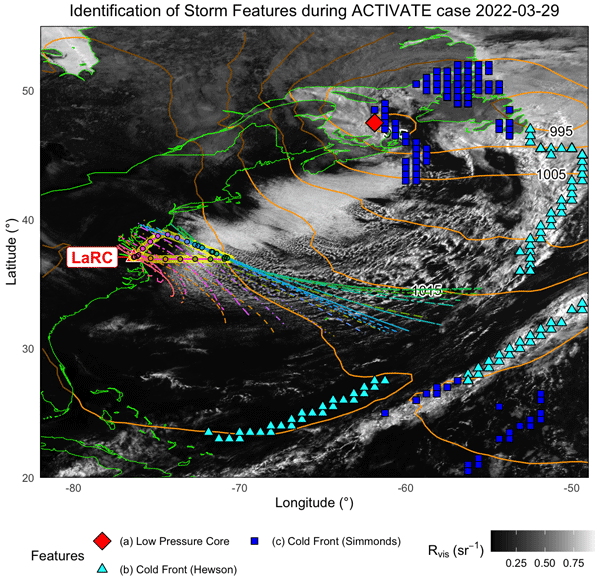
Florian Tornow, Ann Fridlind, George Tselioudis, Brian Cairns, Andrew Ackerman, Seethala Chellappan, David Painemal, Paquita Zuidema, Christiane Voigt, Simon Kirschler, and Armin Sorooshian
Atmos. Chem. Phys., 25, 5053–5074, https://doi.org/10.5194/acp-25-5053-2025, https://doi.org/10.5194/acp-25-5053-2025, 2025
Short summary
Short summary
The recent NASA campaign ACTIVATE (Aerosol Cloud meTeorology Interactions oVer the western ATlantic Experiment) performed 71 tandem flights in mid-latitude marine cold-air outbreaks off the US eastern seaboard. We provide meteorological and cloud transition stage context, allowing us to identify days that are most suitable for Lagrangian modeling and analysis. Surveyed cloud properties show signatures of cloud microphysical processes, such as cloud-top entrainment and secondary ice formation.
Xiaojian Zheng, Yan Feng, David Painemal, Shaocheng Xie, Zhujun Li, and Yuan Wang
EGUsphere, https://doi.org/10.5194/egusphere-2026-5932, https://doi.org/10.5194/egusphere-2026-5932, 2026
This preprint is open for discussion and under review for Atmospheric Chemistry and Physics (ACP).
Short summary
Short summary
Smoke from African fires often drifts over the cloud deck of the southeastern Atlantic, but how it changes the water in these clouds remains uncertain. Using nine years of satellite data, we sorted days by weather pattern and by whether the smoke sat above or touched the clouds. The cloud-water response depends on both, and averaging over all days hides it. A climate model gives the opposite response, pointing to processes that need improvement in the model.
Michael S. Diamond, Andrew S. Ackerman, Alejandro Baró Pérez, Ann M. Fridlind, Ehsan Erfani, Caspar Jungbacker, Hyunho Lee, David Painemal, Frida A.-M. Bender, Annica M. L. Ekman, Franziska Glassmeier, Graham Feingold, Fredrik Jansson, David A. Johnson, Matthias Schwarz, Robert Wood, Takanobu Yamaguchi, Jianhao Zhang, Xiaoli Zhou, and Paquita Zuidema
EGUsphere, https://doi.org/10.5194/egusphere-2026-5350, https://doi.org/10.5194/egusphere-2026-5350, 2026
This preprint is open for discussion and under review for Atmospheric Chemistry and Physics (ACP).
Short summary
Short summary
We compare how cloud resolving models represent an important cloud transition over the subtropical oceans. Clouds can either break up by deepening and drying out or by raining and forming an open cell pattern. Compared to observations, the clouds deepen a bit too much and get too polluted when smoke is present. In clean conditions, some models drizzle and break up into open cells while others barely rain; the model spread stems from different rain amounts for similar clouds.
Kanika Taneja, Silvia M. Calderón, Harri Kokkola, Juha Tonttila, Sami Romakkaniemi, Seethala Chellappan, Antti Arola, Antti Lipponen, Taina Yli-Juuti, Snehitha M. Kommula, Tuukka Petäjä, Markku Kulmala, and Tero Mielonen
EGUsphere, https://doi.org/10.5194/egusphere-2026-4750, https://doi.org/10.5194/egusphere-2026-4750, 2026
This preprint is open for discussion and under review for Atmospheric Chemistry and Physics (ACP).
Short summary
Short summary
Vegetation can cool the climate by releasing gases that form aerosols, which scatter sunlight and brighten clouds. To quantify this feedback in Finland and the United States, we combine field measurements of aerosols and satellite observations of clouds. It is essential to select near-ideal clouds; otherwise, cloud-related cooling is underestimated. Cloud cooling matched aerosol cooling at the clean site in Finland and was nearly three times stronger at the rural site in the United States.
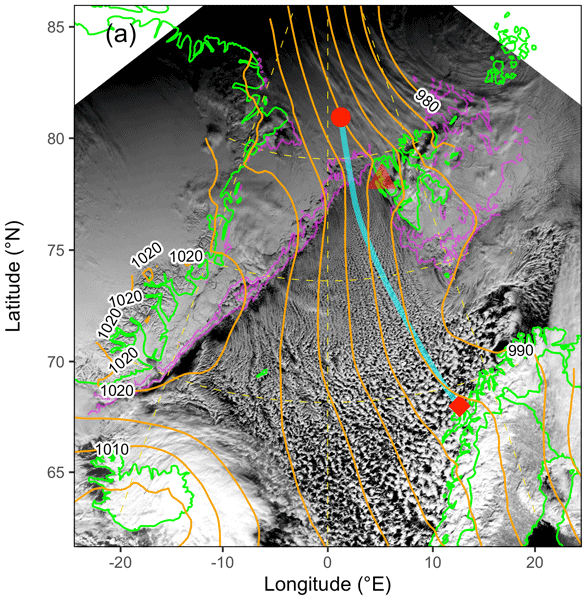
Timothy W. Juliano, Florian Tornow, Ann M. Fridlind, Andrew S. Ackerman, Gregory S. Elsaesser, Bart Geerts, Christian P. Lackner, David Painemal, Israel Silber, Mikhail Ovchinnikov, Gunilla Svensson, Michael Tjernström, Peng Wu, Alejandro Baró Pérez, Peter Bogenschutz, Dmitry Chechin, Kamal Kant Chandrakar, Jan Chylik, Andrey Debolskiy, Rostislav Fadeev, Anu Gupta, Luisa Ickes, Michail Karalis, Martin Köhler, Branko Kosović, Peter Kuma, Weiwei Li, Evgeny Mortikov, Hugh Morrison, Roel A. J. Neggers, Anna Possner, Tomi Raatikainen, Lea Raillard, Sami Romakkaniemi, Niklas Schnierstein, Shin-ichiro Shima, Nikita Silin, Mikhail Tolstykh, Étienne Vignon, Lulin Xue, Meng Zhang, and Xue Zheng
Atmos. Chem. Phys., 26, 13267–13302, https://doi.org/10.5194/acp-26-13267-2026, https://doi.org/10.5194/acp-26-13267-2026, 2026
Short summary
Short summary
Models struggle to capture cloud and precipitation processes and their radiative effects in marine cold-air outbreaks. We use a quasi-Lagrangian framework to compare large-eddy simulation (LES) and single-column model (SCM) output with field and satellite observations. With fixed droplet and ice numbers, LES and SCM agree in liquid-only tests. In mixed-phase conditions, LES plausibly capture cloud thinning and breakup, while SCMs largely remain overcast and thereby miss cloud radiative effects.
Veronica Z. Berta, Lynn Monica Russell, Abigail S. Williams, Jeramy L. Dedrick, Sanghee Han, Dan Lubin, Ryan N. Farley, Allison C. Aiken, Jeremy Wentzell, and John Liggio
EGUsphere, https://doi.org/10.5194/egusphere-2026-4695, https://doi.org/10.5194/egusphere-2026-4695, 2026
Short summary
Short summary
This study examines different formation pathways for various types of organic aerosol using one year of aerosol mass spectrometry measurements from the Eastern Pacific Cloud Aerosol Precipitation Experiment (EPCAPE) in La Jolla, California. The results show that photochemical, cloud and aerosol water aqueous reactions, and combustion emissions contribute differently to organic aerosol across seasons, with in-cloud aqueous reactions most strongly associated with highly oxidized organic aerosol.
Zhujun Li, David Painemal, Yan Feng, and Xiaojian Zheng
Atmos. Chem. Phys., 26, 7705–7720, https://doi.org/10.5194/acp-26-7705-2026, https://doi.org/10.5194/acp-26-7705-2026, 2026
Short summary
Short summary
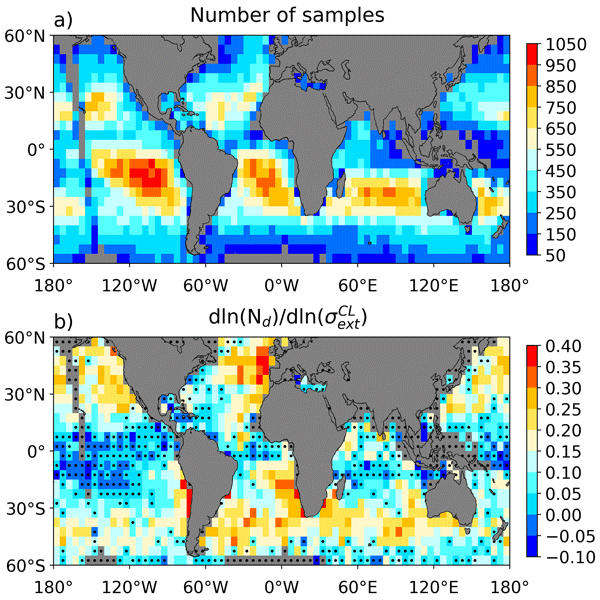
This study is the first global assessment of aerosol-cloud interactions (ACI) and cloud adjustments that relies on vertically resolved aerosol retrievals that are vertically matched with the location of the cloud layer. We computed ACI metrics and cloud adjustments over the global ocean by combining retrievals from active and passive satellite sensors and found high sensitivity of clouds to changes in their cloud droplet number concentration due to aerosols.
Jianhao Zhang, David Painemal, Tom Dror, Jung-Sub Lim, Armin Sorooshian, and Graham Feingold
Atmos. Chem. Phys., 26, 6015–6034, https://doi.org/10.5194/acp-26-6015-2026, https://doi.org/10.5194/acp-26-6015-2026, 2026
Short summary
Short summary
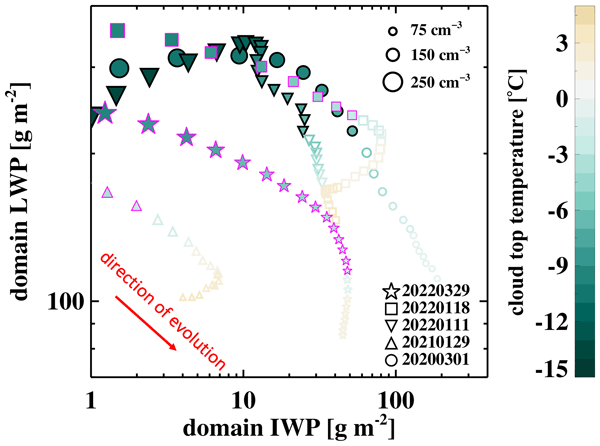
Clouds transitioning from overcast to broken fields play an important role in regulating the amount of sunlight reaching Earth’s surface. Using satellite imagery and a novel space-time exchange approach, we examine these transitions during marine cold-air outbreaks. Our analysis reveals characteristic signatures (or fingerprints) of liquid- and ice-phase processes, demonstrating how space-borne observations can provide new physical insight into cloud evolution.
Jingyi Chen, Hailong Wang, Bo Zhang, Hongyu Liu, David Painemal, Armin Sorooshian, Sheng-Lun Tai, and Christiane Voigt
Atmos. Chem. Phys., 26, 2209–2224, https://doi.org/10.5194/acp-26-2209-2026, https://doi.org/10.5194/acp-26-2209-2026, 2026
Short summary
Short summary
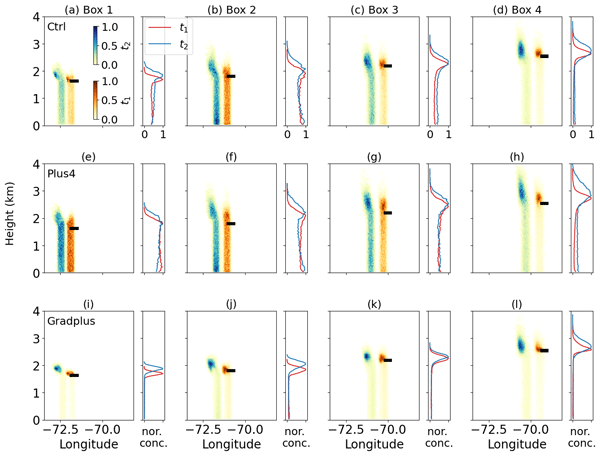
NASA-validated modeling shows +4K SST (sea surface temperature) & +25 % gradients distinctly alter boundary layer dynamics, cloud physics in cold-air outbreaks. Warmer SST reduces cloud cover; increases size, elongation; hydrometeors shift to ice. Sharper Gradients boost liquid water (cold upwind); reduces ice; disrupts organization. Also, SST changes alter cloud-top properties via entrained airmass origin. Resolving ocean-atmosphere coupling in global models is essential for accurate cloud feedback projections.
Timothy W. Juliano, Florian Tornow, Ann M. Fridlind, Andrew S. Ackerman, Gregory S. Elsaesser, Bart Geerts, Christian P. Lackner, David Painemal, Israel Silber, Mikhail Ovchinnikov, Gunilla Svensson, Michael Tjernström, Peng Wu, Alejandro Baró Pérez, Peter Bogenschutz, Dmitry Chechin, Kamal Kant Chandrakar, Jan Chylik, Andrey Debolskiy, Rostislav Fadeev, Anu Gupta, Luisa Ickes, Michail Karalis, Martin Köhler, Branko Kosović, Peter Kuma, Weiwei Li, Evgeny Mortikov, Hugh Morrison, Roel A. J. Neggers, Anna Possner, Tomi Raatikainen, Sami Romakkaniemi, Niklas Schnierstein, Shin-ichiro Shima, Nikita Silin, Mikhail Tolstykh, Lulin Xue, Meng Zhang, and Xue Zheng
EGUsphere, https://doi.org/10.5194/egusphere-2025-6217, https://doi.org/10.5194/egusphere-2025-6217, 2026
Preprint archived
Short summary
Short summary
Models struggle to capture cloud and precipitation processes and their radiative effects in marine cold-air outbreaks. We use a quasi-Lagrangian framework to compare large-eddy simulation (LES) and single-column model (SCM) output with field and satellite observations. With fixed droplet and ice numbers, LES and SCM agree in liquid-only tests. In mixed-phase conditions, LES plausibly capture cloud thinning and breakup, while SCMs largely remain overcast and thereby miss cloud radiative effects.
Xiaojian Zheng, Yan Feng, David Painemal, Meng Zhang, Shaocheng Xie, Zhujun Li, Robert Jacob, and Bethany Lusch
Atmos. Chem. Phys., 25, 17473–17499, https://doi.org/10.5194/acp-25-17473-2025, https://doi.org/10.5194/acp-25-17473-2025, 2025
Short summary
Short summary
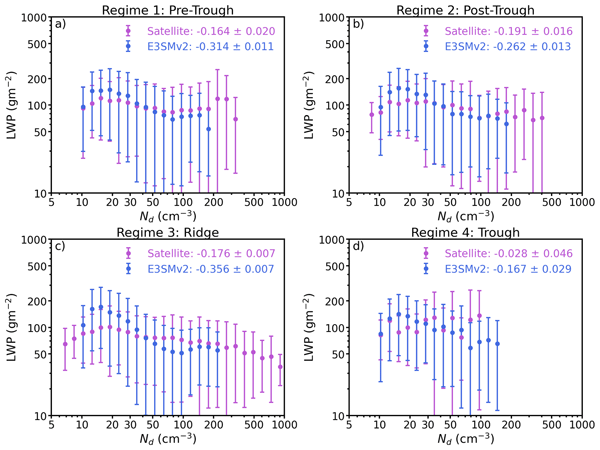
This study used satellite observations and climate model simulations to examine how aerosols affect marine clouds over the Eastern North Atlantic. Cloud responses to aerosols differed significantly across meteorological regimes. The model captured overall trends but exaggerated cloud responses, performing better for shallower than deeper clouds. The results highlight the need to untangle aerosol effects from meteorology and improve cloud process representation in climate models.
Travis D. Toth, Marian B. Clayton, Zhujun Li, David Painemal, Sharon D. Rodier, Jayanta Kar, Tyler J. Thorsen, Richard A. Ferrare, Mark A. Vaughan, Jason L. Tackett, Huisheng Bian, Mian Chin, Anne E. Garnier, Ellsworth J. Welton, Robert A. Ryan, Charles R. Trepte, and David M. Winker
Atmos. Meas. Tech., 18, 6765–6793, https://doi.org/10.5194/amt-18-6765-2025, https://doi.org/10.5194/amt-18-6765-2025, 2025
Short summary
Short summary
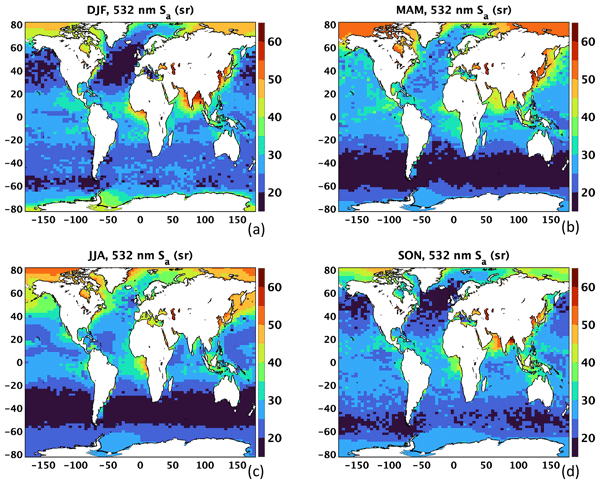
NASA's CALIPSO satellite mission observed aerosols (airborne particles) globally from 2006 to 2023. Its final data products update improves its aerosol optical parameters over oceans by adjusting for regional and seasonal differences in a new measurement-model synergistic approach. This results in a more realistic aerosol characterization, specifically near coastlines (where sea salt mixes with pollution), with potential impacts to future studies of science applications (e.g., climate effects).
Florian Tornow, Ann Fridlind, George Tselioudis, Brian Cairns, Andrew Ackerman, Seethala Chellappan, David Painemal, Paquita Zuidema, Christiane Voigt, Simon Kirschler, and Armin Sorooshian
Atmos. Chem. Phys., 25, 5053–5074, https://doi.org/10.5194/acp-25-5053-2025, https://doi.org/10.5194/acp-25-5053-2025, 2025
Short summary
Short summary
The recent NASA campaign ACTIVATE (Aerosol Cloud meTeorology Interactions oVer the western ATlantic Experiment) performed 71 tandem flights in mid-latitude marine cold-air outbreaks off the US eastern seaboard. We provide meteorological and cloud transition stage context, allowing us to identify days that are most suitable for Lagrangian modeling and analysis. Surveyed cloud properties show signatures of cloud microphysical processes, such as cloud-top entrainment and secondary ice formation.
Hongyu Liu, Bo Zhang, Richard H. Moore, Luke D. Ziemba, Richard A. Ferrare, Hyundeok Choi, Armin Sorooshian, David Painemal, Hailong Wang, Michael A. Shook, Amy Jo Scarino, Johnathan W. Hair, Ewan C. Crosbie, Marta A. Fenn, Taylor J. Shingler, Chris A. Hostetler, Gao Chen, Mary M. Kleb, Gan Luo, Fangqun Yu, Mark A. Vaughan, Yongxiang Hu, Glenn S. Diskin, John B. Nowak, Joshua P. DiGangi, Yonghoon Choi, Christoph A. Keller, and Matthew S. Johnson
Atmos. Chem. Phys., 25, 2087–2121, https://doi.org/10.5194/acp-25-2087-2025, https://doi.org/10.5194/acp-25-2087-2025, 2025
Short summary
Short summary
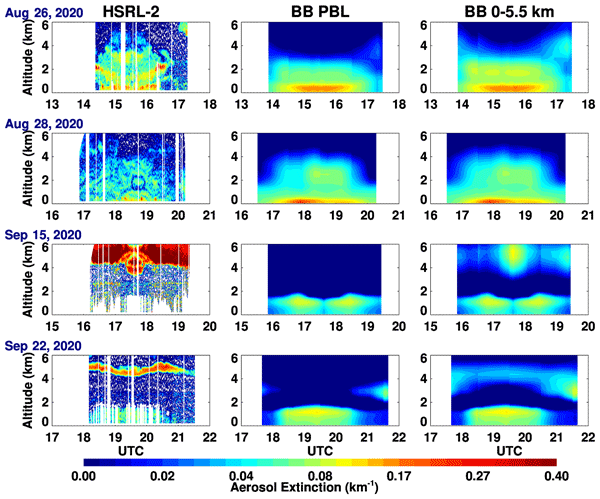
We use the GEOS-Chem model to simulate aerosol distributions and properties over the western North Atlantic Ocean (WNAO) during the winter and summer deployments in 2020 of the NASA ACTIVATE mission. Model results are evaluated against aircraft, ground-based, and satellite observations. The improved understanding of life cycle, composition, transport pathways, and distribution of aerosols has important implications for characterizing aerosol–cloud–meteorology interactions over WNAO.
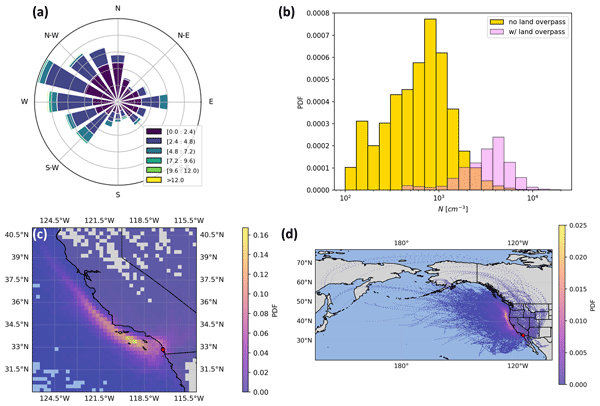
Israel Silber, Jennifer M. Comstock, Michael R. Kieburtz, and Lynn M. Russell
Earth Syst. Sci. Data, 17, 29–42, https://doi.org/10.5194/essd-17-29-2025, https://doi.org/10.5194/essd-17-29-2025, 2025
Short summary
Short summary
We present ARMTRAJ, a set of multipurpose trajectory datasets, which augments cloud, aerosol, and boundary layer studies utilizing the U.S. Department of Energy Atmospheric Radiation Measurement (ARM) user facility data. ARMTRAJ data include ensemble run statistics that enhance consistency and serve as uncertainty metrics for air mass coordinates and state variables. ARMTRAJ will soon become a near real-time product that will accompany past, ongoing, and future ARM deployments.
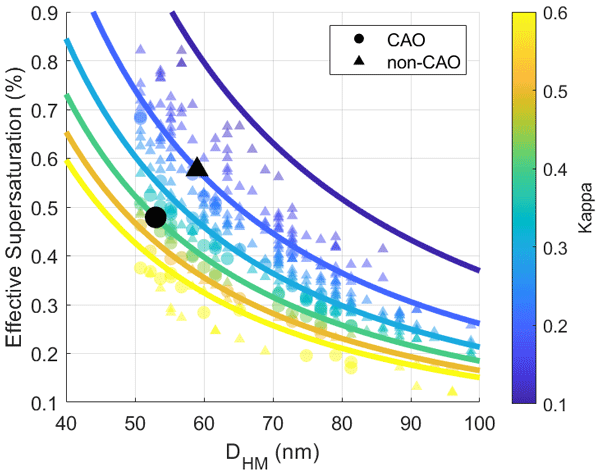
Abigail S. Williams, Jeramy L. Dedrick, Lynn M. Russell, Florian Tornow, Israel Silber, Ann M. Fridlind, Benjamin Swanson, Paul J. DeMott, Paul Zieger, and Radovan Krejci
Atmos. Chem. Phys., 24, 11791–11805, https://doi.org/10.5194/acp-24-11791-2024, https://doi.org/10.5194/acp-24-11791-2024, 2024
Short summary
Short summary
The measured aerosol size distribution modes reveal distinct properties characteristic of cold-air outbreaks in the Norwegian Arctic. We find higher sea spray number concentrations, smaller Hoppel minima, lower effective supersaturations, and accumulation-mode particle scavenging during cold-air outbreaks. These results advance our understanding of cold-air outbreak aerosol–cloud interactions in order to improve their accurate representation in models.
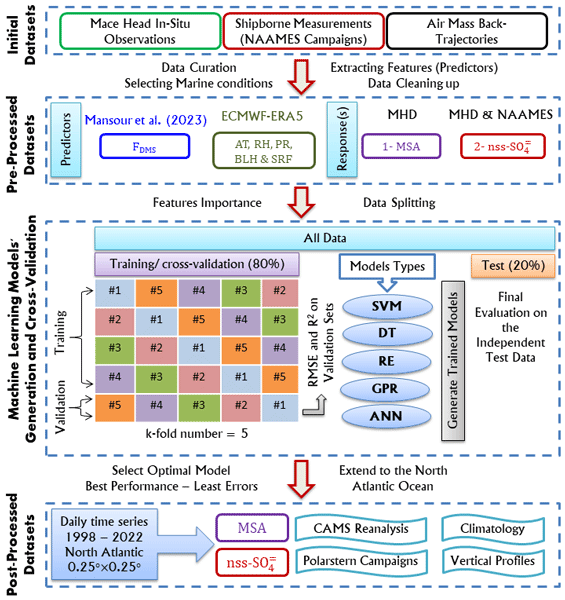
Karam Mansour, Stefano Decesari, Darius Ceburnis, Jurgita Ovadnevaite, Lynn M. Russell, Marco Paglione, Laurent Poulain, Shan Huang, Colin O'Dowd, and Matteo Rinaldi
Earth Syst. Sci. Data, 16, 2717–2740, https://doi.org/10.5194/essd-16-2717-2024, https://doi.org/10.5194/essd-16-2717-2024, 2024
Short summary
Short summary
We propose and evaluate machine learning predictive algorithms to model freshly formed biogenic methanesulfonic acid and sulfate concentrations. The long-term constructed dataset covers the North Atlantic at an unprecedented resolution. The improved parameterization of biogenic sulfur aerosols at regional scales is essential for determining their radiative forcing, which could help further understand marine-aerosol–cloud interactions and reduce uncertainties in climate models

Sunny Sun-Mack, Patrick Minnis, Yan Chen, Gang Hong, and William L. Smith Jr.
Atmos. Meas. Tech., 17, 3323–3346, https://doi.org/10.5194/amt-17-3323-2024, https://doi.org/10.5194/amt-17-3323-2024, 2024
Short summary
Short summary
Multilayer clouds (MCs) affect the radiation budget differently than single-layer clouds (SCs) and need to be identified in satellite images. A neural network was trained to identify MCs by matching imagery with lidar/radar data. This method correctly identifies ~87 % SCs and MCs with a net accuracy gain of 7.5 % over snow-free surfaces. It is more accurate than most available methods and constitutes a first step in providing a reasonable 3-D characterization of the cloudy atmosphere.
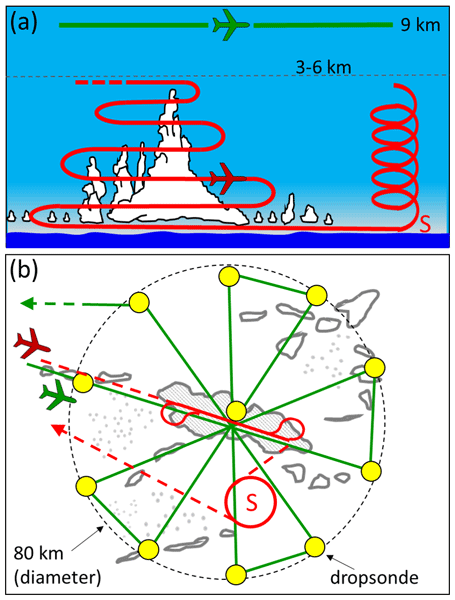
Ewan Crosbie, Luke D. Ziemba, Michael A. Shook, Taylor Shingler, Johnathan W. Hair, Armin Sorooshian, Richard A. Ferrare, Brian Cairns, Yonghoon Choi, Joshua DiGangi, Glenn S. Diskin, Chris Hostetler, Simon Kirschler, Richard H. Moore, David Painemal, Claire Robinson, Shane T. Seaman, K. Lee Thornhill, Christiane Voigt, and Edward Winstead
Atmos. Chem. Phys., 24, 6123–6152, https://doi.org/10.5194/acp-24-6123-2024, https://doi.org/10.5194/acp-24-6123-2024, 2024
Short summary
Short summary
Marine clouds are found to clump together in regions or lines, readily discernible from satellite images of the ocean. While clustering is also a feature of deep storm clouds, we focus on smaller cloud systems associated with fair weather and brief localized showers. Two aircraft sampled the region around these shallow systems: one incorporated measurements taken within, adjacent to, and below the clouds, while the other provided a survey from above using remote sensing techniques.
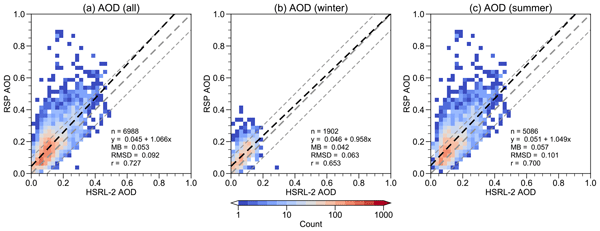
Leong Wai Siu, Joseph S. Schlosser, David Painemal, Brian Cairns, Marta A. Fenn, Richard A. Ferrare, Johnathan W. Hair, Chris A. Hostetler, Longlei Li, Mary M. Kleb, Amy Jo Scarino, Taylor J. Shingler, Armin Sorooshian, Snorre A. Stamnes, and Xubin Zeng
Atmos. Meas. Tech., 17, 2739–2759, https://doi.org/10.5194/amt-17-2739-2024, https://doi.org/10.5194/amt-17-2739-2024, 2024
Short summary
Short summary
An unprecedented 3-year aerosol dataset was collected from a recent NASA field campaign over the western North Atlantic Ocean, which offers a special opportunity to evaluate two state-of-the-art remote sensing instruments, one lidar and the other polarimeter, on the same aircraft. Special attention has been paid to validate aerosol optical depth data and their uncertainties when no reference dataset is available. Physical reasons for the disagreement between two instruments are discussed.

Emily Y. Li, Amir Yazdani, Ann M. Dillner, Guofeng Shen, Wyatt M. Champion, James J. Jetter, William T. Preston, Lynn M. Russell, Michael D. Hays, and Satoshi Takahama
Atmos. Meas. Tech., 17, 2401–2413, https://doi.org/10.5194/amt-17-2401-2024, https://doi.org/10.5194/amt-17-2401-2024, 2024
Short summary
Short summary
Infrared spectroscopy is a cost-effective measurement technique to characterize the chemical composition of organic aerosol emissions. This technique differentiates the organic matter emission factor from different fuel sources by their characteristic functional groups. Comparison with collocated measurements suggests that polycyclic aromatic hydrocarbon concentrations in emissions estimated by conventional chromatography may be substantially underestimated.
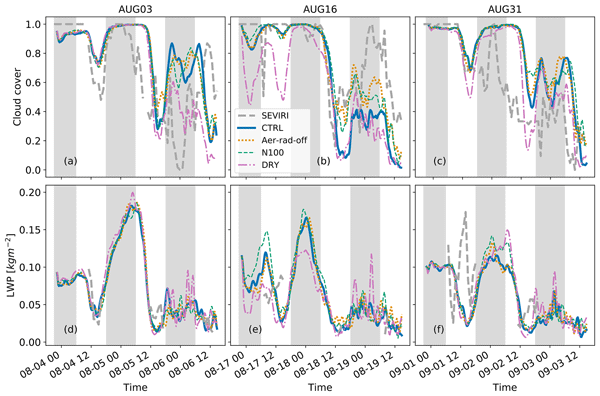
Alejandro Baró Pérez, Michael S. Diamond, Frida A.-M. Bender, Abhay Devasthale, Matthias Schwarz, Julien Savre, Juha Tonttila, Harri Kokkola, Hyunho Lee, David Painemal, and Annica M. L. Ekman
Atmos. Chem. Phys., 24, 4591–4610, https://doi.org/10.5194/acp-24-4591-2024, https://doi.org/10.5194/acp-24-4591-2024, 2024
Short summary
Short summary
We use a numerical model to study interactions between humid light-absorbing aerosol plumes, clouds, and radiation over the southeast Atlantic. We find that the warming produced by the aerosols reduces cloud cover, especially in highly polluted situations. Aerosol impacts on drizzle play a minor role. However, aerosol effects on cloud reflectivity and moisture-induced changes in cloud cover dominate the climatic response and lead to an overall cooling by the biomass burning plumes.
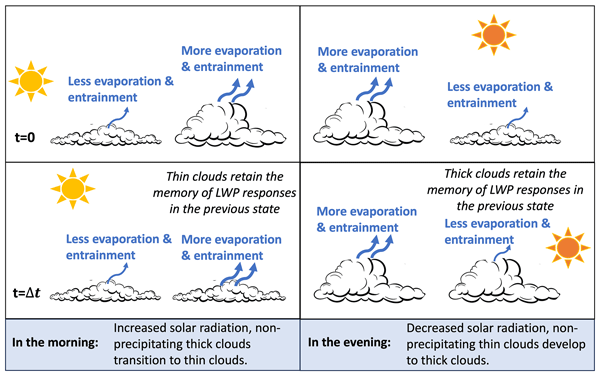
Shaoyue Qiu, Xue Zheng, David Painemal, Christopher R. Terai, and Xiaoli Zhou
Atmos. Chem. Phys., 24, 2913–2935, https://doi.org/10.5194/acp-24-2913-2024, https://doi.org/10.5194/acp-24-2913-2024, 2024
Short summary
Short summary
The aerosol indirect effect (AIE) depends on cloud states, which exhibit significant diurnal variations in the northeastern Atlantic. Yet the AIE diurnal cycle remains poorly understood. Using satellite retrievals, we find a pronounced “U-shaped” diurnal variation in the AIE, which is contributed to by the transition of cloud states combined with the lagged cloud responses. This suggests that polar-orbiting satellites with overpass times at noon underestimate daytime mean values of the AIE.
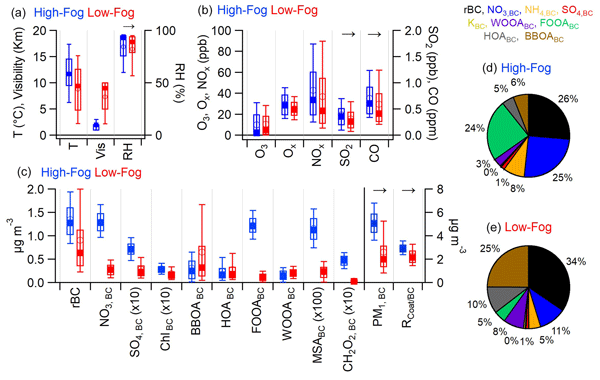
Ryan N. Farley, Sonya Collier, Christopher D. Cappa, Leah R. Williams, Timothy B. Onasch, Lynn M. Russell, Hwajin Kim, and Qi Zhang
Atmos. Chem. Phys., 23, 15039–15056, https://doi.org/10.5194/acp-23-15039-2023, https://doi.org/10.5194/acp-23-15039-2023, 2023
Short summary
Short summary
Soot particles, also known as black carbon (BC), have important implications for global climate and regional air quality. After the particles are emitted, BC can be coated with other material, impacting the aerosol properties. We selectively measured the composition of particles containing BC to explore their sources and chemical transformations in the atmosphere. We focus on a persistent, multiday fog event in order to study the effects of chemical reactions occurring within liquid droplets.
Simon Kirschler, Christiane Voigt, Bruce E. Anderson, Gao Chen, Ewan C. Crosbie, Richard A. Ferrare, Valerian Hahn, Johnathan W. Hair, Stefan Kaufmann, Richard H. Moore, David Painemal, Claire E. Robinson, Kevin J. Sanchez, Amy J. Scarino, Taylor J. Shingler, Michael A. Shook, Kenneth L. Thornhill, Edward L. Winstead, Luke D. Ziemba, and Armin Sorooshian
Atmos. Chem. Phys., 23, 10731–10750, https://doi.org/10.5194/acp-23-10731-2023, https://doi.org/10.5194/acp-23-10731-2023, 2023
Short summary
Short summary
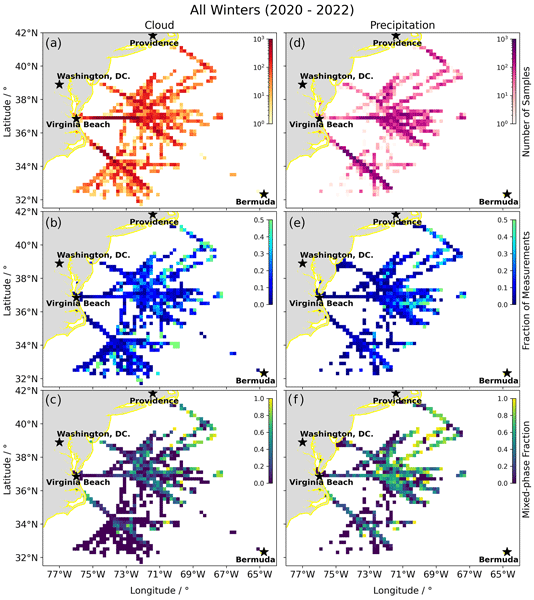
In this study we present an overview of liquid and mixed-phase clouds and precipitation in the marine boundary layer over the western North Atlantic Ocean. We compare microphysical properties of pure liquid clouds to mixed-phase clouds and show that the initiation of the ice phase in mixed-phase clouds promotes precipitation. The observational data presented in this study are well suited for investigating the processes that give rise to liquid and mixed-phase clouds, ice, and precipitation.
Armin Sorooshian, Mikhail D. Alexandrov, Adam D. Bell, Ryan Bennett, Grace Betito, Sharon P. Burton, Megan E. Buzanowicz, Brian Cairns, Eduard V. Chemyakin, Gao Chen, Yonghoon Choi, Brian L. Collister, Anthony L. Cook, Andrea F. Corral, Ewan C. Crosbie, Bastiaan van Diedenhoven, Joshua P. DiGangi, Glenn S. Diskin, Sanja Dmitrovic, Eva-Lou Edwards, Marta A. Fenn, Richard A. Ferrare, David van Gilst, Johnathan W. Hair, David B. Harper, Miguel Ricardo A. Hilario, Chris A. Hostetler, Nathan Jester, Michael Jones, Simon Kirschler, Mary M. Kleb, John M. Kusterer, Sean Leavor, Joseph W. Lee, Hongyu Liu, Kayla McCauley, Richard H. Moore, Joseph Nied, Anthony Notari, John B. Nowak, David Painemal, Kasey E. Phillips, Claire E. Robinson, Amy Jo Scarino, Joseph S. Schlosser, Shane T. Seaman, Chellappan Seethala, Taylor J. Shingler, Michael A. Shook, Kenneth A. Sinclair, William L. Smith Jr., Douglas A. Spangenberg, Snorre A. Stamnes, Kenneth L. Thornhill, Christiane Voigt, Holger Vömel, Andrzej P. Wasilewski, Hailong Wang, Edward L. Winstead, Kira Zeider, Xubin Zeng, Bo Zhang, Luke D. Ziemba, and Paquita Zuidema
Earth Syst. Sci. Data, 15, 3419–3472, https://doi.org/10.5194/essd-15-3419-2023, https://doi.org/10.5194/essd-15-3419-2023, 2023
Short summary
Short summary
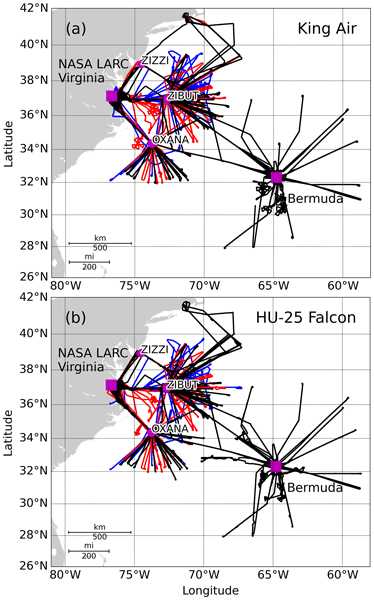
The NASA Aerosol Cloud meTeorology Interactions oVer the western ATlantic Experiment (ACTIVATE) produced a unique dataset for research into aerosol–cloud–meteorology interactions. HU-25 Falcon and King Air aircraft conducted systematic and spatially coordinated flights over the northwest Atlantic Ocean. This paper describes the ACTIVATE flight strategy, instrument and complementary dataset products, data access and usage details, and data application notes.
Veronica Z. Berta, Lynn M. Russell, Derek J. Price, Chia-Li Chen, Alex K. Y. Lee, Patricia K. Quinn, Timothy S. Bates, Thomas G. Bell, and Michael J. Behrenfeld
Atmos. Chem. Phys., 23, 2765–2787, https://doi.org/10.5194/acp-23-2765-2023, https://doi.org/10.5194/acp-23-2765-2023, 2023
Short summary
Short summary
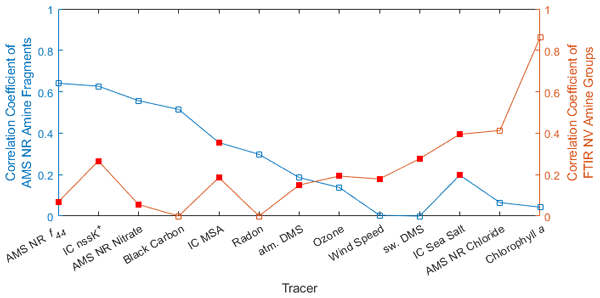
Amines are compounds emitted from a variety of marine and continental sources and were measured by aerosol mass spectrometry and Fourier transform infrared spectroscopy during the North Atlantic Aerosols and Marine Ecosystems Study (NAAMES) cruises. Secondary continental and primary marine sources of amines were identified by comparisons to tracers. The results show that the two methods are complementary for investigating amines in the marine environment.
Francesca Gallo, Kevin J. Sanchez, Bruce E. Anderson, Ryan Bennett, Matthew D. Brown, Ewan C. Crosbie, Chris Hostetler, Carolyn Jordan, Melissa Yang Martin, Claire E. Robinson, Lynn M. Russell, Taylor J. Shingler, Michael A. Shook, Kenneth L. Thornhill, Elizabeth B. Wiggins, Edward L. Winstead, Armin Wisthaler, Luke D. Ziemba, and Richard H. Moore
Atmos. Chem. Phys., 23, 1465–1490, https://doi.org/10.5194/acp-23-1465-2023, https://doi.org/10.5194/acp-23-1465-2023, 2023
Short summary
Short summary
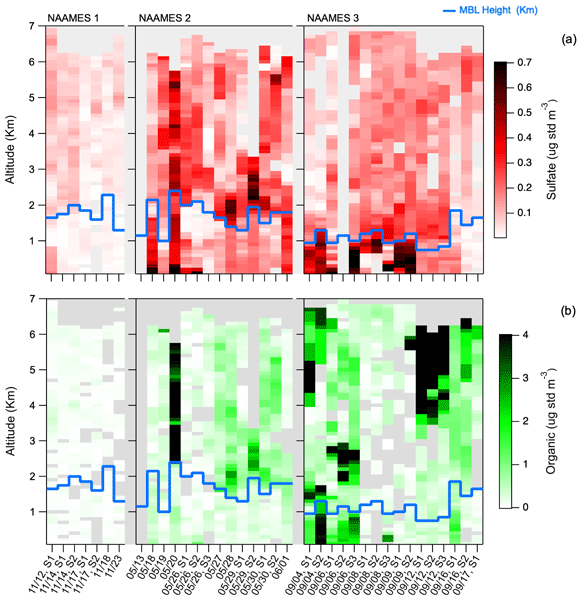
We integrate in situ ship- and aircraft-based measurements of aerosol, trace gases, and meteorological parameters collected during the NASA North Atlantic Aerosols and Marine Ecosystems Study (NAAMES) field campaigns in the western North Atlantic Ocean region. A comprehensive characterization of the vertical profiles of aerosol properties under different seasonal regimes is provided for improving the understanding of aerosol key processes and aerosol–cloud interactions in marine regions.
Jeramy L. Dedrick, Georges Saliba, Abigail S. Williams, Lynn M. Russell, and Dan Lubin
Atmos. Meas. Tech., 15, 4171–4194, https://doi.org/10.5194/amt-15-4171-2022, https://doi.org/10.5194/amt-15-4171-2022, 2022
Short summary
Short summary
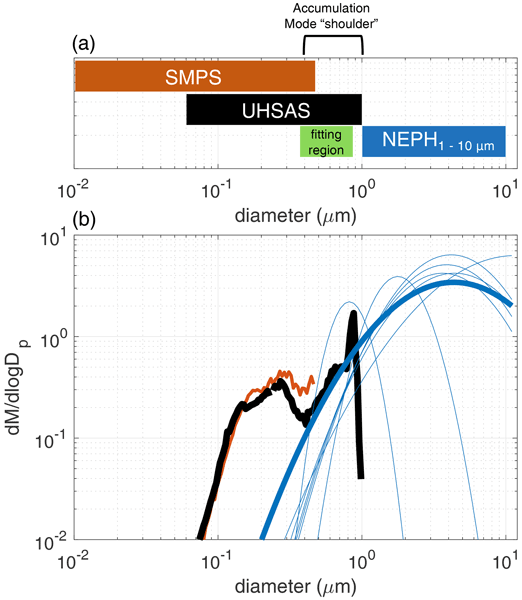
A new method is presented to retrieve the sea spray aerosol size distribution by combining submicron size and nephelometer scattering based on Mie theory. Using available sea spray tracers, we find that this approach serves as a comparable substitute to supermicron size distribution measurements, which are limited in availability at marine sites. Application of this technique can expand sea spray observations and improve the characterization of marine aerosol impacts on clouds and climate.
Edward Gryspeerdt, Daniel T. McCoy, Ewan Crosbie, Richard H. Moore, Graeme J. Nott, David Painemal, Jennifer Small-Griswold, Armin Sorooshian, and Luke Ziemba
Atmos. Meas. Tech., 15, 3875–3892, https://doi.org/10.5194/amt-15-3875-2022, https://doi.org/10.5194/amt-15-3875-2022, 2022
Short summary
Short summary
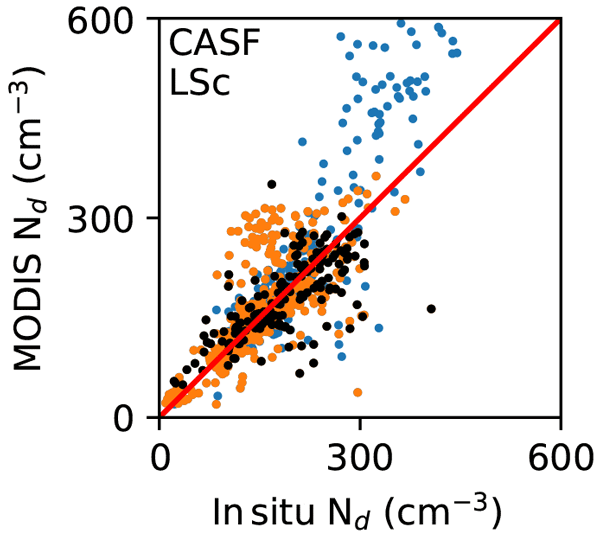
Droplet number concentration is a key property of clouds, influencing a variety of cloud processes. It is also used for estimating the cloud response to aerosols. The satellite retrieval depends on a number of assumptions – different sampling strategies are used to select cases where these assumptions are most likely to hold. Here we investigate the impact of these strategies on the agreement with in situ data, the droplet number climatology and estimates of the indirect radiative forcing.
Zhujun Li, David Painemal, Gregory Schuster, Marian Clayton, Richard Ferrare, Mark Vaughan, Damien Josset, Jayanta Kar, and Charles Trepte
Atmos. Meas. Tech., 15, 2745–2766, https://doi.org/10.5194/amt-15-2745-2022, https://doi.org/10.5194/amt-15-2745-2022, 2022
Short summary
Short summary
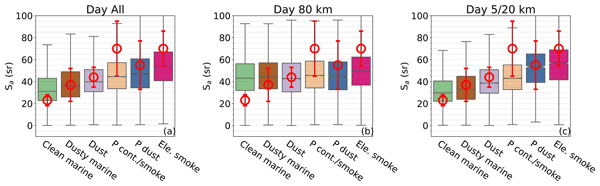
For more than 15 years, CALIPSO has revolutionized our understanding of the role of aerosols in climate. Here we evaluate CALIPSO aerosol typing over the ocean using an independent CALIPSO–CloudSat product. The analysis suggests that CALIPSO correctly categorizes clean marine aerosol over the open ocean, elevated smoke over the SE Atlantic, and dust over the tropical Atlantic. Similarities between clean and dusty marine over the open ocean implies that algorithm modifications are warranted.
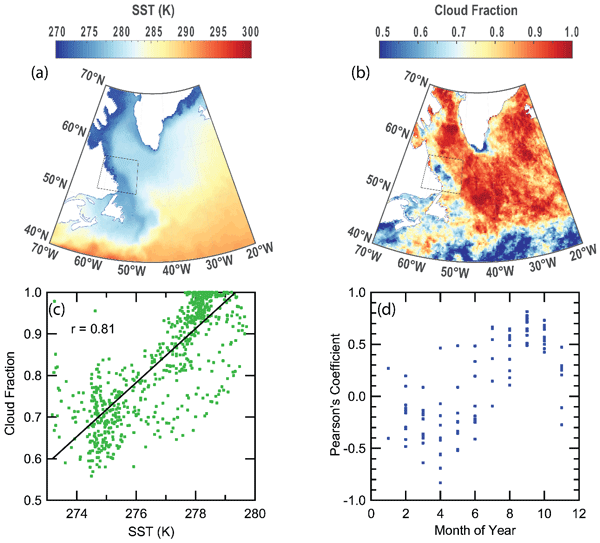
Kevin J. Sanchez, Bo Zhang, Hongyu Liu, Matthew D. Brown, Ewan C. Crosbie, Francesca Gallo, Johnathan W. Hair, Chris A. Hostetler, Carolyn E. Jordan, Claire E. Robinson, Amy Jo Scarino, Taylor J. Shingler, Michael A. Shook, Kenneth L. Thornhill, Elizabeth B. Wiggins, Edward L. Winstead, Luke D. Ziemba, Georges Saliba, Savannah L. Lewis, Lynn M. Russell, Patricia K. Quinn, Timothy S. Bates, Jack Porter, Thomas G. Bell, Peter Gaube, Eric S. Saltzman, Michael J. Behrenfeld, and Richard H. Moore
Atmos. Chem. Phys., 22, 2795–2815, https://doi.org/10.5194/acp-22-2795-2022, https://doi.org/10.5194/acp-22-2795-2022, 2022
Short summary
Short summary
Atmospheric particle concentrations impact clouds, which strongly impact the amount of sunlight reflected back into space and the overall climate. Measurements of particles over the ocean are rare and expensive to collect, so models are necessary to fill in the gaps by simulating both particle and clouds. However, some measurements are needed to test the accuracy of the models. Here, we measure changes in particles in different weather conditions, which are ideal for comparison with models.
Sarah J. Doherty, Pablo E. Saide, Paquita Zuidema, Yohei Shinozuka, Gonzalo A. Ferrada, Hamish Gordon, Marc Mallet, Kerry Meyer, David Painemal, Steven G. Howell, Steffen Freitag, Amie Dobracki, James R. Podolske, Sharon P. Burton, Richard A. Ferrare, Calvin Howes, Pierre Nabat, Gregory R. Carmichael, Arlindo da Silva, Kristina Pistone, Ian Chang, Lan Gao, Robert Wood, and Jens Redemann
Atmos. Chem. Phys., 22, 1–46, https://doi.org/10.5194/acp-22-1-2022, https://doi.org/10.5194/acp-22-1-2022, 2022
Short summary
Short summary
Between July and October, biomass burning smoke is advected over the southeastern Atlantic Ocean, leading to climate forcing. Model calculations of forcing by this plume vary significantly in both magnitude and sign. This paper compares aerosol and cloud properties observed during three NASA ORACLES field campaigns to the same in four models. It quantifies modeled biases in properties key to aerosol direct radiative forcing and evaluates how these biases propagate to biases in forcing.
Cited articles
Abel, M. R. and Hall, A.: Local and synoptic mechanisms causing Southern California's Santa Ana winds, Clim. Dyn., 34, 847–857, https://doi.org/10.1007/s00382-009-0650-4, 2010.
Beddows, D. C. S., Dall'osto, M., and Harrison, R. M.: An enhanced procedure for the merging of atmospheric particle size distribution data measured using electrical mobility and time-of-flight analysers, Aerosol Sci. Tech., 44, 11, https://doi.org/10.1080/02786826.2010.502159, 2010.
Bellouin, N., Quaas, J., Gryspeerdt, E., Kinne, S., Stier, P., Watson-Parris, D., Boucher, O., Carslaw, K. S., Christensen, M., Daniau, A.-L., Dufresne, J.-L., Feingold, G., Fiedler, S., Forster, P., Gettelman, A., Haywood, J. M., Lohmann, U., Malavelle, F., Mauritsen, T., McCoy, D. T., Myhre, G., Mülmenstädt, J., Neubauer, D., Possner, A., Rugenstein, M., Sato, Y., Schulz, M., Schwartz, S. E., Sourdeval, O., Storelvmo, T., Toll, V., Winker, D., and Stevens, B.: Bounding global aerosol radiative forcing of climate change, Rev. Geophys., 58, https://doi.org/10.1029/2019RG000660, 2020.
Berta, V. Z., Han, S., Atsushi, O., Dedrick, J. L., Maneenoi, N., and Russell, L. M.: Aerosol quantification products at Mt. Soledad and Scripps Pier during EPCAPE 2023–24, in: Aerosol Microphysics and Chemical Measurements at Mt. Soledad and Scripps Pier during the Eastern Pacific Cloud Aerosol Precipitation Experiment (EPCAPE) from February 2023 to February 2024, UC San Diego Library Digital Collections [data set], https://doi.org/10.6075/J0WM1DSC, 2025.
Bishop, C. M.: Neural Networks for Pattern Recognition, Oxford University Press, New York, ISBN 978-0-19-853849-3, 482 pp., 1995.
Boers, R. and Mitchell, R. M.: Absorption feedback in stratocumulus clouds influence on cloud top albedo, Tellus, 46A, 229–241, 1994.
Bretherton, C. S. and Blossey, P. N.: Understanding mesoscale aggregation of shallow cumulus convection using large-eddy simulation, J. Adv. Model. Earth Syst., 9, 2798–2821, 2017.
Bretherton, C. S., Wood, R., George, R. C., Leon, D., Allen, G., and Zheng, X.: Southeast Pacific stratocumulus clouds, precipitation and boundary layer structure sampled along 20° S during VOCALS-REx, Atmos. Chem. Phys., 10, 10639–10654, https://doi.org/10.5194/acp-10-10639-2010, 2010.
Chen, Y.-C., Christensen, M. W., Stephens, G. L., and Seinfeld, J. H.: Satellite-based estimate of global aerosol–cloud radiative forcing by marine warm clouds, Nat. Geosci., 7, 643–646, https://doi.org/10.1038/ngeo2214, 2014.
Chiu, J. C., Huang, C., Marshak, A., Slutsker, I., Giles, D. M., Holben, B. N., Knyazikhin, Y., and Wiscombe, W. J.: Cloud optical depth retrievals from the Aerosol Robotic Network (AERONET) cloud mode observations, J. Geophys. Res., 115, D14202, https://doi.org/10.1029/2009JD013121, 2010.
Chiu, J. C., Marshak, A., Huang, C.-H., Várnai, T., Hogan, R. J., Giles, D. M., Holben, B. N., O'Connor, E. J., Knyazikhin, Y., and Wiscombe, W. J.: Cloud droplet size and liquid water path retrievals from zenith radiance measurements: examples from the Atmospheric Radiation Measurement Program and the Aerosol Robotic Network, Atmos. Chem. Phys., 12, 10313–10329, https://doi.org/10.5194/acp-12-10313-2012, 2012.
Clement, A. C., Burgman, R., and Norris, J. R.: Observational and model evidence for positive low-level cloud feedback, Science, 325, 460–464, https://doi.org/10.1126/science.1171255, 2009.
Clemesha, R. E. S., Gershunov, A., Iacobellis, S. F., and Cayan, D. R.: Daily variability of California coastal low cloudiness: A balancing act between stability and subsidence, Geophys. Res. Lett., 44, 3330–3338, https://doi.org/10.1002/2017GL073075, 2017.
Cook, D. R. and Sullivan, R. C.: Eddy Correlation Flux Measurement System (ECOR) Instrument Handbook, U.S. Department of Energy, Atmospheric Radiation Measurement user facility, Richland, Washington, DOE/SC ARM-TR-052, https://doi.org/10.2172/1467448, 2025.
Dedrick, J. L., Osawa, A., Russell, L. M., Miller, M. A., Robinson, L., Chang, R., Williams, A. S., Berta, V. Z., Ravichandran, E., Petters, M., Wheeler, M. J., Han, S., Pelayo, C. N., Maneenoi, N., Lubin, D., Uin, J., Enekwizu, O., Zawadowicz, M., Mayol-Bracero, O., and Twohy, C. H.: Quantitative estimates of upwind and on-site particle scavenging and retrieved cloud supersaturations from urban coastal stratocumulus during EPCAPE, J. Atmos. Sci., 83, 1061–1082, https://doi.org/10.1175/JAS-D-26-0004.1, 2026.
Enekwizu, O., Hayes, C., and Uin, J.,:Atmospheric Radiation Measurement (ARM) user facility: AOS: Cloud Condensation Nuclei Counter (Dual Column), ramping mode, 2023-05-23 to 2024-02-14, ARM Mobile Facility (EPC) La Jolla, CA; AMF1 (main site for EPCAPE on Scripps Pier) (M1), Atmospheric Radiation Measurement (ARM) User Facility, ARM Data Center, https://doi.org/10.5439/1323892, 2023.
Fairless, T., Giangrande, S. C., and Ma, L.: Cloud optical depth retrieved from multi-channel sunphotometer (SPHOTCOD2CHIU), 2023-02-15 to 2024-02-13, ARM Mobile Facility (EPC) La Jolla, CA; AMF1 (main site for EPCAPE on Scripps Pier) (M1), Atmospheric Radiation Measurement (ARM) User Facility, ARM Data Center [data set], https://doi.org/10.5439/1668057, 2023.
Feng, Y., Lindenmaier, I., Theisen, A., Wang, D., Collis, S., Tian, J., Silber, I., Gupta, S., Zhang, D., Mather, J., Comstock, J., Jackson, R., O'Brien, J., and Raut, B.: ARM FY2025 Radar Plan, edited by: Stafford, R., ARM user facility, DOE/SC-ARM-TR-308, https://doi.org/10.2172/2482518, 2024.
Gaustad, K. and Zhang, D.: MWR Retrievals with MWRRET Version 2 (MWRRET2TURN), 2023-02-15 to 2024-02-14, ARM Mobile Facility (EPC) La Jolla, CA; AMF1 (main site for EPCAPE on Scripps Pier) (M1), Atmospheric Radiation Measurement (ARM) User Facility, ARM Data Center [data set], https://doi.org/10.5439/1566156, 2023.
Gaustad, K. L. and Turner, D. D.: MWRRET Value-Added Product: The Retrieval of Liquid Water Path and Precipitable Water Vapor from Microwave Radiometer (MWR) Data Sets, ARM-TR-081.1, U.S. Department of Energy, https://doi.org/10.2172/953818, 2009.
Gershunov, A., Shulgina, T., Clemesha, R. E., Guirguis, K., Pierce, D. W., Dettinger, M. D., and Cayan, D. R.: Precipitation regime change in Western North America: The role of atmospheric rivers, Sci. Rep., 9, 9944, https://doi.org/10.1038/s41598-019-46169-w, 2019.
Grosvenor, D. P., Sourdeval, O., Zuidema, P., Ackerman, A. S., Alexandrov, M. D., Bennartz, R., Boers, R., Cairns, B., Chiu, J. C., Christensen, M., Deneke, H., Diamond, M., Feingold, G., Fridlind, A., Hünerbein, A., Knist, C., Kollias, P., Marshak, A., McCoy, D., Merk, D., Painemal, D., Rausch, J., Rosenfeld, D., Russchenberg, H., Seifert, P., Sinclair, K., Stier, P., van Diedenhoven, B., Wendisch, M., Werner, F., Wood, R., Zhang, Z., and Quaas, J.: Remote sensing of droplet number concentration in warm clouds: A review of the current state of knowledge and perspectives, Rev. Geophys., 56, 409–453, https://doi.org/10.1029/2017RG000593, 2018.
Han, S., Williams, A. S., Russell, L. M., Berta, V. Z., Dedrick, J. L., Pelayo, C., Maneenoi, N., Osawa, A., Silber, I., Zhang, D., Zawadowicz, M. A., and Sedlacek III, A. J.: Nearby Sites Show Similar Upwind Sources and Differing Semivolatile Concentrations in Coastal Aerosol Particles, ACS ES&T Air, 2, 2824–2837, https://doi.org/10.1021/acsestair.5c00191, 2025.
Hartmann, D., Ockert-Bell, M. E., and Michelsen, M. L.: The effect of cloud type on Earth's energy balance: Global analysis, J. Climate, 5, 1281–1304, https://doi.org/10.1175/1520-0442(1992)005<1281:TEOCTO>2.0.CO;2, 1992.
Haykin, S.: Neural Networks: A Comprehensive Foundation, 2nd edn., Prentice Hall, ISBN 978-0132733502, 1999.
Haykin, S.: Neural Networks and Learning Machines, 3rd edn., Pearson Education, Inc., McMaster University, Hamilton, 936 pp., ISBN 978-0131471399, 2009.
Hersbach, H., Bell, B., Berrisford, P., Hirahara, S., Horányi, A., Muñoz-Sabater, J., Nicolas, J., Peubey, C., Radu, R., Schepers, D., Simmons, A. J., Soci, C., Abdalla, S., Abellan, X., Balsamo, G., Bechtold, P., Biavati, G., Bidlot, J.-R., Bonavita, M., De Chiara, G., Dahlgren, P., Dee, D., Diamantakis, M., Dragani, R., Flemming, J., Forbes, R., Fuentes, M., Geer, A., Haimberger, L., Healy, S. B., Hogan, R. J., Holm, E., Janisková, M., Keeley, S., Laloyaux, P., Lopez, P., Lupu, C., Radnóti, G., de Rosnay, P., Rozum, I., Vamborg, F., Villaume, S., and Thépaut, J.-N.: The ERA5 global reanalysis, Q. J. R. Meteorol. Soc., 146, 1999–2049, https://doi.org/10.1002/qj.3803, 2020.
Hersbach, H., Bell, B., Berrisford, P., Biavati, G., Horányi, A., Muñoz Sabater, J., Nicolas, J., Peubey, C., Radu, R., Rozum, I., Schepers, D., Simmons, A., Soci, C., Dee, D., and Thépaut, J.-N.: ERA5 hourly data on single levels from 1940 to present, Copernicus Climate Change Service (C3S) Climate Data Store (CDS) [data set], https://doi.org/10.24381/cds.adbb2d47, 2023.
Hewitson, B. and Crane, R.: Self-organizing maps: applications to synoptic climatology, Clim. Res., 22, 13–26, https://doi.org/10.3354/cr022013, 2002.
Husar, R., Patterson, D., Blumenthal, D., White, W., and Smith, T.: Three-dimensional distribution of air pollutants in the Los Angeles Basin, J. Appl. Meteorol. Climatol., 16, 1089–1096, https://doi.org/10.1175/1520-0450-16.10.1089, 1977.
Husar, R. B. and Patterson, D. E.: Regional scale air pollution: Sources and effects, Ann. N. Y. Acad. Sci., 338, 399–417, https://doi.org/10.1111/j.1749-6632.1980.tb17136.x, 1980.
Jiang, N., Kim, N., Dirks, K., and Luo, K.: Classification of synoptic weather types using the self-organising map and its application to climate and air quality data visualisation, Weather and Climate, 33, 52–75, 2013.
Johnson, K., Giangrande, S., and Toto, T.: Active Remote Sensing of Clouds (ARSCL) product using Ka-band ARM Zenith Radars (ARSCLKAZRBND1KOLLIAS), 2023-02-15 to 2024-02-14, ARM Mobile Facility (EPC) La Jolla, CA; AMF1 (main site for EPCAPE on Scripps Pier) (M1), Atmospheric Radiation Measurement (ARM) User Facility, ARM Data Center [data set], https://doi.org/10.5439/1393437, 2023.
Jones, C. R., Bretherton, C. S., and Leon, D.: Coupled vs. decoupled boundary layers in VOCALS-REx, Atmos. Chem. Phys., 11, 7143–7153, https://doi.org/10.5194/acp-11-7143-2011, 2011.
Juliano, T. W. and Lebo, Z. J.: Linking large-scale circulation patterns to low-cloud properties, Atmos. Chem. Phys., 20, 7125–7138, https://doi.org/10.5194/acp-20-7125-2020, 2020.
Keeler, E.: Balloon-Borne Sounding System (SONDE) Instrument Handbook, edited by: Stafford, R., U.S. Department of Energy, DOE/SC-ARM/TR-029, https://doi.org/10.2172/1020712, 2025.
Keeler, E., Burk, K., and Kyrouac, J.: Balloon-Borne Sounding System (SONDEWNPN), 2023-02-15 to 2024-02-14, ARM Mobile Facility (EPC) La Jolla, CA; AMF1 (main site for EPCAPE on Scripps Pier) (M1), Atmospheric Radiation Measurement (ARM) User Facility, ARM Data Center [data set], https://doi.org/10.5439/1595321, 2023.
Klein, S. A. and Hartmann, D. L.: The seasonal cycle of low stratiform clouds, J. Climate, 6, 1587–1606, 1993.
Klein, S. A., Hartmann, D. L., and Norris, J. R.: On the relationships among low-cloud structure, sea surface temperature, and atmospheric circulation in the summertime northeast Pacific, J. Climate, 10, 2550–2563, 1997.
Kohonen, T.: Self-organized formation of topologically correct feature maps, Biol. Cybern., 43, 59–69, https://doi.org/10.1007/BF00337288, 1982.
Kohonen, T.: The self-organizing map, Proc. IEEE, 78, 1464–1480, 1990.
Kohonen, T.: Self-Organizing Maps, 3rd Edn., Springer-Verlag, Berlin, Heidelberg, New York, 501 pp., https://doi.org/10.1007/978-3-642-56927-2, 2001.
Krzywinski, M. and Altman, N.: Points of significance: Comparing samples – part I, Nat. Methods, 11, 215–216, https://doi.org/10.1038/nmeth.2858, 2014.
Lebassi-Habtezion, B., González, J., and Bornstein, R.: Modeled large-scale warming impacts on summer California coastal-cooling trends, J. Geophys. Res., 116, D20114, https://doi.org/10.1029/2011JD015759, 2011.
Lewis, E. R.: Marine ARM GPCI Investigation of Clouds (MAGIC) Field Campaign Report, U.S. Department of Energy, https://doi.org/10.2172/1343577, 2016.
Lu, R. and Turco, R. P.: Air pollutant transport in a coastal environment. Part I: Two-dimensional simulations of sea-breeze and mountain effects, J. Atmos. Sci., 51, 2285–2308, https://doi.org/10.1175/1520-0469(1994)051<2285:APTIAC>2.0.CO;2, 1994.
Lu, R. and Turco, R. P.: Air pollutant transport in a coastal environment – II. Three-dimensional simulations over Los Angeles basin, Atmos. Environ., 29, 1499–1518, https://doi.org/10.1016/1352-2310(95)00015-Q, 1995.
Maneenoi, N., Russell, L. M., Han, S., Dedrick, J. L., Williams, A. S., Berta, V. Z., Pelayo, C., Zawadowicz, M. A., Sedlacek, A. J. III, Silber, I., Thieman, M., Painemal, D., and Shen, S. S. P.: Photochemical and cloud and aerosol aqueous contributions to regionally-emitted shipping and biogenic non-sea-salt sulfate aerosol in coastal California, ACS ES&T Air, 2, 648–664, https://doi.org/10.1021/acsestair.4c00352, 2025.
McComiskey, A., Feingold, G., Frisch, A. S., Turner, D. D., Miller, M. A., Chiu, J. C., Min, Q., and Ogren, J. A.: Anassessment of aerosol-cloud interactions in marine stratus clouds based on surface remote sensing, J. Geophys. Res., 114, D09203, https://doi.org/10.1029/2008JD011006, 2009.
Minnis, P., Trepte, Q. Z., Sun-Mack, S., Chen, Y., Doelling, D. R., Young, D. F., Spangenberg, D. A., Miller, W. F., Wielicki, B. A., Brown, R. R., and Gibson, S. C.: Cloud detection in nonpolar regions for CERES using TRMM VIRS and Terra and Aqua MODIS data, IEEE Trans. Geosci. Remote Sens., 46, 3857–3884, 2008.
Minnis, P., Sun-Mack, S., Young, D. F., Heck, P. W., Garber, D. P., Chen, Y., Spangenberg, D. A., Arduini, R. F., Trepte, Q. Z., Smith, W. L., and Ayers, J. K.: CERES edition-2 cloud property retrievals using TRMM VIRS and Terra and Aqua MODIS data – Part I: Algorithms, IEEE Trans. Geosci. Remote Sens., 49, 4374–4400, 2011.
Minnis, P., Sun-Mack, S., Chen, Y., Chang, F.-L., Yost, C. R., Smith, W. L. Jr., Heck, P. W., Arduini, R. F., Bedka, S. T., Yi, Y., Hong, G., Jin, Z., Painemal, D., Palikonda, R., Scarino, B., Spangenberg, D. A., Smith, R. A., Trepte, Q. Z., Yang, P., and Xie, Y.: CERES MODIS cloud product retrievals for Edition 4, Part I: Algorithm changes, IEEE Trans. Geosci. Remote Sens., 51, 2744–2780, https://doi.org/10.1109/TGRS.2020.3008866, 2021.
Minnis, P., Sun-Mack, S., Smith Jr., W. L., Trepte, Q. Z., Hong, G., Chen, Y., Yost, C. R., Chang, F.-L., Smith, R. A., Heck, P. W., and Yang, P.: VIIRS Edition 1 Cloud Properties for CERES, Part 1: Algorithm Adjustments and Results, Remote Sens., 15, 578, https://doi.org/10.3390/rs15030578, 2023.
Morris, V. R.: Ceilometer Instrument Handbook, DOE/SC-ARM-TR-020, U.S. Department of Energy, https://doi.org/10.2172/1036530, 2016.
Myers, T. A. and Norris, J. R.: Observational evidence that enhanced subsidence reduces subtropical marine boundary layer cloudiness, J. Climate, 26, 7507–7524, https://doi.org/10.1175/JCLI-D-12-00736.1, 2013.
Nakajima, T. and King, M. D.: Determination of the optical thickness and effective particle radius of clouds from reflected solar radiation measurements. Part I: Theory, J. Atmos. Sci., 47, 1878–1893, https://doi.org/10.1175/1520-0469(1990)047<1878:DOTOTA>2.0.CO;2, 1990.
Nakajima, T., King, M. D., Spinhirne, J. D., and Radke, L. F.: Determination of the optical thickness and effective particle radius of clouds from reflected solar radiation measurements. Part II: Marine stratocumulus observations, J. Atmos. Sci., 48, 728–751, https://doi.org/10.1175/1520-0469(1991)048<0728:DOTOTA>2.0.CO;2, 1991.
Neiburger, M., Johnson, D. S., and Chien, C.-W.: Studies of the Structure of the Atmosphere over the Eastern Pacific Ocean in the Summer, University of California Press, 94 pp., 1961.
Newsom, R. K., Sivaraman, C., Riihimaki, L., Dexheimer, D., Lindenmaier, I., and Berg, L. K.: Doppler Lidar Vertical Velocity Statistics Value-Added Product, U.S. Department of Energy, Office of Scientific and Technical Information, April 2019, https://doi.org/10.2172/1238068, 2025.
Painemal, D.: Global estimates of changes in shortwave low-cloud albedo and fluxes due to variations in cloud droplet number concentration derived from CERES-MODIS satellite sensors, Geophys. Res. Lett., 45, 9288–9296, https://doi.org/10.1029/2018GL078880, 2018.
Painemal, D. and Zuidema, P.: Assessment of MODIS cloud effective radius and optical thickness retrievals over the Southeast Pacific with VOCALS-REx in situ measurements, J. Geophys. Res., 116, D24206, https://doi.org/10.1029/2011JD016155, 2011.
Painemal, D., Minnis, P., and Nordeen, M.: Aerosol variability, synoptic-scale processes, and their link to the cloud microphysics over the northeast Pacific during MAGIC, J. Geophys. Res.-Atmos., 120, 5122–5139, https://doi.org/10.1002/2015JD023175, 2015.
Painemal, D., Chiu, J.-Y. C., Minnis, P., Yost, C., Zhou, X., Cadeddu, M., Eloranta, E., Lewis, E. R., Ferrare, R., and Kollias, P.: Aerosol and cloud microphysics covariability in the northeast Pacific boundary layer estimated with ship-based and satellite remote sensing observations, J. Geophys. Res.-Atmos., 122, 2403–2418, https://doi.org/10.1002/2016JD025771, 2017.
Painemal, D., Chellappan, S., Smith Jr., W. L., Spangenberg, D., Park, J. M., Ackerman, A., Chen, J., Crosbie, E., Ferrare, R., Hair, J., Kirschler, S., Li, X.-Y., McComiskey, A., Moore, R. H., Sanchez, K., Sorooshian, A., Tornow, F., Voigt, C., Wang, H., Winstead, E., Zeng, X., Ziemba, L., and Zuidema, P.: Wintertime synoptic patterns of midlatitude boundary layer clouds over the western North Atlantic: Climatology and insights from in-situ ACTIVATE observations, J. Geophys. Res.-Atmos., 128, e2022JD037725, https://doi.org/10.1029/2022JD037725, 2023.
Painemal, D., Smith, W. L. Jr., Gupta, S., Moore, R., Cairns, B., McFarquhar, G. M., and O'Brien, J.: Can we rely on satellite visible/infrared microphysical retrievals of boundary layer clouds in partially cloudy scenes? Implications for climate research, Geophys. Res. Lett., 52, e2024GL113825, https://doi.org/10.1029/2024GL113825, 2025.
Parish, T. R.: Forcing of the summertime low-level jet along the California coast, J. Appl. Meteorol. Climatol., 39, 2421–2433, 2000.
Pearce, J., Waller, L., Chang, H., Klein, M., Mulholland, J., Sarnat, J., Ebelt, S., Strickland, M., and Tolbert, P.: Using self-organizing maps to develop ambient air quality classifications: a time series example, Environ. Health, 13, 56, https://doi.org/10.1186/1476-069X-13-56, 2014.
Raphael, M. N.: The Santa Ana winds of California, Earth Interact., 7, 1–13, https://doi.org/10.1175/1087-3562(2003)007<0001:TSAWOC>2.0.CO;2, 2003.
Russell, L. M., Lubin, D., Silber, I., Eloranta, E., Muelmenstaedt, J., Burrows, S., Aiken, A., Wang, D., Petters, M., Miller, M., Ackerman, A., Fridlind, A., Witte, M., Lebsock, M., Painemal, D., Chang, R., Liggio, J., and Wheeler, M.: EPCAPE Field: Final Campaign Report, U.S. Department of Energy, Office of Scientific and Technical Information, April 2025, https://doi.org/10.2172/3015487, 2025.
Sheridan, S. C. and Lee, C. C.: The self-organizing map in synoptic climatological research, Prog. Phys. Geogr., 35, 109–119, 2011.
Shilling, J. and Levin, M.: ACSM, corrected for composition-dependent collection efficiency (ACSMCDCE), ARM Data Center [data set], https://doi.org/10.5439/1641833, 2024.
Shilling, J. E.: Merged aerosol particle size distribution for the SMPS and APS instruments, Atmospheric Radiation Measurement (ARM) user facility, ARM Data Center [data set], https://doi.org/10.5439/1871375, 2023.
Shilling, J. E. and Levin, M. S.: Scanning Mobility Particle Sizer (SMPS)-Aerodynamic Particle Sizer (APS) Merged Size Distribution (mergedsmpsaps) Value-Added Product Report, DOE/SC-ARM-TR-294, U.S. Department of Energy, Atmospheric Radiation Measurement user facility, Richland, Washington, https://doi.org/10.2172/2234267, 2023.
Silber, I.: Airmass trajectories to support studies using ARM data (ARMTRAJ), 2023-03-01 to 2024-02-13, ARM Mobile Facility (EPC) La Jolla, CA; AMF1 (main site for EPCAPE on Scripps Pier) (M1), Atmospheric Radiation Measurement (ARM) user facility, ARM Data Center [data set], https://doi.org/10.5439/2309848, 2023.
Silber, I., Comstock, J. M., Kieburtz, M. R., and Russell, L. M.: ARMTRAJ: a set of multipurpose trajectory datasets augmenting the Atmospheric Radiation Measurement (ARM) user facility measurements, Earth Syst. Sci. Data, 17, 29–42, https://doi.org/10.5194/essd-17-29-2025, 2025.
Sorooshian, A., Anderson, B., Bauer, S. E., Braun, R. A., Cairns, B., Crosbie, E., Dadashazar, H., Diskin, G., Ferrare, R., Flagan, R. C., Hair, J., Hostetler, C., Jonsson, H. H., Kleb, M. M., Liu, H., MacDonald, A. B., McComiskey, A., Moore, R., Painemal, D., Russell, L. M., Seinfeld, J. H., Shook, M., Smith, W. L., Thornhill, K., Tselioudis, G., Wang, H., Zeng, X., Zhang, B., Ziemba, L., and Zuidema, P.: Aerosol–Cloud–Meteorology Interaction Airborne Field Investigations: Using Lessons Learned from the U.S. West Coast in the Design of ACTIVATE off the U.S. East Coast, B. Am. Meteorol. Soc., 100, 1511–1528, https://doi.org/10.1175/BAMS-D-18-0100.1, 2019.
Sullivan, R. C., Billesbach, D. P., Biraud, S., Chan, S., Hart, R., Keeler, E., Kyrouac, J., Pal, S., Pekour, M., Sullivan, S. L., Theisen, A., Tuftedal, M., and Cook, D. R.: Over three decades, and counting, of near-surface turbulent flux measurements from the Atmospheric Radiation Measurement (ARM) user facility, Earth Syst. Sci. Data, 17, 5007–5038, https://doi.org/10.5194/essd-17-5007-2025, 2025.
Teixeira, J., Cardoso, S., Bonazzola, M., Cole, J. N., Del Genio, A. D., DeMott, C., Franklin, C., Hannay, C., Jakob, C., Jiao, Y., Karlsson, J., Kitagawa, H., Köhler, M., Kuwano-Yoshida, A., LeDrian, C., Li, J., Lock, A., Miller, M. J., Marquet, P., Martins, J., Mechoso, C. R., van Meijgaard, E., Meinke, I., Miranda, P. M. A., Mironov, D., Neggers, R., Pan, H. L., Randall, D. A., Rasch, P. J., Rockel, B., Rossow, W. B., Ritter, B., Siebesma, A. P., Soares, P. M. M., Turk, F. J., Vaillancourt, P. A., von Engeln, A., and Zhao, M.: Tropical and sub-tropical cloud transitions in weather and climate prediction models: The GCSS/WGNE Pacific Cross-section Intercomparison (GPCI), J. Clim., 24, 5223–5256, https://doi.org/10.1175/2011JCLI3672.1, 2011.
Turner, D. D., Clough, S. A., Liljegren, J. C., Clothiaux, E. E., Cady-Pereira, K. E., and Gaustad, K. L.: Retrieving liquid water path and precipitable water vapor from the Atmospheric Radiation Measurement (ARM) microwave radiometers, IEEE Trans. Geosci. Remote Sens., 45, 3680–3690, https://doi.org/10.1109/TGRS.2007.903703, 2007.
Vesanto, J. and Alhoniemi, E.: Clustering of the self-organizing map, IEEE Trans. Neural Netw., 11, 586–600, https://doi.org/10.1109/72.846731, 2000.
Vettigli, G.: MiniSom: Minimalistic and Numpy-Based Implementation of the Self Organizing Map, GitHub [code], https://github.com/JustGlowing/minisom/ (last access: 15 October 2026), 2018.
Weaver, C. P. and Ramanathan, V.: Relationships between large-scale vertical velocity, static stability, and cloud radiative forcing over Northern Hemisphere extratropical oceans, J. Climate, 10, 2871–2887, https://doi.org/10.1175/1520-0442(1997)010<2871:RBLSVV>2.0.CO;2, 1997.
Widener, K., Bharadwaj, N., and Johnson, K.: Ka-Band ARM Zenith Radar Handbook, DOE/SC-ARM/TR-106, https://doi.org/10.2172/1035855, 2012.
Wood, R.: Drizzle in Stratiform Boundary Layer Clouds. Part I: Vertical and Horizontal Structure. J. Atmos. Sci., 62, 3011–3033, https://doi.org/10.1175/JAS3529.1, 2005.
Wood, R.: Stratocumulus clouds, Mon. Weather Rev., 140, 2373–2423, https://doi.org/10.1175/mwr-d-11-00121.1, 2012.
Wood, R. and Bretherton, C. S.: Boundary layer depth, entrainment, and decoupling in the cloud-capped subtropical and tropical marine boundary layer, J. Climate, 17, 3576–3588, https://doi.org/10.1175/1520-0442(2004)017<3576:BLDEAD>2.0.CO;2, 2004.
Wood, R. and Hartmann, D. L.: Spatial variability of liquid water path in marine low cloud: The importance of mesoscale cellular convection, J. Climate, 19, 1748–1764, https://doi.org/10.1175/JCLI3702.1, 2006.
Wood, R., Leon, D., Lebsock, M., Snider, J., and Clarke, A. D.: Precipitation driving of droplet concentration variability in marine low clouds, J. Geophys. Res., 117, D19210, https://doi.org/10.1029/2012JD018305, 2012.
Zhang, D.: Atmospheric Radiation Measurement (ARM) user facility: Droplet number concentration (NDROP), 2023-02-15 to 2024-02-14, ARM Mobile Facility (EPC) La Jolla, CA; AMF1 (main site for EPCAPE on Scripps Pier) (M1), Atmospheric Radiation Measurement (ARM) User Facility, ARM Data Center [data set], https://doi.org/10.5439/1131339, 2023.
Zhang, D., Morris, V., and Ermold, B.: Ceilometer (CEIL10M), 2023-02-15 to 2024-02-14, ARM Mobile Facility (EPC) La Jolla, CA; Supplemental Facility 2 (Mt Soledad lab) (S2), Atmospheric Radiation Measurement (ARM) User Facility, ARM Data Center [data set], https://doi.org/10.5439/1181954, 2023.
Zhang, J., Zhou, X., Goren, T., and Feingold, G.: Albedo susceptibility of northeastern Pacific stratocumulus: the role of covarying meteorological conditions, Atmos. Chem. Phys., 22, 861–880, https://doi.org/10.5194/acp-22-861-2022, 2022.
Zhou, C., Zelinka, M. D., Dessler, A. E., and Klein, S. A.: The relationship between interannual and long-term cloud feedbacks, Geophys. Res. Lett., 42, 10463–10469, https://doi.org/10.1002/2015GL066698, 2015.
Short summary
We analyzed observations from the ARM (Atmospheric Radiation Measurement) EPCAPE (Eastern Pacific Cloud Aerosol Precipitation Experiment) campaign at coastal California, and satellite cloud properties to understand how large-scale weather patterns influence marine low clouds and aerosols. Using ERA5 data and Self-Organizing Maps, we identified nine synoptic regimes linked to cloud cover, depth, and liquid water path. Satellite data show anticyclone position strongly affects cloud properties, while aerosol–cloud covariability depends on turbulence and supersaturation.
We analyzed observations from the ARM (Atmospheric Radiation Measurement) EPCAPE (Eastern...


Altmetrics
Final-revised paper
Preprint