
Articles | Volume 26, issue 2
https://doi.org/10.5194/acp-26-1229-2026
© Author(s) 2026. This work is distributed under
the Creative Commons Attribution 4.0 License.
the Creative Commons Attribution 4.0 License.
https://doi.org/10.5194/acp-26-1229-2026
© Author(s) 2026. This work is distributed under
the Creative Commons Attribution 4.0 License.
the Creative Commons Attribution 4.0 License.
Research article
| 
26 Jan 2026
Research article |
| 26 Jan 2026
| 26 Jan 2026
Methane fluxes from Arctic & boreal North America: comparisons between process-based estimates and atmospheric observations

Department of Environmental Health and Engineering, Johns Hopkins University, Baltimore, MD, USA
Misa Ishizawa
Environment and Climate Change Canada, Toronto, ON, Canada
Felix R. Vogel
Environment and Climate Change Canada, Toronto, ON, Canada
Zhen Zhang
Institute of Tibetan Plateau Research, Chinese Academy of Sciences, Beijing, China
Benjamin Poulter
Spark Climate Solutions, San Francisco, CA, USA
Leyang Feng
Department of Environmental Health and Engineering, Johns Hopkins University, Baltimore, MD, USA
Department of Environmental Health and Engineering, Johns Hopkins University, Baltimore, MD, USA
Anna L. Gagné-Landmann
Department of Physics, Northern Arizona University, Flagstaff, AZ, USA
Deborah N. Huntzinger
School of Earth and Sustainability, Northern Arizona University, Flagstaff, AZ, USA
Joe R. Melton
Environment and Climate Change Canada, Victoria, BC, Canada
Vineet Yadav
Jet Propulsion Laboratory, California Institute of Technology, Pasadena, CA, USA
Dylan C. Gaeta
Department of Environmental Health and Engineering, Johns Hopkins University, Baltimore, MD, USA
Ziting Huang
Department of Environmental Health and Engineering, Johns Hopkins University, Baltimore, MD, USA
Douglas E. J. Worthy
Environment and Climate Change Canada, Toronto, ON, Canada
Douglas Chan
Environment and Climate Change Canada, Toronto, ON, Canada
Scot M. Miller
Department of Environmental Health and Engineering, Johns Hopkins University, Baltimore, MD, USA
Related authors
Zeyu Wang, Jieyi Wang, Hanyu Liu, Ziting Huang, Kewei Liang, Feng Zhang, and Scot M. Miller
EGUsphere, https://doi.org/10.5194/egusphere-2026-4304, https://doi.org/10.5194/egusphere-2026-4304, 2026
Short summary
Short summary
We developed GenGHG, a globally applicable machine learning model that rapidly links satellite greenhouse gas observations to nearby surface emissions. Its generative design represents stochastic atmospheric transport, helping preserve transport structure close to physical references. It produces emission estimates close to full physical simulations and enables fast comparison of transport differences across weather products.
Trevor Sloughter, Zebedee Nicholls, Gang Tang, Thomas Kleinen, Zhen Zhang, and Joeri Rogelj
Geosci. Model Dev., 19, 9063–9076, https://doi.org/10.5194/gmd-19-9063-2026, https://doi.org/10.5194/gmd-19-9063-2026, 2026
Short summary
Short summary
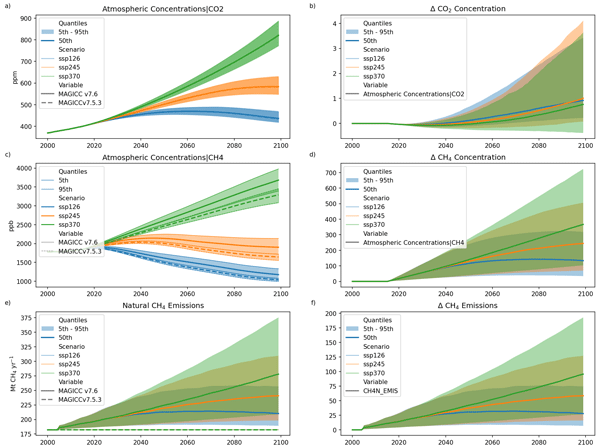
High resolution models of the earth system exhibit some disagreement and uncertainty on future methane emissions from natural sources, in particular wetlands, with some studies predicting wetlands alone could be very significant sources over the 21st century. Modelling these emissions as a response to global temperature is one option for simple models to approximate the climate impact of wetlands. The effect is a small increase in overall temperatures and a widening of the uncertainty range.

Jiawei Jiang, Zhifeng Yan, Jinshi Jian, Jesper Riis Christiansen, Xinchu Wang, Ren-Min Yang, Zhen Zhang, and Philippe Ciais
Earth Syst. Sci. Data, 18, 6783–6797, https://doi.org/10.5194/essd-18-6783-2026, https://doi.org/10.5194/essd-18-6783-2026, 2026
Short summary
Short summary
Soil methane uptake represents the second-largest sink of atmospheric methane but the field observations have not yet been systematically compiled. Here, we compiled an open global soil methane uptake database from the 1980s, covering most regions in multi-timescale along with the soil moisture and temperature data. The data show strong seasonal changes and different controls across biomes, helping improve climate estimates, models, and satellite evaluations.
Anthony Campbell, Lauren Potyk, and Benjamin Poulter
Atmos. Meas. Tech., 19, 5603–5615, https://doi.org/10.5194/amt-19-5603-2026, https://doi.org/10.5194/amt-19-5603-2026, 2026
Short summary
Short summary
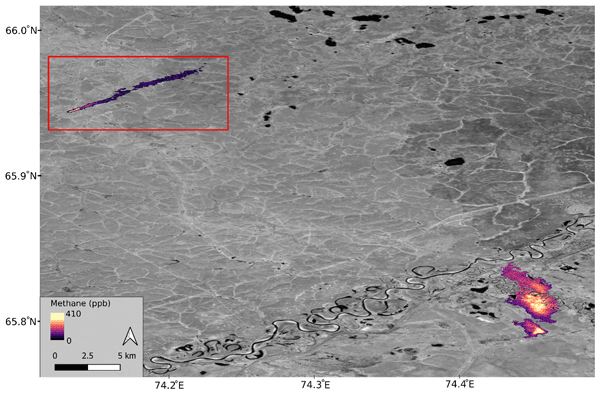
CH4 observations from space are an essential component for improving our estimates of CH4 emissions from fossil fuels and natural sources. We utilized GHGSat, a CH4 plume mapping satellite constellation, to update the fossil fuel emission inventory in the Western Siberian Lowlands to understand how including plume observations in models changes emissions estimates. Our approach resulted in a reduction in CH4 emissions attributed to wetlands.
Xiaoying Shi, Daniel M. Ricciuto, Yaoping Wang, Joe R. Melton, Fortunat Joos, Yiqi Luo, Xiaofeng Xu, Dafeng Hui, Qianlai Zhuang, Chunjing Qiu, Hongxing He, Siya Shao, Xingjie Lu, Yongjiu Dai, Akihiko Ito, Qing Sun, Nitin Chaudhary, Ayesha Hussain, Mousong Wu, Jian Zhou, Jingwei Zhang, Ye Yuan, Rachael H. Turton, Eleanor J. Burke, Jiafu Mao, Yuefeng Hao, Natalie A. Griffiths, Verity Salmon, Paul J. Hanson, Melanie A. Mayes, and Peter E. Thornton
EGUsphere, https://doi.org/10.5194/egusphere-2026-5193, https://doi.org/10.5194/egusphere-2026-5193, 2026
This preprint is open for discussion and under review for Biogeosciences (BG).
Short summary
Short summary
Northern peatlands store vast amounts of carbon, but their response to climate change remains uncertain. We compared 15 ecosystem models with observations from a long-term warming and elevated carbon dioxide experiment in Minnesota. Models differed widely in their carbon responses, reflecting differences in ecosystem processes and model parameters. The results identify priorities for improving peatland models and projections of future carbon–climate feedbacks.
Hui Li, Philippe Ciais, Frédéric Chevallier, Bo Zheng, Paul I. Palmer, Frank Hase, Morgan Lopez, Elsa M. Ordway, Shushi Peng, Danielle Monteverde, Michel Ramonet, Jason M. St. Clair, Le Bienfaiteur Sagang, and Benjamin Poulter
Atmos. Chem. Phys., 26, 11893–11908, https://doi.org/10.5194/acp-26-11893-2026, https://doi.org/10.5194/acp-26-11893-2026, 2026
Short summary
Short summary
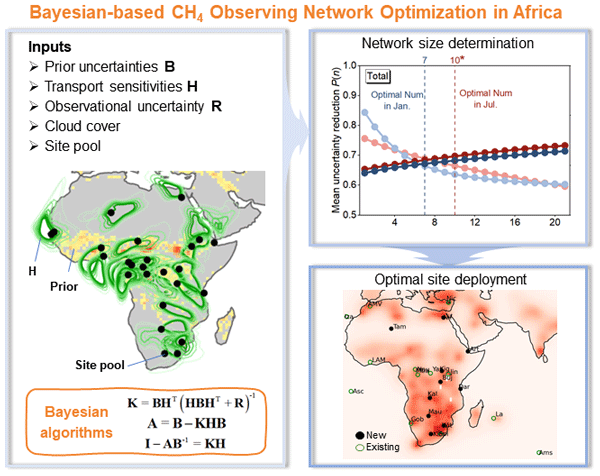
We studied how to best place methane monitoring instruments across Africa to better understand where emissions come from. Because observations can overlap in what they detect, adding more sites does not always improve results equally. Using a statistical approach, we identified both the ideal number and locations of sites (ten new sites can reduce emission uncertainty by over 65 % for total African CH4). Our results help guide cost-effective monitoring strategies in regions with limited data.
Matthew L. Loman, Lee T. Murray, Peter D. Ivatt, Róisín Commane, Andrew Hallward-Driemeier, Raghav Dhall, Eric M. Leibensperger, Nicholas Balasus, Lucas Estrada, Melissa P. Sulprizio, Maryann R. Sargent, and Felix Vogel
EGUsphere, https://doi.org/10.5194/egusphere-2026-3153, https://doi.org/10.5194/egusphere-2026-3153, 2026
Short summary
Short summary
We evaluate methane emissions and their trends in New York State based on observations of methane from 29 sites, including four new long-term sites. These observations are most sensitive to emissions in southeastern New York State, including New York City. We find regional trends and biases in some locations, including underestimated emissions in the New York City area. Our results also demonstrate that policy-relevant validation of methane emissions needs a combination of observation platforms.
Zeyu Wang, Jieyi Wang, Hanyu Liu, Ziting Huang, Kewei Liang, Feng Zhang, and Scot M. Miller
EGUsphere, https://doi.org/10.5194/egusphere-2026-4304, https://doi.org/10.5194/egusphere-2026-4304, 2026
Short summary
Short summary
We developed GenGHG, a globally applicable machine learning model that rapidly links satellite greenhouse gas observations to nearby surface emissions. Its generative design represents stochastic atmospheric transport, helping preserve transport structure close to physical references. It produces emission estimates close to full physical simulations and enables fast comparison of transport differences across weather products.
Nikola Besic, Philippe Ciais, Fa Li, Robert Jackson, Kunxiaojia Yuan, Shushi Peng, Benjamin Poulter, Zhen Zhang, and Qing Zhu
EGUsphere, https://doi.org/10.5194/egusphere-2026-2604, https://doi.org/10.5194/egusphere-2026-2604, 2026
This preprint is open for discussion and under review for Geoscientific Model Development (GMD).
Short summary
Short summary
Wetlands are the largest natural source of methane, an important greenhouse gas, but current estimates of their emissions remain highly uncertain because models often disagree. We combined field measurements from wetlands around the world with advanced statistical methods to identify where different models perform best. Our results show that accounting for regional differences in model skill can substantially change local methane estimates and potentially improve future climate assessments.
April Sue Dalton, Michelle Garneau, and Joe R. Melton
Earth Syst. Sci. Data Discuss., https://doi.org/10.5194/essd-2026-169, https://doi.org/10.5194/essd-2026-169, 2026
Preprint under review for ESSD
Short summary
Short summary
Canadian peatlands store about 25 % of the world’s peat carbon. To better estimate this carbon, we compiled two large datasets: 88,763 peat-depth measurements from 844 sources and 436,923 locations where no peat was found. These data span nearly 100 years of studies and include many newly digitized records.
Mengze Li, Robert B. Jackson, Marielle Saunois, Philippe Ciais, Ben Poulter, Josep G. Canadell, Prabir K. Patra, Hanqin Tian, Zhen Zhang, Etienne Fluet-Chouinard, Zutao Ouyang, Ting Zhang, David J. Beerling, Dmitry A. Belikov, Philippe Bousquet, Danilo Custodio, Naveen Chandra, Xinyu Dou, Nicola Gedney, Peter O. Hopcroft, Alison M. Hoyt, Kazuhito Ichii, Akihito Ito, Atul K. Jain, Katherine Jensen, Fortunat Joos, Thomas Kleinen, Masayuki Kondo, Fa Li, Tingting Li, Xiangyu Liu, Shamil Maksyutov, Avni Malhotra, Adrien Martinez, Kyle McDonald, Joe R. Melton, Jurek Müller, Yosuke Niwa, Shufen Pan, Shushi Peng, Changhui Peng, Zhangcai Qin, Peter Raymond, William Riley, Arjo Segers, Rona L. Thompson, Aki Tsuruta, Yi Xi, Kunxiaojia Yuan, Wenxin Zhang, Bo Zheng, Qing Zhu, Qiuan Zhu, and Qianlai Zhuang
Earth Syst. Sci. Data, 18, 3507–3524, https://doi.org/10.5194/essd-18-3507-2026, https://doi.org/10.5194/essd-18-3507-2026, 2026
Short summary
Short summary
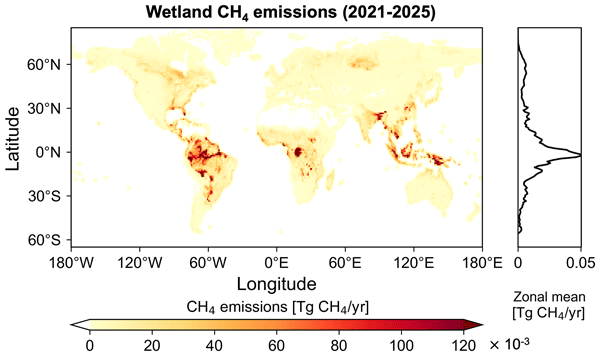
We proposed a framework that combines machine-learning and climate data to predict global natural vegetated wetland methane emissions for 2000–2025. We found that although total global emissions remained stable in the post-2020s, Northern Hemisphere emissions surged whilst tropical emissions fell. This approach allows us to rapidly monitor emissions and provides early warnings for climate impacts.
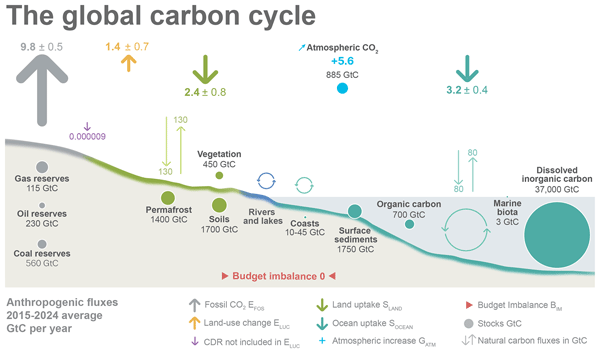
Pierre Friedlingstein, Michael O'Sullivan, Matthew W. Jones, Robbie M. Andrew, Dorothee C. E. Bakker, Judith Hauck, Peter Landschützer, Corinne Le Quéré, Hongmei Li, Ingrid T. Luijkx, Glen P. Peters, Wouter Peters, Julia Pongratz, Clemens Schwingshackl, Stephen Sitch, Josep G. Canadell, Philippe Ciais, Kjetil Aas, Simone R. Alin, Peter Anthoni, Leticia Barbero, Nicholas R. Bates, Nicolas Bellouin, Alice Benoit-Cattin, Carla F. Berghoff, Raffaele Bernardello, Laurent Bopp, Ida Bagus Mandhara Brasika, Matthew A. Chamberlain, Naveen Chandra, Frédéric Chevallier, Louise P. Chini, Nathan O. Collier, Thomas H. Colligan, Margot Cronin, Laique M. Djeutchouang, Xinyu Dou, Matt P. Enright, Kazutaka Enyo, Michael Erb, Wiley Evans, Richard A. Feely, Liang Feng, Daniel J. Ford, Adrianna Foster, Filippa Fransner, Thomas Gasser, Marion Gehlen, Thanos Gkritzalis, Jefferson Goncalves De Souza, Giacomo Grassi, Luke Gregor, Nicolas Gruber, Bertrand Guenet, Özgür Gürses, Kirsty Harrington, Ian Harris, Jens Heinke, George C. Hurtt, Yosuke Iida, Tatiana Ilyina, Akihiko Ito, Andrew R. Jacobson, Atul K. Jain, Tereza Jarníková, Annika Jersild, Fei Jiang, Steve D. Jones, Etsushi Kato, Ralph F. Keeling, Kees Klein Goldewijk, Jürgen Knauer, Yawen Kong, Jan Ivar Korsbakken, Charles Koven, Taro Kunimitsu, Xin Lan, Junjie Liu, Zhiqiang Liu, Zhu Liu, Claire Lo Monaco, Lei Ma, Gregg Marland, Patrick C. McGuire, Galen A. McKinley, Joe R. Melton, Natalie Monacci, Erwan Monier, Eric J. Morgan, David R. Munro, Jens D. Müller, Shin-Ichiro Nakaoka, Lorna R. Nayagam, Yosuke Niwa, Tobias Nutzel, Are Olsen, Abdirahman M. Omar, Naiqing Pan, Sudhanshu Pandey, Denis Pierrot, Zhangcai Qin, Pierre Regnier, Gregor Rehder, Laure Resplandy, Alizée Roobaert, Thais M. Rosan, Christian Rödenbeck, Jörg Schwinger, Ingunn Skjelvan, T. Luke Smallman, Victoria Spada, Mohanan G. Sreeush, Qing Sun, Adrienne J. Sutton, Colm Sweeney, Didier Swingedouw, Roland Séférian, Shintaro Takao, Hiroaki Tatebe, Hanqin Tian, Xiangjun Tian, Bronte Tilbrook, Hiroyuki Tsujino, Francesco Tubiello, Erik van Ooijen, Guido R. van der Werf, Sebastiaan J. van de Velde, Anthony P. Walker, Rik Wanninkhof, Xiaojuan Yang, Wenping Yuan, Xu Yue, and Jiye Zeng
Earth Syst. Sci. Data, 18, 3211–3288, https://doi.org/10.5194/essd-18-3211-2026, https://doi.org/10.5194/essd-18-3211-2026, 2026
Short summary
Short summary
The Global Carbon Budget 2025 describes the methodology, main results, and datasets used to quantify the anthropogenic emissions of carbon dioxide (CO2) and their partitioning among the atmosphere, land ecosystems, and the ocean over the historical period (1750–2025). These living datasets are updated every year to provide the highest transparency and traceability in the reporting of CO2, the key driver of climate change.
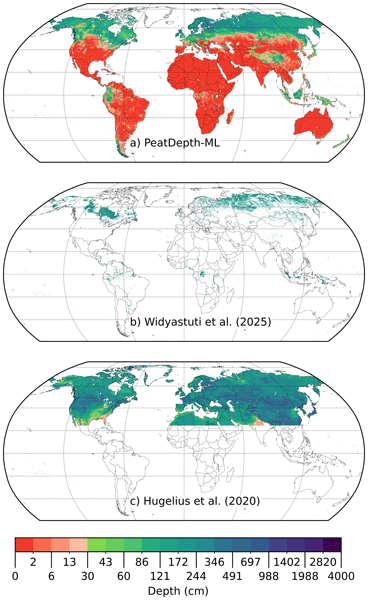
Jade Skye, Joe R. Melton, Colin Goldblatt, Angela Gallego-Sala, Michelle Garneau, and Scott Winton
Biogeosciences, 23, 2959–2983, https://doi.org/10.5194/bg-23-2959-2026, https://doi.org/10.5194/bg-23-2959-2026, 2026
Short summary
Short summary
We developed PeatDepth-ML, a machine learning model predicting peat depth worldwide to help estimate carbon stocks in these climate-critical ecosystems. Our model predicts median depths of 134 cm in peatlands. Using bootstrapping, we rigorously assessed how sampling bias affects predictions. This revealed predictor selection and regional accuracy can vary greatly with different data subsets, demonstrating model reliability fundamentally depends on training data quality and geographic coverage.
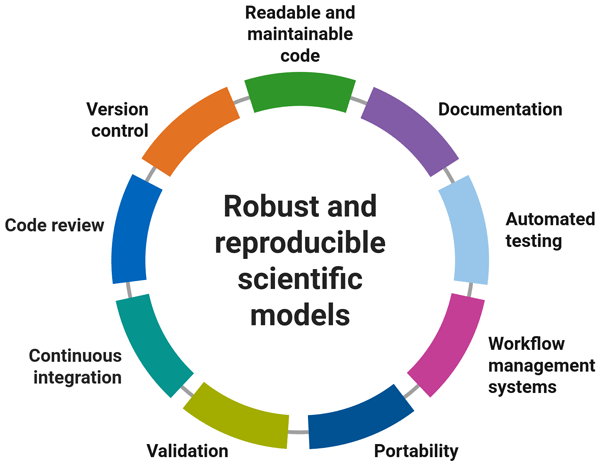
Konstantin Gregor, Benjamin F. Meyer, Tillmann Gaida, Victor Justo Vasquez, Karina Bett-Williams, Matthew Forrest, João P. Darela-Filho, Sam Rabin, Marcos Longo, Joe R. Melton, Johan Nord, Peter Anthoni, Vladislav Bastrikov, Thomas Colligan, Christine Delire, Michael C. Dietze, George Hurtt, Akihiko Ito, Lasse T. Keetz, Jürgen Knauer, Johannes Köster, Tzu-Shun Lin, Lei Ma, Marie Minvielle, Stefan Olin, Sebastian Ostberg, Hao Shi, Reiner Schnur, Qing Sun, Peter E. Thornton, and Anja Rammig
Geosci. Model Dev., 19, 2407–2436, https://doi.org/10.5194/gmd-19-2407-2026, https://doi.org/10.5194/gmd-19-2407-2026, 2026
Short summary
Short summary
Geoscientific models are crucial for understanding Earth’s processes. However, they sometimes do not adhere to highest software quality standards, and scientific results are often hard to reproduce due to the complexity of the workflows. Here we gather the expertise of 20 modeling groups and software engineers to define best practices for making geoscientific models maintainable, usable, and reproducible. We conclude with an open-source example serving as a reference for modeling communities.
Shengxi Bai, Huilin Chen, Zhen Zhang, Shushi Peng, Fei Jiang, Fei Li, Shuzhuang Feng, Yingqi Yan, Qidan Huang, and Yongguang Zhang
EGUsphere, https://doi.org/10.5194/egusphere-2025-4610, https://doi.org/10.5194/egusphere-2025-4610, 2026
Short summary
Short summary
We examined methane emissions from coal mines in Shanxi Province, China’s major coal production region. Using satellite observations and advanced analysis, we found that rare but very large methane releases play a major role in total emissions. Policies to cut coal capacity initially reduced methane, but emissions rose again with production recovery. Our findings improve understanding of how energy policies affect climate pollution and offer a framework for better methane monitoring worldwide.
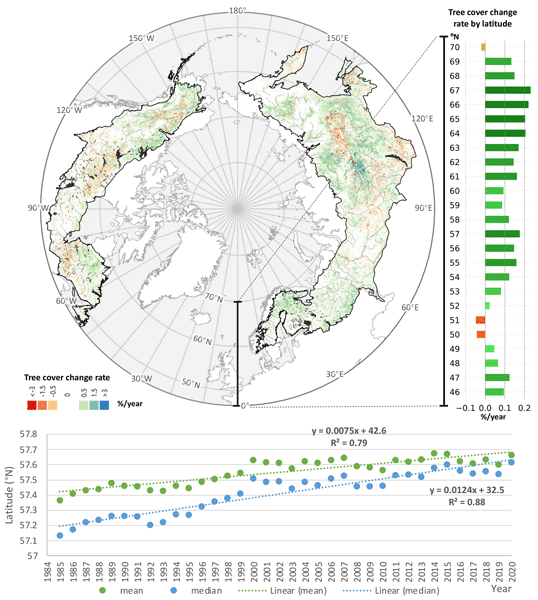
Min Feng, Joseph O. Sexton, Panshi Wang, Paul M. Montesano, Leonardo Calle, Nuno Carvalhais, Benjamin Poulter, Matthew J. Macander, Michael A. Wulder, Margaret Wooten, William Wagner, Akiko Elders, Saurabh Channan, and Christopher S. R. Neigh
Biogeosciences, 23, 1089–1101, https://doi.org/10.5194/bg-23-1089-2026, https://doi.org/10.5194/bg-23-1089-2026, 2026
Short summary
Short summary
Analysis of 36 years of satellite tree cover data provide the first comprehensive confirmation of the northward advance of the boreal forest. Boreal tree cover expanded by 0.84 million km² (12%) from 1985 to 2020 and shifted northward by 0.43°. Gains outpaced losses across most latitudes, confirming a biome-wide poleward shift. Young forests now comprise 15% of the area of the world’s largest forest biome, storing 1–6 Pg C and potentially sequestering an additional 2–4 Pg C as they mature.
Shoma Yamanouchi, Sebastien Ars, Meghan Flood, Lawson Gillespie, Jordan Stuart, Kiran Ramlogan, and Felix Vogel
EGUsphere, https://doi.org/10.5194/egusphere-2025-5086, https://doi.org/10.5194/egusphere-2025-5086, 2026
Short summary
Short summary
Methane is a potent greenhouse gas. In this study, Gaussian plume model, a simple, computationally inexpensive modeling method, was used in conjunction with measurements of atmospheric methane concentrations to estimate emissions of methane from refineries and waste treatment facilities. This study also presents novel methods to improve the model, including a method to better describe the atmosphere, as well as an algorithmic way to nudge source locations to get better emission estimates.
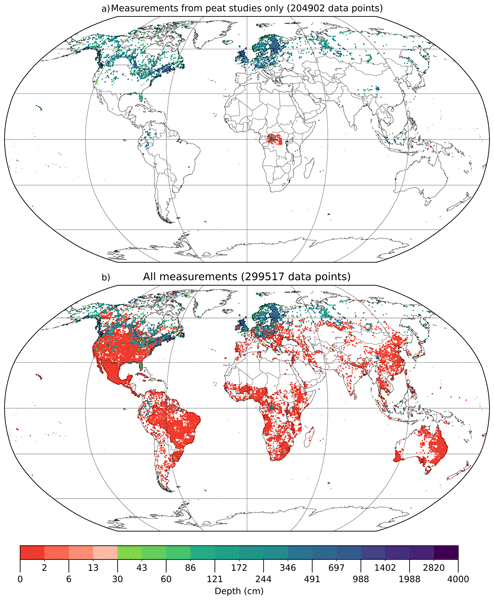
Jade Skye, Joe R. Melton, Colin Goldblatt, Louis Saumier, Angela Gallego-Sala, Michelle Garneau, R. Scott Winton, Erick B. Bahati, Juan C. Benavides, Lee Fedorchuk, Gérard Imani, Carol Kagaba Kairumba, Frank Kansiime, Mariusz Lamentowicz, Michel Mbasi, Daria Wochal, Sambor Czerwiński, Jacek Landowski, Joanna Landowska, Vincent Maire, Minna M. Väliranta, Matthew Warren, Lydia E. S. Cole, Marissa A. Davies, Erik A. Lilleskov, Jingjing Sun, and Yuwan Wang
Earth Syst. Sci. Data, 17, 7313–7330, https://doi.org/10.5194/essd-17-7313-2025, https://doi.org/10.5194/essd-17-7313-2025, 2025
Short summary
Short summary
Peatlands are large stores of carbon but are vulnerable to human activities and climate change. Comprehensive peatland data are vital to understand these ecosystems, but existing datasets are fragmented and contain errors. To address this, we created Peat-DBase – a standardized global database of peat depth measurements with > 200 000 measurements worldwide, showing median depths of 130 cm. Peat-DBase avoids overlapping data compilation efforts while identifying critical observational gaps.
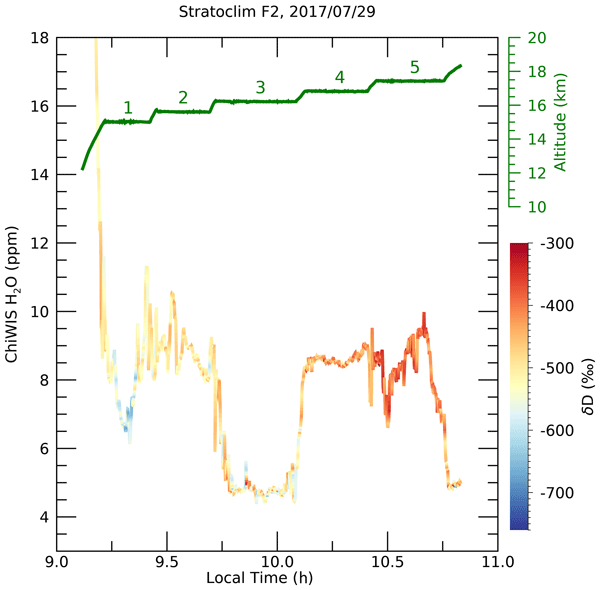
Benjamin W. Clouser, Laszlo C. Sarkozy, Clare E. Singer, Carly C. KleinStern, Adrien Desmoulin, Dylan Gaeta, Sergey Khaykin, Stephen Gabbard, Stephen Shertz, and Elisabeth J. Moyer
Atmos. Meas. Tech., 18, 6465–6491, https://doi.org/10.5194/amt-18-6465-2025, https://doi.org/10.5194/amt-18-6465-2025, 2025
Short summary
Short summary
The water molecule comes in several different varieties, which are nearly indistinguishable in daily life. However, slight differences between the water molecule types can be exploited to achieve better scientific understanding of parts of Earth's atmosphere. In this work we describe the design, construction, and operation of an instrument meant to measure these molecules aboard research aircraft up to altitudes of 20 km.
Scott D. Chambers, Ute Karstens, Alan D. Griffiths, Stefan Röttger, Arnoud Frumau, Christopher T. Roulston, Peter Sperlich, Felix Vogel, Agnieszka Podstawczyńska, Dafina Kikaj, Maksym Gachkivskyi, Michel Ramonet, Blagoj Mitrevski, Janja Vaupotič, Xuemeng Chen, and Annette Röttger
EGUsphere, https://doi.org/10.5194/egusphere-2025-5042, https://doi.org/10.5194/egusphere-2025-5042, 2025
Short summary
Short summary
The Radon Tracer Method (RTM) is a top-down approach to estimate greenhouse gas emissions. While simple in principle, incorrect use can complicate interpretation of results. Based on observations from a range of contrasting sites, this article reviews the underlying assumptions and key considerations for applying the RTM. It also introduces the concept of coupling RTM analyses with nocturnal stability classification, to reduce uncertainty of fetch estimates and improve interpretation of results.
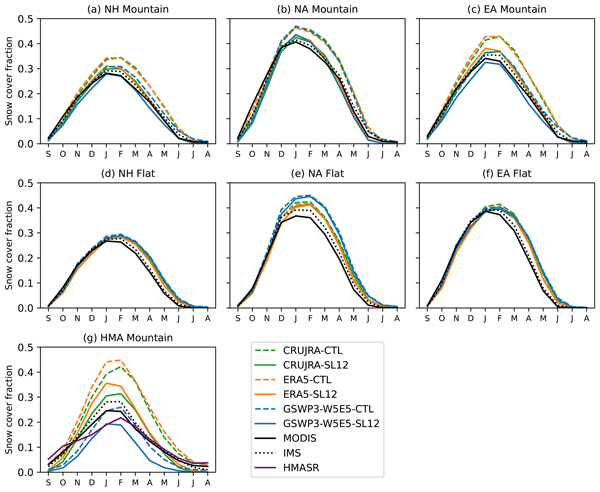
Libo Wang, Lawrence Mudryk, Joe R. Melton, Colleen Mortimer, Jason Cole, Gesa Meyer, Paul Bartlett, and Mickaël Lalande
Geosci. Model Dev., 18, 6597–6621, https://doi.org/10.5194/gmd-18-6597-2025, https://doi.org/10.5194/gmd-18-6597-2025, 2025
Short summary
Short summary
This study shows that an alternate snow cover fraction parameterization significantly improves snow simulation by CLASSIC in mountainous areas for all three choices of meteorological datasets. Annual mean bias, unbiased root mean squared area, and correlation improve by 75 %, 32 %, and 7 % when evaluated with MODIS observations over the Northern Hemisphere. We also link relative biases in the meteorological forcing data to differences in simulated snow water equivalent and snow cover fraction.
Rubaya Pervin, Scott Robeson, Mallory Barnes, Stephen Sitch, Anthony Walker, Ben Poulter, Fabienne Maignan, Qing Sun, Thomas Colligan, Sönke Zaehle, Kashif Mahmud, Peter Anthoni, Almut Arneth, Vivek Arora, Vladislav Bastrikov, Liam Bogucki, Bertrand Decharme, Christine Delire, Stefanie Falk, Akihiko Ito, Etsushi Kato, Daniel Kennedy, Jürgen Knauer, Michael O’Sullivan, Wenping Yuan, and Natasha MacBean
EGUsphere, https://doi.org/10.5194/egusphere-2025-2841, https://doi.org/10.5194/egusphere-2025-2841, 2025
Short summary
Short summary
Drylands contribute more than a third of the global vegetation productivity. Yet, these regions are not well represented in global vegetation models. Here, we tested how well 15 global models capture annual changes in dryland vegetation productivity. Models that didn’t have vegetation change over time or fire have lower variability in vegetation productivity. Models need better representation of grass cover types and their coverage. Our work highlights where and how these models need to improve.
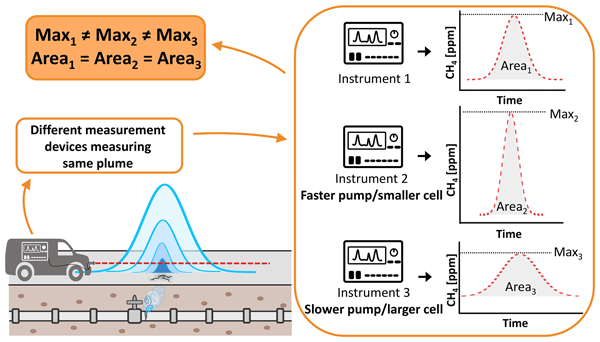
Judith Tettenborn, Daniel Zavala-Araiza, Daan Stroeken, Hossein Maazallahi, Carina van der Veen, Arjan Hensen, Ilona Velzeboer, Pim van den Bulk, Felix Vogel, Lawson Gillespie, Sebastien Ars, James France, David Lowry, Rebecca Fisher, and Thomas Röckmann
Atmos. Meas. Tech., 18, 3569–3584, https://doi.org/10.5194/amt-18-3569-2025, https://doi.org/10.5194/amt-18-3569-2025, 2025
Short summary
Short summary
Measurements of methane with vehicle-based sensors are an effective method to identify and quantify leaks from urban gas distribution systems. We deliberately released methane in different environments and calibrated the response of different methane analysers when they transected the plumes in a vehicle. We derived an improved statistical function for consistent emission estimations using different instruments. Repeated transects reduce the uncertainty in emission rate estimates.
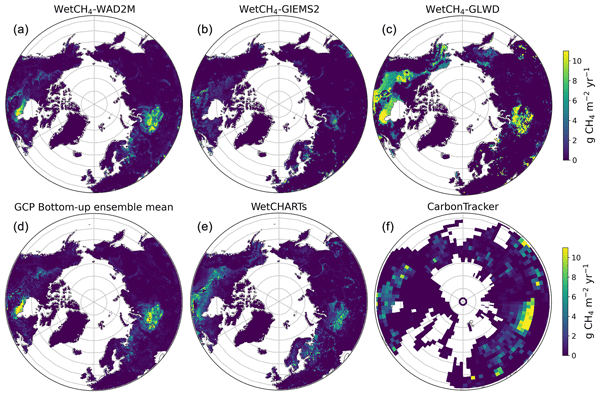
Qing Ying, Benjamin Poulter, Jennifer D. Watts, Kyle A. Arndt, Anna-Maria Virkkala, Lori Bruhwiler, Youmi Oh, Brendan M. Rogers, Susan M. Natali, Hilary Sullivan, Amanda Armstrong, Eric J. Ward, Luke D. Schiferl, Clayton D. Elder, Olli Peltola, Annett Bartsch, Ankur R. Desai, Eugénie Euskirchen, Mathias Göckede, Bernhard Lehner, Mats B. Nilsson, Matthias Peichl, Oliver Sonnentag, Eeva-Stiina Tuittila, Torsten Sachs, Aram Kalhori, Masahito Ueyama, and Zhen Zhang
Earth Syst. Sci. Data, 17, 2507–2534, https://doi.org/10.5194/essd-17-2507-2025, https://doi.org/10.5194/essd-17-2507-2025, 2025
Short summary
Short summary
We present daily methane (CH4) fluxes of northern wetlands at 10 km resolution during 2016–2022 (WetCH4) derived from a novel machine learning framework. We estimated an average annual CH4 emission of 22.8 ± 2.4 Tg CH4 yr−1 (15.7–51.6 Tg CH4 yr−1). Emissions were intensified in 2016, 2020, and 2022, with the largest interannual variation coming from Western Siberia. Continued, all-season tower observations and improved soil moisture products are needed for future improvement of CH4 upscaling.
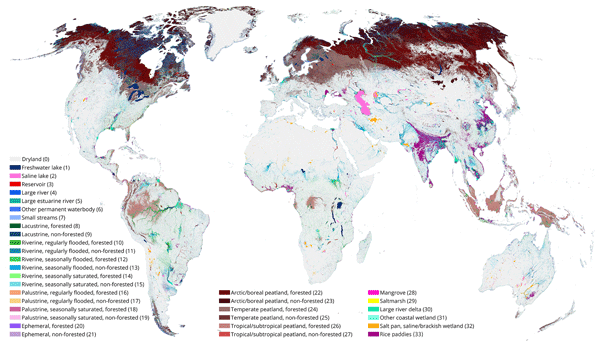
Bernhard Lehner, Mira Anand, Etienne Fluet-Chouinard, Florence Tan, Filipe Aires, George H. Allen, Philippe Bousquet, Josep G. Canadell, Nick Davidson, Meng Ding, C. Max Finlayson, Thomas Gumbricht, Lammert Hilarides, Gustaf Hugelius, Robert B. Jackson, Maartje C. Korver, Liangyun Liu, Peter B. McIntyre, Szabolcs Nagy, David Olefeldt, Tamlin M. Pavelsky, Jean-Francois Pekel, Benjamin Poulter, Catherine Prigent, Jida Wang, Thomas A. Worthington, Dai Yamazaki, Xiao Zhang, and Michele Thieme
Earth Syst. Sci. Data, 17, 2277–2329, https://doi.org/10.5194/essd-17-2277-2025, https://doi.org/10.5194/essd-17-2277-2025, 2025
Short summary
Short summary
The Global Lakes and Wetlands Database (GLWD) version 2 distinguishes a total of 33 non-overlapping wetland classes, providing a static map of the world’s inland surface waters. It contains cell fractions of wetland extents per class at a grid cell resolution of ~500 m. The total combined extent of all classes including all inland and coastal waterbodies and wetlands of all inundation frequencies – that is, the maximum extent – covers 18.2 × 10⁶ km2, equivalent to 13.4 % of total global land area.
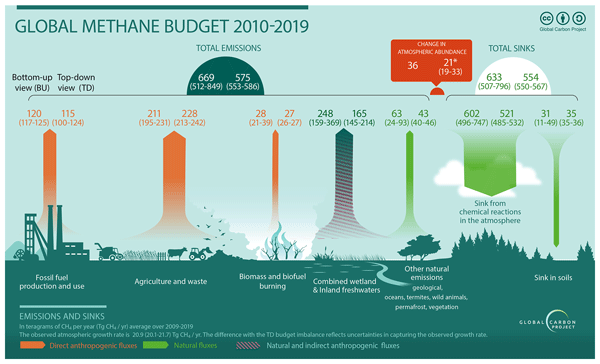
Marielle Saunois, Adrien Martinez, Benjamin Poulter, Zhen Zhang, Peter A. Raymond, Pierre Regnier, Josep G. Canadell, Robert B. Jackson, Prabir K. Patra, Philippe Bousquet, Philippe Ciais, Edward J. Dlugokencky, Xin Lan, George H. Allen, David Bastviken, David J. Beerling, Dmitry A. Belikov, Donald R. Blake, Simona Castaldi, Monica Crippa, Bridget R. Deemer, Fraser Dennison, Giuseppe Etiope, Nicola Gedney, Lena Höglund-Isaksson, Meredith A. Holgerson, Peter O. Hopcroft, Gustaf Hugelius, Akihiko Ito, Atul K. Jain, Rajesh Janardanan, Matthew S. Johnson, Thomas Kleinen, Paul B. Krummel, Ronny Lauerwald, Tingting Li, Xiangyu Liu, Kyle C. McDonald, Joe R. Melton, Jens Mühle, Jurek Müller, Fabiola Murguia-Flores, Yosuke Niwa, Sergio Noce, Shufen Pan, Robert J. Parker, Changhui Peng, Michel Ramonet, William J. Riley, Gerard Rocher-Ros, Judith A. Rosentreter, Motoki Sasakawa, Arjo Segers, Steven J. Smith, Emily H. Stanley, Joël Thanwerdas, Hanqin Tian, Aki Tsuruta, Francesco N. Tubiello, Thomas S. Weber, Guido R. van der Werf, Douglas E. J. Worthy, Yi Xi, Yukio Yoshida, Wenxin Zhang, Bo Zheng, Qing Zhu, Qiuan Zhu, and Qianlai Zhuang
Earth Syst. Sci. Data, 17, 1873–1958, https://doi.org/10.5194/essd-17-1873-2025, https://doi.org/10.5194/essd-17-1873-2025, 2025
Short summary
Short summary
Methane (CH4) is the second most important human-influenced greenhouse gas in terms of climate forcing after carbon dioxide (CO2). A consortium of multi-disciplinary scientists synthesise and update the budget of the sources and sinks of CH4. This edition benefits from important progress in estimating emissions from lakes and ponds, reservoirs, and streams and rivers. For the 2010s decade, global CH4 emissions are estimated at 575 Tg CH4 yr-1, including ~65 % from anthropogenic sources.
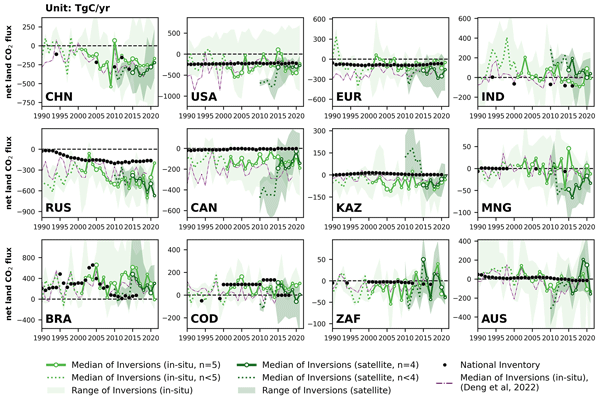
Zhu Deng, Philippe Ciais, Liting Hu, Adrien Martinez, Marielle Saunois, Rona L. Thompson, Kushal Tibrewal, Wouter Peters, Brendan Byrne, Giacomo Grassi, Paul I. Palmer, Ingrid T. Luijkx, Zhu Liu, Junjie Liu, Xuekun Fang, Tengjiao Wang, Hanqin Tian, Katsumasa Tanaka, Ana Bastos, Stephen Sitch, Benjamin Poulter, Clément Albergel, Aki Tsuruta, Shamil Maksyutov, Rajesh Janardanan, Yosuke Niwa, Bo Zheng, Joël Thanwerdas, Dmitry Belikov, Arjo Segers, and Frédéric Chevallier
Earth Syst. Sci. Data, 17, 1121–1152, https://doi.org/10.5194/essd-17-1121-2025, https://doi.org/10.5194/essd-17-1121-2025, 2025
Short summary
Short summary
This study reconciles national greenhouse gas (GHG) inventories with updated atmospheric inversion results to evaluate discrepancies for three principal GHG fluxes at the national level. Compared to our previous study, new satellite-based CO2 inversions were included and an updated mask of managed lands was used, improving agreement for Brazil and Canada. The proposed methodology can be regularly applied as a check to assess the gap between top-down inversions and bottom-up inventories.
Tuula Aalto, Aki Tsuruta, Jarmo Mäkelä, Jurek Müller, Maria Tenkanen, Eleanor Burke, Sarah Chadburn, Yao Gao, Vilma Mannisenaho, Thomas Kleinen, Hanna Lee, Antti Leppänen, Tiina Markkanen, Stefano Materia, Paul A. Miller, Daniele Peano, Olli Peltola, Benjamin Poulter, Maarit Raivonen, Marielle Saunois, David Wårlind, and Sönke Zaehle
Biogeosciences, 22, 323–340, https://doi.org/10.5194/bg-22-323-2025, https://doi.org/10.5194/bg-22-323-2025, 2025
Short summary
Short summary
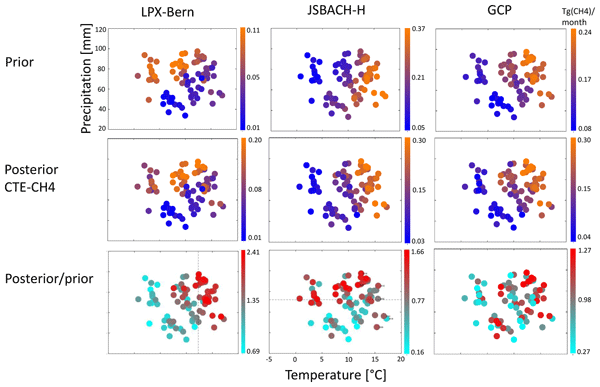
Wetland methane responses to temperature and precipitation were studied in a boreal wetland-rich region in northern Europe using ecosystem models, atmospheric inversions, and upscaled flux observations. The ecosystem models differed in their responses to temperature and precipitation and in their seasonality. However, multi-model means, inversions, and upscaled fluxes had similar seasonality, and they suggested co-limitation by temperature and precipitation.
Zhen Zhang, Benjamin Poulter, Joe R. Melton, William J. Riley, George H. Allen, David J. Beerling, Philippe Bousquet, Josep G. Canadell, Etienne Fluet-Chouinard, Philippe Ciais, Nicola Gedney, Peter O. Hopcroft, Akihiko Ito, Robert B. Jackson, Atul K. Jain, Katherine Jensen, Fortunat Joos, Thomas Kleinen, Sara H. Knox, Tingting Li, Xin Li, Xiangyu Liu, Kyle McDonald, Gavin McNicol, Paul A. Miller, Jurek Müller, Prabir K. Patra, Changhui Peng, Shushi Peng, Zhangcai Qin, Ryan M. Riggs, Marielle Saunois, Qing Sun, Hanqin Tian, Xiaoming Xu, Yuanzhi Yao, Yi Xi, Wenxin Zhang, Qing Zhu, Qiuan Zhu, and Qianlai Zhuang
Biogeosciences, 22, 305–321, https://doi.org/10.5194/bg-22-305-2025, https://doi.org/10.5194/bg-22-305-2025, 2025
Short summary
Short summary
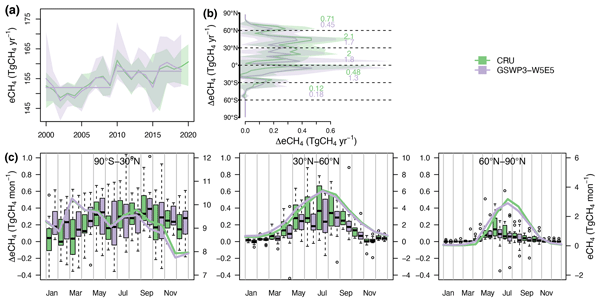
This study assesses global methane emissions from wetlands between 2000 and 2020 using multiple models. We found that wetland emissions increased by 6–7 Tg CH4 yr-1 in the 2010s compared to the 2000s. Rising temperatures primarily drove this increase, while changes in precipitation and CO2 levels also played roles. Our findings highlight the importance of wetlands in the global methane budget and the need for continuous monitoring to understand their impact on climate change.
Malena Sabaté Landman, Julianne Chung, Jiahua Jiang, Scot M. Miller, and Arvind K. Saibaba
Geosci. Model Dev., 17, 8853–8872, https://doi.org/10.5194/gmd-17-8853-2024, https://doi.org/10.5194/gmd-17-8853-2024, 2024
Short summary
Short summary
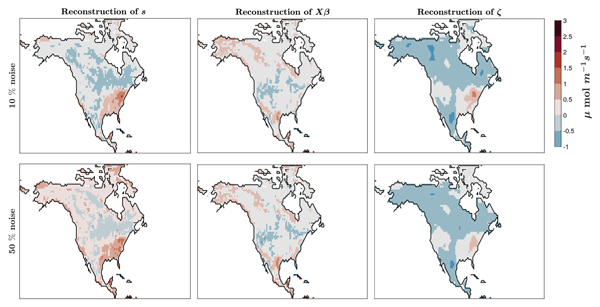
Making an informed decision about what prior information to incorporate or discard in an inverse model is important yet very challenging, as it is often not straightforward to distinguish between informative and non-informative variables. In this study, we develop a new approach for incorporating prior information in an inverse model using predictor variables, while simultaneously selecting the relevant predictor variables for the estimation of the unknown quantity of interest.
Misa Ishizawa, Douglas Chan, Doug Worthy, Elton Chan, Felix Vogel, Joe R. Melton, and Vivek K. Arora
Atmos. Chem. Phys., 24, 10013–10038, https://doi.org/10.5194/acp-24-10013-2024, https://doi.org/10.5194/acp-24-10013-2024, 2024
Short summary
Short summary
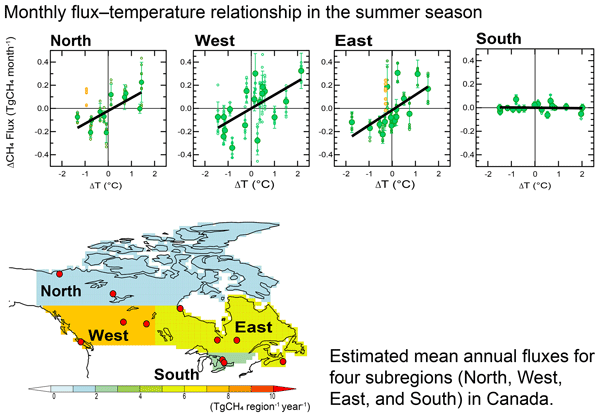
Methane (CH4) emissions in Canada for 2007–2017 were estimated using Canada’s surface greenhouse gas measurements. The estimated emissions show no significant trend, but emission uncertainty was reduced as more measurement sites became available. Notably for climate change, we find the wetland CH4 emissions show a positive correlation with surface air temperature in summer. Canada’s measurement network could monitor future CH4 emission changes and compliance with climate change mitigation goals.
Salvatore R. Curasi, Joe R. Melton, Elyn R. Humphreys, Txomin Hermosilla, and Michael A. Wulder
Geosci. Model Dev., 17, 2683–2704, https://doi.org/10.5194/gmd-17-2683-2024, https://doi.org/10.5194/gmd-17-2683-2024, 2024
Short summary
Short summary
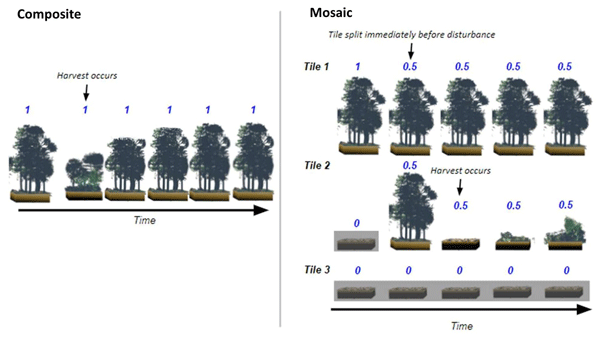
Canadian forests are responding to fire, harvest, and climate change. Models need to quantify these processes and their carbon and energy cycling impacts. We develop a scheme that, based on satellite records, represents fire, harvest, and the sparsely vegetated areas that these processes generate. We evaluate model performance and demonstrate the impacts of disturbance on carbon and energy cycling. This work has implications for land surface modeling and assessing Canada’s terrestrial C cycle.
Pramod Kumar, Christopher Caldow, Grégoire Broquet, Adil Shah, Olivier Laurent, Camille Yver-Kwok, Sebastien Ars, Sara Defratyka, Susan Warao Gichuki, Luc Lienhardt, Mathis Lozano, Jean-Daniel Paris, Felix Vogel, Caroline Bouchet, Elisa Allegrini, Robert Kelly, Catherine Juery, and Philippe Ciais
Atmos. Meas. Tech., 17, 1229–1250, https://doi.org/10.5194/amt-17-1229-2024, https://doi.org/10.5194/amt-17-1229-2024, 2024
Short summary
Short summary
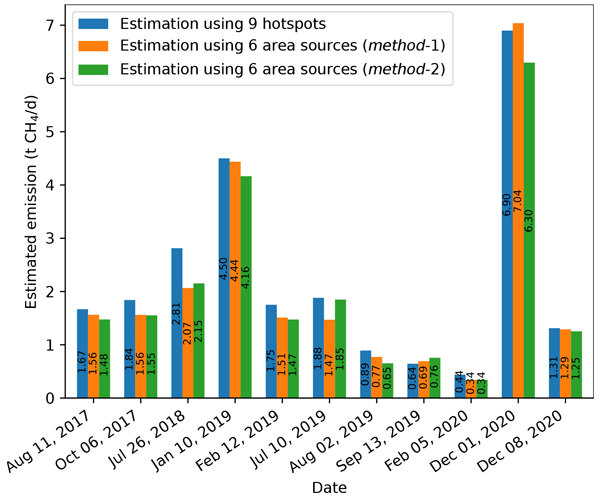
This study presents a series of mobile measurement campaigns to monitor the CH4 emissions from an active landfill. These measurements are processed using a Gaussian plume model and atmospheric inversion techniques to quantify the landfill CH4 emissions. The methane emission estimates range between ~0.4 and ~7 t CH4 per day, and their variations are analyzed. The robustness of the estimates is assessed depending on the distance of the measurements from the potential sources in the landfill.
Jonathan Hobbs, Matthias Katzfuss, Hai Nguyen, Vineet Yadav, and Junjie Liu
Geosci. Model Dev., 17, 1133–1151, https://doi.org/10.5194/gmd-17-1133-2024, https://doi.org/10.5194/gmd-17-1133-2024, 2024
Short summary
Short summary
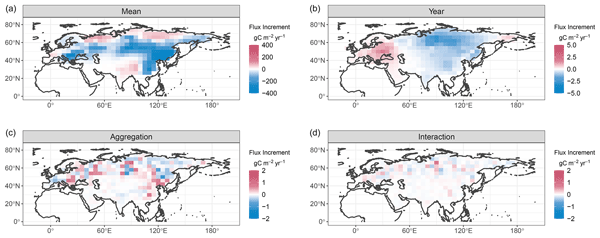
The cycling of carbon among the land, oceans, and atmosphere is a closely monitored process in the global climate system. These exchanges between the atmosphere and the surface can be quantified using a combination of atmospheric carbon dioxide observations and computer models. This study presents a statistical method for investigating the similarities and differences in the estimated surface–atmosphere carbon exchange when different computer model assumptions are invoked.
Douglas E. J. Worthy, Michele K. Rauh, Lin Huang, Felix R. Vogel, Alina Chivulescu, Kenneth A. Masarie, Ray L. Langenfelds, Paul B. Krummel, Colin E. Allison, Andrew M. Crotwell, Monica Madronich, Gabrielle Pétron, Ingeborg Levin, Samuel Hammer, Sylvia Michel, Michel Ramonet, Martina Schmidt, Armin Jordan, Heiko Moossen, Michael Rothe, Ralph Keeling, and Eric J. Morgan
Atmos. Meas. Tech., 16, 5909–5935, https://doi.org/10.5194/amt-16-5909-2023, https://doi.org/10.5194/amt-16-5909-2023, 2023
Short summary
Short summary
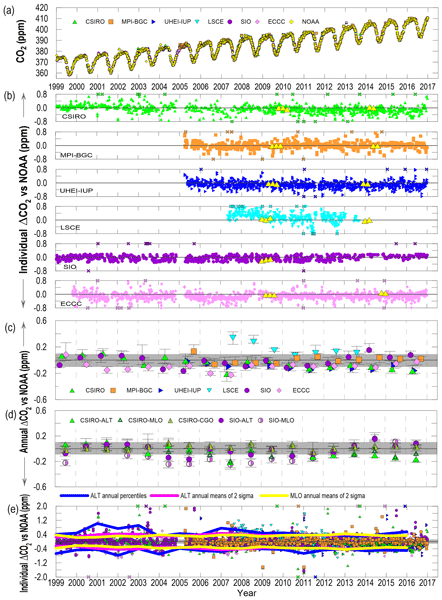
Network compatibility is important for inferring greenhouse gas fluxes at global or regional scales. This study is the first assessment of the measurement agreement among seven individual programs within the World Meteorological Organization community. It compares co-located flask air measurements at the Alert Observatory in Canada over a 17-year period. The results provide stronger confidence in the uncertainty estimation while using those datasets in various data interpretation applications.
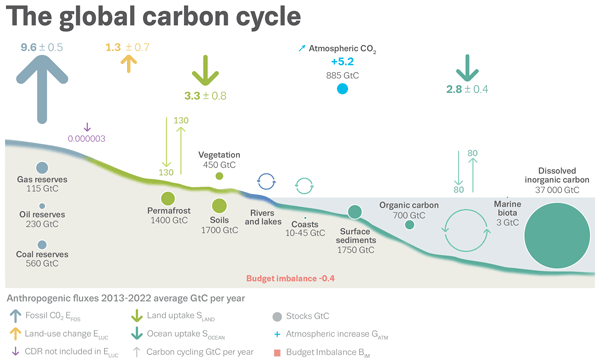
Pierre Friedlingstein, Michael O'Sullivan, Matthew W. Jones, Robbie M. Andrew, Dorothee C. E. Bakker, Judith Hauck, Peter Landschützer, Corinne Le Quéré, Ingrid T. Luijkx, Glen P. Peters, Wouter Peters, Julia Pongratz, Clemens Schwingshackl, Stephen Sitch, Josep G. Canadell, Philippe Ciais, Robert B. Jackson, Simone R. Alin, Peter Anthoni, Leticia Barbero, Nicholas R. Bates, Meike Becker, Nicolas Bellouin, Bertrand Decharme, Laurent Bopp, Ida Bagus Mandhara Brasika, Patricia Cadule, Matthew A. Chamberlain, Naveen Chandra, Thi-Tuyet-Trang Chau, Frédéric Chevallier, Louise P. Chini, Margot Cronin, Xinyu Dou, Kazutaka Enyo, Wiley Evans, Stefanie Falk, Richard A. Feely, Liang Feng, Daniel J. Ford, Thomas Gasser, Josefine Ghattas, Thanos Gkritzalis, Giacomo Grassi, Luke Gregor, Nicolas Gruber, Özgür Gürses, Ian Harris, Matthew Hefner, Jens Heinke, Richard A. Houghton, George C. Hurtt, Yosuke Iida, Tatiana Ilyina, Andrew R. Jacobson, Atul Jain, Tereza Jarníková, Annika Jersild, Fei Jiang, Zhe Jin, Fortunat Joos, Etsushi Kato, Ralph F. Keeling, Daniel Kennedy, Kees Klein Goldewijk, Jürgen Knauer, Jan Ivar Korsbakken, Arne Körtzinger, Xin Lan, Nathalie Lefèvre, Hongmei Li, Junjie Liu, Zhiqiang Liu, Lei Ma, Greg Marland, Nicolas Mayot, Patrick C. McGuire, Galen A. McKinley, Gesa Meyer, Eric J. Morgan, David R. Munro, Shin-Ichiro Nakaoka, Yosuke Niwa, Kevin M. O'Brien, Are Olsen, Abdirahman M. Omar, Tsuneo Ono, Melf Paulsen, Denis Pierrot, Katie Pocock, Benjamin Poulter, Carter M. Powis, Gregor Rehder, Laure Resplandy, Eddy Robertson, Christian Rödenbeck, Thais M. Rosan, Jörg Schwinger, Roland Séférian, T. Luke Smallman, Stephen M. Smith, Reinel Sospedra-Alfonso, Qing Sun, Adrienne J. Sutton, Colm Sweeney, Shintaro Takao, Pieter P. Tans, Hanqin Tian, Bronte Tilbrook, Hiroyuki Tsujino, Francesco Tubiello, Guido R. van der Werf, Erik van Ooijen, Rik Wanninkhof, Michio Watanabe, Cathy Wimart-Rousseau, Dongxu Yang, Xiaojuan Yang, Wenping Yuan, Xu Yue, Sönke Zaehle, Jiye Zeng, and Bo Zheng
Earth Syst. Sci. Data, 15, 5301–5369, https://doi.org/10.5194/essd-15-5301-2023, https://doi.org/10.5194/essd-15-5301-2023, 2023
Short summary
Short summary
The Global Carbon Budget 2023 describes the methodology, main results, and data sets used to quantify the anthropogenic emissions of carbon dioxide (CO2) and their partitioning among the atmosphere, land ecosystems, and the ocean over the historical period (1750–2023). These living datasets are updated every year to provide the highest transparency and traceability in the reporting of CO2, the key driver of climate change.
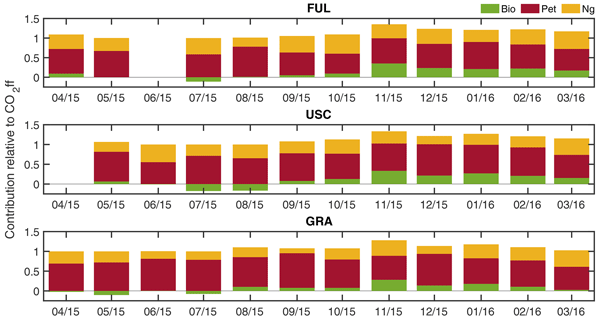
Jinsol Kim, John B. Miller, Charles E. Miller, Scott J. Lehman, Sylvia E. Michel, Vineet Yadav, Nick E. Rollins, and William M. Berelson
Atmos. Chem. Phys., 23, 14425–14436, https://doi.org/10.5194/acp-23-14425-2023, https://doi.org/10.5194/acp-23-14425-2023, 2023
Short summary
Short summary
In this study, we present the partitioning of CO2 signals from biogenic, petroleum and natural gas sources by combining CO, 13CO2 and 14CO2 measurements. Using measurements from flask air samples at three sites in the greater Los Angeles region, we find larger and positive contributions of biogenic signals in winter and smaller and negative contributions in summer. The largest contribution of natural gas combustion generally occurs in summer.
Lawson David Gillespie, Sébastien Ars, James Phillip Williams, Louise Klotz, Tianjie Feng, Stephanie Gu, Mishaal Kandapath, Amy Mann, Michael Raczkowski, Mary Kang, Felix Vogel, and Debra Wunch
Atmos. Meas. Tech. Discuss., https://doi.org/10.5194/amt-2023-193, https://doi.org/10.5194/amt-2023-193, 2023
Preprint withdrawn
Short summary
Short summary
We investigate techniques for calculating emissions from mobile in situ gas concentrations recorded during downwind plume transects. We find that using the enhancement area to estimate emissions is the most consistent method when comparing different setups and instruments. Observations from a multi year urban methane survey and controlled release experiment are analyzed, and emissions rates for combined sewage overflow basins and a large wastewater treatment plant in Toronto are calculated.
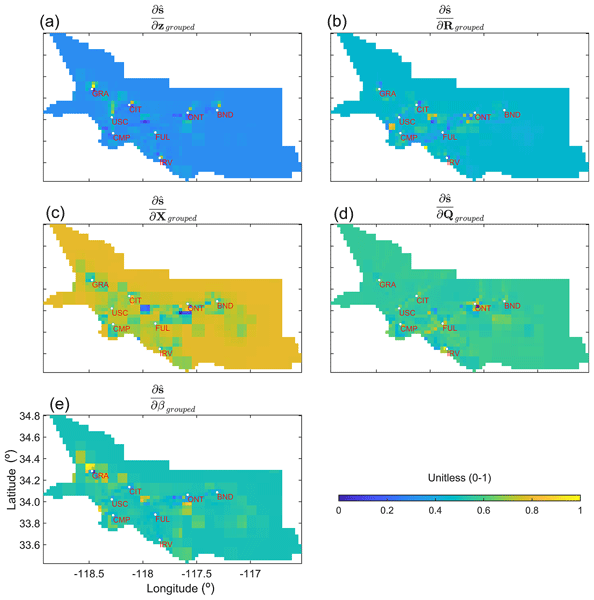
Vineet Yadav, Subhomoy Ghosh, and Charles E. Miller
Geosci. Model Dev., 16, 5219–5236, https://doi.org/10.5194/gmd-16-5219-2023, https://doi.org/10.5194/gmd-16-5219-2023, 2023
Short summary
Short summary
Measuring the performance of inversions in linear Bayesian problems is crucial in real-life applications. In this work, we provide analytical forms of the local and global sensitivities of the estimated fluxes with respect to various inputs. We provide methods to uniquely map the observational signal to spatiotemporal domains. Utilizing this, we also show techniques to assess correlations between the Jacobians that naturally translate to nonstationary covariance matrix components.
Bo Qu, Alexandre Roy, Joe R. Melton, Jennifer L. Baltzer, Youngryel Ryu, Matteo Detto, and Oliver Sonnentag
EGUsphere, https://doi.org/10.5194/egusphere-2023-1167, https://doi.org/10.5194/egusphere-2023-1167, 2023
Preprint archived
Short summary
Short summary
Accurately simulating photosynthesis and evapotranspiration challenges terrestrial biosphere models across North America’s boreal biome, in part due to uncertain representation of the maximum rate of photosynthetic carboxylation (Vcmax). This study used forest stand scale observations in an optimization framework to improve Vcmax values for representative vegetation types. Several stand characteristics well explained spatial Vcmax variability and were useful to improve boreal forest modelling.
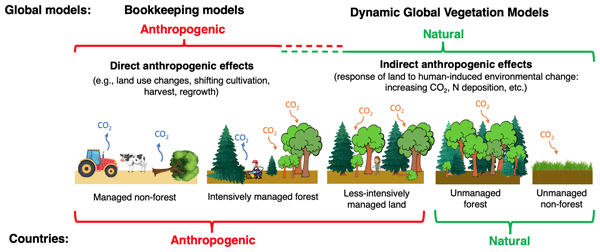
Giacomo Grassi, Clemens Schwingshackl, Thomas Gasser, Richard A. Houghton, Stephen Sitch, Josep G. Canadell, Alessandro Cescatti, Philippe Ciais, Sandro Federici, Pierre Friedlingstein, Werner A. Kurz, Maria J. Sanz Sanchez, Raúl Abad Viñas, Ramdane Alkama, Selma Bultan, Guido Ceccherini, Stefanie Falk, Etsushi Kato, Daniel Kennedy, Jürgen Knauer, Anu Korosuo, Joana Melo, Matthew J. McGrath, Julia E. M. S. Nabel, Benjamin Poulter, Anna A. Romanovskaya, Simone Rossi, Hanqin Tian, Anthony P. Walker, Wenping Yuan, Xu Yue, and Julia Pongratz
Earth Syst. Sci. Data, 15, 1093–1114, https://doi.org/10.5194/essd-15-1093-2023, https://doi.org/10.5194/essd-15-1093-2023, 2023
Short summary
Short summary
Striking differences exist in estimates of land-use CO2 fluxes between the national greenhouse gas inventories and the IPCC assessment reports. These differences hamper an accurate assessment of the collective progress under the Paris Agreement. By implementing an approach that conceptually reconciles land-use CO2 flux from national inventories and the global models used by the IPCC, our study is an important step forward for increasing confidence in land-use CO2 flux estimates.
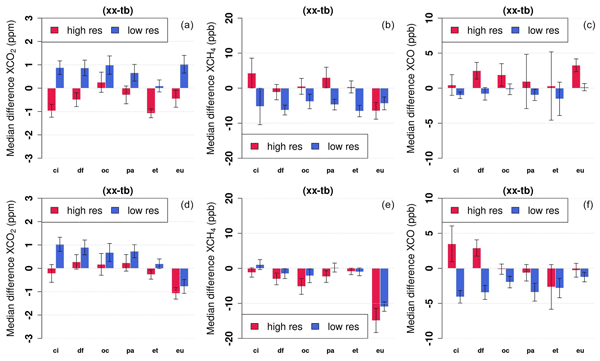
Nasrin Mostafavi Pak, Jacob K. Hedelius, Sébastien Roche, Liz Cunningham, Bianca Baier, Colm Sweeney, Coleen Roehl, Joshua Laughner, Geoffrey Toon, Paul Wennberg, Harrison Parker, Colin Arrowsmith, Joseph Mendonca, Pierre Fogal, Tyler Wizenberg, Beatriz Herrera, Kimberly Strong, Kaley A. Walker, Felix Vogel, and Debra Wunch
Atmos. Meas. Tech., 16, 1239–1261, https://doi.org/10.5194/amt-16-1239-2023, https://doi.org/10.5194/amt-16-1239-2023, 2023
Short summary
Short summary
Ground-based remote sensing instruments in the Total Carbon Column Observing Network (TCCON) measure greenhouse gases in the atmosphere. Consistency between TCCON measurements is crucial to accurately infer changes in atmospheric composition. We use portable remote sensing instruments (EM27/SUN) to evaluate biases between TCCON stations in North America. We also improve the retrievals of EM27/SUN instruments and evaluate the previous (GGG2014) and newest (GGG2020) retrieval algorithms.
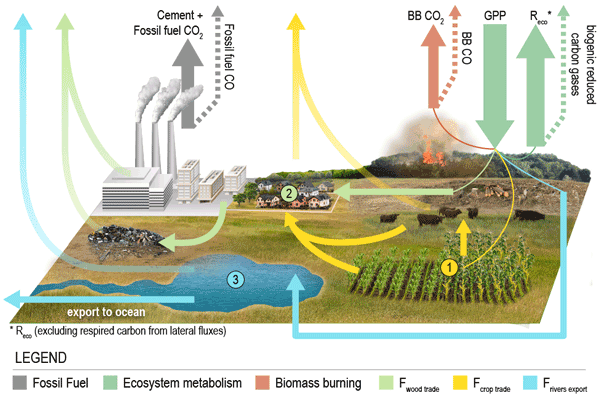
Brendan Byrne, David F. Baker, Sourish Basu, Michael Bertolacci, Kevin W. Bowman, Dustin Carroll, Abhishek Chatterjee, Frédéric Chevallier, Philippe Ciais, Noel Cressie, David Crisp, Sean Crowell, Feng Deng, Zhu Deng, Nicholas M. Deutscher, Manvendra K. Dubey, Sha Feng, Omaira E. García, David W. T. Griffith, Benedikt Herkommer, Lei Hu, Andrew R. Jacobson, Rajesh Janardanan, Sujong Jeong, Matthew S. Johnson, Dylan B. A. Jones, Rigel Kivi, Junjie Liu, Zhiqiang Liu, Shamil Maksyutov, John B. Miller, Scot M. Miller, Isamu Morino, Justus Notholt, Tomohiro Oda, Christopher W. O'Dell, Young-Suk Oh, Hirofumi Ohyama, Prabir K. Patra, Hélène Peiro, Christof Petri, Sajeev Philip, David F. Pollard, Benjamin Poulter, Marine Remaud, Andrew Schuh, Mahesh K. Sha, Kei Shiomi, Kimberly Strong, Colm Sweeney, Yao Té, Hanqin Tian, Voltaire A. Velazco, Mihalis Vrekoussis, Thorsten Warneke, John R. Worden, Debra Wunch, Yuanzhi Yao, Jeongmin Yun, Andrew Zammit-Mangion, and Ning Zeng
Earth Syst. Sci. Data, 15, 963–1004, https://doi.org/10.5194/essd-15-963-2023, https://doi.org/10.5194/essd-15-963-2023, 2023
Short summary
Short summary
Changes in the carbon stocks of terrestrial ecosystems result in emissions and removals of CO2. These can be driven by anthropogenic activities (e.g., deforestation), natural processes (e.g., fires) or in response to rising CO2 (e.g., CO2 fertilization). This paper describes a dataset of CO2 emissions and removals derived from atmospheric CO2 observations. This pilot dataset informs current capabilities and future developments towards top-down monitoring and verification systems.
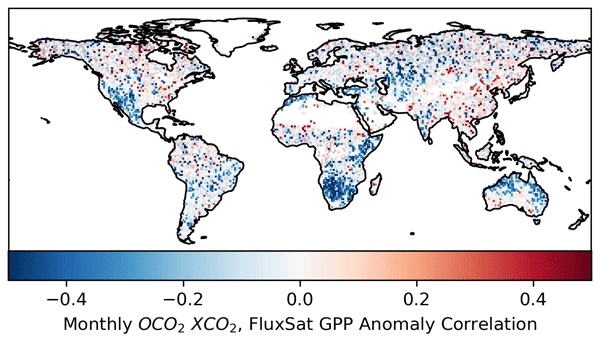
Andrew F. Feldman, Zhen Zhang, Yasuko Yoshida, Abhishek Chatterjee, and Benjamin Poulter
Atmos. Chem. Phys., 23, 1545–1563, https://doi.org/10.5194/acp-23-1545-2023, https://doi.org/10.5194/acp-23-1545-2023, 2023
Short summary
Short summary
We investigate the conditions under which satellite-retrieved column carbon dioxide concentrations directly hold information about surface carbon dioxide fluxes, without the use of inversion models. We show that OCO-2 column carbon dioxide retrievals, available at 1–3 month latency, can be used to directly detect and roughly estimate extreme biospheric CO2 fluxes. As such, these OCO-2 retrievals have value for rapidly monitoring extreme conditions in the terrestrial biosphere.
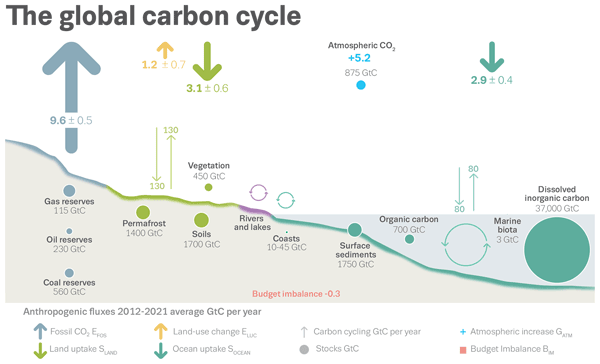
Pierre Friedlingstein, Michael O'Sullivan, Matthew W. Jones, Robbie M. Andrew, Luke Gregor, Judith Hauck, Corinne Le Quéré, Ingrid T. Luijkx, Are Olsen, Glen P. Peters, Wouter Peters, Julia Pongratz, Clemens Schwingshackl, Stephen Sitch, Josep G. Canadell, Philippe Ciais, Robert B. Jackson, Simone R. Alin, Ramdane Alkama, Almut Arneth, Vivek K. Arora, Nicholas R. Bates, Meike Becker, Nicolas Bellouin, Henry C. Bittig, Laurent Bopp, Frédéric Chevallier, Louise P. Chini, Margot Cronin, Wiley Evans, Stefanie Falk, Richard A. Feely, Thomas Gasser, Marion Gehlen, Thanos Gkritzalis, Lucas Gloege, Giacomo Grassi, Nicolas Gruber, Özgür Gürses, Ian Harris, Matthew Hefner, Richard A. Houghton, George C. Hurtt, Yosuke Iida, Tatiana Ilyina, Atul K. Jain, Annika Jersild, Koji Kadono, Etsushi Kato, Daniel Kennedy, Kees Klein Goldewijk, Jürgen Knauer, Jan Ivar Korsbakken, Peter Landschützer, Nathalie Lefèvre, Keith Lindsay, Junjie Liu, Zhu Liu, Gregg Marland, Nicolas Mayot, Matthew J. McGrath, Nicolas Metzl, Natalie M. Monacci, David R. Munro, Shin-Ichiro Nakaoka, Yosuke Niwa, Kevin O'Brien, Tsuneo Ono, Paul I. Palmer, Naiqing Pan, Denis Pierrot, Katie Pocock, Benjamin Poulter, Laure Resplandy, Eddy Robertson, Christian Rödenbeck, Carmen Rodriguez, Thais M. Rosan, Jörg Schwinger, Roland Séférian, Jamie D. Shutler, Ingunn Skjelvan, Tobias Steinhoff, Qing Sun, Adrienne J. Sutton, Colm Sweeney, Shintaro Takao, Toste Tanhua, Pieter P. Tans, Xiangjun Tian, Hanqin Tian, Bronte Tilbrook, Hiroyuki Tsujino, Francesco Tubiello, Guido R. van der Werf, Anthony P. Walker, Rik Wanninkhof, Chris Whitehead, Anna Willstrand Wranne, Rebecca Wright, Wenping Yuan, Chao Yue, Xu Yue, Sönke Zaehle, Jiye Zeng, and Bo Zheng
Earth Syst. Sci. Data, 14, 4811–4900, https://doi.org/10.5194/essd-14-4811-2022, https://doi.org/10.5194/essd-14-4811-2022, 2022
Short summary
Short summary
The Global Carbon Budget 2022 describes the datasets and methodology used to quantify the anthropogenic emissions of carbon dioxide (CO2) and their partitioning among the atmosphere, the land ecosystems, and the ocean. These living datasets are updated every year to provide the highest transparency and traceability in the reporting of CO2, the key driver of climate change.
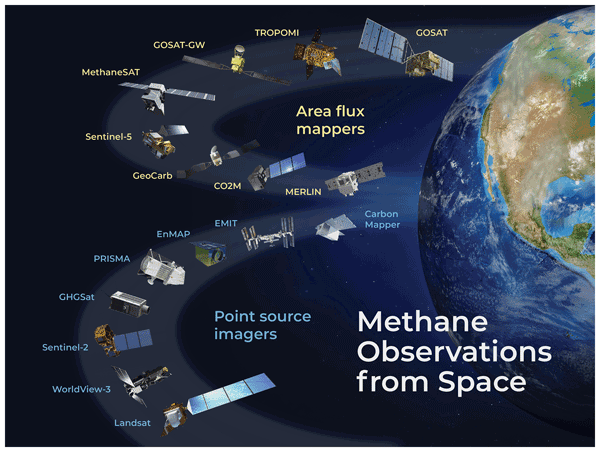
Daniel J. Jacob, Daniel J. Varon, Daniel H. Cusworth, Philip E. Dennison, Christian Frankenberg, Ritesh Gautam, Luis Guanter, John Kelley, Jason McKeever, Lesley E. Ott, Benjamin Poulter, Zhen Qu, Andrew K. Thorpe, John R. Worden, and Riley M. Duren
Atmos. Chem. Phys., 22, 9617–9646, https://doi.org/10.5194/acp-22-9617-2022, https://doi.org/10.5194/acp-22-9617-2022, 2022
Short summary
Short summary
We review the capability of satellite observations of atmospheric methane to quantify methane emissions on all scales. We cover retrieval methods, precision requirements, inverse methods for inferring emissions, source detection thresholds, and observations of system completeness. We show that current instruments already enable quantification of regional and national emissions including contributions from large point sources. Coverage and resolution will increase significantly in coming years.

Taewon Cho, Julianne Chung, Scot M. Miller, and Arvind K. Saibaba
Geosci. Model Dev., 15, 5547–5565, https://doi.org/10.5194/gmd-15-5547-2022, https://doi.org/10.5194/gmd-15-5547-2022, 2022
Short summary
Short summary
Atmospheric inverse modeling describes the process of estimating greenhouse gas fluxes or air pollution emissions at the Earth's surface using observations of these gases collected in the atmosphere. The launch of new satellites, the expansion of surface observation networks, and a desire for more detailed maps of surface fluxes have yielded numerous computational and statistical challenges. This article describes computationally efficient methods for large-scale atmospheric inverse modeling.

Joe R. Melton, Ed Chan, Koreen Millard, Matthew Fortier, R. Scott Winton, Javier M. Martín-López, Hinsby Cadillo-Quiroz, Darren Kidd, and Louis V. Verchot
Geosci. Model Dev., 15, 4709–4738, https://doi.org/10.5194/gmd-15-4709-2022, https://doi.org/10.5194/gmd-15-4709-2022, 2022
Short summary
Short summary
Peat-ML is a high-resolution global peatland extent map generated using machine learning techniques. Peatlands are important in the global carbon and water cycles, but their extent is poorly known. We generated Peat-ML using drivers of peatland formation including climate, soil, geomorphology, and vegetation data, and we train the model with regional peatland maps. Our accuracy estimation approaches suggest Peat-ML is of similar or higher quality than other available peatland mapping products.
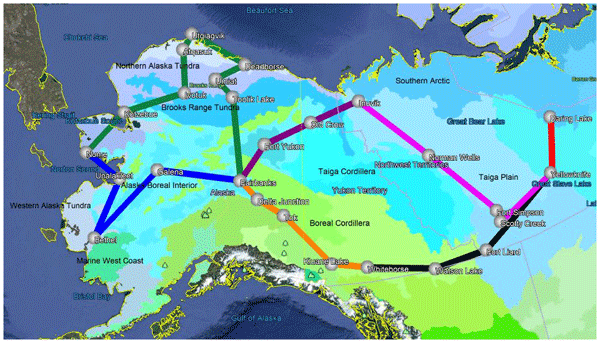
Colm Sweeney, Abhishek Chatterjee, Sonja Wolter, Kathryn McKain, Robert Bogue, Stephen Conley, Tim Newberger, Lei Hu, Lesley Ott, Benjamin Poulter, Luke Schiferl, Brad Weir, Zhen Zhang, and Charles E. Miller
Atmos. Chem. Phys., 22, 6347–6364, https://doi.org/10.5194/acp-22-6347-2022, https://doi.org/10.5194/acp-22-6347-2022, 2022
Short summary
Short summary
The Arctic Carbon Atmospheric Profiles (Arctic-CAP) project demonstrates the utility of aircraft profiles for independent evaluation of model-derived emissions and uptake of atmospheric CO2, CH4, and CO from land and ocean. Comparison with the Goddard Earth Observing System (GEOS) modeling system suggests that fluxes of CO2 are very consistent with observations, while those of CH4 have some regional and seasonal biases, and that CO comparison is complicated by transport errors.
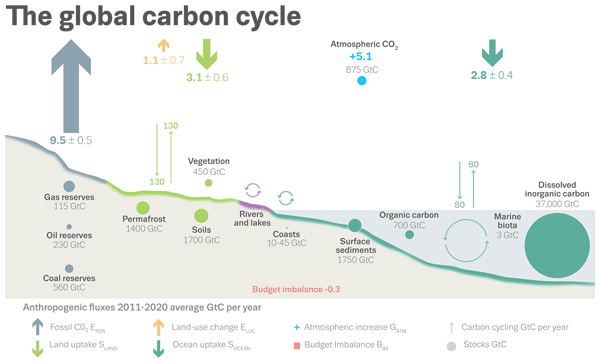
Pierre Friedlingstein, Matthew W. Jones, Michael O'Sullivan, Robbie M. Andrew, Dorothee C. E. Bakker, Judith Hauck, Corinne Le Quéré, Glen P. Peters, Wouter Peters, Julia Pongratz, Stephen Sitch, Josep G. Canadell, Philippe Ciais, Rob B. Jackson, Simone R. Alin, Peter Anthoni, Nicholas R. Bates, Meike Becker, Nicolas Bellouin, Laurent Bopp, Thi Tuyet Trang Chau, Frédéric Chevallier, Louise P. Chini, Margot Cronin, Kim I. Currie, Bertrand Decharme, Laique M. Djeutchouang, Xinyu Dou, Wiley Evans, Richard A. Feely, Liang Feng, Thomas Gasser, Dennis Gilfillan, Thanos Gkritzalis, Giacomo Grassi, Luke Gregor, Nicolas Gruber, Özgür Gürses, Ian Harris, Richard A. Houghton, George C. Hurtt, Yosuke Iida, Tatiana Ilyina, Ingrid T. Luijkx, Atul Jain, Steve D. Jones, Etsushi Kato, Daniel Kennedy, Kees Klein Goldewijk, Jürgen Knauer, Jan Ivar Korsbakken, Arne Körtzinger, Peter Landschützer, Siv K. Lauvset, Nathalie Lefèvre, Sebastian Lienert, Junjie Liu, Gregg Marland, Patrick C. McGuire, Joe R. Melton, David R. Munro, Julia E. M. S. Nabel, Shin-Ichiro Nakaoka, Yosuke Niwa, Tsuneo Ono, Denis Pierrot, Benjamin Poulter, Gregor Rehder, Laure Resplandy, Eddy Robertson, Christian Rödenbeck, Thais M. Rosan, Jörg Schwinger, Clemens Schwingshackl, Roland Séférian, Adrienne J. Sutton, Colm Sweeney, Toste Tanhua, Pieter P. Tans, Hanqin Tian, Bronte Tilbrook, Francesco Tubiello, Guido R. van der Werf, Nicolas Vuichard, Chisato Wada, Rik Wanninkhof, Andrew J. Watson, David Willis, Andrew J. Wiltshire, Wenping Yuan, Chao Yue, Xu Yue, Sönke Zaehle, and Jiye Zeng
Earth Syst. Sci. Data, 14, 1917–2005, https://doi.org/10.5194/essd-14-1917-2022, https://doi.org/10.5194/essd-14-1917-2022, 2022
Short summary
Short summary
The Global Carbon Budget 2021 describes the data sets and methodology used to quantify the emissions of carbon dioxide and their partitioning among the atmosphere, land, and ocean. These living data are updated every year to provide the highest transparency and traceability in the reporting of CO2, the key driver of climate change.
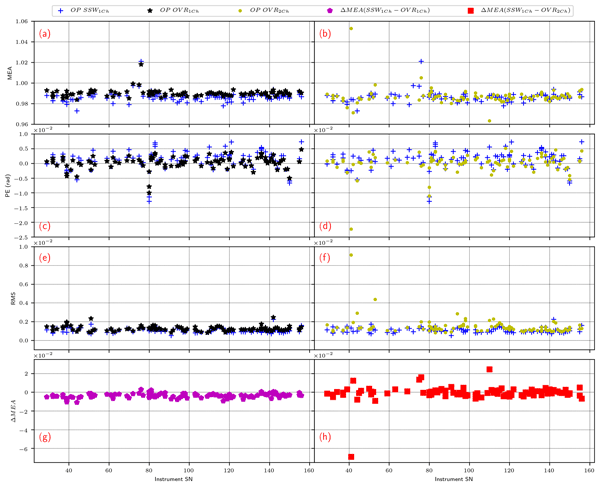
Carlos Alberti, Frank Hase, Matthias Frey, Darko Dubravica, Thomas Blumenstock, Angelika Dehn, Paolo Castracane, Gregor Surawicz, Roland Harig, Bianca C. Baier, Caroline Bès, Jianrong Bi, Hartmut Boesch, André Butz, Zhaonan Cai, Jia Chen, Sean M. Crowell, Nicholas M. Deutscher, Dragos Ene, Jonathan E. Franklin, Omaira García, David Griffith, Bruno Grouiez, Michel Grutter, Abdelhamid Hamdouni, Sander Houweling, Neil Humpage, Nicole Jacobs, Sujong Jeong, Lilian Joly, Nicholas B. Jones, Denis Jouglet, Rigel Kivi, Ralph Kleinschek, Morgan Lopez, Diogo J. Medeiros, Isamu Morino, Nasrin Mostafavipak, Astrid Müller, Hirofumi Ohyama, Paul I. Palmer, Mahesh Pathakoti, David F. Pollard, Uwe Raffalski, Michel Ramonet, Robbie Ramsay, Mahesh Kumar Sha, Kei Shiomi, William Simpson, Wolfgang Stremme, Youwen Sun, Hiroshi Tanimoto, Yao Té, Gizaw Mengistu Tsidu, Voltaire A. Velazco, Felix Vogel, Masataka Watanabe, Chong Wei, Debra Wunch, Marcia Yamasoe, Lu Zhang, and Johannes Orphal
Atmos. Meas. Tech., 15, 2433–2463, https://doi.org/10.5194/amt-15-2433-2022, https://doi.org/10.5194/amt-15-2433-2022, 2022
Short summary
Short summary
Space-borne greenhouse gas missions require ground-based validation networks capable of providing fiducial reference measurements. Here, considerable refinements of the calibration procedures for the COllaborative Carbon Column Observing Network (COCCON) are presented. Laboratory and solar side-by-side procedures for the characterization of the spectrometers have been refined and extended. Revised calibration factors for XCO2, XCO and XCH4 are provided, incorporating 47 new spectrometers.
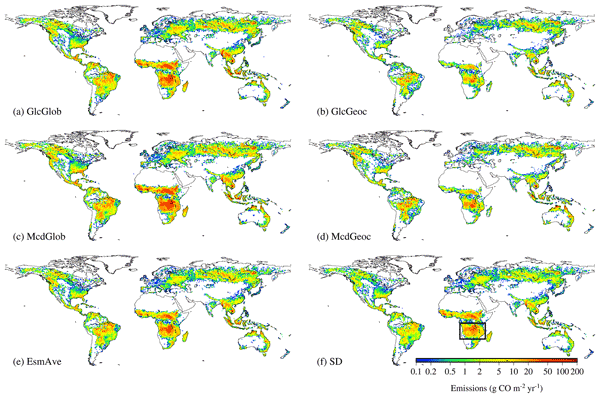
Makoto Saito, Tomohiro Shiraishi, Ryuichi Hirata, Yosuke Niwa, Kazuyuki Saito, Martin Steinbacher, Doug Worthy, and Tsuneo Matsunaga
Biogeosciences, 19, 2059–2078, https://doi.org/10.5194/bg-19-2059-2022, https://doi.org/10.5194/bg-19-2059-2022, 2022
Short summary
Short summary
This study tested combinations of two sources of AGB data and two sources of LCC data and used the same burned area satellite data to estimate BB CO emissions. Our analysis showed large discrepancies in annual mean CO emissions and explicit differences in the simulated CO concentrations among the BB emissions estimates. This study has confirmed that BB emissions estimates are sensitive to the land surface information on which they are based.
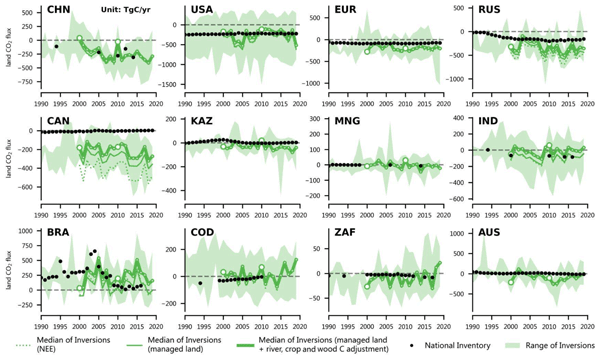
Zhu Deng, Philippe Ciais, Zitely A. Tzompa-Sosa, Marielle Saunois, Chunjing Qiu, Chang Tan, Taochun Sun, Piyu Ke, Yanan Cui, Katsumasa Tanaka, Xin Lin, Rona L. Thompson, Hanqin Tian, Yuanzhi Yao, Yuanyuan Huang, Ronny Lauerwald, Atul K. Jain, Xiaoming Xu, Ana Bastos, Stephen Sitch, Paul I. Palmer, Thomas Lauvaux, Alexandre d'Aspremont, Clément Giron, Antoine Benoit, Benjamin Poulter, Jinfeng Chang, Ana Maria Roxana Petrescu, Steven J. Davis, Zhu Liu, Giacomo Grassi, Clément Albergel, Francesco N. Tubiello, Lucia Perugini, Wouter Peters, and Frédéric Chevallier
Earth Syst. Sci. Data, 14, 1639–1675, https://doi.org/10.5194/essd-14-1639-2022, https://doi.org/10.5194/essd-14-1639-2022, 2022
Short summary
Short summary
In support of the global stocktake of the Paris Agreement on climate change, we proposed a method for reconciling the results of global atmospheric inversions with data from UNFCCC national greenhouse gas inventories (NGHGIs). Here, based on a new global harmonized database that we compiled from the UNFCCC NGHGIs and a comprehensive framework presented in this study to process the results of inversions, we compared their results of carbon dioxide (CO2), methane (CH4), and nitrous oxide (N2O).
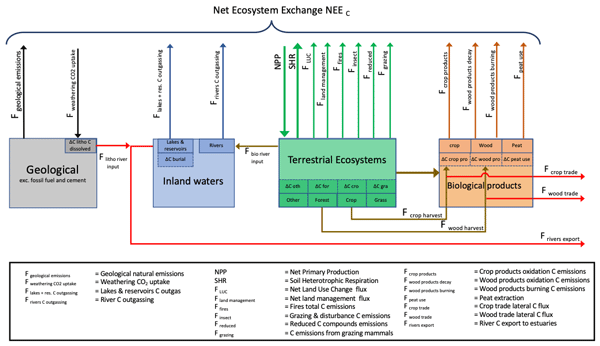
Philippe Ciais, Ana Bastos, Frédéric Chevallier, Ronny Lauerwald, Ben Poulter, Josep G. Canadell, Gustaf Hugelius, Robert B. Jackson, Atul Jain, Matthew Jones, Masayuki Kondo, Ingrid T. Luijkx, Prabir K. Patra, Wouter Peters, Julia Pongratz, Ana Maria Roxana Petrescu, Shilong Piao, Chunjing Qiu, Celso Von Randow, Pierre Regnier, Marielle Saunois, Robert Scholes, Anatoly Shvidenko, Hanqin Tian, Hui Yang, Xuhui Wang, and Bo Zheng
Geosci. Model Dev., 15, 1289–1316, https://doi.org/10.5194/gmd-15-1289-2022, https://doi.org/10.5194/gmd-15-1289-2022, 2022
Short summary
Short summary
The second phase of the Regional Carbon Cycle Assessment and Processes (RECCAP) will provide updated quantification and process understanding of CO2, CH4, and N2O emissions and sinks for ten regions of the globe. In this paper, we give definitions, review different methods, and make recommendations for estimating different components of the total land–atmosphere carbon exchange for each region in a consistent and complete approach.
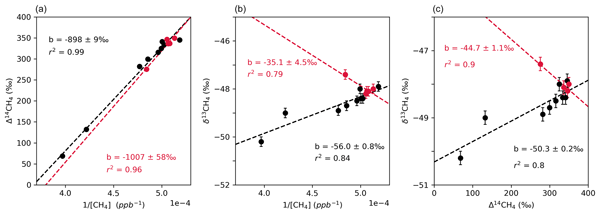
Regina Gonzalez Moguel, Felix Vogel, Sébastien Ars, Hinrich Schaefer, Jocelyn C. Turnbull, and Peter M. J. Douglas
Atmos. Chem. Phys., 22, 2121–2133, https://doi.org/10.5194/acp-22-2121-2022, https://doi.org/10.5194/acp-22-2121-2022, 2022
Short summary
Short summary
Evaluating methane (CH4) sources in the Athabasca oil sands region (AOSR) is crucial to effectively mitigate CH4 emissions. We tested the use of carbon isotopes to estimate source contributions from key CH4 sources in the AOSR and found that 56 ± 18 % of CH4 emissions originated from surface mining and processing facilities, 34 ± 18 % from tailings ponds, and 10 ± < 1 % from wetlands, confirming previous findings and showing that this method can be successfully used to partition CH4 sources.
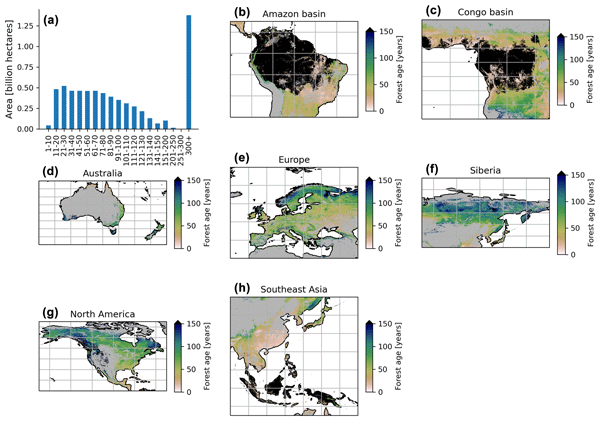
Simon Besnard, Sujan Koirala, Maurizio Santoro, Ulrich Weber, Jacob Nelson, Jonas Gütter, Bruno Herault, Justin Kassi, Anny N'Guessan, Christopher Neigh, Benjamin Poulter, Tao Zhang, and Nuno Carvalhais
Earth Syst. Sci. Data, 13, 4881–4896, https://doi.org/10.5194/essd-13-4881-2021, https://doi.org/10.5194/essd-13-4881-2021, 2021
Short summary
Short summary
Forest age can determine the capacity of a forest to uptake carbon from the atmosphere. Yet, a lack of global diagnostics that reflect the forest stage and associated disturbance regimes hampers the quantification of age-related differences in forest carbon dynamics. In this paper, we introduced a new global distribution of forest age inferred from forest inventory, remote sensing and climate data in support of a better understanding of the global dynamics in the forest water and carbon cycles.
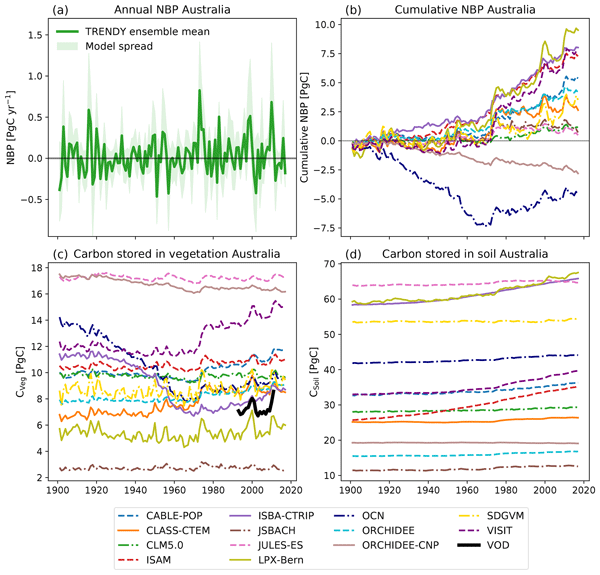
Lina Teckentrup, Martin G. De Kauwe, Andrew J. Pitman, Daniel S. Goll, Vanessa Haverd, Atul K. Jain, Emilie Joetzjer, Etsushi Kato, Sebastian Lienert, Danica Lombardozzi, Patrick C. McGuire, Joe R. Melton, Julia E. M. S. Nabel, Julia Pongratz, Stephen Sitch, Anthony P. Walker, and Sönke Zaehle
Biogeosciences, 18, 5639–5668, https://doi.org/10.5194/bg-18-5639-2021, https://doi.org/10.5194/bg-18-5639-2021, 2021
Short summary
Short summary
The Australian continent is included in global assessments of the carbon cycle such as the global carbon budget, yet the performance of dynamic global vegetation models (DGVMs) over Australia has rarely been evaluated. We assessed simulations by an ensemble of dynamic global vegetation models over Australia and highlighted a number of key areas that lead to model divergence on both short (inter-annual) and long (decadal) timescales.
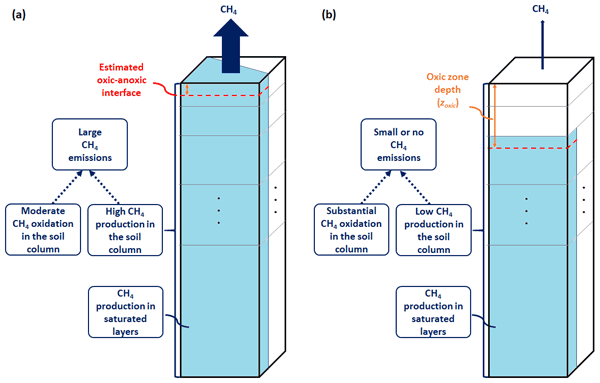
Claude-Michel Nzotungicimpaye, Kirsten Zickfeld, Andrew H. MacDougall, Joe R. Melton, Claire C. Treat, Michael Eby, and Lance F. W. Lesack
Geosci. Model Dev., 14, 6215–6240, https://doi.org/10.5194/gmd-14-6215-2021, https://doi.org/10.5194/gmd-14-6215-2021, 2021
Short summary
Short summary
In this paper, we describe a new wetland methane model (WETMETH) developed for use in Earth system models. WETMETH consists of simple formulations to represent methane production and oxidation in wetlands. We also present an evaluation of the model performance as embedded in the University of Victoria Earth System Climate Model (UVic ESCM). WETMETH is capable of reproducing mean annual methane emissions consistent with present-day estimates from the regional to the global scale.
Cited articles
Baray, S., Jacob, D. J., Maasakkers, J. D., Sheng, J.-X., Sulprizio, M. P., Jones, D. B. A., Bloom, A. A., and McLaren, R.: Estimating 2010–2015 anthropogenic and natural methane emissions in Canada using ECCC surface and GOSAT satellite observations, Atmos. Chem. Phys., 21, 18101–18121, https://doi.org/10.5194/acp-21-18101-2021, 2021. a
Bohn, T. J., Melton, J. R., Ito, A., Kleinen, T., Spahni, R., Stocker, B. D., Zhang, B., Zhu, X., Schroeder, R., Glagolev, M. V., Maksyutov, S., Brovkin, V., Chen, G., Denisov, S. N., Eliseev, A. V., Gallego-Sala, A., McDonald, K. C., Rawlins, M. A., Riley, W. J., Subin, Z. M., Tian, H., Zhuang, Q., and Kaplan, J. O.: WETCHIMP-WSL: intercomparison of wetland methane emissions models over West Siberia, Biogeosciences, 12, 3321–3349, https://doi.org/10.5194/bg-12-3321-2015, 2015. a
Cao, M., Marshall, S., and Gregson, K.: Global carbon exchange and methane emissions from natural wetlands: Application of a process-based model, J. Geophys. Res.-Atmos., 101, 14399–14414, https://doi.org/10.1029/96JD00219, 1996. a
Chan, E., Worthy, D. E. J., Chan, D., Ishizawa, M., Moran, M. D., Delcloo, A., and Vogel, F.: Eight-Year Estimates of Methane Emissions from Oil and Gas Operations in Western Canada Are Nearly Twice Those Reported in Inventories, Environ. Sci. Technol., 54, 14899–14909, https://doi.org/10.1021/acs.est.0c04117, 2020. a, b
Chang, R. Y.-W., Miller, C. E., Dinardo, S. J., Karion, A., Sweeney, C., Daube, B. C., Henderson, J. M., Mountain, M. E., Eluszkiewicz, J., Miller, J. B., Bruhwiler, L. M. P., and Wofsy, S. C.: Methane emissions from Alaska in 2012 from CARVE airborne observations, P. Natl. Acad. Sci. USA, 111, 16694–16699, https://doi.org/10.1073/pnas.1412953111, 2014. a, b, c, d, e
Copernicus Atmosphere Monitoring Service: CAMS global emission inventories, Copernicus Atmosphere Monitoring Service (CAMS) Atmosphere Data Store [data set], https://doi.org/10.24381/1d158bec, 2020. a
Delwiche, K. B., Knox, S. H., Malhotra, A., Fluet-Chouinard, E., McNicol, G., Feron, S., Ouyang, Z., Papale, D., Trotta, C., Canfora, E., Cheah, Y.-W., Christianson, D., Alberto, Ma. C. R., Alekseychik, P., Aurela, M., Baldocchi, D., Bansal, S., Billesbach, D. P., Bohrer, G., Bracho, R., Buchmann, N., Campbell, D. I., Celis, G., Chen, J., Chen, W., Chu, H., Dalmagro, H. J., Dengel, S., Desai, A. R., Detto, M., Dolman, H., Eichelmann, E., Euskirchen, E., Famulari, D., Fuchs, K., Goeckede, M., Gogo, S., Gondwe, M. J., Goodrich, J. P., Gottschalk, P., Graham, S. L., Heimann, M., Helbig, M., Helfter, C., Hemes, K. S., Hirano, T., Hollinger, D., Hörtnagl, L., Iwata, H., Jacotot, A., Jurasinski, G., Kang, M., Kasak, K., King, J., Klatt, J., Koebsch, F., Krauss, K. W., Lai, D. Y. F., Lohila, A., Mammarella, I., Belelli Marchesini, L., Manca, G., Matthes, J. H., Maximov, T., Merbold, L., Mitra, B., Morin, T. H., Nemitz, E., Nilsson, M. B., Niu, S., Oechel, W. C., Oikawa, P. Y., Ono, K., Peichl, M., Peltola, O., Reba, M. L., Richardson, A. D., Riley, W., Runkle, B. R. K., Ryu, Y., Sachs, T., Sakabe, A., Sanchez, C. R., Schuur, E. A., Schäfer, K. V. R., Sonnentag, O., Sparks, J. P., Stuart-Haëntjens, E., Sturtevant, C., Sullivan, R. C., Szutu, D. J., Thom, J. E., Torn, M. S., Tuittila, E.-S., Turner, J., Ueyama, M., Valach, A. C., Vargas, R., Varlagin, A., Vazquez-Lule, A., Verfaillie, J. G., Vesala, T., Vourlitis, G. L., Ward, E. J., Wille, C., Wohlfahrt, G., Wong, G. X., Zhang, Z., Zona, D., Windham-Myers, L., Poulter, B., and Jackson, R. B.: FLUXNET-CH4: a global, multi-ecosystem dataset and analysis of methane seasonality from freshwater wetlands , Earth Syst. Sci. Data, 13, 3607–3689, https://doi.org/10.5194/essd-13-3607-2021, 2021. a
Di Sarra, A. G., Zahn, A., Watson, A., Ankur Desai, Karion, A., Hoheisel, A., Leskinen, A., Arlyn Andrews, Jordan, A., Colomb, A., Kers, B., Scheeren, B., Baier, B., Viner, B., Stephens, B., Daube, B., Van Der Veen, C., Labuschagne, C., Myhre, C. L., Couret, C., Miller, C. E., Choong-Hoon Lee, Lunder, C. R., Plass-Duelmer, C., Plass-Duelmer, C., Gerbig, C., Sloop, C. D., Sweeney, C., Kubistin, D., Goto, D., Jaffe, D., Heltai, D., Lowry, D., Munro, D., Worthy, D., Dlugokencky, E., Kozlova, E., Gloor, E., Cuevas, E., Hintsa, E., Kort, E., Morgan, E., Nisbet, E., Obersteiner, F., Apadula, F., Meinhardt, F., Moore, F., Vitkova, G., Giordane A. Martins, Manca, G., Zazzeri, G., Brailsford, G., Forster, G., Santoni, G., Haeyoung Lee, Boenisch, H., Moossen, H., Timas, H., Matsueda, H., Kang, H.-Y., Huilin Chen, Lehner, I., Mammarella, I., Bartyzel, J., Elkins, J. W., Jaroslaw Necki, Pittman, J., Pichon, J. M., Müller-Williams, J., Jgor Arduini, Turnbull, J., Miller, J. B., Lee, J., Jooil Kim, Pitt, J., DiGangi, J. P., Lavric, J., Hatakka, J., Worsey, J., Holst, J., Lehtinen, K., Kominkova, K., McKain, K., Saito, K., Davis, K., Thoning, K., Tørseth, K., Haszpra, L., Sørensen, L. L., Gatti, L. V., Emmenegger, L., Sha, M. K., Menoud, M., Delmotte, M., Fischer, M. L., De Vries, M., Schumacher, M., Torn, M., Popa, M. E., Leuenberger, M., Heimann, M., Heimann, M., Steinbacher, M., Schmidt, M., De Mazière, M., Lindauer, M., Mölder, M., Martin, M. Y., Ko, M.-Y., Rothe, M., Heliasz, M., Marek, M. V., Ramonet, M., Stanisavljević, M., Lopez, M., Sasakawa, M., Miles, N., Laurent, O., Hermanssen, O., Trisolino, P., Cristofanelli, P., Krummel, P., Shepson, P., Smith, P., Rivas, P. P., Bergamaschi, P., Keronen, P., Keeling, R., Langenfelds, R., Weiss, R., Leppert, R., De Souza, R. A. F., Piacentino, S., Richardson, S., Biraud, S. C., Conil, S., Morimoto, S., Aoki, S., O'Doherty, S., Zaehle, S., Platt, S. M., Prinzivalli, S., Wofsy, S., Nichol, S., Schuck, T., Lauvaux, T., Röckmann, T., Seifert, T., Biermann, T., Kneuer, T., Gehrlein, T., Machida, T., Laurila, T., Aalto, T., Monteiro, V., Kazan, V., Ivakhov, V., Joubert, W., Brand, W. A., Lan, X., Niwa, Y., and Loh, Z.: Multi-laboratory compilation of atmospheric methane data for the period 1983–2021, Global Monitoring Laboratory, https://doi.org/10.25925/20230301, 2023. a, b
Feng, L., Tavakkoli, S., Jordaan, S. M., Andrews, A. E., Benmergui, J. S., Waugh, D. W., Zhang, M., Gaeta, D. C., and Miller, S. M.: Inter-annual variability in atmospheric transport complicates estimation of US methane emissions trends, Geophys. Res. Lett., 50, e2022GL100366, https://doi.org/10.1029/2022GL100366, 2023. a
Global Monitoring Laboratory: CarbonTracker-CH4, Global Monitoring Laboratory [data set], https://doi.org/10.25925/40jt-qd67, 2023. a
Granier, C., Darras, S., van der Gon, H. D., Doubalova, J., Elguindi, N., Galle, B., Gauss, M., Guevara, M., Jalkanen, J.-P., Kuenen, J., Liousse, C., Quack, B., Simpson, D., and Sindelarova, K.: The Copernicus Atmosphere Monitoring Service global and regional emissions (April 2019 version), copernicus Atmosphere Monitoring Service (CAMS) report, https://atmosphere.copernicus.eu/sites/default/files/2019-06/cams_emissions_general_document_apr2019_v7.pdf (last access: 10 January 2026), 2019. a, b
Harris, I., Jones, P., and Osborn, T.: CRU TS4.06: Climatic Research Unit (CRU) Time-Series (TS) version 4.06 of high-resolution gridded data of month-by-month variation in climate (Jan. 1901–Dec. 2021), NERC EDS Centre for Environmental Data Analysis, https://catalogue.ceda.ac.uk/uuid/e0b4e1e56c1c4460b796073a31366980/ (last access: 10 January 2026), 2022. a
Hartery, S., Commane, R., Lindaas, J., Sweeney, C., Henderson, J., Mountain, M., Steiner, N., McDonald, K., Dinardo, S. J., Miller, C. E., Wofsy, S. C., and Chang, R. Y.-W.: Estimating regional-scale methane flux and budgets using CARVE aircraft measurements over Alaska, Atmos. Chem. Phys., 18, 185–202, https://doi.org/10.5194/acp-18-185-2018, 2018. a, b, c, d, e, f, g
Henderson, J. M., Eluszkiewicz, J., Mountain, M. E., Nehrkorn, T., Chang, R. Y.-W., Karion, A., Miller, J. B., Sweeney, C., Steiner, N., Wofsy, S. C., and Miller, C. E.: Atmospheric transport simulations in support of the Carbon in Arctic Reservoirs Vulnerability Experiment (CARVE), Atmos. Chem. Phys., 15, 4093–4116, https://doi.org/10.5194/acp-15-4093-2015, 2015. a
Hodson, E. L., Poulter, B., Zimmermann, N. E., Prigent, C., and Kaplan, J. O.: The El Niño–Southern Oscillation and wetland methane interannual variability, Geophys. Res. Lett., 38, https://doi.org/10.1029/2011GL046861, 2011. a
Hu, L., Andrews, A. E., Thoning, K. W., Sweeney, C., Miller, J. B., Michalak, A. M., Dlugokencky, E., Tans, P. P., Shiga, Y. P., Mountain, M., Nehrkorn, T., Montzka, S. A., McKain, K., Kofler, J., Trudeau, M., Michel, S. E., Biraud, S. C., Fischer, M. L., Worthy, D. E. J., Vaughn, B. H., White, J. W. C., Yadav, V., Basu, S., and van der Velde, I. R.: Enhanced North American carbon uptake associated with El Niño, Sci. Adv., 5, eaaw0076, https://doi.org/10.1126/sciadv.aaw0076, 2019. a
Hugelius, G., Strauss, J., Zubrzycki, S., Harden, J. W., Schuur, E. A. G., Ping, C.-L., Schirrmeister, L., Grosse, G., Michaelson, G. J., Koven, C. D., O'Donnell, J. A., Elberling, B., Mishra, U., Camill, P., Yu, Z., Palmtag, J., and Kuhry, P.: Estimated stocks of circumpolar permafrost carbon with quantified uncertainty ranges and identified data gaps, Biogeosciences, 11, 6573–6593, https://doi.org/10.5194/bg-11-6573-2014, 2014. a
Ishizawa, M., Chan, D., Worthy, D., Chan, E., Vogel, F., and Maksyutov, S.: Analysis of atmospheric CH4 in Canadian Arctic and estimation of the regional CH4 fluxes, Atmos. Chem. Phys., 19, 4637–4658, https://doi.org/10.5194/acp-19-4637-2019, 2019. a, b, c
Ishizawa, M., Chan, D., Worthy, D., Chan, E., Vogel, F., Melton, J. R., and Arora, V. K.: Estimation of Canada's methane emissions: inverse modelling analysis using the Environment and Climate Change Canada (ECCC) measurement network, Atmos. Chem. Phys., 24, 10013–10038, https://doi.org/10.5194/acp-24-10013-2024, 2024. a, b, c, d, e
Ito, A.: Methane emission from pan-Arctic natural wetlands estimated using a process-based model, 1901–2016, Polar Sci., 21, 26–36, https://doi.org/10.1016/j.polar.2018.12.001, 2019. a
Ito, A., Li, T., Qin, Z., Melton, J. R., Tian, H., Kleinen, T., Zhang, W., Zhang, Z., Joos, F., Ciais, P., Hopcroft, P. O., Beerling, D. J., Liu, X., Zhuang, Q., Zhu, Q., Peng, C., Chang, K.-Y., Fluet-Chouinard, E., McNicol, G., Patra, P., Poulter, B., Sitch, S., Riley, W., and Zhu, Q.: Cold-season methane fluxes simulated by GCP-CH4 models, Geophys. Res. Lett., 50, e2023GL103037, https://doi.org/10.1029/2023GL103037, 2023. a
Jolliffe, I. T.: Principal Component Analysis and Factor Analysis, pp. 115–128, Springer New York, New York, NY, ISBN 978-1-4757-1904-8, https://doi.org/10.1007/978-1-4757-1904-8_7, 1986. a
Karion, A., Sweeney, C., Miller, J. B., Andrews, A. E., Commane, R., Dinardo, S., Henderson, J. M., Lindaas, J., Lin, J. C., Luus, K. A., Newberger, T., Tans, P., Wofsy, S. C., Wolter, S., and Miller, C. E.: Investigating Alaskan methane and carbon dioxide fluxes using measurements from the CARVE tower, Atmos. Chem. Phys., 16, 5383–5398, https://doi.org/10.5194/acp-16-5383-2016, 2016. a, b
Kirschke, S., Bousquet, P., Ciais, P., Saunois, M., Canadell, J. G., Dlugokencky, E. J., Bergamaschi, P., Bergmann, D., Blake, D. R., Bruhwiler, L., Cameron-Smith, P., Castaldi, S., Chevallier, F., Feng, L., Fraser, A., Heimann, M., Hodson, E. L., Houweling, S., Josse, B., Fraser, P. J., Krummel, P. B., Lamarque, J.-F., Langenfelds, R. L., Le Quéré, C., Naik, V., O'Doherty, S., Palmer, P. I., Pison, I., Plummer, D., Poulter, B., Prinn, R. G., Rigby, M., Ringeval, B., Santini, M., Schmidt, M., Shindell, D. T., Simpson, I. J., Spahni, R., Steele, L. P., Strode, S. A., Sudo, K., Szopa, S., van der Werf, G. R., Voulgarakis, A., van Weele, M., Weiss, R. F., Williams, J. E., and Zeng, G.: Three decades of global methane sources and sinks, Nat. Geosci., 6, 813–823, https://doi.org/10.1038/ngeo1955, 2013. a
Koffi, E. N., Bergamaschi, P., Alkama, R., and Cescatti, A.: An observation-constrained assessment of the climate sensitivity and future trajectories of wetland methane emissions, Sci. Adv., 6, eaay4444, https://doi.org/10.1126/sciadv.aay4444, 2020. a
Kort, E. A., Andrews, A. E., Dlugokencky, E., Sweeney, C., Hirsch, A., Eluszkiewicz, J., Nehrkorn, T., Michalak, A., Stephens, B., Gerbig, C., Miller, J. B., Kaplan, J. O., Houweling, S., Daube, B. C., Tans, P., and Wofsy, S. C.: Atmospheric constraints on 2004 emissions of methane and nitrous oxide in North America from atmospheric measurements and a receptor-oriented modeling framework, Journal of Integrative Environmental Sciences, 7, 125–133, https://doi.org/10.1080/19438151003767483, 2010. a
Kyzivat, E. D. and Smith, L. C.: A closer look at the effects of lake area, aquatic vegetation, and double-counted wetlands on Pan-Arctic lake methane emissions estimates, Geophys. Res. Lett., 50, e2023GL104825, https://doi.org/10.1029/2023GL104825, 2023. a
Lange, S. and Büchner, M.: ISIMIP2a atmospheric climate input data, ISIMIP Repository [data set], https://doi.org/10.48364/ISIMIP.886955, 2020. a
Lin, J. C., Gerbig, C., Wofsy, S. C., Andrews, A. E., Daube, B. C., Davis, K. J., and Grainger, C. A.: A near-field tool for simulating the upstream influence of atmospheric observations: The Stochastic Time-Inverted Lagrangian Transport (STILT) model, J. Geophys. Res.-Atmos., 108, https://doi.org/10.1029/2002JD003161, 2003. a
Liu, L., Zhuang, Q., Oh, Y., Shurpali, N. J., Kim, S., and Poulter, B.: Uncertainty quantification of global Net methane emissions from terrestrial ecosystems using a mechanistically based biogeochemistry model, J. Geophys. Res.-Biogeo., 125, e2019JG005428, https://doi.org/10.1029/2019JG005428, 2020. a
Lu, X., Jacob, D. J., Wang, H., Maasakkers, J. D., Zhang, Y., Scarpelli, T. R., Shen, L., Qu, Z., Sulprizio, M. P., Nesser, H., Bloom, A. A., Ma, S., Worden, J. R., Fan, S., Parker, R. J., Boesch, H., Gautam, R., Gordon, D., Moran, M. D., Reuland, F., Villasana, C. A. O., and Andrews, A.: Methane emissions in the United States, Canada, and Mexico: evaluation of national methane emission inventories and 2010–2017 sectoral trends by inverse analysis of in situ (GLOBALVIEWplus CH4 ObsPack) and satellite (GOSAT) atmospheric observations, Atmos. Chem. Phys., 22, 395–418, https://doi.org/10.5194/acp-22-395-2022, 2022. a
Lupascu, M., Wadham, J. L., Hornibrook, E. R. C., and Pancost, R. D.: Temperature sensitivity of methane production in the permafrost active layer at Stordalen, Sweden: A comparison with non-permafrost northern wetlands, Arct. Antarct. Alp. Res., 44, 469–482, https://doi.org/10.1657/1938-4246-44.4.469, 2012. a
Maasakkers, J. D., Jacob, D. J., Sulprizio, M. P., Turner, A. J., Weitz, M., Wirth, T., Hight, C., DeFigueiredo, M., Desai, M., Schmeltz, R., Hockstad, L., Bloom, A. A., Bowman, K. W., Jeong, S., and Fischer, M. L.: Gridded national inventory of U.S. methane emissions, Environ. Sci. Technol., 50, 13123–13133, https://doi.org/10.1021/acs.est.6b02878, 2016. a
Maasakkers, J. D., McDuffie, E. E., Sulprizio, M. P., Chen, C., Schultz, M., Brunelle, L., Thrush, R., Steller, J., Sherry, C., Jacob, D. J., Jeong, S., Irving, B., and Weitz, M.: A gridded inventory of annual 2012–2018 U.S. anthropogenic methane emissions, Environ. Sci. Technol., 57, 16276–16288, https://doi.org/10.1021/acs.est.3c05138, 2023. a, b
MacKay, K., Lavoie, M., Bourlon, E., Atherton, E., O'Connell, E., Baillie, J., Fougère, C., and Risk, D.: Methane emissions from upstream oil and gas production in Canada are underestimated, Sci. Rep., 11, 8041, https://doi.org/10.1038/s41598-021-87610-3, 2021. a, b
McDuffie, E. E., Maasakkers, J. D., Sulprizio, M. P., Chen, C., Schultz, M., Brunelle, L., Thrush, R., Steller, J., Sherry, C., Jacob, D. J., Jeong, S., Irving, B., and Weitz, M.: Gridded EPA U.S. Anthropogenic Methane Greenhouse Gas Inventory (gridded GHGI) (v1.0), Zenodo [data set], https://doi.org/10.5281/zenodo.8367082, 2023. a
McKain, K., Down, A., Raciti, S. M., Budney, J., Hutyra, L. R., Floerchinger, C., Herndon, S. C., Nehrkorn, T., Zahniser, M. S., Jackson, R. B., Phillips, N., and Wofsy, S. C.: Methane emissions from natural gas infrastructure and use in the urban region of Boston, Massachusetts, P. Natl. Acad. Sci. USA, 112, 1941–1946, https://doi.org/10.1073/pnas.1416261112, 2015. a
Melton, J. R., Wania, R., Hodson, E. L., Poulter, B., Ringeval, B., Spahni, R., Bohn, T., Avis, C. A., Beerling, D. J., Chen, G., Eliseev, A. V., Denisov, S. N., Hopcroft, P. O., Lettenmaier, D. P., Riley, W. J., Singarayer, J. S., Subin, Z. M., Tian, H., Zürcher, S., Brovkin, V., van Bodegom, P. M., Kleinen, T., Yu, Z. C., and Kaplan, J. O.: Present state of global wetland extent and wetland methane modelling: conclusions from a model inter-comparison project (WETCHIMP), Biogeosciences, 10, 753–788, https://doi.org/10.5194/bg-10-753-2013, 2013. a, b, c, d, e, f, g
Miller, S. M., Wofsy, S. C., Michalak, A. M., Kort, E. A., Andrews, A. E., Biraud, S. C., Dlugokencky, E. J., Eluszkiewicz, J., Fischer, M. L., Janssens-Maenhout, G., Miller, B. R., Miller, J. B., Montzka, S. A., Nehrkorn, T., and Sweeney, C.: Anthropogenic emissions of methane in the United States, P. Natl. Acad. Sci. USA, 110, 20 018–20 022, https://doi.org/10.1073/pnas.1314392110, 2013. a, b
Miller, S. M., Worthy, D. E. J., Michalak, A. M., Wofsy, S. C., Kort, E. A., Havice, T. C., Andrews, A. E., Dlugokencky, E. J., Kaplan, J. O., Levi, P. J., Tian, H., and Zhang, B.: Observational constraints on the distribution, seasonality, and environmental predictors of North American boreal methane emissions, Global Biogeochem. Cycles, 28, 146–160, https://doi.org/10.1002/2013GB004580, 2014. a, b, c, d, e, f
Miller, S. M., Commane, R., Melton, J. R., Andrews, A. E., Benmergui, J., Dlugokencky, E. J., Janssens-Maenhout, G., Michalak, A. M., Sweeney, C., and Worthy, D. E. J.: Evaluation of wetland methane emissions across North America using atmospheric data and inverse modeling, Biogeosciences, 13, 1329–1339, https://doi.org/10.5194/bg-13-1329-2016, 2016a. a, b, c
Miller, S. M., Miller, C. E., Commane, R., Chang, R. Y.-W., Dinardo, S. J., Henderson, J. M., Karion, A., Lindaas, J., Melton, J. R., Miller, J. B., Sweeney, C., Wofsy, S. C., and Michalak, A. M.: A multiyear estimate of methane fluxes in Alaska from CARVE atmospheric observations, Global Biogeochem. Cycles, 30, 1441–1453, https://doi.org/10.1002/2016GB005419, 2016b. a, b, c, d, e, f, g, h, i, j, k
Nzotungicimpaye, C.-M., Zickfeld, K., MacDougall, A. H., Melton, J. R., Treat, C. C., Eby, M., and Lesack, L. F. W.: WETMETH 1.0: a new wetland methane model for implementation in Earth system models, Geosci. Model Dev., 14, 6215–6240, https://doi.org/10.5194/gmd-14-6215-2021, 2021. a
Obu, J.: How much of the earth's surface is underlain by permafrost?, J. Geophys. Res.-Earth Surf., 126, e2021JF006123, https://doi.org/10.1029/2021JF006123, 2021. a
Oh, Y., Bruhwiler, L., Lan, X., Basu, S., Schuldt, K., Thoning, K., Michel, S. E., Clark, R., Miller, J. B., Andrews, A., Sherwood, O., Etiope, G., Crippa, M., Liu, L., Zhuang, Q., Randerson, J., van der Werf, G., Aalto, T., Amendola, S., Andra, S. C., Andrade, M., Nguyen, N. A., Aoki, S., Apadula, F., Arifin, I. B., Arnold, S., Arshinov, M., Baier, B., Bergamaschi, P., Biermann, T., Biraud, S. C., Blanc, P.-E., Brailsford, G., Chen, H., Colomb, A., Couret, C., Cristofanelli, P., Cuevas, E., Chmura, L., Delmotte, M., Emmenegger, L., Esenzhanova, G., Fujita, R., Gatti, L., Guerette, E.-A., Haszpra, L., Heliasz, M., Hermansen, O., Holst, J., Di lorio, T., Jordan, A., Jennifer, M.-W., Karion, A., Kawasaki, T., Kazan, V., Keronen, P., Kim, S.-Y., Kneuer, T., Kominkova, K., Kozlova, E., Krummel, P., Kubistin, D., Labuschagne, C., Langenfelds, R., Laurent, O., Laurila, T., Lee, H., Lehner, I., Leuenberger, M., Lindauer, M., Lopez, M., Mahdi, R., Mammarella, I., Manca, G., Marek, M. V., Mazière, M. D., McKain, K., Meinhardt, F., Miller, C. E., Mölder, M., Moncrieff, J., Moosen, H., Moreno, C., Morimoto, S., Myhre, C. L., Nahas, A. C., Necki, J., Nichol, S., O'Doherty, S., Paramonova, N., Piacentino, S., Pichon, J. M., Plass-Dülmer, C., Ramonet, M., Ries, L., di Sarra, A. G., Sasakawa, M., Say, D., Schaefer, H., Scheeren, B., Schmidt, M., Schumacher, M., Sha, M. K., Shepson, P., Smale, D., Smith, P. D., Steinbacher, M., Sweeney, C., Takatsuji, S., Torres, G., Tørseth, K., Trisolino, P., Turnbull, J., Uhse, K., Umezawa, T., Vermeulen, A., Vimont, I., Vitkova, G., Wang, H.-J. R., Worthy, D., and Xueref-Remy, I.: CarbonTracker CH4 2023, Global Monitoring Laboratory, https://doi.org/10.25925/40JT-QD67, 2023. a, b
Pickett-Heaps, C. A., Jacob, D. J., Wecht, K. J., Kort, E. A., Wofsy, S. C., Diskin, G. S., Worthy, D. E. J., Kaplan, J. O., Bey, I., and Drevet, J.: Magnitude and seasonality of wetland methane emissions from the Hudson Bay Lowlands (Canada), Atmos. Chem. Phys., 11, 3773–3779, https://doi.org/10.5194/acp-11-3773-2011, 2011. a, b, c
Poulter, B., Bousquet, P., Canadell, J. G., Ciais, P., Peregon, A., Saunois, M., Arora, V. K., Beerling, D. J., Brovkin, V., Jones, C. D., Joos, F., Gedney, N., Ito, A., Kleinen, T., Koven, C. D., McDonald, K., Melton, J. R., Peng, C., Peng, S., Prigent, C., Schroeder, R., Riley, W. J., Saito, M., Spahni, R., Tian, H., Taylor, L., Viovy, N., Wilton, D., Wiltshire, A., Xu, X., Zhang, B., Zhang, Z., and Zhu, Q.: Global wetland contribution to 2000–2012 atmospheric methane growth rate dynamics, Environ. Res. Lett., 12, 094013, https://doi.org/10.1088/1748-9326/aa8391, 2017. a, b
Randerson, J. T., van der Werf, G. R., Giglio, L., Collatz, G. J., and Kasibhatla, P. S.: Global Fire Emissions Database, Version 4.1 (GFEDv4) (Version 4.1), ORNL Distributed Active Archive Center [data set], https://doi.org/10.3334/ORNLDAAC/1293, 2017. a, b
Rantanen, M., Karpechko, A. Y., Lipponen, A., Nordling, K., Hyvärinen, O., Ruosteenoja, K., Vihma, T., and Laaksonen, A.: The Arctic has warmed nearly four times faster than the globe since 1979, Commun. Earth Environ., 3, 168, https://doi.org/10.1038/s43247-022-00498-3, 2022. a
Riley, W. J., Subin, Z. M., Lawrence, D. M., Swenson, S. C., Torn, M. S., Meng, L., Mahowald, N. M., and Hess, P.: Barriers to predicting changes in global terrestrial methane fluxes: analyses using CLM4Me, a methane biogeochemistry model integrated in CESM, Biogeosciences, 8, 1925–1953, https://doi.org/10.5194/bg-8-1925-2011, 2011. a
Ringeval, B., de Noblet-Ducoudré, N., Ciais, P., Bousquet, P., Prigent, C., Papa, F., and Rossow, W. B.: An attempt to quantify the impact of changes in wetland extent on methane emissions on the seasonal and interannual time scales, Global Biogeochem. Cycles, 24, https://doi.org/10.1029/2008GB003354, 2010. a
Saunois, M., Martinez, A., Poulter, B., Zhang, Z., Raymond, P. A., Regnier, P., Canadell, J. G., Jackson, R. B., Patra, P. K., Bousquet, P., Ciais, P., Dlugokencky, E. J., Lan, X., Allen, G. H., Bastviken, D., Beerling, D. J., Belikov, D. A., Blake, D. R., Castaldi, S., Crippa, M., Deemer, B. R., Dennison, F., Etiope, G., Gedney, N., Höglund-Isaksson, L., Holgerson, M. A., Hopcroft, P. O., Hugelius, G., Ito, A., Jain, A. K., Janardanan, R., Johnson, M. S., Kleinen, T., Krummel, P. B., Lauerwald, R., Li, T., Liu, X., McDonald, K. C., Melton, J. R., Mühle, J., Müller, J., Murguia-Flores, F., Niwa, Y., Noce, S., Pan, S., Parker, R. J., Peng, C., Ramonet, M., Riley, W. J., Rocher-Ros, G., Rosentreter, J. A., Sasakawa, M., Segers, A., Smith, S. J., Stanley, E. H., Thanwerdas, J., Tian, H., Tsuruta, A., Tubiello, F. N., Weber, T. S., van der Werf, G. R., Worthy, D. E. J., Xi, Y., Yoshida, Y., Zhang, W., Zheng, B., Zhu, Q., Zhu, Q., and Zhuang, Q.: Global Methane Budget 2000–2020, Earth Syst. Sci. Data, 17, 1873–1958, https://doi.org/10.5194/essd-17-1873-2025, 2025. a, b, c, d
Scarpelli, T., Jacob, D., Moran, M., Reuland, F., and Gordon, D.: Gridded inventory of Canada's anthropogenic methane emissions for 2018, Harvard Dataverse, V1 [data set], https://doi.org/10.7910/DVN/CC3KLO, 2021. a, b, c, d
Schulzweida, U.: Climate Data Operators (CDO) User Guide, https://code.mpimet.mpg.de/projects/cdo/embedded/cdo.pdf (last access: 10 January 2026), 2023. a
Schuur, E. A. G., McGuire, A. D., Schädel, C., Grosse, G., Harden, J. W., Hayes, D. J., Hugelius, G., Koven, C. D., Kuhry, P., Lawrence, D. M., Natali, S. M., Olefeldt, D., Romanovsky, V. E., Schaefer, K., Turetsky, M. R., Treat, C. C., and Vonk, J. E.: Climate change and the permafrost carbon feedback, Nature, 520, 171–179, https://doi.org/10.1038/nature14338, 2015. a
Singarayer, J. S., Valdes, P. J., Friedlingstein, P., Nelson, S., and Beerling, D. J.: Late Holocene methane rise caused by orbitally controlled increase in tropical sources, Nature, 470, 82–85, https://doi.org/10.1038/nature09739, 2011. a
Spahni, R., Wania, R., Neef, L., van Weele, M., Pison, I., Bousquet, P., Frankenberg, C., Foster, P. N., Joos, F., Prentice, I. C., and van Velthoven, P.: Constraining global methane emissions and uptake by ecosystems, Biogeosciences, 8, 1643–1665, https://doi.org/10.5194/bg-8-1643-2011, 2011. a
Sweeney, C., Dlugokencky, E., Miller, C. E., Wofsy, S., Karion, A., Dinardo, S., Chang, R. Y.-W., Miller, J. B., Bruhwiler, L., Crotwell, A. M., Newberger, T., McKain, K., Stone, R. S., Wolter, S. E., Lang, P. E., and Tans, P.: No significant increase in long-term CH4 emissions on North Slope of Alaska despite significant increase in air temperature, Geophys. Res. Lett., 43, 6604–6611, https://doi.org/10.1002/2016GL069292, 2016. a, b
Sweeney, C., Chatterjee, A., Wolter, S., McKain, K., Bogue, R., Conley, S., Newberger, T., Hu, L., Ott, L., Poulter, B., Schiferl, L., Weir, B., Zhang, Z., and Miller, C. E.: Using atmospheric trace gas vertical profiles to evaluate model fluxes: a case study of Arctic-CAP observations and GEOS simulations for the ABoVE domain, Atmos. Chem. Phys., 22, 6347–6364, https://doi.org/10.5194/acp-22-6347-2022, 2022. a, b, c
Thompson, R. L., Sasakawa, M., Machida, T., Aalto, T., Worthy, D., Lavric, J. V., Lund Myhre, C., and Stohl, A.: Methane fluxes in the high northern latitudes for 2005–2013 estimated using a Bayesian atmospheric inversion, Atmos. Chem. Phys., 17, 3553–3572, https://doi.org/10.5194/acp-17-3553-2017, 2017. a, b, c, d
Tian, H., Xu, X., Liu, M., Ren, W., Zhang, C., Chen, G., and Lu, C.: Spatial and temporal patterns of CH4 and N2O fluxes in terrestrial ecosystems of North America during 1979–2008: application of a global biogeochemistry model, Biogeosciences, 7, 2673–2694, https://doi.org/10.5194/bg-7-2673-2010, 2010. a
van der Werf, G. R., Randerson, J. T., Giglio, L., van Leeuwen, T. T., Chen, Y., Rogers, B. M., Mu, M., van Marle, M. J. E., Morton, D. C., Collatz, G. J., Yokelson, R. J., and Kasibhatla, P. S.: Global fire emissions estimates during 1997–2016, Earth Syst. Sci. Data, 9, 697–720, https://doi.org/10.5194/essd-9-697-2017, 2017. a
van Huissteden, J. and Dolman, A.: Soil carbon in the Arctic and the permafrost carbon feedback, Current Opinion in Environmental Sustainability, 4, 545–551, https://doi.org/10.1016/j.cosust.2012.09.008, 2012. a
Walter, B. P. and Heimann, M.: A process-based, climate-sensitive model to derive methane emissions from natural wetlands: Application to five wetland sites, sensitivity to model parameters, and climate, Global Biogeochem. Cycles, 14, 745–765, https://doi.org/10.1029/1999GB001204, 2000. a
Wania, R., Ross, I., and Prentice, I. C.: Implementation and evaluation of a new methane model within a dynamic global vegetation model: LPJ-WHyMe v1.3.1, Geosci. Model Dev., 3, 565–584, https://doi.org/10.5194/gmd-3-565-2010, 2010. a
Wania, R., Melton, J. R., Hodson, E. L., Poulter, B., Ringeval, B., Spahni, R., Bohn, T., Avis, C. A., Chen, G., Eliseev, A. V., Hopcroft, P. O., Riley, W. J., Subin, Z. M., Tian, H., van Bodegom, P. M., Kleinen, T., Yu, Z. C., Singarayer, J. S., Zürcher, S., Lettenmaier, D. P., Beerling, D. J., Denisov, S. N., Prigent, C., Papa, F., and Kaplan, J. O.: Present state of global wetland extent and wetland methane modelling: methodology of a model inter-comparison project (WETCHIMP), Geosci. Model Dev., 6, 617–641, https://doi.org/10.5194/gmd-6-617-2013, 2013. a, b, c
Ward, R. H., Sweeney, C., Miller, J. B., Goeckede, M., Laurila, T., Hatakka, J., Ivakov, V., Sasakawa, M., Machida, T., Morimoto, S., Goto, D., and Ganesan, A. L.: Increasing methane emissions and widespread cold-season release from high-Arctic regions detected through atmospheric measurements, J. Geophys. Res.-Atmos., 129, e2024JD040766, https://doi.org/10.1029/2024JD040766, 2024. a
Watts, J. D., Farina, M., Kimball, J. S., Schiferl, L. D., Liu, Z., Arndt, K. A., Zona, D., Ballantyne, A., Euskirchen, E. S., Parmentier, F.-J. W., Helbig, M., Sonnentag, O., Tagesson, T., Rinne, J., Ikawa, H., Ueyama, M., Kobayashi, H., Sachs, T., Nadeau, D. F., Kochendorfer, J., Jackowicz-Korczynski, M., Virkkala, A., Aurela, M., Commane, R., Byrne, B., Birch, L., Johnson, M. S., Madani, N., Rogers, B., Du, J., Endsley, A., Savage, K., Poulter, B., Zhang, Z., Bruhwiler, L. M., Miller, C. E., Goetz, S., and Oechel, W. C.: Carbon uptake in Eurasian boreal forests dominates the high-latitude net ecosystem carbon budget, Global Change Biol., 29, 1870–1889, https://doi.org/10.1111/gcb.16553, 2023. a
Wold, S., Esbensen, K., and Geladi, P.: Principal component analysis, Chemometrics and Intelligent Laboratory Systems, proceedings of the Multivariate Statistical Workshop for Geologists and Geochemists, 2, 37–52, https://doi.org/10.1016/0169-7439(87)80084-9, 1987. a
Worthy, D. E. J., Levin, I., Trivett, N. B. A., Kuhlmann, A. J., Hopper, J. F., and Ernst, M. K.: Seven years of continuous methane observations at a remote boreal site in Ontario, Canada, J. Geophys. Res.-Atmos., 103, 15995–16007, https://doi.org/10.1029/98JD00925, 1998. a
Xiao, H., Song, C., Li, S., Lu, X., Liang, M., Xia, X., and Yuan, W.: Global wetland methane emissions from 2001 to 2020: magnitude, dynamics and controls, Earth's Future, 12, e2024EF004794, https://doi.org/10.1029/2024EF004794, 2024. a
Zhang, Z., Zimmermann, N. E., Stenke, A., Li, X., Hodson, E. L., Zhu, G., Huang, C., and Poulter, B.: Emerging role of wetland methane emissions in driving 21st century climate change, P. Natl. Acad. Sci. USA, 114, 9647–9652, https://doi.org/10.1073/pnas.1618765114, 2017. a, b
Zhang, Z., Fluet-Chouinard, E., Jensen, K., McDonald, K., Hugelius, G., Gumbricht, T., Carroll, M., Prigent, C., Bartsch, A., and Poulter, B.: Development of the global dataset of Wetland Area and Dynamics for Methane Modeling (WAD2M) , Earth Syst. Sci. Data, 13, 2001–2023, https://doi.org/10.5194/essd-13-2001-2021, 2021. a, b
Zhang, Z., Poulter, B., Feldman, A. F., Ying, Q., Ciais, P., Peng, S., and Li, X.: Recent intensification of wetland methane feedback, Nat. Clim. Change, 13, 430–433, https://doi.org/10.1038/s41558-023-01629-0, 2023. a
Zhang, Z., Poulter, B., Melton, J. R., Riley, W. J., Allen, G. H., Beerling, D. J., Bousquet, P., Canadell, J. G., Fluet-Chouinard, E., Ciais, P., Gedney, N., Hopcroft, P. O., Ito, A., Jackson, R. B., Jain, A. K., Jensen, K., Joos, F., Kleinen, T., Knox, S. H., Li, T., Li, X., Liu, X., McDonald, K., McNicol, G., Miller, P. A., Müller, J., Patra, P. K., Peng, C., Peng, S., Qin, Z., Riggs, R. M., Saunois, M., Sun, Q., Tian, H., Xu, X., Yao, Y., Xi, Y., Zhang, W., Zhu, Q., Zhu, Q., and Zhuang, Q.: Ensemble estimates of global wetland methane emissions over 2000–2020, Biogeosciences, 22, 305–321, https://doi.org/10.5194/bg-22-305-2025, 2025. a, b, c, d, e, f, g
Short summary
We find that the state-of-the-art process-based methane flux models have both lower flux magnitude and reduced inter-model uncertainty compared to a previous model inter-comparison from over a decade ago. Despite these improvements, methane flux estimates from process-based models are still likely too high compared to atmospheric observations. We also find that models with simpler parameterizations often result in better agreement with atmospheric observations in high-latitude North America.
We find that the state-of-the-art process-based methane flux models have both lower flux...


Altmetrics
Final-revised paper
Preprint