
the Creative Commons Attribution 4.0 License.
the Creative Commons Attribution 4.0 License.
 | 13 Jul 2026
Chemical characteristics and environmental drivers of nitrogen-containing organic aerosol formation in coastal and inland urban atmospheres in Myanmar
Ning Zhang
Jialiang Feng
Simon Patrick O'Meara
Ziyi Liu
Yingge Ma
Xinlei Ge
Wenjing Li
Piero Chiacchiaretta
Piero Di Carlo
Eleonora Aruffo
Nitrogen-containing organic compounds (NOCs) are important light-absorbing constituents of atmospheric PM2.5 and can substantially influence aerosol radiative forcing, air quality, and climate. Previous studies have mainly focused on the source apportionment and concentrations levels of NOCs, while the mechanisms governing their formation and particle-phase partitioning remain insufficiently constrained, particularly in tropical regions. Here, we aim to elucidate regional differences in NOCs characteristics in Myanmar, with emphasis on how relative humidity (RH) and precursor species influence their formation pathways. We report the first molecular-level spatio-temporal characterization of NOCs in Myanmar, identifying 1064 organic compounds in ESI− mode, with NOCs contributing 14 %–21 % of molecular formulas and 13 %–35 % of total mass. Organic nitrates (ONs) dominated CHON species across all sites, with higher abundances in Mandalay than in Yangon. Two ubiquitous nitrophenols, nitrocatechol (C6H5NO4) and dimethyl nitrocatechol (C8H9NO4), showed strong covariance but a distinct relationship of their particle-phase C8H9NO4 C6H5NO4 ratio with RH. CHemistry with Aerosol Microphysics in Python (PyCHAM) box model simulations reveal that increasing RH enhances aerosol water content, to which C8H9NO4 and C6H5NO4 respond differently because of differences in their partitioning thermodynamics. Increased photochemistry in summertime further promotes C6H5NO4 formation. These two processes, in addition to gas-phase precursor concentration, can explain the observed RH relationship and demonstrate that the C8H9NO4 C6H5NO4 ratio is sensitive, by comparable extents, to: partitioning thermodynamics, photochemistry and precursor supply. These findings provide new constraints on nitrophenol evolution in humid tropical environments and improve interpretation of NOC sources and aging processes, thereby supporting more accurate assessments of their regional and global radiative impacts.
- Article
(3523 KB) - Full-text XML
-
Supplement
(940 KB) - BibTeX
- EndNote


Nitrogen-containing organic compounds (NOCs) are abundant and important constituents of atmospheric aerosols (Li et al., 2025), accounting from around 10 % up to 60 % of the total aerosol nitrogen under typical urban (Yu et al., 2025, 2021), and playing a significant role in the global nitrogen cycle (Ma et al., 2024). In addition, NOCs have been identified as important precursors of secondary organic aerosol (SOA), thereby contributing to air pollution, and posing potential risks to human health (Smith et al., 2009; Abudumutailifu et al., 2024).
Over the past decade, research on NOCs has mainly focused on source apportionment and concentrations levels (Lin et al., 2010; Samy et al., 2013; Priestley et al., 2018), and Yu et al. (2024) reported that biomass burning and secondary formation are dominant NOCs sources. Observational studies conducted in urban, rural, marine and forested environments have demonstrated pronounced spatial variability in the molecular composition and relative abundances of aerosol NOCs (Samy and Hays, 2013; Jiang et al., 2022; Lin et al., 2012a; Xu et al., 2023; Zeng et al., 2020; Geng et al., 2009). Such variability is largely attributed to the diversity of emission sources and the heterogeneity of formation mechanisms of aerosol NOCs (Ma et al., 2024). Furthermore, subsequent oxidation or nitration of certain NOCs by ozone (O3), hydroxyl radical (OH), and nitrogen oxides (NOx) can exacerbate the health risks associated with organic aerosols (Bandowe and Meusel, 2017).
In recent years, increasing attention has been directed toward the formation mechanisms of NOCs, for example, Ma et al. (2024) elucidated how fresh and aged biomass fuels emit distinct classes of NOCs during combustion. Organic nitrates (ONs) and nitrophenols are two classes of NOCs that have attracted considerable research attention. Aerosol-phase ONs play an important role in the atmospheric fate of NOx and O3 production (Lelieveld et al., 2016), and several analytical techniques have been developed for their direct quantification in both the gas and particle phases. For instance, Aruffo et al. (2022) and Rollins et al. (2012) applied thermal dissociation laser-induced fluorescence (TD-LIF) to measure ONs in chamber experiments and field observations. Xu et al. (2017) estimated the mass concentration of organic nitrogen in Beijing using aerosol mass spectrometry (AMS), whereas Yu et al. (2019) quantified ON mass concentrations in PM1 based on measurements from a high-resolution time-of-flight aerosol mass spectrometer (HR-ToF-AMS).
Nitrophenols are important components of brown carbon, formed through both primary emissions from combustion processes and secondary atmospheric chemistry (Desyaterik et al., 2013; Harrison et al., 2005). Time-of-flight mass spectrometer (ToF-MS), High Performance Liquid Chromatography (HPLC), and Gas Chromatography-Mass Spectrometry (GC-MS) have been widely employed to detect nitrophenols in cloud water and aerosol samples, as well as to investigate their sources, concentrations and formation mechanisms (Desyaterik et al., 2013; Harrison et al., 2005). Yu et al. (2019) identified three biogenic volatile organic compounds (VOCs) (α-pinene, limonene, and camphene) and one anthropogenic VOC (styrene) as key precursors contributing to the formation of particulate ONs in urban site in China. Biomass burning not only acts an important primary source of nitrophenols but also provides critical precursors for their secondary formation (Harrison et al., 2005; Laskin et al., 2015). However, owing to the limited commercial availability of nitrophenol standards, most studies have been restricted to the quantitative analysis of only a limited number of nitrophenolic compounds (Cai et al., 2022; Cao et al., 2023).
Previous ultra-high-performance liquid chromatography coupled with orbitrap mass spectrometry (UHPLC-Orbitrap MS) studies have successfully characterized the molecular composition of atmospheric NOCs and nitroaromatic compounds in urban environments such as Beijing (Li et al., 2020; Wang et al., 2022). However, comparable molecular-level investigations remain largely unavailable in Southeast Asia, particularly in Myanmar, a region strongly influenced by severe air pollution and frequent biomass burning (Zhang et al., 2022; Nway et al., 2020). Existing studies in Myanmar have mainly focused on the mass concentrations, chemical composition, and source apportionment of atmospheric particulate matter (Zhang et al., 2022, 2024b), whereas systematic investigations into the characteristics and formation pathways of atmospheric NOCs remain limited. This study aimed to characterize the spatial variability of NOCs in ambient PM2.5 samples collected from Yangon and Mandalay, Myanmar, using UHPLC-Orbitrap MS. In addition, the formation-related processes of high-abundance nitrophenolic compounds were investigated, with particular emphasis on the influences of relative humidity (RH) and precursor availability on their secondary formation. Molecular-level identification of aerosol NOCs provides critical insights into their precursors, sources, and formation pathways, thereby enhancing our understanding of atmospheric NOCs drivers.
2.1 Sample collection
PM2.5 samples were collected at two major urban sites in Myanmar, Yangon and Mandalay (Fig. S1 in the Supplement), during 2016 and 2017. In Yangon, sampling was conducted using a medium-volume PM2.5 sampler (flow rate was 0.3 m3 min−1, Guangzhou Mingye Huanbao Technology Company, China) deployed on the rooftop of a six-story building (about 20 m above the ground) in Hlaing Township (16°51′30′′ N, 96°8′0′′ E), located in the northwestern urban area. In Mandalay, samples were collected on the rooftop of a three-story building situated in a mixed residential and commercial area of Chan-aye-thazan township (21°58′0′′ N, 96°5′0′′ E). Daily PM2.5 samples were collected during both winter and summer periods, including winter campaigns from 4–22 December 2016 in Yangon and from 26 December 2016 to 16 January 2017 in Mandalay, as well as summer campaigns from 10–29 April 2017 in Yangon and from 20 March to 7 April 2017 in Mandalay. In total, 72 PM2.5 samples were obtained. Detailed descriptions of the sampling procedures can be found in Zhang et al. (2022).
2.2 Instrumental analysis
2.2.1 Determination of water-soluble organic nitrogen
The mass concentration of water-soluble organic nitrogen (WSON) in atmospheric particulate matter was calculated as the difference between the concentration of water-soluble total nitrogen (WSTN) and that of water-soluble inorganic nitrogen (WSIN), i.e., WSON = WSTN − WSIN, where WSIN was calculated as WSIN = [NO] 62 × 14 + [NH] 18 × 14. Here, [NO] and [NH] denote the mass concentrations of nitrate and ammonium, respectively, measured by ion chromatography. The mass concentration of WSTN was determined using a UV-visible spectrophotometer (TU-1901, China).
Quality assurance and quality control (QA/QC) procedures were implemented throughout the analyses. For the determination of water-soluble inorganic ions, one procedural blank was analyzed for every 20 samples. In addition, duplicate analyses were performed for 10 % of the samples during instrumental measurements, and the relative difference between duplicate measurements was generally less than 5 %. For WSTN determination, one duplicate sample was analyzed for every 10 samples, with relative differences between duplicate measurements also below 5 %. Spike recovery tests were conducted to evaluate analytical accuracy, and the recoveries generally ranged from 90 % to 110 %. Furthermore, the concentrations of target species in field blank samples were less than 5 % of those measured in ambient samples, indicating negligible effects on the quantified concentrations.
2.2.2 GC-MS analysis of organic compounds
20 µL methyl-β-D-xylanopyranoside (MXP) was spiked onto the filters (30 cm2) as an internal standard. The filters were subsequently subjected to ultrasonic extraction with 20 mL of dichloromethane/methanol (1 : 1 ) for 20 min at room temperature for three times. The combined extracts were concentrated to approximately 2–3 mL using a rotary evaporator, followed by filtration and derivatization with 100 µL of N,O-bis-(trimethylsilyl)-trifluoroacetamide (BSTFA, with 1 % trimethylchlorosilane as catalyst) and 20 µL of pyridine at 75 °C for 45 min. Prior to injection, hexamethylbenzene was added as an injection standard to evaluate the recovery of the target compounds, which ranged from 80 % to 120 %.
The extracts were analyzed using GC-MS (Agilent 5975 MSD coupled with Agilent 6890 GC) to determine levoglucosan mass concentrations. The GC oven was programmed to start at 60 °C for 2 min, ramped to 300 °C at 5 °C min−1, and held isothermally at 300 °C for 10 min. Detailed descriptions of the GC-MS settings and analytical procedures are provided in previous publications (Feng et al., 2013; Zhong et al., 2021).
2.2.3 UHPLC-MS analysis of polar organic compounds
A 12 cm2 section of each sampling filter was ultrasonically extracted with 3 mL of methanol and 30 µL of ethylene diamine tetraacetic acid (EDTA) for 30 min, with ice added to the water bath to prevent temperature increases and decomposition of organic compounds. After standing for 15 min, the extract was filtered through a 0.45 µm PTFE syringe filter. The residual filter was subsequently extracted twice (using 2 mL of methanol with 20 µL of EDTA and 1 mL of methanol with 10 µL of EDTA, respectively). All filtered extracts were combined and evaporated to near dryness under a slow stream of high-purity nitrogen, then redissolved in 100 µL of water and acetonitrile mixture (V:V = 1 : 1). The redissolved solution was centrifuged at > 11 000 rpm for 20 min, and 5 µL of the supernatant was injected for analysis using UHPLC (Dionex 3000, Thermo Scientific, USA) – Orbitrap MS (Thermo Scientific, USA).
3-Nitrophenol (3-NP) was utilized to estimate the semi-quantitative concentrations of the detected compounds based on peak areas (unit: ng m−3). To assess the reliability of the semi-quantitative approach, the summed concentrations of all detected organic compounds were compared with independently measured water-soluble organic carbon (WSOC) concentrations. A strong correlation was observed (Fig. S2, r=0.88), indicating that the semi-quantified molecular data reasonably capture the temporal variability of WSOC. It should be noted that the semi-quantitative approach adopted in this study is intended primarily to compare relative abundance patterns and temporal variations among compound classes rather than to provide absolute concentrations. Detailed information for the HPLC separation setup, UHPLC-Orbitrap MS data analysis and quantification procedures can be founded in Sects. S1–S3 and Figs. S3–S4. The instrument was calibrated weekly to ensure that the mass resolution in negative mode (ESI−) was below 2 ppm. Blank samples were processed and analyzed in the same way for deduction of background effects.
2.3 Box modeling
Observation interpretation was augmented through application of the CHemistry with Aerosol Microphysics in Python (PyCHAM) box model (O'Meara et al., 2021) version 5.6.0 (available at https://github.com/simonom/PyCHAM, last access: 10 July 2026). The model used v3.3.1 of the Master Chemical Mechanism (Rickard, 2025) to solve gas-phase chemistry, including gas-phase inorganics and the following gas-phase VOCs: methane, propane, α-pinene, benzene, ethylbenzene, m,o,p-xylene (Bloss et al., 2005; Jenkin et al., 1997, 2003; Saunders et al., 2003). The model treats gas-particle partitioning dynamically with thermodynamics driven by the Kelvin term, component mole fraction (Raoult's law), particle-phase solubility and pure component vapor pressures, as described in O'Meara et al. (2021). It was run in Eulerian mode. Assuming zero-dimensional representation of a 1 × 1 × 1 km box, and a 3 m s−1 horizontal wind vector, gave an air change rate of 3 × 10⁻³ s−1. Observations of NOx, O3, RO2 and HO2 from urban Asian sites were used to set representative influx rates of NOx and aliphatic parent VOCs (Aung et al., 2019; Tan et al., 2018; Nelson et al., 2021).
Since the gas-particle partitioning of aromatic oxidation products was investigated here, specifically C6H5NO4 and C8H9NO4, influx rates of their parent VOCs (benzene for C6H5NO4 and ethylbenzene and o,m,p-xylene for C8H9NO4) were particularly important for accurately identifying drivers of particle-phase aromatic oxidation products. For summer in Yangon, rates were set to give aromatic parent VOC concentrations consistent with observations from May 2017 in Yangon (Aung et al., 2019). However, Zhang et al. (2022) show that the prevailing source of air is maritime during Yangon summer and continental for Yangon winter and Mandalay winter and summer, resulting in substantially lower particle-phase organic carbon loading during Yangon summer. Furthermore, we know from Nelson et al. (2021) that benzene concentrations in southern Asian cities can reach 10 ppb, eight times more than the 1.2 ppb maximum reported for Yangon summer by Aung et al. (2019).
Additionally, Myanmar is a major biomass-burning region (Amnuaylojaroen and Parasin, 2023); Continental air is more prone to influence from open fire burning (e.g. agricultural residues and tropical forest) than maritime air, levoglucosan concentrations (Yangon winter: 629.6 ng m−3, Yangon summer: 461.1 ng m−3, Mandalay winter: 827.6 ng m−3, Mandalay summer: 553.0 ng m−3), a well-established tracer for biomass burning, were significantly higher at the inland site (Mandalay), indicating stronger influence from biomass combustion (Fig. S5). Whilst both C6H5NO4 and C8H9NO4 were well correlated with levoglucosan in both cities (Fig. S5), indicating a biomass burning source for both, the emission ratios of the precursors vary substantially between urban biomass burning, with ratios around 3 : 1 for C8H9NO4 : C6H5NO4 precursors (Krugly et al., 2014), and tropical forest or agricultural residue burning, which have ratios of 1 : 3 and 1 : 2, respectively (Andreae, 2019). Therefore, for all locations and times, the same influx rates of C8H9NO4 precursors was used (those constrained against observations for Yangon summer), however, the C6H5NO4 precursor influx rate was set three times greater in Mandalay winter and summer than in Yangon summer and two times higher in Yangon winter than in Yangon summer, ratios consistent with the relative organic carbon loadings reported in Zhang et al. (2022).
For PyCHAM simulations, RH, temperature, and seed particle concentration were constrained against Zhang et al. (2022). The pure component saturation vapour pressures of C6H5NO4 and C8H9NO4 were constrained by the observations of Fredrickson et al. (2022) who report a c∗ for C6H5NO4 of the order 101 µg m−3. Using the Nannoolal et al. (2008) method for vapour pressure prediction from the UManSysProp toolkit (Topping et al., 2016), the vapour pressure of C8H9NO4 compounds was estimated to be an order of magnitude lower than for C6H5NO4, and was therefore set at 100 µg m−3. For other organics the Nannoolal et al. (2008) method was used to estimate pure component vapour pressures. The different particle-phase solubilities were not directly measured, but were represented through activity coefficients following previous studies of structurally similar aromatic nitro-compounds (Lee et al., 2000). The C6H5NO4 molecule contains hydroxyl and nitro functional groups that enhance polarity and hydrogen-bonding interactions with aerosol water, and was therefore assumed to behave relatively close to ideal solution conditions. In contrast, C8H9NO4 contains additional non-polar organic functionality, which is expected to increase non-ideal interactions and reduce effective aqueous-phase solubility. Solubility was assumed to vary linearly with particle water mole fraction, consistent with Kholod et al. (2011). Consequently, for both C6H5NO4 and C8H9NO4 the activity coefficient was assumed to be unity at zero particle water mole fraction, whilst for C6H5NO4 diluted by water, the activity coefficient was set to 10, and for C8H9NO4 it was set to 3000. The combination of different volatilities and solubilities of C6H5NO4 and C8H9NO4 in a thermodynamic simulation of gas-particle partitioning presents the potential for different sensitivities to varying particle-phase water content, which is quantitatively investigated in the results.
The model does not explicitly include the organic oxidation products entering the simulated box, similarly it cannot spatially distinguish between precursors of SOA that were emitted directly from sources within the box and those transported in from sources outside. Nevertheless, the model and its setup, including a non-zero air change rate for representative transport losses, allow investigation of the processes driving particle-phase organic composition in the observed areas. The results and implications below are therefore constrained to this ability.
The HO2 uptake coefficient to particles was set to 0.2 following Jacob (2000) Gas-phase HONO influx rate was assumed to vary linearly with gas-phase water content, and tuned to give HONO values comparable to those observed in Delhi in 2017 by Pawar et al. (2024) with a maximum of 4.8 × 10⁻¹⁷ mol s−1 for 1.2 × 10⁻⁶ mol cm−3 of gas-phase water during Yangon summer.
Testing showed the model required around 9 h of spin-up (starting from midday local time) before mass concentrations of all components, including radicals, were within 5 % of their concentration 24 h later, and therefore results were taken over the 24 h of simulation from 9–33 h through the simulation. Unless otherwise stated, PyCHAM results are arithmetic means over these 24 h. Natural light intensity was determined by setting the day of year and relevant latitude and longitude following the parameterisation of Hayman (1997). All relevant PyCHAM input files, and key outputs, are archived at https://github.com/simonom/PyCHAM/releases/tag/v5.7.8 (last access: 10 July 2026).
2.4 Data analysis
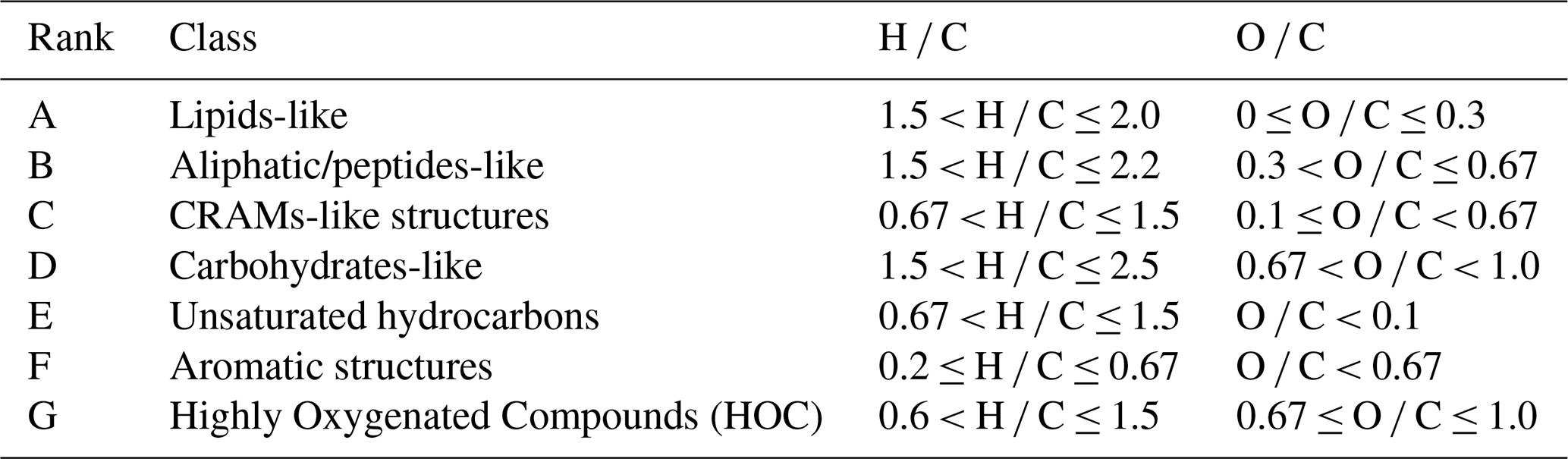
The Van Krevelen (VK) diagram is widely used to illustrate the evolutionary pathways of organic mixtures to infer the potential sources of organic aerosols by classifying known categories of natural and anthropogenic organic compounds (Xie et al., 2021; Bianco et al., 2018). Based on the H C and O C ratios, the VK diagram can be divided into seven regions corresponding to common classes of compounds identified in dissolved organic matter (Table 1): (A) lipids-like compounds, (B) aliphatic/peptides-like compounds, (C) carboxylic-rich alicyclic molecules (CRAMs-like structures), (D) carbohydrates-like compounds, (E) unsaturated hydrocarbons, (F) aromatic structures, and (G) highly oxygenated compounds (HOC).
Table 1Stoichiometric ranges of VK classes (Bianco et al., 2018).
The aromaticity index (AI) is a parameter used to represent the density of C=C double bonds in organic molecules. Koch and Dittmar (2006) proposed a modified formula for AI that excludes the potential contribution of heteroatoms to C=C bond density (Eq. 1). AI ≥ 0.67 is generally considered indicative of condensed aromatic structures, whereas AI > 0.50 indicates the presence of aromatic structures. When the calculated AI value is less than zero, it is set to zero. The equation for calculating AI is given as follows (Koch and Dittmar, 2006):
3.1 Characteristics of molecules in ESI− modes
The identified organic compounds were classified into six categories based on molecular composition: CHO, CHON, CHONS, CHN, CHNS, and CHOS. CHONS- compounds represent species containing only C, H, O, N, and S in the ESI− mode, and the other categories are defined analogously. CHN and CHNS compounds were rarely detected in the ESI− mode.
The number of organic compounds identified in the ESI− mode ranged from 562 to 1318, with an average of 1064 molecular formulas. Among these, CHO species accounted for the largest proportion (46 %–67 %), followed by CHOS (13 %–25 %) and CHON (14 %–21 %). Similar molecular composition patterns have been reported in a wide range of atmospheric environments. Sun et al. (2025) summarized observations from urban, forest, and remote regions worldwide and showed that CHO compounds generally dominate atmospheric organic matter, followed by CHON and/or CHOS compounds. Consistent with this review, a wintertime study in Beijing using UHPLC-Orbitrap MS also identified CHO, CHON, and CHOS as the three most abundant molecular classes (Wang et al., 2022). These results suggest that the predominance of these compound classes is a common feature of atmospheric organic matter, although their relative contributions may vary depending on local emission sources and atmospheric processing.
The total mass concentration of organic compounds detected in the ESI− mode was 279.7 ± 87.6 ng m−3. Specifically, the mass concentrations of CHO-, CHON-, and CHOS- compounds were 164.3 ± 39.0, 62.3 ± 31.8, and 43.8 ± 18.6 ng m−3, respectively (Table S1). Their corresponding contributions to the total concentration ranged from 49 %–73 % for CHO species, 13 %–35 % for CHON species, and 8 %–22 % for CHOS species. Although the number proportion of CHON compounds was lower than that of CHOS species, their contribution to the total mass concentration was comparatively higher, indicating that CHON compounds possess higher average molecular abundances and play a non-negligible role in the overall organic aerosol mass.
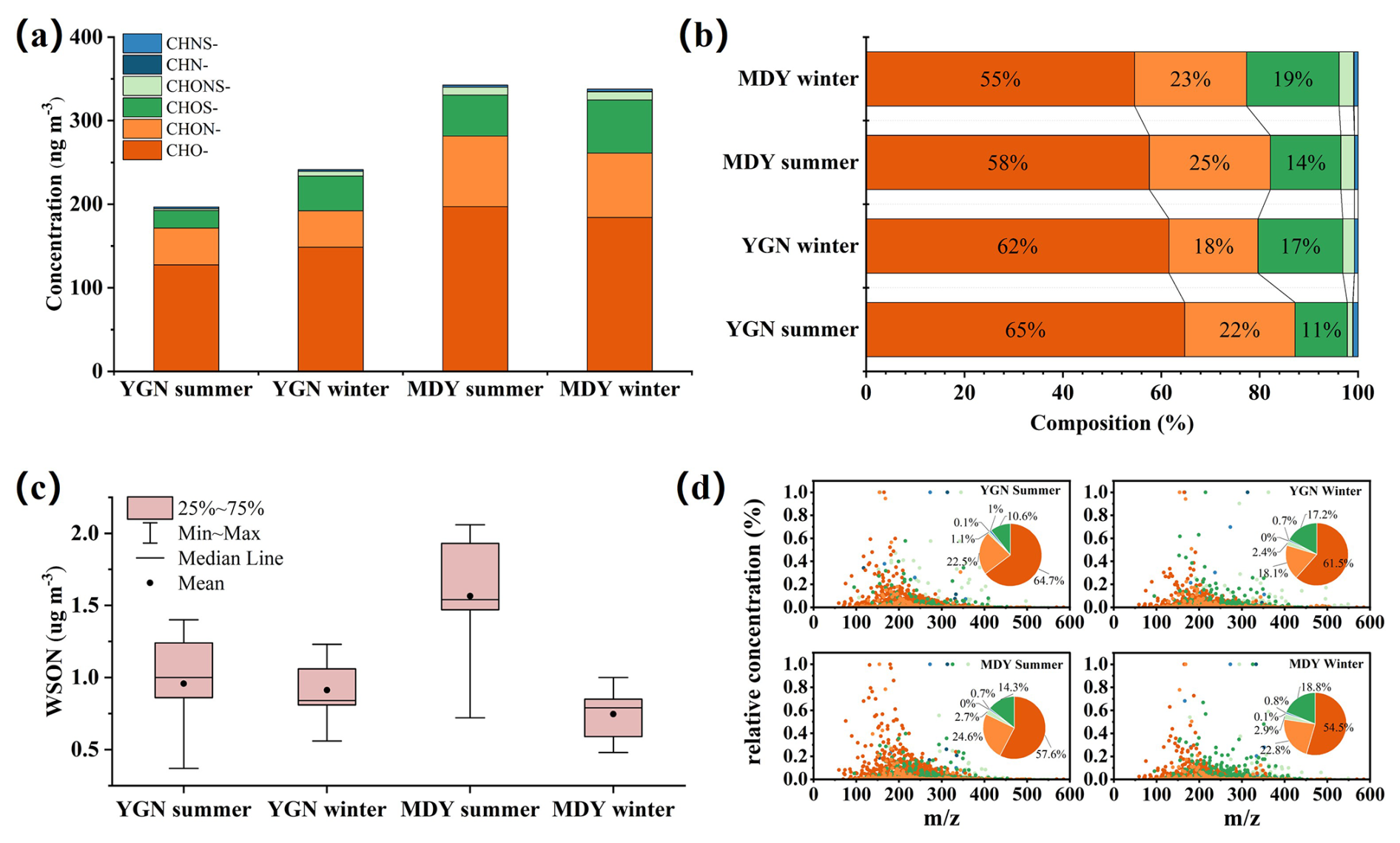
Figure 1Molecular characteristics of organic matter in Yangon (YGN) and Mandalay (MDY). (a) Semi-quantitative concentrations of CHO, CHON, CHOS, CHONS, CHN, and CHNS species detected in both cities during summer and winter in the ESI− mode. (b) Percentage contributions of CHO, CHON, CHOS, CHONS, CHN, and CHNS species to the total molecular mass concentrations in both cities during summer and winter in the ESI− mode. (c) Mass concentration of WSON in both cities during summer and winter. (d) Reconstructed mass spectra of organic compounds derived from extracted ion chromatograms in the ESI− mode. The vertical axis represents the semi-quantitative normalized concentration of each compound. The pie charts illustrate the seasonal average concentration contributions of different molecular species.
Significant differences in the mass concentrations and compositions of various compound classes were observed between the two cities (Fig. 1a and b, Table S2). In the ESI− mode, the mass concentrations of all compound types in PM2.5 were higher in Mandalay than in Yangon during both winter and summer, consistent with the spatial distribution patterns of organic carbon (OC) (Zhang et al., 2024a).
The concentration proportion of CHO compounds was consistently higher in Yangon than in Mandalay (Yangon summer: 65 %, Yangon winter: 62 %, Mandalay summer: 58 %, Mandalay winter: 55 %). In contrast, CHON compounds accounted for a lower proportion in Yangon compared to Mandalay (Yangon summer: 22 %, Yangon winter: 18 %; Mandalay summer: 25 %, Mandalay winter: 23 %). The spatial distribution of CHOS concentration contributions exhibited a pattern similar to that of CHON, with higher fractions observed in Mandalay (Yangon summer: 11 %, Yangon winter: 17 %; Mandalay summer: 14 %, Mandalay winter: 19 %). Notably, the mass concentration of WSON, particularly during the MDY summer period, was substantially higher than those observed in the other three sampling periods (Fig. 1c). The results of the t-test showed that the WSON mass concentration in MDY summer was significantly different from that in YGN summer and MDY winter, with p values lower than 0.05 for both comparisons. These results indicate a statistically significant enhancement of WSON during the MDY summer period, and the underlying causes of the elevated WSON levels in MDY summer warrant further investigation. The reconstructed mass spectra of PM2.5 samples collected in Yangon and Mandalay during winter, and summer are shown in Fig. 1d. The molecular weights of the detected compounds were primarily distributed between 100 and 400, with majority of signal intensities concentrated between 100 and 200.
3.2 Spatial distribution characteristics of NOCs
3.2.1 Spatial distribution of organic nitrates
The formation of organic nitrates (ONs) enhances the partitioning of semi-volatile compounds into the particulate phase, thereby promoting SOA growth (Ng et al., 2007). Consequently, ONs are recognized as an important class of atmospheric compounds. In all Myanmar samples, 69 %–87 % (mean: 77 %) of CHON molecules met the structural criterion of containing at least one -ONO2 functional group (O 3N ≥ 1) and were preliminarily identified as ONs (Lin et al., 2012b; Wang et al., 2016). This result is consistent with the findings of Lin et al. (2012a), who reported that ONs constitute a major subclass of CHON- compounds in PM2.5.
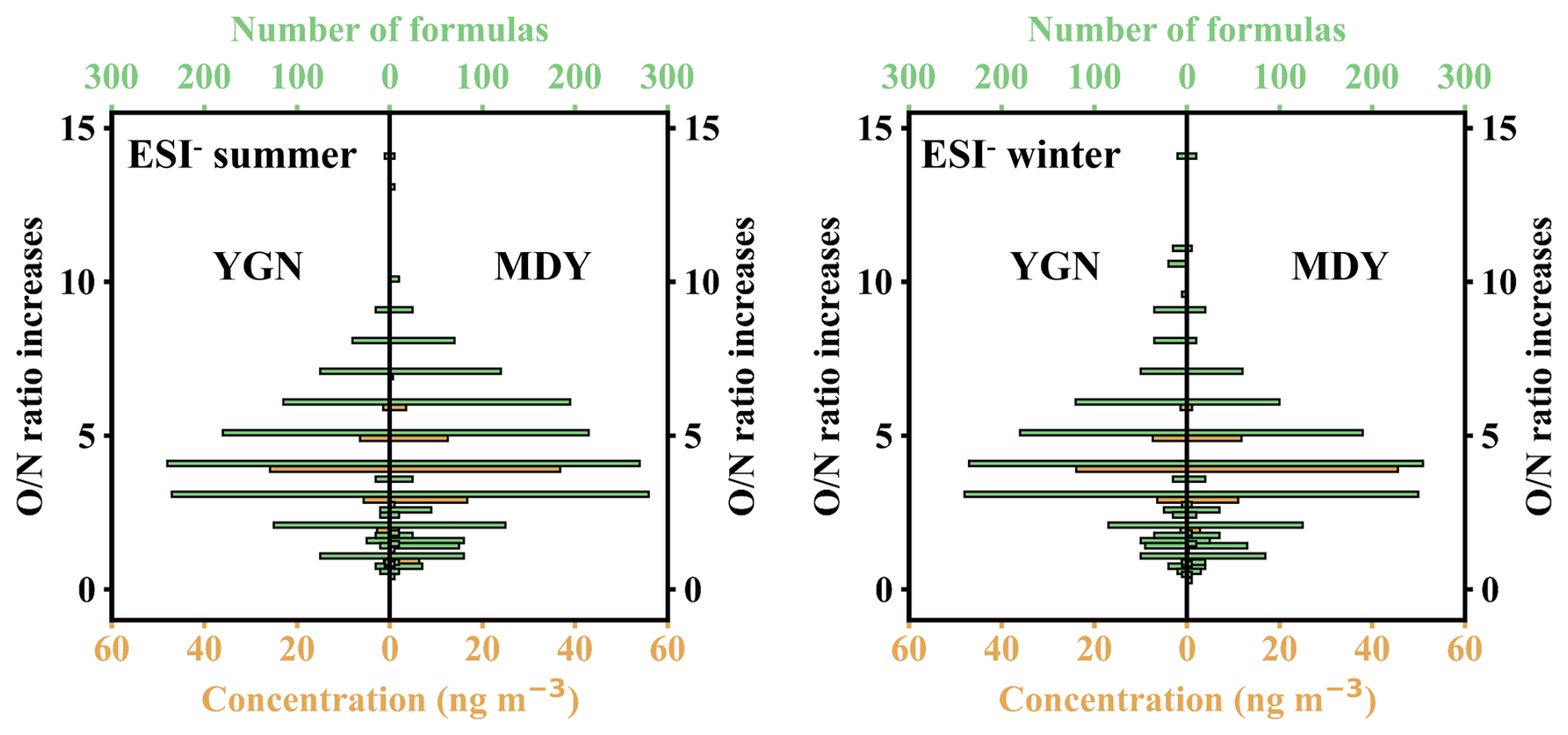
Figure 2Classification of CHON compounds into subgroups based on O N ratios in the ESI− mode. Yellow and green colors indicate the ONs mass concentrations (ng m−3) and number of species in each subgroup, respectively.
As shown in Fig. 2, CHON compounds were classified into 32 subgroups according to their O N ratios. A total of 245 CHON compounds were detected in the Yangon summer samples, of which 75.1 % were identified as ONs. 263 CHON compounds were detected in Yangon winter samples, with ONs accounting for 73.0 % of the total CHON molecular species. Similarly, 351 and 278 CHON compounds were identified in the Mandalay summer and Mandalay winter samples, with ONs constituting 69.5 % and 66.2 %, respectively. The contributions of ONs to the total CHON compound mass concentrations in PM2.5 were 89.5 %, 91.5 %, 84.4 %, and 90.6 % for Yangon summer, Yangon winter, Mandalay summer, and Mandalay winter, respectively. The remarkably high proportions of ONs in both molecular number and mass concentration indicate that ONs represent a dominant subgroup within CHON compounds.
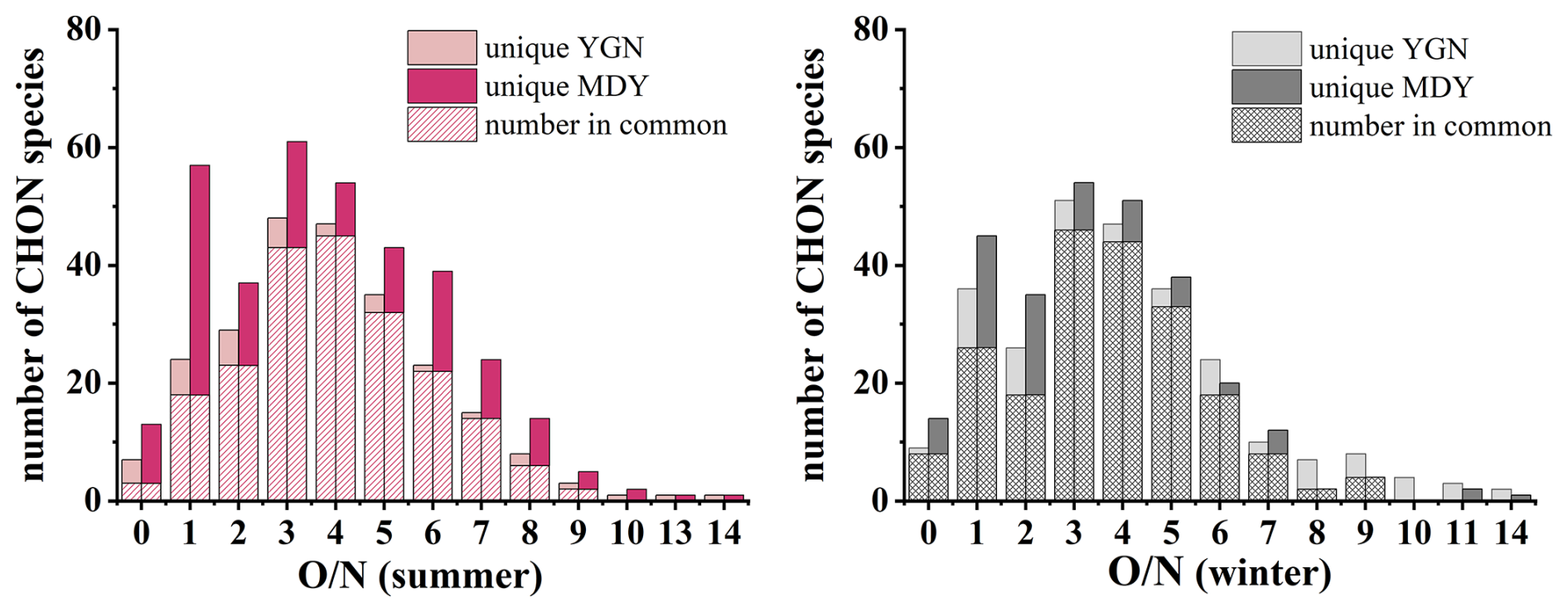
Figure 3Numbers of common and region-specific compounds in MDY and YGN binned by O N ratio. Number in common refers to the number of CHON compounds detected in both YGN and MDY, whereas unique YGN and unique MDY denote the numbers of CHON compounds detected exclusively in YGN and MDY, respectively.
In Fig. 2, pronounced differences in ON mass concentrations between the two sites are observed. The mass concentrations of ONs with O N ratios higher than 3 in MDY were substantially higher than those in YGN (39.6, 40.0, 71.2, and 69.7 ng m−3 for Yangon summer, Yangon winter, Mandalay summer, and Mandalay winter, respectively). In contrast, the comparable overall mass contributions of ONs between the two sites were mainly attributable to the relatively higher mass concentrations of compounds with O N < 3 in MDY than in YGN (4.7, 3.7, 13.1, and 7.3 ng m−3 for Yangon summer, Yangon winter, Mandalay summer, and Mandalay winter, respectively). Further examination of CHON molecular formulas (Fig. 3) shows that, for most O N ratio bins, the number of CHON compounds detected exclusively in MDY aerosols was higher than that detected exclusively in YGN aerosols, a pattern that was particularly pronounced in summer. These results indicate substantial differences in aerosol composition between the two cities, especially during MDY summer, exhibiting a more distinct molecular profile (Figs. 1c and 3).
3.2.2 Spatial distribution characteristics of nitrophenols
To more accurately identify types of NOCs, compounds containing aromatic rings were screened by combining AI values with the VK diagram. Molecular formulas that simultaneously met the criteria of O N ≥ 3 (as nitrophenols contain at least one nitro group (-NO2) and one hydroxyl group (-OH), corresponding to a minimum theoretical O N ratio of 3) and AI > 0.5 were classified as potential nitrophenolic compounds. These compounds were primarily distributed across Zones C, F, and G of the VK diagram (Figs. 4 and 5). Bianco et al. (2018) reported that compounds with CRAMs-like structures (Zone C) may be associated with photochemical processing in aerosols, whereas HOC (Zone G) represent a group of extensively oxidized organics. Consequently, these two types of compounds are predominantly formed via secondary oxidation processes. Notably, mass concentration of these two compounds was higher in the Mandalay samples than in Yangon (Yangon summer: 40.2 ng m−3, Yangon winter: 40.1 ng m−3, Mandalay summer: 78.4 ng m−3, Mandalay winter: 71.4 ng m−3), suggesting that secondary formation processes play a more prominent role in PM2.5 in Mandalay than in Yangon.
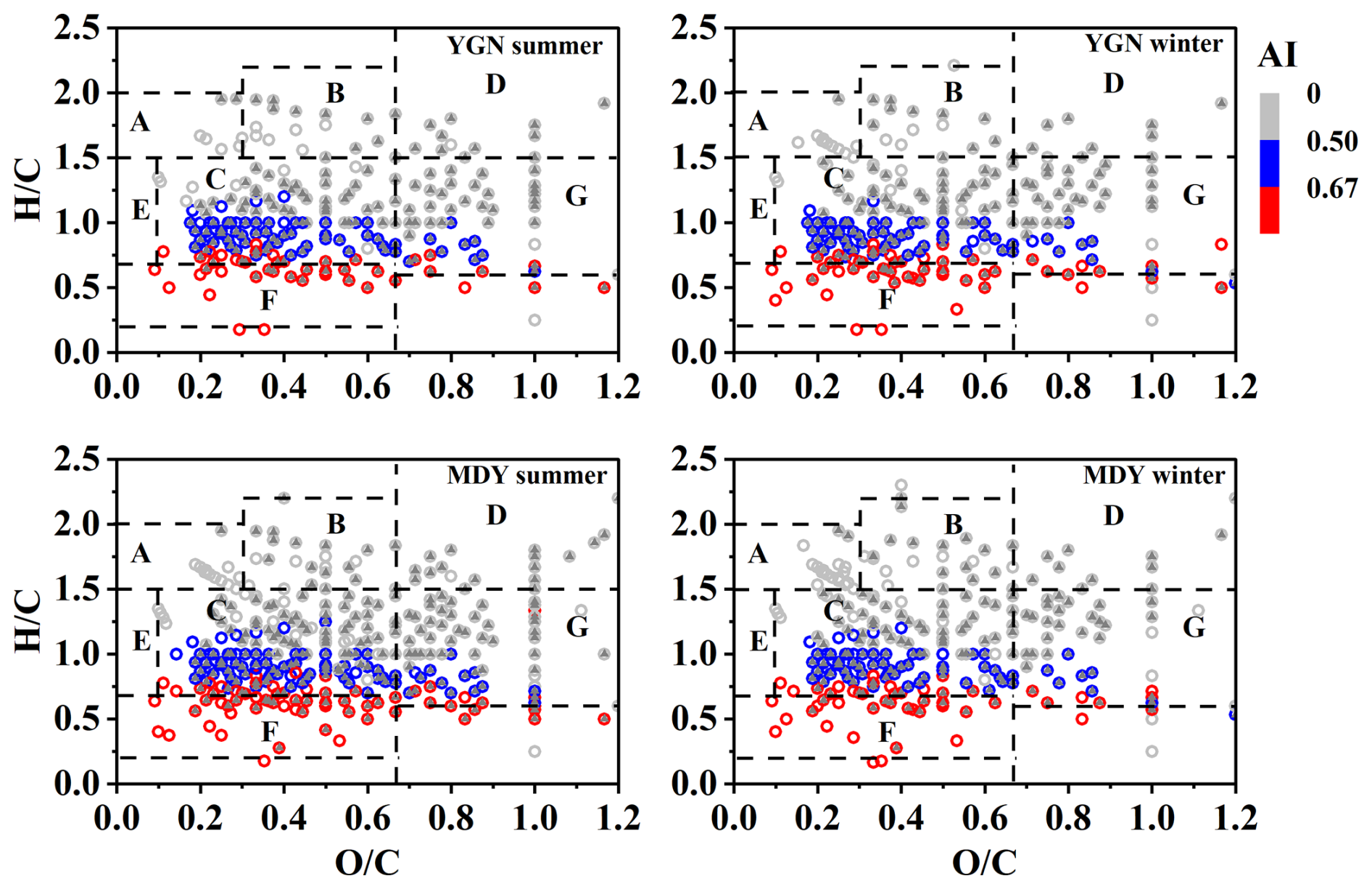
Figure 4CHON- Van Krevelen (VK) diagram for the identified compounds. According to the H C and O C ratios, organic compounds are classified into seven categories (A–G). Color bars represent the aromaticity index (AI), while grey triangles denote compounds with O N ≥ 3.
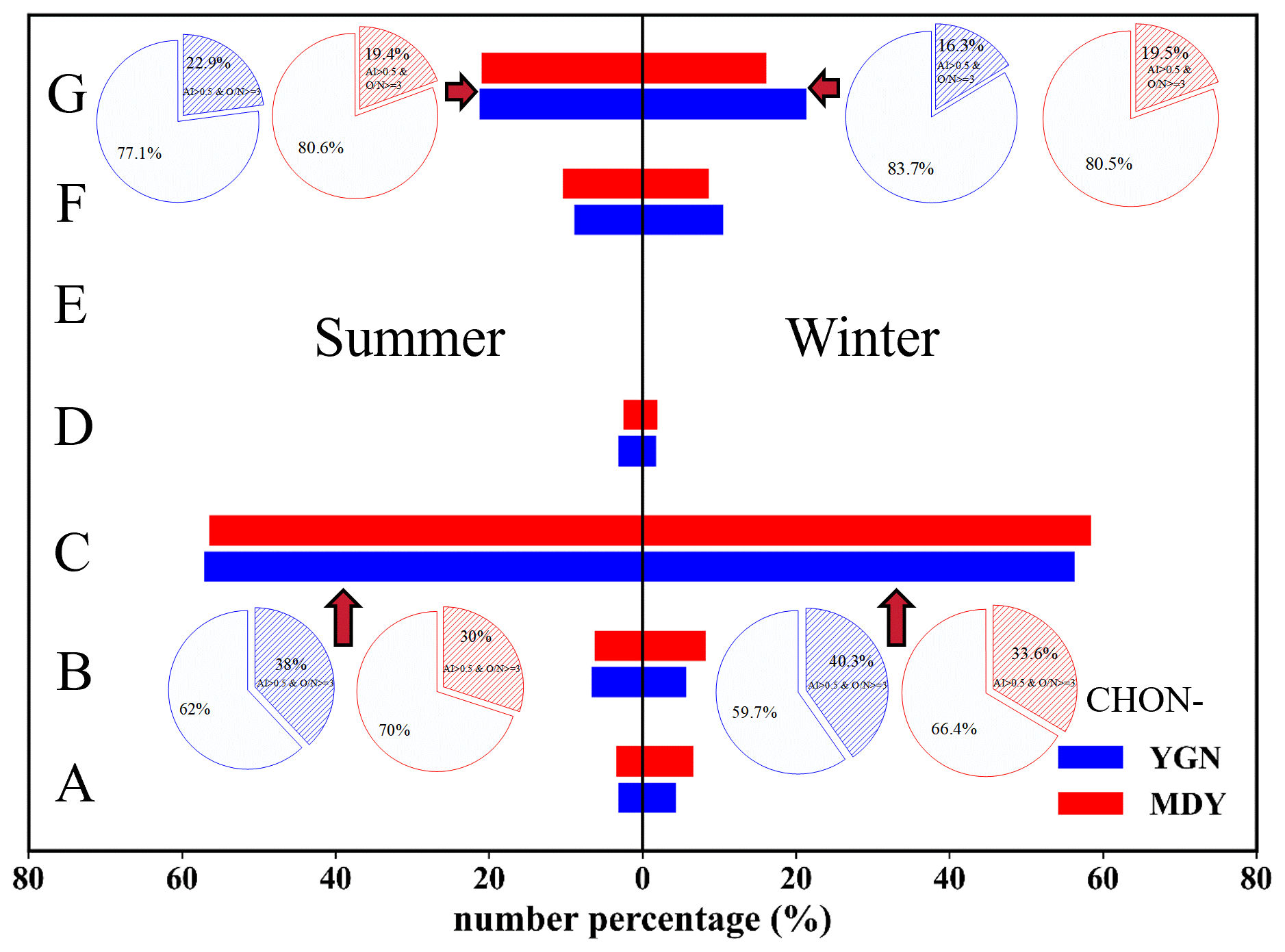
Figure 5Percentage of CHON- subfraction groups (A–G). Shaded sections in the pie charts represent the number proportion of nitrophenolic compounds within each corresponding subgroup. Blue denotes the Yangon site, while red represents the Mandalay site.
The number of nitrophenolic compounds accounted for a relatively high proportion within Zone C (approximately 35 %), with higher proportion observed in Yangon than in Mandalay during both seasons (Fig. 5). In Zone G, number of nitrophenolic compounds represented about 20 % of all identified species. During summer, the number proportion of nitrophenolic compounds in Zone G was higher in Yangon (22.9 %) than in Mandalay (19.4 %), whereas in winter, the trend was reversed, with Mandalay exhibiting a higher proportion (19.5 %) compared to Yangon (16.3 %).
3.3 C8H9NO4 and C6H5NO4
3.3.1 High detection efficiency NOCs
Compounds detected in all samples (detection frequency of 100 %) were defined as common peaks. A total of 35 CHON compounds were identified as common peaks, and their reconstructed mass spectra were generated (Fig. S6). Among these, the two most abundant compounds corresponded to the molecular formulas C6H5NO4 ( 154.01477) and C8H9NO4 ( 182.04609), which were located in Zones G and C of Fig. 4, respectively. Based on literature reports, NIST library analysis, and the strong positive correlations of these compounds with levoglucosan (r = 0.76 and 0.73 for C8H9NO4 and C6H5NO4, respectively, Fig. S5), C6H5NO4 and C8H9NO4 were inferred to be nitrocatechol (Herich et al., 2011; Simoneit et al., 1991; Lin et al., 2018) and dimethyl nitrocatechol (Claeys et al., 2012; Kourtchev et al., 2016), respectively.
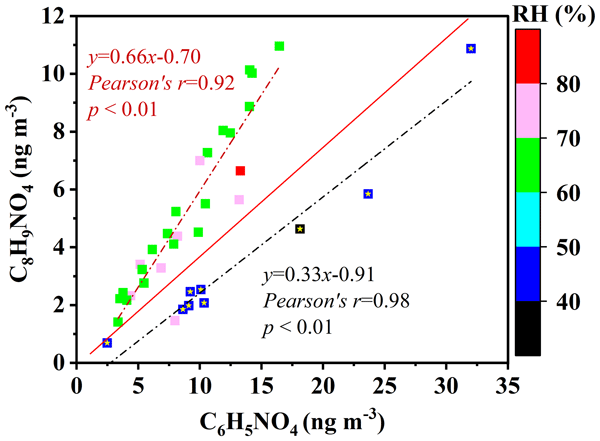
Correlation analysis revealed a strong positive relationship between C6H5NO4 and C8H9NO4, suggesting that these two compounds share similar sources. However, under RH < 50 %, the ratio of C8H9NO4 C6H5NO4 mass concentration changes with RH (Fig. 6). Samples collected during the Mandalay summer exhibited a relatively lower C8H9NO4 C6H5NO4 that coincided with a lower RH compared to the other sampling periods. According to our previous study (Zhang et al., 2022), the backward trajectories during both winter and summer in Mandalay were highly similar, indicating that the observed RH differences cannot be attributed to variations in air-mass transport. Collectively, these findings indicate that the formation of C6H5NO4 and C8H9NO4 is strongly associated with RH. The PyCHAM box model is applied to further investigate the factors influencing the formation of these two compounds.
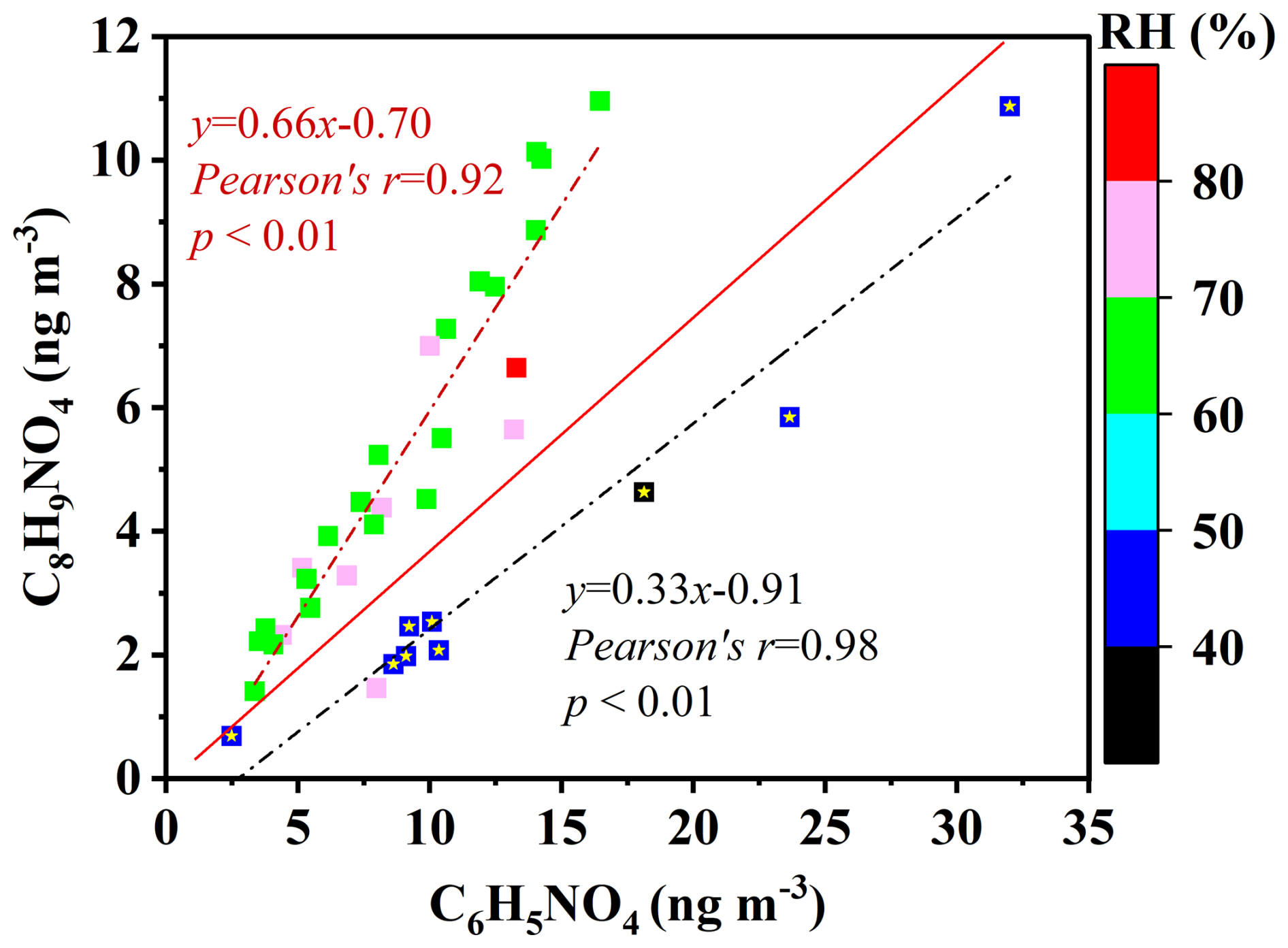
Figure 6The correlation between C6H5NO4 and C8H9NO4. Color bar is relative humidity. Yellow stars represent MDY summer samples.
3.3.2 RH effect on C8H9NO4 C6H5NO4
Following application of the constraints to box modelling described in Sect. 2.3, six simulations were conducted to investigate the drivers of varying particle-phase C8H9NO4 C6H5NO4 ratio, three for Yangon and three for Mandalay. In Mandalay, the RH changed substantially between seasons, whilst simulated influx rates of precursors remained constant, whilst in Yangon, the RH was relatively consistent but simulated influx rates of precursors changed with season. To help probe the effect of varying photochemistry between seasons, one of the Yangon simulations is a hypothetical scenario where the photochemistry was set to winter but the precursor influx was set to summer conditions (Fig. S7).
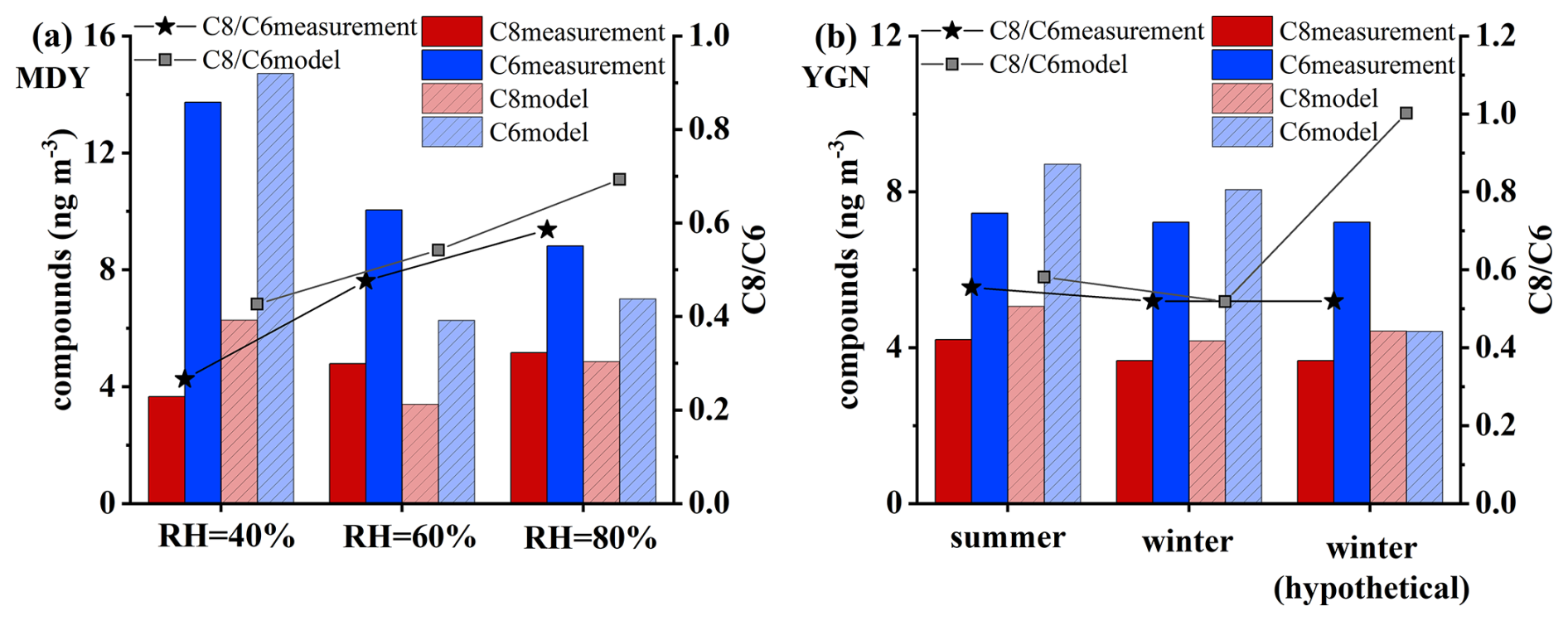
Figure 7(a) Concentration distributions of C8H9NO4 and C6H5NO4 under different RH conditions in Mandalay. (b) Concentration distributions of C8H9NO4 and C6H5NO4 during Yangon summer, winter and winter hypothetical. Dark-colored bars represent the observed mass concentrations, while light-colored bars indicate the mass concentrations simulated by the model.
The resulting simulations of particle-phase C8H9NO4 and C6H5NO4 reproduce the observed trend of increasing C8H9NO4 C6H5NO4 ratio with increasing RH (Fig. 7). Several factors are at play in the simulated results of Fig. 7, the increase in gas-phase OH concentration from winter to summer (photochemistry effect), the increasing influx rate of benzene from a minimum in Yangon summer to a moderate value in Yangon winter and a maximum for both seasons for Mandalay, the changing partitioning thermodynamics for C8H9NO4 and C6H5NO4 due to the changing absorptive molar concentration of particles and changing water mole fraction that affects solubility as explained in Sect. 2.3.
The effect of HO2 uptake to particles and of HONO influx rate dependence on gas-phase water content was tested by turning off HO2 uptake and by setting HONO influx rate to constant across simulations. Neither process showed a significant change to the trend of increasing C8H9NO4 C6H5NO4 ratio with increasing RH.
Considering first just the Mandalay results (Fig. 7a), for which the influx rates of C6H5NO4 and C8H9NO4 precursors were constant across all RH, modelled C8H9NO4 C6H5NO4 changes from 0.69 to 0.54 as RH changes from 80 % to 60 %, whilst observations report a change from 0.59 to 0.48. Because both 80 % and 60 % were during the winter period, the modelled change is not due to changing actinic flux, similarly although the decrease in gas-phase water content from 80 % to 60 % RH leads to a slight decrease in OH concentration, the change in consumption of the parent VOCs is negligible, therefore photochemistry does not explain the change in ratio. The only remaining explanation for the ratio changes available to the model is changes to the particle phase due to changed partitioning thermodynamics. The decrease in particle-phase concentration of C8H9NO4 from 80 % to 60 % RH is 30 %, whilst the decrease is 10 % for C6H5NO4. Therefore, the greater sensitivity of C8H9NO4 to changing partitioning thermodynamics, which results from changes to both absorptive particle concentration and particle-phase solubility, results in changed C8H9NO4 C6H5NO4. Variations in sensitivity are dependent on the product of component activity coefficient and vapour pressure, which gives an effective volatility or . For C8H9NO4, changes from 2400 to 1800 µg m−3 between 80 % and 60 % RH, whilst for C6H5NO4 changes from 82 to 64 µg m−3. These effective volatilities can be divided by the component molar masses to give units of mol m−3 and combined with the total absorptive molar concentration (cn,abs) of the particle phase in an equation for equilibrium gas-particle partitioning (Pankow, 1994) to demonstrate the different thermodynamic sensitivity of the two components:
where ξ is the equilibrium condensing fraction of component i and n is the molar concentration. Using the simulated cn,abs of 3.59 × 10⁻⁶ and 7.28 × 10⁻⁶ mol m−3 for the 60 % and 80 % RH scenarios, respectively, gives a factor change in ξ () of 1.33 for C8H9NO4 and 1.04 for C6H5NO4.
Whilst partitioning thermodynamics continues to act to decrease condensation of C8H9NO4 and C6H5NO4 as RH decreases from 60 % in Mandalay winter to 40 % in Mandalay summer, the particle-phase loading of both C8H9NO4 and C6H5NO4 actually increases, driven by the increased OH concentration that results from enhanced photochemistry. C6H5NO4 appears to be particularly sensitive to changing atmospheric oxidizing capacity, as its relative increase is greater than that of C8H9NO4, with fractional increases of 140 % and 70 % respectively. Analysis of simulated rates of production and destruction at midday shows a production enhancement of factor 2.33 for C6H5NO4 going from 60 % to 40 % RH, whilst the factor for C8H9NO4 is 1.62 and for both components the rate of chemical destruction is relatively minor so that dilution dominates losses.
The Yangon results are all for 70 % RH, and therefore have similar partitioning thermodynamics. For Yangon results, two factors are therefore at play, changing influx rates (Sect. 2.3 and Fig. S7) and changing photochemistry. Moving from Yangon summer to winter, photochemical changes act to increase C8H9NO4 C6H5NO4, as seen and explained above for Mandalay results between 40 % and 60 %. The photochemistry effect for Yangon is isolated from the influx rate effect by the hypothetical result in Fig. 7b, and indeed predicts increased C8H9NO4 C6H5NO4 from Yangon summer. However, both measurements and non-hypothetical simulation (for the latter changed photochemistry and changed precursor influx rates are at play) results show a slight decrease in C8H9NO4 C6H5NO4. Taking the hypothetical and non-hypothetical simulation results for Yangon winter together shows that the opposing effects of changes in photochemistry and precursor influx rates on C8H9NO4 C6H5NO4 broadly compensate one another for the non-hypothetical Yangon winter simulation.
The box modelling results and above explanations have shown that changes in partitioning thermodynamics that are driven by changes in aerosol water content, which are driven by changes in RH, exert a physical influence over C8H9NO4 C6H5NO4, since C8H9NO4 is more sensitive to the effect. However, atmospheric oxidizing capacity has also been identified as playing an influential role in explaining the observed changes in C8H9NO4 C6H5NO4. The box modelling results are consistent with observed changes in the BeP (BeP + BaP) ratio (where BeP (Benzo[e]pyrene) and BaP (Benzo[a]pyrene) data were taken from our previous study; Zhang et al., 2024b, Fig. S8). The BeP (BeP + BaP) ratio has been widely used as an indicator of aerosol aging (Křůmal et al., 2013). Fig. S8 shows the highest BeP (BeP + BaP) ratios for Mandalay summer and Yangon summer, supporting the box model result that photochemistry varies substantially between seasons. Because of the difference in sensitivity to changing oxidizing capacity between C8H9NO4 and C6H5NO4, when all else is constant, the C8H9NO4 C6H5NO4 acts as an indicator of aerosol aging. However, the spread of points in Fig. S8, particularly for Yangon summer and Mandalay summer, indicates that aerosol aging alone cannot fully explain the variability in C8H9NO4 C6H5NO4. The box-model simulations suggest that RH-dependent partitioning, precursor emissions, and photochemical processing all contribute to the observed variability.
Considering the modelling and observation results discussed in this section, two factors are suggested to contribute to the significantly greater WSON in Mandalay summer in Fig. 1. First, the high degree of oxidation of organics due to enhanced photochemistry relative to the winter scenarios. Second, the high concentration of precursors for relatively soluble oxidation products relative to Yangon summer (see Sect. 2.3 for discussion of why C6H5NO4 is expected to be more water soluble than C8H9NO4). However, a more thorough investigation involving more NOCs would be needed to test this hypothesis.
This study provides new insights into the molecular characteristics and formation controls of NOCs in urban aerosols influenced by biomass burning. The results demonstrate that ONs and nitrophenolic compounds constitute major components of NOCs. By combining molecular-level observations with aromatic emission rates from combustion of varying biomasses and box model simulations, we show that variations in the formation of nitrophenolic compounds can be influenced by changing RH, variations in precursor concentrations, and seasonal changes to photochemistry. Our results are consistent with previous studies identifying biomass burning as an important source of aromatic precursors and nitrophenolic compounds (Salvador et al., 2021; Wang et al., 2020), whilst providing additional investigation of how RH and photochemical conditions can influence molecular-level partitioning and transformation of nitrophenolic compounds in tropical urban atmospheres.
We found that enhanced photolysis acts to increase particle-phase C6H5NO4 in particular, but that changes to influence from open biomass burning can exert a comparable change to particle-phase C6H5NO4 concentration. Seasonal changes in open biomass burning influence, represented by changed model influx rates, are supported by changes to air mass back trajectories in Zhang et al. (2022) that show a shift from maritime to continental influence from Yangon summer to Yangon winter. The simulated effect of changing precursor availability for Yangon is sufficiently great to indicate that varying precursor concentration could drive changes also seen in Mandalay, however we did not have the data to justify changing precursor influx rates between Mandalay simulations, in contrast to changes in photochemistry and RH that were justified for Mandalay.
Meanwhile, particle-phase C8H9NO4 concentrations were shown to be relatively sensitive to changing RH, via partitioning thermodynamics. These findings indicate the importance of accurately representing emissions, photochemistry, and gas-particle partitioning thermodynamics in predicting particle-phase composition and abundance in chemical transport models, and we note that the latter two processes are in principle represented by the BAT-VBS framework (Serrano Damha et al., 2024). While this study focuses on Myanmar, the identified controls of RH on gas-particle partitioning and of atmospheric oxidizing capacity on nitrophenol formation are fundamental atmospheric processes likely relevant to other humid and photochemically active regions. Nevertheless, regional differences in precursor abundance and emission profiles may modulate the sensitivity of particle-phase nitrophenolic compounds to these processes. As nitrophenolic compounds are important constituents of biomass-burning-derived brown carbon, the demonstrated sensitivity of their abundance to RH and photochemical conditions may also contribute to uncertainties in estimates of brown carbon radiative forcing. However, due to the limited availability of standards, quantitative analysis was only possible for few nitrophenolic compounds. Future work should include more comprehensive laboratory simulations to better constrain the effects of RH and OH on the formation and degradation of nitrophenolic compounds.
The data supporting the findings of this study are publicly available at Zenodo (https://doi.org/10.5281/zenodo.20328885, Zhang, 2026).
The supplement related to this article is available online at https://doi.org/10.5194/acp-26-9793-2026-supplement.
JF and YM designed the research. NZ conducted the measurements. NZ, JF, SO, ZL, JW and EA analysed the data. NZ, JF, SO, YM, XG, WL, PC, PDC, JW and EA reviewed and commented on the paper. NZ and SO wrote the paper.
The contact author has declared that none of the authors has any competing interests.
Publisher's note: Copernicus Publications remains neutral with regard to jurisdictional claims made in the text, published maps, institutional affiliations, or any other geographical representation in this paper. The authors bear the ultimate responsibility for providing appropriate place names. Views expressed in the text are those of the authors and do not necessarily reflect the views of the publisher.
This work was supported by the Natural Science Foundation of Jiangsu Province (grant no. BK20240036), National Natural Science Foundation of China (grant nos. U24A20515, 22276099, 41877373, 42405113), Jiangsu Funding Program for Excellent Postdoctoral Talent (grant no. 2023ZB396), and the Guangxi Key Research and Development Program, China (grant no. Guike AB24010074), the UK National Centre for Atmospheric Science.
This paper was edited by Benjamin A Nault and reviewed by two anonymous referees.
Abudumutailifu, M., Shang, X., Wang, L., Zhang, M., Kang, H., Chen, Y., Li, L., Ju, R., Li, B., Ouyang, H., Tang, X., Li, C., Wang, L., Wang, X., George, C., Rudich, Y., Zhang, R., and Chen, J.: Unveiling the molecular characteristics, origins, and formation mechanism of reduced nitrogen organic compounds in the urban atmosphere of Shanghai using a versatile aerosol concentration enrichment system, Environ. Sci. Technol., 58, 7099–7112, https://doi.org/10.1021/acs.est.3c04071, 2024.
Amnuaylojaroen, T. and Parasin, N.: Perspective on particulate matter: from biomass burning to the health crisis in mainland Southeast Asia, Toxics, 11, 553, https://doi.org/10.3390/toxics11070553, 2023.
Andreae, M. O.: Emission of trace gases and aerosols from biomass burning – an updated assessment, Atmos. Chem. Phys., 19, 8523–8546, https://doi.org/10.5194/acp-19-8523-2019, 2019.
Aruffo, E., Wang, J., Ye, J., Ohno, P., Qin, Y., Stewart, M., McKinney, K., Di Carlo, P., and Martin, S. T.: Partitioning of organonitrates in the production of secondary organic aerosols from α-pinene photo-oxidation, Environ. Sci. Technol., 56, 5421–5429, https://doi.org/10.1021/acs.est.1c08380, 2022.
Aung, W.-Y., Noguchi, M., Pan-Nu Yi, E.-E., Thant, Z., Uchiyama, S., Win-Shwe, T.-T., Kunugita, N., and Mar, O.: Preliminary assessment of outdoor and indoor air quality in Yangon city, Myanmar, Atmos. Pollut. Res., 10, 722–730, https://doi.org/10.1016/j.apr.2018.11.011, 2019.
Bandowe, B. A. M. and Meusel, H.: Nitrated polycyclic aromatic hydrocarbons (nitro-PAHs) in the environment – a review, Sci. Total Environ., 581–582, 237–257, https://doi.org/10.1016/j.scitotenv.2016.12.115, 2017.
Bianco, A., Deguillaume, L., Vaïtilingom, M., Nicol, E., Baray, J.-L., Chaumerliac, N., and Bridoux, M.: Molecular characterization of cloud water samples collected at the puy de Dôme (France) by fourier transform ion cyclotron resonance mass spectrometry, Environ. Sci. Technol., 52, 10275–10285, https://doi.org/10.1021/acs.est.8b01964, 2018.
Bloss, C., Wagner, V., Jenkin, M. E., Volkamer, R., Bloss, W. J., Lee, J. D., Heard, D. E., Wirtz, K., Martin-Reviejo, M., Rea, G., Wenger, J. C., and Pilling, M. J.: Development of a detailed chemical mechanism (MCMv3.1) for the atmospheric oxidation of aromatic hydrocarbons, Atmos. Chem. Phys., 5, 641–664, https://doi.org/10.5194/acp-5-641-2005, 2005.
Cai, D., Wang, X., George, C., Cheng, T., Herrmann, H., Li, X., and Chen, J.: Formation of secondary nitroaromatic compounds in polluted urban environments, J. Geophys. Res.-Atmos., 127, e2021JD036167, https://doi.org/10.1029/2021JD036167, 2022.
Cao, M., Yu, W., Chen, M., and Chen, M.: Characterization of nitrated aromatic compounds in fine particles from Nanjing, China: optical properties, source allocation, and secondary processes, Environ. Pollut., 316, 120650, https://doi.org/10.1016/j.envpol.2022.120650, 2023.
Claeys, M., Vermeylen, R., Yasmeen, F., Gómez-González, Y., Chi, X., Maenhaut, W., Mészáros, T., and Salma, I.: Chemical characterisation of humic-like substances from urban, rural and tropical biomass burning environments using liquid chromatography with UV/vis photodiode array detection and electrospray ionisation mass spectrometry, Environ. Chem., 9, 273–284, https://doi.org/10.1071/EN11163, 2012.
Desyaterik, Y., Sun, Y., Shen, X., Lee, T., Wang, X., Wang, T., and Collett Jr., J. L.: Speciation of “brown” carbon in cloud water impacted by agricultural biomass burning in eastern China, J. Geophys. Res.-Atmos., 118, 7389–7399, https://doi.org/10.1002/jgrd.50561, 2013.
Feng, J., Li, M., Zhang, P., Gong, S., Zhong, M., Wu, M., Zheng, M., Chen, C., Wang, H., and Lou, S.: Investigation of the sources and seasonal variations of secondary organic aerosols in PM2.5 in Shanghai with organic tracers, Atmos. Environ., 79, 614–622, https://doi.org/10.1016/j.atmosenv.2013.07.022, 2013.
Fredrickson, C. D., Palm, B. B., Lee, B. H., Zhang, X., Orlando, J. J., Tyndall, G. S., Garofalo, L. A., Pothier, M. A., Farmer, D. K., Decker, Z. C. J., Robinson, M. A., Brown, S. S., Murphy, S. M., Shen, Y., Sullivan, A. P., Schobesberger, S., and Thornton, J. A.: Formation and evolution of catechol-derived SOA mass, composition, volatility, and light absorption, ACS Earth Space Chem., 6, 1067–1079, https://doi.org/10.1021/acsearthspacechem.2c00007, 2022.
Geng, H., Park, Y., Hwang, H., Kang, S., and Ro, C.-U.: Elevated nitrogen-containing particles observed in Asian dust aerosol samples collected at the marine boundary layer of the Bohai Sea and the Yellow Sea, Atmos. Chem. Phys., 9, 6933–6947, https://doi.org/10.5194/acp-9-6933-2009, 2009.
Harrison, M. A. J., Barra, S., Borghesi, D., Vione, D., Arsene, C., and Iulian Olariu, R.: Nitrated phenols in the atmosphere: a review, Atmos. Environ., 39, 231–248, https://doi.org/10.1016/j.atmosenv.2004.09.044, 2005.
Hayman, G.: Effects of pollution control on UV exposure, in: AEA technology final report, Reference AEA/RCEC/22522001/R/002 ISSUE1, Department of Health on Contract 121/6377, AEA Technology, Oxfordshire, UK, 1997.
Herich, H., Hueglin, C., and Buchmann, B.: A 2.5 year's source apportionment study of black carbon from wood burning and fossil fuel combustion at urban and rural sites in Switzerland, Atmos. Meas. Tech., 4, 1409–1420, https://doi.org/10.5194/amt-4-1409-2011, 2011.
Jacob, D. J.: Heterogeneous chemistry and tropospheric ozone, Atmos. Environ., 34, 2131–2159, https://doi.org/10.1016/S1352-2310(99)00462-8, 2000.
Jenkin, M. E., Saunders, S. M., and Pilling, M. J.: The tropospheric degradation of volatile organic compounds: a protocol for mechanism development, Atmos. Environ., 31, 81–104, https://doi.org/10.1016/S1352-2310(96)00105-7, 1997.
Jenkin, M. E., Saunders, S. M., Wagner, V., and Pilling, M. J.: Protocol for the development of the Master Chemical Mechanism, MCM v3 (Part B): tropospheric degradation of aromatic volatile organic compounds, Atmos. Chem. Phys., 3, 181–193, https://doi.org/10.5194/acp-3-181-2003, 2003.
Jiang, H., Li, J., Tang, J., Zhao, S., Chen, Y., Tian, C., Zhang, X., Jiang, B., Liao, Y., and Zhang, G.: Factors influencing the molecular compositions and distributions of atmospheric nitrogen-containing compounds, J. Geophys. Res.-Atmos., 127, e2021JD036284, https://doi.org/10.1029/2021JD036284, 2022.
Kholod, Y. A., Gryn'ova, G., Gorb, L., Hill, F. C., and Leszczynski, J.: Evaluation of the dependence of aqueous solubility of nitro compounds on temperature and salinity: A COSMO-RS simulation, Chemosphere, 83, 287–294, https://doi.org/10.1016/j.chemosphere.2010.12.065, 2011.
Koch, B. P. and Dittmar, T.: From mass to structure: an aromaticity index for high-resolution mass data of natural organic matter, Rapid Commun. Mass Spectrom., 20, 926–932, https://doi.org/10.1002/rcm.2386, 2006.
Kourtchev, I., Godoi, R. H. M., Connors, S., Levine, J. G., Archibald, A. T., Godoi, A. F. L., Paralovo, S. L., Barbosa, C. G. G., Souza, R. A. F., Manzi, A. O., Seco, R., Sjostedt, S., Park, J.-H., Guenther, A., Kim, S., Smith, J., Martin, S. T., and Kalberer, M.: Molecular composition of organic aerosols in central Amazonia: an ultra-high-resolution mass spectrometry study, Atmos. Chem. Phys., 16, 11899–11913, https://doi.org/10.5194/acp-16-11899-2016, 2016.
Krugly, E., Martuzevicius, D., Puida, E., Buinevicius, K., Stasiulaitiene, I., Radziuniene, I., Minikauskas, A., and Kliucininkas, L.: Characterization of gaseous- and particle-phase emissions from the combustion of biomass-residue-derived fuels in a small residential boiler, Energy & Fuels, 28, 5057–5066, https://doi.org/10.1021/ef500420t, 2014.
Křůmal, K., Mikuška, P., and Večeřa, Z.: Polycyclic aromatic hydrocarbons and hopanes in PM1 aerosols in urban areas, Atmos. Environ., 67, 27–37, https://doi.org/10.1016/j.atmosenv.2012.10.033, 2013.
Laskin, A., Laskin, J., and Nizkorodov, S. A.: Chemistry of atmospheric brown carbon, Chem. Rev., 115, 4335–4382, https://doi.org/10.1021/cr5006167, 2015.
Lee, S. C., Hung, H., Shiu, W. Y., and Mackay, D.: Estimations of vapor pressure and activity coefficients in water and octanol for selected aromatic chemicals at 25 °C, Environ. Toxicol. Chem., 19, 2623–2630, https://doi.org/10.1002/etc.5620191102, 2000.
Lelieveld, J., Gromov, S., Pozzer, A., and Taraborrelli, D.: Global tropospheric hydroxyl distribution, budget and reactivity, Atmos. Chem. Phys., 16, 12477–12493, https://doi.org/10.5194/acp-16-12477-2016, 2016.
Li, X., Wang, Y., Hu, M., Tan, T., Li, M., Wu, Z., Chen, S., and Tang, X.: Characterizing chemical composition and light absorption of nitroaromatic compounds in the winter of Beijing, Atmos. Environ., 237, 117712, https://doi.org/10.1016/j.atmosenv.2020.117712, 2020.
Li, Y., Fu, T.-M., Yu, J. Z., Zhang, A., Yu, X., Ye, J., Zhu, L., Shen, H., Wang, C., Yang, X., Tao, S., Chen, Q., Li, Y., Li, L., Che, H., and Heald, C. L.: Nitrogen dominates global atmospheric organic aerosol absorption, Science, 387, 989–995, https://doi.org/10.1126/science.adr4473, 2025.
Lin, M., Walker, J., Geron, C., and Khlystov, A.: Organic nitrogen in PM2.5 aerosol at a forest site in the Southeast US, Atmos. Chem. Phys., 10, 2145–2157, https://doi.org/10.5194/acp-10-2145-2010, 2010.
Lin, P., Rincon, A. G., Kalberer, M., and Yu, J. Z.: Elemental composition of HULIS in the Pearl River Delta Region, China: results inferred from positive and negative electrospray high resolution mass spectrometric data, Environ. Sci. Technol., 46, 7454–7462, https://doi.org/10.1021/es300285d, 2012a.
Lin, P., Yu, J. Z., Engling, G., and Kalberer, M.: Organosulfates in humic-like substance fraction isolated from aerosols at seven locations in East Asia: a study by ultra-high-resolution mass spectrometry, Environ. Sci. Technol., 46, 13118–13127, https://doi.org/10.1021/es303570v, 2012b.
Lin, P., Fleming, L. T., Nizkorodov, S. A., Laskin, J., and Laskin, A.: Comprehensive molecular characterization of atmospheric brown carbon by high resolution mass spectrometry with electrospray and atmospheric pressure photoionization, Anal. Chem., 90, 12493–12502, https://doi.org/10.1021/acs.analchem.8b02177, 2018.
Ma, Y.-J., Xu, Y., Yang, T., Xiao, H.-W., and Xiao, H.-Y.: Measurement report: Characteristics of nitrogen-containing organics in PM2.5 in Ürümqi, northwestern China – differential impacts of combustion of fresh and aged biomass materials, Atmos. Chem. Phys., 24, 4331–4346, https://doi.org/10.5194/acp-24-4331-2024, 2024.
Nannoolal, Y., Rarey, J., and Ramjugernath, D.: Estimation of pure component properties: Part 3. Estimation of the vapor pressure of non-electrolyte organic compounds via group contributions and group interactions, Fluid Phase Equilibr., 269, 117–133, https://doi.org/10.1016/j.fluid.2008.04.020, 2008.
Nelson, B. S., Stewart, G. J., Drysdale, W. S., Newland, M. J., Vaughan, A. R., Dunmore, R. E., Edwards, P. M., Lewis, A. C., Hamilton, J. F., Acton, W. J., Hewitt, C. N., Crilley, L. R., Alam, M. S., Şahin, Ü. A., Beddows, D. C. S., Bloss, W. J., Slater, E., Whalley, L. K., Heard, D. E., Cash, J. M., Langford, B., Nemitz, E., Sommariva, R., Cox, S., Shivani, Gadi, R., Gurjar, B. R., Hopkins, J. R., Rickard, A. R., and Lee, J. D.: In situ ozone production is highly sensitive to volatile organic compounds in Delhi, India, Atmos. Chem. Phys., 21, 13609–13630, https://doi.org/10.5194/acp-21-13609-2021, 2021.
Ng, N. L., Chhabra, P. S., Chan, A. W. H., Surratt, J. D., Kroll, J. H., Kwan, A. J., McCabe, D. C., Wennberg, P. O., Sorooshian, A., Murphy, S. M., Dalleska, N. F., Flagan, R. C., and Seinfeld, J. H.: Effect of NOx level on secondary organic aerosol (SOA) formation from the photooxidation of terpenes, Atmos. Chem. Phys., 7, 5159–5174, https://doi.org/10.5194/acp-7-5159-2007, 2007.
Nway, N. C., Aung, W. Y., Yi, E. E. P. N., Thant, Z., Yagishita, M., Ishigaki, Y., Suzuki, T., Nakajima, D., Win-Shwe, T.-T., and Mar, O.: Seasonal and regional variation of particulate matter dispersion in Yangon City and Taunggyi City, Myanmar, IOP Conference Series: Earth and Environmental Science, 496, 012003, https://doi.org/10.1088/1755-1315/496/1/012003, 2020.
O'Meara, S. P., Xu, S., Topping, D., Alfarra, M. R., Capes, G., Lowe, D., Shao, Y., and McFiggans, G.: PyCHAM (v2.1.1): a Python box model for simulating aerosol chambers, Geosci. Model Dev., 14, 675–702, https://doi.org/10.5194/gmd-14-675-2021, 2021.
Pankow, J. F.: An absorption model of gas/particle partitioning of organic compounds in the atmosphere, Atmos. Environ., 28, 185–188, https://doi.org/10.1016/1352-2310(94)90093-0, 1994.
Pawar, P. V., Mahajan, A. S., and Ghude, S. D.: HONO chemistry and its impact on the atmospheric oxidizing capacity over the Indo-Gangetic Plain, Sci. Total Environ., 947, 174604, https://doi.org/10.1016/j.scitotenv.2024.174604, 2024.
Priestley, M., Le Breton, M., Bannan, T. J., Leather, K. E., Bacak, A., Reyes-Villegas, E., De Vocht, F., Shallcross, B. M. A., Brazier, T., Anwar Khan, M., Allan, J., Shallcross, D. E., Coe, H., and Percival, C. J.: Observations of isocyanate, amide, nitrate, and nitro compounds from an anthropogenic biomass burning event using a ToF-CIMS, J. Geophys. Res.-Atmos., 123, 7687–7704, https://doi.org/10.1002/2017JD027316, 2018.
Rickard, A.: Master Chemical Mechanism (MCM) v3.3.1, https://www.mcm.york.ac.uk/MCM (last access: May 2025), 2025.
Rollins, A. W., Browne, E. C., Min, K. E., Pusede, S. E., Wooldridge, P. J., Gentner, D. R., Goldstein, A. H., Liu, S., Day, D. A., Russell, L. M., and Cohen, R. C.: Evidence for NOx control over nighttime SOA formation, Science, 337, 1210–1212, https://doi.org/10.1126/science.1221520, 2012.
Salvador, C. M. G., Tang, R., Priestley, M., Li, L., Tsiligiannis, E., Le Breton, M., Zhu, W., Zeng, L., Wang, H., Yu, Y., Hu, M., Guo, S., and Hallquist, M.: Ambient nitro-aromatic compounds – biomass burning versus secondary formation in rural China, Atmos. Chem. Phys., 21, 1389–1406, https://doi.org/10.5194/acp-21-1389-2021, 2021.
Samy, S. and Hays, M. D.: Quantitative LC–MS for water-soluble heterocyclic amines in fine aerosols (PM2.5) at Duke Forest, USA, Atmos. Environ., 72, 77–80, https://doi.org/10.1016/j.atmosenv.2013.02.032, 2013.
Samy, S., Robinson, J., Rumsey, I. C., Walker, J. T., and Hays, M. D.: Speciation and trends of organic nitrogen in southeastern U.S. fine particulate matter (PM2.5), J. Geophys. Res.-Atmos., 118, 1996–2006, https://doi.org/10.1029/2012JD017868, 2013.
Saunders, S. M., Jenkin, M. E., Derwent, R. G., and Pilling, M. J.: Protocol for the development of the Master Chemical Mechanism, MCM v3 (Part A): tropospheric degradation of non-aromatic volatile organic compounds, Atmos. Chem. Phys., 3, 161–180, https://doi.org/10.5194/acp-3-161-2003, 2003.
Serrano Damha, C., Cummings, B. E., Schervish, M., Shiraiwa, M., Waring, M. S., and Zuend, A.: Capturing the relative-humidity-sensitive gas-particle partitioning of organic aerosols in a 2D volatility basis set, Geophys. Res. Lett., 51, e2023GL106095, https://doi.org/10.1029/2023GL106095, 2024.
Simoneit, B. R. T., Sheng, G., Chen, X., Fu, J., Zhang, J., and Xu, Y.: Molecular marker study of extractable organic matter in aerosols from urban areas of China, Atmos. Environ. A-Gen., 25, 2111–2129, https://doi.org/10.1016/0960-1686(91)90088-O, 1991.
Smith, J. S., Laskin, A., and Laskin, J.: Molecular characterization of biomass burning aerosols using high-resolution mass spectrometry, Anal. Chem., 81, 1512–1521, https://doi.org/10.1021/ac8020664, 2009.
Sun, Y., Luo, H., Li, Y., Zhou, W., Xu, W., Fu, P., and Zhao, D.: Atmospheric organic aerosols: online molecular characterization and environmental impacts, npj Clim. Atmos. Sci., 8, 305, https://doi.org/10.1038/s41612-025-01199-2, 2025.
Tan, Z., Rohrer, F., Lu, K., Ma, X., Bohn, B., Broch, S., Dong, H., Fuchs, H., Gkatzelis, G. I., Hofzumahaus, A., Holland, F., Li, X., Liu, Y., Liu, Y., Novelli, A., Shao, M., Wang, H., Wu, Y., Zeng, L., Hu, M., Kiendler-Scharr, A., Wahner, A., and Zhang, Y.: Wintertime photochemistry in Beijing: observations of ROx radical concentrations in the North China Plain during the BEST-ONE campaign, Atmos. Chem. Phys., 18, 12391–12411, https://doi.org/10.5194/acp-18-12391-2018, 2018.
Topping, D., Barley, M., Bane, M. K., Higham, N., Aumont, B., Dingle, N., and McFiggans, G.: UManSysProp v1.0: an online and open-source facility for molecular property prediction and atmospheric aerosol calculations, Geosci. Model Dev., 9, 899–914, https://doi.org/10.5194/gmd-9-899-2016, 2016.
Wang, H., Gao, Y., Wang, S., Wu, X., Liu, Y., Li, X., Huang, D., Lou, S., Wu, Z., Guo, S., Jing, S., Li, Y., Huang, C., Tyndall, G. S., Orlando, J. J., and Zhang, X.: Atmospheric processing of nitrophenols and nitrocresols from biomass burning emissions, J. Geophys. Res.-Atmos., 125, e2020JD033401, https://doi.org/10.1029/2020JD033401, 2020.
Wang, X. K., Rossignol, S., Ma, Y., Yao, L., Wang, M. Y., Chen, J. M., George, C., and Wang, L.: Molecular characterization of atmospheric particulate organosulfates in three megacities at the middle and lower reaches of the Yangtze River, Atmos. Chem. Phys., 16, 2285–2298, https://doi.org/10.5194/acp-16-2285-2016, 2016.
Wang, Z., Ge, Y., Bi, S., Liang, Y., and Shi, Q.: Molecular characterization of organic aerosol in winter from Beijing using UHPLC-Orbitrap MS, Sci. Total Environ., 812, 151507, https://doi.org/10.1016/j.scitotenv.2021.151507, 2022.
Xie, Q., Su, S., Chen, J., Dai, Y., Yue, S., Su, H., Tong, H., Zhao, W., Ren, L., Xu, Y., Cao, D., Li, Y., Sun, Y., Wang, Z., Liu, C.-Q., Kawamura, K., Jiang, G., Cheng, Y., and Fu, P.: Increase of nitrooxy organosulfates in firework-related urban aerosols during Chinese New Year's Eve, Atmos. Chem. Phys., 21, 11453–11465, https://doi.org/10.5194/acp-21-11453-2021, 2021.
Xu, W., Sun, Y., Wang, Q., Du, W., Zhao, J., Ge, X., Han, T., Zhang, Y., Zhou, W., Li, J., Fu, P., Wang, Z., and Worsnop, D. R.: Seasonal characterization of organic nitrogen in atmospheric aerosols using high resolution aerosol mass spectrometry in Beijing, China, ACS Earth Space Chem., 1, 673–682, https://doi.org/10.1021/acsearthspacechem.7b00106, 2017.
Xu, Y., Dong, X.-N., He, C., Wu, D.-S., Xiao, H.-W., and Xiao, H.-Y.: Mist cannon trucks can exacerbate the formation of water-soluble organic aerosol and PM2.5 pollution in the road environment, Atmos. Chem. Phys., 23, 6775–6788, https://doi.org/10.5194/acp-23-6775-2023, 2023.
Yu, K., Zhu, Q., Du, K., and Huang, X.-F.: Characterization of nighttime formation of particulate organic nitrates based on high-resolution aerosol mass spectrometry in an urban atmosphere in China, Atmos. Chem. Phys., 19, 5235–5249, https://doi.org/10.5194/acp-19-5235-2019, 2019.
Yu, X., Li, Q., Ge, Y., Li, Y., Liao, K., Huang, X. H., Li, J., and Yu, J. Z.: Simultaneous determination of aerosol inorganic and organic nitrogen by thermal evolution and chemiluminescence detection, Environ. Sci. Technol., 55, 11579–11589, https://doi.org/10.1021/acs.est.1c04876, 2021.
Yu, X., Li, Q., Liao, K., Li, Y., Wang, X., Zhou, Y., Liang, Y., and Yu, J. Z.: New measurements reveal a large contribution of nitrogenous molecules to ambient organic aerosol, npj Clim. Atmos. Sci., 7, 72, https://doi.org/10.1038/s41612-024-00620-6, 2024.
Yu, X., Zhou, M., Zhu, S., Qiao, L., Li, J., Ma, Y., Zhang, Z., Liao, K., Wang, H., and Yu, J. Z.: Significant secondary formation of nitrogenous organic aerosols in an urban atmosphere revealed by bihourly measurements of bulk organic nitrogen and comprehensive molecular markers, Atmos. Chem. Phys., 25, 9061–9074, https://doi.org/10.5194/acp-25-9061-2025, 2025.
Zeng, Y., Shen, Z., Takahama, S., Zhang, L., Zhang, T., Lei, Y., Zhang, Q., Xu, H., Ning, Y., Huang, Y., Cao, J., and Rudolf, H.: Molecular absorption and evolution mechanisms of PM2.5 brown carbon revealed by electrospray ionization fourier transform–ion cyclotron resonance mass spectrometry during a severe winter pollution episode in Xi'an, China, Geophys. Res. Lett., 47, e2020GL087977, https://doi.org/10.1029/2020GL087977, 2020.
Zhang, M., Cai, D., Lin, J., Liu, Z., Li, M., Wang, Y., and Chen, J.: Molecular characterization of atmospheric organic aerosols in typical megacities in China, npj Clim. Atmos. Sci., 7, 230, https://doi.org/10.1038/s41612-024-00784-1, 2024a.
Zhang, N.: Data for “Chemical characteristics and environmental drivers of nitrogen-containing organic aerosol formation in coastal and inland urban atmospheres in Myanmar”, Zenodo [data set], https://doi.org/10.5281/zenodo.20328885, 2026.
Zhang, N., Maung, M. W., Win, M. S., Feng, J., and Yao, X.: Carbonaceous aerosol and inorganic ions of PM2.5 in Yangon and Mandalay of Myanmar: seasonal and spatial variations in composition and sources, Atmos. Pollut. Res., 13, 101444, https://doi.org/10.1016/j.apr.2022.101444, 2022.
Zhang, N., Maung, M. W., Wang, S., Aruffo, E., and Feng, J.: Characterization and health risk assessment of PM2.5-bound polycyclic aromatic hydrocarbons in Yangon and Mandalay of Myanmar, Sci. Total Environ., 914, 170034, https://doi.org/10.1016/j.scitotenv.2024.170034, 2024b.
Zhong, Y., Chen, J., Zhao, Q., Zhang, N., Feng, J., and Fu, Q.: Temporal trends of the concentration and sources of secondary organic aerosols in PM2.5 in Shanghai during 2012 and 2018, Atmos. Environ., 261, 170034, https://doi.org/10.1016/j.atmosenv.2021.118596, 2021.