
Articles | Volume 26, issue 13
https://doi.org/10.5194/acp-26-9453-2026
© Author(s) 2026. This work is distributed under
the Creative Commons Attribution 4.0 License.
the Creative Commons Attribution 4.0 License.
https://doi.org/10.5194/acp-26-9453-2026
© Author(s) 2026. This work is distributed under
the Creative Commons Attribution 4.0 License.
the Creative Commons Attribution 4.0 License.
Research article
| 
06 Jul 2026
Research article |
| 06 Jul 2026
| 06 Jul 2026
Elevated foehn exacerbates surface ozone pollution in summer Beijing
Zhiheng Liao
CORRESPONDING AUTHOR
Institute of Urban Meteorology, China Meteorological Administration, Beijing, China
Jing Xu
Institute of Urban Meteorology, China Meteorological Administration, Beijing, China
Institute of Urban Meteorology, China Meteorological Administration, Beijing, China
Liyan Zhou
Institute of Urban Meteorology, China Meteorological Administration, Beijing, China
Chao Liu
Institute of Urban Meteorology, China Meteorological Administration, Beijing, China
Lin Wu
Huairou Meteorological Office of Beijing, Beijing, China
Zhiqiang Ma
CORRESPONDING AUTHOR
Institute of Urban Meteorology, China Meteorological Administration, Beijing, China
Related authors
Zhiheng Liao, Jinqiang Zhang, Meng Gao, and Zhiqiang Ma
Atmos. Chem. Phys., 25, 14865–14877, https://doi.org/10.5194/acp-25-14865-2025, https://doi.org/10.5194/acp-25-14865-2025, 2025
Short summary
Short summary
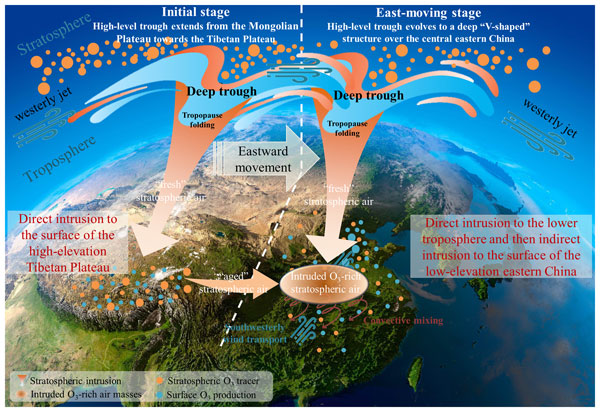
We present evidence for widespread stratospheric intrusion influence on surface ozone pollution from western plateaus to eastern plains over China in a deep trough event based on multi-site ozonesondes and validated ozone reanalysis. The findings refine the fundamental understanding of stratospheric ozone intrusion and its contribution to surface ozone pollution in China.
Zhiheng Liao, Jinqiang Zhang, Yubin Pan, Xingcan Jia, Pengkun Ma, Qianqian Wang, Zhigang Cheng, Lindong Dai, and Jiannong Quan
EGUsphere, https://doi.org/10.5194/egusphere-2023-1393, https://doi.org/10.5194/egusphere-2023-1393, 2023
Preprint withdrawn
Short summary
Short summary
This study presents the first systematic assessment of observationally constrained UTLS O3 variability over the Northeast Asia region in the framework of upper-level circulation pattern classification. The results indicate that lower-stratospheric O3 exhibits a far stronger sensitivity to upper-level circulation patterns when compared with upper-tropospheric O3. The progression of the East Asian Trough plays a critical role in determining the location and intensity of O3 enhancements.
Weiwei Pu, Jing Xu, Lingyun Zhu, Chao Liu, Liyan Zhou, Jian Dong, Shuangshuang Ge, and Zhiqiang Ma
Atmos. Chem. Phys., 26, 6133–6145, https://doi.org/10.5194/acp-26-6133-2026, https://doi.org/10.5194/acp-26-6133-2026, 2026
Short summary
Short summary
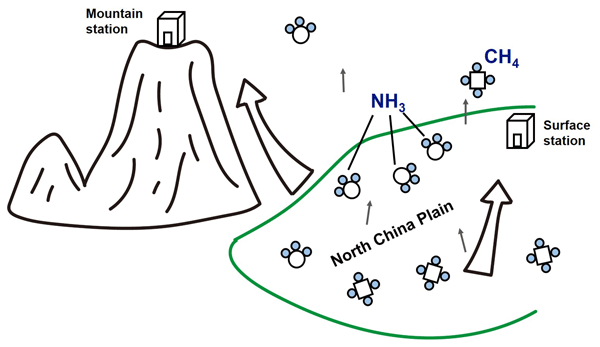
This study presents a year of high-resolution NH3 measurements at a high-altitude mountain site in northern China. We found that NH3 levels at this elevation are remarkably similar to those at a regional background station, despite their vast difference in altitude and significant geographic distance. Our findings reveal that agricultural emissions from the North China Plain are efficiently transported to the lower free troposphere through complex mountain-plain circulations.
Zhiheng Liao, Jinqiang Zhang, Meng Gao, and Zhiqiang Ma
Atmos. Chem. Phys., 25, 14865–14877, https://doi.org/10.5194/acp-25-14865-2025, https://doi.org/10.5194/acp-25-14865-2025, 2025
Short summary
Short summary
We present evidence for widespread stratospheric intrusion influence on surface ozone pollution from western plateaus to eastern plains over China in a deep trough event based on multi-site ozonesondes and validated ozone reanalysis. The findings refine the fundamental understanding of stratospheric ozone intrusion and its contribution to surface ozone pollution in China.
Ke Li, Rong Tan, Wenhao Qiao, Taegyung Lee, Yufen Wang, Danyuting Zhang, Minglong Tang, Wenqing Zhao, Yixuan Gu, Shaojia Fan, Jinqiang Zhang, Xiaopu Lyu, Likun Xue, Jianming Xu, Zhiqiang Ma, Mohd Talib Latif, Teerachai Amnuaylojaroen, Junsu Gil, Mee-Hye Lee, Juseon Bak, Joowan Kim, Hong Liao, Yugo Kanaya, Xiao Lu, Tatsuya Nagashima, and Ja-Ho Koo
Atmos. Chem. Phys., 25, 11575–11596, https://doi.org/10.5194/acp-25-11575-2025, https://doi.org/10.5194/acp-25-11575-2025, 2025
Short summary
Short summary
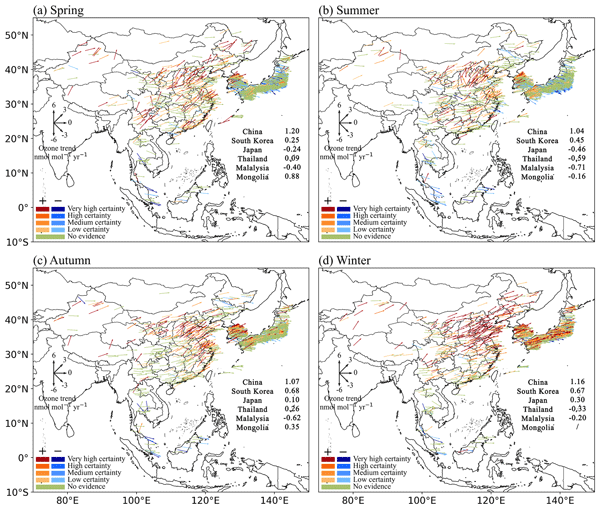
East Asia and Southeast Asia have been identified as a global hot spot, with the fastest ozone increase. This paper presents the most comprehensive observational review of ozone distributions and evolution over East Asia and Southeast Asia across different spatiotemporal scales in the past two decades, which will have important implications for assessing ozone impacts on public health and crop yields and for developing future ozone control strategies.
Ju Li, Jingjiang Zhang, Mengxin Bai, Jie Su, Qingchun Li, and Xingcan Jia
Atmos. Chem. Phys., 25, 8683–8700, https://doi.org/10.5194/acp-25-8683-2025, https://doi.org/10.5194/acp-25-8683-2025, 2025
Short summary
Short summary
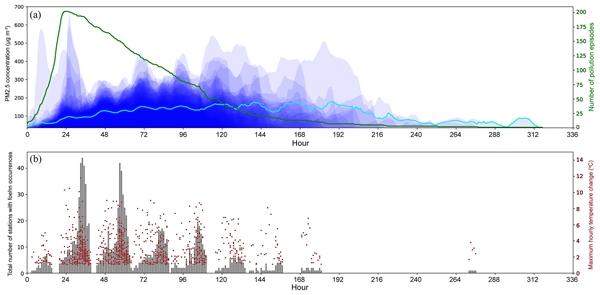
This research examines foehn events in Beijing using weather station data from 2015 to 2020. We found an average of 56.5 foehn days annually, primarily in winter. These winds can raise temperatures significantly and are associated with air pollution levels. Strong foehn winds tend to reduce pollution, while weaker winds may increase it. Our study highlights the impact of foehn events on air quality, providing valuable insights for urban planning and environmental management.
Ziru Lan, Xiaoyi Zhang, Weili Lin, Xiaobin Xu, Zhiqiang Ma, Jun Jin, Lingyan Wu, and Yangmei Zhang
Atmos. Chem. Phys., 24, 9355–9368, https://doi.org/10.5194/acp-24-9355-2024, https://doi.org/10.5194/acp-24-9355-2024, 2024
Short summary
Short summary
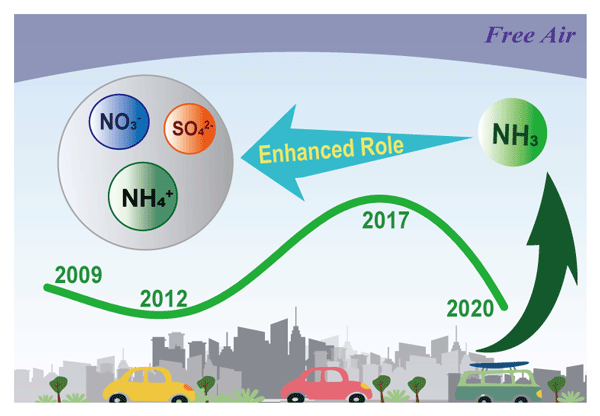
Our study examined the long-term trends of atmospheric ammonia in urban Beijing from 2009 to 2020. We found that the trends did not match satellite data or emission estimates, revealing complexities in ammonia sources. While seasonal variations in ammonia were temperature-dependent, daily variations were correlated with water vapor. We also found an increasing contribution of ammonia reduction, emphasizing its importance in mitigating the effects of fine particulate matter in Beijing.
Weijun Quan, Zhenfa Wang, Lin Qiao, Xiangdong Zheng, Junli Jin, Yinruo Li, Xiaomei Yin, Zhiqiang Ma, and Martin Wild
Earth Syst. Sci. Data, 16, 961–983, https://doi.org/10.5194/essd-16-961-2024, https://doi.org/10.5194/essd-16-961-2024, 2024
Short summary
Short summary
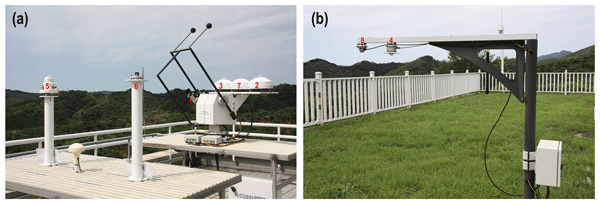
Radiation components play important roles in various fields such as the Earth’s surface radiation budget, ecosystem productivity, and human health. In this study, a dataset consisting of quality-assured daily data of nine radiation components is presented based on the in situ measurements at the Shangdianzi regional GAW station in China during 2013–2022. The dataset can be applied in the validation of satellite products and numerical models and investigation of atmospheric radiation.
Zhiheng Liao, Jinqiang Zhang, Yubin Pan, Xingcan Jia, Pengkun Ma, Qianqian Wang, Zhigang Cheng, Lindong Dai, and Jiannong Quan
EGUsphere, https://doi.org/10.5194/egusphere-2023-1393, https://doi.org/10.5194/egusphere-2023-1393, 2023
Preprint withdrawn
Short summary
Short summary
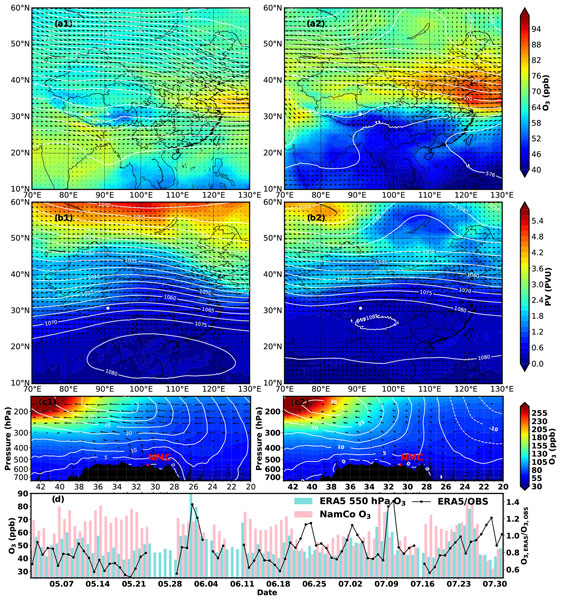
This study presents the first systematic assessment of observationally constrained UTLS O3 variability over the Northeast Asia region in the framework of upper-level circulation pattern classification. The results indicate that lower-stratospheric O3 exhibits a far stronger sensitivity to upper-level circulation patterns when compared with upper-tropospheric O3. The progression of the East Asian Trough plays a critical role in determining the location and intensity of O3 enhancements.
Wanyun Xu, Yuxuan Bian, Weili Lin, Yingjie Zhang, Yaru Wang, Zhiqiang Ma, Xiaoyi Zhang, Gen Zhang, Chunxiang Ye, and Xiaobin Xu
Atmos. Chem. Phys., 23, 7635–7652, https://doi.org/10.5194/acp-23-7635-2023, https://doi.org/10.5194/acp-23-7635-2023, 2023
Short summary
Short summary
Tropospheric ozone (O3) and peroxyacetyl nitrate (PAN) are both photochemical pollutants harmful to the ecological environment and human health, especially in the Tibetan Plateau (TP). However, the factors determining their variations in the TP have not been comprehensively investigated. Results from field measurements and observation-based models revealed that day-to-day variations in O3 and PAN were in fact controlled by distinct physiochemical processes.

Xueli Liu, Liang Ran, Weili Lin, Xiaobin Xu, Zhiqiang Ma, Fan Dong, Di He, Liyan Zhou, Qingfeng Shi, and Yao Wang
Atmos. Chem. Phys., 22, 7071–7085, https://doi.org/10.5194/acp-22-7071-2022, https://doi.org/10.5194/acp-22-7071-2022, 2022
Short summary
Short summary
Significant decreases in annual mean NOx from 2011 to 2016 and SO2 from 2008 to 2016 confirm the effectiveness of relevant control measures on the reduction in NOx and SO2 emissions in the North China Plain (NCP). NOx at SDZ had a weaker influence than SO2 on the emission reduction in Beijing and other areas in the NCP. An increase in the number of motor vehicles and weak traffic restrictions have caused vehicle emissions of NOx, which indicates that NOx emission control should be strengthened.
Yulu Qiu, Zhiqiang Ma, Ke Li, Mengyu Huang, Jiujiang Sheng, Ping Tian, Jia Zhu, Weiwei Pu, Yingxiao Tang, Tingting Han, Huaigang Zhou, and Hong Liao
Atmos. Chem. Phys., 21, 17995–18010, https://doi.org/10.5194/acp-21-17995-2021, https://doi.org/10.5194/acp-21-17995-2021, 2021
Short summary
Short summary
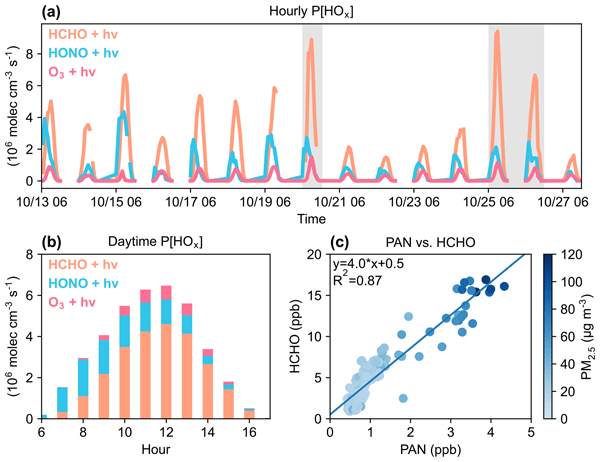
Photochemical pollution over the North China Plain (NCP) is attracting much concern. Our observations at a rural site in the NCP identified high peroxyacetyl nitrate (PAN) concentrations, even on cold days. Increased acetaldehyde concentration and hydroxyl radical production rates drive fast PAN formation. Moreover, our study emphasizes the importance of formaldehyde photolysis in PAN formation and calls for implementing strict volatile organic compound controls after summer over the NCP.
Cited articles
Baumann, K., Maurer, H., Rau, G., Piringer, M., Pechinger, U., Prévôt, A., Furger, M., Neininger, B., and Pellegrini, U.: The influence of south Foehn on the ozone distribution in the Alpine Rhine valley – results from the MAP field phase, Atmos. Environ., 35, 6379–6390, https://doi.org/10.1016/S1352-2310(01)00364-8, 2001.
Campana, M., Li, Y., Staehelin, J., Prevot, A. S. H., Bonasoni, P., Loetscher, H., and Peter, T.: The influence of south foehn on the ozone mixing ratios at the high alpine site Arosa, Atmos. Environ., 39, 2945–2955, https://doi.org/10.1016/j.atmosenv.2005.01.037, 2005.
Dong, Y. M., Li, J., Guo, J. P., Jiang, Z. J., Chu, Y. Q., Chang, L., Yang, Y., and Liao, H.: The impact of synoptic patterns on summertime ozone pollution in the North China Plain, Sci. Total Environ., 735, 139559, https://doi.org/10.1016/j.scitotenv.2020.139559, 2020.
Elvidge, A. D. and Renfrew, I. A.: The Causes of Foehn Warming in the Lee of Mountains, B. Am. Meteorol. Soc., 97, 455–466, https://doi.org/10.1175/BAMS-D-14-00194.1, 2016.
Flowerday, C. and Hansen, J. C.: Peroxyacetyl Nitrate (PAN) in the Atmosphere: A Comprehensive Review of Chemistry, Measurements, and Chemical-Transport Implications, Environ. Sci.-Atmos., https://doi.org/10.1039/D6EA00017G, 2026.
Gaffin, D. M.: Unexpected Warming Induced by Foehn Winds in the Lee of the Smoky Mountains, Weather Forecast., 17, 907-915, https://doi.org/10.1175/1520-0434(2002)017<0907:UWIBFW>2.0.CO;2, 2002.
Gaffin, D. M.: On High Winds and Foehn Warming Associated with Mountain-Wave Events in the Western Foothills of the Southern Appalachian Mountains, Weather Forecast., 24, 53–75, https://doi.org/10.1175/2008WAF2007096.1, 2009.
Grell, G. A., Peckham, S. E., Schmitz, R., McKeen, S. A., Frost, G., Skamarock, W. C., and Eder, B.: Fully coupled “online” chemistry within the WRF model, Atmos. Environ., 39, 6957–6975, https://doi.org/10.1016/j.atmosenv.2005.04.027, 2005.
Gu, Y., Li, K., Xu, J., Liao, H., and Zhou, G.: Observed dependence of surface ozone on increasing temperature in Shanghai, China, Atmos. Environ., 221, 117108, https://doi.org/10.1016/j.atmosenv.2019.117108, 2020.
Guenther, A., Karl, T., Harley, P., Wiedinmyer, C., Palmer, P. I., and Geron, C.: Estimates of global terrestrial isoprene emissions using MEGAN (Model of Emissions of Gases and Aerosols from Nature), Atmos. Chem. Phys., 6, 3181–3210, https://doi.org/10.5194/acp-6-3181-2006, 2006.
Han, H., Liu, J., Shu, L., Wang, T., and Yuan, H.: Local and synoptic meteorological influences on daily variability in summertime surface ozone in eastern China, Atmos. Chem. Phys., 20, 203–222, https://doi.org/10.5194/acp-20-203-2020, 2020.
Kerr, R. A.: Chinook Winds Resemble Water Flowing over a Rock, Science, 231, 1244–1245, https://doi.org/10.1126/science.231.4743.1244, 1986.
Kirchgaessner, A., King, J. C., and Anderson, P. S.: The Impact of Föhn Conditions Across the Antarctic Peninsula on Local Meteorology Based on AWS Measurements, J. Geophys. Res.-Atmos., 126, e2020JD033748, https://doi.org/10.1029/2020JD033748, 2021.
Li, J., Sun, Z., Lenschow, D. H., Zhou, M., Dou, Y., Cheng, Z., Wang, Y., and Li, Q.: A foehn-induced haze front in Beijing: observations and implications, Atmos. Chem. Phys., 20, 15793–15809, https://doi.org/10.5194/acp-20-15793-2020, 2020a.
Li, J., Zhang, J., Bai, M., Su, J., Li, Q., and Jia, X.: Identification and characterization of foehn events in Beijing and their impact on air pollution episodes, Atmos. Chem. Phys., 25, 8683–8700, https://doi.org/10.5194/acp-25-8683-2025, 2025.
Li, X., Xia, X., Wang, L., Cai, R., Zhao, L., Feng, Z., Ren, Q., and Zhao, K.: The role of foehn in the formation of heavy air pollution events in Urumqi, China, J. Geophys. Res.-Atmos., 120, 5371–5384, https://doi.org/10.1002/2014JD022778, 2015.
Li, X., Xia, X., Zhong, S., Luo, L., Yu, X., Jia, J., Zhao, K., Li, N., Liu, Y., and Ren, Q.: Shallow foehn on the northern leeside of Tianshan Mountains and its influence on atmospheric boundary layer over Urumqi, China – A climatological study, Atmos. Res., 240, 104940, https://doi.org/10.1016/j.atmosres.2020.104940, 2020b.
Li, Y., Chen, M., Miao, S., Zhang, G., Huang, Q., and Zhang, S.: Evaluation of three scale-aware planetary boundary layer schemes in WRF Model during Beijing 2022 Winter Olympics, Atmos. Res., 328, 108416, https://doi.org/10.1016/j.atmosres.2025.108416, 2026.
Liao, Z., Sun, J., Yao, J., Liu, L., Li, H., Liu, J., Xie, J., Wu, D., and Fan, S.: Self-organized classification of boundary layer meteorology and associated characteristics of air quality in Beijing, Atmos. Chem. Phys., 18, 6771–6783, https://doi.org/10.5194/acp-18-6771-2018, 2018.
Liao, Z., Pan, Y., Ma, P., Jia, X., Cheng, Z., Wang, Q., Dou, Y., Zhao, X., Zhang, J., and Quan, J.: Meteorological and chemical controls on surface ozone diurnal variability in Beijing: A clustering-based perspective, Atmos. Environ., 295, 119566, https://doi.org/10.1016/j.atmosenv.2022.119566, 2023.
Liao, Z. H., Jia, X. C., Qiu, Y. L., Quan, J. N., Pan, Y. B., Ma, P. K., Cheng, Z. G., and Wang, Q. Q.: Synoptic controls on warm-season O3 pollution in eastern China: A focus on O3-NOx-VOC chemistry, Atmos. Res., 311, 107660, https://doi.org/10.1016/j.atmosres.2024.107660, 2024.
Liu, J., Wang, L., Li, M., Liao, Z., Sun, Y., Song, T., Gao, W., Wang, Y., Li, Y., Ji, D., Hu, B., Kerminen, V.-M., Wang, Y., and Kulmala, M.: Quantifying the impact of synoptic circulation patterns on ozone variability in northern China from April to October 2013–2017, Atmos. Chem. Phys., 19, 14477–14492, https://doi.org/10.5194/acp-19-14477-2019, 2019.
Liu, S. and Liang, X.-Z.: Observed Diurnal Cycle Climatology of Planetary Boundary Layer Height, J. Climate, 23, 5790–5809, https://doi.org/10.1175/2010JCLI3552.1, 2010.
Luo, R., Zheng, Y., and Chen, M.: Mechanism of a rare night sudden intense warming event in Beijing and surrounding area, Meteorol. Monthly, 46, 478-489, https://doi.org/10.7519/j.issn.1000-0526.2020.04.003, 2020 (in Chinese).
Ma, Y., Yang, Y., Hu, X., and Gan, R.: Characteristics and Mechanisms of the Sudden Warming Events in the Nocturnal Atmospheric Boundary Layer: A Case Study Using WRF, J. Meteorol. Res., 29, 747–763, https://doi.org/10.1007/s13351-015-4101-3, 2015.
Miltenberger, A. K., Reynolds, S., and Sprenger, M.: Revisiting the latent heating contribution to foehn warming: Lagrangian analysis of two foehn events over the Swiss Alps, Q. J. Roy. Meteor. Soc., 142, 2194–2204, https://doi.org/10.1002/qj.2816, 2016.
Ouyang, S., Deng, T., Liu, R., Chen, J., He, G., Leung, J. C.-H., Wang, N., and Liu, S. C.: Impact of a subtropical high and a typhoon on a severe ozone pollution episode in the Pearl River Delta, China, Atmos. Chem. Phys., 22, 10751–10767, https://doi.org/10.5194/acp-22-10751-2022, 2022.
Pal, S. and Lee, T. R.: Advected Air Mass Reservoirs in the Downwind of Mountains and Their Roles in Overrunning Boundary Layer Depths Over the Plains, Geophys. Res. Lett., 46, 10140–10149, https://doi.org/10.1029/2019GL083988, 2019.
Seibert, P., Feldmann, H., Neininger, B., Bäumle, M., and Trickl, T.: South foehn and ozone in the Eastern Alps – case study and climatological aspects, Atmos. Environ., 34, 1379–1394, https://doi.org/10.1016/S1352-2310(99)00439-2, 2000.
Shu, L., Xie, M., Wang, T., Gao, D., Chen, P., Han, Y., Li, S., Zhuang, B., and Li, M.: Integrated studies of a regional ozone pollution synthetically affected by subtropical high and typhoon system in the Yangtze River Delta region, China, Atmos. Chem. Phys., 16, 15801–15819, https://doi.org/10.5194/acp-16-15801-2016, 2016.
Stein, A. F., Draxler, R. R., Rolph, G. D., Stunder, B. J. B., Cohen, M. D., and Ngan, F.: NOAA's HYSPLIT Atmospheric Transport and Dispersion Modeling System, B. Am. Meteorol. Soc., 96, 2059–2077, https://doi.org/10.1175/BAMS-D-14-00110.1, 2015.
Steinhoff, D. F., Bromwich, D. H., Speirs, J. C., McGowan, H. A., and Monaghan, A. J.: Austral summer foehn winds over the McMurdo dry valleys of Antarctica from Polar WRF, Q. J. R. Meteor. Soc., 140, 1825–1837, https://doi.org/10.1002/qj.2278, 2014.
Stull, R. B.: An Introduction to Boundary Layer Meteorology, Kluwer Academic Publishers, Dordrecht, the Netherlands, ISBN: 978-90-277-2768-8, 1988.
Tang, G., Zhang, J., Zhu, X., Song, T., Münkel, C., Hu, B., Schäfer, K., Liu, Z., Zhang, J., Wang, L., Xin, J., Suppan, P., and Wang, Y.: Mixing layer height and its implications for air pollution over Beijing, China, Atmos. Chem. Phys., 16, 2459–2475, https://doi.org/10.5194/acp-16-2459-2016, 2016.
Wang, X. Y. and Wang, K. C.: Estimation of atmospheric mixing layer height from radiosonde data, Atmos. Meas. Tech., 7, 1701–1709, https://doi.org/10.5194/amt-7-1701-2014, 2014.
Wu, W., Fu, T.-M., Arnold, S. R., Spracklen, D. V., Zhang, A., Tao, W., Wang, X., Hou, Y., Mo, J., Chen, J., Li, Y., Feng, X., Lin, H., Huang, Z., Zheng, J., Shen, H., Zhu, L., Wang, C., Ye, J., and Yang, X.: Temperature-Dependent Evaporative Anthropogenic VOC Emissions Significantly Exacerbate Regional Ozone Pollution, Environ. Sci. Technol., 58, 5430–5441, https://doi.org/10.1021/acs.est.3c09122, 2024.
Xu, J., Zhang, Z., Zhao, X., and Zhang, J.: Synthetically impacts of the topography and typhoon periphery on the atmospheric boundary layer structure and special regional pollution pattern of O3 in North China Plain, Atmos. Environ., 330, 120566, https://doi.org/10.1016/j.atmosenv.2024.120566, 2024.
Xu, X., Shu, S., Wang, G., and Li, W.: Machine-learning-based identification of influencing factors and synoptic patterns of foehn on the eastern foothills of the Taihang Mountains, China, Atmos. Chem. Phys., 26, 6507–6519, https://doi.org/10.5194/acp-26-6507-2026, 2026.
Yang, X., Yang, M., Li, J., and Zhang, S.: Impact analysis of a Taihang Mountain foehn on haze intensity, Meteorol. Monthly, 44, 313–319, https://doi.org/10.7519/j.issn.1000-0526.2018.02.011, 2018 (in Chinese).
Zhang, Q., Streets, D. G., Carmichael, G. R., He, K. B., Huo, H., Kannari, A., Klimont, Z., Park, I. S., Reddy, S., Fu, J. S., Chen, D., Duan, L., Lei, Y., Wang, L. T., and Yao, Z. L.: Asian emissions in 2006 for the NASA INTEX-B mission, Atmos. Chem. Phys., 9, 5131–5153, https://doi.org/10.5194/acp-9-5131-2009, 2009.
Zhang, S., Zeng, G., Yang, X., Wu, R., and Yin, Z.: Comparison of the influence of two types of cold surge on haze dispersion in eastern China, Atmos. Chem. Phys., 21, 15185–15197, https://doi.org/10.5194/acp-21-15185-2021, 2021.
Zong, L., Yang, Y., Xia, H., Yuan, J., and Guo, M.: Elucidating the Impacts of Various Atmospheric Ventilation Conditions on Local and Transboundary Ozone Pollution Patterns: A Case Study of Beijing, China, J. Geophys. Res.-Atmos., 128, e2023JD039141, https://doi.org/10.1029/2023JD039141, 2023.
Short summary
We discovered that warm, dry winds flowing over mountains – a phenomenon known as elevated foehn – are a key driver of severe summer ozone pollution in Beijing. Unlike shallow foehn that can clear the air, these higher-altitude winds trap and intensify ozone pollution. They work in three ways: by heating the air to boost ozone formation, by lowering the ceiling of the mixing layer to concentrate pollutants, and by slowing winds to prevent their dispersal.
We discovered that warm, dry winds flowing over mountains – a phenomenon known as elevated foehn...


Altmetrics
Final-revised paper
Preprint