Articles | Volume 26, issue 11
https://doi.org/10.5194/acp-26-8159-2026
© Author(s) 2026. This work is distributed under
the Creative Commons Attribution 4.0 License.
https://doi.org/10.5194/acp-26-8159-2026
© Author(s) 2026. This work is distributed under
the Creative Commons Attribution 4.0 License.
Observation of the lunar tide in the middle atmosphere by the Aura Microwave Limb Sounder

Klemens Hocke
CORRESPONDING AUTHOR
Institute of Applied Physics, University of Bern, 3012 Bern, Switzerland
Oeschger Centre for Climate Change Research, University of Bern, 3012 Bern, Switzerland
Related authors
Wenyue Wang, Adrian J. McDonald, Simon Alexander, and Klemens Hocke
EGUsphere, https://doi.org/10.5194/egusphere-2026-2155, https://doi.org/10.5194/egusphere-2026-2155, 2026
This preprint is open for discussion and under review for Atmospheric Chemistry and Physics (ACP).
Short summary
Short summary
This study identifies high-frequency gravity waves from Doppler velocity oscillations measured by ship-based cloud radar over the Southern Ocean near the East Antarctic coastline. These waves have periods of approximately 10 minutes and can persist for up to 48 hours. They occur frequently, are associated with multiple sources, and modulate cloud properties.
Klemens Hocke, Wenyue Wang, Leonie Bernet, Alistair Bell, and Christian Mätzler
EGUsphere, https://doi.org/10.5194/egusphere-2026-989, https://doi.org/10.5194/egusphere-2026-989, 2026
Short summary
Short summary
We analyse observations of the tropospheric water radiometer (TROWARA) which monitored integrated water vapour (IWV) above Bern from 1995 to 2025. The relative IWV increase is 5.1 %/decade. Evaluation of coincident IWV data from ERA5 (reanalysis of European Centre for Medium-Range Weather Forecasts) gives a trend of 3.7 %/decade. The positive IWV trends are possibly due to the warming climate in Switzerland over the past decades.
Klemens Hocke
EGUsphere, https://doi.org/10.5194/egusphere-2026-1111, https://doi.org/10.5194/egusphere-2026-1111, 2026
Preprint archived
Short summary
Short summary
The observations of the Aura Microwave Limb Sounder (Aura/MLS) indicate the existence of a polar mesospheric precursor of major sudden stratospheric warmings (SSWs). The geopotential height data of Aura/MLS from 2004 to 2021 show that a burst of a 4 day-oscillation (zonally symmetric wave with zonal wavenumber zero) occurs at the stratopause and in the mesosphere at 80° N about 17 days before the central date of the SSW.
Guanyi Ma and Klemens Hocke
Atmos. Chem. Phys., 25, 5009–5020, https://doi.org/10.5194/acp-25-5009-2025, https://doi.org/10.5194/acp-25-5009-2025, 2025
Short summary
Short summary
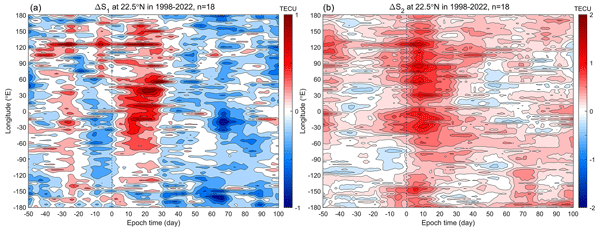
We analyse the influences of sudden stratospheric warming (SSW) on diurnal/semidiurnal variations of the ionosphere with the global total electron content (TEC) data from 1998 to 2022. We use machine learning (ML) to establish the TEC (ML-TEC) model related to the solar/geomagnetic activities and seasonal change from the TEC data. Subtracting the ML-TEC from the observed TEC, we find a global SSW-induced enhancement in diurnal/semidiurnal TEC variations.
Alistair Bell, Eric Sauvageat, Gunter Stober, Klemens Hocke, and Axel Murk
Atmos. Meas. Tech., 18, 555–567, https://doi.org/10.5194/amt-18-555-2025, https://doi.org/10.5194/amt-18-555-2025, 2025
Short summary
Short summary
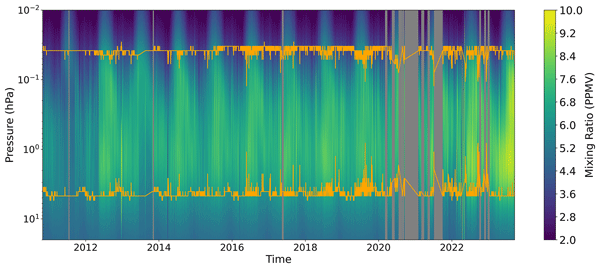
Hardware and software developments have been made on a 22 GHz microwave radiometer for the measurement of middle-atmospheric water vapour near Bern, Switzerland. Previous measurements dating back to 2010 have been re-calibrated and an improved optimal estimation retrieval performed on these measurements, giving a 13-year dataset. Measurements made with new and improved instrumental hardware are used to correct previous measurements, which show better agreement than the non-corrected dataset.
Klemens Hocke, Wenyue Wang, and Guanyi Ma
Atmos. Chem. Phys., 24, 5837–5846, https://doi.org/10.5194/acp-24-5837-2024, https://doi.org/10.5194/acp-24-5837-2024, 2024
Short summary
Short summary
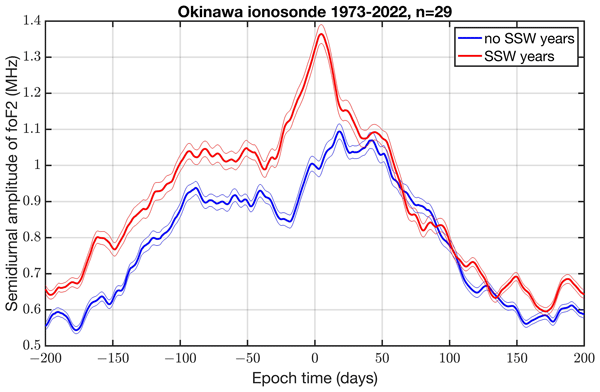
We find a sudden stratospheric warming (SSW) effect in the F2 critical frequency (foF2) series for Okinawa. Across 29 SSW events, the amplitude of the semidiurnal cycle of foF2 peaks at the SSW onset in the SSW years. In these years, we find, for the first time, a lunar terdiurnal component with a relative amplitude of about 5 %, and lunar diurnal and semidiurnal components have relative amplitudes of about 10 %. The periods of lunar ionospheric tidal variations align with those of ocean tides.
Wenyue Wang, Klemens Hocke, Leonardo Nania, Alberto Cazorla, Gloria Titos, Renaud Matthey, Lucas Alados-Arboledas, Agustín Millares, and Francisco Navas-Guzmán
Atmos. Chem. Phys., 24, 1571–1585, https://doi.org/10.5194/acp-24-1571-2024, https://doi.org/10.5194/acp-24-1571-2024, 2024
Short summary
Short summary
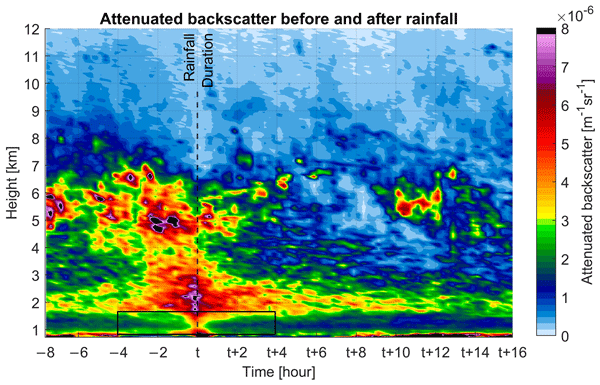
The south-central interior of Andalusia experiences complex precipitation patterns as a result of the semi-arid Mediterranean climate and the influence of Saharan dust. This study monitored the inter-relations between aerosols, clouds, meteorological variables, and precipitation systems using ground-based remote sensing and in situ instruments.
Eric Sauvageat, Klemens Hocke, Eliane Maillard Barras, Shengyi Hou, Quentin Errera, Alexander Haefele, and Axel Murk
Atmos. Chem. Phys., 23, 7321–7345, https://doi.org/10.5194/acp-23-7321-2023, https://doi.org/10.5194/acp-23-7321-2023, 2023
Short summary
Short summary
In Switzerland, two microwave radiometers can measure continuous ozone profiles in the middle atmosphere. From these instruments, we can study the diurnal variation of ozone, which is difficult to observe otherwise. It is valuable to validate the model simulations of diurnal variations in this region. We present results obtained during the last decade and compare them against various models. For the first time, we also show that the winter diurnal variations have some short-term fluctuations.
Eric Sauvageat, Eliane Maillard Barras, Klemens Hocke, Alexander Haefele, and Axel Murk
Atmos. Meas. Tech., 15, 6395–6417, https://doi.org/10.5194/amt-15-6395-2022, https://doi.org/10.5194/amt-15-6395-2022, 2022
Short summary
Short summary
We present new harmonized ozone time series from two ground-based microwave radiometers in Switzerland. The new series consist of hourly ozone profiles in the middle atmosphere (~ 20–70 km) from 2009 until 2021. Cross-validation of the new data series shows the benefit of the harmonization process compared to the previous versions. Comparisons with collocated satellite observations is used to further validate these time series for long-term ozone monitoring over central Europe.
Wenyue Wang, Adrian J. McDonald, Simon Alexander, and Klemens Hocke
EGUsphere, https://doi.org/10.5194/egusphere-2026-2155, https://doi.org/10.5194/egusphere-2026-2155, 2026
This preprint is open for discussion and under review for Atmospheric Chemistry and Physics (ACP).
Short summary
Short summary
This study identifies high-frequency gravity waves from Doppler velocity oscillations measured by ship-based cloud radar over the Southern Ocean near the East Antarctic coastline. These waves have periods of approximately 10 minutes and can persist for up to 48 hours. They occur frequently, are associated with multiple sources, and modulate cloud properties.
Klemens Hocke, Wenyue Wang, Leonie Bernet, Alistair Bell, and Christian Mätzler
EGUsphere, https://doi.org/10.5194/egusphere-2026-989, https://doi.org/10.5194/egusphere-2026-989, 2026
Short summary
Short summary
We analyse observations of the tropospheric water radiometer (TROWARA) which monitored integrated water vapour (IWV) above Bern from 1995 to 2025. The relative IWV increase is 5.1 %/decade. Evaluation of coincident IWV data from ERA5 (reanalysis of European Centre for Medium-Range Weather Forecasts) gives a trend of 3.7 %/decade. The positive IWV trends are possibly due to the warming climate in Switzerland over the past decades.
Klemens Hocke
EGUsphere, https://doi.org/10.5194/egusphere-2026-1111, https://doi.org/10.5194/egusphere-2026-1111, 2026
Preprint archived
Short summary
Short summary
The observations of the Aura Microwave Limb Sounder (Aura/MLS) indicate the existence of a polar mesospheric precursor of major sudden stratospheric warmings (SSWs). The geopotential height data of Aura/MLS from 2004 to 2021 show that a burst of a 4 day-oscillation (zonally symmetric wave with zonal wavenumber zero) occurs at the stratopause and in the mesosphere at 80° N about 17 days before the central date of the SSW.
Guanyi Ma and Klemens Hocke
Atmos. Chem. Phys., 25, 5009–5020, https://doi.org/10.5194/acp-25-5009-2025, https://doi.org/10.5194/acp-25-5009-2025, 2025
Short summary
Short summary
We analyse the influences of sudden stratospheric warming (SSW) on diurnal/semidiurnal variations of the ionosphere with the global total electron content (TEC) data from 1998 to 2022. We use machine learning (ML) to establish the TEC (ML-TEC) model related to the solar/geomagnetic activities and seasonal change from the TEC data. Subtracting the ML-TEC from the observed TEC, we find a global SSW-induced enhancement in diurnal/semidiurnal TEC variations.
Alistair Bell, Eric Sauvageat, Gunter Stober, Klemens Hocke, and Axel Murk
Atmos. Meas. Tech., 18, 555–567, https://doi.org/10.5194/amt-18-555-2025, https://doi.org/10.5194/amt-18-555-2025, 2025
Short summary
Short summary
Hardware and software developments have been made on a 22 GHz microwave radiometer for the measurement of middle-atmospheric water vapour near Bern, Switzerland. Previous measurements dating back to 2010 have been re-calibrated and an improved optimal estimation retrieval performed on these measurements, giving a 13-year dataset. Measurements made with new and improved instrumental hardware are used to correct previous measurements, which show better agreement than the non-corrected dataset.
Klemens Hocke, Wenyue Wang, and Guanyi Ma
Atmos. Chem. Phys., 24, 5837–5846, https://doi.org/10.5194/acp-24-5837-2024, https://doi.org/10.5194/acp-24-5837-2024, 2024
Short summary
Short summary
We find a sudden stratospheric warming (SSW) effect in the F2 critical frequency (foF2) series for Okinawa. Across 29 SSW events, the amplitude of the semidiurnal cycle of foF2 peaks at the SSW onset in the SSW years. In these years, we find, for the first time, a lunar terdiurnal component with a relative amplitude of about 5 %, and lunar diurnal and semidiurnal components have relative amplitudes of about 10 %. The periods of lunar ionospheric tidal variations align with those of ocean tides.
Wenyue Wang, Klemens Hocke, Leonardo Nania, Alberto Cazorla, Gloria Titos, Renaud Matthey, Lucas Alados-Arboledas, Agustín Millares, and Francisco Navas-Guzmán
Atmos. Chem. Phys., 24, 1571–1585, https://doi.org/10.5194/acp-24-1571-2024, https://doi.org/10.5194/acp-24-1571-2024, 2024
Short summary
Short summary
The south-central interior of Andalusia experiences complex precipitation patterns as a result of the semi-arid Mediterranean climate and the influence of Saharan dust. This study monitored the inter-relations between aerosols, clouds, meteorological variables, and precipitation systems using ground-based remote sensing and in situ instruments.
Eric Sauvageat, Klemens Hocke, Eliane Maillard Barras, Shengyi Hou, Quentin Errera, Alexander Haefele, and Axel Murk
Atmos. Chem. Phys., 23, 7321–7345, https://doi.org/10.5194/acp-23-7321-2023, https://doi.org/10.5194/acp-23-7321-2023, 2023
Short summary
Short summary
In Switzerland, two microwave radiometers can measure continuous ozone profiles in the middle atmosphere. From these instruments, we can study the diurnal variation of ozone, which is difficult to observe otherwise. It is valuable to validate the model simulations of diurnal variations in this region. We present results obtained during the last decade and compare them against various models. For the first time, we also show that the winter diurnal variations have some short-term fluctuations.
Eric Sauvageat, Eliane Maillard Barras, Klemens Hocke, Alexander Haefele, and Axel Murk
Atmos. Meas. Tech., 15, 6395–6417, https://doi.org/10.5194/amt-15-6395-2022, https://doi.org/10.5194/amt-15-6395-2022, 2022
Short summary
Short summary
We present new harmonized ozone time series from two ground-based microwave radiometers in Switzerland. The new series consist of hourly ozone profiles in the middle atmosphere (~ 20–70 km) from 2009 until 2021. Cross-validation of the new data series shows the benefit of the harmonization process compared to the previous versions. Comparisons with collocated satellite observations is used to further validate these time series for long-term ozone monitoring over central Europe.
Cited articles
Bartels, J. and Johnston, H. F.: Geomagnetic tides in horizontal intensity at Huancayo, Terrestrial Magnetism and Atmospheric Electricity, 45, 269–308, https://doi.org/10.1029/TE045i003p00269, 1940. a, b
Chapman, S.: Atmospheric Tides and Oscillations, American Meteorological Society, Boston, MA, pp. 510–530, https://doi.org/10.1007/978-1-940033-70-9_43, 1951. a, b
Chau, J. L., Hoffmann, P., Pedatella, N. M., Matthias, V., and Stober, G.: Upper mesospheric lunar tides over middle and high latitudes during sudden stratospheric warming events, J. Geophys. Res.-Space, 120, 3084–3096, https://doi.org/10.1002/2015JA020998, 2015. a
Conte, J. F., Chau, J. L., and Peters, D. H. W.: Middle- and High-Latitude Mesosphere and Lower Thermosphere Mean Winds and Tides in Response to Strong Polar-Night Jet Oscillations, J. Geophys. Res.-Atmos., 124, 9262–9276, https://doi.org/10.1029/2019JD030828, 2019. a, b, c, d
Ebel, A., Ghazi, A., and Bätz, W.: Evidence of global-scale waves with zonal wave number zero in the stratosphere, Pure Appl. Geophys., 116, 8–31, https://doi.org/10.1007/BF00878982, 1978. a
Forbes, J. M.: Atmospheric tide: 2. The solar and lunar semidiurnal components, J. Geophys. Res.-Space, 87, 5241–5252, https://doi.org/10.1029/JA087iA07p05241, 1982. a, b, c
Forbes, J. M. and Zhang, X.: Lunar tide amplification during the January 2009 stratosphere warming event: Observations and theory, J. Geophys. Res.-Space, 117, https://doi.org/10.1029/2012JA017963, 2012. a, b, c
Hagan, M., Forbes, J., and Richmond, A.: Atmospheric tides, in: Encyclopedia of Atmospheric Sciences, edited by: Holton, J. R., Academic Press, Oxford, pp. 159–165, https://doi.org/10.1016/B0-12-227090-8/00409-7, 2003. a
Hocke, K.: Oscillations of global mean TEC, J. Geophys. Res.-Space, 113, https://doi.org/10.1029/2007JA012798, 2008. a
Hocke, K.: Modulation of the lunar semidiurnal tide in GNSS TEC by the variable Earth-Moon distance, Frontiers in Astronomy and Space Sciences, 12, https://doi.org/10.3389/fspas.2025.1585247, 2025. a
Hocke, K. and Ma, G.: Big L Days in GNSS TEC Data, Atmosphere, 16, https://doi.org/10.3390/atmos16101191, 2025. a, b, c
Lieberman, R. S., Harding, B. J., Heelis, R. A., Pedatella, N. M., Forbes, J. M., and Oberheide, J.: Atmospheric Lunar Tide in the Low Latitude Thermosphere-Ionosphere, Geophys. Res. Lett., 49, e2022GL098078, https://doi.org/10.1029/2022GL098078, 2022. a
Lindzen, R. S. and Chapman, S.: Atmospheric tides, Space Sci. Rev., 10, 3–188, https://doi.org/10.1007/BF00171584, 1969. a
Livesey, N. J., Read, W. G., Wagner, P. A., Froidevaux, L., Santee, M. L., Schwartz, M. J., Lambert, A., Valle, L. F. M., Pumphrey, H. C., Manney, G. L., Fuller, R. A., Jarnot, R. F., Knosp, B. W., and Lay, R. R.: Earth Observing System (EOS) Aura Microwave Limb Sounder (MLS) Version 5.0x Level 2 and 3 data quality and description document, Technical report, JPL D-105336 Rev. B, https://mls.jpl.nasa.gov/data/v5-0_data_quality_document.pdf (last access: 11 June 2026), 2022. a
Onwumechilli, A.: On the existence of days with extraordinary geomagnetic lunar tide, J. Atmos. Terr. Phy., 26, 729–748, https://doi.org/10.1016/0021-9169(64)90161-8, 1964. a
Paulino, A., Batista, P., and Clemesha, R.: Lunar tides in the mesosphere and lower thermosphere over Cachoeira Paulista (22.7° S; 45.0° W), J. Atmos. Sol.-Terr. Phy., 78–79, 31–36, https://doi.org/10.1016/j.jastp.2011.04.018, 2012. a
Pedatella, N. M., Liu, H.-L., and Richmond, A. D.: Atmospheric semidiurnal lunar tide climatology simulated by the Whole Atmosphere Community Climate Model, J. Geophys. Res.-Space, 117, https://doi.org/10.1029/2012JA017792, 2012. a
Pedatella, N. M., Richmond, A. D., Maute, A., and Liu, H.-L.: Impact of semidiurnal tidal variability during SSWs on the mean state of the ionosphere and thermosphere, J. Geophys. Res.-Space, 121, 8077–8088, https://doi.org/10.1002/2016JA022910, 2016. a, b, c
Pekeris, C. L.: Atmospheric oscillations, Proc. Roy. Soc. London, 158A, 650–671, 1937. a
Sakazaki, T. and Hamilton, K.: Discovery of a lunar air temperature tide over the ocean: a diagnostic of air-sea coupling, npj Clim. Atmos. Sci., 1, 25, https://doi.org/10.1038/s41612-018-0033-9, 2018. a, b, c
Sandford, D. J., Muller, H. G., and Mitchell, N. J.: Observations of lunar tides in the mesosphere and lower thermosphere at Arctic and middle latitudes, Atmos. Chem. Phys., 6, 4117–4127, https://doi.org/10.5194/acp-6-4117-2006, 2006. a, b
Schindelegger, M., Sakazaki, T., and Green, M.: Chapter 16 – Atmospheric tides – An Earth system signal, in: A Journey Through Tides, edited by: Green, M. and Duarte, J. C., Elsevier, pp. 389–416, https://doi.org/10.1016/B978-0-323-90851-1.00007-8, 2023. a
Schlapp, D.: Lunar tides in the stratosphere and mesosphere from NIMBUS 6 data, J. Atmos. Terr. Phy., 43, 205–207, https://doi.org/10.1016/0021-9169(81)90039-8, 1981. a
Schwartz, M. J., Lambert, A., Manney, G. L., Read, W. G., Livesey, N. J., Froidevaux, L., Ao, C. O., Bernath, P. F., Boone, C. D., Cofield, R. E., Daffer, W. H., Drouin, B. J., Fetzer, E. J., Fuller, R. A., Jarnot, R. F., Jiang, J. H., Jiang, Y. B., Knosp, B. W., Krüger, K., Li, J.-L. F., Mlynczak, M. G., Pawson, S., Russell III, J. M., Santee, M. L., Snyder, W. V., Stek, P. C., Thurstans, R. P., Tompkins, A. M., Wagner, P. A., Walker, K. A., Waters, J. W., and Wu, D. L.: Validation of the Aura Microwave Limb Sounder temperature and geopotential height measurements, J. Geophys. Res.-Atmos., 113, https://doi.org/10.1029/2007JD008783, 2008. a, b, c, d
Siddiqui, T. A., Stolle, C., Luhr, H., and Matzka, J.: On the relationship between weakening of the northern polar vortex and the lunar tidal amplification in the equatorial electrojet, J. Geophys. Res.-Space, 120, 10006–10019, https://doi.org/10.1002/2015JA021683, 2015. a
Studer, S., Hocke, K., and Kämpfer, N.: Intraseasonal oscillations of stratospheric ozone above Switzerland, J. Atmos. Sol.-Terr. Phy., 74, 189–198, https://doi.org/10.1016/j.jastp.2011.10.020, 2012. a
Tsuda, T., Tanii, J., Aso, T., and Kato, S.: Lunar tides at meteor heights, Geophys. Res. Lett., 8, 191–194, https://doi.org/10.1029/GL008i003p00191, 1981. a
Vial, F. and Forbes, J.: Monthly simulations of the lunar semi-diurnal tide, J. Atmos. Terr. Phy., 56, 1591–1607, https://doi.org/10.1016/0021-9169(94)90089-2, 1994. a, b
Waters, J. W., Froidevaux, L., Harwood, R. S., Jarnot, R. F., Pickett, H. M., Read, W. G., Siegel, P. H., Cofield, R. E., Filipiak, M. J., Flower, D. A., Holden, J. R., Lau, G. K. K., Livesey, N. J., Manney, G. L., Pumphrey, H. C., Santee, M. L., Wu, D. L., Cuddy, D. T., Lay, R. R., Loo, M. S., Perun, V. S., Schwartz, M. J., Stek, P. C., Thurstans, R. P., Boyles, M. A., Chandra, K. M., Chavez, M. C., Chen, G. S., Chudasama, B. V., Dodge, R., Fuller, R. A., Girard, M. A., Jiang, J. H., Jiang, Y. B., Knosp, B. W., LaBelle, R. C., Lam, J. C., Lee, K. A., Miller, D., Oswald, J. E., Patel, N. C., Pukala, D. M., Quintero, O., Scaff, D. M., Van Snyder, W., Tope, M. C., Wagner, P. A., and Walch, M. J.: The Earth Observing System Microwave Limb Sounder (EOS MLS) on the Aura satellite, IEEE T. Geosci. Remote, 44, 1075–1092, 2006. a
Yamazaki, Y.: Large lunar tidal effects in the equatorial electrojet during northern winter and its relation to stratospheric sudden warming events, J. Geophys. Res.-Space, 118, 7268–7271, https://doi.org/10.1002/2013JA019215, 2013. a, b, c
Yamazaki, Y. and Richmond, A. D.: A theory of ionospheric response to upward-propagating tides: Electrodynamic effects and tidal mixing effects, J. Geophys. Res.-Space, 118, 5891–5905, https://doi.org/10.1002/jgra.50487, 2013. a
Zhang, J. T., Forbes, J. M., Zhang, C. H., Doornbos, E., and Bruinsma, S. L.: Lunar tide contribution to thermosphere weather, Space Weather, 12, 538–551, https://doi.org/10.1002/2014SW001079, 2014. a
Short summary
The Aura/MLS (Aura satellite/Microwave Limb Sounder) observations of geopotential height and temperature show lunar semimonthly variations which inform about the amplitude profiles and the vertical phase progression of the lunar tide in the middle atmosphere. The observed lunar tide are compared to a simulation of the lunar tide by Geller.
The Aura/MLS (Aura satellite/Microwave Limb Sounder) observations of geopotential height and...
Altmetrics
Final-revised paper
Preprint