
the Creative Commons Attribution 4.0 License.
the Creative Commons Attribution 4.0 License.
 | 02 Jun 2026
Quantifying meteorological impacts on local landfill methane emissions by using field measurements and machine learning
Donghee Kim
Dong Yeong Chang
Jaewon Joo
Landfills are a major anthropogenic source of methane (CH4), contributing up to 20 % of global CH4 emissions. Although CH4 emissions from landfills are highly sensitive to meteorological conditions, their response to climate variations remains not fully understood, leading to substantial uncertainty in emission projections under climate change. This study evaluated the impact of meteorological factors on landfill CH4 generation, using a site-specific machine-learning-based model optimized for temperature and precipitation. The model optimized for meteorological conditions performed better than conventional models such as LandGEM and the IPCC model, with a root mean squared error (RMSE) of 6.57 million m3 CH4, a mean absolute error (MAE) of 4.91 million m3 CH4, and Pearson correlation coefficients of 0.89, when compared with field measurements. Sensitivity analysis and OLS regression showed that simulated CH4 generation had strong positive association with temperature (0.8–1.0 % per 1 °C, p<0.001), while precipitation exhibited inverted-U response, peaking at intermediate levels (9–10 mm d−1, p<0.01). Quantification of the contributions of the meteorological variables, revealed that temperature accounted for 5.96 ± 3.06 %, and precipitation for 7.38 ± 0.58 % of the total modeled CH4 generation. These results highlight the high importance of incorporating meteorological variability into landfill CH4 estimation to improve predictive accuracy, and emphasize the need for stronger and faster CH4 mitigation efforts under climate change.
- Article
(1868 KB) - Full-text XML
-
Supplement
(558 KB) - BibTeX
- EndNote


Methane (CH4) is a major greenhouse gas (GHG) emitted into the atmosphere from various natural and anthropogenic sources (Saunois et al., 2025). CH4 has a high global warming potential (GWP), 28 times greater than that of carbon dioxide (CO2) over a 100-year period (Myhre et al., 2013). It accounts for approximately 16 % of anthropogenic GHG emissions (US-EPA, 2012), and has contributed to approximately 30 % to global warming since the Industrial Revolution (IEA, 2022; Masson-Delmotte et al., 2021). Owing to its relatively short atmospheric lifetime (approximately 9–12 years) (Prather et al., 2012; Solomon et al., 2007). and strong GWP, reducing anthropogenic CH4 emissions is one of the most effective strategies for mitigating climate change (Montzka et al., 2011). Consequently, the number of countries participating in the Global Methane Pledge has increased from about 100 to 159, with all committing to a 30 % reduction in CH4 emissions from 2020 levels by 2030 (European Commission and United States of America, 2021). To achieve this goal, it is essential that a considerable number of countries accurately monitor, estimate and verify their CH4 emissions.
Approximately 60 % of global CH4 emissions originate from anthropogenic sources, including natural gas facilities, agriculture and waste management (Saunois et al., 2025). Of these, landfills represent a significant source, accounting for approximately 19 % of anthropogenic CH4 emissions, making them the third-largest source after agriculture and the fossil fuel sector (Saunois et al., 2025). Moreover, rapid population growth, industrialization, and urbanization have led to the accumulation of large amounts of waste in landfills, and the contribution is even greater at the urban scale (Kumar et al., 2016). For example, in certain megacities, including Buenos Aires and Seoul, the contribution of landfills to total CH4 emissions is up to 50 % (Maasakkers et al., 2022; SCNSC, 2024), which is as high as the CH4 emissions from the oil and gas industry (Wang et al., 2024). Furthermore, it has been estimated that future CH4 emissions from landfills in urban areas will increase considerably due to ongoing waste generation, rapid urbanization, and population growth (Kaza et al., 2018).
Landfill gas (LFG) is generated via the anaerobic decomposition of organic waste by microorganisms (Kim and Townsend, 2012; Themelis and Ulloa, 2007). The produced LFG typically contains 40 %–60 % CH4, which is used as an energy source or burned in flares (Tchobanoglous et al., 1993; Themelis and Ulloa, 2007). However, some gases escape into the atmosphere through soil pores, contributing to CH4 emissions (Fjelsted et al., 2020). Owing to the low efficiency of LFG collection systems, as well as inadequate landfill site management, an estimated 12.4 % to 74.1 % of CH4 emissions can be released into the atmosphere (Bian et al., 2021). Even after landfill closure, the decomposition process continues until the major organic materials are completely degraded (Mønster et al., 2019). Therefore, an accurate estimation of LFG generation, collection efficiency, and fugitive CH4 emissions is required for effective landfill management and GHG regulation (Amini et al., 2013).
Various measurement methods have been used to quantify landfill CH4 emissions, including the flux chamber method (Jeong et al., 2019; Reinhart et al., 1992; Yilmaz et al., 2021), differential absorption light detection and ranging (LiDAR/DIAL) (Innocenti et al., 2017; Robinson et al., 2011), unmanned aerial vehicles (UAVs/drones) (Daugla et al., 2020; Kim et al., 2021), airborne (Cusworth et al., 2024) and satellite technologies (Maasakkers et al., 2022; Nesser et al., 2024). These methods have been shown to directly measure CH4 emissions from landfills, thereby providing more accurate estimates through measurement-based quantification (Mønster et al., 2019). Recent studies have demonstrated significant improvements in the quantification of CH4 emissions by using observation-based methods (Fosco et al., 2024; Tyagi et al., 2025). For example, satellite observations have identified substantial CH4 emission hotspots at major landfill sites worldwide, contributing to more comprehensive emission assessments (Maasakkers et al., 2022). Furthermore, the use of multiple field measurement techniques has proven beneficial, as each method complements another (Cambaliza et al., 2017). However, accessibility limitations, labor requirements, and financial constraints make the continuous monitoring of landfill measurements difficult (Kormi et al., 2018; Mønster et al., 2019).
To address this measurement difficulty, numerous studies have been conducted on numerical models for estimating CH4 generation. First-order decay (FOD) models have been developed to estimate LFG and CH4 generated in landfills. These models assume that the degradable organic matter in waste decays at a relatively slow rate over several decades. Because of their easy applicability and user-friendliness, FOD models, including the Intergovernmental Panel on Climate Change (IPCC) Waste Model, Landfill Gas Emission Model (LandGEM), and Capturing Landfill Emissions for Energy Needs (CLEEN) models, are the most widely adopted approaches (Vu et al., 2017). The IPCC guidelines proposed an IPCC waste model, which is based on the FOD, to support countries in estimating landfill CH4 emissions. The model's individual values for the CH4 generation potential and CH4 generation rate constants are derived from the degradable organic carbon (DOC) contained in various waste fractions (Eggleston et al., 2006). The LandGEM model was developed by the United States Environmental Protection Agency (US EPA) for the estimation of landfill emissions and is typically applied using information on the amount and composition of municipal solid waste (MSW), as well as its treatment methods. LandGEM provides an estimate of the evolution of cumulative LFG emissions over time (Alexander et al., 2005). Meanwhile, the CLEEN model is an experiment-based model that estimates CH4 generation as a function of waste composition, the ambient temperature, and landfill precipitation in the landfill. Based on microbial degradation reactions observed in municipal solid waste experiments, the CLEEN model proposes an equation that links the rate of waste decomposition in landfills to meteorological conditions (Karanjekar et al., 2015).
Although previous models have been useful for estimating landfill CH4 emissions, they are insufficient for predicting future emissions under changing climate conditions. Landfill CH4 generation is driven by the anaerobic microbial degradation, and meteorological conditions strongly influence the extent and rate of these biological processes. (Bai et al., 2025; Scheutz et al., 2009; Sacramento et al., 2024). In regions with pronounced seasonality, such as Korea, microbial decomposition rates vary substantially with seasonal changes in temperature and moisture (Kang et al., 2024; Park and Shin, 2001). In the FOD models, the CH4 generation rate constants (k) represents the biodegradation rate of organic matter in landfills (Purmessur and Surroop, 2019), however the IPCC and LandGEM models remain too simplified to consider climate impacts, using default k values based on climate zones (Alexander et al., 2005; Eggleston et al., 2006). As climate change is expected to intensify landfill CH4 emissions, accurately representing and quantifying the impacts of meteorological drivers on CH4 generation is becoming increasingly important (Fei et al., 2021). By contrast, the CLEEN model, which explicitly incorporates temperature and precipitation, appears to reproduce field-based emissions well. However, further calibration and optimization of these parameters are required before the model can be applied to other regions (Karanjekar et al., 2015).
In this study, we aim to assess the impacts of meteorological conditions on landfill CH4 generation and to evaluate their implications for future climate change. Existing models simplify the application of meteorological factors, thereby limiting their ability to fully reflect actual landfill emission dynamics. To address this limitation, we propose a machine-learning-based methodology that optimizes an effective emission factor using field measurement data from the Sudokwon Landfill Site, one of the largest landfills in the world. The optimized model is then applied to quantify the effects of meteorological conditions on landfill CH4 emissions, identify site-specific features and suggest mitigation strategies.
2.1 Site description
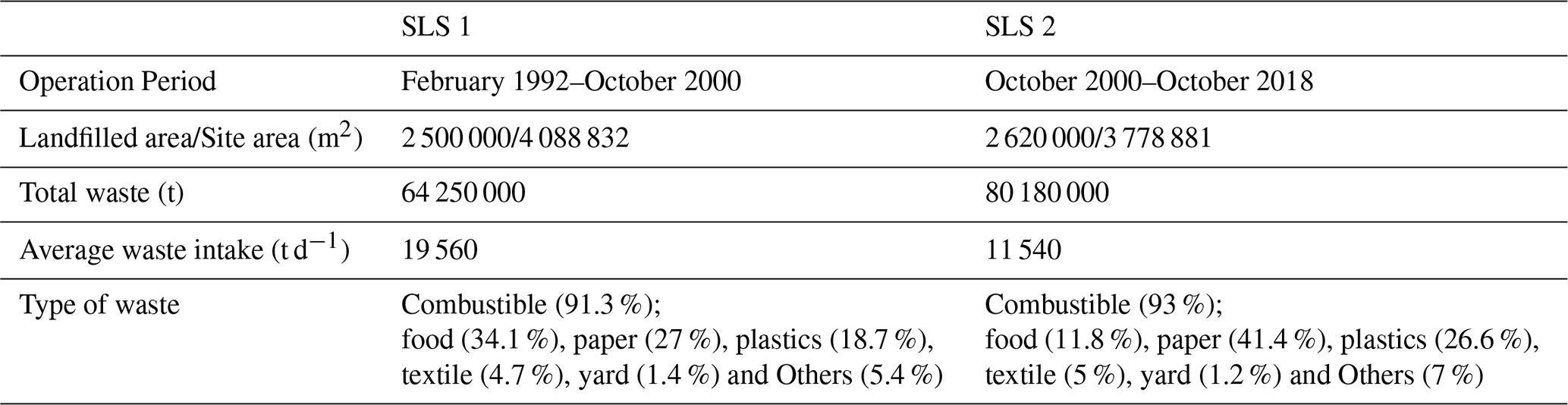
The study area was the SLS, the largest sanitary landfill located on the west coast of Incheon, Korea (Fig. 1). It is in a temperate climate zone with an average annual temperature and precipitation of 12.5 °C (−18.2 to 37.2 °C) and 1219.7 mm (652 to 1777.7 mm), respectively, during 1991–2023. From February 1992, SLS received about 20 000 t of solid waste daily generated by 5.3 million people in the Seoul metropolitan area, representing the largest amount globally (Owlcation, 2024). The SLS contains two separate closed landfill sites. The Table 1 provides an overview of these two sites. The first landfill site (SLS 1) received approximately 64.25 Mt of waste in an area of 2.5 km2 between February 1992 and October 2000, while the second landfill site (SLS 2) received 80.18 Mt of waste in an area of 2.6 km2 from October 2000 to October 2018.
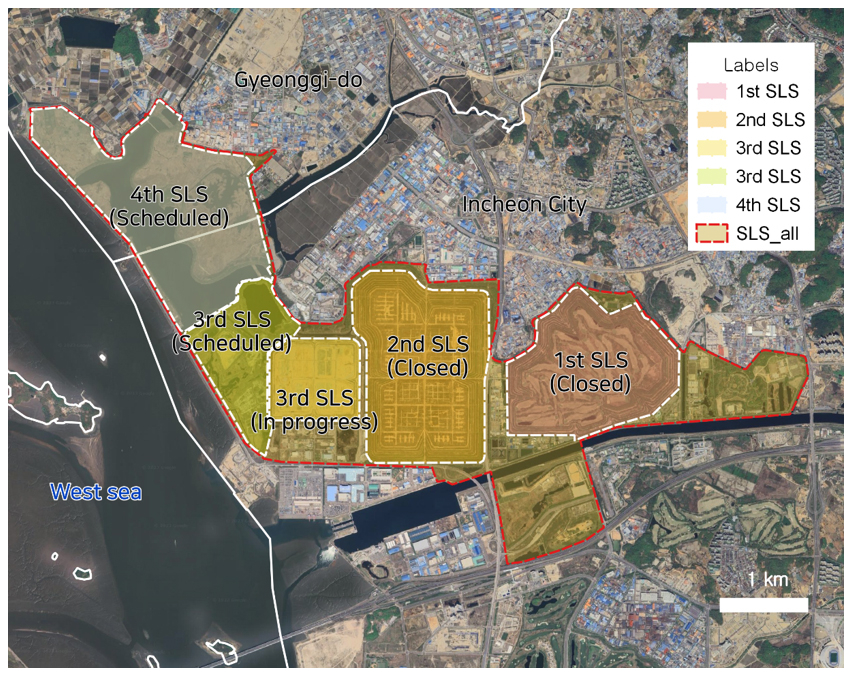
Figure 1The Sudokwon landfill site description. The background map is sourced from Basemap in QGIS: Google Satellite; Imagery © 2025 Google, Map data © 2025 Google.
2.2 Data
Data on the amount of waste deposited monthly from 1998 to 2021 were acquired from the Sudokwon Landfill Site Management Corporation (SLC) platform (https://dream-ics.slc.or.kr/, last access: 1 July 2025). According to a long-term monitoring reports, the yearly composition of waste was examined and collected for the period from 1998 to 2021 (SLC, 2024). The typical MSW composition, along with the mean values, in SLS 1 was: food (34.1 ± 2.8 %), paper (27 ± 2.4 %), plastic (18.7 ± 3 %), textile (4.7 ± 0.4 %), and wood (1.4 ± 0.4 %), while the composition in SLS 2 was: food (14.5 ± 9.8 %), paper (40.2 ± 7 %), plastic (26.1 ± 4.7 %), textile (5.0 ± 1.1 %), and wood (1.2 ± 0.6 %).
The Biochemical Methane Potential (BMP) values were used to ascertain the CH4 generation potential (L0) of the SLS. The BMP assay is a widely used method for predicting the CH4 generation rate and potential of MSW (Sil et al., 2014). SLS 1 had 40.2 m3 CH4 Mg−1, median value of 33.7–46.7 m3 CH4 Mg−1 (Park et al., 2019), while SLS 2 had 47.5 m3 CH4 Mg−1, with a median value of 37–58 m3 CH4 Mg−1 (Jeon et al., 2007).
The field measurement data for CH4 generation were provided by the SLC (SLC, 2020; SLC, 2022). Observations were conducted on a seasonal basis from 2005 to 2021, along the major LFG emission path: gas recovery, gas flaring, and surface emissions (Figs. S1 and S2 in the Supplement). The SLS operates an electricity generation plant that captures LFG with a 50 MW steam turbine, with an average daily collection rate of 501.5 m3 min−1. Some of the gas that was not injected into the power generation process was transported to a centralized combustion facility for flaring. The gas incinerator at SLS 1 has not been operational since its final decommissioning in 2004, and SLS 2 was operated for a short period between 2004 and 2007, after which it was restarted in 2011. The landfill surface emissions were quantified using the flux chamber method, which offers the advantages of accuracy, simplicity, and flexibility compared to other measurement techniques (Reinhart et al., 1992). The measurements were conducted using the open-flux chamber method, with 39 measurement points at SLS 1 and 130 measurement points at SLS 2. Quantification of oxidized CH4 is challenging because it was estimated based on stable carbon isotope ratios. Therefore, this model used the fraction of CH4 oxidized at 10 %, which is the value recommended by the IPCC guidelines (Eggleston et al., 2006).
Meteorological data were obtained from the Korea Meteorological Administration (https://data.kma.go.kr/, last access: 1 July 2025). To align the temporal resolution of the weather data with the field measurement period, the monthly temperature and precipitation values were aggregated into three-month seasonal periods. Specifically, December–February was defined as winter, March–May as spring, June–August as summer, and September–November as autumn. For each season, the average temperature and precipitation across the three months were used as representative seasonal values. This seasonal aggregation allowed for a consistent comparison with the CH4 emission measurements, which were available on a seasonal basis
2.3 Method used to estimate CH4 generation
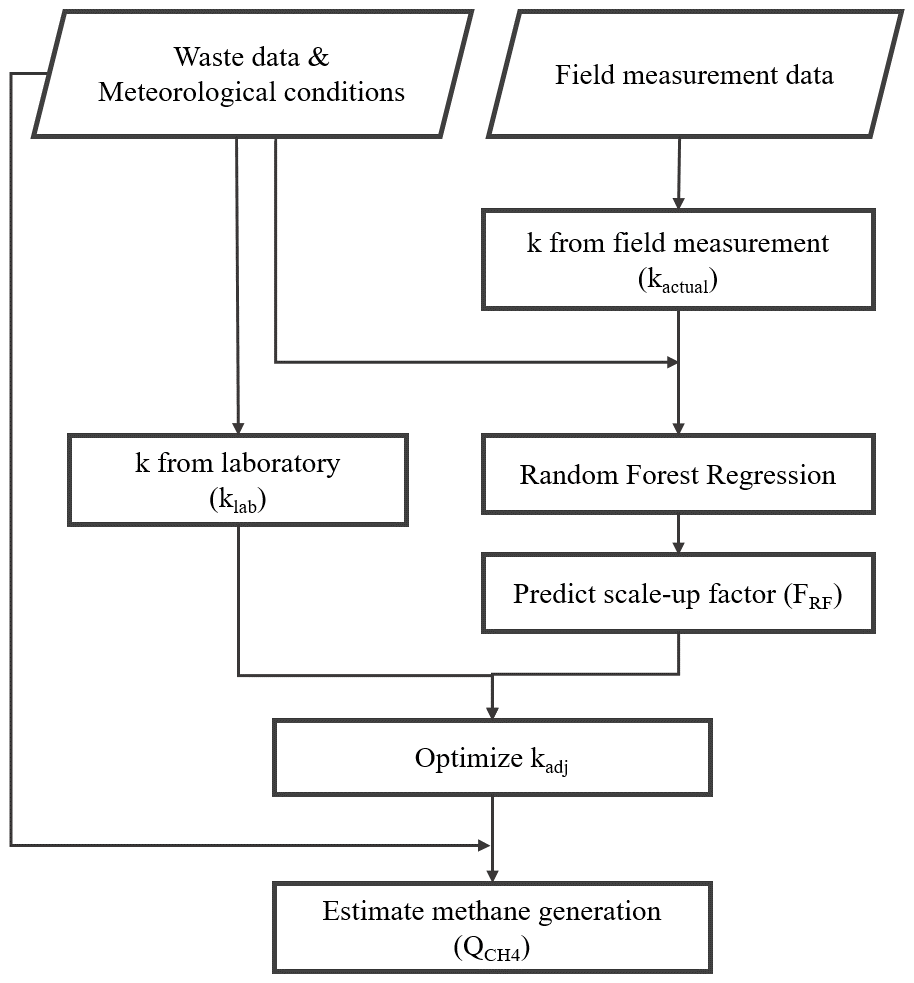
The proposed landfill CH4 generation estimation model, CLEENopt, is a locally optimized model that reflects local landfill environments. The model is based on the FOD equation, which has two critical factors: L0 and k. L0 depends on the composition and degradable organic content of the waste, while k depends on the waste composition, waste particle size, temperature, moisture, and pH (Amini et al., 2012; Machado et al., 2009). The CLEENopt model calibrates the laboratory-based klab to reflect individual landfill characteristics, including field measurements and meteorological data. The flowchart in Fig. 2 describes the main steps used to implement the improved method for calculating landfill emissions.
2.3.1 Estimating laboratory-based klab
The CLEEN model is a FOD–based model that estimates CH4 generation by using the waste amount, waste composition, ambient temperature, and annual rainfall (Karanjekar et al., 2015). According to a statistical experimental design, the model proposed a multiple linear regression equation relating temperature, precipitation, and waste composition to microbial waste decomposition, as shown in Eq. (1).
where klab is the laboratory-scale FOD constant (yr−1), R is the average annual rainfall (mm d−1), T is the ambient temperature (K), TX is the proportion of textiles in the landfilled waste (%), Y is the proportion of yards in the landfilled waste (%), and FD is the proportion of food in the landfilled waste (%). The value of a is −3.02658, b is −0.0067282, c is 0.00172807, d is 0.01046, e is −0.01152, f is 0.00418, and g is 0.00598.
To reflect the relationship between climatic conditions and microbial decomposition, the CLEENopt model uses the laboratory-based klab. However, the values obtained under idealized laboratory conditions are generally higher than those in actual landfill sites (Barlaz, 2006; Ress et al., 1998). The CLEEN model presents a correction factor (F) to calibrate klab to the field k values based on the annual temperature and precipitation. However, the field measurement data have been used at selected landfills in the United States and Israel, and its applicability to landfills in other regions is limited. Therefore, we propose the CLEENopt model, which can be calibrated using landfill-specific field measurements.
2.3.2 Estimating field-based kactual
The CLEENopt model calibrates klab to kadj, using landfill field measurements. CH4 generation was calculated as the sum of the recovered CH4 and CH4 surface emissions, as shown in Eq. (2) (Eggleston et al., 2006)
The amount of CH4 recovered was determined based on flow rate and CH4 concentration data obtained from an LFG recovery system. Sanitary landfills are typically equipped with vertical or horizontal wells that collect LFG, which is used as fuel to generate electricity or combusted and released as CO2. Uncaptured CH4 gas is oxidized to CO2 by soil microorganisms or emitted directly into the atmosphere through cracks and pores on the landfill surface. These pathways are referred to as CH4 oxidation and CH4 emission, respectively. Landfill surface emissions can be measured using various techniques, including remote methods (e.g., dynamic tracer gas dispersion, differential absorption Lidar [DiAL], and radial plume mapping) and surface-based methods such as flux chambers (Babilotte et al., 2010; Fjelsted et al., 2020; Mønster et al., 2019; US-EPA, 2006). In this study, CH4 surface emissions were quantified using the flux chamber method because of its high spatial resolution, which is suitable for site–scale monitoring.
To estimate actual CH4 generation, we applied inverse modeling to derive kactual: by reversing the predictive process of the FOD equation (Eq. 3).
where kactual is the FOD constant that best fits the observed data, is the CH4 generation estimated from field measurements, Mi is the amount of waste disposed of, and L0 is the methane generation potential. However, kactual can only be determined when field measurement data are available. For periods without field measurements, we introduced a scale-up factor, FRF, which calibrates the relationship between klab and kactual, accounting for laboratory-based microbial degradation and landfill environmental conditions.
2.3.3 Improvement of factor k
We selected the random forest RF regression model to estimate the scale-up factors, FRF. RF provides high accuracy and strong generalization, as it does not assume linearity between the predictor and response variables and it is insensitive to outliers. Additionally, RF is a non-parametric model, that is, it does not estimate distributions based on parameters, allowing it to capture complex associations between parameters and observations (Breiman, 2001). Therefore, RF is used in the CLEENopt model to achieve a good performance across various applications.
The establishment of a variable was based on the factors related to the landfill organic–degradation environment. The dependent variable, FRF, indicates the calibrated laboratory–based klab, used to reflect the field characteristics. The explanatory variables consisted of factors directly related to the landfill field environment. Precipitation and temperature represent the landfill meteorological conditions that affects microbial degradation. Waste amount is the amount of waste disposed of that entered the landfill over time. Lifespan is the time elapsed from the start of landfilling to the time of the estimation, reflecting the time required for landfilled waste to decompose. L0 is the CH4 generation potential, which represents the amount of organic matter that can be decomposed per landfill.
The FRF derived from the trained RF model was applied in Eq. (4) to calculate kadj which reflects the specific landfill environment, as follows:
where FRF is the scale-up factor and klab was calculated using Eq. (1). klab can be used to calculate an optimized kadj, which reflects the field conditions of the landfill.
2.3.4 Estimation of CH4 generation
The FOD equation used to estimate the CH4 generation in the CLEENopt model is as follows:
where is the amount of CH4 generated (m3 yr−1), Mi is the mass of MSW landfilled in year i within the landfill (Mg), kadj is the calibrated FOD constant (yr−1), L0 is the potential CH4 generation per waste (m3 Mg−1), n is the total number of landfilling years, a is th of the waste deposited in the year, tij is the age of the jth section of waste mass Mi in the i year.
To estimate CH4 generation according to the resolution of the field data, we propose dividing a year into a month and applying the formula. For example, monthly data can be calculated by applying 12 to a. Unlike the existing CLEEN model, this method uses the value calibrated to the landfill by applying kadj by Eq. (4).
L0 is one of the main factors in the FOD and is defined as the amount of CH4 that can be produced per unit mass of waste under ideal conditions for CH4 formation (Krause et al., 2016). It can be estimated in various ways, using formulas such as those in the stoichiometric method, the IPCC method, or experiments such as the BMP test (Eggleston et al., 2006; Symons and Buswell, 1933).
2.3.5 Monte Carlo uncertainty
In this study, the Monte Carlo Simulation method was used to evaluate the model uncertainty of the output values for each year. The Monte Carlo method is a sampling-based approach that uses random samples of input parameters to simulate the probabilities of random variables (Herrador and Gonzalez, 2004; Kalos and Whitlock, 2008; Papadopoulos and Yeung, 2001). The probability distribution function of the model uncertainty was obtained from randomly sampled input variables within a range of possible values. The detailed input variables (xi) and their distributions are summarized in Table S1 in the Supplement. A random experiment was repeated according to the selected number of trials (M), and the output of the corresponding function (yM) was determined using the estimation model. To obtain a sufficiently precise sampling distribution, 1000 random samples were utilized. The calculation for uncertainty is shown in Eqs. (S1) and (S2) in the Supplement. In addition, to obtain a conservative coverage probability for Y, which has a discrete distribution, a 95 % confidence interval was chosen (Fig. S3).
2.4 Model evaluation
To evaluate the model performance, we compared the simulated seasonal landfill CH4 generation with field measurements. Because seasonal chamber-based CH4 surface emission data were only available for the period from 2005 to 2021, the model outputs were assessed over this same period. Three performance metrics were used: the root mean square error (RMSE), mean absolute error (MAE), and Pearson correlation coefficients (r). Low RMSE and MAE values indicate better predictive accuracy achieved by capturing underlying emission patterns, while a high Pearson's r reflects a stronger correlation between the model predictions and observations. In addition, for comparison with conventional models such as the CLEEN, IPCC, and LandGEM models, which estimate annual CH4 emissions, we aggregated the seasonal outputs to annual scales. This allowed for a direct comparison between the field measurements and existing model estimates.
2.5 Quantifying the impact of meteorological conditions
To assess the individual and synergistic effects of temperature and precipitation on CH4 generation in landfills, we designed four input scenarios, while all other model conditions were kept constant: (a) using observed temperature and precipitation, (b) using a fixed mean temperature (12.5 °C) and observed precipitation, (c) using observed temperature and a fixed mean precipitation (3.2 mm d−1), and (d) using both fixed mean temperature and precipitation. The influence of each variable was quantified based on the absolute difference in the predicted CH4 generation between the baseline scenario (a) and each counterfactual scenario (b–d). The mean absolute difference was then normalized according to the total predicted generation under the baseline and expressed as a percentage, representing the relative absolute contribution of the given variable to CH4 generation.
3.1 Optimization of model parameters
The RF model was developed using landfill field measurement data from the SLS, with the training dataset including seasonal precipitation, temperature, lifespan, waste amount, and L0 from 2005 to 2021. A total of 128 data points was used, with 80 % allocated for training and the remainder allocated for 10-fold cross-validation. The hyperparameters were optimized using a grid search. The model demonstrated an R2 value of 0.86 when evaluated against the FRF and landfill conditions. The significance of each feature indicates the statistical importance of each parameter in the dataset and its impact on the model performance. Among the variables, L0, precipitation, and temperature were identified as the statistically significant and key predictors, indicating their substantial influence on CH4 generation. The results demonstrated that CH4 generation in landfills was primarily determined by waste composition and environmental factors, particularly precipitation and temperature, which affect the waste decomposition process (Krause et al., 2016; Warith and Sharma, 1998).
The estimated k values for each model were compared with those of kactual, as summarized in Table 2. The laboratory-based klab, calculated using Eq. (1), was adjusted to kadj using the field refinement factor (FRF). For comparison, Table 2 also provides the k values used in the LandGEM and IPCC models with country-specific emission factors for South Korea. Among all models, klab exhibited by far the largest discrepancy from kactual with errors ranging from 2585 % to 7269 %. This overestimation arises because klab is derived under idealized laboratory conditions, which do not fully represent the heterogeneous and often less favorable conditions in actual landfills. Regarding this, Karanjekar et al. (2015) emphasized that laboratory-derived k values must be calibrated against field data before applied to real landfill systems. The optimized kadj provided the closest approximation to the k value derived from the actual field data, with an average error of 25 %. However, the k values for the IPCC and LandGEM models deviated from kactual by 84 % and 112 % on average, respectively. These results showed that the substantial overestimation of the laboratory-based klab can be effectively addressed by the kadj.

3.2 Evaluation of model performance
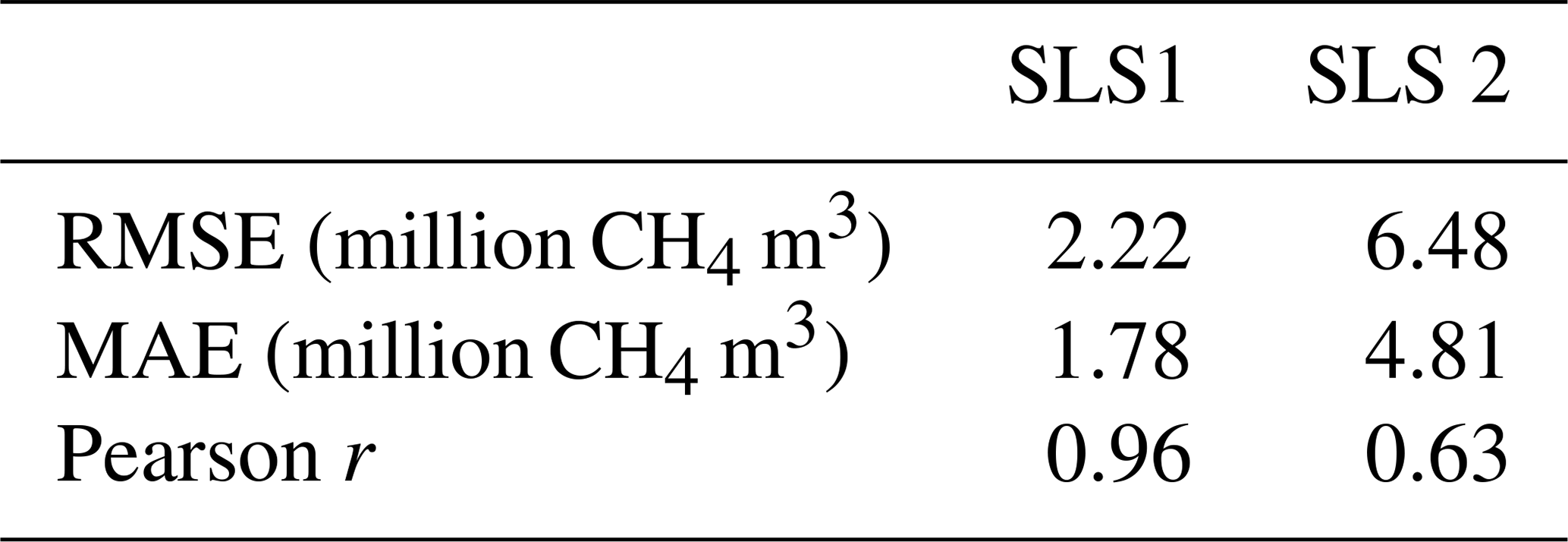
To evaluate model performance, CH4 generation estimates from the CLEENopt model were compared with the observed seasonal CH4 generation at two landfill sites (SLS 1 and SLS 2) (Table 3). The model showed strong correlations with field measurements at both sites, with a particularly high correlation at SLS 1 (RMSE = 2.22 million CH4 m3, MAE = 1.78 million CH4 m3, r=0.96). In contrast, the model performance for SLS 2 was relatively low (RMSE = 6.48 million CH4 m3, MAE = 4.81 million CH4 m3, r=0.64), likely because of the greater variability in field measurements caused by ongoing landfilling activities.
Table 3The evaluation of the seasonal simulation of the CLEENopt model for SLS 1 and SLS 2.
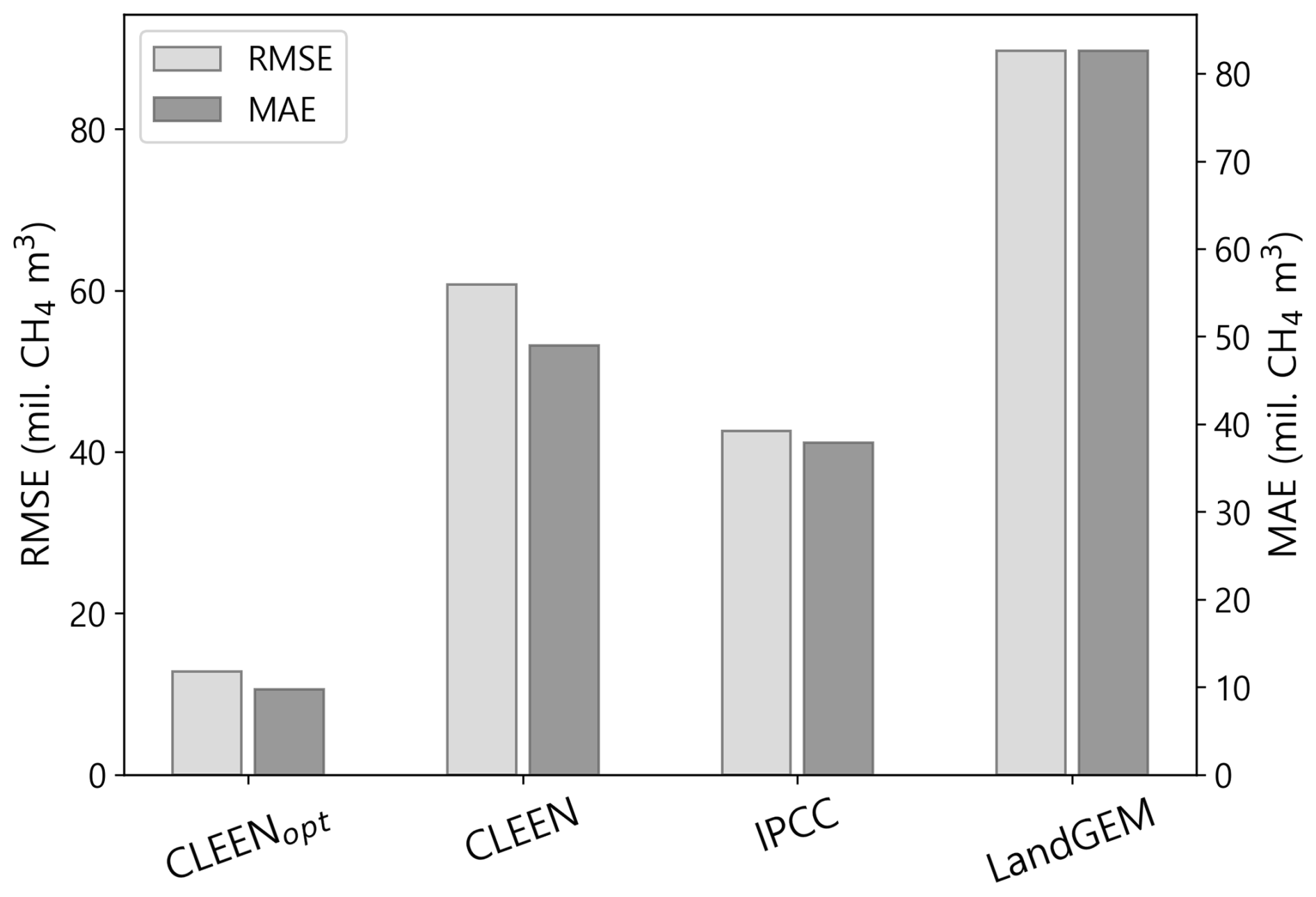
To compare the performance with conventional models such as the CLEEN, IPCC, and LandGEM models, which estimate CH4 emissions on an annual basis, the annual CLEENopt model CH4 generation values were used. As shown in Fig. 3, the CLEENopt model achieved the lowest RMSE and MAE (values of 12.7 and 9.8 million CH4 m3, respectively), demonstrating superior accuracy in simulating observed data. In terms of predictive error, the models ranked in ascending order, were IPCC, CLEEN, and LandGEM, with LandGEM exhibiting the highest RMSE and MAE values.
3.3 Simulation of model estimates
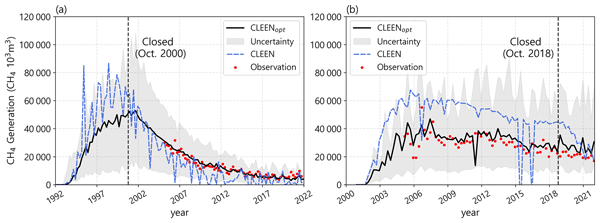
Figure 4 shows the simulated seasonal CH4 generation from the CLEENopt and CLEEN models for SLS 1 and SLS 2. The results indicated that CH4 generation increased during the active landfilling phase and gradually declined after site closure in both landfills. For SLS 1, the CLEENopt model estimated the peak CH4 generation in 2002 at 52.7 million m3, followed by a gradual decline (Fig. 4a). By contrast, the CLEEN model estimated an earlier peak in 1998 at 86.6 million m3. For SLS 2, the CLEENopt model showed a peak in 2007 at 47.5 million m3, while the CLEEN model estimated a peak in 2005 at 67.5 million m3 (Fig. 4b). The sharp drop in the SLS 2 model-estimated CH4 generation during the summer of 2011 was likely due to extreme precipitation events, particularly in July, when the monthly total rainfall reached 864.2 mm, more than twice the climatological average. This anomaly likely caused the model to underestimate the CH4 generation during this period.
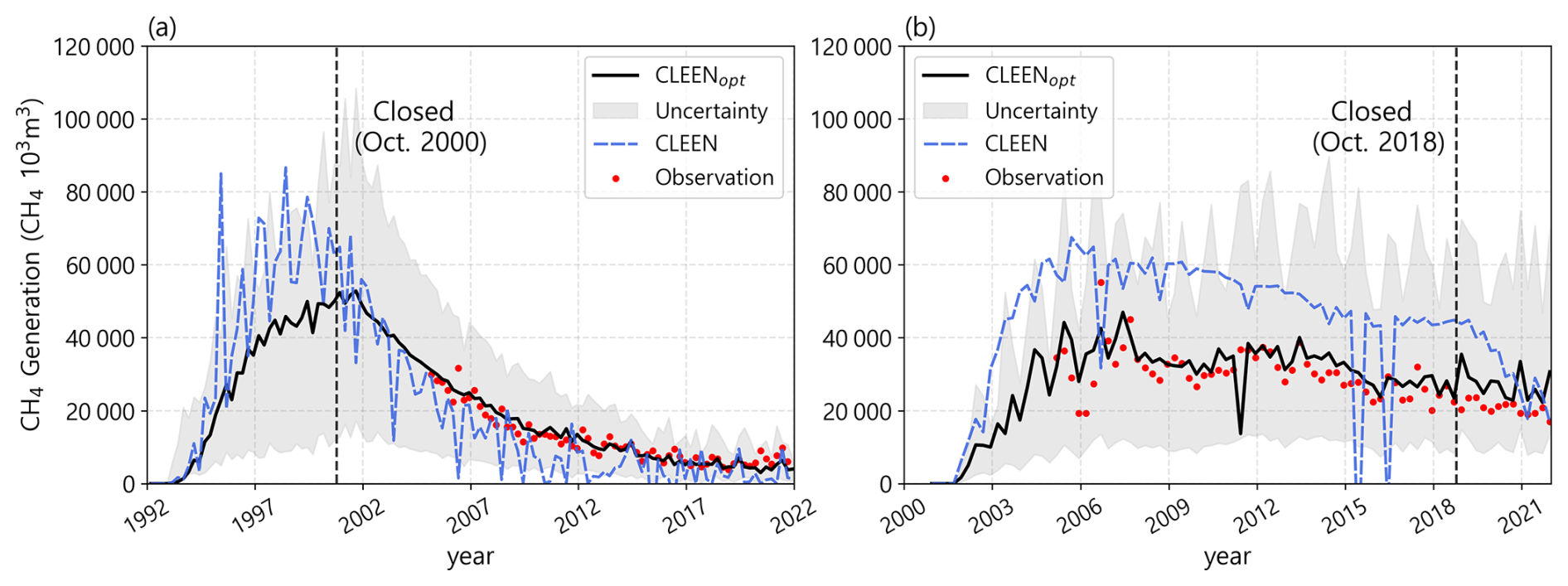
Figure 4Seasonal CH4 generation of CLEENopt, CLEEN, and actual field observation for (a) the SLS 1 and (b) the SLS 2.
The CLEEN model showed significant overestimation and variability in the simulated CH4 generation. This overestimation likely resulted from the use of non-calibrated emission factors despite the incorporation of identical meteorological inputs. In contrast, the CLEENopt model demonstrated improved reproducibility and alignment with CH4 generation trends. These results highlight the importance of the site-specific calibration of model parameters with meteorological conditions to accurately estimate emissions.
The model uncertainty was assessed using the Monte Carlo method by randomly sampling input variables within their specified value ranges (Fig. S3). Uncertainty was defined as the 95 % confidence interval of the average annual CH4 generation calculated from 1000 simulation runs. The estimated uncertainty in CH4 generation at SLS 1 ranged from 75 % to 145 %, whereas that at the SLS 2 ranged from 51 % to 67 %.
3.4 Model results based on meteorological condition
To examine the response of CH4 generation to meteorological variability, the CLEENopt model was applied under an idealized landfill scenario, with a fixed waste input of 600 000 t per month and an L0 of 100 m3 Mg−1. The ambient temperature and precipitation were varied independently across ranges representative of seasonal conditions in South Korea (−5 to 39 °C and 0 to 16 mm d−1, respectively). For each temperature and precipitation scenario, the model simulated CH4 generation over a 30-year period, and the total CH4 generation was compared across all scenarios to assess the relative impact of each variable. The analysis aimed to reflect conditions similar to those of the Sudokwon landfill, using the same modeling period for consistency.
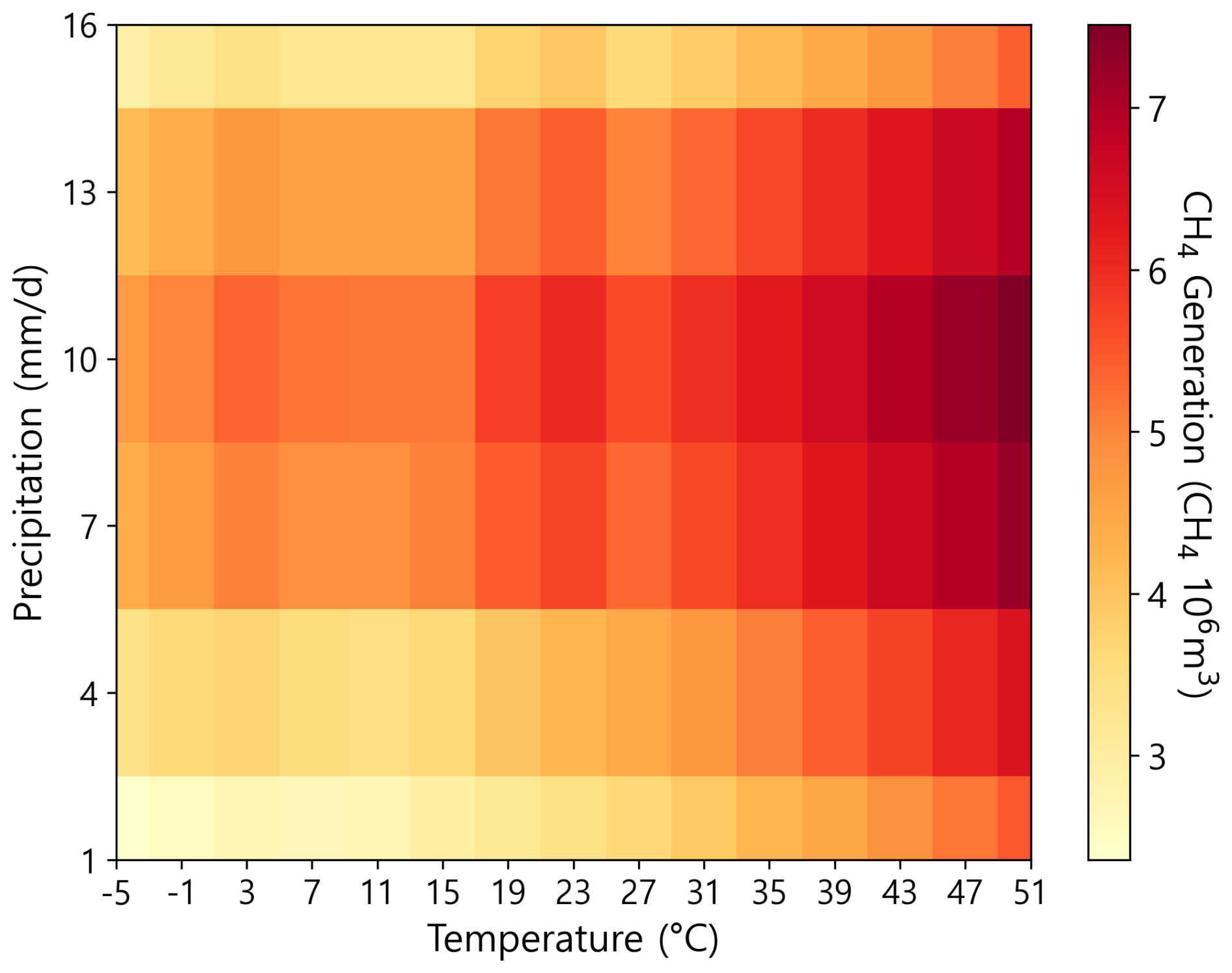
Figure 5Heatmap of simulated methane generation as a function of temperature and precipitation.
Table 4Assessment of climate-induced CH4 generation using OLS regression analysis.
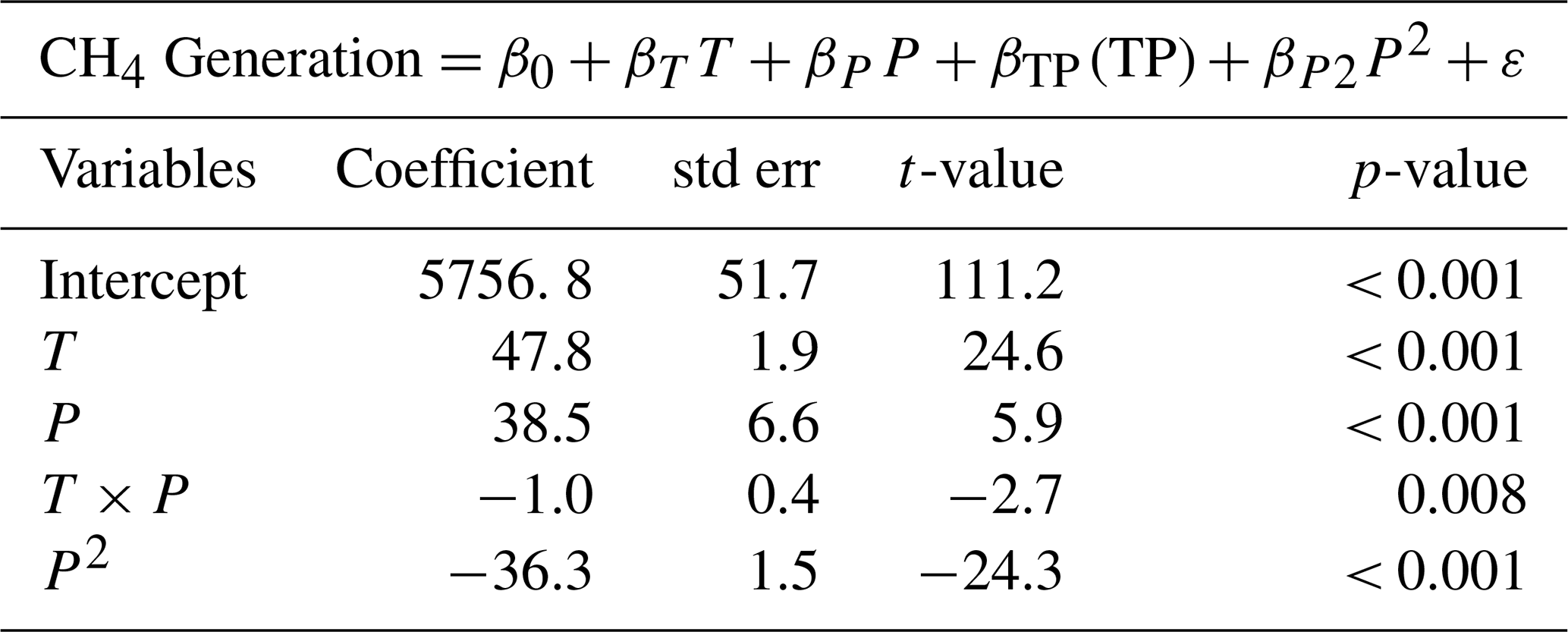
Figure 5 shows a 2D heatmap of simulated CH4 generation as a function of temperature and precipitation. As temperature increases, CH4 generation consistently rises across the full range of precipitation. In case of precipitation, CH4 generation increases up to approximately 9–10 mm d−1, but declines at higher precipitation level.
To statistically quantify these relationships, we applied ordinary least squares (OLS) using centered predictors to mitigate multicollinearity (Iacobucci et al., 2016; Kraemer and Blasey, 2004). The regression results summarized in Table 4 shows a strong positive association with temperature (p < 0.001). Under average conditions, the OLS coefficient for temperature (47.8 units per 1 °C) corresponds to an increase of approximately 0.8 %–1.0 % in simulated CH4 generation per 1 °C warming. In contrast, precipitation indicates a significant nonlinear effect: the combination of a positive linear and negative quadratic term (both p < 0.001) produce the inverted-U shaped relationship, with emissions peaking at intermediate precipitation levels around 9–10 mm d−1. In addition, the temperature–precipitation interaction term is statistically significant (p = 0.008), indicating that increasing precipitation reduces the effect of temperature on CH4 generation. In other words, under dry conditions, the effect of temperature on CH4 generation is relatively more pronounced, whereas under moist conditions, the influence of precipitation becomes comparatively more important.
Previous studies have reported peak CH4 emissions at subsurface soil temperatures between 25 and 40 °C (Scheutz et al., 2009; Spokas and Bogner, 2011; Whalen et al., 1990), which closely correlate with ambient temperatures (Yesiller and Hanson, 2003). Elevated ambient temperatures provide a favorable environment for the bacterial degradation of waste (Rachor et al., 2013; Wang et al., 2012). Precipitation influences CH4 emissions by affecting both soil moisture content and water diffusion within the landfill. Although moderate moisture levels support microbial activity and enhance CH4 production, excessive precipitation can saturate landfill pores, thereby inhibiting gas diffusion and reducing CH4 emissions (Rachor et al., 2013; Scheutz et al., 2009). These results suggested that optimal CH4 generation occurred under high temperatures and moderate precipitation, whereas excessive rainfall could suppress emissions owing to pore saturation and limited gas transportation.
3.5 Analysis of meteorological impacts
The absolute contributions of temperature and precipitation variability to the modeled CH4 emissions across the two landfill sites are shown in Fig. 6. The contrasting sensitivities observed between the two landfill sites suggested that the landfill operational status played a key role in mediating climate-driven CH4 generation. SLS 1, which reached the post-closure phase and was undergoing stabilization, showed a lower response to both temperature (2.90 %) and combined variability of temperature and precipitation (4.59 %), although precipitation still exhibited a strong influence (7.96 %). In contrast, SLS 2, which remained in an active state with ongoing waste placement, showed greater sensitivity to temperature (9.02 %) and combined variability (13.11 %).
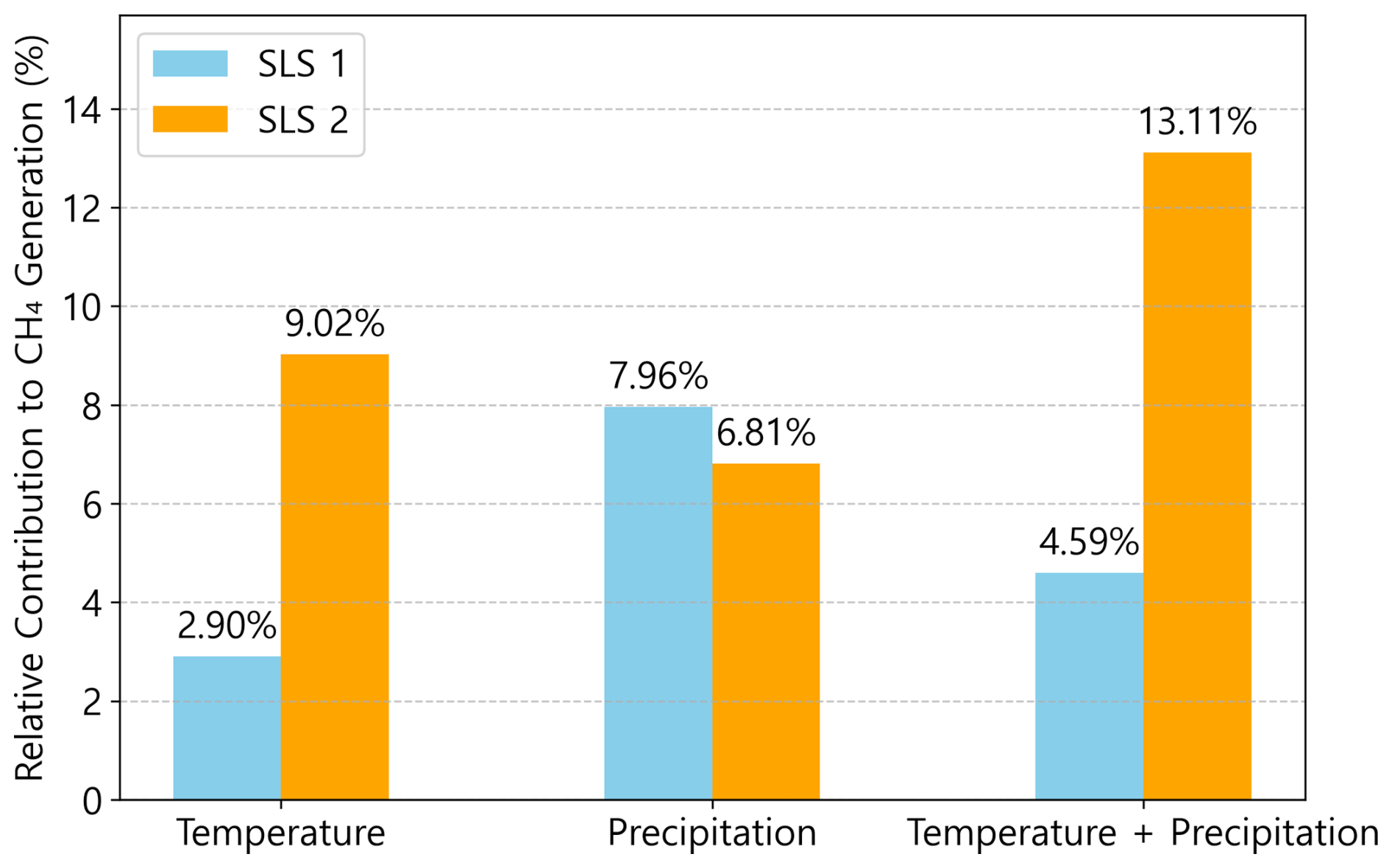
Figure 6The contribution of temperature and precipitation to CH4 generation in SLS 1 and SLS 2.
These differences were likely due to the dynamic microbial and hydrological conditions present in active landfills. The continuous deposition of waste in SLS 2 maintained high levels of organic loading and microbial activity. Given the ongoing operation, the surface has not yet been fully covered, leaving it more exposed to external environmental factors. Conversely, in closed landfills with stable conditions, such as SLS 1, the application of a final cover likely reduces environmental variability at the surface, thereby mitigating the impact of meteorological conditions.
In this study, we showed that incorporating site-specific meteorological conditions significantly improved the accuracy of CH4 generation estimates at the SLS. We further evaluated the influence of meteorological conditions on CH4 generation at the SLS. The results indicated that CH4 generation increased with rising temperature, whereas the effect of precipitation increased up to a certain threshold and then decreased. Prior research has also reported such relationships between meteorological variables and landfill CH4 generation. For instance, Fei et al. (2016) found that higher temperatures were associated with increased waste decomposition, as reflected by elevated k values based on laboratory and field monitoring data. Similarly, Jain et al. (2021) examined 114 closed landfills in the US and found that landfills in regions with adequate annual precipitation emitted more CH4 than those in arid regions. However, excessive soil moisture has been reported to reduce CH4 emissions by impeding gas exchange owing to water-filled pore spaces (Rachor et al., 2013). In contrast, some studies have reported a negative relationship between temperature and CH4 emissions (Rachor et al., 2013), which was attributed to reduced moisture availability under high-temperature conditions (Sacramento et al., 2024; Visvanathan et al., 1999). In the SLS, the positive correlation between temperature and CH4 generation was likely due to the availability of sufficient moisture during the summer months when temperatures were high.
We quantified the relative contributions of temperature and precipitation to CH4 generation in the SLS and highlighted the site-specific differences in climate sensitivity based on the operational status of the landfill. Climate sensitivity can vary depending on the physical and biochemical conditions of landfills, particularly whether active or closed (Barlaz et al., 1990; Karanjekar et al., 2015). Closed landfills are typically capped with cover layers, which reduce exposure to external environmental influences and stabilize organic waste over time (Duan et al., 2022). By contrast, active landfills continue to receive degradable organic waste and remain open to the atmosphere, making them more susceptible to fluctuations in meteorological conditions (Przydatek et al., 2024). Quantifying the effects of meteorological factors can contribute to more accurate estimation of future CH4 emissions from landfills. In regions where the temperature and precipitation are expected to change under future climate change, the CLEENopt model can be applied to estimate potential CH4 emissions. These projections can serve as a scientific basis for informed policy decisions, enabling more effective landfill CH4 measurements that are tailored to the operational status of landfills and site-specific climatic conditions.
The CLEENopt model estimated CH4 generation by accounting for key variables, including waste input, waste composition, ambient temperature, and precipitation. However, other environmental and meteorological factors that may influence CH4 generation – such as soil moisture, atmospheric pressure, wind direction, and pH (Amini et al., 2013; Scheutz et al., 2009) – were not explicitly represented in this study. Furthermore, the CH4 generated in landfills undergoes microbial oxidation in the cover soil before being released into the atmosphere (Duan et al., 2022; Scheutz et al., 2009). To ensure consistency with national inventory practice, we applied a default oxidation rate of 10 %, following the IPCC guidelines (Eggleston et al., 2006). However, this value represents a major assumption and an important source of uncertainty in our emission estimates. In reality, CH4 oxidation is also strongly influenced by climatic conditions, particularly temperature and precipitation (Christophersen et al., 2000). To achieve more accurate and policy-relevant estimates of atmospheric CH4 emissions, future studies should aim to use oxidation rates that reflect local environmental variability, rather than relying on a default value (Chanton et al., 2009; Scheutz et al., 2009). It is therefore imperative to obtain long-term, site-specific field measurements to enhance model calibration and validation. Expanding field-based monitoring across diverse landfill types and environmental conditions would improve both the accuracy and generalizability of landfill CH4 emission models (Mønster et al., 2019).
To extend the CLEENopt framework to landfills with different climates, waste compositions, and operational practices, sufficient site-specific data are required for model calibration. The most critical inputs are field measurements of landfill gas (including surface emissions, gas collection, and gas flaring), along with detailed records of the amount of waste disposal and local temperature and precipitation. To adequately capture seasonal dynamics, these datasets should ideally have at least monthly or seasonal temporal resolution over several years. In addition, L0 should be carefully constrained based on the amount and composition of degradable organic matter at the target landfill. In data-limited cases, one might use parameter sets derived from SLS for landfills that share similar conditions and waste management practices. However, such a parameter transfer would likely introduce substantial additional uncertainty, and parameter sets should be rigorously evaluated against local field measurements before being applied. Overall, the transferability of CLEENopt to other regions depends strongly on the availability of long-term, temporally resolved landfill gas and activity data. Where such data exist, the framework can provide high-resolution and locally optimized CH4 generation estimates, thereby enabling more robust applications across diverse climatic and waste management contexts.
Optimization of the emission factor within the CLEENopt framework provides a facility-specific approach that is consistent with an IPCC Tier 3 methodology. By calibrating constant k under site-specific meteorological conditions, the model yields facility-level emission factors that can be used to refine Tier 3 parameterization in national landfill CH4 inventory methods. When combined with reliable, high-resolution activity data, CLEENopt can enhance both the accuracy and transparency of landfill CH4 emission estimates and support a more explicit quantification of inventory uncertainties. Systematically application of this framework at the national scale would enable country-specific, higher-tier emission estimates, aligning with IPCC guidelines. In turn, this could directly inform the improvement of national GHG inventory systems, support the design of effective CH4 mitigation strategies, and provide a scientific basis for assessing progress toward national NDC (Nationally Determined Contribution) targets.
This study demonstrated that integrating site-specific meteorological conditions into landfill CH4 generation modeling significantly improves estimation accuracy. Our results showed that CH4 generation responded strongly to both temperature and precipitation, indicating an enhanced accuracy of the CLEENopt model compared to that of conventional models that do not fully account for meteorological variability. The response of CH4 generation to meteorological variations showed a linear response with temperature and a parabolic response with precipitation. Furthermore, the findings indicated that CH4 generation increased with precipitation up to approximately 10 mm d−1, but decreased beyond this point, likely due to excessive soil moisture, which inhibited gas exchange. Using the CLEENopt model, we quantified the relative contributions of temperature (5.96 ± 3.06 %) and precipitation (7.38 ± 0.58 %) to CH4 generation at the SLS. These results highlight the importance of climate-sensitive modeling approaches that account for both seasonal variability and site-specific landfill characteristics. Quantifying the influence of meteorological conditions provides valuable insights into CH4 mitigation strategies tailored to landfill type, operational phase, and regional climate. Long-term field observations in diverse landfill environments are essential to further enhance the reliability and applicability of landfill emission models.
The data used in this study could be available upon request from the corresponding author.
The supplement related to this article is available online at https://doi.org/10.5194/acp-26-7789-2026-supplement.
DHK, SJJ and DYC conceived and designed the study. DHK collected and performed the data analysis. SJJ, DYC, and JWJ discussed the results. All authors contributed to the manuscript writing.
The contact author has declared that none of the authors has any competing interests.
Publisher's note: Copernicus Publications remains neutral with regard to jurisdictional claims made in the text, published maps, institutional affiliations, or any other geographical representation in this paper. The authors bear the ultimate responsibility for providing appropriate place names. Views expressed in the text are those of the authors and do not necessarily reflect the views of the publisher.
This article is part of the special issue “Greenhouse gas monitoring in the Asia–Pacific region (ACP/AMT/GMD inter-journal SI)”. It is not associated with a conference.
This work was supported by Korea Environmental Industry and Technology Institute (KEITI) through Project for developing an observation-based GHG emissions geospatial information map, funded by Korea Ministry of Environment (MOE) (RS-2023-00232066) and the Carbon Neutrality Core Technology Development Program (RS-2023-00267529, 2410000450) funded by the Ministry of Trade, Industry and Energy (MOTIE, Korea) and Korea Planning and Evaluation Institute of Industrial Technology (KEIT, Korea).
This paper was edited by Tanja Schuck and reviewed by two anonymous referees.
Alexander, A., Burklin, C., and Singleton, A.: Landfill gas emissions model (LandGEM) version 3.02 user's guide, https://www.epa.gov/ (last access: 16 March 2026), 2005.
Amini, H. R., Reinhart, D. R., and Mackie, K. R.: Determination of first-order landfill gas modeling parameters and uncertainties, Waste Manag., 32, 305–316, https://doi.org/10.1016/j.wasman.2011.09.021, 2012.
Amini, H. R., Reinhart, D. R., and Niskanen, A.: Comparison of first-order-decay modeled and actual field measured municipal solid waste landfill methane data, Waste Manag., 33, 2720–2728, https://doi.org/10.1016/j.wasman.2013.07.025, 2013
Babilotte, A., Lagier, T., Fiani, E., and Taramini, V.: Fugitive methane emissions from landfills: Field comparison of five methods on a French landfill, J. Environ. Eng., 136, 777–784, https://doi.org/10.1061/(ASCE)EE.1943-7870.0000200, 2010.
Bai, S., Li, F., Yan, Y., Huang, Q., Jiang, F., Chen, H., and Zhang, Y.: Seasonal variations of methane emissions from a Urumqi landfill in China and its driving factors using hyperspectral satellite time-series observations, J. Geophys. Res.-Atmos., 130, e2025JD044272, https://doi.org/10.1029/2025JD044272, 2025.
Barlaz, M. A.: Forest products decomposition in municipal solid waste landfills, Waste Manag., 26, 321–333, https://doi.org/10.1016/j.wasman.2005.11.002, 2006.
Barlaz, M. A., Ham, R. K., Schaefer, D. M., and Isaacson, R.: Methane production from municipal refuse: a review of enhancement techniques and microbial dynamics, Crit. Rev. Environ. Sci. Technol., 19, 557–584, https://doi.org/10.1080/10643389009388384, 1990.
Bian, R., Chen, J., Li, W., Shi, W., Lin, Y., Chai, X., and Sun, Y.: Methane emissions and energy generation potential from a municipal solid waste landfill based on inventory models: A case study, Environ. Prog. Sustain. Energy, 40, e13654, https://doi.org/10.1002/ep.13654, 2021.
Breiman, L.: Statistical modeling: The two cultures (with comments and a rejoinder by the author), Stat. Sci., 16, 199-231, https://doi.org/10.1214/ss/1009213726, 2001.
Cambaliza, M. O. L., Bogner, J. E., Green, R. B., Shepson, P. B., Harvey, T. A., Spokas, K. A., Stirm, B. H., and Corcoran, M.: Field measurements and modeling to resolve m2 to km2 CH4 emissions for a complex urban source: An Indiana landfill study, Elem. Sci. Anth., 5, 36, https://doi.org/10.1525/elementa.145, 2017.
Chanton, J. P., Powelson, D. K., and Green, R. B.: Methane oxidation in landfill cover soils, is a 10 % default value reasonable?, J. Environ. Qual., 38, 654–663, https://doi.org/10.2134/jeq2008.0221, 2009.
Christophersen, M., Linderød, L., Jensen, P. E., and Kjeldsen, P.: Methane oxidation at low temperatures in soil exposed to landfill gas, J. Environ. Qual., 29, 1989–1997, https://doi.org/10.2134/jeq2000.00472425002900060036x, 2000.
Cusworth, D. H., Duren, R. M., Ayasse, A. K., Jiorle, R., Howell, K., Aubrey, A., Green, R. O., Eastwood, M. L., Chapman, J. W., and Thorpe, A. K.: Quantifying methane emissions from United States landfills, Science, 383, 1499–1504, https://doi.org/10.1126/science.adi7735, 2024.
Daugla, I., Sužiedelyt Visockien, J., and Kumpien, J.: Detection and analysis of methane emissions from a landfill using unmanned aerial drone systems and semiconductor sensors, Detritus, 10, 127–138, https://doi.org/10.31025/2611-4135/2020.13942, 2020.
Duan, Z., Kjeldsen, P., and Scheutz, C.: Efficiency of gas collection systems at Danish landfills and implications for regulations, Waste Manag., 139, 269–278, https://doi.org/10.1016/j.wasman.2021.12.023, 2022.
Eggleston, H., Buendia, L., Miwa, K., Ngara, T., and Tanabe, K.: 2006 IPCC guidelines for national greenhouse gas inventories, https://www.ipcc-nggip.iges.or.jp/public/2006gl/ (last access: 16 March 2026), 2006.
European Commission and United States of America: Global methane pledge, https://www.ccacoalition.org/resources/global-methane-pledge (last access: 7 February 2026), 2021.
Fei, X., Fang, M., and Wang, Y.: Climate change affects land-disposed waste, Nat. Clim. Change, 11, 1004-1005, https://doi.org/10.1038/s41558-021-01220-5, 2021.
Fei, X., Zekkos, D., and Raskin, L.: Quantification of parameters influencing methane generation due to biodegradation of municipal solid waste in landfills and laboratory experiments, Waste Manag., 55, 276–287, https://doi.org/10.1016/j.wasman.2015.10.015, 2016.
Fjelsted, L., Christensen, A. G., Larsen, J. E., Kjeldsen, P., and Scheutz, C.: Closing the methane mass balance for an old closed Danish landfill, Waste Manag., 102, 179–189, https://doi.org/10.1016/j.wasman.2019.10.045, 2020.
Fosco, D., De Molfetta, M., Renzulli, P., and Notarnicola, B.: Progress in monitoring methane emissions from landfills using drones: An overview of the last ten years, Sci. Total Environ., 173981, https://doi.org/10.1016/j.scitotenv.2024.173981, 2024.
Herrador, M. A. and Gonzalez, A. G.: Evaluation of measurement uncertainty in analytical assays by means of Monte-Carlo simulation, Talanta, 64, 415–422, https://doi.org/10.1016/j.talanta.2004.03.011, 2004.
Iacobucci, D., Schneider, M. J., Popovich, D. L., and Bakamitsos, G. A.: Mean centering helps alleviate “micro” but not “macro” multicollinearity, Behav. Res. Methods, 48, 1308–1317, https://doi.org/10.3758/s13428-015-0624-x, 2016.
IEA: Global methane tracker 2022, IEA, Paris, https://www.iea.org/reports/global-methane-tracker-2022 (last access: 7 February 2026), 2022.
Innocenti, F., Robinson, R., Gardiner, T., Finlayson, A., and Connor, A.: Differential absorption lidar (DIAL) measurements of landfill methane emissions, Remote Sens., 9, 953, https://doi.org/10.3390/rs9090953, 2017.
Jain, P., Wally, J., Townsend, T. G., Krause, M., and Tolaymat, T.: Greenhouse gas reporting data improves understanding of regional climate impact on landfill methane production and collection, PLoS One, 16, e0246334, https://doi.org/10.1371/journal.pone.0246334, 2021.
Jeon, E., Bae, S., Lee, D., Seo, D., Chun, S., Lee, N., and Kim, J.: Methane generation potential and biodegradability of MSW components, in: Proc. 11th Int. Waste Manag. and Landfill Symp. (Sardinia 2007), S. Margherita di Pula, Cagliari, Italy, 2007.
Jeong, S., Park, J., Kim, Y. M., Park, M. H., and Kim, J. Y.: Innovation of flux chamber network design for surface methane emission from landfills using spatial interpolation models, Sci. Total Environ., 688, 18–25, https://doi.org/10.1016/j.scitotenv.2019.06.138, 2019.
Kalos, M. H. and Whitlock, P. A.: Monte Carlo Methods, 2nd Edn., Wiley-VCH, https://doi.org/10.1002/9783527626212, 2008.
Kang, M., Cho, S., Lee, Y., Lee, K.-H., Sohn, S., Choi, S.-W., Kim, J., and Park, J.: Quantification of methane and carbon dioxide surface emissions from a metropolitan landfill based on quasi-continuous eddy covariance measurement, Waste Manag., 186, 355–365, https://doi.org/10.1016/j.wasman.2024.06.020, 2024.
Karanjekar, R. V., Bhatt, A., Altouqui, S., Jangikhatoonabad, N., Durai, V., Sattler, M. L., Hossain, M. D., and Chen, V.: Estimating methane emissions from landfills based on rainfall, ambient temperature, and waste composition: The CLEEN model, Waste Manag., 46, 389–398, https://doi.org/10.1016/j.wasman.2015.07.030, 2015.
Kaza, S., Yao, L., Bhada-Tata, P., and Van Woerden, F.: What a waste 2.0: a global snapshot of solid waste management to 2050, World Bank Publications, https://doi.org/10.1596/978-1-4648-1329-0, 2018.
Kim, H. and Townsend, T. G.: Wet landfill decomposition rate determination using methane yield results for excavated waste samples, Waste Manag., 32, 1427–1433, https://doi.org/10.1016/j.wasman.2012.03.017, 2012.
Kim, Y. M., Park, M. H., Jeong, S., Lee, K. H., and Kim, J. Y.: Evaluation of error inducing factors in unmanned aerial vehicle mounted detector to measure fugitive methane from solid waste landfill, Waste Manag., 124, 368–376, https://doi.org/10.1016/j.wasman.2021.02.023, 2021.
Kormi, T., Mhadhebi, S., Bel Hadj Ali, N., Abichou, T., and Green, R.: Estimation of fugitive landfill methane emissions using surface emission monitoring and Genetic Algorithms optimization, Waste Manag., 72, 313–328, https://doi.org/10.1016/j.wasman.2016.11.024, 2018.
Kraemer, H. C. and Blasey, C. M.: Centring in regression analyses: a strategy to prevent errors in statistical inference, Int. J. Methods Psychiatr. Res., 13, 141–151, https://doi.org/10.1002/mpr.170, 2004.
Krause, M. J., Chickering, G. W., Townsend, T. G., and Reinhart, D. R.: Critical review of the methane generation potential of municipal solid waste, Crit. Rev. Environ. Sci. Technol., 46, 1117–1182, https://doi.org/10.1080/10643389.2016.1204812, 2016.
Kumar, S., Nimchuk, N., Kumar, R., Zietsman, J., Ramani, T., Spiegelman, C., and Kenney, M.: Specific model for the estimation of methane emission from municipal solid waste landfills in India, Bioresour. Technol., 216, 981–987, https://doi.org/10.1016/j.biortech.2016.06.050, 2016.
Maasakkers, J. D., Varon, D. J., Elfarsdottir, A., McKeever, J., Jervis, D., Mahapatra, G., Pandey, S., Lorente, A., Borsdorff, T., and Foorthuis, L. R.: Using satellites to uncover large methane emissions from landfills, Sci. Adv., 8, eabn9683, https://doi.org/10.1126/sciadv.abn9683, 2022.
Machado, S. L., Carvalho, M. F., Gourc, J.-P., Vilar, O. M., and do Nascimento, J. C.: Methane generation in tropical landfills: Simplified methods and field results, Waste Manag., 29, 153–161, https://doi.org/10.1016/j.wasman.2008.02.017, 2009.
Masson-Delmotte, V., Zhai, P., Pirani, A., Connors, S. L., Pean, C., Berger, S., Caud, N., Chen, Y., Goldfarb, L., and Gomis, M.: Climate change 2021: The physical science basis. Contribution of Working Group I to the Sixth Assessment Report of the Intergovernmental Panel on Climate Change, 2, 2391, https://doi.org/10.1017/9781009157896, 2021.
Mønster, J., Kjeldsen, P., and Scheutz, C.: Methodologies for measuring fugitive methane emissions from landfills – A review, Waste Manag., 87, 835–859, https://doi.org/10.1016/j.wasman.2018.12.047, 2019.
Montzka, S. A., Dlugokencky, E. J., and Butler, J. H.: Non-CO2 greenhouse gases and climate change, Nature, 476, 43–50, https://doi.org/10.1038/nature10322, 2011.
Myhre, G., Samset, B. H., Schulz, M., Balkanski, Y., Bauer, S., Berntsen, T. K., Bian, H., Bellouin, N., Chin, M., Diehl, T., Easter, R. C., Feichter, J., Ghan, S. J., Hauglustaine, D., Iversen, T., Kinne, S., Kirkevåg, A., Lamarque, J.-F., Lin, G., Liu, X., Lund, M. T., Luo, G., Ma, X., van Noije, T., Penner, J. E., Rasch, P. J., Ruiz, A., Seland, Ø., Skeie, R. B., Stier, P., Takemura, T., Tsigaridis, K., Wang, P., Wang, Z., Xu, L., Yu, H., Yu, F., Yoon, J.-H., Zhang, K., Zhang, H., and Zhou, C.: Radiative forcing of the direct aerosol effect from AeroCom Phase II simulations, Atmos. Chem. Phys., 13, 1853–1877, https://doi.org/10.5194/acp-13-1853-2013, 2013.
Nesser, H., Jacob, D. J., Maasakkers, J. D., Lorente, A., Chen, Z., Lu, X., Shen, L., Qu, Z., Sulprizio, M. P., Winter, M., Ma, S., Bloom, A. A., Worden, J. R., Stavins, R. N., and Randles, C. A.: High-resolution US methane emissions inferred from an inversion of 2019 TROPOMI satellite data: contributions from individual states, urban areas, and landfills, Atmos. Chem. Phys., 24, 5069–5091, https://doi.org/10.5194/acp-24-5069-2024, 2024.
Owlcation: Landfills and dumps around the world with statistics, https://owlcation.com/stem/15-of-the-Worlds-Largest-Landfills (last access: 1 July 2025), 2024.
Papadopoulos, C. E. and Yeung, H.: Uncertainty estimation and Monte Carlo simulation method, Flow Meas. Instrum., 12, 291–298, https://doi.org/10.1016/S0955-5986(01)00015-2, 2001.
Park, J.-K., Chong, Y.-G., Tameda, K., and Lee, N.-H.: Applying methane and carbon flow balances for determination of first-order landfill gas model parameters, Environ. Eng. Res., 25, 374–383, https://doi.org/10.4491/eer.2019.074, 2019.
Park, J.-W. and Shin, H.-C.: Surface emission of landfill gas from solid waste landfill, Atmos. Environ., 35, 3445–3451, https://doi.org/10.1016/S1352-2310(01)00118-2, 2001.
Prather, M. J., Holmes, C. D., and Hsu, J.: Reactive greenhouse gas scenarios: Systematic exploration of uncertainties and the role of atmospheric chemistry, Geophys. Res. Lett., 39, https://doi.org/10.1029/2012GL051440, 2012.
Przydatek, G., Generowicz, A., and Kanownik, W.: Evaluation of the activity of a municipal waste landfill site in the operational and non-operational sectors based on landfill gas productivity, Energies, 17, 2421, https://doi.org/10.3390/en17102421, 2024.
Purmessur, B. and Surroop, D.: Power generation using landfill gas generated from new cell at the existing landfill site, J. Environ. Chem. Eng., 7, 103060, https://doi.org/10.1016/j.jece.2019.103060, 2019.
Rachor, I., Gebert, J., Grongroft, A., and Pfeiffer, E. M.: Variability of methane emissions from an old landfill over different time-scales, Eur. J. Soil Sci., 64, 16–26, https://doi.org/10.1111/ejss.12004, 2013.
Reinhart, D. R., Cooper, D. C., and Walker, B. L.: Flux chamber design and operation for the measurement of municipal solid waste landfill gas emission rates, J. Air Waste Manage. Assoc., 42, 1067–1070, https://doi.org/10.1080/10473289.1992.10467053, 1992.
Ress, B. B., Calvert, P. P., Pettigrew, C. A., and Barlaz, M. A.: Testing anaerobic biodegradability of polymers in a laboratory-scale simulated landfill, Environ. Sci. Technol., 32, 821–827, https://doi.org/10.1021/es970296h, 1998.
Robinson, R., Gardiner, T., Innocenti, F., Woods, P., and Coleman, M.: Infrared differential absorption Lidar (DIAL) measurements of hydrocarbon emissions, J. Environ. Monit., 13, 2213–2220, https://doi.org/10.1039/C0EM00312C, 2011.
Sacramento, F. C. C., Rangel, G., Zanta, V. M., and Queiroz, L. M.: Climate variability impacts on methane recovery in a municipal solid waste landfill: A case study in a humid tropical climate region, Environ. Res., 247, 118181, https://doi.org/10.1016/j.envres.2024.118181, 2024.
Saunois, M., Martinez, A., Poulter, B., Zhang, Z., Raymond, P. A., Regnier, P., Canadell, J. G., Jackson, R. B., Patra, P. K., Bousquet, P., Ciais, P., Dlugokencky, E. J., Lan, X., Allen, G. H., Bastviken, D., Beerling, D. J., Belikov, D. A., Blake, D. R., Castaldi, S., Crippa, M., Deemer, B. R., Dennison, F., Etiope, G., Gedney, N., Höglund-Isaksson, L., Holgerson, M. A., Hopcroft, P. O., Hugelius, G., Ito, A., Jain, A. K., Janardanan, R., Johnson, M. S., Kleinen, T., Krummel, P. B., Lauerwald, R., Li, T., Liu, X., McDonald, K. C., Melton, J. R., Mühle, J., Müller, J., Murguia-Flores, F., Niwa, Y., Noce, S., Pan, S., Parker, R. J., Peng, C., Ramonet, M., Riley, W. J., Rocher-Ros, G., Rosentreter, J. A., Sasakawa, M., Segers, A., Smith, S. J., Stanley, E. H., Thanwerdas, J., Tian, H., Tsuruta, A., Tubiello, F. N., Weber, T. S., van der Werf, G. R., Worthy, D. E. J., Xi, Y., Yoshida, Y., Zhang, W., Zheng, B., Zhu, Q., Zhu, Q., and Zhuang, Q.: Global Methane Budget 2000–2020, Earth Syst. Sci. Data, 17, 1873–1958, https://doi.org/10.5194/essd-17-1873-2025, 2025.
Scheutz, C., Kjeldsen, P., Bogner, J. E., De Visscher, A., Gebert, J., Hilger, H. A., Huber-Humer, M., and Spokas, K.: Microbial methane oxidation processes and technologies for mitigation of landfill gas emissions, Waste Manag. Res., 27, 409-455, https://doi.org/10.1177/0734242X09339325, 2009.
Seoul Carbon Neutrality Support Center (SCNSC): 2022 Seoul Greenhouse Gas Inventory Report, SCNSC, https://seoulnetzero.si.re.kr/archives/data/ (last access: 16 March 2026), 2024.
Sil, A., Kumar, S., and Wong, J. W.: Development of correction factors for landfill gas emission model suiting Indian condition to predict methane emission from landfills, Bioresour. Technol., 168, 97–99, 2014.
Solomon, S., Qin, D., Manning, M., Chen, Z., Marquis, M., Averyt, K. B., Tignor, M., and Miller, H. L.: AR4 Climate Change 2007: The Physical Science Basis. Contribution of Working Group I to the Fourth Assessment Report of the Intergovernmental Panel on Climate Change, Cambridge University Press, Cambridge, UK, ISBN 978-0521-88009-1, 2007.
Spokas, K. A. and Bogner, J. E.: Limits and dynamics of methane oxidation in landfill cover soils, Waste Manag., 31, 823–832, https://doi.org/10.1016/j.wasman.2009.12.018, 2011.
Sudokwon Landfill Cooperation (SLC): 2019 On-site monitoring and emission characteristics analysis of landfill gas in the Sudokwon landfill, https://www.slc.or.kr/ (last access: 16 March 2026), 2020.
Sudokwon Landfill Cooperation (SLC): Journal of Resource Circulation Technology Research, 18, https://www.slc.or.kr/ (last access: 16 March 2026), 2022.
Sudokwon Landfill Cooperation (SLC): Year 2023 Sudokwon Landfill Statistics Year Book, https://www.slc.or.kr/ (last access: 16 March 2026), 2024.
Symons, G. and Buswell, A.: The methane fermentation of carbohydrates, J. Am. Chem. Soc., 55, 2028–2036, https://doi.org/10.1021/ja01332a039, 1933.
Tchobanoglous, G., Theisen, H., and Vigil, S.: Integrated solid waste management: Engineering principles and management issues, McGraw-Hill, , ISBN 978-0070632370, 1993.
Themelis, N. J. and Ulloa, P. A.: Methane generation in landfills, Renew. Energy, 32, 1243–1257, https://doi.org/10.1016/j.renene.2006.04.020, 2007.
Tyagi, L., Devi, R., Tyagi, S., Kumar, V., Sharma, K., Gautam, Y. K., Kumar, A., Kapoor, S., Bhardwaj, A., and Kumar, A.: Environmental impacts and recent advancements in the sensing of methane: A review, Environ. Technol. Rev., 14, 191–212, https://doi.org/10.1080/21622515.2025.2470448, 2025.
US-EPA: Other Test Method 10 (OTM10): Optical remote sensing for emission characterization from non-point sources, US-EPA, https://www.epa.gov/emc/emc-other-test-methods (last access: 16 March 2026), 2006.
US-EPA: Global Anthropogenic Non-CO2 Greenhouse Gas Emissions: 1990–2030, EPA 430-R-12-006, US-EPA, https://www.epa.gov/global-mitigation-non-co2-greenhouse-gases/global-non-co2-ghg-emissions-1990-2030 (last access: 16 March 2026), 2012.
Visvanathan, C., Pokhrel, D., Cheimchaisri, W., Hettiaratchi, J., and Wu, J. S.: Methanotrophic activities in tropical landfill cover soils: Effects of temperature, moisture content and methane concentration, Waste Manag. Res., 17, 313–323, https://doi.org/10.1177/0734242X9901700407, 1999.
Vu, H. L., Ng, K. T. W., and Richter, A.: Optimization of first order decay gas generation model parameters for landfills located in cold semi-arid climates, Waste Manag., 69, 315–324, https://doi.org/10.1016/j.wasman.2017.08.028, 2017.
Wang, Y., Fang, M., Lou, Z., He, H., Guo, Y., Pi, X., Wang, Y., Yin, K., and Fei, X.: Methane emissions from landfills differentially underestimated worldwide, Nat. Sustain., 7, 496–507, https://doi.org/10.1038/s41893-024-01307-9, 2024.
Wang, Y., Pelkonen, M., and Kaila, J.: Effects of temperature on the long-term behaviour of waste degradation, emissions and post-closure management based on landfill simulators, Open Waste Manag. J., 5, 19–27, https://doi.org/10.2174/1876400201205010019, 2012.
Warith, M. and Sharma, R.: Technical review of methods to enhance biological degradation in sanitary landfills, Water Qual. Res. J., 33, 417–438, https://doi.org/10.2166/wqrj.1998.024, 1998.
Whalen, S., Reeburgh, W., and Sandbeck, K.: Rapid methane oxidation in a landfill cover soil, Appl. Environ. Microbiol., 56, 3405–3411, https://doi.org/10.1128/aem.56.11.3405-3411.1990, 1990.
Yesiller, N. and Hanson, J. L.: Analysis of temperatures at a municipal solid waste landfill, in: Proc. 9th Int. Waste Manag. Landfill Symp. (Sardinia 2003), S. Margherita di Pula, Cagliari, Italy, ISBN 88-900254-2-6, 2003.
Yilmaz, M., Tinjum, J. M., Acker, C., and Marten, B.: Transport mechanisms and emission of landfill gas through various cover soil configurations in an MSW landfill using a static flux chamber technique, J. Environ. Manag., 280, 111677, https://doi.org/10.1016/j.jenvman.2020.111677, 2021.