
Articles | Volume 26, issue 1
https://doi.org/10.5194/acp-26-427-2026
© Author(s) 2026. This work is distributed under
the Creative Commons Attribution 4.0 License.
the Creative Commons Attribution 4.0 License.
https://doi.org/10.5194/acp-26-427-2026
© Author(s) 2026. This work is distributed under
the Creative Commons Attribution 4.0 License.
the Creative Commons Attribution 4.0 License.
Research article
| 
08 Jan 2026
Research article |
| 08 Jan 2026
| 08 Jan 2026
Simulating out-of-sample atmospheric transport to enable flux inversions
Nikhil Dadheech
Department of Atmospheric and Climate Science, University of Washington, Seattle, WA, USA

Department of Atmospheric and Climate Science, University of Washington, Seattle, WA, USA
Related authors
Nikhil Dadheech, Tai-Long He, and Alexander J. Turner
Atmos. Chem. Phys., 25, 5159–5174, https://doi.org/10.5194/acp-25-5159-2025, https://doi.org/10.5194/acp-25-5159-2025, 2025
Short summary
Short summary
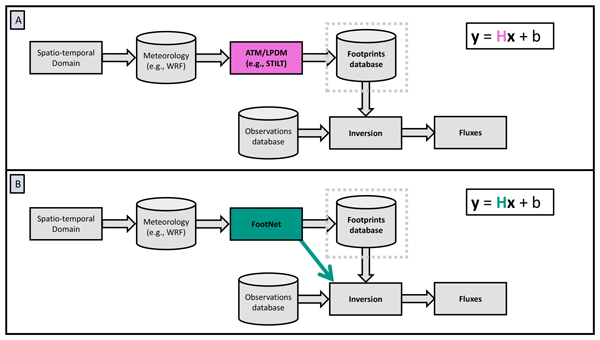
We developed an efficient GHG (greenhouse gas) flux inversion framework using a machine-learning emulator (FootNet) as a surrogate for an atmospheric transport model, resulting in a 650 × speedup. Paradoxically, the flux inversion using the ML (machine-learning) model outperforms the full-physics model in our case study. We attribute this to the ML model mitigating transport errors in the GHG flux inversion.
Tai-Long He, Nikhil Dadheech, Tammy M. Thompson, and Alexander J. Turner
Geosci. Model Dev., 18, 1661–1671, https://doi.org/10.5194/gmd-18-1661-2025, https://doi.org/10.5194/gmd-18-1661-2025, 2025
Short summary
Short summary
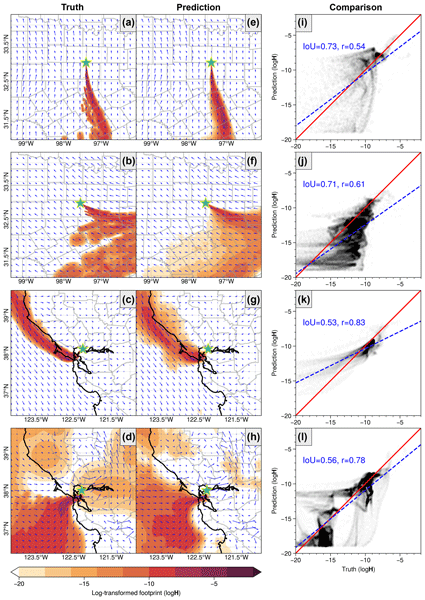
It is computationally expensive to infer greenhouse gas (GHG) emissions using atmospheric observations. This is partly due to the detailed model used to represent atmospheric transport. We demonstrate how a machine learning (ML) model can be used to simulate high-resolution atmospheric transport. This type of ML model will help estimate GHG emissions using dense observations, which are becoming increasingly common with the proliferation of urban monitoring networks and geostationary satellites.
Nicholas Balasus, Daniel J. Jacob, A. Anthony Bloom, James D. East, Lucas A. Estrada, Sarah E. Hancock, Megan He, Todd A. Mooring, Alexander J. Turner, and John R. Worden
Atmos. Chem. Phys., 26, 4601–4617, https://doi.org/10.5194/acp-26-4601-2026, https://doi.org/10.5194/acp-26-4601-2026, 2026
Short summary
Short summary
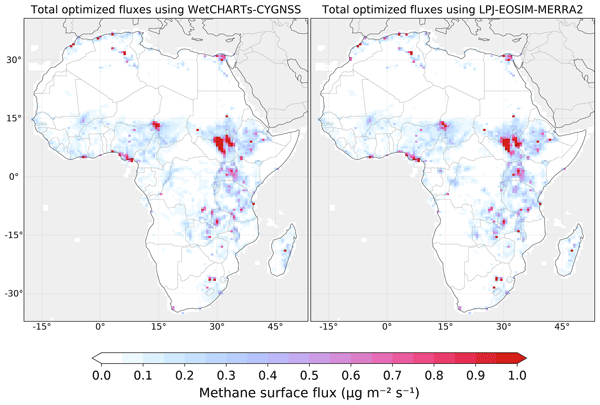
We use satellite observations of methane to determine the amount of methane coming from Africa and relate this to the physical processes responsible, with relevance for climate change given methane's potency as a greenhouse gas. We find that the amount of methane coming from Africa has increased by a third across 2019–2024, driven primarily by steady increases in emissions from livestock, in addition to irregular surges from wetlands.
James Young Suk Yoon, Kelley C. Wells, Dylan B. Millet, Christian Frankenberg, Suniti Sanghavi, Abigail L. S. Swann, Joel A. Thornton, and Alexander J. Turner
Atmos. Chem. Phys., 26, 4509–4529, https://doi.org/10.5194/acp-26-4509-2026, https://doi.org/10.5194/acp-26-4509-2026, 2026
Short summary
Short summary
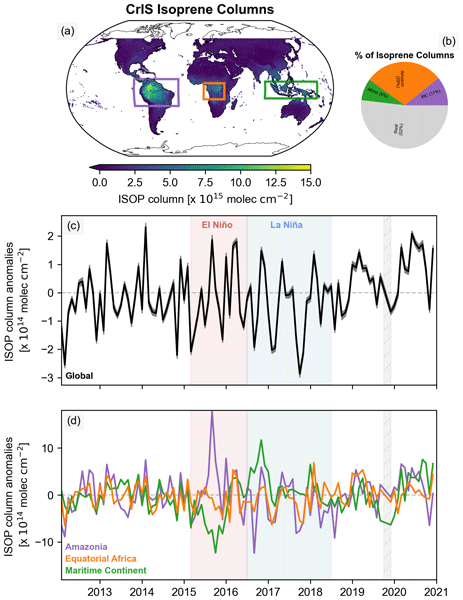
Isoprene is a molecule emitted by trees that is oxidized in the atmosphere within hours. Much of the isoprene globally is emitted in the remote tropics, where we have few direct observations of isoprene. Here, we use new satellite retrievals of isoprene to infer drivers of tropical isoprene variability. Across three regions, isoprene column variability is controlled by different factors, namely changes in isoprene emissions or changes in natural nitrogen oxide sources, like soils and fires.
Eric J. Mei, Gregory J. Hakim, Max Taniguchi-King, Dominik Stiller, and Alexander J. Turner
Atmos. Chem. Phys., 25, 15033–15045, https://doi.org/10.5194/acp-25-15033-2025, https://doi.org/10.5194/acp-25-15033-2025, 2025
Short summary
Short summary
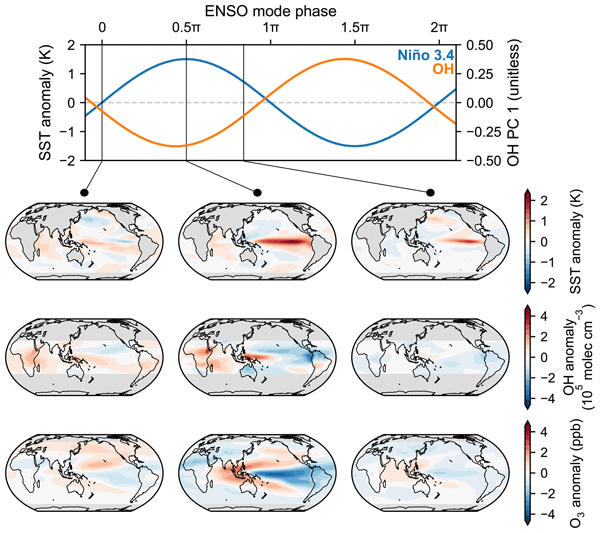
Chemistry-climate models are used to investigate how physical climate influences the composition of the atmosphere but are slow and expensive to run. We train a linear inverse model that can replicate the behavior of chemistry-climate models at low computational cost. It captures how large-scale climate features like El Niño affect atmospheric composition and can make accurate forecasts up to a year ahead. This model enables fast hypothesis testing and estimates of past atmospheric composition.
Matthew S. Johnson, Sofia D. Hamilton, Seongeun Jeong, Yu Yan Cui, Dien Wu, Alex Turner, and Marc Fischer
Atmos. Chem. Phys., 25, 8475–8492, https://doi.org/10.5194/acp-25-8475-2025, https://doi.org/10.5194/acp-25-8475-2025, 2025
Short summary
Short summary
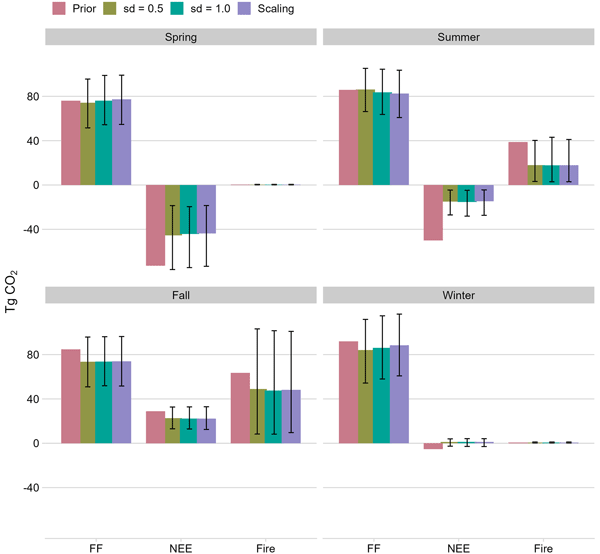
Satellites, such as NASA's Orbiting Carbon Observatory-2 and -3 (OCO-2 and OCO-3, respectively), retrieve carbon dioxide (CO2) concentrations, which provide vital information for estimating surface CO2 emissions. Here, we investigate the ability of OCO-2/3 retrievals to constrain CO2 emissions for the state of California for the major emission sectors (i.e., fossil fuels, net ecosystem exchange, and wildfire).
Nikhil Dadheech, Tai-Long He, and Alexander J. Turner
Atmos. Chem. Phys., 25, 5159–5174, https://doi.org/10.5194/acp-25-5159-2025, https://doi.org/10.5194/acp-25-5159-2025, 2025
Short summary
Short summary
We developed an efficient GHG (greenhouse gas) flux inversion framework using a machine-learning emulator (FootNet) as a surrogate for an atmospheric transport model, resulting in a 650 × speedup. Paradoxically, the flux inversion using the ML (machine-learning) model outperforms the full-physics model in our case study. We attribute this to the ML model mitigating transport errors in the GHG flux inversion.
Tai-Long He, Nikhil Dadheech, Tammy M. Thompson, and Alexander J. Turner
Geosci. Model Dev., 18, 1661–1671, https://doi.org/10.5194/gmd-18-1661-2025, https://doi.org/10.5194/gmd-18-1661-2025, 2025
Short summary
Short summary
It is computationally expensive to infer greenhouse gas (GHG) emissions using atmospheric observations. This is partly due to the detailed model used to represent atmospheric transport. We demonstrate how a machine learning (ML) model can be used to simulate high-resolution atmospheric transport. This type of ML model will help estimate GHG emissions using dense observations, which are becoming increasingly common with the proliferation of urban monitoring networks and geostationary satellites.
Xueying Yu, Dylan B. Millet, Daven K. Henze, Alexander J. Turner, Alba Lorente Delgado, A. Anthony Bloom, and Jianxiong Sheng
Atmos. Chem. Phys., 23, 3325–3346, https://doi.org/10.5194/acp-23-3325-2023, https://doi.org/10.5194/acp-23-3325-2023, 2023
Short summary
Short summary
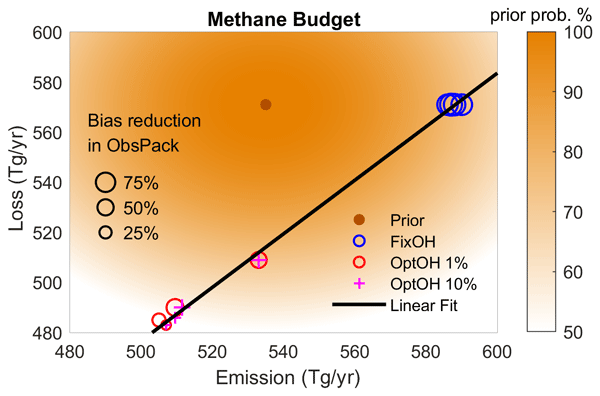
We combine satellite measurements with a novel downscaling method to map global methane emissions at 0.1°×0.1° resolution. These fine-scale emission estimates reveal unreported emission hotspots and shed light on the roles of agriculture, wetlands, and fossil fuels for regional methane budgets. The satellite-derived emissions point in particular to missing fossil fuel emissions in the Middle East and to a large emission underestimate in South Asia that appears to be tied to monsoon rainfall.
Johannes Gensheimer, Alexander J. Turner, Philipp Köhler, Christian Frankenberg, and Jia Chen
Biogeosciences, 19, 1777–1793, https://doi.org/10.5194/bg-19-1777-2022, https://doi.org/10.5194/bg-19-1777-2022, 2022
Short summary
Short summary
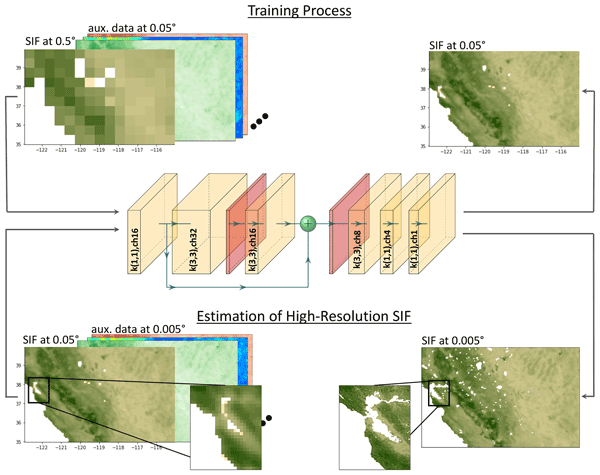
We develop a convolutional neural network, named SIFnet, that increases the spatial resolution of SIF from TROPOMI by a factor of 10 to a spatial resolution of 0.005°. SIFnet utilizes coarse SIF observations, together with a broad range of high-resolution auxiliary data. The insights gained from interpretable machine learning techniques allow us to make quantitative claims about the relationships between SIF and other common parameters related to photosynthesis.
Helen L. Fitzmaurice, Alexander J. Turner, Jinsol Kim, Katherine Chan, Erin R. Delaria, Catherine Newman, Paul Wooldridge, and Ronald C. Cohen
Atmos. Chem. Phys., 22, 3891–3900, https://doi.org/10.5194/acp-22-3891-2022, https://doi.org/10.5194/acp-22-3891-2022, 2022
Short summary
Short summary
On-road emissions are thought to vary widely from existing predictions, as the effects of the age of the vehicle fleet, the performance of emission control systems, and variations in speed are difficult to assess under ambient driving conditions. We present an observational approach to characterize on-road emissions and show that the method is consistent with other approaches to within ~ 3 %.

Alexander J. Turner, Philipp Köhler, Troy S. Magney, Christian Frankenberg, Inez Fung, and Ronald C. Cohen
Biogeosciences, 18, 6579–6588, https://doi.org/10.5194/bg-18-6579-2021, https://doi.org/10.5194/bg-18-6579-2021, 2021
Short summary
Short summary
This work builds a high-resolution estimate (500 m) of gross primary productivity (GPP) over the US using satellite measurements of solar-induced chlorophyll fluorescence (SIF) from the TROPOspheric Monitoring Instrument (TROPOMI) between 2018 and 2020. We identify ecosystem-specific scaling factors for estimating gross primary productivity (GPP) from TROPOMI SIF. Extreme precipitation events drive four regional GPP anomalies that account for 28 % of year-to-year GPP differences across the US.
Cited articles
Asimow, N. G., Turner, A. J., and Cohen, R. C.: Sustained Reductions of Bay Area CO2 Emissions 2018–2022, Environmental Science & Technology, 58, 6586–6594, https://doi.org/10.1021/acs.est.3c09642, 2024. a
Asimow, N. G., Patel, M. Y., Zhu, Y., Winter, A. R., Gurney, K. R., Berelson, W. M., Turner, A. J., and Cohen, R. C.: Differences in Regional Home Heating Behavior in Three U.S. Cities Revealed by Ground-Based Sensor Network, Geophysical Research Letters, 52, e2025GL115772, https://doi.org/10.1029/2025GL115772, 2025. a
Bishop, C. M.: Pattern Recognition and Machine Learning by Christopher M. Bishop, Springer Science+ Business Media, LLC, ISBN 10 0-387-31073-8, ISBN 13 978-0387-31073-2, 2006. a
Cartwright, L., Zammit-Mangion, A., and Deutscher, N. M.: Emulation of greenhouse-gas sensitivities using variational autoencoders, Environmetrics, 34, e2754, https://doi.org/10.1002/env.2754, 2023. a, b
Dadheech, N. and Turner, A.: Simulating out-of-sample atmospheric transport to enable flux inversions, Zenodo [code], https://doi.org/10.5281/zenodo.16010441, 2025a. a
Dadheech, N. and Turner, A.: Simulating out-of-sample atmospheric transport to enable flux inversions, Zenodo [data set], https://doi.org/10.5281/zenodo.16011454, 2025b. a
Davis, K. J., Deng, A., Lauvaux, T., Miles, N. L., Richardson, S. J., Sarmiento, D. P., Gurney, K. R., Hardesty, R. M., Bonin, T. A., Brewer, W. A., Lamb, B. K., Shepson, P. B., Harvey, R. M., Cambaliza, M. O., Sweeney, C., Turnbull, J. C., Whetstone, J., and Karion, A.: The Indianapolis Flux Experiment (INFLUX): A test-bed for developing urban greenhouse gas emission measurements, Elementa: Science of the Anthropocene, 5, 21, https://doi.org/10.1525/elementa.188, 2017. a
Eldering, A., Taylor, T. E., O'Dell, C. W., and Pavlick, R.: The OCO-3 mission: measurement objectives and expected performance based on 1 year of simulated data, Atmos. Meas. Tech., 12, 2341–2370, https://doi.org/10.5194/amt-12-2341-2019, 2019. a
Estrada, L. A., Varon, D. J., Sulprizio, M., Nesser, H., Chen, Z., Balasus, N., Hancock, S. E., He, M., East, J. D., Mooring, T. A., Oort Alonso, A., Maasakkers, J. D., Aben, I., Baray, S., Bowman, K. W., Worden, J. R., Cardoso-Saldaña, F. J., Reidy, E., and Jacob, D. J.: Integrated Methane Inversion (IMI) 2.0: an improved research and stakeholder tool for monitoring total methane emissions with high resolution worldwide using TROPOMI satellite observations, Geosci. Model Dev., 18, 3311–3330, https://doi.org/10.5194/gmd-18-3311-2025, 2025. a
Fasoli, B., Lin, J. C., Bowling, D. R., Mitchell, L., and Mendoza, D.: Simulating atmospheric tracer concentrations for spatially distributed receptors: updates to the Stochastic Time-Inverted Lagrangian Transport model's R interface (STILT-R version 2), Geosci. Model Dev., 11, 2813–2824, https://doi.org/10.5194/gmd-11-2813-2018, 2018. a, b
Fillola, E., Santos-Rodriguez, R., Manning, A., O'Doherty, S., and Rigby, M.: A machine learning emulator for Lagrangian particle dispersion model footprints: a case study using NAME, Geosci. Model Dev., 16, 1997–2009, https://doi.org/10.5194/gmd-16-1997-2023, 2023. a, b
Fillola, E., Santos-Rodriguez, R., Tunnicliffe, R., Clark, J., Keshtmand, N., Ganesan, A., and Rigby, M.: Enabling Fast Greenhouse Gas Emissions Inference from Satellites with GATES: a Graph-Neural-Network Atmospheric Transport Emulation System, EGUsphere [preprint], https://doi.org/10.5194/egusphere-2025-2392, 2025. a
Fisher, A., Rudin, C., and Dominici, F.: All Models are Wrong, but Many are Useful: Learning a Variable's Importance by Studying an Entire Class of Prediction Models Simultaneously, JOURNAL OF MACHINE LEARNING RESEARCH, 20, 1–81, 2019. a
Hamilton, S. D., Wu, D., Johnson, M. S., Turner, A. J., Fischer, M. L., Dadheech, N., and Jeong, S.: Estimating Carbon Dioxide Emissions in Two California Cities Using Bayesian Inversion and Satellite Measurements, Geophysical Research Letters, 51, e2024GL111150, https://doi.org/10.1029/2024GL111150, 2024. a
He, T.-L., Dadheech, N., Thompson, T. M., and Turner, A. J.: FootNet v1.0: development of a machine learning emulator of atmospheric transport, Geosci. Model Dev., 18, 1661–1671, https://doi.org/10.5194/gmd-18-1661-2025, 2025. a, b, c, d
Henze, D. K., Hakami, A., and Seinfeld, J. H.: Development of the adjoint of GEOS-Chem, Atmos. Chem. Phys., 7, 2413–2433, https://doi.org/10.5194/acp-7-2413-2007, 2007. a
IPCC: Climate Change 2023: Synthesis Report. Contribution of Working Groups I, II and III to the Sixth Assessment Report of the Intergovernmental Panel on Climate Change, edited by: Core Writing Team, Lee, H., and Romero, J., IPCC, Geneva, Switzerland, 184 pp., https://doi.org/10.59327/IPCC/AR6-9789291691647, 2023. a
Jones, T. S., Franklin, J. E., Chen, J., Dietrich, F., Hajny, K. D., Paetzold, J. C., Wenzel, A., Gately, C., Gottlieb, E., Parker, H., Dubey, M., Hase, F., Shepson, P. B., Mielke, L. H., and Wofsy, S. C.: Assessing urban methane emissions using column-observing portable Fourier transform infrared (FTIR) spectrometers and a novel Bayesian inversion framework, Atmos. Chem. Phys., 21, 13131–13147, https://doi.org/10.5194/acp-21-13131-2021, 2021. a
Karion, A., Lauvaux, T., Lopez Coto, I., Sweeney, C., Mueller, K., Gourdji, S., Angevine, W., Barkley, Z., Deng, A., Andrews, A., Stein, A., and Whetstone, J.: Intercomparison of atmospheric trace gas dispersion models: Barnett Shale case study, Atmos. Chem. Phys., 19, 2561–2576, https://doi.org/10.5194/acp-19-2561-2019, 2019. a
Lin, J. C. and Gerbig, C.: Accounting for the effect of transport errors on tracer inversions, Geophysical Research Letters, 32, https://doi.org/10.1029/2004GL021127, 2005. a
Lin, J. C., Gerbig, C., Wofsy, S. C., Andrews, A. E., Daube, B. C., Davis, K. J., and Grainger, C. A.: A near-field tool for simulating the upstream influence of atmospheric observations: The Stochastic Time-Inverted Lagrangian Transport (STILT) model, Journal of Geophysical Research: Atmospheres, 108, https://doi.org/10.1029/2002JD003161, 2003. a, b, c
Maasakkers, J. D., McDuffie, E. E., Sulprizio, M. P., Chen, C., Schultz, M., Brunelle, L., Thrush, R., Steller, J., Sherry, C., Jacob, D. J., Jeong, S., Irving, B., and Weitz, M.: A Gridded Inventory of Annual 2012–2018 U.S. Anthropogenic Methane Emissions, Environmental Science & Technology, 57, 16276–16288, https://doi.org/10.1021/acs.est.3c05138, 2023. a, b
McDonald, B. C., McBride, Z. C., Martin, E. W., and Harley, R. A.: High-resolution mapping of motor vehicle carbon dioxide emissions, Journal of Geophysical Research: Atmospheres, 119, 5283–5298, https://doi.org/10.1002/2013JD021219, 2014. a, b
Meng, C., Griesemer, S., Cao, D., Seo, S., and Liu, Y.: When physics meets machine learning: A survey of physics-informed machine learning, Machine Learning for Computational Science and Engineering, 1, 1–23, https://doi.org/10.1007/s44379-025-00016-0, 2025. a
Munassar, S., Monteil, G., Scholze, M., Karstens, U., Rödenbeck, C., Koch, F.-T., Totsche, K. U., and Gerbig, C.: Why do inverse models disagree? A case study with two European CO2 inversions, Atmos. Chem. Phys., 23, 2813–2828, https://doi.org/10.5194/acp-23-2813-2023, 2023. a
Nassar, R., Hill, T. G., McLinden, C. A., Wunch, D., Jones, D. B. A., and Crisp, D.: Quantifying CO2 Emissions From Individual Power Plants From Space, Geophysical Research Letters, 44, 10045–10053, https://doi.org/10.1002/2017GL074702, 2017. a, b
O'Dell, C. W., Connor, B., Bösch, H., O'Brien, D., Frankenberg, C., Castano, R., Christi, M., Eldering, D., Fisher, B., Gunson, M., McDuffie, J., Miller, C. E., Natraj, V., Oyafuso, F., Polonsky, I., Smyth, M., Taylor, T., Toon, G. C., Wennberg, P. O., and Wunch, D.: The ACOS CO2 retrieval algorithm – Part 1: Description and validation against synthetic observations, Atmos. Meas. Tech., 5, 99–121, https://doi.org/10.5194/amt-5-99-2012, 2012. a
Pasquill, F.: The estimation of the dispersion of windborne material, Meteoro. Mag., 90, 20–49, 1961. a
Rohrschneider, R. R., Wofsy, S., Franklin, J. E., Benmergui, J., Soto, J., and Davis, S. B.: The methanesat mission, 35th Annual Small Satellite Conference, SSC21-II-05, 2021. a
Roten, D., Wu, D., Fasoli, B., Oda, T., and Lin, J. C.: An Interpolation Method to Reduce the Computational Time in the Stochastic Lagrangian Particle Dispersion Modeling of Spatially Dense XCO2 Retrievals, Earth and Space Science, 8, e2020EA001343, https://doi.org/10.1029/2020EA001343, 2021. a, b
Shukla, K., Dadheech, N., Kumar, P., and Khare, M.: Regression-based flexible models for photochemical air pollutants in the national capital territory of megacity Delhi, Chemosphere, 272, 129611, https://doi.org/10.1016/j.chemosphere.2021.129611, 2021. a
Shusterman, A. A., Teige, V. E., Turner, A. J., Newman, C., Kim, J., and Cohen, R. C.: The BErkeley Atmospheric CO2 Observation Network: initial evaluation, Atmos. Chem. Phys., 16, 13449–13463, https://doi.org/10.5194/acp-16-13449-2016, 2016. a, b
Sturm, P. O. and Wexler, A. S.: A mass- and energy-conserving framework for using machine learning to speed computations: a photochemistry example, Geosci. Model Dev., 13, 4435–4442, https://doi.org/10.5194/gmd-13-4435-2020, 2020. a
Turner, A. J., Shusterman, A. A., McDonald, B. C., Teige, V., Harley, R. A., and Cohen, R. C.: Network design for quantifying urban CO2 emissions: assessing trade-offs between precision and network density, Atmos. Chem. Phys., 16, 13465–13475, https://doi.org/10.5194/acp-16-13465-2016, 2016. a, b
Turner, A. J., Kim, J., Fitzmaurice, H., Newman, C., Worthington, K., Chan, K., Wooldridge, P. J., Köehler, P., Frankenberg, C., and Cohen, R. C.: Observed Impacts of COVID-19 on Urban CO Emissions, Geophysical Research Letters, 47, e2020GL090037, https://doi.org/10.1029/2020GL090037, 2020. a, b, c, d
Varon, D. J., Jacob, D. J., Sulprizio, M., Estrada, L. A., Downs, W. B., Shen, L., Hancock, S. E., Nesser, H., Qu, Z., Penn, E., Chen, Z., Lu, X., Lorente, A., Tewari, A., and Randles, C. A.: Integrated Methane Inversion (IMI 1.0): a user-friendly, cloud-based facility for inferring high-resolution methane emissions from TROPOMI satellite observations, Geosci. Model Dev., 15, 5787–5805, https://doi.org/10.5194/gmd-15-5787-2022, 2022. a
Varon, D. J., Jacob, D. J., Hmiel, B., Gautam, R., Lyon, D. R., Omara, M., Sulprizio, M., Shen, L., Pendergrass, D., Nesser, H., Qu, Z., Barkley, Z. R., Miles, N. L., Richardson, S. J., Davis, K. J., Pandey, S., Lu, X., Lorente, A., Borsdorff, T., Maasakkers, J. D., and Aben, I.: Continuous weekly monitoring of methane emissions from the Permian Basin by inversion of TROPOMI satellite observations, Atmos. Chem. Phys., 23, 7503–7520, https://doi.org/10.5194/acp-23-7503-2023, 2023. a
Veefkind, J., Aben, I., McMullan, K., Förster, H., de Vries, J., Otter, G., Claas, J., Eskes, H., de Haan, J., Kleipool, Q., van Weele, M., Hasekamp, O., Hoogeveen, R., Landgraf, J., Snel, R., Tol, P., Ingmann, P., Voors, R., Kruizinga, B., Vink, R., Visser, H., and Levelt, P.: TROPOMI on the ESA Sentinel-5 Precursor: A GMES mission for global observations of the atmospheric composition for climate, air quality and ozone layer applications, Remote Sensing of Environment, 120, 70–83, https://doi.org/10.1016/j.rse.2011.09.027, 2012. a, b
Wang, Y.-H. and Gupta, H. V.: A Mass-Conserving-Perceptron for Machine-Learning-Based Modeling of Geoscientific Systems, Water Resources Research, 60, e2023WR036461, https://doi.org/10.1029/2023WR036461, 2024. a
Wu, D., Lin, J. C., Fasoli, B., Oda, T., Ye, X., Lauvaux, T., Yang, E. G., and Kort, E. A.: A Lagrangian approach towards extracting signals of urban CO2 emissions from satellite observations of atmospheric column CO2 (XCO2): X-Stochastic Time-Inverted Lagrangian Transport model (“X-STILT v1”), Geosci. Model Dev., 11, 4843–4871, https://doi.org/10.5194/gmd-11-4843-2018, 2018. a, b
Yadav, V. and Michalak, A. M.: Improving computational efficiency in large linear inverse problems: an example from carbon dioxide flux estimation, Geosci. Model Dev., 6, 583–590, https://doi.org/10.5194/gmd-6-583-2013, 2013. a, b
Zhou, Z., Rahman Siddiquee, M. M., Tajbakhsh, N., and Liang, J.: Unet++: A nested u-net architecture for medical image segmentation, in: Deep learning in medical image analysis and multimodal learning for clinical decision support: 4th international workshop, DLMIA 2018, and 8th international workshop, ML-CDS 2018, held in conjunction with MICCAI 2018, Granada, Spain, 20 September 2018, proceedings 4, 3–11, Springer, https://doi.org/10.1007/978-3-030-00889-5_1, 2018. a, b
Short summary
We developed a generalized emulator of atmospheric transport (FootNet v3) trained over the United States, enabling the emulation of both surface & column-averaged footprints at kilometer-scale resolution. We demonstrate that FootNet v3 generalizes to previously unseen regions and meteorological conditions, enabling accurate out-of-sample simulation of atmospheric transport. Flux inversion case studies show that FootNet matches or exceeds the performance of full-physics models in unseen regions.
We developed a generalized emulator of atmospheric transport (FootNet v3) trained over the...


Altmetrics
Final-revised paper
Preprint