
Articles | Volume 26, issue 3
https://doi.org/10.5194/acp-26-1847-2026
© Author(s) 2026. This work is distributed under
the Creative Commons Attribution 4.0 License.
the Creative Commons Attribution 4.0 License.
https://doi.org/10.5194/acp-26-1847-2026
© Author(s) 2026. This work is distributed under
the Creative Commons Attribution 4.0 License.
the Creative Commons Attribution 4.0 License.
Research article
| 
05 Feb 2026
Research article |
| 05 Feb 2026
| 05 Feb 2026
Modeling the coupled and decoupled states of polar boundary-layer mixed-phase clouds
Étienne Vignon
CORRESPONDING AUTHOR

Laboratoire de Météorologie Dynamique-IPSL, Sorbonne Université/CNRS/Ecole Normale Supérieure-PSL Université/Ecole Polytechnique-Institut Polytechnique de Paris, Paris, France
Laboratoire de Physique et Chimie de l'Environnement et de l'Espace (LPC2E), Université d'Orléans, CNRS UMR7328, CNES, Orléans, France
Lea Raillard
Laboratoire de Météorologie Dynamique-IPSL, Sorbonne Université/CNRS/Ecole Normale Supérieure-PSL Université/Ecole Polytechnique-Institut Polytechnique de Paris, Paris, France
Audran Borella
Institut Pierre‐Simon Laplace, Sorbonne Université/CNRS, Paris, France
Gwendal Rivière
Laboratoire de Météorologie Dynamique-IPSL, Sorbonne Université/CNRS/Ecole Normale Supérieure-PSL Université/Ecole Polytechnique-Institut Polytechnique de Paris, Paris, France
Jean-Baptiste Madeleine
Laboratoire de Météorologie Dynamique-IPSL, Sorbonne Université/CNRS/Ecole Normale Supérieure-PSL Université/Ecole Polytechnique-Institut Polytechnique de Paris, Paris, France
Related authors
Lea Raillard, Audran Borella, Gwendal Rivière, Niels Dutrievoz, Meryl Wimmer, Ionela Musat, and Étienne Vignon
EGUsphere, https://doi.org/10.5194/egusphere-2026-5432, https://doi.org/10.5194/egusphere-2026-5432, 2026
This preprint is open for discussion and under review for Atmospheric Chemistry and Physics (ACP).
Short summary
Short summary
Climate models struggle to predict snowfall near the poles, which matters for tracking ice sheet changes. We built a new, efficient snowfall scheme for a global climate model and tested it using aircraft and ground radar data from Arctic Svalbard and Antarctica. The improved model better captures how snow forms and falls through clouds, bringing us closer to reliable predictions of polar snowfall, and showing where further refinements are needed.
Pierre Grzegorczyk, Lea Raillard, Valentin Wiener, Étienne Vignon, Christophe Genthon, and Alexis Berne
EGUsphere, https://doi.org/10.5194/egusphere-2026-4473, https://doi.org/10.5194/egusphere-2026-4473, 2026
This preprint is open for discussion and under review for Geoscientific Model Development (GMD).
Short summary
Short summary
Evaluating cloud representation in Atmospheric General Circulation Models (AGCMs) is important for surface precipitation and the Earth radiative balance. The LORIS (LMDZ Offline Radar Instrument Simulator) is a new tool designed to evaluate clouds in LMDZ (the atmospheric component of the IPSL Coupled Model). LORIS offers flexible options for subgrid representation, scattering assumptions, and microphysics properties, enabling the evaluation and improvement of cloud and precipitation in LMDZ.
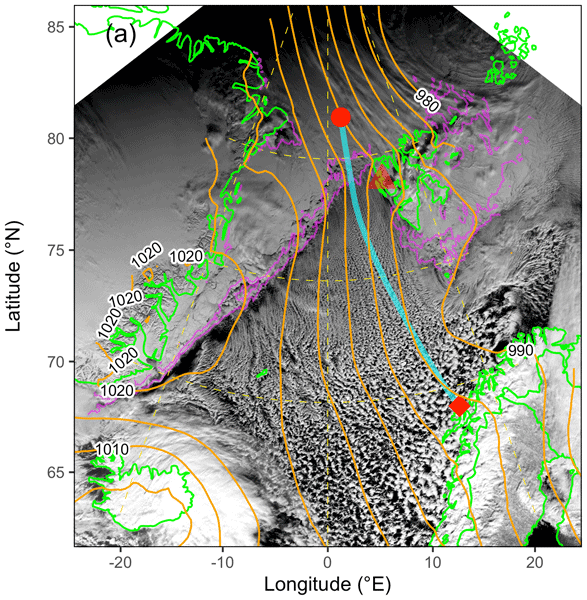
Timothy W. Juliano, Florian Tornow, Ann M. Fridlind, Andrew S. Ackerman, Gregory S. Elsaesser, Bart Geerts, Christian P. Lackner, David Painemal, Israel Silber, Mikhail Ovchinnikov, Gunilla Svensson, Michael Tjernström, Peng Wu, Alejandro Baró Pérez, Peter Bogenschutz, Dmitry Chechin, Kamal Kant Chandrakar, Jan Chylik, Andrey Debolskiy, Rostislav Fadeev, Anu Gupta, Luisa Ickes, Michail Karalis, Martin Köhler, Branko Kosović, Peter Kuma, Weiwei Li, Evgeny Mortikov, Hugh Morrison, Roel A. J. Neggers, Anna Possner, Tomi Raatikainen, Lea Raillard, Sami Romakkaniemi, Niklas Schnierstein, Shin-ichiro Shima, Nikita Silin, Mikhail Tolstykh, Étienne Vignon, Lulin Xue, Meng Zhang, and Xue Zheng
Atmos. Chem. Phys., 26, 13267–13302, https://doi.org/10.5194/acp-26-13267-2026, https://doi.org/10.5194/acp-26-13267-2026, 2026
Short summary
Short summary
Models struggle to capture cloud and precipitation processes and their radiative effects in marine cold-air outbreaks. We use a quasi-Lagrangian framework to compare large-eddy simulation (LES) and single-column model (SCM) output with field and satellite observations. With fixed droplet and ice numbers, LES and SCM agree in liquid-only tests. In mixed-phase conditions, LES plausibly capture cloud thinning and breakup, while SCMs largely remain overcast and thereby miss cloud radiative effects.
Nicolas Chiabrando, Gwendal Rivière, Étienne Vignon, and Julien Delanoë
EGUsphere, https://doi.org/10.5194/egusphere-2026-3987, https://doi.org/10.5194/egusphere-2026-3987, 2026
Short summary
Short summary
Arctic cyclones are large-scale depressions evolving within the Arctic circle. We study a summertime Arctic cyclone that moved near Svalbard in 2022 and was well observed during the THINICE field campaign to understand what controls the intensity of a near-surface wind jet associated with the cyclone. We find that clouds and near-surface frictional effects globally strengthened the wind while the cyclone was growing, but became much less important after it evolved toward a cold-core structure.
Aymeric Dziduch, Antoine Baudoux, Guillaume Mioche, Antoine Canzi, Benjamin Doiteau, Manuel Moser, Emma Järvinen, Étienne Vignon, Jean-Christophe Raut, Régis Dupuy, Christophe Gourbeyre, Jean-Luc Baray, Marie Monier, Frédéric Szczap, Guillaume Penide, Julien Delanoë, Odran Sourdeval, Alfons Schwarzenboeck, Stephan Mertes, Franz Martin Schnaiter, Christiane Voigt, Mario Mech, Susanne Crewell, Andreas Herber, Christof Lüpkes, André Ehrlich, Manfred Wendisch, and Olivier Jourdan
EGUsphere, https://doi.org/10.5194/egusphere-2026-3265, https://doi.org/10.5194/egusphere-2026-3265, 2026
This preprint is open for discussion and under review for Atmospheric Chemistry and Physics (ACP).
Short summary
Short summary
This study examines the microphysical properties and ice crystal habits of low-level Arctic mixed-phase clouds around Svalbard. Using airborne in situ observations from four campaigns, we show that cloud microphysical structure and ice crystal habits are influenced by weather conditions and surface type. These results provide quantitative observations to better understand low-level Arctic clouds, their ice formation processes, and their influence on the Arctic atmosphere and climate system.
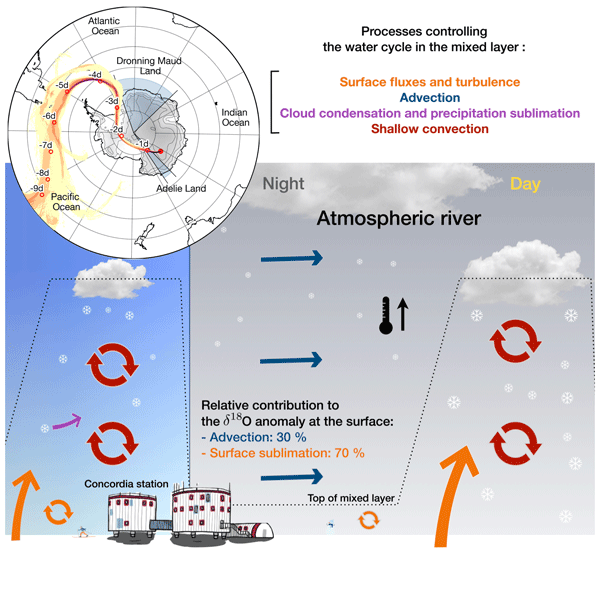
Niels Dutrievoz, Cécile Agosta, Cécile Davrinche, Amaëlle Landais, Sebastien Nguyen, Étienne Vignon, Inès Ollivier, Christophe Leroy-Dos Santos, Elise Fourré, Mathieu Casado, Jonathan Wille, Vincent Favier, Bénédicte Minster, and Frédéric Prié
The Cryosphere, 20, 1025–1046, https://doi.org/10.5194/tc-20-1025-2026, https://doi.org/10.5194/tc-20-1025-2026, 2026
Short summary
Short summary
In December 2018, an atmospheric river event from the Atlantic reached Dome C, East Antarctica, causing a +18 °C warming, tripled water vapour, and a strong isotopic anomaly in water vapour (+ 17 ‰ for δ18O) at the surface. During the peak of the event, we found 70 % of the water vapour came from local snow sublimation, and 30 % from the atmospheric river itself, highlighting both long-range moisture advection and interactions between the boundary layer and the snowpack.
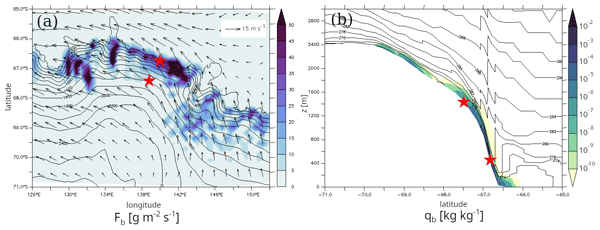
Étienne Vignon, Nicolas Chiabrando, Cécile Agosta, Charles Amory, Valentin Wiener, Justine Charrel, Thomas Dubos, and Christophe Genthon
Geosci. Model Dev., 19, 239–259, https://doi.org/10.5194/gmd-19-239-2026, https://doi.org/10.5194/gmd-19-239-2026, 2026
Short summary
Short summary
The erosion of surface snow by the wind is an important process for the Antarctic surface mass balance. This study presents the first development of a parameterisation of blowing snow for a global climate model. Simulations avec evaluated using measurements in Antarctica. Results show an overall decrease of the snow accumulation in the escarpment region of the ice sheet due to snow erosion and an increase at the coast due to blowing snow deposition and increase in precipitation.
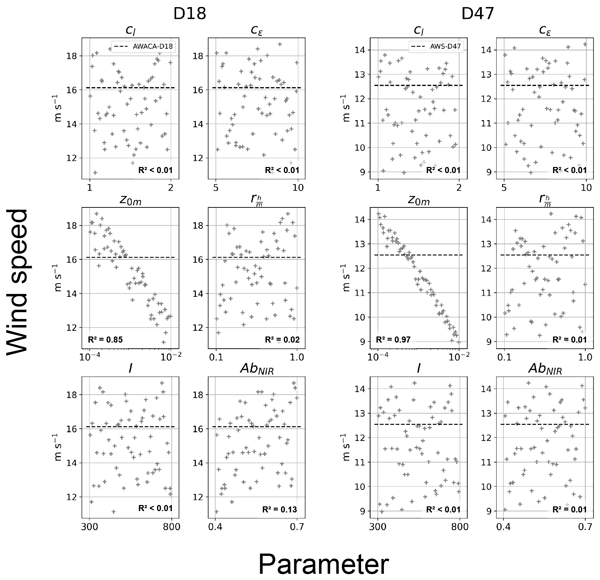
Valentin Wiener, Étienne Vignon, Thomas Caton Harrison, Christophe Genthon, Felipe Toledo, Guylaine Canut-Rocafort, Yann Meurdesoif, and Alexis Berne
Weather Clim. Dynam., 6, 1605–1627, https://doi.org/10.5194/wcd-6-1605-2025, https://doi.org/10.5194/wcd-6-1605-2025, 2025
Short summary
Short summary
Katabatic winds are a key feature of the climate of Antarctica, but substantial biases remain in their representation in atmospheric models. This study investigates a katabatic wind event in an atmospheric circulation model using in-situ observations. The framework allows to disentangle which part of the bias is due to horizontal resolution, to parameter calibration and to structural deficiencies in the model. We underline in particular the need to refine the physics of the model snow cover.
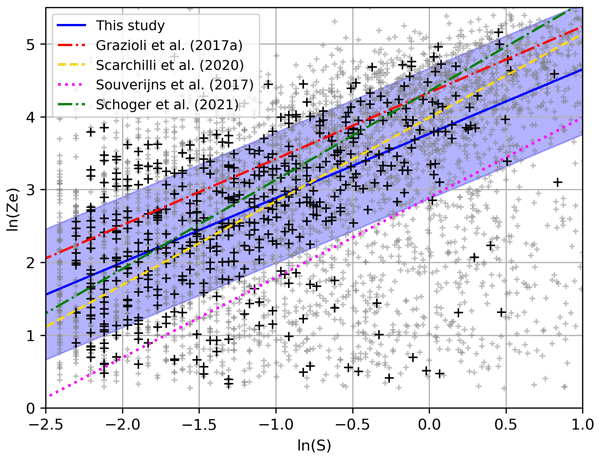
Valentin Wiener, Marie-Laure Roussel, Christophe Genthon, Étienne Vignon, Jacopo Grazioli, and Alexis Berne
Earth Syst. Sci. Data, 16, 821–836, https://doi.org/10.5194/essd-16-821-2024, https://doi.org/10.5194/essd-16-821-2024, 2024
Short summary
Short summary
This paper presents 7 years of data from a precipitation radar deployed at the Dumont d'Urville station in East Antarctica. The main characteristics of the dataset are outlined in a short statistical study. Interannual and seasonal variability are also investigated. Then, we extensively describe the processing method to retrieve snowfall profiles from the radar data. Lastly, a brief comparison is made with two climate models as an application example of the dataset.
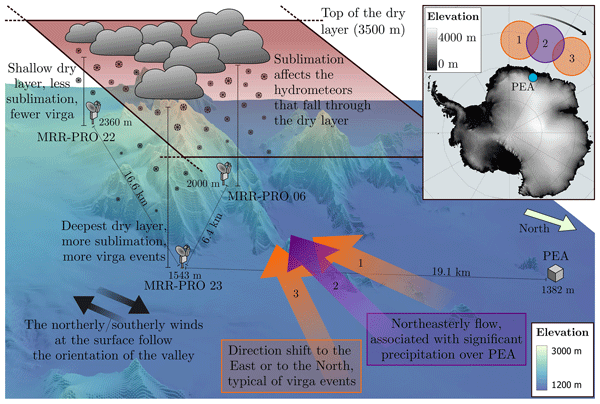
Alfonso Ferrone, Étienne Vignon, Andrea Zonato, and Alexis Berne
The Cryosphere, 17, 4937–4956, https://doi.org/10.5194/tc-17-4937-2023, https://doi.org/10.5194/tc-17-4937-2023, 2023
Short summary
Short summary
In austral summer 2019/2020, three K-band Doppler profilers were deployed across the Sør Rondane Mountains, south of the Belgian base Princess Elisabeth Antarctica. Their measurements, along with atmospheric simulations and reanalyses, have been used to study the spatial variability in precipitation over the region, as well as investigate the interaction between the complex terrain and the typical flow associated with precipitating systems.
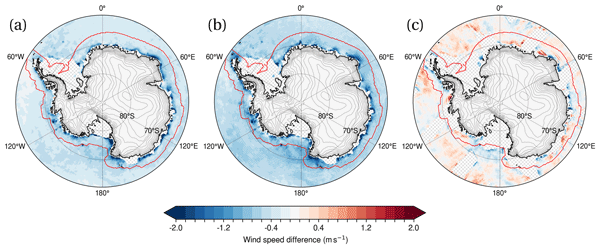
Thomas Caton Harrison, Stavroula Biri, Thomas J. Bracegirdle, John C. King, Elizabeth C. Kent, Étienne Vignon, and John Turner
Weather Clim. Dynam., 3, 1415–1437, https://doi.org/10.5194/wcd-3-1415-2022, https://doi.org/10.5194/wcd-3-1415-2022, 2022
Short summary
Short summary
Easterly winds encircle Antarctica, impacting sea ice and helping drive ocean currents which shield ice shelves from warmer waters. Reanalysis datasets give us our most complete picture of how these winds behave. In this paper we use satellite data, surface measurements and weather balloons to test how realistic recent reanalysis estimates are. The winds are generally accurate, especially in the most recent of the datasets, but important short-term variations are often misrepresented.

Étienne Vignon, Lea Raillard, Christophe Genthon, Massimo Del Guasta, Andrew J. Heymsfield, Jean-Baptiste Madeleine, and Alexis Berne
Atmos. Chem. Phys., 22, 12857–12872, https://doi.org/10.5194/acp-22-12857-2022, https://doi.org/10.5194/acp-22-12857-2022, 2022
Short summary
Short summary
The near-surface atmosphere over the Antarctic Plateau is cold and pristine and resembles to a certain extent the high troposphere where cirrus clouds form. In this study, we use innovative humidity measurements at Concordia Station to study the formation of ice fogs at temperatures <−40°C. We provide observational evidence that ice fogs can form through the homogeneous freezing of solution aerosols, a common nucleation pathway for cirrus clouds.
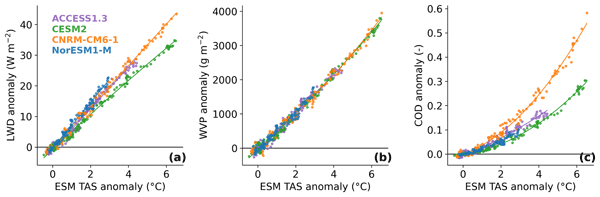
Christoph Kittel, Charles Amory, Stefan Hofer, Cécile Agosta, Nicolas C. Jourdain, Ella Gilbert, Louis Le Toumelin, Étienne Vignon, Hubert Gallée, and Xavier Fettweis
The Cryosphere, 16, 2655–2669, https://doi.org/10.5194/tc-16-2655-2022, https://doi.org/10.5194/tc-16-2655-2022, 2022
Short summary
Short summary
Model projections suggest large differences in future Antarctic surface melting even for similar greenhouse gas scenarios and warming rates. We show that clouds containing a larger amount of liquid water lead to stronger melt. As surface melt can trigger the collapse of the ice shelves (the safety band of the Antarctic Ice Sheet), clouds could be a major source of uncertainties in projections of sea level rise.
Patrick Le Moigne, Eric Bazile, Anning Cheng, Emanuel Dutra, John M. Edwards, William Maurel, Irina Sandu, Olivier Traullé, Etienne Vignon, Ayrton Zadra, and Weizhong Zheng
The Cryosphere, 16, 2183–2202, https://doi.org/10.5194/tc-16-2183-2022, https://doi.org/10.5194/tc-16-2183-2022, 2022
Short summary
Short summary
This paper describes an intercomparison of snow models, of varying complexity, used for numerical weather prediction or academic research. The results show that the simplest models are, under certain conditions, able to reproduce the surface temperature just as well as the most complex models. Moreover, the diversity of surface parameters of the models has a strong impact on the temporal variability of the components of the simulated surface energy balance.
Christophe Genthon, Dana E. Veron, Etienne Vignon, Jean-Baptiste Madeleine, and Luc Piard
Earth Syst. Sci. Data, 14, 1571–1580, https://doi.org/10.5194/essd-14-1571-2022, https://doi.org/10.5194/essd-14-1571-2022, 2022
Short summary
Short summary
The surface atmosphere of the high Antarctic Plateau is very cold and clean. Such conditions favor water vapor supersaturation. A 3-year quasi-continuous series of atmospheric moisture in a ~40 m atmospheric layer at Dome C is reported that documents time variability, vertical profiles and occurrences of supersaturation. Supersaturation with respect to ice is frequently observed throughout the column, with relative humidities occasionally reaching values near liquid water saturation.
Paraskevi Georgakaki, Georgia Sotiropoulou, Étienne Vignon, Anne-Claire Billault-Roux, Alexis Berne, and Athanasios Nenes
Atmos. Chem. Phys., 22, 1965–1988, https://doi.org/10.5194/acp-22-1965-2022, https://doi.org/10.5194/acp-22-1965-2022, 2022
Short summary
Short summary
The modelling study focuses on the importance of ice multiplication processes in orographic mixed-phase clouds, which is one of the least understood cloud types in the climate system. We show that the consideration of ice seeding and secondary ice production through ice–ice collisional breakup is essential for correct predictions of precipitation in mountainous terrain, with important implications for radiation processes.
Christophe Genthon, Dana Veron, Etienne Vignon, Delphine Six, Jean-Louis Dufresne, Jean-Baptiste Madeleine, Emmanuelle Sultan, and François Forget
Earth Syst. Sci. Data, 13, 5731–5746, https://doi.org/10.5194/essd-13-5731-2021, https://doi.org/10.5194/essd-13-5731-2021, 2021
Short summary
Short summary
A 10-year dataset of observation in the atmospheric boundary layer at Dome C on the high Antarctic plateau is presented. This is obtained with sensors at six levels along a tower higher than 40 m. The temperature inversion can reach more than 25 °C along the tower in winter, while full mixing by convection can occur in summer. Different amplitudes of variability for wind and temperature at the different levels reflect different signatures of solar vs. synoptic forcing of the boundary layer.
Lea Raillard, Audran Borella, Gwendal Rivière, Niels Dutrievoz, Meryl Wimmer, Ionela Musat, and Étienne Vignon
EGUsphere, https://doi.org/10.5194/egusphere-2026-5432, https://doi.org/10.5194/egusphere-2026-5432, 2026
This preprint is open for discussion and under review for Atmospheric Chemistry and Physics (ACP).
Short summary
Short summary
Climate models struggle to predict snowfall near the poles, which matters for tracking ice sheet changes. We built a new, efficient snowfall scheme for a global climate model and tested it using aircraft and ground radar data from Arctic Svalbard and Antarctica. The improved model better captures how snow forms and falls through clouds, bringing us closer to reliable predictions of polar snowfall, and showing where further refinements are needed.
Pierre Grzegorczyk, Lea Raillard, Valentin Wiener, Étienne Vignon, Christophe Genthon, and Alexis Berne
EGUsphere, https://doi.org/10.5194/egusphere-2026-4473, https://doi.org/10.5194/egusphere-2026-4473, 2026
This preprint is open for discussion and under review for Geoscientific Model Development (GMD).
Short summary
Short summary
Evaluating cloud representation in Atmospheric General Circulation Models (AGCMs) is important for surface precipitation and the Earth radiative balance. The LORIS (LMDZ Offline Radar Instrument Simulator) is a new tool designed to evaluate clouds in LMDZ (the atmospheric component of the IPSL Coupled Model). LORIS offers flexible options for subgrid representation, scattering assumptions, and microphysics properties, enabling the evaluation and improvement of cloud and precipitation in LMDZ.
Timothy W. Juliano, Florian Tornow, Ann M. Fridlind, Andrew S. Ackerman, Gregory S. Elsaesser, Bart Geerts, Christian P. Lackner, David Painemal, Israel Silber, Mikhail Ovchinnikov, Gunilla Svensson, Michael Tjernström, Peng Wu, Alejandro Baró Pérez, Peter Bogenschutz, Dmitry Chechin, Kamal Kant Chandrakar, Jan Chylik, Andrey Debolskiy, Rostislav Fadeev, Anu Gupta, Luisa Ickes, Michail Karalis, Martin Köhler, Branko Kosović, Peter Kuma, Weiwei Li, Evgeny Mortikov, Hugh Morrison, Roel A. J. Neggers, Anna Possner, Tomi Raatikainen, Lea Raillard, Sami Romakkaniemi, Niklas Schnierstein, Shin-ichiro Shima, Nikita Silin, Mikhail Tolstykh, Étienne Vignon, Lulin Xue, Meng Zhang, and Xue Zheng
Atmos. Chem. Phys., 26, 13267–13302, https://doi.org/10.5194/acp-26-13267-2026, https://doi.org/10.5194/acp-26-13267-2026, 2026
Short summary
Short summary
Models struggle to capture cloud and precipitation processes and their radiative effects in marine cold-air outbreaks. We use a quasi-Lagrangian framework to compare large-eddy simulation (LES) and single-column model (SCM) output with field and satellite observations. With fixed droplet and ice numbers, LES and SCM agree in liquid-only tests. In mixed-phase conditions, LES plausibly capture cloud thinning and breakup, while SCMs largely remain overcast and thereby miss cloud radiative effects.
Nicolas Chiabrando, Gwendal Rivière, Étienne Vignon, and Julien Delanoë
EGUsphere, https://doi.org/10.5194/egusphere-2026-3987, https://doi.org/10.5194/egusphere-2026-3987, 2026
Short summary
Short summary
Arctic cyclones are large-scale depressions evolving within the Arctic circle. We study a summertime Arctic cyclone that moved near Svalbard in 2022 and was well observed during the THINICE field campaign to understand what controls the intensity of a near-surface wind jet associated with the cyclone. We find that clouds and near-surface frictional effects globally strengthened the wind while the cyclone was growing, but became much less important after it evolved toward a cold-core structure.
Aymeric Dziduch, Antoine Baudoux, Guillaume Mioche, Antoine Canzi, Benjamin Doiteau, Manuel Moser, Emma Järvinen, Étienne Vignon, Jean-Christophe Raut, Régis Dupuy, Christophe Gourbeyre, Jean-Luc Baray, Marie Monier, Frédéric Szczap, Guillaume Penide, Julien Delanoë, Odran Sourdeval, Alfons Schwarzenboeck, Stephan Mertes, Franz Martin Schnaiter, Christiane Voigt, Mario Mech, Susanne Crewell, Andreas Herber, Christof Lüpkes, André Ehrlich, Manfred Wendisch, and Olivier Jourdan
EGUsphere, https://doi.org/10.5194/egusphere-2026-3265, https://doi.org/10.5194/egusphere-2026-3265, 2026
This preprint is open for discussion and under review for Atmospheric Chemistry and Physics (ACP).
Short summary
Short summary
This study examines the microphysical properties and ice crystal habits of low-level Arctic mixed-phase clouds around Svalbard. Using airborne in situ observations from four campaigns, we show that cloud microphysical structure and ice crystal habits are influenced by weather conditions and surface type. These results provide quantitative observations to better understand low-level Arctic clouds, their ice formation processes, and their influence on the Arctic atmosphere and climate system.
Myriam Besson, Gwendal Rivière, and Sébastien Fromang
Weather Clim. Dynam., 7, 805–823, https://doi.org/10.5194/wcd-7-805-2026, https://doi.org/10.5194/wcd-7-805-2026, 2026
Short summary
Short summary
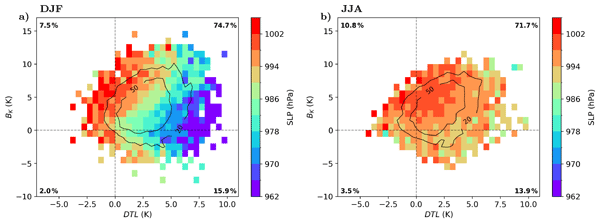
Extratropical cyclones are key weather features that often lead to strong wind and precipitations. We focus on those formed in the northern midlatitudes through the prism of their core temperature, thermal asymmetry and baroclinic growth rate. With these variables is built a new cyclone phase space that allows a distinction between warm-core cyclones, that fit with the classical baroclinic wave models and are the most common in the midlatitudes, and cold-core cyclones, that are more intriguing.
Niels Dutrievoz, Cécile Agosta, Cécile Davrinche, Amaëlle Landais, Sebastien Nguyen, Étienne Vignon, Inès Ollivier, Christophe Leroy-Dos Santos, Elise Fourré, Mathieu Casado, Jonathan Wille, Vincent Favier, Bénédicte Minster, and Frédéric Prié
The Cryosphere, 20, 1025–1046, https://doi.org/10.5194/tc-20-1025-2026, https://doi.org/10.5194/tc-20-1025-2026, 2026
Short summary
Short summary
In December 2018, an atmospheric river event from the Atlantic reached Dome C, East Antarctica, causing a +18 °C warming, tripled water vapour, and a strong isotopic anomaly in water vapour (+ 17 ‰ for δ18O) at the surface. During the peak of the event, we found 70 % of the water vapour came from local snow sublimation, and 30 % from the atmospheric river itself, highlighting both long-range moisture advection and interactions between the boundary layer and the snowpack.
Étienne Vignon, Nicolas Chiabrando, Cécile Agosta, Charles Amory, Valentin Wiener, Justine Charrel, Thomas Dubos, and Christophe Genthon
Geosci. Model Dev., 19, 239–259, https://doi.org/10.5194/gmd-19-239-2026, https://doi.org/10.5194/gmd-19-239-2026, 2026
Short summary
Short summary
The erosion of surface snow by the wind is an important process for the Antarctic surface mass balance. This study presents the first development of a parameterisation of blowing snow for a global climate model. Simulations avec evaluated using measurements in Antarctica. Results show an overall decrease of the snow accumulation in the escarpment region of the ice sheet due to snow erosion and an increase at the coast due to blowing snow deposition and increase in precipitation.
Valentin Wiener, Étienne Vignon, Thomas Caton Harrison, Christophe Genthon, Felipe Toledo, Guylaine Canut-Rocafort, Yann Meurdesoif, and Alexis Berne
Weather Clim. Dynam., 6, 1605–1627, https://doi.org/10.5194/wcd-6-1605-2025, https://doi.org/10.5194/wcd-6-1605-2025, 2025
Short summary
Short summary
Katabatic winds are a key feature of the climate of Antarctica, but substantial biases remain in their representation in atmospheric models. This study investigates a katabatic wind event in an atmospheric circulation model using in-situ observations. The framework allows to disentangle which part of the bias is due to horizontal resolution, to parameter calibration and to structural deficiencies in the model. We underline in particular the need to refine the physics of the model snow cover.

Audran Borella, Olivier Boucher, Keith P. Shine, Marc Stettler, Katsumasa Tanaka, Roger Teoh, and Nicolas Bellouin
Atmos. Chem. Phys., 24, 9401–9417, https://doi.org/10.5194/acp-24-9401-2024, https://doi.org/10.5194/acp-24-9401-2024, 2024
Short summary
Short summary
This work studies how to compare the climate impact of the CO2 emitted and contrails formed by a flight. This is applied to contrail avoidance strategies that would decrease climate impact of flights by changing the trajectory of aircraft to avoid persistent contrail formation, at the risk of increasing CO2 emissions. We find that different comparison methods lead to different quantification of the total climate impact of a flight but lead to similar decisions of whether to reroute an aircraft.
Sidiki Sanogo, Olivier Boucher, Nicolas Bellouin, Audran Borella, Kevin Wolf, and Susanne Rohs
Atmos. Chem. Phys., 24, 5495–5511, https://doi.org/10.5194/acp-24-5495-2024, https://doi.org/10.5194/acp-24-5495-2024, 2024
Short summary
Short summary
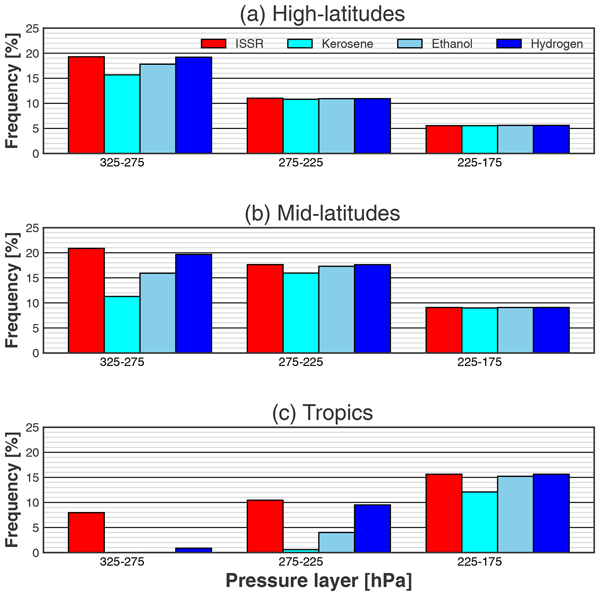
Relative humidity relative to ice (RHi) is a key variable in the formation of cirrus clouds and contrails. This study shows that the properties of the probability density function of RHi differ between the tropics and higher latitudes. In line with RHi and temperature variability, aircraft are likely to produce more contrails with bioethanol and liquid hydrogen as fuel. The impact of this fuel change decreases with decreasing pressure levels but increases from high latitudes to the tropics.
Valentin Wiener, Marie-Laure Roussel, Christophe Genthon, Étienne Vignon, Jacopo Grazioli, and Alexis Berne
Earth Syst. Sci. Data, 16, 821–836, https://doi.org/10.5194/essd-16-821-2024, https://doi.org/10.5194/essd-16-821-2024, 2024
Short summary
Short summary
This paper presents 7 years of data from a precipitation radar deployed at the Dumont d'Urville station in East Antarctica. The main characteristics of the dataset are outlined in a short statistical study. Interannual and seasonal variability are also investigated. Then, we extensively describe the processing method to retrieve snowfall profiles from the radar data. Lastly, a brief comparison is made with two climate models as an application example of the dataset.
Alfonso Ferrone, Étienne Vignon, Andrea Zonato, and Alexis Berne
The Cryosphere, 17, 4937–4956, https://doi.org/10.5194/tc-17-4937-2023, https://doi.org/10.5194/tc-17-4937-2023, 2023
Short summary
Short summary
In austral summer 2019/2020, three K-band Doppler profilers were deployed across the Sør Rondane Mountains, south of the Belgian base Princess Elisabeth Antarctica. Their measurements, along with atmospheric simulations and reanalyses, have been used to study the spatial variability in precipitation over the region, as well as investigate the interaction between the complex terrain and the typical flow associated with precipitating systems.
Thomas Caton Harrison, Stavroula Biri, Thomas J. Bracegirdle, John C. King, Elizabeth C. Kent, Étienne Vignon, and John Turner
Weather Clim. Dynam., 3, 1415–1437, https://doi.org/10.5194/wcd-3-1415-2022, https://doi.org/10.5194/wcd-3-1415-2022, 2022
Short summary
Short summary
Easterly winds encircle Antarctica, impacting sea ice and helping drive ocean currents which shield ice shelves from warmer waters. Reanalysis datasets give us our most complete picture of how these winds behave. In this paper we use satellite data, surface measurements and weather balloons to test how realistic recent reanalysis estimates are. The winds are generally accurate, especially in the most recent of the datasets, but important short-term variations are often misrepresented.
Étienne Vignon, Lea Raillard, Christophe Genthon, Massimo Del Guasta, Andrew J. Heymsfield, Jean-Baptiste Madeleine, and Alexis Berne
Atmos. Chem. Phys., 22, 12857–12872, https://doi.org/10.5194/acp-22-12857-2022, https://doi.org/10.5194/acp-22-12857-2022, 2022
Short summary
Short summary
The near-surface atmosphere over the Antarctic Plateau is cold and pristine and resembles to a certain extent the high troposphere where cirrus clouds form. In this study, we use innovative humidity measurements at Concordia Station to study the formation of ice fogs at temperatures <−40°C. We provide observational evidence that ice fogs can form through the homogeneous freezing of solution aerosols, a common nucleation pathway for cirrus clouds.
Christoph Kittel, Charles Amory, Stefan Hofer, Cécile Agosta, Nicolas C. Jourdain, Ella Gilbert, Louis Le Toumelin, Étienne Vignon, Hubert Gallée, and Xavier Fettweis
The Cryosphere, 16, 2655–2669, https://doi.org/10.5194/tc-16-2655-2022, https://doi.org/10.5194/tc-16-2655-2022, 2022
Short summary
Short summary
Model projections suggest large differences in future Antarctic surface melting even for similar greenhouse gas scenarios and warming rates. We show that clouds containing a larger amount of liquid water lead to stronger melt. As surface melt can trigger the collapse of the ice shelves (the safety band of the Antarctic Ice Sheet), clouds could be a major source of uncertainties in projections of sea level rise.
Patrick Le Moigne, Eric Bazile, Anning Cheng, Emanuel Dutra, John M. Edwards, William Maurel, Irina Sandu, Olivier Traullé, Etienne Vignon, Ayrton Zadra, and Weizhong Zheng
The Cryosphere, 16, 2183–2202, https://doi.org/10.5194/tc-16-2183-2022, https://doi.org/10.5194/tc-16-2183-2022, 2022
Short summary
Short summary
This paper describes an intercomparison of snow models, of varying complexity, used for numerical weather prediction or academic research. The results show that the simplest models are, under certain conditions, able to reproduce the surface temperature just as well as the most complex models. Moreover, the diversity of surface parameters of the models has a strong impact on the temporal variability of the components of the simulated surface energy balance.
Christophe Genthon, Dana E. Veron, Etienne Vignon, Jean-Baptiste Madeleine, and Luc Piard
Earth Syst. Sci. Data, 14, 1571–1580, https://doi.org/10.5194/essd-14-1571-2022, https://doi.org/10.5194/essd-14-1571-2022, 2022
Short summary
Short summary
The surface atmosphere of the high Antarctic Plateau is very cold and clean. Such conditions favor water vapor supersaturation. A 3-year quasi-continuous series of atmospheric moisture in a ~40 m atmospheric layer at Dome C is reported that documents time variability, vertical profiles and occurrences of supersaturation. Supersaturation with respect to ice is frequently observed throughout the column, with relative humidities occasionally reaching values near liquid water saturation.
Marie Sicard, Masa Kageyama, Sylvie Charbit, Pascale Braconnot, and Jean-Baptiste Madeleine
Clim. Past, 18, 607–629, https://doi.org/10.5194/cp-18-607-2022, https://doi.org/10.5194/cp-18-607-2022, 2022
Short summary
Short summary
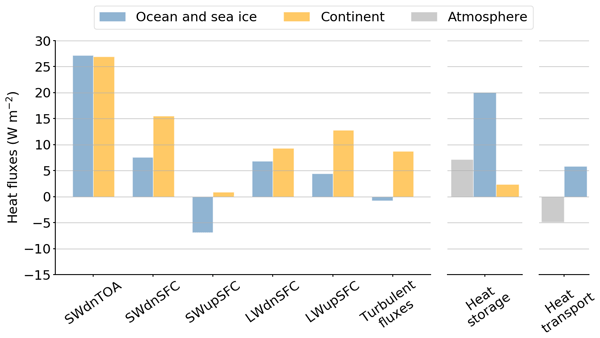
The Last Interglacial (129–116 ka) is characterised by an increased summer insolation over the Arctic region, which leads to a strong temperature rise. The aim of this study is to identify and quantify the main processes and feedback causing this Arctic warming. Using the IPSL-CM6A-LR model, we investigate changes in the energy budget relative to the pre-industrial period. We highlight the crucial role of Arctic sea ice cover, ocean and clouds on the Last Interglacial Arctic warming.
Paraskevi Georgakaki, Georgia Sotiropoulou, Étienne Vignon, Anne-Claire Billault-Roux, Alexis Berne, and Athanasios Nenes
Atmos. Chem. Phys., 22, 1965–1988, https://doi.org/10.5194/acp-22-1965-2022, https://doi.org/10.5194/acp-22-1965-2022, 2022
Short summary
Short summary
The modelling study focuses on the importance of ice multiplication processes in orographic mixed-phase clouds, which is one of the least understood cloud types in the climate system. We show that the consideration of ice seeding and secondary ice production through ice–ice collisional breakup is essential for correct predictions of precipitation in mountainous terrain, with important implications for radiation processes.
Christophe Genthon, Dana Veron, Etienne Vignon, Delphine Six, Jean-Louis Dufresne, Jean-Baptiste Madeleine, Emmanuelle Sultan, and François Forget
Earth Syst. Sci. Data, 13, 5731–5746, https://doi.org/10.5194/essd-13-5731-2021, https://doi.org/10.5194/essd-13-5731-2021, 2021
Short summary
Short summary
A 10-year dataset of observation in the atmospheric boundary layer at Dome C on the high Antarctic plateau is presented. This is obtained with sensors at six levels along a tower higher than 40 m. The temperature inversion can reach more than 25 °C along the tower in winter, while full mixing by convection can occur in summer. Different amplitudes of variability for wind and temperature at the different levels reflect different signatures of solar vs. synoptic forcing of the boundary layer.
Cited articles
Arteaga, D., Planche, C., Tridon, F., Dupuy, R., Baudoux, A., Banson, S., Baray, J.-L., Mioche, G., Ehrlich, A., Mech, M., Mertes, S., Wendisch, M., Wobrock, W., and Jourdan, O.: Arctic mixed-phase clouds simulated by the WRF model: Comparisons with ACLOUD radar and in situ airborne observations and sensitivity of microphysics properties, Atmospheric Research, 307, 107471, https://doi.org/10.1016/j.atmosres.2024.107471, 2024. a
Barrett, A. I., Hogan, R. J., and Forbes, R. M.: Why are mixed-phase altocumulus clouds poorly predicted by large-scale models? Part 1. Physical processes, Journal of Geophysical Research: Atmospheres, 122, 9903–9926, https://doi.org/10.1002/2016JD026321, 2017a. a
Barrett, A. I., Hogan, R. J., and Forbes, R. M.: Why are mixed-phase altocumulus clouds poorly predicted by large-scale models? Part 2. Vertical resolution sensitivity and parameterization, Journal of Geophysical Research: Atmospheres, 122, 9922–9944, https://doi.org/10.1002/2016JD026322, 2017b. a
Barrett, P. A., Blyth, A., Brown, P. R. A., and Abel, S. J.: The structure of turbulence and mixed-phase cloud microphysics in a highly supercooled altocumulus cloud, Atmos. Chem. Phys., 20, 1921–1939, https://doi.org/10.5194/acp-20-1921-2020, 2020. a
Bodas-Salcedo, A., Williams, K. D., Ringer, M. A., Beau, I., Cole, J. N. S., Dufresne, J.-L., Koshiro, T., Stevens, B., Wang, Z., and Yokohata, T.: Origins of the Solar Radiation Biases over the Southern Ocean in CFMIP2 Models, Journal of Climate, 27, 41–56, https://doi.org/10.1175/JCLI-D-13-00169.1, 2014. a
Bodas-Salcedo, A., Andrews, T., Karmalkar, A. V., and Ringer, M. A.: Cloud liquid water path and radiative feedbacks over the Southern Ocean, Geophysical Research Letters, 43, 10938–10946, https://doi.org/10.1002/2016GL070770, 2016. a
Bony, S. and Emanuel, K. A.: A Parameterization of the Cloudiness Associated with Cumulus Convection; Evaluation Using TOGA COARE Data, Journal of the Atmospheric Sciences, 58, 3158–3183, https://doi.org/10.1175/1520-0469(2001)058<3158:APOTCA>2.0.CO;2, 2001. a
Borella, A., Vignon, É., Boucher, O., Meurdesoif, Y., and Fairhead, L.: A New Prognostic Parameterization of Subgrid Ice Supersaturation and Cirrus Clouds in the ICOLMDZ AGCM, Journal of Advances in Modeling Earth Systems, 17, e2024MS004918, https://doi.org/10.1029/2024MS004918, 2025. a
Boucher, O., Servonnat, J., Albright, A. L., Aumont, O., Balkanski, Y., Bastrikov, V., Bekki, S., Bonnet, R., Bony, S., Bopp, L., Braconnot, P., Brockmann, P., Cadule, P., Caubel, A., Cheruy, F., Codron, F., Cozic, A., Cugnet, D., D'Andrea, F., Davini, P., de Lavergne, C., Denvil, S., Deshayes, J., Devilliers, M., Ducharne, A., Dufresne, J.-L., Dupont, E., Éthé, C., Fairhead, L., Falletti, L., Flavoni, S., Foujols, M.-A., Gardoll, S., Gastineau, G., Ghattas, J., Grandpeix, J.-Y., Guenet, B., Guez, Lionel, E., Guilyardi, E., Guimberteau, M., Hauglustaine, D., Hourdin, F., Idelkadi, A., Joussaume, S., Kageyama, M., Khodri, M., Krinner, G., Lebas, N., Levavasseur, G., Lévy, C., Li, L., Lott, F., Lurton, T., Luyssaert, S., Madec, G., Madeleine, J.-B., Maignan, F., Marchand, M., Marti, O., Mellul, L., Meurdesoif, Y., Mignot, J., Musat, I., Ottlé, C., Peylin, P., Planton, Y., Polcher, J., Rio, C., Rochetin, N., Rousset, C., Sepulchre, P., Sima, A., Swingedouw, D., Thiéblemont, R., Traore, A. K., Vancoppenolle, M., Vial, J., Vialard, J., Viovy, N., and Vuichard, N.: Presentation and Evaluation of the IPSL-CM6A-LR Climate Model, Journal of Advances in Modeling Earth Systems, 12, e2019MS002010, https://doi.org/10.1029/2019MS002010, 2020. a
Cesana, G. V., Khadir, T., Chepfer, H., and Chiriaco, M.: Southern Ocean Solar Reflection Biases in CMIP6 Models Linked to Cloud Phase and Vertical Structure Representations, Geophysical Research Letters, 49, e2022GL099777, https://doi.org/10.1029/2022GL099777, 2022. a
Cesana, G. V., Ackerman, A. S., Fridlind, A. M., Silber, I., Del Genio, A. D., Zelinka, M. D., Chepfer, H., Khadir, T., and Roehrig, R.: Observational constraint on a feedback from supercooled clouds reduces projected warming uncertainty, Communications Earth & Environment, 5, 181, https://doi.org/10.1038/s43247-024-01339-1, 2024. a
Chellini, G. and Kneifel, S.: Turbulence as a Key Driver of Ice Aggregation and Riming in Arctic Low-Level Mixed-Phase Clouds, Revealed by Long-Term Cloud Radar Observations, Geophysical Research Letters, 51, e2023GL106599, https://doi.org/10.1029/2023GL106599, 2024. a
Cheruy, F., Ducharne, A., Hourdin, F., Musat, I., Vignon, E., Gastineau, G., Bastrikov, V., Vuichard, N., Diallo, B., Dufresne, J.-L., Ghattas, J., Grandpeix, J.-Y., Idelkadi, A., Mellul, L., Maignan, F., Ménégoz, M., Ottlé, C., Peylin, P., Servonnat, J., Wang, F., and Zhao, Y.: Improved Near-Surface Continental Climate in IPSL-CM6A-LR by Combined Evolutions of Atmospheric and Land Surface Physics, Journal of Advances in Modeling Earth Systems, 12, e2019MS002005, https://doi.org/10.1029/2019MS002005, 2020. a
Creamean, J. M., Barry, K., Hill, T. C., Hume, C., DeMott, P. J., Shupe, M. D., Dahlke, S., Willmes, S., Schmale, J., Beck, I., Hoppe, C. J. M., Fong, A., Chamberlain, E., Bowman, J., Scharien, R., and Persson, O.: Annual cycle observations of aerosols capable of ice formation in central Arctic clouds, Nature Communications, 13, 3537, https://doi.org/10.1038/s41467-022-31182-x, 2022. a
Cronin, T. W. and Tziperman, E.: Low clouds suppress Arctic air formation and amplify high-latitude continental winter warming, Proceedings of the National Academy of Sciences, 112, 11490–11495, https://doi.org/10.1073/pnas.1510937112, 2015. a
DeMott, P. J., Prenni, A. J., Liu, X., Kreidenweis, S. M., Petters, M. D., Twohy, C. H., Richardson, M., Eidhammer, T., and Rogers, D.: Predicting global atmospheric ice nuclei distributions and their impacts on climate, Proceedings of the National Academy of Sciences, 107, 11217–11222, 2010. a
Dietlicher, R., Neubauer, D., and Lohmann, U.: Prognostic parameterization of cloud ice with a single category in the aerosol-climate model ECHAM(v6.3.0)-HAM(v2.3), Geosci. Model Dev., 11, 1557–1576, https://doi.org/10.5194/gmd-11-1557-2018, 2018. a
Eirund, G. K., Possner, A., and Lohmann, U.: Response of Arctic mixed-phase clouds to aerosol perturbations under different surface forcings, Atmos. Chem. Phys., 19, 9847–9864, https://doi.org/10.5194/acp-19-9847-2019, 2019. a
Engström, A., Karlsson, J., and Svensson, G.: The Importance of Representing Mixed-Phase Clouds for Simulating Distinctive Atmospheric States in the Arctic, Journal of Climate, 27, 265–272, https://doi.org/10.1175/JCLI-D-13-00271.1, 2014. a
Field, P. R., Hill, A. A., Furtado, K., and Korolev, A.: Mixed-phase clouds in a turbulent environment. Part 2: Analytic treatment, Quarterly Journal of the Royal Meteorological Society, 140, 870–880, https://doi.org/10.1002/qj.2175, 2014. a, b, c
Fridlind, A. M. and Ackerman, A. S.: Simulations of Arctic mixed-phase boundary layer clouds: Advances in understanding and outstanding questions, Mixed-Phase Clouds, Elsevier Inc., 153–183, https://doi.org/10.1016/B978-0-12-810549-8.00007-6, 2018. a, b
Furtado, K.: Chapter 8 – Subgrid Representation of Mixed-Phase Clouds in a General Circulation Model, in: Mixed-Phase Clouds, edited by: Andronache, C., Elsevier, ISBN 978-0-12-810549-8, 185–214, https://doi.org/10.1016/B978-0-12-810549-8.00008-8, 2018. a, b
Furtado, K., Field, P. R., Boutle, I. A., Morcrette, C. R., and Wilkinson, H.: A physically based subgrid parametrization for the production and maintenance of mixed-phase clouds in a general circulation model, J. Atmos. Sci., 73, 279–291, https://doi.org/10.1175/JAS-D-15-0021.1, 2016. a, b, c, d
Gettelman, A. and Morrison, H.: Advanced Two-Moment Bulk Microphysics for Global Models. Part I: Off-Line Tests and Comparison with Other Schemes, Journal of Climate, 28, 1268–1287, https://doi.org/10.1175/JCLI-D-14-00102.1, 2015. a
Gettelman, A., Hannay, C., Bacmeister, J. T., Neale, R. B., Pendergrass, A. G., Danabasoglu, G., Lamarque, J.-F., Fasullo, J. T., Bailey, D. A., Lawrence, D. M., and Mills, M. J.: High Climate Sensitivity in the Community Earth System Model Version 2 (CESM2), Geophysical Research Letters, 46, 8329–8337, https://doi.org/10.1029/2019GL083978, 2019. a
Gierens, R., Kneifel, S., Shupe, M. D., Ebell, K., Maturilli, M., and Löhnert, U.: Low-level mixed-phase clouds in a complex Arctic environment, Atmos. Chem. Phys., 20, 3459–3481, https://doi.org/10.5194/acp-20-3459-2020, 2020. a
Griesche, H. J., Ohneiser, K., Seifert, P., Radenz, M., Engelmann, R., and Ansmann, A.: Contrasting ice formation in Arctic clouds: surface-coupled vs. surface-decoupled clouds, Atmos. Chem. Phys., 21, 10357–10374, https://doi.org/10.5194/acp-21-10357-2021, 2021. a
Hofer, S., Tedstone, A. J., Fettweis, X., and Bamber, J. L.: Cloud microphysics and circulation anomalies control differences in future Greenland melt, Nature Climate Change, 9, 523–528, 2019. a
Hourdin, F., Jam, A., Rio, C., Couvreux, F., Sandu, I., Lefebvre, M.-P., Brient, F., and Idelkadi, A.: Unified Parameterization of Convective Boundary Layer Transport and Clouds With the Thermal Plume Model, Journal of Advances in Modeling Earth Systems, 11, 2910–2933, https://doi.org/10.1029/2019MS001666, 2019. a, b, c, d
Hourdin, F., Rio, C., Grandpeix, J.-Y., Madeleine, J.-B., Cheruy, F., Rochetin, N., Jam, A., Musat, I., Idelkadi, A., Fairhead, L., Foujols, M.-A., Mellul, L., Traore, A.-K., Dufresne, J.-L., Boucher, O., Lefebvre, M.-P., Millour, E., Vignon, E., Jouhaud, J., Diallo, F. B., Lott, F., Gastineau, G., Caubel, A., Meurdesoif, Y., and Ghattas, J.: LMDZ6A: the atmospheric component of the IPSL climate model with improved and better tuned physics, Journal of Advances in Modeling Earth Systems, https://doi.org/10.1029/2019MS001892, 2020. a, b
Hourdin, F., Williamson, D., Rio, C., Couvreux, F., Roehrig, R., Villefranque, N., Musat, I., Fairhead, L., Diallo, F. B., and Volodina, V.: Process-Based Climate Model Development Harnessing Machine Learning: II. Model Calibration From Single Column to Global, Journal of Advances in Modeling Earth Systems, 13, e2020MS002225, https://doi.org/10.1029/2020MS002225, 2021. a, b, c, d
Hyder, P., Edwards, J. M., Allan, R. P., Hewitt, H. T., Bracegirdle, T. J., Gregory, J. M., Wood, R. A., Meijers, A. J., Mulcahy, J., Field, P., Furtado, K., Bodas-Salcedo, A., Williams, K. D., Copsey, D., Josey, S. A., Liu, C., Roberts, C. D., Sanchez, C., Ridley, J., Thorpe, L., Hardiman, S. C., Mayer, M., Berry, D. I., and Belcher, S. E.: Critical Southern Ocean climate model biases traced to atmospheric model cloud errors, Nature Communications, 9, https://doi.org/10.1038/s41467-018-05634-2, 2018. a
Jam, A., Hourdin, F., Rio, C., and Couvreux, F.: Resolved Versus Parametrized Boundary-Layer Plumes. Part III: Derivation of a Statistical Scheme for Cumulus Clouds, Boundary-Layer Meteorol 147, 421–441, https://doi.org/10.1007/s10546-012-9789-3, 2013. a, b
Kay, J. E., L'Ecuyer, T., Chepfer, H., Loeb, N., Morrison, A., and Cesana, G.: Recent advances in Arctic cloud and climate research, Current Climate Change Reports, 2, 159–169, https://doi.org/10.1007/s40641-016-0051-9, 2016a. a
Kay, J. E., Wall, C., Yettella, V., Medeiros, B., Hannay, C., Caldwell, P., and Bitz, C.: Global Climate Impacts of Fixing the Southern Ocean Shortwave Radiation Bias in the Community Earth System Model (CESM), Journal of Climate, 29, 4617–4636, https://doi.org/10.1175/JCLI-D-15-0358.1, 2016b. a
Kittel, C., Amory, C., Hofer, S., Agosta, C., Jourdain, N. C., Gilbert, E., Le Toumelin, L., Vignon, É., Gallée, H., and Fettweis, X.: Clouds drive differences in future surface melt over the Antarctic ice shelves, The Cryosphere, 16, 2655–2669, https://doi.org/10.5194/tc-16-2655-2022, 2022. a
Klein, S. A., McCoy, R. B., Morrison, H., Ackerman, A. S., Avramov, A., Boer, G. D., Chen, M., Cole, J. N. S., Del Genio, A. D., Falk, M., Foster, M. J., Fridlind, A., Golaz, J.-C., Hashino, T., Harrington, J. Y., Hoose, C., Khairoutdinov, M. F., Larson, V. E., Liu, X., Luo, Y., McFarquhar, G. M., Menon, S., Neggers, R. A. J., Park, S., Poellot, M. R., Schmidt, J. M., Sednev, I., Shipway, B. J., Shupe, M. D., Spangenberg, D. A., Sud, Y. C., Turner, D. D., Veron, D. E., Salzen, K. v., Walker, G. K., Wang, Z., Wolf, A. B., Xie, S., Xu, K.-M., Yang, F., and Zhang, G.: Intercomparison of model simulations of mixed-phase clouds observed during the ARM Mixed-Phase Arctic Cloud Experiment. I: single-layer cloud, Quarterly Journal of the Royal Meteorological Society, 135, 979–1002, https://doi.org/10.1002/qj.416, 2009. a, b, c, d, e, f
Knopf, D. A., Silber, I., Riemer, N., Fridlind, A. M., and Ackerman, A. S.: A 1D Model for Nucleation of Ice From Aerosol Particles: An Application to a Mixed-Phase Arctic Stratus Cloud Layer, Journal of Advances in Modeling Earth Systems, 15, e2023MS003663, https://doi.org/10.1029/2023MS003663, 2023. a
Korolev, A. and Milbrandt, J.: How Are Mixed-Phase Clouds Mixed?, Geophysical Research Letters, 49, e2022GL099578, https://doi.org/10.1029/2022GL099578, 2022. a
Korolev, A., McFarquhar, G., Field, P. R., Franklin, C., Lawson, P., Wang, Z., Williams, E., Abel, S. J., Axisa, D., Borrmann, S., Crosier, J., Fugal, J., Krämer, M., Lohmann, U., Schlenczek, O., Schnaiter, M., and Wendisch, M.: Mixed-Phase Clouds: Progress and Challenges, Meteorological Monographs, 58, 5.1–5.50, https://doi.org/10.1175/AMSMONOGRAPHS-D-17-0001.1, 2017. a, b
Korolev, A. V. and Mazin, I. P.: Supersaturation of Water Vapor in Clouds, Journal of the Atmospheric Sciences, 60, 2957–2974, https://doi.org/10.1175/1520-0469(2003)060<2957:SOWVIC>2.0.CO;2, 2003. a, b
Lawson, R. P.: Effects of ice particles shattering on the 2D-S probe, Atmos. Meas. Tech., 4, 1361–1381, https://doi.org/10.5194/amt-4-1361-2011, 2011. a
Lawson, R. P. and Gettelman, A.: Impact of Antarctic mixed-phase clouds on climate, Proceedings of the National Academy of Sciences, 111, 18156–18161, https://doi.org/10.1073/pnas.1418197111, 2014. a
Lenaerts, J. T. M., Van Tricht, K., Lhermitte, S., and L'Ecuyer, T. S.: Polar clouds and radiation in satellite observations, reanalyses, and climate models, Geophysical Research Letters, 44, 3355–3364, https://doi.org/10.1002/2016GL072242, 2017. a
Liu, X., Xie, S., Boyle, J., Klein, S. A., Shi, X., Wang, Z., Lin, W., Ghan, S. J., Earle, M., Liu, P. S. K., and Zelenyuk, A.: Testing cloud microphysics parameterizations in NCAR CAM5 with ISDAC and M-PACE observations, Journal of Geophysical Research: Atmospheres, 116, https://doi.org/10.1029/2011JD015889, 2011. a
Lohmann, U. and Neubauer, D.: The importance of mixed-phase and ice clouds for climate sensitivity in the global aerosol–climate model ECHAM6-HAM2, Atmos. Chem. Phys., 18, 8807–8828, https://doi.org/10.5194/acp-18-8807-2018, 2018. a
Madeleine, J.-B., Hourdin, F., Grandpeix, J.-Y., Rio, C., Dufresne, J.-L., Vignon, E., Boucher, O., Konsta, D., Cheruy, F., Musat, I., Idelkadi, A., Fairhead, L., Millour, E., Lefebvre, M.-P., Mellul, L., Rochetin, N., Lemonnier, F., Touzé-Peiffer, L., and Bonazzola, M.: Improved Representation of Clouds in the Atmospheric Component LMDZ6A of the IPSL-CM6A Earth System Model, Journal of Advances in Modeling Earth Systems, 12, e2020MS002046, https://doi.org/10.1029/2020MS002046, 2020. a, b, c, d, e, f
Maherndl, N., Moser, M., Schirmacher, I., Bansemer, A., Lucke, J., Voigt, C., and Maahn, M.: How does riming influence the observed spatial variability of ice water in mixed-phase clouds?, Atmos. Chem. Phys., 24, 13935–13960, https://doi.org/10.5194/acp-24-13935-2024, 2024. a
McFarquhar, G. M., Zhang, G., Poellot, M. R., Kok, G. L., McCoy, R., Tooman, T., Fridlind, A., and Heymsfield, A. J.: Ice properties of single-layer stratocumulus during the Mixed-Phase Arctic Cloud Experiment: 1. Observations, Journal of Geophysical Research: Atmospheres, 112, https://doi.org/10.1029/2007JD008633, 2007. a, b, c
McFarquhar, G. M., Ghan, S., Verlinde, J., Korolev, A., Strapp, J. W., Schmid, B., Tomlinson, J. M., Wolde, M., Brooks, S. D., Cziczo, D., Dubey, M. K., Fan, J., Flynn, C., Gultepe, I., Hubbe, J., Gilles, M. K., Laskin, A., Lawson, P., Leaitch, W. R., Liu, P., Liu, X., Lubin, D., Mazzoleni, C., Macdonald, A.-M., Moffet, R. C., Morrison, H., Ovchinnikov, M., Shupe, M. D., Turner, D. D., Xie, S., Zelenyuk, A., Bae, K., Freer, M., and Glen, A.: Indirect and Semi-direct Aerosol Campaign: The Impact of Arctic Aerosols on Clouds, Bulletin of the American Meteorological Society, 92, 183–201, https://doi.org/10.1175/2010BAMS2935.1, 2011. a, b
Morrison, H., De Boer, G., Feingold, G., Harrington, J., Shupe, M. D., and Sulia, K.: Resilience of persistent Arctic mixed-phase clouds, Nature Geoscience, 5, 11, https://doi.org/10.1038/ngeo1332, 2012. a
Ovchinnikov, M., Ackerman, A. S., Avramov, A., Cheng, A., Fan, J., Fridlind, A. M., Ghan, S., Harrington, J., Hoose, C., Korolev, A., McFarquhar, G. M., Morrison, H., Paukert, M., Savre, J., Shipway, B. J., Shupe, M. D., Solomon, A., and Sulia, K.: Intercomparison of large-eddy simulations of Arctic mixed-phase clouds: Importance of ice size distribution assumptions, Journal of Advances in Modeling Earth Systems, 6, 223–248, https://doi.org/10.1002/2013MS000282, 2014. a, b, c, d, e, f, g, h, i, j, k, l
Pasquier, J. T., Henneberger, J., Ramelli, F., Lauber, A., David, R. O., Wieder, J., Carlsen, T., Gierens, R., Maturilli, M., and Lohmann, U.: Conditions favorable for secondary ice production in Arctic mixed-phase clouds, Atmos. Chem. Phys., 22, 15579–15601, https://doi.org/10.5194/acp-22-15579-2022, 2022. a
Pithan, F., Medeiros, B., and Mauritsen, T.: Mixed-phase clouds cause climate model biases in Arctic wintertime temperature inversions, Climate Dynamics, 43, 289–303, 2014. a
Pithan, F., Ackerman, A., Angevine, W. M., Hartung, K., Ickes, L., Kelley, M., Medeiros, B., Sandu, I., Steeneveld, G.-J., Sterk, H. A. M., Svensson, G., Vaillancourt, P. A., and Zadra, A.: Select strengths and biases of models in representing the Arctic winter boundary layer over sea ice: the Larcform 1 single column model intercomparison, Journal of Advances in Modeling Earth Systems, 8, 1345–1357, https://doi.org/10.1002/2016MS000630, 2016. a, b
Pithan, F., Svensson, G., Caballero, R., Chechin, D., Cronin, T. W., Ekman, A. M., Neggers, R., Shupe, M. D., Solomon, A., Tjernström, M., and Wendisch, M.: Role of air-mass transformations in exchange between the Arctic and mid-latitudes, Nature Geoscience, 11, 805–812, https://doi.org/10.1038/s41561-018-0234-1, 2018. a
Possner, A., Pfannkuch, K., and Ramadoss, V.: Cloud-Resolving ICON Simulations of Secondary Ice Production in Arctic Mixed-Phase Stratocumuli Observed during M-PACE, Journal of the Atmospheric Sciences, 81, 417–434, https://doi.org/10.1175/JAS-D-23-0069.1, 2024. a
Raillard, L., Vignon, E., Rivière, G., Madeleine, J.-B., Meurdesoif, Y., Delanoë, J., Caubel, A., Jourdan, O., Baudoux, A., Fromang, S., and Conesa, P.: Leveraging RALI-THINICE Observations to Assess How the ICOLMDZ Model Simulates Clouds Embedded in Arctic Cyclones, Journal of Geophysical Research: Atmospheres, 129, e2024JD040973, https://doi.org/10.1029/2024JD040973, 2024. a, b
Rio, C. and Hourdin, F.: A thermal plume model for the convective boundary layer: representation of cumulus clouds, J. Atmos. Sci., 65, 407–425, 2008. a
Rio, C., Hourdin, F., Couvreux, F., and Jam, A.: Resolved Versus Parametrized Boundary-Layer Plumes. Part II: Continuous Formulations of Mixing Rates for Mass-Flux Schemes, Boundary-Layer Meteorol., 135, 469–483, https://doi.org/10.1007/s10546-010-9478-z, 2010. a
Rodean, H. C.: Stochastic Lagrangian models of turbulent diffusion, vol. 45, Springer, https://doi.org/10.1007/978-1-935704-11-9, 1996. a
Rotstayn, L. D., Ryan, B. F., and Katzfey, J. J.: A scheme for calculation of the liquid fraction in mixed-phase stratiform clouds in large-scale models, Monthly Weather Review, 128, 1070–1088, 2000. a
Shupe, M. D., Matrosov, S. Y., and Uttal, T.: Arctic Mixed-Phase Cloud Properties Derived from Surface-Based Sensors at SHEBA, Journal of the Atmospheric Sciences, 63, 697–711, https://doi.org/10.1175/JAS3659.1, 2006. a
Shupe, M. D., Kollias, P., Persson, P. O. G., and McFarquhar, G. M.: Vertical motions in Arctic mixed-phase stratiform clouds, Journal of the Atmospheric Sciences, 65, 1304–1322, 2008. a
Shupe, M. D., Persson, P. O. G., Brooks, I. M., Tjernström, M., Sedlar, J., Mauritsen, T., Sjogren, S., and Leck, C.: Cloud and boundary layer interactions over the Arctic sea ice in late summer, Atmos. Chem. Phys., 13, 9379–9399, https://doi.org/10.5194/acp-13-9379-2013, 2013. a
Silber, I., Fridlind, A. M., Verlinde, J., Ackerman, A. S., Chen, Y.-S., Bromwich, D. H., Wang, S.-H., Cadeddu, M., and Eloranta, E. W.: Persistent Supercooled Drizzle at Temperatures Below −25 °C Observed at McMurdo Station, Antarctica, Journal of Geophysical Research: Atmospheres, 124, 10878–10895, https://doi.org/10.1029/2019JD030882, 2019. a
Silber, I., Fridlind, A. M., Verlinde, J., Russell, L. M., and Ackerman, A. S.: Nonturbulent Liquid-Bearing Polar Clouds: Observed Frequency of Occurrence and Simulated Sensitivity to Gravity Waves, Geophysical Research Letters, 47, https://doi.org/10.1029/2020GL087099, 2020. a
Silber, I., Fridlind, A. M., Verlinde, J., Ackerman, A. S., Cesana, G. V., and Knopf, D. A.: The prevalence of precipitation from polar supercooled clouds, Atmos. Chem. Phys., 21, 3949–3971, https://doi.org/10.5194/acp-21-3949-2021, 2021. a
Silber, I., Jackson, R. C., Fridlind, A. M., Ackerman, A. S., Collis, S., Verlinde, J., and Ding, J.: The Earth Model Column Collaboratory (EMC2) v1.1: an open-source ground-based lidar and radar instrument simulator and subcolumn generator for large-scale models, Geosci. Model Dev., 15, 901–927, https://doi.org/10.5194/gmd-15-901-2022, 2022. a
Simpfendoerfer, L. F., Verlinde, J., Harrington, J. Y., Shupe, M. D., Chen, Y.-S., Clothiaux, E. E., and Golaz, J.-C.: Formation of Arctic Stratocumuli Through Atmospheric Radiative Cooling, Journal of Geophysical Research: Atmospheres, 124, 9644–9664, https://doi.org/10.1029/2018JD030189, 2019. a, b
Sotiropoulou, G., Sedlar, J., Tjernström, M., Shupe, M. D., Brooks, I. M., and Persson, P. O. G.: The thermodynamic structure of summer Arctic stratocumulus and the dynamic coupling to the surface, Atmos. Chem. Phys., 14, 12573–12592, https://doi.org/10.5194/acp-14-12573-2014, 2014. a
Sotiropoulou, G., Vignon, É., Young, G., Morrison, H., O'Shea, S. J., Lachlan-Cope, T., Berne, A., and Nenes, A.: Secondary ice production in summer clouds over the Antarctic coast: an underappreciated process in atmospheric models, Atmos. Chem. Phys., 21, 755–771, https://doi.org/10.5194/acp-21-755-2021, 2021. a
Storelvmo, T., Kristjánsson, J. E., Lohmann, U., Iversen, T., Kirkevåg, A., and Seland, O.: Modeling of the Wegener–Bergeron–Findeisen process–implications for aerosol indirect effects, Environmental Research Letters, 3, 045001, https://doi.org/10.1088/1748-9326/3/4/045001, 2008. a
Tan, I. and Storelvmo, T.: Evidence of Strong Contributions From Mixed-Phase Clouds to Arctic Climate Change, Geophysical Research Letters, 46, 2894–2902, https://doi.org/10.1029/2018GL081871, 2019. a
Tornow, F., Crosbie, E. C., Fridlind, A. M., Ackerman, A. S., Ziemba, L. D., Elsaesser, G., Cairns, B., Painemal, D., Chellappan, S., Zuidema, P., Voigt, C., Kirschler, S., and Sorooshian, A.: High Accumulation Mode Aerosol Concentration and Moderate Aerosol Hygroscopicity Limit Impacts of Recent Particle Formation on Northwest Atlantic Post-Frontal Clouds, Geophysical Research Letters, 52, e2025GL116020, https://doi.org/10.1029/2025GL116020, 2025. a
Vázquez-Martín, S., Kuhn, T., and Eliasson, S.: Shape dependence of snow crystal fall speed, Atmos. Chem. Phys., 21, 7545–7565, https://doi.org/10.5194/acp-21-7545-2021, 2021. a, b
Verlinde, J., Harrington, J. Y., McFarquhar, G. M., Yannuzzi, V. T., Avramov, A., Greenberg, S., Johnson, N., Zhang, G., Poellot, M. R., Mather, J. H., Turner, D. D., Eloranta, E. W., Zak, B. D., Prenni, A. J., Daniel, J. S., Kok, G. L., Tobin, D. C., Holz, R., Sassen, K., Spangenberg, D., Minnis, P., Tooman, T. P., Ivey, M. D., Richardson, S. J., Bahrmann, C. P., Shupe, M., DeMott, P. J., Heymsfield, A. J., and Schofield, R.: The Mixed-Phase Arctic Cloud Experiment, Bulletin of the American Meteorological Society, 88, 205–222, https://doi.org/10.1175/BAMS-88-2-205, 2007. a
Vignon, É., Hourdin, F., Genthon, C., Gallée, H., Bazile, E., Lefebvre, M.-P., Madeleine, J.-B., and Van de Wiel, B. J. H.: Parametrization of the boundary layer over the Antarctic Plateau in a General Circulation Model: 1D simulations against summertime observations at Dome C, J. Geophys. Res. Atmos., 122, https://doi.org/10.1002/2017JD026802, 2017. a
Vignon, É., Alexander, S. P., DeMott, P. J., Sotiropoulou, G., Gerber, F., Hill, T. C. J., Marchand, R., Nenes, A., and Berne, A.: Challenging and Improving the Simulation of Mid-Level Mixed-Phase Clouds Over the High-Latitude Southern Ocean, Journal of Geophysical Research: Atmospheres, 126, e2020JD033490, https://doi.org/10.1029/2020JD033490, 2021. a, b
Vignon, É., Arjdal, K., Cheruy, F., Coulon-Decorzens, M., Dehondt, C., Dubos, T., Fromang, S., Hourdin, F., Lange, L., Raillard, L., Rivière, G., Roehrig, R., Sima, A., Spiga, A., and Tiengou, P.: Designing a Fully-Tunable and Versatile TKE-l Turbulence Parameterization for the Simulation of Stable Boundary Layers, Journal of Advances in Modeling Earth Systems, 16, e2024MS004400, https://doi.org/10.1029/2024MS004400, 2024. a, b
Wex, H., Eckermann, O., Jurányi, Z., Weller, R., Mangold, A., Van Overmeiren, P., Zeppenfeld, S., van Pinxteren, M., Dall'Osto, M., and Henning, S.: Antarctica's Unique Atmosphere: Really Low INP Concentrations, Geophysical Research Letters, 52, e2024GL112583, https://doi.org/10.1029/2024GL112583, 2025. a
Wiener, V., Vignon, É., Caton Harrison, T., Genthon, C., Toledo, F., Canut-Rocafort, G., Meurdesoif, Y., and Berne, A.: An extensive investigation of the ability of the ICOLMDZ model to simulate a katabatic wind event in Antarctica, Weather Clim. Dynam., 6, 1605–1627, https://doi.org/10.5194/wcd-6-1605-2025, 2025. a
Wu, E., Yang, H., Kleissl, J., Suselj, K., Kurowski, M. J., and Teixeira, J.: On the Parameterization of Convective Downdrafts for Marine Stratocumulus Clouds, Monthly Weather Review, 148, 1931–1950, https://doi.org/10.1175/MWR-D-19-0292.1, 2020. a
Zelinka, M. D., Myers, T. A., McCoy, D. T., Po-Chedley, S., Caldwell, P. M., Ceppi, P., Klein, S. A., and Taylor, K. E.: Causes of Higher Climate Sensitivity in CMIP6 Models, Geophysical Research Letters, 47, e2019GL085782, https://doi.org/10.1029/2019GL085782, 2020. a
Zhang, M., Xie, S., Liu, X., Lin, W., Zhang, K., Ma, H.-Y., Zheng, X., and Zhang, Y.: Toward Understanding the Simulated Phase Partitioning of Arctic Single-Layer Mixed-Phase Clouds in E3SM, Earth and Space Science, 7, e2020EA001125, https://doi.org/10.1029/2020EA001125, 2020. a
Short summary
Polar low-level clouds are most often of mixed-phase composition as they contain both liquid droplets and ice crystals. Such clouds are challenging to simulate in climate models, leading to uncertainties in the projection of polar climates. This study presents major advances in the representation of polar mixed-phase clouds in a climate model thanks to the adaptation of an original subgrid parameterization which considers interactions between turbulent eddies and clouds.
Polar low-level clouds are most often of mixed-phase composition as they contain both liquid...


Altmetrics
Final-revised paper
Preprint