
Articles | Volume 26, issue 3
https://doi.org/10.5194/acp-26-1665-2026
© Author(s) 2026. This work is distributed under
the Creative Commons Attribution 4.0 License.
the Creative Commons Attribution 4.0 License.
https://doi.org/10.5194/acp-26-1665-2026
© Author(s) 2026. This work is distributed under
the Creative Commons Attribution 4.0 License.
the Creative Commons Attribution 4.0 License.
Research article
| 
02 Feb 2026
Research article |
| 02 Feb 2026
| 02 Feb 2026
Strateole 2 balloons reveal persistent errors in reanalyzed winds and trajectory calculations in the tropical lower stratosphere
Pierre Cadiou
Météo France, Rennes, France
Riwal Plougonven
CORRESPONDING AUTHOR

Laboratoire de Météorologie Dynamique/IPSL, Paris, France
Ecole Polytechnique, Institut Polytechnique de Paris, Paris, France
Aurélien Podglajen
Laboratoire de Météorologie Dynamique/IPSL, Paris, France
CNRS, Paris, France
Ecole Normale Supérieure, PSL University, Paris, France
Albert Hertzog
Laboratoire de Météorologie Dynamique/IPSL, Paris, France
Sorbonne University, Paris, France
Alexandra Mac Farlane
Laboratoire de Météorologie Dynamique/IPSL, Paris, France
Ecole Polytechnique, Institut Polytechnique de Paris, Paris, France
Related authors
No articles found.
Giovanni Biagioli, Alexis Aubel, Riwal Plougonven, and Sandrine Bony
EGUsphere, https://doi.org/10.5194/egusphere-2026-4254, https://doi.org/10.5194/egusphere-2026-4254, 2026
This preprint is open for discussion and under review for Atmospheric Chemistry and Physics (ACP).
Short summary
Short summary
Atmospheric waves produce many effects, such as regularly spaced clouds. One such event was sampled by a research aircraft in a recent campaign, as part of a larger wave collection spanning 500 km. The wave left a clear imprint on wind and temperature measurements. We characterize the waves and explain their surprising extent and persistence: the environment created a waveguide from 5–10 km altitude. We then build an easy-to-calculate metric aggregating factors conducive to waveguide emergence.
Camille Le Coz, Alexis Tantet, Rémi Flamary, and Riwal Plougonven
Geosci. Model Dev., 19, 8167–8189, https://doi.org/10.5194/gmd-19-8167-2026, https://doi.org/10.5194/gmd-19-8167-2026, 2026
Short summary
Short summary
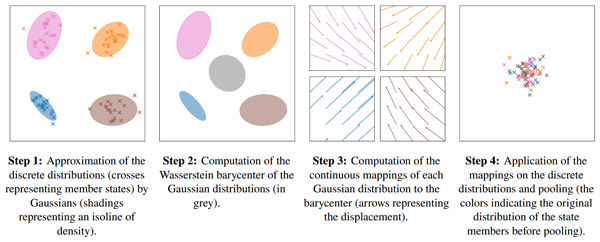
We explore an alternative framework for constructing multi-model ensembles by formulating ensemble combination as a barycenter problem. We compare the L2 barycenter (equivalent to pooling) with the Wasserstein barycenter (more precisely its Gaussian approximation). Both have the same ensemble mean but differ in how they represent forecasts uncertainty. In terms of Continuous Ranked Probability Score, the Wasserstein barycenter outperforms more often while performing similarly on average.
Milena Corcos, Bernd Kärcher, Thomas Lesigne, Aurélien Podglajen, and Eric J. Jensen
EGUsphere, https://doi.org/10.5194/egusphere-2026-3112, https://doi.org/10.5194/egusphere-2026-3112, 2026
Short summary
Short summary
Thin ice clouds near the boundary between the troposphere and stratosphere affect Earth's climate by influencing radiation and the transport of water into the upper atmosphere. Using a model constrained by cloud observations, we investigated why some clouds disappear within hours while others persist much longer. We show that their lifetime depends on both rapid fluctuations and slower temperature changes. Long-lived clouds are rare but may have a disproportionate influence on climate.
Phoebe Noble, Haruka Okui, Joan Alexander, Manfred Ern, Neil P. Hindley, Lars Hoffmann, Laura Holt, Annelize van Niekerk, Riwal Plougonven, Inna Polichtchouk, Claudia C. Stephan, Martina Bramberger, Milena Corcos, William Putnam, Christopher Kruse, and Corwin J. Wright
Atmos. Chem. Phys., 26, 7607–7630, https://doi.org/10.5194/acp-26-7607-2026, https://doi.org/10.5194/acp-26-7607-2026, 2026
Short summary
Short summary
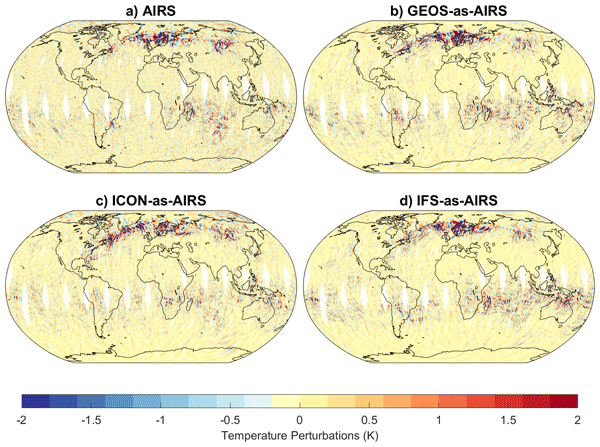
Gravity waves are small-scale processes that drive the circulation in the middle and upper atmosphere. In this work, we assess 3 new high-resolution (3-5km horizontal resolution) models against satellite data. Generally, models capture the spatial patterns and represent stratospheric northern hemisphere mountain generated waves well. However, they still underestimate amplitudes globally and struggle with the representation of southern hemispheric convective waves.
Flore Juge, Richard Wilson, and Albert Hertzog
EGUsphere, https://doi.org/10.5194/egusphere-2026-2520, https://doi.org/10.5194/egusphere-2026-2520, 2026
Short summary
Short summary
Turbulence in the Tropical Tropopause Layer affects the transport of gases and momentum into the stratosphere but is poorly documented. Using long-duration balloon flights from the Strateole-2 project, we present turbulence occurrence and distribution near 20 km altitude and identify its main sources: short-period convective gravity waves over land and the maritime continent, and Quasi-Biennial Oscillation wind shear modulated by the vanishing Walker circulation with altitude over the Pacific.

Clair Duchamp, Bernard Legras, Aurélien Podglajen, Pasquale Sellitto, Adam E. Bourassa, Alexei Rozanov, Ghassan Taha, and Daniel J. Zawada
Atmos. Meas. Tech., 19, 1675–1696, https://doi.org/10.5194/amt-19-1675-2026, https://doi.org/10.5194/amt-19-1675-2026, 2026
Short summary
Short summary
We analyzed the stratospheric aerosol plume from the 2022 Hunga eruption using satellite lidar data. We implemented a method to retrieve some aerosol properties, as standard products failed in this case. We found very high optical depth values in the days following the eruption, which decreased rapidly but remained elevated for months. Our results are broadly validated, though some satellite products underestimate the values due, in part, to the unusual aerosol size distribution in the plume.
Sullivan Carbone, Emmanuel D. Riviere, Mélanie Ghysels, Jérémie Burgalat, Georges Durry, Nadir Amarouche, Aurélien Podglajen, and Albert Hertzog
Atmos. Chem. Phys., 25, 10603–10623, https://doi.org/10.5194/acp-25-10603-2025, https://doi.org/10.5194/acp-25-10603-2025, 2025
Short summary
Short summary
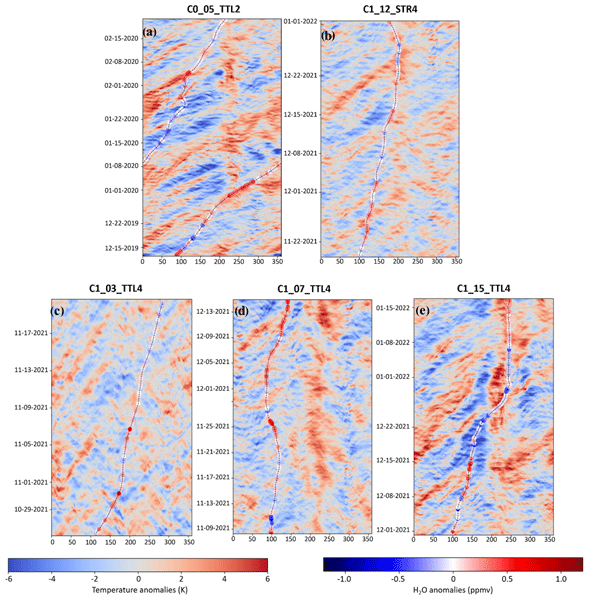
During the first two Strateole 2 campaigns, instruments were flown under super-pressure balloons at between 18 and 20 km altitude for several weeks at the Equator and performed in situ measurements of water vapour. This article describes the methodology used to quantify the modulation of water vapour by atmospheric waves and deep convective cases. This methodology allows us to bring to light the influence of atmospheric waves and extreme deep convection on the observed water vapour anomalies.
Pasquale Sellitto, Redha Belhadji, Bernard Legras, Aurélien Podglajen, and Clair Duchamp
Atmos. Chem. Phys., 25, 6353–6364, https://doi.org/10.5194/acp-25-6353-2025, https://doi.org/10.5194/acp-25-6353-2025, 2025
Short summary
Short summary
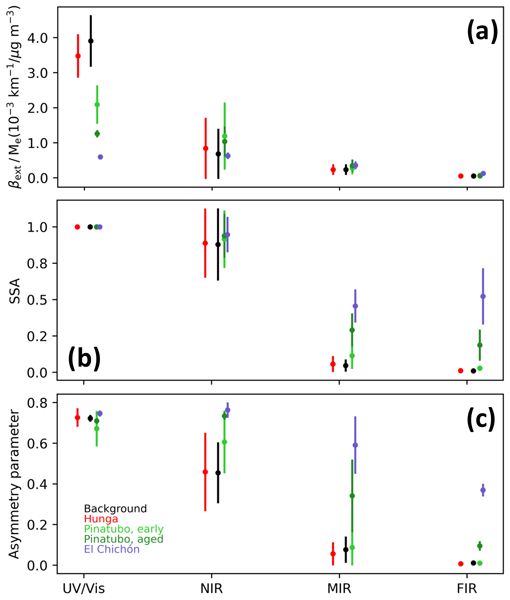
The Hunga Tonga–Hunga Ha’apai volcano erupted on 15 January 2022, producing the largest stratospheric aerosol perturbation of the last 30 years. Stratospheric volcanic aerosols usually produce a transient climate cooling; these impacts depend on volcanic aerosol composition/size, due to size-dependent interactions with solar/terrestrial radiation. We demonstrate that the Hunga Tonga–Hunga Ha’apai stratospheric aerosols have a larger cooling potential per unit mass than the past climate-relevant El Chichón (1984) and Pinatubo (1991) eruptions.
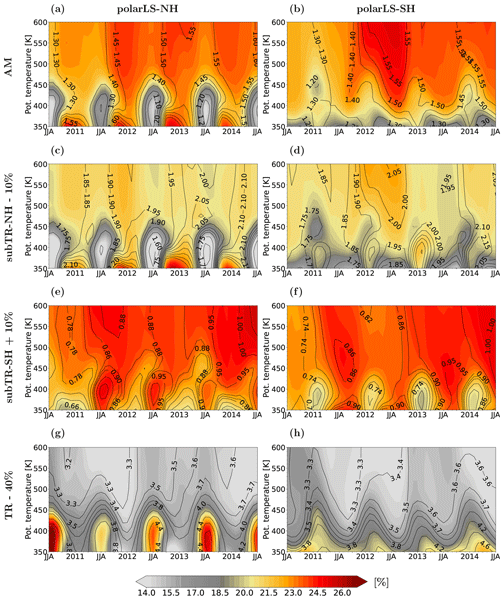
Xiaolu Yan, Paul Konopka, Felix Ploeger, and Aurélien Podglajen
Atmos. Chem. Phys., 25, 1289–1305, https://doi.org/10.5194/acp-25-1289-2025, https://doi.org/10.5194/acp-25-1289-2025, 2025
Short summary
Short summary
Our study finds that the air mass fractions (AMFs) from the Asian boundary layer (ABL) to the polar regions are about 1.5 times larger than those from the same latitude band in the Southern Hemisphere. The transport of AMFs from the ABL to the polar vortex primarily occurs above 20 km and over timescales exceeding 2 years. Our analysis reveals a strong correlation between the polar pollutants and the AMFs from the ABL. About 20 % of SF6 in the polar stratosphere originates from the ABL.
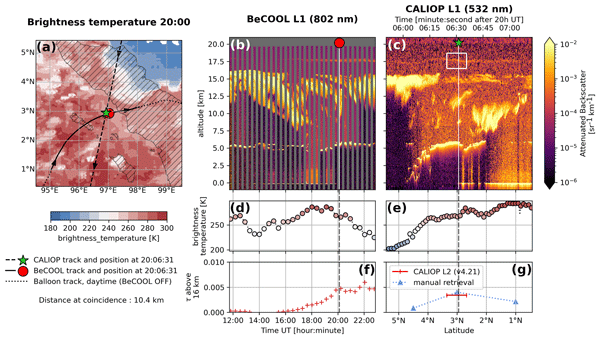
Thomas Lesigne, François Ravetta, Aurélien Podglajen, Vincent Mariage, and Jacques Pelon
Atmos. Chem. Phys., 24, 5935–5952, https://doi.org/10.5194/acp-24-5935-2024, https://doi.org/10.5194/acp-24-5935-2024, 2024
Short summary
Short summary
Upper tropical clouds have a strong impact on Earth's climate but are challenging to observe. We report the first long-duration observations of tropical clouds from lidars flying on board stratospheric balloons. Comparisons with spaceborne observations reveal the enhanced sensitivity of balloon-borne lidar to optically thin cirrus. These clouds, which have a significant coverage and lie in the uppermost troposphere, are linked with the dehydration of air masses on their way to the stratosphere.
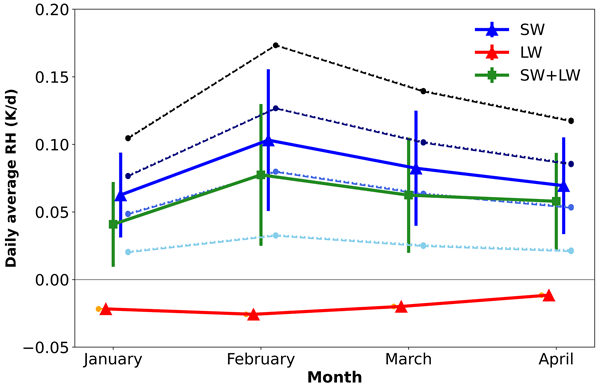
Pasquale Sellitto, Redha Belhadji, Juan Cuesta, Aurélien Podglajen, and Bernard Legras
Atmos. Chem. Phys., 23, 15523–15535, https://doi.org/10.5194/acp-23-15523-2023, https://doi.org/10.5194/acp-23-15523-2023, 2023
Short summary
Short summary
Record-breaking wildfires ravaged south-eastern Australia during the fire season 2019–2020. These fires injected a smoke plume in the stratosphere, which dispersed over the whole Southern Hemisphere and interacted with solar and terrestrial radiation. A number of detached smoke bubbles were also observed emanating from this plume and ascending quickly to over 35 km altitude. Here we study how absorption of radiation generated ascending motion of both the the hemispheric plume and the vortices.
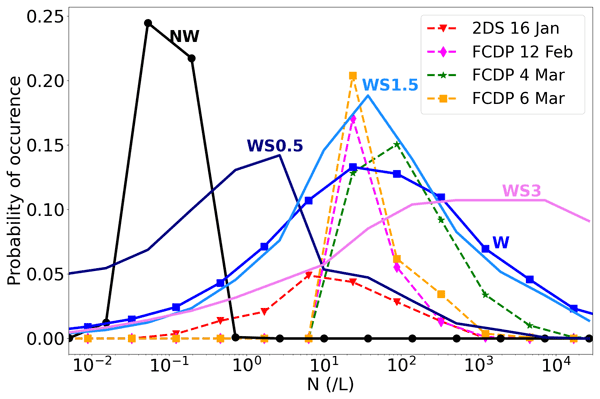
Milena Corcos, Albert Hertzog, Riwal Plougonven, and Aurélien Podglajen
Atmos. Chem. Phys., 23, 6923–6939, https://doi.org/10.5194/acp-23-6923-2023, https://doi.org/10.5194/acp-23-6923-2023, 2023
Short summary
Short summary
The role of gravity waves on tropical cirrus clouds and air-parcel dehydration was studied using the combination of Lagrangian observations of temperature fluctuations from superpressure balloons and a 1.5D model. The inclusion of the gravity waves to a reference simulation of a slow ascent around the cold-point tropopause drastically increases ice-crystal density, cloud fraction, and air-parcel dehydration, and it produces a crystal size distribution that agrees better with observations.
Richard Wilson, Clara Pitois, Aurélien Podglajen, Albert Hertzog, Milena Corcos, and Riwal Plougonven
Atmos. Meas. Tech., 16, 311–330, https://doi.org/10.5194/amt-16-311-2023, https://doi.org/10.5194/amt-16-311-2023, 2023
Short summary
Short summary
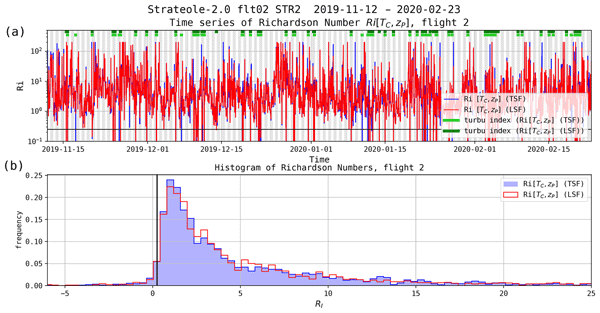
Strateole-2 is an French–US initiative designed to study atmospheric events in the tropical upper troposphere–lower stratosphere. In this work, data from several superpressure balloons, capable of staying aloft at an altitude of 18–20 km for over 3 months, were used. The present article describes methods to detect the occurrence of atmospheric turbulence – one efficient process impacting the properties of the atmosphere composition via stirring and mixing.
Bing Cao, Jennifer S. Haase, Michael J. Murphy, M. Joan Alexander, Martina Bramberger, and Albert Hertzog
Atmos. Chem. Phys., 22, 15379–15402, https://doi.org/10.5194/acp-22-15379-2022, https://doi.org/10.5194/acp-22-15379-2022, 2022
Short summary
Short summary
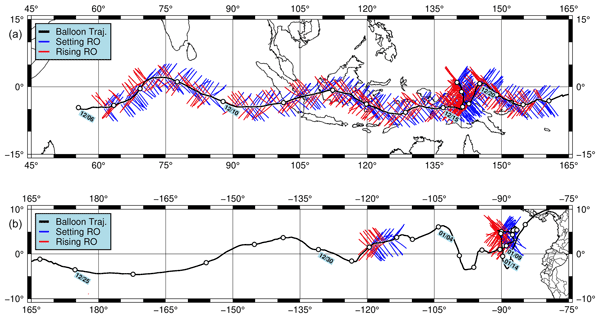
Atmospheric waves that carry momentum from tropospheric weather systems into the equatorial stratosphere modify the winds there. The Strateole-2 2019 campaign launched long-duration stratospheric superpressure balloons to measure these equatorial waves. We deployed a GPS receiver on one of the balloons to measure atmospheric temperature profiles beneath the balloon. Temperature variations in the retrieved profiles show planetary-scale waves with a 20 d period and 3–4 d period waves.
Bernard Legras, Clair Duchamp, Pasquale Sellitto, Aurélien Podglajen, Elisa Carboni, Richard Siddans, Jens-Uwe Grooß, Sergey Khaykin, and Felix Ploeger
Atmos. Chem. Phys., 22, 14957–14970, https://doi.org/10.5194/acp-22-14957-2022, https://doi.org/10.5194/acp-22-14957-2022, 2022
Short summary
Short summary
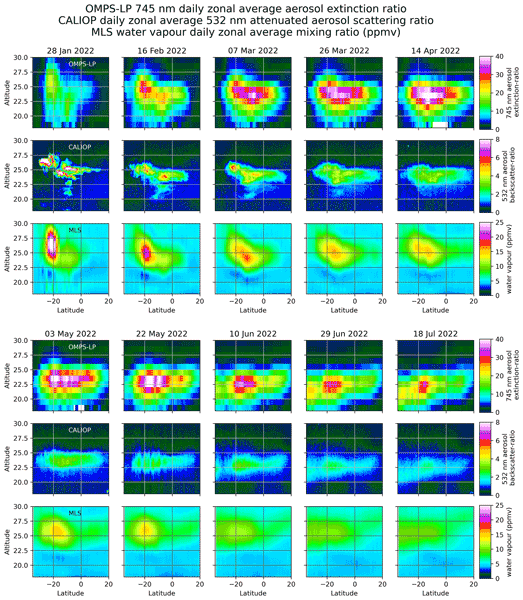
The long-duration atmospheric impact of the Tonga eruption in January 2022 is a plume of water and sulfate aerosols in the stratosphere that persisted for more than 6 months. We study this evolution using several satellite instruments and analyse the unusual behaviour of this plume as sulfates and water first moved down rapidly and then separated into two layers. We also report the self-organization in compact and long-lived patches.
Cameron Bertossa, Peter Hitchcock, Arthur DeGaetano, and Riwal Plougonven
EGUsphere, https://doi.org/10.5194/egusphere-2022-601, https://doi.org/10.5194/egusphere-2022-601, 2022
Preprint archived
Short summary
Short summary
This work has identified characteristic spatial and temporal scales for non-Gaussian outbreaks in forecasts, specifically, bimodality. Methodology is introduced which allows one to connect meteorological phenomena to bimodal outbreaks. Large-scale circulation interacting with local processes is uncovered as a frequent ingredient to such outbreaks. These insights not only provide a deeper understanding of the dynamical processes involved, but also have drastic implications for forecast skill.

Cameron Bertossa, Peter Hitchcock, Arthur DeGaetano, and Riwal Plougonven
Weather Clim. Dynam., 2, 1209–1224, https://doi.org/10.5194/wcd-2-1209-2021, https://doi.org/10.5194/wcd-2-1209-2021, 2021
Short summary
Short summary
While the assumption of Gaussianity leads to many simplifications, ensemble forecasts often exhibit non-Gaussian distributions. This work has systematically identified the presence of a specific case of
non-Gaussianity, bimodality. It has been found that bimodality occurs in a large portion of global 2 m temperature forecasts. This has drastic implications on forecast skill as the minimum probability in a bimodal distribution often lies at the maximum probability of a Gaussian distribution.
Cited articles
Baker, W. E., Atlas, R., Cardinali, C., Clement, A., Emmitt, G. D., Gentry, B. M., Hardesty, R. M., Källén, E., Kavaya, M. J., Langland, R., Ma, Z., Masutani, M., McCarty, W., Pierce, R. B., Pu, Z., Riishojgaard, L. P., Ryan, J., Tucker, S., Weissmann, M., and Yoe, J. G.: Lidar-Measured Wind Profiles: The Missing Link in the Global Observing System, B. Am. Meteorol. Soc., 95, 543–564, 2014. a, b, c, d
Behera, A. K., Rivière, E. D., Khaykin, S. M., Marécal, V., Ghysels, M., Burgalat, J., and Held, G.: On the cross-tropopause transport of water by tropical convective overshoots: a mesoscale modelling study constrained by in situ observations during the TRO-Pico field campaign in Brazil, Atmos. Chem. Phys., 22, 881–901, https://doi.org/10.5194/acp-22-881-2022, 2022. a
Bley, S., Rennie, M., Žagar, N., Pinol Sole, M., Straume, A. G., Antifaev, J., Candido, S., Carver, R., Fehr, T., von Bismarck, J., Hünerbein, A., and Deneke, H.: Validation of the Aeolus L2B Rayleigh winds and ECMWF short-range forecasts in the upper troposphere and lower stratosphere using Loon super pressure balloon observations, Q. J. Roy. Meteor. Soc., 148, 3852–3868, https://doi.org/10.1002/qj.4391, 2022. a
Bramberger, M., Goetz, D., Alexander, M. J., Kalnajs, L., Hertzog, A., and Podglajen, A.: Tropical Wave Observations From the Reel-Down Atmospheric Temperature Sensor (RATS) in the Lowermost Stratosphere During Strateole-2, Geophys. Res. Lett., 50, e2023GL104711, https://doi.org/10.1029/2023GL104711, 2023. a
Butchart, N.: The Brewer-Dobson circulation, Rev. Geophys., 52, 157–184, https://doi.org/10.1002/2013RG000448, 2014. a
Cao, B., Haase, J. S., Murphy, M. J., Alexander, M. J., Bramberger, M., and Hertzog, A.: Equatorial waves resolved by balloon-borne Global Navigation Satellite System radio occultation in the Strateole-2 campaign, Atmos. Chem. Phys., 22, 15379–15402, https://doi.org/10.5194/acp-22-15379-2022, 2022. a
Carbone, S., D. Riviere, E., Ghysels, M., Burgalat, J., Durry, G., Amarouche, N., Podglajen, A., and Hertzog, A.: Influence of atmospheric waves and deep convection on water vapour in the equatorial lower stratosphere seen from long-duration balloon measurements, Atmos. Chem. Phys., 25, 10603–10623, https://doi.org/10.5194/acp-25-10603-2025, 2025. a
Corcos, M., Hertzog, A., Plougonven, R., and Podglajen, A.: Observation of gravity waves at the tropical tropopause using superpressure balloons, J. Geophys. Res., 126, e2021JD035165, https://doi.org/10.1029/2021JD035165, 2021. a
de Mendoza y Rios, J.: Memoria sobre algunos metodos nuevos de calcular la longitud por las distancias lunares: y aplicacion de su teorica a la solucion de otros problemas de navegacion, Impreta Real, https://uvadoc.uva.es/handle/10324/57278 (last access: 16 January 2026), 1795. a
Dee, D. P., Uppala, S. M., Simmons, A. J., Berrisford, P., Poli, P., Kobayashi, S., Andrae, U., Balmaseda, M. A., Balsamo, G., Bauer, P., Bechtold, P., Beljaars, A. C. M., van de Berg, L., Bidlot, J., Bormann, N., Delsol, C., Dragani, R., Fuentes, M., Geer, A. J., Haimberger, L., Healy, S. B., Hersbach, H., Hólm, E. V., Isaksen, L., Kållberg, P., Köhler, M., Matricardi, M., McNally, A. P., Monge-Sanz, B. M., Morcrette, J.-J., Park, B.-K., Peubey, C., de Rosnay, P., Tavolato, C., Thépaut, J.-N., and Vitart, F.: The ERA-Interim reanalysis: Configuration and performance of the data assimilation system, Q. J. Roy. Meteor. Soc., 137, 553–597, 2011. a
Friedrich, L. S., McDonald, A. J., Bodeker, G. E., Cooper, K. E., Lewis, J., and Paterson, A. J.: A comparison of Loon balloon observations and stratospheric reanalysis products, Atmos. Chem. Phys., 17, 855–866, https://doi.org/10.5194/acp-17-855-2017, 2017. a
Fueglistaler, S., Dessler, A. E., Dunkerton, T. J., Folkins, I., Fu, Q., and Mote, P. W.: Tropical Tropopause Layer, Rev. Geophys., 47, https://doi.org/10.1029/2008RG000267, 2009. a, b
Fujiwara, M., Manney, G., Gray, L., and Wright, J.: SPARC Reanalysis Intercomparison Project (S-RIP) Final Report, 10, World Clim. Res. Prog., https://doi.org/10.17874/800dee57d13, 2022. a
Gettelman, A., Hotlon, J., and Douglass, A.: Simulations of water vapor in the lower stratosphere and upper troposphere, J. Geophys. Res., 105, 9003–9023, 2000. a
Gonzalez-Nieto, P. L., Flechoso, M. G., Mocoroa, M. A., Martin, A. M., Lorenzo, M. G., Gomez, G. C., Gomez, J. A., Fraile, A. C., Dagan, J. O., Palomares, R. M., and Lahoz-Beltra, R.: Design and development of a virtual laboratory in PYTHON for the teaching of data analysis and mathematics in geology: GeoPy, in: INTED2020 Proceedings, IATED, 2236–2242, https://doi.org/10.21125/inted.2020.0687, 2020. a
Haase, J., Alexander, M., Hertzog, A., Kalnajs, L., Deshler, T., Davis, S., Plougonven, R., Cocquerez, P., and Venel, S.: Around the world in 84 days, Eos, 99, https://doi.org/10.1029/2018EO091907, 2018. a, b
Hersbach, H., Bell, B., Berrisford, P., Hirahara, S., Horányi, A., Muñoz-Sabater, J., Nicolas, J., Peubey, C., Radu, R., Schepers, D., Simmons, A., Soci, C., Abdalla, S., Abellan, X., Balsamo, G., Bechtold, P., Biavati, G., Bidlot, J., Bonavita, M., De Chiara, G., Dahlgren, P., Dee, D., Diamantakis, M., Dragani, R., Flemming, J., Forbes, R., Fuentes, M., Geer, A., Haimberger, L., Healy, S., Hogan, R. J., Hólm, E., Janisková, M., Keeley, S., Laloyaux, P., Lopez, P., Lupu, C., Radnoti, G., de Rosnay, P., Rozum, I., Vamborg, F., Villaume, S., and Thépaut, J.-N.: The ERA5 global reanalysis, Q. J. Roy. Meteor. Soc., 146, 1999–2049, https://doi.org/10.1002/qj.3803, 2020. a
Hertzog, A., Cocquerez, P., Basdevant, C., Boccara, G., Bordereau, J., Brioit, B., Cardonne, A., Guilbon, R., Ravissot, A., Schmitt, E., Valdivia, J., Venel, S., and Vial, F.: Stratéole/Vorcore – Long duration, superpressure balloons to study the Antarctic stratosphere during the 2005 winter, J. Ocean. Atmos. Tech., 24, 2048–2061, 2007. a
Inai, Y., Hasebe, F., Fujiwara, M., Shiotani, M., Nishi, N., Ogino, S.-Y., Vömel, H., Iwasaki, S., and Shibata, T.: Dehydration in the tropical tropopause layer estimated from the water vapor match, Atmos. Chem. Phys., 13, 8623–8642, https://doi.org/10.5194/acp-13-8623-2013, 2013. a
Jensen, E. and Pfister, L.: Transport and freeze-drying in the tropical tropopause layer, J. Geophys. Res., 109, https://doi.org/10.1029/2003JD004022, 2004. a, b
Jensen, E., Pfister, L., and Bui, T.: Physical processes controlling ice concentrations in cold cirrus near the tropical tropopause, J. Geophys. Res., 117, https://doi.org/10.1029/2011JD017319, 2012. a, b
Jensen, E. J., Ueyama, R., Pfister, L., Bui, T. V., Alexander, M. J., Podglajen, A., Hertzog, A., Woods, S., Lawson, R. P., Kim, J.-E., and Schoeberl, M. R.: High-frequency gravity waves and homogeneous ice nucleation in tropical tropopause layer cirrus, Geophysical Research Letters, 43, 6629–6635, https://doi.org/10.1002/2016GL069426, 2016. a
Jensen, E. J., Pfister, L., Jordan, D. E., Bui, T. V., Ueyama, R., Singh, H. B., Thornberry, T. D., Rollins, A. W., Gao, R.-S., Fahey, D. W., Elkins, K. H. R. J. W., Diskin, G. S., DiGangi, J. P., Lawson, R. P., Woods, S., Atlas, E. L., Rodriguez, M. A. N., Wofsy, S. C., Pittman, J., Bardeen, C. G., Toon, O. B., Kindel, B. C., Newman, P. A., McGill, M. J., Hlavka, D. L., Lait, L. R., Schoeberl, M. R., Bergman, J. W., Selkirk, H. B., Alexander, M. J., Kim, J.-E., Lim, B. H., Stutz, J., and Pfeilsticker, K.: The NASA Airborne Tropical Tropopause Experiment: High-altitude aircraft measurements in the tropical western Pacific, Bulletin of the American Meteorological Society, 98, 129–143, 2017. a
Jewtoukoff, V., Hertzog, A., Plougonven, R., de la Camara, A., and Lott, F.: Gravity waves in the Southern Hemisphere derived from balloon observations and ECMWF analyses, J. Atmos. Sci., 72, 3449–3468, 2015. a
Kalnajs, L. E., Davis, S. M., Goetz, J. D., Deshler, T., Khaykin, S., St. Clair, A., Hertzog, A., Bordereau, J., and Lykov, A.: A reel-down instrument system for profile measurements of water vapor, temperature, clouds, and aerosol beneath constant-altitude scientific balloons, Atmos. Meas. Tech., 14, 2635–2648, https://doi.org/10.5194/amt-14-2635-2021, 2021. a, b
Kawatani, Y., Hamilton, K., Miyazaki, K., Fujiwara, M., and Anstey, J. A.: Representation of the tropical stratospheric zonal wind in global atmospheric reanalyses, Atmos. Chem. Phys., 16, 6681–6699, https://doi.org/10.5194/acp-16-6681-2016, 2016. a
Laroche, S. and St-James, J.: Impact of the Aeolus Level-2B horizontal line-of-sight winds in the Environment and Climate Change Canada global forecast system, Q. J. Roy. Meteor. Soc., 148, 2047–2062, 2022. a
Lee, C., Smets, P., Charlton-Perez, A., Evers, L., Harrison, G., and Marlton, G.: The potential impact of upper stratospheric measurements on sub-seasonal forecasts in the extra-tropics, in: Infrasound monitoring for atmospheric studies: Challenges in middle atmosphere dynamics and societal benefits, Springer, 889–907, ISBN 978-3-319-75138-2, https://doi.org/10.1007/978-3-319-75140-5, 2018. a
Lesigne, T., Ravetta, F., Podglajen, A., Mariage, V., and Pelon, J.: Extensive coverage of ultrathin tropical tropopause layer cirrus clouds revealed by balloon-borne lidar observations, Atmos. Chem. Phys., 24, 5935–5952, https://doi.org/10.5194/acp-24-5935-2024, 2024. a, b, c
McMahon, B. B.: Measuring winds from space: the European Space Agency's Aeolus mission., Weather, 74, https://doi.org/10.1002/wea.3500, 2019. a
Mohd Razali, N. and Yap, B.: Power Comparisons of Shapiro-Wilk, Kolmogorov-Smirnov, Lilliefors and Anderson-Darling Tests, J. Stat. Model. Analytics, 2, 21–33, ISBN 978-967-363-157-5, 2011. a
Noel, V., Chepfer, H., Chiriaco, M., and Yorks, J.: The diurnal cycle of cloud profiles over land and ocean between 51° S and 51° N, seen by the CATS spaceborne lidar from the International Space Station, Atmos. Chem. Phys., 18, 9457–9473, https://doi.org/10.5194/acp-18-9457-2018, 2018. a
Podglajen, A., Hertzog, A., Plougonven, R., and Legras, B.: Lagrangian temperature and vertical velocity fluctuations due to gravity waves in the lower stratosphere, Geophys. Res. Lett., 43, 3543–3553, https://doi.org/10.1002/2016GL068148, 2016a. a
Podglajen, A., Plougonven, R., Hertzog, A., and Legras, B.: A modelling case study of a large-scale cirrus in the tropical tropopause layer, Atmos. Chem. Phys., 16, 3881–3902, https://doi.org/10.5194/acp-16-3881-2016, 2016b. a
Podglajen, A., Hertzog, A., Plougonven, R., and Legras, B.: Lagrangian gravity wave spectra in the lower stratosphere of current (re)analyses, Atmos. Chem. Phys., 20, 9331–9350, https://doi.org/10.5194/acp-20-9331-2020, 2020. a, b
Pourret, V., Šavli, M., Mahfouf, J.-F., Raspaud, D., Doerenbecher, A., Bénichou, H., and Payan, C.: Operational assimilation of Aeolus winds in the Météo-France global NWP model ARPEGE, Q. J. Roy. Meteor. Soc., 148, 2652–2671, 2022. a
Rabier, F., Bouchard, A., , Brun, E., Doerenbecher, A., Guedj, S., Guidard, V., Karbou, F., Peuch, V.-H., Amraoui, L. E., Puech, D., Genthon, C., Picard, G., , Town, M., Hertzog, A., Vial, F., Cocquerez, P., Cohn, S. A., Hock, T., Fox, J., Cole, H., Parsons, D., Powers, J., Romberg, K., VanAndel, J., Deshler, T., Mercer, J., Haase, J. S., Avallone, L., Kalnajs, L., Mechoso, C. R., Tangborn, A., Pellegrini, A., Frenot, Y., Thépaut, J.-N., McNally, A., Balsamo, G., and Steinle, P.: The Concordiasi project in Antarctica, B. Am. Meteorol. Soc., 91, 69–86, 2010. a
Randel, W. and Jensen, E.: Physical processes in the tropical tropopause layer and their roles in a changing climate, Nature Geoscience, 6, 169–176, https://doi.org/10.1038/ngeo1733, 2013. a
Rennie, M. P., Isaksen, L., Weiler, F., de Kloe, J., Kanitz, T., and Reitebuch, O.: The impact of Aeolus wind retrievals on ECMWF global weather forecasts, Q. J. Roy. Meteor. Soc., 147, 3555–3586, 2021. a
Riese, M., Ploeger, F., Rap, A., Vogel, B., Konopka, P., Dameris, M., and Forster, P.: Impact of uncertainties on atmospheric mixing on simulated UTLS composition and related radiative effects, J. Geophys. Res. Atmos., 117, 2156–2202, https://doi.org/10.1029/2012JD017751, 2012. a
Scaife, A. A., Baldwin, M. P., Butler, A. H., Charlton-Perez, A. J., Domeisen, D. I. V., Garfinkel, C. I., Hardiman, S. C., Haynes, P., Karpechko, A. Y., Lim, E.-P., Noguchi, S., Perlwitz, J., Polvani, L., Richter, J. H., Scinocca, J., Sigmond, M., Shepherd, T. G., Son, S.-W., and Thompson, D. W. J.: Long-range prediction and the stratosphere, Atmos. Chem. Phys., 22, 2601–2623, https://doi.org/10.5194/acp-22-2601-2022, 2022. a
Schoeberl, M., Dessler, A., Ye, H., Wang, T., Avery, M., and Jensen, E.: The impact of gravity waves and cloud nucleation threshold on stratospheric water and tropical tropospheric cloud fraction, Earth Space Sci., 3, 295–305, https://doi.org/10.1002/2016EA000180, 2016. a, b
Schoeberl, M. R., Jensen, E., Podglajen, A., Coy, L., Lodha, C., Candido, S., and Carver, R.: Gravity wave spectra in the lower stratosphere diagnosed from project loon balloon trajectories, J. Geophys. Res., 122, 8517–8524, https://doi.org/10.1002/2017JD026471, 2017. a
Selvaraj, D., Plougonven, R., Hertzog, A., Podglajen, A., Rennie, M., Isaksen, L., and Kébir, S.: Accuracy of balloon trajectory forecasts in the lower stratosphere, Atmosphere, 10, https://doi.org/10.3390/atmos10020102, 2019. a, b, c, d
Solomon, S., Rosenlof, K., Portmann, R., Daniel, J., Davis, S., Sanford, T., and Plattner, G.-K.: Contributions of Stratospheric Water Vapor to Decadal Changes in the Rate of Global Warming, Science, 1219–1223, https://doi.org/10.1126/science.1182488, 2010. a
Spichtinger, P. and Krämer, M.: Tropical tropopause ice clouds: a dynamic approach to the mystery of low crystal numbers, Atmos. Chem. Phys., 13, 9801–9818, https://doi.org/10.5194/acp-13-9801-2013, 2013. a
Taylor, J. R., Randel, W. J., and Jensen, E. J.: Cirrus cloud-temperature interactions in the tropical tropopause layer: a case study, Atmos. Chem. Phys., 11, 10085–10095, https://doi.org/10.5194/acp-11-10085-2011, 2011. a
Vincent, R. A. and Hertzog, A.: The response of superpressure balloons to gravity wave motions, Atmos. Meas. Tech., 7, 1043–1055, https://doi.org/10.5194/amt-7-1043-2014, 2014. a, b
Vitart, F. and Robertson, A.: Sub-seasonal to seasonal prediction, Elsevier, Vitard & Robertson, ISBN 978-0-12-811714-9, 2018. a
Wilson, R., Pitois, C., Podglajen, A., Hertzog, A., Corcos, M., and Plougonven, R.: Detection of turbulence occurrences from temperature, pressure, and position measurements under superpressure balloons, Atmos. Meas. Tech., 16, 311–330, https://doi.org/10.5194/amt-16-311-2023, 2023. a
Winker, D. M., Vaughan, M. A., Omar, A., Hu, Y., Powell, K. A., Liu, Z., Hunt, W. H., and Young, S. A.: Overview of the CALIPSO mission and CALIOP data processing algorithms, Journal of Atmospheric and Oceanic Technology, 26, 2310–2323, 2009. a
Short summary
Winds in the Equatorial region remain difficult to model. We take advantage of long-duration balloon campaigns from 2019 and 2021 to assess errors in winds between 18 and 20 km in a weather forecast model. Large errors persist: one third of the time, the error is larger than 3.5 m per second. This has implications for research studies that calculate air mass trajectories in this transition region between the troposphere and the stratosphere.
Winds in the Equatorial region remain difficult to model. We take advantage of long-duration...


Altmetrics
Final-revised paper
Preprint