
the Creative Commons Attribution 4.0 License.
the Creative Commons Attribution 4.0 License.
Light absorption properties and composition of water-soluble brown carbon in North China Plain: implication for an enhancing role of nitrogenous organic compounds
Can Wu
Huijun Zhang
Kehan Sun
Rongjie Li
Ziting Yan
Yubao Chen
Zheng Li
Binyu Xiao
Yanqin Ren

Brown carbon (BrC), an efficiently light-absorbing carbonaceous aerosol, exerts significant impacts on the global energy budget and regional climate, attracting growing scientific attention. To advance understanding of the spatial variability of atmospheric BrC and its dominant formation pathways in the North China Plain (NCP), light absorption properties, chemical composition and formation process of the water-soluble BrC in 2023 winter were investigated by conducting simultaneous measurements at five sites across the NCP, namely, Beijing, Tianjin, Luancheng (rural site), Handan and Jinan. Our results showed that the average light absorption coefficient at 365 nm (abs365) in Luancheng was approximately 1.1–3.5 times higher than those in urban ones. However, mass absorption efficiency displayed a distinctly different spatial pattern, with the strongest light-absorptivity (1.40 ± 0.02 m2 g−1) recorded in Jinan. Notably, average abs365 in four urban sites exhibited a decline of ∼ 45 % from 2018 to 2023 compared to those previous observations. Furthermore, the light-absorptivity of water-soluble BrC was enhanced from clean to haze period at the most sampling sites along with the increasing N:C ratio, indicating that nitrogenous organic compounds (NOCs) were important chromophores of water-soluble BrC in the NCP. Additionally, These NOCs were found to be closely associated with aqueous reactions, in which ammonia played an important role. These results elucidate the substantial contribution of NOCs to atmospheric BrC in the NCP, and further suggest a potentially important role of NH3 emission control in alleviating wintertime haze and BrC pollution under moist conditions in this region.
- Article
(3724 KB) - Full-text XML
-
Supplement
(1378 KB) - BibTeX
- EndNote
Light-absorbing organic aerosol, optically defined as brown carbon (BrC), is prevalent in the troposphere and efficiently absorbs solar radiation, thereby perturbing the global energy budget and influencing regional climate (Liu et al., 2020; Laskin et al., 2015; Samset et al., 2018). Recent modeling studies demonstrates that BrC is responsible for >20 % of the direct radiative effect (DRE) caused by carbonaceous aerosols (Zeng et al., 2020; Feng et al., 2013; Zhang et al., 2017; Liu et al., 2015a). Most significantly, BrC even dominates the DRE in certain regions of the Earth, e.g., in the remote tropical upper troposphere (Zhang et al., 2020). However, these reported BrC DRE have large uncertainty, partly stemming from the poor understanding of optical properties and atmospheric evolution of BrC. Unlike black carbon (BC), BrC is characterized by a pronounced dependence of light-absorption on wavelength, with absorbance increasing steeply near UV wavelengths (Andreae and Gelencsér, 2006). Consequently, abundant BrC can also reduce the amount of ultraviolet sunlight reaching surface, subsequently altering tropospheric photochemistry. Indeed, growing evidence reveal a nonnegligible reduction in photolysis rates of the ozone and radicals with enhanced BrC load (Hammer et al., 2016; Gligorovski et al., 2015; Jo et al., 2016; He and Carmichael, 1999). Beyond the climatic and atmospheric effects, multiple BrC chromophores (e.g, polycyclic aromatic and nitro-heterocyclic compounds) also pose adverse health effects because of their strong oxidative potential (Fang et al., 2019; Daellenbach et al., 2020).
Diverse sources of atmospheric BrC have been identified, including the various primary emissions and complex secondary formation. Primary BrC is known to be directly emitted from the incomplete combustion of biomass and other fuels (Washenfelder et al., 2015; Lack et al., 2012; Chen et al., 2017; Yan et al., 2017), of which optical properties are inherently related to combustion conditions and fuel types (Ni et al., 2021; Xie et al., 2017; Stockwell et al., 2015). And field measurements and laboratory studies indicated that the aromatics, conjugated systems, and highly functionalized species with high light-absorptivity can be secondarily formed via photooxidation of various precursors (Hems and Abbatt, 2018; Jiang et al., 2019; Finewax et al., 2018), or reactions initiated by ammonia/amines with atmospherically relevant carbonyls (Updyke et al., 2012; Powelson et al., 2014; Grace et al., 2020). These processes would generate abundant N-containing compounds (NOCs), which have been recognized as significant components of BrC (Lin et al., 2015; Yang et al., 2022; Wang et al., 2025a). Notably, the latest modeling study suggested that the NOCs dominate the global organic aerosol absorption, accounting for 18 % of global DRE induced by carbonaceous aerosols (Li et al., 2025). These absorptive NOCs are probably responsible for an enhanced light absorption of BrC in the upper boundary layer, as a result of their efficient formation in the lifting air masses (Wu et al., 2024a; Wu et al., 2024b). Moreover, the further aging processes would chemically modify the BrC composition, subsequently leading to either an increase (photodarkening) or decrease (photobleaching) in light-absorptivity of BrC chromophores (Wong et al., 2017; Jiang et al., 2022; Hems et al., 2021). These dynamic natures of BrC drive pronounced spatiotemporal heterogeneity in its chemical components and optical properties, propagating significant uncertainties in climate models that limit the reliable projection and mitigation of the climate effects caused by diverse BrC.
Over the past decade, stringent emission control measures, such as shifting residential coal to natural gas/electricity, eliminating small coal-fired industrial boilers, and banning straw burning, etc., have been implemented in the North China Plain (NCP) (Chen et al., 2024b; Zheng et al., 2018). Given the substantial contribution of primary emissions to atmospheric BrC, BrC level in this region was expected to drastically decrease. Nevertheless, high loads of strongly light-absorbing BrC were still detected frequently in this region (Wang et al., 2025c; Chen et al., 2024a; Gong et al., 2023; Sun et al., 2026). Therefore, the sources and formation mechanism remain elusive in the NCP. Moreover, the atmospheric environment in this region also undergone significant changes, characterized particularly by enhanced atmospheric oxidation capacity driven by reduced NOx emissions and elevated O3 levels, as well as persistently high NH3 loadings due to insufficient controls on agricultural emissions (Li et al., 2019; Zheng et al., 2018; Zhu et al., 2023). Our recent studies demonstrate that such an ammonia-rich environment plays a key role in enhancing BrC absorption, primarily by reducing aerosol acidity and facilitating the formation of light-absorbing NOCs (Liu et al., 2023; Zhang et al., 2024). These findings imply that the primary drivers of BrC formation may have changed relative to those in the past. Motivated by this, atmospheric BrC in the NCP were collected during the 2023 winter and analyzed for the characteristics of water-soluble BrC. We investigated the spatial difference of chemical composition and light-absorption of water-soluble BrC, and discussed the role of NOCs in the BrC light absorption and their formation pathways.
2.1 Sampling
The multi-site observations were synchronously conducted on the North China Plain from 15 November to 31 December 2023 (Fig. S1). Four of the sampling sites are located in urban areas, namely Beijing (BJ), Tianjin (TJ), Handan (HD) and Jinan (JN), which are surrounded by the traffic arteries and dense residential and commercial buildings. And the remaining one, adjacent to Luancheng (LC), serves as a rural station free from significant industrial influences. At each site, the PM2.5 samples with a 12 h interval were collected onto prebaked (at 450 °C for 6 h) quartz filters using high- (1.13 m3 min−1) or medium-volume (100 L min−1) air samplers; All the samplers located on the rooftops approximately 15–20 m above ground level. After sampling, the filter samples were wrapped in prebaked aluminum foils and stored in a freezer (at −18 °C) prior to analysis.
Hourly concentrations of PM2.5 and associated pollutants (e.g., NO2, O3, CO) at the sampling sites were obtained from the National Urban Air Quality Real-time Release Platform of China (https://air.cnemc.cn:18007/, last access: 6 April 2025), of which monitoring sites are adjacent to ours with a distance of <10 km. The meteorological data including ambient temperature (T) and relative humidity (RH) were downloaded from National Climatic Data Center (https://www.ncei.noaa.gov/, last access: 6 April 2025).
2.2 Chemical analysis
A piece of each filter was extracted with 40 mL ultrapure Milli-Q water (18.2 MΩ) under ultrasonication for 30 min. A part of the extract was used for the detection of water-soluble ions (SO, NO, Cl−, Na+, NH, K+, Mg2+ and Ca2+) by using an ion chromatography; The remaining part was detected for the water-soluble organic carbon (WSOC) and water-soluble total nitrogen (WSTN) via a total organic carbon (TOC) analyzer (Model TOC-L CPH, Shimadzu, Japan). And the water-soluble organic nitrogen (WSON) can be quantified by deducting the water-soluble inorganic nitrogen (WSIN) from WSTN (i.e., WSON = WSTN − WSIN), thereby revealing variations in the N:C ratios of water-soluble components across different sampling sites (Fig. S2). A DRI-model 2001 thermal–optical carbon analyzer following the IMPROVE-A protocol was applied here to measure organic carbon (OC) and element carbon (EC) of PM2.5.
The molecular compositions in PM2.5 samples, including nitro-aromatic compounds (NACs, Table S1), polycyclic aromatic hydrocarbons (PAHs) and others organic tracers, were extracted with a mixture of dichloromethane and methanol (2:1, ); Subsequently, the extracts were derivatized via derivatization reagent (a mixture of 50 µL of N,O-bis-(trimethylsilyl)trifluoroacetamide (BSTFA) and 1 % trimethylsilyl chloride and 10 µL of pyridine) prior to GC-MS analyses. More details of the extraction, derivatization and the GC-MS analyses can refer to elsewhere (Wang et al., 2006; Wu et al., 2025a).
Additionally, the aerodyne high-resolution time-of-flight aerosol mass spectrometer (HR-AMS) was applied here to characterize the imidazole-related fragments (e.g., C3H3N and C3H4N) in a typical humid haze event (12 to 31 December of 2023, Fig. S3), following the method reported by Ge et al. (2024). It should be pointed out that above fragments may stem from other nitrogen-containing precursors, which inevitably introduces uncertainties into the quantification. Accordingly, the concentrations derived from these fragment ions cannot represent the actual abundances of the real molecules. Even so, the fragment ion levels can still indicate the variation trends of imidazole N-heterocycles. Because imidazole concentrations measured by orbitrap mass spectrometry in our previous field campaign showed a significant positive correlation with offline-AMS signals of C3H3N and C3H4N (Fig. S4).
The details of the extraction and derivatization can be found elsewhere (Wu et al., 2024a). Briefly, a part of the PM2.5 filter was extracted following the procedure similar to that of other water-soluble components; then the extracts were atomized using argon as the carrier gas, dehydrated by a diffusion drier, and ultimately quantified by HR-AMS. Each sample was continuously monitored by HR-AMS for >10 min to obtain stable signal, and above procedure was also applied to the blank samples to account for any potential contamination or background signals. A deep post-processing was conducted for the V-mode data in this study using the Igor-based Aerosol Mass Spectrometer Analysis Toolkit. The mass concentration of imidazole-related fragments was calculated as the follow:
Where CIMs denotes to the concentration of the imidazole-related fragments. FIMs is mass contribution of the imidazole-related fragments to the total fragments measured by HR-AMS; WSOM refers to atmospheric concentration of water-soluble organic matter (µg m−3)
2.3 Optical Absorption of BrC
The light-absorbing chromophores (i.e., BrC) were also extracted with 10 mL ultrapure Milli-Q water, following the procedure for water-soluble ions. A UV–vis spectrometer was applied here to record the absorption spectra of all the extracts, which were finally converted into absorption coefficient (absλ, M m−1) at a given wavelength (λ) using the following equation:
Where Aλ is the absorbance at wavelength λ (nm), vL and va refer to the volume of the extractant and air through corresponding to filter punches, respectively. The optical path length is 1 cm (i.e, l). From absλ, the mass absorption coefficient (MAEλ, m2 g−1) can be characterized as:
Where C is the mass concentration of water-soluble organic carbon.
2.4 Random forest analysis for water-soluble organic nitrogen
Random forest (RF), as a powerful tool for regression and prediction (Hu et al., 2017; Vu et al., 2019), was employed here to elucidate the relationships between secondary WSON (WSONsec) and potential factors (NH, NO2, O3, ALWC, pH and meteorological factors). The importance of each factor to WSONsec can be determined by a SHAP method originally proposed by Lundberg and Lee (2017). Rooted in cooperative game theory, SHAP framework as a model-agnostic additive feature attribution method enables an in-depth exploration of interaction effects and effectively alleviates poor interpretability of machine learning models. In the RF model design, 70 % of the dataset including all the samples from the five monitoring sites was randomly divided into a training subset to construct the RF model, and the remaining 30 % (i.e., test set) was used to assess the model performance. Following systematic hyperparameter optimization, the decision tree (ntree) was set to 300 to balance model performance and computational efficiency; and number of variables split at each node (nmtry) was limited to 12 to avoid overfitting. Additionally, a 10-fold cross-validation strategy was adopted here to optimize model parameters and estimate model performance. The RF model was constructed using the “randomForest” R package, of which performance was evaluated by coefficient of determination (R2), mean square error (MSE) or root-mean-square error (RMSE) and mean absolute error (MAE). As summarized in Table S2, the simulated WSONsec corrected strongly with observed ones, and the error metric remained at low levels; Thess indicated that the model could reconstruct commendably the variations of WSONsec in this study.
2.5 Theoretical estimation of particulate fraction of NACs (Fp)
Since gas-phase nitro-aromatic compounds (NACs) were not detected in this study, the particulate-phase fraction (Fp) of NACs was calculated based on absorption equilibrium theory (Pankow et al., 2001; Zuend and Seinfeld, 2012), and the specific calculation method referred to that reported by Chen et al. (2025). As shown in the following equations:
Herein, Cg and Cp are the mass concentrations of the organic molecule in gas and particle phase, respectively. Kp refers to gas–particle partitioning coefficient, and is determine by many factors in Eq. (5). Specifically, PV is the saturation pressure (Pa), which is 0.00378 torr for 4-nitrophenol (at 298 K). ξ is the activity coefficient of the species, adopting from the values reported by Wang et al. (2019). M refers to the molecular weight of NAC species (g mol−1). Additionally, R is the gas constant (8.314 J (mol K)−1), T is the temperature (K), f denotes the fraction of organic matter in particle, and PM is the mass concentration of PM2.5.
3.1 Spatial variation of PM2.5 Chemical Composition
As shown in Table 1 and Fig. S3, the PM2.5 concentration across the North China Plain (NCP) exhibited significant spatial heterogeneity, ranging from 4.0 to 223.7 µg m−3. Specifically, the highest average PM2.5 load was recorded in JN (94.1 ± 37.8 µg m−3), partially attributed to unfavorable topographic conditions and intensive anthropogenic emissions. The average PM2.5 level at remaining sampling sites decreased gradually from south to north. Notably, the PM2.5 concentration in Beijing during the campaign was only a quarter of that recorded a decade ago (158 µg m−3), indicating a notable air quality improvement in BJ over recent years. Even so, multi-day haze episodes (PM2.5 > 75 µg m−3) still occurred frequently in BJ (Fig. S3), of which hourly peak concentration even reached up to 203 µg m−3, about 3-fold of National Air Quality Standard grade-II (75 µg m−3). Additionally, these events were also observed simultaneously at other sites, suggesting that regional PM2.5 pollution remains a persistent challenge during winter across the NCP, particularly in its southern region.
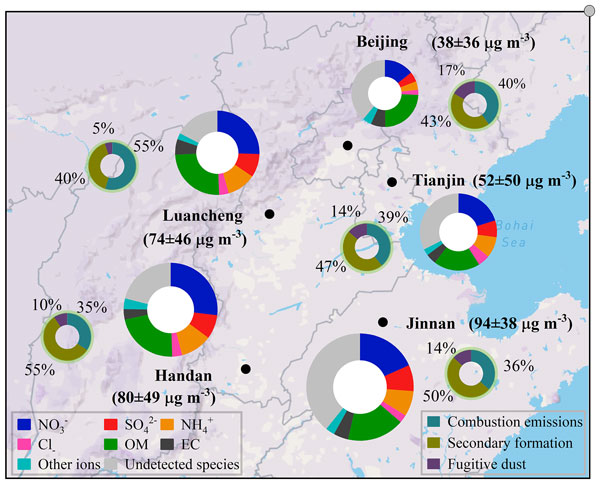
The spatiotemporal differences in chemical compositions, sources of organic matter (OM) in PM2.5 among sampling sites are illustrated in Fig. 1. As the major component of PM2.5, water soluble ions (WSIs) accounted for approximately 30 %–53 % of PM2.5; Similar to the spatial pattern of PM2.5, WSIs also exhibited high loads in JN (40.4 ± 23.2 µg m−3) and HD (44.1 ± 34.3 µg m−3), which were ∼ 1.2–4 fold of those measured in other sites. From Fig. 1, nitrate was the most abundant ion across the NCP, accounting for 14 %–27 % of PM2.5, followed by sulfate (5 %–9 %) and ammonium (4 %–11 %), respectively. Compared to those in urban sites, relative abundance of SNA (SO, NO and NH) in rural site (LC) moderately enhanced by 10 %–23 %, indicating a significant influence of secondary aerosol formation in the rural area. Furthermore, a relatively high concentration of chloride was detected among the sampling sites, even with a molarity being >1.5-fold of that of sulfate (Fig. S5a). A strong correlation between chloride and levoglucosan+Benzo[k]fluoranthene (BkF) across the sampling sites (R2=0.97) implied that combustion emissions were the primary source for the abundant chloride in the NCP (Fig. S5b). These abundant chlorides could promote heterogeneous formation of sulfate as evidenced by a robust relationship chloride and SOR () (Fig. S5c). This finding was consistent with the results of our laboratory experiments (Wang et al., 2025b, 2016), which demonstrated that the abundant chloride could significantly enhance the uptake of NO2 by interfacial electrostatic attraction, subsequently accelerating sulfate formation.
Table 1Optical properties of BrC, mass concentrations of chemical composition in PM2.5, and meteorological parameters at sampling sites.
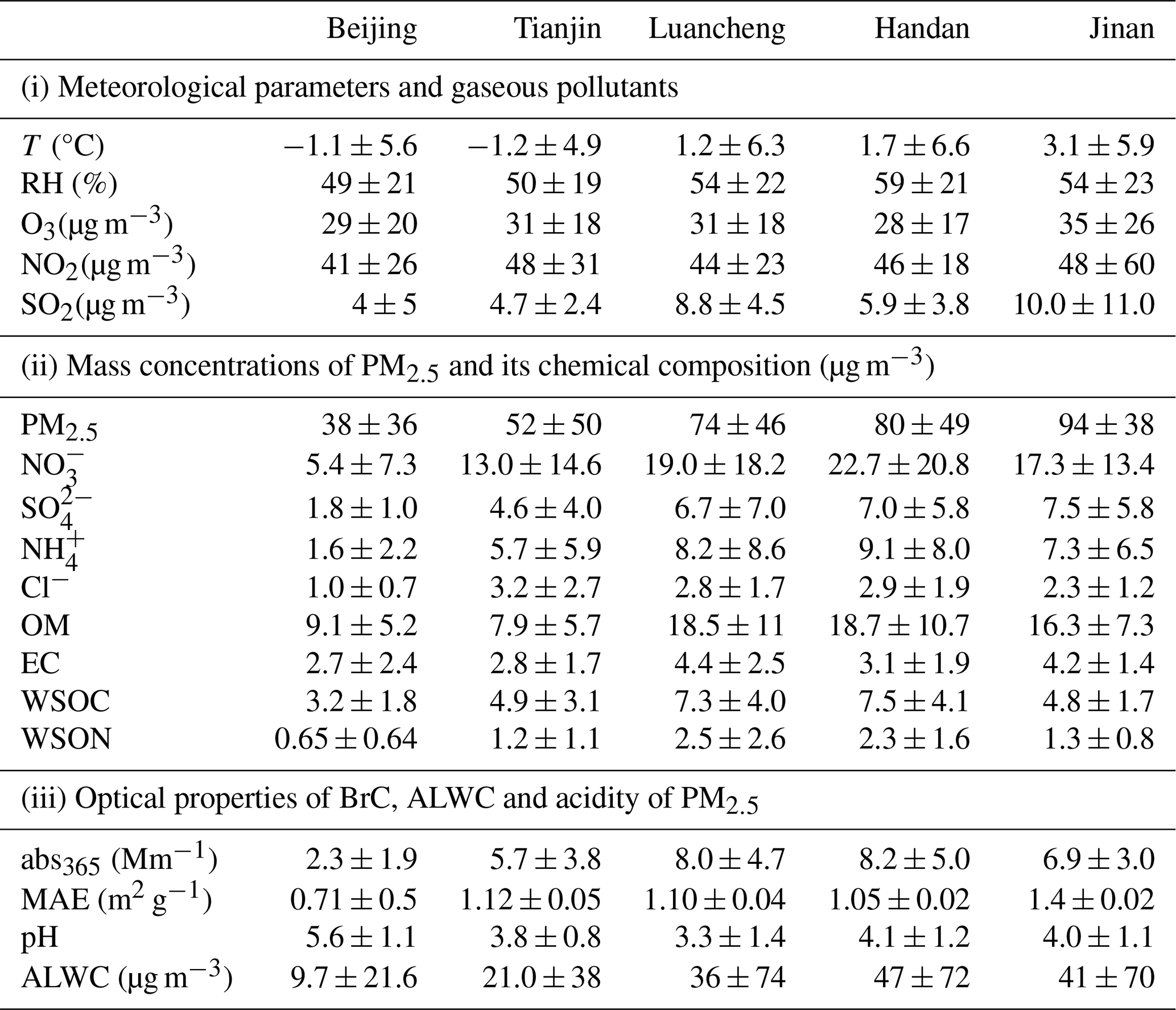
ALWC: aerosol liquid water content; ALWC and pH were simulated by thermodynamic model (ISORROPIA-II), details can be found in Sect. S5.
The average concentration of OM ranged from 7.9 ± 5.7 to 18.7 ± 10.7 µg m−3, accounting for 17 %–25 % of PM2.5. Although OM was a predominant species in PM2.5 at most sites, its spatial distribution differed slightly from that of PM2.5, with high loads in LC (18.5 ± 11 µg m−3) and HD (18.7 ± 10.7 µg m−3). To determine the sources of the abundant OM, a PMF was applied here and identified three types OM sources (Fig. S6, Sect. S1). From Fig. 1, a significant fraction of OM (40 %–55 %) at urban sites was associated with secondary formation, comparable to that in northern regions of China (50 %) (Chen et al., 2024b). In contrast, combustion-derived primary OM accounted for less than 40 % of the total OM. This finding was consistent with the field observations, which demonstrated a widespread decline in primary OM in NCP during 2013–2020 due to the significant reduction in residential fuel burning (Chen et al., 2024b). Notably, about 55 % of OM at rural site was derived from combustion, reflecting an urban-rural variation in sources.
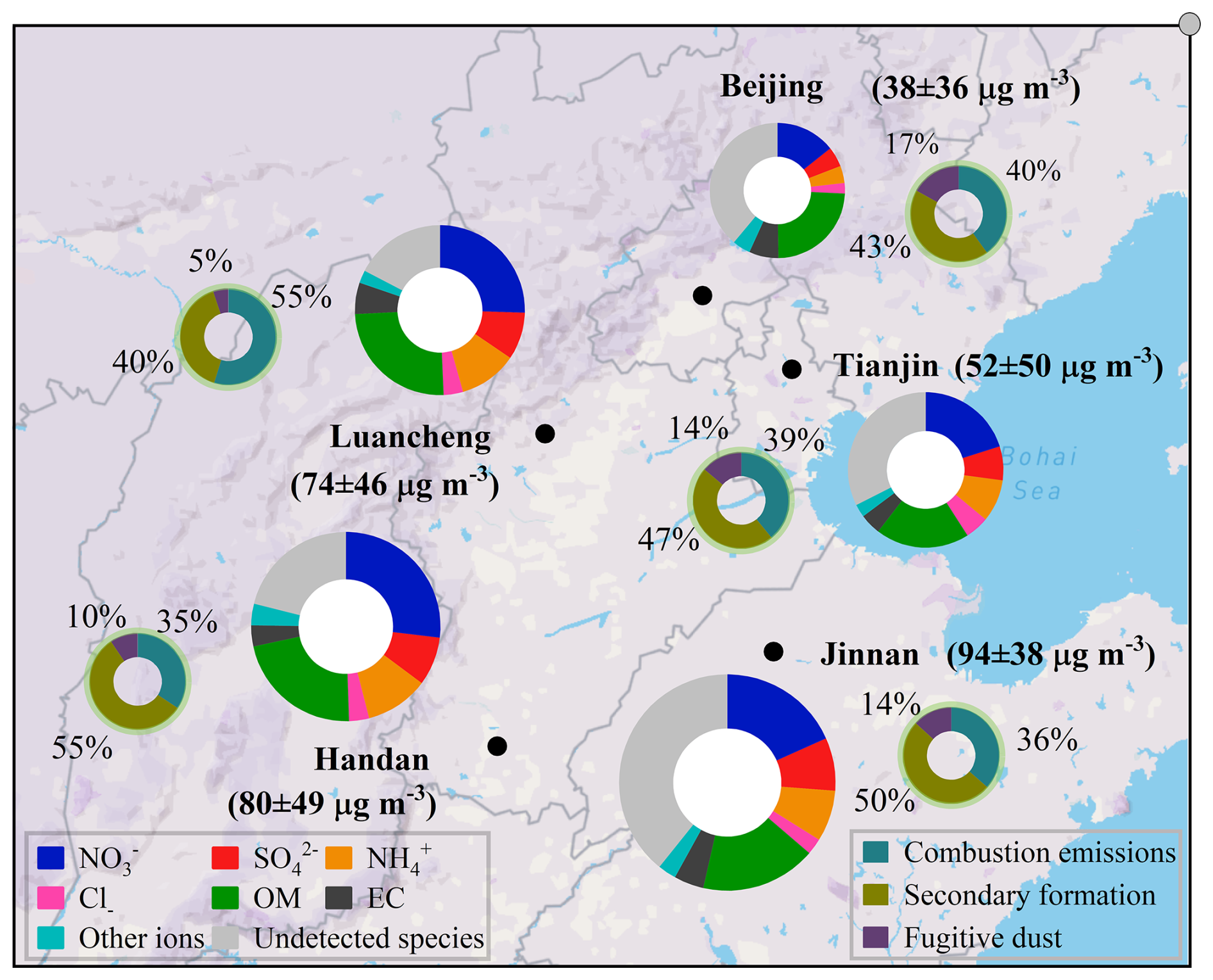
Figure 1Chemical composition of PM2.5 and sources for organic matters (OM) at different sampling sites. The mass concentration data correspond to PM2.5. The maps are the reproductions from © Mapbox (https://account.mapbox.com/, last access: 3 December 2025).
3.2 Spatial variability in optical properties of BrC
Figure 2a displays the average absorption spectra of WSOC across the sampling sites, which exhibits the marked feature of BrC with the reduced light absorption from the ultraviolet to the visible ranges. As illustrated in Table 1 and Fig. 2, the light absorption coefficient at 365 nm (abs365) displayed a spatial pattern similar to that of organic matter (OM) across the five sampling sites. Specifically, the highest average abs365was observed at LC site, with average of (8.0 ± 4.7 Mm−1), followed by HD (7.9 ± 5.0 Mm−1), JN (6.9 ± 3.0 Mm−1), TJ (5.7 ± 3.8 Mm−1) and BJ (2.3 ± 1.9 Mm−1), respectively. Across the sampling sites, abs365 correlated robustly (R2=0.73, p<0.05) with levoglucosan being a known tracer for biomass burning (BB). This implied that water-soluble BrC in the NCP was significantly affected by fresh emissions from BB, which aligns with the prior observations in China (Li et al., 2022b; Desyaterik et al., 2013; Li et al., 2023). Additionally, the BB emission was more pronounced in rural areas, as indicated by a higher mass fraction of levoglucosan to OM (0.67 ± 0.39 %), which was approximately 2.1 to 5 times higher than those in urban areas. These findings highlight the significant impact of anthropogenic combustion on air quality in the rural NCP. From Fig. 2b, the average light-absorption of urban BrC in the NCP exhibited a decline of ∼ 45 % from 10.7 ± 3.0 Mm−1 in 2018 to 5.8 ± 2.2 Mm−1 in 2023. Beijing exhibited a more substantial reduction, where the abs365 was only 16 % of that recorded a decade ago (Fig. 2b). Even so, the averaged abs365 in the NCP still remains higher than that in Nanjing, Guangzhou and urban areas in developed countries (Table S3).
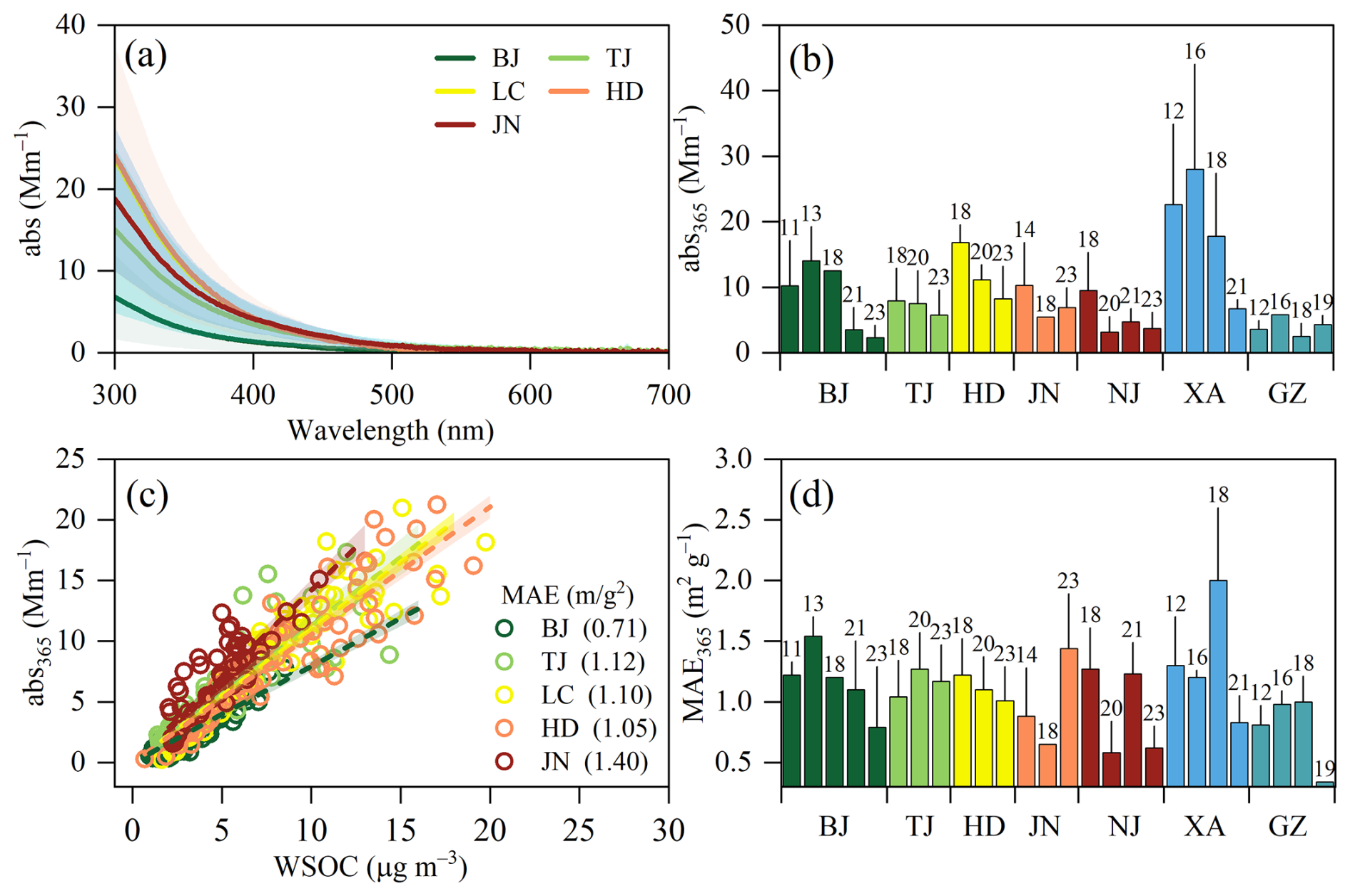
Figure 2Optical properties of BrC at each sampling site. (a, c) Average absorption spectra and mass absorption coefficient of WSOC; (b, d) Comparison of abs365 and MAE365 in different cities of China (NJ, XA and GZ represent Nanjing, Xi'an and Guangzhou; Superscripts indicate the corresponding years, for instance, the superscript “11” refers to 2011. The datasets of (b) and (d) were derived from the literature, and given in Table S4).
As a metric for characterizing the light absorptivity of BrC, the MAE at 365 nm (MAE365) was quantified by the linear regression slope of abs365 against WSOC. As illustrated in Fig. 2c, MAE365 exhibits a distinctly different spatial pattern relative to abs365. A strikingly high MAE365 value was measured in JN (1.4 ± 0.04 m2 g−1), on par with those found in severely polluted regions like Xingtai, Xi'an and Delhi, India (1.2–1.6 m2 g−1, in the cold season) (Li et al., 2023; Wu et al., 2020; Kirillova et al., 2014); And the MAE365 value also falls within the range for documented BrC emitted from residential coal combustion (e.g., 1.20–1.59 m2 g−1 for bituminous coal) (Ni et al., 2021), suggesting that coal combustion is one of the potential sources of atmospheric BrC in JN. Additionally, TJ, LC and HD shared a comparable MAE365 value of approximately 1.1 m2 g−1, which closely matches the values associated with biomass burning-derived BrC (1.2 ± 0.3 m2 g−1) (Cao et al., 2021). This finding further indicated a significant effect of biomass burning on the wintertime BrC in the NCP, which can be corroborated by the concentration-weighted trajectory (CWT) analysis. As shown in Fig. 3, high CWT loadings for abs365 were predominantly associated with regions characterized by concentrated fire hotspots, especially in LC, HD and their adjacent areas. Of note, the MAE365 of the BrC in BJ was the lowest (0.71 ± 0.02 m2 g−1), only half that of JN. This relatively weak light absorptivity of BrC in BJ may be attributable to substantial vehicle emissions, as BrC from this source typically exhibits relatively low MAE values, ranging from approximately 0.35 to 0.71 m2 g−1 (Tang et al., 2020; Huang et al., 2022). Another possibility is that the aerosol in BJ was more age, because BrC light-absorption would decay in the aerosol aging process as revealed by observational and experimental findings (Hems et al., 2021; Qiu et al., 2024). This can be confirmed by the ratio (). Since BaP is easily degraded via atmospheric oxidation while BeP is chemically stable, a higher value indicates more aged atmospheric aerosols. As shown in Fig. S7a, the ratio in BJ was relatively higher than those at other sampling sites. Moreover, a negative correlation between and MAE365further supported this hypothesis (Fig. S7b). In Fig. 2d, we can note that unlike the temporal evolution of abs365, the MAE365 of the water-soluble BrC at most sampling sites undergone indistinctive variations in response to the reduction in anthropogenic emission.
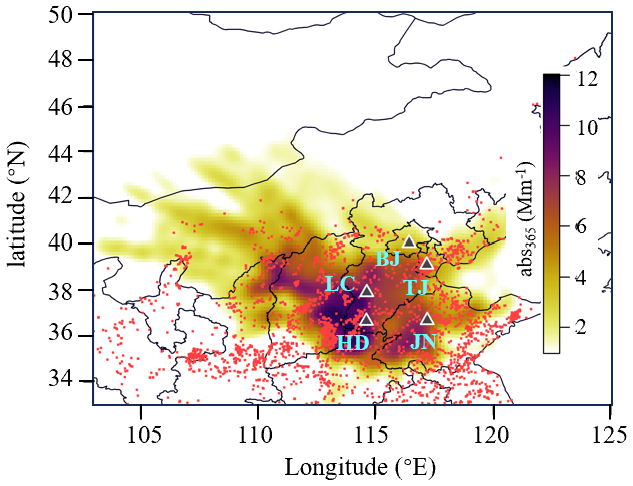
Figure 3The CWT analysis of BrC at sampling sites along with fire hotspot. Fire hotspot data from Fire Information for Resource Management System (FIRMS) were applied to evaluate open biomass burning intensity during the campaign. The data were acquired from the Visible Infrared Imaging Radiometer Suite (VIIRS) sensor and processed using a fire detection algorithm to identify active fire hotspots.
As depicted in Fig. 4a, the optical properties of water-soluble BrC in different periods are plotted in the AAE-MAE405 (log scale) space, with reference to the optically defined BrC classes proposed by Saleh (2020). On average, the water-soluble BrC across the sampling sites exhibits optical characteristics consistent with biomass-burning and coal-combustion sources, falling into the “weakly” absorbing BrC class. This observation reinforced remarkable impacts of combustion sources on BrC in the NCP. Of particular note, the BrC light-absorptivity was enhanced from clean (PM2.5< 75 µg m−3) to haze (PM2.5 > 75 µg m−3) periods at most sampling sites, coinciding with the increasing N:C ratio (Fig. 4a). And a positive correlation between N:C ratio and abs365 was also found across the NCP (Fig. 4b), indicating that NOCs likely serve as the potential chromophores modulating BrC optical properties in this region (Figue S8). Accordingly, the high N:C ratio was also associated with an elevated WSOC/OC ratio (Fig. 4b), implying that the secondary formation was likely the predominant source of the N-containing chromophores in the NCP.
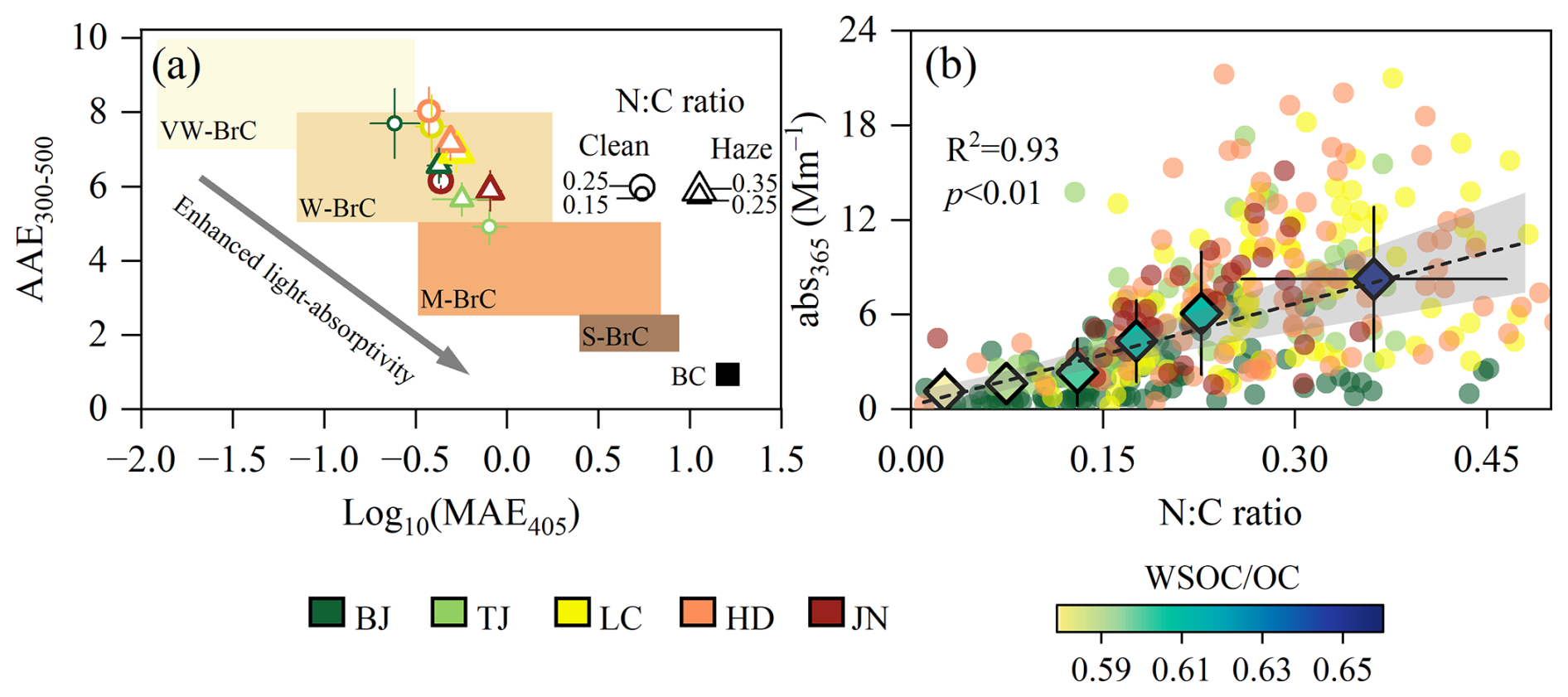
Figure 4Graphical representation of optical-based BrC classes in log10(MAE405)-AAE space (a). The shaded regions represent very weakly light-absorbing BrC (VW-BrC), weakly light-absorbing BrC (W-BrC), moderately light-absorbing BrC (M-BrC), strongly light-absorbing BrC (S-BrC), and absorbing BC, respectively. Panel (b) shows the linear fit regressions for abs365 with N:C ratio (Diamonds indicate the averaged abs365 and N:C ratio of all sites in each binned N:C interval, with bars representing standard deviations).
3.3 Secondary formation N-containing compounds in the NCP
To obtain the contribution of secondary formation to the water-soluble organic nitrogen, a tracer method analogous to that used for estimating secondary organic carbon (SOC) with EC as a tracer was adopted here (Sect. S2 in the Supplement). This approach assumes that combustion-related primary WSON (WSONpri) share the common sources with EC and can be approximated using a representative primary ratio. Based on the sensitivity tests (Table S4), the primary ratios used here can capture temporal variations of the WSONpri, which positively correlated with CO at all sampling sites. Even so, the secondary WSON (WSONsec) may still be overestimated because a fraction of WSONpri may arise from non-combustion sources. Therefore, the derived secondary fractions here should be interpreted as semi-quantitative estimates rather than precise source apportionments. From the results illustrated in Fig. 5a, a dominant role of secondary formation in WSON accumulation was observed across five sites. Specifically, secondary WSON in BJ explained more than approximately 64 ± 21 % of the total WSON, which was comparable to those at other urban sites but was approximately 1.2-fold of that in LC. Such spatial pattern was attribute to the enhanced primary emission (e.g., biomass burning) in rural site. Additionally, the fractional contribution of WSONsec increased with the rising PM2.5 levels (Fig. S8) across sampling sites, particularly in BJ. Above findings further highlighted the critical role of secondary formation in regulating the abundance of strongly light-absorbing N-containing chromophores during haze periods.
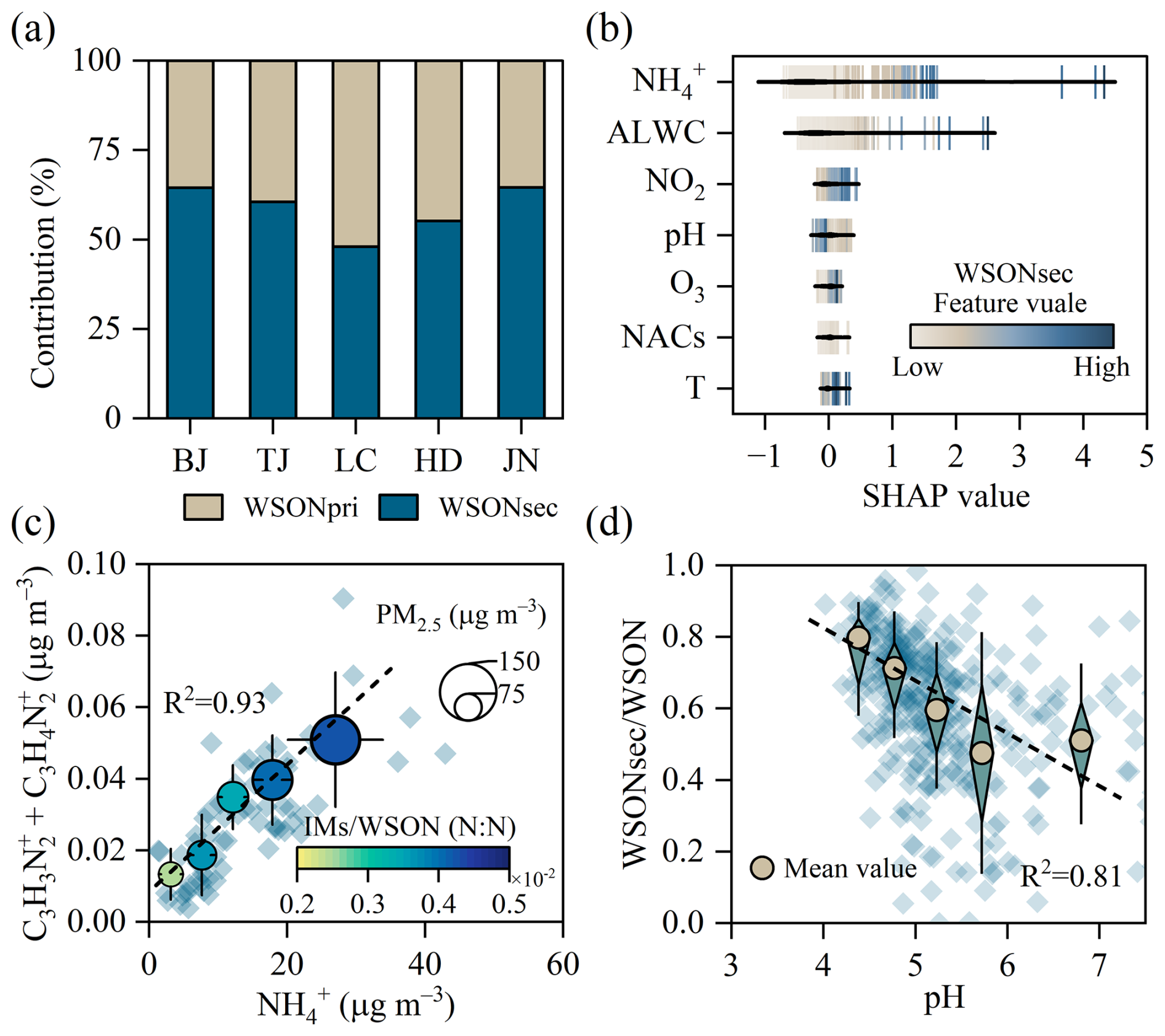
Figure 5Aqueous formation of N-containing compounds in the NCP. Fractional contribution of primary water-soluble organic nitrogen (WSONpri) and secondary WSON (WSONsec) to the total (a); SHAP feature importance assessment for the key factors affecting WSONsec (b); Linear correlation between IMs-related fragments and NH with different PM2.5 loads (the fragment signals do not represent absolute molecular abundances) (c); panel (d) shows the linear fit regressions for WSONsec WSON with pH value across the NCP. (Circles in c and d show grouped mean statistics over all sampling site).
3.3.1 Aerosol aqueous formation of light-absorbing NOCs
The secondary WSON formation can be affected by multiple factors, e.g., NH, NO2, O3, ALWC, pH, NACs and meteorological factors. To investigate the contributions of these factors to WSONsec, a random forest analysis was conducted here and demonstrated that atmospheric WSONsec in the NCP was largely affected by NH (∼ 48 %) and ALWC (∼ 28 %). Given the limited capability of the RF model to capture interactive and nonlinear relationships between driving factors and WSONsec, a generalized additive model (GAM) was applied here, which is a nonparametric modeling framework (Sect. S3). As shown in Fig. S9, the GAM model can robustly rebuild the WSONsec variation, and consistently identified NH and ALWC as the primary driving factors of WSONsec. These results only reflect the statistical relationships among above factors and may not fully capture the responses of the actual atmosphere. Accordingly, we also analyzed the ionic fragments of hydroxy methanesulfonic acid (MSA) predominantly formed via aqueous-phase reactions, which exhibited a significant positive correlation with WSONsec during humid haze episode (Fig. S10). All the above evidence indicated that WSONsec formation was closely linked to the aqueous processing in this region. Above phenomenon is presumably prevalent across China, as it has been observed in the rural site (Xianghe) in the NCP, Yangtze River Delta, the Guanzhong Plain, and even the upper boundary layer (Liu et al., 2023; Wu et al., 2024a; Xiao et al., 2025). Previously, aqueous-phase reactions via α-dicarbonyls (e..g, methylglyoxal and glyoxal) with NH3 have been identified as an important formation pathway for N-heterocyclic species (e.g., imidazoles, IMs) (Yang et al., 2024; Aiona et al., 2017; Lin et al., 2015), of which yield can be regulated by the chemical forms of ammonium in aerosol. Specially, the uptake coefficient of methylglyoxal or glyoxal (the prevalent α-dicarbonyls in the atmosphere) on (NH4)2SO4 seed was significantly higher than on NH4HSO4 seed, thereby leading to an enhanced yield of N-heterocycles and their oligomers (Li et al., 2021b). Whereas it has been confirmed theoretically that the aerosol across five sites were characterized by abundant (NH4)2SO4and NH4NO3 as shown in Fig. S11a and Sect. S4. These hygroscopic (NH4)2SO4particles would promote N-containing compounds formation via NH3-mediated aqueous-phase chemistry. To further validate above assumption, IMs-related fragments (e.g., C3H3N and C3H4N) were measured by offline AMS analysis during a humid haze episode across the NCP. Although this approach does not provide actual ambient concentrations of individual imidazole compounds, the fragment signals can serve as supportive indicators to characterize the evolution of imidazole-related species, because they exhibit strong linear correlations with the measured ambient concentrations of the corresponding compounds. (Fig. S4). During this event, the was approximately 1.5-fold of that observed in the remaining periods (Fig. S11b), indicating that aerosols were far more likely to be in the liquid phase during this period. In the atmosphere, IMs can be either directly emitted from biomass burning or secondarily produced via aqueous reactions (Gao et al., 2021). As illustrated in Figs. 5c and S12, IMs-related fragments weakly correlated with the levoglucosan+BkF (R2=0.02, p>0.05) but strongly with ammonium (R2=0.93, p<0.01), suggesting that a major fraction of the IMs-like heterocyclic compounds was secondarily formed during the humid event. As the haze episode evolved, the (N:N) ratio increased dramatically across the NCP, further suggesting an important role of NH3-induced chemistry in NOCs formation under moist environments.
Additionally, aerosol acidity also modulated the WSON formation, with relative importance being ∼ 8 % (Fig. 5b). Figure 5d clearly demonstrates a negative correlation between the mass fraction of WSONsec in the total WSON and aerosol pH, indicating that acidic condition likely favors NOCs formation. It is possible that ammonia would be more readily partitioned into acidic aerosol, thereby promoting the formation of NOCs. Consistent with this hypothesis, our estimation of the gas-to-particle partitioning coefficient for NH3 () showed that at pH 3.0 was one order of magnitude higher than that at pH 5.0 (Sect. S4). And numerous experimental evidences have established that the reactions of with carbonyl are generally acid catalyzed (Liu et al., 2015b; Zhang et al., 2015). Furthermore, our recent findings confirmed that compared to the neutral aerosols, acidic aerosols are more conducive to the formation of high-molecular-weight NOCs through carbonyl-to-NH3 reactions, which exhibit stronger light-absorptivity (Zhang et al., 2024).
3.3.2 Gas-phase formation of light-absorbing NOCs
It is worth noting that NO2 and O3 explained over 8 % and 6 % of the variances in the WSONsec (Fig. 5b), implying that partial WSONsec presumably formed by gas-phase photochemical oxidation under relatively high NOx loadings. To verify this, nine NACs herein were quantified, which typically derived from gas-phase reactions of polyphenols with radicals, and followed by partitioning into the aerosol. As shown in Fig. 6a, 4-Nitrophenol (4NP) and 4-Nitrocatechol (4NC) were the dominant species among the detected NACs. On average, they accounted for 56.8 %–74.0 % and 10.3 %–20.7 % of the total NACs across the five sites, respectively. This finding is consistent with previous observations reported in Shanghai (Liu et al., 2023), Dezhou (Li et al., 2021a), and Xinglong (Sun et al., 2026).
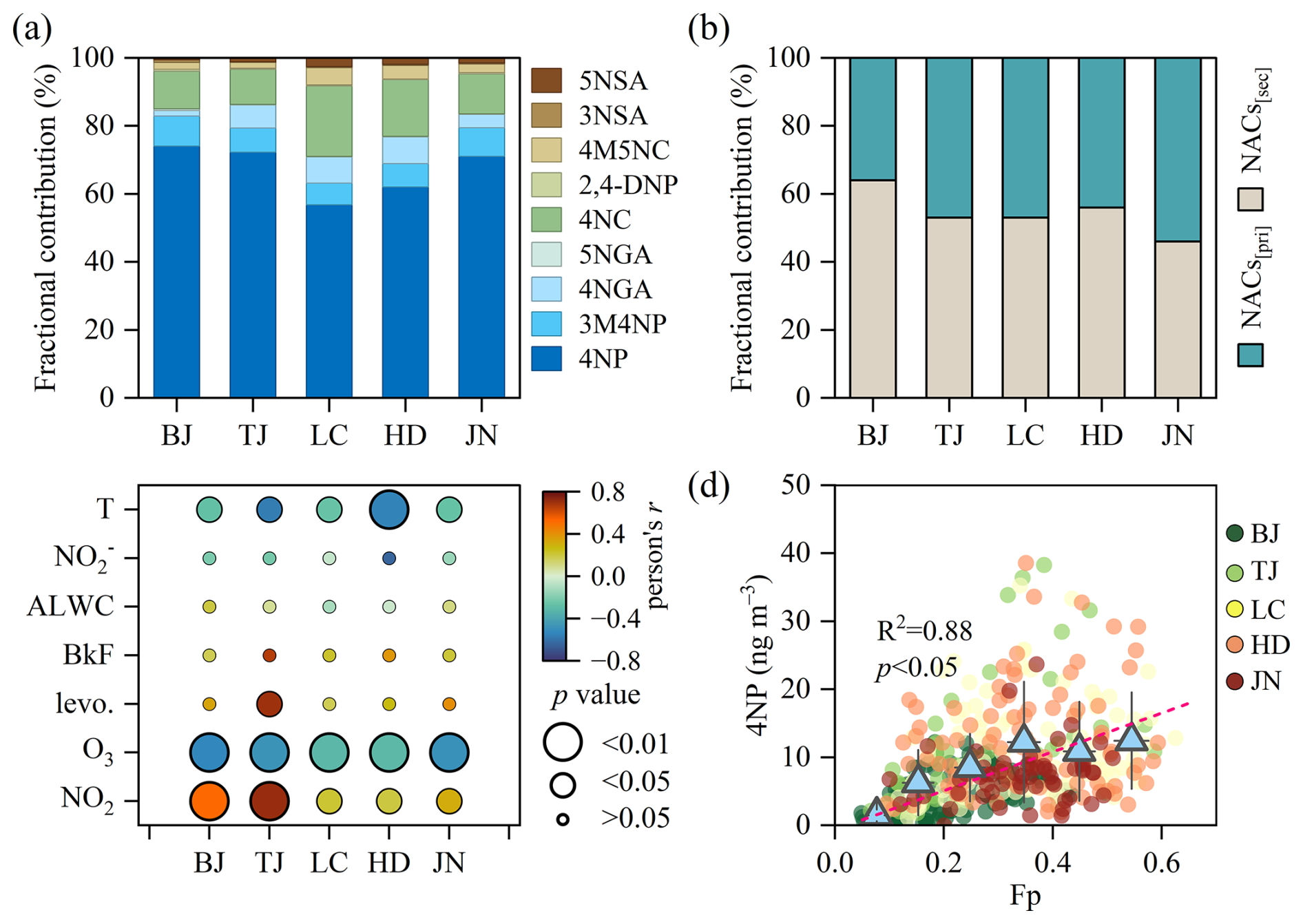
Figure 6Chemical composition and formation of NACs. Fractional mass contribution of individual NAC to the total (a); Relative contributions of primary emissions (NACs[pri]) and secondary formation (NACs[sec]) to the detected NACs (b); Pearson coefficients between NACs[sec]and various influencing factors (c); Linear regression analysis for particulate 4NP with its gas-to-particle-phase partitioning coefficient (d). (Triangles in panel d correspond to the bin-averaged 4NP versus Fp over all sampling sites, cross bars represent standard deviation.)
Furthermore, secondary NACs were also quantified following the semi-quantitative method of WSONsec. As depicted in Fig. 6b, secondary formation played a dominant role in NACs accumulation, contributing approximately 46 %–64 % of total NACs across the five sites. Notably, secondary NACs (NACs[sec]) at all sites except TJ correlated strongly with NO2 (p<0.05) but displayed no significant relationships with levoglucosan and BkF, suggesting a potentially important role of gas-phase oxidation in NACs formation. Previously, it is has been well established that nitrite is an important source of aerosol aqueous-phase NO2 radical (Vione et al., 2004), which can react with aromatic compounds (e.g., phenol or catechol) to yield corresponding NACs. However, secondary NACs (NACs[sec]) exhibited weak correlations with NO and ALWC (Fig. 6c) and no significant correlation with the ionic fragments of MSA (Fig. S10), a species formed predominantly through aqueous-phase processing. These patterns were consistent with an important contribution of gas-phase oxidation to NACs[sec] formation during the campaign.
Notably, the NACs[sec] exhibited a temperature-dependent pattern across all sampling sites (P<0.05, Fig. 6c). It is possible that ambient temperature largely affected gas-to-particle partitioning of the NACs, thereby moderating the abundance of particulate NACs. On this basis, we theoretically estimated the fraction of particulate 4NP (Fp) relative to the total based on the Pankow's absorption equilibrium theory, obtaining an average Fp of 0.3 ± 0.1 across the NCP. This predicted value was within the range of field observations (0.2 in Hongkong to 0.75 on Mt. Tai) (Li et al., 2022a; Chen et al., 2025). As depicted in Fig. 6d, the Fp correlated positively with the particulate 4NP, again suggesting that partial NOCs are formed by gas-phase photooxidation reactions, subsequently partitioning into the aerosol. In addition, temperature can also affect the abundance of NACs regulating the rates of numerous photochemical reactions. For instance, Lignell et al. (2014) found that low temperature substantially restrained the photolysis of 2, 4-Dinitrophenol in secondary organic aerosols, with its decay rate at 0 °C dropping by nearly one order of magnitude relative to 25 °C. Correspondingly, the low-temperature atmospheric environment likely inhibited the photolysis of NACs during the campaign, thereby facilitating their accumulation in the particle phase. This may be one of the reasons for the significant negative correlation between NACs and temperature.
Synchronous observations of the optical properties and chemical compositions of water-soluble BrC were conducted at five sites across the NCP during the winter of 2023. The OM was identified as the predominant component of PM2.5 at all sampling sites, accounting for 40 %–55 % of the PM2.5. The water-soluble BrC in rural area exhibited a higher light-absorption, being approximately 1.1–3.5 folds of those recorded at urban sites. Compared with the previous observations, the average light absorption of urban BrC decreased substantially by roughly 45 % over the period 2018–2023, which was mainly due to significant anthropogenic emission controls in the NCP. The average MAE365 ranged from 0.7 ± 0.04 to 1.40 ± 0.02 m2 g−1, with a distinctly different spatial pattern. Specially, a strikingly high MAE365 value (1.40 ± 0.02 m2 g−1) was measured in JN, falls within the range for BrC emitted from residential coal combustion. While, the MAE365 values of BrC (∼ 1.1 m2 g−1) in TJ, LC and HD were closely matched the values associated with biomass burning-derived BrC. The MAE365 value in BJ was the lowest among all the sampling sites, which was likely ascribed to enhanced photobleaching during aerosol aging.
During the haze periods, we found that the MAE365 of water-soluble BrC at most sample sites was 1.5-fold of that in clean periods, indicating enhanced light-absorptivity of BrC as the haze developed. Of particular note, a parallel variation was also found for N:C ratio. These findings indicated that N-containing compounds (NOCs), as crucial chromophores affecting water-soluble BrC optical properties in the NCP, were abundantly formed in the aerosol aging process. Additionally, these secondary NOCs were closely associated with the aerosol aqueous reactions, in which ammonia playing an important role. In the previous observation conducted on Mt. Hua (Wu et al., 2024a), we also revealed that ammonia-driven aerosol aqueous reactions can also significantly promote BrC formation during the air mass lifting process. Consequently, NH3 is probably one of the important factors contributing to the high loading of strongly light-absorbing BrC within the boundary layer across China. This effect is likely to be particularly pronounced during moist winter haze episodes, when enhanced aerosol liquid water facilitates aqueous-phase reactions. Accordingly, targeted NH3 emission control may be important for further mitigating haze and BrC pollution under such conditions in ammonia-rich regions.
The primary data used in this study can be obtained from https://doi.org/10.5281/zenodo.17947347 (Wu, 2025b). Other data utilized in the present study are available from the corresponding author on request.
The supplement related to this article is available online at https://doi.org/10.5194/acp-26-14229-2026-supplement.
G.W. designed research and contributed analytic tools. CW, ZL BX and RL collected the samples. CW and YC conducted the sample analysis. CW performed the data interpretation. CW and GW wrote the paper. All authors contributed to the paper with useful scientific discussions.
The contact author has declared that none of the authors has any competing interests.
Publisher's note: Copernicus Publications remains neutral with regard to jurisdictional claims made in the text, published maps, institutional affiliations, or any other geographical representation in this paper. The authors bear the ultimate responsibility for providing appropriate place names. Views expressed in the text are those of the authors and do not necessarily reflect the views of the publisher.
This work acknowledge financial support from the National Key Research and Development Program of China and the National Natural Science Foundation of China.
This research has been supported by the National Key Research and Development Program of China (grant no. 2023YFC3706302) and the National Natural Science Foundation of China (grant nos. 42130704 and 42477097).
This paper was edited by Alex Lee and reviewed by two anonymous referees.
Aiona, P. K., Lee, H. J., Leslie, R., Lin, P., Laskin, A., Laskin, J., and Nizkorodov, S. A.: Photochemistry of Products of the Aqueous Reaction of Methylglyoxal with Ammonium Sulfate, ACS Earth and Space Chemistry, 1, 522–532, https://doi.org/10.1021/acsearthspacechem.7b00075, 2017.
Andreae, M. O. and Gelencsér, A.: Black carbon or brown carbon? The nature of light-absorbing carbonaceous aerosols, Atmos. Chem. Phys., 6, 3131–3148, https://doi.org/10.5194/acp-6-3131-2006, 2006.
Cao, T., Li, M., Zou, C., Fan, X., Song, J., Jia, W., Yu, C., Yu, Z., and Peng, P.: Chemical composition, optical properties, and oxidative potential of water- and methanol-soluble organic compounds emitted from the combustion of biomass materials and coal, Atmos. Chem. Phys., 21, 13187–13205, https://doi.org/10.5194/acp-21-13187-2021, 2021.
Chen, H. B., Zhou, R. Z., Fang, L., Sun, H. L., Yang, Q. Y., Niu, H. Y., Liu, J. W., Tian, Y. Z., Cui, M., and Yan, C. Q.: Variations in optical properties of water- and methanol-soluble organic carbon in PM2.5 in Tianjin and Handan over the Wintertime of 2018–2020, Atmos. Res., 303, https://doi.org/10.1016/j.atmosres.2024.107332, 2024a.
Chen, J. M., Li, C. L., Ristovski, Z., Milic, A., Gu, Y. T., Islam, M. S., Wang, S. X., Hao, J. M., Zhang, H. F., He, C. R., Guo, H., Fu, H. B., Miljevic, B., Morawska, L., Thai, P., Lam, Y. F., Pereira, G., Ding, A. J., Huang, X., and Dumka, U. C.: A review of biomass burning: Emissions and impacts on air quality, health and climate in China, Sci. Total Environ., 579, 1000-1034, https://doi.org/10.1016/j.scitotenv.2016.11.025, 2017.
Chen, Q., Miao, R. Q., Geng, G. N., Shrivastava, M., Dao, X., Xu, B. Y., Sun, J. Q., Zhang, X., Liu, M. Y., Tang, G. G., Tang, Q., Hu, H. W., Huang, R. J., Wang, H., Zheng, Y., Qin, Y., Guo, S., Hu, M., and Zhu, T.: Widespread 2013–2020 decreases and reduction challenges of organic aerosol in China, Nat. Commun., 15, https://doi.org/10.1038/s41467-024-48902-0, 2024b.
Chen, Y., Xia, M., Zheng, P. G., Li, Y. M., Zou, Z. X., Tong, S. R., Li, K., Feng, X., Hui, L. R., Yuan, Q., Li, J. J., Yu, J. Z., Lee, S. C., Wang, T., and Wang, Z.: Complex gas-particle partitioning of nitro-phenolic compounds: field-based insights and determination of apparent activity coefficient, Npj Climate and Atmospheric Science, 8, https://doi.org/10.1038/s41612-025-01156-z, 2025.
Daellenbach, K. R., Uzu, G., Jiang, J. H., Cassagnes, L. E., Leni, Z., Vlachou, A., Stefenelli, G., Canonaco, F., Weber, S., Segers, A., Kuenen, J. J. P., Schaap, M., Favez, O., Albinet, A., Aksoyoglu, S., Dommen, J., Baltensperger, U., Geiser, M., El Haddad, I., Jaffrezo, J. L., and Prévôt, A. S. H.: Sources of particulate-matter air pollution and its oxidative potential in Europe, Nature, 587, 414–419, https://doi.org/10.1038/s41586-020-2902-8, 2020.
Desyaterik, Y., Sun, Y., Shen, X. H., Lee, T. Y., Wang, X. F., Wang, T., and Collett, J. L.: Speciation of ”brown” carbon in cloud water impacted by agricultural biomass burning in eastern China, J. Geophys. Res.-Atmos., 118, 7389–7399, https://doi.org/10.1002/jgrd.50561, 2013.
Fang, T., Lakey, P. S. J., Weber, R. J., and Shiraiwa, M.: Oxidative Potential of Particulate Matter and Generation of Reactive Oxygen Species in Epithelial Lining Fluid, Environ. Sci. Technol., 53, 12784–12792, https://doi.org/10.1021/acs.est.9b03823, 2019.
Feng, Y., Ramanathan, V., and Kotamarthi, V. R.: Brown carbon: a significant atmospheric absorber of solar radiation?, Atmos. Chem. Phys., 13, 8607–8621, https://doi.org/10.5194/acp-13-8607-2013, 2013.
Finewax, Z., de Gouw, J. A., and Ziemann, P. J.: Identification and Quantification of 4-Nitrocatechol Formed from OH and NO3 Radical-Initiated Reactions of Catechol in Air in the Presence of NOx: Implications for Secondary Organic Aerosol Formation from Biomass Burning, Environ. Sci. Technol., 52, 1981–1989, https://doi.org/10.1021/acs.est.7b05864, 2018.
Gao, K., Zhang, Y. D., Liu, Y. Y., Yang, M. G., and Zhu, T.: Screening of imidazoles in atmospheric aerosol particles using a hybrid targeted and untargeted method based on ultra-performance liquid chromatography-quadrupole time-of-flight mass spectrometry, Anal. Chim. Acta, 1163, https://doi.org/10.1016/j.aca.2021.338516, 2021.
Ge, X., Sun, Y., Trousdell, J., Chen, M., and Zhang, Q.: Enhancing characterization of organic nitrogen components in aerosols and droplets using high-resolution aerosol mass spectrometry, Atmos. Meas. Tech., 17, 423–439, https://doi.org/10.5194/amt-17-423-2024, 2024.
Gligorovski, S., Strekowski, R., Barbati, S., and Vione, D.: Environmental Implications of Hydroxyl Radicals (•OH), Chem. Rev., 115, 13051–13092, https://doi.org/10.1021/cr500310b, 2015.
Gong, Y., Huang, R.-J., Yang, L., Wang, T., Yuan, W., Xu, W., Cao, W., Wang, Y., and Li, Y.: Measurement report: Brown carbon aerosol in polluted urban air of the North China Plain – day–night differences in the chromophores and optical properties, Atmos. Chem. Phys., 23, 15197–15207, https://doi.org/10.5194/acp-23-15197-2023, 2023.
Grace, D. N., Lugos, E. N., Ma, S. Q., Griffith, D. R., Hendrickson, H. P., Woo, J. L., and Galloway, M. M.: Brown Carbon Formation Potential of the Biacetyl-Ammonium Sulfate Reaction System, ACS Earth and Space Chemistry, 4, 1104–1113, https://doi.org/10.1021/acsearthspacechem.0c00096, 2020.
Hammer, M. S., Martin, R. V., van Donkelaar, A., Buchard, V., Torres, O., Ridley, D. A., and Spurr, R. J. D.: Interpreting the ultraviolet aerosol index observed with the OMI satellite instrument to understand absorption by organic aerosols: implications for atmospheric oxidation and direct radiative effects, Atmos. Chem. Phys., 16, 2507–2523, https://doi.org/10.5194/acp-16-2507-2016, 2016.
He, S. and Carmichael, G. R.: Sensitivity of photolysis rates and ozone production in the troposphere to aerosol properties, J. Geophys. Res.-Atmos., 104, 26307–26324, https://doi.org/10.1029/1999jd900789, 1999.
Hems, R. F. and Abbatt, J. P. D.: Aqueous Phase Photo-oxidation of Brown Carbon Nitrophenols: Reaction Kinetics, Mechanism, and Evolution of Light Absorption, ACS Earth and Space Chemistry, 2, 225–234, https://doi.org/10.1021/acsearthspacechem.7b00123, 2018.
Hems, R. F., Schnitzler, E. G., Liu-Kang, C., Cappa, C. D., and Abbatt, J. P. D.: Aging of Atmospheric Brown Carbon Aerosol, ACS Earth and Space Chemistry, 5, 722–748, https://doi.org/10.1021/acsearthspacechem.0c00346, 2021.
Hu, X. F., Belle, J. H., Meng, X., Wildani, A., Waller, L. A., Strickland, M. J., and Liu, Y.: Estimating PM2.5 Concentrations in the Conterminous United States Using the Random Forest Approach, Environ. Sci. Technol., 51, 6936–6944, https://doi.org/10.1021/acs.est.7b01210, 2017.
Huang, R. J., Yuan, W., Yang, L., Yang, H. N., Cao, W. J., Guo, J., Zhang, N. N., Zhu, C. S., Wu, Y. F., and Zhang, R. J.: Concentration, optical characteristics, and emission factors of brown carbon emitted by on-road vehicles, Sci. Total Environ., 810, https://doi.org/10.1016/j.scitotenv.2021.151307, 2022.
Jiang, H. H., Frie, A. L., Lavi, A., Chen, J. Y., Zhang, H. F., Bahreini, R., and Lin, Y. H.: Brown Carbon Formation from Nighttime Chemistry of Unsaturated Heterocyclic Volatile Organic Compounds, Environ. Sci. Technol. Letters, 6, 184–190, https://doi.org/10.1021/acs.estlett.9b00017, 2019.
Jiang, X. T., Liu, D. T., Li, Q., Tian, P., Wu, Y. Z., Li, S. Y., Hu, K., Ding, S., Bi, K., Li, R. J., Huang, M. Y., Ding, D. P., Chen, Q. C., Kong, S. F., Li, W. J., Pang, Y., and He, D.: Connecting the Light Absorption of Atmospheric Organic Aerosols with Oxidation State and Polarity, Environ. Sci. Technol., 56, 12873–12885, https://doi.org/10.1021/acs.est.2c02202, 2022.
Jo, D. S., Park, R. J., Lee, S., Kim, S.-W., and Zhang, X.: A global simulation of brown carbon: implications for photochemistry and direct radiative effect, Atmos. Chem. Phys., 16, 3413–3432, https://doi.org/10.5194/acp-16-3413-2016, 2016.
Kirillova, E. N., Andersson, A., Tiwari, S., Srivastava, A. K., Bisht, D. S., and Gustafsson, Ö.: Water-soluble organic carbon aerosols during a full New Delhi winter: Isotope-based source apportionment and optical properties, J. Geophys. Res.-Atmos., 119, 3476–3485, https://doi.org/10.1002/2013jd020041, 2014.
Lack, D. A., Langridge, J. M., Bahreini, R., Cappa, C. D., Middlebrook, A. M., and Schwarz, J. P.: Brown carbon and internal mixing in biomass burning particles, P. Natl. Acad. Sci. USA, 109, 14802–14807, https://doi.org/10.1073/pnas.1206575109, 2012.
Laskin, A., Laskin, J., and Nizkorodov, S. A.: Chemistry of Atmospheric Brown Carbon, Chem. Rev., 115, 4335–4382, https://doi.org/10.1021/cr5006167, 2015.
Li, D. P., Wu, C., Zhang, S., Lei, Y. L., Lv, S. J., Du, W., Liu, S. J., Zhang, F., Liu, X. D., Liu, L., Meng, J. J., Wang, Y. S., Gao, J., and Wang, G. H.: Significant coal combustion contribution to water-soluble brown carbon during winter in Xingtai, China: Optical properties and sources, J. Environ. Sci., 124, 892–900, https://doi.org/10.1016/j.jes.2022.02.026, 2023.
Li, K., Jacob, D. J., Liao, H., Shen, L., Zhang, Q., and Bates, K. H.: Anthropogenic drivers of 2013-2017 trends in summer surface ozone in China, P. Natl. Acad. Sci. USA, 116, 422–427, https://doi.org/10.1073/pnas.1812168116, 2019.
Li, M., Wang, X. F., Zhao, Y. N., Du, P., Li, H. Y., Li, J. R., Shen, H. Q., Liu, Z. Y., Jiang, Y. R., Chen, J., Bi, Y. J., Zhao, Y., Xue, L. K., Wang, Y., Chen, J. M., and Wang, W. X.: Atmospheric Nitrated Phenolic Compounds in Particle, Gaseous, and Aqueous Phases During Cloud Events at a Mountain Site in North China: Distribution Characteristics and Aqueous-Phase Formation, J. Geophys. Res.-Atmos., 127, https://doi.org/10.1029/2022jd037130, 2022a.
Li, X., Hu, M., Wang, Y. J., Xu, N., Fan, H. Y., Zong, T. M., Wu, Z. J., Guo, S., Zhu, W. F., Chen, S. Y., Dong, H. B., Zeng, L. M., Yu, X. N., and Tang, X. Y.: Links between the optical properties and chemical compositions of brown carbon chromophores in different environments: Contributions and formation of functionalized aromatic compounds, Sci. Total Environ., 786, https://doi.org/10.1016/j.scitotenv.2021.147418, 2021a.
Li, X. R., Sun, N. N., Jin, Q. H., Zhao, Z. Y., Wang, L. L., Wang, Q. L., Gu, X., Li, Y. X., and Liu, X. A.: Light absorption properties of black and brown carbon in winter over the North China Plain: Impacts of regional biomass burning, Atmos. Environ., 278, https://doi.org/10.1016/j.atmosenv.2022.119100, 2022b.
Li, Y., Ji, Y., Zhao, J., Wang, Y., Shi, Q., Peng, J., Wang, Y., Wang, C., Zhang, F., Wang, Y., Seinfeld, J. H., and Zhang, R.: Unexpected Oligomerization of Small α-Dicarbonyls for Secondary Organic Aerosol and Brown Carbon Formation, Environ. Sci. Technol., 55, 4430-4439, https://doi.org/10.1021/acs.est.0c08066, 2021b.
Li, Y. M., Fu, T. M., Yu, J. Z., Zhang, A. X., Yu, X., Ye, J. H., Zhu, L., Shen, H. Z., Wang, C., Yang, X., Tao, S., Chen, Q., Li, Y., Li, L., Che, H. Z., and Heald, C. L.: Nitrogen dominates global atmospheric organic aerosol absorption, Science, 387, https://doi.org/10.1126/science.adr4473, 2025.
Lignell, H., Hinks, M. L., and Nizkorodov, S. A.: Exploring matrix effects on photochemistry of organic aerosols, P. Natl. Acad. Sci. USA, 111, 13780–13785, https://doi.org/10.1073/pnas.1322106111, 2014.
Lin, P., Laskin, J., Nizkorodov, S. A., and Laskin, A.: Revealing Brown Carbon Chromophores Produced in Reactions of Methylglyoxal with Ammonium Sulfate, Environ. Sci. Technol., 49, 14257–14266, https://doi.org/10.1021/acs.est.5b03608, 2015.
Liu, D. T., He, C. L., Schwarz, J. P., and Wang, X.: Lifecycle of light-absorbing carbonaceous aerosols in the atmosphere, Npj Climate and Atmospheric Science, 3, https://doi.org/10.1038/s41612-020-00145-8, 2020.
Liu, J., Scheuer, E., Dibb, J., Diskin, G. S., Ziemba, L. D., Thornhill, K. L., Anderson, B. E., Wisthaler, A., Mikoviny, T., Devi, J. J., Bergin, M., Perring, A. E., Markovic, M. Z., Schwarz, J. P., Campuzano-Jost, P., Day, D. A., Jimenez, J. L., and Weber, R. J.: Brown carbon aerosol in the North American continental troposphere: sources, abundance, and radiative forcing, Atmos. Chem. Phys., 15, 7841–7858, https://doi.org/10.5194/acp-15-7841-2015, 2015a.
Liu, X. D., Wang, H. Y., Wang, F. L., Lv, S. J., Wu, C., Zhao, Y., Zhang, S., Liu, S. J., Xu, X. B., Lei, Y. L., and Wang, G. H.: Secondary Formation of Atmospheric Brown Carbon in China Haze: Implication for an Enhancing Role of Ammonia, Environ. Sci. Technol., 57, 11163–11172, https://doi.org/10.1021/acs.est.3c03948, 2023.
Liu, Y., Liggio, J., Staebler, R., and Li, S.-M.: Reactive uptake of ammonia to secondary organic aerosols: kinetics of organonitrogen formation, Atmos. Chem. Phys., 15, 13569–13584, https://doi.org/10.5194/acp-15-13569-2015, 2015b.
Lundberg, S. M. and Lee, S. I.: A Unified Approach to Interpreting Model Predictions, in: 31st Annual Conference on Neural Information Processing Systems (NIPS), Long Beach, CA, 4–9 December 2017, WOS:000452649404081, https://proceedings.neurips.cc/paper/2017/hash/8a20a8621978632d76c43dfd28b67767-Abstract.htmlS16 (last accessed: 23 September 2026), 2017
Ni, H. Y., Huang, R. J., Pieber, S. M., Corbin, J. C., Stefenelli, G., Pospisilova, V., Klein, F., Gysel-Beer, M., Yang, L., Baltensperger, U., El Haddad, I., Slowik, J. G., Cao, J. J., Prévôt, A. S. H., and Dusek, U.: Brown Carbon in Primary and Aged Coal Combustion Emission, Environ. Sci. Technol., 55, 5701–5710, https://doi.org/10.1021/acs.est.0c08084, 2021.
Pankow, J. F., Seinfeld, J. H., Asher, W. E., and Erdakos, G. B.: Modeling the formation of secondary organic aerosol.: 1.: Application of theoretical principles to measurements obtained in the α-pinene/, β- pinene/, sabinene/, Δ3-carene/, and cyclohexene/ozone systems, Environ. Sci. Technol., 35, 1164–1172, https://doi.org/10.1021/es001321d, 2001.
Powelson, M. H., Espelien, B. M., Hawkins, L. N., Galloway, M. M., and De Haan, D. O.: Brown Carbon Formation by Aqueous-Phase Carbonyl Compound Reactions with Amines and Ammonium Sulfate, Environ. Sci. Technol., 48, 985–993, https://doi.org/10.1021/es4038325, 2014.
Qiu, Y. T., Qiu, T., Wu, Z. J., Liu, Y. N., Fang, W. X., Man, R. Q., Liu, Y. C., Wang, J. R., Meng, X. X. Y., Chen, J. C., Liang, D. P., Guo, S., and Hu, M.: Observational Evidence of Brown Carbon Photobleaching in Urban Atmosphere at Molecular Level, Environ. Sci. Technol. Let., 11, 1032–1039, https://doi.org/10.1021/acs.estlett.4c00647, 2024.
Saleh, R.: From Measurements to Models: Toward Accurate Representation of Brown Carbon in Climate Calculations, Current Pollution Reports, 6, 90–104, https://doi.org/10.1007/s40726-020-00139-3, 2020.
Samset, B. H., Stjern, C. W., Andrews, E., Kahn, R. A., Myhre, G., Schulz, M., and Schuster, G. L.: Aerosol Absorption: Progress Towards Global and Regional Constraints, Current Climate Change Reports, 4, 65–83, https://doi.org/10.1007/s40641-018-0091-4, 2018.
Stockwell, C. E., Veres, P. R., Williams, J., and Yokelson, R. J.: Characterization of biomass burning emissions from cooking fires, peat, crop residue, and other fuels with high-resolution proton-transfer-reaction time-of-flight mass spectrometry, Atmos. Chem. Phys., 15, 845–865, https://doi.org/10.5194/acp-15-845-2015, 2015.
Sun, Y., Sun, K., Wu, C., Zhang, H., Chen, Y., Li, Z., Li, R., Xiao, B., Ren, Y., and Wang, G.: Insights into the spatiotemporal differences of brown carbon in North China plain: Composition, optical properties and sources, Atmos. Res., 331, https://doi.org/10.1016/j.atmosres.2025.108648, 2026.
Tang, J., Li, J., Su, T., Han, Y., Mo, Y., Jiang, H., Cui, M., Jiang, B., Chen, Y., Tang, J., Song, J., Peng, P., and Zhang, G.: Molecular compositions and optical properties of dissolved brown carbon in biomass burning, coal combustion, and vehicle emission aerosols illuminated by excitation–emission matrix spectroscopy and Fourier transform ion cyclotron resonance mass spectrometry analysis, Atmos. Chem. Phys., 20, 2513–2532, https://doi.org/10.5194/acp-20-2513-2020, 2020.
Updyke, K. M., Nguyen, T. B., and Nizkorodov, S. A.: Formation of brown carbon via reactions of ammonia with secondary organic aerosols from biogenic and anthropogenic precursors, Atmos. Environ., 63, 22–31, https://doi.org/10.1016/j.atmosenv.2012.09.012, 2012.
Vione, D., Maurino, V., Minero, C., Lucchiari, M., and Pelizzetti, E.: Nitration and hydroxylation of benzene in the presence of nitrite/nitrous acid in aqueous solution, Chemosphere, 56, 1049–1059, https://doi.org/10.1016/j.chemosphere.2004.05.027, 2004.
Vu, T. V., Shi, Z., Cheng, J., Zhang, Q., He, K., Wang, S., and Harrison, R. M.: Assessing the impact of clean air action on air quality trends in Beijing using a machine learning technique, Atmos. Chem. Phys., 19, 11303–11314, https://doi.org/10.5194/acp-19-11303-2019, 2019.
Wang, D. W., Shen, Z. X., Bai, G. Z., Zhang, L. M., Huang, S. S., Zheng, H. H., Li, C. L., Sun, J., Xu, H. M., and Cao, J. J.: Oxidized Nitrogen-Containing Organic Compounds Formation Enhanced the Light Absorption of PM2.5 Brown Carbon, J. Geophys. Res.-Atmos., 130, https://doi.org/10.1029/2024jd042960, 2025a.
Wang, G., Zhang, S., Wu, C., Zhu, T., Xu, X., Ge, S., Sun, H., Sun, Z., Wang, J., Ji, Y., Gao, J., Ren, Y., Li, H., Zhang, F., Wang, Y., and Seinfeld, J. H.: Atmospheric sulfate aerosol formation enhanced by interfacial anions, PNAS Nexus, 4, https://doi.org/10.1093/pnasnexus/pgaf058, 2025b.
Wang, G. H., Kawamura, K., Lee, S., Ho, K. F., and Cao, J. J.: Molecular, seasonal, and spatial distributions of organic aerosols from fourteen Chinese cities, Environ. Sci. Technol., 40, 4619–4625, https://doi.org/10.1021/es060291x, 2006.
Wang, G. H., Zhang, R. Y., Gomez, M. E., Yang, L. X., Zamora, M. L., Hu, M., Lin, Y., Peng, J. F., Guo, S., Meng, J. J., Li, J. J., Cheng, C. L., Hu, T. F., Ren, Y. Q., Wang, Y. S., Gao, J., Cao, J. J., An, Z. S., Zhou, W. J., Li, G. H., Wang, J. Y., Tian, P. F., Marrero-Ortiz, W., Secrest, J., Du, Z. F., Zheng, J., Shang, D. J., Zeng, L. M., Shao, M., Wang, W. G., Huang, Y., Wang, Y., Zhu, Y. J., Li, Y. X., Hu, J. X., Pan, B., Cai, L., Cheng, Y. T., Ji, Y. M., Zhang, F., Rosenfeld, D., Liss, P. S., Duce, R. A., Kolb, C. E., and Molina, M. J.: Persistent sulfate formation from London Fog to Chinese haze, P. Natl. Acad. Sci. USA, 113, 13630–13635, https://doi.org/10.1073/pnas.1616540113, 2016.
Wang, L. Y., Zhang, L., Wang, G. H., An, X. Q., Wu, C., Chen, Y. B., Xie, Y. N., Lv, S. J., Wang, F. L., Li, L., Lu, Y. T., Che, H. Z., and Zhang, X. Y.: Notable Radiative Effects of Brown Carbon in China Haze, Geophys. Res. Lett., 52, https://doi.org/10.1029/2025gl118037, 2025c.
Wang, Y., Hu, M., Wang, Y., Zheng, J., Shang, D., Yang, Y., Liu, Y., Li, X., Tang, R., Zhu, W., Du, Z., Wu, Y., Guo, S., Wu, Z., Lou, S., Hallquist, M., and Yu, J. Z.: The formation of nitro-aromatic compounds under high NOx and anthropogenic VOC conditions in urban Beijing, China, Atmos. Chem. Phys., 19, 7649–7665, https://doi.org/10.5194/acp-19-7649-2019, 2019.
Washenfelder, R. A., Attwood, A. R., Brock, C. A., Guo, H., Xu, L., Weber, R. J., Ng, N. L., Allen, H. M., Ayres, B. R., Baumann, K., Cohen, R. C., Draper, D. C., Duffey, K. C., Edgerton, E., Fry, J. L., Hu, W. W., Jimenez, J. L., Palm, B. B., Romer, P., Stone, E. A., Wooldridge, P. J., and Brown, S. S.: Biomass burning dominates brown carbon absorption in the rural southeastern United States, Geophys. Res. Lett., 42, 653–664, https://doi.org/10.1002/2014gl062444, 2015.
Wong, J. P. S., Nenes, A., and Weber, R. J.: Changes in Light Absorptivity of Molecular Weight Separated Brown Carbon Due to Photolytic Aging, Environ. Sci. Technol., 51, 8414–8421, https://doi.org/10.1021/acs.est.7b01739, 2017.
Wu, C., Chen, Y., Sun, Y., Zhang, H., Zhang, S., Cao, C., Li, J., and Wang, G.: Effects of anthropogenic pollutants on biogenic secondary organic aerosol formation in the atmosphere of Mt. Hua, China, Atmos. Chem. Phys., 25, 11975–11989, https://doi.org/10.5194/acp-25-11975-2025, 2025a.
Wu, C.: Simultaneous observation of brown carbon at five sites across the North China Plain, Zenodo [data set], https://doi.org/10.5281/zenodo.17947347, 2025b.
Wu, C., Liu, X., Zhang, K., Zhang, S., Cao, C., Li, J., Li, R., Zhang, F., and Wang, G.: Measurement report: Formation of tropospheric brown carbon in a lifting air mass, Atmos. Chem. Phys., 24, 9263–9275, https://doi.org/10.5194/acp-24-9263-2024, 2024a.
Wu, C., Wang, G., Li, J., Li, J., Cao, C., Ge, S., Xie, Y., Chen, J., Li, X., Xue, G., Wang, X., Zhao, Z., and Cao, F.: The characteristics of atmospheric brown carbon in Xi'an, inland China: sources, size distributions and optical properties, Atmos. Chem. Phys., 20, 2017–2030, https://doi.org/10.5194/acp-20-2017-2020, 2020.
Wu, Y. Z., Liu, Q., Liu, D. T., Tian, P., Xu, W. Q., Wang, J. F., Hu, K., Li, S. Y., Jiang, X. T., Wang, F., Huang, M. Y., Ding, D. P., Yu, C. J., and Hu, D. W.: Enhanced formation of nitrogenous organic aerosols and brown carbon after aging in the planetary boundary layer, Npj Climate and Atmospheric Science, 7, https://doi.org/10.1038/s41612-024-00726-x, 2024b.
Xiao, B., Wang, G., Li, Z., Li, R., Liang, C., Wang, H., Zhang, S., Wu, C., Li, R., Zhang, F., Zhang, R., Wu, Y., and Zhang, L.: High Contribution of Secondary Formation to Brown Carbon in China Humid Haze: Enhancing Role of Ammonia and Amines, Environ. Sci. Technol., 59, 27530–27540, https://doi.org/10.1021/acs.est.5c13436, 2025.
Xie, M. J., Hays, M. D., and Holder, A. L.: Light-absorbing organic carbon from prescribed and laboratory biomass burning and gasoline vehicle emissions, Scientific Reports, 7, https://doi.org/10.1038/s41598-017-06981-8, 2017.
Yan, C. Q., Zheng, M., Bosch, C., Andersson, A., Desyaterik, Y., Sullivan, A. P., Collett, J. L., Zhao, B., Wang, S. X., He, K. B., and Gustafsson, Ö.: Important fossil source contribution to brown carbon in Beijing during winter, Scientific Reports, 7, https://doi.org/10.1038/srep43182, 2017.
Yang, L., Huang, R. J., Yuan, W., Huang, D. D., and Huang, C.: pH-Dependent Aqueous-Phase Brown Carbon Formation: Rate Constants and Implications for Solar Absorption and Atmospheric Photochemistry, Environ. Sci. Technol., 58, 1236–1243, https://doi.org/10.1021/acs.est.3c07631, 2024.
Yang, Z. M., Tsona, N. T., George, C., and Du, L.: Nitrogen-Containing Compounds Enhance Light Absorption of Aromatic-Derived Brown Carbon, Environ. Sci. Technol., 56, 4005–4016, https://doi.org/10.1021/acs.est.1c08794, 2022.
Zeng, L. H., Zhang, A. X., Wang, Y. H., Wagner, N. L., Katich, J. M., Schwarz, J. P., Schill, G. P., Brock, C., Froyd, K. D., Murphy, D. M., Williamson, C. J., Kupc, A., Scheuer, E., Dibb, J., and Weber, R. J.: Global Measurements of Brown Carbon and Estimated Direct Radiative Effects, Geophys. Res. Lett., 47, https://doi.org/10.1029/2020gl088747, 2020.
Zhang, A., Wang, Y., Zhang, Y., Weber, R. J., Song, Y., Ke, Z., and Zou, Y.: Modeling the global radiative effect of brown carbon: a potentially larger heating source in the tropical free troposphere than black carbon, Atmos. Chem. Phys., 20, 1901–1920, https://doi.org/10.5194/acp-20-1901-2020, 2020.
Zhang, R. Y., Wang, G. H., Guo, S., Zarnora, M. L., Ying, Q., Lin, Y., Wang, W. G., Hu, M., and Wang, Y.: Formation of Urban Fine Particulate Matter, Chem. Rev., 115, 3803–3855, https://doi.org/10.1021/acs.chemrev.5b00067, 2015.
Zhang, S., Gao, Y., Xu, X., Chen, L., Wu, C., Li, Z., Li, R., Xiao, B., Liu, X., Li, R., Zhang, F., and Wang, G.: Heterogeneous formation and light absorption of secondary organic aerosols from acetone photochemical reactions: remarkably enhancing effects of seeds and ammonia, Atmos. Chem. Phys., 24, 14177–14190, https://doi.org/10.5194/acp-24-14177-2024, 2024.
Zhang, Y. Z., Forrister, H., Liu, J. M., Dibb, J., Anderson, B., Schwarz, J. P., Perring, A. E., Jimenez, J. L., Campuzano-Jost, P., Wang, Y. H., Nenes, A., and Weber, R. J.: Top-of-atmosphere radiative forcing affected by brown carbon in the upper troposphere, Nat. Geosci., 10, 486–489, https://doi.org/10.1038/ngeo2960, 2017.
Zheng, B., Tong, D., Li, M., Liu, F., Hong, C., Geng, G., Li, H., Li, X., Peng, L., Qi, J., Yan, L., Zhang, Y., Zhao, H., Zheng, Y., He, K., and Zhang, Q.: Trends in China's anthropogenic emissions since 2010 as the consequence of clean air actions, Atmos. Chem. Phys., 18, 14095–14111, https://doi.org/10.5194/acp-18-14095-2018, 2018.
Zhu, S. Q., Ma, J. L., Wang, S. Y., Sun, S. D., Wang, P., and Zhang, H. L.: Shifts of Formation Regimes and Increases of Atmospheric Oxidation Led to Ozone Increase in North China Plain and Yangtze River Delta From 2016 to 2019, J. Geophys. Res.-Atmos., 128, https://doi.org/10.1029/2022jd038373, 2023.
Zuend, A. and Seinfeld, J. H.: Modeling the gas-particle partitioning of secondary organic aerosol: the importance of liquid-liquid phase separation, Atmos. Chem. Phys., 12, 3857–3882, https://doi.org/10.5194/acp-12-3857-2012, 2012.