
the Creative Commons Attribution 4.0 License.
the Creative Commons Attribution 4.0 License.
 | 05 Oct 2026
Sensitivity of dynamic aging on the climate effects of black carbon aerosols over East Asia in summer
Peng Gao

Yaxin Hu
Yinan Zhou
Runqi Zhao
Qianqian Wang
Shu Li
Tijian Wang
Mengmeng Li
The climate effects of black carbon (BC) remain highly uncertain, and one critical process that requires accurate representation in climate models is BC aging. This study implements a dynamic aging scheme, which accounts for both condensation and coagulation processes, into the regional climate and chemistry coupled model RegCM-Chem to evaluate the BC climate effects over East Asia in summer. Results indicate that in heavily polluted regions such as the North China Plain and the Sichuan Basin, the BC aging timescale is shorter than 10 h, promoting the formation and wet deposition of hydrophilic BC, which reduces the BC column burden over East Asia by an average of 0.12 mg m−2. Conversely, BC surface concentrations and optical depth exhibit an increase over eastern China due to the compensation of reduced dry deposition. The strengthened BC direct effects favor the development of the East Asian summer monsoon and enhance moisture convergence and cloud fraction in southern China. Additionally, accelerated aging also promotes increases in cloud droplet number concentrations and cloud optical depth. Under the dynamic aging scheme, the effective radiative forcing at the top of the atmosphere over East Asia due to BC–radiation interactions, BC–cloud interactions and BC–radiation–cloud interactions are +3.60, −0.58 and +0.90 W m−2, respectively. The climate effects of BC exhibit pronounced nonlinearity driven by adjustments in circulation and cloud. Overall, BC induces a much drier and warmer surface in northern China, whereas southern China experiences the opposite effect.
- Article
(18501 KB) - Full-text XML
-
Supplement
(3054 KB) - BibTeX
- EndNote


Black carbon (BC) aerosols, mainly generated from the incomplete combustion processes such as fossil fuel and biomass burning (Bond et al., 2013), can exert unique and crucial influences on global and regional climate through direct (Ramanathan and Carmichael, 2008), semi-direct (Koch and Del Genio, 2010) and indirect effects (Zhuang et al., 2013). As a short-lived climate pollutant, BC is widely recognized as the second most important contributor to global warming after carbon dioxide (Jacobson, 2002). Moreover, BC-induced heating can alter atmospheric stability and thereby exacerbate air pollution levels (Randles and Ramaswamy, 2008; Ding et al., 2016).
Due to its high climate sensitivity and severe air pollution, East Asia is a region where aerosols have been firmly established as one of the primary anthropogenic factors of local climate change (Watson-Parris and Smith, 2022; Li et al., 2022; Zhuang et al., 2023). Long-term ground-based and satellite observations have further revealed pronounced spatial and seasonal variations in aerosol optical properties across China (Che et al., 2013; Zhu et al., 2014). The Intergovernmental Panel on Climate Change Sixth Assessment Report evaluated the global effective radiative forcing of BC to range from −0.28 to +0.41 W m−2 (IPCC, 2021). At the regional scale, the mean direct radiative forcing due to BC was estimated at +0.84 W m−2 over East Asia (Gao et al., 2024) and +1.22 W m−2 over China (Li et al., 2016). This positive radiative forcing can substantially offset the cooling effect of scattering aerosols, thereby contributing to regional warming (Shindell and Faluvegi, 2009; Zhuang et al., 2019). Given that East Asia is dominated by an active summer monsoon system, the radiative perturbations exerted by BC further significantly modulate the atmospheric thermodynamic field and hydrological cycle (Zhang et al., 2009; Chen et al., 2024; Zhuang et al., 2025). For example, BC emissions from China may favor the circulation development of the East Asian summer monsoon (Wang et al., 2015; Zhuang et al., 2018), consequently triggering regional droughts and floods over East Asia (Menon et al., 2002; Chen et al., 2020; Fang et al., 2025). All these studies have demonstrated the importance of BC to the energy balance of the Earth–atmosphere system and climate change, particularly in highly polluted and climate-sensitive areas.
Significant uncertainties persist in the assessment of the BC climate effects within current climate models, and precise quantification relies heavily on the representation of BC loadings, optical properties and hygroscopicity (Myhre et al., 2013; Fierce et al., 2017; Sand et al., 2021; Che et al., 2024; Guan et al., 2026a). A review by Bond et al. (2013) indicated that across 18 global climate models, the global BC column burden ranged from 0.11 to 0.53 mg m−2, with corresponding BC absorption aerosol optical depth (AAOD) at 500 nm varying between 0.0006 and 0.0035. Furthermore, the indirect radiative forcing induced by BC in liquid clouds is estimated to range from −0.64 to +0.23 W m−2 (Koch et al., 2011; Storelvmo, 2012; Zhang et al., 2025). Such discrepancies in simulations principally arise from the different treatments of aerosol processes, among which the BC aging is a key process that requires faithful representations (Lund et al., 2017; Shen et al., 2024). Freshly emitted BC particles typically exhibit hydrophobic characteristics (Weingartner et al., 1997). Through a series of complex atmospheric processes, such as condensation and coagulation, they evolve into aged, hydrophilic and internally mixed ones. This transformation, known as the “aging process”, leads to changes in the BC physical and optical properties (Johnson et al., 2005; Kanakidou et al., 2005; Dusek et al., 2006). The increased BC hygroscopicity due to the aging process promotes their activation efficiency as cloud condensation nuclei (CCN) and subsequent wet removal of BC particles (Zuberi et al., 2005; Furutani et al., 2008; Lund et al., 2018). For instance, a relatively thin soluble coating as thin as 2 nm is enough to trigger hydrophobic BC particles CCN-active under typical atmospheric supersaturation conditions (Dalirian et al., 2018). Additionally, when internally mixed with other coating materials, the light absorption capacity of BC can be enhanced by a factor of 1–3 due to the “lensing effect”, which is critical for accurately assessing the BC optical properties and direct radiative forcing (Lack et al., 2012; Cappa et al., 2012; Chakrabarty and Heinson, 2018; Wang et al., 2021b, 2023). These findings highlight that both the direct and indirect climate effects of BC are highly sensitive to the aging process in climate models.
Simulating the evolution of complex particle populations over time remains a significant challenge in Earth system models (Bauer et al., 2008). Currently, the most accurate simulations of BC aging and mixing state are achieved using particle-resolved models that track the size and chemical composition of individual particles. A prominent example is PartMC-MOSAIC, developed by Riemer et al. (2009, 2019), which explicitly resolves the aerosol mixing state. However, its application in large-scale simulations is still constrained by prohibitive computational costs and storage requirements. Consequently, most climate models represent BC aging via highly parameterized methods within simplified aerosol modules (Fierce et al., 2017). Many models employ two tracers for BC, corresponding to fresh and aged BC (hydrophobic and hydrophilic BC), and assume that fresh BC is converted to aged BC using a characteristic e-folding aging timescale (Cooke et al., 1999; Chung and Seinfeld, 2002). In the simplest treatment, this aging timescale is often set to a fixed value of approximately 1 d (Solmon et al., 2006; Koch et al., 2009; Lee et al., 2013). Such an assumption, however, neglects the fact that BC aging rates vary substantially across regions under different atmospheric conditions. Peng et al. (2016) measured the BC aging timescale of 4.6 h in Beijing and 18 h in Houston, respectively, using the QUALITY chamber. Similarly, in highly urbanized environments like Los Angeles (Krasowsky et al., 2016) and Mexico City (Moffet and Prather, 2009), BC particles could become largely aged within about 3 h. Numerical simulations by Ghosh et al. (2021) and Shen et al. (2023) both showed that the BC aging timescale typically spanned only a few hours across the highly polluted regions of eastern China, whereas it was significantly protracted in the Qinghai–Tibet Plateau, often exceeding 24 h. Recently, Fierce et al. (2025) quantified the average timescale for internal mixing as approximately 3 h in a global aerosol model, which is much shorter than the default setting traditionally applied in bulk aerosol models.
To address these issues, this study incorporates a dynamic BC aging parameterization that explicitly accounts for condensation and coagulation processes into the regional climate and chemistry coupled model RegCM-Chem. This scheme improves upon the currently fixed aging timescale of 1.15 d with intermediate complexity and computational efficiency (Fierce et al., 2017; Ghosh et al., 2021), which is also compatible with the aerosol framework of RegCM-Chem. A series of numerical experiments are conducted to systematically investigate the impacts of dynamic aging representation on the direct, indirect and total climate effects of BC over East Asia during summer. Particular attention is given to the responses of BC loading, radiative forcing and regional climate to dynamic aging. This study aims to provide a more realistic assessment of BC climate effects in highly polluted and monsoon-dominated East Asia and to improve the understanding of uncertainties associated with BC aging processes in regional climate simulations. In the following, Sect. 2 describes the dynamic aging scheme and the experimental design, Sect. 3 presents the key findings and Sect. 4 is the conclusion.
2.1 Model description
Compared with global models, regional climate models offer higher spatial resolution and a greater capability to capture small-scale climatic features (Denis et al., 2002). Here, we employ the regional climate and chemistry coupled model (RegCM-Chem), developed by the Abdus Salam International Centre for Theoretical Physics (ICTP), to assess the climate effects of BC over East Asia. In recent years, RegCM-Chem has been widely applied in studies of the regional aerosol–climate interactions (Ghosh et al., 2023; Ma et al., 2023; Hu et al., 2024; Cao et al., 2026). To better address trace gases, inorganic and secondary organic aerosols, a gas phase chemistry module with a Carbon-Bond Mechanism version Z (Shalaby et al., 2012), a thermodynamic equilibrium model ISORROPIA (Fountoukis and Nenes, 2007) and a volatility basis set model (Yin et al., 2015) have been coupled into the model. Additionally, the current version of RegCM-Chem also involves new physical parameterization schemes, such as those for land surface, planetary boundary layer and air–sea flux (Giorgi et al., 2012). The radiative transfer package from the National Center for Atmospheric Research Community Climate Model, version 3 is adopted to investigate the direct radiative forcing of aerosols (Kiehl et al., 1996).
The aerosol module in RegCM-Chem incorporates hydrophobic and hydrophilic BC and primary organic carbon (OC), as well as a sulfate aerosol scheme described in Qian et al. (2001). The mass concentrations of these species are tracked independently, and they are assumed to be externally mixed. For a given tracer i, the rate of change in its mass mixing ratio is governed by the following tracer transport equation (Solmon et al., 2006):
where the first four terms represent advection, horizontal and vertical turbulent diffusion, and convective transport, respectively. The surface emission term Ei will be detailed in the subsequent section. and are the wet removal rates associated with large-scale and convective rain, respectively, and denotes the dry deposition. The final term for BC represents production and loss due to the aging process, which is simplified in the current scheme as a transformation from a hydrophobic to a hydrophilic state with a fixed e-folding timescale of τ0=1.15 d (27.6 h) (Cooke et al., 1999). The atmospheric lifetime of aerosols is primarily determined by dry and wet deposition processes. In RegCM-Chem, the dry deposition flux is computed from the tracer concentration in the model's lowest layer and the dry deposition velocity depending on particle physical properties and aerodynamic transport mechanisms (Giorgi, 1986; Zakey et al., 2008). Wet deposition in the model is divided into in-cloud and below-cloud scavenging. The in-cloud scavenging process occurs in large-scale clouds when the liquid water in the model layers with a nonzero cloud fraction exceeds a prescribed threshold, and it is parameterized as a function of the fractional removal rate of the liquid water and aerosol solubility (Ghosh et al., 2023). Different aerosol solubilities are assigned to hydrophobic and hydrophilic particles, thereby distinguishing their in-cloud scavenging rates (Table 1). The below-cloud scavenging is determined by the precipitation rate and particle collection efficiency, the latter of which is calculated from the aerosol effective diameter and density (Giorgi, 1989; Nair et al., 2012).
2.2 Dynamic aging scheme
Based on the work of Fierce et al. (2017) and Ghosh et al. (2021), we replace the currently adopted 1.15 d fixed aging timescale in RegCM-Chem with a dynamic BC aging parameterization. Fierce et al. (2017) used a high-detail particle-resolved model to simulate the aging evolution of aerosols through condensation and coagulation processes. Through parameter regression, the required timescale for the transition to achieve internal mixing is expressed as a function of the condensation rate (Icond) and the overall aerosol number concentration (N):
where the parameters kcond=0.1 nm−1 and cm3 h−1 are obtained by least-squares regression using the outputs from hundreds of particle-resolved simulations that include effects of condensation and coagulation individually. The benchmark ensemble varied 28 inputs across 100 scenarios generated using Latin hypercube sampling, covering a wide range of aging conditions from polluted urban to pristine background. Simulations involving the combined processes are used to validate the parameterization, as described in detail by Fierce et al. (2017). Following Ghosh et al. (2021), the total aerosol number concentration (N) is calculated using the following equation:
where M, D and ρ represent the mass concentration, characteristic effective diameter, and density of a specific tracer, respectively (Table 1). The condensation growth term (Icond) in Eq. (2) is determined as follows:
where and are the condensation mass flux and density of sulfate aerosols, respectively. Saer is the surface area concentration of aerosols. The condensation mass flux is represented as the local mass production rate of secondary sulfate aerosols, which is mainly driven by the oxidation of SO2 (Qian et al., 2001). Detailed information of the aging scheme can be found in Fierce et al. (2017) and Ghosh et al. (2021).
2.3 BC direct and indirect effects
The direct radiative effect of aerosols is highly dependent on aerosol optical depth (AOD). The BC AOD Φi(λ) at different wavelengths λ in RegCM-Chem is calculated according to the following formula (Kasten, 1969; Kiehl and Briegleb, 1993; Kiehl et al., 2000):
where Mi is the mass concentration of a specific tracer i (including hydrophobic/fresh and hydrophilic/aged BC). βλi denotes the wavelength-dependent mass extinction coefficient, which is derived from the refractive index and lognormal size distribution based on a Mie code (Matzler, 2002). The effect of relative humidity (RH) on AOD is also included. α represents the hygroscopic growth factor and differs among aerosol species. The physical and optical parameters used in this study are listed in Table 1. To account for coating growth and absorption enhancement due to aging, hydrophilic BC is implicitly assigned a larger characteristic diameter and extinction coefficient. Specifically, in the shortwave spectral range, the extinction coefficient of hydrophilic BC is approximately 1.3 times that of hydrophobic BC (Solmon et al., 2006). Further descriptions of BC direct effect treatments (e.g. single-scattering albedo and asymmetry factor) are provided in Solmon et al. (2006) and Huang et al. (2007).
To address the aerosol first indirect effect, the cloud droplet activation parameterization of Abdul-Razzak and Ghan (2000, 2002) is further developed, in which the cloud droplet number concentration (Nd) is expressed as follows:
where Ni, Smi and σi denote the number concentration, critical supersaturation and geometric standard deviation of tracer i, respectively. Smi is determined by the coefficient of the curvature effect and hygroscopicity. Previous studies generally assumed a uniform hygroscopicity value of for BC (Ghan et al., 2001; Takemura et al., 2005). Here, the hygroscopicity of hydrophilic BC is set to 0.22 to reflect the enhanced activation capacity of BC particles due to the aging process, following the bulk hygroscopicity range (0.11–0.34) recommended by Wu et al. (2019) based on observations. Smax denotes the maximum supersaturation, which is related to Smi, updraft velocity, heat diffusion, particle moisture and other factors. The vertical velocity w is composed of the grid mean value () and the subgrid-scale vertical velocity (σw), shown as Jiang and Cotton (2005):
where the coefficient c is derived from Wang and Penner (2009). The subgrid-scale variability of cloud-base updraft velocity, represented by σw, is parameterized from turbulent kinetic energy (TKE) which is calculated online in RegCM-Chem (Lohmann et al., 1999; Virtanen et al., 2025). The effective radius of the cloud droplets (Reff) can be obtained via the following scheme (Martin et al., 1994):
where q and ρw are the cloud liquid water content and water density, respectively. k is the ratio of Reff to the mean volume radius, which is related to the relative dispersion of the cloud size distribution ϵ (Liu and Daum, 2002). As defined in Eq. (11), a double-parameter scheme for ϵ proposed by Zou et al. (2022) is employed here, in which the volume-mean diameter of cloud droplets Dvc is expressed as a function of q and Nd.
The autoconversion rate of cloud liquid water to rainwater (P) is further introduced in the model to account for the aerosol second indirect effect, as described below (Liou and Ou, 1989; Boucher and Lohmann, 1995):
where Cl,aut, ρa and H(re−rec) are the Stokes constant, air density and Heaviside function, respectively. re is the mean volume cloud droplet radius and rec denotes its critical value. Details can also be found in Wang et al. (2015) and Zhuang et al. (2025). Background cloud droplets are employed here because this model does not include background aerosols. Wang and Penner (2009) suggested that it is reasonable to set a background Nd to prevent situations in which the simulated aerosol loadings are too low. The background Nd is prescribed as 400 cm−3 over land (decreasing with height) and 150 cm−3 over ocean, as recommended by Kristjánsson (2002).
Table 1Physical and optical parameters of hydrophobic and hydrophilic BC used in this study, which are adopted from Solmon et al. (2006) and Wu et al. (2019). r0 and s are the geometric mean diameter and standard deviation of the particle lognormal size distribution. D, ρ and α are the characteristic effective diameter, density and hygroscopic growth factor, respectively.

2.4 Experimental design
As shown in Fig. 1, the simulated domain is centered at (106° E, 30° N) and covers most regions of East Asia, South Asia and Southeast Asia, with a horizontal resolution of 60 km and grid number of 117×137. There are 18 σ-coordinate layers in the vertical direction from the surface to 5 hPa. The 6 h European Centre for Medium-Range Weather Forecasts Re-Analysis-Interim data with a spatial resolution of 1.5° (EIN15) and the weekly mean product of the National Oceanic and Atmospheric Administration's Optimum Interpolated sea surface temperature with a spatial resolution of 1° (OISST) are used to drive RegCM-Chem. The chemical data from the Model for Ozone and Related Chemical Tracers, version 4 (MOZART-4) are applied for the initial and boundary conditions of aerosols (Emmons et al., 2010). Anthropogenic emissions in China are provided by the Multi-resolution Emission Inventory for China (MEIC), a bottom-up emission inventory model developed by Tsinghua University (Li et al., 2017a; Zheng et al., 2018). The spatial resolution of the MEIC inventory is 0.25°, which includes monthly and interannual variations across the simulation period. The 2008 MIX Asian inventory provides the anthropogenic emission for the domain outside China (Li et al., 2017b), with the same monthly emissions repeated annually.
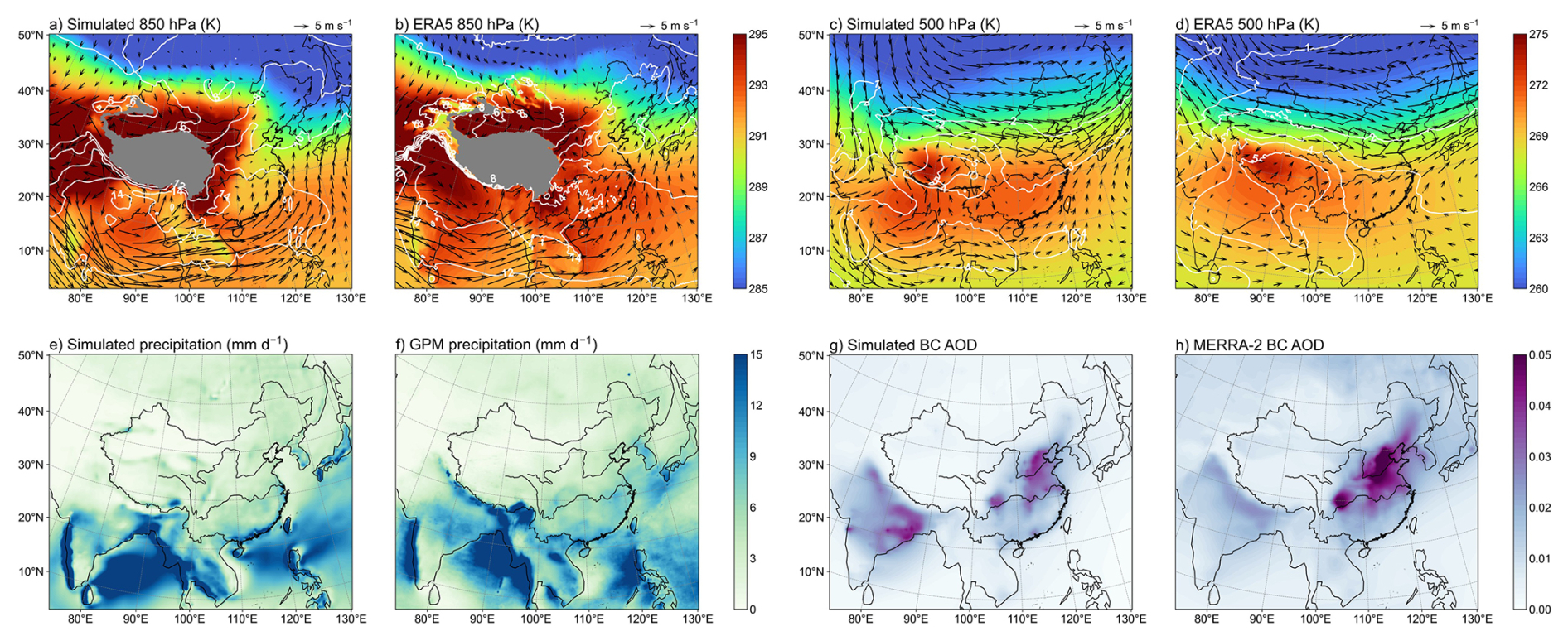
Figure 1Comparisons between RegCM-Chem summer outputs in the Exp. 8 and multiple reference datasets, including air temperature (shaded, K), specific humidity (contours, g kg−1), wind (vectors, m s−1) at 850 hPa (a, b) and 500 hPa (c, d), precipitation (e, f, mm d−1) and BC aerosol optical depth (AOD) (g, h).
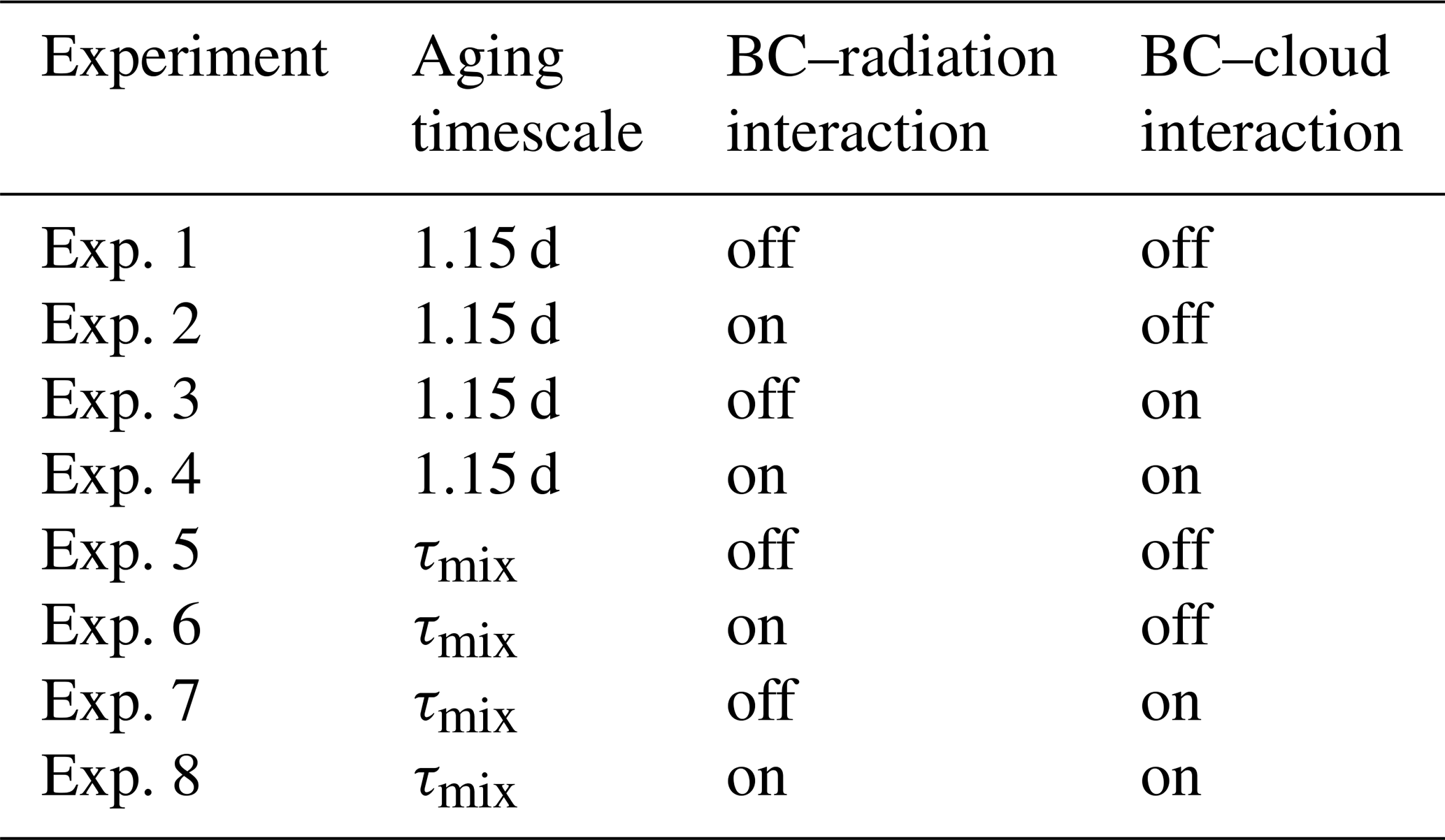
To investigate the impact of dynamic aging scheme on the BC climate effect, eight experiments are carried out in this study (Table 2). Experiment 1 serves as a control run with the fixed aging timescale of 1.15 d and excludes any BC effects. Experiments 2–4 are sensitivity experiments under the same configuration in Table 1 but incorporate BC–radiation interactions, BC–cloud interactions and BC–radiation–cloud interactions, respectively. Therefore, Exps. 2–4 minus Exp. 1 represent the direct (Def_Dir), indirect (Def_Ind) and total (Def_Tot) climate effects of BC under default aging settings, respectively. Experiments 5–8 follow the same design as Exps. 1–4 but only replace τ0 with the dynamic aging scheme to simulate the BC direct (Dyn_Dir), indirect (Dyn_Ind) and total (Dyn_Tot) effects. All simulations are integrated from November 2007 to November 2021, with a spin-up period of one month. Only the outputs in summer (June–August) are analyzed in the following sections. A two-sided paired Student's t-test is performed on the seasonal summer means of each year (n=14) to evaluate the statistical significance of the difference between the experiment results (Zwiers and von Storch, 1995), with the effective sample size adjusted to account for the lag-1 autocorrelation coefficient (r1).
3.1 Model validation
The RegCM-Chem model has been demonstrated to effectively capture the climatic and pollutant characteristics over East Asia (Sun et al., 2012; Zhou et al., 2014; Zhuang et al., 2018; Gao et al., 2022; Ma et al., 2023; Chen et al., 2024). In this study, we further evaluate the summer output from the Exp. 8 against multiple reference datasets. Specifically, the simulated seasonal mean thermodynamic fields and humidity at 850 and 500 hPa are compared with ERA5 reanalysis data, and surface precipitation is compared with satellite observations from GPM, as shown in Fig. 1. The results indicate that RegCM-Chem successfully reproduces the regional climatic features of East Asia in summer, with values decreasing from south to north. Additionally, the model's performance in simulating cloud fraction, cloud optical depth and net longwave and shortwave radiative fluxes has been validated in previous studies (Ma et al., 2023; Hu et al., 2024).
The simulated BC surface concentration in the Exps. 4 and 8 is further evaluated against observations at 33 sites from the China BC Observational Network (CBNET) during 2012–2018 (Table S1 in the Supplement). Figure S1 shows the observed and simulated annual mean BC surface concentrations and their decreasing trends, and the corresponding statistical metrics are summarized in Table S2. The model reasonably reproduces the distribution of BC surface concentration, with correlation coefficients of 0.97 and 0.70 in the temporal and spatial dimensions, respectively. Nevertheless, the model still substantially underestimates BC surface concentration. Such a discrepancy is comparable to or smaller than the findings from most current climate modeling studies, which have typically reported underestimations of 30 %–60 % in simulated BC surface concentrations across China (Li et al., 2016; Yang et al., 2017; Fang et al., 2020; Liu et al., 2022). Compared with Exp. 4, Exp. 8 slightly reduces the temporal RMSE and NMB and better captures the declining trend under the context of emission reductions, whereas the influence on the spatial distribution is not significant (Fig. S1 and Table S2). These results indicate that although the dynamic aging treatment modestly reduces the overall negative bias in simulated BC concentration to some extent, this improvement remains limited, in agreement with the findings of Ghosh et al. (2021) and Shen et al. (2023). This bias may stem from other processes in the climate model, such as grid resolution, dry and wet deposition, and aerosol transport (Wang et al., 2013; Liu et al., 2016). Beyond the systematic comparison, the model-simulated BC loadings also show reasonable agreement with observations at several intensive monitoring sites (Zhou et al., 2024; Tiwari et al., 2025). In addition, a reanalysis-based evaluation of the simulated BC AOD is conducted using MERRA-2 AOD as the reference. Compared with the relatively modest improvement in BC concentration, Exp. 8 more substantially reduces the low bias of BC AOD, although the low bias still remains (Fig. 1 and Table S2). This performance reflects the physically consistent response of BC optical properties to dynamic aging, as discussed in Sect. 3.4.
3.2 BC aging timescale
Figure 2a presents the spatial distribution of aerosol precursor (SO2 + BC + OC) emissions across East Asia from 2008 to 2021. In summer, high emissions are predominantly concentrated in northern India, central to northern and southeastern China, the Pearl River Delta and the Yangtze River Delta. These hotspots, driven primarily by power plants and industrial activities (Li et al., 2017b; Zhuang et al., 2019), exhibit peak emission flux of 4.54 µg m−2 s−1. Moreover, except for the Qinghai-Tibet region and northeastern China, the simulated BC aging timescale for the Exp. 8 in most of the eastern China and Indian landmass is generally shorter than the default value used in the model (27.6 h), which indicates that the fast aging exists widely in summer (Fig. 2b). Even shorter timescales (<10 h) are observed over the North China Plain and the Sichuan Basin, with the minimum monthly mean reaching 2.84 h. Under the new dynamic aging scheme, the BC aging timescale exhibits a clear inverse relationship with local pollutant emissions in its spatial distribution, which is attributable to the fact that the abundant condensable species and hygroscopic particles in highly polluted environment accelerate the conversion of fresh BC by enhancing the condensation and coagulation processes. Conversely, in remote regions such as the Qinghai-Tibet region or over the oceanic areas, where anthropogenic emissions are weak and condensable material is limited, BC aging typically requires more than one day and may even extend to several days.
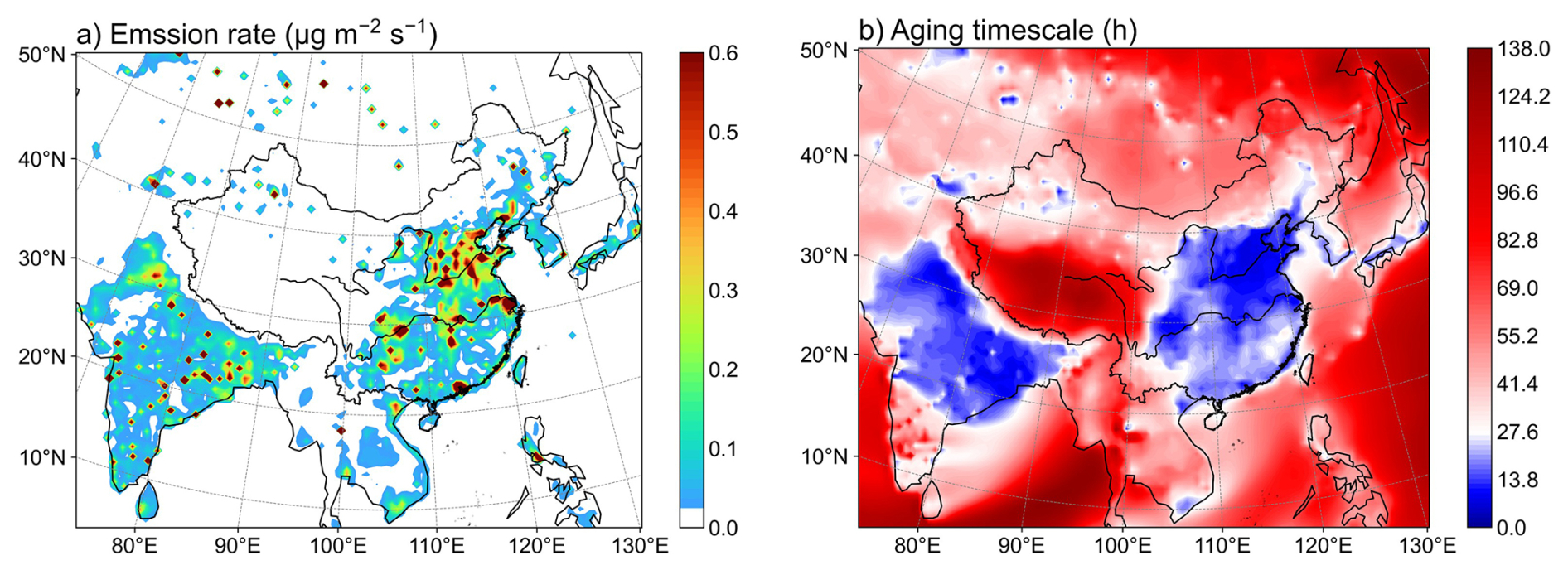
Figure 2Spatial distributions of the aerosol precursor (SO2 + OC + BC) emission rate (a, µg m−2 s−1) and BC aging timescale (b, h) over East Asia in summer during 2008–2021 in the Exp. 8.
The BC aging timescale simulated in this study is broadly comparable to observations and other modeling studies. Using an environmental chamber approach, Peng et al. (2016) derived a BC aging timescale of 4.6 h during August–October in Beijing, one of the most polluted areas over East Asia. Similarly, this short timescale was also reported in Shen et al. (2023) (3.8 h) and Chen et al. (2017) (<2 h). By comparison, the summertime timescale in our study is found to be 6.94 h. This overestimation may stem from a sampling bias toward daytime or afternoon periods in these studies, whereas BC aging typically exhibits significant diurnal variation and tends to be slower at night (Riemer et al., 2004; Jacobson, 2010; Chen et al., 2017). Based on constraints from the HIAPER Pole-to-Pole Observations (HIPPO) observations, the e-folding timescale of BC emissions from East Asia or near source regions was estimated to be on the order of a few hours (Shen et al., 2014; Zhang et al., 2015; He et al., 2016), consistent with our simulated results (Fig. 2b). By coupling a parameterization scheme of BC aging into the model, Ghosh et al. (2021) and Shen et al. (2023) both indicated that BC aging in western China and the Qinghai-Tibet region occurs on timescales of several days, which are substantially longer than those in eastern China. Overall, the results in this study can be considered to be reasonable in representing BC aging under different atmospheric conditions.
3.3 BC spatial distribution
The summertime spatial distributions of BC surface concentration and column burden under the dynamic aging scheme are presented in Fig. 3a and b. Driven by anthropogenic emissions, high BC levels are mainly found over northern India and eastern China, where the maximum concentration and burden reach 8.82 µg m−3 and 2.73 mg m−2, respectively. This spatial pattern is consistent with previous studies (Li et al., 2017b; Zhuang et al., 2019). Northeastern India and the Sichuan Basin exhibit a higher column burden, and this slight discrepancy from the emission distribution may be attributed to topography, atmospheric transport and circulation background (Ji et al., 2015; Yang et al., 2021; Gao et al., 2024). The response of BC loadings to accelerated aging is also shown in Fig. 3, derived from the differences between Exps. 8 and 4. BC concentrations increase over the southeastern coast of China and the North China Plain, with the maximum exceeding 0.2 µg m−3 when the dynamic aging timescale is used (Fig. 3c). Negative changes are found over central to southern China. Meanwhile, the BC column burden exhibits a spatially coherent decrease across East Asia by a regional mean of 0.12 mg m−2 (Fig. 3d). These findings indicate that introducing the dynamic aging timescale can substantially alter the spatial distribution of BC mass.
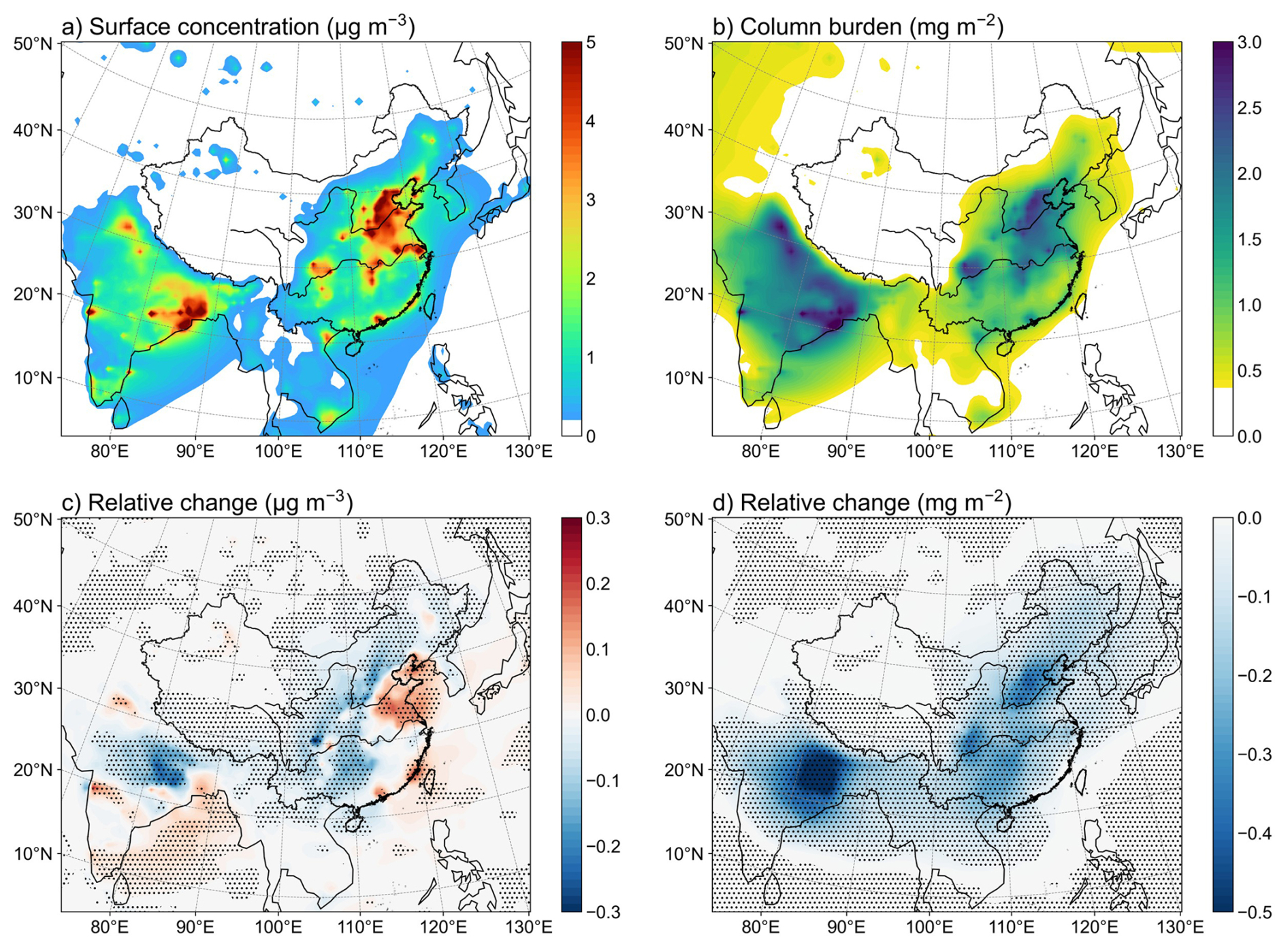
Figure 3Spatial distributions of the BC surface concentration (a, µg m−3) and column burden (b, mg m−2) over East Asia in summer during 2008–2021 in the Exp. 8. Relative changes in the BC surface concentration (c, µg m−3) and column burden (d, mg m−2) over East Asia in summer during 2008–2021 between the Exps. 8 and 4. Black-dotted regions denote statistically significant differences at the 90 % confidence level based on a two-sided paired Student's t-test.
These results can be explained as follows. Generally, rapid BC aging in an area facilitates the conversion of hydrophobic BC to hydrophilic BC (Fig. S2), and vice versa. By altering the partitioning between hydrophobic and hydrophilic particles, changes in the aging rate further alter the removal efficiency and atmospheric lifetime of BC by modulating dry and wet deposition. In regions such as eastern China which undergo faster aging, a larger fraction of hydrophilic BC is involved in both dry and wet deposition, whereas the contribution of hydrophobic particles to deposition is reduced because of their lower abundance (Fig. 4). It is worth noting that, hydrophilic BC is more readily removed by wet deposition but is less susceptible to dry deposition compared with hydrophobic BC. This is attributed to the larger characteristic diameter and higher solubility assigned to hydrophilic tracers, which in turn reduces their dry deposition velocity, consistent with the fundamental principles of aerosol dynamics (Solmon et al., 2006; Ghosh et al., 2021). Therefore, as illustrated in Fig. 4c and f, total BC dry deposition decreases while wet deposition increases, in agreement with the respective changes in hydrophobic and hydrophilic BC. The two processes act in a compensatory manner to co-regulate the overall BC sink. For example, the reduction in dry deposition dominates the increase in surface concentration in the North China Plain, where precipitation and wet deposition are relatively limited in summer (Fig. 3c). A similar phenomenon observed along the southeastern coastal regions may also be associated with the decreased dry deposition of hydrophobic BC. In terms of vertical distribution, wet deposition, which is dominated by in-cloud scavenging, is the primary mechanism for the removal of BC particles from the atmosphere (Park et al., 2003; Cozic et al., 2007; Ohata et al., 2016). Compared to surface layer, the wet removal efficiency of BC at higher altitudes is more sensitive to the aging rate (Wang et al., 2013; Shen et al., 2023). In the lower troposphere near source regions in eastern China, the high abundance of pollutants still induces rapid aging of BC (Fig. S3). As a result, BC mass is efficiently removed by wet scavenging, leading to an observed decline in the BC column burden (Fig. 3d).
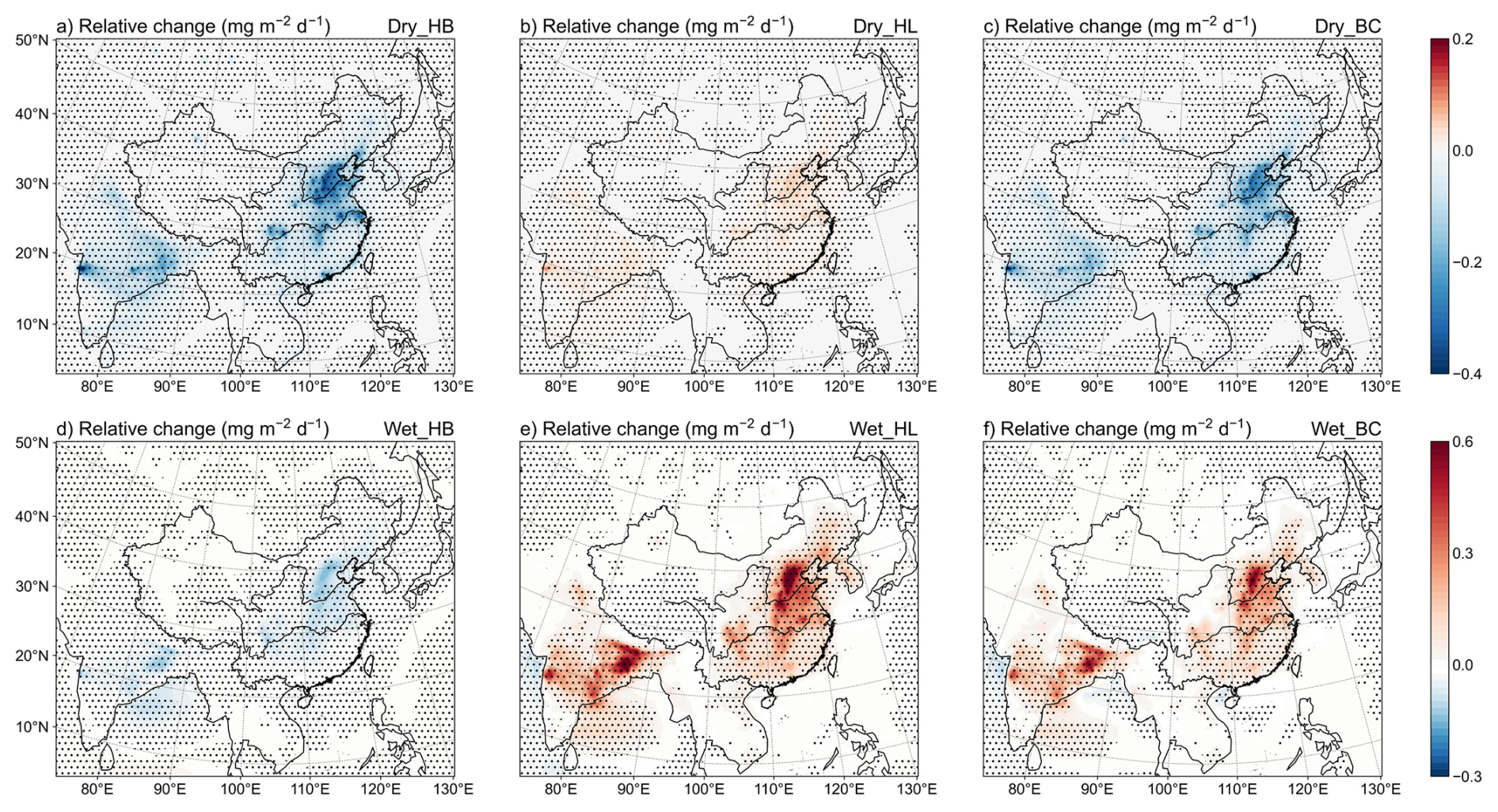
Figure 4Relative changes in the dry deposition flux (a–c, mg m−2 d−1) and wet deposition flux (d–f, mg m−2 d−1) of hydrophobic BC (HB, left), hydrophilic BC (HL, center) and total BC (BC, right) over East Asia in summer during 2008–2021 between the Exps. 8 and 4. Black-dotted regions denote statistically significant differences at the 90 % confidence level based on a two-sided paired Student's t-test.
3.4 BC direct climate effects
The distributions of the seasonal mean BC aerosol optical depth (AOD) and instantaneous direct radiative forcing (IDRF) for summer are presented in Fig. 5a–c. Consistent with the spatial pattern of BC loadings, high AOD appears in southwestern and central to northern China, with a maximum exceeding 0.05. Owing to the strong absorption of solar radiation, BC can exert a positive IDRF at the top of the atmosphere (TOA) and a negative radiative forcing at the surface. Here, IDRF is defined as the change in net radiative flux under clear-sky conditions caused only by aerosol–radiation interactions, without considering the influences of cloud cover or climate feedbacks. In the IDRF calculation, the radiative transfer model is called twice that with and without BC at each time step. The radiative forcing calculated in this study is relative to zero BC effect. Therefore, the distribution of BC IDRF is closely related to AOD. Generally, the IDRF at the surface exhibits a spatial pattern similar to that at the TOA but a greater magnitude over East Asia, with regional mean values of +0.82 and −3.00 W m−2, respectively. In northwestern and northeastern China where the AOD is low, BC still induces a stronger IDRF at the TOA (Fig. 5b). This is likely because the higher surface albedo in these regions reflects more incoming solar radiation back into the atmosphere, thereby enhancing BC absorption and leading to a stronger TOA IDRF but weaker surface values (Ocko et al., 2012; Zhuang et al., 2014; Gao et al., 2024).
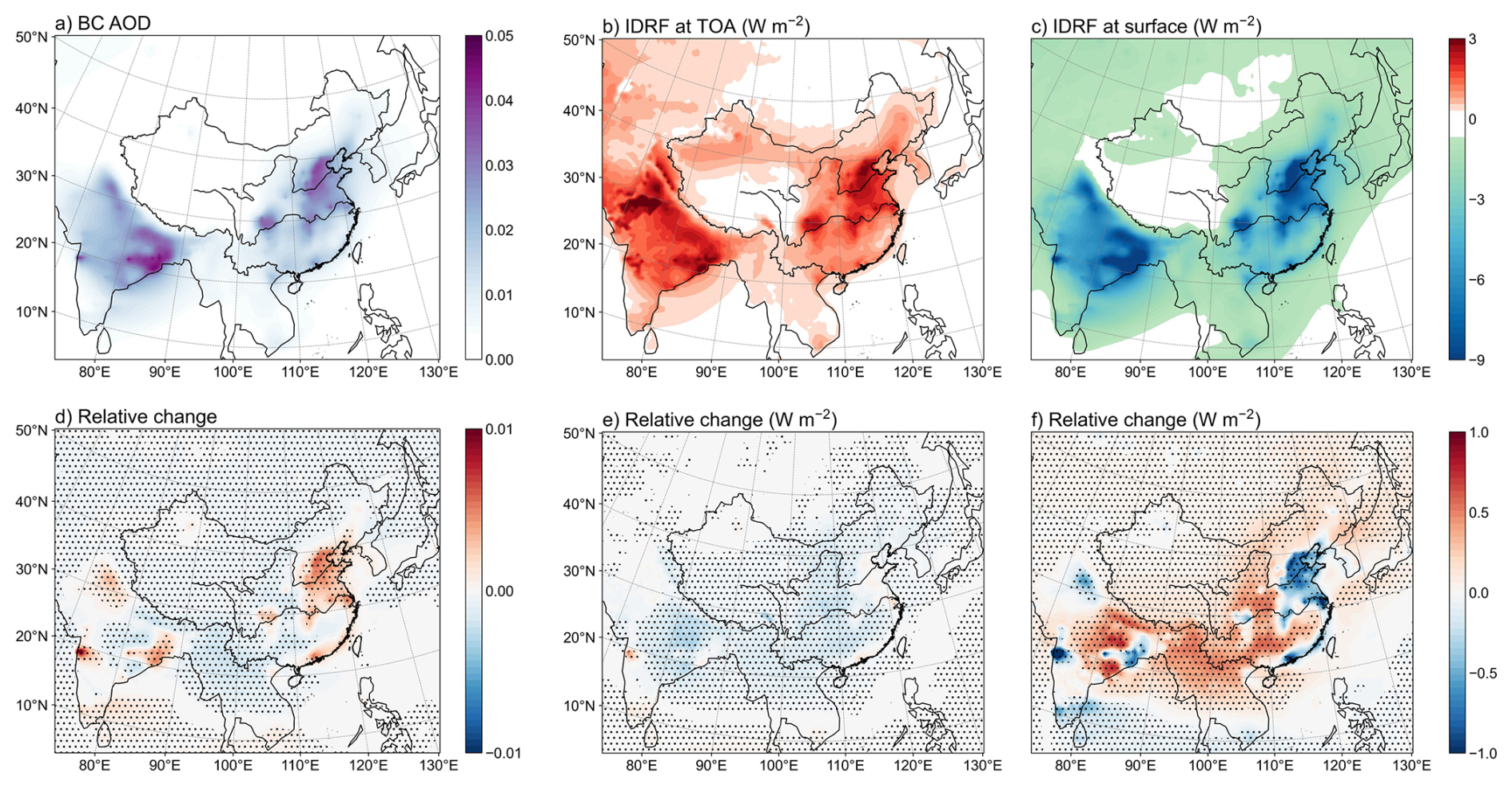
Figure 5Spatial distributions of the BC aerosol optical depth (AOD) (a), instantaneous direct radiative forcing (IDRF) at the TOA and surface (b, c, W m−2) over East Asia in summer during 2008–2021 in the Dyn_Dir experiment. Relative changes in the BC AOD (d), IDRF at the TOA and surface (e, f, W m−2) over East Asia in summer during 2008–2021 between the Dyn_Dir and Def_Dir experiments. Black-dotted regions denote statistically significant differences at the 90 % confidence level based on a two-sided paired Student's t-test.
The response of BC AOD to dynamic aging does not remain consistent with the change in column burden, but instead shows a significant increase over eastern China (Fig. 5d). Although AOD represents the vertical integral of total extinction in the atmospheric column, the increase in near-surface BC concentration plays a dominant role in enhanced BC AOD, as BC is primarily concentrated in the lower troposphere. In addition, rapid aging accelerates the production of hydrophilic BC, whose extinction coefficient is larger than that of hydrophobic particles (Solmon et al., 2006), therefore making an additional positive contribution to AOD. This also helps explain why the magnitude of the AOD increase exceeds that of the surface concentration (Figs. 3c and 5d). As a result, in regions where AOD increases, the attenuation of solar radiation by BC is correspondingly strengthened, leading to stronger IDRF at both the TOA and surface (Fig. 5e and f). The sensitivity of surface IDRF in response to AOD is more pronounced, especially in summer when the solar altitude angle is higher (Zhuang et al., 2014).
Radiative perturbations caused by BC can significantly trigger dynamical adjustments. Figure 6 illustrates the changes in horizontal and vertical atmospheric circulation directions driven by the BC direct effects. Adjustments in the low-tropospheric wind field subsequently modulate moisture transport and cloud formation. A comparison between the Dyn_Dir and Def_Dir experiments reveals that the introduction of the dynamic aging scheme dominates this response over eastern China. As shown in Fig. 6c, pronounced southerly wind anomalies originating from the ocean are observed along the southeastern coast of China. A similar feature was also reported by Zhuang et al. (2019), who suggested that the southerly anomaly could become more substantial in southern China if there were considerable BC loadings in East Asia. This anomaly promotes a cyclonic anomaly near 850 hPa over southern China and effectively transports warm and moist air from the South China Sea inland (Fig. 6a). Meanwhile, the increase in BC-induced heating due to the dynamic aging scheme further strengthens the anomalous ascending motion and meridional circulation, with the shortwave heating rate exceeding K s−1 (∼0.12 K d−1) (Fig. 6b and d). These processes collectively promote moisture convergence and a 1 %–2 % increase in cloud fraction (CF) over the southern region. Similarly, moist oceanic airflow and cyclonic updraft are conducive to the increased cloud cover over eastern India and the Indochina Peninsula (Fig. 6a). The responses of the wind field near 850 hPa to the BC direct effects can be advantageous to the development of the East Asian summer monsoon, consistent with previous studies (Wang et al., 2015; Zhuang et al., 2018; Chen et al., 2020). Over northern China, the BC heating center is located near 35° N, which likewise induces upward motion with the moist accumulation in the middle troposphere. Conversely, compensating subsidence develops in the lower troposphere on both sides of this ascending center, accompanied by decreased specific humidity (Fig. 6b and d). Horizontally, the southwesterly anomalies formed over the North China Plain under the dynamic aging scheme favor the eastward transport of local moisture, while the compensating northerly flow brings colder and drier air southward from higher latitudes (Fig. 6c), leading to a reduction in CF of 2 %–3 %. Additionally, the stronger semi-direct effect by high BC loadings in northern China also contributes to the suppression of cloud formation to a certain extent (Zhuang et al., 2013).
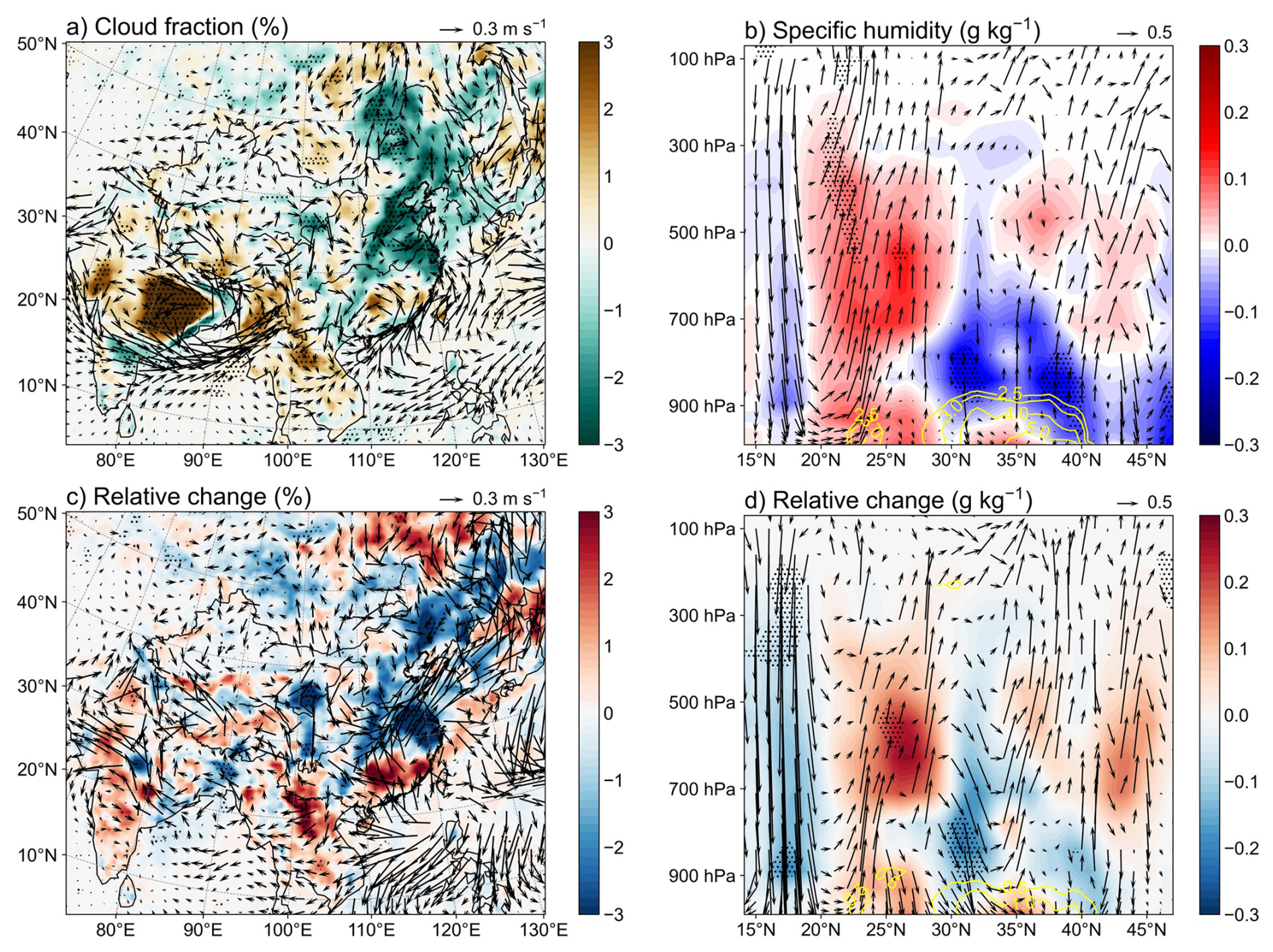
Figure 6Changes in the wind field (arrow, m s−1) and cloud fraction (shaded, %) (a) near 850 hPa, meridional circulation (arrow), specific humidity (shaded, g kg−1) and shortwave heating rate (contour, 10−6 K s−1) (b) in the altitude–latitude section averaged from 112 to 122° E from the BC–radiation interaction over East China in summer during 2008–2021 in the Dyn_Dir experiment. Relative changes in the wind field (arrow, m s−1) and cloud fraction (shaded, %) (c) near 850 hPa, meridional circulation (arrow), specific humidity (shaded, g kg−1) and shortwave heating rate (contour, 10−6 K s−1) (d) in the altitude–latitude section averaged from 112 to 122° E from the BC–radiation interaction over East China in summer during 2008–2021 between the Dyn_Dir and Def_Dir experiments. Black-dotted regions denote statistically significant differences at the 90 % confidence level based on a two-sided paired Student's t-test.
3.5 BC indirect climate effects
Figure 7 presents the changes in the cloud droplet number concentration (Nd) resulting from the BC indirect effects (Dyn_Ind), as well as the changes attributable to the dynamic aging scheme (calculated as Dyn_Ind minus Def_Ind) and the BC direct effects (calculated as Dyn_Tot minus Dyn_Ind). As other aerosols (sulfate and OC) are not considered in the Nd calculation, the results here only represent the idealized BC-only activation conditions against the background Nd (Method). There is a substantial increase (more than 150 cm−3) in the region with high BC loadings since Nd highly depends on the aerosol number concentration (Fig. 7a). The mean Nd in the lower troposphere is increased by approximately 36.98 cm−3 in East Asia for BC. Marked Nd responses are also found over some low-to-mid latitude oceans and remote clean regions, such as the South China Sea and eastern Kazakhstan. This phenomenon may be due to the abundant water vapor and strong upward convective motions in these regions, which are more favorable for offering higher maximum supersaturation. Moreover, the lower background aerosol concentration weakens the competition for water vapor among particles, thereby increasing the sensitivity of Nd to aerosol perturbations (Reutter et al., 2009; Sullivan et al., 2016; Gryspeerdt et al., 2023). Compared to the default aging scheme, the introduction of the dynamic aging timescale accelerates the production of hydrophilic BC, whose larger hygroscopicity lowers the critical supersaturation and thus increases the potential to be activated as cloud droplets (McFiggans et al., 2006; Petters and Kreidenweis, 2007). Consequently, the rapid aging process increases the mean Nd over East Asia by 9.37 cm−3. In the Dyn_Tot experiment, Nd also increases over southern China and Shaanxi Province (Fig. 7c), likely because the upward motion caused by the BC direct heating promotes particle activation (Reutter et al., 2009). This is reflected in the distribution of turbulent kinetic energy (TKE) shown in Fig. 7d, given that the updraft velocity at the cloud base is not explicitly resolved in climate models but instead parameterized from TKE (Virtanen et al., 2025).
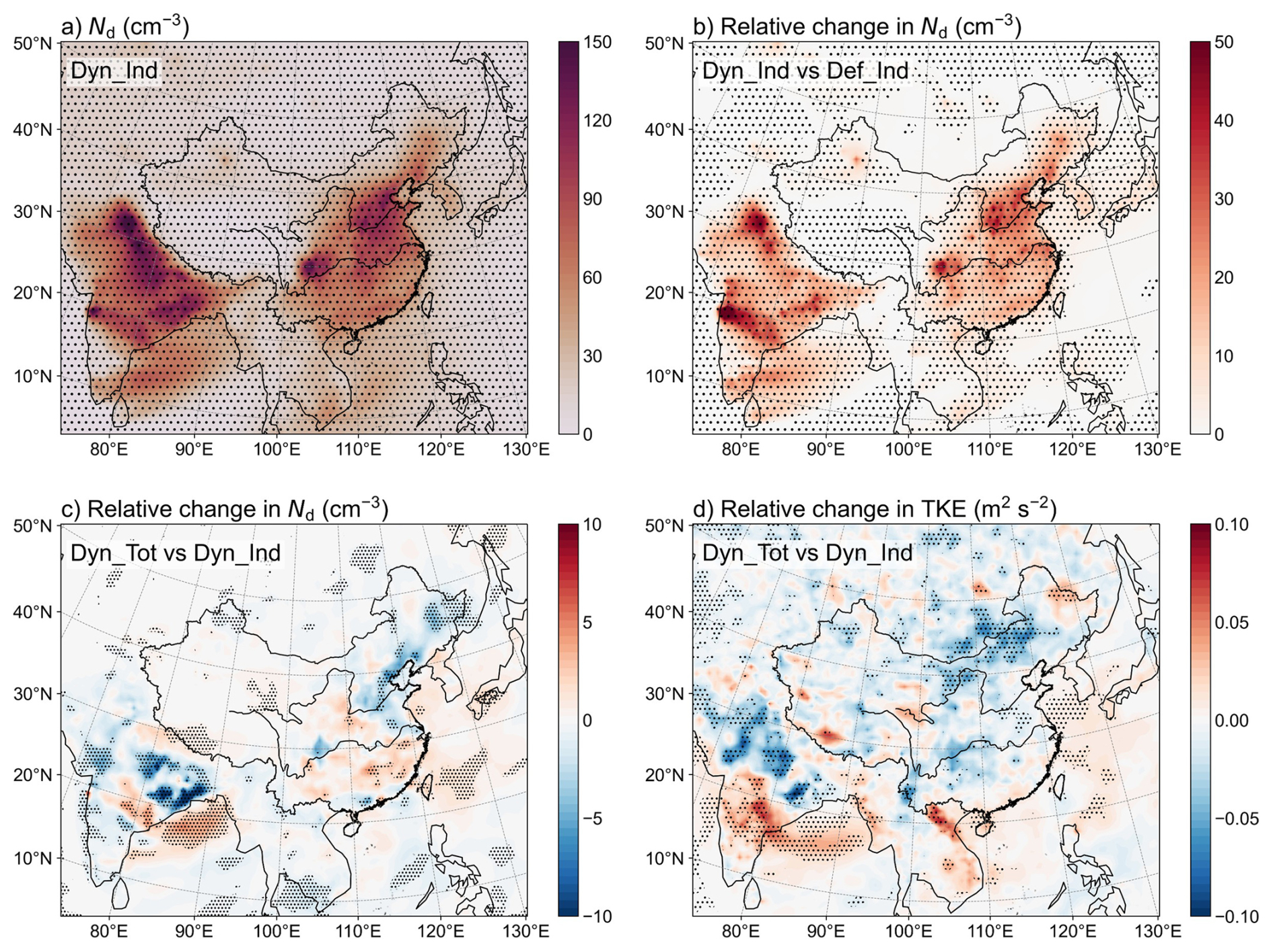
Figure 7Changes in the cloud droplet number concentration (Nd) (a, cm−3) near 850 hPa from the BC–cloud interaction over East China in summer during 2008–2021 in the Dyn_Ind experiment. Relative changes in the Nd (b, cm−3) near 850 hPa from the BC–cloud interaction over East China in summer during 2008–2021 between the Dyn_Ind and Def_Ind experiments. Relative changes in the Nd (c, cm−3) and TKE (d, m2 s−2) near 850 hPa from the BC–cloud interaction over East China in summer during 2008–2021 between the Dyn_Tot and Dyn_Ind experiments. Black-dotted regions denote statistically significant differences at the 90 % confidence level based on a two-sided paired Student's t-test.
Aerosol particles can reduce the effective radius of cloud droplets by increasing Nd, thereby enhancing both the cloud optical depth (COD) and cloud albedo (Twomey, 1977). In summer, the BC indirect effects lead to a decrease in cloud effective radius (up to −0.9 µm) in the lower troposphere (not shown), accompanied by an overall increase in COD over East Asia (Fig. 8a). However, in addition to the influence of aerosol–cloud interactions on microphysical processes, thermodynamic adjustments induced by the BC indirect effects can also substantially affect cloud formation. In contrast to the BC direct heating, the COD enhancement caused by BC indirect effects reduces the solar radiation reaching the surface, thereby inducing radiative cooling. This cooling may weaken the development of the East and South Asian Summer Monsoons by diminishing the land-sea thermal gradient (Wang et al., 2015), which in turn suppresses the moisture transport from the oceans, as illustrated in Fig. 8d. Furthermore, the anticyclonic anomaly over southern China contributes to a localized reduction in CF. Consistent but stronger divergence anomalies appear over northeastern China, and their influence exceeds that of the aerosol indirect effects themselves on COD because of the lower Nd there, resulting instead in a decrease in CF and COD. Overall, the thermodynamic responses to BC–cloud interactions are unfavorable for cloud formation over East Asia. A similar pattern is observed in the comparison between the Dyn_Ind and Def_Ind experiments. Although the introduction of the new aging scheme generally leads to a nearly linear increase in Nd over East Asia (Fig. 7b), the response of the atmospheric circulation dominates the differences in cloud cover and COD between the two experiments, even though the increased Nd still makes a positive contribution to COD to some extent (Fig. 8b and e). Figure 8f reveals the changes in the wind field driven by the BC direct effects similar to those in the Dyn_Dir experiment (Fig. 6a). However, due to the consideration of feedbacks from the BC–cloud interactions, cloud cover in northern or southern China exhibits a stronger response (ranging from −4.13 to 3.71 %), which is likely related to BC-induced changes in cloud microphysical processes there. For example, the cyclonic updraft over southern China favors an increase in Nd and cloud formation.
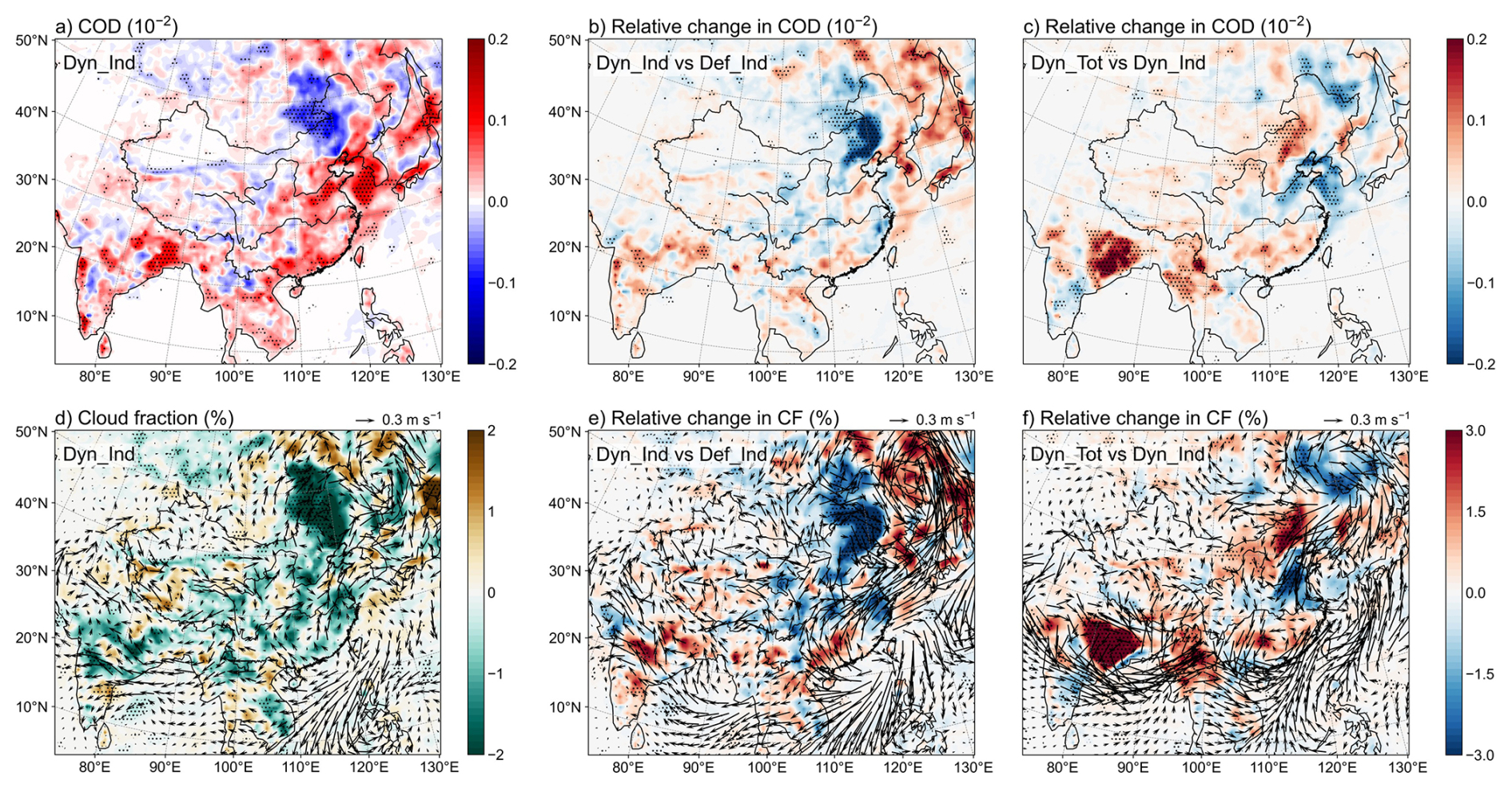
Figure 8Changes in the cloud optical depth (COD) (a) and cloud fraction (CF) (d, %) near 850 hPa from the BC–cloud interaction over East China in summer during 2008–2021 in the Dyn_Ind experiment. Relative changes in COD (b) and CF (e, %) near 850 hPa from the BC–cloud interaction over East China in summer during 2008–2021 between the Dyn_Ind and Def_Ind experiments. Relative changes in the COD (c) and CF (f, %) near 850 hPa from the BC–cloud interaction over East China in summer during 2008–2021 between the Dyn_Tot and Dyn_Ind experiments. Black-dotted regions denote statistically significant differences at the 90 % confidence level based on a two-sided paired Student's t-test.
To further assess the sensitivity of the modeled BC–cloud interactions to the hygroscopicity parameter, additional sensitivity experiments are performed based on Exp. 7, in which the hygroscopicity value of hydrophilic BC (0.22) is replaced by 0.11 and 0.34, respectively. The formation of Nd induced by BC exhibits limited sensitivity to variations in the assumed hygroscopicity. Specifically, as the value increases from 0.11 to 0.34 (about a threefold increase), the BC-induced Nd ranges from −13.1 % to 8.1 % relative to the results in Exp. 7. Similar results have also been reported in the observational study by Wu et al. (2019), who found the BC activation fraction was 33±16 % at a critical supersaturation of 0.1 % within the aforementioned hygroscopicity range. In contrast, the sensitivity of the BC-induced cloud radiative forcing and regional climate response to the assumed hygroscopicity is stronger. For example, the surface ERF over East Asia varied from −0.25 to −0.93 W m−2 across the tested hygroscopicity values. This indicates that, although the changes in Nd are relatively weak, subsequent cloud radiative and dynamical adjustments can amplify the regional radiative forcing and climate response to BC hygroscopicity, which is also reflected in the sensitivity of the BC indirect effect to dynamic aging (Figs. 7 and 8). Previous studies have reported a wide range of BC indirect radiative forcing in liquid clouds from −0.64 to +0.23 W m−2 (Kristjánsson, 2002; Chen et al., 2010; Koch et al., 2011; Spracklen et al., 2011; Storelvmo, 2012), with considerable uncertainty largely attributed to challenges in accurately assessing the hygroscopicity of BC-containing particles (Zhang et al., 2025). Therefore, it should be clarified that the absolute climate responses here depend on the single parameterization scheme selected in this study.
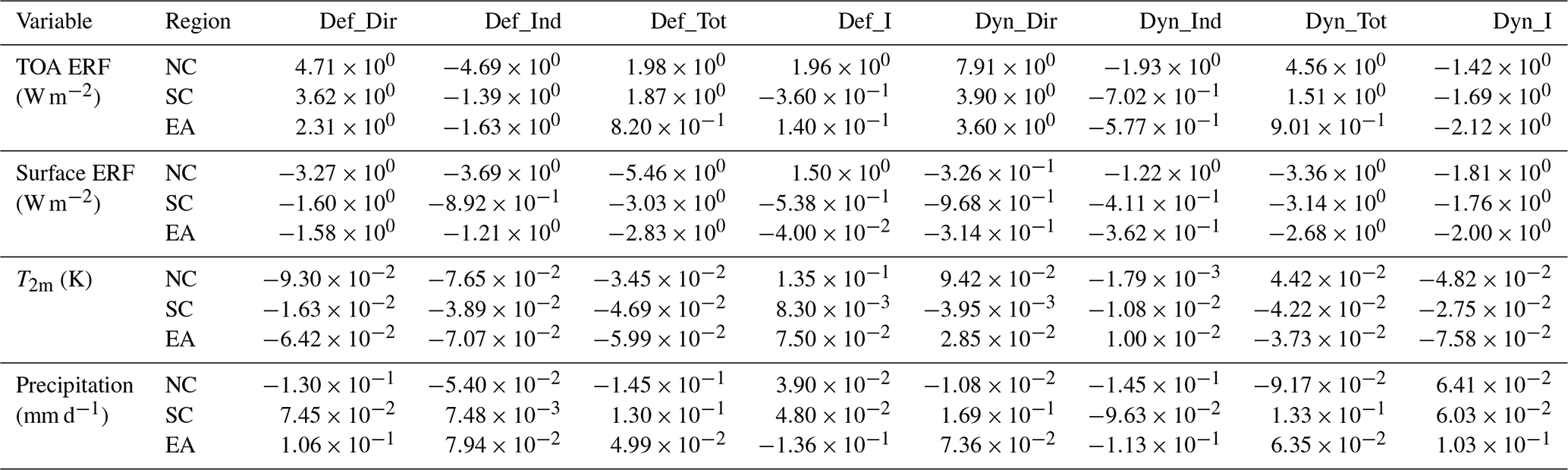
Table 3BC ERF at the TOA and surface, as well as the climate responses averaged over NC (northern China, 30–40° N, 110–120° E), SC (southern China, 22–30° N, 100–120° E) and EA (East Asia, 20–45° N, 100–130° E) for the six experiments and their nonlinear interaction terms.
3.6 BC effective radiative forcing and regional climate responses
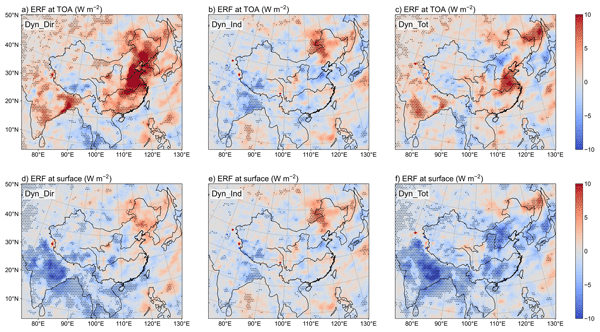
Since the Fifth Assessment Report of the Intergovernmental Panel on Climate Change, effective radiative forcing (ERF) has gained more attention because the climate response to aerosols can also influence the energy balance of the Earth–atmosphere system (IPCC, 2013). Unlike IDRF, ERF is defined as the changes in net radiative flux at the TOA and surface after a perturbation is imposed, allowing for the rapid adjustments of meteorological factors in the troposphere and stratosphere. In this study, the summer ERFs induced by BC–radiation interactions (ERFbri), BC–cloud interactions (ERFbci) and BC–radiation–cloud interactions (total ERF) under the new aging scheme are calculated as the differences between the corresponding sensitivity experiments and the control experiment, as described in the Method section (Fig. 9). Similar to the spatial patterns of BC IDRF, the ERFbri over most of the study domain is positive at the TOA and negative at the surface due to the strong absorption of solar radiation, with regional mean values of +3.60 and −0.31 W m−2 over East Asia in summer, respectively (Fig. 9a and d). However, significant discrepancies exist between IDRF and ERFbri because the latter accounts for meteorological adjustments, primarily driven by cloud responses (Gao et al., 2024). For instance, reduced CF over northern China and the North China Plain allows more solar radiation to be absorbed and to reach the surface (Fig. 6a), thereby enhancing radiative income at both the TOA and surface. Such positive adjustments can offset or even exceed the initial negative IDRF, leading to a net positive ERFbri at the surface (Fig. 9d). Opposite trends are observed in regions such as India. The significance of climate feedbacks for the ERFbri has also been demonstrated in previous studies, which suggest that approximately 30 %–50 % of the BC IDRF can be affected by adjustments in clouds and the temperature lapse rate (Stjern et al., 2017; Smith et al., 2018; Zhao and Suzuki, 2019). In contrast, the ERFbci exhibits a more consistent spatial distribution at the TOA and at the surface in East Asia (Fig. 9b and e), as the BC indirect effects are primarily mediated through cloud-driven radiative changes. The increase in low-level COD associated with BC-induced Nd enhances the radiative cooling effect of clouds. As a result, the BC indirect effects produce predominantly negative ERFbci at both the TOA and surface over East Asia, with maximum values reaching −7.46 and −5.94 W m−2, respectively. Nevertheless, strong circulation and cloud responses also modulate the spatial distribution of ERFbci in a similar way to some extent. As shown in Figs. 8d and 9, decreased cloud cover in the middle and lower reaches of the Yangtze River and the upper Yellow River results in localized positive ERFbci. Although the sign of the total ERF remains consistent with that of ERFbri, the inclusion of cooling effects from BC–cloud interactions results in a more negative surface ERF of −2.68 W m−2 over East Asia, whereas the total ERF at the TOA is reduced to 0.90 W m−2. In addition, the total ERF is not simply equal to the linear sum of the ERFbri and ERFbci, which may be closely related to climate feedbacks (Zhuang et al., 2019; Chen et al., 2020; Gao et al., 2024). This nonlinear behavior is also evident in the regional differences before and after the introduction of the dynamic aging scheme, as shown in Table 3.
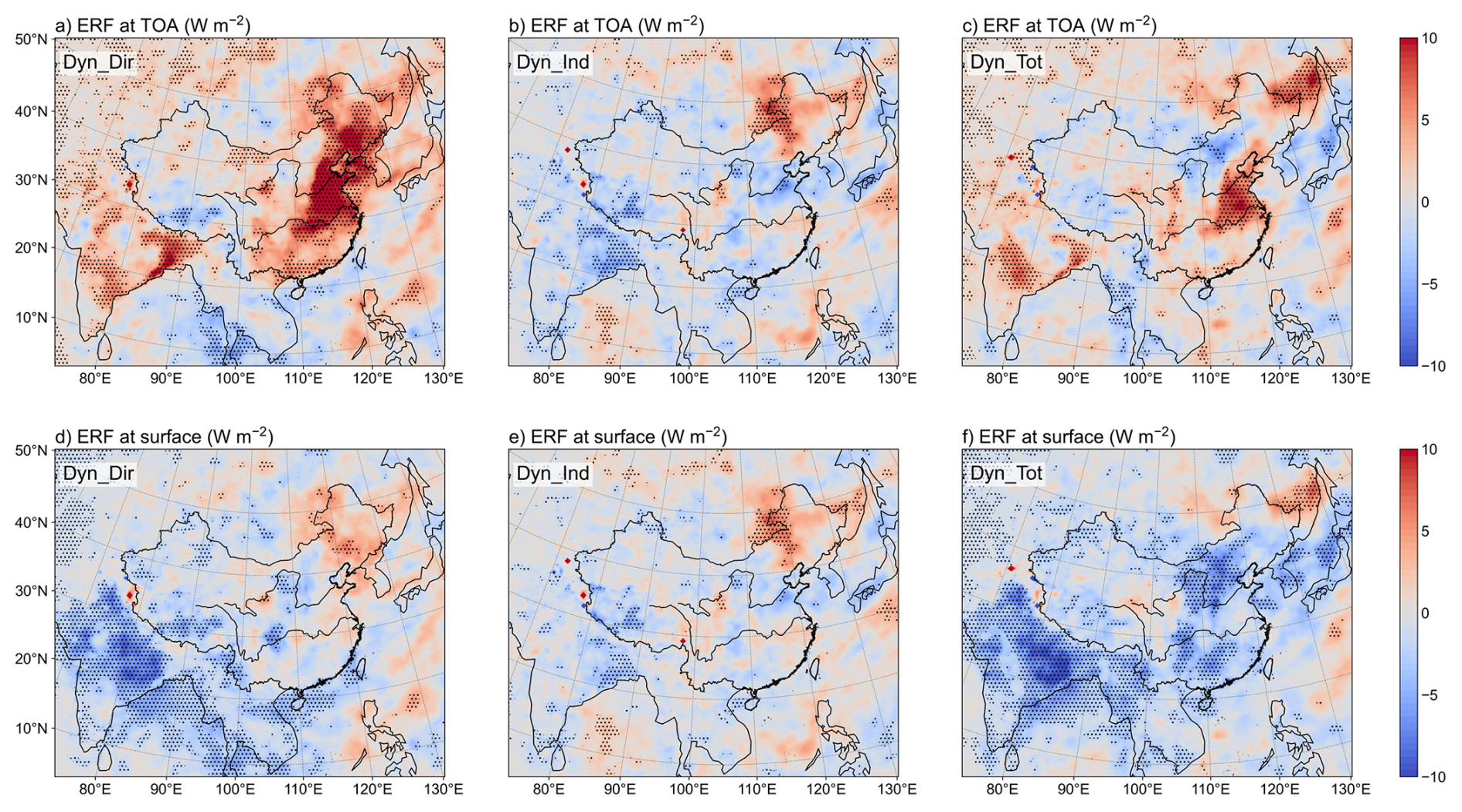
Figure 9Spatial distributions of the BC effective radiative forcing (ERF) at the TOA and surface (a–c, d–f, W m−2) over East Asia in summer during 2008–2021 in the Dyn_Dir (left), Dyn_Ind (center) and Dyn_Tot (right) experiments. Black-dotted regions denote statistically significant differences at the 90 % confidence level based on a two-sided paired Student's t-test.
Figure 10a–c illustrate the responses of surface air temperature at 2 m (T2m) to different BC climate effects over East Asia during summer with the new aging scheme. The spatial distribution of the air temperature anomalies aligns closely with the ERF patterns but exhibits an inverse relationship with cloud cover. In the Dyn_Dir experiment, the reduction in surface radiation directly induces surface cooling over the Sichuan Basin and southern China (Figs. 9d and 10a), with a maximum temperature decrease of −0.54 K. In contrast, surface warming occurs over the North China Plain and northeastern China, where low-level CF decreases and ERFbri becomes positive. A similar relationship is also evident in the temperature changes induced by BC–cloud interactions, with a regional mean anomaly of −0.01 K over eastern China (20–40° N, 100–120° E), ranging from −0.27 to 0.35 K (Fig. 10b). Simulation in the Dyn_Tot experiment shows an average warming of 0.044 K in northern China and a cooling of −0.042 K in the south due to the BC total effect. Notably, the temperature changes here further highlight the nonlinearity of regional climate responses (Zhuang et al., 2019). For example, while the increased air temperature is found over northeastern China in both Dyn_Dir and Dyn_Ind experiments, an opposite cooling trend appears in the Dyn_Tot experiment. Feedbacks from wind fields and cloud cover play a critical role in this nonlinearity, further triggering the complex and heterogeneous response of precipitation.
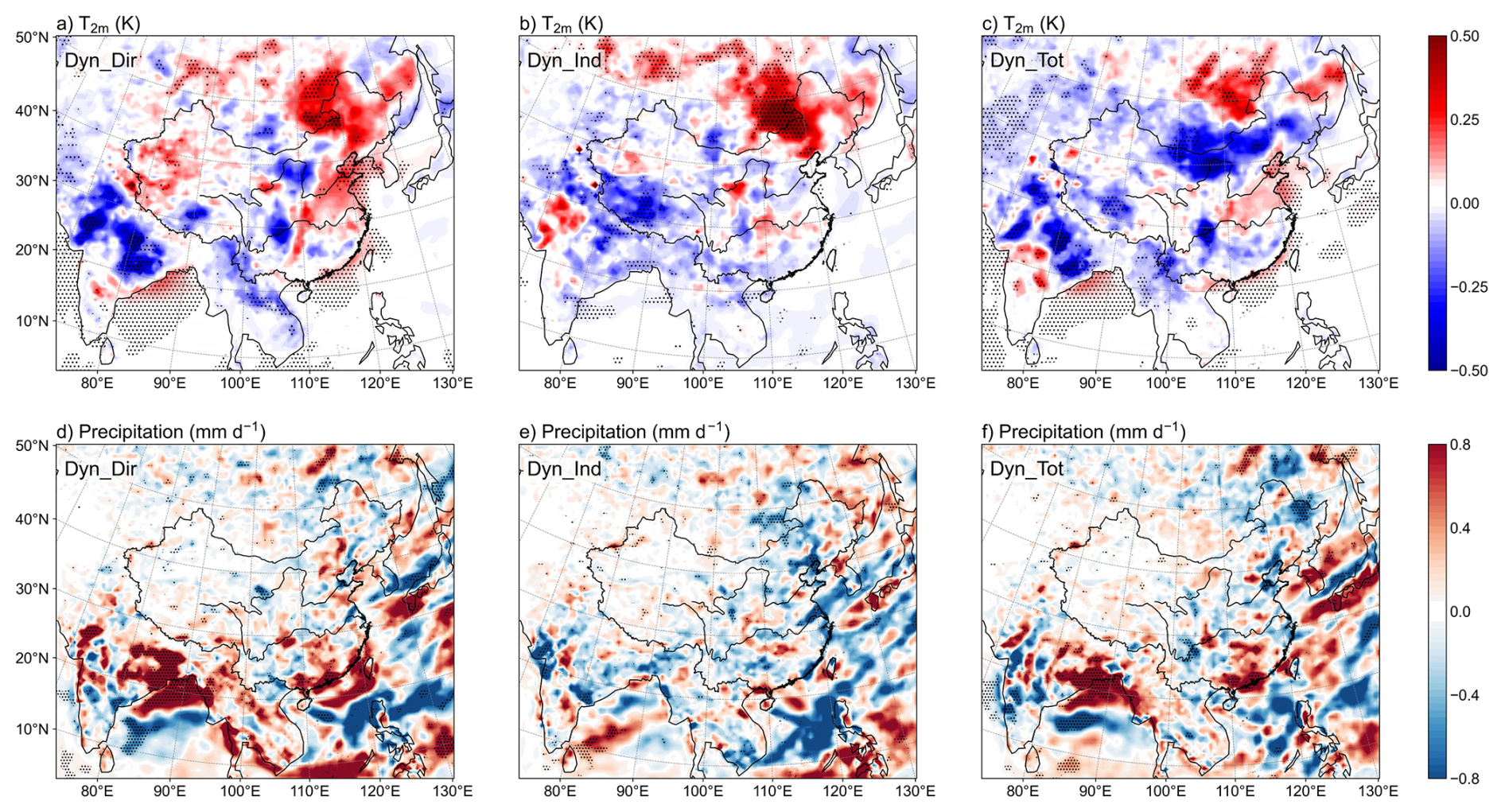
Figure 10Changes in the surface air temperature at 2 m (T2m) (a–c, K) and precipitation (d–f, mm d−1) over East Asia in summer during 2008–2021 in the Dyn_Dir (left), Dyn_Ind (center) and Dyn_Tot (right) experiments. Black-dotted regions denote statistically significant differences at the 90 % confidence level based on a two-sided paired Student's t-test.
BC–radiation interactions primarily affect precipitation through thermodynamic adjustments by radiative perturbations. Generally, local floods result from an increase in moisture transport or a convergence anomaly, and vice versa (Figs. 6a and 10d). For instance, moisture convergence over southern China leads to a significant increase in precipitation there. Although the BC loading is relatively low in this region, the magnitude of precipitation change exceeds that in northern China. This aligns with previous studies suggesting that circulation responses in regions where AOD is weak dominate precipitation changes (Gu et al., 2016; Chen et al., 2020; Zhuang et al., 2025). Compared with the annual mean (Gao et al., 2024), summer precipitation changes are also substantially larger because of the more vigorous background atmospheric circulation, which also supports this opinion. Similarly, stronger precipitation responses can also be observed over the ocean, where compensating airflows drive more pronounced moisture transport. A widespread reduction in precipitation over East Asia is observed in the Dyn_Ind experiment, with regional mean and maximum values of −0.11 and −1.92 mm d−1, respectively (Fig. 10e). In addition to the aerosol second indirect effect, which suppresses precipitation by reducing the conversion rate of cloud water into rainwater, the influence of large-scale circulation patterns may exceed that of local cloud microphysical processes on seasonal timescales by modulating monsoon intensity and moisture transport pathways (Wang et al., 2021a, 2024; Qie et al., 2025). Consequently, precipitation shows an increase over parts of central China. With respect to the total effects, the circulation background dominated by the BC direct effects shapes the evolution of the south–wet and north–dry precipitation patterns in summer, with regional mean values of −0.09 and +0.13 mm d−1 in northern and southern China, respectively (Figs. 8f and 10f). The responses in precipitation found in this study agree with some previous findings (Menon et al., 2002; Zhuang et al., 2018; Gao et al., 2024).
The above analyses demonstrate that the complexity and inconsistency of regional climate responses to BC perturbations are reflected not only in the nonlinear dependence on BC concentration or aging timescale, but also in the pronounced non-additivity among the direct, indirect and total climate responses. To explicitly quantify the nonlinear coupling between BC–radiation and BC–cloud interactions, a nonlinear interaction term is introduced for both the dynamic and default aging experiments (Table 3). For the series of dynamic aging experiments, the nonlinear interaction term (Dyn_I) is calculated as Dyn_Tot − Dyn_Dir − Dyn_Ind. Similarly, the corresponding term for the default aging experiments (Def_I) is calculated as Def_Tot − Def_Dir − Def_Ind. A two-sided paired Student's t-test is performed between the total response and the sum of the isolated BC–radiation and BC–cloud interaction responses based on the summer means for each individual year. Figure 11 further presents the spatial distributions of Dyn_I in TOA and surface ERF, CF, wind field, specific humidity, T2m and precipitation. Significant nonlinear residuals in major climate variables over East Asia are generally consistent with the changes in circulation and cloud cover. In particular, this interaction enhances moisture convergence and CF over northeastern China (Fig. 11c and d), leading to substantial negative residuals in ERF (−2.12 W m−2 at the TOA and −2.00 W m−2 at the surface) and T2m (−0.076 K) over East Asia (Table 3). In southern China, the anomalous cyclonic flow is conducive to cloud formation. Meanwhile, the upward motion induced by BC–radiation interactions may also promote increases in Nd and strengthen the CF response (Figs. 7c and 11c). These coupled moisture and cloud adjustments subsequently contribute to increased precipitation over most areas of East Asia, resulting in the Dyn_I of 0.10 mm d−1 in precipitation (Fig. 11). Similar relationships are also evident for Def_I. For example, opposite changes in CF over northern and southern China correspond to different signs in ERF and surface temperature residuals (Fig. S4). Over the low-latitude South China Sea, the reduction in water vapor associated with descending airflow weakens atmospheric absorption of solar shortwave radiation during summer (Kim et al., 2022; Harris et al., 2025), thereby increasing the radiative forcing at the sea surface and contributing to reduced precipitation there. These results indicate that the pronounced nonlinear residuals arise primarily from coupled circulation–moisture–cloud adjustments (Sadiq et al., 2015).
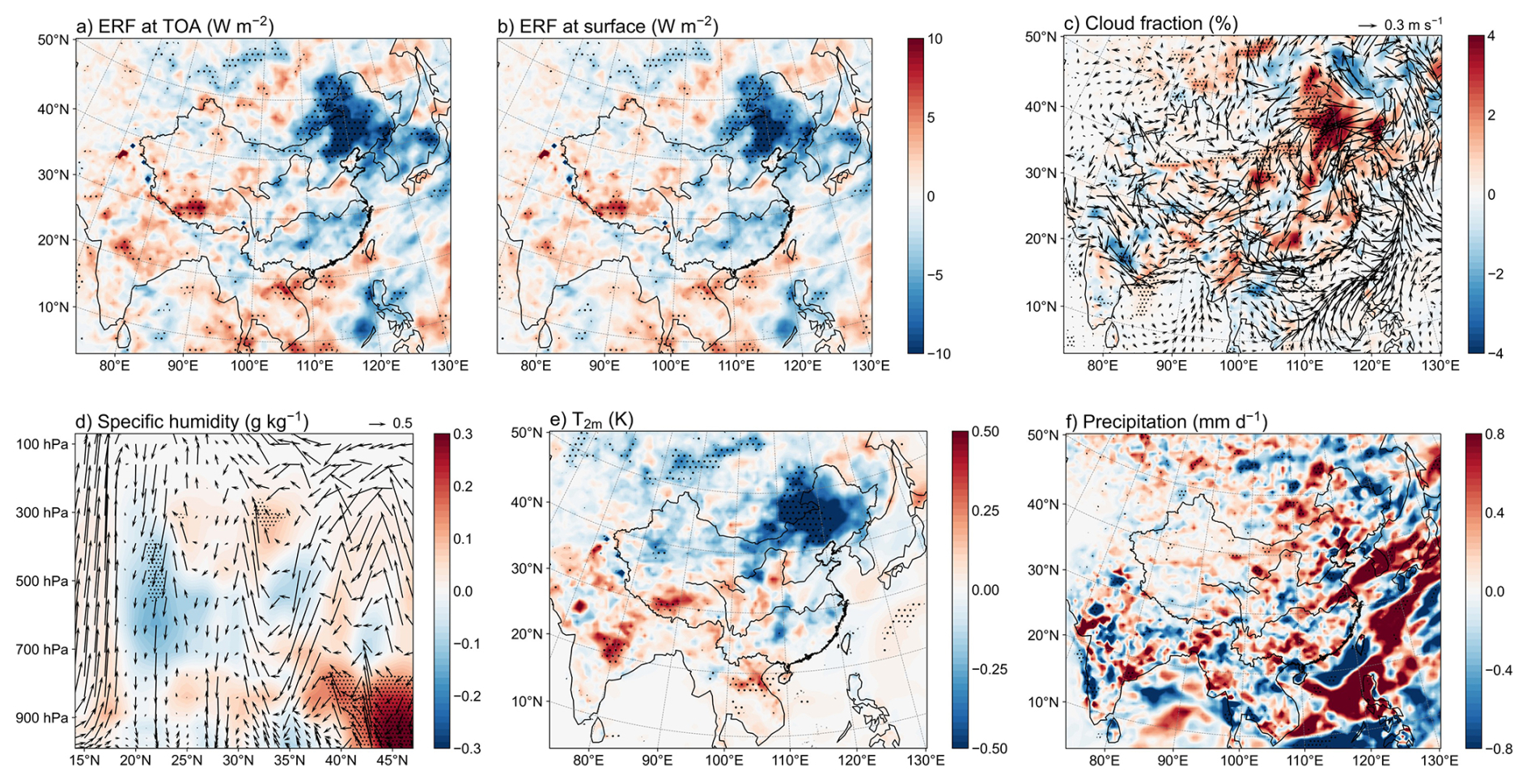
Figure 11Spatial distributions of the nonlinear interaction term under the dynamic aging scheme (Dyn_I) for the BC effective radiative forcing (ERF) at TOA and surface (a, b, W m−2), wind field (arrow, m s−1) and cloud fraction (shaded, %) (c) near 850 hPa, meridional circulation (arrow) and specific humidity (shaded, g kg−1) (d) in the altitude–latitude section averaged from 112 to 122° E, surface temperature at 2 m (T2m) (e, K) and precipitation (f, mm d−1) over East Asia in summer during 2008–2021. Black-dotted regions denote statistically significant differences at the 90 % confidence level based on a two-sided paired Student's t-test.
In the experiment considering only BC–radiation interactions, BC direct heating induces thermodynamic and semi-direct cloud responses, whereas in the experiment for only BC–cloud interactions, perturbations to cloud microphysical processes by BC trigger adjustments in cloud radiation and dynamics. When the two pathways are activated simultaneously, processes that are separated in the individual pathway experiments become dynamically coupled through complex climate and aerosol feedbacks, and their combined responses cannot be reconstructed as a linear sum. Therefore, the results diagnosed from the BC direct or indirect effects are interpreted as sensitivities of isolated pathways rather than as additive components of the combined climate responses in this study. Strongly nonlinear climate responses have also been reported in previous studies (Zhuang et al., 2019; Chen et al., 2020; Gao et al., 2024, 2025), as aerosol-induced changes in atmospheric circulation and clouds can feed back onto the initial radiative perturbation, although their experimental designs differ from that employed here. Chen et al. (2020) and Zhuang et al. (2019) both found that the combined direct effect of BC emissions from multiple source regions or sectors could not be reproduced by a simple linear summation of the effects caused by individual source region or sector. Gao et al. (2024, 2025) demonstrated that regional climate responses to future aerosol emission reductions also exhibited pronounced nonlinear behavior. Therefore, different from source-region contributions or emission changes, the nonlinearity reported here is more appropriately represented as a strong pathway-dependent interaction (coupling between BC–radiation and BC–cloud interactions) within the summertime East Asian climate system. Notably, the magnitude of this interaction can be comparable to, or even exceed, isolated pathway responses at the regional scale (Table 3).
This study incorporates a dynamic BC aging parameterization scheme, which explicitly accounts for condensation and coagulation processes, into RegCM-Chem, and systematically investigates the impacts of aging representation on the direct, indirect and total climate effects of BC over East Asia during summer. The simulation results indicate that the BC aging timescale is generally shorter in heavily polluted regions than the conventional fixed e-folding aging timescale of 1.15 d. In particular, the BC aging process can be completed within 10 h over the North China Plain and the Sichuan Basin, with the minimum monthly mean reaching 2.84 h, whereas longer timescales are found in remote regions such as the Tibetan Plateau and oceanic areas. The simulated aging timescales are broadly consistent with previous studies (Peng et al., 2016; Shen et al., 2023; Fierce et al., 2025), which reported BC aging on timescales of several hours in Beijing and other polluted environments, in contrast to much slower aging over clean areas. The introduction of the dynamic aging scheme substantially alters the spatial distribution and removal pathways of BC. Accelerated aging promotes the formation and wet deposition of hydrophilic BC, leading to a regional mean reduction of 0.12 mg m−2 in BC column burden over East Asia. However, localized increases in BC surface concentrations are observed in the North China Plain and southeastern coastal China, primarily driven by the overcompensation associated with the weakened dry deposition near the surface.
While earlier work has primarily focused on developing the representation of BC aging processes in climate models (Ghosh et al., 2021; Shen et al., 2023), this study extends these efforts by quantifying how the BC climate effects respond to dynamic aging. The enhancement of BC AOD over eastern China is attributed to increases in BC surface concentrations and the greater extinction efficiency of hydrophilic BC, further amplifying the IDRF at both of the TOA and surface under the dynamic aging scheme. This stronger direct heating by BC induces a pronounced circulation adjustment, which is conducive to the development of the East Asian summer monsoon. This process strengthens low-level convergence and ascending motion over southern China, thereby facilitating moisture transport and increasing cloud cover. In contrast, compensating subsidence and the semi-direct effects of BC tend to suppress cloud formation in northern China. Additionally, dynamic aging accelerates the production of hydrophilic BC and its participation in Nd formation in the lower troposphere, resulting in a significant cloud radiative cooling effect through the increased COD. However, the dynamic adjustments in atmospheric circulation may outweigh the influence of cloud microphysical processes, thereby playing a dominant role in determining cloud responses in certain regions (Zhuang et al., 2025).
Our study further investigates the BC ERF and regional climate responses under the dynamic scheme. BC–radiation interactions exert a positive ERF at the TOA and a negative ERF at the surface, with regional means over East Asia of +3.60 and −0.31 W m−2, respectively. The signs of total ERF at both the TOA and surface are generally consistent with those of the direct effect but with the more negative magnitudes (+0.90 and −2.68 W m−2) due to the cooling contribution from aerosol–cloud interactions. Similar to the ERF, adjustments in atmospheric circulation and cloud cover intensify the nonlinear responses of regional climate. In terms of the BC total climate effects, the circulation background dominated by BC–radiation interactions shapes a characteristic “southern flooding and northern drought” precipitation pattern in summer, with the regional mean anomalies of +0.13 and −0.09 mm d−1 over southern and northern China, respectively. The responses in precipitation found in this study agree with some recent studies (Zhuang et al., 2018; Gao et al., 2024). Meanwhile, BC can lead to slight warming in northern China and cooling in the south. Pronounced nonlinear interactions are also identified between the BC direct and indirect pathways in the summertime East Asian climate response. The combined climate effects cannot be reconstructed by simply adding the responses from the isolated pathways, because circulation, moisture and cloud adjustments become dynamically coupled when both processes operate simultaneously. These nonlinear interactions substantially affect regional climate responses and their magnitudes can be comparable to or even larger than those of the individual pathway responses.
There are a few limitations that should be addressed in the future. First, although the simulated BC aging timescales are broadly comparable to most modeling estimates, direct observational evidence for BC aging timescales, column burden and AOD remains limited. Second, the introduction of the dynamic aging scheme does not fully solve the pre-existing underestimation of BC surface concentrations and optical contribution, suggesting that uncertainties in other processes such as emissions (without considering open biomass-burning emissions), transport and grid resolution may still affect estimates of BC loadings and climate effects (Wang et al., 2013; Liu et al., 2016). Third, the improved representation of BC aging in this study focused on the aging timescale. Future developments should further incorporate observational constraints on BC size distributions, mixing state, hygroscopicity and absorption enhancement (Liu et al., 2024, 2026; Guan et al., 2026b). Despite these limitations, these findings highlight that the representation of BC aging in the regional climate model is crucial for more reliable assessments of aerosol radiative forcing and regional climate effects, particularly in highly polluted and monsoon-dominated regions, which improves the understanding of aerosol–climate interactions in East Asia.
The input data of RegCM-Chem, including the EIN15 data, the OISST data and the MOZART-4 data, can be downloaded from http://clima-dods.ictp.it/data/regcm4/ (last access: 5 July 2025). The MEIC anthropogenic emission inventories are available at http://www.meicmodel.org (last access: 15 January 2023). The ERA5 data are publicly available from https://cds.climate.copernicus.eu/datasets (last access: 8 March 2026). The MERRA-2 and GPM data are available via GES DISC at https://disc.gsfc.nasa.gov/datasets (last access: 10 March 2026).
The supplement related to this article is available online at https://doi.org/10.5194/acp-26-13861-2026-supplement.
BZ designed the study and carried out the simulation. PG performed the analysis and drafted the manuscript. All authors helped to review and edit this manuscript.
The contact author has declared that none of the authors has any competing interests.
Publisher's note: Copernicus Publications remains neutral with regard to jurisdictional claims made in the text, published maps, institutional affiliations, or any other geographical representation in this paper. The authors bear the ultimate responsibility for providing appropriate place names. Views expressed in the text are those of the authors and do not necessarily reflect the views of the publisher.
We greatly thank Wenxiang Shen for providing the BC concentration data from the China BC Observational Network. We also thank all the scientists, software engineers and administrators who contributed to the development of RegCM-Chem.
This research was supported by the National Key Research and Development Program of China (grant no. 2024YFC3711904), the National Natural Science Foundation of China (grant no. 42075099), and the Frontiers Science Center for Critical Earth Material Cycling of Nanjing University.
This paper was edited by Jason Cohen and reviewed by two anonymous referees.
Abdul-Razzak, H. and Ghan, S. J.: A parameterization of aerosol activation 2. Multiple aerosol types, J. Geophys. Res.-Atmos., 105, 6837–6844, https://doi.org/10.1029/1999jd901161, 2000.
Abdul-Razzak, H. and Ghan, S. J.: A parameterization of aerosol activation – 3. Sectional representation, J. Geophys. Res.-Atmos., 107, AAC 1–1–AAC 1–6, https://doi.org/10.1029/2001jd000483, 2002.
Bauer, S. E., Wright, D. L., Koch, D., Lewis, E. R., McGraw, R., Chang, L.-S., Schwartz, S. E., and Ruedy, R.: MATRIX (Multiconfiguration Aerosol TRacker of mIXing state): an aerosol microphysical module for global atmospheric models, Atmos. Chem. Phys., 8, 6003–6035, https://doi.org/10.5194/acp-8-6003-2008, 2008.
Bond, T. C., Doherty, S. J., Fahey, D. W., Forster, P. M., Berntsen, T., DeAngelo, B. J., Flanner, M. G., Ghan, S., Kaercher, B., Koch, D., Kinne, S., Kondo, Y., Quinn, P. K., Sarofim, M. C., Schultz, M. G., Schulz, M., Venkataraman, C., Zhang, H., Zhang, S., Bellouin, N., Guttikunda, S. K., Hopke, P. K., Jacobson, M. Z., Kaiser, J. W., Klimont, Z., Lohmann, U., Schwarz, J. P., Shindell, D., Storelvmo, T., Warren, S. G., and Zender, C. S.: Bounding the role of black carbon in the climate system: A scientific assessment, J. Geophys. Res.-Atmos., 118, 5380–5552, https://doi.org/10.1002/jgrd.50171, 2013.
Boucher, O. and Lohmann, U.: The Sulfate-Ccn-Cloud Albedo Effect – A Sensitivity Study With 2 General-Circulation Models, Tellus B, 47, 281–300, https://doi.org/10.1034/j.1600-0889.47.issue3.1.x, 1995.
Cao, H., Zhuang, B., Zhou, Y., Gao, P., Hu, Y., Wang, T., Li, S., Li, M., Xie, M., and Liu, Q.: Impact of boundary layer schemes in RegCM-Chem on East Asian climate and its response to the aerosol-radiation interaction, Atmos. Res., 337, 108951, https://doi.org/10.1016/j.atmosres.2026.108951, 2026.
Cappa, C. D., Onasch, T. B., Massoli, P., Worsnop, D. R., Bates, T. S., Cross, E. S., Davidovits, P., Hakala, J., Hayden, K. L., Jobson, B. T., Kolesar, K. R., Lack, D. A., Lerner, B. M., Li, S.-M., Mellon, D., Nuaaman, I., Olfert, J. S., Petaja, T., Quinn, P. K., Song, C., Subramanian, R., Williams, E. J., and Zaveri, R. A.: Radiative Absorption Enhancements Due to the Mixing State of Atmospheric Black Carbon, Science, 337, 1078–1081, https://doi.org/10.1126/science.1223447, 2012.
Chakrabarty, R. K. and Heinson, W. R.: Scaling Laws for Light Absorption Enhancement Due to Nonrefractory Coating of Atmospheric Black Carbon Aerosol, Phys. Rev. Lett., 121, https://doi.org/10.1103/PhysRevLett.121.218701, 2018.
Che, H., Wang, Y., Sun, J., Zhang, X., Zhang, X., and Guo, J.: Variation of Aerosol Optical Properties over the Taklimakan Desert in China, Aerosol Air Qual. Res., 13, 777–785, https://doi.org/10.4209/aaqr.2012.07.0200, 2013.
Che, H. Z., Xia, X. G., Zhao, H. J., Li, L., Gui, K., Zheng, Y., Song, J. J., Qi, B., Zhu, J., Miao, Y. C., Wang, Y. Q., Wang, Z. L., Wang, H., Dubovik, O., Holben, B., Chen, H. B., Shi, G. Y., and Zhang, X. Y.: Aerosol optical and radiative properties and their environmental effects in China: A review, Earth Sci. Rev., 248, https://doi.org/10.1016/j.earscirev.2023.104634, 2024.
Chen, H., Zhuang, B., Liu, J., Li, S., Wang, T., Xie, X., Xie, M., Li, M., and Zhao, M.: Regional Climate Responses in East Asia to the Black Carbon Aerosol Direct Effects from India and China in Summer, J. Climate, 33, 9783–9800, https://doi.org/10.1175/jcli-d-19-0706.1, 2020.
Chen, H., Zhuang, B., Liu, J., Ma, D., Li, S., Wang, T., Xie, M., and Li, M.: The influence of the black carbon warming effect on near-surface ozone in China in summer, Atmos. Res., 301, 107284, https://doi.org/10.1016/j.atmosres.2024.107284, 2024.
Chen, W. T., Lee, Y. H., Adams, P. J., Nenes, A., and Seinfeld, J. H.: Will black carbon mitigation dampen aerosol indirect forcing?, Geophys. Res. Lett., 37, https://doi.org/10.1029/2010gl042886, 2010.
Chen, X., Wang, Z., Yu, F., Pan, X., Li, J., Ge, B., Wang, Z., Hu, M., Yang, W., and Chen, H.: Estimation of atmospheric aging time of black carbon particles in the polluted atmosphere over central-eastern China using microphysical process analysis in regional chemical transport model, Atmos. Environ., 163, 44–56, https://doi.org/10.1016/j.atmosenv.2017.05.016, 2017.
Chung, S. H. and Seinfeld, J. H.: Global distribution and climate forcing of carbonaceous aerosols, J. Geophys. Res.-Atmos., 107, AAC 14–11–AAC 14–33, https://doi.org/10.1029/2001JD001397, 2002.
Cooke, W. F., Liousse, C., Cachier, H., and Feichter, J.: Construction of a 1°×1° fossil fuel emission data set for carbonaceous aerosol and implementation and radiative impact in the ECHAM4 model, J. Geophys. Res.-Atmos., 104, 22137–22162, https://doi.org/10.1029/1999jd900187, 1999.
Cozic, J., Verheggen, B., Mertes, S., Connolly, P., Bower, K., Petzold, A., Baltensperger, U., and Weingartner, E.: Scavenging of black carbon in mixed phase clouds at the high alpine site Jungfraujoch, Atmos. Chem. Phys., 7, 1797–1807, https://doi.org/10.5194/acp-7-1797-2007, 2007.
Dalirian, M., Ylisirniö, A., Buchholz, A., Schlesinger, D., Ström, J., Virtanen, A., and Riipinen, I.: Cloud droplet activation of black carbon particles coated with organic compounds of varying solubility, Atmos. Chem. Phys., 18, 12477–12489, https://doi.org/10.5194/acp-18-12477-2018, 2018.
Denis, B., Laprise, R., Caya, D., and Cote, J.: Downscaling ability of one-way nested regional climate models: the Big-Brother Experiment, Clim. Dynam., 18, 627–646, https://doi.org/10.1007/s00382-001-0201-0, 2002.
Ding, A. J., Huang, X., Nie, W., Sun, J. N., Kerminen, V. M., Petaja, T., Su, H., Cheng, Y. F., Yang, X. Q., Wang, M. H., Chi, X. G., Wang, J. P., Virkkula, A., Guo, W. D., Yuan, J., Wang, S. Y., Zhang, R. J., Wu, Y. F., Song, Y., Zhu, T., Zilitinkevich, S., Kulmala, M., and Fu, C. B.: Enhanced haze pollution by black carbon in megacities in China, Geophys. Res. Lett., 43, 2873–2879, https://doi.org/10.1002/2016gl067745, 2016.
Dusek, U., Reischl, G. P., and Hitzenberger, R.: CCN activation of pure and coated carbon black particles, Environ. Sci. Technol., 40, 1223–1230, https://doi.org/10.1021/es0503478, 2006.
Emmons, L. K., Walters, S., Hess, P. G., Lamarque, J.-F., Pfister, G. G., Fillmore, D., Granier, C., Guenther, A., Kinnison, D., Laepple, T., Orlando, J., Tie, X., Tyndall, G., Wiedinmyer, C., Baughcum, S. L., and Kloster, S.: Description and evaluation of the Model for Ozone and Related chemical Tracers, version 4 (MOZART-4), Geosci. Model Dev., 3, 43–67, https://doi.org/10.5194/gmd-3-43-2010, 2010.
Fang, C., Zhu, B., Pan, C., Yun, X., Ding, D., and Tao, S.: Regional and Sectoral Sources for Black Carbon Over South China in Spring and Their Sensitivity to East Asian Summer Monsoon Onset, J. Geophys. Res.-Atmos., 125, https://doi.org/10.1029/2020jd033219, 2020.
Fang, C., Zhu, B., Pan, C., Qian, P., Wang, D., Zhang, Y., Lu, C., and Liao, H.: Inconsistent Fast and Slow Responses of East Asian Summer Monsoon Precipitation Forced by Black Carbon, J. Climate, 38, 1081–1103, https://doi.org/10.1175/jcli-d-24-0067.1, 2025.
Fierce, L., Riemer, N., and Bond, T. C.: Toward Reduced Representation Of Mixing State For Simulating Aerosol Effects On Climate, B. Am. Meteorol. Soc., 98, 971–980, https://doi.org/10.1175/bams-d-16-0028.1, 2017.
Fierce, L., Li, Y., Feng, Y., Riemer, N., Schutgens, N. A. J., Aiken, A. C., Dubey, M. K., Ma, P.-L., and Wuebbles, D.: Constraining Black Carbon Aging in Global Models to Reflect Timescales for Internal Mixing, J. Adv. Model. Earth Sy., 17, https://doi.org/10.1029/2024ms004471, 2025.
Fountoukis, C. and Nenes, A.: ISORROPIA II: a computationally efficient thermodynamic equilibrium model for K+–Ca2+–Mg2+–NH4+–Na+–SO42−–NO3−–Cl−–H2O aerosols, Atmos. Chem. Phys., 7, 4639–4659, https://doi.org/10.5194/acp-7-4639-2007, 2007.
Furutani, H., Dall'osto, M., Roberts, G. C., and Prather, K. A.: Assessment of the relative importance of atmospheric aging on CCN activity derived from field observations, Atmos. Environ., 42, 3130–3142, https://doi.org/10.1016/j.atmosenv.2007.09.024, 2008.
Gao, P., Gao, Y., Zhou, Y., Cao, H., Hu, Y., Li, S., Liang, S., Wang, T., Xie, M., Li, M., and Zhuang, B.: Changes in the Direct Climate Effect of Black Carbon Aerosols in East Asia Under the “Dual Carbon” Goal of China, J. Geophys. Res.-Atmos., 129, e2024JD040874, https://doi.org/10.1029/2024jd040874, 2024.
Gao, Y., Zhuang, B., Wang, T., Chen, H., Li, S., Wei, W., Lin, H., and Li, M.: Climatic-Environmental Effects of Aerosols and Their Sensitivity to Aerosol Mixing States in East Asia in Winter, Remote Sens., 14, https://doi.org/10.3390/rs14153539, 2022.
Gao, Y., Gao, P., Zhuang, B., Hu, Y., Zhou, Y., Wang, T., Li, S., Li, M., and Xie, M.: Changes in the Climate Effects of Major Anthropogenic Aerosols in East Asia Under Different Emission Reduction Scenarios in China, J. Geophys. Res.-Atmos., 130, https://doi.org/10.1029/2024jd042301, 2025.
Ghan, S., Laulainen, N., Easter, R., Wagener, R., Nemesure, S., Chapman, E., Zhang, Y., and Leung, R.: Evaluation of aerosol direct radiative forcing in MIRAGE, J. Geophys. Res.-Atmos., 106, 5295–5316, https://doi.org/10.1029/2000jd900502, 2001.
Ghosh, S., Riemer, N., Giuliani, G., Giorgi, F., Ganguly, D., and Dey, S.: Sensitivity of Carbonaceous Aerosol Properties to the Implementation of a Dynamic Aging Parameterization in the Regional Climate Model RegCM, J. Geophys. Res.-Atmos., 126, https://doi.org/10.1029/2020jd033613, 2021.
Ghosh, S., Dey, S., Das, S., Riemer, N., Giuliani, G., Ganguly, D., Venkataraman, C., Giorgi, F., Tripathi, S. N., Ramachandran, S., Rajesh, T. A., Gadhavi, H., and Srivastava, A. K.: Towards an improved representation of carbonaceous aerosols over the Indian monsoon region in a regional climate model: RegCM, Geosci. Model Dev., 16, 1–15, https://doi.org/10.5194/gmd-16-1-2023, 2023.
Giorgi, F.: A Particle Dry-Deposition Parameterization Scheme For Use In Tracer Transport Models, J. Geophys. Res.-Atmos., 91, 9794–9806, https://doi.org/10.1029/JD091iD09p09794, 1986.
Giorgi, F.: Two-dimensional simulations of possible mesoscale effects of nuclear war fires: 1. Model description, J. Geophys. Res.-Atmos., 94, 1127–1144, https://doi.org/10.1029/JD094iD01p01127, 1989.
Giorgi, F., Coppola, E., Solmon, F., Mariotti, L., Sylla, M. B., Bi, X., Elguindi, N., Diro, G. T., Nair, V., Giuliani, G., Turuncoglu, U. U., Cozzini, S., Guettler, I., O'Brien, T. A., Tawfik, A. B., Shalaby, A., Zakey, A. S., Steiner, A. L., Stordal, F., Sloan, L. C., and Brankovic, C.: RegCM4: model description and preliminary tests over multiple CORDEX domains, Clim. Res., 52, 7–29, https://doi.org/10.3354/cr01018, 2012.
Gryspeerdt, E., Povey, A. C., Grainger, R. G., Hasekamp, O., Hsu, N. C., Mulcahy, J. P., Sayer, A. M., and Sorooshian, A.: Uncertainty in aerosol–cloud radiative forcing is driven by clean conditions, Atmos. Chem. Phys., 23, 4115–4122, https://doi.org/10.5194/acp-23-4115-2023, 2023.
Gu, Y., Xue, Y., De Sales, F., and Liou, K. N.: A GCM investigation of dust aerosol impact on the regional climate of North Africa and South/East Asia, Clim. Dynam., 46, 2353–2370, https://doi.org/10.1007/s00382-015-2706-y, 2016.
Guan, L., Cohen, J. B., Wang, S., Tiwari, P., Liu, Z., and Qin, K.: Improving Aerosol Absorption Estimates Via Size-Resolved Constraints Based on AERONET and In Situ Measurements, Geophys. Res. Lett., 53, https://doi.org/10.1029/2025gl117418, 2026a.
Guan, L., Cohen, J. B., Wang, S., Tiwari, P., Liu, Z., Li, Z., and Qin, K.: In-tandem multi-waveband particulate absorption and size observations yield substantial changes in radiative forcing over industrial Central China, Atmos. Chem. Phys., 26, 3107–3123, https://doi.org/10.5194/acp-26-3107-2026, 2026b.
Harris, A., Wick, G., and Castro, S.: The Effect of Water Vapor and Solar Zenith Angle on Oceanic Diurnal Warming, Geophys. Res. Lett., 52, https://doi.org/10.1029/2024gl114394, 2025.
He, C., Li, Q., Liou, K.-N., Qi, L., Tao, S., and Schwarz, J. P.: Microphysics-based black carbon aging in a global CTM: constraints from HIPPO observations and implications for global black carbon budget, Atmos. Chem. Phys., 16, 3077–3098, https://doi.org/10.5194/acp-16-3077-2016, 2016.
Hu, Y., Zhuang, B., Zhou, Y., Gao, Y., Gao, P., Wang, T., Li, S., Xie, M., and Li, M.: Effects of emission reductions on major anthropogenic aerosol-radiation-cloud interactions in East Asia in winter during 2007–2020, Atmos. Environ., 327, https://doi.org/10.1016/j.atmosenv.2024.120499, 2024.
Huang, Y., Chameides, W. L., and Dickinson, R. E.: Direct and indirect effects of anthropogenic aerosols on regional precipitation over east Asia, J. Geophys. Res.-Atmos., 112, https://doi.org/10.1029/2006jd007114, 2007.
IPCC (Climate Change 2013): The Physical Science Basis. Contribution of Working Group I to the Fifth Assessment Report of the Intergovernmental Panel on Climate Change, edited by: Stocker, T. F., Qin, D., Plattner, G.-K., Tignor, M., Allen, S. K., Boschung, J., Nauels, A., Xia, Y., Bex, V., and Midgley, P. M., Cambridge University Press, https://doi.org/10.1017/CBO9781107415324, 2013.
IPCC (Climate Change 2021): The Physical Science Basis. Contribution of Working Group I to the Sixth Assessment Report of the Intergovernmental Panel on Climate Change, edited by: Masson-Delmotte, V., Zhai, P., Pirani, A., Connors, S. L., Péan, C., Berger, S., Caud, N., Chen, Y., Goldfarb, L., Gomis, M. I., Huang, M., Leitzell, K., Lonnoy, E., Matthews, J. B. R., Maycock, T. K., Waterfield, T., Yelekçi, O., Yu, R., and Zhou, B., Cambridge University Press, https://doi.org/10.1017/9781009157896, 2021.
Jacobson, M. Z.: Control of fossil-fuel particulate black carbon and organic matter, possibly the most effective method of slowing global warming, J. Geophys. Res.-Atmos., 107, https://doi.org/10.1029/2001jd001376, 2002.
Jacobson, M. Z.: Short-term effects of controlling fossil-fuel soot, biofuel soot and gases, and methane on climate, Arctic ice, and air pollution health, J. Geophys. Res.-Atmos., 115, https://doi.org/10.1029/2009jd013795, 2010.
Ji, Z., Kang, S., Cong, Z., Zhang, Q., and Yao, T.: Simulation of carbonaceous aerosols over the Third Pole and adjacent regions: distribution, transportation, deposition, and climatic effects, Clim. Dynam., 45, 2831–2846, https://doi.org/10.1007/s00382-015-2509-1, 2015.
Jiang, H. L. and Cotton, W. R.: A diagnostic study of subgrid-scale activation, J. Geophys. Res.-Atmos., 110, https://doi.org/10.1029/2004jd005722, 2005.
Johnson, K. S., Zuberi, B., Molina, L. T., Molina, M. J., Iedema, M. J., Cowin, J. P., Gaspar, D. J., Wang, C., and Laskin, A.: Processing of soot in an urban environment: case study from the Mexico City Metropolitan Area, Atmos. Chem. Phys., 5, 3033–3043, https://doi.org/10.5194/acp-5-3033-2005, 2005.
Kanakidou, M., Seinfeld, J. H., Pandis, S. N., Barnes, I., Dentener, F. J., Facchini, M. C., Van Dingenen, R., Ervens, B., Nenes, A., Nielsen, C. J., Swietlicki, E., Putaud, J. P., Balkanski, Y., Fuzzi, S., Horth, J., Moortgat, G. K., Winterhalter, R., Myhre, C. E. L., Tsigaridis, K., Vignati, E., Stephanou, E. G., and Wilson, J.: Organic aerosol and global climate modelling: a review, Atmos. Chem. Phys., 5, 1053–1123, https://doi.org/10.5194/acp-5-1053-2005, 2005.
Kasten, F.: Visibility in the prephase of condensation, Tellus, 21, 631–635, 1969.
Kiehl, J. T. and Briegleb, B. P.: The Relative Roles of Sulfate Aerosols and Greenhouse Gases in Climate Forcing, Science, 260, 311–314, https://doi.org/10.1126/science.260.5106.311, 1993.
Kiehl, J. T., Hack, J. J., Bonan, G. B., Boville, B. A., Briegleb, B. P., Williamson, D. L., and Rasch, P. J.: Description of the NCAR Community Climate Model (CCM3), University Corporation for Atmospheric Research, NCAR/TN-420+STR, https://doi.org/10.5065/D6FF3Q99, 1996.
Kiehl, J. T., Schneider, T. L., Rasch, P. J., Barth, M. C., and Wong, J.: Radiative forcing due to sulfate aerosols from simulations with the National Center for Atmospheric Research Community Climate Model, Version 3, J. Geophys. Res.-Atmos., 105, 1441–1457, https://doi.org/10.1029/1999JD900495, 2000.
Kim, H., Pendergrass, A. G., and Kang, S. M.: The Dependence of Mean Climate State on Shortwave Absorption by Water Vapor, J. Climate, 35, 2189–2207, https://doi.org/10.1175/jcli-d-21-0417.1, 2022.
Koch, D. and Del Genio, A. D.: Black carbon semi-direct effects on cloud cover: review and synthesis, Atmos. Chem. Phys., 10, 7685–7696, https://doi.org/10.5194/acp-10-7685-2010, 2010.
Koch, D., Schulz, M., Kinne, S., McNaughton, C., Spackman, J. R., Balkanski, Y., Bauer, S., Berntsen, T., Bond, T. C., Boucher, O., Chin, M., Clarke, A., De Luca, N., Dentener, F., Diehl, T., Dubovik, O., Easter, R., Fahey, D. W., Feichter, J., Fillmore, D., Freitag, S., Ghan, S., Ginoux, P., Gong, S., Horowitz, L., Iversen, T., Kirkevåg, A., Klimont, Z., Kondo, Y., Krol, M., Liu, X., Miller, R., Montanaro, V., Moteki, N., Myhre, G., Penner, J. E., Perlwitz, J., Pitari, G., Reddy, S., Sahu, L., Sakamoto, H., Schuster, G., Schwarz, J. P., Seland, Ø., Stier, P., Takegawa, N., Takemura, T., Textor, C., van Aardenne, J. A., and Zhao, Y.: Evaluation of black carbon estimations in global aerosol models, Atmos. Chem. Phys., 9, 9001–9026, https://doi.org/10.5194/acp-9-9001-2009, 2009.
Koch, D., Bauer, S. E., Del Genio, A., Faluvegi, G., McConnell, J. R., Menon, S., Miller, R. L., Rind, D., Ruedy, R., Schmidt, G. A., and Shindell, D.: Coupled Aerosol-Chemistry-Climate Twentieth-Century Transient Model Investigation: Trends in Short-Lived Species and Climate Responses, J. Climate, 24, 2693–2714, https://doi.org/10.1175/2011jcli3582.1, 2011.
Krasowsky, T. S., McMeeking, G. R., Wang, D., Sioutas, C., and Ban-Weiss, G. A.: Measurements of the impact of atmospheric aging on physical and optical properties of ambient black carbon particles in Los Angeles, Atmos. Environ., 142, 496–504, https://doi.org/10.1016/j.atmosenv.2016.08.010, 2016.
Kristjánsson, J. E.: Studies of the aerosol indirect effect from sulfate and black carbon aerosols, J. Geophys. Res.-Atmos., 107, https://doi.org/10.1029/2001jd000887, 2002.
Lack, D. A., Langridge, J. M., Bahreini, R., Cappa, C. D., Middlebrook, A. M., and Schwarz, J. P.: Brown carbon and internal mixing in biomass burning particles, P. Natl. Acad. Sci. USA, 109, 14802–14807, https://doi.org/10.1073/pnas.1206575109, 2012.
Lee, Y. H., Lamarque, J.-F., Flanner, M. G., Jiao, C., Shindell, D. T., Berntsen, T., Bisiaux, M. M., Cao, J., Collins, W. J., Curran, M., Edwards, R., Faluvegi, G., Ghan, S., Horowitz, L. W., McConnell, J. R., Ming, J., Myhre, G., Nagashima, T., Naik, V., Rumbold, S. T., Skeie, R. B., Sudo, K., Takemura, T., Thevenon, F., Xu, B., and Yoon, J.-H.: Corrigendum to “Evaluation of preindustrial to present-day black carbon and its albedo forcing from Atmospheric Chemistry and Climate Model Intercomparison Project (ACCMIP)” published in Atmos. Chem. Phys., 13, 2607–2634, 2013, Atmos. Chem. Phys., 13, 6553–6554, https://doi.org/10.5194/acp-13-6553-2013, 2013.
Li, J., Carlson, B. E., Yung, Y. L., Lv, D., Hansen, J., Penner, J. E., Liao, H., Ramaswamy, V., Kahn, R. A., Zhang, P., Dubovik, O., Ding, A., Lacis, A. A., Zhang, L., and Dong, Y.: Scattering and absorbing aerosols in the climate system, Nat. Rev. Earth Environ., 3, 363–379, https://doi.org/10.1038/s43017-022-00296-7, 2022.
Li, K., Liao, H., Mao, Y., and Ridley, D. A.: Source sector and region contributions to concentration and direct radiative forcing of black carbon in China, Atmos. Environ., 124, 351–366, https://doi.org/10.1016/j.atmosenv.2015.06.014, 2016.
Li, M., Liu, H., Geng, G., Hong, C., Liu, F., Song, Y., Tong, D., Zheng, B., Cui, H., Man, H., Zhang, Q., and He, K.: Anthropogenic emission inventories in China: a review, Natl. Sci. Rev., 4, 834–866, https://doi.org/10.1093/nsr/nwx150, 2017a.
Li, M., Zhang, Q., Kurokawa, J.-I., Woo, J.-H., He, K., Lu, Z., Ohara, T., Song, Y., Streets, D. G., Carmichael, G. R., Cheng, Y., Hong, C., Huo, H., Jiang, X., Kang, S., Liu, F., Su, H., and Zheng, B.: MIX: a mosaic Asian anthropogenic emission inventory under the international collaboration framework of the MICS-Asia and HTAP, Atmos. Chem. Phys., 17, 935–963, https://doi.org/10.5194/acp-17-935-2017, 2017b.
Liou, K. N. and Ou, S. C.: The Role Of Cloud Microphysical Processes In Climate - An Assessment From A One-Dimensional Perspective, J. Geophys. Res.-Atmos., 94, 8599–8607, https://doi.org/10.1029/JD094iD06p08599, 1989.
Liu, X., Ma, P.-L., Wang, H., Tilmes, S., Singh, B., Easter, R. C., Ghan, S. J., and Rasch, P. J.: Description and evaluation of a new four-mode version of the Modal Aerosol Module (MAM4) within version 5.3 of the Community Atmosphere Model, Geosci. Model Dev., 9, 505–522, https://doi.org/10.5194/gmd-9-505-2016, 2016.
Liu, Y., Wang, M., Qian, Y., and Ding, A.: A Strong Anthropogenic Black Carbon Forcing Constrained by Pollution Trends Over China, Geophys. Res. Lett., 49, https://doi.org/10.1029/2022gl098965, 2022.
Liu, Y. G. and Daum, P. H.: Anthropogenica erosols – Indirect warming effect from dispersion forcing, Nature, 419, 580–581, https://doi.org/10.1038/419580a, 2002.
Liu, Z., Cohen, J. B., Wang, S., Wang, X., Tiwari, P., and Qin, K.: Remotely sensed BC columns over rapidly changing Western China show significant decreases in mass and inconsistent changes in number, size, and mixing properties due to policy actions, npj Clim. Atmos. Sci., 7, https://doi.org/10.1038/s41612-024-00663-9, 2024.
Liu, Z., Cohen, J. B., Tiwari, P., Guan, L., Wang, S., Li, Z., and Qin, K.: A global black carbon dataset of column concentration and microphysical information derived from MISR multi-band observations and Mie scattering simulations, Earth Syst. Sci. Data, 18, 507–533, https://doi.org/10.5194/essd-18-507-2026, 2026.
Lohmann, U., Feichter, J., Chuang, C. C., and Penner, J. E.: Prediction of the number of cloud droplets in the ECHAM GCM, J. Geophys. Res.-Atmos., 104, 9169–9198, https://doi.org/10.1029/1999JD900046, 1999.
Lund, M. T., Berntsen, T. K., and Samset, B. H.: Sensitivity of black carbon concentrations and climate impact to aging and scavenging in OsloCTM2–M7, Atmos. Chem. Phys., 17, 6003–6022, https://doi.org/10.5194/acp-17-6003-2017, 2017.
Lund, M. T., Samset, B. H., Skeie, R. B., Watson-Parris, D., Katich, J. M., Schwarz, J. P., and Weinzierl, B.: Short Black Carbon lifetime inferred from a global set of aircraft observations, npj Clim. Atmos. Sci., 1, https://doi.org/10.1038/s41612-018-0040-x, 2018.
Ma, D. Y., Wang, T. J., Xu, B. Y., Song, R., Gao, L. B., Chen, H. M., Ren, X. J., Li, S., Zhuang, B. L., Li, M. M., Xie, M., and Saikawa, E.: The mutual interactions among ozone, fine particulate matter, and carbon dioxide on summer monsoon climate in East Asia, Atmos. Environ., 299, https://doi.org/10.1016/j.atmosenv.2023.119668, 2023.
Martin, G. M., Johnson, D. W., and Spice, A.: The Measurement And Parameterization Of Effective Radius Of Droplets In Warm Stratocumulus Clouds, J. Atmos. Sci., 51, 1823–1842, https://doi.org/10.1175/1520-0469(1994)051<1823:Tmapoe>2.0.Co;2, 1994.
Matzler, C.: MATLAB functions for Mie scattering and absorption, IAP Res. Rep., 8, https://doi.org/10.7892/boris.146551, 2002.
McFiggans, G., Artaxo, P., Baltensperger, U., Coe, H., Facchini, M. C., Feingold, G., Fuzzi, S., Gysel, M., Laaksonen, A., Lohmann, U., Mentel, T. F., Murphy, D. M., O'Dowd, C. D., Snider, J. R., and Weingartner, E.: The effect of physical and chemical aerosol properties on warm cloud droplet activation, Atmos. Chem. Phys., 6, 2593–2649, https://doi.org/10.5194/acp-6-2593-2006, 2006.
Menon, S., Hansen, J., Nazarenko, L., and Luo, Y. F.: Climate effects of black carbon aerosols in China and India, Science, 297, 2250–2253, https://doi.org/10.1126/science.1075159, 2002.
Moffet, R. C. and Prather, K. A.: In-situ measurements of the mixing state and optical properties of soot with implications for radiative forcing estimates, P. Natl. Acad. Sci. USA, 106, 11872–11877, https://doi.org/10.1073/pnas.0900040106, 2009.
Myhre, G., Samset, B. H., Schulz, M., Balkanski, Y., Bauer, S., Berntsen, T. K., Bian, H., Bellouin, N., Chin, M., Diehl, T., Easter, R. C., Feichter, J., Ghan, S. J., Hauglustaine, D., Iversen, T., Kinne, S., Kirkevåg, A., Lamarque, J.-F., Lin, G., Liu, X., Lund, M. T., Luo, G., Ma, X., van Noije, T., Penner, J. E., Rasch, P. J., Ruiz, A., Seland, Ø., Skeie, R. B., Stier, P., Takemura, T., Tsigaridis, K., Wang, P., Wang, Z., Xu, L., Yu, H., Yu, F., Yoon, J.-H., Zhang, K., Zhang, H., and Zhou, C.: Radiative forcing of the direct aerosol effect from AeroCom Phase II simulations, Atmos. Chem. Phys., 13, 1853–1877, https://doi.org/10.5194/acp-13-1853-2013, 2013.
Nair, V. S., Solmon, F., Giorgi, F., Mariotti, L., Babu, S. S., and Moorthy, K. K.: Simulation of South Asian aerosols for regional climate studies, J. Geophys. Res.-Atmos., 117, https://doi.org/10.1029/2011jd016711, 2012.
Ocko, I. B., Ramaswamy, V., Ginoux, P., Ming, Y., and Horowitz, L. W.: Sensitivity of scattering and absorbing aerosol direct radiative forcing to physical climate factors, J. Geophys. Res.-Atmos., 117, https://doi.org/10.1029/2012jd018019, 2012.
Ohata, S., Moteki, N., Mori, T., Koike, M., and Kondo, Y.: A key process controlling the wet removal of aerosols: new observational evidence, Sci. Rep., 6, https://doi.org/10.1038/srep34113, 2016.
Park, R. J., Jacob, D. J., Chin, M., and Martin, R. V.: Sources of carbonaceous aerosols over the United States and implications for natural visibility, J. Geophys. Res.-Atmos., 108, https://doi.org/10.1029/2002jd003190, 2003.
Peng, J., Hu, M., Guo, S., Du, Z., Zheng, J., Shang, D., Zamora, M., Zeng, L., Shao, M., Wu, Y., Zheng, J., Wang, Y., Glen, C., Collins, D., Molina, M., and Zhang, R.: Markedly enhanced absorption and direct radiative forcing of black carbon under polluted urban environments, P. Natl. Acad. Sci. USA, 113, 4266–4271, https://doi.org/10.1073/pnas.1602310113, 2016.
Petters, M. D. and Kreidenweis, S. M.: A single parameter representation of hygroscopic growth and cloud condensation nucleus activity, Atmos. Chem. Phys., 7, 1961–1971, https://doi.org/10.5194/acp-7-1961-2007, 2007.
Qian, Y., Giorgi, F., Huang, Y., Chameides, W., and Luo, C.: Regional simulation of anthropogenic sulfur over East Asia and its sensitivity to model parameters, Tellus B, 53, 171–191, https://doi.org/10.1034/j.1600-0889.2001.d01-14.x, 2001.
Qie, K., Tian, W., Bian, J., Xie, F., and Li, D.: Weakened Asian summer monsoon anticyclone related to increased anthropogenic aerosol emissions in recent decades, npj Clim. Atmos. Sci., 8, https://doi.org/10.1038/s41612-025-01026-8, 2025.
Ramanathan, V. and Carmichael, G.: Global and regional climate changes due to black carbon, Nat. Geosci., 1, 221–227, https://doi.org/10.1038/ngeo156, 2008.
Randles, C. A. and Ramaswamy, V.: Absorbing aerosols over Asia: A Geophysical Fluid Dynamics Laboratory general circulation model sensitivity study of model response to aerosol optical depth and aerosol absorption, J. Geophys. Res.-Atmos., 113, https://doi.org/10.1029/2008jd010140, 2008.
Reutter, P., Su, H., Trentmann, J., Simmel, M., Rose, D., Gunthe, S. S., Wernli, H., Andreae, M. O., and Pöschl, U.: Aerosol- and updraft-limited regimes of cloud droplet formation: influence of particle number, size and hygroscopicity on the activation of cloud condensation nuclei (CCN), Atmos. Chem. Phys., 9, 7067–7080, https://doi.org/10.5194/acp-9-7067-2009, 2009.
Riemer, N., Vogel, H., and Vogel, B.: Soot aging time scales in polluted regions during day and night, Atmos. Chem. Phys., 4, 1885–1893, https://doi.org/10.5194/acp-4-1885-2004, 2004.
Riemer, N., West, M., Zaveri, R. A., and Easter, R. C.: Simulating the evolution of soot mixing state with a particle-resolved aerosol model, J. Geophys. Res.-Atmos., 114, https://doi.org/10.1029/2008jd011073, 2009.
Riemer, N., Ault, A. P., West, M., Craig, R. L., and Curtis, J. H.: Aerosol Mixing State: Measurements, Modeling, and Impacts, Rev. Geophys., 57, 187–249, https://doi.org/10.1029/2018rg000615, 2019.
Sadiq, M., Tao, W., Liu, J., and Tao, S.: Air quality and climate responses to anthropogenic black carbon emission changes from East Asia, North America and Europe, Atmos. Environ., 120, 262–276, https://doi.org/10.1016/j.atmosenv.2015.07.001, 2015.
Sand, M., Samset, B. H., Myhre, G., Gliß, J., Bauer, S. E., Bian, H., Chin, M., Checa-Garcia, R., Ginoux, P., Kipling, Z., Kirkevåg, A., Kokkola, H., Le Sager, P., Lund, M. T., Matsui, H., van Noije, T., Olivié, D. J. L., Remy, S., Schulz, M., Stier, P., Stjern, C. W., Takemura, T., Tsigaridis, K., Tsyro, S. G., and Watson-Parris, D.: Aerosol absorption in global models from AeroCom phase III, Atmos. Chem. Phys., 21, 15929–15947, https://doi.org/10.5194/acp-21-15929-2021, 2021.
Shalaby, A., Zakey, A. S., Tawfik, A. B., Solmon, F., Giorgi, F., Stordal, F., Sillman, S., Zaveri, R. A., and Steiner, A. L.: Implementation and evaluation of online gas-phase chemistry within a regional climate model (RegCM-CHEM4), Geosci. Model Dev., 5, 741–760, https://doi.org/10.5194/gmd-5-741-2012, 2012.
Shen, W., Wang, M., Liu, Y., Dong, X., Zhao, D., Yue, M., Tian, P., and Ding, D.: Evaluating BC Aging Processes in the Community Atmosphere Model Version 6 (CAM6), J. Geophys. Res.-Atmos., 128, https://doi.org/10.1029/2022jd037427, 2023.
Shen, W., Wang, M., Riemer, N., Zheng, Z., Liu, Y., and Dong, X.: Improving BC Mixing State and CCN Activity Representation With Machine Learning in the Community Atmosphere Model Version 6 (CAM6), J. Adv. Model. Earth Sy., 16, https://doi.org/10.1029/2023ms003889, 2024.
Shen, Z., Liu, J., Horowitz, L. W., Henze, D. K., Fan, S., H., L. I., Mauzerall, D. L., Lin, J.-T., and Tao, S.: Analysis of transpacific transport of black carbon during HIPPO-3: implications for black carbon aging, Atmos. Chem. Phys., 14, 6315–6327, https://doi.org/10.5194/acp-14-6315-2014, 2014.
Shindell, D. and Faluvegi, G.: Climate response to regional radiative forcing during the twentieth century, Nat. Geosci., 2, 294–300, https://doi.org/10.1038/ngeo473, 2009.
Smith, C. J., Kramer, R. J., Myhre, G., Forster, P. M., Soden, B. J., Andrews, T., Boucher, O., Faluvegi, G., Flaschner, D., Hodnebrog, O., Kasoar, M., Kharin, V., Kirkevag, A., Lamarque, J. F., Muelmenstaedt, J., Olivie, D., Richardson, T., Samset, B. H., Shindell, D., Stier, P., Takemura, T., Voulgarakis, A., and Watson-Parris, D.: Understanding Rapid Adjustments to Diverse Forcing Agents, Geophys. Res. Lett., 45, 12023–12031, https://doi.org/10.1029/2018gl079826, 2018.
Solmon, F., Giorgi, F., and Liousse, C.: Aerosol modelling for regional climate studies: application to anthropogenic particles and evaluation over a European/African domain, Tellus B, 58, 51–72, https://doi.org/10.1111/j.1600-0889.2005.00155.x, 2006.
Spracklen, D. V., Carslaw, K. S., Pöschl, U., Rap, A., and Forster, P. M.: Global cloud condensation nuclei influenced by carbonaceous combustion aerosol, Atmos. Chem. Phys., 11, 9067–9087, https://doi.org/10.5194/acp-11-9067-2011, 2011.
Stjern, C. W., Samset, B. H., Myhre, G., Forster, P. M., Hodnebrog, O., Andrews, T., Boucher, O., Faluvegi, G., Iversen, T., Kasoar, M., Kharin, V., Kirkevag, A., Lamarque, J.-F., Olivie, D., Richardson, T., Shawki, D., Shindell, D., Smith, C. J., Takemura, T., and Voulgarakis, A.: Rapid Adjustments Cause Weak Surface Temperature Response to Increased Black Carbon Concentrations, J. Geophys. Res.-Atmos., 122, 11462–11481, https://doi.org/10.1002/2017jd027326, 2017.
Storelvmo, T.: Uncertainties in aerosol direct and indirect effects attributed to uncertainties in convective transport parameterizations, Atmos. Res., 118, 357–369, https://doi.org/10.1016/j.atmosres.2012.06.022, 2012.
Sullivan, S. C., Lee, D., Oreopoulos, L., and Nenes, A.: Role of updraft velocity in temporal variability of global cloud hydrometeor number, P. Natl. Acad. Sci. USA, 113, 5791–5796, https://doi.org/10.1073/pnas.1514039113, 2016.
Sun, H., Pan, Z., and Liu, X.: Numerical simulation of spatial-temporal distribution of dust aerosol and its direct radiative effects on East Asian climate, J. Geophys. Res.-Atmos., 117, https://doi.org/10.1029/2011jd017219, 2012.
Takemura, T., Nozawa, T., Emori, S., Nakajima, T. Y., and Nakajima, T.: Simulation of climate response to aerosol direct and indirect effects with aerosol transport-radiation model, J. Geophys. Res.-Atmos., 110, https://doi.org/10.1029/2004jd005029, 2005.
Tiwari, P., Cohen, J. B., Lu, L., Wang, S., Li, X., Guan, L., Liu, Z., Li, Z., and Qin, K.: Multi-platform observations and constraints reveal overlooked urban sources of black carbon in Xuzhou and Dhaka, Commun. Earth Environ., 6, https://doi.org/10.1038/s43247-025-02012-x, 2025.
Twomey, S.: Influence of Pollution on Shortwave Albedo of Clouds, J. Atmos. Sci., 34, 1149–1152, https://doi.org/10.1175/1520-0469(1977)034<1149:Tiopot>2.0.Co;2, 1977.
Virtanen, A., Joutsensaari, J., Kokkola, H., Partridge, D. G., Blichner, S., Seland, O., Holopainen, E., Tovazzi, E., Lipponen, A., Mikkonen, S., Leskinen, A., Hyvaerinen, A.-P., Zieger, P., Krejci, R., Ekman, A. M. L., Riipinen, I., Quaas, J., and Romakkaniemi, S.: High sensitivity of cloud formation to aerosol changes, Nat. Geosci., 18, 289–295, https://doi.org/10.1038/s41561-025-01662-y, 2025.
Wang, D., Zhu, B., Wang, H., and Sun, L.: Simulation study on the indirect effect of sulfate on the summer climate over the eastern China monsoon region, Sci. Rep., 11, https://doi.org/10.1038/s41598-021-87832-5, 2021a.
Wang, H., Easter, R. C., Rasch, P. J., Wang, M., Liu, X., Ghan, S. J., Qian, Y., Yoon, J.-H., Ma, P.-L., and Vinoj, V.: Sensitivity of remote aerosol distributions to representation of cloud–aerosol interactions in a global climate model, Geosci. Model Dev., 6, 765–782, https://doi.org/10.5194/gmd-6-765-2013, 2013.
Wang, J., Wang, J., Cai, R., Liu, C., Jiang, J., Nie, W., Wang, J., Moteki, N., Zaveri, R. A., Huang, X., Ma, N., Chen, G., Wang, Z., Jin, Y., Cai, J., Zhang, Y., Chi, X., Holanda, B. A., Xing, J., Liu, T., Qi, X., Wang, Q., Poehlker, C., Su, H., Cheng, Y., Wang, S., Hao, J., Andreae, M. O., and Ding, A.: Unified theoretical framework for black carbon mixing state allows greater accuracy of climate effect estimation, Nat. Commun., 14, https://doi.org/10.1038/s41467-023-38330-x, 2023.
Wang, M. and Penner, J. E.: Aerosol indirect forcing in a global model with particle nucleation, Atmos. Chem. Phys., 9, 239–260, https://doi.org/10.5194/acp-9-239-2009, 2009.
Wang, T. J., Zhuang, B. L., Li, S., Liu, J., Xie, M., Yin, C. Q., Zhang, Y., Yuan, C., Zhu, J. L., Ji, L. Q., and Han, Y.: The interactions between anthropogenic aerosols and the East Asian summer monsoon using RegCCMS, J. Geophys. Res.-Atmos., 120, 5602–5621, https://doi.org/10.1002/2014jd022877, 2015.
Wang, Y., Pang, Y., Huang, J., Bi, L., Che, H., Zhang, X., and Li, W.: Constructing Shapes and Mixing Structures of Black Carbon Particles With Applications to Optical Calculations, J. Geophys. Res.-Atmos., 126, https://doi.org/10.1029/2021jd034620, 2021b.
Wang, Z., Lei, Y., Che, H., Wu, B., and Zhang, X.: Aerosol forcing regulating recent decadal change of summer water vapor budget over the Tibetan Plateau, Nat. Commun., 15, https://doi.org/10.1038/s41467-024-46635-8, 2024.
Watson-Parris, D. and Smith, C. J.: Large uncertainty in future warming due to aerosol forcing, Nat. Clim. Change, 12, 1111–1113, https://doi.org/10.1038/s41558-022-01516-0, 2022.
Weingartner, E., Burtscher, H., and Baltensperger, U.: Hygroscopic properties of carbon and diesel soot particles, Atmos. Environ., 31, 2311–2327, https://doi.org/10.1016/s1352-2310(97)00023-x, 1997.
Wu, Y., Liu, D., Wang, J., Shen, F., Chen, Y., Cui, S., Ge, S., Wu, Y., Chen, M., and Ge, X.: Characterization of Size-Resolved Hygroscopicity of Black Carbon-Containing Particle in Urban Environment, Environ. Sci. Technol., 53, 14212–14221, https://doi.org/10.1021/acs.est.9b05546, 2019.
Yang, Y., Wang, H., Smith, S. J., Ma, P.-L., and Rasch, P. J.: Source attribution of black carbon and its direct radiative forcing in China, Atmos. Chem. Phys., 17, 4319–4336, https://doi.org/10.5194/acp-17-4319-2017, 2017.
Yang, Y., Ni, C., Jiang, M., and Chen, Q.: Effects of aerosols on the atmospheric boundary layer temperature inversion over the Sichuan Basin, China, Atmos. Environ., 262, https://doi.org/10.1016/j.atmosenv.2021.118647, 2021.
Yin, C., Wang, T., Solmon, F., Mallet, M., Jiang, F., Li, S., and Zhuang, B.: Assessment of direct radiative forcing due to secondary organic aerosol over China with a regional climate model, Tellus B, 67, https://doi.org/10.3402/tellusb.v67.24634, 2015.
Zakey, A. S., Giorgi, F., and Bi, X.: Modeling of sea salt in a regional climate model: Fluxes and radiative forcing, J. Geophys. Res.-Atmos., 113, https://doi.org/10.1029/2007jd009209, 2008.
Zhang, H., Wang, Z., Guo, P., and Wang, Z.: A Modeling Study of the Effects of Direct Radiative Forcing Due to Carbonaceous Aerosol on the Climate in East Asia, Adv. Atmos. Sci., 26, 57–66, https://doi.org/10.1007/s00376-009-0057-5, 2009.
Zhang, J., Liu, J., Tao, S., and Ban-Weiss, G. A.: Long-range transport of black carbon to the Pacific Ocean and its dependence on aging timescale, Atmos. Chem. Phys., 15, 11521–11535, https://doi.org/10.5194/acp-15-11521-2015, 2015.
Zhang, Z., Wang, J., Riemer, N., Wang, J., Liu, C., Jin, Y., Tian, Z., Shen, S., Wang, B., Chen, G., Zhao, B., Hu, J., Wang, M., Su, H., Wang, S., Cheng, Y., and Ding, A.: The Droplet Activation Parameterization for Black Carbon-Containing Particles in Steady State, Geophys. Res. Lett., 52, https://doi.org/10.1029/2024gl114433, 2025.
Zhao, S. and Suzuki, K.: Differing Impacts of Black Carbon and Sulfate Aerosols on Global Precipitation and the ITCZ Location via Atmosphere and Ocean Energy Perturbations, J. Climate, 32, 5567–5582, https://doi.org/10.1175/jcli-d-18-0616.1, 2019.
Zheng, B., Tong, D., Li, M., Liu, F., Hong, C., Geng, G., Li, H., Li, X., Peng, L., Qi, J., Yan, L., Zhang, Y., Zhao, H., Zheng, Y., He, K., and Zhang, Q.: Trends in China's anthropogenic emissions since 2010 as the consequence of clean air actions, Atmos. Chem. Phys., 18, 14095–14111, https://doi.org/10.5194/acp-18-14095-2018, 2018.
Zhou, Y., Huang, A., Jiang, J., and La, M.: Modeled interaction between the subseasonal evolving of the East Asian summer monsoon and the direct effect of anthropogenic sulfate, J. Geophys. Res.-Atmos., 119, 1993–2016, https://doi.org/10.1002/2013jd020612, 2014.
Zhou, Y., Zhuang, B., Wang, T., Gao, P., Li, S., Hu, Y., Li, M., Cao, H., Xie, M., and Chen, H.: Characteristics of urban black carbon aerosols in the Yangtze River Delta of China based on long-term observations, Atmos. Environ., 326, https://doi.org/10.1016/j.atmosenv.2024.120488, 2024.
Zhu, J., Che, H., Xia, X., Chen, H., Goloub, P., and Zhang, W.: Column-integrated aerosol optical and physical properties at a regional background atmosphere in North China Plain, Atmos. Environ., 84, 54–64, https://doi.org/10.1016/j.atmosenv.2013.11.019, 2014.
Zhuang, B., Liu, Q., Wang, T., Yin, C., Li, S., Xie, M., Jiang, F., and Mao, H.: Investigation on semi-direct and indirect climate effects of fossil fuel black carbon aerosol over China, Theor. Appl. Climatol., 114, 651–672, https://doi.org/10.1007/s00704-013-0862-8, 2013.
Zhuang, B., Gao, Y., Hu, Y., Chen, H., Wang, T., Li, S., Li, M., and Xie, M.: Interaction between different mixing aerosol direct effects and East Asian summer monsoon, Clim. Dynam, 61, 1157–1176, https://doi.org/10.1007/s00382-022-06617-2, 2023.
Zhuang, B. L., Wang, T. J., Li, S., Liu, J., Talbot, R., Mao, H. T., Yang, X. Q., Fu, C. B., Yin, C. Q., Zhu, J. L., Che, H. Z., and Zhang, X. Y.: Optical properties and radiative forcing of urban aerosols in Nanjing, China, Atmos. Environ., 83, 43–52, https://doi.org/10.1016/j.atmosenv.2013.10.052, 2014.
Zhuang, B. L., Li, S., Wang, T. J., Liu, J., Chen, H. M., Chen, P. L., Li, M. M., and Xie, M.: Interaction between the Black Carbon Aerosol Warming Effect and East Asian Monsoon Using RegCM4, J. Climate, 31, 9367–9388, https://doi.org/10.1175/jcli-d-17-0767.1, 2018.
Zhuang, B. L., Chen, H. M., Li, S., Wang, T. J., Liu, J., Zhang, L. J., Liu, H. N., Xie, M., Chen, P. L., Li, M. M., and Zhao, M.: The direct effects of black carbon aerosols from different source sectors in East Asia in summer, Clim. Dynam., 53, 5293–5310, https://doi.org/10.1007/s00382-019-04863-5, 2019.
Zhuang, B. L., Zhou, Y. A., Hu, Y. X., Liang, S. R., Gao, P., Gao, Y. M., Chen, H. M., Li, S., Wang, T. J., Xie, M., and Li, M. M.: Influence of ship emitted sulfur and carbonaceous aerosols on East Asian climate in summer, Atmos. Environ., 344, https://doi.org/10.1016/j.atmosenv.2025.121035, 2025.
Zou, Q., Zhu, L., Lu, C., Zhang, G. J., Xu, X., Chen, Q., and Li, D.: Parameterizations of different hydrometeor spectral relative dispersion in the convective clouds, Atmos. Oceanic Sci. Lett., 15, https://doi.org/10.1016/j.aosl.2021.100141, 2022.
Zuberi, B., Johnson, K. S., Aleks, G. K., Molina, L. T., and Laskin, A.: Hydrophilic properties of aged soot, Geophys. Res. Lett., 32, https://doi.org/10.1029/2004gl021496, 2005.
Zwiers, F. W. and von Storch, H.: Taking serial correlation into account in tests of the mean, J. Climate, 8, 336–351, https://doi.org/10.1175/1520-0442(1995)008<0336:Tsciai>2.0.Co;2, 1995.