
Articles | Volume 26, issue 17
https://doi.org/10.5194/acp-26-12565-2026
© Author(s) 2026. This work is distributed under
the Creative Commons Attribution 4.0 License.
the Creative Commons Attribution 4.0 License.
https://doi.org/10.5194/acp-26-12565-2026
© Author(s) 2026. This work is distributed under
the Creative Commons Attribution 4.0 License.
the Creative Commons Attribution 4.0 License.
Research article
| 
04 Sep 2026
Research article |
| 04 Sep 2026
| 04 Sep 2026
Coastal upwelling and tropical warm water intrusions are key drivers of interannual fog variability along the southwestern African coast

Karlsruhe Institute of Technology (KIT), Institute of Meteorology and Climate Research Atmospheric Trace Gases and Remote Sensing, Karlsruhe, Germany
Karlsruhe Institute of Technology (KIT), Institute of Photogrammetry and Remote Sensing, Karlsruhe, Germany
Jan Cermak
Karlsruhe Institute of Technology (KIT), Institute of Meteorology and Climate Research Atmospheric Trace Gases and Remote Sensing, Karlsruhe, Germany
Karlsruhe Institute of Technology (KIT), Institute of Photogrammetry and Remote Sensing, Karlsruhe, Germany
Hendrik Andersen
Karlsruhe Institute of Technology (KIT), Institute of Meteorology and Climate Research Atmospheric Trace Gases and Remote Sensing, Karlsruhe, Germany
Karlsruhe Institute of Technology (KIT), Institute of Photogrammetry and Remote Sensing, Karlsruhe, Germany
Related authors
Alexandre Mass, Jan Cermak, Reto Knutti, Anna L. Merrifield, and Hendrik Andersen
EGUsphere, https://doi.org/10.5194/egusphere-2026-3242, https://doi.org/10.5194/egusphere-2026-3242, 2026
Short summary
Short summary
Fog is a critical water source for life in the Namib Desert. To assess how fog may change in the future, we combined satellite observations with climate model projections. Warming ocean temperatures reduce fog, but stronger onshore winds and increased atmospheric stability counteract this effect. Overall, Namib fog appears more resilient to climate change than previously thought, a finding that may apply to other fog-prone coasts worldwide.
Alexandre Mass, Hendrik Andersen, Jan Cermak, Paola Formenti, Eva Pauli, and Julian Quinting
Atmos. Chem. Phys., 25, 491–510, https://doi.org/10.5194/acp-25-491-2025, https://doi.org/10.5194/acp-25-491-2025, 2025
Short summary
Short summary
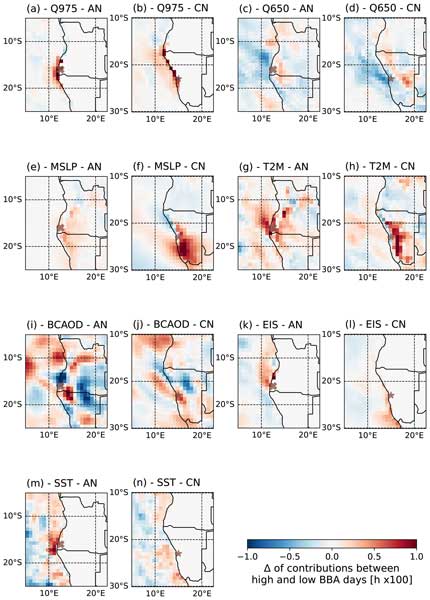
This study investigates the interaction between smoke aerosols and fog and low clouds (FLCs) in the Namib Desert between June and October. Here, a satellite-based dataset of FLCs, reanalysis data and machine learning are used to systematically analyze FLC persistence under different aerosol loadings. Aerosol plumes are shown to modify local thermodynamics, which increase FLC persistence. But fully disentangling aerosol effects from meteorological ones remains a challenge.
Viola Hipler, Hendrik Andersen, Robert Spirig, Roland Vogt, Stuart Piketh, Bianca Adler, and Jan Cermak
Atmos. Chem. Phys., 26, 14367–14384, https://doi.org/10.5194/acp-26-14367-2026, https://doi.org/10.5194/acp-26-14367-2026, 2026
Short summary
Short summary
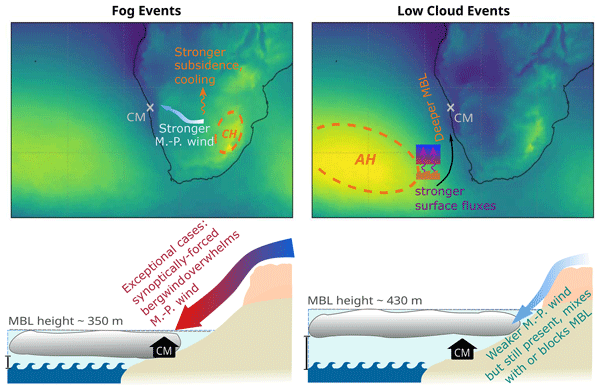
Fog is a key component of the Namib Desert ecosystem, and is mostly associated with the advection of marine stratus clouds. Here, we use local measurements near the coast to distinguish fog situations from lifted low-cloud situations. Using reanalysis data, we find synoptic and regional-scale processes over the ocean and over the continent that are connected to stratus altitude and therefore fog occurrence patterns. The results lead to a better understanding of the coastal desert fog system.
Deepanshu Malik, Hendrik Andersen, Jan Cermak, and Roland Vogt
EGUsphere, https://doi.org/10.5194/egusphere-2026-2693, https://doi.org/10.5194/egusphere-2026-2693, 2026
This preprint is open for discussion and under review for Atmospheric Measurement Techniques (AMT).
Short summary
Short summary
We created the first continuous maps of fog occurrence for the central Namib Desert by combining satellite observations with ground measurements. The study shows where and how often fog reaches the surface and distinguishes it from low clouds that remain above the ground. These maps improve understanding of an important hidden water source that supports desert ecosystems and may help future studies of climate and water availability.
Jaume Ruiz de Morales, Josep Calbó, Josep-Abel González, Hendrik Andersen, Jan Cermak, Julia Fuchs, Yolanda Sola, and José Luis Gómez-Amo
EGUsphere, https://doi.org/10.5194/egusphere-2026-3737, https://doi.org/10.5194/egusphere-2026-3737, 2026
Short summary
Short summary
This study presents cloud–aerosol transition zone distributions from coincidental ground-based and satellite lidar observations. The aim is to evaluate the capabilities of both observing systems and improve knowledge of transition zones, including their occurrence, horizontal extent, and vertical distribution. The results show how integrating both methods can compensate for their individual limitations and provide a more comprehensive characterization of cloud-TZ-aerosol distribution.
Alexandre Mass, Jan Cermak, Reto Knutti, Anna L. Merrifield, and Hendrik Andersen
EGUsphere, https://doi.org/10.5194/egusphere-2026-3242, https://doi.org/10.5194/egusphere-2026-3242, 2026
Short summary
Short summary
Fog is a critical water source for life in the Namib Desert. To assess how fog may change in the future, we combined satellite observations with climate model projections. Warming ocean temperatures reduce fog, but stronger onshore winds and increased atmospheric stability counteract this effect. Overall, Namib fog appears more resilient to climate change than previously thought, a finding that may apply to other fog-prone coasts worldwide.
Paulo Ceppi, Sarah Wilson Kemsley, Hendrik Andersen, Timothy Andrews, Ryan J. Kramer, Peer Nowack, Casey J. Wall, and Mark D. Zelinka
Atmos. Chem. Phys., 26, 4153–4171, https://doi.org/10.5194/acp-26-4153-2026, https://doi.org/10.5194/acp-26-4153-2026, 2026
Short summary
Short summary
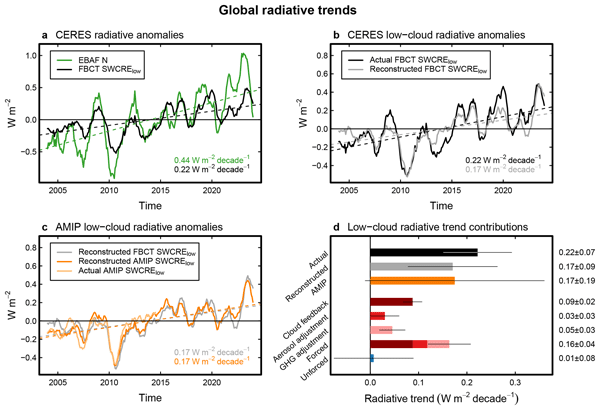
Recent decades have seen a marked decrease in global low-level cloud cover, leading to more sunlight heating the Earth. This trend is poorly understood, raising the concern that clouds may amplify global warming more than previously thought. We show that the cloud decrease is mostly caused by human forcing on climate, and that it agrees with previous estimates of how clouds respond to decreasing aerosol pollution, increasing greenhouse gas concentration, and their effects on global temperature.
Yichen Jia, Hendrik Andersen, David Neubauer, Ulrike Lohmann, Corinna Hoose, and Jan Cermak
EGUsphere, https://doi.org/10.5194/egusphere-2026-569, https://doi.org/10.5194/egusphere-2026-569, 2026
Short summary
Short summary
Understanding how ocean clouds respond to air pollution is important for climate projections. Using artificial intelligence and a climate model, we show that some model settings produce very high cloud cover, leaving little room for further cloud growth as pollution increases. This “headroom effect” can make cloud responses appear weak. Our results highlight the need to consider existing cloud conditions when interpreting how cloud cover responds to the environment.
Deepanshu Malik, Hendrik Andersen, Jan Cermak, Roland Vogt, and Bianca Adler
Atmos. Chem. Phys., 26, 681–701, https://doi.org/10.5194/acp-26-681-2026, https://doi.org/10.5194/acp-26-681-2026, 2026
Short summary
Short summary
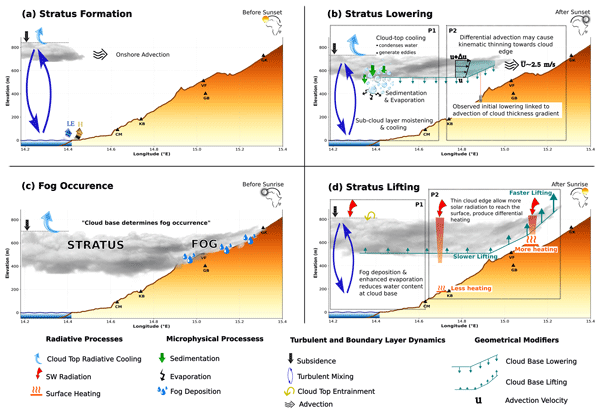
We investigated cloud base height changes in the Namib Desert and developed a method to estimate it using ground-based humidity data. This improves fog monitoring by distinguishing fog from low clouds, which satellites alone cannot reliably do. Our results reveal diurnal patterns and linkages to coastal proximity in the vertical dynamics of fog and low clouds, highlighting key atmospheric processes with potential importance for future research.
Babak Jahani, Steffen Karalus, Julia Fuchs, Tobias Zech, Marina Zara, and Jan Cermak
Atmos. Meas. Tech., 18, 1927–1941, https://doi.org/10.5194/amt-18-1927-2025, https://doi.org/10.5194/amt-18-1927-2025, 2025
Short summary
Short summary
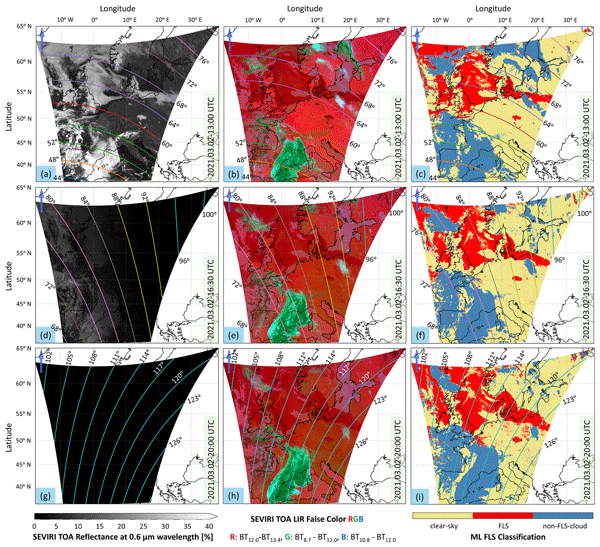
Fog and low stratus (FLS) are both persistent clouds close to the Earth's surface. This study introduces a new machine-learning-based algorithm developed for the Meteosat Second Generation geostationary satellites that can provide a coherent and detailed view of FLS development over large areas over the 24 h day cycle.
Alexandre Mass, Hendrik Andersen, Jan Cermak, Paola Formenti, Eva Pauli, and Julian Quinting
Atmos. Chem. Phys., 25, 491–510, https://doi.org/10.5194/acp-25-491-2025, https://doi.org/10.5194/acp-25-491-2025, 2025
Short summary
Short summary
This study investigates the interaction between smoke aerosols and fog and low clouds (FLCs) in the Namib Desert between June and October. Here, a satellite-based dataset of FLCs, reanalysis data and machine learning are used to systematically analyze FLC persistence under different aerosol loadings. Aerosol plumes are shown to modify local thermodynamics, which increase FLC persistence. But fully disentangling aerosol effects from meteorological ones remains a challenge.
Yichen Jia, Hendrik Andersen, and Jan Cermak
Atmos. Chem. Phys., 24, 13025–13045, https://doi.org/10.5194/acp-24-13025-2024, https://doi.org/10.5194/acp-24-13025-2024, 2024
Short summary
Short summary
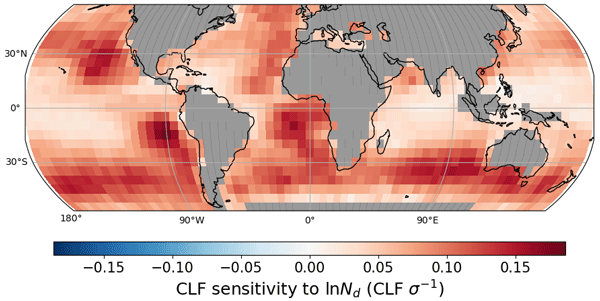
We present a near-global observation-based explainable machine learning framework to quantify the response of cloud fraction (CLF) of marine low clouds to cloud droplet number concentration (Nd), accounting for the covariations with meteorological factors. This approach provides a novel data-driven method to analyse the CLF adjustment by assessing the CLF sensitivity to Nd and numerous meteorological factors as well as the dependence of the Nd–CLF sensitivity on the meteorological conditions.
Sarah Wilson Kemsley, Paulo Ceppi, Hendrik Andersen, Jan Cermak, Philip Stier, and Peer Nowack
Atmos. Chem. Phys., 24, 8295–8316, https://doi.org/10.5194/acp-24-8295-2024, https://doi.org/10.5194/acp-24-8295-2024, 2024
Short summary
Short summary
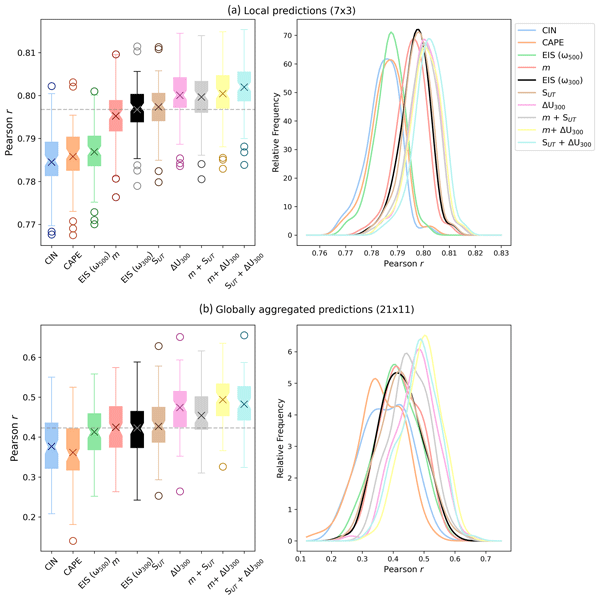
Aiming to inform parameter selection for future observational constraint analyses, we incorporate five candidate meteorological drivers specifically targeting high clouds into a cloud controlling factor framework within a range of spatial domain sizes. We find a discrepancy between optimal domain size for predicting locally and globally aggregated cloud radiative anomalies and identify upper-tropospheric static stability as an important high-cloud controlling factor.
Karine Desboeufs, Paola Formenti, Raquel Torres-Sánchez, Kerstin Schepanski, Jean-Pierre Chaboureau, Hendrik Andersen, Jan Cermak, Stefanie Feuerstein, Benoit Laurent, Danitza Klopper, Andreas Namwoonde, Mathieu Cazaunau, Servanne Chevaillier, Anaïs Feron, Cécile Mirande-Bret, Sylvain Triquet, and Stuart J. Piketh
Atmos. Chem. Phys., 24, 1525–1541, https://doi.org/10.5194/acp-24-1525-2024, https://doi.org/10.5194/acp-24-1525-2024, 2024
Short summary
Short summary
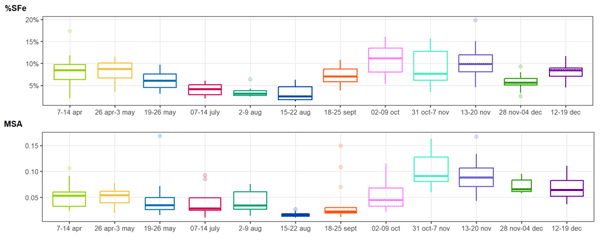
This study investigates the fractional solubility of iron (Fe) in dust particles along the coast of Namibia, a critical region for the atmospheric Fe supply of the South Atlantic Ocean. Our results suggest a possible two-way interplay whereby marine biogenic emissions from the coastal marine ecosystems into the atmosphere would increase the solubility of Fe-bearing dust by photo-reduction processes. The subsequent deposition of soluble Fe could act to further enhance marine biogenic emissions.
Hendrik Andersen, Jan Cermak, Alyson Douglas, Timothy A. Myers, Peer Nowack, Philip Stier, Casey J. Wall, and Sarah Wilson Kemsley
Atmos. Chem. Phys., 23, 10775–10794, https://doi.org/10.5194/acp-23-10775-2023, https://doi.org/10.5194/acp-23-10775-2023, 2023
Short summary
Short summary
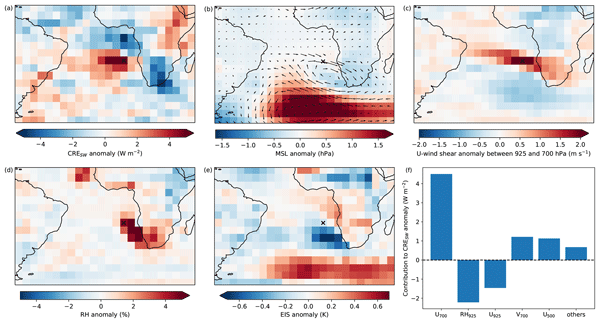
This study uses an observation-based cloud-controlling factor framework to study near-global sensitivities of cloud radiative effects to a large number of meteorological and aerosol controls. We present near-global sensitivity patterns to selected thermodynamic, dynamic, and aerosol factors and discuss the physical mechanisms underlying the derived sensitivities. Our study hopes to guide future analyses aimed at constraining cloud feedbacks and aerosol–cloud interactions.
Julia Fuchs, Hendrik Andersen, Jan Cermak, Eva Pauli, and Rob Roebeling
Atmos. Meas. Tech., 15, 4257–4270, https://doi.org/10.5194/amt-15-4257-2022, https://doi.org/10.5194/amt-15-4257-2022, 2022
Short summary
Short summary
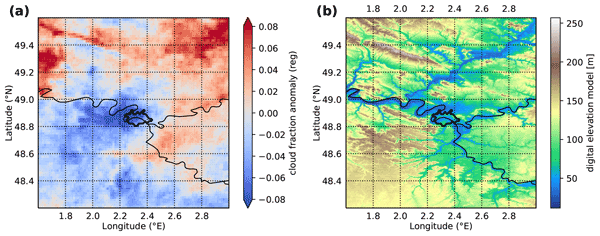
Two cloud-masking approaches, a local and a regional approach, using high-resolution satellite data are developed and validated for the region of Paris to improve applicability for analyses of urban effects on low clouds. We found that cloud masks obtained from the regional approach are more appropriate for the high-resolution analysis of locally induced cloud processes. Its applicability is tested for the analysis of typical fog conditions over different surface types.
Babak Jahani, Hendrik Andersen, Josep Calbó, Josep-Abel González, and Jan Cermak
Atmos. Chem. Phys., 22, 1483–1494, https://doi.org/10.5194/acp-22-1483-2022, https://doi.org/10.5194/acp-22-1483-2022, 2022
Short summary
Short summary
The change in the state of sky from cloudy to cloudless (or vice versa) comprises an additional phase called
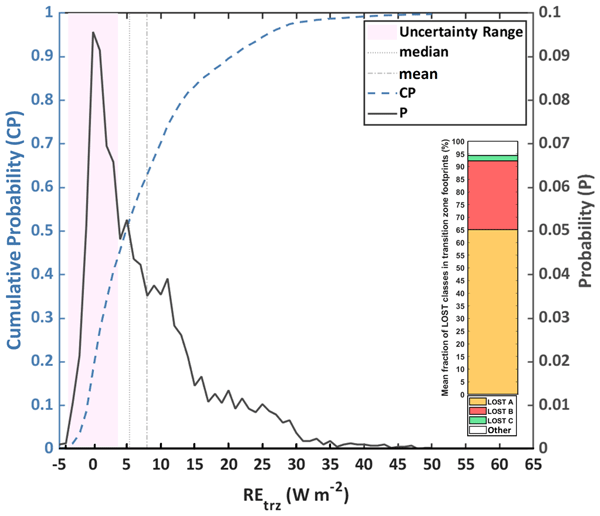
transition zonewith characteristics laying between those of aerosols and clouds. This study presents an approach for the quantification of the broadband longwave radiative effects of the cloud–aerosol transition zone at the top of the atmosphere during daytime over the ocean based on satellite observations and radiative transfer simulations.

Matthew W. Christensen, Andrew Gettelman, Jan Cermak, Guy Dagan, Michael Diamond, Alyson Douglas, Graham Feingold, Franziska Glassmeier, Tom Goren, Daniel P. Grosvenor, Edward Gryspeerdt, Ralph Kahn, Zhanqing Li, Po-Lun Ma, Florent Malavelle, Isabel L. McCoy, Daniel T. McCoy, Greg McFarquhar, Johannes Mülmenstädt, Sandip Pal, Anna Possner, Adam Povey, Johannes Quaas, Daniel Rosenfeld, Anja Schmidt, Roland Schrödner, Armin Sorooshian, Philip Stier, Velle Toll, Duncan Watson-Parris, Robert Wood, Mingxi Yang, and Tianle Yuan
Atmos. Chem. Phys., 22, 641–674, https://doi.org/10.5194/acp-22-641-2022, https://doi.org/10.5194/acp-22-641-2022, 2022
Short summary
Short summary
Trace gases and aerosols (tiny airborne particles) are released from a variety of point sources around the globe. Examples include volcanoes, industrial chimneys, forest fires, and ship stacks. These sources provide opportunistic experiments with which to quantify the role of aerosols in modifying cloud properties. We review the current state of understanding on the influence of aerosol on climate built from the wide range of natural and anthropogenic laboratories investigated in recent decades.
Cited articles
Andersen, H. and Cermak, J.: First fully diurnal fog and low cloud satellite detection reveals life cycle in the Namib, Atmos. Meas. Tech., 11, 5461–5470, https://doi.org/10.5194/amt-11-5461-2018, 2018. a, b, c, d
Andersen, H., Cermak, J., Zipfel, L., and Myers, T. A.: Attribution of observed recent decrease in low clouds over the Northeastern Pacific to cloud-controlling factors, Geophys. Res. Lett., 49, e2021GL096498, https://doi.org/10.1029/2021GL096498, 2022. a, b
Andersen, H., Cermak, J., Douglas, A., Myers, T. A., Nowack, P., Stier, P., Wall, C. J., and Wilson Kemsley, S.: Sensitivities of cloud radiative effects to large-scale meteorology and aerosols from global observations, Atmos. Chem. Phys., 23, 10775–10794, https://doi.org/10.5194/acp-23-10775-2023, 2023. a, b
Andrews, W. and Hutchings, L.: Upwelling in the Southern Benguela Current, Prog. Oceanogr., 9, 1–81, https://doi.org/10.1016/0079-6611(80)90015-4, 1980. a, b
Biastoch, A., Rühs, S., Ivanciu, I., Schwarzkopf, F. U., Veitch, J., Reason, C., Zorita, E., Tim, N., Hünicke, B., Vafeidis, A. T., Santamaria-Aguilar, S., Kupfer, S., and Soltau, F.: The Agulhas Current System as an Important Driver for Oceanic and Terrestrial Climate, Springer International Publishing, Cham, https://doi.org/10.1007/978-3-031-10948-5_8, 191–220, 2024. a
Brandt, P., Bordbar, M. H., Coelho, P., Imbol Koungue, R. A., Körner, M., Lamont, T., Lübbecke, J. F., Mohrholz, V., Prigent, A., Roch, M., Schmidt, M., van der Plas, A. K., and Veitch, J.: Physical drivers of Southwest African coastal upwelling and its response to climate variability and change, in: Sustainability of Southern African Ecosystems under Global Change: Science for Management and Policy Interventions, Springer, https://doi.org/10.1007/978-3-031-10948-5_9, 221–257, 2024. a
Bretherton, C. S., Blossey, P. N., and Jones, C. R.: Mechanisms of marine low cloud sensitivity to idealized climate perturbations: a single-LES exploration extending the CGILS cases, J. Adv. Model. Earth Sy., 5, 316–337, https://doi.org/10.1002/jame.20019, 2013. a, b
Brune, S., Keller, J. D., and Wahl, S.: Evaluation of wind speed estimates in reanalyses for wind energy applications, Adv. Sci. Res., 18, 115–126, https://doi.org/10.5194/asr-18-115-2021, 2021. a
Ceppi, P., Wilson Kemsley, S., Andersen, H., Andrews, T., Kramer, R. J., Nowack, P., Wall, C. J., and Zelinka, M. D.: Emerging low-cloud feedback and adjustment in global satellite observations, Atmos. Chem. Phys., 26, 4153–4171, https://doi.org/10.5194/acp-26-4153-2026, 2026. a
Cermak, J.: Low clouds and fog along the South-Western African coast – satellite-based retrieval and spatial patterns, Atmos. Res., 116, 15–21, https://doi.org/10.1016/j.atmosres.2011.02.012, 2012. a
Christensen, M. W., Carrió, G. G., Stephens, G. L., and Cotton, W. R.: Radiative impacts of free-tropospheric clouds on the properties of marine stratocumulus, J. Atmos. Sci., 70, 3102–3118, https://doi.org/10.1175/JAS-D-12-0287.1, 2013. a
Dormann, C. F., Elith, J., Bacher, S., Buchmann, C., Carl, G., Carré, G., García Marquéz, J. R., Gruber, B., Lafourcade, B., Leitão, P. J., Münkemüller, T., McClean, C., Osborne, P. E., Reineking, B., Schröder, B., Skidmore, A. K., Zurell, D., and Lautenbach, S.: Collinearity: a review of methods to deal with it and a simulation study evaluating their performance, Ecography, 36, 27–46, https://doi.org/10.1111/j.1600-0587.2012.07348.x, 2013. a
Ebner, M., Miranda, T., and Roth-Nebelsick, A.: Efficient fog harvesting by Stipagrostis sabulicola (Namib dune bushman grass), J. Arid Environ., 75, 524–531, https://doi.org/10.1016/j.jaridenv.2011.01.004, 2011. a
Espinoza, V., Lobos-Roco, F., and del Río, C.: Synoptic control of the spatiotemporal variability of fog and low clouds under ENSO phenomena along the Chilean coast (17°–36° S), Atmos. Res., 308, 107533, https://doi.org/10.1016/j.atmosres.2024.107533, 2024. a
Florenchie, P., Lutjeharms, J. R., Reason, C., Masson, S., and Rouault, M.: The source of Benguela Niños in the south Atlantic Ocean, Geophys. Res. Lett., 30, https://doi.org/10.1029/2003GL017172, 2003. a, b
Florenchie, P., Reason, C., Lutjeharms, J., Rouault, M., Roy, C., and Masson, S.: Evolution of interannual warm and cold events in the southeast Atlantic Ocean, J. Climate, 17, 2318–2334, https://doi.org/10.1175/1520-0442(2004)017<2318:EOIWAC>2.0.CO;2, 2004. a
Formenti, P., D'Anna, B., Flamant, C., Mallet, M., Piketh, S. J., Schepanski, K., Waquet, F., Auriol, F., Brogniez, G., Burnet, F., Chaboureau, J.-P., Chauvigné, A., Chazette, P., Denjean, C., Desboeufs, K., Doussin, J.-F., Elguindi, N., Feuerstein, S., Gaetani, M., Giorio, C., Klopper, D., Mallet, M. D., Nabat, P., Monod, A., Solmon, F., Namwoonde, A., Chikwililwa, C., Mushi, R., Welton, E. J., and Holben, B.: The aerosols, radiation and clouds in southern Africa field campaign in Namibia: overview, illustrative observations, and way forward, B. Am. Meteorol. Soc., 100, 1277–1298, https://doi.org/10.1175/BAMS-D-17-0278.1, 2019. a
Gelaro, R., McCarty, W., Suárez, M. J., Todling, R., Molod, A., Takacs, L., Randles, C. A., Darmenov, A., Bosilovich, M. G., Reichle, R., Wargan, K., Coy, L., Cullather, R., Draper, C., Akella, S., Buchard, V., Conaty, A., da Silva, A. M., Gu, W., Kim, G.-K., Koster, R., Lucchesi, R., Merkova, D., Nielsen, J. E., Partyka, G., Pawson, S., Putman, W., Rienecker, M., Schubert, S. D., Sienkiewicz, M., and Zhao, B.: The modern-era retrospective analysis for research and applications, version 2 (MERRA-2), J. Climate, 30, 5419–5454, https://doi.org/10.1175/JCLI-D-16-0758.1, 2017. a
Glantz, M. H. and Ramirez, I. J.: Reviewing the Oceanic Niño Index (ONI) to enhance societal readiness for El Niño's impacts, Int. J. Disast. Risk. Sc., 11, 394–403, https://doi.org/10.1007/s13753-020-00275-w, 2020. a
Global Modeling and Assimilation Office and Pawson, S.: MERRA-2 instM_3d_ana_Np: 3d, Monthly Mean, Instantaneous, Pressure-Level, Analysis, Analyzed Meteorological Fields V5.12.4, Goddard Earth Sciences Data and Information Services Center (GES DISC), Greenbelt, MD, USA [data set], https://doi.org/10.5067/V92O8XZ30XBI, 2015a. a
Global Modeling and Assimilation Office and Pawson, S.: MERRA-2 instM_2d_asm_Nx: 2d, Monthly Mean, Single-Level, Assimilation, Single-Level Diagnostics V5.12.4, Goddard Earth Sciences Data and Information Services Center (GES DISC), Greenbelt, MD, USA [data set], https://doi.org/10.5067/5ESKGQTZG7FO, 2015b. a
Global Modeling and Assimilation Office and Pawson, S.: MERRA-2 inst1_2d_asm_Nx: 2d, 1-Hourly, Instantaneous, Single-Level, Assimilation, Single-Level Diagnostics V5.12.4, Goddard Earth Sciences Data and Information Services Center (GES DISC), Greenbelt, MD, USA [data set], https://doi.org/10.5067/3Z173KIE2TPD, 2015c. a
Gottlieb, T. R., Eckardt, F. D., Venter, Z. S., and Cramer, M. D.: The contribution of fog to water and nutrient supply to Arthraerua leubnitziae in the central Namib Desert, Namibia, J. Arid Environ., 161, 35–46, https://doi.org/10.1016/j.jaridenv.2018.11.002, 2019. a
Griffin, M.: The species diversity, distribution and conservation of Namibian mammals, Biodivers. Conserv., 7, 483–494, https://doi.org/10.1023/A:1008875511827, 1998. a
Gultepe, I., Tardif, R., Michaelides, S. C., Cermak, J., Bott, A., Bendix, J., Müller, M. D., Pagowski, M., Hansen, B., Ellrod, G., Jacobs, W., Toth, G., and Cober, S. G.: Fog research: a review of past achievements and future perspectives, Pure Appl. Geophys., 164, 1121–1159, https://doi.org/10.1007/s00024-007-0211-x, 2007. a, b
Hersbach, H., Bell, B., Berrisford, P., Hirahara, S., Horányi, A., Muñoz-Sabater, J., Nicolas, J., Peubey, C., Radu, R., Schepers, D., Simmons, A., Soci, C., Abdalla, S., Abellan, X., Balsamo, G., Bechtold, P., Biavati, G., Bidlot, J., Bonavita, M., De Chiara, G., Dahlgren, P., Dee, D., Diamantakis, M., Dragani, R., Flemming, J., Forbes, R., Fuentes, M., Geer, A., Haimberger, L., Healy, S., Hogan, R. J., Hólm, E., Janisková, M., Keeley, S., Laloyaux, P., Lopez, P., Lupu, C., Radnoti, G., de Rosnay, P., Rozum, I., Vamborg, F., Villaume, S., and Thépaut, J.-N.: The ERA5 global reanalysis, Q. J. Roy. Meteor. Soc., 146, 1999–2049, https://doi.org/10.1002/qj.3803, 2020. a
Hersbach, H., Bell, B., Berrisford, P., Biavati, G., Horányi, A., Muñoz Sabater, J., Nicolas, J., Peubey, C., Radu, R., Rozum, I., Schepers, D., Simmons, A., Soci, C., Dee, D., and Thépaut, J.-N.: ERA5 monthly averaged data on single levels from 1940 to present, Copernicus Climate Change Service (C3S) Climate Data Store (CDS) [data set], https://doi.org/10.24381/cds.f17050d7, 2023a. a
Hersbach, H., Bell, B., Berrisford, P., Biavati, G., Horányi, A., Muñoz Sabater, J., Nicolas, J., Peubey, C., Radu, R., Rozum, I., Schepers, D., Simmons, A., Soci, C., Dee, D., and Thépaut, J.-N.: ERA5 monthly averaged data on pressure levels from 1940 to present, Copernicus Climate Change Service (C3S) Climate Data Store (CDS) [data set], https://doi.org/10.24381/cds.6860a573, 2023b. a
Hipler, V., Andersen, H., Spirig, R., Vogt, R., Piketh, S., Adler, B., and Cermak, J.: Synoptic and regional-scale meteorological controls of stratus altitude in the Namib Desert, EGUsphere [preprint], https://doi.org/10.5194/egusphere-2025-5816, 2026. a
Hoerl, A. E. and Kennard, R. W.: Ridge regression: Biased estimation for nonorthogonal problems, Technometrics, 12, 55–67, https://doi.org/10.1080/00401706.1970.10488634, 1970. a
Huang, B., Liu, C., Banzon, V., Freeman, E., Graham, G., Hankins, B., Smith, T., and Zhang, H.-M.: Improvements of the daily optimum interpolation sea surface temperature (DOISST) version 2.1, J. Climate, 34, 2923–2939, https://doi.org/10.1175/JCLI-D-20-0166.1, 2021. a
Huntley, B. J.: The Namib Desert Biome, Springer International Publishing, Cham, https://doi.org/10.1007/978-3-031-18923-4_16, 361–382, 2023. a
Hutchings, L., van der Lingen, C., Shannon, L., Crawford, R., Verheye, H., Bartholomae, C., van der Plas, A., Louw, D., Kreiner, A., Ostrowski, M., Fidel, Q., Barlow, R., Lamont, T., Coetzee, J., Shillington, F., Veitch, J., Currie, J., and Monteiro, P.: The Benguela current: an ecosystem of four components, Prog. Oceanogr., 83, 15–32, https://doi.org/10.1016/j.pocean.2009.07.046, 2009. a, b
Imbol Koungue, R. A., Rouault, M., Illig, S., Brandt, P., and Jouanno, J.: Benguela Niños and Benguela Niñas in forced ocean simulation from 1958 to 2015, J. Geophys. Res.-Oceans, 124, 5923–5951, https://doi.org/10.1029/2019JC015013, 2019. a
Juergens, N., Oldeland, J., Hachfeld, B., Erb, E., and Schultz, C.: Ecology and spatial patterns of large-scale vegetation units within the central Namib Desert, J. Arid Environ., 93, 59–79, https://doi.org/10.1016/j.jaridenv.2012.09.009, 2013. a
Kaseke, K. F., Wang, L., and Seely, M. K.: Nonrainfall water origins and formation mechanisms, Science Advances, 3, e1603131, https://doi.org/10.1126/sciadv.1603131, 2017. a
Kaseke, K. F., Tian, C., Wang, L., Seely, M., Vogt, R., Wassenaar, T., and Mushi, R.: Fog spatial distributions over the Central Namib Desert-an isotope approach, Aerosol Air Qual. Res., 18, 49–61, https://doi.org/10.4209/aaqr.2017.01.0062, 2018. a
Kaspar, F., Helmschrot, J., Mhanda, A., Butale, M., de Clercq, W., Kanyanga, J. K., Neto, F. O. S., Kruger, S., Castro Matsheka, M., Muche, G., Hillmann, T., Josenhans, K., Posada, R., Riede, J., Seely, M., Ribeiro, C., Kenabatho, P., Vogt, R., and Jürgens, N.: The SASSCAL contribution to climate observation, climate data management and data rescue in Southern Africa, Adv. Sci. Res., 12, 171–177, https://doi.org/10.5194/asr-12-171-2015, 2015. a, b
Lancaster, J., Lancaster, N., and Seely, M. K: Climate of the central Namib Desert, Madoqua, 1984, 5–61, 1984. a
Li, Y., Wang, L., Diersing, C. J., Qiao, N., Liu, Y., Maggs-Kölling, G., and Marais, E.: El Niño intensified fog formation in the Namib Desert, Earths Future, 13, e2024EF005725, https://doi.org/10.1029/2024EF005725, 2025. a, b
Lindesay, J. A. and Tyson, P. D.: Thermo-topographically induced boundary layer oscillations over the central Namib, southern Africa, Int. J. Climatol., 10, 63–77, https://doi.org/10.1002/joc.3370100108, 1990. a, b
Louw, G. N. and Holm, E.: Physiological, morphological and behavioural adaptations of the ultrapsammophilous, Namib Desert lizard Aporosaura anchietae (Bocage), Madoqua, 1, 67–85, 1972. a
Malik, D., Andersen, H., Cermak, J., Vogt, R., and Adler, B.: Cloud base height determines fog occurrence patterns in the Namib Desert, Atmos. Chem. Phys., 26, 681–701, https://doi.org/10.5194/acp-26-681-2026, 2026. a, b
Mass, A., Andersen, H., Cermak, J., Formenti, P., Pauli, E., and Quinting, J.: A satellite-based analysis of semi-direct effects of biomass burning aerosols on fog and low-cloud dissipation in the Namib Desert, Atmos. Chem. Phys., 25, 491–510, https://doi.org/10.5194/acp-25-491-2025, 2025. a, b
Mass, A., Andersen, H., and Cermak, J.: Code for: “Coastal upwelling and tropical warm water intrusions are key drivers of interannual fog variability along the southwestern African coast”, Zenodo [code], https://doi.org/10.5281/zenodo.21630065, 2026a. a
Mass, A., Andersen, H., and Cermak, J.: Satellite-based fog and low stratus monthly cover in the Angolan Namib and Central Namib, Karlsruhe Institute of Technology (KIT), RADAR4KIT [data set], https://doi.org/10.35097/pebssmnzn7n8czg5, 2026b. a
Maúre, G., Pinto, I., Ndebele-Murisa, M., Muthige, M., Lennard, C., Nikulin, G., Dosio, A., and Meque, A.: The southern African climate under 1.5 °C and 2 °C of global warming as simulated by CORDEX regional climate models, Environ. Res. Lett., 13, 065002, https://doi.org/10.1088/1748-9326/aab190, 2018. a
McPhaden, M. J., Jarugula, S., Aroucha, L. C., and Lübbecke, J. F.: Indian ocean dipole intensifies Benguela Niño through Congo River discharge, Communications Earth and Environment, 5, 779, https://doi.org/10.1038/s43247-024-01955-x, 2024. a
Myers, T. A. and Norris, J. R.: Reducing the uncertainty in subtropical cloud feedback, Geophys. Res. Lett., 43, 2144–2148, https://doi.org/10.1002/2015GL067416, 2016. a, b
Nelson, G. and Hutchings, L.: The Benguela upwelling area, Prog. Oceanogr., 12, 333–356, https://doi.org/10.1016/0079-6611(83)90013-7, 1983. a
Richter, I., Behera, S. K., Masumoto, Y., Taguchi, B., Komori, N., and Yamagata, T.: On the triggering of Benguela Niños: remote equatorial versus local influences, Geophys. Res. Lett., 37, https://doi.org/10.1029/2010GL044461, 2010. a
Rouault, M. and Tomety, F.: Impact of El Niño–southern oscillation on the Benguela upwelling, J. Phys. Oceanogr., 52, 2573–2587, https://doi.org/10.1175/JPO-D-21-0219.1, 2022. a, b, c, d
Rouault, M., Illig, S., Lübbecke, J., and Koungue, R. A. I.: Origin, development and demise of the 2010–2011 Benguela Niño, J. Marine Syst., 188, 39–48, https://doi.org/10.1016/j.jmarsys.2017.07.007, 2018. a
Schmetz, J., Pili, P., Tjemkes, S., Just, D., Kerkmann, J., Rota, S., and Ratier, A.: An introduction to Meteosat second generation (MSG), B. Am. Meteorol. Soc., 83, 977–992, https://doi.org/10.1175/1520-0477(2002)083<0977:AITMSG>2.3.CO;2, 2002. a
Scott, R. C., Myers, T. A., Norris, J. R., Zelinka, M. D., Klein, S. A., Sun, M., and Doelling, D. R.: Observed sensitivity of low-cloud radiative effects to meteorological perturbations over the global oceans, J. Climate, 33, 7717–7734, https://doi.org/10.1175/JCLI-D-19-1028.1, 2020. a, b, c, d, e, f
Siddiqui, C., Rixen, T., Lahajnar, N., Van der Plas, A. K., Louw, D. C., Lamont, T., and Pillay, K.: Regional and global impact of CO2 uptake in the Benguela Upwelling System through preformed nutrients, Nat. Commun., 14, 2582, https://doi.org/10.1038/s41467-023-38208-y, 2023. a, b
Spirig, R., Vogt, R., Larsen, J. A., Feigenwinter, C., Wicki, A., Franceschi, J., Parlow, E., Adler, B., Kalthoff, N., Cermak, J., Andersen, H., Fuchs, J., Bott, A., Hacker, M., Wagner, N., Maggs-Kölling, G., Wassenaar, T., and Seely, M.: Probing the fog life cycles in the Namib Desert, B. Am. Meteorol. Soc., 100, 2491–2507, https://doi.org/10.1175/BAMS-D-18-0142.1, 2019. a, b, c
Tomety, F. S., Illig, S., Ostrowski, M., Awo, F. M., Bachèlery, M.-L., Keenlyside, N., and Rouault, M.: Long-term climatological trends driving the recent warming along the Angolan and Namibian coasts, Clim. Dynam., 62, 7763–7782, https://doi.org/10.1007/s00382-024-07305-z, 2024. a
Van der Dussen, J., De Roode, S., Dal Gesso, S., and Siebesma, A.: An LES model study of the influence of the free tropospheric thermodynamic conditions on the stratocumulus response to a climate perturbation, J. Adv. Model. Earth Sy., 7, 670–691, https://doi.org/10.1002/2014MS000380, 2015. a
Wang, L., Kaseke, K. F., Ravi, S., Jiao, W., Mushi, R., Shuuya, T., and Maggs-Kölling, G.: Convergent vegetation fog and dew water use in the Namib Desert, Ecohydrology, 12, e2130, https://doi.org/10.1002/eco.2130, 2019. a
Warren-Rhodes, K. A., McKay, C. P., Boyle, L. N., Wing, M. R., Kiekebusch, E. M., Cowan, D. A., Stomeo, F., Pointing, S. B., Kaseke, K. F., Eckardt, F., Henschel, J. R., Anisfeld, A., Seely, M., and Rhodes, K. L.: Physical ecology of hypolithic communities in the central Namib Desert: the role of fog, rain, rock habitat, and light, J. Geophys. Res.-Biogeo., 118, 1451–1460, https://doi.org/10.1002/jgrg.20117, 2013. a, b
Weathers, K. C., Ponette-González, A. G., and Dawson, T. E.: Medium, vector, and connector: fog and the maintenance of ecosystems, Ecosystems, 23, 217–229, https://doi.org/10.1007/s10021-019-00388-4, 2020. a
Wood, R. and Bretherton, C. S.: On the relationship between stratiform low cloud cover and lower-tropospheric stability, J. Climate, 19, 6425–6432, https://doi.org/10.1175/JCLI3988.1, 2006. a
Short summary
Fog is a vital water source in the Namib Desert, but its year-to-year variability is poorly understood. Using satellite observations and reanalysis data, we show that fog and low-cloud variability is closely tied to sea surface temperatures in the Benguela upwelling system. Warm events driven by tropical water intrusions are followed by reduced fog in the northern Namib, indicating that ocean state carries predictive information for fog in this hyper-arid ecosystem.
Fog is a vital water source in the Namib Desert, but its year-to-year variability is poorly...


Altmetrics
Final-revised paper
Preprint