
Articles | Volume 26, issue 17
https://doi.org/10.5194/acp-26-12457-2026
© Author(s) 2026. This work is distributed under
the Creative Commons Attribution 4.0 License.
the Creative Commons Attribution 4.0 License.
https://doi.org/10.5194/acp-26-12457-2026
© Author(s) 2026. This work is distributed under
the Creative Commons Attribution 4.0 License.
the Creative Commons Attribution 4.0 License.
Research article
| 
02 Sep 2026
Research article |
| 02 Sep 2026
| 02 Sep 2026
A cross-instrument closure and polarimetric study for improving sub-millimeter polarimeter-radiometer ice cloud microphysics retrievals

Climate and Radiation Lab, NASA Goddard Space Flight Center, Greenbelt, MD, USA
Yuli Liu
GESTAR-II, University of Maryland at Baltimore County, Baltimore, MD, USA
Joseph A. Finlon
ESSIC, University of Maryland at College Park, College Park, MD, USA
Mesoscale Atmospheric Processes Lab, NASA Goddard Space Flight Center, Greenbelt, MD, USA
Ian S. Adams
Mesoscale Atmospheric Processes Lab, NASA Goddard Space Flight Center, Greenbelt, MD, USA
Rachael A. Kroodsma
Mesoscale Atmospheric Processes Lab, NASA Goddard Space Flight Center, Greenbelt, MD, USA
Dong L. Wu
Climate and Radiation Lab, NASA Goddard Space Flight Center, Greenbelt, MD, USA
Ralf Bennartz
Dept. of Earth and Environmental Sciences, Vanderbilt University, Nashville, TN, USA
Related authors
Yuli Liu, Jie Gong, Ian S. Adams, Rachael A. Kroodsma, Ruiyao Chen, Dong L. Wu, Ralf Bennartz, and Scott A. Braun
EGUsphere, https://doi.org/10.5194/egusphere-2026-1348, https://doi.org/10.5194/egusphere-2026-1348, 2026
Short summary
Short summary
This paper presents an ice hydrometeor retrieval algorithm for the PolSIR and PMM satellite missions. The algorithm combines Bayesian Monte Carlo Integration with the Optimal Estimation Method, extending retrieval capability beyond the limitations of the a priori database. Experiments using simulations and airborne observations show that the algorithm effectively reduces discrepancies between observations and simulations and improves the accuracy of retrieved ice cloud microphysical properties.
Jie Gong, Dong L. Wu, Michelle Badalov, Manisha Ganeshan, and Minghua Zheng
Atmos. Meas. Tech., 18, 4025–4043, https://doi.org/10.5194/amt-18-4025-2025, https://doi.org/10.5194/amt-18-4025-2025, 2025
Short summary
Short summary
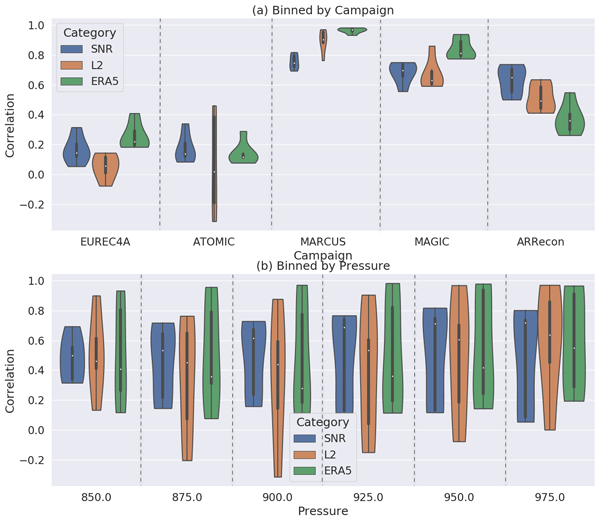
Marine boundary layer (MABL) water vapor is among the key factors to couple the ocean and atmosphere, but it is also among the hardest to retrieve from a satellite remote sensing perspective. Here we propose a novel way to retrieve MABL specific humidity profiles using the GNSS (Global Navigation Satellite System) Level-1 signal-to-noise ratio. Using a machine learning approach, we successfully obtained a retrieval product that outperforms the ERA-5 reanalysis and operational Level-2 retrievals globally, except in the deep tropics.
Manisha Ganeshan, Dong L. Wu, Joseph A. Santanello, Jie Gong, Chi Ao, Panagiotis Vergados, and Kevin J. Nelson
Atmos. Meas. Tech., 18, 1389–1403, https://doi.org/10.5194/amt-18-1389-2025, https://doi.org/10.5194/amt-18-1389-2025, 2025
Short summary
Short summary
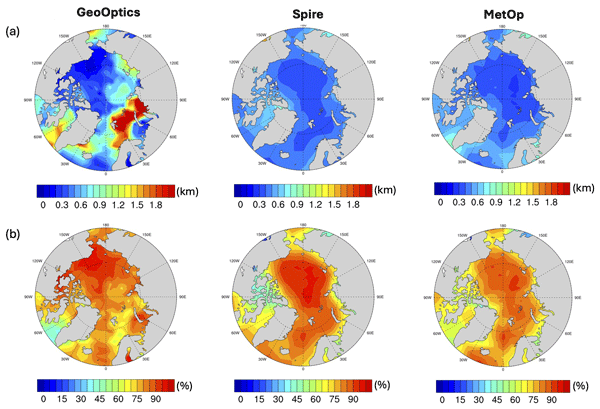
This study explores the potential of two newly launched commercial Global Navigation Satellite System (GNSS) radio occultation (RO) satellite missions for advancing Arctic lower-atmospheric studies. The products have a good sampling of the lower Arctic atmosphere and are useful to derive the planetary boundary layer (PBL) height during winter months. This research is a step towards closing the observation gap in polar regions due to the decomissioning of Constellation Observing System for Meteorology, Ionosphere, and Climate (COSMIC-1) GNSS RO mission and the lack of high-latitude coverage by its successor (COSMIC-2).
Dong L. Wu, Valery A. Yudin, Kyu-Myong Kim, Mohar Chattopadhyay, Lawrence Coy, Ruth S. Lieberman, C. C. Jude H. Salinas, Jae N. Lee, Jie Gong, and Guiping Liu
Atmos. Meas. Tech., 18, 843–863, https://doi.org/10.5194/amt-18-843-2025, https://doi.org/10.5194/amt-18-843-2025, 2025
Short summary
Short summary
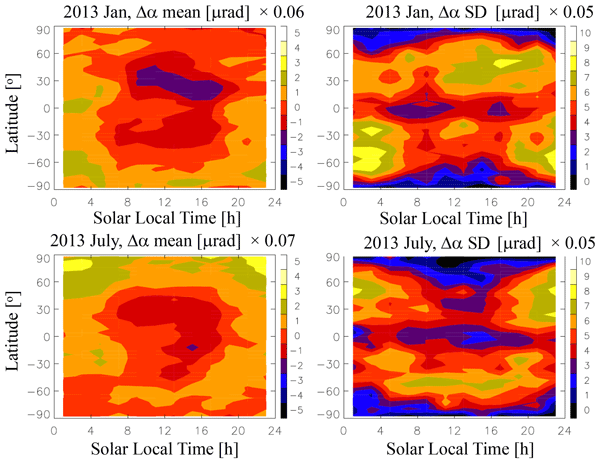
Global Navigation Satellite System radio occultation data help monitor climate and weather prediction but are affected by residual ionospheric errors (RIEs). A new excess-phase-gradient method detects and corrects RIEs, showing both positive and negative values, varying by latitude, time, and solar activity. Tests show that RIE impacts polar stratosphere temperatures in models, with differences up to 3–4 K. This highlights the need for RIE correction to improve the accuracy of data assimilation.
Jie Gong, Dong L. Wu, and Patrick Eriksson
Earth Syst. Sci. Data, 13, 5369–5387, https://doi.org/10.5194/essd-13-5369-2021, https://doi.org/10.5194/essd-13-5369-2021, 2021
Short summary
Short summary
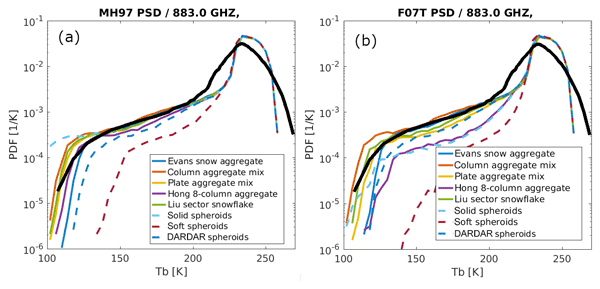
Launched from the International Space Station, the IceCube radiometer orbited the Earth for 15 months and collected the first spaceborne radiance measurements at 874–883 GHz. This channel is uniquely important to fill in the sensitivity gap between operational visible–infrared and microwave remote sensing for atmospheric cloud ice and snow. This paper delivers the IceCube Level 1 radiance data processing algorithm and provides a data quality evaluation and discussion on its scientific merit.
Gavin Blair, Mohamad Kazma, Ahmad Taha, Ralf Bennartz, and Sankaran Mahadevan
EGUsphere, https://doi.org/10.5194/egusphere-2026-3813, https://doi.org/10.5194/egusphere-2026-3813, 2026
This preprint is open for discussion and under review for Geoscientific Model Development (GMD).
Short summary
Short summary
Earth’s ability to reflect incoming sunlight plays an important role in how its temperature changes over time. This reflectivity varies across regions and seasons, but many climate models represent it only in simplified ways. In this paper, we develop models that predict how reflectivity changes alongside temperature. We find that these models can improve predictions, but their performance is limited in regions and seasons with little or no sunlight.
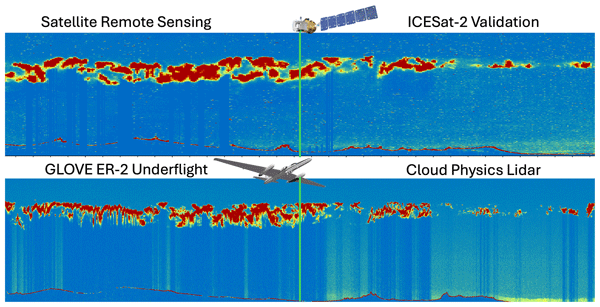
John E. Yorks, Edward P. Nowottnick, Steven Platnick, Kerry G. Meyer, Matthew Walker McLinden, Meloe S. F. Kacenelenbogen, Kenneth E. Christian, Joseph A. Finlon, Natalie A. Midzak, Natalia Roldán-Henao, Patrick A. Selmer, Matthew J. McGill, Erica K. Dolinar, Charles N. Helms, Robert Koopman, Jonas von Bismark, and Montserrat Pińol Solé
Earth Syst. Sci. Data, 18, 3833–3852, https://doi.org/10.5194/essd-18-3833-2026, https://doi.org/10.5194/essd-18-3833-2026, 2026
Short summary
Short summary
The Goddard Space Flight Center's Lidar Observation and Validation Experiment (GLOVE) was a NASA field campaign from January–February 2025 that used a special airplane with scientific instruments to check if satellites measuring Earth's atmosphere were working correctly. The plane flew under two key satellites to compare measurements of clouds, dust, and other particles in the air. Data from 8 flights help scientists better understand how well these space-based instruments perform, especially for detecting different types of clouds and atmospheric conditions.
Yuli Liu, Jie Gong, Ian S. Adams, Rachael A. Kroodsma, Ruiyao Chen, Dong L. Wu, Ralf Bennartz, and Scott A. Braun
EGUsphere, https://doi.org/10.5194/egusphere-2026-1348, https://doi.org/10.5194/egusphere-2026-1348, 2026
Short summary
Short summary
This paper presents an ice hydrometeor retrieval algorithm for the PolSIR and PMM satellite missions. The algorithm combines Bayesian Monte Carlo Integration with the Optimal Estimation Method, extending retrieval capability beyond the limitations of the a priori database. Experiments using simulations and airborne observations show that the algorithm effectively reduces discrepancies between observations and simulations and improves the accuracy of retrieved ice cloud microphysical properties.

Daniel J. Emmons, Cornelius Csar Jude H. Salinas, Dong L. Wu, Nimalan Swarnalingam, Eugene V. Dao, Jorge L. Chau, Yosuke Yamazaki, Kyle E. Fitch, and Victoriya V. Forsythe
Ann. Geophys., 44, 17–34, https://doi.org/10.5194/angeo-44-17-2026, https://doi.org/10.5194/angeo-44-17-2026, 2026
Short summary
Short summary
The E-region of the Earth’s ionosphere plays an important role in atmospheric energy balance and High Frequency radio propagation. In this paper, we compare predictions from two recently developed ionospheric models to observations by ionospheric sounders (ionosondes). Overall, the models show reasonable agreement with the observations. However, there are several areas for improvement in the models as well as questions about the accuracy of the automatically processed ionosonde dataset.
Jie Gong, Dong L. Wu, Michelle Badalov, Manisha Ganeshan, and Minghua Zheng
Atmos. Meas. Tech., 18, 4025–4043, https://doi.org/10.5194/amt-18-4025-2025, https://doi.org/10.5194/amt-18-4025-2025, 2025
Short summary
Short summary
Marine boundary layer (MABL) water vapor is among the key factors to couple the ocean and atmosphere, but it is also among the hardest to retrieve from a satellite remote sensing perspective. Here we propose a novel way to retrieve MABL specific humidity profiles using the GNSS (Global Navigation Satellite System) Level-1 signal-to-noise ratio. Using a machine learning approach, we successfully obtained a retrieval product that outperforms the ERA-5 reanalysis and operational Level-2 retrievals globally, except in the deep tropics.
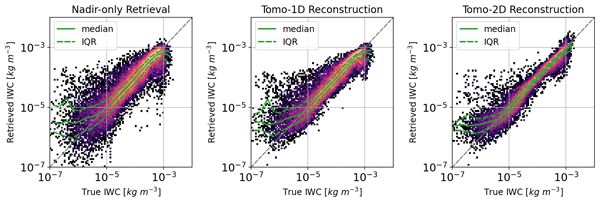
Yuli Liu and Ian Stuart Adams
Atmos. Meas. Tech., 18, 1659–1674, https://doi.org/10.5194/amt-18-1659-2025, https://doi.org/10.5194/amt-18-1659-2025, 2025
Short summary
Short summary
This paper presents our latest development in tomographic reconstruction algorithms that use multi-angle (sub)millimeter-wave brightness temperature to reconstruct the spatial distribution of ice clouds. Compared to nadir-only retrievals, the tomography technique provides a detailed reconstruction of ice clouds’ inner structure with high spatial resolution and significantly improves retrieval accuracy. Also, the technique effectively increases detection sensitivity for small ice cloud particles.
Manisha Ganeshan, Dong L. Wu, Joseph A. Santanello, Jie Gong, Chi Ao, Panagiotis Vergados, and Kevin J. Nelson
Atmos. Meas. Tech., 18, 1389–1403, https://doi.org/10.5194/amt-18-1389-2025, https://doi.org/10.5194/amt-18-1389-2025, 2025
Short summary
Short summary
This study explores the potential of two newly launched commercial Global Navigation Satellite System (GNSS) radio occultation (RO) satellite missions for advancing Arctic lower-atmospheric studies. The products have a good sampling of the lower Arctic atmosphere and are useful to derive the planetary boundary layer (PBL) height during winter months. This research is a step towards closing the observation gap in polar regions due to the decomissioning of Constellation Observing System for Meteorology, Ionosphere, and Climate (COSMIC-1) GNSS RO mission and the lack of high-latitude coverage by its successor (COSMIC-2).
Dong L. Wu, Valery A. Yudin, Kyu-Myong Kim, Mohar Chattopadhyay, Lawrence Coy, Ruth S. Lieberman, C. C. Jude H. Salinas, Jae N. Lee, Jie Gong, and Guiping Liu
Atmos. Meas. Tech., 18, 843–863, https://doi.org/10.5194/amt-18-843-2025, https://doi.org/10.5194/amt-18-843-2025, 2025
Short summary
Short summary
Global Navigation Satellite System radio occultation data help monitor climate and weather prediction but are affected by residual ionospheric errors (RIEs). A new excess-phase-gradient method detects and corrects RIEs, showing both positive and negative values, varying by latitude, time, and solar activity. Tests show that RIE impacts polar stratosphere temperatures in models, with differences up to 3–4 K. This highlights the need for RIE correction to improve the accuracy of data assimilation.
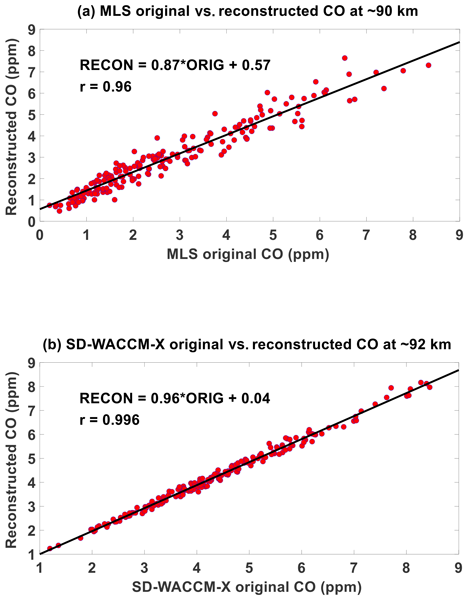
Cornelius Csar Jude H. Salinas, Dong L. Wu, Jae N. Lee, Loren C. Chang, Liying Qian, and Hanli Liu
Atmos. Chem. Phys., 23, 1705–1730, https://doi.org/10.5194/acp-23-1705-2023, https://doi.org/10.5194/acp-23-1705-2023, 2023
Short summary
Short summary
Upper mesospheric carbon monoxide's (CO) photochemical lifetime is longer than dynamical timescales. This work uses satellite observations and model simulations to establish that the migrating diurnal tide and its seasonal and interannual variabilities drive CO primarily through vertical advection. Vertical advection is a transport process that is currently difficult to observe. This work thus shows that we can use CO as a tracer for vertical advection across seasonal and interannual timescales.
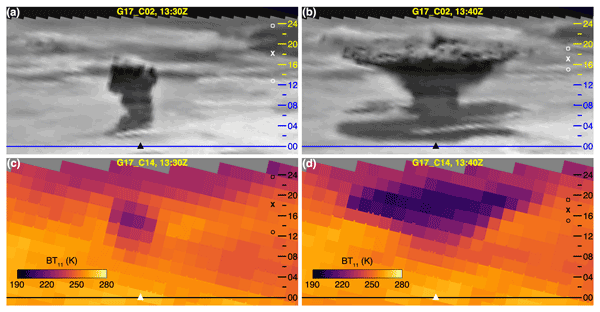
Ákos Horváth, James L. Carr, Dong L. Wu, Julia Bruckert, Gholam Ali Hoshyaripour, and Stefan A. Buehler
Atmos. Chem. Phys., 22, 12311–12330, https://doi.org/10.5194/acp-22-12311-2022, https://doi.org/10.5194/acp-22-12311-2022, 2022
Short summary
Short summary
We estimate plume heights for the April 2021 La Soufrière daytime eruptions using GOES-17 near-limb side views and GOES-16–MODIS stereo views. These geometric heights are then compared with brightness-temperature-based radiometric height estimates to characterize the biases of the latter. We also show that the side view method can be applied to infrared imagery and thus nighttime eruptions, albeit with larger uncertainty.
Jie Gong, Dong L. Wu, and Patrick Eriksson
Earth Syst. Sci. Data, 13, 5369–5387, https://doi.org/10.5194/essd-13-5369-2021, https://doi.org/10.5194/essd-13-5369-2021, 2021
Short summary
Short summary
Launched from the International Space Station, the IceCube radiometer orbited the Earth for 15 months and collected the first spaceborne radiance measurements at 874–883 GHz. This channel is uniquely important to fill in the sensitivity gap between operational visible–infrared and microwave remote sensing for atmospheric cloud ice and snow. This paper delivers the IceCube Level 1 radiance data processing algorithm and provides a data quality evaluation and discussion on its scientific merit.
Rachel Atlas, Johannes Mohrmann, Joseph Finlon, Jeremy Lu, Ian Hsiao, Robert Wood, and Minghui Diao
Atmos. Meas. Tech., 14, 7079–7101, https://doi.org/10.5194/amt-14-7079-2021, https://doi.org/10.5194/amt-14-7079-2021, 2021
Short summary
Short summary
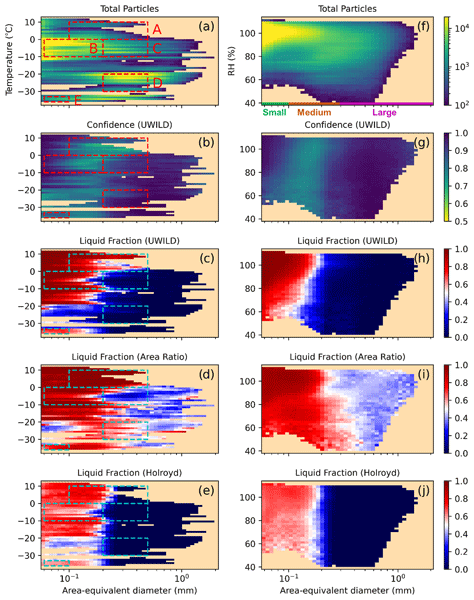
Many clouds with temperatures between 0 °C and −40 °C contain both liquid and ice particles, and the ratio of liquid to ice particles influences how the clouds interact with radiation and moderate Earth's climate. We use a machine learning method called random forest to classify images of individual cloud particles as either liquid or ice. We apply our algorithm to images captured by aircraft within clouds overlying the Southern Ocean, and we find that it outperforms two existing algorithms.
Heather Guy, Ian M. Brooks, Ken S. Carslaw, Benjamin J. Murray, Von P. Walden, Matthew D. Shupe, Claire Pettersen, David D. Turner, Christopher J. Cox, William D. Neff, Ralf Bennartz, and Ryan R. Neely III
Atmos. Chem. Phys., 21, 15351–15374, https://doi.org/10.5194/acp-21-15351-2021, https://doi.org/10.5194/acp-21-15351-2021, 2021
Short summary
Short summary
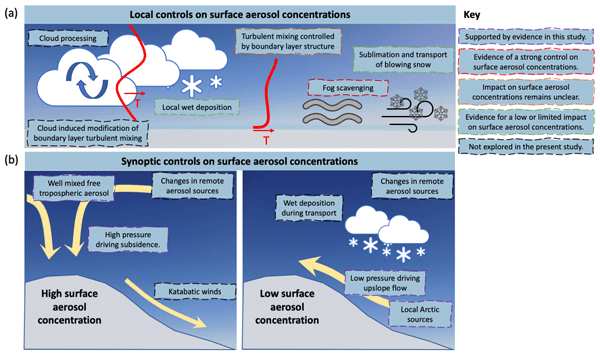
We present the first full year of surface aerosol number concentration measurements from the central Greenland Ice Sheet. Aerosol concentrations here have a distinct seasonal cycle from those at lower-altitude Arctic sites, which is driven by large-scale atmospheric circulation. Our results can be used to help understand the role aerosols might play in Greenland surface melt through the modification of cloud properties. This is crucial in a rapidly changing region where observations are sparse.
Cited articles
Barlakas, V. and Eriksson, P.: Three Dimensional Radiative Effects in Passive Millimeter/Sub-Millimeter All-sky Observations, Remote Sens., 12, https://doi.org/10.3390/rs12030531, 2020. a
Barlakas, V., Geer, A. J., and Eriksson, P.: Introducing hydrometeor orientation into all-sky microwave and submillimeter assimilation, Atmos. Meas. Tech., 14, 3427–3447, https://doi.org/10.5194/amt-14-3427-2021, 2021. a
Barlakas, V., Galligani, V. S., Geer, A. J., and Eriksson, P.: On the accuracy of RTTOV-SCATT for radiative transfer at all-sky microwave and submillimeter frequencies, J. Quant. Spectrosc. Ra., 283, 108137, https://doi.org/10.1016/j.jqsrt.2022.108137, 2022. a
Battaglia, A., Saavedra, P., Morales, C. A., and Simmer, C.: Understanding three-dimensional effects in polarized observations with the ground-based ADMIRARI radiometer during the CHUVA campaign, J. Geophys. Res.-Atmos., 116, https://doi.org/10.1029/2010JD015335, 2011. a
Brath, M., Ekelund, R., Eriksson, P., Lemke, O., and Buehler, S. A.: Microwave and submillimeter wave scattering of oriented ice particles, Atmos. Meas. Tech., 13, 2309–2333, https://doi.org/10.5194/amt-13-2309-2020, 2020. a, b, c
Buehler, S. A., Mendrok, J., Eriksson, P., Perrin, A., Larsson, R., and Lemke, O.: ARTS, the Atmospheric Radiative Transfer Simulator – version 2.2, the planetary toolbox edition, Geosci. Model Dev., 11, 1537–1556, https://doi.org/10.5194/gmd-11-1537-2018, 2018. a
Chase, R. J., Nesbitt, S. W., and McFarquhar, G. M.: A Dual-Frequency Radar Retrieval of Two Parameters of the Snowfall Particle Size Distribution Using a Neural Network, J. Appl. Meteorol. Clim., 60, 341–359, https://doi.org/10.1175/JAMC-D-20-0177.1, 2021. a, b
Cober, S. G., Isaac, G. A., and Korolev, A. V.: Assessing the Rosemount Icing Detector with In Situ Measurements, J. Atmos. Ocean. Tech., 18, 515–528, https://doi.org/10.1175/1520-0426(2001)018<0515:ATRIDW>2.0.CO;2, 2001. a, b
Ekelund, R., Eriksson, P., and Pfreundschuh, S.: Using passive and active observations at microwave and sub-millimetre wavelengths to constrain ice particle models, Atmos. Meas. Tech., 13, 501–520, https://doi.org/10.5194/amt-13-501-2020, 2020. a, b
Eriksson, P., Ekelund, R., Mendrok, J., Brath, M., Lemke, O., and Buehler, S. A.: A general database of hydrometeor single scattering properties at microwave and sub-millimetre wavelengths, Earth Syst. Sci. Data, 10, 1301–1326, https://doi.org/10.5194/essd-10-1301-2018, 2018. a
Eriksson, P., Emrich, A., Kempe, K., Riesbeck, J., Aljarosha, A., Auriacombe, O., Kugelberg, J., Hekma, E., Albers, R., Murk, A., Møller Pedersen, S., John, L., Stake, J., McEvoy, P., Rydberg, B., Dybbroe, A., Thoss, A., Canestri, A., Accadia, C., Colucci, P., Gherardi, D., and Kangas, V.: The Arctic Weather Satellite radiometer, Atmos. Meas. Tech., 18, 4709–4729, https://doi.org/10.5194/amt-18-4709-2025, 2025. a
Evans, K., Wang, J., Racette, P., Heymsfield, G., and Li, L.: Ice Cloud Retrievals and Analysis with the Compact Scanning Submillimeter Imaging Radiometer and the Cloud Radar System during CRYSTAL FACE, J. Appl. Meteor., https://doi.org/10.1175/JAM2250.1, 2005. a, b
Field, P. R., Heymsfield, A. J., and Bansemer, A.: Snow Size Distribution Parameterization for Midlatitude and Tropical Ice Clouds, J. Atmos. Sci., 64, 4346–4365, https://doi.org/10.1175/2007JAS2344.1, 2007. a
Finlon, J. A., McMurdie, L. A., and Chase, R. J.: Investigation of Microphysical Properties within Regions of Enhanced Dual-Frequency Ratio during the IMPACTS Field Campaign, J. Atmos. Sci., 79, 2773–2795, https://doi.org/10.1175/JAS-D-21-0311.1, 2022. a
Finlon, J. A., Yorks, J. E., Wagner, S., Nairy, C. M., Selmer, P., Nowottnick, E. P., Delene, D. J., and McMurdie, L. A.: Influence of Cloud Microphysical Properties on Airborne Lidar Measurements: Results From the IMPACTS Field Campaign, J. Geophys. Res.-Atmos., 130, e2025JD044591, https://doi.org/10.1029/2025JD044591, 2025. a
Finlon, J. A., McMurdie, L. A., Helms, C. N., Chase, R. J., and Yeh, P.: Microphysical Properties within Regions of Enhanced Dual-Frequency Ratio during IMPACTS, J. Atmos. Sci., 83, 67–85, https://doi.org/10.1175/JAS-D-25-0065.1, 2026. a
Fox, S., Lee, C., Moyna, B., Philipp, M., Rule, I., Rogers, S., King, R., Oldfield, M., Rea, S., Henry, M., Wang, H., and Harlow, R. C.: ISMAR: an airborne submillimetre radiometer, Atmos. Meas. Tech., 10, 477–490, https://doi.org/10.5194/amt-10-477-2017, 2017. a
Fox, S., Mendrok, J., Eriksson, P., Ekelund, R., O'Shea, S. J., Bower, K. N., Baran, A. J., Harlow, R. C., and Pickering, J. C.: Airborne validation of radiative transfer modelling of ice clouds at millimetre and sub-millimetre wavelengths, Atmos. Meas. Tech., 12, 1599–1617, https://doi.org/10.5194/amt-12-1599-2019, 2019. a
Gong, J.: Plotting code and corresponding dataset to preprint EGUSPHERE-2026-1291, Zenodo [code and data set], https://doi.org/10.5281/zenodo.19161985, 2026. a
Gong, J., Zeng, X., Wu, D. L., Munchak, S. J., Li, X., Kneifel, S., Ori, D., Liao, L., and Barahona, D.: Linkage among ice crystal microphysics, mesoscale dynamics, and cloud and precipitation structures revealed by collocated microwave radiometer and multifrequency radar observations, Atmos. Chem. Phys., 20, 12633–12653, https://doi.org/10.5194/acp-20-12633-2020, 2020. a
Gong, J., Wu, D. L., and Eriksson, P.: The first global 883 GHz cloud ice survey: IceCube Level 1 data calibration, processing and analysis, Earth Syst. Sci. Data, 13, 5369–5387, https://doi.org/10.5194/essd-13-5369-2021, 2021. a, b
Heymsfield, A. J., Schmitt, C., Bansemer, A., and Twohy, C. H.: Improved Representation of Ice Particle Masses Based on Observations in Natural Clouds, J. Atmos. Sci., 67, 3303–3318, https://doi.org/10.1175/2010JAS3507.1, 2010. a, b
Kaur, I., Eriksson, P., Barlakas, V., Pfreundschuh, S., and Fox, S.: Fast Radiative Transfer Approximating Ice Hydrometeor Orientation and Its Implication on IWP Retrievals, Remote Sens., 14, https://doi.org/10.3390/rs14071594, 2022. a
Kroodsma, R., Adams, I. S., Ames, T., Fritts, M., Gambacorta, A., Mohammed, P., and Piepmeier, J. R.: First Observations from the Airborne Hyperspectral Microwave Sounder CoSMIR-H, in: AGU Fall Meeting Abstracts, vol. 2024 of AGU Fall Meeting Abstracts, pp. A11S–1937, https://ui.adsabs.harvard.edu/abs/2024AGUFMA11S.1937K/abstract (last access: 25 August 2026), 2024. a
Lawson, R. P., O'Connor, D., Zmarzly, P., Weaver, K., Baker, B., Mo, Q., and Jonsson, H.: The 2D-S (Stereo) Probe: Design and Preliminary Tests of a New Airborne, High-Speed, High-Resolution Particle Imaging Probe, J. Atmos. Ocean. Tech., 23, 1462–1477, https://doi.org/10.1175/JTECH1927.1, 2006. a
Lawson, R. P., Pilson, B., Baker, B., Mo, Q., Jensen, E., Pfister, L., and Bui, P.: Aircraft measurements of microphysical properties of subvisible cirrus in the tropical tropopause layer, Atmos. Chem. Phys., 8, 1609–1620, https://doi.org/10.5194/acp-8-1609-2008, 2008. a
Liu, Y., Mace, G. G., and Posselt, D. J.: Assessing Synergistic Radar and Radiometer Retrievals of Ice Cloud Microphysics for the Atmosphere Observing System (AOS) Architecture, IEEE Transactions on Geoscience and Remote Sens., 60, 1–14, https://doi.org/10.1109/TGRS.2022.3165578, 2022. a
Liu, Y., Gong, J., Adams, I. S., Kroodsma, R. A., Chen, R., Wu, D. L., Bennartz, R., and Braun, S. A.: A Hybrid Ice Hydrometeor Retrieval Algorithm for (Sub)millimeter-Wave Radiometers in Support of the PolSIR and PMM Missions, EGUsphere [preprint], https://doi.org/10.5194/egusphere-2026-1348, 2026. a, b, c, d
May, E. and Eriksson, P.: The Ice Cloud Imager: retrieval of frozen water mass profiles, Atmos. Meas. Tech., 18, 7243–7266, https://doi.org/10.5194/amt-18-7243-2025, 2025. a
McCusker, K., Baran, A. J., Westbrook, C., Fox, S., Eriksson, P., Cotton, R., Delanoë, J., and Ewald, F.: The first microwave and submillimetre closure study using particle models of oriented ice hydrometeors to simulate polarimetric measurements of ice clouds, Atmos. Meas. Tech., 17, 3533–3552, https://doi.org/10.5194/amt-17-3533-2024, 2024. a, b, c, d, e, f, g
McGill, M., Hlavka, D., Hart, W., Scott, V. S., Spinhirne, J., and Schmid, B.: Cloud Physics Lidar: instrument description and initial measurement results, Appl. Opt., 41, 3725–3734, https://doi.org/10.1364/AO.41.003725, 2002. a
McMurdie, L.: Mission Reports IMPACTS, NASA Global Hydrometeorology Resource Center Distributed Active Archive Center [data set], https://doi.org/10.5067/IMPACTS/REPORTS/DATA101, 2025. a, b
McMurdie, L. A., Heymsfield, G. M., Yorks, J. E., Braun, S. A., Skofronick-Jackson, G., Rauber, R. M., Yuter, S., Colle, B., McFarquhar, G. M., Poellot, M., Novak, D. R., Lang, T. J., Kroodsma, R., McLinden, M., Oue, M., Kollias, P., Kumjian, M. R., Greybush, S. J., Heymsfield, A. J., Finlon, J. A., McDonald, V. L., and Nicholls, S.: Chasing Snowstorms: The Investigation of Microphysics and Precipitation for Atlantic Coast-Threatening Snowstorms (IMPACTS) Campaign, B. Am. Meteorol. Soc., 103, E1243–E1269, https://doi.org/10.1175/BAMS-D-20-0246.1, 2022. a
Pathak, M., Slade, R., Shukla, P., Skea, J., Pichs-Madruga, R., and Ürge-Vorsatz, D.: Technical Summary, in: Climate Change 2022: Mitigation of Climate Change. Contribution of Working Group III to the Sixth Assessment Report of the Intergovernmental Panel on Climate Change, edited by: Shukla, P., Skea, J., Slade, R., Khourdajie, A. A., van Diemen, R., McCollum, D., Pathak, M., Some, S., Vyas, P., Fradera, R., Belkacemi, M., Hasija, A., Lisboa, G., Luz, S., and Malley, J., Cambridge University Press, Cambridge, UK and New York, NY, USA, https://doi.org/10.1017/9781009157926.002, 2022. a
Prigent, C., Aires, F., Wang, D., Fox, S., and Harlow, C.: Sea-surface emissivity parametrization from microwaves to millimetre waves, Q. J. Roy. Meteor. Soc., 143, 596–605, https://doi.org/10.1002/qj.2953, 2017. a
Rauber, R. M. and Tokay, A.: An Explanation for the Existence of Supercooled Water at the Top of Cold Clouds, J. Atmos. Sci., 48, 1005–1023, https://doi.org/10.1175/1520-0469(1991)048<1005:AEFTEO>2.0.CO;2, 1991. a
Rosenfeld, D. and Woodley, W. L.: Deep convective clouds with sustained supercooled liquid water down to −37.5 °C, Nature, 405, 440–442, https://doi.org/10.1038/35013030, 2000. a, b
Tridon, F., Battaglia, A., Chase, R. J., Turk, F. J., Leinonen, J., Kneifel, S., Mroz, K., Finlon, J., Bansemer, A., Tanelli, S., Heymsfield, A. J., and Nesbitt, S. W.: The Microphysics of Stratiform Precipitation During OLYMPEX: Compatibility Between Triple-Frequency Radar and Airborne In Situ Observations, J. Geophys. Res.-Atmos., 124, 8764–8792, https://doi.org/10.1029/2018JD029858, 2019. a, b
Wang, D., Prigent, C., Kilic, L., Fox, S., Harlow, C., Jimenez, C., Aires, F., Grassotti, C., and Karbou, F.: Surface Emissivity at Microwaves to Millimeter Waves over Polar Regions: Parameterization and Evaluation with Aircraft Experiments, J. Atmos. Ocean. Tech., 34, 1039–1059, https://doi.org/10.1175/JTECH-D-16-0188.1, 2017. a
Wu, D. L., Gong, J., Deal, W. R., Gaines, W., Cooke, C. M., De Amici, G., Pantina, P., Liu, Y., Yang, P., Eriksson, P., and Bennartz, R.: Remote Sens. of Ice Cloud Properties With Millimeter and Submillimeter-Wave Polarimetry, IEEE J. Microwaves, 4, 847–857, https://doi.org/10.1109/JMW.2024.3487758, 2024. a, b, c, d, e
Yorks, J. E., Miller, M. A., Lang, T. J., Finlon, J. A., Adams, I. S., Colle, B. A., Greybush, S. J., Heymsfield, A. J., Heymsfield, G. M., Kroodsma, R., LeBlanc, S., McLinden, M. W., McFarquhar, G. M., Rauber, R. M., Yuter, S. E., Zaremba, T., and McMurdie, L. A.: Sampling Strategies to Optimize Coincident Remote Sensing and In Situ Cloud and Precipitation Observations from Multiple Aircraft, B. Am. Meteorol. Soc., 106, E2544–E2562, https://doi.org/10.1175/BAMS-D-24-0280.1, 2025. a, b
Zaremba, T. J., Rauber, R. M., Heimes, K., Yorks, J. E., Finlon, J. A., Nicholls, S. D., Selmer, P., McMurdie, L. A., and McFarquhar, G. M.: Cloud-Top Phase Characterization of Extratropical Cyclones over the Northeast and Midwest United States: Results from IMPACTS, J. Atmos. Sci., 81, 341–361, https://doi.org/10.1175/JAS-D-23-0123.1, 2024. a
Short summary
This is a closure and polarimetric study using a variety of airborne observations to disentangle hydrometeor microphysical properties and their vertical distribution. This work paves a concrete step in assuring timely delivery of high-quality science products for several future sub-mm radiometer missions as well as possibilities of new science products beyond the mission requirements.
This is a closure and polarimetric study using a variety of airborne observations to disentangle...


Altmetrics
Final-revised paper
Preprint