
Articles | Volume 26, issue 14
https://doi.org/10.5194/acp-26-10379-2026
© Author(s) 2026. This work is distributed under
the Creative Commons Attribution 4.0 License.
the Creative Commons Attribution 4.0 License.
https://doi.org/10.5194/acp-26-10379-2026
© Author(s) 2026. This work is distributed under
the Creative Commons Attribution 4.0 License.
the Creative Commons Attribution 4.0 License.
Research article
| 
24 Jul 2026
Research article |
| 24 Jul 2026
| 24 Jul 2026
Spatiotemporal optimization of NOx and VOC emissions using a hybrid inversion framework and implications for ozone sensitivity-regime diagnosis
Jeonghyeok Moon
Environmental Planning Institute, Seoul National University, Seoul 08826, South Korea

BK21 School of Earth and Environmental System, Pusan National University, Busan 46241, South Korea
Department of Atmospheric Sciences, Pusan National University, Busan 46241, South Korea
Institute of Environmental Studies, Pusan National University, Busan 46241, South Korea
Sujong Jeong
Environmental Planning Institute, Seoul National University, Seoul 08826, South Korea
Department of Environmental Management, Graduate School of Environmental Studies, Seoul National University, Seoul 08826, South Korea
Climate Tech Center, Seoul National University, Seoul 08826, South Korea
Institute for Sustainable Development, Seoul National University, Seoul 08826, South Korea
Yunsoo Choi
Department of Earth and Atmospheric Sciences, University of Houston, Houston, TX 77204, USA
Hyun Cheol Kim
Air Resources Laboratory, National Oceanic and Atmospheric Administration, College Park, MD 20740, USA
Cooperative Institute for Satellite Earth System Studies, University of Maryland, College Park, MD 20742, USA
Soon-Young Park
Department of Science Education, Daegu National University of Education, Daegu 42411, South Korea
Juseon Bak
Institute of Environmental Studies, Pusan National University, Busan 46241, South Korea
Jung-Woo Yoo
Institute of Environmental Studies, Pusan National University, Busan 46241, South Korea
Jaehyeong Park
Division of Earth Environmental System, Pusan National University, Busan 46241, South Korea
Dongjin Kim
BK21 School of Earth and Environmental System, Pusan National University, Busan 46241, South Korea
Division of Earth Environmental System, Pusan National University, Busan 46241, South Korea
Hyeonsik Choe
BK21 School of Earth and Environmental System, Pusan National University, Busan 46241, South Korea
Division of Earth Environmental System, Pusan National University, Busan 46241, South Korea
Chae-Yeong Yang
BK21 School of Earth and Environmental System, Pusan National University, Busan 46241, South Korea
Division of Earth Environmental System, Pusan National University, Busan 46241, South Korea
BK21 School of Earth and Environmental System, Pusan National University, Busan 46241, South Korea
Division of Earth Environmental System, Pusan National University, Busan 46241, South Korea
Related authors
No articles found.
Hayoung Park, Sujong Jeong, Jaewon Joo, Dong Yeong Chang, Yu-Ri Lee, Hyuckjae Lee, Jueun Kim, Jaewon Shin, Jonghyuk Lee, Jaemin Hong, Jae Hyun Lim, Donghee Kim, Isamu Morino, Matthias M. Frey, Gwangju Moon, Hyojin Eom, Sumin Kim, Sunran Lee, Jungho Yu, and Kyucheol Shin
EGUsphere, https://doi.org/10.5194/egusphere-2026-3755, https://doi.org/10.5194/egusphere-2026-3755, 2026
This preprint is open for discussion and under review for Atmospheric Chemistry and Physics (ACP).
Short summary
Short summary
This study analyzed greenhouse gas emissions from one of South Korea’s largest petrochemical complexes using ground, mobile, aircraft, and satellite measurements. The results revealed higher emissions, including methane leaks, than what was reported in existing inventory estimates. By integrating different types of observations, this study shows a more accurate way to measure industrial emissions and provides information that can support better emissions reporting and climate action.
Donghee Kim, Sujong Jeong, Dong Yeong Chang, and Jaewon Joo
Atmos. Chem. Phys., 26, 7789–7802, https://doi.org/10.5194/acp-26-7789-2026, https://doi.org/10.5194/acp-26-7789-2026, 2026
Short summary
Short summary
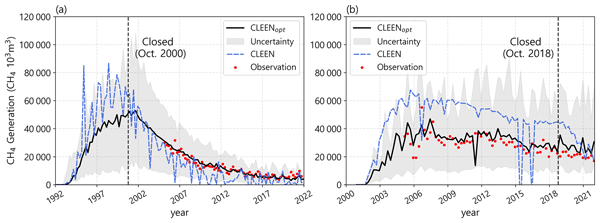
This study uses data and machine learning to better estimate methane emissions from a major landfill in South Korea. By considering local weather conditions like temperature and rain, the research improves how landfill methane is tracked over time. The results help us understand how climate affects emissions and provide tools that can be used worldwide to improve greenhouse gas monitoring and climate action planning.
Jaewon Joo, Sujong Jeong, Hyuckjae Lee, Yeonsoo Kim, Jaewon Shin, Donghee Kim, and Dong Yeong Chang
Atmos. Meas. Tech., 19, 3019–3030, https://doi.org/10.5194/amt-19-3019-2026, https://doi.org/10.5194/amt-19-3019-2026, 2026
Short summary
Short summary
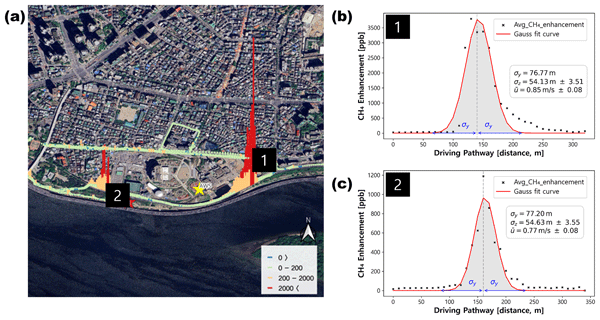
This research presents an assessment of fugitive methane emissions from a liquefied natural gas (LNG) power plant in Seoul, using a mobile greenhouse gas (GHG) measurement platform. Three key emission hotspots were identified, including continuous methane leaks and one stochastic super-emitter from the LNG power plant facilities. Our measurements revealed significant discrepancies compared to bottom-up inventories, which fail to capture these intermittent, high-emission events.
Anna Martin, Klaus Klingmüller, Benedikt Steil, Sergey Gromov, Yu-Ri Lee, Dong Yeong Chang, Nic Surawski, Jos Lelieveld, Sujong Jeong, and Andrea Pozzer
EGUsphere, https://doi.org/10.5194/egusphere-2026-371, https://doi.org/10.5194/egusphere-2026-371, 2026
Short summary
Short summary
We evaluate a new model simulating soil uptake of methane and hydrogen from the atmosphere. Coupled to an atmospheric chemistry and land surface model, it accounts for weather and soil conditions. Our results match observations, showing accurate removal depending on soil properties, temperature, moisture, and atmospheric conditions. This work improves the model’s ability to represent natural cycles of methane and hydrogen.
Juseon Bak, Arno Keppens, Daesung Choi, Sungjae Hong, Jae-Hwan Kim, Cheol-Hee Kim, Hyo-Jung Lee, Wonbae Jeon, Jhoon Kim, Ja-Ho Koo, Joowan Kim, Kanghyun Baek, Kai Yang, Xiong Liu, Gonzalo González Abad, Klaus-Peter Heue, Jean-Christopher Lambert, Yeonjin Jung, Hyunkee Hong, and Won-Jin Lee
Atmos. Meas. Tech., 19, 119–134, https://doi.org/10.5194/amt-19-119-2026, https://doi.org/10.5194/amt-19-119-2026, 2026
Short summary
Short summary
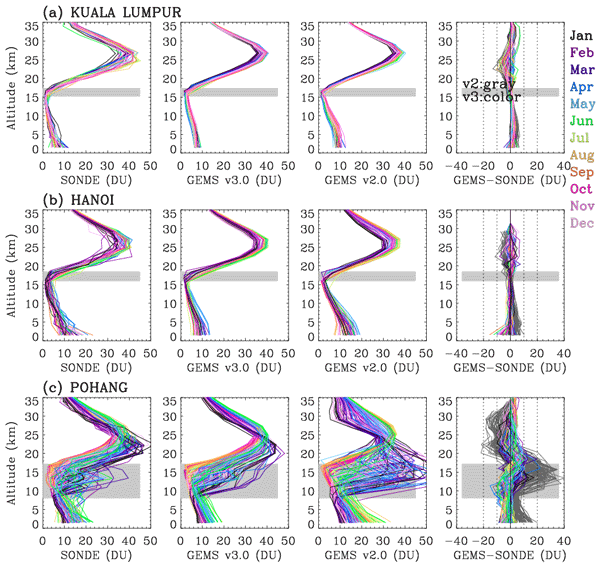
This study presents the first complete description of the operational version 3 ozone profile retrieval algorithm for the Geostationary Environment Monitoring Spectrometer (GEMS) and its performance characteristics. Improvements in radiometric and wavelength calibration reduce spectral fitting uncertainties and enhance agreement with ozonesonde profiles and Pandora total ozone measurements.
Sojung Sim and Sujong Jeong
Atmos. Chem. Phys., 25, 18509–18526, https://doi.org/10.5194/acp-25-18509-2025, https://doi.org/10.5194/acp-25-18509-2025, 2025
Short summary
Short summary
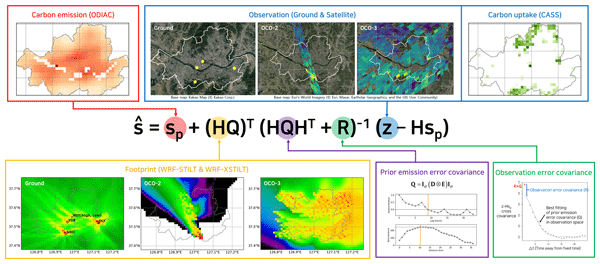
This study develops a high-resolution inverse modeling framework that combines ground-based and satellite CO2 observations to improve urban emission estimates in Seoul. By integrating atmospheric data and transport models, the research reduces uncertainties in CO2 emissions and reveals spatial and temporal patterns. The method offers a valuable tool for supporting climate policies and can be applied to other cities for better emission verification.
Ran Chen, Jin-Soo Kim, Jung-Eun Chu, Hyo-Jeong Kim, Bora Lee, Sujong Jeong, and Gabriela Schaepman-Strub
EGUsphere, https://doi.org/10.5194/egusphere-2025-5805, https://doi.org/10.5194/egusphere-2025-5805, 2025
Short summary
Short summary
We investigated the responses of mangroves to temperature and solar radiation, and further projected future climate favourability for mangroves across East Asia. East Asian mangrove growth is positively linked to temperature and solar radiation, particularly in cumulative anomalies on seasonal time scales. Winter isotherm shifts suggest northward mangrove expansion under global warming, but low solar radiation from aerosol emissions in East Asia may still constrain their growth.
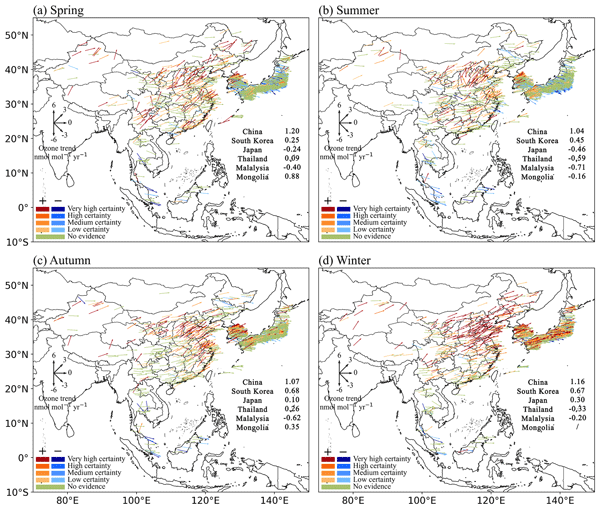
Ke Li, Rong Tan, Wenhao Qiao, Taegyung Lee, Yufen Wang, Danyuting Zhang, Minglong Tang, Wenqing Zhao, Yixuan Gu, Shaojia Fan, Jinqiang Zhang, Xiaopu Lyu, Likun Xue, Jianming Xu, Zhiqiang Ma, Mohd Talib Latif, Teerachai Amnuaylojaroen, Junsu Gil, Mee-Hye Lee, Juseon Bak, Joowan Kim, Hong Liao, Yugo Kanaya, Xiao Lu, Tatsuya Nagashima, and Ja-Ho Koo
Atmos. Chem. Phys., 25, 11575–11596, https://doi.org/10.5194/acp-25-11575-2025, https://doi.org/10.5194/acp-25-11575-2025, 2025
Short summary
Short summary
East Asia and Southeast Asia have been identified as a global hot spot, with the fastest ozone increase. This paper presents the most comprehensive observational review of ozone distributions and evolution over East Asia and Southeast Asia across different spatiotemporal scales in the past two decades, which will have important implications for assessing ozone impacts on public health and crop yields and for developing future ozone control strategies.
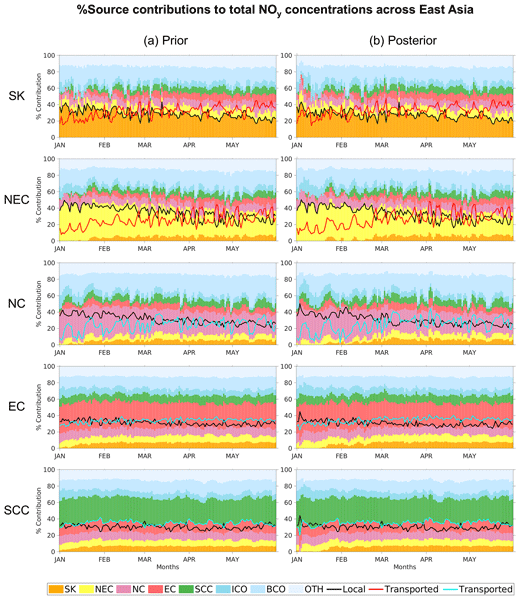
Jincheol Park, Yunsoo Choi, and Sagun Kayastha
Atmos. Chem. Phys., 25, 4291–4311, https://doi.org/10.5194/acp-25-4291-2025, https://doi.org/10.5194/acp-25-4291-2025, 2025
Short summary
Short summary
We investigated NOx emission contributions to NOy loadings across five regions of East Asia during the 2022 winter–spring transition through chemical transport modeling informed by satellite data. As seasons progress, local contributions within each region to its NOy budget decreased from 32 %–43 % to 23 %–30 %, while transboundary contributions increased from 16 %–33 % to 27 %–37 %, driven by a shift in synoptic settings that allowed pollutants to spread more broadly across the regions.
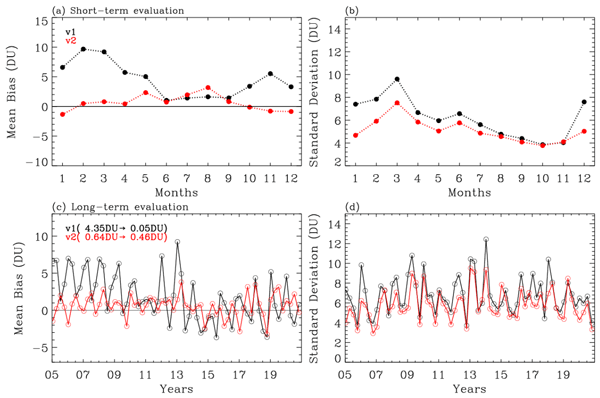
Juseon Bak, Xiong Liu, Kai Yang, Gonzalo Gonzalez Abad, Ewan O'Sullivan, Kelly Chance, and Cheol-Hee Kim
Atmos. Meas. Tech., 17, 1891–1911, https://doi.org/10.5194/amt-17-1891-2024, https://doi.org/10.5194/amt-17-1891-2024, 2024
Short summary
Short summary
The new version (V2) of the OMI ozone profile product is introduced to improve retrieval quality and long-term consistency of tropospheric ozone by incorporating the recent collection 4 OMI L1b spectral products and refining radiometric correction, forward model calculation, and a priori ozone data.
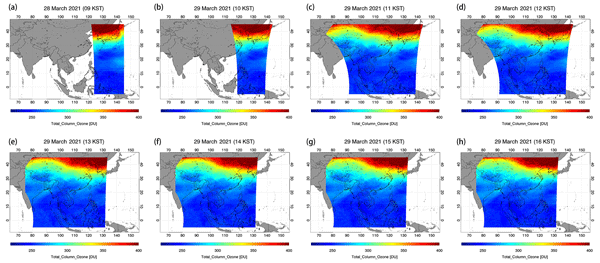
Kanghyun Baek, Jae Hwan Kim, Juseon Bak, David P. Haffner, Mina Kang, and Hyunkee Hong
Atmos. Meas. Tech., 16, 5461–5478, https://doi.org/10.5194/amt-16-5461-2023, https://doi.org/10.5194/amt-16-5461-2023, 2023
Short summary
Short summary
The GEMS mission was the first mission of the geostationary satellite constellation for hourly atmospheric composition monitoring. The GEMS ozone measurements were cross-compared to those of Pandora, OMPS, and TROPOMI satellite sensors and excellent agreement was found. GEMS has proven to be a powerful new instrument for monitoring and assessing the diurnal variation in atmospheric ozone. This experience can be used to advance research with future geostationary environmental satellite missions.
Jincheol Park, Jia Jung, Yunsoo Choi, Hyunkwang Lim, Minseok Kim, Kyunghwa Lee, Yun Gon Lee, and Jhoon Kim
Atmos. Meas. Tech., 16, 3039–3057, https://doi.org/10.5194/amt-16-3039-2023, https://doi.org/10.5194/amt-16-3039-2023, 2023
Short summary
Short summary
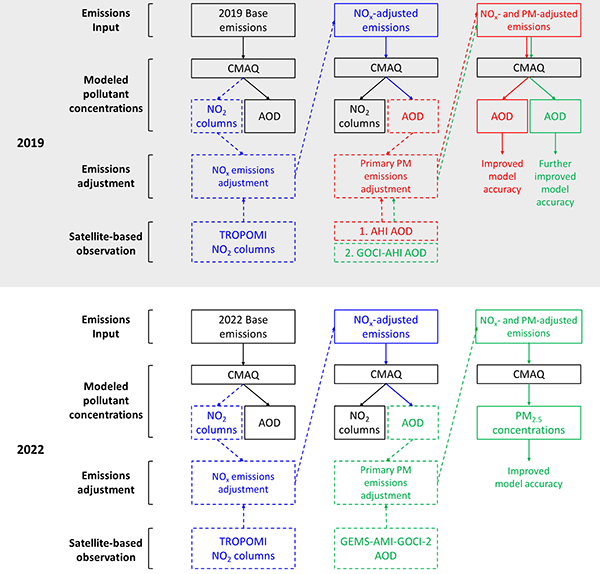
In response to the recent release of new geostationary platform-derived observational data generated by the Geostationary Environment Monitoring Spectrometer (GEMS) and its sister instruments, this study utilized the GEMS data fusion product and its proxy data in adjusting aerosol precursor emissions over East Asia. The use of spatiotemporally more complete observation references in updating the emissions resulted in more promising model performances in estimating aerosol loadings in East Asia.
Lei Shu, Lei Zhu, Juseon Bak, Peter Zoogman, Han Han, Song Liu, Xicheng Li, Shuai Sun, Juan Li, Yuyang Chen, Dongchuan Pu, Xiaoxing Zuo, Weitao Fu, Xin Yang, and Tzung-May Fu
Atmos. Chem. Phys., 23, 3731–3748, https://doi.org/10.5194/acp-23-3731-2023, https://doi.org/10.5194/acp-23-3731-2023, 2023
Short summary
Short summary
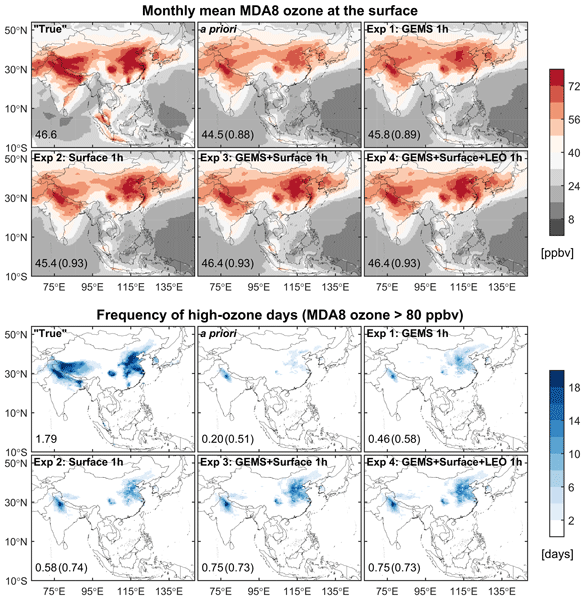
We quantify the benefit of multisource observations (GEMS, LEO satellite, and surface) on ozone simulations in Asia. Data assimilation improves the monitoring of exceedance, spatial pattern, and diurnal variation of surface ozone, with the regional mean bias reduced from −2.1 to −0.2 ppbv. Data assimilation also better represents ozone vertical distributions in the middle to upper troposphere at low latitudes. Our results offer a valuable reference for future ozone simulations.
Brendan Byrne, David F. Baker, Sourish Basu, Michael Bertolacci, Kevin W. Bowman, Dustin Carroll, Abhishek Chatterjee, Frédéric Chevallier, Philippe Ciais, Noel Cressie, David Crisp, Sean Crowell, Feng Deng, Zhu Deng, Nicholas M. Deutscher, Manvendra K. Dubey, Sha Feng, Omaira E. García, David W. T. Griffith, Benedikt Herkommer, Lei Hu, Andrew R. Jacobson, Rajesh Janardanan, Sujong Jeong, Matthew S. Johnson, Dylan B. A. Jones, Rigel Kivi, Junjie Liu, Zhiqiang Liu, Shamil Maksyutov, John B. Miller, Scot M. Miller, Isamu Morino, Justus Notholt, Tomohiro Oda, Christopher W. O'Dell, Young-Suk Oh, Hirofumi Ohyama, Prabir K. Patra, Hélène Peiro, Christof Petri, Sajeev Philip, David F. Pollard, Benjamin Poulter, Marine Remaud, Andrew Schuh, Mahesh K. Sha, Kei Shiomi, Kimberly Strong, Colm Sweeney, Yao Té, Hanqin Tian, Voltaire A. Velazco, Mihalis Vrekoussis, Thorsten Warneke, John R. Worden, Debra Wunch, Yuanzhi Yao, Jeongmin Yun, Andrew Zammit-Mangion, and Ning Zeng
Earth Syst. Sci. Data, 15, 963–1004, https://doi.org/10.5194/essd-15-963-2023, https://doi.org/10.5194/essd-15-963-2023, 2023
Short summary
Short summary
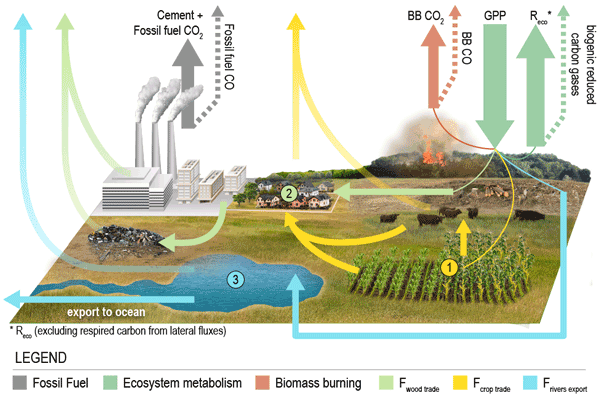
Changes in the carbon stocks of terrestrial ecosystems result in emissions and removals of CO2. These can be driven by anthropogenic activities (e.g., deforestation), natural processes (e.g., fires) or in response to rising CO2 (e.g., CO2 fertilization). This paper describes a dataset of CO2 emissions and removals derived from atmospheric CO2 observations. This pilot dataset informs current capabilities and future developments towards top-down monitoring and verification systems.

Juseon Bak, Eun-Ji Song, Hyo-Jung Lee, Xiong Liu, Ja-Ho Koo, Joowan Kim, Wonbae Jeon, Jae-Hwan Kim, and Cheol-Hee Kim
Atmos. Chem. Phys., 22, 14177–14187, https://doi.org/10.5194/acp-22-14177-2022, https://doi.org/10.5194/acp-22-14177-2022, 2022
Short summary
Short summary
Our study investigates the temporal variations of ozone profiles at Pohang in the Korean Peninsula from multiple ozone products. We discuss the quantitative relationships between daily surface measurements and key meteorological variables, different seasonality of ozone between the troposphere and stratosphere, and interannual changes in the lower tropospheric ozone, linked by the weather pattern driven by the East Asian summer monsoon.
Carlos Alberti, Frank Hase, Matthias Frey, Darko Dubravica, Thomas Blumenstock, Angelika Dehn, Paolo Castracane, Gregor Surawicz, Roland Harig, Bianca C. Baier, Caroline Bès, Jianrong Bi, Hartmut Boesch, André Butz, Zhaonan Cai, Jia Chen, Sean M. Crowell, Nicholas M. Deutscher, Dragos Ene, Jonathan E. Franklin, Omaira García, David Griffith, Bruno Grouiez, Michel Grutter, Abdelhamid Hamdouni, Sander Houweling, Neil Humpage, Nicole Jacobs, Sujong Jeong, Lilian Joly, Nicholas B. Jones, Denis Jouglet, Rigel Kivi, Ralph Kleinschek, Morgan Lopez, Diogo J. Medeiros, Isamu Morino, Nasrin Mostafavipak, Astrid Müller, Hirofumi Ohyama, Paul I. Palmer, Mahesh Pathakoti, David F. Pollard, Uwe Raffalski, Michel Ramonet, Robbie Ramsay, Mahesh Kumar Sha, Kei Shiomi, William Simpson, Wolfgang Stremme, Youwen Sun, Hiroshi Tanimoto, Yao Té, Gizaw Mengistu Tsidu, Voltaire A. Velazco, Felix Vogel, Masataka Watanabe, Chong Wei, Debra Wunch, Marcia Yamasoe, Lu Zhang, and Johannes Orphal
Atmos. Meas. Tech., 15, 2433–2463, https://doi.org/10.5194/amt-15-2433-2022, https://doi.org/10.5194/amt-15-2433-2022, 2022
Short summary
Short summary
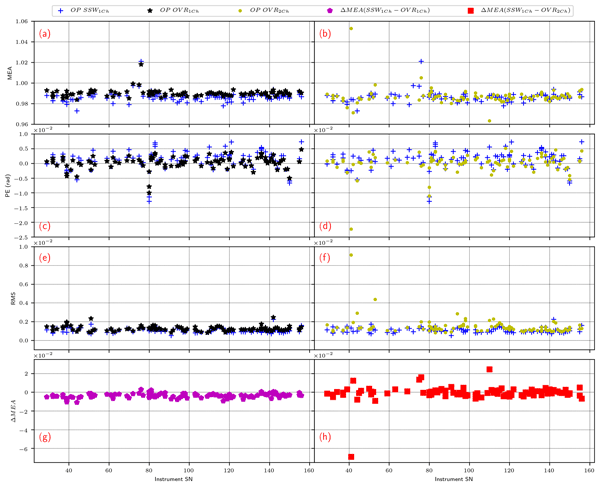
Space-borne greenhouse gas missions require ground-based validation networks capable of providing fiducial reference measurements. Here, considerable refinements of the calibration procedures for the COllaborative Carbon Column Observing Network (COCCON) are presented. Laboratory and solar side-by-side procedures for the characterization of the spectrometers have been refined and extended. Revised calibration factors for XCO2, XCO and XCH4 are provided, incorporating 47 new spectrometers.
Soon-Young Park, Uzzal Kumar Dash, Jinhyeok Yu, Keiya Yumimoto, Itsushi Uno, and Chul Han Song
Geosci. Model Dev., 15, 2773–2790, https://doi.org/10.5194/gmd-15-2773-2022, https://doi.org/10.5194/gmd-15-2773-2022, 2022
Short summary
Short summary
An EnKF was applied to CMAQ for assimilating ground PM2.5 observations from China and South Korea. The EnKF performed better than that without assimilation and even superior to 3D-Var. The reduced MBs in 24 h predictions were 48 % and 27 % by improving ICs and BCs, respectively.
Amir H. Souri, Kelly Chance, Juseon Bak, Caroline R. Nowlan, Gonzalo González Abad, Yeonjin Jung, David C. Wong, Jingqiu Mao, and Xiong Liu
Atmos. Chem. Phys., 21, 18227–18245, https://doi.org/10.5194/acp-21-18227-2021, https://doi.org/10.5194/acp-21-18227-2021, 2021
Short summary
Short summary
The global pandemic is believed to have an impact on emissions of air pollutants such as nitrogen dioxide (NO2) and formaldehyde (HCHO). This study quantifies the changes in the amount of NOx and VOC emissions via state-of-the-art inverse modeling technique using satellite observations during the lockdown 2020 with respect to a baseline over Europe, which in turn, it permits unraveling atmospheric processes being responsible for ozone formation in a less cloudy month.
Cited articles
Atkinson, R. and Arey, J.: Gas-phase tropospheric chemistry of biogenic volatile organic compounds: a review, Atmos. Environ., 37, 197–219, https://doi.org/10.1016/S1352-2310(03)00391-1, 2003.
Bae, K., Song, C. K., Van Roozendael, M., Richter, A., Wagner, T., Merlaud, A., Pinardi, G., Friedrich, M. M., Fayt, C., Dimitropoulou, E., Lange, K., Bösch, T., Zilker, B., Latsch, M., Behrens, L. K., Ziegler, S., Ripperger-Lukosiunaite, S., Kuhn, L., Lauster, B., Reischmann, L., Uhlmannsiek, K., Cede, A., Tiefengraber, M., Gebetsberger, M., Park, R. J., Lee, H., Hong, H., Chang, L. S., and Jeon, K.: Validation of GEMS operational v2.0 total column NO2 and HCHO during the GMAP/SIJAQ campaign, Sci. Total Environ., 974, 179190, https://doi.org/10.1016/j.scitotenv.2025.179190, 2025.
Chen, Y., Shen, H., Kaiser, J., Hu, Y., Capps, S. L., Zhao, S., Hakami, A., Shih, J.-S., Pavur, G. K., Turner, M. D., Henze, D. K., Resler, J., Nenes, A., Napelenok, S. L., Bash, J. O., Fahey, K. M., Carmichael, G. R., Chai, T., Clarisse, L., Coheur, P.-F., Van Damme, M., and Russell, A. G.: High-resolution hybrid inversion of IASI ammonia columns to constrain US ammonia emissions using the CMAQ adjoint model, Atmos. Chem. Phys., 21, 2067–2082, https://doi.org/10.5194/acp-21-2067-2021, 2021.
Cheng, X., Hao, Z., Zang, Z., Liu, Z., Xu, X., Wang, S., Liu, Y., Hu, Y., and Ma, X.: A new inverse modeling approach for emission sources based on the DDM-3D and 3DVAR techniques: an application to air quality forecasts in the Beijing–Tianjin–Hebei region, Atmos. Chem. Phys., 21, 13747–13761, https://doi.org/10.5194/acp-21-13747-2021, 2021.
Choi, J., Henze, D. K., Cao, H., Nowlan, C. R., González Abad, G., Kwon, H.-A., Lee, H.-M., Oak, Y. J., Park, R. J., Bates, K. H., Maasakkers, J. D., Wisthaler, A., and Weinheimer, A. J.: An inversion framework for optimizing nonmethane VOC emissions using remote sensing and airborne observations in northeast Asia during the KORUS-AQ field campaign, J. Geophys. Res.-Atmos., 127, e2021JD035844, https://doi.org/10.1029/2021JD035844, 2022.
Choi, J., Henze, D. K., Wells, K. C., and Millet, D. B.: Joint inversion of satellite-based isoprene and formaldehyde observations to constrain emissions of nonmethane volatile organic compounds, J. Geophys. Res.-Atmos., 130, e2024JD042070, https://doi.org/10.1029/2024JD042070, 2025.
Cooper, M., Martin, R. V., Padmanabhan, A., and Henze, D. K.: Comparing mass balance and adjoint methods for inverse modeling of nitrogen dioxide columns for global nitrogen oxide emissions, J. Geophys. Res.-Atmos., 122, 4718–4734, https://doi.org/10.1002/2016JD025985, 2017.
Cooper, M. J., Martin, R. V., Henze, D. K., and Jones, D. B. A.: Effects of a priori profile shape assumptions on comparisons between satellite NO2 columns and model simulations, Atmos. Chem. Phys., 20, 7231–7241, https://doi.org/10.5194/acp-20-7231-2020, 2020.
Crippa, M., Solazzo, E., Huang, G., Guizzardi, D., Koffi, E., Muntean, M., Schieberle, C., Friedrich, R., and Janssens-Maenhout, G.: High resolution temporal profiles in the Emissions Database for Global Atmospheric Research, Sci. Data, 7, 121, https://doi.org/10.1038/s41597-020-0462-2, 2020.
Crippa, M., Guizzardi, D., Butler, T., Keating, T., Wu, R., Kaminski, J., Kuenen, J., Kurokawa, J., Chatani, S., Morikawa, T., Pouliot, G., Racine, J., Moran, M. D., Klimont, Z., Manseau, P. M., Mashayekhi, R., Henderson, B. H., Smith, S. J., Suchyta, H., Muntean, M., Solazzo, E., Banja, M., Schaaf, E., Pagani, F., Woo, J.-H., Kim, J., Monforti-Ferrario, F., Pisoni, E., Zhang, J., Niemi, D., Sassi, M., Ansari, T., and Foley, K.: The HTAP_v3 emission mosaic: merging regional and global monthly emissions (2000–2018) to support air quality modelling and policies, Earth Syst. Sci. Data, 15, 2667–2694, https://doi.org/10.5194/essd-15-2667-2023, 2023.
De Smedt, I., Pinardi, G., Vigouroux, C., Compernolle, S., Bais, A., Benavent, N., Boersma, F., Chan, K.-L., Donner, S., Eichmann, K.-U., Hedelt, P., Hendrick, F., Irie, H., Kumar, V., Lambert, J.-C., Langerock, B., Lerot, C., Liu, C., Loyola, D., Piters, A., Richter, A., Rivera Cárdenas, C., Romahn, F., Ryan, R. G., Sinha, V., Theys, N., Vlietinck, J., Wagner, T., Wang, T., Yu, H., and Van Roozendael, M.: Comparative assessment of TROPOMI and OMI formaldehyde observations and validation against MAX-DOAS network column measurements, Atmos. Chem. Phys., 21, 12561–12593, https://doi.org/10.5194/acp-21-12561-2021, 2021.
Douros, J., Eskes, H., van Geffen, J., Boersma, K. F., Compernolle, S., Pinardi, G., Blechschmidt, A.-M., Peuch, V.-H., Colette, A., and Veefkind, P.: Comparing Sentinel-5P TROPOMI NO2 column observations with the CAMS regional air quality ensemble, Geosci. Model Dev., 16, 509–534, https://doi.org/10.5194/gmd-16-509-2023, 2023.
Duncan, B. N., Yoshida, Y., Olson, J. R., Sillman, S., Martin, R. V., Lamsal, L., Hu, Y., Pickering, K. E., Retscher, C., Allen, D. J., and Crawford, J. H.: Application of OMI observations to a space-based indicator of NOx and VOC controls on surface ozone formation, Atmos. Environ., 44, 2213–2223, https://doi.org/10.1016/j.atmosenv.2010.03.010, 2010.
East, J. D., Henderson, B. H., Napelenok, S. L., Koplitz, S. N., Sarwar, G., Gilliam, R., Lenzen, A., Tong, D. Q., Pierce, R. B., and Garcia-Menendez, F.: Inferring and evaluating satellite-based constraints on NOx emissions estimates in air quality simulations, Atmos. Chem. Phys., 22, 15981–16001, https://doi.org/10.5194/acp-22-15981-2022, 2022.
Elbern, H., Strunk, A., Schmidt, H., and Talagrand, O.: Emission rate and chemical state estimation by 4-dimensional variational inversion, Atmos. Chem. Phys., 7, 3749–3769, https://doi.org/10.5194/acp-7-3749-2007, 2007.
Feng, S., Jiang, F., Jiang, Z., Wang, H., Cai, Z., and Zhang, L.: Impact of 3DVAR assimilation of surface PM2.5 observations on PM2.5 forecasts over China during wintertime, Atmos. Environ., 187, 34–49, https://doi.org/10.1016/j.atmosenv.2018.05.049, 2018.
Fu, W., Zhu, L., Kwon, H. A., Park, R. J., Lee, G. T., De Smedt, I., Liu, S., Li, X., Chen, Y., Pu, D., Li, J., Zuo, X., Zhang, P., Li, Y., Yan, Z., Zhang, X., Zhang, J., Wu, X., Shen, H., Ye, J., Wang, C., Fu, T.-M., and Yang, X.: Evaluating GEMS HCHO retrievals with TROPOMI product, Pandora observations, and GEOS-Chem simulations, Earth Space Sci., 12, e2024EA003894, https://doi.org/10.1029/2024EA003894, 2025.
Goldberg, D. L., Tao, M., Kerr, G. H., Ma, S., Tong, D., Fiore, A. M., Dickens, A. F., Adelman, Z., and Anenberg, S. C.: Evaluating the spatial patterns of U.S. urban NOx emissions using TROPOMI NO2, Remote Sens. Environ., 300, 113917, https://doi.org/10.1016/j.rse.2023.113917, 2024.
Gryparis, A., Forsberg, B., Katsouyanni, K., Analitis, A., Touloumi, G., Schwartz, J., Samoli, E., Medina, S., Anderson, H. R., Niciu, E. M., Wichmann, H. E., Kriz, B., Kosnik, M., Skorkovsky, J., Vonk, J. M., and Dörtbudak, Z.: Acute effects of ozone on mortality from the “Air Pollution and Health: A European Approach” project, Am. J. Resp. Crit. Care, 170, 1080–1087, https://doi.org/10.1164/rccm.200403-333OC, 2004.
Guenther, A. B., Jiang, X., Heald, C. L., Sakulyanontvittaya, T., Duhl, T., Emmons, L. K., and Wang, X.: The Model of Emissions of Gases and Aerosols from Nature version 2.1 (MEGAN2.1): an extended and updated framework for modeling biogenic emissions, Geosci. Model Dev., 5, 1471–1492, https://doi.org/10.5194/gmd-5-1471-2012, 2012.
Hansen, P. C.: The L-curve and its use in the numerical treatment of inverse problems, IMM Tech. Rep. 15/1999, Kongens Lyngby, Denmark, 1999.
Henze, D. K., Seinfeld, J. H., and Shindell, D. T.: Inverse modeling and mapping US air quality influences of inorganic PM2.5 precursor emissions using the adjoint of GEOS-Chem, Atmos. Chem. Phys., 9, 5877–5903, https://doi.org/10.5194/acp-9-5877-2009, 2009.
Hersbach, H., Bell, B., Berrisford, P., Biavati, G., Horányi, A., Muñoz Sabater, J., Nicolas, J., Peubey, C., Radu, R., Rozum, I., Schepers, D., Simmons, A., Soci, C., Dee, D., and Thépaut, J.-N.: ERA5 hourly data on pressure levels from 1940 to present, Copernicus Climate Change Service (C3S) Climate Data Store (CDS) [data set], https://doi.org/10.24381/cds.bd0915c6, 2023a.
Hersbach, H., Bell, B., Berrisford, P., Biavati, G., Horányi, A., Muñoz Sabater, J., Nicolas, J., Peubey, C., Radu, R., Rozum, I., Schepers, D., Simmons, A., Soci, C., Dee, D., and Thépaut, J.-N.: ERA5 hourly data on single levels from 1940 to present, Copernicus Climate Change Service (C3S) Climate Data Store (CDS) [data set], https://doi.org/10.24381/cds.adbb2d47, 2023b.
Hou, X., Wild, O., Zhu, B., and Lee, J.: Future tropospheric ozone budget and distribution over east Asia under a net-zero scenario, Atmos. Chem. Phys., 23, 15395–15411, https://doi.org/10.5194/acp-23-15395-2023, 2023.
Hristov, A. N., Harper, M., Meinen, R., Day, R., Lopes, J., Ott, T., Venkatesh, A., and Randles, C. A.: Discrepancies and Uncertainties in Bottom-up Gridded Inventories of Livestock Methane Emissions for the Contiguous United States, Environ. Sci. Technol., 51, 13668–13677, https://doi.org/10.1021/acs.est.7b03332, 2017.
Hu, Y., Zang, Z., Ma, X., Li, Y., Liang, Y., You, W., Pan, X., and Li, Z.: Four-dimensional variational assimilation for SO2 emission and its application around the COVID-19 lockdown in the spring 2020 over China, Atmos. Chem. Phys., 22, 13183–13200, https://doi.org/10.5194/acp-22-13183-2022, 2022.
Hu, Y., Li, Y., Ma, X., Liang, Y., You, W., Pan, X., and Zang, Z.: The optimization of SO2 emissions by the 4DVAR and EnKF methods and its application in WRF-Chem, Sci. Total Environ., 888, 163796, https://doi.org/10.1016/j.scitotenv.2023.163796, 2023.
Itahashi, S., Irie, H., Shimadera, H., and Chatani, S.: Fifteen-year trends (2005–2019) in the satellite-derived ozone-sensitive regime in East Asia: a gradual shift from VOC-Sensitive to NOx-Sensitive, Remote Sens., 14, https://doi.org/10.3390/rs14184512, 2022.
Jang, J., Lee, Y. G., Yu, J. A., Sung, K. H., and Kim, S. M.: Characteristic Analysis of Tropospheric Ozone Sensitivity from the Satellite-Based HCHO/NO2 Ratio in South Korea, Korean J. Remote Sens., 39, 563–576, https://doi.org/10.7780/kjrs.2023.39.5.1.8, 2023.
Jeon, W., Choi, Y., Lee, H. W., Lee, S. H., Yoo, J. W., Park, J., and Lee, H. J.: A quantitative analysis of grid nudging effect on each process of PM2.5 production in the Korean Peninsula, Atmos. Environ., 122, 763–774, https://doi.org/10.1016/j.atmosenv.2015.10.050, 2015.
Jia, G., Huang, Z., Tang, X., Ou, J., Lu, M., Xu, Y., Zhong, Z., Sha, Q., Wu, H., Zheng, C., Deng, T., Chen, D., He, M., and Zheng, J.: A meteorologically adjusted ensemble Kalman filter approach for inversing daily emissions: a case study in the Pearl River Delta, China, J. Environ. Sci., 114, 233–248, https://doi.org/10.1016/j.jes.2021.08.048, 2022.
Judd, L. M., Al-Saadi, J. A., Szykman, J. J., Valin, L. C., Janz, S. J., Kowalewski, M. G., Eskes, H. J., Veefkind, J. P., Cede, A., Mueller, M., Gebetsberger, M., Swap, R., Pierce, R. B., Nowlan, C. R., Abad, G. G., Nehrir, A., and Williams, D.: Evaluating Sentinel-5P TROPOMI tropospheric NO2 column densities with airborne and Pandora spectrometers near New York City and Long Island Sound, Atmos. Meas. Tech., 13, 6113–6140, https://doi.org/10.5194/amt-13-6113-2020, 2020.
Kurpius, M. R. and Goldstein, A. H.: Gas-phase chemistry dominates O3 loss to a forest, implying a source of aerosols and hydroxyl radicals to the atmosphere, Geophys. Res. Lett., 30, 1371, https://doi.org/10.1029/2002GL016785, 2003.
Lamsal, L. N., Martin, R. V., Padmanabhan, A., van Donkelaar, A., Zhang, Q., Sioris, C. E., Chance, K., Kurosu, T. P., and Newchurch, M. J.: Application of satellite observations for timely updates to global anthropogenic NOx emission inventories, Geophys. Res. Lett., 38, L05810, https://doi.org/10.1029/2010GL046476, 2011.
Lee, H. J., Chang, L. S., Jaffe, D. A., Bak, J., Liu, X., Abad, G. G., Jo, H.-Y., Jo, Y.-J., Lee, J.-B., and Kim, C.-H.: Ozone continues to increase in East Asia despite decreasing NO2: Causes and abatements, Remote Sens., 13, 2177, https://doi.org/10.3390/rs13112177, 2021.
Li, C., Martin, R. V., Shephard, M. W., Cady-Pereira, K., Cooper, M. J., Kaiser, J., Lee, C. J., Zhang, L., and Henze, D. K.: Assessing the iterative finite difference mass balance and 4D-Var methods to derive ammonia emissions over North America using synthetic observations, J. Geophys. Res.-Atmos., 124, 4222–4236, https://doi.org/10.1029/2018JD030183, 2019.
Liu, C. and Shi, K.: A review on methodology in O3-NOx-VOC sensitivity study, Environ. Pollut., 291, 118249, https://doi.org/10.1016/j.envpol.2021.118249, 2021.
Liu, J., Li, X., Tan, Z., Wang, W., Yang, Y., Zhu, Y., Yang, S., Song, M., Chen, S., Wang, H., Lu, K., Zeng, L., and Zhang, Y.: Assessing the Ratios of Formaldehyde and Glyoxal to NO2 as Indicators of O3-NOx-VOC Sensitivity, Environ. Sci. Technol., 55, 10935–10945, https://doi.org/10.1021/acs.est.0c07506, 2021.
Miller, S. M., Michalak, A. M., and Levi, P. J.: Atmospheric inverse modeling with known physical bounds: an example from trace gas emissions, Geosci. Model Dev., 7, 303–315, https://doi.org/10.5194/gmd-7-303-2014, 2014.
Millet, D. B., Jacob, D. J., Turquety, S., Hudman, R. C., Wu, S., Fried, A., Walega, J., Heikes, B. G., Blake, D. R., Singh, H. B., Anderson, B. E., and Clarke, A. D.: Formaldehyde distribution over North America: Implications for satellite retrievals of formaldehyde columns and isoprene emission, J. Geophys. Res.-Atmos., 111, D24S02, https://doi.org/10.1029/2005JD006853, 2006.
Momeni, M., Choi, Y., Yeganeh, A. K., Pouyaei, A., Jung, J., Park, J., Shephard, M. W., Dammers, E., and Cady-Pereira, K. E.: Constraining East Asia ammonia emissions through satellite observations and iterative Finite Difference Mass Balance (iFDMB) and investigating its impact on inorganic fine particulate matter, Environ. Int., 184, 108473, https://doi.org/10.1016/j.envint.2024.108473, 2024.
Moon, J.: Inverse Modeling for Constraining Spatiotemporal Distributions of Emissions, PhD thesis, Pusan National University, Busan, South Korea, https://doi.org/10.23172/pusan.000000167548.21016.0000787, 2025.
Moon, J., Choi, Y., Jeon, W., Kim, H. C., Pouyaei, A., Jung, J., Pan, S., Kim, S., Kim, C.-H., Bak, J., Yoo, J.-W., Park, J., and Kim, D.: Hybrid IFDMB/4D-Var inverse modeling to constrain the spatiotemporal distribution of CO and NO2 emissions using the CMAQ adjoint model, Atmos. Environ., 327, 120490, https://doi.org/10.1016/j.atmosenv.2024.120490, 2024.
Mun, J., Choi, Y., Jeon, W., Lee, H. W., Kim, C.-H., Park, S.-Y., Bak, J., Jung, J., Oh, I., Park, J., and Kim, D.: Assessing mass balance-based inverse modeling methods via a pseudo-observation test to constrain NOx emissions over South Korea, Atmos. Environ., 292, 119429, https://doi.org/10.1016/j.atmosenv.2022.119429, 2023.
Nüß, J. R., Daskalakis, N., Piwowarczyk, F. G., Gkouvousis, A., Schneising, O., Buchwitz, M., Kanakidou, M., Krol, M. C., and Vrekoussis, M.: Top-down CO emission estimates using TROPOMI CO data in the TM5-4DVAR (r1258) inverse modeling suit, Geosci. Model Dev., 18, 2861–2890, https://doi.org/10.5194/gmd-18-2861-2025, 2025.
Oomen, G.-M., Müller, J.-F., Stavrakou, T., De Smedt, I., Blumenstock, T., Kivi, R., Makarova, M., Palm, M., Röhling, A., Té, Y., Vigouroux, C., Friedrich, M. M., Frieß, U., Hendrick, F., Merlaud, A., Piters, A., Richter, A., Van Roozendael, M., and Wagner, T.: Weekly derived top-down volatile-organic-compound fluxes over Europe from TROPOMI HCHO data from 2018 to 2021, Atmos. Chem. Phys., 24, 449–474, https://doi.org/10.5194/acp-24-449-2024, 2024.
Peng, Z., Liu, Z., Chen, D., and Ban, J.: Improving PM2.5 forecast over China by the joint adjustment of initial conditions and source emissions with an ensemble Kalman filter, Atmos. Chem. Phys., 17, 4837–4855, https://doi.org/10.5194/acp-17-4837-2017, 2017.
Qu, Z., Henze, D. K., Capps, S. L., Wang, Y., Xu, X., Wang, J., and Keller, M.: Monthly top-down NOx emissions for China (2005–2012): A hybrid inversion method and trend analysis, J. Geophys. Res.-Atmos., 122, 4600–4625, https://doi.org/10.1002/2016JD025852, 2017.
Qu, Z., Henze, D. K., Theys, N., Wang, J., and Wang, W.: Hybrid Mass balance/4D-var joint inversion of NOx and SO2 emissions in East Asia, J. Geophys. Res.-Atmos., 124, 8203–8224. https://doi.org/10.1029/2018JD030240, 2019.
Rahman, M. M., Shults, R., Ali, M. F., Hasan, M. G., and Shuo, W.: Formaldehyde-to-Nitrogen dioxide ratio (FNR) analysis for ozone sensitivity: a case study over Bangladesh using OMI data, Air. Qual. Atmos. Hlth., 18, 1879–1886, https://doi.org/10.1007/s11869-025-01732-5, 2025.
Raza, A., Dahlquist, M., Lind, T., and Ljungman, P. L. S.: Susceptibility to short-term ozone exposure and cardiovascular and respiratory mortality by previous hospitalizations, Environ. Health, 17, 37, https://doi.org/10.1186/s12940-018-0384-z, 2018.
Sillman, S.: The use of NOy, H2O2, and HNO3 as indicators for ozone-NOx-hydrocarbon sensitivity in urban locations, J. Geophys. Res., 100, 14175–14188, https://doi.org/10.1029/94JD02953, 1995.
Skamarock, W. C., Klemp, J. B., Dudhia, J., Gill, D. O., Barker, D. M., Duda, M. G., Huang, X.-Y., Wang, W., and Powers, J. G.: A Description of the Advanced Research WRF Version 3, National Center for Atmospheric Research, Boulder, CO, USA, https://doi.org/10.5065/D68S4MVH, 2008.
Solazzo, E., Crippa, M., Guizzardi, D., Muntean, M., Choulga, M., and Janssens-Maenhout, G.: Uncertainties in the Emissions Database for Global Atmospheric Research (EDGAR) emission inventory of greenhouse gases, Atmos. Chem. Phys., 21, 5655–5683, https://doi.org/10.5194/acp-21-5655-2021, 2021.
Souri, A. H., Choi, Y., Jeon, W., Li, X., Pan, S., Diao, L., and Westenbarger, D. A.: Constraining NOx emissions using satellite NO2 measurements during 2013 DISCOVER-AQ Texas campaign, Atmos. Environ., 131, 371–381, https://doi.org/10.1016/j.atmosenv.2016.02.020, 2016.
Turner, M. C., Jerrett, M., Pope, C. A., Krewski, D., Gapstur, S. M., Diver, W. R., Beckerman, B. S., Marshall, J. D., Su, J., Crouse, D. L., and Burnett, R. T.: Long-term ozone exposure and mortality in a large prospective study, Am. J. Resp. Crit. Care, 193, 1134–1142, https://doi.org/10.1164/rccm.201508-1633OC, 2016.
van Geffen, J., Eskes, H., Compernolle, S., Pinardi, G., Verhoelst, T., Lambert, J.-C., Sneep, M., ter Linden, M., Ludewig, A., Boersma, K. F., and Veefkind, J. P.: Sentinel-5P TROPOMI NO2 retrieval: impact of version v2.2 improvements and comparisons with OMI and ground-based data, Atmos. Meas. Tech., 15, 2037–2060, https://doi.org/10.5194/amt-15-2037-2022, 2022.
Veefkind, J., Aben, I., McMullan, K., Förster, H., De Vries, J., Otter, G., Claas, J., Eskes, H., De Haan, J., Kleipool, Q., van Weele, M., Hasekamp, O., Hoogeveen, R., Landgraf, J., Snel, R., Tol, P., Ingmann, P., Voors, R., and Levelt, P. F.: TROPOMI on the ESA Sentinel-5 precursor: a GMES mission for global observations of the atmospheric composition for climate, air quality and ozone layer applications, Remote Sens. Environ., 120, 70–83, https://doi.org/10.1016/j.rse.2011.09.027, 2012.
Voshtani, S., Ménard, R., Walker, T. W., and Hakami, A.: Use of Assimilation Analysis in 4D-Var Source Inversion: Observing System Simulation Experiments (OSSEs) with GOSAT Methane and Hemispheric CMAQ, Atmosphere, 14, 758, https://doi.org/10.3390/atmos14040758, 2023.
Wang, Y., Yu, C., Tao, J., Wang, Z., Si, Y., Cheng, L., Wang, H., Zhu, S., and Chen, L.: Spatio-temporal characteristics of tropospheric ozone and its precursors in Guangxi, South China, Atmosphere, 9, 355, https://doi.org/10.3390/atmos9090355, 2018.
Wang, Z., Zhang, H., Shi, C., Ji, X., Zhu, Y., Xia, C., Sun, X., Zhang, M., Lin, X., Yan, S., Zhou, Y., Xing, C., Chen, Y., and Liu, C.: Vertical and spatial differences in ozone formation sensitivities under different ozone pollution levels in eastern Chinese cities, Npj Clim. Atmos. Sci., 8, 30, https://doi.org/10.1038/s41612-024-00855-3, 2025.
Wells, K. C. and Millet, D. B.: ROCR isoprene retrievals from the CrIS satellite sensor, Data Repository for the University of Minnesota (DRUM), https://doi.org/10.13020/5n0j-wx73, 2022.
Wolfe, G. M., Kaiser, J., Hanisco, T. F., Keutsch, F. N., de Gouw, J. A., Gilman, J. B., Graus, M., Hatch, C. D., Holloway, J., Horowitz, L. W., Lee, B. H., Lerner, B. M., Lopez-Hilifiker, F., Mao, J., Marvin, M. R., Peischl, J., Pollack, I. B., Roberts, J. M., Ryerson, T. B., Thornton, J. A., Veres, P. R., and Warneke, C.: Formaldehyde production from isoprene oxidation across NOx regimes, Atmos. Chem. Phys., 16, 2597–2610, https://doi.org/10.5194/acp-16-2597-2016, 2016.
Wu, H., Kong, L., Tang, X., Zhu, L., Zhu, J., and Wang, Z.: Air quality forecasting with inversely updated emissions for China, Environ. Sci. Tech. Let., 10, 655–661, https://doi.org/10.1021/acs.estlett.3c00266, 2023.
Yu, X., Millet, D. B., and Henze, D. K.: How well can inverse analyses of high-resolution satellite data resolve heterogeneous methane fluxes? Observing system simulation experiments with the GEOS-Chem adjoint model (v35), Geosci. Model Dev., 14, 7775–7793, https://doi.org/10.5194/gmd-14-7775-2021, 2021.
Zhao, S., Russell, M. G., Hakami, A., Capps, S. L., Turner, M. D., Henze, D. K., Percell, P. B., Resler, J., Shen, H., Russell, A. G., Nenes, A., Pappin, A. J., Napelenok, S. L., Bash, J. O., Fahey, K. M., Carmichael, G. R., Stanier, C. O., and Chai, T.: A multiphase CMAQ version 5.0 adjoint, Geosci. Model Dev., 13, 2925–2944, https://doi.org/10.5194/gmd-13-2925-2020, 2020a.
Zhao, S., Russell, M. G., Hakami, A., Capps, S. L., Turner, M. D., Henze, D. K., Percell, P. B., Resler, J., Shen, H., Russell, A. G., Nenes, A., Pappin, A. J., Napelenok, S. L., Bash, J. O., Fahey, K. M., Carmichael, G. R., Stanier, C. O., and Chai, T.: CMAQ 5.0 Adjoint, Zenodo [computer software], https://doi.org/10.5281/zenodo.3780216, 2020b.
Zhao, Y., Nielsen, C. P., Lei, Y., McElroy, M. B., and Hao, J.: Quantifying the uncertainties of a bottom-up emission inventory of anthropogenic atmospheric pollutants in China, Atmos. Chem. Phys., 11, 2295–2308, https://doi.org/10.5194/acp-11-2295-2011, 2011.
Short summary
This study develops a hybrid inverse modeling framework to better estimate the spatiotemporal distributions of nitrogen oxides (NOx) and volatile organic compound (VOC) emissions over South Korea. The optimized emissions improve ozone simulations and clarify whether ozone formation is more sensitive to NOx or to VOC. By identifying when precursor emissions exert the strongest influence on ozone, this work provides time-resolved guidance for region-specific air quality strategies.
This study develops a hybrid inverse modeling framework to better estimate the spatiotemporal...


Altmetrics
Final-revised paper
Preprint