
Articles | Volume 25, issue 24
https://doi.org/10.5194/acp-25-18549-2025
© Author(s) 2025. This work is distributed under
the Creative Commons Attribution 4.0 License.
the Creative Commons Attribution 4.0 License.
https://doi.org/10.5194/acp-25-18549-2025
© Author(s) 2025. This work is distributed under
the Creative Commons Attribution 4.0 License.
the Creative Commons Attribution 4.0 License.
Research article
| 
19 Dec 2025
Research article |
| 19 Dec 2025
| 19 Dec 2025
Influence of secondary ice formation on tropical deep convective clouds simulated by the Unified Model

Department of Earth and Environmental Sciences, University of Manchester, Manchester, UK
Paul J. Connolly
Department of Earth and Environmental Sciences, University of Manchester, Manchester, UK
Paul R. Field
Met Office, Exeter, UK
Institute for Climate and Atmospheric Science, School of Earth and Environment, University of Leeds, Leeds, UK
Declan L. Finney
Institute for Climate and Atmospheric Science, School of Earth and Environment, University of Leeds, Leeds, UK
National Centre for Atmospheric Science, Leeds, UK
Alan M. Blyth
National Centre for Atmospheric Science, Leeds, UK
Institute for Climate and Atmospheric Science, School of Earth and Environment, University of Leeds, Leeds, UK
Related authors
Mengyu Sun, Paul J. Connolly, Paul R. Field, Declan L. Finney, and Alan M. Blyth
EGUsphere, https://doi.org/10.5194/egusphere-2025-5665, https://doi.org/10.5194/egusphere-2025-5665, 2025
Short summary
Short summary
We use a high resolution weather model together with satellite and radar data to study how small particles in the air influence ice and rain in a tropical storm near Darwin. We find that when particle levels are moderate, storm clouds form more ice high in the atmosphere, spread a wider cloud cover, and produce stronger rainfall concentrated in certain regions. These results help improve how weather and climate models represent tropical storms and their rainfall.
Declan L. Finney, Alan M. Blyth, Paul R. Field, Martin I. Daily, Benjamin J. Murray, Mengyu Sun, Paul J. Connolly, Zhiqiang Cui, and Steven Böing
Atmos. Chem. Phys., 25, 10907–10929, https://doi.org/10.5194/acp-25-10907-2025, https://doi.org/10.5194/acp-25-10907-2025, 2025
Short summary
Short summary
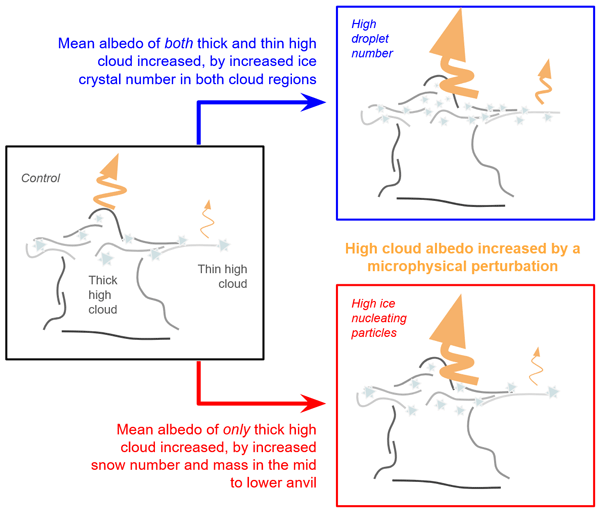
We present observation-informed modelling from the Deep Convective Microphysics Experiment (DCMEX) to study how environmental conditions and cloud processes affect anvil cloud albedo and radiation. Aerosols influencing cloud droplets or influencing ice formation yield varying radiative effects. We introduce fingerprint metrics to discern these effects. Using detailed observations and modelling, we offer insights into high-cloud radiative effects and feedbacks.
Xinyi Huang, Paul R. Field, Ross J. Herbert, Benjamin J. Murray, Floortje van den Heuvel, Daniel P. Grosvenor, Rachel W. N. Sansom, and Kenneth S. Carslaw
Atmos. Chem. Phys., 26, 14577–14616, https://doi.org/10.5194/acp-26-14577-2026, https://doi.org/10.5194/acp-26-14577-2026, 2026
Short summary
Short summary
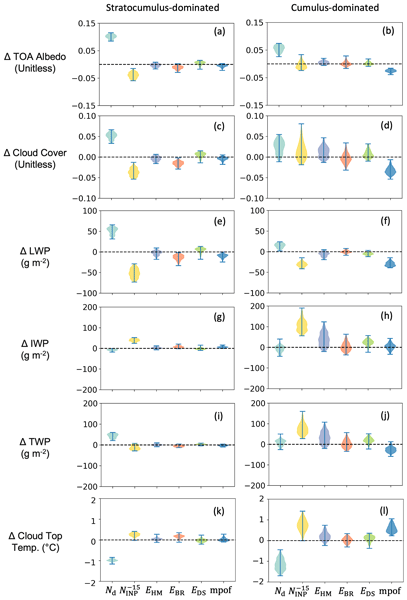
Aerosol-cloud interactions and ice formation processes are key to modelling mixed-phase clouds in cold-air outbreaks. However, no studies have investigated the joint effects of these processes. Here, we used perturbed parameter ensembles and model emulators to show that these processes have strongly interacting effects on the properties of cold air outbreak clouds. Single sensitivity tests may therefore provide incomplete information about cloud-controlling factors.
Michael Biggart, Thomas W. Choularton, Martin W. Gallagher, Keith N. Bower, Gary Lloyd, Paul J. Connolly, Benjamin J. Murray, Mark D. Tarn, Erin N. Raif, and Steven J. Abel
Atmos. Chem. Phys., 26, 13401–13439, https://doi.org/10.5194/acp-26-13401-2026, https://doi.org/10.5194/acp-26-13401-2026, 2026
Short summary
Short summary
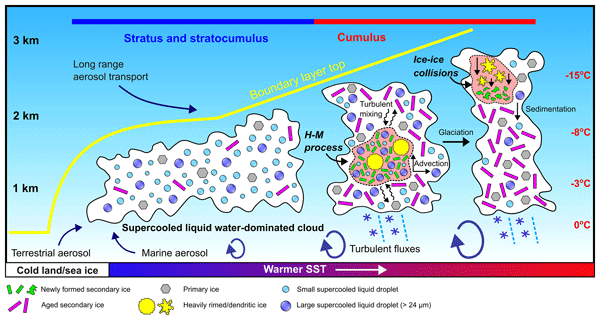
Microphysical processes controlling the phase of mixed-phase clouds in cold air outbreaks (CAOs) are poorly represented by climate models. Of these, secondary ice production (SIP) is a major contributor to uncertainties in the mixed-phase cloud response to warming. We examine observations made in CAOs to understand which SIP processes are dominating and under which conditions. Our results inform future modelling, helping reduce radiative flux biases and uncertainties in climate sensitivity.
Deepak Waman, Julian Meusel, Behrooz Keshtgar, Gabriella Wallentin, Christian Barthlott, Sachin Patade, Sonali Shete, Thara Prabhakaran, Romain Fievet, Declan Finney, Alan Blyth, and Corinna Hoose
Atmos. Chem. Phys., 26, 11371–11407, https://doi.org/10.5194/acp-26-11371-2026, https://doi.org/10.5194/acp-26-11371-2026, 2026
Short summary
Short summary
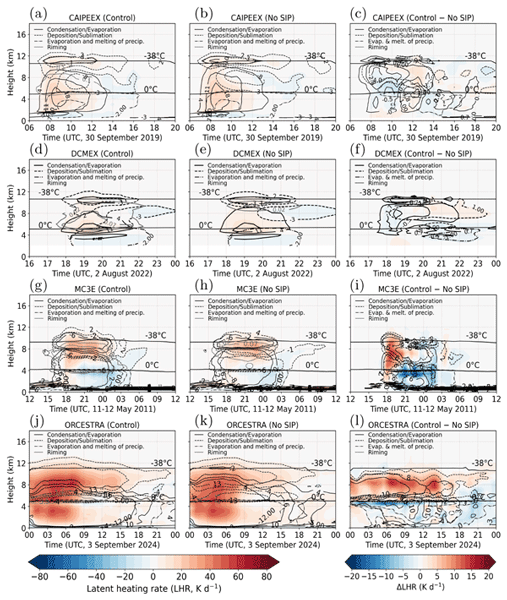
We use a weather model with aircraft and satellite data to study ice multiplication in thunderstorms across India, Mexico, Oklahoma, and the tropical Atlantic. This process can create spurious ice particles in clouds, thereby increasing latent and radiative heating that strengthens stratiform ascents in storms and extends anvil-cloud lifetimes. These results improve our understanding of how small-scale ice processes influence large-scale storm behavior and rainfall patterns.
Zhangcheng Pei, Sonya L. Fiddes, Marc D. Mallet, Matthew T. Woodhouse, Simon P. Alexander, Alain Protat, Kalli Furtado, and Paul R. Field
EGUsphere, https://doi.org/10.5194/egusphere-2026-3541, https://doi.org/10.5194/egusphere-2026-3541, 2026
This preprint is open for discussion and under review for Atmospheric Chemistry and Physics (ACP).
Short summary
Short summary
Climate models misrepresent Southern Ocean clouds, causing warming biases. Using ship data, we updated a weather model to test how sea spray affects cloud ice. Adding realistic ocean particles prevents deep clouds from freezing too fast, correcting sunlight trasmissions. Yet, shallow clouds remain flawed due to missing moisture. Thus, accurate climate predictions require improving both aerosol-cloud interactions and large-scale weather dynamics.
Ezri E. Alkilani-Brown, Declan L. Finney, Alan M. Blyth, Paul R. Field, Jonathan Crosier, and Chetan R. Deva
EGUsphere, https://doi.org/10.5194/egusphere-2026-3385, https://doi.org/10.5194/egusphere-2026-3385, 2026
Short summary
Short summary
Graupel continues to be one of the most poorly characterised ice particles in deep convective clouds. In situ images are critical for understanding its microphysical development. Consequently, a plethora of independent classification schemes has become commonplace. Here, an independent evaluation of several open-source algorithms was undertaken to assess if they are generalisable. Classifications were then applied to the entire DCMEX campaign, to infer graupel concentrations.
Bowen Z. Portman, Paul J. Connolly, Alan M. Blyth, Rachel L. James, and Huihui Wu
Atmos. Chem. Phys., 26, 8367–8385, https://doi.org/10.5194/acp-26-8367-2026, https://doi.org/10.5194/acp-26-8367-2026, 2026
Short summary
Short summary
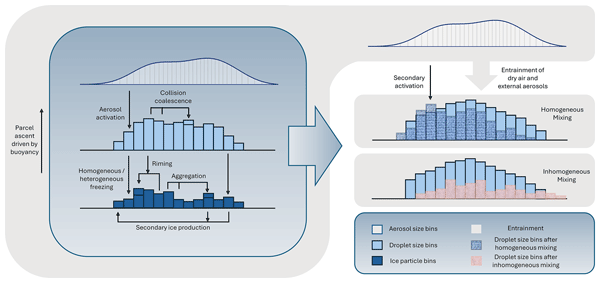
Secondary ice production (SIP) is key to explaining the high ice particle concentrations observed in deep convective clouds. We investigate secondary ice production in summer convective clouds over New Mexico, and our results show that collisions between supercooled water droplets and more massive ice particles are the dominant SIP mechanism in these clouds. We also find that the entrainment of external aerosols leads to earlier ice enhancement under homogeneous mixing.
Omer Celebi, Andrew R. D. Smedley, Paul Connolly, and Ann R. Webb
Atmos. Meas. Tech., 19, 2621–2631, https://doi.org/10.5194/amt-19-2621-2026, https://doi.org/10.5194/amt-19-2621-2026, 2026
Short summary
Short summary
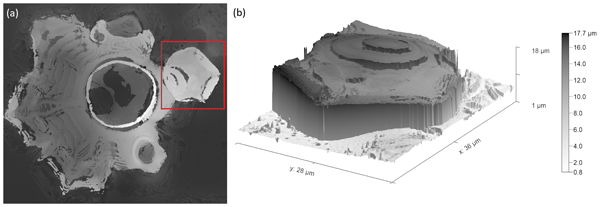
The surface structure of ice crystals in clouds influences how sunlight travels through the atmosphere and contributes to uncertainty in climate predictions. Because these features are difficult to observe, we present a practical approach for mapping ice crystal surface structure using an established capture technique. Ice crystals were produced in a laboratory cloud chamber and their surfaces were measured in detail. This approach enables reliable mapping of ice crystal surfaces.
Masaru Yoshioka, Daniel P. Grosvenor, Amy H. Peace, Jim M. Haywood, Ying Chen, and Paul R. Field
Atmos. Chem. Phys., 26, 4341–4358, https://doi.org/10.5194/acp-26-4341-2026, https://doi.org/10.5194/acp-26-4341-2026, 2026
Short summary
Short summary
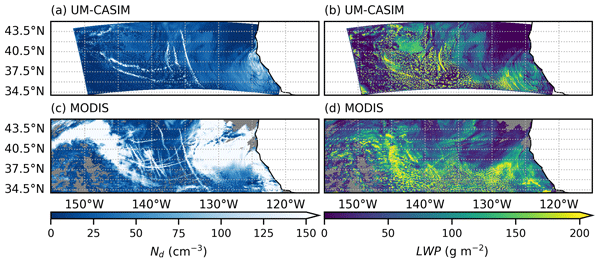
We used advanced computer simulations to study how aerosol particles from a volcanic eruption in Iceland affected clouds. The eruption plume increased small droplets, but changes in cloud water and horizontal extent were not clear. Satellite comparisons between plume and non-plume regions can miss volcanic effects due to spatial variability in weather and aerosol, but simulations can isolate the impact by comparing cases with and without the eruption.
Anna Tippett, Paul R. Field, and Edward Gryspeerdt
Atmos. Chem. Phys., 26, 4251–4274, https://doi.org/10.5194/acp-26-4251-2026, https://doi.org/10.5194/acp-26-4251-2026, 2026
Short summary
Short summary
Clouds and their interactions with tiny particles in the air (aerosols) are a large source of uncertainty in climate models. To study Marine Cloud Brightening (MCB), we use ship tracks (changes to clouds from ship pollution). Comparing real ship track data with model results, we find the model struggles under rainy conditions and overestimates effects at high pollution levels, suggesting it needs improvement for reliable MCB simulations.
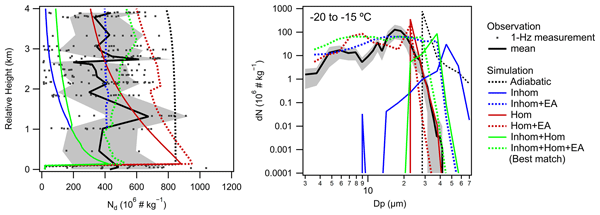
Huihui Wu, Nicholas Marsden, Paul Connolly, Michael Flynn, Paul I. Williams, Declan Finney, Kezhen Hu, Graeme J. Nott, Navaneeth M. Thamban, Keith Bower, Alan Blyth, Martin Gallagher, and Hugh Coe
Atmos. Chem. Phys., 25, 18409–18429, https://doi.org/10.5194/acp-25-18409-2025, https://doi.org/10.5194/acp-25-18409-2025, 2025
Short summary
Short summary
Airborne observations over the Magdalena Mountains in New Mexico underscore the combined influence of meteorological conditions and aerosol characteristics on the development of deep-convective clouds under different flow regimes. Model-observation comparisons emphasize the critical role of aerosol entrainment in reproducing the observed broad cloud droplet spectra. This study provides valuable constraints for improving parameterizations of aerosol-cloud interactions in deep convective systems.
Mengyu Sun, Paul J. Connolly, Paul R. Field, Declan L. Finney, and Alan M. Blyth
EGUsphere, https://doi.org/10.5194/egusphere-2025-5665, https://doi.org/10.5194/egusphere-2025-5665, 2025
Short summary
Short summary
We use a high resolution weather model together with satellite and radar data to study how small particles in the air influence ice and rain in a tropical storm near Darwin. We find that when particle levels are moderate, storm clouds form more ice high in the atmosphere, spread a wider cloud cover, and produce stronger rainfall concentrated in certain regions. These results help improve how weather and climate models represent tropical storms and their rainfall.
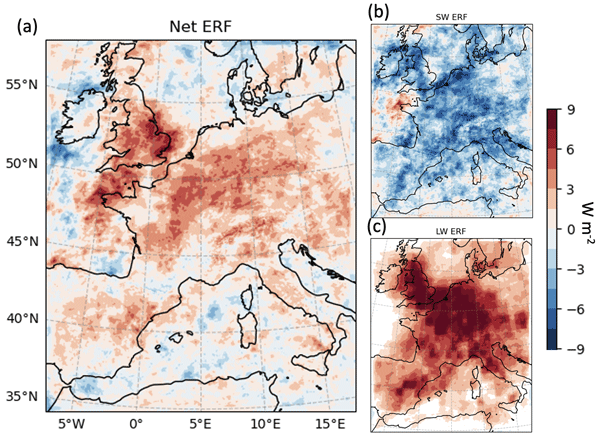
Weiyu Zhang, Paul R. Field, Kwinten Van Weverberg, Piers M. Forster, Cyril J. Morcrette, and Alexandru Rap
Atmos. Chem. Phys., 25, 14153–14166, https://doi.org/10.5194/acp-25-14153-2025, https://doi.org/10.5194/acp-25-14153-2025, 2025
Short summary
Short summary
Contrail cirrus is the largest, yet the most uncertain, aviation climate impact term. A newly implemented contrail cirrus scheme in a double-moment cloud microphysics scheme in climate model realistically reproduces the contrail evolution and provides regional forcing estimates within the range reported by other models. The work highlights the importance of initial contrail characteristics and the need for detailed cloud particle representations in climate model contrail simulations.
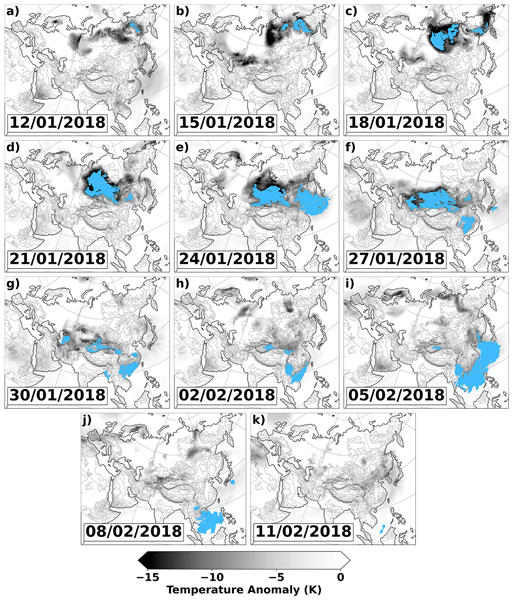
Weronika Osmolska, Charles Chemel, Amanda Maycock, and Paul Field
Weather Clim. Dynam., 6, 1221–1240, https://doi.org/10.5194/wcd-6-1221-2025, https://doi.org/10.5194/wcd-6-1221-2025, 2025
Short summary
Short summary
Extreme cold temperatures have widespread impacts on health, agriculture, infrastructures and the economy. We develop for the first time a methodology to build a catalogue of cold spell events, tracked in space and time. This catalogue is used to examine the behaviour of cold spells and its climatology. The results reveal specific pathways through which cold air affect midlatitudes.
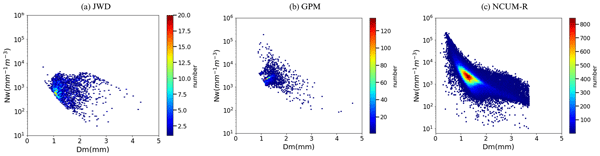
K. S. Apsara, Aravindakshan Jayakumar, Theethai Jacob Anurose, Saji Mohandas, Paul R. Field, Thara Prabhakaran, Mahen Konwar, and Vijayapurapu Srinivasa Prasad
Atmos. Chem. Phys., 25, 11423–11439, https://doi.org/10.5194/acp-25-11423-2025, https://doi.org/10.5194/acp-25-11423-2025, 2025
Short summary
Short summary
Science has made significant strides in weather prediction, especially for intense tropical rainfall that can lead to floods and landslides. Our study aims to improve monsoon rainfall forecasts by analyzing raindrop sizes. Using a new approach to model raindrop growth, we achieved a more accurate depiction of large rainfall events. These improvements can be generalized to enhance early warning systems, offering reliable predictions that help reduce risks from severe tropical weather events.
Xinyi Huang, Paul R. Field, Benjamin J. Murray, Daniel P. Grosvenor, Floortje van den Heuvel, and Kenneth S. Carslaw
Atmos. Chem. Phys., 25, 11363–11406, https://doi.org/10.5194/acp-25-11363-2025, https://doi.org/10.5194/acp-25-11363-2025, 2025
Short summary
Short summary
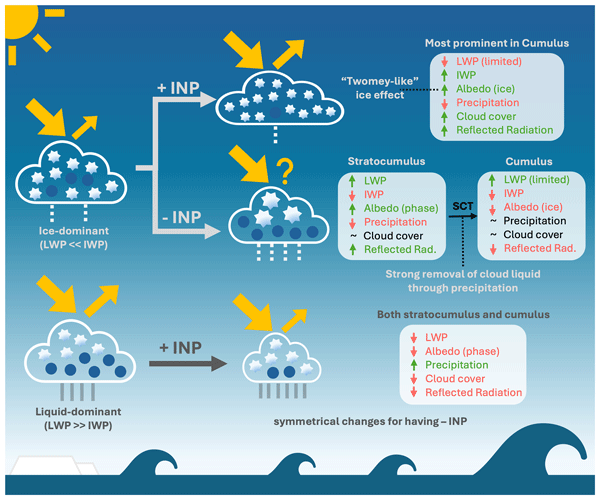
Cold-air outbreak (CAO) clouds play a vital role in climate prediction. This study explores the responses of CAO clouds to aerosols and ice production under different environmental conditions. We found that CAO cloud responses vary with cloud temperature and are strongly controlled by the liquid–ice partitioning in these clouds, suggesting the importance of good representations of cloud microphysics properties to predict the behaviours of CAO clouds in a warming climate.
Pratapaditya Ghosh, Ian Boutle, Paul Field, Adrian Hill, Marie Mazoyer, Katherine J. Evans, Salil Mahajan, Hyun-Gyu Kang, Min Xu, Wei Zhang, and Hamish Gordon
Atmos. Chem. Phys., 25, 11157–11182, https://doi.org/10.5194/acp-25-11157-2025, https://doi.org/10.5194/acp-25-11157-2025, 2025
Short summary
Short summary
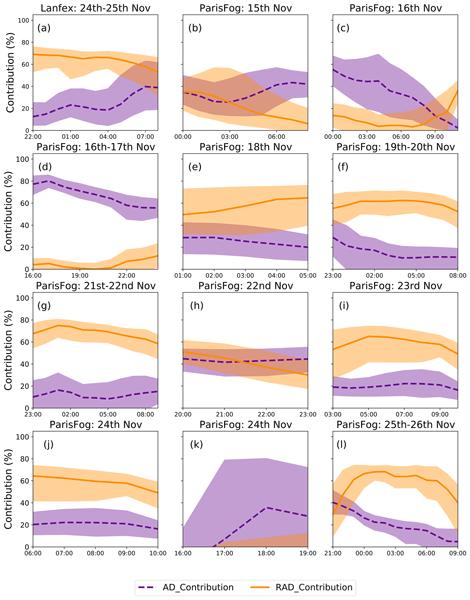
We study the life cycle of fog events in Europe using a weather and climate model. By incorporating droplet formation and growth driven by radiative cooling, our model better simulates the total liquid water in foggy atmospheric columns. We show that both adiabatic and radiative cooling play significant, often equally important, roles in driving droplet formation and growth. We discuss strategies to address droplet number overpredictions by improving model physics and addressing model artifacts.
Declan L. Finney, Alan M. Blyth, Paul R. Field, Martin I. Daily, Benjamin J. Murray, Mengyu Sun, Paul J. Connolly, Zhiqiang Cui, and Steven Böing
Atmos. Chem. Phys., 25, 10907–10929, https://doi.org/10.5194/acp-25-10907-2025, https://doi.org/10.5194/acp-25-10907-2025, 2025
Short summary
Short summary
We present observation-informed modelling from the Deep Convective Microphysics Experiment (DCMEX) to study how environmental conditions and cloud processes affect anvil cloud albedo and radiation. Aerosols influencing cloud droplets or influencing ice formation yield varying radiative effects. We introduce fingerprint metrics to discern these effects. Using detailed observations and modelling, we offer insights into high-cloud radiative effects and feedbacks.
Mike Bush, David L. A. Flack, Huw W. Lewis, Sylvia I. Bohnenstengel, Chris J. Short, Charmaine Franklin, Adrian P. Lock, Martin Best, Paul Field, Anne McCabe, Kwinten Van Weverberg, Segolene Berthou, Ian Boutle, Jennifer K. Brooke, Seb Cole, Shaun Cooper, Gareth Dow, John Edwards, Anke Finnenkoetter, Kalli Furtado, Kate Halladay, Kirsty Hanley, Margaret A. Hendry, Adrian Hill, Aravindakshan Jayakumar, Richard W. Jones, Humphrey Lean, Joshua C. K. Lee, Andy Malcolm, Marion Mittermaier, Saji Mohandas, Stuart Moore, Cyril Morcrette, Rachel North, Aurore Porson, Susan Rennie, Nigel Roberts, Belinda Roux, Claudio Sanchez, Chun-Hsu Su, Simon Tucker, Simon Vosper, David Walters, James Warner, Stuart Webster, Mark Weeks, Jonathan Wilkinson, Michael Whitall, Keith D. Williams, and Hugh Zhang
Geosci. Model Dev., 18, 3819–3855, https://doi.org/10.5194/gmd-18-3819-2025, https://doi.org/10.5194/gmd-18-3819-2025, 2025
Short summary
Short summary
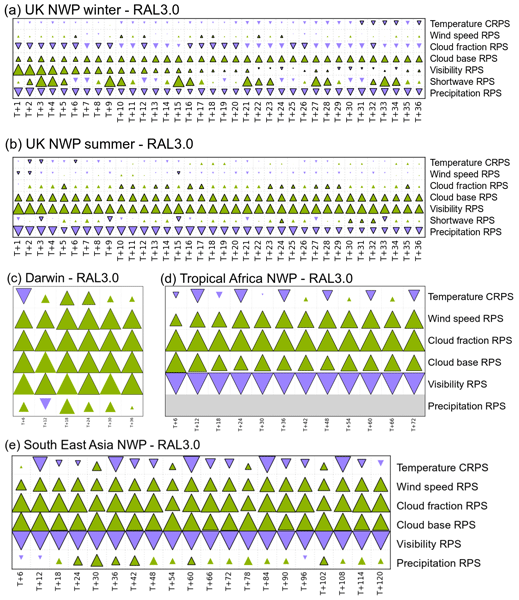
RAL configurations define settings for the Unified Model atmosphere and Joint UK Land Environment Simulator. The third version of the Regional Atmosphere and Land (RAL3) science configuration for kilometre- and sub-kilometre-scale modelling represents a major advance compared to previous versions (RAL2) by delivering a common science definition for applications in tropical and mid-latitude regions. RAL3 has more realistic precipitation distributions and an improved representation of clouds and visibility.
Weiyu Zhang, Kwinten Van Weverberg, Cyril J. Morcrette, Wuhu Feng, Kalli Furtado, Paul R. Field, Chih-Chieh Chen, Andrew Gettelman, Piers M. Forster, Daniel R. Marsh, and Alexandru Rap
Atmos. Chem. Phys., 25, 473–489, https://doi.org/10.5194/acp-25-473-2025, https://doi.org/10.5194/acp-25-473-2025, 2025
Short summary
Short summary
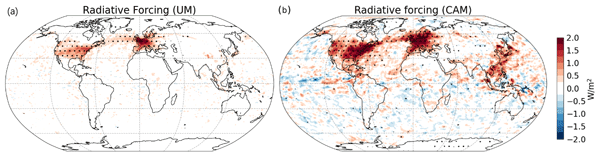
Contrail cirrus is the largest, but also most uncertain, contribution of aviation to global warming. We evaluate, for the first time, the impact of the host climate model on contrail cirrus properties. Substantial differences exist between contrail cirrus formation, persistence, and radiative effects in the host climate models. Reliable contrail cirrus simulations require advanced representation of cloud optical properties and microphysics, which should be better constrained by observations.
Erin N. Raif, Sarah L. Barr, Mark D. Tarn, James B. McQuaid, Martin I. Daily, Steven J. Abel, Paul A. Barrett, Keith N. Bower, Paul R. Field, Kenneth S. Carslaw, and Benjamin J. Murray
Atmos. Chem. Phys., 24, 14045–14072, https://doi.org/10.5194/acp-24-14045-2024, https://doi.org/10.5194/acp-24-14045-2024, 2024
Short summary
Short summary
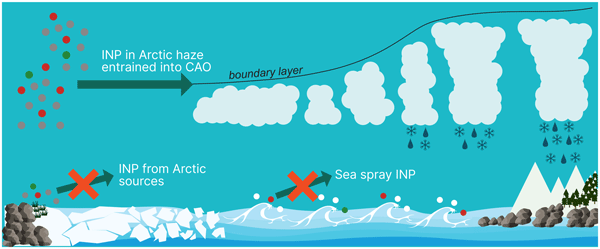
Ice-nucleating particles (INPs) allow ice to form in clouds at temperatures warmer than −35°C. We measured INP concentrations over the Norwegian and Barents seas in weather events where cold air is ejected from the Arctic. These concentrations were among the highest measured in the Arctic. It is likely that the INPs were transported to the Arctic from distant regions. These results show it is important to consider hemispheric-scale INP processes to understand INP concentrations in the Arctic.
Gary Lloyd, Alan Blyth, Zhiqiang Cui, Thomas Choularton, Keith Bower, Martin Gallagher, Michael Flynn, Nicholas Marsden, Leif Denby, and Peter Gallimore
EGUsphere, https://doi.org/10.5194/egusphere-2024-142, https://doi.org/10.5194/egusphere-2024-142, 2024
Preprint archived
Short summary
Short summary
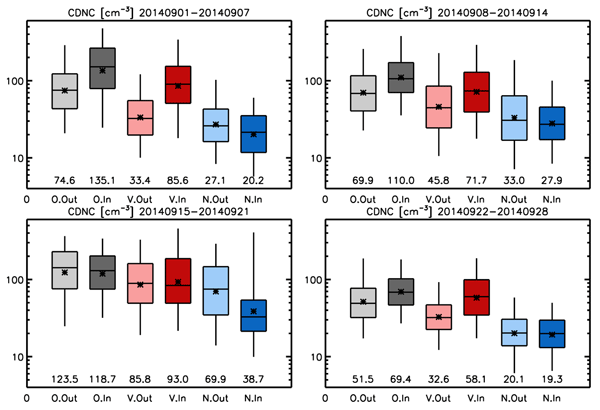
Clouds that develop in the tropical trade-wind regions are extensive and persistent in nature. They are important for understanding how the magnitude of warming by these cloud systems might change in a warming climate. This paper describes measurements of common cloud types in these regions (shallow cumulus clouds) and the way in which they produce rainfall. During different periods, with different amounts of particulate in the air, the characteristics of the clouds were very different.
Declan L. Finney, Alan M. Blyth, Martin Gallagher, Huihui Wu, Graeme J. Nott, Michael I. Biggerstaff, Richard G. Sonnenfeld, Martin Daily, Dan Walker, David Dufton, Keith Bower, Steven Böing, Thomas Choularton, Jonathan Crosier, James Groves, Paul R. Field, Hugh Coe, Benjamin J. Murray, Gary Lloyd, Nicholas A. Marsden, Michael Flynn, Kezhen Hu, Navaneeth M. Thamban, Paul I. Williams, Paul J. Connolly, James B. McQuaid, Joseph Robinson, Zhiqiang Cui, Ralph R. Burton, Gordon Carrie, Robert Moore, Steven J. Abel, Dave Tiddeman, and Graydon Aulich
Earth Syst. Sci. Data, 16, 2141–2163, https://doi.org/10.5194/essd-16-2141-2024, https://doi.org/10.5194/essd-16-2141-2024, 2024
Short summary
Short summary
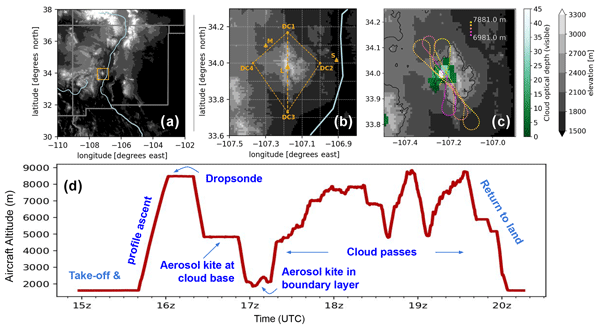
The DCMEX (Deep Convective Microphysics Experiment) project undertook an aircraft- and ground-based measurement campaign of New Mexico deep convective clouds during July–August 2022. The campaign coordinated a broad range of instrumentation measuring aerosol, cloud physics, radar signals, thermodynamics, dynamics, electric fields, and weather. The project's objectives included the utilisation of these data with satellite observations to study the anvil cloud radiative effect.
Zhiqiang Cui, Alan Blyth, Ralph Burton, Sandrine Bony, Steven Böing, Alan Gadian, and Leif Denby
EGUsphere, https://doi.org/10.5194/egusphere-2023-1999, https://doi.org/10.5194/egusphere-2023-1999, 2023
Preprint archived
Short summary
Short summary
Cumulus clouds near Barbados can influence how much heat and energy reaches the Earth's surface. A cluster of clouds resembling a flower is presented. Satellite images, dropsonde data, and weather data are used to understand how this cloud system developed. A significant feature was the appearance of a large area of rain at the centre of the cloud system during its later stages. The paper also studied the environmental conditions around the cloud system.
Rachel L. James, Jonathan Crosier, and Paul J. Connolly
Atmos. Chem. Phys., 23, 9099–9121, https://doi.org/10.5194/acp-23-9099-2023, https://doi.org/10.5194/acp-23-9099-2023, 2023
Short summary
Short summary
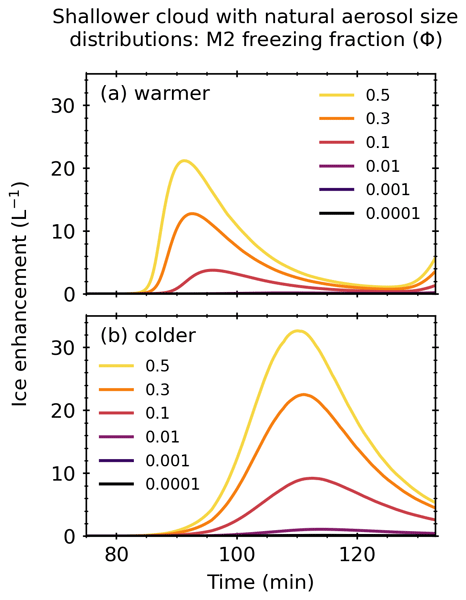
Secondary ice production (SIP) may significantly enhance the ice particle concentration in mixed-phase clouds. We present a systematic modelling study of secondary ice formation in idealised shallow convective clouds for various conditions. Our results suggest that the SIP mechanism of collisions of supercooled water drops with more massive ice particles may be a significant ice formation mechanism in shallow convective clouds outside the rime-splintering temperature range (−3 to −8 °C).
Gillian Young McCusker, Jutta Vüllers, Peggy Achtert, Paul Field, Jonathan J. Day, Richard Forbes, Ruth Price, Ewan O'Connor, Michael Tjernström, John Prytherch, Ryan Neely III, and Ian M. Brooks
Atmos. Chem. Phys., 23, 4819–4847, https://doi.org/10.5194/acp-23-4819-2023, https://doi.org/10.5194/acp-23-4819-2023, 2023
Short summary
Short summary
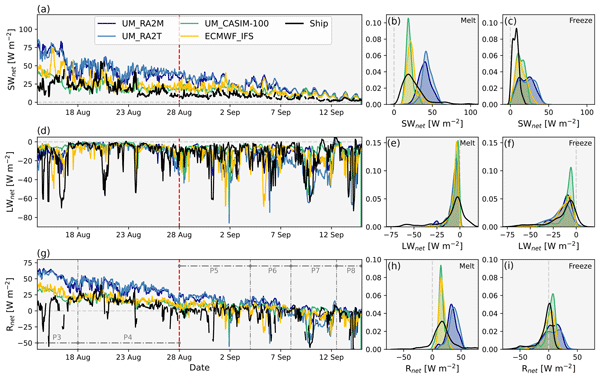
In this study, we show that recent versions of two atmospheric models – the Unified Model and Integrated Forecasting System – overestimate Arctic cloud fraction within the lower troposphere by comparison with recent remote-sensing measurements made during the Arctic Ocean 2018 expedition. The overabundance of cloud is interlinked with the modelled thermodynamic structure, with strong negative temperature biases coincident with these overestimated cloud layers.
Ruth Price, Andrea Baccarini, Julia Schmale, Paul Zieger, Ian M. Brooks, Paul Field, and Ken S. Carslaw
Atmos. Chem. Phys., 23, 2927–2961, https://doi.org/10.5194/acp-23-2927-2023, https://doi.org/10.5194/acp-23-2927-2023, 2023
Short summary
Short summary
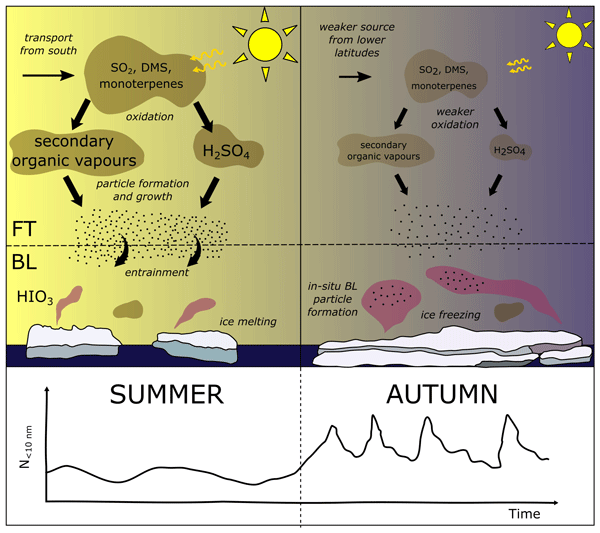
Arctic clouds can control how much energy is absorbed by the surface or reflected back to space. Using a computer model of the atmosphere we investigated the formation of atmospheric particles that allow cloud droplets to form. We found that particles formed aloft are transported to the lowest part of the Arctic atmosphere and that this is a key source of particles. Our results have implications for the way Arctic clouds will behave in the future as climate change continues to impact the region.
Kalli Furtado and Paul Field
Atmos. Chem. Phys., 22, 3391–3407, https://doi.org/10.5194/acp-22-3391-2022, https://doi.org/10.5194/acp-22-3391-2022, 2022
Short summary
Short summary
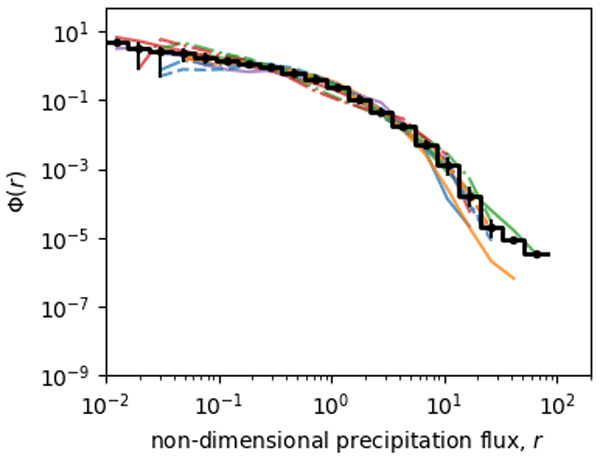
The complex processes involved mean that no simple answer to this
question has so far been discovered: do aerosols increase or decrease precipitation? Using high-resolution weather simulations, we find a self-similar property of rainfall that is not affected by aerosols. Using this invariant, we can collapse all our simulations to a single curve. So, although aerosol effects on rain are many, there may be a universal constraint on the number of degrees of freedom needed to represent them.
Zhiqiang Cui, Alan Blyth, Yahui Huang, Gary Lloyd, Thomas Choularton, Keith Bower, Paul Field, Rachel Hawker, and Lindsay Bennett
Atmos. Chem. Phys., 22, 1649–1667, https://doi.org/10.5194/acp-22-1649-2022, https://doi.org/10.5194/acp-22-1649-2022, 2022
Short summary
Short summary
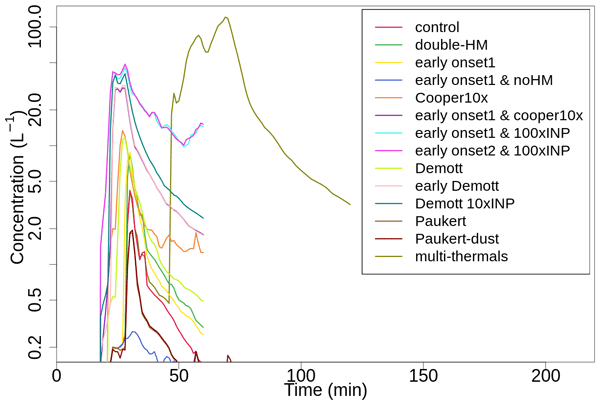
High concentrations of ice particles were observed at temperatures greater than about –8 C. The default scheme of the secondary ice production cannot explain the high concentrations. Relaxing the conditions for secondary ice production or considering dust aerosol alone is insufficient to produce the observed amount of ice particles. It is likely that multi-thermals play an important role in producing very high concentrations of secondary ice particles in some tropical clouds.
Rachel L. James, Vaughan T. J. Phillips, and Paul J. Connolly
Atmos. Chem. Phys., 21, 18519–18530, https://doi.org/10.5194/acp-21-18519-2021, https://doi.org/10.5194/acp-21-18519-2021, 2021
Short summary
Short summary
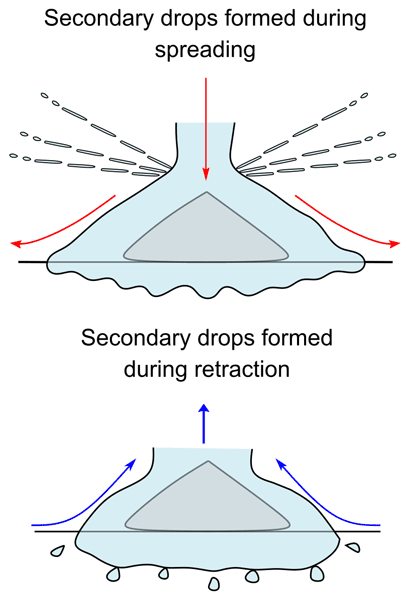
Secondary ice production (SIP) plays an important role in ice formation within mixed-phase clouds. We present a laboratory investigation of a potentially new SIP mechanism involving the collisions of supercooled water drops with ice particles. At impact, the supercooled water drop fragments form smaller secondary drops. Approximately 30 % of the secondary drops formed during the retraction phase of the supercooled water drop impact freeze over a temperature range of −4 °C to −12 °C.
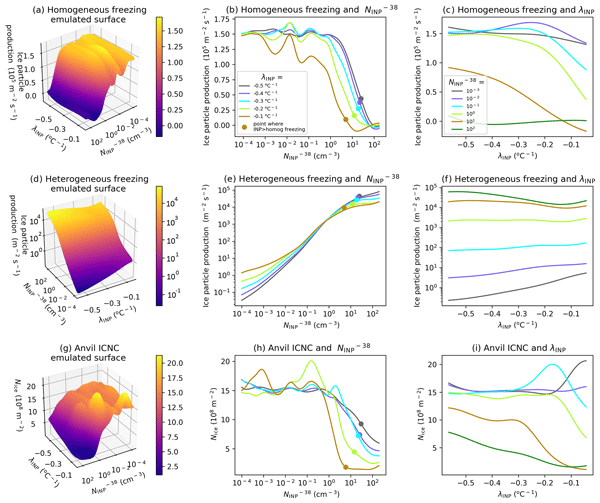
Rachel E. Hawker, Annette K. Miltenberger, Jill S. Johnson, Jonathan M. Wilkinson, Adrian A. Hill, Ben J. Shipway, Paul R. Field, Benjamin J. Murray, and Ken S. Carslaw
Atmos. Chem. Phys., 21, 17315–17343, https://doi.org/10.5194/acp-21-17315-2021, https://doi.org/10.5194/acp-21-17315-2021, 2021
Short summary
Short summary
We find that ice-nucleating particles (INPs), aerosols that can initiate the freezing of cloud droplets, cause substantial changes to the properties of radiatively important convectively generated anvil cirrus. The number concentration of INPs had a large effect on ice crystal number concentration while the INP temperature dependence controlled ice crystal size and cloud fraction. The results indicate information on INP number and source is necessary for the representation of cloud glaciation.
Cited articles
Bazantay, C., Febvre, G., Jaffeux, L., and Schwarzenboeck, A.: Analysis of Ice Crystal Morphologies in Deep Convective Clouds Using In-Flight Measurements during HAIC–HIWC Cayenne, J. Atmos. Sci., 82, 2275–2289, https://doi.org/10.1175/JAS-D-25-0021.1, 2025.
Bigg, E. K.: The supercooling of water, Proc. Phys. Soc. B, 66, 688–694, https://doi.org/10.1088/0370-1301/66/8/309, 1953.
Boutle, I. A., Eyre, J. E. J., and Lock, A. P.: Seamless stratocumulus simulation across the turbulent gray zone, Mon. Weather Rev., 142, 1655–1668, https://doi.org/10.1175/MWR-D-13-00229.1, 2014.
Bush, M., Boutle, I., Edwards, J., Finnenkoetter, A., Franklin, C., Hanley, K., Jayakumar, A., Lewis, H., Lock, A., Mittermaier, M., Mohandas, S., North, R., Porson, A., Roux, B., Webster, S., and Weeks, M.: The second Met Office Unified Model–JULES Regional Atmosphere and Land configuration, RAL2, Geosci. Model Dev., 16, 1713–1734, https://doi.org/10.5194/gmd-16-1713-2023, 2023.
Cantrell, W. and Heymsfield, A.: Production of Ice in Tropospheric Clouds: A Review, Bull. Amer. Meteor. Soc., 86, 795–808, https://doi.org/10.1175/BAMS-86-6-795, 2005.
Connolly, P. J., Choularton, T. W., Gallagher, M. W., Bower, K. N., Flynn, M. J. and Whiteway, J. A.: Cloud-resolving simulations of intense tropical Hector thunderstorms: Implications for aerosol–cloud interactions, Q. J. Roy. Meteor. Soc., 132, 3079–3106, https://doi.org/10.1256/qj.05.86, 2006.
Connolly, P. J., Vaughan, G., May, P. T., Chemel, C., Allen, G., Choularton, T. W., Gallagher, M. W., Bower, K. N., Crosier, J. and Dearden, C.: Can aerosols influence deep tropical convection? Aerosol indirect effects in the Hector island thunderstorm, Q. J. Roy. Meteor. Soc., 139, 2190–2208, https://doi.org/10.1002/qj.2083, 2013.
Cooper, W. A.: Ice Initiation in Natural Clouds, Meteor. Mon., 43, 29–32, https://doi.org/10.1175/0065-9401-21.43.29, 1986.
Crook, N. A.: Understanding Hector: The Dynamics of Island Thunderstorms, Mon. Weather Rev., 129, 1550–1563. https://doi.org/10.1175/1520-0493(2001)129<1550:UHTDOI>2.0.CO;2, 2001.
Dauhut, T., Chaboureau, J.-P., Escobar, J., and Mascart, P.: Large-eddy simulations of Hector the convector making the stratosphere wetter, Atmos. Sci. Lett., 16, 135–140, https://doi.org/10.1002/asl2.534, 2015.
Dedekind, Z., Lauber, A., Ferrachat, S., and Lohmann, U.: Sensitivity of precipitation formation to secondary ice production in winter orographic mixed-phase clouds, Atmos. Chem. Phys., 21, 15115–15134, https://doi.org/10.5194/acp-21-15115-2021, 2021.
Dye, J. E. and Hobbs, P. V.: The influence of environmental parameters on the freezing and fragmentation of suspended water drops, J. Atmos. Sci., 25, 82–96, https://doi.org/10.1175/1520-0469(1968)0250082:TIOEPO.2.0.CO;2, 1968.
Edwards, J. M. and Slingo, A.: Studies with a flexible new radiation code. I: Choosing a configuration for a large-scale model, Q. J. Roy. Meteor. Soc., 122, 689–719, https://doi.org/10.1002/qj.49712253107, 1996.
Field, P. R., Lawson, R. P., Brown, P. R. A., Lloyd, G., Westbrook, C., Moisseev, D., Miltenberger, A., Nenes, A., Blyth, A., Choularton, T., Connolly, P., Buehl, J., Crosier, J., Cui, Z., Dearden, C., DeMott, P., Flossmann, A., Heymsfield, A., Huang, Y., Kalesse, H., Kanji, Z. A., Korolev, A., Kirchgaessner, A., Lasher-Trapp, S., Leisner, T., McFarquhar, G., Phillips, V., Stith, J., and Sullivan, S.: Chapter 7. Secondary Ice Production- current state of the science and recommendations for the future, Meteor. Mon., 58, 7.1–7.20, https://doi.org/10.1175/amsmonographs-d-16-0014.1, 2017.
Field, P. R., Hill, A., Shipway, B., Furtado, K., Wilkinson, J., Miltenberger, A., Gordon, H., Grosvenor D. P., Stevens, R., and Van Weverberg, K.: Implementation of a double moment cloud microphysics scheme in the UK met office regional numerical weather prediction model, Q. J. Roy. Meteor. Soc., 149, 703–739, https://doi.org/10.1002/qj.4414, 2023.
Finney, D. L., Blyth, A. M., Field, P. R., Daily, M. I., Murray, B. J., Sun, M., Connolly, P. J., Cui, Z., and Böing, S.: Microphysical fingerprints in anvil cloud albedo, Atmos. Chem. Phys., 25, 10907–10929, https://doi.org/10.5194/acp-25-10907-2025, 2025.
Gautam, M., Waman, D., Patade, S., Deshmukh, A., Phillips, V., Jackowicz-Korczynski, M., Paul, F. P., Smith, P., and Bansemer, A.: Fragmentation in Collisions of Snow with Graupel/Hail: New Formulation from Field Observations, J. Atmos. Sci., 81, 2149–2164, https://doi.org/10.1175/JAS-D-23-0122.1, 2024.
Grabowski, W. W. and Morrison, H.: Do Ultrafine Cloud Condensation Nuclei Invigorate Deep Convection?, J. Atmos. Sci., 77, 2567–2583, https://doi.org/10.1175/JAS-D-20-0012.1, 2020.
Grzegorczyk, P., Yadav, S., Zanger, F., Theis, A., Mitra, S. K., Borrmann, S., and Szakáll, M.: Fragmentation of ice particles: laboratory experiments on graupel–graupel and graupel–snowflake collisions, Atmos. Chem. Phys., 23, 13505–13521, https://doi.org/10.5194/acp-23-13505-2023, 2023.
Grzegorczyk, P., Wobrock, W., Canzi, A., Niquet, L., Tridon, F., and Planche, C.: Investigating secondary ice production in a deep convective cloud with a 3D bin microphysics model: Part I – Sensitivity study of microphysical processes representations, Atmos. Res., 313, 107774, https://doi.org/10.1016/j.atmosres.2024.107774, 2025a.
Grzegorczyk, P., Wobrock, W., Canzi, A., Niquet, L., Tridon, F., and Planche, C.: Investigating secondary ice production in a deep convective cloud with a 3D bin microphysics model: Part II – Effects on the cloud formation and development, Atmos. Res., 314, 107797, https://doi.org/10.1016/j.atmosres.2024.107797, 2025b.
Grzegorczyk, P., Wobrock, W., Dziduch, A., and Planche, C.: Influence of secondary ice production on cloud and rain properties: analysis of the HYMEX IOP7a heavy-precipitation event, Atmos. Chem. Phys., 25, 10403–10420, https://doi.org/10.5194/acp-25-10403-2025, 2025c.
Hallett, J. and Mossop, S. C.: Production of secondary ice particles during the riming process, Nature, 249, 26–28, https://doi.org/10.1038/249026a0, 1974.
Hallett, J., Sax, R. I., Lamb, D., and Murty, A. S. R.: Aircraft measurements of ice in Florida cumuli, Q. J. Roy. Meteor. Soc., 104, 631–651, https://doi.org/10.1002/qj.49710444108, 1978.
Han, C., Hoose, C., and Dürlich, V.: Secondary Ice Production in Simulated Deep Convective Clouds: A Sensitivity Study, J. Atmos. Sci., 81, 903–921, https://doi.org/10.1175/jas-d-23-0156.1, 2024.
Hawker, R. E., Miltenberger, A. K., Wilkinson, J. M., Hill, A. A., Shipway, B. J., Cui, Z., Cotton, R. J., Carslaw, K. S., Field, P. R., and Murray, B. J.: The temperature dependence of ice-nucleating particle concentrations affects the radiative properties of tropical convective cloud systems, Atmos. Chem. Phys., 21, 5439–5461, https://doi.org/10.5194/acp-21-5439-2021, 2021a.
Hawker, R. E., Miltenberger, A. K., Johnson, J. S., Wilkinson, J. M., Hill, A. A., Shipway, B. J., Field, P. R., Murray, B. J., and Carslaw, K. S.: Model emulation to understand the joint effects of ice-nucleating particles and secondary ice production on deep convective anvil cirrus, Atmos. Chem. Phys., 21, 17315–17343, https://doi.org/10.5194/acp-21-17315-2021, 2021b.
Hobbs, P. V. and Rangno, A. L.: Ice particle concentrations in clouds, J. Atmos. Sci., 42, 2523–2549, https://doi.org/10.1175/1520-0469(1985)042<2523:IPCIC>2.0.CO;2, 1985.
Huang, Y., Wu, W., McFarquhar, G. M., Xue, M., Morrison, H., Milbrandt, J., Korolev, A. V., Hu, Y., Qu, Z., Wolde, M., Nguyen, C., Schwarzenboeck, A., and Heckman, I.: Microphysical processes producing high ice water contents (HIWCs) in tropical convective clouds during the HAIC-HIWC field campaign: dominant role of secondary ice production, Atmos. Chem. Phys., 22, 2365–2384, https://doi.org/10.5194/acp-22-2365-2022, 2022.
Jackson, R., Collis, S., Louf, V., Protat, A., Wang, D., Giangrande, S., Thompson, E. J., Dolan, B., and Powell, S. W.: The development of rainfall retrievals from radar at Darwin, Atmos. Meas. Tech., 14, 53–69, https://doi.org/10.5194/amt-14-53-2021, 2021.
James, R. L., Phillips, V. T. J., and Connolly, P. J.: Secondary ice production during the break-up of freezing water drops on impact with ice particles, Atmos. Chem. Phys., 21, 18519–18530, https://doi.org/10.5194/acp-21-18519-2021, 2021.
James, R. L., Crosier, J., and Connolly, P. J.: A bin microphysics parcel model investigation of secondary ice formation in an idealised shallow convective cloud, Atmos. Chem. Phys., 23, 9099–9121, https://doi.org/10.5194/acp-23-9099-2023, 2023.
Jeffery, C. A. and Austin, P. H.: Homogeneous nucleation of supercooled water: Results from a new equation of state, J. Geophys. Res., 102, 25269–25279, https://doi.org/10.1029/97JD02243, 1997.
Keinert, A., Spannagel, D., Leisner, T., and Kiselev, A.: Secondary ice production upon freezing of freely falling drizzle droplets, J. Atmos. Sci., 77, 2959–2967, https://doi.org/10.1175/JAS-D-20-0081.1, 2020.
Korolev, A., Heckman, I., Wolde, M., Ackerman, A. S., Fridlind, A. M., Ladino, L. A., Lawson, R. P., Milbrandt, J., and Williams, E.: A new look at the environmental conditions favorable to secondary ice production, Atmos. Chem. Phys., 20, 1391–1429, https://doi.org/10.5194/acp-20-1391-2020, 2020.
Korolev, A., DeMott, P. J., Heckman, I., Wolde, M., Williams, E., Smalley, D. J., and Donovan, M. F.: Observation of secondary ice production in clouds at low temperatures, Atmos. Chem. Phys., 22, 13103–13113, https://doi.org/10.5194/acp-22-13103-2022, 2022.
Kudzotsa, I., Phillips, V. T. J., and Dobbie, S.: Aerosol indirect effects on glaciated clouds. Part 2: Sensitivity tests using solute aerosols, Q. J. Roy. Meteor. Soc., 142, 1970–1981, https://doi.org/10.1002/qj.2790, 2016.
Lasher-Trapp, S., Leon, D. C., DeMott, P. J., Villanueva-Birriel, C. M., Johnson, A. V., Moser, D. H., Tully, C. S., and Wu, W.: A Multisensor Investigation of Rime Splintering in Tropical Maritime Cumuli, J. Atmos. Sci., 73, 2547–2564, https://doi.org/10.1175/JAS-D-15-0285.1, 2016.
Lauber, A., Kiselev, A., Pander, T., Handmann, P., and Leisner, T.: Secondary Ice Formation during Freezing of Levitated Droplets, J. Atmos. Sci., 75, 2815–2826, https://doi.org/10.1175/jas-d-18-0052.1, 2018.
Lock, A. P., Brown, A. R., Bush, M. R., Martin, G. M., and Smith, R. N. B.: A new boundary layer mixing scheme. Part I: Scheme description and single-column model tests, Mon. Weather Rev., 128, 3187–3199, https://doi.org/10.1175/1520-0493(2000)128<3187:ANBLMS>2.0.CO;2, 2000.
Lohmann, U.: Aerosol Effects on Clouds and Climate, Space Sci. Rev., 125, 129–137, https://doi.org/10.1007/s11214-006-9051-8, 2006.
Louf, V., Protat, A., Warren, R. A., Collis, S. M., Wolff, D. B., Raunyiar, S., Jakob, C., and Petersen, W. A.: An Integrated Approach to Weather Radar Calibration and Monitoring Using Ground Clutter and Satellite Comparisons, J. Atmos. Ocean. Technol., 36, 17–39, https://doi.org/10.1175/JTECH-D-18-0007.1, 2019.
Manners, J., Edwards, J. M., Hill, P., and Thelen, J.-C.: SOCRATES (Suite Of Community RAdiative Transfer codes based on Edwards and Slingo) Technical Guide, Met Office, UK, https://code.metoffice.gov.uk/trac/socrates (last access: 1 November 2025), 2025.
May, P. T., Mather, J. H., Vaughan, G., Jakob, C., McFarquhar, G. M., Bower, K. N., and Mace, G. G.: The Tropical Warm Pool International Cloud Experiment, B. Am. Meteorol. Soc., 89, 629–646, https://doi.org/10.1175/BAMS-89-5-629, 2008.
McKim, B., Bony, S., and Dufresne, J.-L.: Weak anvil cloud area feedback suggested by physical and observational constraints, Nature Geoscience, 17, 392–397, https://doi.org/10.1038/s41561-024-01414-4, 2024.
Miltenberger, A. K. and Field, P. R.: Sensitivity of mixed-phase moderately deep convective clouds to parameterizations of ice formation – an ensemble perspective, Atmos. Chem. Phys., 21, 3627–3642, https://doi.org/10.5194/acp-21-3627-2021, 2021.
Miltenberger, A. K., Field, P. R., Hill, A. H., and Heymsfield, A. J.: Vertical redistribution of moisture and aerosol in orographic mixed-phase clouds, Atmos. Chem. Phys., 20, 7979–8001, https://doi.org/10.5194/acp-20-7979-2020, 2020.
Mittermaier, M. P.: Improving short-range high-resolution model precipitation forecast skill using time-lagged ensembles, Q. J. Roy. Meteor. Soc., 133, 1487–1500, https://doi.org/10.1002/qj.135, 2007.
Mossop, S. C.: Secondary ice particle production during rime growth: The effect of drop size distribution and rimer velocity, Q. J. Roy. Meteor. Soc., 111, 1113–1124, https://doi.org/10.1002/qj.49711147012, 1985.
Phillips, V. T., Patade, S., Gutierrez, J., and Bansemer, A.: Secondary Ice Production by Fragmentation of Freezing Drops: Formulation and Theory, J. Atmos. Sci., 76, 3031–3070, https://doi.org/10.1175/JAS-D-17-0190.1, 2018.
Phillips, V. T. J., Yano, J.-I., and Khain, A.: Ice Multiplication by Breakup in Ice–Ice Collisions. Part I: Theoretical Formulation, J. Atmos. Sci., 74, 1705–1719, https://doi.org/10.1175/JAS-D-16-0224.1, 2017a.
Phillips, V. T. J., Yano, J.-I., Formenton, M., Ilotoviz, E., Kanawade, V., Kudzotsa, I., Sun, J., Bansemer, A., Detwiler, A. G., Khain, A., and Tessendorf, S. A.: Ice Multiplication by Breakup in Ice–Ice Collisions. Part II: Numerical Simulations, J. Atmos. Sci., 74, 2789–2811, https://doi.org/10.1175/jas-d-16-0223.1, 2017b.
Qu, Z., Korolev, A., Milbrandt, J. A., Heckman, I., Huang, Y., McFarquhar, G. M., Morrison, H., Wolde, M., and Nguyen, C.: The impacts of secondary ice production on microphysics and dynamics in tropical convection, Atmos. Chem. Phys., 22, 12287–12310, https://doi.org/10.5194/acp-22-12287-2022, 2022.
Seidel, J. S., Kiselev, A. A., Keinert, A., Stratmann, F., Leisner, T., and Hartmann, S.: Secondary ice production – no evidence of efficient rime-splintering mechanism, Atmos. Chem. Phys., 24, 5247–5263, https://doi.org/10.5194/acp-24-5247-2024, 2024.
Sullivan, S. C., Barthlott, C., Crosier, J., Zhukov, I., Nenes, A., and Hoose, C.: The effect of secondary ice production parameterization on the simulation of a cold frontal rainband, Atmos. Chem. Phys., 18, 16461–16480, https://doi.org/10.5194/acp-18-16461-2018, 2018.
Sun, M., Liu, D., Qie, X., Mansell, E. R., Yair, Y., Fierro, A. O., Yuan, S., Chen, Z., and Wang, D.: Aerosol effects on electrification and lightning discharges in a multicell thunderstorm simulated by the WRF-ELEC model, Atmos. Chem. Phys., 21, 14141–14158, https://doi.org/10.5194/acp-21-14141-2021, 2021.
Sun, M., Li, Z., Wang, T., Mansell, E. R., Qie, X., Shan, S., Liu, D., and Cribb, M.: Understanding the effects of aerosols on electrification and lightning polarity in an idealized supercell thunderstorm via model emulation, J. Geophys. Res.-Atmos., 129, e2023JD039251, https://doi.org/10.1029/2023JD039251, 2024.
Takahashi, T., Nagao, Y., and Kushiyama, Y.: Possible High Ice Particle Production during Graupel–Graupel Collisions, J. Atmos. Sci., 52, 4523–4527, https://doi.org/10.1175/1520-0469(1995)052<4523:PHIPPD>2.0.CO;2, 1995.
Varble, A. C., Igel, A. L., Morrison, H., Grabowski, W. W., and Lebo, Z. J.: Opinion: A critical evaluation of the evidence for aerosol invigoration of deep convection, Atmos. Chem. Phys., 23, 13791–13808, https://doi.org/10.5194/acp-23-13791-2023, 2023.
Vardiman, L.: The Generation of Secondary Ice Particles in Clouds by Crystal–Crystal Collision, J. Atmos. Sci., 35, 2168–2180, https://doi.org/10.1175/1520-0469(1978)035<2168:TGOSIP>2.0.CO;2, 1978.
Vaughan, G., Schiller, C., MacKenzie, A. R., Bower, K., Peter, T., Schlager, H., Harris, N. R. P., May, P. T.: SCOUT-O3/ACTIVE high-altitude aircraft measurements around deep tropical convection, B. Am. Meteorol. Soc., 89, 647–662, https://doi.org/10.1175/BAMS-89-5-647, 2008.
Walters, D., Baran, A. J., Boutle, I., Brooks, M., Earnshaw, P., Edwards, J., Furtado, K., Hill, P., Lock, A., Manners, J., Morcrette, C., Mulcahy, J., Sanchez, C., Smith, C., Stratton, R., Tennant, W., Tomassini, L., Van Weverberg, K., Vosper, S., Willett, M., Browse, J., Bushell, A., Carslaw, K., Dalvi, M., Essery, R., Gedney, N., Hardiman, S., Johnson, B., Johnson, C., Jones, A., Jones, C., Mann, G., Milton, S., Rumbold, H., Sellar, A., Ujiie, M., Whitall, M., Williams, K., and Zerroukat, M.: The Met Office Unified Model Global Atmosphere 7.0/7.1 and JULES Global Land 7.0 configurations, Geosci. Model Dev., 12, 1909–1963, https://doi.org/10.5194/gmd-12-1909-2019, 2019.
Waman, D., Patade, S., Jadav, A., Deshmukh, A., Gupta, A. K., Phillips, V. T. J., Bansemer, A., and DeMott, P. J.: Dependencies of Four Mechanisms of Secondary Ice Production on Cloud-Top Temperature in a Continental Convective Storm, J. Atmos. Sci., 79, 3375–3404, https://doi.org/10.1175/JAS-D-21-0278.1, 2022.
Waman, D., Jadav, A., Patade, S., Gautam, M., Deshmukh, A., and Phillips, V. T. J.: Mechanisms for Indirect Effects from Ice Nucleating Particles on Continental Clouds and Radiation, J. Atmos. Sci., 82, 1693–1720, https://doi.org/10.1175/JAS-D-24-0143.1, 2025.
Wood, N., Staniforth, A., White, A., Allen, T., Diamantakis, M., Gross, M., Melvin, T., Smith, C., Vosper, S., Zerroukat, M., and Thuburn, J.: An inherently mass-conserving semi-implicit semi-Lagrangian discretization of the deep-atmosphere global non-hydrostatic equations, Q. J. Roy. Meteor. Soc., 140, 1505–1520, https://doi.org/10.1002/qj.2235, 2014.
Yadav, S., Metten, L., Grzegorczyk, P., Theis, A., Mitra, S. K., and Szakáll, M.: Measurement report: Influence of particle density on secondary ice production by graupel and frozen drop collisions, Atmos. Chem. Phys., 25, 8671–8682, https://doi.org/10.5194/acp-25-8671-2025, 2025.
Young, G., Lachlan-Cope, T., O'Shea, S. J., Dearden, C., Listowski, C., Bower, K. N., Choularton, T. W., and Gallagher, M. W.: Radiative Effects of Secondary Ice Enhancement in Coastal Antarctic Clouds, Geophys. Res. Lett., 46, 2312–2321, https://doi.org/10.1029/2018gl080551, 2019.
Zhao, X. and Liu, X.: Global Importance of Secondary Ice Production, Geophys. Res. Lett., 48, e2021GL092581, https://doi.org/10.1029/2021gl092581, 2021.
Zhao, X., Liu, X., Phillips, V. T. J., and Patade, S.: Impacts of secondary ice production on Arctic mixed-phase clouds based on ARM observations and CAM6 single-column model simulations, Atmos. Chem. Phys., 21, 5685–5703, https://doi.org/10.5194/acp-21-5685-2021, 2021.
Short summary
We investigated how extra ice particles form inside tropical storm clouds and how they affect rainfall and sunlight reflection. By using a weather model, we found that these extra ice particles can change how clouds grow, reduce heat escaping to space, and slightly shift where rain falls. This helps improve how weather and climate models predict tropical storms.
We investigated how extra ice particles form inside tropical storm clouds and how they affect...


Altmetrics
Final-revised paper
Preprint