
Articles | Volume 25, issue 24
https://doi.org/10.5194/acp-25-18373-2025
© Author(s) 2025. This work is distributed under
the Creative Commons Attribution 4.0 License.
the Creative Commons Attribution 4.0 License.
https://doi.org/10.5194/acp-25-18373-2025
© Author(s) 2025. This work is distributed under
the Creative Commons Attribution 4.0 License.
the Creative Commons Attribution 4.0 License.
Research article
| 
17 Dec 2025
Research article |
| 17 Dec 2025
| 17 Dec 2025
Challenges and benefits of using NOx as a quantitative proxy for fossil fuel CO2 in an urban area based on radiocarbon measurements
Hannes Juchem
CORRESPONDING AUTHOR

Institute of Environmental Physics, Heidelberg University, INF 229, 69120 Heidelberg, Germany
ICOS Central Radiocarbon Laboratory, Heidelberg University, Berliner Straße 53, 69120 Heidelberg, Germany
Fabian Maier
Max Planck Institute for Biogeochemistry, 07745 Jena, Germany
Ingeborg Levin
Institute of Environmental Physics, Heidelberg University, INF 229, 69120 Heidelberg, Germany
deceased, 10 February 2024
Armin Jordan
ICOS Flask and Calibration Laboratory, Max Planck Institute for Biogeochemistry, 07745 Jena, Germany
Denis Pöhler
Institute of Environmental Physics, Heidelberg University, INF 229, 69120 Heidelberg, Germany
Airyx GmbH, Hans-Bunte-Str. 4, 69123 Heidelberg, Germany
Claudius Rosendahl
Institute of Environmental Physics, Heidelberg University, INF 229, 69120 Heidelberg, Germany
Julian Della Coletta
Institute of Environmental Physics, Heidelberg University, INF 229, 69120 Heidelberg, Germany
ICOS Central Radiocarbon Laboratory, Heidelberg University, Berliner Straße 53, 69120 Heidelberg, Germany
Susanne Preunkert
Institute of Environmental Physics, Heidelberg University, INF 229, 69120 Heidelberg, Germany
ICOS Central Radiocarbon Laboratory, Heidelberg University, Berliner Straße 53, 69120 Heidelberg, Germany
Samuel Hammer
Institute of Environmental Physics, Heidelberg University, INF 229, 69120 Heidelberg, Germany
ICOS Central Radiocarbon Laboratory, Heidelberg University, Berliner Straße 53, 69120 Heidelberg, Germany
Related authors
Markus Knoll, Martin Penz, Hannes Juchem, Christina Schmidt, Denis Pöhler, and Alexander Bergmann
Atmos. Meas. Tech., 17, 2481–2505, https://doi.org/10.5194/amt-17-2481-2024, https://doi.org/10.5194/amt-17-2481-2024, 2024
Short summary
Short summary
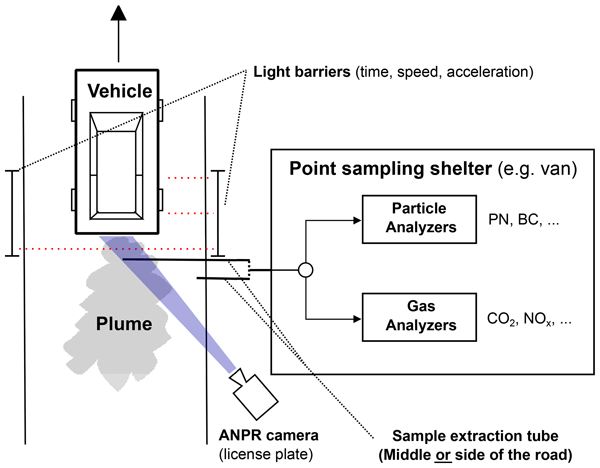
Exhaust emissions from combustion-based vehicles are negatively affecting human health and our environment. In particular, a small share (< 20 %) of poorly maintained or tampered vehicles are responsible for the majority (60 %–90 %) of traffic-related emissions. The emissions from vehicles are currently not properly monitored during their lifetime. We present a roadside measurement technique, called
point sampling, which can be used to monitor vehicle emissions throughout their life cycle.
Thomas Laemmel, Dylan Geissbühler, Stephan Henne, Ryo Fujita, Heather Graven, Christophe Espic, Matthias Bantle, Negar Haghipour, Franz Conen, Dominik Brunner, Martin Steinbacher, Giulia Zazzeri, Samuel Hammer, Markus Leuenberger, and Sönke Szidat
Atmos. Chem. Phys., 26, 12019–12036, https://doi.org/10.5194/acp-26-12019-2026, https://doi.org/10.5194/acp-26-12019-2026, 2026
Short summary
Short summary
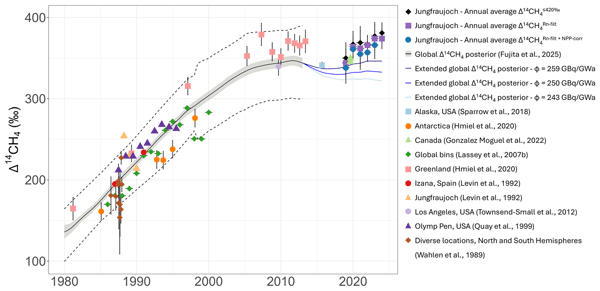
Carbon dioxide and methane are the two main anthropogenic greenhouse gases responsible for current climate change. Beside the measurement of their atmospheric concentration, the analysis of the abundance of their isotope carbon-14 (14C) gives hints about their origin, either biogenic or fossil. Here we present six years of atmospheric 14CH4 and 14CO2 measurements at a high-elevation alpine site in Switzerland (Jungfraujoch) and discuss the observed trends in both local and global views.
Manuel Henning, Philipp Haim, Stefan Schmitt, Johannes Lampel, Denis Pöhler, and Mark Wenig
EGUsphere, https://doi.org/10.5194/egusphere-2026-2724, https://doi.org/10.5194/egusphere-2026-2724, 2026
Short summary
Short summary
This study presents a Bayesian framework for retrieving vertical NO2 profiles from sparse measurements. By reconstructing a 2+1D spatiotemporal NO2 density field using the NIFTy framework, height profiles are derived from combined long-path DOAS and in-situ measurements during the CINDI-III campaign. The reconstructed fields reproduce key atmospheric features and agree well with independent MAX-DOAS retrievals, demonstrating the feasibility of Bayesian inference for atmospheric tomography.
Ann-Kristin Kunz, Samuel Hammer, Patrick Aigner, Laura Bignotti, Lars Borchardt, Jia Chen, Julian Della Coletta, Lukas Emmenegger, Markus Eritt, Xochilt Gutiérrez, Josh Hashemi, Rainer Hilland, Christopher Holst, Armin Jordan, Natascha Kljun, Richard Kneißl, Changxing Lan, Virgile Legendre, Ingeborg Levin, Benjamin Loubet, Matthias Mauder, Betty Molinier, Susanne Preunkert, Michel Ramonet, Stavros Stagakis, and Andreas Christen
Atmos. Chem. Phys., 26, 4967–5003, https://doi.org/10.5194/acp-26-4967-2026, https://doi.org/10.5194/acp-26-4967-2026, 2026
Short summary
Short summary
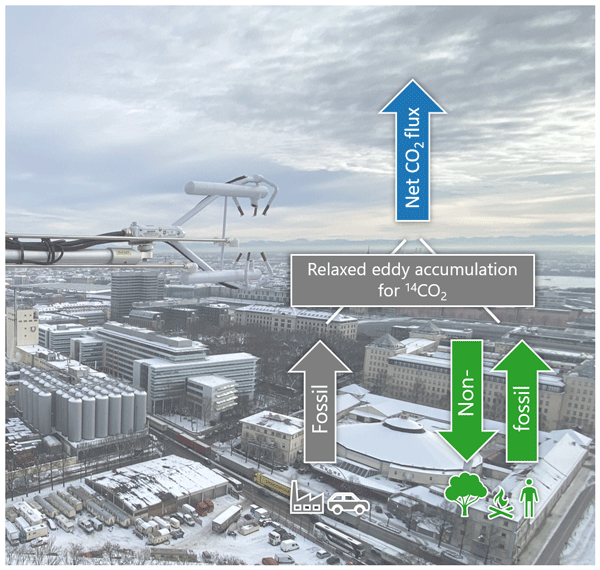
We present radiocarbon (14C)-based fossil fuel CO2 fluxes from relaxed eddy accumulation measurements on tall towers in the cities of Zurich, Paris, and Munich. By separating net CO2 fluxes into fossil and non-fossil components, these data reveal significant and variable contributions from human, plant, and soil respiration, as well as point-source emissions. These unique insights into CO2 flux composition offer crucial information for observation-based validation of urban emission estimates.
Fabian Maier, Christian Rödenbeck, Ute Karstens, Frank-Thomas Koch, Maksym Gachkivskyi, Andrew Smerald, and Christoph Gerbig
EGUsphere, https://doi.org/10.5194/egusphere-2026-739, https://doi.org/10.5194/egusphere-2026-739, 2026
Short summary
Short summary
Transport model errors represent a major source of uncertainty in greenhouse gas flux estimates derived from inverse modelling, yet they remain challenging to quantify. In our study, we leverage the similarities in the atmospheric transport of methane (CH4) and radon (222Rn) by performing a dual-tracer CH4-222Rn inversion over Europe, with the goal of enhancing the reliability of CH4 flux estimates. We discuss the benefits and limitations of this dual-tracer approach.
Ida Storm, Ute Karstens, Claudio D'Onofrio, Alex Vermeulen, Samuel Hammer, Ingrid Super, Theo Glauch, and Wouter Peters
Earth Syst. Sci. Data, 17, 6681–6701, https://doi.org/10.5194/essd-17-6681-2025, https://doi.org/10.5194/essd-17-6681-2025, 2025
Short summary
Short summary
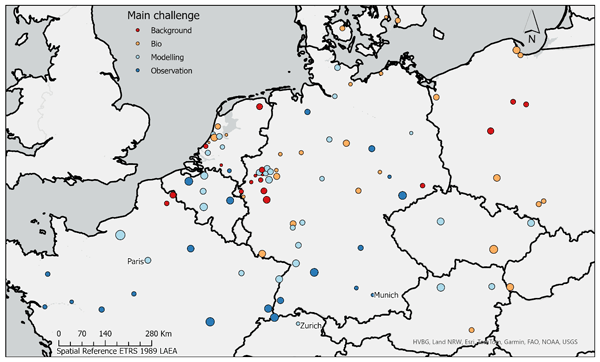
Many cities are committed to ambitious CO2 emission reduction targets, supported by climate action plans. Atmospheric measurements are essential to verify that these efforts lead to the expected reductions. Here, we characterise and compare 96 European cities across 18 metrics, linking them to four major challenges in CO2 emissions monitoring. Our framework includes a tool with additional cities and metrics, as well as "mapbooks" for the 96 cities.
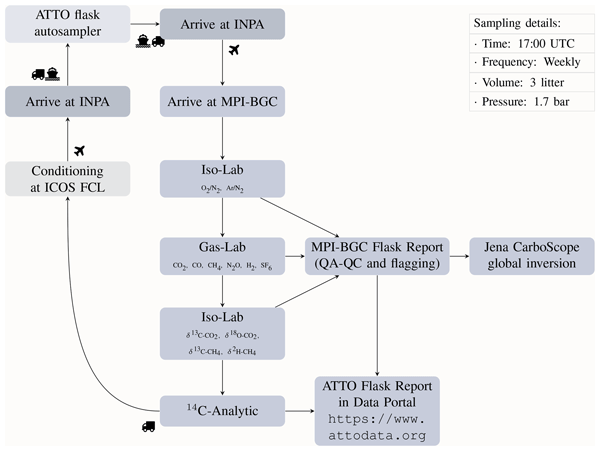
Carlos A. Sierra, Ingrid Chanca, Meinrat O. Andreae, Alessandro Carioca de Araújo, Hella van Asperen, Lars Borchardt, Santiago Botía, Luiz Antonio Candido, Caio S. C. Correa, Cléo Quaresma Dias-Junior, Markus Eritt, Annica Fröhlich, Luciana V. Gatti, Marcus Guderle, Samuel Hammer, Martin Heimann, Viviana Horna, Armin Jordan, Steffen Knabe, Richard Kneißl, Jost Valentin Lavric, Ingeborg Levin, Kita Macario, Juliana Menger, Heiko Moossen, Carlos Alberto Quesada, Michael Rothe, Christian Rödenbeck, Yago Santos, Axel Steinhof, Bruno Takeshi, Susan Trumbore, and Sönke Zaehle
Earth Syst. Sci. Data, 17, 5871–5884, https://doi.org/10.5194/essd-17-5871-2025, https://doi.org/10.5194/essd-17-5871-2025, 2025
Short summary
Short summary
We present here a unique dataset of atmospheric observations of greenhouse gases and isotopes that provide key information on land-atmosphere interactions for the Amazon forests of central Brazil. The data show a relatively large level of variability, but also important trends in greenhouse gases, and signals from fires as well as seasonal biological activity.
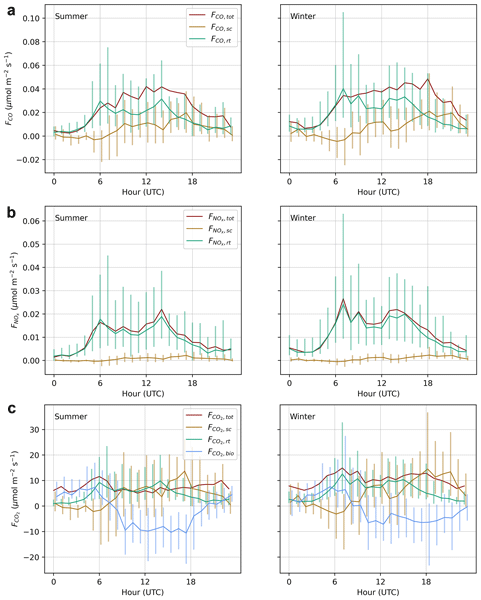
Rainer Hilland, Josh Hashemi, Stavros Stagakis, Dominik Brunner, Lionel Constantin, Natascha Kljun, Ann-Kristin Kunz, Betty Molinier, Samuel Hammer, Lukas Emmenegger, and Andreas Christen
Atmos. Chem. Phys., 25, 14279–14299, https://doi.org/10.5194/acp-25-14279-2025, https://doi.org/10.5194/acp-25-14279-2025, 2025
Short summary
Short summary
We present a study of simultaneously measured fluxes of carbon dioxide (CO2) and co-emitted species in the city of Zurich. Flux measurements of CO2 alone cannot be attributed to specific emission sectors, such as road transport or residential heating. We present a model which uses the measured ratios of CO2 to carbon monoxide (CO) and nitrogen oxides (NOx) as well as sector-specific reference ratios, to attribute measured fluxes to their emission sectors.
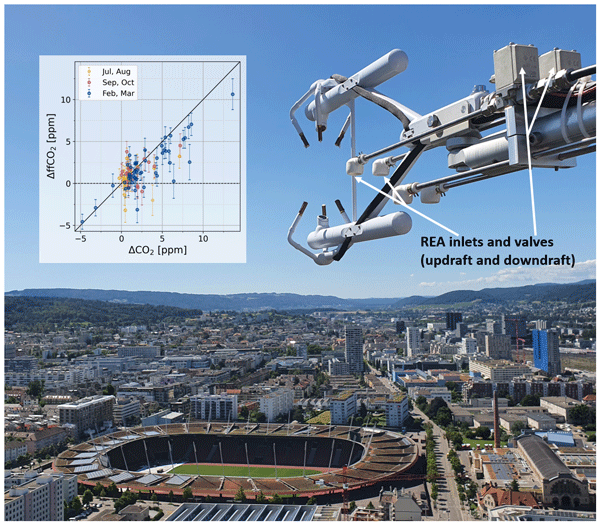
Ann-Kristin Kunz, Lars Borchardt, Andreas Christen, Julian Della Coletta, Markus Eritt, Xochilt Gutiérrez, Josh Hashemi, Rainer Hilland, Armin Jordan, Richard Kneißl, Virgile Legendre, Ingeborg Levin, Susanne Preunkert, Pascal Rubli, Stavros Stagakis, and Samuel Hammer
Atmos. Meas. Tech., 18, 5349–5373, https://doi.org/10.5194/amt-18-5349-2025, https://doi.org/10.5194/amt-18-5349-2025, 2025
Short summary
Short summary
We present, to our knowledge, the first relaxed eddy accumulation system explicitly tailored to a radiocarbon (14C)-based partitioning of fossil and non-fossil urban CO2 fluxes. Laboratory tests and in-depth quality and performance checks prove that the system meets the technical requirements. A pilot application on a tall tower in the city of Zurich, Switzerland, demonstrates the ability to separate fossil and non-fossil CO2 components within the typical precision of 14C measurements.
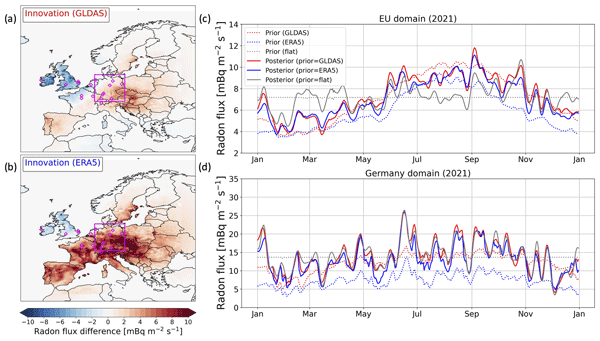
Fabian Maier, Eva Falge, Maksym Gachkivskyi, Stephan Henne, Ute Karstens, Dafina Kikaj, Ingeborg Levin, Alistair Manning, Christian Rödenbeck, and Christoph Gerbig
Atmos. Chem. Phys., 25, 12779–12809, https://doi.org/10.5194/acp-25-12779-2025, https://doi.org/10.5194/acp-25-12779-2025, 2025
Short summary
Short summary
The radioactive noble gas radon (222Rn) is a suitable natural tracer for atmospheric transport and mixing processes that can be used to validate and calibrate atmospheric transport models. However, this requires accurate estimates of the 222Rn flux from the soil into the atmosphere. In our study, we evaluate the reliability of process-based 222Rn flux maps for Europe using a 222Rn inversion. Our inversion results can give some indications on how to improve the process-based 222Rn flux maps.
Michel Legrand, Mstislav Vorobyev, Daria Bokuchava, Stanislav Kutuzov, Andreas Plach, Andreas Stohl, Alexandra Khairedinova, Vladimir Mikhalenko, Maria Vinogradova, Sabine Eckhardt, and Susanne Preunkert
Atmos. Chem. Phys., 25, 1385–1399, https://doi.org/10.5194/acp-25-1385-2025, https://doi.org/10.5194/acp-25-1385-2025, 2025
Short summary
Short summary
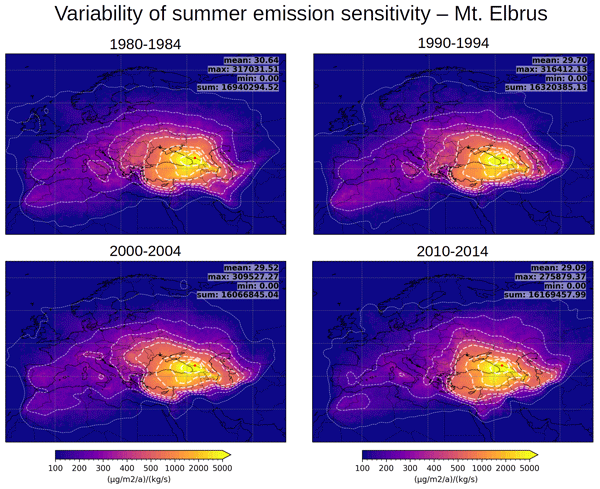
Past atmospheric NH3 pollution in south-eastern Europe was reconstructed by analysing ammonium in an ice core drilled at the Mount Elbrus (Caucasus, Russia). The observed 3.5-fold increase in ice concentrations between 1750 and 1990 CE is in good agreement with estimated past dominant ammonia emissions from agriculture, mainly from south European Russia and Türkiye. In contrast to present-day conditions, the ammonium level observed in 1750 CE indicates significant natural emissions at that time.
Gabrielle Pétron, Andrew M. Crotwell, John Mund, Molly Crotwell, Thomas Mefford, Kirk Thoning, Bradley Hall, Duane Kitzis, Monica Madronich, Eric Moglia, Donald Neff, Sonja Wolter, Armin Jordan, Paul Krummel, Ray Langenfelds, and John Patterson
Atmos. Meas. Tech., 17, 4803–4823, https://doi.org/10.5194/amt-17-4803-2024, https://doi.org/10.5194/amt-17-4803-2024, 2024
Short summary
Short summary
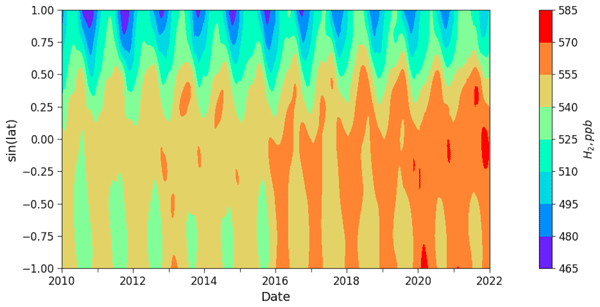
Hydrogen (H2) is a gas in trace amounts in the Earth’s atmosphere with indirect impacts on climate and air quality. Renewed interest in H2 as a low- or zero-carbon source of energy may lead to increased production, uses, and supply chain emissions. NOAA measurements of weekly air samples collected between 2009 and 2021 at over 50 sites in mostly remote locations are now available, and they complement other datasets to study the H2 global budget.
Fabian Maier, Ingeborg Levin, Sébastien Conil, Maksym Gachkivskyi, Hugo Denier van der Gon, and Samuel Hammer
Atmos. Chem. Phys., 24, 8205–8223, https://doi.org/10.5194/acp-24-8205-2024, https://doi.org/10.5194/acp-24-8205-2024, 2024
Short summary
Short summary
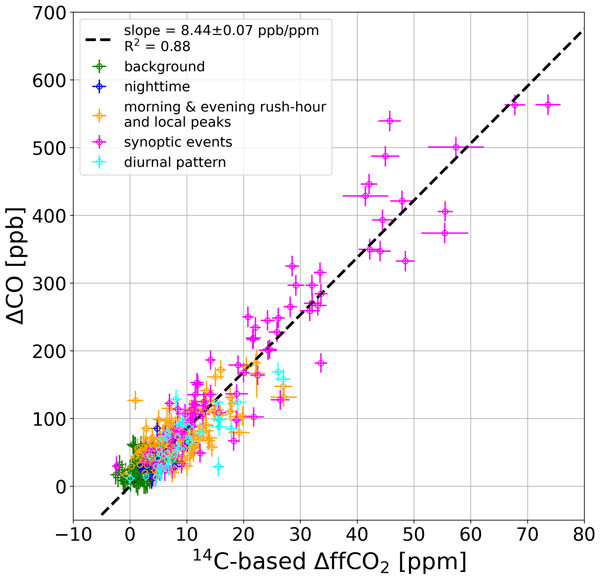
We assess the uncertainty in continuous fossil fuel carbon dioxide (ffCO2) estimates derived from carbon monoxide (CO) observations and radiocarbon (14CO2) flask measurements from an urban and a rural site. This study provides the basis for using continuous CO-based ffCO2 observations in atmospheric transport inversion frameworks to derive ffCO2 emission estimates. We also compare the flask-based CO / ffCO2 ratios with modeled ratios to validate an emission inventory for central Europe.
Fabian Maier, Christian Rödenbeck, Ingeborg Levin, Christoph Gerbig, Maksym Gachkivskyi, and Samuel Hammer
Atmos. Chem. Phys., 24, 8183–8203, https://doi.org/10.5194/acp-24-8183-2024, https://doi.org/10.5194/acp-24-8183-2024, 2024
Short summary
Short summary
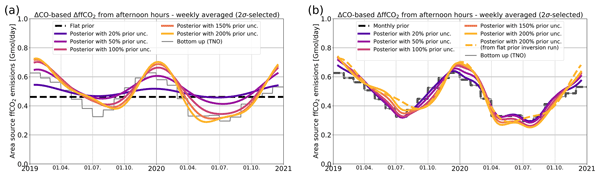
We investigate the usage of discrete radiocarbon (14C)-based fossil fuel carbon dioxide (ffCO2) concentration estimates vs. continuous carbon monoxide (CO)-based ffCO2 estimates to evaluate the seasonal cycle of ffCO2 emissions in an urban region with an inverse modeling framework. We find that the CO-based ffCO2 estimates allow us to reconstruct robust seasonal cycles, which show the distinct COVID-19 drawdown in 2020 and can be used to validate emission inventories.
Susanne Preunkert, Pascal Bohleber, Michel Legrand, Adrien Gilbert, Tobias Erhardt, Roland Purtschert, Lars Zipf, Astrid Waldner, Joseph R. McConnell, and Hubertus Fischer
The Cryosphere, 18, 2177–2194, https://doi.org/10.5194/tc-18-2177-2024, https://doi.org/10.5194/tc-18-2177-2024, 2024
Short summary
Short summary
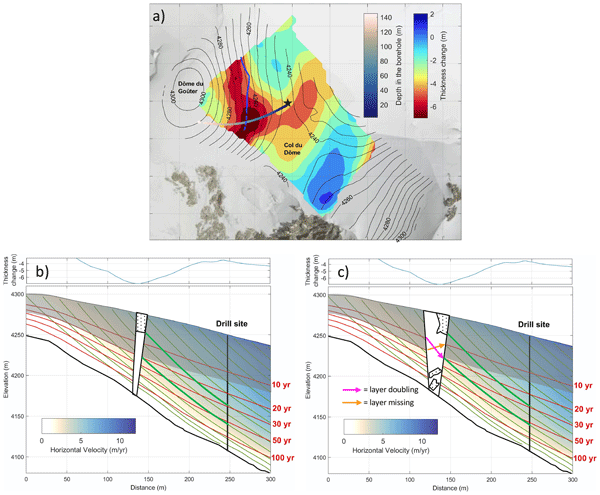
Ice cores from high-elevation Alpine glaciers are an important tool to reconstruct the past atmosphere. However, since crevasses are common at these glacier sites, rigorous investigations of glaciological conditions upstream of drill sites are needed before interpreting such ice cores. On the basis of three ice cores extracted at Col du Dôme (4250 m a.s.l; French Alps), an overall picture of a dynamic crevasse formation is drawn, which disturbs the depth–age relation of two of the three cores.
Markus Knoll, Martin Penz, Hannes Juchem, Christina Schmidt, Denis Pöhler, and Alexander Bergmann
Atmos. Meas. Tech., 17, 2481–2505, https://doi.org/10.5194/amt-17-2481-2024, https://doi.org/10.5194/amt-17-2481-2024, 2024
Short summary
Short summary
Exhaust emissions from combustion-based vehicles are negatively affecting human health and our environment. In particular, a small share (< 20 %) of poorly maintained or tampered vehicles are responsible for the majority (60 %–90 %) of traffic-related emissions. The emissions from vehicles are currently not properly monitored during their lifetime. We present a roadside measurement technique, called
point sampling, which can be used to monitor vehicle emissions throughout their life cycle.
Michael Steiner, Wouter Peters, Ingrid Luijkx, Stephan Henne, Huilin Chen, Samuel Hammer, and Dominik Brunner
Atmos. Chem. Phys., 24, 2759–2782, https://doi.org/10.5194/acp-24-2759-2024, https://doi.org/10.5194/acp-24-2759-2024, 2024
Short summary
Short summary
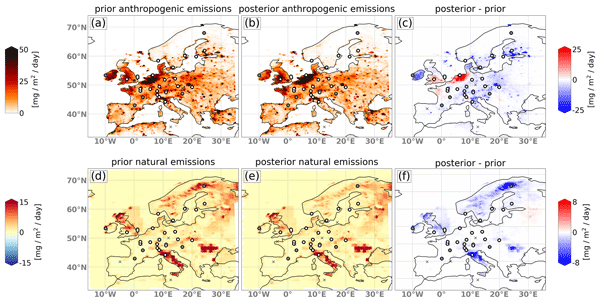
The Paris Agreement increased interest in estimating greenhouse gas (GHG) emissions of individual countries, but top-down emission estimation is not yet considered policy-relevant. It is therefore paramount to reduce large errors and to build systems that are based on the newest atmospheric transport models. In this study, we present the first application of ICON-ART in the inverse modeling of GHG fluxes with an ensemble Kalman filter and present our results for European CH4 emissions.
Vladimir Mikhalenko, Stanislav Kutuzov, Pavel Toropov, Michel Legrand, Sergey Sokratov, Gleb Chernyakov, Ivan Lavrentiev, Susanne Preunkert, Anna Kozachek, Mstislav Vorobiev, Aleksandra Khairedinova, and Vladimir Lipenkov
Clim. Past, 20, 237–255, https://doi.org/10.5194/cp-20-237-2024, https://doi.org/10.5194/cp-20-237-2024, 2024
Short summary
Short summary
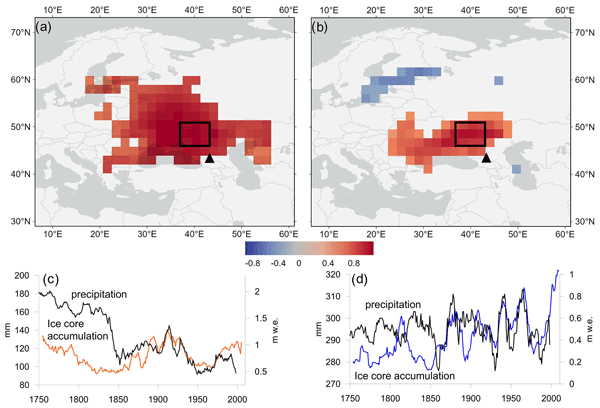
In this paper, we present a reconstruction of snow accumulation for both summer and winter over the past 260 years using ice-core records obtained from Mt. Elbrus in the Caucasus region. The accumulation record represents the historical precipitation patterns in a vast region encompassing the northern Caucasus, Black Sea, and southeastern Europe. Our findings show that the North Atlantic plays a crucial role in determining precipitation levels in this region.
Christian Rödenbeck, Karina E. Adcock, Markus Eritt, Maksym Gachkivskyi, Christoph Gerbig, Samuel Hammer, Armin Jordan, Ralph F. Keeling, Ingeborg Levin, Fabian Maier, Andrew C. Manning, Heiko Moossen, Saqr Munassar, Penelope A. Pickers, Michael Rothe, Yasunori Tohjima, and Sönke Zaehle
Atmos. Chem. Phys., 23, 15767–15782, https://doi.org/10.5194/acp-23-15767-2023, https://doi.org/10.5194/acp-23-15767-2023, 2023
Short summary
Short summary
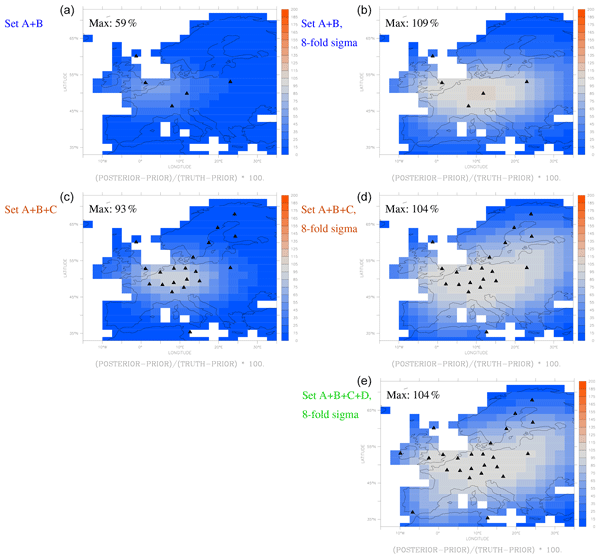
The carbon dioxide content of the Earth atmosphere is increasing due to human emissions from burning of fossil fuels, causing global climate change. The strength of the fossil-fuel emissions is estimated by inventories based on energy data, but independent validation of these inventories has been recommended by the Intergovernmental Panel on Climate Change. Here we investigate the potential to validate inventories based on measurements of small changes in the atmospheric oxygen content.
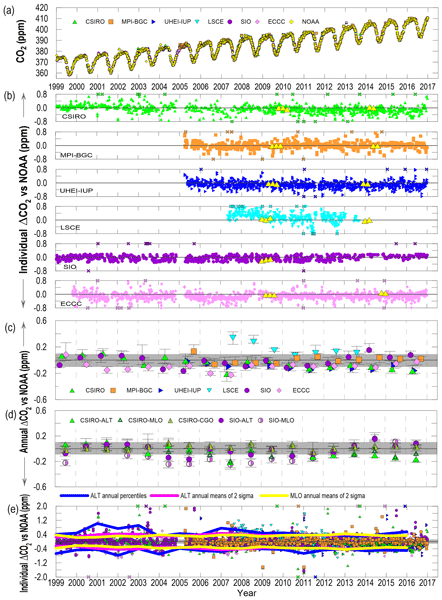
Douglas E. J. Worthy, Michele K. Rauh, Lin Huang, Felix R. Vogel, Alina Chivulescu, Kenneth A. Masarie, Ray L. Langenfelds, Paul B. Krummel, Colin E. Allison, Andrew M. Crotwell, Monica Madronich, Gabrielle Pétron, Ingeborg Levin, Samuel Hammer, Sylvia Michel, Michel Ramonet, Martina Schmidt, Armin Jordan, Heiko Moossen, Michael Rothe, Ralph Keeling, and Eric J. Morgan
Atmos. Meas. Tech., 16, 5909–5935, https://doi.org/10.5194/amt-16-5909-2023, https://doi.org/10.5194/amt-16-5909-2023, 2023
Short summary
Short summary
Network compatibility is important for inferring greenhouse gas fluxes at global or regional scales. This study is the first assessment of the measurement agreement among seven individual programs within the World Meteorological Organization community. It compares co-located flask air measurements at the Alert Observatory in Canada over a 17-year period. The results provide stronger confidence in the uncertainty estimation while using those datasets in various data interpretation applications.
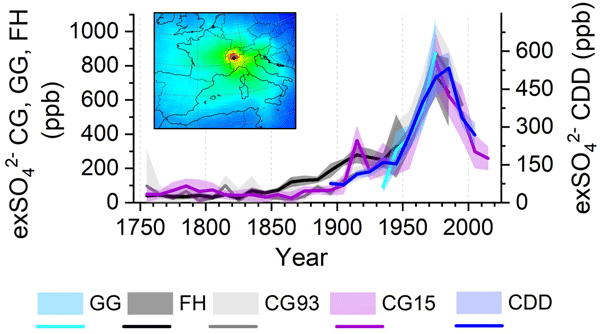
Anja Eichler, Michel Legrand, Theo M. Jenk, Susanne Preunkert, Camilla Andersson, Sabine Eckhardt, Magnuz Engardt, Andreas Plach, and Margit Schwikowski
The Cryosphere, 17, 2119–2137, https://doi.org/10.5194/tc-17-2119-2023, https://doi.org/10.5194/tc-17-2119-2023, 2023
Short summary
Short summary
We investigate how a 250-year history of the emission of air pollutants (major inorganic aerosol constituents, black carbon, and trace species) is preserved in ice cores from four sites in the European Alps. The observed uniform timing in species-dependent longer-term concentration changes reveals that the different ice-core records provide a consistent, spatially representative signal of the pollution history from western European countries.
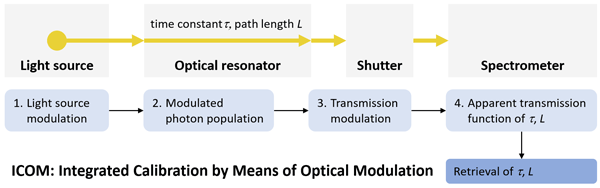
Henning Finkenzeller, Denis Pöhler, Martin Horbanski, Johannes Lampel, and Ulrich Platt
Atmos. Meas. Tech., 16, 1343–1356, https://doi.org/10.5194/amt-16-1343-2023, https://doi.org/10.5194/amt-16-1343-2023, 2023
Short summary
Short summary
Optical resonators enhance the light path in compact instruments, thereby improving their sensitivity. Determining the established path length in the instrument is a prerequisite for the accurate determination of trace gas concentrations but can be a significant complication in the use of such resonators. Here we show two calibration techniques which are relatively simple and free of consumables but still provide accurate calibrations. This facilitates the use of optical resonators.
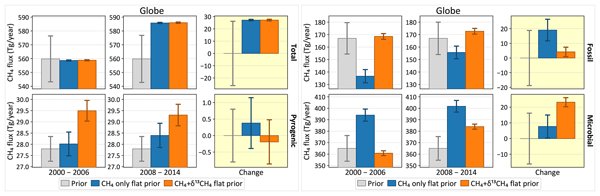
Sourish Basu, Xin Lan, Edward Dlugokencky, Sylvia Michel, Stefan Schwietzke, John B. Miller, Lori Bruhwiler, Youmi Oh, Pieter P. Tans, Francesco Apadula, Luciana V. Gatti, Armin Jordan, Jaroslaw Necki, Motoki Sasakawa, Shinji Morimoto, Tatiana Di Iorio, Haeyoung Lee, Jgor Arduini, and Giovanni Manca
Atmos. Chem. Phys., 22, 15351–15377, https://doi.org/10.5194/acp-22-15351-2022, https://doi.org/10.5194/acp-22-15351-2022, 2022
Short summary
Short summary
Atmospheric methane (CH4) has been growing steadily since 2007 for reasons that are not well understood. Here we determine sources of methane using a technique informed by atmospheric measurements of CH4 and its isotopologue 13CH4. Measurements of 13CH4 provide for better separation of microbial, fossil, and fire sources of methane than CH4 measurements alone. Compared to previous assessments such as the Global Carbon Project, we find a larger microbial contribution to the post-2007 increase.
Silvia Becagli, Elena Barbaro, Simone Bonamano, Laura Caiazzo, Alcide di Sarra, Matteo Feltracco, Paolo Grigioni, Jost Heintzenberg, Luigi Lazzara, Michel Legrand, Alice Madonia, Marco Marcelli, Chiara Melillo, Daniela Meloni, Caterina Nuccio, Giandomenico Pace, Ki-Tae Park, Suzanne Preunkert, Mirko Severi, Marco Vecchiato, Roberta Zangrando, and Rita Traversi
Atmos. Chem. Phys., 22, 9245–9263, https://doi.org/10.5194/acp-22-9245-2022, https://doi.org/10.5194/acp-22-9245-2022, 2022
Short summary
Short summary
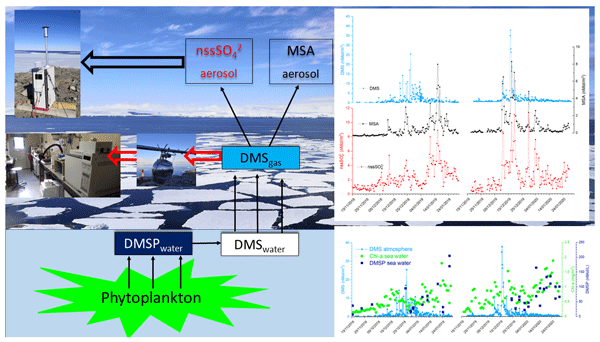
Measurements of phytoplanktonic dimethylsulfide and its oxidation products in the Antarctic atmosphere allow us to understand the role of the oceanic (sea ice melting, Chl α and dimethylsulfoniopropionate) and atmospheric (wind direction and speed, humidity, solar radiation and transport processes) factors in the biogenic aerosol formation, concentration and characteristic ratio between components in an Antarctic coastal site facing the polynya of the Ross Sea.
Fabian Maier, Christoph Gerbig, Ingeborg Levin, Ingrid Super, Julia Marshall, and Samuel Hammer
Geosci. Model Dev., 15, 5391–5406, https://doi.org/10.5194/gmd-15-5391-2022, https://doi.org/10.5194/gmd-15-5391-2022, 2022
Short summary
Short summary
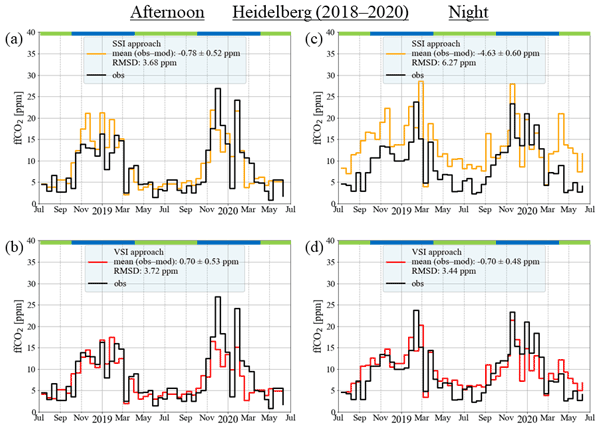
We show that the default representation of point source emissions in WRF–STILT leads to large overestimations when modelling fossil fuel CO2 concentrations for a 30 m high observation site during stable atmospheric conditions. We therefore introduce a novel point source modelling approach in WRF-STILT that takes into account their effective emission heights and results in a much better agreement with observations.
Ingeborg Levin, Ute Karstens, Samuel Hammer, Julian DellaColetta, Fabian Maier, and Maksym Gachkivskyi
Atmos. Chem. Phys., 21, 17907–17926, https://doi.org/10.5194/acp-21-17907-2021, https://doi.org/10.5194/acp-21-17907-2021, 2021
Short summary
Short summary
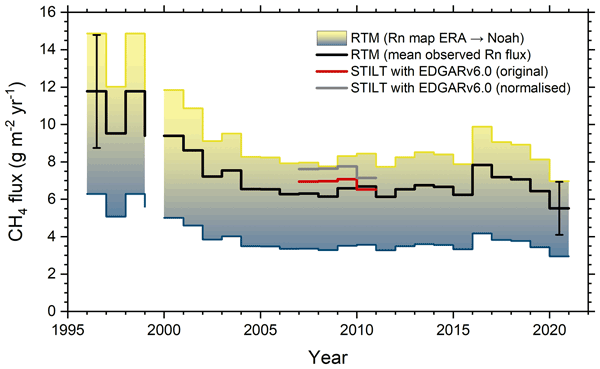
The radon tracer method is applied to atmospheric methane and radon observations from the upper Rhine valley to independently estimate methane emissions from the region. Comparison of our top-down results with bottom-up inventory data requires high-resolution footprint modelling and representative radon flux data. In agreement with inventories, observed emissions decreased, but only until 2005. A limitation of this method is that point-source emissions are not captured or not fully captured.
Cited articles
Beirle, S.: Estimating source strengths and lifetime of Nitrogen Oxides from satellite data, PhD, University of Heidelberg, Heidelberg, https://doi.org/10.11588/heidok.00005225, 2004. a, b, c
Beirle, S., Platt, U., Wenig, M., and Wagner, T.: Weekly cycle of NO2 by GOME measurements: a signature of anthropogenic sources, Atmos. Chem. Phys., 3, 2225–2232, https://doi.org/10.5194/acp-3-2225-2003, 2003. a
Ciais, P., Crisp, D., Denier Van Der Gon, H., Engelen, R., Heimann, M., Janssens-Maenhout, G., Rayner, P., and Scholze, M.: Towards a European Operational Observing System to Monitor Fossil CO2 Emissions. Final Report from the Expert Group, European Commission: Joint Research Centre, https://doi.org/10.2788/350433, 2015. a
Dellaert, S., Super, I., Visschedijk, A., and Denier van der Gon, H.: High resolution scenarios of CO2 and CO emissions, Tech. rep., CHE deliverable D4.2, https://www.che-project.eu/sites/default/files/2019-05/CHE-D4-2-V1-0.pdf (last access: 20 May 2025), 2019. a
Denier van der Gon, H., Kuenen, J., Boleti, E., Muntean, M., Maenhout, G., Marshall, J., and Haussaire, J.-M.: Emissions and natural fluxes Dataset, Tech. rep., CHE deliverable D2.3, https://www.che-project.eu/sites/default/files/2019-01/CHE-D2-3-V1-0.pdf (last access: 20 May 2025), 2019. a
Feng, S., Jiang, F., Wang, H., Liu, Y., He, W., Wang, H., Shen, Y., Zhang, L., Jia, M., Ju, W., and Chen, J. M.: China's fossil fuel CO2 emissions estimated using surface observations of coemitted NO2, Environ. Sci. Technol., https://doi.org/10.1021/acs.est.3c07756, 2024. a
Gamnitzer, U., Karstens, U., Kromer, B., Neubert, R. E. M., Meijer, H. A. J., Schroeder, H., and Levin, I.: Carbon monoxide: a quantitative tracer for fossil fuel CO2?, J. Geophys. Res.-Atmos., 111, https://doi.org/10.1029/2005JD006966, 2006. a
Goldberg, D. L., Lu, Z., Oda, T., Lamsal, L. N., Liu, F., Griffin, D., McLinden, C. A., Krotkov, N. A., Duncan, B. N., and Streets, D. G.: Exploiting OMI NO2 satellite observations to infer fossil-fuel CO2 emissions from U.S. megacities, Sci. Total Environ., 695, 133805, https://doi.org/10.1016/j.scitotenv.2019.133805, 2019. a, b
Hazan, L., Tarniewicz, J., Ramonet, M., Laurent, O., and Abbaris, A.: Automatic processing of atmospheric CO2 and CH4 mole fractions at the ICOS Atmosphere Thematic Centre, Atmos. Meas. Tech., 9, 4719–4736, https://doi.org/10.5194/amt-9-4719-2016, 2016. a
Hersbach, H., Bell, B., Berrisford, P., Hirahara, S., Horányi, A., Muñoz Sabater, J., Nicolas, J., Peubey, C., Radu, R., Schepers, D., Simmons, A., Soci, C., Abdalla, S., Abellan, X., Balsamo, G., Bechtold, P., Biavati, G., Bidlot, J., Bonavita, M., De Chiara, G., Dahlgren, P., Dee, D., Diamantakis, M., Dragani, R., Flemming, J., Forbes, R., Fuentes, M., Geer, A., Haimberger, L., Healy, S., Hogan, R. J., Hólm, E., Janisková, M., Keeley, S., Laloyaux, P., Lopez, P., Lupu, C., Radnoti, G., De Rosnay, P., Rozum, I., Vamborg, F., Villaume, S., and Thépaut, J.: The ERA5 global reanalysis, Q. J. Roy. Meteor. Soc., 146, 1999–2049, https://doi.org/10.1002/qj.3803, 2020. a
Hilland, R., Hashemi, J., Stagakis, S., Brunner, D., Constantin, L., Kljun, N., Kunz, A.-K., Molinier, B., Hammer, S., Emmenegger, L., and Christen, A.: Sectoral attribution of greenhouse gas and pollutant emissions using multi-species eddy covariance on a tall tower in Zurich, Switzerland, Atmos. Chem. Phys., 25, 14279–14299, https://doi.org/10.5194/acp-25-14279-2025, 2025. a
Horbanski, M., Pöhler, D., Lampel, J., and Platt, U.: The ICAD (iterative cavity-enhanced DOAS) method, Atmos. Meas. Tech., 12, 3365–3381, https://doi.org/10.5194/amt-12-3365-2019, 2019. a
ICOS RI: ICOS Atmosphere Station Specifications V2.0, edited by: Laurent, O., ICOS ERIC, https://doi.org/10.18160/GK28-2188, 2020. a
Jordan, A. and Damak, F.: ICOS CAL – Quality Control Report 2024, ICOS CAL, https://doi.org/10.18160/V2NS-9WXH, 2025. a
Juchem, H., Maier, F., Hammer, S., Della Coletta, J., Pöhler, D., Preunkert, S.: 14C-based ΔffCO2 estimates and NOx measurements for Heidelberg (2020-2021), V1, heiDATA [data set], https://doi.org/10.11588/DATA/KI8DTQ, 2025. a
Kenagy, H. S., Sparks, T. L., Ebben, C. J., Wooldrige, P. J., Lopez-Hilfiker, F. D., Lee, B. H., Thornton, J. A., McDuffie, E. E., Fibiger, D. L., Brown, S. S., Montzka, D. D., Weinheimer, A. J., Schroder, J. C., Campuzano-Jost, P., Day, D. A., Jimenez, J. L., Dibb, J. E., Campos, T., Shah, V., Jaeglé, L., and Cohen, R. C.: NOx lifetime and NOy partitioning during WINTER, J. Geophys. Res.-Atmos., 123, 9813–9827, https://doi.org/10.1029/2018JD028736, 2018. a, b
Konovalov, I. B., Berezin, E. V., Ciais, P., Broquet, G., Zhuravlev, R. V., and Janssens-Maenhout, G.: Estimation of fossil-fuel CO2 emissions using satellite measurements of “proxy” species, Atmos. Chem. Phys., 16, 13509–13540, https://doi.org/10.5194/acp-16-13509-2016, 2016. a
Kromer, B. and Münnich, K. O.: CO2 gas proportional counting in radiocarbon dating – review and perspective, in: Radiocarbon After Four Decades, edited by: Taylor, R. E., Long, A., and Kra, R. S., Springer, New York, NY, https://doi.org/10.1007/978-1-4757-4249-7_13, 184–197, 1992. a
Kromer, B., Lindauer, S., Synal, H.-A., and Wacker, L.: MAMS – a new AMS facility at the Curt-Engelhorn-Centre for Achaeometry, Mannheim, Germany, Nuclear Instruments and Methods in Physics Research Section B: Beam Interactions with Materials and Atoms, 294, 11–13, https://doi.org/10.1016/j.nimb.2012.01.015, 2013. a
Levin, I. and Karstens, U.: Inferring high-resolution fossil fuel CO2 records at continental sites from combined 14CO2 and CO observations, Tellus B, 59, 245, https://doi.org/10.1111/j.1600-0889.2006.00244.x, 2007. a, b
Levin, I., Münnich, K. O., and Weiss, W.: The effect of anthropogenic CO2 and 14CO sources on the distribution of 14CO in the atmosphere, Radiocarbon, 22, 379–391, https://doi.org/10.1017/S003382220000967X, 1980. a
Levin, I., Kromer, B., Schmidt, M., and Sartorius, H.: A novel approach for independent budgeting of fossil fuel CO2 over Europe by 14CO2 observations, Geophys. Res. Lett., 30, https://doi.org/10.1029/2003GL018477, 2003. a
Levin, I., Karstens, U., Eritt, M., Maier, F., Arnold, S., Rzesanke, D., Hammer, S., Ramonet, M., Vítková, G., Conil, S., Heliasz, M., Kubistin, D., and Lindauer, M.: A dedicated flask sampling strategy developed for Integrated Carbon Observation System (ICOS) stations based on CO2 and CO measurements and Stochastic Time-Inverted Lagrangian Transport (STILT) footprint modelling, Atmos. Chem. Phys., 20, 11161–11180, https://doi.org/10.5194/acp-20-11161-2020, 2020. a
Lin, J. C., Gerbig, C., Wofsy, S. C., Andrews, A. E., Daube, B. C., Davis, K. J., and Grainger, C. A.: A near-field tool for simulating the upstream influence of atmospheric observations: the Stochastic Time-Inverted Lagrangian Transport (STILT) model, J. Geophys. Res.-Atmos., 108, https://doi.org/10.1029/2002JD003161, 2003. a
Ling, Q., Zhou, Y., Chen, D., Varricchio, L., Detti, A., Bartalini, S., and Guan, Z.: Laser spectroscopy applied in radiocarbon dating with the bomb peak, Optics Express, 33, 7830, https://doi.org/10.1364/OE.554129, 2025. a
Liu, F., Beirle, S., Zhang, Q., Dörner, S., He, K., and Wagner, T.: NOx lifetimes and emissions of cities and power plants in polluted background estimated by satellite observations, Atmos. Chem. Phys., 16, 5283–5298, https://doi.org/10.5194/acp-16-5283-2016, 2016. a
Liu, F., Duncan, B. N., Krotkov, N. A., Lamsal, L. N., Beirle, S., Griffin, D., McLinden, C. A., Goldberg, D. L., and Lu, Z.: A methodology to constrain carbon dioxide emissions from coal-fired power plants using satellite observations of co-emitted nitrogen dioxide, Atmos. Chem. Phys., 20, 99–116, https://doi.org/10.5194/acp-20-99-2020, 2020. a
Lopez, M., Schmidt, M., Delmotte, M., Colomb, A., Gros, V., Janssen, C., Lehman, S. J., Mondelain, D., Perrussel, O., Ramonet, M., Xueref-Remy, I., and Bousquet, P.: CO, NOx and 13CO2 as tracers for fossil fuel CO2: results from a pilot study in Paris during winter 2010, Atmos. Chem. Phys., 13, 7343–7358, https://doi.org/10.5194/acp-13-7343-2013, 2013. a
Lux, J. T.: A new target preparation facility for high precision AMS measurements and strategies for efficient 14CO2 sampling, PhD, University of Heidelberg, Heidelberg, https://doi.org/10.11588/heidok.00024767, 2018. a
Maier, F.: Estimating fossil fuel carbon dioxide (ffCO2) emissions in the Rhine Valley metropolitan region from local atmospheric observations in Heidelberg, PhD, University of Heidelberg, Heidelberg, https://doi.org/10.11588/heidok.00033558, 2023. a
Maier, F., Gerbig, C., Levin, I., Super, I., Marshall, J., and Hammer, S.: Effects of point source emission heights in WRF–STILT: a step towards exploiting nocturnal observations in models, Geosci. Model Dev., 15, 5391–5406, https://doi.org/10.5194/gmd-15-5391-2022, 2022. a
Maier, F., Levin, I., Conil, S., Gachkivskyi, M., Denier van der Gon, H., and Hammer, S.: Uncertainty in continuous ΔCO-based ΔffCO2 estimates derived from 14C flask and bottom-up
Maier, F., Rödenbeck, C., Levin, I., Gerbig, C., Gachkivskyi, M., and Hammer, S.: Potential of 14C-based vs. ΔCO-based ΔffCO2 observations to estimate urban fossil fuel CO2 (ffCO2) emissions, Atmos. Chem. Phys., 24, 8183–8203, https://doi.org/10.5194/acp-24-8183-2024, 2024b. a
Martin, R. V., Jacob, D. J., Chance, K., Kurosu, T. P., Palmer, P. I., and Evans, M. J.: Global inventory of nitrogen oxide emissions constrained by space-based observations of NO2 columns, J. Geophys. Res.-Atmos., 108, https://doi.org/10.1029/2003JD003453, 2003. a
Nehrkorn, T., Eluszkiewicz, J., Wofsy, S. C., Lin, J. C., Gerbig, C., Longo, M., and Freitas, S.: Coupled weather research and forecasting–stochastic time-inverted lagrangian transport (WRF–STILT) model, Meteorology and Atmospheric Physics, 107, 51–64, https://doi.org/10.1007/s00703-010-0068-x, 2010. a
Romer, P. S., Duffey, K. C., Wooldridge, P. J., Allen, H. M., Ayres, B. R., Brown, S. S., Brune, W. H., Crounse, J. D., de Gouw, J., Draper, D. C., Feiner, P. A., Fry, J. L., Goldstein, A. H., Koss, A., Misztal, P. K., Nguyen, T. B., Olson, K., Teng, A. P., Wennberg, P. O., Wild, R. J., Zhang, L., and Cohen, R. C.: The lifetime of nitrogen oxides in an isoprene-dominated forest, Atmos. Chem. Phys., 16, 7623–7637, https://doi.org/10.5194/acp-16-7623-2016, 2016. a
Super, I., Denier van der Gon, H. A. C., van der Molen, M. K., Dellaert, S. N. C., and Peters, W.: Optimizing a dynamic fossil fuel CO2 emission model with CTDAS (CarbonTracker Data Assimilation Shell, v1.0) for an urban area using atmospheric observations of CO2, CO, NOx, and SO2, Geosci. Model Dev., 13, 2695–2721, https://doi.org/10.5194/gmd-13-2695-2020, 2020. a
Super, I., Scarpelli, T., Droste, A., and Palmer, P. I.: Improved definition of prior uncertainties in CO2 and CO fossil fuel fluxes and its impact on multi-species inversion with GEOS-Chem (v12.5), Geosci. Model Dev., 17, 7263–7284, https://doi.org/10.5194/gmd-17-7263-2024, 2024. a
Turnbull, J. C., Miller, J. B., Lehman, S. J., Tans, P. P., Sparks, R. J., and Southon, J.: Comparison of 14CO2, CO, and SF6 as tracers for recently added fossil fuel CO2 in the atmosphere and implications for biological CO2 exchange, Geophys. Res. Lett., 33, https://doi.org/10.1029/2005GL024213, 2006. a, b
Turnbull, J. C., Sweeney, C., Karion, A., Newberger, T., Lehman, S. J., Tans, P. P., Davis, K. J., Lauvaux, T., Miles, N. L., Richardson, S. J., Cambaliza, M. O., Shepson, P. B., Gurney, K., Patarasuk, R., and Razlivanov, I.: Toward quantification and source sector identification of fossil fuel CO2 emissions from an urban area: results from the INFLUX experiment, J. Geophys. Res.-Atmos., 120, 292–312, https://doi.org/10.1002/2014JD022555, 2015. a
Van Der Laan, S., Karstens, U., Neubert, R., Van Der Laan-Luijkx, I., and Meijer, H.: Observation-based estimates of fossil fuel-derived CO2 emissions in the Netherlands using and Δ14C, CO and 222Radon, Tellus B, 62, 389, https://doi.org/10.1111/j.1600-0889.2010.00493.x, 2010. a
Short summary
This study explores how in situ NOx observations can be used to estimate fossil fuel CO2 (ffCO2) enhancements in an urban context, based on radiocarbon measurements. Even with a simple approach to account for atmospheric chemistry and ratio variability, a strong correlation could be observed, allowing the construction of a high temporal resolution NOx-based ffCO2 record with uncertainties comparable to the use of CO as proxy. Comparisons with independent records show good agreement between them.
This study explores how in situ NOx observations can be used to estimate fossil fuel CO2 (ffCO2)...


Altmetrics
Final-revised paper
Preprint