
Articles | Volume 25, issue 23
https://doi.org/10.5194/acp-25-17301-2025
© Author(s) 2025. This work is distributed under
the Creative Commons Attribution 4.0 License.
the Creative Commons Attribution 4.0 License.
https://doi.org/10.5194/acp-25-17301-2025
© Author(s) 2025. This work is distributed under
the Creative Commons Attribution 4.0 License.
the Creative Commons Attribution 4.0 License.
Research article
| 
02 Dec 2025
Research article |
| 02 Dec 2025
| 02 Dec 2025
Understanding mesoscale convective processes over the Congo Basin using the Model for Prediction Across Scales-Atmosphere (MPAS-A)

Joint Institute for Regional Earth System Science & Engineering, University of California, Los Angeles, Los Angeles, CA, USA
Department of Atmospheric and Oceanic Sciences, University of California, Los Angeles, Los Angeles, CA, USA
Rong Fu
Joint Institute for Regional Earth System Science & Engineering, University of California, Los Angeles, Los Angeles, CA, USA
Department of Atmospheric and Oceanic Sciences, University of California, Los Angeles, Los Angeles, CA, USA
Kelly Núñez Ocasio
Department of Atmospheric Sciences, Texas A&M University, College Station, TX, USA
Robert Nystrom
Department of Earth, Atmosphere, and Climate, Iowa State University, Ames, IA, USA
Cenlin He
Research Applications Laboratory, NSF National Center for Atmospheric Research (NCAR), Boulder, CO, USA
Jiaying Zhang
Agroecosystem Sustainability Center, Institute for Sustainability, Energy, and Environment, University of Illinois Urbana-Champaign, Urbana, IL, USA
Xianan Jiang
Joint Institute for Regional Earth System Science & Engineering, University of California, Los Angeles, Los Angeles, CA, USA
Jet Propulsion Laboratory, California Institute of Technology, Pasadena, CA, USA
Joao Teixeira
Jet Propulsion Laboratory, California Institute of Technology, Pasadena, CA, USA
Related authors
No articles found.
Alexandra E. Ng, Manish Shrivastava, Brian Gaudet, Cenlin He, Zezhen Cheng, and William Vizuete
EGUsphere, https://doi.org/10.5194/egusphere-2026-5534, https://doi.org/10.5194/egusphere-2026-5534, 2026
This preprint is open for discussion and under review for Atmospheric Chemistry and Physics (ACP).
Short summary
Short summary
Wildfire smoke contains dark particles called tar balls that absorb sunlight and warm the air, but air quality and climate models usually leave them out. We added tar balls to a model of the southeastern United States and compared it with aircraft and ground measurements. Including them, and accounting for the coatings that form around them, raised the sunlight absorbed by smoke by up to 6 %. Models that omit tar balls may therefore underestimate warming from wildfires.
Harsh G. Kamath, Gordon B. Bonan, Zong-Liang Yang, Ronnie Abolafia-Rosenzweig, Cenlin He, Ashley Matheny, and Dev Niyogi
EGUsphere, https://doi.org/10.5194/egusphere-2026-4875, https://doi.org/10.5194/egusphere-2026-4875, 2026
This preprint is open for discussion and under review for Geoscientific Model Development (GMD).
Short summary
Short summary
Noah-MP-ML² v1.0 extends the community Noah-MP land surface model with a multilayer canopy, improved radiation and turbulence schemes, Medlyn stomatal conductance, and a mass-conserving Richards-equation solver. Evaluation at five forest FLUXNET sites shows improved simulation of friction velocity, turbulent heat fluxes, and vertical soil-moisture dynamics while identifying remaining uncertainties in soil hydraulic properties, rooting profiles, and plant hydraulics.
Chayan Roychoudhury, Rajesh Kumar, Cenlin He, William Y. Y. Cheng, Kirpa Ram, Naoki Mizukami, and Avelino F. Arellano
Earth Syst. Sci. Data, 18, 5209–5257, https://doi.org/10.5194/essd-18-5209-2026, https://doi.org/10.5194/essd-18-5209-2026, 2026
Short summary
Short summary
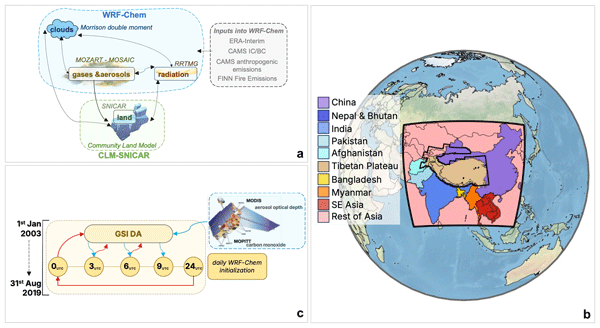
Snow and ice in the high mountains of Asia feed rivers supplying water to over a billion people, but airborne soot and dust darken the snow and speed up melting. We built a 17-year record of these conditions by blending satellite observations with a complex model that simulates weather, air pollution, land, and snow as one connected system. The record agrees well with independent measurements and traces soot on the glaciers to its regional sources, helping assess risks to Asia's water supply.
Sarah Worden and Rong Fu
Atmos. Chem. Phys., 26, 8529–8552, https://doi.org/10.5194/acp-26-8529-2026, https://doi.org/10.5194/acp-26-8529-2026, 2026
Short summary
Short summary
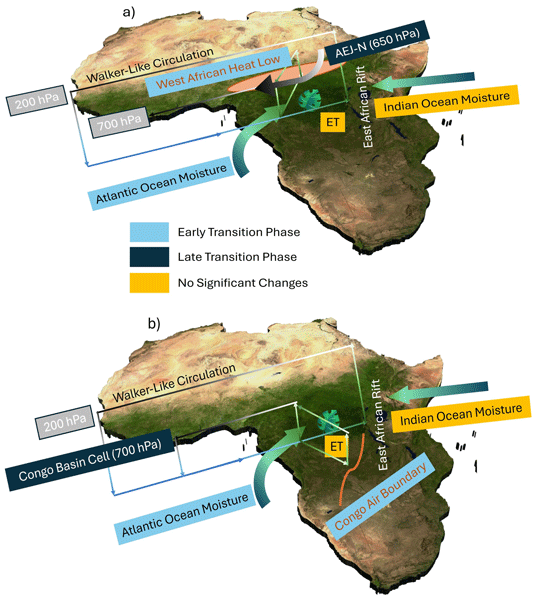
We studied how the rainy seasons begin in the equatorial Congo Basin in Africa. Using satellite observations and climate data, we found they are triggered by shifts in large-scale winds that bring in ocean moisture. Evapotranspiration from forests supplies most atmospheric moisture but does not change during this period. These winds push atmospheric moisture up against the East African Rift mountains to moisten the atmosphere and start the rainy seasons.
Joao Teixeira, Robert C. Wilson, and Heidar T. Thrastarson
EGUsphere, https://doi.org/10.5194/egusphere-2026-1013, https://doi.org/10.5194/egusphere-2026-1013, 2026
Short summary
Short summary
This study provides definitive experimental confirmation from space that the observed impact of CO2 growth on longwave spectral radiances, in the troposphere and stratosphere, follows theory and that the results are independent of CO2 uncertainties. By refining and extending a new methodology that disentangles the observational effects of CO2 on Earth’s longwave spectra, from temperature and water vapor, the results conclusively confirm a critical foundation of the science of global warming.
Yanyan Cheng, Yaomin Wang, Kalli Furtado, Cenlin He, Fei Chen, Alan D. Ziegler, Song Chen, Matteo Detto, Yuna Mao, Baoxiang Pan, Yoshiko Kosugi, Marryanna Lion, Shoji Noguchi, Satoru Takanashi, Lulie Melling, and Baoqing Zhang
Geosci. Model Dev., 19, 2197–2217, https://doi.org/10.5194/gmd-19-2197-2026, https://doi.org/10.5194/gmd-19-2197-2026, 2026
Short summary
Short summary
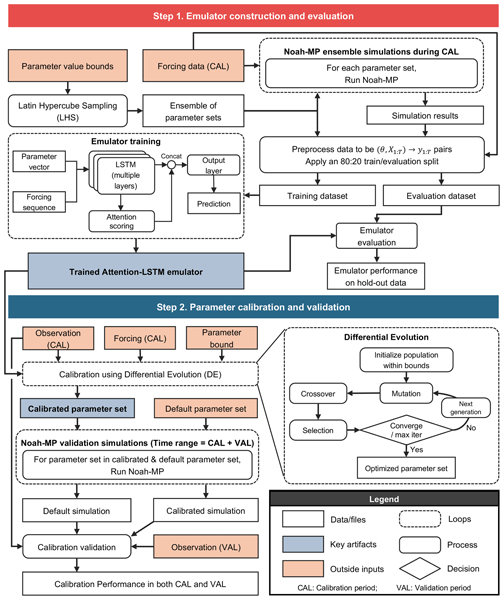
Tropical land surface processes shape the Earth's climate, but models often lack accuracy in the tropics due to limited data for validation. We improved the Noah with Multi-Parameterizations (Noah-MP) land surface model for the tropics using data from forests in Panama and Malaysia. Calibration enhanced simulations of energy and water fluxes, and revealed key vegetation and soil parameters, as well as future directions for model improvement in tropical regions.
Cenlin He, Tzu-Shun Lin, David M. Mocko, Ronnie Abolafia-Rosenzweig, Jerry W. Wegiel, and Sujay V. Kumar
Geosci. Model Dev., 18, 8439–8460, https://doi.org/10.5194/gmd-18-8439-2025, https://doi.org/10.5194/gmd-18-8439-2025, 2025
Short summary
Short summary
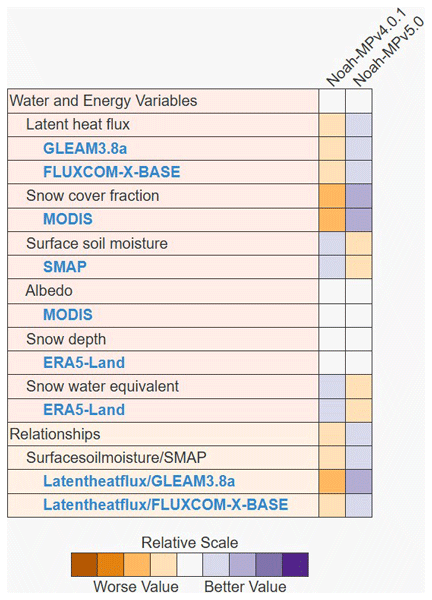
This study integrates the refactored community Noah-MP version 5.0 model with the NASA Land Information System (LIS) version 7.5.2 to streamline the synchronization, development, and maintenance of Noah-MP within LIS and to enhance their interoperability and applicability. The model benchmarking and evaluation results reveal key model strengths and weaknesses in simulating land surface quantities and show implications for future model improvements.
Parag Joshi, Tzu-Shun Lin, Cenlin He, and Katia Lamer
Geosci. Model Dev., 18, 7869–7890, https://doi.org/10.5194/gmd-18-7869-2025, https://doi.org/10.5194/gmd-18-7869-2025, 2025
Short summary
Short summary
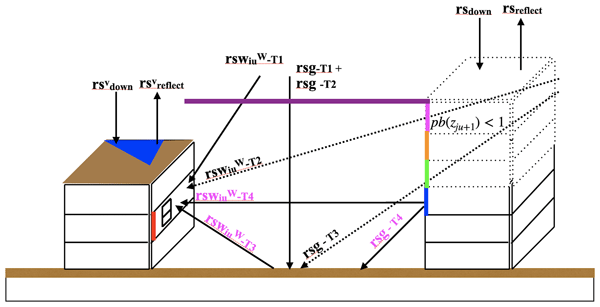
Present study revisits model that represent urban effects in the Weather Research & Forecasting model. We propose methods to identify evaluable parameters via field measurements and found inconsistencies between physics and its code implementation. Simulations reveal small errors can significantly impact outputs.
Naoki Mizukami, Samar Minallah, Cenlin He, Chayan Roychoudhury, William Y.Y. Cheng, and Rajesh Kumar
EGUsphere, https://doi.org/10.5194/egusphere-2025-4586, https://doi.org/10.5194/egusphere-2025-4586, 2025
Short summary
Short summary
We examined how air pollution particles that darken snow affect water resources in High Mountain Asia, a region that supplies rivers vital to millions of populations. Using computer models, we found that these particles cause snow to melt two weeks to a month earlier, shifting when water becomes available. This leads to more runoff at first but less later in the year, slightly reducing annual river flow. The findings highlight the need to link air pollution control with water management.
Chayan Roychoudhury, Cenlin He, Rajesh Kumar, and Avelino F. Arellano Jr.
Earth Syst. Dynam., 16, 1237–1266, https://doi.org/10.5194/esd-16-1237-2025, https://doi.org/10.5194/esd-16-1237-2025, 2025
Short summary
Short summary
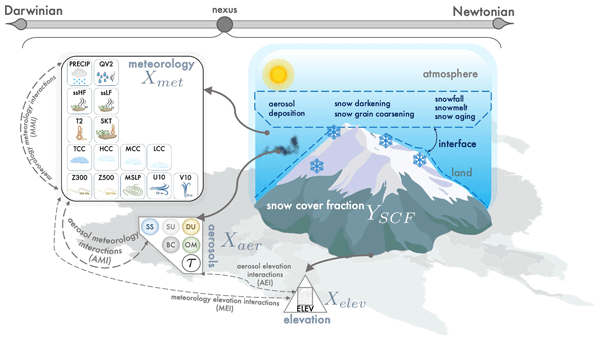
We present a novel data-driven approach to understand how pollution and weather processes interact to influence snowmelt in Asian glaciers and how these interactions are represented in three climate models. Our findings show where models need improvement in predicting snowmelt, particularly dust and its transport. This method can support future model development for reliable predictions in climate-vulnerable regions.
Rajesh Kumar, Piyush Bhardwaj, Cenlin He, Jennifer Boehnert, Forrest Lacey, Stefano Alessandrini, Kevin Sampson, Matthew Casali, Scott Swerdlin, Olga Wilhelmi, Gabriele G. Pfister, Benjamin Gaubert, and Helen Worden
Earth Syst. Sci. Data, 17, 1807–1834, https://doi.org/10.5194/essd-17-1807-2025, https://doi.org/10.5194/essd-17-1807-2025, 2025
Short summary
Short summary
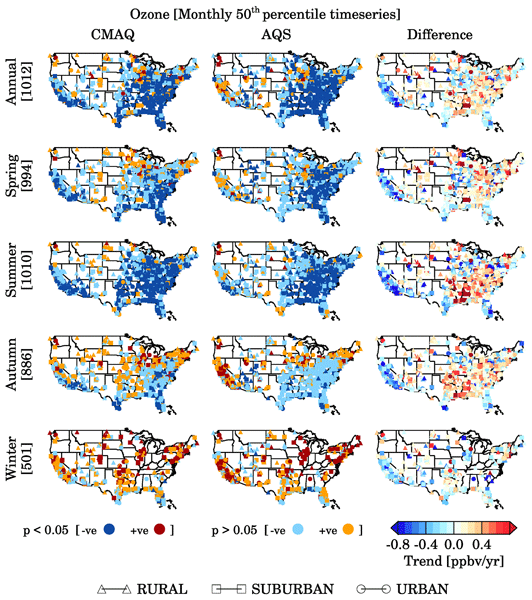
We have created a 14-year hourly air quality dataset at 12 km resolution by combining satellite observations of atmospheric composition with air quality models over the contiguous United States (CONUS). The dataset has been found to reproduce key observed features of air quality over the CONUS. To enable easy visualization and interpretation of county-level air quality measures and trends by stakeholders, an ArcGIS air quality dashboard has also been developed.
Mohamed Hamitouche, Giorgia Fosser, Alessandro Anav, Cenlin He, and Tzu-Shun Lin
Hydrol. Earth Syst. Sci., 29, 1221–1240, https://doi.org/10.5194/hess-29-1221-2025, https://doi.org/10.5194/hess-29-1221-2025, 2025
Short summary
Short summary
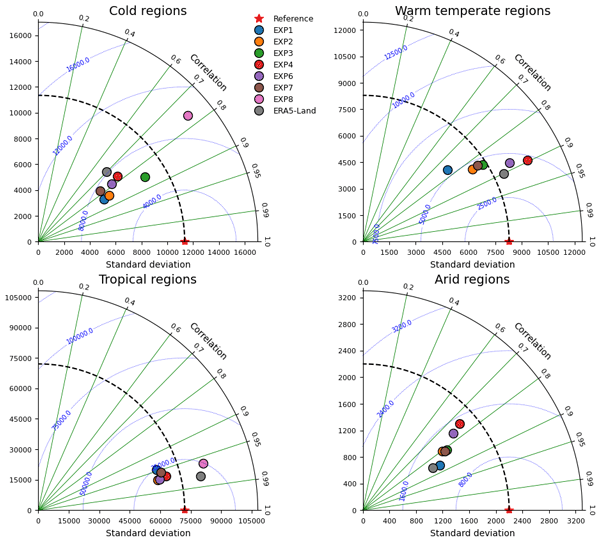
This study evaluates how different methods of simulating runoff impact river flow predictions globally. By comparing seven approaches within the Noah-Multi-parameterisation (Noah-MP) land surface model, we found significant differences in accuracy, with some methods underestimating or overestimating runoff. The results are crucial for improving water resource management and flood prediction. Our work highlights the need for precise modelling to better prepare for climate-related challenges.
Dario Di Santo, Cenlin He, Fei Chen, and Lorenzo Giovannini
Geosci. Model Dev., 18, 433–459, https://doi.org/10.5194/gmd-18-433-2025, https://doi.org/10.5194/gmd-18-433-2025, 2025
Short summary
Short summary
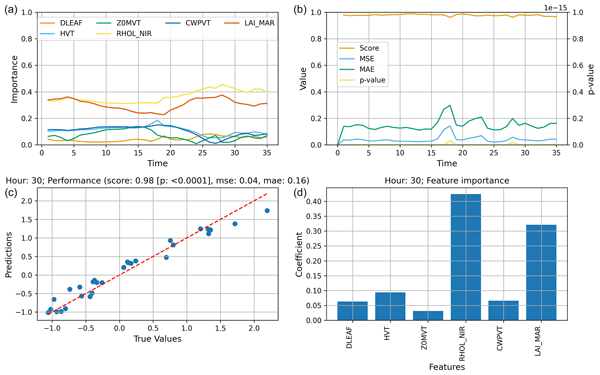
This paper presents the Machine Learning-based Automated Multi-method Parameter Sensitivity and Importance analysis Tool (ML-AMPSIT), a computationally efficient tool that uses machine learning algorithms for sensitivity analysis in atmospheric models. It is tested with the Weather Research and Forecasting (WRF) model coupled with the Noah-Multiparameterization (Noah-MP) land surface model to investigate sea breeze circulation sensitivity to vegetation-related parameters.
Tim Trent, Marc Schröder, Shu-Peng Ho, Steffen Beirle, Ralf Bennartz, Eva Borbas, Christian Borger, Helene Brogniez, Xavier Calbet, Elisa Castelli, Gilbert P. Compo, Wesley Ebisuzaki, Ulrike Falk, Frank Fell, John Forsythe, Hans Hersbach, Misako Kachi, Shinya Kobayashi, Robert E. Kursinski, Diego Loyola, Zhengzao Luo, Johannes K. Nielsen, Enzo Papandrea, Laurence Picon, Rene Preusker, Anthony Reale, Lei Shi, Laura Slivinski, Joao Teixeira, Tom Vonder Haar, and Thomas Wagner
Atmos. Chem. Phys., 24, 9667–9695, https://doi.org/10.5194/acp-24-9667-2024, https://doi.org/10.5194/acp-24-9667-2024, 2024
Short summary
Short summary
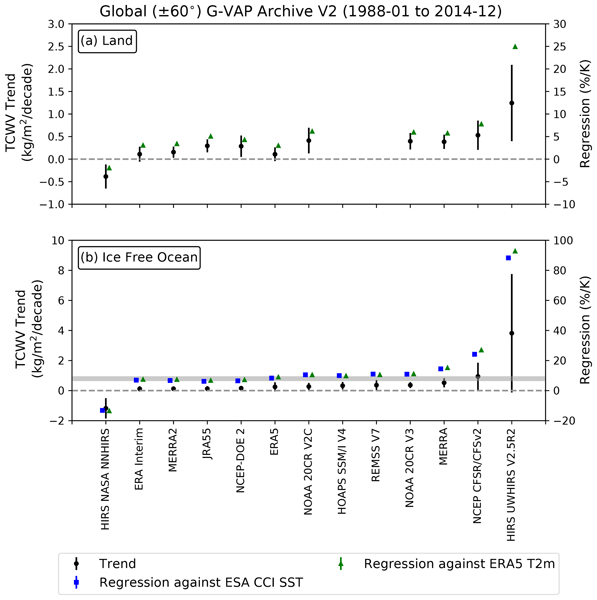
In a warmer future, water vapour will spend more time in the atmosphere, changing global rainfall patterns. In this study, we analysed the performance of 28 water vapour records between 1988 and 2014. We find sensitivity to surface warming generally outside expected ranges, attributed to breakpoints in individual record trends and differing representations of climate variability. The implication is that longer records are required for high confidence in assessing climate trends.
Kelly M. Núñez Ocasio and Zachary L. Moon
Geosci. Model Dev., 17, 6035–6049, https://doi.org/10.5194/gmd-17-6035-2024, https://doi.org/10.5194/gmd-17-6035-2024, 2024
Short summary
Short summary
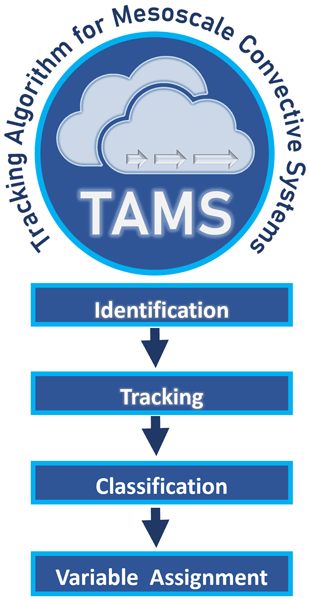
TAMS is an open-source Python-based package for tracking and classifying mesoscale convective systems that can be used to study observed and simulated systems. Each step of the algorithm is described in this paper with examples showing how to make use of visualization and post-processing tools within the package. A unique and valuable feature of this tracker is its support for unstructured grids in the identification stage and grid-independent tracking.
João Teixeira, R. Chris Wilson, and Heidar Th. Thrastarson
Atmos. Chem. Phys., 24, 6375–6383, https://doi.org/10.5194/acp-24-6375-2024, https://doi.org/10.5194/acp-24-6375-2024, 2024
Short summary
Short summary
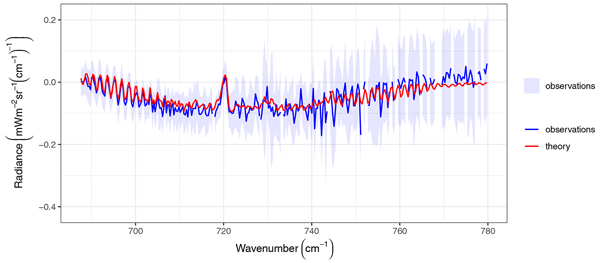
This paper presents direct evidence from space (solely based on observations) that CO2 increase leads to the theoretically expected effects on longwave spectral radiances. This is achieved by using a methodology that allows us to isolate the CO2 effects from the temperature and water vapor effects. By searching for ensembles of temperature and water vapor profiles that are similar to each other but have different values of CO2, it is possible to estimate the direct effects of CO2 on the spectra.
Gaoyun Wang, Rong Fu, Yizhou Zhuang, Paul A. Dirmeyer, Joseph A. Santanello, Guiling Wang, Kun Yang, and Kaighin McColl
Atmos. Chem. Phys., 24, 3857–3868, https://doi.org/10.5194/acp-24-3857-2024, https://doi.org/10.5194/acp-24-3857-2024, 2024
Short summary
Short summary
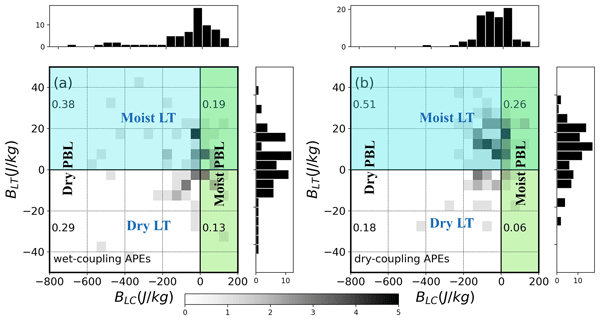
This study investigates the influence of lower-tropospheric humidity on land–atmosphere coupling (LAC) during warm seasons in the US Southern Great Plains. Using radiosonde data and a buoyancy model, we find that elevated LT humidity is crucial for generating afternoon precipitation events under dry soil conditions not accounted for by conventional LAC indices. This underscores the importance of considering LT humidity in understanding LAC over dry soil during droughts in the SGP.
Yizhou Zhuang and Rong Fu
Atmos. Chem. Phys., 24, 1641–1657, https://doi.org/10.5194/acp-24-1641-2024, https://doi.org/10.5194/acp-24-1641-2024, 2024
Short summary
Short summary
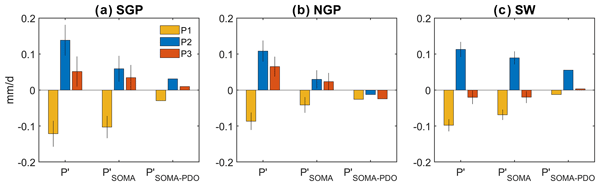
This study investigated how atmospheric circulation affects precipitation variability and changes in the US Great Plains (GP) and southwest (SW). By developing a new method called self organizing map–analogue, we found that circulation significantly influences short-term precipitation variability, accounting for 54 %–61 % of the total variance. Furthermore, circulation contributes considerably to the multi-decadal changes in precipitation and its extremes, especially for the southern GP and SW.
Wenfu Tang, Louisa K. Emmons, Helen M. Worden, Rajesh Kumar, Cenlin He, Benjamin Gaubert, Zhonghua Zheng, Simone Tilmes, Rebecca R. Buchholz, Sara-Eva Martinez-Alonso, Claire Granier, Antonin Soulie, Kathryn McKain, Bruce C. Daube, Jeff Peischl, Chelsea Thompson, and Pieternel Levelt
Geosci. Model Dev., 16, 6001–6028, https://doi.org/10.5194/gmd-16-6001-2023, https://doi.org/10.5194/gmd-16-6001-2023, 2023
Short summary
Short summary
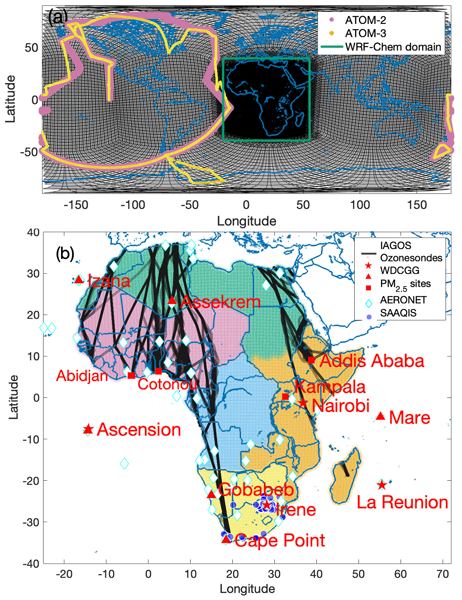
The new MUSICAv0 model enables the study of atmospheric chemistry across all relevant scales. We develop a MUSICAv0 grid for Africa. We evaluate MUSICAv0 with observations and compare it with a previously used model – WRF-Chem. Overall, the performance of MUSICAv0 is comparable to WRF-Chem. Based on model–satellite discrepancies, we find that future field campaigns in an eastern African region (30°E–45°E, 5°S–5°N) could substantially improve the predictive skill of air quality models.
Cenlin He, Prasanth Valayamkunnath, Michael Barlage, Fei Chen, David Gochis, Ryan Cabell, Tim Schneider, Roy Rasmussen, Guo-Yue Niu, Zong-Liang Yang, Dev Niyogi, and Michael Ek
Geosci. Model Dev., 16, 5131–5151, https://doi.org/10.5194/gmd-16-5131-2023, https://doi.org/10.5194/gmd-16-5131-2023, 2023
Short summary
Short summary
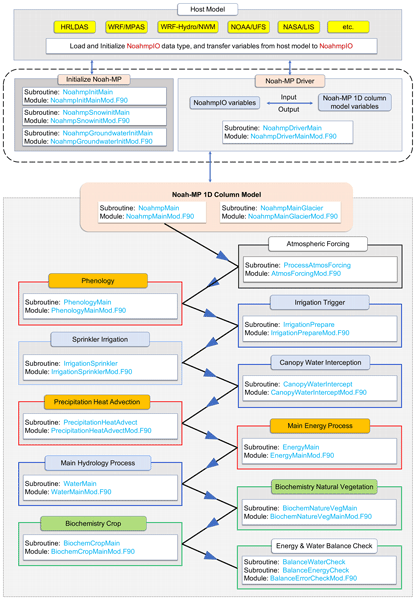
Noah-MP is one of the most widely used open-source community land surface models in the world, designed for applications ranging from uncoupled land surface and ecohydrological process studies to coupled numerical weather prediction and decadal climate simulations. To facilitate model developments and applications, we modernize Noah-MP by adopting modern Fortran code and data structures and standards, which substantially enhance model modularity, interoperability, and applicability.
Zhe Zhang, Yanping Li, Fei Chen, Phillip Harder, Warren Helgason, James Famiglietti, Prasanth Valayamkunnath, Cenlin He, and Zhenhua Li
Geosci. Model Dev., 16, 3809–3825, https://doi.org/10.5194/gmd-16-3809-2023, https://doi.org/10.5194/gmd-16-3809-2023, 2023
Short summary
Short summary
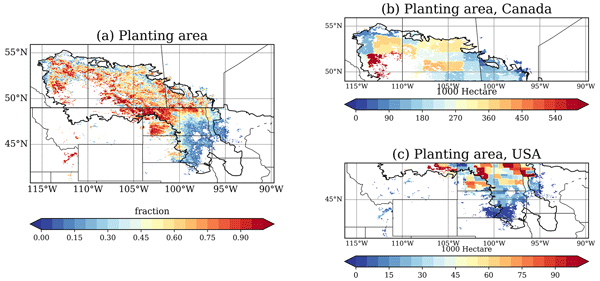
Crop models incorporated in Earth system models are essential to accurately simulate crop growth processes on Earth's surface and agricultural production. In this study, we aim to model the spring wheat in the Northern Great Plains, focusing on three aspects: (1) develop the wheat model at a point scale, (2) apply dynamic planting and harvest schedules, and (3) adopt a revised heat stress function. The results show substantial improvements and have great importance for agricultural production.
Wenfu Tang, Simone Tilmes, David M. Lawrence, Fang Li, Cenlin He, Louisa K. Emmons, Rebecca R. Buchholz, and Lili Xia
Atmos. Chem. Phys., 23, 5467–5486, https://doi.org/10.5194/acp-23-5467-2023, https://doi.org/10.5194/acp-23-5467-2023, 2023
Short summary
Short summary
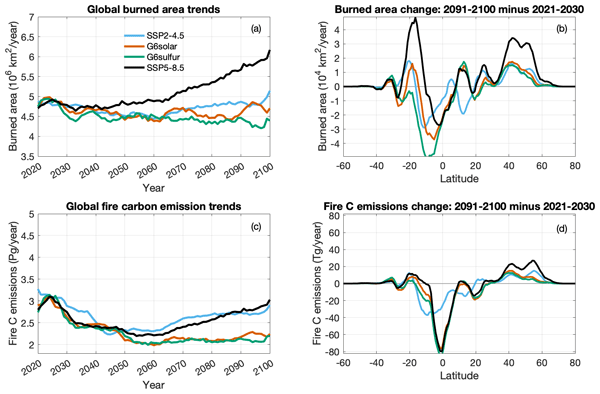
Globally, total wildfire burned area is projected to increase over the 21st century under scenarios without geoengineering and decrease under the two geoengineering scenarios. Geoengineering reduces fire by decreasing surface temperature and wind speed and increasing relative humidity and soil water. However, geoengineering also yields reductions in precipitation, which offset some of the fire reduction.
Maria J. Chinita, Mikael Witte, Marcin J. Kurowski, Joao Teixeira, Kay Suselj, Georgios Matheou, and Peter Bogenschutz
Geosci. Model Dev., 16, 1909–1924, https://doi.org/10.5194/gmd-16-1909-2023, https://doi.org/10.5194/gmd-16-1909-2023, 2023
Short summary
Short summary
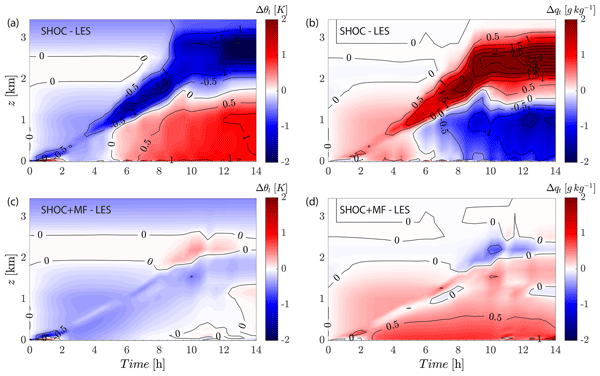
Low clouds are one of the largest sources of uncertainty in climate prediction. In this paper, we introduce the first version of the unified turbulence and shallow convection parameterization named SHOC+MF developed to improve the representation of shallow cumulus clouds in the Simple Cloud-Resolving E3SM Atmosphere Model (SCREAM). Here, we also show promising preliminary results in a single-column model framework for two benchmark cases of shallow cumulus convection.
Dalei Hao, Gautam Bisht, Karl Rittger, Edward Bair, Cenlin He, Huilin Huang, Cheng Dang, Timbo Stillinger, Yu Gu, Hailong Wang, Yun Qian, and L. Ruby Leung
Geosci. Model Dev., 16, 75–94, https://doi.org/10.5194/gmd-16-75-2023, https://doi.org/10.5194/gmd-16-75-2023, 2023
Short summary
Short summary
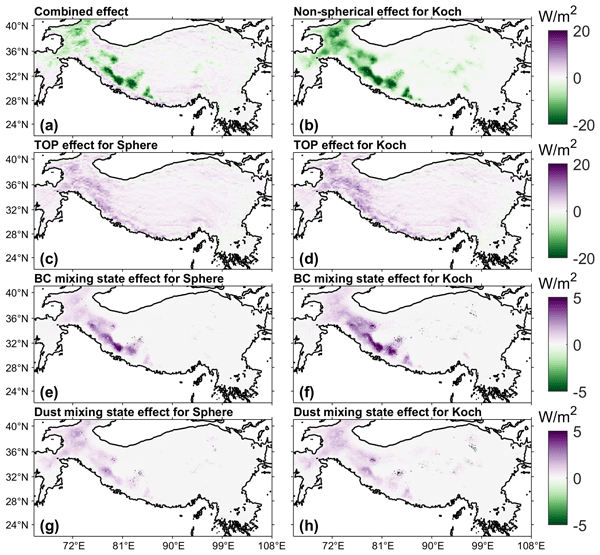
Snow with the highest albedo of land surface plays a vital role in Earth’s surface energy budget and water cycle. This study accounts for the impacts of snow grain shape and mixing state of light-absorbing particles with snow on snow albedo in the E3SM land model. The findings advance our understanding of the role of snow grain shape and mixing state of LAP–snow in land surface processes and offer guidance for improving snow simulations and radiative forcing estimates in Earth system models.
Huilin Huang, Yun Qian, Ye Liu, Cenlin He, Jianyu Zheng, Zhibo Zhang, and Antonis Gkikas
Atmos. Chem. Phys., 22, 15469–15488, https://doi.org/10.5194/acp-22-15469-2022, https://doi.org/10.5194/acp-22-15469-2022, 2022
Short summary
Short summary
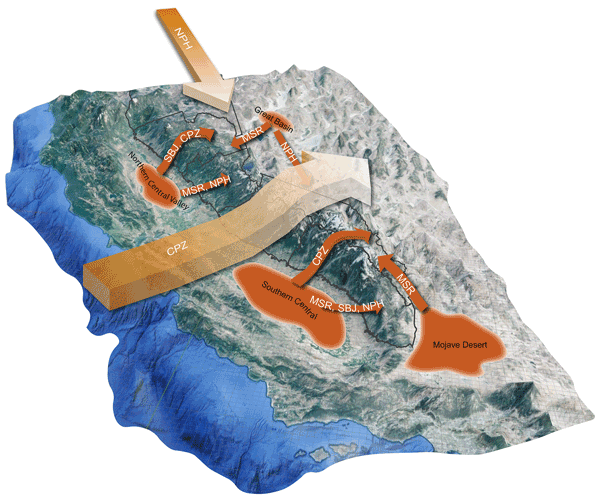
Using a clustering method developed in the field of artificial neural networks, we identify four typical dust transport patterns across the Sierra Nevada, associated with the mesoscale and regional-scale wind circulations. Our results highlight the connection between dust transport and dominant weather patterns, which can be used to understand dust transport in a changing climate.
Chaman Gul, Shichang Kang, Siva Praveen Puppala, Xiaokang Wu, Cenlin He, Yangyang Xu, Inka Koch, Sher Muhammad, Rajesh Kumar, and Getachew Dubache
Atmos. Chem. Phys., 22, 8725–8737, https://doi.org/10.5194/acp-22-8725-2022, https://doi.org/10.5194/acp-22-8725-2022, 2022
Short summary
Short summary
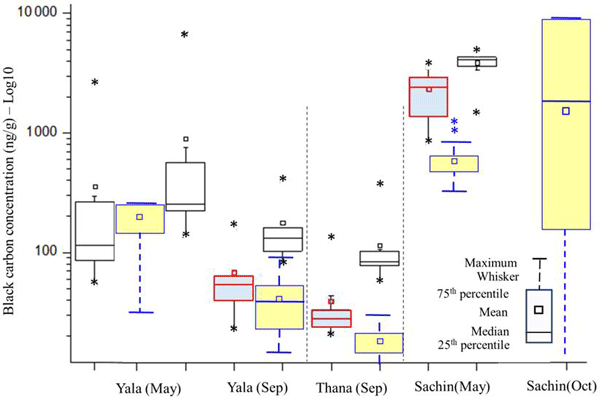
This work aims to understand concentrations, spatial variability, and potential source regions of light-absorbing impurities (black carbon aerosols, dust particles, and organic carbon) in the surface snow of central and western Himalayan glaciers and their impact on snow albedo and radiative forcing.
Mark G. Flanner, Julian B. Arnheim, Joseph M. Cook, Cheng Dang, Cenlin He, Xianglei Huang, Deepak Singh, S. McKenzie Skiles, Chloe A. Whicker, and Charles S. Zender
Geosci. Model Dev., 14, 7673–7704, https://doi.org/10.5194/gmd-14-7673-2021, https://doi.org/10.5194/gmd-14-7673-2021, 2021
Short summary
Short summary
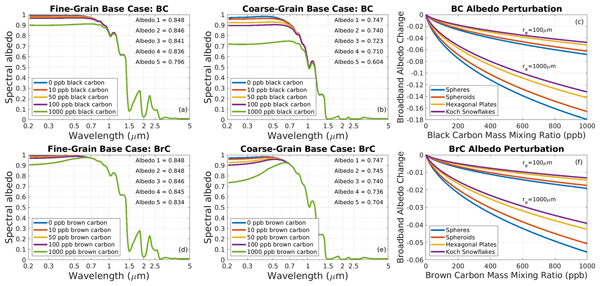
We present the technical formulation and evaluation of a publicly available code and web-based model to simulate the spectral albedo of snow. Our model accounts for numerous features of the snow state and ambient conditions, including the the presence of light-absorbing matter like black and brown carbon, mineral dust, volcanic ash, and snow algae. Carbon dioxide snow, found on Mars, is also represented. The model accurately reproduces spectral measurements of clean and contaminated snow.
Cited articles
Alber, K., Zhou, L., and Raghavendra, A.: A shift in the diurnal timing and intensity of deep convection over the Congo Basin during the past 40 years, Atmospheric Research, 264, 105869, https://doi.org/10.1016/j.atmosres.2021.105869, 2021.
Aloysius, N. R., Sheffield, J., Saiers, J. E., Li, H., and Wood, E. F.: Evaluation of historical and future simulations of precipitation and temperature in central Africa from CMIP5 climate models, Journal Geophysical Research: Atmospheres, 121, 130–152, https://doi.org/10.1002/2015JD023656, 2016.
Andrews, P. C., Cook, K. H., and Vizy, E. K.: Mesoscale convective systems in the Congo Basin: seasonality, regionality, and diurnal cycles, Climate Dynamics, 62, 609–630, https://doi.org/10.1007/s00382-023-06903-7, 2024.
Barendrecht, M. H., Matanó, A., Mendoza, H., Weesie, R., Rohse, M., Koehler, J., de Ruiter, M., Garcia, M., Mazzoleni, M., Aerts, J. C. J. H., Ward, P. J., Di Baldassarre, G., Day, R., and Van Loon, A. F.: Exploring drought-to-flood interactions and dynamics: A global case review, WIREs Water, 11, e1726, https://doi.org/10.1002/wat2.1726, 2024.
Barnes, H. C. and Houze, R. A.: The precipitating cloud population of the Madden-Julian Oscillation over the Indian and west Pacific Oceans, Journal of Geophysical Research: Atmospheres, 118, 6996–7023, https://doi.org/10.1002/jgrd.50375, 2013.
Brummett, R., Tanania, C., Pandi, A., Ladel, J., Munzini, Y., and Russell, A.: Ressources en eau et biens et services liés à l'écosystème forestier, in: Les forêts du Bassin du Congo, edited by: Wasseige, C., Devers, D., de Marcen, P., Eba'a Atyi, R., Nasi, R., and Mayaux, P., Office des publications de l'Union européenne, Luxembourg, https://doi.org/10.2788/32456, 2009.
Chakraborty, S., Sullivan, S. C., and Feng, Z.: An Overview of Mesoscale Convective Systems: Global Climatology, Satellite Observations, and Modeling Strategies, in: Clouds and Their Climatic Impacts, edited by: Sullivan, S. C. and Hoose, C., https://doi.org/10.1002/9781119700357.ch9, 2023.
Chen, M., Shi, W., Xie, P., Silva, V. B. S., Kousky, V. E., and Higgins, R. W.: Assessing objective techniques for gauge-based analyses of global daily precipitation, Journal of Geophysical Research Atmospheres, 113, https://doi.org/10.1029/2007JD009132, 2008.
Chen, X., Leung, L. R., Feng, Z., and Song, F.: Crucial Role of Mesoscale Convective Systems in the Vertical Mass, Water, and Energy Transports of the South Asian Summer Monsoon, Journal of Climate, 35, 91–108, https://doi.org/10.1175/JCLI-D-21-0124.1, 2022.
Chen, X., Leung, L. R., Feng, Z., and Yang, Q.: Environmental controls on MCS lifetime rainfall over tropical oceans, Geophysical Research Letters, 50, e2023GL103267, https://doi.org/10.1029/2023GL103267, 2023.
CICOS: Cahiers des statistiques sur les incidents et accidents et sur les flux de marchandises de 2011–2012, https://www.cicos.int/actualites/flux-des-marchandises-et-accidents-fluviaux-dans-lespace-cicos-vers-des-statistiques-plus-fiables/ (last access: 20 November 2025), 2012.
Clavner, M., Cotton, W. R., van den Heever, S. C., Saleeby, S. M., and Pierce, J. R.: The response of a simulated mesoscale convective system to increased aerosol pollution: Part I: Precipitation intensity, distribution, and efficiency, Atmospheric Research, 199, 193–208, https://doi.org/10.1016/j.atmosres.2017.08.010, 2018.
Creese, A. and Washington, R.: Using qflux to constrain modeled Congo Basin rainfall in the CMIP5 ensemble, Journal of Geophysical Research: Atmospheres, 121, 13415–13442, https://doi.org/10.1002/2016jd025596, 2016.
Creese, A. and Washington, R.: A process-based assessment of CMIP5 rainfall in The Congo Basin: the September–November rainy season, Journal of Climate, 31, 7417–7439, https://doi.org/10.1175/JCLI-D-17-0818.1, 2018.
Creese, A., Washington, R., and Munday, C.: The plausibility of September-October-November Congo Basin rainfall change in coupled climate models, Journal of Geophysical Research: Atmospheres, 124, 5822–5846, https://doi.org/10.1029/2018JD029847, 2019.
Davies, R.: Flooding in the Democratic Republic of the Congo and Congo-Brazzaville, January 2024, Copernicus, https://global-flood.emergency.copernicus.eu/news/159-flooding-in-the-democratic-republic-of-the-congo-and-congo-brazzaville-january-2024/ (last access: 20 November 2025), 2024.
Duda, M., Jacobsen, D., Petersen, M., Hoffman, M., Turner, A. K., Asay-Davis, X., Ringler, T., Van Roeke, L., Curry, M., Lipscomb, W., Price, S., skamaroc, Jeffery, N., Heinzeller, D., Woodring, J., Wolfram, P. J., maltrud, Saenz, J., Dickerson, G. D., Nick, weiwangncar, mperego, Mametjanov, A., Werner, K., Wolfe, J., Jones, P., Foucar, J., Larofeticus, and Ha11, S.: knubez/MPAS-Model: MPAS v8.0.1-isolevels, Zenodo [code], https://doi.org/10.5281/zenodo.13696552, 2024
Dyer, E. L. E., Jones, D. B. A., Nusbaumer, J., Li, H., Collins, O., Vettoretti, G., and Noone, D.: Congo Basin precipitation: Assessing seasonality, regional interactions, and sources of moisture, Journal of Geophysical Research: Atmospheres, 122, 6882–6898, https://doi.org/10.1002/2016JD026240, 2017.
Evans, J. L. and Shemo, R. E.: A Procedure for Automated Satellite-Based Identification and Climatology Development of Various Classes of Organized Convection, Journal of Applied Meteorology and Climatology, 35, 638-652, https://doi.org/10.1175/1520-0450(1996)035<0638:APFASB>2.0.CO;2, 1996.
Feng, Z., Houze, R. A., Jr., Leung, L. R., Song, F., Hardin, J. C., Wang, J., Gustafson Jr., W. I., and Homeyer, C. R.: Spatiotemporal Characteristics and Large-Scale Environments of Mesoscale Convective Systems East of the Rocky Mountains, Journal of Climate, 32, 7303-7328, https://doi.org/10.1175/JCLI-D-19-0137.1, 2019.
Feng, Z., Leung, L. R., Liu, N., Wang, J., Houze, R. A., Li, J., Hardin, J. C., Chen D., and Guo, J.: A global high-resolution mesoscale convective system database using satellite-derived cloud tops, surface precipitation, and tracking, Journal of Geophysical Research: Atmospheres, 126, https://doi.org/10.1029/2020JD034202, 2021.
Feng, Z., Leung, L. R., Hardin, J., Terai, C. R., Song, F., and Caldwell, P.: Mesoscale convective systems in DYAMOND global convection-permitting simulations, Geophysical Research Letters, 50, e2022GL102603, https://doi.org/10.1029/2022gl102603, 2023a.
Feng, Z., Hardin, J., Barnes, H. C., Li, J., Leung, L. R., Varble, A., and Zhang, Z.: PyFLEXTRKR: a flexible feature tracking Python software for convective cloud analysis, Geosci. Model Dev., 16, 2753–2776, https://doi.org/10.5194/gmd-16-2753-2023, 2023b.
Feng, Z., Prein, A. F., Kukulies, J., Fiolleau, T., Jones, W. K., Maybee, B., Moon, Z. L., Núñez Ocasio, K. M., Dong, W., Molina, M. J., Albright, M. G., Rajagopal, M., Robledo, V., Song, J., Song, F., Leung, L. R., Varble, A. C., Klein, C., Roca, R., Feng, R., and Mejia, J. F.: Mesoscale convective systems tracking method intercomparison (MCSMIP): Application to DYAMOND global km-scale simulations, Journal of Geophysical Research: Atmospheres, 130, e2024JD042204, https://doi.org/10.1029/2024JD042204, 2025.
Fotso-Kamga, G., Fotso-Nguemo, T. C., Diallo, I., Yepdo, Z. D., Pokam, W. M., Vondou, D. A., and Lenouo, A.: An evaluation of COSMO-CLM regional climate model in simulating precipitation over Central Africa, International Journal of Climatology, 40, 2891–2912, https://doi.org/10.1002/joc.6372, 2020.
Hamilton, H. L., Young, G. S., Evans, J. L., Fuentes, J. D., and Núñez Ocasio, K. M.: The relationship between the Guinea Highlands and the West African offshore rainfall maximum, Geophys. Res. Lett., 44, 1158–1166, https://doi.org/10.1002/2016GL071170, 2017.
Hamilton, H. L., Núñez Ocasio, K. M., Evans, J. L., Young, G. S., and Fuentes, J. D.: Topographic influence on the African Easterly Jet and African Easterly Wave energetics, Journal of Geophysical Research: Atmospheres, 125, e2019JD032138, https://doi.org/10.1029/2019JD032138, 2020.
Hartman, A. T.: Tracking mesoscale convective systems in central equatorial Africa, International Journal of Climatology, 41, 469–482, https://doi.org/10.1002/joc.6632, 2020.
Hersbach, H., Bell, B., Berrisford, P., Hirahara, S., Horányi, A., Muñoz-Sabater, J., Nicolas, J., Peubey, C., Radu, R., Schepers, D., Simmons, A., Soci, C., Abdalla, S., Abellan, X., Balsamo, G., Bechtold, P., Biavati, G., Bidlot, J., Bonavita, M., De Chiara, G., Dahlgren, P., Dee, D., Diamantakis, M., Dragani, R., Flemming, J., Forbes, R., Fuentes, M., Geer, A., Haimberger, L., Healy, S., Hogan, R. J., Hólm, E., Janisková, M., Keeley, S., Laloyaux, P., Lopez, P., Lupu, C., Radnoti, G., de Rosnay, P., Rozum, I., Vamborg, F., Villaume, S., and Thépaut, J.-N.: The ERA5 global reanalysis, Quarterly Journal of the Royal Meteorological Society, 146, 1999–2049, https://doi.org/10.1002/qj.3803, 2020.
Hobbs, P. V. and J. M. Wallace: Atmospheric Science: An Introductory Survey, 2nd edn., Academic Press, 86 pp., ISBN 0-12-732951-X, 2006.
Hong, S. Y. and Lim, J.: The WRF single-moment 6-class microphysics scheme (WSM6), Journal of the Korean Meteorological Society, 42, 129–151, 2006.
Hong, S., Noh, Y., and Dudhia, J.: A New Vertical Diffusion Package with an Explicit Treatment of Entrainment Processes, Monthly Weather Review, 134, 2318–2341, https://doi.org/10.1175/MWR3199.1, 2006.
Hopsch, S. B., Thorncroft, C. D., and Tyle, K. R.: Analysis of African Easterly Wave Structures and Their Role in Influencing Tropical Cyclogenesis, Monthly Weather Review, 138, 1399–1419, https://doi.org/10.1175/2009MWR2760.1, 2010.
Houze, R. A.: Mesoscale convective systems, Reviews of Geophysics, 42, RG4003, https://doi.org/10.1029/2004RG000150, 2004.
Houze, R. A.: 100 years of research on mesoscale convective systems, Meteorological Monographs, 59, 17.1–17.54, https://doi.org/10.1175/amsmonographs-d-18-0001.1, 2018.
Huffman, G. J., Stocker, E. F., Bolvin, D. T., Nelkin, E. J., and Tan, J.: GPM IMERG Final Precipitation L3 Half Hourly 0.1 degree x 0.1 degree V07, Greenbelt, MD, Goddard Earth Sciences Data and Information Services Center (GES DISC) [data set], https://doi.org/10.5067/GPM/IMERG/3B-HH/07, 2023.
Hughes, D. A.: Comparison of satellite rainfall data with observations from gauging station networks, Journal of Hydrology, 327, 399–410, https://doi.org/10.1016/j.jhydrol.2005.11.041, 2006.
Iacono, M. J., Delamere, J. S., Mlawer, E. J., Shephard, M. W., Clough, S. A., and Collins, W. D.: Radiative forcing by long-lived greenhouse gases: Calculations with the AER radiative transfer models, Journal of Geophysical Research, 113, D13103, https://doi.org/10.1029/2008JD009944, 2008.
Imamovic, A., Schlemmer, L., and Schär, C.: Collective impacts of orography and soil moisture on the soil moisture-precipitation feedback, Geophysical Research Letters, 44, 11682–11691, https://doi.org/10.1002/2017GL075657, 2017
Jackson, B., Nicholson, S. E., and Klotter, D.: Mesoscale Convective Systems over Western Equatorial Africa and Their Relationship to Large-Scale Circulation, Monthly Weather Review, 137, 1272–1294, https://doi.org/10.1175/2008MWR2525.1, 2009.
Janowiak, J., Joyce, B., and Xie, P.: NCEP/CPC L3 Half Hourly 4km Global (60S–60N) Merged IR V1, Edited by Andrey Savtchenko, Greenbelt, MD, Goddard Earth Sciences Data and Information Services Center (GES DISC) [data set], https://doi.org/10.5067/P4HZB9N27EKU, 2017.
Jiménez, P. A., Dudhia, J., González-Rouco, J. F., Navarro, J., Montávez, J. P., and García-Bustamante, E.: A Revised Scheme for the WRF Surface Layer Formulation, Monthly Weather Review, 140, 898–918, https://doi.org/10.1175/MWR-D-11-00056.1, 2012.
Joachim, E. I., Vanel, A. R., and Youssif, G. T.: Climate Change and Urban Risks: Understanding and Analysing the Vulnerability of the City Of Brazzaville in the Republic Of Congo to Flooding in 2023, Pakistan Journal of Life and Social Sciences, 22, 8907–8918, https://doi.org/10.57239/PJLSS-2024-22.2.00673, 2024.
Kigotsi, J. K., Soula, S., Kazadi, A. B. M., and Zana, A. N.: Contribution to the study of thunderstorms in the Congo Basin: Analysis of periods with intense activity, Atmospheric Research, 269, 106013, https://doi.org/10.1016/j.atmosres.2021.106013, 2022.
Kirshbaum, D. J., Sindhu, K. D., and Turner, D. D.: An Observational Evaluation of RKW Theory over the U.S. Southern Great Plains, Journal of the Atmospheric Sciences, 82, 1341–1360, https://doi.org/10.1175/JAS-D-24-0185.1, 2025.
Koster, R. D., Dirmeyer, P., Guo, Z., Bonan, G., Chan, E., Cox, P., Gordon, C. T., Kanae, S., Kowalczyk, E., Lawrence, D., Liu, P., Lu, C.-H., Malyshec, S., McAvaney, B., Mitchell, K., Mocko, D., Oki, T., Oleson, K., Pitman, A., Sud, Y. C., Taylor, C. M., Verseghy, D., Vasic, R., Xue, Y., and Yamada, T.: Regions of Strong Coupling Between Soil Moisture and Precipitation, Science, 305, 1138–1140, https://doi.org/10.1126/science.1100217, 2004.
Kunkel, K. E., Easterling, D. R., Kristovich, D. A. R., Gleason, B., Stoecker, L., and Smith, R.: Meteorological Causes of the Secular Variations in Observed Extreme Precipitation Events for the Conterminous United States, Journal of Hydrometeorology, 13, 1131–1141, https://doi.org/10.1175/JHM-D-11-0108.1, 2012.
Laing, A. G. and Fritsch, J. M.: Mesoscale Convective Complexes in Africa, Monthly Weather Review, 121.8, 2254–2263, https://doi.org/10.1175/1520-0493(1993)121<2254:MCCIA>2.0.CO;2, 1993.
Laing, A. G. and Fritsch, J. M.: The global population of mesoscale convective complexes, Quarterly Journal of the Royal Meteorological Society, 123, 389–405, https://doi.org/10.1002/qj.49712353807, 1997.
Laing, A. G., Carbone, R. E., and Levizzani, V. : Cycles and propagation of deep convection over equatorial Africa, Monthly Weather Review, 139, 2832–2853, https://doi.org/10.1175/2011mwr3500.1, 2011.
Lee, C., Cheung, K. K. W., Hui, J. S. N., and Elsberry, R. L.: Mesoscale Features Associated with Tropical Cyclone Formations in the Western North Pacific, Monthly Weather Review, 136, 2006–2022, https://doi.org/10.1175/2007MWR2267.1, 2008.
Li, B., Beaudoing, H., and Rodell, M.: NASA/GSFC/HSL: GLDAS Catchment Land Surface Model L4 daily 0.25 x 0.25 degree GRACE-DA1 V2.2, Greenbelt, Maryland, USA, Goddard Earth Sciences Data and Information Services Center (GES DISC) [data set], https://doi.org/10.5067/TXBMLX370XX8, 2020.
Maddox, R. A.: Meoscale convective complexes, Bulletin of the American Meteorological Society, 61, 1374–1400, https://doi.org/10.1175/1520-0477(1980)061<1374:MCC>2.0.CO;2, 1980.
Mayta, V. C., Adames Corraliza, Á. F., Torres Maldonado, K., Luo, H., and Núñez Ocasio, K. M.: Thermodynamic Processes Governing the Evolution of Developing and Strong Nondeveloping African Easterly Waves, Journal of the Atmospheric Sciences, 82, 1161–1174, https://doi.org/10.1175/JAS-D-24-0125.1, 2025.
Mba, W. P., Vondou, D. A., and Kamsu-Tamo, P. H.: Central African Climate, in: Congo Basin Hydrology, Climate, and Biogeochemistry, edited by: Tshimanga, R. M., N'kaya, G. D. M., and Alsdorf, D., https://doi.org/10.1002/9781119657002.ch2, 2022.
Mohr, K. I., Famiglietti, J. S., and Zipser, E. J.: The contribution to tropical rainfall with respect to convective system type, size, and intensity estimated from the 85-GHz ice-scattering signature, Journal of Applied Meteorology, 38, 596–606, https://doi.org/10.1175/1520-0450(1999)038<0596:TCTTRW>2.0.CO;2, 1999.
Moon, Z. and Núñez Ocasio, K. M.: knubez/TAMS: v0.1.7, Zenodo [code], https://doi.org/10.5281/zenodo.15353123, 2025.
Muetzelfeldt, M. R., Plant, R. S., Christensen, H. M., Zhang, Z., Woollings, T., Feng, Z., and Li, P.: Environmental Conditions Affecting Global Mesoscale Convective System Occurrence, Journal of the Atmospheric Sciences, 82, 391–407, https://doi.org/10.1175/JAS-D-24-0058.1, 2025.
Nguyen, H. and Duvel, J. P.: Synoptic wave perturbations and convective systems over equatorial Africa, Journal of Climate, 21, 6372–6388, https://doi.org/10.1175/2008JCLI2409.1, 2008.
Nicholson, S. E.: The ITCZ and the seasonal cycle over equatorial Africa, Bulletin of the American Meteorological Society, 99, 337–348, https://doi.org/10.1175/BAMS-D-16-0287.1, 2018.
Nicholson, S. E.: The Rainfall and Convective Regime over Equatorial Africa, with Emphasis on the Congo Basin, American Geophysical Union (AGU), 25–48, https://doi.org/10.1002/9781119657002.CH3, 2022.
Nicholson, S. E., Klotter, D., Dezfuli, A. K., and Zhou, L.: New Rainfall Datasets for the Congo Basin and Surrounding Regions, Journal of Hydrometeorology, 19, 1379–1396, https://doi.org/10.1175/JHM-D-18-0015.1, 2018.
Niu, G.-Y., Yang, Z.-L., Mitchell, K. E., Chen, F., Ek, M. B., Barlage, M., Kumar, A., Manning, K., Niyogi, D., Rosero, E., Tewari, M., and Xia, Y.: The community Noah land surface model with multiparameterization options (Noah-MP): 1. Model description and evaluation with local-scale measurements, Journal of Geophysical Research, 116, D12109, https://doi.org/10.1029/2010JD015139, 2011.
N'kaya, G. D. M., Laraque, A., Paturel, J.-E., Guzanga, G. G., Mahé, G., and Tshimanga, R. M.: A New Look at Hydrology in the Congo Basin, Based on the Study of Multi-Decadal Time Series, in: Congo Basin Hydrology, Climate, and Biogeochemistry, edited by: Tshimanga, R. M., N'kaya, G. D. M., and Alsdorf, D., https://doi.org/10.1002/9781119657002.ch8, 2022.
Núñez Ocasio, K. M. and Dougherty, E. M.: The effect of pseudo-global warming on the weather-climate system of Africa in a convection-permitting model, Geophysical Research Letters, 51, e2024GL112341, https://doi.org/10.1029/2024GL112341, 2024.
Núñez Ocasio, K. M. and Moon, Z. L.: TAMS: a tracking, classifying, and variable-assigning algorithm for mesoscale convective systems in simulated and satellite-derived datasets, Geosci. Model Dev., 17, 6035–6049, https://doi.org/10.5194/gmd-17-6035-2024, 2024.
Núñez Ocasio, K. M. and Rios-Berrios, R.: African easterly wave evolution and tropical cyclogenesis in a pre-Helene (2006) hindcast using the Model for Prediction Across Scales-Atmosphere (MPAS-A).,Journal of Advances in Modeling Earth Systems, 15, e2022MS003181, https://doi.org/10.1029/2022MS003181, 2023.
Núñez Ocasio, K. M., Evans, J. L., and Young, G. S.: A wave-relative framework analysis of AEW–MCS interactions leading to tropical cyclogenesis, Monthly Weather Review, 148, 4657–4671, https://doi.org/10.1175/MWR-D-20-0152.1, 2020a.
Núñez Ocasio, K. M., Evans, J. L., and Young, G. S.: Tracking Mesoscale Convective Systems that are Potential Candidates for Tropical Cyclogenesis, Monthly Weather Review, 148, 655–669, https://doi.org/10.1175/MWR-D-19-0070.1, 2020b.
Núñez Ocasio, K. M., Brammer, A., Evans, J. L., Young, G. S., and Moon, Z. L.: Favorable monsoon environment over eastern Africa for subsequent tropical cyclogenesis of African easterly waves, Journal of the Atmospheric Sciences, 78, 2911–2925, https://doi.org/10.1175/JAS-D-20-0339.1, 2021.
Núñez Ocasio, K. M., Davis, C. A., Moon, Z. L., and Lawton, Q. A.: Moisture dependence of an african easterly wave within the west african monsoon system, Journal of Advances in Modeling Earth Systems, 16, e2023MS004070, https://doi.org/10.1029/2023MS004070, 2024.
Núñez Ocasio, K. M., Dougherty, E. M., Moon, Z. L., and Davis, C. A.: Response of African easterly waves to a warming climate: A convection-permitting approach, Journal of Advances in Modeling Earth Systems, 17, e2025MS005146, https://doi.org/10.1029/2025MS005146, 2025.
Peters, J. M. and Schumacher, R. S.: Dynamics governing a simulated mesoscale convective system with a training convective line, Journal of the Atmospheric Sciences, 73, 2643–2664, https://doi.org/10.1175/JAS-D-15-0199.1, 2016.
Pokam, W. M., Bain, C. L., Chadwick, R. S., Graham, R., Sonwa, D. J., and Kamga, F. M.: Identification of Processes Driving Low-Level Westerlies in West Equatorial Africa, Journal of Climate, 27, 4245–4262, https://doi.org/10.1175/JCLI-D-13-00490.1, 2014.
Prein, A. F., Feng, Z., Fiolleau, T., Moon, Z. L., Núñez Ocasio, K. M., Kukulies, J., Roca, R., Varble, A. C., Rehbein, A., Liu, C., Ikeda, K., Mu, Y., and Rasmussen, R. M.: Km-scale simulations of mesoscale convective systems over South America – A feature tracker intercomparison, Journal of Geophysical Research: Atmospheres, 129, e2023JD040254, https://doi.org/10.1029/2023JD040254, 2024.
Raghavendra, A., Xia, G., Zhou, L., and Jiang, Y.: Orographic enhancement of rainfall over the Congo Basin, Atmospheric Science Letters, 23, e1079, https://doi.org/10.1002/asl.1079, 2022.
Rasmussen, K. L., Chaplin, M. M. , Zuluaga, M. D., and Houze Jr., R. A.,: Contribution of Extreme Convective Storms to Rainfall in South America, Journal of Hydrometeorology, 17, 353–367, https://doi.org/10.1175/JHM-D-15-0067.1, 2016.
Rehbein, A., Ambrizzi, T., Mechoso, C. R., Espinosa, S. A. I., and Myers, T. A.: Mesoscale convective systems over the Amazon basin: The GoAmazon2014/5 program, International Journal of Climatology, 39, 5599–5618, https://doi.org/10.1002/joc.6173, 2019.
Rotunno, R., Klemp, J. B., and Weisman, M. L.: A Theory for Strong, Long-Lived Squall Lines, Journal of Atmospheric Sciences, 45, 463–485, https://doi.org/10.1175/1520-0469(1988)045<0463:ATFSLL>2.0.CO;2, 1988.
Satoh, M., Stevens, B., Judt, F., Khairoutdinov, M., Lin, S.-J., Putman, W. M., and Duben, P.: Global cloud-resolving models, Current Climate Change Reports, 5, 172–184, https://doi.org/10.1007/s40641-019-00131-0, 2019.
Schumacher, R. S. and Rasmussen, K. L.: The formation, character and changing nature of mesoscale convective systems, Nature Reviews Earth & Environment, 1, 300–314, https://doi.org/10.1038/s43017-020-0057-7, 2020.
Schumann, G. J.-P., Moller, D. K., Croneborg-Jones, L., and Andreadis, K. M.: Reviewing Applications of Remote Sensing Techniques to Hydrologic Research in Sub-Saharan Africa, with a Special Focus on the Congo Basin, in: Congo Basin Hydrology, Climate, and Biogeochemistry, edited by: Tshimanga, R. M., N'kaya, G. D. M., and Alsdorf, D., https://doi.org/10.1002/9781119657002.ch16, 2022.
Skamarock, W. C., Klemp, J. B., Duda, M. G., Fowler, L. D., Park, S., and Ringler, T. D.: A Multiscale Nonhydrostatic Atmospheric Model Using Centroidal Voronoi Tesselations and C-Grid Staggering, Monthly Weather Review, 140, 3090–3105, https://doi.org/10.1175/MWR-D-11-00215.1, 2012.
Smith, B. T., Thompson, R. L., Grams, J. S., Broyles, C., and Brooks, H. E.: Convective Modes for Significant Severe Thunderstorms in the Contiguous United States. Part I: Storm Classification and Climatology, Weather and Forecasting, 27, 1114–1135, https://doi.org/10.1175/WAF-D-11-00115.1, 2012.
Solimine, S. L., Zhou, L., Raghavendra, A., and Cai, Y.: Relationships between intense convection, lightning, and rainfall over the interior Congo Basin using TRMM data, Atmospheric Research, 273, 106164, https://doi.org/10.1016/j.atmosres.2022.106164, 2022.
Stevens, B., Satoh, M., Auger, L., Biercamp, J., Bretherton, C. S., Chen, X., Düben, P., Judt, F., Khairoutdinov, M., Klocke, D., Kodama, C., Kornblueh, L., Lin, S.-J., Neumann, P., Putman, W. M., Röber, N., Shibuya, R., Vanniere, B., Vidale, P. L., Wedi, N., and Zhou, L.: DYAMOND: The DYnamics of the Atmospheric general circulation Modeled On Non-hydrostatic Domains, Prog. Earth Planet. Sci., 6, 61, https://doi.org/10.1186/s40645-019-0304-z, 2019.
Sullivan, S. C., Schiro, K. A., Stubenrauch, C., and Gentine, P.: The response of tropical organized convection to El Niño warming, Journal of Geophysical Research: Atmospheres, 124, 8481–8500, https://doi.org/10.1029/2019JD031026, 2019.
Sultan, B., Janicot, S., and Diedhiou, A.: The West African monsoon dynamics. Part I: Documentation of intraseasonal variability, Journal of Climate, 16, 3389–3406, https://doi.org/10.1175/1520-0442(2003)016<3389:TWAMDP>2.0.CO;2, 2003.
Trismidianto, Yulihastin, E., Satyawardhana, H., Nugroho, J. T., and Ishida, S.: The contribution of the mesoscale convective complexes (MCCs) to total rainfall over indonesian maritime continent, Earth and Environmental Science, 54, 012027, https://doi.org/10.1088/1755-1315/54/1/012027, 2017.
Tsakraklides, G. and Evans, J. L.: Global and Regional Diurnal Variations of Organized Convection, Journal of Climate, 16, 1562–1572, https://doi.org/10.1175/1520-0442(2003)016<1562:GARDVO>2.0.CO;2, 2003.
Tshimanga, R. M., Tshitenge, J. M., Kabuya, P., Alsdorf, D., Mahe, G., Kibukusa, G., and Lukanda V.: A regional perceptive of flood forecasting and disaster management systems for the Congo River Basin, in: Flood Forecasting: A Global Perspective, edited by: Adams, T. E. and Pagano, T. C., Elsevier, ISBN 978-0-12-801884-2, 2016.
Tshimanga, R. M., N'kaya, G. D. M., Laraque, A., Nicholson, S. E., Onema, J.-M. K., Lumbuenamo, R., and Alsdorf, D.: Congo Basin Research, in: Congo Basin Hydrology, Climate, and Biogeochemistry, edited by: Tshimanga, R. M., N'kayam G. D. M., and Alsdorf, D., https://doi.org/10.1002/9781119657002.ch1, 2022.
Uccellini, L. W. and Johnson, D. R.: The Coupling of Upper and Lower Tropospheric Jet Streaks and Implications for the Development of Severe Convective Storms, Monthly Weather Review, 107, 682–703, https://doi.org/10.1175/1520-0493(1979)107<0682:TCOUAL>2.0.CO;2, 1979.
Wang, W.: Forecasting Convection with a “Scale-Aware” Tiedtke Cumulus Parameterization Scheme at Kilometer Scales, Weather and Forecasting, 37, 1491–1507, https://doi.org/10.1175/WAF-D-21-0179.1, 2022.
Washington, R., James, R., Pearce, H., Pokam, W. M., and Moufouma-Okia, W.: Congo basin rainfall climatology: Can we believe the climate models?, Philosophical Transactions of the Royal Society B: Biological Sciences, 368, https://doi.org/10.1098/rstb.2012.0296, 2013.
Xie, P., Joyce, R., Wu, S., Yoo, S.-H., Yarosh, Y., Sun, F., Lin, R., and NOAA CDR Program: NOAA Climate Data Record (CDR) of CPC Morphing Technique (CMORPH) High Resolution Global Precipitation Estimates, Version 1, NOAA National Centers for Environmental Information [data set], https://doi.org/10.25921/w9va-q159, 2019.
Xu, K.-M. and Randall, D. A.: A Semiempirical cloudiness parameterization for use in climate models, Journal of the Atmospheric Sciences, 53, 3084–3102, 1996.
Yang, G. and Slingo, J.: The Diurnal Cycle in the Tropics, Monthly Weather Review, 129, 784–801, https://doi.org/10.1175/1520-0493(2001)129<0784:TDCITT>2.0.CO;2, 2001.
Yang, W., Seager, R., Cane, M. A., and Lyon, B.: The annual cycle of East African precipitation, Journal of Climate, 28, 2385–2404, https://doi.org/10.1175/JCLI-D-14-00484.1, 2015.
Zhao, S.: Code and Data for “Understanding mesoscale convective processes over the Congo Basin using the Model for Prediction Across Scales-Atmosphere (MPAS-A)”, Zenodo [code and data set], https://doi.org/10.5281/zenodo.15758254, 2025.
Zhao, S. and Fu, R.: The influence of convectively coupled Kelvin waves on Atlantic Niños, Journal of Geophysical Research: Atmospheres, 127, e2021JD036241, https://doi.org/10.1029/2021JD036241, 2022.
Zhao, S. and Zhang, J.: Causal effect of the tropical Pacific sea surface temperature on the upper Colorado River basin spring precipitation, Climate Dynamics, 58, 941–959, https://doi.org/10.1007/s00382-021-05944-0, 2022.
Zuluaga, M. D. and Houze, R. A.: Evolution of the population of precipitating convective systems over the equatorial Indian Ocean in active phases of the Madden-Julian Oscillation, Journal of the Atmospheric Sciences, 70, 2713–2725, https://doi.org/10.1175/JAS-D-12-0311.1, 2013.
Short summary
The Congo Basin has frequent organized thunderstorms producing much of the region’s rainfall, yet their development remains unclear due to limited data. Using a high-resolution global model, it shows the long-lasting storm is significantly linked to and supported by vertical wind shear up to 400 km ahead, with the mid-level jet stream playing a role in maintaining the shear. The findings highlight the value of such model in data-sparse regions for examining storms and their impacts.
The Congo Basin has frequent organized thunderstorms producing much of the region’s rainfall,...


Altmetrics
Final-revised paper
Preprint