
Articles | Volume 26, issue 13
https://doi.org/10.5194/acp-26-9443-2026
© Author(s) 2026. This work is distributed under
the Creative Commons Attribution 4.0 License.
the Creative Commons Attribution 4.0 License.
https://doi.org/10.5194/acp-26-9443-2026
© Author(s) 2026. This work is distributed under
the Creative Commons Attribution 4.0 License.
the Creative Commons Attribution 4.0 License.
Research article
| 
06 Jul 2026
Research article |
| 06 Jul 2026
| 06 Jul 2026
Marine cloud brightening of cumulus clouds: from the sprayer to the cloud
Johannes Kainz
Meteorological Institute, Ludwig-Maximilians-Universität München, München, Germany
Daniel P. Harrison
National Marine Science Center, Southern Cross University, Coffs Harbour, Australia

Institute of Meteorology, Freie Universität Berlin, Berlin, Germany
Related authors
No articles found.
Lara S. Richards, Yi Huang, Michael A. Barnes, Chenhui Jin, Fadhlil R. Muhammad, Daniel P. Harrison, and Steven T. Siems
Weather Clim. Dynam., 7, 1977–1993, https://doi.org/10.5194/wcd-7-1977-2026, https://doi.org/10.5194/wcd-7-1977-2026, 2026
Short summary
Short summary
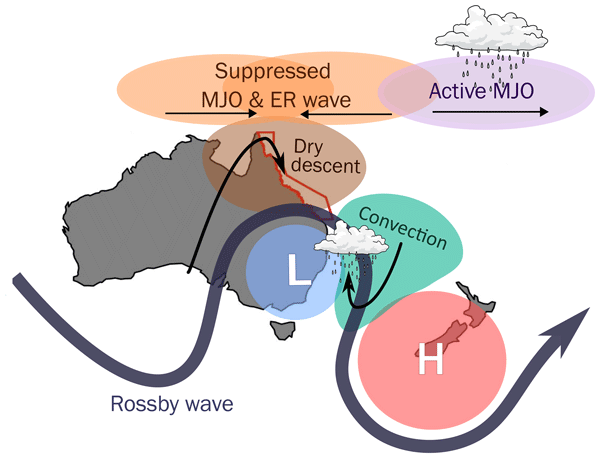
The doldrums are regions of light winds and relatively clear skies found in the tropics. They often occur during severe coral bleaching events on the Great Barrier Reef yet remain poorly understood. This study examines why the doldrums form and persist, identifying how both tropical and extratropical weather systems align to first form the doldrums and how the stalling of these weather systems prolongs the doldrums over the Great Barrier Reef.

Richard Maier, Fabian Jakub, Fabian Hoffmann, and Bernhard Mayer
Atmos. Chem. Phys., 26, 12771–12791, https://doi.org/10.5194/acp-26-12771-2026, https://doi.org/10.5194/acp-26-12771-2026, 2026
Short summary
Short summary
Most atmospheric models only use 1D radiation, neglecting any 3D radiative effects. Here, we show that the dynamic TenStream solver provides a computationally efficient way to represent these effects. Like full 3D radiation, it causes daytime clouds to organize into streets, grow larger, and contain more liquid water. We show that this occurs because 3D radiation does not shade cloud updrafts and modifies the surface energy balance, resulting in an increased latent heat flux into the atmosphere.
Juha Sulo, Magdalena Okuljar, Joel Alroe, Zijun Li, Eva Johanna Horchler, Luke Cravigan, Branka Miljevic, Luke Harrison, Daniel Harrison, and Zoran Ristovski
Aerosol Research, 4, 413–427, https://doi.org/10.5194/ar-4-413-2026, https://doi.org/10.5194/ar-4-413-2026, 2026
Short summary
Short summary
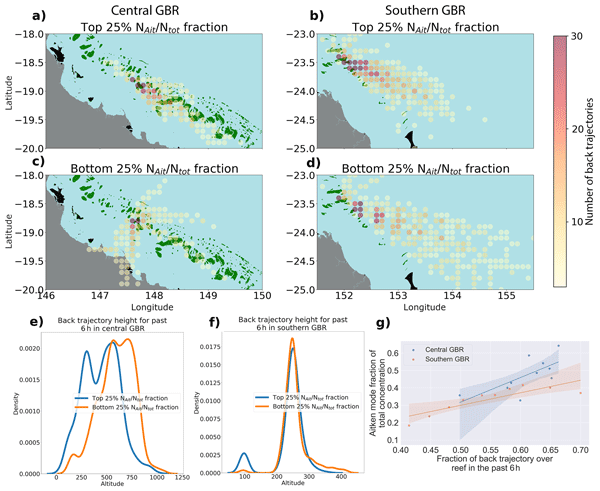
The Great Barrier Reef is the world’s largest coral reef system, and the air above it plays a role in cloud formation. Using direct measurements taken over several years, this study shows that although the reef has low aerosol concentrations, air that passes directly over coral reefs contains more very small particles, providing the first direct evidence that reefs add particles to the atmosphere. These locally produced particles make a measurable contribution to cloud formation over the reef.
Magdalena Okuljar, Juha Sulo, Joel Alroe, Zijun Li, Branka Miljevic, Daniel Harrison, and Zoran Ristovski
EGUsphere, https://doi.org/10.5194/egusphere-2026-4869, https://doi.org/10.5194/egusphere-2026-4869, 2026
Short summary
Short summary
The Great Barrier Reef is the largest coral reef system globally, yet the extent to which it contributes to local atmospheric particle loading remains poorly understood. This work focuses on particle formation processes observed during a six-week measurement campaign. Our results show that the reef ecosystem can influence local aerosol formation processes, with implications for regional cloud formation and climate feedbacks in marine ecosystems.
Benjamin Ascher and Fabian Hoffmann
Atmos. Chem. Phys., 26, 11747–11770, https://doi.org/10.5194/acp-26-11747-2026, https://doi.org/10.5194/acp-26-11747-2026, 2026
Short summary
Short summary
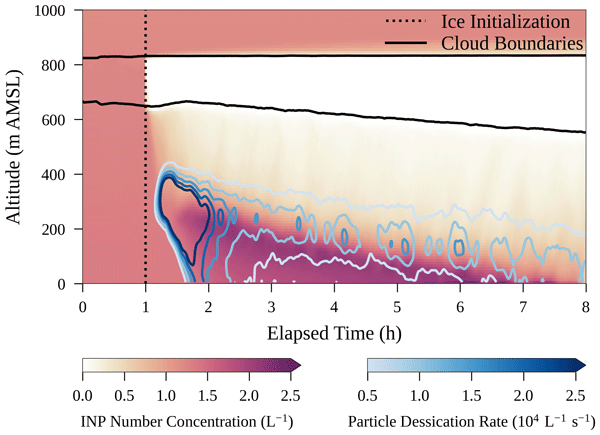
Arctic clouds with liquid and ice have important effects on climate. To investigate how ice crystals and liquid droplets grow in shallow Arctic clouds, we conducted high-resolution simulations. We find that drier air above the cloud leads to a greater sublimation rate of ice beneath the cloud and recycling of particles necessary for ice formation within the cloud. We also find that the amount of sublimation and recycling is affected by the rate of temperature change with height above the cloud.
Xiaoshen Sun, Chris Medcraft, Ramon Braga, Peter Butcherine, Zoran Ristovski, Steven Siems, Christian J. Sanders, and Daniel P. Harrison
EGUsphere, https://doi.org/10.5194/egusphere-2026-1729, https://doi.org/10.5194/egusphere-2026-1729, 2026
This preprint is open for discussion and under review for Atmospheric Measurement Techniques (AMT).
Short summary
Short summary
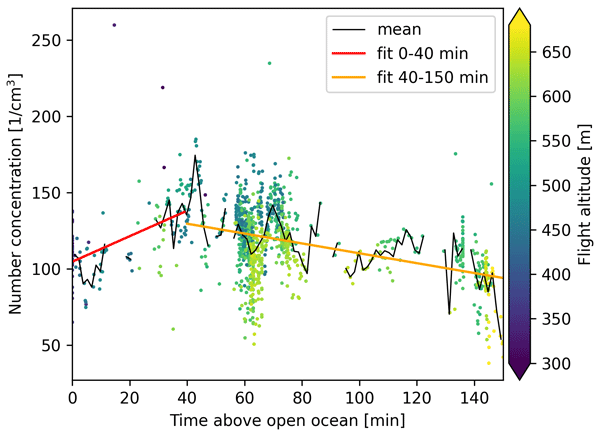
We propose a novel method to detect and track sea spray particles released during marine cloud brightening (MCB) over the Great Barrier Reef. Using aircraft measurements, we showed that these released particles can be separated from the research ship and aircraft exhaust and tracked as they spread horizontally and vertically. This improves our ability to trace added sea spray aerosols and supports future work on how they may affect clouds.
Rebecca L. Jackson, Matthew T. Woodhouse, Mark Baird, Clothilde Langlais, Mathieu Mongin, Anthony Jones, Daniel Partridge, Luke Harrison, Johanna Horchler, Joel Alroe, Luke Cravigan, Zoran Ristovski, and Daniel P. Harrison
EGUsphere, https://doi.org/10.5194/egusphere-2026-2761, https://doi.org/10.5194/egusphere-2026-2761, 2026
Short summary
Short summary
ACCESS-EMS-GBR is a regional coupled atmosphere-ocean model of the Great Barrier Reef. It simulates aerosol and cloud processes in the atmosphere, plus hydrodynamics, biogeochemistry and ecological processes in the marine environment. Developed to assess the effects of Marine Cloud Brightening on coral bleaching, it is the first regional model able to simulate how aerosol emissions affect clouds, radiation and the underlying reef ecosystem and is ideal for a range of atmosphere-ocean studies.
Netta Yeheskel, Matthew W. Christensen, Fabian Hoffmann, Graham Feingold, and Guy Dagan
Atmos. Chem. Phys., 26, 8765–8781, https://doi.org/10.5194/acp-26-8765-2026, https://doi.org/10.5194/acp-26-8765-2026, 2026
Short summary
Short summary
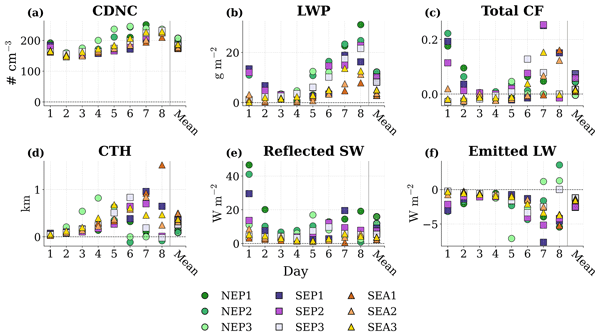
Aerosols influence cloud formation, structure, and radiative effects. As air masses move from the subtropics to the tropics, clouds transition from shallow to deeper systems. Using five years of satellite observations and numerical simulations, we find a robust aerosol impact on this Lagrangian cloud evolution: higher aerosol levels produce thicker, more reflective clouds, enhancing cooling and modifying energy and moisture transport toward the tropics.
Anna Weber, Fabian Hoffmann, and Bernhard Mayer
Atmos. Chem. Phys., 26, 8001–8020, https://doi.org/10.5194/acp-26-8001-2026, https://doi.org/10.5194/acp-26-8001-2026, 2026
Short summary
Short summary
The vertical evolution of microphysical cloud properties in low-level mixed-phase clouds during a marine cold air outbreak in the Arctic is analyzed based on measurements collected during the HALO–(𝒜𝒞)3 campaign. In particular, pseudo-vertical profiles of cloud thermodynamic phase and the cloud droplet size are constructed. The measured vertical profiles are compared to predictions from an entraining parcel model to investigate the influence of ice processes on supercooled liquid water droplets.
Jung-Sub Lim and Fabian Hoffmann
Atmos. Chem. Phys., 26, 5427–5446, https://doi.org/10.5194/acp-26-5427-2026, https://doi.org/10.5194/acp-26-5427-2026, 2026
Short summary
Short summary
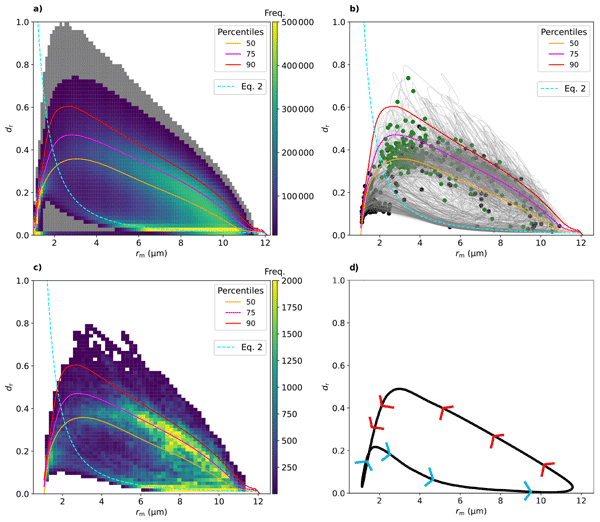
We used high-resolution simulations to track individual cloud droplets within marine clouds. We discovered that while droplets grow similarly, they evaporate differently depending on their specific history of exposure to dry air. This helps resolve ambiguities in interpreting field observations, where droplet history is often unknown. We also propose a simple formula to capture this variability, offering a more accurate tool for representing cloud evolution in models.
Prasanth Prabhakaran, Timothy A. Myers, Fabian Hoffmann, and Graham Feingold
Atmos. Chem. Phys., 26, 5151–5167, https://doi.org/10.5194/acp-26-5151-2026, https://doi.org/10.5194/acp-26-5151-2026, 2026
Short summary
Short summary
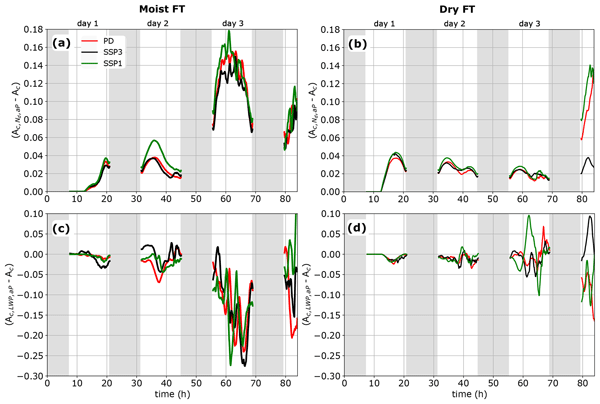
We explore how climate change and aerosol affect the evolution of marine low-clouds. Using high-resolution simulations, we find that warming has a stronger impact on these clouds, but aerosol becomes more important after the clouds form precipitation. Our results suggest that attempts to brighten these clouds using aerosol may become less effective in a warmer future due to the decrease in cloud cover.
Wenhui Zhao, Yi Huang, Steven Siems, and Daniel Harrison
EGUsphere, https://doi.org/10.5194/egusphere-2026-1251, https://doi.org/10.5194/egusphere-2026-1251, 2026
Short summary
Short summary
Using convection-permitting WRF simulations, this study examines how marine cloud brightening over the GBR depends on aerosol emission strength and spatial distribution. Densely spaced sources generate more uniform aerosol enhancements and stronger cloud microphysical responses than sparsely distributed sources, despite identical emissions. CDNC and optical depth increase strongly, indicating a dominant Twomey effect, while cloud water and coverage respond weakly.
Ramon Campos Braga, Daniel Harrison, Manfred Wendisch, and Rachel Albrecht
EGUsphere, https://doi.org/10.5194/egusphere-2026-795, https://doi.org/10.5194/egusphere-2026-795, 2026
Short summary
Short summary
We introduce a new thermodynamic method to quantify water vapor supersaturation (Sv) at warm cloud bases by describing the ascent of a cloudy air parcel as a reversible cloud-adiabatic process. This approach enables the calculation of cloud-base droplet number concentration spectra from in situ airborne measurements without reliance on prescribed updraft velocities or empirical parameterizations. The method is validated using CCN measurements from airborne observations over the Amazon Basin.

Lara S. Richards, Steven T. Siems, Yi Huang, Daniel P. Harrison, and Wenhui Zhao
Weather Clim. Dynam., 7, 109–127, https://doi.org/10.5194/wcd-7-109-2026, https://doi.org/10.5194/wcd-7-109-2026, 2026
Short summary
Short summary
By studying the variability of the trade winds during the Great Barrier Reef coral bleaching season, we show that ocean heating and a higher risk of coral bleaching are linked to the breakdown of the trade winds into either calm and clear conditions or a monsoon-like northerly flow. Years with mass coral bleaching are also associated with more "calm and clear" days in the warmest months and fewer strong trade wind days on the fringe months of the bleaching season.
Levin Rug, Willi Schimmel, Fabian Hoffmann, and Oswald Knoth
Geosci. Model Dev., 18, 9039–9059, https://doi.org/10.5194/gmd-18-9039-2025, https://doi.org/10.5194/gmd-18-9039-2025, 2025
Short summary
Short summary
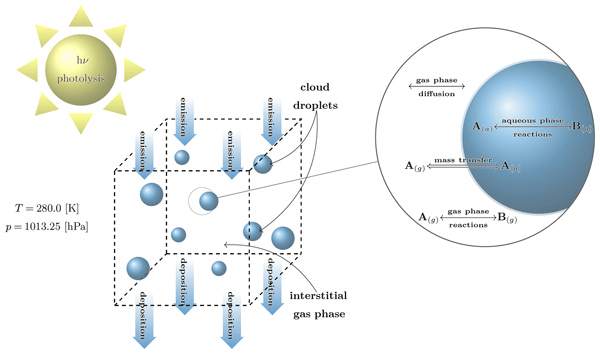
We present the Chemical Mechanism Integrator (Cminor) v1.0, a tool to predict concentrations of chemical compounds undergoing arbitrary reactions. Cminor is an advanced, open-source solver to model either combustion chemistry, or atmospheric chemistry and its direct influence on condensation of cloud droplets and the subsequent processing of aerosol. It uses the superdroplet idea, making it particularly feasible for coupling with such models, which is part of future work.
Robert G. Ryan, Lilani Toms-Hardman, Alexander Smirnov, Daniel P. Harrison, and Robyn Schofield
Atmos. Chem. Phys., 25, 11183–11197, https://doi.org/10.5194/acp-25-11183-2025, https://doi.org/10.5194/acp-25-11183-2025, 2025
Short summary
Short summary
Measurements of aerosol vertical distribution are key for understanding how they interact with clouds and sunlight. Such measurements are currently lacking at the Great Barrier Reef, limiting our ability to validate climate models in this sensitive, ecologically rich environment. Here we use a range of techniques to quantify the vertical variation of aerosols above the Great Barrier Reef for the first time, using the comparison of techniques to also infer aerosol spatial variation.
Graham Feingold, Franziska Glassmeier, Jianhao Zhang, and Fabian Hoffmann
Atmos. Chem. Phys., 25, 10869–10885, https://doi.org/10.5194/acp-25-10869-2025, https://doi.org/10.5194/acp-25-10869-2025, 2025
Short summary
Short summary
Scientists usually use snapshots of atmospheric data to glean understanding of time-evolving atmospheric processes. We examine how much can be learned about processes from snapshots using examples from cloud and atmospheric physics. We couch the analysis in terms of the theory of ergodic systems, space-time-exchange, and the Deborah number – concepts that are commonly applied in other branches of physics. We discuss the reasons for the varying degrees of success.
E. Johanna Horchler, Joel Alroe, Luke Harrison, Luke Cravigan, Daniel P. Harrison, and Zoran D. Ristovski
Atmos. Chem. Phys., 25, 10075–10087, https://doi.org/10.5194/acp-25-10075-2025, https://doi.org/10.5194/acp-25-10075-2025, 2025
Short summary
Short summary
Aerosols play a role in global climate by interacting with incoming solar radiation and by taking up water vapour from the atmosphere to form clouds. Enhancing local-scale cloud cover can reduce sea surface temperatures. Coral bleaching events have increased in the Great Barrier Reef (GBR) as sea surface temperatures have risen. Our study found that the number of aerosols and the cloud-forming ability over the GBR increased if the aerosols were transported from inland Australia rather than the ocean.
Fabian Hoffmann, Yao-Sheng Chen, and Graham Feingold
Atmos. Chem. Phys., 25, 8657–8670, https://doi.org/10.5194/acp-25-8657-2025, https://doi.org/10.5194/acp-25-8657-2025, 2025
Short summary
Short summary
Clouds reflect a substantial portion of the incoming solar radiation back into space. This capacity is determined by the number of cloud droplets, which in turn is influenced by the number of aerosol particles, forming the basis for aerosol–cloud–climate interactions. In this study, we use a simple entrainment parameterization to understand the effect of aerosol on cloud water in weakly and non-precipitating stratocumulus.
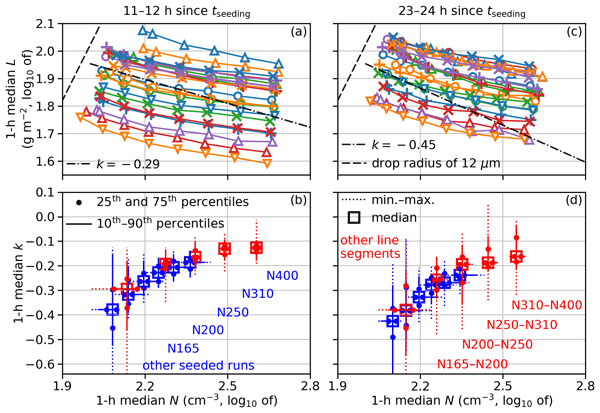
Yao-Sheng Chen, Prasanth Prabhakaran, Fabian Hoffmann, Jan Kazil, Takanobu Yamaguchi, and Graham Feingold
Atmos. Chem. Phys., 25, 6141–6159, https://doi.org/10.5194/acp-25-6141-2025, https://doi.org/10.5194/acp-25-6141-2025, 2025
Short summary
Short summary
Injecting sea salt aerosols into marine stratiform clouds can distribute the cloud water over more droplets in smaller sizes. This process is expected to make the clouds brighter, allowing them to reflect more sunlight back to space. However, it may also cause the clouds to lose water over time, reducing their ability to reflect sunlight. We use a computer model to show that the loss of cloud water occurs relatively quickly and does not completely offset the initial brightening.
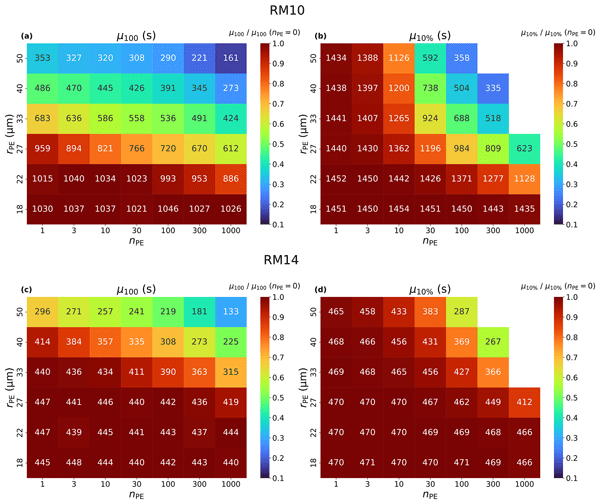
Jung-Sub Lim, Yign Noh, Hyunho Lee, and Fabian Hoffmann
Atmos. Chem. Phys., 25, 5313–5329, https://doi.org/10.5194/acp-25-5313-2025, https://doi.org/10.5194/acp-25-5313-2025, 2025
Short summary
Short summary
Rain formation in warm clouds begins when small droplets collide, but this process can be slow without larger droplets. We used simulations to explore the role of bigger droplets, known as precipitation embryos, in triggering rain. We found that they speed up rain only when their size and number exceed a critical threshold. This threshold becomes larger when collisions are naturally efficient, such as in clouds with broad droplet size distributions or strong turbulence.
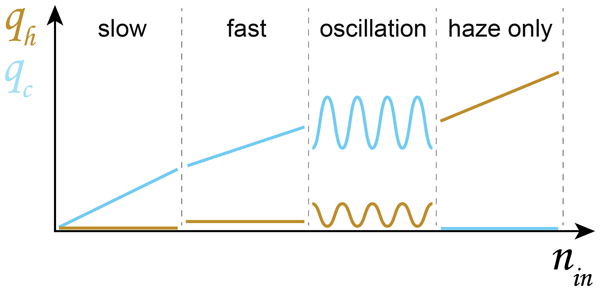
Fan Yang, Hamed Fahandezh Sadi, Raymond A. Shaw, Fabian Hoffmann, Pei Hou, Aaron Wang, and Mikhail Ovchinnikov
Atmos. Chem. Phys., 25, 3785–3806, https://doi.org/10.5194/acp-25-3785-2025, https://doi.org/10.5194/acp-25-3785-2025, 2025
Short summary
Short summary
Large-eddy simulations of a convection cloud chamber show two new microphysics regimes, cloud oscillation and cloud collapse, due to haze–cloud interactions. Our results suggest that haze particles and their interactions with cloud droplets should be considered especially in polluted conditions. To properly simulate haze–cloud interactions, we need to resolve droplet activation and deactivation processes, instead of using Twomey-type activation parameterization.
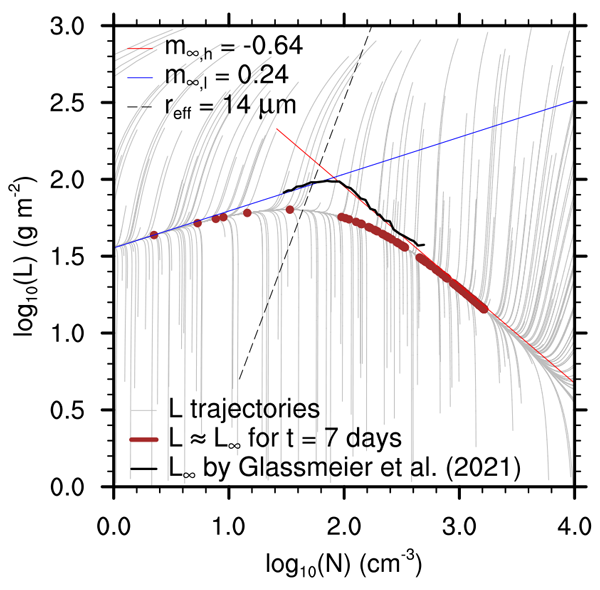
Fabian Hoffmann, Franziska Glassmeier, and Graham Feingold
Atmos. Chem. Phys., 24, 13403–13412, https://doi.org/10.5194/acp-24-13403-2024, https://doi.org/10.5194/acp-24-13403-2024, 2024
Short summary
Short summary
Clouds constitute a major cooling influence on Earth's climate system by reflecting a large fraction of the incident solar radiation back to space. This ability is controlled by the number of cloud droplets, which is governed by the number of aerosol particles in the atmosphere, laying the foundation for so-called aerosol–cloud–climate interactions. In this study, a simple model to understand the effect of aerosol on cloud water is developed and applied.
Yao-Sheng Chen, Jianhao Zhang, Fabian Hoffmann, Takanobu Yamaguchi, Franziska Glassmeier, Xiaoli Zhou, and Graham Feingold
Atmos. Chem. Phys., 24, 12661–12685, https://doi.org/10.5194/acp-24-12661-2024, https://doi.org/10.5194/acp-24-12661-2024, 2024
Short summary
Short summary
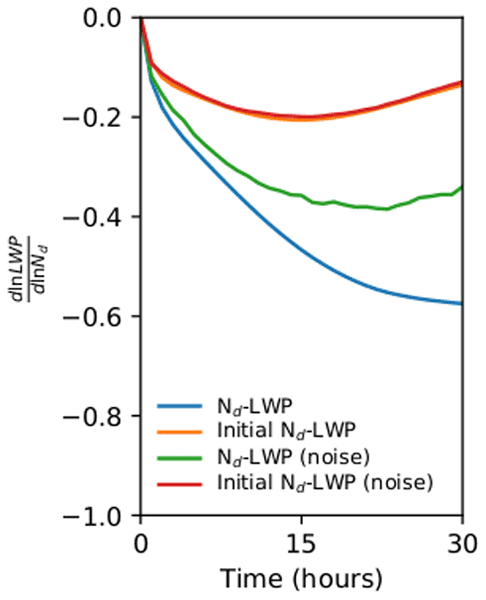
Marine stratocumulus cloud is a type of shallow cloud that covers the vast areas of Earth's surface. It plays an important role in Earth's energy balance by reflecting solar radiation back to space. We used numerical models to simulate a large number of marine stratocumuli with different characteristics. We found that how the clouds develop throughout the day is affected by the level of humidity in the air above the clouds and how closely the clouds connect to the ocean surface.
Wenhui Zhao, Yi Huang, Steven Siems, Michael Manton, and Daniel Harrison
Atmos. Chem. Phys., 24, 5713–5736, https://doi.org/10.5194/acp-24-5713-2024, https://doi.org/10.5194/acp-24-5713-2024, 2024
Short summary
Short summary
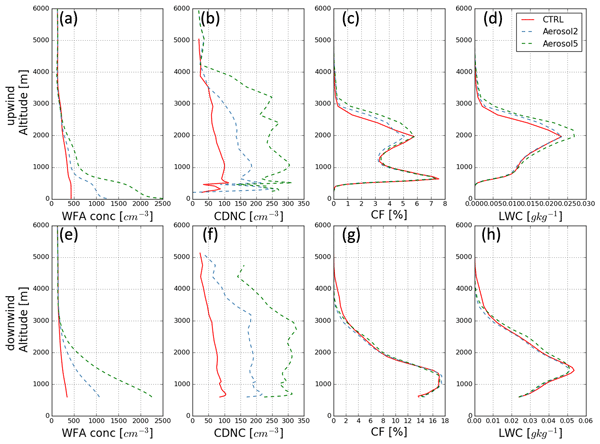
We studied how shallow clouds and rain behave over the Great Barrier Reef (GBR) using a detailed weather model. We found that the shape of the land, especially mountains, and particles in the air play big roles in influencing these clouds. Surprisingly, the sea's temperature had a smaller effect. Our research helps us understand the GBR's climate and how various factors can influence it, where the importance of the local cloud in thermal coral bleaching has recently been identified.
Prasanth Prabhakaran, Fabian Hoffmann, and Graham Feingold
Atmos. Chem. Phys., 24, 1919–1937, https://doi.org/10.5194/acp-24-1919-2024, https://doi.org/10.5194/acp-24-1919-2024, 2024
Short summary
Short summary
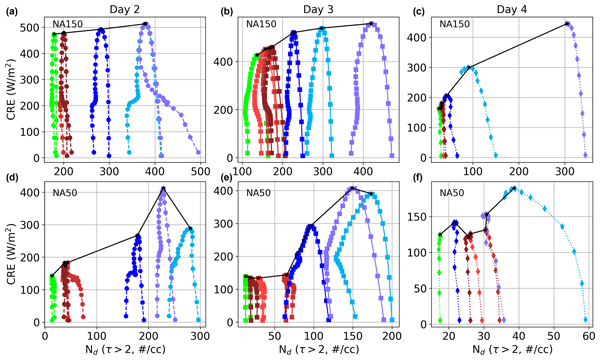
In this study, we explore the impact of deliberate aerosol perturbation in the northeast Pacific region using large-eddy simulations. Our results show that cloud reflectivity is sensitive to the aerosol sprayer arrangement in the pristine system, whereas in the polluted system it is largely proportional to the total number of aerosol particles injected. These insights would aid in assessing the efficiency of various aerosol injection strategies for climate intervention applications.
Edward Gryspeerdt, Franziska Glassmeier, Graham Feingold, Fabian Hoffmann, and Rebecca J. Murray-Watson
Atmos. Chem. Phys., 22, 11727–11738, https://doi.org/10.5194/acp-22-11727-2022, https://doi.org/10.5194/acp-22-11727-2022, 2022
Short summary
Short summary
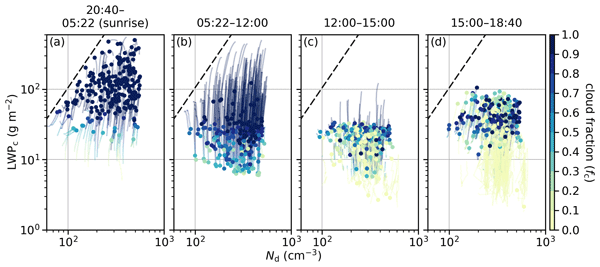
The response of clouds to changes in aerosol remains a large uncertainty in our understanding of the climate. Studies typically look at aerosol and cloud processes in snapshot images, measuring all properties at the same time. Here we use multiple images to characterise how cloud temporal development responds to aerosol. We find a reduction in liquid water path with increasing aerosol, party due to feedbacks. This suggests the aerosol impact on cloud water may be weaker than in previous studies.
Cited articles
Beard, K. V.: Terminal Velocity and Shape of Cloud and Precipitation Drops Aloft, J. Atmos. Sci., 33, 851–864, https://doi.org/10.1175/1520-0469(1976)033<0851:TVASOC>2.0.CO;2, 1976. a
Betts, A. K.: Coupling of water vapor convergence, clouds, precipitation, and land-surface processes, J. Geophys. Res.-Atmos., 112, https://doi.org/10.1029/2006JD008191, 2007. a
Bohren, C. F.: Multiple scattering of light and some of its observable consequences, Am. J. Phys., 55, 524–533, https://doi.org/10.1119/1.15109, 1987. a
Braga, R. C., Rosenfeld, D., Hernandez, D., Medcraft, C., Efraim, A., Moser, M., Lucke, J., Doss, A., and Harrison, D.: Cloud processing dominates the vertical profiles of aerosols in marine air masses over the Great Barrier Reef, Atmos. Res., 315, 107928, https://doi.org/10.1016/j.atmosres.2025.107928, 2025. a
Chen, Y.-S., Prabhakaran, P., Hoffmann, F., Kazil, J., Yamaguchi, T., and Feingold, G.: Magnitude and timescale of liquid water path adjustments to cloud droplet number concentration perturbations for nocturnal non-precipitating marine stratocumulus, Atmos. Chem. Phys., 25, 6141–6159, https://doi.org/10.5194/acp-25-6141-2025, 2025. a
Claudel, C., Lockley, A., Hoffmann, F., and Xia, Y.: Marine-cloud brightening: an airborne concept, Environmental Research Communications, 6, 035020, https://doi.org/10.1088/2515-7620/ad2f71, 2024. a
Condie, S. A., Anthony, K. R. N., Babcock, R. C., Baird, M. E., Beeden, R., Fletcher, C. S., Gorton, R., Harrison, D., Hobday, A. J., Plagányi, É. E., and Westcott, D. A.: Large-scale interventions may delay decline of the Great Barrier Reef, Roy. Soc. Open Sci., 8, 201296, https://doi.org/10.1098/rsos.201296, 2021. a
Dhandapani, C., Kaul, C. M., Pressel, K. G., Blossey, P. N., Wood, R., and Kulkarni, G.: Sensitivities of Large Eddy Simulations of Aerosol Plume Transport and Cloud Response, J. Adv. Model. Earth Sy., 17, e2024MS004546, https://doi.org/10.1029/2024MS004546, 2025. a, b, c
Eckert, C., Monteforte, K. I., Harrison, D. P., and Kelaher, B. P.: Exploring Meteorological Conditions and Microscale Temperature Inversions above the Great Barrier Reef through Drone-Based Measurements, Drones, 7, https://doi.org/10.3390/drones7120695, 2023. a
Feingold, G., Ghate, V. P., Russell, L. M., Blossey, P., Cantrell, W., Christensen, M. W., Diamond, M. S., Gettelman, A., Glassmeier, F., Gryspeerdt, E., Haywood, J., Hoffmann, F., Kaul, C. M., Lebsock, M., McComiskey, A. C., McCoy, D. T., Ming, Y., Mülmenstädt, J., Possner, A., Prabhakaran, P., Quinn, P. K., Schmidt, K. S., Shaw, R. A., Singer, C. E., Sorooshian, A., Toll, V., Wan, J. S., Wood, R., Yang, F., Zhang, J., and Zheng, X.: Physical science research needed to evaluate the viability and risks of marine cloud brightening, Science Advances, 10, eadi8594, https://doi.org/10.1126/sciadv.adi8594, 2024. a, b
Gilgen, H., Wild, M., and Ohmura, A.: Means and trends of shortwave irradiance at the surface estimated from global energy balance archive data, J. Climate, 11, 2042–2061, https://doi.org/10.1175/1520-0442(1998)011<2042:MATOSI>2.0.CO;2, 1998. a
Glassmeier, F., Hoffmann, F., Johnson, J. S., Yamaguchi, T., Carslaw, K. S., and Feingold, G.: Aerosol-cloud-climate cooling overestimated by ship-track data, Science, 371, 485–489, https://doi.org/10.1126/science.abd3980, 2021. a
Harrison, D.: An Overview of Environmental Engineering Methods for Reducing Coral Bleaching Stress, CNC Press, https://doi.org/10.1201/9781003320425, 2024. a, b
Hernandez-Jaramillo, D. C., Harrison, L., Kelaher, B., Ristovski, Z., and Harrison, D. P.: Evaporative Cooling Does Not Prevent Vertical Dispersion of Effervescent Seawater Aerosol for Brightening Clouds, Environ. Sci. Technol., 57, 20559–20570, https://doi.org/10.1021/acs.est.3c04793, 2023. a, b
Hoffmann, F. and Feingold, G.: Entrainment and Mixing in Stratocumulus: Effects of a New Explicit Subgrid-Scale Scheme for Large-Eddy Simulations with Particle-Based Microphysics, J. Atmos. Sci., 76, 1955–1973, https://doi.org/10.1175/JAS-D-18-0318.1, 2019. a
Hoffmann, F. and Feingold, G.: Cloud Microphysical Implications for Marine Cloud Brightening: The Importance of the Seeded Particle Size Distribution, J. Atmos. Sci., 78, 3247–3262, https://doi.org/10.1175/JAS-D-21-0077.1, 2021. a, b
Hoffmann, F., Noh, Y., and Raasch, S.: The route to raindrop formation in a shallow cumulus cloud simulated by a Lagrangian cloud model, J. Atmos. Sci., 74, 2125–2142, https://doi.org/10.1175/JAS-D-16-0220.1, 2017. a
Horchler, E. J., Alroe, J., Harrison, L., Cravigan, L., Harrison, D. P., and Ristovski, Z. D.: Measurement report: Aerosol and cloud nuclei properties along the Central and Northern Great Barrier Reef – impact of continental emissions, Atmos. Chem. Phys., 25, 10075–10087, https://doi.org/10.5194/acp-25-10075-2025, 2025. a
Kainz, J., Harrison, D., and Hoffmann, F.: Marine Cloud Brightening of Cumulus Clouds: From the Sprayer to the Cloud, Zenodo [data set], https://doi.org/10.5281/zenodo.17011767, 2025. a
Khairoutdinov, M. F. and Randall, D. A.: Cloud resolving modeling of the ARM summer 1997 IOP: Model formulation, results, uncertainties, and sensitivities, J. Atmos. Sci., 60, 607–625, https://doi.org/10.1175/1520-0469(2003)060<0607:CRMOTA>2.0.CO;2, 2003. a
Kokhanovsky, A.: Optical properties of terrestrial clouds, Earth-Sci. Rev., 64, 189–241, https://doi.org/10.1016/S0012-8252(03)00042-4, 2004. a
Latham, J.: Amelioration of global warming by controlled enhancement of the albedo and longevity of low-level maritime clouds, Atmos. Sci. Lett., 3, 52–58, https://doi.org/10.1006/asle.2002.0099, 2002. a
Latham, J., Bower, K., Choularton, T., Coe, H., Connolly, P., Cooper, G., Craft, T., Foster, J., Gadian, A., Galbraith, L., et al.: Marine cloud brightening, Philos. T. R. Soc. A, 370, 4217–4262, https://doi.org/10.1098/rsta.2012.0086, 2012. a, b, c, d
Neggers, R. A., Jonker, H. J., and Siebesma, A.: Size statistics of cumulus cloud populations in large-eddy simulations, J. Atmos. Sci., 60, 1060–1074, https://doi.org/10.1175/1520-0469(2003)60<1060:SSOCCP>2.0.CO;2, 2003. a
Oh, D., Noh, Y., and Hoffmann, F.: Paths From Aerosol Particles to Activation and Cloud Droplets in Shallow Cumulus Clouds: The Roles of Entrainment and Supersaturation Fluctuations, J. Geophys. Res.-Atmos., 128, e2022JD038450, https://doi.org/10.1029/2022JD038450, 2023. a, b, c
Prabhakaran, P., Hoffmann, F., and Feingold, G.: Evaluation of Pulse Aerosol Forcing on Marine Stratocumulus Clouds in the Context of Marine Cloud Brightening, J. Atmos. Sci., 80, 1585–1604, https://doi.org/10.1175/JAS-D-22-0207.1, 2023. a
Siebesma, A. P., Bretherton, C. S., Brown, A., Chlond, A., Cuxart, J., Duynkerke, P. G., Jiang, H., Khairoutdinov, M., Lewellen, D., Moeng, C.-H., Sanchez, E., Stevens, B., and Stevens, D. E.: A Large Eddy Simulation Intercomparison Study of Shallow Cumulus Convection, J. Atmos. Sci., 60, 1201–1219, https://doi.org/10.1175/1520-0469(2003)60<1201:ALESIS>2.0.CO;2, 2003. a, b
Stull, R. B.: An Introduction to Boundary Layer Meteorology, Kluwer Academic Publishers, https://doi.org/10.1007/978-94-009-3027-8, 1988. a
Twomey, S.: Pollution and the planetary albedo, Atmos. Environ., 8, 1251–1256, https://doi.org/10.1016/0004-6981(74)90004-3, 1974. a
Twomey, S.: The influence of pollution on the shortwave albedo of clouds, J. Atmos. Sci., 34, 1149–1152, https://doi.org/10.1175/1520-0469(1977)034<1149:TIOPOT>2.0.CO;2, 1977. a
Wood, R.: Assessing the potential efficacy of marine cloud brightening for cooling Earth using a simple heuristic model, Atmos. Chem. Phys., 21, 14507–14533, https://doi.org/10.5194/acp-21-14507-2021, 2021. a, b
Zhang, J. and Feingold, G.: Distinct regional meteorological influences on low-cloud albedo susceptibility over global marine stratocumulus regions, Atmos. Chem. Phys., 23, 1073–1090, https://doi.org/10.5194/acp-23-1073-2023, 2023. a
Short summary
Marine Cloud Brightening (MCB) aims to counter global warming. It suggests to increase cloud reflectance by spraying aerosols from which additional cloud droplets can form. We demonstrate that MCB can be applied to cumulus clouds. The impact of aerosol particles released by a single aerosol sprayer using simulations is analyzed. The study draws conclusions on the optimal placement height of the sprayer to optimize aerosol transport, the ability to form new cloud droplets, and the area affected.
Marine Cloud Brightening (MCB) aims to counter global warming. It suggests to increase cloud...


Altmetrics
Final-revised paper
Preprint