
Articles | Volume 26, issue 13
https://doi.org/10.5194/acp-26-9277-2026
© Author(s) 2026. This work is distributed under
the Creative Commons Attribution 4.0 License.
the Creative Commons Attribution 4.0 License.
https://doi.org/10.5194/acp-26-9277-2026
© Author(s) 2026. This work is distributed under
the Creative Commons Attribution 4.0 License.
the Creative Commons Attribution 4.0 License.
Research article
| 
02 Jul 2026
Research article |
| 02 Jul 2026
| 02 Jul 2026
Gas-phase degradation of the aroma compound ethyl butyrate and its methylated derivatives: UV-C photolysis and reactions with the hydroxyl radical

Wolfson Atmospheric Chemistry Laboratories, Department of Chemistry, University of York, York, YO10 5DD, UK
Mark A. Blitz
School of Chemistry, University of Leeds, Leeds, LS2 9JT, UK
National Centre for Atmospheric Science, University of Leeds, Leeds, LS2 9JT, UK
Paul W. Seakins
School of Chemistry, University of Leeds, Leeds, LS2 9JT, UK
Nicola Carslaw
Department of Environment and Geography, University of York, York, YO10 5DD, UK
Wolfson Atmospheric Chemistry Laboratories, Department of Chemistry, University of York, York, YO10 5DD, UK
Related authors
Duong H. Do, Astrid Kerkweg, Yarê Baker, Birger Bohn, Hendrik Fuchs, Quanfu He, Thorsten Hohaus, Sungah Kang, Timo Kirfel, Finja Löher, Niklas Diepenthal, Anke C. Nölscher, Anna Novelli, Alexander Pschera, Felix Wieser, Sören R. Zorn, Andreas Wahner, and Domenico Taraborrelli
EGUsphere, https://doi.org/10.5194/egusphere-2026-4522, https://doi.org/10.5194/egusphere-2026-4522, 2026
This preprint is open for discussion and under review for Geoscientific Model Development (GMD).
Short summary
Short summary
This work builds a chamber simulation tool that mimics how air chemistry changes inside laboratory reactors, including injected gases, changing light, gas and liquid reactions, wall effects, and dilution. Tests in several chambers reproduced measured changes in reactive species, nitrogen compounds, and ozone, and helped capture how organic particles form. The same chemistry can be reused in larger, global air simulations to assess real-world impact.
Finja Löher, Esther Borrás, Amalia Muñoz, and Anke Christine Nölscher
Atmos. Meas. Tech., 17, 4553–4579, https://doi.org/10.5194/amt-17-4553-2024, https://doi.org/10.5194/amt-17-4553-2024, 2024
Short summary
Short summary
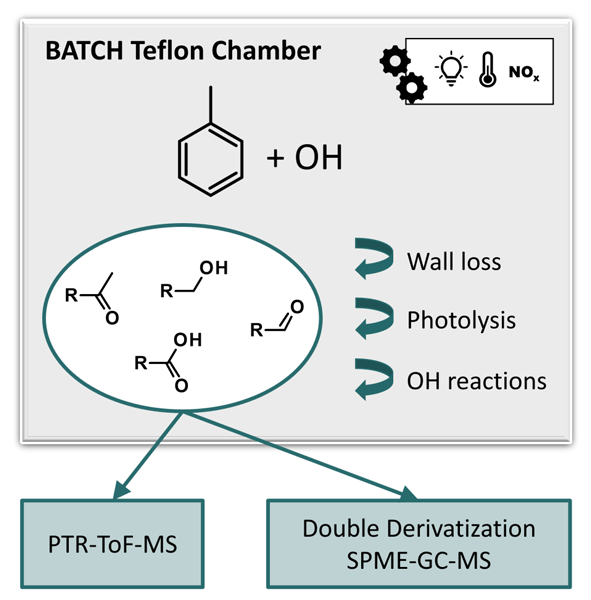
We constructed and characterized a new indoor Teflon atmospheric simulation chamber. We evaluated wall losses, photolysis rates, and secondary reactions of multifunctional photooxidation products in the chamber. To measure these products on-line, we combined chromatographic and mass spectrometric analyses to obtain both isomeric information and a high temporal resolution. For method validation, we studied the formation yields of the main ring-retaining products of toluene.
Duong H. Do, Astrid Kerkweg, Yarê Baker, Birger Bohn, Hendrik Fuchs, Quanfu He, Thorsten Hohaus, Sungah Kang, Timo Kirfel, Finja Löher, Niklas Diepenthal, Anke C. Nölscher, Anna Novelli, Alexander Pschera, Felix Wieser, Sören R. Zorn, Andreas Wahner, and Domenico Taraborrelli
EGUsphere, https://doi.org/10.5194/egusphere-2026-4522, https://doi.org/10.5194/egusphere-2026-4522, 2026
This preprint is open for discussion and under review for Geoscientific Model Development (GMD).
Short summary
Short summary
This work builds a chamber simulation tool that mimics how air chemistry changes inside laboratory reactors, including injected gases, changing light, gas and liquid reactions, wall effects, and dilution. Tests in several chambers reproduced measured changes in reactive species, nitrogen compounds, and ozone, and helped capture how organic particles form. The same chemistry can be reused in larger, global air simulations to assess real-world impact.
James D'Souza Metcalf, Ruth K. Winkless, Caterina Mapelli, C. Rob McElroy, Claudiu Roman, Cecilia Arsene, Romeo I. Olariu, Iustinian G. Bejan, and Terry J. Dillon
Atmos. Chem. Phys., 25, 9169–9181, https://doi.org/10.5194/acp-25-9169-2025, https://doi.org/10.5194/acp-25-9169-2025, 2025
Short summary
Short summary
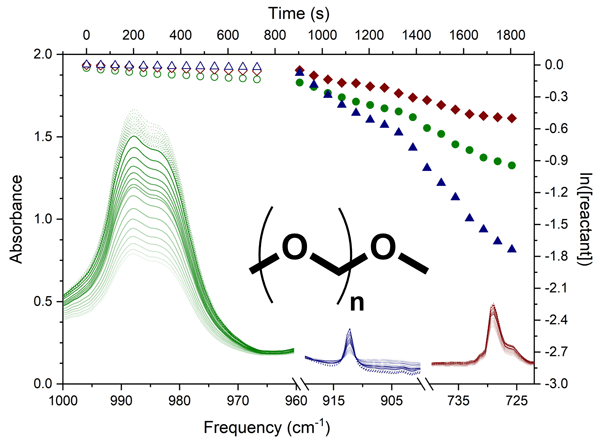
Oxymethylene ethers are a class of sustainable compounds that could be used to replace harmful organic solvents in a range of applications. In this work, we use lab-based experiments to identify the main breakdown routes of these compounds in the atmosphere. We have determined that they likely contribute less to air pollution than the compounds that they replace.
Barbara Ervens, Andrew Rickard, Bernard Aumont, William P. L. Carter, Max McGillen, Abdelwahid Mellouki, John Orlando, Bénédicte Picquet-Varrault, Paul Seakins, William R. Stockwell, Luc Vereecken, and Timothy J. Wallington
Atmos. Chem. Phys., 24, 13317–13339, https://doi.org/10.5194/acp-24-13317-2024, https://doi.org/10.5194/acp-24-13317-2024, 2024
Short summary
Short summary
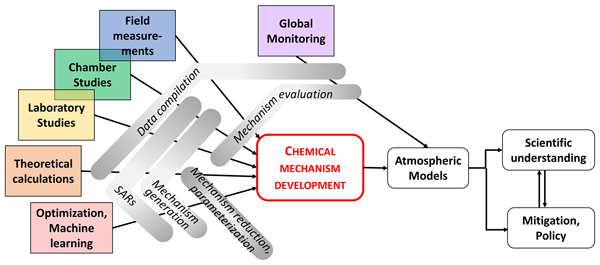
Chemical mechanisms describe the chemical processes in atmospheric models that are used to describe the changes in the atmospheric composition. Therefore, accurate chemical mechanisms are necessary to predict the evolution of air pollution and climate change. The article describes all steps that are needed to build chemical mechanisms and discusses the advances and needs of experimental and theoretical research activities needed to build reliable chemical mechanisms.
Finja Löher, Esther Borrás, Amalia Muñoz, and Anke Christine Nölscher
Atmos. Meas. Tech., 17, 4553–4579, https://doi.org/10.5194/amt-17-4553-2024, https://doi.org/10.5194/amt-17-4553-2024, 2024
Short summary
Short summary
We constructed and characterized a new indoor Teflon atmospheric simulation chamber. We evaluated wall losses, photolysis rates, and secondary reactions of multifunctional photooxidation products in the chamber. To measure these products on-line, we combined chromatographic and mass spectrometric analyses to obtain both isomeric information and a high temporal resolution. For method validation, we studied the formation yields of the main ring-retaining products of toluene.
David R. Shaw, Toby J. Carter, Helen L. Davies, Ellen Harding-Smith, Elliott C. Crocker, Georgia Beel, Zixu Wang, and Nicola Carslaw
Geosci. Model Dev., 16, 7411–7431, https://doi.org/10.5194/gmd-16-7411-2023, https://doi.org/10.5194/gmd-16-7411-2023, 2023
Short summary
Short summary
Exposure to air pollution is one of the greatest risks to human health, and it is indoors, where we spend upwards of 90 % of our time, that our exposure is greatest. The INdoor CHEMical model in Python (INCHEM-Py) is a new, community-led box model that tracks the evolution and fate of atmospheric chemical pollutants indoors. We have shown the processes simulated by INCHEM-Py, its ability to model experimental data and how it may be used to develop further understanding of indoor air chemistry.
Frank A. F. Winiberg, William J. Warman, Charlotte A. Brumby, Graham Boustead, Iustinian G. Bejan, Thomas H. Speak, Dwayne E. Heard, Daniel Stone, and Paul W. Seakins
Atmos. Meas. Tech., 16, 4375–4390, https://doi.org/10.5194/amt-16-4375-2023, https://doi.org/10.5194/amt-16-4375-2023, 2023
Short summary
Short summary
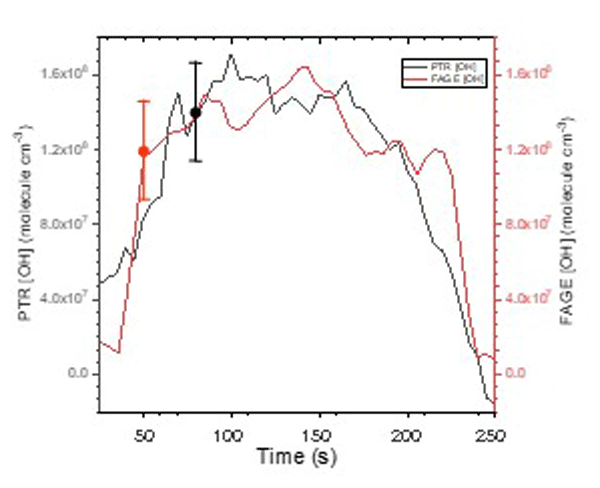
OH and HO2 are key reactive intermediates in the Earth's atmosphere. Accurate measurements in either the field or simulation chambers provide a good test for chemical mechanisms. Fluorescence techniques have the appropriate sensitivity for detection but require calibration. This paper compares different methods of calibration and specifically how calibration factors vary across a temperature range relevant to atmospheric and chamber determinations.
Caterina Mapelli, James K. Donnelly, Úna E. Hogan, Andrew R. Rickard, Abbie T. Robinson, Fergal Byrne, Con Rob McElroy, Basile F. E. Curchod, Daniel Hollas, and Terry J. Dillon
Atmos. Chem. Phys., 23, 7767–7779, https://doi.org/10.5194/acp-23-7767-2023, https://doi.org/10.5194/acp-23-7767-2023, 2023
Short summary
Short summary
Solvents are chemical compounds with countless uses in the chemical industry, and they also represent one of the main sources of pollution in the chemical sector. Scientists are trying to develop new
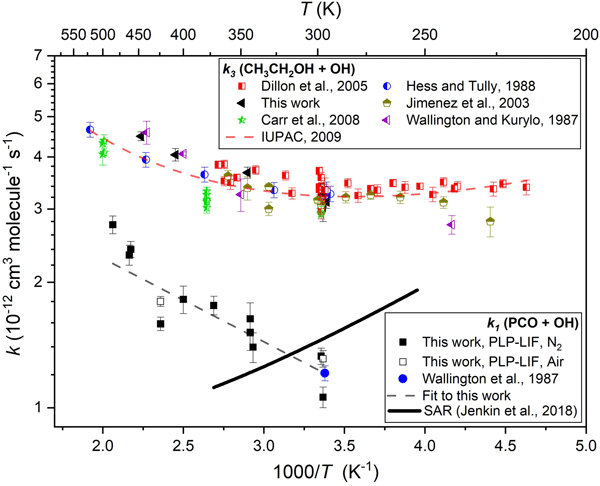
greensafer solvents which present favourable advantages when compared to traditional solvents. Since the assessment of these green solvents often lacks air quality considerations, this study aims to understand the behaviour of these compounds, investigating their reactivity in the troposphere.
Caterina Mapelli, Juliette V. Schleicher, Alex Hawtin, Conor D. Rankine, Fiona C. Whiting, Fergal Byrne, C. Rob McElroy, Claudiu Roman, Cecilia Arsene, Romeo I. Olariu, Iustinian G. Bejan, and Terry J. Dillon
Atmos. Chem. Phys., 22, 14589–14602, https://doi.org/10.5194/acp-22-14589-2022, https://doi.org/10.5194/acp-22-14589-2022, 2022
Short summary
Short summary
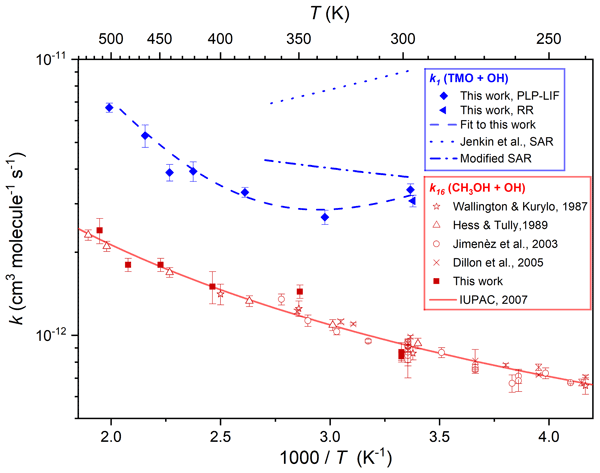
Solvents represent an important source of pollution from the chemical industry. New "green" solvents aim to replace toxic solvents with new molecules made from renewable sources and designed to be less harmful. Whilst these new molecules are selected according to toxicity and other characteristics, no consideration has yet been included on air quality. Studying the solvent breakdown in air, we found that TMO has a lower impact on air quality than traditional solvents with similar properties.
Zara S. Mir, Matthew Jamieson, Nicholas R. Greenall, Paul W. Seakins, Mark A. Blitz, and Daniel Stone
Atmos. Meas. Tech., 15, 2875–2887, https://doi.org/10.5194/amt-15-2875-2022, https://doi.org/10.5194/amt-15-2875-2022, 2022
Short summary
Short summary
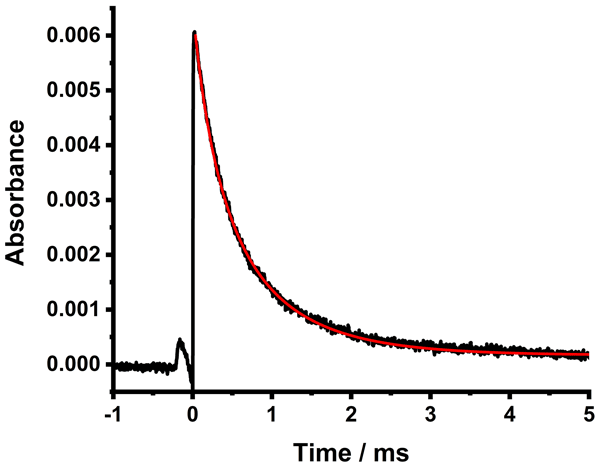
In this work we describe the development and characterisation of an experiment using laser flash photolysis coupled with time-resolved mid-infrared (mid-IR) quantum cascade laser (QCL) absorption spectroscopy, with initial results reported for measurements of the infrared spectrum, kinetics, and product yields for the reaction of the CH2OO Criegee intermediate with SO2. This work has significance for the identification and measurement of reactive trace species in complex systems.
Cited articles
Anderson, R. S., Czuba, E., Ernst, D., Huang, L., Thompson, A. E., and Rudolph, J.: Method for Measuring Carbon Kinetic Isotope Effects of Gas-Phase Reactions of Light Hydrocarbons with the Hydroxyl Radical, J. Phys. Chem. A, 107, 6191–6199, https://doi.org/10.1021/jp034256d, 2003.
Anhaia-Machado, J. O., Soares, A. C. G., de Oliveira Pinto, C. A. S., Barrera, A. I. Á., Baby, A. R., and Trossini, G. H. G.: Molecular Modeling Based on Time-Dependent Density Functional Theory (TD-DFT) Applied to the UV-Vis Spectra of Natural Compounds, Chemistry, 5, 41–53, https://doi.org/10.3390/chemistry5010004, 2023.
Aumont, B., Szopa, S., and Madronich, S.: Modelling the evolution of organic carbon during its gas-phase tropospheric oxidation: development of an explicit model based on a self generating approach, Atmos. Chem. Phys., 5, 2497–2517, https://doi.org/10.5194/acp-5-2497-2005, 2005.
Ausloos, P.: The photolysis of alkyl esters, Can. J. Chem., 36, 383–392, https://doi.org/10.1139/v58-054, 1958.
Badawy, T., Williamson, J., and Xu, H.: Laminar burning characteristics of ethyl propionate, ethyl butyrate, ethyl acetate, gasoline and ethanol fuels, Fuel, 183, 627–640, https://doi.org/10.1016/j.fuel.2016.06.087, 2016.
Baeza-Romero, M. T., Glowacki, D. R., Blitz, M. A., Heard, D. E., Pilling, M. J., Rickard, A. R., and Seakins, P. W.: A combined experimental and theoretical study of the reaction between methylglyoxal and OH/OD radical: OH regeneration, Phys. Chem. Chem. Phys., 9, 4114–4128, https://doi.org/10.1039/B702916K, 2007.
Barba, C., Beno, N., Guichard, E., and Thomas-Danguin, T.: Selecting odorant compounds to enhance sweet flavor perception by gas chromatography/olfactometry-associated taste (GC/O-AT), Food Chem., 257, 172–181, https://doi.org/10.1016/j.foodchem.2018.02.152, 2018.
Bicas, J. L., Molina, G., Dionísio, A. P., Barros, F. F. C., Wagner, R., Maróstica, M. R., and Pastore, G. M.: Volatile constituents of exotic fruits from Brazil, Food Res. Int., 44, 1843–1855, https://doi.org/10.1016/j.foodres.2011.01.012, 2011.
Blitz, M. A., Guy, P., Shannon, R., and Seakins, P. W.: Rate Coefficients and Branching Ratios for the Reaction of the OH Radical with Formic Acid under Low-Temperature Combustion Conditions and the Fate of the HOCO Product, J. Phys. Chem. A, 129, 6437–6450, https://doi.org/10.1021/acs.jpca.5c01814, 2025.
Boelens, H., Haring, H. G., and Takken, H. J.: The Influence of Molecular-Structure on Olfactive Quality (a Quantitative Approach), Chem. Ind., 1, 26–30, 1983.
Braure, T., Bedjanian, Y., Romanias, M. N., Morin, J., Riffault, V., Tomas, A., and Coddeville, P.: Experimental Study of the Reactions of Limonene with OH and OD Radicals: Kinetics and Products, J. Phys. Chem. A, 118, 9482–9490, https://doi.org/10.1021/jp507180g, 2014.
Calvert, J., Mellouki, A., Orlando, J., Pilling, M., and Wallington, T.: Mechanisms of Atmospheric Oxidation of the Oxygenates, Oxford University Press, Oxford, New York, 1634 pp., ISBN 978-0-19-976707-6, 2011.
Carslaw, N. and Shaw, D.: Secondary product creation potential (SPCP): a metric for assessing the potential impact of indoor air pollution on human health, Environ. Sci. Process. Impacts, 21, 1313–1322, https://doi.org/10.1039/C9EM00140A, 2019.
Caswell, L. R., Howard, M. F., and Onisto, T. M.: Solvent and substituent effects upon the
Chaturvedi, S., Kumar, A., Singh, V., Chakraborty, B., Kumar, R., and Min, L.: Recent Advancement in Organic Aerosol Understanding: a Review of Their Sources, Formation, and Health Impacts, Water Air Soil Poll., 234, 750, https://doi.org/10.1007/s11270-023-06772-0, 2023.
Chen, I.-Y., Chang, C.-W., Fittschen, C., and Luo, P.-L.: Accurate Kinetic Studies of OH+HO2 Radical–Radical Reaction through Direct Measurement of Precursor and Radical Concentrations with High-Resolution Time-Resolved Dual-Comb Spectroscopy, J. Phys. Chem. Lett., 15, 3733–3739, https://doi.org/10.1021/acs.jpclett.4c00494, 2024.
Closson, W. D. and Haug, Pat.: The Effects of Solvent and Structure on the Low Intensity (
Cometto, P. M., Daële, V., Idir, M., Lane, S. I., and Mellouki, A.: Reaction Rate Coefficients of OH Radicals and Cl Atoms with Ethyl Propanoate, n-Propyl Propanoate, Methyl 2-Methylpropanoate, and Ethyl n-Butanoate, J. Phys. Chem. A, 113, 10745–10752, https://doi.org/10.1021/jp9061708, 2009.
Doner, A. C., Christianson, M. G., Davis, J. C., Koritzke, A. L., Larsson, A., Frandsen, K., and Rotavera, B.: Vacuum-ultraviolet absorption cross-sections of functionalized cyclic hydrocarbons: Six-membered rings, J. Quant. Spectrosc. Ra., 236, 106603, https://doi.org/10.1016/j.jqsrt.2019.106603, 2019.
D'Souza Metcalf, J., Winkless, R. K., Robinson, A., Smith, S. C., Rickard, A. R., and Dillon, T. J.: Practical atmospheric photochemical kinetics for undergraduate teaching and research, RSC Sustain., 3, 5146–5154, https://doi.org/10.1039/D5SU00681C, 2025.
El-Nahas, A. M., Navarro, M. V., Simmie, J. M., Bozzelli, J. W., Curran, H. J., Dooley, S., and Metcalfe, W.: Enthalpies of Formation, Bond Dissociation Energies and Reaction Paths for the Decomposition of Model Biofuels: Ethyl Propanoate and Methyl Butanoate, J. Phys. Chem. A, 111, 3727–3739, https://doi.org/10.1021/jp067413s, 2007.
El-Nahas, A. M., Heikal, L. A., Mangood, A. H., and El-Shereefy, E.-S. E.: Structures and Energetics of Unimolecular Thermal Degradation of Isopropyl Butanoate as a Model Biofuel: Density Functional Theory and Ab Initio Studies, J. Phys. Chem. A, 114, 7996–8002, https://doi.org/10.1021/jp103397f, 2010.
Faxon, C. B. and Allen, D. T.: Chlorine chemistry in urban atmospheres: a review, Environ. Chem., 10, 221–233, https://doi.org/10.1071/EN13026, 2013.
Ferrari, C., Roche, A., Jacob, V., Foster, P., and Baussand, P.: Kinetics of the reaction of OH radicals with a series of esters under simulated conditions at 295 K, Int. J. Chem. Kinet., 28, 609–614, https://doi.org/10.1002/(SICI)1097-4601(1996)28:8<609::AID-KIN6>3.0.CO;2-Z, 1996.
Frisch, M. J., Trucks, G. W., Schlegel, H. B., Scuseria, G. E., Robb, M. A., Cheeseman, J. R., Scalmani, G., Barone, V., Petersson, G. A., Nakatsuji, H., Li, X., Caricato, M., Marenich, A. V., Bloino, J., Janesko, B. G., Gomperts, R., Mennucci, B., Hratchian, H. P., Ortiz, J. V., Izmaylov, A. F., Sonnenberg, J. L., Williams-Young, D., Ding, F., Lipparini, F., Egidi, F., Goings, J., Peng, B., Petrone, A., Henderson, T., Ranasinghe, D., Zakrzewski, V. G., Gao, J., Rega, N., Zheng, G., Liang, W., Hada, M., Ehara, M., Toyota, K., Fukuda, R., Hasegawa, J., Ishida, M., Nakajima, T., Honda, Y., Kitao, O., Nakai, H., Vreven, T., Throssell, K., Montgomery, J. A., Jr., Peralta, J. E., Ogliaro, F., Bearpark, M. J., Heyd, J. J., Brothers, E. N., Kudin, K. N., Staroverov, V. N., Keith, T. A., Kobayashi, R., Normand, J., Raghavachari, K., Rendell, A. P., Burant, J. C., Iyengar, S. S., Tomasi, J., Cossi, M., Millam, J. M., Klene, M., Adamo, C., Cammi, R., Ochterski, J. W., Martin, R. L., Morokuma, K., Farkas, O., Foresman, J. B., and Fox, D. J.: Gaussian 16, Revision C.02, Gaussian Inc., Wallingford CT, https://gaussian.com/gaussian16/ (last access: 30 June 2026), 2016.
Galano, A. and Raúl Alvarez-Idaboy, J.: Atmospheric Reactions of Oxygenated Volatile Organic Compounds + OH Radicals: Role of Hydrogen-Bonded Intermediates and Transition States, in: Advances in Quantum Chemistry, edited by: Goodsite, M. E. and Johnson, M. S., vol. 55, Academic Press, 245–274, https://doi.org/10.1016/S0065-3276(07)00212-2, 2008.
Gour, N. K., Deka, R. C., Singh, H. J., and Mishra, B. K.: Theoretical study on the gas-phase reactions of ethyl butyrate with OH radicals at 298 K, Monatsh. Chem., 145, 1759–1767, https://doi.org/10.1007/s00706-014-1255-0, 2014.
Greiner, N. R.: Hydroxyl Radical Kinetics by Kinetic Spectroscopy, VI. Reactions with Alkanes in the Range 300–500° K, J. Chem. Phys., 53, 1070–1076, https://doi.org/10.1063/1.1674099, 1970.
Hong, Z., Cook, R. D., Davidson, D. F., and Hanson, R. K.: A Shock Tube Study of
Hoyle, C. R., Myhre, G., Berntsen, T. K., and Isaksen, I. S. A.: Anthropogenic influence on SOA and the resulting radiative forcing, Atmos. Chem. Phys., 9, 2715–2728, https://doi.org/10.5194/acp-9-2715-2009, 2009.
Ifang, S., Benter, T., and Barnes, I.: Reactions of Cl atoms with alkyl esters: kinetic, mechanism and atmospheric implications, Environ. Sci. Pollut. R., 22, 4820–4832, https://doi.org/10.1007/s11356-014-2913-9, 2015.
Jenkin, M. E., Derwent, R. G., and Wallington, T. J.: Photochemical ozone creation potentials for volatile organic compounds: Rationalization and estimation, Atmos. Environ., 163, 128–137, https://doi.org/10.1016/j.atmosenv.2017.05.024, 2017.
Jenkin, M. E., Valorso, R., Aumont, B., Rickard, A. R., and Wallington, T. J.: Estimation of rate coefficients and branching ratios for gas-phase reactions of OH with aliphatic organic compounds for use in automated mechanism construction, Atmos. Chem. Phys., 18, 9297–9328, https://doi.org/10.5194/acp-18-9297-2018, 2018.
Kim, Y.-H., Kim, K.-H., Szulejko, J. E., and Parker, D.: Quantitative Analysis of Fragrance and Odorants Released from Fresh and Decaying Strawberries, Sensors, 13, 7939–7978, https://doi.org/10.3390/s130607939, 2013.
Klepeis, N. E., Nelson, W. C., Ott, W. R., Robinson, J. P., Tsang, A. M., Switzer, P., Behar, J. V., Hern, S. C., and Engelmann, W. H.: The National Human Activity Pattern Survey (NHAPS): a resource for assessing exposure to environmental pollutants, J. Expo. Sci. Env. Epid., 11, 231–252, https://doi.org/10.1038/sj.jea.7500165, 2001.
Knothe, G. and Steidley, K. R.: Fatty Acid Alkyl Esters as Solvents: Evaluation of the Kauri-Butanol Value. Comparison to Hydrocarbons, Dimethyl Diesters, and Other Oxygenates, Ind. Eng. Chem. Res., 50, 4177–4182, https://doi.org/10.1021/ie1023172, 2011.
Kraft, P., Bajgrowicz, J. A., Denis, C., and Fráter, G.: Odds and Trends: Recent Developments in the Chemistry of Odorants, Angew. Chem. Int. Edit., 39, 2980–3010, https://doi.org/10.1002/1521-3773(20000901)39:17%3C2980::AID-ANIE2980%3E3.0.CO;2-%23, 2000.
Kwok, E. S. C. and Atkinson, R.: Estimation of hydroxyl radical reaction rate constants for gas-phase organic compounds using a structure-reactivity relationship: An update, Atmos. Environ., 29, 1685–1695, https://doi.org/10.1016/1352-2310(95)00069-B, 1995.
Labbe, D., Rytz, A., Morgenegg, C., Ali, S., and Martin, N.: Subthreshold Olfactory Stimulation Can Enhance Sweetness, Chem. Senses, 32, 205–214, https://doi.org/10.1093/chemse/bjl040, 2007.
Langer, S., Ljungström, E., and Wängberg, I.: Rates of reaction between the nitrate radical and some aliphatic esters, J. Chem. Soc. Farad. T., 89, 425–431, https://doi.org/10.1039/FT9938900425, 1993.
Lary, D. J. and Shallcross, D. E.: Central role of carbonyl compounds in atmospheric chemistry, J. Geophys. Res.-Atmos., 105, 19771–19778, https://doi.org/10.1029/1999JD901184, 2000.
Lelieveld, J., Dentener, F. J., Peters, W., and Krol, M. C.: On the role of hydroxyl radicals in the self-cleansing capacity of the troposphere, Atmos. Chem. Phys., 4, 2337–2344, https://doi.org/10.5194/acp-4-2337-2004, 2004.
Lelieveld, J., Butler, T. M., Crowley, J. N., Dillon, T. J., Fischer, H., Ganzeveld, L., Harder, H., Lawrence, M. G., Martinez, M., Taraborrelli, D., and Williams, J.: Atmospheric oxidation capacity sustained by a tropical forest, Nature, 452, 737–740, https://doi.org/10.1038/nature06870, 2008.
Lelieveld, J., Gromov, S., Pozzer, A., and Taraborrelli, D.: Global tropospheric hydroxyl distribution, budget and reactivity, Atmos. Chem. Phys., 16, 12477–12493, https://doi.org/10.5194/acp-16-12477-2016, 2016.
Liang, P., Mu, Y., Daële, V., and Mellouki, A.: Rate Coefficients for Reactions of OH and Cl with Esters, ChemPhysChem, 11, 4097–4102, https://doi.org/10.1002/cphc.201000262, 2010.
Link, M. F., Shore, A., Hamadani, B. H., and Poppendieck, D.: Ozone Generation from a Germicidal Ultraviolet Lamp with Peak Emission at 222 nm, Environ. Sci. Tech. Let., 10, 675–679, https://doi.org/10.1021/acs.estlett.3c00318, 2023.
Ludwig, W., Brandt, B., Friedrichs, G., and Temps, F.: Kinetics of the Reaction C2H5+HO2 by Time-Resolved Mass Spectrometry, J. Phys. Chem. A, 110, 3330–3337, https://doi.org/10.1021/jp0557464, 2006.
Mapelli, C., Schleicher, J. V., Hawtin, A., Rankine, C. D., Whiting, F. C., Byrne, F., McElroy, C. R., Roman, C., Arsene, C., Olariu, R. I., Bejan, I. G., and Dillon, T. J.: Atmospheric breakdown chemistry of the new “green” solvent 2,2,5,5-tetramethyloxolane via gas-phase reactions with OH and Cl radicals, Atmos. Chem. Phys., 22, 14589–14602, https://doi.org/10.5194/acp-22-14589-2022, 2022.
Mapelli, C., Donnelly, J. K., Hogan, Ú. E., Rickard, A. R., Robinson, A. T., Byrne, F., McElroy, C. R., Curchod, B. F. E., Hollas, D., and Dillon, T. J.: Atmospheric oxidation of new “green” solvents – Part 2: methyl pivalate and pinacolone, Atmos. Chem. Phys., 23, 7767–7779, https://doi.org/10.5194/acp-23-7767-2023, 2023.
McMillan, V.: Photochemistry, personal communication to J. G. Calvert, J. N. Pitts Jr., John Wiley & Sons, New York, p. 429, 1966.
Mellouki, A., Le Bras, G., and Sidebottom, H.: Kinetics and Mechanisms of the Oxidation of Oxygenated Organic Compounds in the Gas Phase, Chem. Rev., 103, 5077–5096, https://doi.org/10.1021/cr020526x, 2003.
Mutzel, A., Poulain, L., Berndt, T., Iinuma, Y., Rodigast, M., Böge, O., Richters, S., Spindler, G., Sipilä, M., Jokinen, T., Kulmala, M., and Herrmann, H.: Highly Oxidized Multifunctional Organic Compounds Observed in Tropospheric Particles: A Field and Laboratory Study, Environ. Sci. Technol., 49, 7754–7761, https://doi.org/10.1021/acs.est.5b00885, 2015.
Naito, K., Sawadaishi, K., and Kawasaki, M.: Photobiochemical mechanisms of biomolecules relevant to germicidal ultraviolet irradiation at 222 and 254 nm, Sci. Rep., 12, 18217, https://doi.org/10.1038/s41598-022-22969-5, 2022.
Nakashima, K., Uchida-Kai, K., Koyanagi, M., and Kanda, Y.: Solvent Effects on the Intensities of Forbidden Bands of Molecules. Absorption Spectra of Acetone and Cyclopentanone, B. Chem. Soc. Jpn., 55, 415–419, https://doi.org/10.1246/bcsj.55.415, 1982.
NCAR: Tropospheric Ultraviolet and Visible (TUV) Radiation Model by the National Center for Atmospheric Research (NCAR), v5.3, web version of model, https://www.acom.ucar.edu/Models/TUV/Interactive_TUV/ (last access: 28 Nov 2025), 2025.
Nematollahi, N., Doronila, A., Mornane, P. J., Duan, A., Kolev, S. D., and Steinemann, A.: Volatile chemical emissions from fragranced baby products, Air Qual. Atmos. Hlth., 11, 785–790, https://doi.org/10.1007/s11869-018-0593-1, 2018.
Notario, A., Le Bras, G., and Mellouki, A.: Absolute Rate Constants for the Reactions of Cl Atoms with a Series of Esters, J. Phys. Chem. A, 102, 3112–3117, https://doi.org/10.1021/jp980416n, 1998.
Onel, L., Blitz, M. A., and Seakins, P. W.: Direct Determination of the Rate Coefficient for the Reaction of OH Radicals with Monoethanol Amine (MEA) from 296–510 K, J. Phys. Chem. Lett., 3, 853–856, https://doi.org/10.1021/jz300200c, 2012.
Pandey, N., Mehata, M. S., Pant, S., and Tewari, N.: Structural, Electronic and NLO Properties of 6-aminoquinoline: A DFT/TD-DFT Study, J. Fluoresc., 31, 1719–1729, https://doi.org/10.1007/s10895-021-02788-z, 2021.
Peng, Z., Day, D. A., Symonds, G. A., Jenks, O. J., Stark, H., Handschy, A. V., de Gouw, J. A., and Jimenez, J. L.: Significant Production of Ozone from Germicidal UV Lights at 222 nm, Environ. Sci. Tech. Let., 10, 668–674, https://doi.org/10.1021/acs.estlett.3c00314, 2023.
Potter, D. G., Wiseman, S., Blitz, M. A., and Seakins, P. W.: Laser Photolysis Kinetic Study of OH Radical Reactions with Methyl tert-Butyl Ether and Trimethyl Orthoformate under Conditions Relevant to Low Temperature Combustion: Measurements of Rate Coefficients and OH Recycling, J. Phys. Chem. A, 122, 9701–9711, https://doi.org/10.1021/acs.jpca.8b09122, 2018.
Potter, D. G., Blitz, M. A., and Seakins, P. W.: A generic method for determining R+O2 rate parameters via OH regeneration, Chem. Phys. Lett., 730, 213–219, https://doi.org/10.1016/j.cplett.2019.06.014, 2019.
Ramya, C. B. and Rajakumar, B.: Cl atom initiated tropospheric chemistry of ethyl butyrate, Chem. Phys. Lett., 731, 136594, https://doi.org/10.1016/j.cplett.2019.136594, 2019.
Rao, P. D., Husile, N., Strasser, A. A., and Wise, P. M.: Pilot Experiment: the Effect of Added Flavorants on the Taste and Pleasantness of Mixtures of Glycerol and Propylene Glycol, Chemosens. Percept., 11, 1–9, https://doi.org/10.1007/s12078-017-9231-9, 2018.
Ravishankara, A. R.: Are chlorine atoms significant tropospheric free radicals?, P. Natl. Acad. Sci. USA, 106, 13639–13640, https://doi.org/10.1073/pnas.0907089106, 2009.
Robertson, N. C. K., Onel, L., Blitz, M. A., Shannon, R., Stone, D., Seakins, P. W., Robertson, S. H., Kühn, C., Pazdera, T. M., and Olzmann, M.: Temperature-Dependent, Site-Specific Rate Coefficients for the Reaction of OH (OD) with Methyl Formate Isotopologues via Experimental and Theoretical Studies, J. Phys. Chem. A, 128, 5028–5040, https://doi.org/10.1021/acs.jpca.4c02524, 2024.
Shannon, R. J., Caravan, R. L., Blitz, M. A., and Heard, D. E.: A combined experimental and theoretical study of reactions between the hydroxyl radical and oxygenated hydrocarbons relevant to astrochemical environments, Phys. Chem. Chem. Phys., 16, 3466–3478, https://doi.org/10.1039/C3CP54664K, 2014.
Shaw, J. T., Rickard, A. R., Newland, M. J., and Dillon, T. J.: Rate coefficients for reactions of OH with aromatic and aliphatic volatile organic compounds determined by the multivariate relative rate technique, Atmos. Chem. Phys., 20, 9725–9736, https://doi.org/10.5194/acp-20-9725-2020, 2020.
Śmialek, M. A., Łabuda, M., Guthmuller, J., Hubin-Franskin, M.-J., Delwiche, J., Hoffmann, S. V., Jones, N. C., Mason, N. J., and Limão-Vieira, P.: Electronic state spectroscopy by high-resolution vacuum ultraviolet photoabsorption, He(I) photoelectron spectroscopy and ab initio calculations of ethyl acetate, Eur. Phys. J. D, 70, 138, https://doi.org/10.1140/epjd/e2016-70239-9, 2016.
Sosa-Moguel, O., Pino, J. A., Sauri-Duch, E., and Cuevas-Glory, L.: Characterization of odor-active compounds in three varieties of ciruela (Spondias purpurea L.) fruit, Int. J. Food Prop., 21, 1008–1016, https://doi.org/10.1080/10942912.2018.1479858, 2018.
Tang, X., Zhang, Y., Wang, L., Sun, C., Wang, L., and Huang, Z.: Excited-state antioxidant capacity of Flavonoids based on solvent effect: A TD-DFT study, J. Mol. Liq., 404, 124973, https://doi.org/10.1016/j.molliq.2024.124973, 2024.
The Good Scents Company Information System: https://www.thegoodscentscompany.com/, last access: 20 January 2026.
Uhde, E. and Schulz, N.: Impact of room fragrance products on indoor air quality, Atmos. Environ., 106, 492–502, https://doi.org/10.1016/j.atmosenv.2014.11.020, 2015.
US Environmental Protection Agency: EPI Suite™ Version 1.0.1-beta, Module MPBPVP™, https://episuite.dev/#/ (last access: 25 January 2026), 2026.
Wallington, T. J., Dagaut, P., Liu, R., and Kurylo, M. J.: The gas phase reactions of hydroxyl radicals with a series of esters over the temperature range 240–440 K, Int. J. Chem. Kinet., 20, 177–186, https://doi.org/10.1002/kin.550200210, 1988.
Wang, X., Jacob, D. J., Eastham, S. D., Sulprizio, M. P., Zhu, L., Chen, Q., Alexander, B., Sherwen, T., Evans, M. J., Lee, B. H., Haskins, J. D., Lopez-Hilfiker, F. D., Thornton, J. A., Huey, G. L., and Liao, H.: The role of chlorine in global tropospheric chemistry, Atmos. Chem. Phys., 19, 3981–4003, https://doi.org/10.5194/acp-19-3981-2019, 2019.
Weschler, C. J. and Carslaw, N.: Indoor Chemistry, Environ. Sci. Technol., 52, 2419–2428, https://doi.org/10.1021/acs.est.7b06387, 2018.
Williams, D. C., O'Rji, L. N., and Stone, D. A.: Kinetics of the reactions of OH radicals with selected acetates and other esters under simulated atmospheric conditions, Int. J. Chem. Kinet., 25, 539–548, https://doi.org/10.1002/kin.550250704, 1993.
Wolkoff, P., Clausen, P. A., Jensen, B., Nielsen, G. D., and Wilkins, C. K.: Are We Measuring the Relevant Indoor Pollutants?, Indoor Air, 7, 92–106, https://doi.org/10.1111/j.1600-0668.1997.t01-2-00003.x, 1997.
Wollenhaupt, M., Carl, S. A., Horowitz, A., and Crowley, J. N.: Rate Coefficients for Reaction of OH with Acetone between 202 and 395 K, J. Phys. Chem. A, 104, 2695–2705, https://doi.org/10.1021/jp993738f, 2000.
Wong, J. P. S., Carslaw, N., Zhao, R., Zhou, S., and Abbatt, J. P. D.: Observations and impacts of bleach washing on indoor chlorine chemistry, Indoor Air, 27, 1082–1090, https://doi.org/10.1111/ina.12402, 2017.
Xiao, Z., Zhang, S., Zhu, J., Niu, Y., Xiong, W., and Chen, F.: Identification of key aromas of grapefruit juice and study of their contributions to the enhancement of sweetness perception, Eur. Food Res. Technol., 249, 537–551, https://doi.org/10.1007/s00217-022-04151-3, 2023.
Xiao, Z., Hu, Y., Niu, Y., Zhang, J., and Yang, B.: Five representative esters and aldehydes from fruits can enhance sweet perception, LWT, 194, 115804, https://doi.org/10.1016/j.lwt.2024.115804, 2024.
Xu, Y., Minhazul, K. A. H. M., and Li, X.: The occurrence, enzymatic production, and application of ethyl butanoate, an important flavor constituent, Flavour Frag. J., 35, 601–615, https://doi.org/10.1002/ffj.3613, 2020.
Yeoman, A. M., Shaw, M., Carslaw, N., Murrells, T., Passant, N., and Lewis, A. C.: Simplified speciation and atmospheric volatile organic compound emission rates from non-aerosol personal care products, Indoor Air, 30, 459–472, https://doi.org/10.1111/ina.12652, 2020.
Young, C. J., Washenfelder, R. A., Edwards, P. M., Parrish, D. D., Gilman, J. B., Kuster, W. C., Mielke, L. H., Osthoff, H. D., Tsai, C., Pikelnaya, O., Stutz, J., Veres, P. R., Roberts, J. M., Griffith, S., Dusanter, S., Stevens, P. S., Flynn, J., Grossberg, N., Lefer, B., Holloway, J. S., Peischl, J., Ryerson, T. B., Atlas, E. L., Blake, D. R., and Brown, S. S.: Chlorine as a primary radical: evaluation of methods to understand its role in initiation of oxidative cycles, Atmos. Chem. Phys., 14, 3427–3440, https://doi.org/10.5194/acp-14-3427-2014, 2014.
Zhang, H., Kang, S., Li, J., Li, Z., Chang, J., Xu, Y., Max Lu, G., and Sun, C.: Near zero-waste biofuel production from bioderived polyhydroxybutyrate, Fuel, 286, 119405, https://doi.org/10.1016/j.fuel.2020.119405, 2021.
Short summary
Ethyl butyrate and its methylated derivatives are volatile and commonly used aroma compounds, yet their gas-phase chemistry and air quality impact remain poorly characterised. In this work, we investigated the reactivity of these compounds experimentally. We determined temperature-dependent rate coefficients for their reaction with the main atmospheric oxidant, OH, and found that this was the dominant tropospheric loss process. In contrast, direct photolysis is negligible under most conditions.
Ethyl butyrate and its methylated derivatives are volatile and commonly used aroma compounds,...


Altmetrics
Final-revised paper
Preprint