
Articles | Volume 26, issue 12
https://doi.org/10.5194/acp-26-8999-2026
© Author(s) 2026. This work is distributed under
the Creative Commons Attribution 4.0 License.
the Creative Commons Attribution 4.0 License.
https://doi.org/10.5194/acp-26-8999-2026
© Author(s) 2026. This work is distributed under
the Creative Commons Attribution 4.0 License.
the Creative Commons Attribution 4.0 License.
Research article
| 
25 Jun 2026
Research article |
| 25 Jun 2026
| 25 Jun 2026
A global view of the stratospheric background, volcanic and wildfire aerosol in the CALIOP era (2006–2023)
Bengt G. Martinsson
CORRESPONDING AUTHOR

Department of Physics, Lund University, Lund, Sweden
Johan Friberg
Department of Physics, Lund University, Lund, Sweden
Moa K. Sporre
Department of Physics, Lund University, Lund, Sweden
Related authors
Bengt G. Martinsson, Johan Friberg, and Moa K. Sporre
Atmos. Chem. Phys., 25, 10677–10690, https://doi.org/10.5194/acp-25-10677-2025, https://doi.org/10.5194/acp-25-10677-2025, 2025
Short summary
Short summary
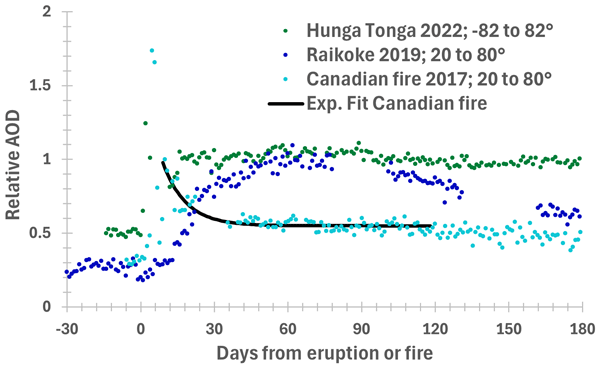
Highly variable stratospheric aerosol bears great importance for Earth's climate. The 1-year average aerosol load from the 2022 volcanic eruption in Hunga Tonga is the highest since the 1991 Mt. Pinatubo eruption. The usual volcanic aerosol precursor gas (SO2) mass was not sufficient to explain the aerosol load. Intense volcanism–sea interaction amplified the eruption, and sea salt emission forms a plausible explanation for the high aerosol loading.
Johan Friberg, Bengt G. Martinsson, and Moa K. Sporre
Atmos. Chem. Phys., 23, 12557–12570, https://doi.org/10.5194/acp-23-12557-2023, https://doi.org/10.5194/acp-23-12557-2023, 2023
Short summary
Short summary
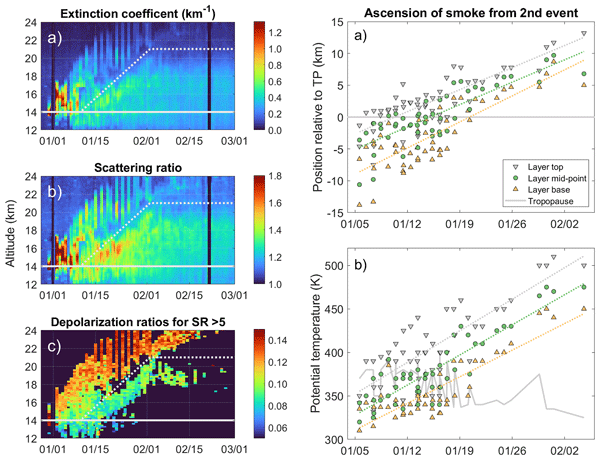
We study the short- and long-term stratospheric impact of smoke from the massive Australian wildfires in Dec 2019–Jan 2020 using four satellite sensors. Smoke entered the stratosphere rapidly via transport by firestorms, as well as weeks after the fires. The smoke particle properties evolved over time together with rapidly decreasing stratospheric aerosol load, suggesting photolytic loss of organics in the smoke particles. The depletion rate was estimated to a half-life (e folding) of 10 (14) d.
Bengt G. Martinsson, Johan Friberg, Oscar S. Sandvik, and Moa K. Sporre
Atmos. Chem. Phys., 22, 3967–3984, https://doi.org/10.5194/acp-22-3967-2022, https://doi.org/10.5194/acp-22-3967-2022, 2022
Short summary
Short summary
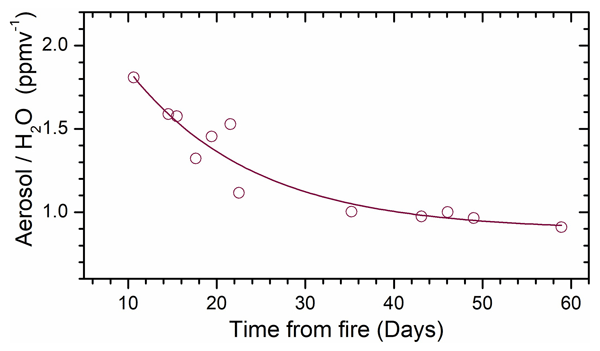
Large amounts of wildfire smoke reached the stratosphere in 2017. The literature on stratospheric aerosol is mainly based on horizontally viewing sensors that saturate in dense smoke. Using also a vertically viewing sensor with orders of magnitude shorter path in the smoke, we show that the horizontally viewing sensors miss a dramatic exponential decline of the aerosol load with a half-life of 10 d, where 80 %–90 % of smoke is lost. We attribute the decline to photolytic loss of organic aerosol.
Oscar S. Sandvik, Johan Friberg, Moa K. Sporre, and Bengt G. Martinsson
Atmos. Meas. Tech., 14, 7153–7165, https://doi.org/10.5194/amt-14-7153-2021, https://doi.org/10.5194/amt-14-7153-2021, 2021
Short summary
Short summary
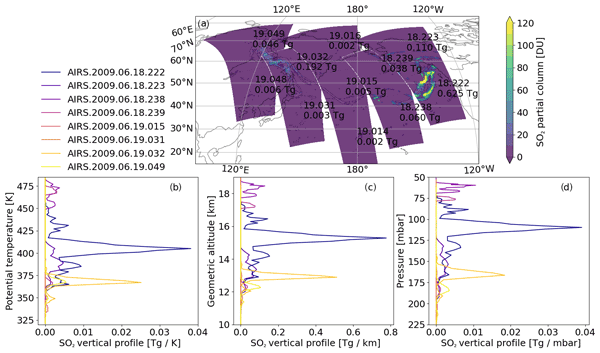
A method to form SO2 profiles in the stratosphere with high vertical resolution following volcanic eruptions is introduced. The method combines space-based high-resolution vertical aerosol profiles and SO2 measurements the first 2 weeks after an eruption with air mass trajectory analyses. The SO2 is located at higher altitude than in most previous studies. The detailed resolution of the SO2 profile is unprecedented compared to other methods.
Moa Kristina Sporre, Linda Hartman, Shubham Singh, and Johan Friberg
EGUsphere, https://doi.org/10.5194/egusphere-2026-1795, https://doi.org/10.5194/egusphere-2026-1795, 2026
Short summary
Short summary
We have investigated 50 years of fog frequency data at 12 Swedish airports. In the investigation we have used meteorological data from the airports and measurements of sulfur aerosol concentrations. Fog frequency has decreased in southern Sweden, likely linked to a decline in aerosol concentrations. Fog frequencies in northern Sweden have increased at some airports, which we connect to a combination of increased river temperatures in and low wind speeds.
Carl Svenhag, Pontus Roldin, Tinja Olenius, Robin Wollesen de Jonge, Sara M. Blichner, Daniel Yazgi, and Moa K. Sporre
Atmos. Chem. Phys., 25, 11483–11504, https://doi.org/10.5194/acp-25-11483-2025, https://doi.org/10.5194/acp-25-11483-2025, 2025
Short summary
Short summary
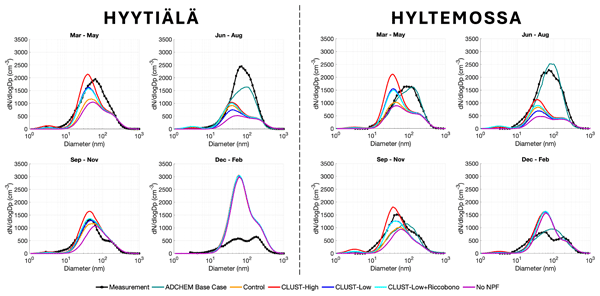
This study is an investigation of the model representation of how particles are formed and grow in the atmosphere. Using modelled and observed data from two boreal forest stations in 2018, we identify key factors for new particle formation to improve particle climate predictions in the global EC-Earth3 model. Comparisons with the detailed ADCHEM model show that adding ammonia improves particle growth predictions, though EC-Earth3 still greatly underestimates the number of particles during warmer months.
Bengt G. Martinsson, Johan Friberg, and Moa K. Sporre
Atmos. Chem. Phys., 25, 10677–10690, https://doi.org/10.5194/acp-25-10677-2025, https://doi.org/10.5194/acp-25-10677-2025, 2025
Short summary
Short summary
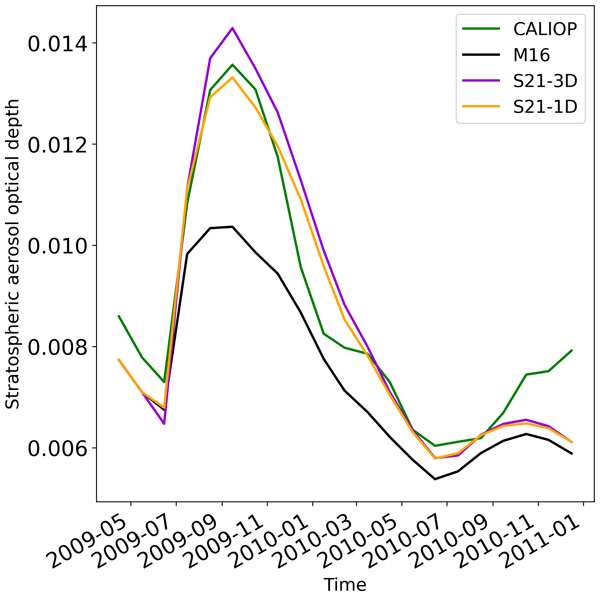
Highly variable stratospheric aerosol bears great importance for Earth's climate. The 1-year average aerosol load from the 2022 volcanic eruption in Hunga Tonga is the highest since the 1991 Mt. Pinatubo eruption. The usual volcanic aerosol precursor gas (SO2) mass was not sufficient to explain the aerosol load. Intense volcanism–sea interaction amplified the eruption, and sea salt emission forms a plausible explanation for the high aerosol loading.
Emma Axebrink, Moa K. Sporre, and Johan Friberg
Atmos. Chem. Phys., 25, 2047–2059, https://doi.org/10.5194/acp-25-2047-2025, https://doi.org/10.5194/acp-25-2047-2025, 2025
Short summary
Short summary
We investigate the importance of using high-vertical-resolution (HR) SO2 data when simulating volcanic eruptions' impact on the stratospheric aerosol load and climate, using WACCM, and compare simulations with aerosol observations from CALIOP. Simulations with HR SO2 data match the observations well, whereas simulations with the model's default low-resolution (LR) data underestimate the aerosol load by ~ 50 %. The resulting climate cooling is twice as high for the HR than the LR SO2 data.
Carl Svenhag, Moa K. Sporre, Tinja Olenius, Daniel Yazgi, Sara M. Blichner, Lars P. Nieradzik, and Pontus Roldin
Geosci. Model Dev., 17, 4923–4942, https://doi.org/10.5194/gmd-17-4923-2024, https://doi.org/10.5194/gmd-17-4923-2024, 2024
Short summary
Short summary
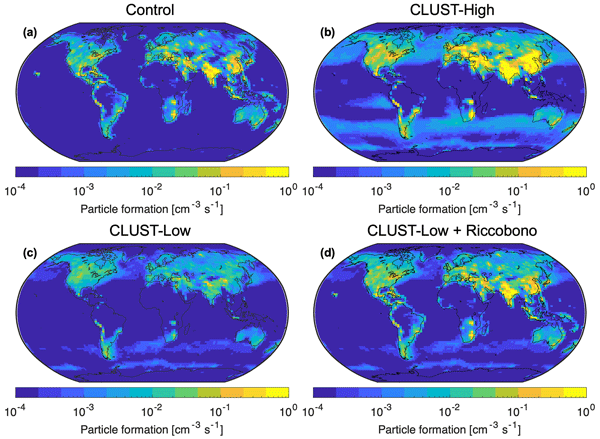
Our research shows the importance of modeling new particle formation (NPF) and growth of particles in the atmosphere on a global scale, as they influence the outcomes of clouds and our climate. With the global model EC-Earth3 we show that using a new method for NPF modeling, which includes new detailed processes with NH3 and H2SO4, significantly impacts the number of particles in the air and clouds and changes the radiation balance of the same magnitude as anthropogenic greenhouse emissions.
Johan Friberg, Bengt G. Martinsson, and Moa K. Sporre
Atmos. Chem. Phys., 23, 12557–12570, https://doi.org/10.5194/acp-23-12557-2023, https://doi.org/10.5194/acp-23-12557-2023, 2023
Short summary
Short summary
We study the short- and long-term stratospheric impact of smoke from the massive Australian wildfires in Dec 2019–Jan 2020 using four satellite sensors. Smoke entered the stratosphere rapidly via transport by firestorms, as well as weeks after the fires. The smoke particle properties evolved over time together with rapidly decreasing stratospheric aerosol load, suggesting photolytic loss of organics in the smoke particles. The depletion rate was estimated to a half-life (e folding) of 10 (14) d.
Bengt G. Martinsson, Johan Friberg, Oscar S. Sandvik, and Moa K. Sporre
Atmos. Chem. Phys., 22, 3967–3984, https://doi.org/10.5194/acp-22-3967-2022, https://doi.org/10.5194/acp-22-3967-2022, 2022
Short summary
Short summary
Large amounts of wildfire smoke reached the stratosphere in 2017. The literature on stratospheric aerosol is mainly based on horizontally viewing sensors that saturate in dense smoke. Using also a vertically viewing sensor with orders of magnitude shorter path in the smoke, we show that the horizontally viewing sensors miss a dramatic exponential decline of the aerosol load with a half-life of 10 d, where 80 %–90 % of smoke is lost. We attribute the decline to photolytic loss of organic aerosol.
Sara Marie Blichner, Moa Kristina Sporre, and Terje Koren Berntsen
Atmos. Chem. Phys., 21, 17243–17265, https://doi.org/10.5194/acp-21-17243-2021, https://doi.org/10.5194/acp-21-17243-2021, 2021
Short summary
Short summary
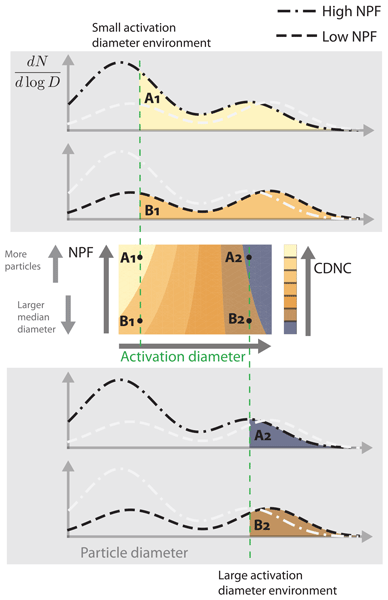
In this study we quantify how a new way of modeling the formation of new particles in the atmosphere affects the estimated cooling from aerosol–cloud interactions since pre-industrial times. Our improved scheme merges two common approaches to aerosol modeling: a sectional scheme for treating early growth and the pre-existing modal scheme in NorESM. We find that the cooling from aerosol–cloud interactions since pre-industrial times is reduced by 10 % when the new scheme is used.
Oscar S. Sandvik, Johan Friberg, Moa K. Sporre, and Bengt G. Martinsson
Atmos. Meas. Tech., 14, 7153–7165, https://doi.org/10.5194/amt-14-7153-2021, https://doi.org/10.5194/amt-14-7153-2021, 2021
Short summary
Short summary
A method to form SO2 profiles in the stratosphere with high vertical resolution following volcanic eruptions is introduced. The method combines space-based high-resolution vertical aerosol profiles and SO2 measurements the first 2 weeks after an eruption with air mass trajectory analyses. The SO2 is located at higher altitude than in most previous studies. The detailed resolution of the SO2 profile is unprecedented compared to other methods.
Cited articles
Andersson, S. M., Martinsson, B. G., Friberg, J., Brenninkmeijer, C. A. M., Rauthe-Schöch, A., Hermann, M., van Velthoven, P. F. J., and Zahn, A.: Composition and evolution of volcanic aerosol from eruptions of Kasatochi, Sarychev and Eyjafjallajökull in 2008–2010 based on CARIBIC observations, Atmos. Chem. Phys., 13, 1781–1796, https://doi.org/10.5194/acp-13-1781-2013, 2013.
Andersson, S. M., Martinsson, B. G., Vernier, J.-P., Friberg, J., Brenninkmeijer, C. A. M., Hermann, M., van Velthoven, P. F. J., and Zahn, A.: Significant radiative impact of volcanic aerosol in the lowermost stratosphere, Nat. Commun., 6, 1–8, https://doi.org/10.1038/ncomms8692, 2015.
Appenzeller, C., Holton, J. R., and Rosenlov, K. H.: Seasonal variation of mass transport across the tropopause, J. Geophys. Res., 101, 15071–15078, 1996.
Austin, J. and Li, F.: On the relationship between the strength of the Brewer-Dobson circulation and the age of stratospheric air, Geophys. Res. Lett., 33, L17807, https://doi.org/10.1029/2006GL026867, 2006.
Axebrink, E., Sporre, M. K., and Friberg, J.: Impact of SO2 injection profiles on simulated volcanic forcing for the 2009 Sarychev eruptions – investigating the importance of using high-vertical-resolution methods when compiling SO2 data, Atmos. Chem. Phys., 25, 2047–2059, https://doi.org/10.5194/acp-25-2047-2025, 2025.
Baars, H., Ansmann, A., Ohneiser, K., Haarig, M., Engelmann, R., Althausen, D., Hanssen, I., Gausa, M., Pietruczuk, A., Szkop, A., Stachlewska, I. S., Wang, D., Reichardt, J., Skupin, A., Mattis, I., Trickl, T., Vogelmann, H., Navas-Guzmán, F., Haefele, A., Acheson, K., Ruth, A. A., Tatarov, B., Müller, D., Hu, Q., Podvin, T., Goloub, P., Veselovskii, I., Pietras, C., Haeffelin, M., Fréville, P., Sicard, M., Comerón, A., Fernández García, A. J., Molero Menéndez, F., Córdoba-Jabonero, C., Guerrero-Rascado, J. L., Alados-Arboledas, L., Bortoli, D., Costa, M. J., Dionisi, D., Liberti, G. L., Wang, X., Sannino, A., Papagiannopoulos, N., Boselli, A., Mona, L., D'Amico, G., Romano, S., Perrone, M. R., Belegante, L., Nicolae, D., Grigorov, I., Gialitaki, A., Amiridis, V., Soupiona, O., Papayannis, A., Mamouri, R.-E., Nisantzi, A., Heese, B., Hofer, J., Schechner, Y. Y., Wandinger, U., and Pappalardo, G.: The unprecedented 2017–2018 stratospheric smoke event: decay phase and aerosol properties observed with the EARLINET, Atmos. Chem. Phys., 19, 15183–15198, https://doi.org/10.5194/acp-19-15183-2019, 2019.
Bauman, J. J., Russell, P. B., Geller, M. A., and Hamill, P.: A stratospheric aerosol climatology from SAGE II and CLAES measurements, 2. Results and comparisons, 1984–1999, J. Geophys. Res., 108, 4383, https://doi.org/10.1029/2002JD002993, 2003.
Behrenfeld, M. J., Lorenzoni, L., Hu, Y., Bissom, K. M., Hostetler, C. A., Di Girolamo, P., Dionisi, D., Longo, F., and Zoffoli, S.: Satellite Lidar Measurements as a Critical New Global Ocean Climate Record, Remote Sens., 15, 5567, https://doi.org/10.3390/rs15235567, 2023.
Brühl, C., Lelieveld, J., Crutzen, P. J., and Tost, H.: The role of carbonyl sulphide as a source of stratospheric sulphate aerosol and its impact on climate, Atmos. Chem. Phys., 12, 1239–1253, https://doi.org/10.5194/acp-12-1239-2012, 2012.
Butchart, N.: The Brewer-Dobson circulation, Rev. Geophys., 52, 157–184, https://doi.org/10.1002/2013RG000448, 2014.
Carn, S. A., Krueger, A. J., Krotkov, N. A., Yang, K., and Evans, K.: Tracking volcanic sulfur dioxide clouds for aviation hazard mitigation, Nat. Hazards, 51, 325–343, https://doi.org/10.1007/s11069-008-9228-4, 2009.
Carn, S. A. and Prata, F. J.: Satellite-based constraints on explosive SO2 release from Soufrière Hills Volcano, Montserrat, Geophys. Res. Lett., 37, 1–5, https://doi.org/10.1029/2010GL044971, 2010.
Carn, S. A., Krotkov, N. A., Fisher, B. L., and Li, C.: Out of the blue, Volcanic SO2 emissions during the 2021–2022 eruptions of Hunga Tonga– Hunga Ha'apai (Tonga), Front. Earth Sci., 10, 976962, https://doi.org/10.3389/feart.2022.976962, 2022.
Chin, M. and Davies, D. D.: A reanalysis of carbonyl sulfide as a source of stratospheric background sulfur aerosol, J. Geophys. Res., 100, 8993–9005, 1995.
Clarisse, L., Hurtmans, D., Clerbaux, C., Hadji-Lazaro, J., Ngadi, Y., and Coheur, P.-F.: Retrieval of sulphur dioxide from the infrared atmospheric sounding interferometer (IASI), Atmos. Meas. Tech., 5, 581–594, https://doi.org/10.5194/amt-5-581-2012, 2012.
Clarisse, L., Coheur, P.-F., Prata, F., Hadji-Lazaro, J., Hurtmans, D., and Clerbaux, C.: A unified approach to infrared aerosol remote sensing and type specification, Atmos. Chem. Phys., 13, 2195–2221, https://doi.org/10.5194/acp-13-2195-2013, 2013.
Crutzen, P. J.: The possible importance of CSO for the sulfate layer of the stratosphere, Geophys. Res. Lett., 3, 73–76, 1976.
Cruz, M. G., Sullivan, A. L., Gould, J. S., Sims, N. C., Bannister, A. J., Hollis, J. J., and Hurley, R. J.: Anatomy of a catastrophic wildfire: The Black Saturday Kilmore East fire in Victoria, Australia, Forest Ecol. Manag. 284, 269–295, 2012.
Damadeo, R. P., Zawodny, J. M., Thomason, L. W., and Iyer, N.: SAGE version 7.0 algorithm: application to SAGE II, Atmos. Meas. Tech., 6, 3539–3561, https://doi.org/10.5194/amt-6-3539-2013, 2013.
Friberg, J., Martinsson, B. G., Andersson, S. M., Brenninkmei jer, C. A. M., Hermann, M., Van Velthoven, P. F. J., and Zahn, A.: Sources of increase in lowermost stratospheric sulphurous and carbonaceous aerosol background concentrations during 1999–2008 derived from CARIBIC flights, Tellus B, 66, 23428, https://doi.org/10.3402/tellusb.v66.23428, 2014.
Friberg, J., Martinsson, B. G., Andersson, S. M., and Sandvik, O. S.: Volcanic impact on the climate – the stratospheric aerosol load in the period 2006–2015, Atmos. Chem. Phys., 18, 11149–11169, https://doi.org/10.5194/acp-18-11149-2018, 2018.
Friberg, J., Martinsson, B. G., and Sporre, M. K.: Short- and long-term stratospheric impact of smoke from the 2019–2020 Australian wildfires, Atmos. Chem. Phys., 23, 12557–12570, https://doi.org/10.5194/acp-23-12557-2023, 2023.
Fromm, M., Lindsey, D. T., Servranckx, R., Yue, G., Trickl, T., Sica, R., Doucet, P., and Godin-Beekmann, S.: The untold story of pyrocumulonimbus, B. Am. Meteorol. Soc., 91, 1193–1209, 2010.
Fromm, M., Kablick III, G. P., Peterson, D. A., Kahn, R. A., Flower, V. J. B., and Seftor, C. J.: Quantifying the source term and uniqueness of the August 12, 2017 Pacific Northwest pyroCb event, J. Geophys. Res., 126, https://doi.org/10.1029/2021JD034928, 2021.
Garofalo, L. A., Levin, E. J. T., Campos, T., Kreidenweis, S. N., and Farmer, D. K.: Emission and evolution of submicron organic aerosol in smoke from wild fires in the western United States, ACS Space Chem., 3, 1237–1247, 2019.
Gelaro, R., McCarty, W., Suarez, M. J., Todling, R., Moloud, A., Takacs, L., Randles, C. A., Darmenov, A., Bosilovich, M. G., Reichle, R., Wargan, K., Coy, L., Cullather, R., Draper, C., Akella, S., Buchard, V., Conaty, A., da Silva, A. M., Gu, W., Kim, G.-K., Koster, R., Lucchesi, R., Merkova, D., Nielsen, J. E., Partyka, G., Pawson, S., Putman, W., Rienecker, M., Schubert, S. D., Seinkiewicz, M., and Zhao, B.: The Modern-Era Retrospective Analysis for Research and Applications, Version 2 (MERRA-2), J. Clim. 30, 5419–5454, 2017.
Haywood, J. M., Jones, A., Clarisse, L., Bourassa, A., Barnes, J., Telford, P., Bellouin, N., Boucher, O., Agnew, P., Clerbaux, C., Coheur, P., Degenstein, D., and Braesicke, P.: Observations of the eruption of the Sarychev volcano and simulations using the HadGEM2 climate model, J. Geophys. Res., 115, https://doi.org/10.1029/2010JD014447, 2010.
Illingworth, A. J., Barker, H. W., Beljaars, A., Ceccaldi, M., Chepfer, H., Clerbaux, N., Cole, J., Delanoë, J., Domenech, C., Donovan, D. P., Fukuda, S., Hirakata, M., Hogan, R. J., Huenerbein, A., Kollias, P., Kubota, T., Nakajima, T., Naka jima, T. Y., Nishizawa, T., Ohno, Y., Okamoto, H., Oki, R., Sato, K., Satoh, M., Shephard, M. W., Velázquez-Blázquez, A., Wandinger, U., Wehr, T., and van Zadelhoff, G.-J.: The Earth CARE Satellite, The Next Step Forward in Global Measurements of Clouds, Aerosols, Precipitation, and Radiation, B. Am. Meteorol. Soc., 96, 1311–1332, https://doi.org/10.1175/BAMS-D-12-00227.1, 2015.
Junge, C. E., Chagnon, C. W., and Manson, J. E.: A World-wide Stratospheric Aerosol Layer, Science, 133, 1478–1479, 1961.
Kablick, G. P., Allen, D. R., Fromm, M. D., and Nedoluha, G. E.: Australian PyroCb Smoke Generates Synoptic-Scale Strato spheric Anticyclones, Geophys. Res. Lett., 47, https://doi.org/10.1029/2020GL088101, 2020.
Kar, J., Lee, K.-P., Vaughan, M. A., Tackett, J. L., Trepte, C. R., Winker, D. M., Lucker, P. L., and Getzewich, B. J.: CALIPSO level 3 stratospheric aerosol profile product: version 1.00 algorithm description and initial assessment, Atmos. Meas. Tech., 12, 6173–6191, https://doi.org/10.5194/amt-12-6173-2019, 2019.
Kloss, C., Berthet, G., Sellitto, P., Ploeger, F., Taha, G., Tidiga, M., Eremenko, M., Bossolasco, A., Jégou, F., Renard, J.-B., and Legras, B.: Stratospheric aerosol layer perturbation caused by the 2019 Raikoke and Ulawun eruptions and their radiative forcing, Atmos. Chem. Phys., 21, 535–560, https://doi.org/10.5194/acp-21-535-2021, 2021.
Kovilakam, M., Thomason, L. W., Ernest, N., Rieger, L., Bourassa, A., and Millán, L.: The Global Space-based Stratospheric Aerosol Climatology (version 2.0): 1979–2018, Earth Syst. Sci. Data, 12, 2607–2634, https://doi.org/10.5194/essd-12-2607-2020, 2020.
Kovilakam, M., Thomason, L., and Knepp, T.: SAGE III/ISS aerosol/cloud categorization and its impact on GloSSAC, Atmos. Meas. Tech., 16, 2709–2731, https://doi.org/10.5194/amt-16-2709-2023, 2023.
Kremser, S., Thomason, L. W., von Hobe, M., Hermann, M., Desh ler, T., Timmreck, C., Toohey, M., Stenke, A., Schwarz, J. P., Weigel, R., Fueglistaler, S., Prata, F. J., Vernier, J. P., Schlager, H., Barnes, J. E., Antuña-Marrero, J. C., Fairlie, D., Palm, M., Mahieu, E., Notholt, J., Rex, M., Bingen, C., Vanhellemont, F., Bourassa, A., Plane, J. M. C., Klocke, D., Carn, S. A., Clarisse, L., Trickl, T., Neely, R., James, A. D., Rieger, L., Wilson, J. C., and Meland, B.: Stratospheric aerosol– Observations, processes, and impact on climate, Rev. Geophys., 54, 278–335, https://doi.org/10.1002/2015RG000511, 2016.
Li, C., Krotkov, N. A., Carn, S., Zhang, Y., Spurr, R. J. D., and Joiner, J.: New-generation NASA Aura Ozone Monitoring Instrument (OMI) volcanic SO2 dataset: algorithm description, initial results, and continuation with the Suomi-NPP Ozone Mapping and Profiler Suite (OMPS), Atmos. Meas. Tech., 10, 445–458, https://doi.org/10.5194/amt-10-445-2017, 2017.
Malinina, E., Rozanov, A., Niemeier, U., Wallis, S., Arosio, C., Wrana, F., Timmreck, C., von Savigny, C., and Burrows, J. P.: Changes in stratospheric aerosol extinction coefficient after the 2018 Ambae eruption as seen by OMPS-LP and MAECHAM5-HAM, Atmos. Chem. Phys., 21, 14871–14891, https://doi.org/10.5194/acp-21-14871-2021, 2021.
Martinsson, B. G., Nguyen, H. N., Brenninkmeijer, C. A. M., Zahn, A., Heintzenberg, J., Hermann, M., and van Velthoven, P. F. J.: Characteristics and origin of lowermost stratospheric aerosol at northern midlatitudes under volcanically quiescent conditions based on CARIBIC observations, J. Geophys. Res., 110, https://doi.org/10.1029/2004JD005644, 2005.
Martinsson, B. G., Brenninkmeijer, C. A. M., Cam, S. A., Hermann, M., Heue, K. P., van Velthoven, P. F. J., and Zahn, A.: Influence of the 2008 Kasatochi volcanic eruption on sulfurous and carbonaceous aerosol constituents in the lower stratosphere, Geophys. Res. Lett., 36, 1–5, https://doi.org/10.1029/2009GL038735, 2009.
Martinsson, B. G., Friberg, J., Sandvik, O. S., Hermann, M., van Velthoven, P. F. J., and Zahn, A.: Particulate sulfur in the upper troposphere and lowermost stratosphere – sources and climate forcing, Atmos. Chem. Phys., 17, 10937–10953, https://doi.org/10.5194/acp-17-10937-2017, 2017.
Martinsson, B. G., Friberg, J., Sandvik, O. S., Hermann, M., van Velthoven, P. F. J., and Zahn, A.: Formation and composition of the UTLS aerosol, npj Climate and Atmospheric Science, 2, 1–6, https://doi.org/10.1038/s41612-019-0097-1, 2019.
Martinsson, B. G., Friberg, J., Sandvik, O. S., and Sporre, M. K.: Five-satellite-sensor study of the rapid decline of wildfire smoke in the stratosphere, Atmos. Chem. Phys., 22, 3967–3984, https://doi.org/10.5194/acp-22-3967-2022, 2022.
Martinsson, B. G., Friberg, J., and Sporre, M. K.: Stratospheric aerosol formed by intense volcanism–sea interaction during the 2022 Hunga Ha'apai eruption, Atmos. Chem. Phys., 25, 10677–10690, https://doi.org/10.5194/acp-25-10677-2025, 2025.
Mastin, L. G., Van Eaton, A. R., and Cronin, S. J.: Did steam boost the height and growth rate of the giant Hunga eruption plume?, B. Volcanol., 86, 64, https://doi.org/10.1007/s00445-024-01749-1, 2024.
McCarthy, G. J., Plucinski, M. P., and Gould, J. S.: Analysis of the resourcing and containment of multiple remote fires: The Great Divide Complex of fires, Victoria, December 2006, Aust. Forestry, 75, 54–63, https://doi.org/10.1080/00049158.2012.10676385, 2012.
Mote, P. W., Dunkerton, T. J., McIntyre, M. E., Ray, E. A., Haynes, P. H., and Russell III, J. M.: Vertical velocity, vertical diffusion, and dilution by midlatitude air in the tropical lower stratosphere, J. Geophys. Res. 103, 8651–8666, 1998.
Murphy, D. M., Cziczo, D. J., Hudson, P. K., and Thomson, D. S.: Carbonaceous material in aerosol particles in the lower stratosphere and tropopause region, J. Geophys. Res., 112, https://doi.org/10.1029/2006JD007297, 2007.
NASA/LARC/SD/ASDC: Science CALIPSO Lidar Level 1B profile data, V4-51, NASA Langley Atmospheric Data Center DAAC [data set], https://doi.org/10.5067/CALIOP/CALIPSO/CAL_LID_L1-Standard-V4-51, 2024.
Nicknish, P. A., Stone, K., Solomon, S., and Carn, S. A.: Quantifying the decay timescale of volcanic sulfur dioxide in the stratosphere, Atmos. Chem. Phys., 25, 11535–11555, https://doi.org/10.5194/acp-25-11535-2025, 2025.
Ohneiser, K., Ansmann, A., Baars, H., Seifert, P., Barja, B., Jimenez, C., Radenz, M., Teisseire, A., Floutsi, A., Haarig, M., Foth, A., Chudnovsky, A., Engelmann, R., Zamorano, F., Bühl, J., and Wandinger, U.: Smoke of extreme Australian bushfires observed in the stratosphere over Punta Arenas, Chile, in January 2020: optical thickness, lidar ratios, and depolarization ratios at 355 and 532 nm, Atmos. Chem. Phys., 20, 8003–8015, https://doi.org/10.5194/acp-20-8003-2020, 2020.
Pardini, F., Burton, M., Arzilli, F., La Spina, G., and Polacci, M.: SO2 emissions, plume heights and magmatic processes inferred from satellite data: The 2015 Calbuco eruptions, J. Volcanol. Geotherm. Res., 361, 12–24, 2018.
Peterson, D. A., Fromm, M. D., McRae, R. H. D., Campbell, J. R., Hyer, E. J., Taha, G., Camacho, C. P., Kablick, G. P., Schmidt, C. C., and DeLand, M. T.: Australia's Black Summer pyrocumulonimbus super outbreak reveals potential for increasingly extreme stratospheric smoke events, Npj Clim. Atmos. Sci., 4, 38 https://doi.org/10.1038/s41612-021-00192-9, 2021.
Peterson, D. A., Berman, M. T., Fromm, M. D., Servranckx, R., Julstrom, W. J., Hyer, E. J., Campbell, J. R., McHardy, T. M., and Lambert, A.: Worldwide inventory reveals the frequency and variability of pyrocumulonimbus and stratospheric smoke plumes during 2013–2023, Npj Clim. Atmos. Sci., 8, 325, https://doi.org/10.1038/s41612-025-01188-5, 2025.
Ploeger, F., Diallo, M., Charlesworth, E., Konopka, P., Legras, B., Laube, J. C., Grooß, J.-U., Günther, G., Engel, A., and Riese, M.: The stratospheric Brewer–Dobson circulation inferred from age of air in the ERA5 reanalysis, Atmos. Chem. Phys., 21, 8393–8412, https://doi.org/10.5194/acp-21-8393-2021, 2021.
Prata, A. T., Young, S. A., Siems, S. T., and Manton, M. J.: Lidar ratios of stratospheric volcanic ash and sulfate aerosols retrieved from CALIOP measurements, Atmos. Chem. Phys., 17, 8599–8618, https://doi.org/10.5194/acp-17-8599-2017, 2017.
Rieger, L. A., Bourassa, A. E., and Degenstein, D. A.: Merging the OSIRIS and SAGE II stratospheric aerosol records, J. Geophys. Res.-Atmos., 120, 8890–8904, https://doi.org/10.1002/2015JD023133, 2015.
Sandvik, O. S., Friberg, J., Sporre, M. K., and Martinsson, B. G.: Methodology to obtain highly resolved SO2 vertical profiles for representation of volcanic emissions in climate models, Atmos. Meas. Tech., 14, 7153–7165, https://doi.org/10.5194/amt-14-7153-2021, 2021.
Sato, M., Hansen, J. E., McCormick, M. P., and Pollack J. B.: Stratospheric aerosol optical depths, 1850–1990, J. Geophys. Res., 98, 22987–22994, 1993.
Schmidt, A., Mills, M. J., Ghan, S., Gregory, J. M., Allan, R. P., Andrews, T., Bardeen, C. G., Conley, A., Forster, P. M., Gettelman, A., Portmann, R. W., Solomon, S., and Toon, O. B.: Volcanic radiative forcing from 1979 to 2015, J. Geophys. Res.-Atmos., 123, 12491–12508, https://doi.org/10.1029/2018JD028776, 2018.
Seabrook, S., Mackay, K., Watson, S. J., Clare, M. A., Hunt, J. E., Yeo, I. A., Lane, E. M., Clark, M. R., Wysoczanski, R., Rowden, A. A., Kula, T., Hoffmann, L. J., Armstrong, E., and Williams, M. J. M.: Volcaniclastic density currents explain widespread and di verse seafloor impacts of the 2022 Hunga Volcano eruption, Nat. Commun., 14, 7881, https://doi.org/10.1038/s41467-023-43607 2, 2023.
Sheng, J.-X., Weisenstein, D. K., Luo, B.-P., Rozanov, E., Stenke, A., Anet, J., Bingemer, H., and Peter, T.: Global atmospheric sulfur budget under volcanically quiescent conditions: Aerosol-chemistry-climate model predictions and validation, J. Geophys. Res.-Atmos., 120, 256–276, https://doi.org/10.1002/2014JD021985, 2015.
Solomon, S., Daniel, J. S., Neely, R. R., Vernier, J.-P., Dutton, E. G., and Thomason, L. W.: The persistently variable “background” stratospheric aerosol layer and global climate change, Science, 333, 866–870, 2011.
Solomon, S., Dube, K., Stone, K., Yu, P., Kinnison, D., Toon, O. B., Strahan, S. E., Rosenlov, K. H., Portmann, R., Davis, S., Randel, W., Bernath, P., Boone, C., Bardeen, C. G., Bourassa, A., Zawada, D., and Degenstein, D.: On the stratospheric chemistry of midlatitude wildfire smoke, Proc. Natl. Acad. Sci. USA, 119, https://doi.org/10.1073/pnas.2117325119, 2022.
Surono, Jousset, P., Pallister, J., Boichu, M., Boungiorno, M. F., Budisantoso, A., Costa, F., Andreastuti, S., Prata, F., Schneider, D., Clarisse, L., Humaida, H., Sumarti, S., Bignami, C., Griswold, J., Carn, S., Oppenheimer C., and Lavigne F.: The 2010 explosive eruption of Java's Merapi volcano – A “100-year” event, J. Volcanol. Geotherm. Res. 241–242, 121–135, 2012.
Taylor, I. A., Grainger, R. G., Prata, A. T., Proud, S. R., Mather, T. A., and Pyle, D. M.: A satellite chronology of plumes from the April 2021 eruption of La Soufrière, St Vincent, Atmos. Chem. Phys., 23, 15209–15234, https://doi.org/10.5194/acp-23-15209-2023, 2023.
Thomas, H. E., Watson, I. M., Carn, S. A., Prata, A. J., and Realmuta, V. J.: A comparison of AIRS, MODIS and OMI sulphur dioxide retrievals in volcanic clouds, Geomatics, Natural Hazards and Risk, 2, 217–232, 2011.
Thomason, L. W., Ernest, N., Millán, L., Rieger, L., Bourassa, A., Vernier, J.-P., Manney, G., Luo, B., Arfeuille, F., and Peter, T.: A global space-based stratospheric aerosol climatology: 1979–2016, Earth Syst. Sci. Data, 10, 469–492, https://doi.org/10.5194/essd-10-469-2018, 2018.
Vernier, J.-P., Pommereau, J. P., Garnier, A., Pelon, J., Larsen, N., Nielsen, J., Christiansen, T., Cairo, F., Thomason, L. W., Leblanc, T., and McDermid, I. S.: Tropical stratospheric aerosol layer from CALIPSO lidar observations, J. Geophys. Res., 114, https://doi.org/10.1029/2009JD011946, 2009.
Vernier, J.-P., Farlie, T. D., Murray, J. J., Tupper, A., Trepte, C., Winker, D., Pelon, J., Garnier, A., Jumelet, J., Pavolonis, M., Omar, A. H., and Powell, K. A.: An Advanced System to Monitor the 3D Structure of Diffuse Volcanic Ash Clouds, J. Appl. Meteorol. Clim., 10, 2125–2138, 2013.
Vernier, J.-P., Farlie, T. D., Natarajan, M., Wiengold, F. G., Bian, J., Martinsson, B. G., Crumeyrolle, S., Thomason, L. W., and Bedka, K. M.: Increase in upper tropospheric and lower stratospheric aerosol levels and its potential connection with Asian pollution, J. Geophys. Res., 120, https://doi.org/10.1002/ 2014JD022372, 2015.
Weisenstein, D. K., Yue, G. K., Ko, M. K. W., Sze, N.-D., Rodriguez, J. M., and Scott, C. J.: A two-dimensional model of sulfur species and aerosol, J. Geophys. Res., 102, 13019–13035, 1997.
Winker, D. M., Hunt, W. H., and McGill, M. J.: Initial performance assessment of CALIOP, Geophys. Res. Lett., 34, 1–5, https://doi.org/10.1029/2007GL030135, 2007.
Winker, D. M., Pelon, J., Coakley, J. A., Ackerman, S. A., Charl son, R. J., Colarco, P. R., Flamant, P., Fu, Q., Hoff, R. M., Kittaka, C., Kubar, T. L., Le Treut, H., McCormick, M. P., Mégie, G., Poole, L., Powell, K., Trepte, K., Vaughan, M. A., and Wielicki, B. A.: The CALIPSO mission – A global 3D view of aerosols and clouds, B. Am. Meteorol. Soc., 91, 1211–1229, https://doi.org/10.1175/2010BAMS3009.1, 2010.
Short summary
The highly variable stratospheric aerosol with great importance for the Earth’s climate was investigated with the satellite-based lidar CALIOP (Cloud-Aerosol LIdar with Orthogonal Polarization) during its entire active period 2006–2023. The background aerosol was identified, showing excellent agreement with solar occultation from the volcanically quiescent period (1998–2000), and indicate strong influence from carbonyl sulfide. 15 volcanic eruptions and 5 wildfires caused variability, from background radiative forcing of -0.14 to -0.4 W/m2.
The highly variable stratospheric aerosol with great importance for the Earth’s climate was...


Altmetrics
Final-revised paper
Preprint