
the Creative Commons Attribution 4.0 License.
the Creative Commons Attribution 4.0 License.
 | 16 Jun 2026
Measurement Report: Methane and NOx emissions from natural gas cooking stoves, the case of Chile and Colombia
Ricardo Morales-Betancourt
Cristóbal J. Galbán-Malagón
Thalia Montejo-Barato
Estela Blanco
Paula Tapia-Pino
Rosario Vargas
Cynthia Cordova
Colin Finnegan
Abenezer Shankute
Nicolas Huneeus
J. Sebastian Hernandez-Suarez
Paola Valencia
Marcelo Mena-Carrasco
Robert B. Jackson
Natural gas is widely used for household cooking, with methane (CH4), its main component, being a potent short-lived greenhouse gas (GHG). While a much cleaner alternative to solid fuels like wood and charcoal, natural gas combustion and leaks also contribute to GHG emissions and indoor air pollution. Yet, combustion and fugitive methane and air pollutant emissions from residential appliances, especially cookstoves, are poorly quantified in low- and middle-income countries. In this study, we measured CH4, carbon dioxide (CO2), carbon monoxide (CO), and nitrogen oxides (NOx) emissions from cookstoves in 35 homes in Santiago, Chile, and 23 in Bogotá, Colombia, two countries experiencing growth in natural gas use over the last decades. We assessed continuous (“stove-off”) methane leaks, ignition-related emissions, and combustion emissions, using a mass balance approach that accounts for air exchange rates and gas concentrations. Our real-world measurements provide rare data on household cookstove emissions and inform emission factors used in GHG inventories. The mean (median) methane emission rate during combustion was 410.2 (63.9) mg h−1 in Bogotá and 331.2 (30.7) mg h−1 in Santiago, respectively. The equivalent energy-based methane emission factors derived from the data for residential stoves in Bogotá averaged 80.8 (median = 16.2) and Santiago 41.2 (median = 3.66) kgCH4 TJ−1 are many times higher than the Tier 1 IPCC emission factors currently used in national inventories. Notably, our data suggests that continuous leaks and ignition-related emissions, which are excluded from current national and local emission inventories, contribute significantly to total methane emissions, with around 50 % of total methane emissions likely coming from continuous and episodic leaks, with the remaining half of emissions generated during combustion. For NOx, the emission factors from the measurements were 21.4 g GJ−1 (C.I., 19.1–23.8) and 15.8 g GJ−1 (C.I., 11.4–19.6) for Bogotá and Santiago, respectively. Overall, these findings suggest that current national inventories in Chile and Colombia underestimate methane emissions from household gas use, highlighting the need for more real-world measurements and research across Latin America. Our results have important implications for improving the accuracy of GHG inventories, understanding the role of household energy use in climate change, and guiding effective mitigation strategies.
- Article
(870 KB) - Full-text XML
-
Supplement
(2187 KB) - BibTeX
- EndNote


Natural gas is widely used for household cooking, with millions of homes globally relying on it for daily meal preparation in developing countries (Quinn et al., 2018; WHO, 2014) and with future use projected to increase further (Stoner et al., 2021). It is primarily composed of methane (CH4), with small amounts of other short-chain hydrocarbons such as butane, propane, and benzene (Chan et al., 2000; Rowland et al., 2024). In addition to carbon dioxide (CO2), the main driver of anthropogenic climate change, natural gas combustion generates air toxics and air pollutants such as carbon monoxide (CO), and nitrogen oxides (NOx = NO + NO2). Both, long-term (e.g., Huangfu and Atkinson, 2020), and short- term exposure to NO2 (Orellano et al., 2020; Zheng et al., 2021) have been associated with asthma and other deleterious health effects. NOx is also a key ozone precursor. Unlike other gas appliances that vent emissions outdoors, stoves release combustion byproducts directly indoors, which can impact both household air quality and contribute to overall air pollutant emissions (Barros and Fontes, 2024; Balmes et al., 2023).
Furthermore, methane itself is a significant contributor to anthropogenic greenhouse gas (GHG) emissions and plays a crucial role in global warming (e.g., Saunois et al., 2020). Although methane has an atmospheric lifetime of around 11 years, much shorter than that of CO2, its 100-year global warming potential is 28, making it a potent short-lived greenhouse gas whose emissions must be mitigated to avoid overshooting current climate goals (e.g., Schindell et al., 2012). Therefore, it has been recognized that mitigating methane is one of the fastest ways to reduce warming in the short term (UNEP, 2021). However, atmospheric CO2 and methane concentrations are still rising rapidly (Nisbet et al., 2019, 2020). In addition to driving climate change, methane emissions can play a significant role controlling global ozone background concentrations. Ozone, in turn, is an air pollutant and a GHG. Some studies estimate that reducing global anthropogenic methane emissions by 20 % could prevent >370 000 ozone-related premature deaths in a 20 year span (West et al., 2006), with other studies suggesting that a hypothetical reduction of anthropogenic methane to zero could lead to significant reductions in ozone exposure globally (Staniaszek et al., 2022). Therefore, reducing emissions associated with residential natural gas use would reduce emissions of key GHGs and air pollutants, and is likely to lead to improved indoor air quality.
In recent years, the use of natural gas in residential applications – including cooking, heating, and water heating – has expanded substantially not only in developed countries but also in developing and low-income countries (IEA, 2024), often replacing much dirtier fuels, such as biomass or other solid fuels, which are still prevalent in many regions. This increasing reliance on natural gas raises concerns about both indoor air quality and its contribution GHG emissions (IPCC, 2021), as emission trajectories that are compatible with decreasing the likelihood of extreme climate change require both substantial near-term reductions in global GHG emissions and to sustain those emissions at near net-zero. Most studies on methane emissions from the energy sector have focused on fugitive emissions from oil and gas exploitation, as well as leaks from natural gas distribution networks (Boothroyd et al., 2016; Hendrick et al., 2016; Staniaszek et al., 2022). However, far less research has been conducted on methane emissions occurring inside buildings, particularly from residential appliances like gas stoves (Lebel et al., 2022). Due to its strong global warming potential, even small methane leaks can contribute disproportionately to the total GHG emissions from buildings.
Natural gas appliances emit methane through incomplete combustion as well as through small but continuous methane leaks, even when the appliance is off (Lebel et al., 2022). Household cookstoves, although small in the quantity of gas burned when compared to gas furnaces, are important components in domestic energy use and contribute to GHG emissions. In developing countries, household fuel consumption represents a significant share of total energy use, yet the emission factors associated with small-scale fuel combustion are often poorly quantified compared to larger-scale sources (Levine, 1996). While some studies have reported emission factors for specific countries and fuel sources (e.g., Smith et al., 1993; Lebel et al., 2022), these datasets remain limited due to the overall scarcity of studies and the corresponding lack of geographic diversity, creating uncertainties in global emission inventories. Furthermore, fugitive methane emissions from residential appliances are often overlooked in the development of national emission inventories, and the reliance on generalized or non-local emission factors can lead to inaccurate estimation of emissions, affecting inventory accuracy. It also limits assimilation of research outcomes on the topic, as it is not an imported research initiative, but one that reflects local realities. These uncertainties hinder the accuracy of climate models and the development of effective mitigation and adaptation strategies. As research has shown in other natural gas applications, underestimating leakage of methane emissions can lead to significant misrepresentations of its full contribution to warming (e.g., Alvarez et al., 2012; Comer et al., 2024)
As evidence of emissions from natural gas stoves in the global south are scant, building on previous research, this study aims to quantify both GHG emissions as well as other air pollutant emissions, from natural gas cookstoves in Chile and Colombia. The two countries have experienced a rapid expansion in the use of natural gas as household fuel. In Colombia, natural gas currently supplies 17 % of residential energy demand, growing from just 2.8 PJ in 1991 to 56.4 PJ per year in 2021, a 20-fold increase, with emissions from its residential use currently accounting for 2.44 MtCO2eq. According to government estimates, most of its residential use is in direct-heat applications, overwhelmingly in cooking. Similarly, in Chile, adoption of natural gas has increased in recent years, and currently supplies some 13 % of the residential energy demand, and accounts for 1.08 MtCO2eq (MMA, 2018). According to Chile's official energy balances, final natural gas consumption increased from 73.8 PJ in 2004 to approximately 83.7 PJ in 2020. Although the increase in total final natural gas demand was moderate over this period, the residential segment became progressively more relevant (CNE, 2025). In 2020, aggregated commercial, public and residential (CPR) use accounted for 12.7 % (32.5 PJ) of final natural gas consumption, while in 2004 accounted for 5.4 % (18.2 PJ). Both countries, however, have strikingly different residential energy profiles due to climatic differences. In Chile, with a stronger seasonal cycle, residential heating is a significant component of residential energy demand which is supplied mainly by natural gas and wood. In Colombia, for contrast, most of the residential natural gas demand is destined for cooking. Because natural gas combustion emits significantly lower amounts of particulate pollution, methane, and other harmful species compared to biomass and other solid and liquid fuels, the quantification of the emission rates of air pollutants from residential gas stove use has been overlooked, resulting in limited data to characterize this atmospheric pollution source. By measuring emissions during different operational phases – including while the stove is off, during ignition, and during combustion – this research seeks to refine household emission estimates, providing evidence to improve GHG inventories, indoor air quality, and inform policy on residential energy use and climate mitigation strategies. These findings will be valuable for national regulators and policymakers, helping to bridge knowledge gaps and enhance the accuracy of emission estimates critical for climate action planning.
2.1 Data Collection
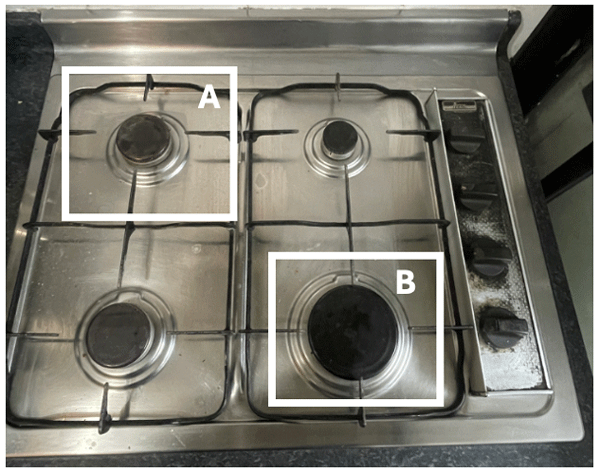
We measured CH4, CO2, CO and NOx (NO and NO2) emissions from cookstoves in 35 houses in Santiago de Chile and in 23 houses in Bogotá (Colombia). Sampling was carried out in private residences that used natural gas as fuel for cooking, with measurements taking place during June to August of 2024 in Chile, and during September and October of the same year in Colombia. Each sampling unit consisted of a kitchen equipped with a natural gas stove (see Fig. 1 for an example), and measurements were conducted on one to three burners. Ovens were not sampled during this campaign. These burners were tested at different heat outputs (high, medium and low flames) to assess emissions and leaks under different operational conditions, following previously established methodologies (Lebel et al., 2022; Kashtan et al., 2023). The sampled residences were selected to represent a variety of socio-economic status and locations within the city. The selected participants were asked to report information on stove characteristics through a short questionnaire. In the case of Colombia, natural gas use for cooking is widespread across socioeconomic sectors in urban areas, as its price has been competitive relative to electricity use. Therefore, house selection for sampling was carried out ensuring wide geographic coverage within the city and spanning houses in all socioeconomic status. As a result of this, the houses selected for sampling in Bogotá covered 11 out of the 16 administrative units in the city and spanned the totality of the six socioeconomic status classifications used by the Colombian Statistical Department. In the case of Santiago de Chile, natural gas is consumed across all socioeconomic groups, but its penetration and relative importance are greater among higher- and middle-income households, particularly in urban areas with access to distribution networks (CDT, 2019; FNE, 2020); thus, the sampling covered the user socioeconomic profile reflected in 10 out of 40 administrative units in the city of Santiago. The gas stoves sampled averaged 7-years old in Santiago and 10-years in Bogotá as registered in the self-reporting questionnaire. In some cases, the owner reported not knowing the age of the stove. Users were asked to report the number of times they used the stove on a typical day but did not gather detailed information on number of burners used or for how long they were typically used. The lack of detailed stove use data limits the ability to estimate accurate activity factors for gas-stove use. This limitation was partially overcome in the case of Bogotá, by registering the monthly natural gas consumption (in m3) from the natural gas service bill.
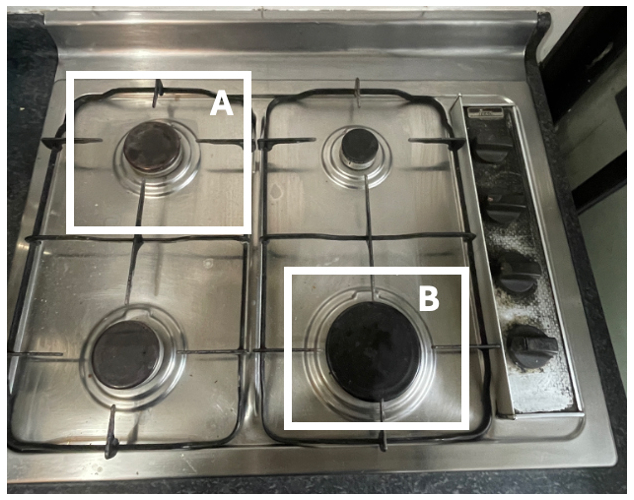
Figure 1A smaller burner (A) and a large burner (B) from one of the stoves used for sample collection in Santiago, Chile. (Photo taken by Abenezer Shankute).
Burner emissions were measured using a static flux chamber method as applied in recent studies (Lebel et al., 2022). In each sampled household, a chamber was created by enclosing the kitchen space using plastic sheets to estimate emission factors (though with plastic never used in assessing concentrations), making a best effort to minimize the air exchange between the enclosed kitchen space (containing the stove) and the surroundings. This approach was used to construct a chamber of known volume and with minimal air exchange with the surroundings. Seals were reinforced with foam bars, painter's tape, and sandbags. Fans were deployed to ensure a short mixing timescale inside the chamber, so the conditions of a well-mixed system were fulfilled (see Supplement).
Continuous gas monitors with sensitivity in the ppb range were used in both cities. For Methane (CH4), concentrations were recorded at 1 Hz with a Li-7810 Traces Gas Analyzer (LI-COR) and Aeris Mira ULTRA analyzer in Santiago and Picarro G-4301 non-dispersive infrared (NDIR) spectrometer for Bogotá sampling campaign. Limit of detection for methane emission rate was estimated at 0.05 mg h−1 (Lebel et al., 2022), assigning this value to negative numbers. All the NDIR instruments used also measure water vapor mole fractions and use this measurement to apply a correction due to the well-characterized cross-sensitivity of H2O on the trace gas being analyzed. This correction could be significant in the type of enclosed chamber experiments carried out in this study. NO and NO2 were measured with a Teledyne 200A and Thermo-Fischer 42iQ chemiluminescence analyzers. Carbon monoxide (CO) was measured with an APMA-370 NDIR spectrometer (Horiba Inc.) and Thermo 48i CO analyzer (Thermo Scientific). The temperature in the enclosed kitchen space was monitored with an Onset HOBO Logger (UX100-23A) and HT SensorPush data logger (HT.w Sensor) with the dual purpose of characterizing the range of temperature variations during the experiments and carrying out ideal-gas-law conversions from molar mixing ratios to either mass or molar concentrations. The devices were calibrated before the start of the sampling campaign in each city, which lasted for 3 weeks in Bogotá, and 5 weeks in Chile. Instrument operation started while the static chamber was set-up in each house, ensuring a warmup period of at least 30 min before sampling started.
2.2 Measurement of Emission Factors (EF)
We determined the emission rates for NOx (= NO + NO2), CO2, and CH4 in (mg min−1) for each sampled stove during three different operating settings. These operating settings were designed to determine (1) CH4 emissions resulting from continuous leaks, (2) instantaneous CH4 releases from turning on or off each burner, and (3) emissions of NOx, CO, CO2 and CH4 during combustion. Continuous leaks were measured during the “Steady-State Off” stage, which consists of measuring gas concentration within the enclosed space and the burners turned off, under constant air circulation. This process lasts approximately 10 min. Instantaneous releases of CH4 were quantified by analyzing the observed pulse of CH4 concentration, i.e., an immediate increase in concentration, after turning on or off a given burner.
After the “Steady-State Off” stage was completed, researchers then accessed the kitchen and proceeded to ignite one of the gas stove burners. To ensure the measurements were representative of everyday cooking conditions, a water-filled cooking pot was placed on the ignited burner during this phase. Immediately after igniting the burner, the kitchen was vacated and sealed to begin the timed measurement phase, termed “Steady-State On” which lasted typically 6 to 10 min. During this phase, the concentration of combustion generated species CO2, CO, and NOx, quickly increased. At the end of the stage, the burner was turned off, waiting about ten seconds before exiting the kitchen again. Figure 2 shows the evolution of different gas species during these sampling stages.
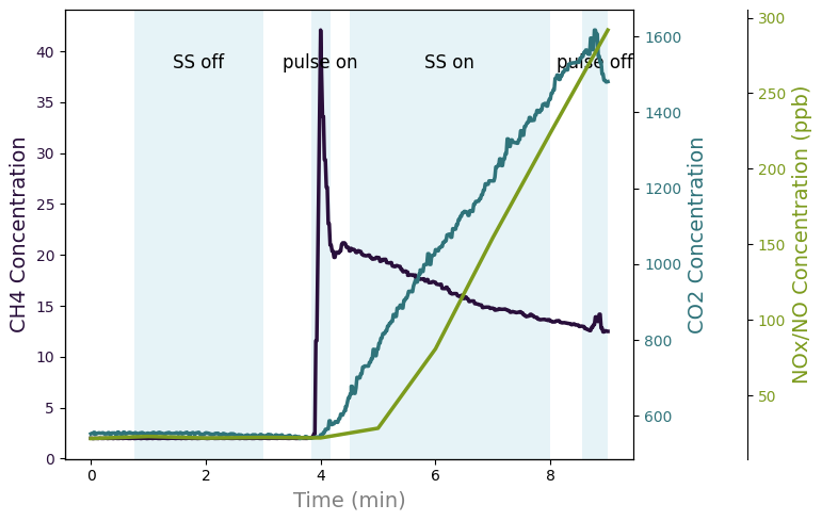
Figure 2Variation in the concentrations of the gases analyzed during the sampling campaign. The sharp increase in CH4 associated with burner ignition (pulse-On) is clearly visible. Also, the linear increase in combustion generated gases (NOx, and CO2) can be observed during consumption.
The determination of the emission rate of a gas “i” was carried out through a mass balance of the species within the kitchen chamber. Provided the gases do not undergo significant chemical reaction during the observation period and that the chamber is well-mixed, the evolution of the concentration Ci (mol m−3) of the gas within the chamber can be expressed as (Cooper and Alley, 2010):
where is the rate of accumulation of gas “i” (mol m−3 min−1) in the chamber, Ci,b (mol m−3) is the background or ambient concentration of gas “i”, V0 is the volume of the enclosed space in the kitchen (m3), and λ (min−1) is the air exchange rate between the confined kitchen space and the surroundings. By accurately measuring the concentration Ci over time, and by determining λ and V0 is possible to estimate the emission rate of gas Ei (mol min−1). The room temperature (T) and pressure (p) of the chamber must be known, as the monitoring devices determine mol fractions, χi, (mol mol−1), and they must be converted to molar concentrations by In this work, we follow closely the methodology of (Kashtan et al., 2023). Details can be found in the Supplement. The methodology can be applied for any period in which the stove is operating in steady-state, and therefore, the emission rate is approximately constant over that period. We aim to determine the average emission rate for a given operation setting, (mol min−1). The methodology can then be applied over multiple intervals within the same kitchen, modifying the stove's operating mode each time. For example, if a single burner is turned on and the methodology is applied, the emission rate for that burner can be determined. If the process is repeated with other burners, the emission rates of additional burners can also be measured.
The absolute emission rates, either in a molar (mol min−1) or mass basis (mg min−1), can be used to estimate total emissions if typical operating times and intensities are known. For some applications, however, it is useful to express these emission rates as an emission factor, i.e., normalized by the amount of natural gas burned during the operation. Since most of the carbon emitted during combustion is likely contained in the species that were measured, namely CO2, CO, and CH4, it is possible to precisely determine the amount of natural gas used during operation, provided its composition (CxHy) is known. In this way, the combined molar flows of these major carbonaceous species are a good estimate of the molar flow of natural gas (mol min−1). The latter can be computed as , where and are the molar flow ratios of CO to CO2 and CH4 to CO2 respectively. In normal operation conditions, both and . Furthermore, using the lower heating value (LHV) of natural gas (MJ mol−1) and the molar weight of species Mi (kg mol−1), an energy-based emission factor, EFi (kg TJ−1), for each species can be estimated as EF. Expressing emissions in terms of the emission factor facilitates the comparison of the observed values to those used in local air quality inventories or those for GHG emission inventories. The city of Bogotá is supplied with a natural gas mixture with 82.2 % CH4, 10.2 % ethane, with the remaining being propane, butane, pentane, hexane and CO2 (UPME, 2016). The mean number of carbon atoms in the Natural Gas supplied to Bogotá is x=1.14, and the LHV is 45.05 MJ kg−1. For the case of Santiago, natural gas is richer in methane, with 90.0 % CH4, 6.38 % ethane, 0.22 % propane, with the remaining fraction corresponding to higher-carbon content gases and CO2. For Santiago, we used x=1.05 and LHV of 43.7 MJ kg−1 (CNE, 2009).
The volume V0 of the confined space was determined geometrically by carefully measuring all the relevant dimensions of the confined space, and subtracting the volume occupied by other kitchen appliances and shelves. This method has been shown to differ by only 3 % from volume determinations using trace gas measurement methods (Lebel et al., 2022). The air exchange rate λ (min−1), a key parameter to be determined in this methodology, was measured using the concentration decay method. This is, by measuring CO2 concentration as it decreases in the enclosed space in the absence of sources and determining the logarithmic slope of the time series, i.e., applying Eq. (1) for CO2 when Ei=0. In our study, a specific period was devoted for this analysis in each kitchen, typically immediately after the “steady-state on” stage. At that moment, CO2 concentration inside the chamber was significantly higher than background levels. After turning the burners off, the kitchen was sealed again, and the decay constant of CO2 concentration was determined with a least-squares method.
Figure 2 shows the typical evolution of CH4, CO2 and NOx concentration during a combination of “pulse-on”, which corresponds to the initial pulse of gas emitted when the burner is ignited, and “steady-state on” stages, which reflects steady-state emissions while the burner remains on. The variations in the concentration of each species reflects the process by which it is released to the atmosphere. The pulse of methane released immediately before ignition is visible, while the combustion generated species (CO2 and NOx) accumulate in the chamber while the stove is on.
The methane emission rates found for each house and each burner sampled during the campaign are shown in Fig. 3. As is often the case, the distribution of emissions is highly skewed, approaching a lognormal distribution, with a small subset of the sample (the highest emitters) accounting for a significant fraction of the sample's total emissions. The datasets in Bogotá and Santiago share similar characteristics and are comparable to what has been reported in previous studies elsewhere (Lebel et al., 2022; Merrin and Francisco, 2019). The mean (median and C.I. for the median) “steady-state on” CH4 emissions, which are those that occur during the combustion process, were 410.2 (63.9; C.I. 18.8–78.3) mg h−1 in Bogotá (n=51 burners), and 331.2 (30.7; C.I. 4.8–27.9) mg h−1 in Santiago (n=65 burners). The distribution of “steady-state on” emissions is approximately log-normal (Fig. 3), which is highly skewed. Because of the relatively small sample size, the mean emission rate in both cases was sensitive to the outliers visible in Fig. 3. These highly emitting stoves contribute disproportionately to the total emissions, which is often the case when analyzing real-life emission rates. Only one datapoint was removed from the data as the CO2 emission was abnormally low, suggesting a technical issue for that one point in the case of Santiago. Following the procedure outlined in the methods, the mean (median) energy-based emission factors from the observations are equivalent to 80.8 (16.2) kgCH4 TJ−1 for Bogotá and 41.2 (3.66) kgCH4 TJ−1 for Santiago. Our results suggest that the true variability in emission rates, which spans several orders of magnitude, is much larger than the uncertainties associated with the method used (see Supplement).
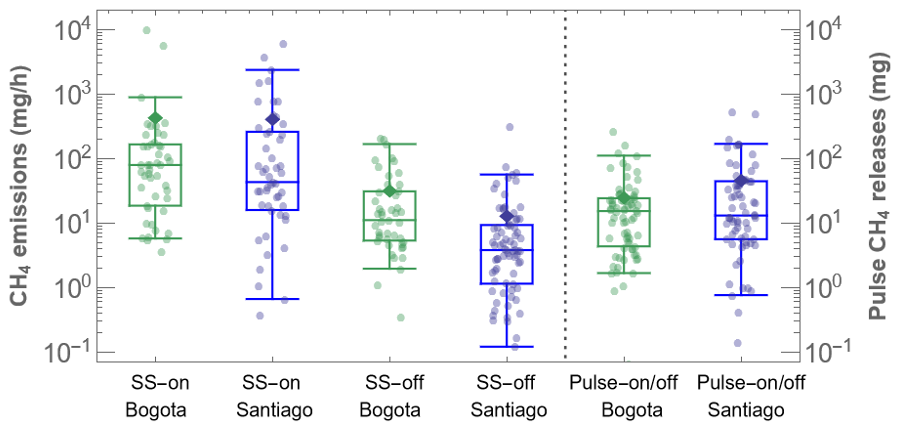
Figure 3Methane emission rates for “steady-state on” (SS–On) and “steady-state off” (SS–Off) measured during the sampling campaign in Bogota (Colombia) and Santiago (Chile). Filled circles represent emission rates for individual burners (for SS–On). For SS–Off, the circles are repetitions of continuous methane release rates in each kitchen (i.e., are not associated with a specific burner). The box depicts the 25th, 50th and 75th percentiles of the sample, while the whiskers are the 5th and 95th percentiles.
The “steady-state off” emission rates, which quantify continuous methane releases from imperfect seals in the ductwork and/or in the stove itself, are several times lower than those measured during combustion (i.e., the “steady-state on” stage) but occur throughout the day, rather than just during cooking periods. Over half the stoves in Bogota leaked methane at a rate higher than 10 mg h−1. The mean (median) steady-state leak emission rate was 32.5 (12.4 C.I. 8.8–20.0) mg h−1 in Bogotá, and 13.3 (3.8 C.I. 2.3–5.0) mg h−1 in Chile. Because these emissions are generated from the fittings and ductwork, they do not necessarily belong to a specific burner but rather to a stove and kitchen installation. The difference in leaks observed between the two cities might be partially explained by the higher mean age of stoves sampled in Bogotá compared to Santiago. Despite the emission rate from leaks being lower than those during combustion, the former occurs continuously, while the latter occur only during cooking. Although detailed stove use data is missing in both countries, stoves are likely idle many times longer than it is in operation. Therefore, our measurements suggest that for Bogotá, emissions from continuous leaks are likely on par with total combustion emissions, while they account for a smaller fraction of total emissions in Chile. These continuous leaks are equivalent to 0.26 kgCH4 yr−1 per stove in Bogotá, and 0.12 kgCH4 in Santiago.
Instantaneous releases of CH4 during the operation of turning on and off the burners were on average 25.5 mg per event for Bogota, and 48.8 mg per event for Santiago. These instantaneous releases, which are expected to occur typically twice during each use of a given burner, are equivalent to several hours of continuous leaks. This suggests that these episodic methane releases contribute a non-negligible amount to total emissions.
To estimate the overall contribution to methane emissions from each of the three mechanisms explored in this study, it would be necessary to have detailed information on activity use, such as the one available in other countries (e.g., EIA, 2015), which is lacking for both Chile and Colombia. However, to get an estimate of each contribution, we used the monthly natural gas consumption registered in the bill provided by the participants of the study. For the case of Bogotá, this information was retrieved for 18 houses, for which the mean monthly natural gas consumption was 18.2 m3. From our experimental estimate of the molar flow it is then possible to estimate the equivalent operation time of the stove assuming the average for a given house. After carrying out this estimate, the equivalent daily use of an average burner is 130 min d−1 so we applied this total use-time for the present estimations for Bogotá and Chile. Under these assumptions, the methane emissions during combustion in Bogotá are estimated to be 881.93 mg d−1, or 0.32 kgCH4 yr−1 per stove. This estimate suggests that combustion emissions and continuous leaks contribute significantly to the overall methane emissions from gas stoves. The contribution from instantaneous releases would require knowledge of the number of on/off episodes, which is unknown. However, estimating that two burners are turned on and off on average twice a day, i.e., assuming 8 events per day, yields a daily methane emission of 204 mgCH4 d−1 per stove. The overall emission through all mechanisms is around 0.65 kg of methane per stove per year. The analysis suggests that the contribution of each mechanism is 66 % from combustion, 26 % from continuous leaks, and 8 % from the episodic releases associated with turning on and off each burner. A similar estimate for Chile suggests contributions of 51 % for combustion, 21 % for episodic leaks, for an estimated 0.5 kg yr−1 per stove.
Emission from NOx, which is formed during high-temperature processes in the presence of air, were measured during the “steady-state on” combustion stage, because it is not expected to be generated in any other stove operation setting. Figure 4 displays the measured emission rates from each individual burner sampled in both cities, as a function of the measured flow of CO2 and CH4, a quantity proportional to the molar flow of natural gas. The mean emission rates found in both cities were similar, with 91.4 mg h−1 for Bogota and 94.4 mg h−1 for Santiago. The NOx emission rate (NO2 + NO) was found to increase linearly with the amount of gas burned, with a slope of 0.36 mmol mol−1 (C.I., 0.32–0.40) and R2=0.87 for Bogota, and 0.24 mmol mol−1 (C.I., 0.18–0.31) with R2=0.64 in the Santiago samples. This proportionality is consistent with the expected dependance of NOx generation on flame intensity and combustion temperature. In Bogota, where a log was kept regarding the intensity the sampled burners were operating at, revealed mean emission rates of 30.7, 74.1 and 139.0 mg h−1 for those burners labeled as operating in low, medium and high flame intensities respectively. In Santiago all burners were operated in a high flame intensity setting. When expressed as energy-based emission factors, the overall NOx emissions rates are 21.4 gNOx GJ−1 gas burned (C.I., 19.1–23.8) and 15.8 gNOx GJ−1 (C.I., 11.4–19.6) for Bogota and Santiago, respectively.
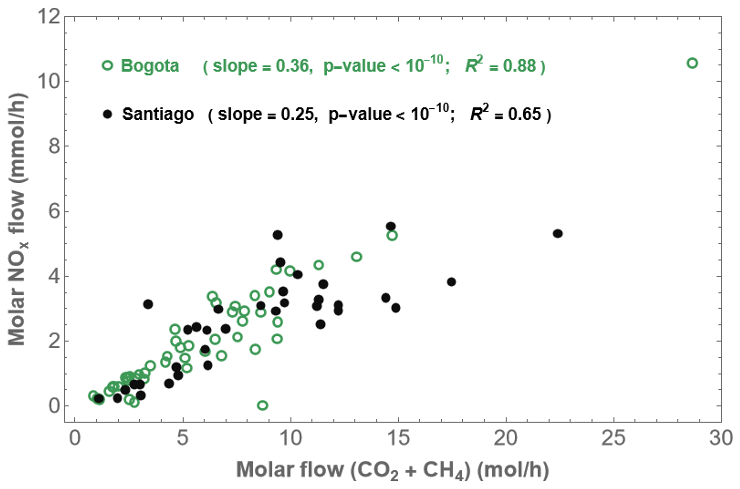
Figure 4NOx (NO2 + NO) molar flow (mmol h−1) as function of the molar flow of CO2 + CH4 (mol h−1), the latter of which is proportional to the molar flow of natural gas used in the combustion process. A linear relationship between both variables is observed in the measurements carried out in both cities. The slope of this linear relationship is proportional to the NOx emission factor.
Lastly, valid CO emissions were measured in both cities, yielding a mean emission rate of 1190 mg h−1 in Bogotá and 1776 mg h−1 in Santiago. This mass emission rate is equivalent to a CO to CO2 ratio of 0.46 %, suggesting that combustion efficiency, as measured by this ratio, was not low. No discernible association was noted between methane emissions and the ratio of CO to CO2. As expected, CO emissions were higher for burners operating at high power output, with mean emissions of 151.0, 866.4, and 1972.5 mg h−1 for burners operating in low, medium, and high-power outputs, respectively.
The methane emission rates measured in this work are several times higher than those resulting from using the Tier 1 emission factors suggested by the IPPC guidelines for countries with no available local data (IPCC, 2006). For methane, the energy-based emission factor during combustion of natural gas for residential cooking were on average equal to 80.8 kgCH4 TJ−1 for Bogotá and 41.2 kgCH4 TJ−1 and Santiago. These values are one order of magnitude higher than those used in the construction of national inventories (i.e., the IPCC Tier 1 emission factor for natural gas combustion is 5.0 kgCH4 TJ−1) for Colombia and Chile respectively. Over 42 % of the samples in Santiago were above this Tier 1 emission factor, with a similar percentage observed in Colombia. Furthermore, this first-of-its-kind study in Latin America, supports the idea that continuous methane leaks might be larger and more commonplace than previously thought, and are likely to emit significant amounts of methane. These types of continuous releases were only recently incorporated into IPPC GHG emission guidelines, but further evidence to constrain its true value is still needed. Despite the potential limitation from the sample size, the findings of this work suggest that the contribution to national methane emissions from residential use of natural gas are significantly underestimated in both countries. The findings for both cities are consistent with recent methane and NOx emission estimates carried out in the U.S. (Lebel et al., 2022).
The measured emissions rates for NOx and CO were similar to those reported elsewhere and were the same order of magnitude as those assumed in constructing local emission inventories. However, the specific characteristics of houses in different geographic regions, likely related to climate, cultural, and socioeconomic aspects, might imply strongly differing indoor air quality implications for each case, even under similar emission rates and total indoor emissions. As mentioned earlier, HVAC systems are extremely rare for houses in Bogota and Santiago, where houses rely on natural ventilation. However, some of the sampled households were small apartments located in the interior parts of a larger building. For those cases, natural ventilation was found to be poor, and, together with the overall small size of the living area (often shared with the cooking area) could lead to unhealthy NOx and CO levels. Therefore, future studies should focus on integrating the multiple aspects that would determine indoor air quality under the ventilation characteristics specific to the region.
This study constitutes to our knowledge the first direct measurement of the emission rates of NOx, CO, and CH4 from the use of natural gas in residential kitchens in Latin America. The findings of this effort to determine real-world emission rates reveal that methane releases, both episodic during the action of turning on/off the burners, as well as continues leaks into the kitchen space, constitute most of the total methane emissions from natural gas stoves, both in Chile and in Colombia. Those types of fugitive emissions are not accounted for in the emission estimates reported by countries to the UNFCCC. Furthermore, in our sample we found that CH4 emissions during combustion, expressed as energy-based emission factors, were between 8 and 16 times higher than the default values that are typically assumed in absence of local emission datasets. The findings of this work reveal the relevance of conducting real-world emission measurements, as these can provide a more realistic picture of the actual emissions from any given sector. The specific potential for GHG emission reductions attainable by switching to other energy sources for residential cooking are highly dependent on the local conditions, i.e., the carbon intensity of the power generation in each country, together with the efficiencies of the available electric cooking technologies.
In addition, we quantified the emissions of air pollutants NOx and CO, finding values consistent with other studies. In the case of Bogotá, a city located at 2600 m a.s.l., we expected higher CO emissions from less efficient or oxygen deficient combustion, however, the emission rates for CO in both cities analyzed were comparable, with emission rates slightly higher in Santiago. Further research should increase sample sizes (involving other cities in the region) and include the measurement of hazardous species released by combustion of natural gas stoves. Efforts should also be made to ensure that accurate country-wide appliance use patterns are developed and can be used in bottom-up emission estimates.
Processed steady-state data used in this study are openly available in the Zenodo repository with the DOI: https://doi.org/10.5281/zenodo.19545481 (Morales Betancourt et al., 2026) and are distributed under a Creative Commons Attribution 4.0 International (CC BY 4.0) license.
The supplement related to this article is available online at https://doi.org/10.5194/acp-26-8355-2026-supplement.
RMB and CGM conceived the study, acquired funding, conducted data curation, formal analysis, investigation, methodology, project administration, resources, supervision, validation, visualization, and wrote the original draft. TMB, EB, PTP, RV, CC, CF, AS, NH, SHS, and PV contributed to data curation and investigation. CF and AS provided software, supervision, validation, visualization, and methodology. NH and PV contributed resources. SH-S contributed formal analysis. MMC and RBJ contributed conceptualization, funding acquisition, resources, supervision, and writing. All authors reviewed the paper and provided valuable suggestions.
The contact author has declared that none of the authors has any competing interests.
Publisher's note: Copernicus Publications remains neutral with regard to jurisdictional claims made in the text, published maps, institutional affiliations, or any other geographical representation in this paper. The authors bear the ultimate responsibility for providing appropriate place names. Views expressed in the text are those of the authors and do not necessarily reflect the views of the publisher.
We thank the Institutional Scientific Ethics Committee of Universidad Mayor for its guidance and support during the ethical review process; this study was approved under Approval Act/Folio No. 0491, internal record No. 715/2024.
The authors are grateful to the Fundación Futuro Latinoamericano for funding provided through contract FFLA-INT-2025 to CGM and RMB. CGM also acknowledges support from the Agencia Nacional de Investigación y Desarrollo de Chile through grants FONDECYT Regular 1210946, FONDECYT Regular 1251223, and ANID/SCIA/DIFE/ATE250008. Rosario Vargas acknowledges PhD funding from the Universidad de las Islas Baleares ITS2023-086. EB acknowledges support from FONDECYT Iniciación 11240322. NH acknowledges support from FONDECYT Regular 1231717. Rob Jackson acknowledges support from the Windward Fund.
This paper was edited by Thomas Karl and reviewed by Hugo Denier van der Gon and three anonymous referees.
Alvarez, R. A., Pacala, S. W., Winebrake, J. J., Chameides, W. L., and Hamburg, S. P.: Greater focus needed on methane leakage from natural gas infrastructure, P. Natl. Acad. Sci. USA, 109, 6435–6440, 2012.
Balmes, J. R., Holm, S. M., McCormack, M. C., Hansel, N. N., Gerald, L. B., and Krishnan, J. A.: Cooking with natural gas: just the facts, please, Am. J. Respir. Crit. Care Med., 207, 996–997, https://doi.org/10.1164/rccm.202302-0278VP, 2023.
Barros, N. and Fontes, T.: Impact of kitchen natural gas use on indoor NO2 levels and human health: a case study in two European cities, Appl. Sci., 14, 8461, https://doi.org/10.3390/app14188461, 2024.
Boothroyd, I. M., Almond, S., Qassim, S. M., Worrall, F., and Davies, R. J.: Fugitive emissions of methane from abandoned decommissioned oil and gas wells, Sci. Total Environ., 547, 461–469, 2016.
Chan, S. H. and Wang, H. M.: Effect of natural gas composition on autothermal fuel reforming products, Fuel Process. Technol., 64, 221–239, 2000.
Comer, B., Beecken, J., Vermeulen, R., Sturrup, E., Paschinger, P., Osipova, L., Gore, K., Delahaye, A., Verhagen, V., Knudsen, B., Knudsen, J., and Verbeek, R.: Fugitive and unburned methane emissions from ships (FUMES): Characterizing methane emissions from LNG-fueled ships using drones, helicopters, and onboard measurements, International Council on Clean Transportation, Washington, DC, https://theicct.org/publication/ (last access: 22 August 2025), 2024.
Comisión Nacional de Energía (CNE): Fórmula de cálculo del factor de emisión del gas natural licuado (GNL), https://www.cne.cl/archivos_bajar/DS96_GNL_FEPCO.pdf (last access: 22 August 2025), 2009.
Comisión Nacional de Energía (CNE): Balance energético, Energía Abierta 2024, http://energiaabierta.cl/categorias-estadistica/balance-energetico/ (last access: 19 March 2026), 2025.
Cooper, C. D. and Alley, F. C.: Air Pollution Control: A Design Approach, 4th Edn., Waveland Press, Long Grove, IL, ISBN 157766678X, 2010.
Corporación de Desarrollo Tecnológico (CDT): Usos finales y curva de oferta de conservación de la energía en el sector residencial de Chile, 2018, Informe final, Ministerio de Energía, Chile, https://www.energia.gob.cl/sites/default/files/documentos/informe_final_caracterizacion_residencial_2018.pdf (last access: 20 September 2025), 2019.
EIA: Residential Energy Consumption Survey (RECS); U.S. Energy Information Administration, https://www.eia.gov/consumption/residential/data/2015/ (last access: 15 September 2025), 2015.
Fiscalía Nacional Económica (FNE): Estudio de Mercado del Gas (EM06-2020), División Estudios de Mercado, Santiago, Chile, https://www.fne.gob.cl/wp-content/uploads/2021/12/1.-Informe_Final_publicado.pdf (last access: 1 September 2025), 2021.
Hendrick, M. F., Ackley, R., Sanaie-Movahed, B., Tang, X., and Phillips, N. G.: Fugitive methane emissions from leak-prone natural gas distribution infrastructure in urban environments, Environ. Pollut., 213, 710–716, 2016.
Huangfu, P. and Atkinson, R.: Long-term exposure to NO2 and O3 and all-cause and respiratory mortality: a systematic review and meta-analysis, Environ. Int., 144, 105998, https://doi.org/10.1016/j.envint.2020.105998, 2020.
IEA: World Energy Outlook 2024, IEA, Paris, https://www.iea.org/reports/world-energy-outlook-2024 (last access: 5 April 2025), 2024.
IPCC: 2006 IPCC Guidelines for National Greenhouse Gas Inventories, edited by: Eggleston, H. S., Buendia, L., Miwa, K., Ngara, T., and Tanabe, K., IGES, Japan, https://www.ipcc-nggip.iges.or.jp/public/2006gl/ (last access: 15 May 2025), 2006.
IPCC: Climate Change 2021: The Physical Science Basis. Contribution of Working Group I to the Sixth Assessment Report of the Intergovernmental Panel on Climate Change, Cambridge University Press, https://doi.org/10.1017/9781009157896, 2021.
Kashtan, Y. S., Nicholson, M., Finnegan, C., Ouyang, Z., Lebel, E. D., Michanowicz, D. R., Shonkoff, S. B. C., and Jackson, R. B.: Gas and propane combustion from stoves emits benzene and increases indoor air pollution, Environ. Sci. Technol., 57, 9653–9663, https://doi.org/10.1021/acs.est.2c09289, 2023.
Lebel, E. D., Finnegan, C. J., Ouyang, Z., and Jackson, R. B.: Methane and NO? emissions from natural gas stoves, cooktops, and ovens in residential homes, Environ. Sci. Technol., 56, 2529–2539, 2022.
Levine, J. S. (Ed.): Biomass Burning and Global Change, Vol. 1: Remote Sensing, Modeling and Inventory Development, and Biomass Burning in Africa, The MIT Press, Cambridge, MA, ISBN 978-0-262-12201-6, 1996.
Merrin, Z. and Francisco, P. W.: Unburned methane emissions from residential natural gas appliances, Environ. Sci. Technol., 53, 5473–5482, 2019.
Ministerio del Medio Ambiente (MMA): Tercer informe bienal de actualización de Chile sobre cambio climático, Gobierno de Chile, https://mma.gob.cl/wp-content/uploads/2018 (last access: 12 February 2026), 2018.
Morales Betancourt, R., Galbán Malagón, C., Jackson, R., Shankute, A., Huneeus, N., Montejo-Barato, T., Tapia-Pino, P., Blanco, E., vargas, . rosario ., Cordova, C., Finnegan, C., Hernández-Suárez, S., Valencia, P., and Mena-Carrasco, M.: Meassurement Report: Methane and NOx emissions from natural gas cooking stoves: The case of Chile and Colombia, Zenodo [data set], https://doi.org/10.5281/zenodo.19545481, 2026.
Nisbet, E. G., Manning, M. R., Dlugokencky, E. J., Fisher, R. E., Lowry, D., Michel, S. E., and White, J. W.: Very strong atmospheric methane growth in the 4 years 2014–2017: implications for the Paris Agreement, Global Biogeochem. Cy., 33, 318–342, 2019.
Nisbet, E. G., Fisher, R. E., Lowry, D., France, J. L., Allen, G., Bakkaloglu, S., and Zazzeri, G.: Methane mitigation: methods to reduce emissions, on the path to the Paris Agreement, Rev. Geophys., 58, e2019RG000675, https://doi.org/10.1029/2019RG000675, 2020.
Orellano, P., Reynoso, J., Quaranta, N., Bardach, A., and Ciapponi, A.: Short-term exposure to PM10, PM2.5, NO2, and O3 and mortality: systematic review and meta-analysis, Environ. Int., 142, 105876, https://doi.org/10.1016/j.envint.2020.105876, 2020.
Quinn, A. K., Bruce, N., Puzzolo, E., Dickinson, K., Sturke, R., Jack, D. W., and Rosenthal, J. P.: An analysis of efforts to scale up clean household energy for cooking around the world, Energy Sustain. Dev., 46, 1–10, https://doi.org/10.1016/j.esd.2018.06.011, 2018.
Rowland, S. T., Lebel, E. D., Goldman, J. S. W., Domen, J. K., Bilsback, K. R., Ruiz, A., Jaeger, J. M., Hill, L. A. L., Kashtan, Y. S., Finnegan, C., Nicholson, M., Ouyang, Z., Jackson, R. B., Shonkoff, S. B. C., and Michanowicz, D. R.: Downstream natural gas composition across U.S. and Canada: implications for indoor methane leaks and hazardous air pollutant exposures, Environ. Res. Lett., 19, 064064, https://doi.org/10.1088/1748-9326/ad416c, 2024.
Saunois, M., Stavert, A. R., Poulter, B., Bousquet, P., Canadell, J. G., Jackson, R. B., Raymond, P. A., Dlugokencky, E. J., Houweling, S., Patra, P. K., Ciais, P., Arora, V. K., Bastviken, D., Bergamaschi, P., Blake, D. R., Brailsford, G., Bruhwiler, L., Carlson, K. M., Carrol, M., Castaldi, S., Chandra, N., Crevoisier, C., Crill, P. M., Covey, K., Curry, C. L., Etiope, G., Frankenberg, C., Gedney, N., Hegglin, M. I., Höglund-Isaksson, L., Hugelius, G., Ishizawa, M., Ito, A., Janssens-Maenhout, G., Jensen, K. M., Joos, F., Kleinen, T., Krummel, P. B., Langenfelds, R. L., Laruelle, G. G., Liu, L., Machida, T., Maksyutov, S., McDonald, K. C., McNorton, J., Miller, P. A., Melton, J. R., Morino, I., Müller, J., Murguia-Flores, F., Naik, V., Niwa, Y., Noce, S., O'Doherty, S., Parker, R. J., Peng, C., Peng, S., Peters, G. P., Prigent, C., Prinn, R., Ramonet, M., Regnier, P., Riley, W. J., Rosentreter, J. A., Segers, A., Simpson, I. J., Shi, H., Smith, S. J., Steele, L. P., Thornton, B. F., Tian, H., Tohjima, Y., Tubiello, F. N., Tsuruta, A., Viovy, N., Voulgarakis, A., Weber, T. S., van Weele, M., van der Werf, G. R., Weiss, R. F., Worthy, D., Wunch, D., Yin, Y., Yoshida, Y., Zhang, W., Zhang, Z., Zhao, Y., Zheng, B., Zhu, Q., Zhu, Q., and Zhuang, Q.: The Global Methane Budget 2000–2017, Earth Syst. Sci. Data, 12, 1561–1623, https://doi.org/10.5194/essd-12-1561-2020, 2020.
Shindell, D., Kuylenstierna, J. C., Vignati, E., van Dingenen, R., Amann, M., Klimont, Z., and Fowler, D.: Simultaneously mitigating near-term climate change and improving human health and food security, Science, 335, 183–189, 2012.
Smith, K. R., Khalil, M. A. K., Rasmussen, R. A., Thorneloe, S. A., Manegdeg, F., and Apte, M.: Greenhouse gases from biomass and fossil fuel stoves in developing countries: a Manila pilot study, Chemosphere, 26, 479–505, 1993.
Staniaszek, Z., Griffiths, P. T., Folberth, G. A., O’Connor, F. M., Luke Abraham, N., and Archibald, A. T.: The role of future anthropogenic methane emissions in air quality and climate, npj Clim. Atmos. Sci., 5, 21, https://doi.org/10.1038/s41612-022-00247-5, 2022.
Stoner, O., Lewis, J., Martínez, I. L., Gumy, S., Economou, T., and Adair-Rohani, H.: Household cooking fuel estimates at global and country level for 1990 to 2030, Nat. Commun., 12, 5793, https://doi.org/10.1038/s41467-021-26036-x, 2021.
United Nations Environment Programme (UNEP): UNEP Emissions Gap Report 2021: The Heat Is On – A World of Climate Promises Not Yet Delivered, United Nations Environment Programme, Nairobi, ISBN 978-92-807-3890-2, https://wedocs.unep.org/items/a72e3be5-2204-4590-a65d-ea8f64c588d7 (last access: 20 September 2025), 2021.
Unidad de Planeación Minero Energética (UPME): Consultoría técnica para el fortalecimiento y mejora de la base de datos de factores de emisión de los combustibles colombianos – FECOC, https://app.upme.gov.co/Calculadora_Emisiones1/new/Informe_Final_FECOC_Correcciones_UPME_FunNatura.pdf (last access: 8 April 2025), 2016.
West, J. J., Fiore, A. M., Horowitz, L. W., and Mauzerall, D. L.: Global health benefits of mitigating ozone pollution with methane emission controls, P. Natl. Acad. Sci. USA, 103, 3988–3993, https://doi.org/10.1073/pnas.0600201103, 2006.
World Health Organization (WHO): WHO guidelines for indoor air quality: household fuel combustion, World Health Organization, Geneva, Switzerland, ISBN 978-92-4-154888-5, https://iris.who.int/handle/10665/141496 (last access 22 October 2025), 2014
Zheng, X. Y., Orellano, P., Lin, H. L., Jiang, M., and Guan, W. J.: Short-term exposure to ozone, nitrogen dioxide, and sulphur dioxide and asthma hospital visits: a systematic review and meta-analysis, Environ. Int., 150, 106435, https://doi.org/10.1016/j.envint.2021.106435, 2021.