
Articles | Volume 26, issue 10
https://doi.org/10.5194/acp-26-7435-2026
© Author(s) 2026. This work is distributed under
the Creative Commons Attribution 4.0 License.
the Creative Commons Attribution 4.0 License.
Special issue:
https://doi.org/10.5194/acp-26-7435-2026
© Author(s) 2026. This work is distributed under
the Creative Commons Attribution 4.0 License.
the Creative Commons Attribution 4.0 License.
Research article
| 
29 May 2026
Research article |
| 29 May 2026
| 29 May 2026
Effects of model grid spacing for warm conveyor belt (WCB) moisture transport into the upper troposphere and lower stratosphere (UTLS) – Part 1: Lagrangian perspective
Cornelis Schwenk
CORRESPONDING AUTHOR

Institute for Atmospheric Physics, Johannes Gutenberg University Mainz, Mainz, Germany
Annette Miltenberger
Institute for Atmospheric Physics, Johannes Gutenberg University Mainz, Mainz, Germany
Related authors
Madhuri Umbarkar, Daniel Kunkel, Annette Miltenberger, Hans-Christoph Lachnitt, Thorsten Kaluza, Cornelis Schwenk, and Peter Hoor
Atmos. Chem. Phys., 26, 12067–12096, https://doi.org/10.5194/acp-26-12067-2026, https://doi.org/10.5194/acp-26-12067-2026, 2026
Short summary
Short summary
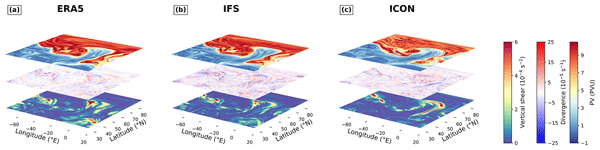
We present an extratropical cyclone case study over the North Atlantic focusing on the role of atmospheric gravity waves (GW) in the generation of strong vertical shear and (clear-air) turbulence (CAT), as well as their impact on tracer distribution in the lowermost stratosphere. Our findings suggest that GW related processes should be considered as a key for upper troposphere lower stratosphere (UTLS) transport and mixing, and as an important candidate for the interpretation of CAT in the UTLS.
Cornelis Schwenk and Annette Miltenberger
EGUsphere, https://doi.org/10.5194/egusphere-2025-5631, https://doi.org/10.5194/egusphere-2025-5631, 2025
Short summary
Short summary
We examined how model resolution affects the moisture and cloud content of large weather systems that move warm, moist air into the upper troposphere. By comparing high- and low-resolution simulations, we found that models which can resolve convectively ascending air produce drier air and more outgoing longwave radiation. This shows that model grid-spacing impacts modeled upper-level moisture and Earth's radiative balance.
Anna Breuninger, Philipp Joppe, Jonas Wilsch, Cornelis Schwenk, Heiko Bozem, Nicolas Emig, Laurin Merkel, Rainer Rossberg, Timo Keber, Arthur Kutschka, Philipp Waleska, Stefan Hofmann, Sarah Richter, Florian Ungeheuer, Konstantin Dörholt, Thorsten Hoffmann, Annette Miltenberger, Johannes Schneider, Peter Hoor, and Alexander L. Vogel
Atmos. Chem. Phys., 25, 16533–16551, https://doi.org/10.5194/acp-25-16533-2025, https://doi.org/10.5194/acp-25-16533-2025, 2025
Short summary
Short summary
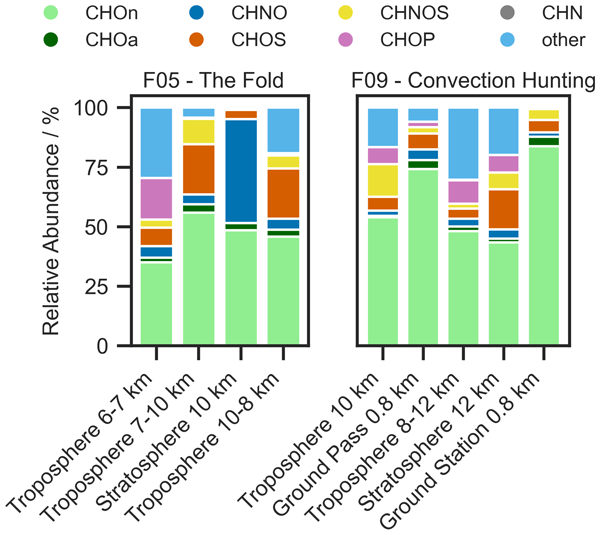
This study investigates molecular organic aerosol composition in the upper troposphere and lower stratosphere from an airborne campaign over Central Europe in summer 2024. Via ultra-high-performance liquid chromatography and high-resolution mass spectrometry of tropospheric and stratospheric filter samples, we identified various organic compounds. Our findings underscore the significant cross-tropopause transport of biogenic secondary organic aerosol and anthropogenic pollutants.
Philipp Joppe, Johannes Schneider, Jonas Wilsch, Heiko Bozem, Anna Breuninger, Joachim Curtius, Martin Ebert, Nicolas Emig, Peter Hoor, Sadath Ismayil, Konrad Kandler, Daniel Kunkel, Isabel Kurth, Hans-Christoph Lachnitt, Yun Li, Annette Miltenberger, Sarah Richter, Christian Rolf, Lisa Schneider, Cornelis Schwenk, Nicole Spelten, Alexander L. Vogel, Yafang Cheng, and Stephan Borrmann
Atmos. Chem. Phys., 25, 15077–15103, https://doi.org/10.5194/acp-25-15077-2025, https://doi.org/10.5194/acp-25-15077-2025, 2025
Short summary
Short summary
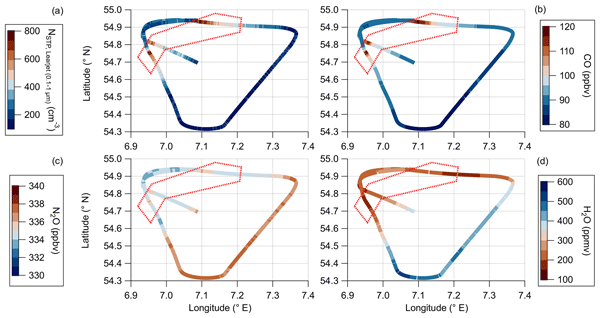
We show measurements of a filament with biomass burning influence transported by a warm conveyor belt (WCB) into the tropopause region over Europe. The pollution originates from Canadian forest fires and is transported in the lower troposphere towards Europe. The WCB transport is followed by mixing with air masses of stratospheric chemical signatures. We hypothesize that this mixing leads to a change in the vertical gradient of the potential temperature.
Cornelis Schwenk, Annette Miltenberger, and Annika Oertel
Atmos. Chem. Phys., 25, 11333–11361, https://doi.org/10.5194/acp-25-11333-2025, https://doi.org/10.5194/acp-25-11333-2025, 2025
Short summary
Short summary
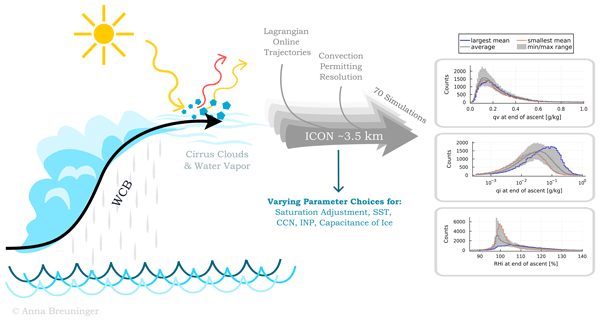
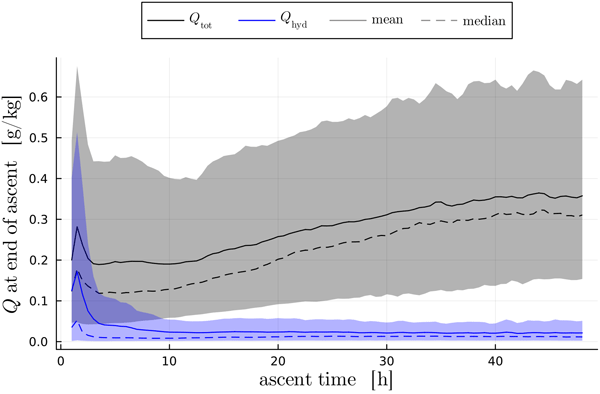
We studied how different parameter choices concerning cloud processes affect the simulated transport of water and ice into the upper atmosphere (which affects the greenhouse effect) during a weather system called a warm conveyor belt. Using a set of model experiments, we found that some parameters have a strong effect on humidity and ice, especially during fast ascents. These findings could help improve weather and climate models and may also be relevant for future climate engineering studies.
Cornelis Schwenk and Annette Miltenberger
Atmos. Chem. Phys., 24, 14073–14099, https://doi.org/10.5194/acp-24-14073-2024, https://doi.org/10.5194/acp-24-14073-2024, 2024
Short summary
Short summary
Warm conveyor belts (WCBs) transport moisture into the upper atmosphere, where it acts as a greenhouse gas. This transport is not well understood, and the role of rapidly rising air is unclear. We simulate a WCB and look at fast- and slow-rising air to see how moisture is (differently) transported. We find that for fast-ascending air more ice particles reach higher into the atmosphere and that frozen cloud particles are removed differently than during slow ascent, which has more water vapour.
Nicolas Emig, Annette Miltenberger, Heiko Bozem, Martina Krämer, Armin Afchine, Daniel Kunkel, Hans-Christoph Lachnitt, Yun Li, Philipp Reutter, Christian Rolf, Nicole Spelten, Holger Tost, and Peter Hoor
EGUsphere, https://doi.org/10.5194/egusphere-2026-4614, https://doi.org/10.5194/egusphere-2026-4614, 2026
This preprint is open for discussion and under review for Atmospheric Chemistry and Physics (ACP).
Short summary
Short summary
In this study we show mixing of ice particles across the extratropical tropopause via turbulence in the jet shear zone based on in situ measurements from the TPEx campaign over the North Sea, combined with Lagrangian model analysis. Trace gas correlations and subsaturated ice particles constrain the timing and mechanism, while backward trajectories indicate suitable turbulent conditions beforehand. This process possibly impacts the water vapour budget of the extratropical lowermost stratosphere.
Tim Lüttmer, Annette Miltenberger, and Peter Spichtinger
EGUsphere, https://doi.org/10.5194/egusphere-2026-5375, https://doi.org/10.5194/egusphere-2026-5375, 2026
This preprint is open for discussion and under review for Atmospheric Chemistry and Physics (ACP).
Short summary
Short summary
Moist air rising rapidly in cyclones produces ice clouds. Uncertain assumptions about ice-nucleating particles strongly affect ice formation. Ice formed by freezing of droplets and ice formed directly from vapor mix as they fall.
Madhuri Umbarkar, Daniel Kunkel, Annette Miltenberger, Hans-Christoph Lachnitt, Thorsten Kaluza, Cornelis Schwenk, and Peter Hoor
Atmos. Chem. Phys., 26, 12067–12096, https://doi.org/10.5194/acp-26-12067-2026, https://doi.org/10.5194/acp-26-12067-2026, 2026
Short summary
Short summary
We present an extratropical cyclone case study over the North Atlantic focusing on the role of atmospheric gravity waves (GW) in the generation of strong vertical shear and (clear-air) turbulence (CAT), as well as their impact on tracer distribution in the lowermost stratosphere. Our findings suggest that GW related processes should be considered as a key for upper troposphere lower stratosphere (UTLS) transport and mixing, and as an important candidate for the interpretation of CAT in the UTLS.
Sylvia C. Sullivan, Aiko Voigt, Edgardo Sepúlveda Araya, Silvia Bucci, Annette Miltenberger, Meredith K. Kupinski, Christian Rolf, and Martina Krämer
Atmos. Chem. Phys., 26, 1685–1698, https://doi.org/10.5194/acp-26-1685-2026, https://doi.org/10.5194/acp-26-1685-2026, 2026
Short summary
Short summary
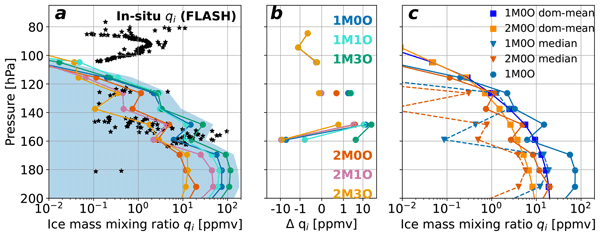
We assess the temperature, moisture, and dynamics in the upper troposphere-lower stratosphere simulated over South Asia in a high-resolution model relative to aircraft data. The lower stratosphere tends to be too warm, too dry, and too quiescent in the model, and as a result, too few ice clouds are predicted to form there. These biases could affect radiative balance and circulation in other areas also, as significant upward transport of moisture and pollutants occurs during the Asian monsoon.

Patrick Konjari, Christian Rolf, Martina Krämer, Armin Afchine, Nicole Spelten, Irene Bartolome Garcia, Annette Miltenberger, Nicolas Emig, Philipp Joppe, Johannes Schneider, Yun Li, Andreas Petzold, Heiko Bozem, and Peter Hoor
Atmos. Chem. Phys., 25, 18031–18050, https://doi.org/10.5194/acp-25-18031-2025, https://doi.org/10.5194/acp-25-18031-2025, 2025
Short summary
Short summary
We investigated how a powerful storm over southern Sweden in June 2024 transported ice particles and moist air into the normally dry stratosphere. We observed unusually high water vapor and ice levels up to 1.5 kilometers above the tropopause. Although the extra water vapor lasted only a few days to weeks, it shows how such storms can temporarily alter the upper atmosphere’s composition.
Cornelis Schwenk and Annette Miltenberger
EGUsphere, https://doi.org/10.5194/egusphere-2025-5631, https://doi.org/10.5194/egusphere-2025-5631, 2025
Short summary
Short summary
We examined how model resolution affects the moisture and cloud content of large weather systems that move warm, moist air into the upper troposphere. By comparing high- and low-resolution simulations, we found that models which can resolve convectively ascending air produce drier air and more outgoing longwave radiation. This shows that model grid-spacing impacts modeled upper-level moisture and Earth's radiative balance.
Anna Breuninger, Philipp Joppe, Jonas Wilsch, Cornelis Schwenk, Heiko Bozem, Nicolas Emig, Laurin Merkel, Rainer Rossberg, Timo Keber, Arthur Kutschka, Philipp Waleska, Stefan Hofmann, Sarah Richter, Florian Ungeheuer, Konstantin Dörholt, Thorsten Hoffmann, Annette Miltenberger, Johannes Schneider, Peter Hoor, and Alexander L. Vogel
Atmos. Chem. Phys., 25, 16533–16551, https://doi.org/10.5194/acp-25-16533-2025, https://doi.org/10.5194/acp-25-16533-2025, 2025
Short summary
Short summary
This study investigates molecular organic aerosol composition in the upper troposphere and lower stratosphere from an airborne campaign over Central Europe in summer 2024. Via ultra-high-performance liquid chromatography and high-resolution mass spectrometry of tropospheric and stratospheric filter samples, we identified various organic compounds. Our findings underscore the significant cross-tropopause transport of biogenic secondary organic aerosol and anthropogenic pollutants.
Philipp Joppe, Johannes Schneider, Jonas Wilsch, Heiko Bozem, Anna Breuninger, Joachim Curtius, Martin Ebert, Nicolas Emig, Peter Hoor, Sadath Ismayil, Konrad Kandler, Daniel Kunkel, Isabel Kurth, Hans-Christoph Lachnitt, Yun Li, Annette Miltenberger, Sarah Richter, Christian Rolf, Lisa Schneider, Cornelis Schwenk, Nicole Spelten, Alexander L. Vogel, Yafang Cheng, and Stephan Borrmann
Atmos. Chem. Phys., 25, 15077–15103, https://doi.org/10.5194/acp-25-15077-2025, https://doi.org/10.5194/acp-25-15077-2025, 2025
Short summary
Short summary
We show measurements of a filament with biomass burning influence transported by a warm conveyor belt (WCB) into the tropopause region over Europe. The pollution originates from Canadian forest fires and is transported in the lower troposphere towards Europe. The WCB transport is followed by mixing with air masses of stratospheric chemical signatures. We hypothesize that this mixing leads to a change in the vertical gradient of the potential temperature.
Nicolas Emig, Annette K. Miltenberger, Peter M. Hoor, and Andreas Petzold
Atmos. Chem. Phys., 25, 13077–13101, https://doi.org/10.5194/acp-25-13077-2025, https://doi.org/10.5194/acp-25-13077-2025, 2025
Short summary
Short summary
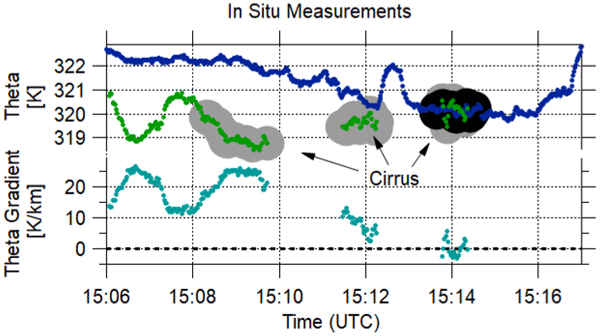
This study presents in situ observations of cirrus occurrence from aircraft measurements in the extratropical transition layer (ExTL) using simultaneous measurements from two platforms. Lagrangian diagnostics based on high-resolution ICON simulations show long residence times of the cirrus in stratospheric air, allowing us to separate different diabatic processes during transit. The findings suggest that radiative diabatic cloud processes significantly impact the tropopause thermodynamic structure.
Cornelis Schwenk, Annette Miltenberger, and Annika Oertel
Atmos. Chem. Phys., 25, 11333–11361, https://doi.org/10.5194/acp-25-11333-2025, https://doi.org/10.5194/acp-25-11333-2025, 2025
Short summary
Short summary
We studied how different parameter choices concerning cloud processes affect the simulated transport of water and ice into the upper atmosphere (which affects the greenhouse effect) during a weather system called a warm conveyor belt. Using a set of model experiments, we found that some parameters have a strong effect on humidity and ice, especially during fast ascents. These findings could help improve weather and climate models and may also be relevant for future climate engineering studies.
Tim Lüttmer, Annette Miltenberger, and Peter Spichtinger
Atmos. Chem. Phys., 25, 10245–10265, https://doi.org/10.5194/acp-25-10245-2025, https://doi.org/10.5194/acp-25-10245-2025, 2025
Short summary
Short summary
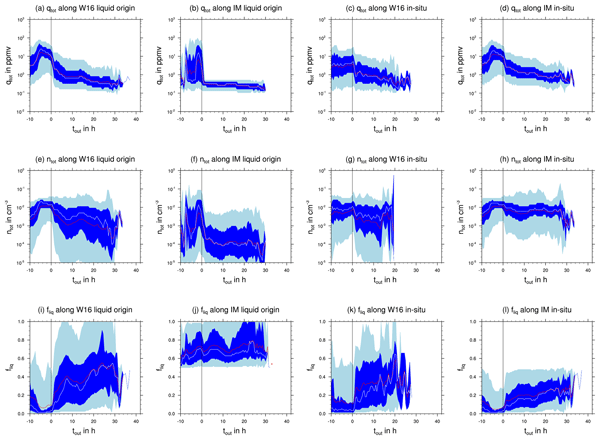
We investigate ice formation pathways in a warm conveyor belt case study. We employ a multi-phase microphysics scheme that distinguishes between ice from different nucleation processes. Ice crystals in the cirrus outflow mostly stem from in situ formation. Hence, they were formed directly from the vapor phase. Sedimentational redistribution modulates cirrus properties and leads to disagreement between cirrus origin classifications based on thermodynamic history and nucleation processes.
Cornelis Schwenk and Annette Miltenberger
Atmos. Chem. Phys., 24, 14073–14099, https://doi.org/10.5194/acp-24-14073-2024, https://doi.org/10.5194/acp-24-14073-2024, 2024
Short summary
Short summary
Warm conveyor belts (WCBs) transport moisture into the upper atmosphere, where it acts as a greenhouse gas. This transport is not well understood, and the role of rapidly rising air is unclear. We simulate a WCB and look at fast- and slow-rising air to see how moisture is (differently) transported. We find that for fast-ascending air more ice particles reach higher into the atmosphere and that frozen cloud particles are removed differently than during slow ascent, which has more water vapour.
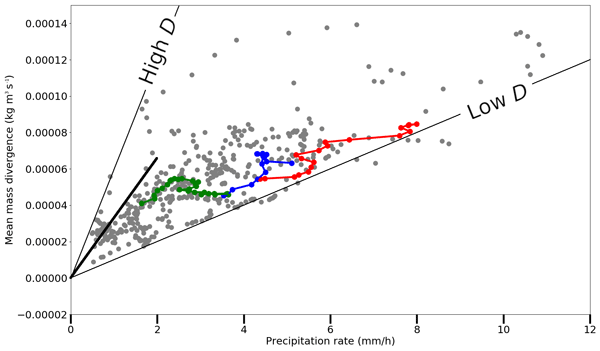
Edward Groot, Patrick Kuntze, Annette Miltenberger, and Holger Tost
Weather Clim. Dynam., 5, 779–803, https://doi.org/10.5194/wcd-5-779-2024, https://doi.org/10.5194/wcd-5-779-2024, 2024
Short summary
Short summary
Deep convective clouds (thunderstorms), which may cause severe weather, tend to coherently organise into structured cloud systems. Accurate representation of these systems in models is difficult due to their complex dynamics and, in numerical simulations, the dependence of their dynamics on resolution. Here, the effect of convective organisation and geometry on their outflow winds (altitudes of 7–14 km) is investigated. Representation of their dynamics and outflows improves at higher resolution.
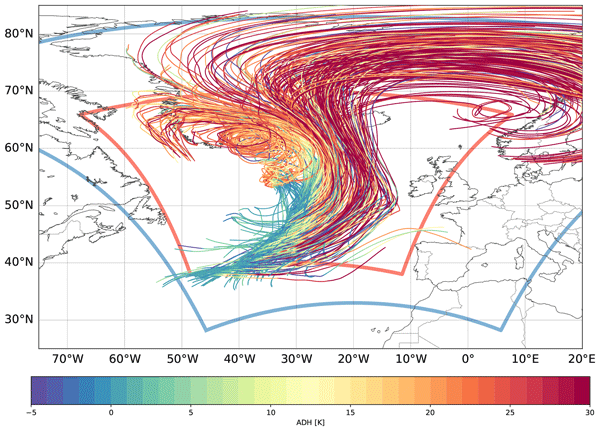
Annika Oertel, Annette K. Miltenberger, Christian M. Grams, and Corinna Hoose
Atmos. Chem. Phys., 23, 8553–8581, https://doi.org/10.5194/acp-23-8553-2023, https://doi.org/10.5194/acp-23-8553-2023, 2023
Short summary
Short summary
Warm conveyor belts (WCBs) are cloud- and precipitation-producing airstreams in extratropical cyclones that are important for the large-scale flow and cloud radiative forcing. We analyze cloud formation processes during WCB ascent in a two-moment microphysics scheme. Quantification of individual diabatic heating rates shows the importance of condensation, vapor deposition, rain evaporation, melting, and cloud-top radiative cooling for total heating and WCB-related potential vorticity structure.
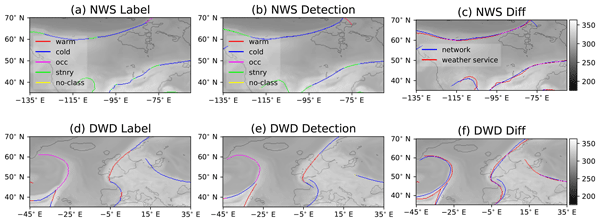
Stefan Niebler, Annette Miltenberger, Bertil Schmidt, and Peter Spichtinger
Weather Clim. Dynam., 3, 113–137, https://doi.org/10.5194/wcd-3-113-2022, https://doi.org/10.5194/wcd-3-113-2022, 2022
Short summary
Short summary
We use machine learning to create a network that detects and classifies four types of synoptic-scale weather fronts from ERA5 atmospheric reanalysis data. We present an application of our method, showing its use case in a scientific context. Additionally, our results show that multiple sources of training data are necessary to perform well on different regions, implying differences within those regions. Qualitative evaluation shows that the results are physically plausible.
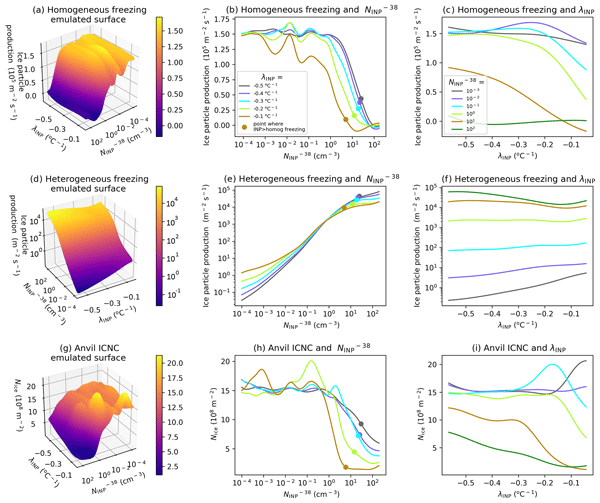
Rachel E. Hawker, Annette K. Miltenberger, Jill S. Johnson, Jonathan M. Wilkinson, Adrian A. Hill, Ben J. Shipway, Paul R. Field, Benjamin J. Murray, and Ken S. Carslaw
Atmos. Chem. Phys., 21, 17315–17343, https://doi.org/10.5194/acp-21-17315-2021, https://doi.org/10.5194/acp-21-17315-2021, 2021
Short summary
Short summary
We find that ice-nucleating particles (INPs), aerosols that can initiate the freezing of cloud droplets, cause substantial changes to the properties of radiatively important convectively generated anvil cirrus. The number concentration of INPs had a large effect on ice crystal number concentration while the INP temperature dependence controlled ice crystal size and cloud fraction. The results indicate information on INP number and source is necessary for the representation of cloud glaciation.
Cited articles
Barstad, I., Grabowski, W. W., and Smolarkiewicz, P. K.: Characteristics of large-scale orographic precipitation: Evaluation of linear model in idealized problems, J. Hydrol., 340, 78–90, https://doi.org/10.1016/j.jhydrol.2007.04.005, 2007. a
Bechtold, P., Köhler, M., Jung, T., Doblas-Reyes, F., Leutbecher, M., Rodwell, M. J., Vitart, F., and Balsamo, G.: Advances in simulating atmospheric variability with the ECMWF model: From synoptic to decadal time-scales, Q. J. Roy. Meteor. Soc., 134, 1337–1351, https://doi.org/10.1002/qj.289, 2008. a, b
Berman, J. D. and Torn, R. D.: The Impact of Initial Condition and Warm Conveyor Belt Forecast Uncertainty on Variability in the Downstream Waveguide in an ECWMF Case Study, Mon. Weather Rev., 147, 4071–4089, https://doi.org/10.1175/mwr-d-18-0333.1, 2019. a
Binder, H., Boettcher, M., Joos, H., Sprenger, M., and Wernli, H.: Vertical cloud structure of warm conveyor belts – a comparison and evaluation of ERA5 reanalysis, CloudSat and CALIPSO data, Weather Clim. Dynam., 1, 577–595, https://doi.org/10.5194/wcd-1-577-2020, 2020. a, b
Blanchard, N., Pantillon, F., Chaboureau, J.-P., and Delanoë, J.: Mid-level convection in a warm conveyor belt accelerates the jet stream, Weather Clim. Dynam., 2, 37–53, https://doi.org/10.5194/wcd-2-37-2021, 2021. a
Charlesworth, E., Plöger, F., Birner, T., Baikhadzhaev, R., Abalos, M., Abraham, N. L., Akiyoshi, H., Bekki, S., Dennison, F., Jöckel, P., Keeble, J., Kinnison, D., Morgenstern, O., Plummer, D., Rozanov, E., Strode, S., Zeng, G., Egorova, T., and Riese, M.: Stratospheric water vapor affecting atmospheric circulation, Nat. Commun., 14, https://doi.org/10.1038/s41467-023-39559-2, 2023. a
Choudhary, A. and Voigt, A.: Impact of grid spacing, convective parameterization and cloud microphysics in ICON simulations of a warm conveyor belt, Weather and Climate Dynamics, 3, 1199–1214, https://doi.org/10.5194/wcd-3-1199-2022, 2022. a, b, c, d
Corti, T., Luo, B. P., de Reus, M., Brunner, D., Cairo, F., Mahoney, M. J., Martucci, G., Matthey, R., Mitev, V., dos Santos, F. H., Schiller, C., Shur, G., Sitnikov, N. M., Spelten, N., Vössing, H. J., Borrmann, S., and Peter, T.: Unprecedented evidence for deep convection hydrating the tropical stratosphere, Geophys. Res. Lett., 35, https://doi.org/10.1029/2008gl033641, 2008. a
Dacre, H. F., Martinez‐Alvarado, O., and Hodges, K. I.: Precipitation Efficiencies in a Climatology of Southern Ocean Extratropical Cyclones, J. Geophys. Res.-Atmos., 128, https://doi.org/10.1029/2023jd039239, 2023. a
Danielsen, E. F.: In situ evidence of rapid, vertical, irreversible transport of lower tropospheric air into the lower tropical stratosphere by convective cloud turrets and by larger‐scale upwelling in tropical cyclones, J. Geophys. Res.-Atmos., 98, 8665–8681, https://doi.org/10.1029/92jd02954, 1993. a
Dauhut, T., Chaboureau, J.-P., Haynes, P. H., and Lane, T. P.: The Mechanisms Leading to a Stratospheric Hydration by Overshooting Convection, J. Atmos. Sci., 75, 4383–4398, https://doi.org/10.1175/jas-d-18-0176.1, 2018. a
Dessler, A., Ye, H., Wang, T., Schoeberl, M., Oman, L., Douglass, A., Butler, A., Rosenlof, K., Davis, S., and Portmann, R.: Transport of ice into the stratosphere and the humidification of the stratosphere over the 21st century, Geophys. Res. Lett., 43, 2323–2329, https://doi.org/10.1002/2016gl067991, 2016. a
Dessler, A. E., Schoeberl, M. R., Wang, T., Davis, S. M., and Rosenlof, K. H.: Stratospheric water vapor feedback, P. Natl. Acad. Sci. USA, 110, 18087–18091, https://doi.org/10.1073/pnas.1310344110, 2013. a
Eckhardt, S., Stohl, A., Wernli, H., James, P., Forster, C., and Spichtinger, N.: A 15-Year Climatology of Warm Conveyor Belts, J. Climate, 17, 218–237, https://doi.org/10.1175/1520-0442(2004)017<0218:aycowc>2.0.co;2, 2004. a
Forbes, R. M. and Clark, P. A.: Sensitivity of extratropical cyclone mesoscale structure to the parametrization of ice microphysical processes, Q. J. Roy. Meteor. Soc., 129, 1123–1148, https://doi.org/10.1256/qj.01.171, 2003. a, b
Gehring, J., Oertel, A., Vignon, É., Jullien, N., Besic, N., and Berne, A.: Microphysics and dynamics of snowfall associated with a warm conveyor belt over Korea, Atmos. Chem. Phys., 20, 7373–7392, https://doi.org/10.5194/acp-20-7373-2020, 2020. a
Gettelman, A., Hegglin, M. I., Son, S., Kim, J., Fujiwara, M., Birner, T., Kremser, S., Rex, M., Añel, J. A., Akiyoshi, H., Austin, J., Bekki, S., Braesike, P., Brühl, C., Butchart, N., Chipperfield, M., Dameris, M., Dhomse, S., Garny, H., Hardiman, S. C., Jöckel, P., Kinnison, D. E., Lamarque, J. F., Mancini, E., Marchand, M., Michou, M., Morgenstern, O., Pawson, S., Pitari, G., Plummer, D., Pyle, J. A., Rozanov, E., Scinocca, J., Shepherd, T. G., Shibata, K., Smale, D., Teyssèdre, H., and Tian, W.: Multimodel assessment of the upper troposphere and lower stratosphere: Tropics and global trends, J. Geophys. Res.-Atmos., 115, https://doi.org/10.1029/2009jd013638, 2010. a
Gordon, A. E., Homeyer, C. R., Smith, J. B., Ueyama, R., Dean-Day, J. M., Atlas, E. L., Smith, K., Pittman, J. V., Sayres, D. S., Wilmouth, D. M., Pandey, A., St. Clair, J. M., Hanisco, T. F., Hare, J., Hannun, R. A., Wofsy, S., Daube, B. C., and Donnelly, S.: Airborne observations of upper troposphere and lower stratosphere composition change in active convection producing above-anvil cirrus plumes, Atmos. Chem. Phys., 24, 7591–7608, https://doi.org/10.5194/acp-24-7591-2024, 2024. a
Grams, C. M., Magnusson, L., and Madonna, E.: An atmospheric dynamics perspective on the amplification and propagation of forecast error in numerical weather prediction models: A case study, Q. J. Roy. Meteor. Soc., 144, 2577–2591, https://doi.org/10.1002/qj.3353, 2018. a
Guo, Z. and Miltenberger, A.: Climatology of Warm Conveyor Belt Contributions to UTLS Moisture in ERA5 between 2010 and 2019, J. Climate, https://doi.org/10.1175/JCLI-D-25-0020.1, 2025. a, b, c
Hansen, J., Lacis, A., Rind, D., Russell, G., Stone, P., Fung, I., Ruedy, R., and Lerner, J.: Climate sensitivity: Analysis of feedback mechanisms, 130–163, American Geophysical Union, https://doi.org/10.1029/gm029p0130, 1984. a
Hassim, M. E. E. and Lane, T. P.: A model study on the influence of overshooting convection on TTL water vapour, Atmospheric Chemistry and Physics, 10, 9833–9849, https://doi.org/10.5194/acp-10-9833-2010, 2010. a
Held, I. M. and Soden, B. J.: Water Vapor Feedback and Global Warming, Annu. Rev. Energ. Environ., 25, 441–475, https://doi.org/10.1146/annurev.energy.25.1.441, 2000. a
Hieronymus, M., Baumgartner, M., Miltenberger, A., and Brinkmann, A.: Algorithmic Differentiation for Sensitivity Analysis in Cloud Microphysics, J. Adv. Model. Earth Sy., 14, https://doi.org/10.1029/2021ms002849, 2022. a
Hieronymus, M., Oertel, A., Miltenberger, A. K., and Brinkmann, A.: Spatio-Temporal Consistency of Cloud-Microphysical Parameter Sensitivity in a Warm-Conveyor Belt, https://doi.org/10.2139/ssrn.5088416, 2025. a
Homeyer, C. R.: Numerical simulations of extratropical tropopause‐penetrating convection: Sensitivities to grid resolution, J. Geophys. Res.-Atmos., 120, 7174–7188, https://doi.org/10.1002/2015jd023356, 2015. a
Homeyer, C. R., Pan, L. L., and Barth, M. C.: Transport from convective overshooting of the extratropical tropopause and the role of large‐scale lower stratosphere stability, J. Geophys. Res.-Atmos., 119, 2220–2240, https://doi.org/10.1002/2013jd020931, 2014. a
Homeyer, C. R., Gordon, A. E., Smith, J. B., Ueyama, R., Wilmouth, D. M., Sayres, D. S., Hare, J., Pandey, A., Hanisco, T. F., Dean‐Day, J. M., Hannun, R., and St. Clair, J. M.: Stratospheric Hydration Processes in Tropopause‐Overshooting Convection Revealed by Tracer‐Tracer Correlations From the DCOTSS Field Campaign, J. Geophys. Res.-Atmos., 129, https://doi.org/10.1029/2024jd041340, 2024. a
Hurst, D. F., Oltmans, S. J., Vömel, H., Rosenlof, K. H., Davis, S. M., Ray, E. A., Hall, E. G., and Jordan, A. F.: Stratospheric water vapor trends over Boulder, Colorado: Analysis of the 30 year Boulder record, J. Geophys. Res., 116, https://doi.org/10.1029/2010jd015065, 2011. a
Jeffery, P. S., Walker, K. A., Sioris, C. E., Boone, C. D., Degenstein, D., Manney, G. L., McElroy, C. T., Millán, L., Plummer, D. A., Ryan, N. J., Sheese, P. E., and Zou, J.: Water vapour and ozone in the upper troposphere–lower stratosphere: global climatologies from three Canadian limb-viewing instruments, Atmos. Chem. Phys., 22, 14709–14734, https://doi.org/10.5194/acp-22-14709-2022, 2022. a, b
Jeske, A. and Tost, H.: The historical climate trend resulted in changed vertical transport patterns in climate model simulations, Atmos. Chem. Phys., 25, 14435–14448, https://doi.org/10.5194/acp-25-14435-2025, 2025. a
Joos, H.: Warm Conveyor Belts and Their Role for Cloud Radiative Forcing in the Extratropical Storm Tracks, J. Climate, 32, 5325–5343, https://doi.org/10.1175/jcli-d-18-0802.1, 2019. a, b, c, d
Khvorostyanov, V.: Mesoscale processes of cloud formation, cloud-radiation interaction, and their modelling with explicit cloud microphysics, Atmos. Res., 39, 1–67, https://doi.org/10.1016/0169-8095(95)00012-g, 1995. a
Khvorostyanov, V. I. and Sassen, K.: Cirrus Cloud Simulation Using Explicit Microphysics and Radiation. Part I: Model Description, J. Atmos. Sci., 55, 1808–1821, https://doi.org/10.1175/1520-0469(1998)055<1808:ccsuem>2.0.co;2, 1998. a
Khvorostyanov, V. I., Curry, J. A., Pinto, J. O., Shupe, M., Baker, B. A., and Sassen, K.: Modeling with explicit spectral water and ice microphysics of a two‐layer cloud system of altostratus and cirrus observed during the FIRE Arctic Clouds Experiment, J. Geophys. Res.-Atmos., 106, 15099–15112, https://doi.org/10.1029/2000jd900521, 2001. a
Konjari, P., Rolf, C., Hegglin, M. I., Rohs, S., Li, Y., Zahn, A., Bönisch, H., Nedelec, P., Krämer, M., and Petzold, A.: Technical note: Water vapour climatologies in the extra-tropical upper troposphere and lower stratosphere derived from a synthesis of passenger and research aircraft measurements, Atmos. Chem. Phys., 25, 4269–4289, https://doi.org/10.5194/acp-25-4269-2025, 2025. a
Krämer, M., Rolf, C., Spelten, N., Afchine, A., Fahey, D., Jensen, E., Khaykin, S., Kuhn, T., Lawson, P., Lykov, A., Pan, L. L., Riese, M., Rollins, A., Stroh, F., Thornberry, T., Wolf, V., Woods, S., Spichtinger, P., Quaas, J., and Sourdeval, O.: A microphysics guide to cirrus – Part 2: Climatologies of clouds and humidity from observations, Atmos. Chem. Phys., 20, 12569–12608, https://doi.org/10.5194/acp-20-12569-2020, 2020. a
Lee, K.-O., Dauhut, T., Chaboureau, J.-P., Khaykin, S., Krämer, M., and Rolf, C.: Convective hydration in the tropical tropopause layer during the StratoClim aircraft campaign: pathway of an observed hydration patch, Atmos. Chem. Phys., 19, 11803–11820, https://doi.org/10.5194/acp-19-11803-2019, 2019. a
Li, L., Chen, Z., Wang, B., Fan, J., Lu, T., and Lv, K.: Response of upper tropospheric water vapor to global warming and ENSO, Sci. Rep., 14, https://doi.org/10.1038/s41598-024-56639-5, 2024. a
Madonna, E., Wernli, H., Joos, H., and Martius, O.: Warm Conveyor Belts in the ERA-Interim Dataset (1979–2010). Part I: Climatology and Potential Vorticity Evolution, J. Climate, 27, 3–26, https://doi.org/10.1175/jcli-d-12-00720.1, 2014. a, b, c
Mazoyer, M., Ricard, D., Rivière, G., Delanoë, J., Arbogast, P., Vié, B., Lac, C., Cazenave, Q., and Pelon, J.: Microphysics Impacts on the Warm Conveyor Belt and Ridge Building of the NAWDEX IOP6 Cyclone, Mon. Weather Rev., 149, 3961–3980, https://doi.org/10.1175/mwr-d-21-0061.1, 2021. a
Mazoyer, M., Ricard, D., Rivière, G., Delanoë, J., Riette, S., Augros, C., Borderies, M., and Vié, B.: Impact of Mixed-Phase Cloud Parameterization on Warm Conveyor Belts and Upper-Tropospheric Dynamics, Mon. Weather Rev., 151, 1073–1091, https://doi.org/10.1175/mwr-d-22-0045.1, 2023. a
Miltenberger, A.: Lagrangian Perspective on Dynamic and Microphysical Processes in Orographically Forced Flows, PhD thesis, ETH Zurich, https://doi.org/10.3929/ETHZ-A-010406950, 2014. a, b
Miltenberger, A. K., Lüttmer, T., and Siewert, C.: Secondary Ice Formation in Idealised Deep Convection–Source of Primary Ice and Impact on Glaciation, Atmosphere, 11, 542, https://doi.org/10.3390/atmos11050542, 2020. a
Morrison, H., van Lier‐Walqui, M., Fridlind, A. M., Grabowski, W. W., Harrington, J. Y., Hoose, C., Korolev, A., Kumjian, M. R., Milbrandt, J. A., Pawlowska, H., Posselt, D. J., Prat, O. P., Reimel, K. J., Shima, S., van Diedenhoven, B., and Xue, L.: Confronting the Challenge of Modeling Cloud and Precipitation Microphysics, J. Adv. Model. Earth Sy., 12, https://doi.org/10.1029/2019ms001689, 2020. a
Neuhauser, C., Hieronymus, M., Kern, M., Rautenhaus, M., Oertel, A., and Westermann, R.: Visual analysis of model parameter sensitivities along warm conveyor belt trajectories using Met.3D (1.6.0-multivar1), Geosci. Model Dev., 16, 4617–4638, https://doi.org/10.5194/gmd-16-4617-2023, 2023. a
Oertel, A., Boettcher, M., Joos, H., Sprenger, M., and Wernli, H.: Potential vorticity structure of embedded convection in a warm conveyor belt and its relevance for large-scale dynamics, Weather Clim. Dynam., 1, 127–153, https://doi.org/10.5194/wcd-1-127-2020, 2020. a, b
Oertel, A., Miltenberger, A. K., Grams, C. M., and Hoose, C.: Sensitivities of warm conveyor belt ascent, associated precipitation characteristics and large‐scale flow pattern: Insights from a perturbed parameter ensemble, Q. J. Roy. Meteor. Society, https://doi.org/10.1002/qj.4986, 2025. a
Pfahl, S., Madonna, E., Boettcher, M., Joos, H., and Wernli, H.: Warm Conveyor Belts in the ERA-Interim Dataset (1979–2010). Part II: Moisture Origin and Relevance for Precipitation, J. Climate, 27, 27–40, https://doi.org/10.1175/jcli-d-13-00223.1, 2014. a, b
Pickl, M., Quinting, J. F., and Grams, C. M.: Warm conveyor belts as amplifiers of forecast uncertainty, Q. J. Roy. Meteor. Soc., 149, 3064–3085, https://doi.org/10.1002/qj.4546, 2023. a
Ploeger, F., Birner, T., Charlesworth, E., Konopka, P., and Müller, R.: Moist bias in the Pacific upper troposphere and lower stratosphere (UTLS) in climate models affects regional circulation patterns, Atmos. Chem. Phys., 24, 2033–2043, https://doi.org/10.5194/acp-24-2033-2024, 2024. a
Posselt, D. J. and Vukicevic, T.: Robust Characterization of Model Physics Uncertainty for Simulations of Deep Moist Convection, Mon. Weather Rev., 138, 1513–1535, https://doi.org/10.1175/2009mwr3094.1, 2010. a
Rasp, S., Selz, T., and Craig, G. C.: Convective and Slantwise Trajectory Ascent in Convection-Permitting Simulations of Midlatitude Cyclones, Mon. Weather Rev., 144, 3961–3976, https://doi.org/10.1175/mwr-d-16-0112.1, 2016. a, b
Rodwell, M., Forbes, R., and Wernli, H.: Why warm conveyor belts matter in NWP, ECMWF, https://doi.org/10.21957/MR20VG, 2018. a, b
Schneider, T., O’Gorman, P. A., and Levine, X. J.: WATER VAPOR AND THE DYNAMICS OF CLIMATE CHANGES, Rev. Geophys., 48, https://doi.org/10.1029/2009rg000302, 2010. a
Schwenk, C. and Miltenberger, A.: The role of ascent timescales for warm conveyor belt (WCB) moisture transport into the upper troposphere and lower stratosphere (UTLS), Atmos. Chem. Phys., 24, 14073–14099, https://doi.org/10.5194/acp-24-14073-2024, 2024. a, b, c, d, e, f, g, h, i, j, k, l, m, n, o, p, q, r, s, t, u, v, w, x, y, z, aa, ab, ac, ad, ae
Schwenk, C.: Reproducibility Repository for “Effects of Model Grid Spacing for Warm Conveyor Belt (WCB) Moisture Transport into the Upper Troposphere and Lower Stratosphere (UTLS) – Parts I and II”, Zenodo [data set, code], https://doi.org/10.5281/zenodo.17698646, 2025. a
Schwenk, C., Miltenberger, A., and Oertel, A.: Microphysical parameter choices modulate ice content and relative humidity in the outflow of a warm conveyor belt, Atmos. Chem. Phys., 25, 11333–11361, https://doi.org/10.5194/acp-25-11333-2025, 2025. a, b, c
Seifert, A. and Beheng, K. D.: A two-moment cloud microphysics parameterization for mixed-phase clouds. Part 1: Model description, Meteorol. Atmos. Phys., 92, 45–66, https://doi.org/10.1007/s00703-005-0112-4, 2005. a
Senf, F., Voigt, A., Clerbaux, N., Hünerbein, A., and Deneke, H.: Increasing Resolution and Resolving Convection Improve the Simulation of Cloud‐Radiative Effects Over the North Atlantic, J. Geophys. Res.-Atmos., 125, https://doi.org/10.1029/2020jd032667, 2020. a
Spichtinger, P., Gierens, K., and Wernli, H.: A case study on the formation and evolution of ice supersaturation in the vicinity of a warm conveyor belt's outflow region, Atmos. Chem. Phys., 5, 973–987, https://doi.org/10.5194/acp-5-973-2005, 2005. a
Tiedtke, M.: A Comprehensive Mass Flux Scheme for Cumulus Parameterization in Large-Scale Models, Mon. Weather Rev., 117, 1779–1800, https://doi.org/10.1175/1520-0493(1989)117<1779:acmfsf>2.0.co;2, 1989. a, b
Tilmes, S., Pan, L. L., Hoor, P., Atlas, E., Avery, M. A., Campos, T., Christensen, L. E., Diskin, G. S., Gao, R., Herman, R. L., Hintsa, E. J., Loewenstein, M., Lopez, J., Paige, M. E., Pittman, J. V., Podolske, J. R., Proffitt, M. R., Sachse, G. W., Schiller, C., Schlager, H., Smith, J., Spelten, N., Webster, C., Weinheimer, A., and Zondlo, M. A.: An aircraft‐based upper troposphere lower stratosphere O3, CO, and H2O climatology for the Northern Hemisphere, J. Geophys. Res.-Atmos., 115, https://doi.org/10.1029/2009jd012731, 2010. a
Ueyama, R., Jensen, E. J., and Pfister, L.: Convective Influence on the Humidity and Clouds in the Tropical Tropopause Layer During Boreal Summer, J. Geophys. Res.-Atmos., 123, 7576–7593, https://doi.org/10.1029/2018jd028674, 2018. a
Ueyama, R., Schoeberl, M., Jensen, E., Pfister, L., Park, M., and Ryoo, J.: Convective Impact on the Global Lower Stratospheric Water Vapor Budget, J. Geophys. Res.-Atmos., 128, https://doi.org/10.1029/2022jd037135, 2023. a
van Lier-Walqui, M., Vukicevic, T., and Posselt, D. J.: Quantification of Cloud Microphysical Parameterization Uncertainty Using Radar Reflectivity, Mon. Weather Rev., 140, 3442–3466, https://doi.org/10.1175/mwr-d-11-00216.1, 2012. a
Vergara-Temprado, J., Ban, N., Panosetti, D., Schlemmer, L., and Schär, C.: Climate Models Permit Convection at Much Coarser Resolutions Than Previously Considered, J. Climate, 33, 1915–1933, https://doi.org/10.1175/jcli-d-19-0286.1, 2020. a
Wang, J., Cole, H. L., and Carlson, D. J.: Water Vapor Variability in the Tropical Western Pacific from 20-year Radiosonde Data, Adv. Atmos. Sci., 18, 752–766, https://doi.org/10.1007/bf03403500, 2001. a
Zahn, A., Christner, E., van Velthoven, P. F. J., Rauthe‐Schöch, A., and Brenninkmeijer, C. A. M.: Processes controlling water vapor in the upper troposphere/lowermost stratosphere: An analysis of 8 years of monthly measurements by the IAGOS‐CARIBIC observatory, J. Geophys. Res.-Atmos., 119, https://doi.org/10.1002/2014jd021687, 2014. a, b
Zängl, G., Reinert, D., Rípodas, P., and Baldauf, M.: The ICON (ICOsahedral Non-hydrostatic) modelling framework of DWD and MPI-M: Description of the non-hydrostatic dynamical core, Q. J. Roy. Meteor. Soc., 141, 563–579, https://doi.org/10.1002/qj.2378, 2014. a
Zängl, G., Reinert, D., and Prill, F.: Grid refinement in ICON v2.6.4, Geosci. Model Dev., 15, 7153–7176, https://doi.org/10.5194/gmd-15-7153-2022, 2022. a
Short summary
We studied how model grid-spacing affects how moisture and ice are carried upward in large weather systems that move warm, moist air into the upper troposphere. By comparing high- and low-resolution simulations, we found that models which are able to represent convectively ascending air produce much drier air at high altitudes. This shows that model resolution strongly influences how water and clouds are transported and how they may affect climate.
We studied how model grid-spacing affects how moisture and ice are carried upward in large...


Altmetrics
Final-revised paper
Preprint