Articles | Volume 26, issue 8
https://doi.org/10.5194/acp-26-5747-2026
© Author(s) 2026. This work is distributed under
the Creative Commons Attribution 4.0 License.
https://doi.org/10.5194/acp-26-5747-2026
© Author(s) 2026. This work is distributed under
the Creative Commons Attribution 4.0 License.
Long-term mercury isotope evidence for a shift toward background-dominated urban atmospheric mercury in North China under sustained emission controls

Chao Zhang
Institute of Surface-Earth System Science, School of Earth System Science, Tianjin University, Tianjin 300072, China
Xiaomiao Mu
Institute of Surface-Earth System Science, School of Earth System Science, Tianjin University, Tianjin 300072, China
Songjing Li
Institute of Surface-Earth System Science, School of Earth System Science, Tianjin University, Tianjin 300072, China
Zhao Wang
Institute of Surface-Earth System Science, School of Earth System Science, Tianjin University, Tianjin 300072, China
Xinguang Li
Institute of Surface-Earth System Science, School of Earth System Science, Tianjin University, Tianjin 300072, China
Muhammad Asif Sherliyat
Institute of Surface-Earth System Science, School of Earth System Science, Tianjin University, Tianjin 300072, China
Xiaojian Wang
Institute of Surface-Earth System Science, School of Earth System Science, Tianjin University, Tianjin 300072, China
Yi Liu
Institute of Surface-Earth System Science, School of Earth System Science, Tianjin University, Tianjin 300072, China
Wang Zheng
Institute of Surface-Earth System Science, School of Earth System Science, Tianjin University, Tianjin 300072, China
Jiubin Chen
Institute of Surface-Earth System Science, School of Earth System Science, Tianjin University, Tianjin 300072, China
Related authors
No articles found.
Yutian Ke, Damien Calmels, Julien Bouchez, Marc Massault, Benjamin Chetelat, Aurélie Noret, Hongming Cai, Jiubin Chen, Jérôme Gaillardet, and Cécile Quantin
Earth Surf. Dynam., 12, 347–365, https://doi.org/10.5194/esurf-12-347-2024, https://doi.org/10.5194/esurf-12-347-2024, 2024
Short summary
Short summary
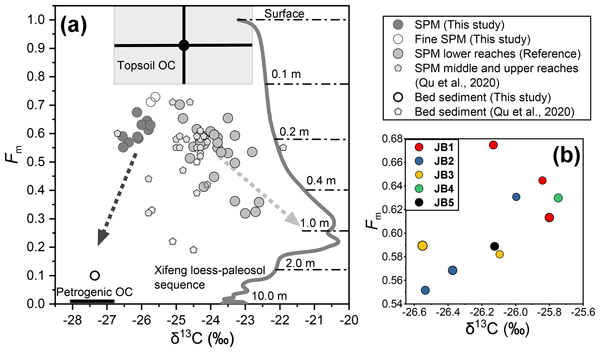
Through a river cross-section, we show that fluvial organic carbon in the lower Huanghe has clear vertical and lateral heterogeneity in elemental and isotopic signals. Bank erosion supplies terrestrial organic carbon to the fluvial transport. Physical erosion of aged and refractory organic carbon, including radiocarbon-dead organic carbon source from the biosphere, from relatively deep soil horizons of the Chinese Loess Plateau contributes to fluvial particulate organic carbon in the Huanghe.
Cited articles
AMAP/UNEP: Technical Background Report to the Global Mercury Assessment 2018, Arctic Monitoring and Assessment Programme, Oslo, Norway/UN Environment Programme, Chemicals and Health Branch, Geneva, Switzerland, https://www.amap.no/documents/doc/technical-background-report-for-the-global-mercury-assessment (last access: 2 July 2024), 2019.
Belelie, M. D., Moiloa, B., Moatshe, A., Ayob, N., Burger, R. P., and Piketh, S. J.: Assessment of multi-year mercury concentration measurements over the south african highveld: a case study of 2016–2023 selected dataset, Atmos. Environ., 355, 121261, https://doi.org/10.1016/j.atmosenv.2025.121261, 2025.
Bencardino, M., D'Amore, F., Angot, H., Angiuli, L., Bertrand, Y., Cairns, W., Diéguez, M. C., Dommergue, A., Ebinghaus, R., Esposito, G., Komínková, K., Labuschagne, C., Mannarino, V., Martin, L., Martino, M., Neves, L. M., Mashyanov, N., Magand, O., Nelson, P., Norstrom, C., Read, K., Sholupov, S., Skov, H., Tassone, A., Vítková, G., Cinnirella, S., Sprovieri, F., and Pirrone, N.: Patterns and trends of atmospheric mercury in the GMOS network: insights based on a decade of measurements, Environ. Pollut., 363, 125104, https://doi.org/10.1016/j.envpol.2024.125104, 2024.
Bergquist, B. A. and Blum, J. D.: The odds and evens of mercury isotopes: Applications of mass-dependent and mass-independent isotope fractionation, Elements, 5, 353–357, https://doi.org/10.2113/gselements.5.6.353, 2009.
Blanchfield, P. J., Rudd, J. W. M., Hrenchuk, L. E., Amyot, M., Babiarz, C. L., Beaty, K. G., Bodaly, R. A. D., Branfireun, B. A., Gilmour, C. C., Graydon, J. A., Hall, B. D., Harris, R. C., Heyes, A., Hintelmann, H., Hurley, J. P., Kelly, C. A., Krabbenhoft, D. P., Lindberg, S. E., Mason, R. P., Paterson, M. J., Podemski, C. L., Sandilands, K. A., Southworth, G. R., St Louis, V. L., Tate, L. S., and Tate, M. T.: Experimental evidence for recovery of Mercury-contaminated fish populations, Nature, 601, 74–78, https://doi.org/10.1038/s41586-021-04222-7, 2022.
Blum, J. D. and Bergquist, B. A.: Reporting of variations in the natural isotopic composition of Mercury, Anal. Bioanal. Chem., 388, 353–359, https://doi.org/10.1007/s00216-007-1236-9, 2007.
Blum, J. D., Sherman, L. S., and Johnson, M. W.: Mercury isotopes in Earth and environmental sciences, Annu. Rev. Earth Planet. Sci., 42, 249–269, https://doi.org/10.1146/annurev-earth-050212-124107, 2014.
Cai, H. and Chen, J.: Mass-independent fractionation of even mercury isotopes, Sci. Bull., 61, 116–124, https://doi.org/10.1007/s11434-015-0968-8, 2016.
Chen, J., Hintelmann, H., Feng, X., and Dimock, B.: Unusual fractionation of both odd and even mercury isotopes in precipitation from peterborough, ON, Canada, Geochim. Cosmochim. Ac., 90, 33–46, https://doi.org/10.1016/j.gca.2012.05.005, 2012.
Cui, Y., Wu, Q., Wang, S., Liu, K., Li, S., Shi, Z., Ouyang, D., Li, Z., Chen, Q., Lü, C., Xie, F., Tang, Y., Wang, Y., and Hao, J.: Integrating point sources to map anthropogenic atmospheric mercury emissions in China, 1978–2021, Earth Syst. Sci. Data, 17, 3315–3328, https://doi.org/10.5194/essd-17-3315-2025, 2025.
Dong, Z., Pavuluri, C. M., Li, P., Xu, Z., Deng, J., Zhao, X., Zhao, X., Fu, P., and Liu, C.-Q.: Measurement report: optical characterization, seasonality, and sources of brown carbon in fine aerosols from Tianjin, north China: year-round observations, Atmos. Chem. Phys., 24, 5887–5905, https://doi.org/10.5194/acp-24-5887-2024, 2024.
Driscoll, C. T., Mason, R. P., Chan, H. M., Jacob, D. J., and Pirrone, N.: Mercury as a global pollutant: sources, pathways, and effects, Environ. Sci. Technol., 47, 4967–4983, https://doi.org/10.1021/es305071v, 2013.
Estrade, N., Carignan, J., Sonke, J. E., and Donard, O. F. X.: Mercury isotope fractionation during liquid–vapor evaporation experiments, Geochim. Cosmochim. Ac., 73, 2693–2711, https://doi.org/10.1016/j.gca.2009.01.024, 2009.
Feinberg, A., Selin, N. E., Braban, C. F., Chang, K.-L., Custódio, D., Jaffe, D. A., Kyllönen, K., Landis, M. S., Leeson, S. R., Luke, W., Molepo, K. M., Murovec, M., Nerentorp Mastromonaco, M. G., Aspmo Pfaffhuber, K., Rüdiger, J., Sheu, G.-R., and St. Louis, V. L.: Unexpected anthropogenic emission decreases explain recent atmospheric mercury concentration declines, P. Natl. Acad. Sci. USA, 121, e2401950121, https://doi.org/10.1073/pnas.2401950121, 2024.
Feng, X., Fu, X., Zhang, H., Wang, X., Jia, L., Zhang, L., Lin, C.-J., Huang, J.-H., Liu, K., and Wang, S.: Combating air pollution significantly reduced air mercury concentrations in China, Natl. Sci. Rev., 11, nwae264, https://doi.org/10.1093/nsr/nwae264, 2024.
Fu, X., Heimbürger, L.-E., and Sonke, J. E.: Collection of atmospheric gaseous mercury for stable isotope analysis using iodine- and chlorine-impregnated activated carbon traps, J. Anal. Atom. Spectrom., 29, 841, https://doi.org/10.1039/c3ja50356a, 2014.
Fu, X., Liu, C., Zhang, H., Xu, Y., Zhang, H., Li, J., Lyu, X., Zhang, G., Guo, H., Wang, X., Zhang, L., and Feng, X.: Isotopic compositions of atmospheric total gaseous mercury in 10 chinese cities and implications for land surface emissions, Atmos. Chem. Phys., 21, 6721–6734, https://doi.org/10.5194/acp-21-6721-2021, 2021a.
Fu, X., Jiskra, M., Yang, X., Marusczak, N., Enrico, M., Chmeleff, J., Heimbürger-Boavida, L.-E., Gheusi, F., and Sonke, J. E.: Mass-independent fractionation of even and odd mercury isotopes during atmospheric mercury redox reactions, Environ. Sci. Technol., 55, 10164–10174, https://doi.org/10.1021/acs.est.1c02568, 2021b.
Fu, X., Zhang, H., Tang, K., Sommar, J., Huang, J.-H., Song, Z., Zhang, Y., Driscoll, C. T., and Feng, X.: Atmospherically deposited elemental mercury drives evasion of Mercury from the ocean and freshwaters, Natl. Sci. Rev., 13, nwaf590, https://doi.org/10.1093/nsr/nwaf590, 2026.
Fu, X. W., Zhang, H., Yu, B., Wang, X., Lin, C.-J., and Feng, X. B.: Observations of atmospheric mercury in China: a critical review, Atmos. Chem. Phys., 15, 9455–9476, https://doi.org/10.5194/acp-15-9455-2015, 2015.
Gačnik, J., Živković, I., and Horvat, M.: Mercury isotopes in the atmosphere: synthesis, perspectives and analytical considerations, TrAC, Trends Anal. Chem., 189, 118257, https://doi.org/10.1016/j.trac.2025.118257, 2025.
Geyman, B. M., Streets, D. G., Olson, C. I., Thackray, C. P., Olson, C. L., Schaefer, K., Krabbenhoft, D. P., and Sunderland, E. M.: Cumulative anthropogenic impacts of past and future emissions and releases on the global mercury cycle, Environ. Sci. Technol., 59, 8578–8590, https://doi.org/10.1021/acs.est.4c13434, 2025.
Gustin, M. S., Amos, H. M., Huang, J., Miller, M. B., and Heidecorn, K.: Measuring and modeling mercury in the atmosphere: a critical review, Atmos. Chem. Phys., 15, 5697–5713, https://doi.org/10.5194/acp-15-5697-2015, 2015.
Horowitz, H. M., Jacob, D. J., Zhang, Y., Dibble, T. S., Slemr, F., Amos, H. M., Schmidt, J. A., Corbitt, E. S., Marais, E. A., and Sunderland, E. M.: A new mechanism for atmospheric mercury redox chemistry: implications for the global mercury budget, Atmos. Chem. Phys., 17, 6353–6371, https://doi.org/10.5194/acp-17-6353-2017, 2017.
Jin, R., Hu, W., Duan, P., Sheng, M., Liu, D., Huang, Z., Niu, M., Wu, L., Deng, J., and Fu, P.: Exometabolomic exploration of culturable airborne microorganisms from an urban atmosphere, Atmos. Chem. Phys., 25, 1805–1829, https://doi.org/10.5194/acp-25-1805-2025, 2025.
Koenig, A. M., Magand, O., Verreyken, B., Brioude, J., Amelynck, C., Schoon, N., Colomb, A., Ferreira Araujo, B., Ramonet, M., Sha, M. K., Cammas, J.-P., Sonke, J. E., and Dommergue, A.: Mercury in the free troposphere and bidirectional atmosphere–vegetation exchanges – insights from maïdo mountain observatory in the southern hemisphere tropics, Atmos. Chem. Phys., 23, 1309–1328, https://doi.org/10.5194/acp-23-1309-2023, 2023.
Lamborg, C. H., Hammerschmidt, C. R., Bowman, K. L., Swarr, G. J., Munson, K. M., Ohnemus, D. C., Lam, P. J., Heimbürger, L.-E., Rijkenberg, M. J. A., and Saito, M. A.: A global ocean inventory of anthropogenic mercury based on water column measurements, Nature, 512, 65–68, https://doi.org/10.1038/nature13563, 2014.
Li, J., Wei, W., Zhen, W., Guo, Y., and Chen, B.: How green transition of energy system impacts china's mercury emissions, Earth's Future, 7, 1407–1416, https://doi.org/10.1029/2019EF001269, 2019.
Liu, K., Wu, Q., Wang, L., Wang, S., Liu, T., Ding, D., Tang, Y., Li, G., Tian, H., Duan, L., Wang, X., Fu, X., Feng, X., and Hao, J.: Measure-specific effectiveness of air pollution control on China's atmospheric mercury concentration and deposition during 2013–2017, Environ. Sci. Technol., 53, 8938–8946, https://doi.org/10.1021/acs.est.9b02428, 2019.
McLagan, D. S., Mitchell, C. P. J., Huang, H., Lei, Y. D., Cole, A. S., Steffen, A., Hung, H., and Wania, F.: A high-precision passive air sampler for gaseous mercury, Environ. Sci. Technol. Lett., 3, 24–29, https://doi.org/10.1021/acs.estlett.5b00319, 2016.
Muntean, M., Crippa, M., Guizzardi, D., Pagani, F., Becker, W., Banja, M., Schaaf, E., and Simonati, A.: EDGAR v8.1 Global Mercury Emissions, European Commission, JRC – Joint Research Centre [data set], https://doi.org/10.2905/83b507d7-5218-4dc5-95f9-0ec36f073204, 2024.
Outridge, P. M., Mason, R. P., Wang, F., Guerrero, S., and Heimbürger-Boavida, L. E.: Updated global and oceanic mercury budgets for the united nations global mercury assessment 2018, Environ. Sci. Technol., 52, acs.est.8b01246, https://doi.org/10.1021/acs.est.8b01246, 2018.
Qin, X., Zhang, L., Wang, G., Wang, X., Fu, Q., Xu, J., Li, H., Chen, J., Zhao, Q., Lin, Y., Huo, J., Wang, F., Huang, K., and Deng, C.: Assessing contributions of natural surface and anthropogenic emissions to atmospheric mercury in a fast-developing region of eastern China from 2015 to 2018, Atmos. Chem. Phys., 20, 10985–10996, https://doi.org/10.5194/acp-20-10985-2020, 2020.
Rose, C. H., Ghosh, S., Blum, J. D., and Bergquist, B. A.: Effects of ultraviolet radiation on Mercury isotope fractionation during photo-reduction for inorganic and organic mercury species, Chem. Geol., 405, 102–111, https://doi.org/10.1016/j.chemgeo.2015.02.025, 2015.
Sommar, J. O., Shi, X., Tang, X., Sun, G., Lin, C.-J., and Feng, X.: Atmospheric mercury: recent advances in theoretical, computational, experimental, observational, and isotopic understanding to decipher its redox transformations in the upper and lower atmosphere and interactions with Earth surface reservoirs, Atmos. Chem. Phys., 25, 12233–12334, https://doi.org/10.5194/acp-25-12233-2025, 2025.
Sonke, J. E., Angot, H., Zhang, Y., Poulain, A., Björn, E., and Schartup, A.: Global change effects on biogeochemical mercury cycling, Ambio, 52, 853–876, https://doi.org/10.1007/s13280-023-01855-y, 2023.
Sprovieri, F., Pirrone, N., Bencardino, M., D'Amore, F., Carbone, F., Cinnirella, S., Mannarino, V., Landis, M., Ebinghaus, R., Weigelt, A., Brunke, E.-G., Labuschagne, C., Martin, L., Munthe, J., Wängberg, I., Artaxo, P., Morais, F., de Melo Jorge Barbosa, H., Brito, J., Cairns, W., Barbante, C., del Carmen Diéguez, M., Garcia, P. E., Dommergue, A., Angot, H., Magand, O., Skov, H., Horvat, M., Kotnik, J., Read, K. A., Neves, L. M., Gawlik, B. M., Sena, F., Mashyanov, N., Obolkin, V., Wip, D., Feng, X. B., Zhang, H., Fu, X., Ramachandran, R., Cossa, D., Knoery, J., Marusczak, N., Nerentorp, M., and Norstrom, C.: Atmospheric mercury concentrations observed at ground-based monitoring sites globally distributed in the framework of the GMOS network, Atmos. Chem. Phys., 16, 11915–11935, https://doi.org/10.5194/acp-16-11915-2016, 2016.
Streets, D. G., Horowitz, H. M., Lu, Z., Levin, L., Thackray, C. P., and Sunderland, E. M.: Global and regional trends in Mercury emissions and concentrations, 2010–2015, Atmos. Environ., 201, 417–427, https://doi.org/10.1016/j.atmosenv.2018.12.031, 2019.
Sun, G., Sommar, J., Feng, X., Lin, C.-J., Ge, M., Wang, W., Yin, R., Fu, X., and Shang, L.: Mass-dependent and -independent fractionation of Mercury isotope during gas-phase oxidation of elemental mercury vapor by atomic Cl and Br, Environ. Sci. Technol., 50, 9232–9241, https://doi.org/10.1021/acs.est.6b01668, 2016a.
Sun, G., Feng, X., Yin, R., Wang, F., Lin, C.-J., Li, K., and Sommar, J. O.: Dissociation of mercuric oxides drives anomalous isotope fractionation during net photo-oxidation of Mercury vapor in air, Environ. Sci. Technol., 56, 13428–13438, https://doi.org/10.1021/acs.est.2c02722, 2022.
Sun, R., Streets, D. G., Horowitz, H. M., Amos, H. M., Liu, G., Perrot, V., Toutain, J.-P., Hintelmann, H., Sunderland, E. M., and Sonke, J. E.: Historical (1850–2010) mercury stable isotope inventory from anthropogenic sources to the atmosphere, Elem. Sci. Anth., 4, 91, https://doi.org/10.12952/journal.elementa.000091, 2016b.
Sun, R., Cao, F., Dai, S., Shan, B., Qi, C., Xu, Z., Li, P., Liu, Y., Zheng, W., and Chen, J.: Atmospheric mercury isotope shifts in response to Mercury emissions from underground coal fires, Environ. Sci. Technol., 57, 8638–8649, https://doi.org/10.1021/acs.est.2c08637, 2023.
Sun, R., Zhang, R., Yang, Y., Liu, Y., Zheng, W., Zhang, Q., Lin, H., Tong, Y., Zhang, Y., Schauer, J., Wang, X., and Chen, J.: Four decades of atmospheric mercury records at mt. Everest reveals significant reduction in anthropogenic mercury emissions over the past decade, ACS ES&T Air, 2, 824–836, https://doi.org/10.1021/acsestair.4c00296, 2025.
Szponar, N., McLagan, D. S., Kaplan, R. J., Mitchell, C. P. J., Wania, F., Steffen, A., Stupple, G. W., Monaci, F., and Bergquist, B. A.: Isotopic characterization of atmospheric gaseous elemental mercury by passive air sampling, Environ. Sci. Technol., 54, 10533–10543, https://doi.org/10.1021/acs.est.0c02251, 2020.
Tang, K., Yin, X., Zhang, H., Fu, X., Zhang, H., Zhang, L., Zhang, Q., Chen, P., Jia, L., De Foy, B., Kang, S., and Feng, X.: Transport of exogenous anthropogenic atmospheric mercury to the Tibetan Plateau identified using mercury stable isotopes, J. Geophys. Res.-Atmos., 129, e2024JD041684, https://doi.org/10.1029/2024JD041684, 2024.
Tang, Y., Wang, S., Wu, Q., Liu, K., Wang, L., Li, S., Gao, W., Zhang, L., Zheng, H., Li, Z., and Hao, J.: Recent decrease trend of atmospheric mercury concentrations in east China: the influence of anthropogenic emissions, Atmos. Chem. Phys., 18, 8279–8291, https://doi.org/10.5194/acp-18-8279-2018, 2018.
Tate, M. T., Janssen, S. E., Lepak, R. F., Flucke, L., and Krabbenhoft, D. P.: National-scale assessment of total gaseous mercury isotopes across the United States, J. Geophys. Res.-Atmos., 128, e2022JD038276, https://doi.org/10.1029/2022JD038276, 2023.
Wang, F., Outridge, P. M., Feng, X., Meng, B., Heimbürger-Boavida, L.-E., and Mason, R. P.: How closely do mercury trends in fish and other aquatic wildlife track those in the atmosphere? – implications for evaluating the effectiveness of the minamata convention, Sci. Total Environ., 674, 58–70, https://doi.org/10.1016/j.scitotenv.2019.04.101, 2019.
Wang, Y. Q., Zhang, X. Y., and Draxler, R. R.: TrajStat: GIS-based software that uses various trajectory statistical analysis methods to identify potential sources from long-term air pollution measurement data, Environ. Model. Softw., 24, 938–939, https://doi.org/10.1016/j.envsoft.2009.01.004, 2009.
Wen, Z., Ma, X., Xu, W., Si, R., Liu, L., Ma, M., Zhao, Y., Tang, A., Zhang, Y., Wang, K., Zhang, Y., Shen, J., Zhang, L., Zhao, Y., Zhang, F., Goulding, K., and Liu, X.: Combined short-term and long-term emission controls improve air quality sustainably in China, Nat. Commun., 15, 5169, https://doi.org/10.1038/s41467-024-49539-9, 2024.
Wiederhold, J. G., Cramer, C. J., Daniel, K., Infante, I., Bourdon, B., and Kretzschmar, R.: Equilibrium mercury isotope fractionation between dissolved hg(II) species and thiol-bound hg, Environ. Sci. Technol., 44, 4191–4197, https://doi.org/10.1021/es100205t, 2010.
Wu, Q., Wang, S., Li, G., Liang, S., Lin, C.-J., Wang, Y., Cai, S., Liu, K., and Hao, J.: Temporal trend and spatial distribution of speciated atmospheric mercury emissions in China during 1978–2014, Environ. Sci. Technol., 50, 13428–13435, https://doi.org/10.1021/acs.est.6b04308, 2016.
Wu, Q., Tang, Y., Wang, S., Li, L., Deng, K., Tang, G., Liu, K., Ding, D., and Zhang, H.: Developing a statistical model to explain the observed decline of atmospheric mercury, Atmos. Environ., 243, 117868, https://doi.org/10.1016/j.atmosenv.2020.117868, 2020.
Wu, X., Fu, X., Zhang, H., Tang, K., Wang, X., Zhang, H., Deng, Q., Zhang, L., Liu, K., Wu, Q., Wang, S., and Feng, X.: Changes in atmospheric gaseous elemental mercury concentrations and isotopic compositions at Mt. Changbai during 2015–2021 and Mt. Ailao during 2017–2021 in China, J. Geophys. Res.-Atmos., 128, e2022JD037749, https://doi.org/10.1029/2022JD037749, 2023.
Yu, B., Yang, L., Liu, H., Xiao, C., Bu, D., Zhang, Q., Fu, J., Zhang, Q., Cong, Z., Liang, Y., Hu, L., Yin, Y., Shi, J., and Jiang, G.: Tracing the transboundary transport of Mercury to the Tibetan Plateau using atmospheric mercury isotopes, Environ. Sci. Technol., 56, 1568–1577, https://doi.org/10.1021/acs.est.1c05816, 2022.
Zhang, C. and Sun, R.: Atmospheric mercury stable isotopes: advances in Mercury cycle tracing and projections of future trends, Earth Sci. Rev., 272, 105348, https://doi.org/10.1016/j.earscirev.2025.105348, 2026.
Zhang, K., Zheng, W., Sun, R., He, S., Shuai, W., Fan, X., Yuan, S., Fu, P., Deng, J., Li, X., Wang, S., and Chen, J.: Stable isotopes reveal photoreduction of particle-bound mercury driven by water-soluble organic carbon during severe haze, Environ. Sci. Technol., 56, 10619–10628, https://doi.org/10.1021/acs.est.2c01933, 2022.
Zhang, Y., Shindell, D., Seltzer, K., Shen, L., Lamarque, J.-F., Zhang, Q., Zheng, B., Xing, J., Jiang, Z., and Zhang, L.: Impacts of emission changes in China from 2010 to 2017 on domestic and intercontinental air quality and health effect, Atmos. Chem. Phys., 21, 16051–16065, https://doi.org/10.5194/acp-21-16051-2021, 2021.
Zhang, Y., Zhang, L., Cao, S., Liu, X., Jin, J., and Zhao, Y.: Improved anthropogenic mercury emission inventories for China from 1980 to 2020: toward more accurate effectiveness evaluation for the minamata convention, Environ. Sci. Technol., 57, 8660–8670, https://doi.org/10.1021/acs.est.3c01065, 2023.
Zheng, B., Tong, D., Li, M., Liu, F., Hong, C., Geng, G., Li, H., Li, X., Peng, L., Qi, J., Yan, L., Zhang, Y., Zhao, H., Zheng, Y., He, K., and Zhang, Q.: Trends in China's anthropogenic emissions since 2010 as the consequence of clean air actions, Atmos. Chem. Phys., 18, 14095–14111, https://doi.org/10.5194/acp-18-14095-2018, 2018.
Zheng, W. and Hintelmann, H.: Mercury isotope fractionation during photoreduction in natural water is controlled by its Hg DOC ratio, Geochim. Cosmochim. Ac., 73, 6704–6715, https://doi.org/10.1016/j.gca.2009.08.016, 2009.
Zheng, W. and Hintelmann, H.: Nuclear field shift effect in isotope fractionation of Mercury during abiotic reduction in the absence of light, J. Phys. Chem. A, 114, 4238–4245, https://doi.org/10.1021/jp910353y, 2010.
Zhu, W., Fu, X., Zhang, H., Liu, C., Skyllberg, U., Sommar, J., Yu, B., and Feng, X.: Mercury isotope fractionation during the exchange of Hg0 between the atmosphere and land surfaces: implications for Hg0 exchange processes and controls, Environ. Sci. Technol., 56, 1445–1457, https://doi.org/10.1021/acs.est.1c05602, 2022.
Zhu, W., Li, Z., Li, P., Sommar, J., Fu, X., Feng, X., Yu, B., Zhang, W., Reis, A. T., and Pereira, E.: Legacy mercury re-emission and subsurface migration at contaminated sites constrained by Hg isotopes and chemical speciation, Environ. Sci. Technol., 58, 5336–5346, https://doi.org/10.1021/acs.est.3c07276, 2024.
Short summary
This study investigates long-term (2018–2025) atmospheric mercury trends in Tianjin, China. Gaseous mercury concentrations declined by > 60 % and stabilized near background levels during and after the COVID-19 pandemic. Mercury isotopes reveal a shift from local emission dominance to background influence, with secondary re-emission from urban surfaces becoming increasingly important. The results demonstrate effective emission controls and the rising significance of legacy mercury in cities.
This study investigates long-term (2018–2025) atmospheric mercury trends in Tianjin, China....
Altmetrics
Final-revised paper
Preprint