
Articles | Volume 26, issue 8
https://doi.org/10.5194/acp-26-5589-2026
© Author(s) 2026. This work is distributed under
the Creative Commons Attribution 4.0 License.
the Creative Commons Attribution 4.0 License.
https://doi.org/10.5194/acp-26-5589-2026
© Author(s) 2026. This work is distributed under
the Creative Commons Attribution 4.0 License.
the Creative Commons Attribution 4.0 License.
Research article
| 
23 Apr 2026
Research article |
| 23 Apr 2026
| 23 Apr 2026
ENSO contribution to the assessment of long-term cloud feedback on global warming
Huan Liu
CORRESPONDING AUTHOR

College of Meteorology and Oceanography, National University of Defense Technology, Changsha, 410073, China
Ilan Koren
Department of Earth and Planetary Sciences, Weizmann Institute of Science, Rehovot, 76100, Israel
Orit Altaratz
Department of Earth and Planetary Sciences, Weizmann Institute of Science, Rehovot, 76100, Israel
Shutian Mu
College of Meteorology and Oceanography, National University of Defense Technology, Changsha, 410073, China
Related authors
Shutian Mu, Huan Liu, Jiazhen Zhao, Xiaoqiao Wang, Fangying Wu, and Lei Liu
EGUsphere, https://doi.org/10.5194/egusphere-2026-3175, https://doi.org/10.5194/egusphere-2026-3175, 2026
Short summary
Short summary
Clouds cause key uncertainty in climate forecasts. Since previous assessments overlooked how warming changes clouds, we identified a cloud cover trend mode linked to global warming. Testing 13 climate models showed that while they capture historical warming, they miss this trend mode, underestimating its magnitude and misplacing the pattern. This reveals fundamental limits in current models. Resolving this will improve predictions of cloud behavior, making climate projections more reliable.
Yael Arieli, Alexander Khain, Orit Altaratz, Ehud Gavze, and Ilan Koren
EGUsphere, https://doi.org/10.5194/egusphere-2026-3677, https://doi.org/10.5194/egusphere-2026-3677, 2026
Short summary
Short summary
Shallow cumulus clouds affect the lower atmosphere, yet the way they dissipate is still poorly understood. We used high-resolution simulations to study the dissipation stage of shallow cumulus and the processes involved. Our results show that dissipation is a distinct and prolonged stage, involving coupled changes in cloud motion, microphysics, turbulence, and the surrounding environment. Therefore dissipation should be considered when interpreting observations and representing clouds in models.
Shutian Mu, Huan Liu, Jiazhen Zhao, Xiaoqiao Wang, Fangying Wu, and Lei Liu
EGUsphere, https://doi.org/10.5194/egusphere-2026-3175, https://doi.org/10.5194/egusphere-2026-3175, 2026
Short summary
Short summary
Clouds cause key uncertainty in climate forecasts. Since previous assessments overlooked how warming changes clouds, we identified a cloud cover trend mode linked to global warming. Testing 13 climate models showed that while they capture historical warming, they miss this trend mode, underestimating its magnitude and misplacing the pattern. This reveals fundamental limits in current models. Resolving this will improve predictions of cloud behavior, making climate projections more reliable.
Yuval Ben Ami, Orit Altaratz, Yoav Yair, and Ilan Koren
Atmos. Meas. Tech., 19, 617–627, https://doi.org/10.5194/amt-19-617-2026, https://doi.org/10.5194/amt-19-617-2026, 2026
Short summary
Short summary
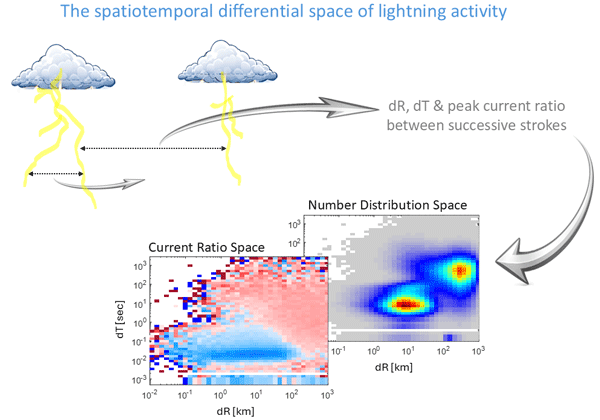
We advanced the Lightning Differential Space (LDS) method, which maps time and distance between lightning strokes, and demonstrated its use across three distinct meteorological regions. By comparing stroke strength and timing, our new Current Ratio approach reveals flash initiation patterns in different storm types. The method is straightforward and data-driven, enabling physical insight without model-based analysis or prior assumptions, and supports regional lightning analysis and forecasting.
Manuel Santos Gutiérrez, Mickaël David Chekroun, and Ilan Koren
EGUsphere, https://doi.org/10.48550/arXiv.2405.11545, https://doi.org/10.48550/arXiv.2405.11545, 2024
Preprint withdrawn
Short summary
Short summary
This letter explores a novel approach for the formation of cloud droplets in rising adiabatic air parcels. Our approach combines microphysical equations accounting for moisture, updrafts and concentration of aerosols. Our analysis reveals three regimes: A) Low moisture and high concentration can hinder activation; B) Droplets can activate and stabilize above critical sizes, and C) sparse clouds can have droplets exhibiting activation and deactivation cycles.
Huan Liu, Ilan Koren, Orit Altaratz, and Mickaël D. Chekroun
Atmos. Chem. Phys., 23, 6559–6569, https://doi.org/10.5194/acp-23-6559-2023, https://doi.org/10.5194/acp-23-6559-2023, 2023
Short summary
Short summary
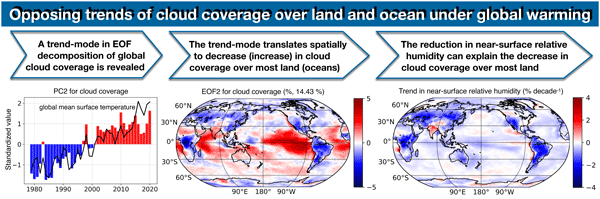
Clouds' responses to global warming contribute the largest uncertainty in climate prediction. Here, we analyze 42 years of global cloud cover in reanalysis data and show a decreasing trend over most continents and an increasing trend over the tropical and subtropical oceans. A reduction in near-surface relative humidity can explain the decreasing trend in cloud cover over land. Our results suggest potential stress on the terrestrial water cycle, associated with global warming.
Elisa T. Sena, Ilan Koren, Orit Altaratz, and Alexander B. Kostinski
Atmos. Chem. Phys., 22, 16111–16122, https://doi.org/10.5194/acp-22-16111-2022, https://doi.org/10.5194/acp-22-16111-2022, 2022
Short summary
Short summary
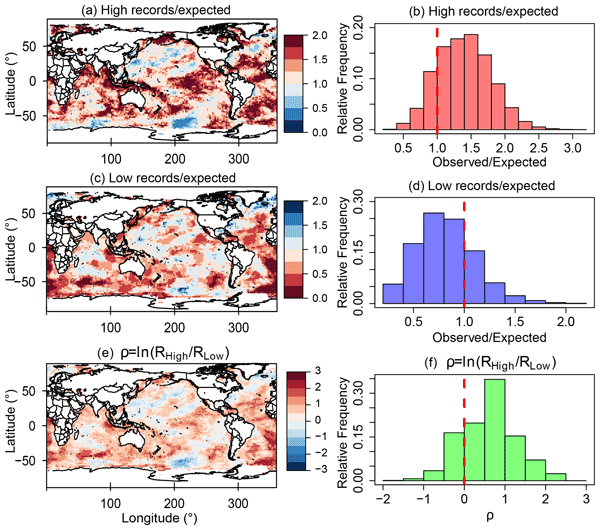
We used record-breaking statistics together with spatial information to create record-breaking SST maps. The maps reveal warming patterns in the overwhelming majority of the ocean and coherent islands of cooling, where low records occur more frequently than high ones. Some of these cooling spots are well known; however, a surprising elliptical area in the Southern Ocean is observed as well. Similar analyses can be performed on other key climatological variables to explore their trend patterns.
Eshkol Eytan, Ilan Koren, Orit Altaratz, Mark Pinsky, and Alexander Khain
Atmos. Chem. Phys., 21, 16203–16217, https://doi.org/10.5194/acp-21-16203-2021, https://doi.org/10.5194/acp-21-16203-2021, 2021
Short summary
Short summary
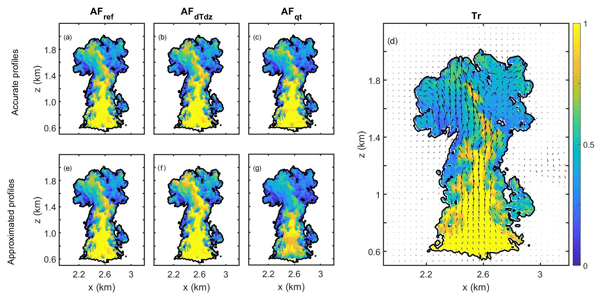
Describing cloud mixing processes is among the most challenging fronts in cloud physics. Therefore, the adiabatic fraction (AF) that serves as a mixing measure is a valuable metric. We use high-resolution (10 m) simulations of single clouds with a passive tracer to test the skill of different methods used to derive AF. We highlight a method that is insensitive to the available cloud samples and allows considering microphysical effects on AF estimations in different environmental conditions.
Cited articles
Angell, J. K.: Tropospheric temperature variations adjusted for El Niño, 1958–1998, J. Geophys. Res.-Atmos., 105, 11841–11849, https://doi.org/10.1029/2000JD900044, 2000.
Bader, D. C., Leung, R., Taylor, M., and McCoy, R. B.: E3SM-Project E3SM1.0 model output prepared for CMIP6 CMIP, Earth System Grid Federation [data set], https://doi.org/10.22033/ESGF/CMIP6.2294, 2019.
Bellenger, H., Guilyardi, E., Leloup, J., Lengaigne, M., and Vialard, J.: ENSO representation in climate models: From CMIP3 to CMIP5, Clim. Dyn., 42, 1999–2018, https://doi.org/10.1007/s00382-013-1783-z, 2014.
Beobide-Arsuaga, G., Bayr, T., Reintges, A., and Latif, M.: Uncertainty of ENSO-amplitude projections in CMIP5 and CMIP6 models, Clim. Dyn., 56, 3875–3888, https://doi.org/10.1007/s00382-021-05673-4, 2021.
Binder, H., Boettcher, M., Joos, H., Sprenger, M., and Wernli, H.: Vertical cloud structure of warm conveyor belts – a comparison and evaluation of ERA5 reanalysis, CloudSat and CALIPSO data, Weather Clim. Dynam., 1, 577–595, https://doi.org/10.5194/wcd-1-577-2020, 2020.
Boucher, O., Denvil, S., Levavasseur, G., Cozic, A., Caubel, A., Foujols, M.-A., Meurdesoif, Y., Cadule, P., Devilliers, M., Ghattas, J., Lebas, N., Lurton, T., Mellul, L., Musat, I., Mignot, J., and Cheruy, F.: IPSL IPSL-CM6A-LR model output prepared for CMIP6 CMIP, Earth System Grid Federation [data set], https://doi.org/10.22033/ESGF/CMIP6.1534, 2018.
Ceppi, P. and Nowack, P.: Observational evidence that cloud feedback amplifies global warming, P. Natl. Acad. Sci. USA, 118, e2026290118, https://doi.org/10.1073/pnas.2026290118, 2021.
Chen, T., Rossow, W. B., and Zhang, Y.: Radiative effects of cloud-type variations, J. Climate, 13, 264–286, https://doi.org/10.1175/1520-0442(2000)013<0264:REOCTV>2.0.CO;2, 2000.
Clement, A. C., Burgman, R., and Norris, J. R.: Observational and Model Evidence for Positive Low-Level Cloud Feedback, Science, 325, 460–464, https://doi.org/10.1126/science.1171255, 2009.
Coburn, J. and Pryor, S. C.: Differential Credibility of Climate Modes in CMIP6, J. Climate, 34, 8145–8164, https://doi.org/10.1175/JCLI-D-21-0359.1, 2021.
Compo, G. P. and Sardeshmukh, P. D.: Removing ENSO-related variations from the climate record, J. Climate, 23, 1957–1978, https://doi.org/10.1175/2009JCLI2735.1, 2010.
Danabasoglu, G.: NCAR CESM2 model output prepared for CMIP6 CMIP, Earth System Grid Federation [data set], https://doi.org/10.22033/ESGF/CMIP6.2185, 2019.
Davey, M., Brookshaw, A., and Ineson, S.: The probability of the impact of ENSO on precipitation and near-surface temperature, Clim. Risk Manag., 1, 5–24, https://doi.org/10.1016/j.crm.2013.12.002, 2014.
Davis, L. L. B., Thompson, D. W. J., Rugenstein, M., and Birner, T.: Links between internal variability and forced climate feedbacks: The importance of patterns of temperature variability and change. Geophys. Res. Lett., 51, e2024GL112774, https://doi.org/10.1029/2024GL112774, 2024.
Dessler, A. E.: A determination of the cloud feedback from climate variations over the past decade, Science, 330, 1523–1527, https://doi.org/10.1126/science.1192546, 2010.
Dessler, A. E. and Forster, P. M.: An estimate of equilibrium climate sensitivity from interannual variability, J. Geophys. Res.-Atmos., 123, 8634–8645, https://doi.org/10.1029/2018JD028481, 2018.
Eleftheratos, K., Zerefos, C., Varotsos, C., and Kapsomenakis, I.: Interannual variability of cirrus clouds in the tropics in el niño southern oscillation (ENSO) regions based on international satellite cloud climatology project (ISCCP) satellite data, Int. J. Remote Sens., 32, 6395–6405, https://doi.org/10.1080/01431161.2010.510491, 2011.
Eyring, V., Bony, S., Meehl, G. A., Senior, C. A., Stevens, B., Stouffer, R. J., and Taylor, K. E.: Overview of the Coupled Model Intercomparison Project Phase 6 (CMIP6) experimental design and organization, Geosci. Model Dev., 9, 1937–1958, https://doi.org/10.5194/gmd-9-1937-2016, 2016.
Eyring, V., Gillett, N. P., Achuta Rao, K. M., Barimalala, R., Barreiro Parrillo, M., Bellouin, N., Cassou, C., Durack, P. J., Kosaka, Y., McGregor, S., Min, S., Morgenstern, O., and Sun, Y.: Human Influence on the Climate System, in Climate Change 2021: The Physical Science Basis, Contribution of Working Group I to the Sixth Assessment Report of the Intergovernmental Panel on Climate Change (Cambridge University), https://doi.org/10.1017/9781009157896.005, 2021.
Forster, P., Storelvmo, T., Armour, K., Collins, W., Dufresne, J.-L., Frame, D., Lunt, D. J., Mauritsen, T., Palmer, M. D., Watanabe, M., Wild, M., and Zhang, H.: The Earth's Energy Budget, Climate Feedbacks, and Climate Sensitivity, in Climate Change 2021: The Physical Science Basis, Contribution of Working Group I to the Sixth Assessment Report of the Intergovernmental Panel on Climate Change (Cambridge University), https://doi.org/10.1017/9781009157896.009, 2021.
Glantz, M. H. and Ramirez, I. J.: Reviewing the oceanic Nino index (ONI) to enhance societal readiness for El Niño's impacts, Int. J. Disaster Risk Sci., 11, 394–403, https://doi.org/10.1007/s13753-020-00275-w, 2020.
Guan, B. and Nigam, S.: Pacific Sea Surface Temperatures in the Twentieth Century: An Evolution-Centric Analysis of Variability and Trend, J. Climate, 21, 2790–2809, https://doi.org/10.1175/2007JCLI2076.1, 2008.
Guilyardi, E., Capotondi, A., Lengaigne, M., Thual, S., and Wittenberg, A. T.: ENSO Modeling: History, Progress, and Challenges, in El Niño Southern Oscillation in a Changing Climate (American Geophysical Union), https://doi.org/10.1002/9781119548164.ch9, 2020.
Gulev, S. K., Thorne, P. W., Ahn, J., Dentener, F. J., Domingues, C. M., Gerland, S., Gong, D., Kaufman, D. S., Nnamchi, H. C., Quaas, J., Rivera, J. A., Sathyendranath, S., Smith, S. L., Trewin, B., von Schuckmann, K., and Vose, R. S.: Changing State of the Climate System, in Climate Change 2021: The Physical Science Basis, Contribution of Working Group I to the Sixth Assessment Report of the Intergovernmental Panel on Climate Change (Cambridge University), https://doi.org/10.1017/9781009157896.004, 2021.
Guo, H., John, J. G., Blanton, C., McHugh, C., Nikonov, S., Radhakrishnan, A., Rand, K., Zadeh, N. T., Balaji, V., Durachta, J., Dupuis, C., Menzel, R., Robinson, T., Underwood, S., Vahlenkamp, H., Bushuk, M., Dunne, K. A., Dussin, R., Gauthier, P. P. G., Ginoux, P., Griffies, S. M., Hallberg, R., Harrison, M., Hurlin, W., Lin, P., Malyshev, S., Naik, V., Paulot, F., Paynter, D. J., Ploshay, J., Reichl, B. G., Schwarzkopf, D. M., Seman, C. J., Shao, A., Silvers, L., Wyman, B., Yan, X., Zeng, Y., Adcroft, A., Dunne, J. P., Held, I. M., Krasting, J. P., Horowitz, L. W., Milly, P. C. D., Shevliakova, E., Winton, M., Zhao, M., and Zhang, R.: NOAA-GFDL GFDL-CM4 model output prepared for CMIP6 CMIP, Earth System Grid Federation [data set], https://doi.org/10.22033/ESGF/CMIP6.1402, 2018.
Hamed, K. H. and Rao, A. R.: A modified Mann-Kendall trend test for autocorrelated data, J. Hydrol., 204, 182–196, https://doi.org/10.1016/S0022-1694(97)00125-X, 1998.
Hersbach, H., Bell, B., Berrisford, P., Hirahara, S., Horányi, A., Muñoz-Sabater, J., Nicolas, J., Peubey, C., Radu, R., Schepers, D., Simmons, A., Soci, C., Abdalla, S., Abellan, X., Balsamo, G., Bechtold, P., Biavati, G., Bidlot, J., Bonavita, M., De Chiara, G., Dahlgren, P., Dee, D., Diamantakis, M., Dragani, R., Flemming, J., Forbes, R., Fuentes, M., Geer, A., Haimberger, L., Healy, S., Hogan, R. J., Hólm, E., Janisková, M., Keeley, S., Laloyaux, P., Lopez, P., Lupu, C., Radnoti, G., de Rosnay, P., Rozum, I., Vamborg, F., Villaume, S., and Thépaut, J.-N.: The ERA5 global reanalysis, Q. J. R. Meteorol. Soc., 146, 1999–2049, https://doi.org/10.1002/qj.3803, 2020.
Hersbach, H., Bell, B., Berrisford, P., Biavati, G., Horányi, A., Muñoz Sabater, J., Nicolas, J., Peubey, C., Radu, R., Rozum, I., Schepers, D., Simmons, A., Soci, C., Dee, D., and Thépaut, J.-N.: ERA5 monthly averaged data on single levels from 1940 to present, Copernicus Climate Change Service (C3S) Climate Data Store (CDS) [data set], https://doi.org/10.24381/cds.f17050d7, 2023.
Hope, P., Henley, B. J., Gergis, J., Brown, J., and Ye, H.: Time-varying spectral characteristics of ENSO over the Last Millennium, Clim. Dyn., 49, 1705–1727, https://doi.org/10.1007/s00382-016-3393-z, 2017.
Hussain, M. M. and Mahmud, I.: pyMannKendall: a python package for non parametric Mann Kendall family of trend tests, J. Open Source Softw., 4, 1556, https://doi.org/10.21105/joss.01556, 2019.
Jiang, W., Huang, P., Huang, G., and Ying, J.: Origins of the Excessive Westward Extension of ENSO SST Simulated in CMIP5 and CMIP6 Models, J. Clim., 34, 2839–2851, https://doi.org/10.1175/JCLI-D-20-0551.1, 2021.
Jin, D., Kramer R. J., Oreopoulos, L., and Lee D.: ENSO disrupts boreal winter CRE feedback, J. Climate, 37, 585–603, https://doi.org/10.1175/JCLI-D-23-0282.1, 2024.
Johnson, N. C.: How many ENSO flavors can we distinguish?, J. Climate, 26, 4816–4827, https://doi.org/10.1175/JCLI-D-12-00649.1, 2013.
Kelly, P. M. and Jones, P. D.: Removal of the El Niño-Southern Oscillation signal from the gridded surface air temperature data set, J. Geophys. Res.-Atmos., 101, 19013–19022, https://doi.org/10.1029/96JD01173, 1996.
Li, Y., Ge, J., Dong, Z., Hu, X., Yang, X., Wang, M., and Han, Z.: Pairwise-rotated EOFs of global cloud cover and their linkages to sea surface temperature, Int. J. Climatol., 41, 2342–2359, https://doi.org/10.1002/joc.6962, 2021.
Liu, H., Koren, I., Altaratz, O., and Chekroun, M. D.: Opposing trends of cloud coverage over land and ocean under global warming, Atmos. Chem. Phys., 23, 6559–6569, https://doi.org/10.5194/acp-23-6559-2023, 2023.
Loeb, N. G., Doelling, D. R., Wang, H., Su, W., Nguyen, C., Corbett, J. G., Liang, L., Mitrescu, C., Rose, F. G., and Kato, S.: Clouds and the earth's radiant energy system (CERES) energy balanced and filled (EBAF) top-ofatmosphere (TOA) edition-4.0 data product, J. Climate, 31, 895–918, https://doi.org/10.1175/JCLI-D-17-0208.1, 2018.
Madenach, N., Carbajal Henken, C., Preusker, R., Sourdeval, O., and Fischer, J.: Analysis and quantification of ENSO-linked changes in the tropical Atlantic cloud vertical distribution using 14 years of MODIS observations, Atmos. Chem. Phys., 19, 13535–13546, https://doi.org/10.5194/acp-19-13535-2019, 2019.
Myers, T. A., Scott, R. C., Zelinka, M. D., Klein, S. A., Norris, J. R., and Caldwell, P. M.: Observational constraints on low cloud feedback reduce uncertainty of climate sensitivity, Nat. Clim. Chang., 11, 501–507, https://doi.org/10.1038/s41558-021-01039-0, 2021.
NASA Goddard Institute for Space Studies (NASA/GISS): NASA-GISS GISS-E2.1H model output prepared for CMIP6 CMIP, Earth System Grid Federation [data set], https://doi.org/10.22033/ESGF/CMIP6.1421, 2018.
NASA Goddard Institute for Space Studies (NASA/GISS): NASA-GISS GISS-E2-2-G model output prepared for CMIP6 CMIP, Earth System Grid Federation [data set], https://doi.org/10.22033/ESGF/CMIP6.2081, 2019.
Neelin, J. D., Battisti, D. S., Hirst, A. C., Jin, F.-F., Wakata, Y., Yamagata, T., and Zebiak, S. E.: ENSO theory, J. Geophys. Res.-Oceans, 103, 14261–14290, https://doi.org/10.1029/97JC03424, 1998.
Park, S. and Leovy C. B.: Marine low-cloud anomalies associated with ENSO, J. Climate, 17, 3448–3469, https://doi.org/10.1175/1520-0442(2004)017<3448:MLAAWE>2.0.CO;2, 2004.
Penland, C. and Matrosova, L.: Studies of El Niño and interdecadal variability in tropical sea surface temperatures using a nonnormal filter, J. Climate, 19, 5796–5815, https://doi.org/10.1175/JCLI3951.1, 2006.
Richardson, M. T., Roy, R. J., and Lebsock, M. D.: Satellites suggest rising tropical high cloud altitude: 2002–2021, Geophys. Res. Lett., 49, e2022GL098160, https://doi.org/10.1029/2022GL098160, 2022.
Seager, R., Cane, M., Henderson, N., Lee, D. E., Abernathey, R., and Zhang, H.: Strengthening tropical Pacific zonal sea surface temperature gradient consistent with rising greenhouse gases, Nat. Clim. Chang., 9, 517–522, https://doi.org/10.1038/s41558-019-0505-x, 2019.
Seland, Ø., Bentsen, M., Oliviè, D. J. L., Toniazzo, T., Gjermundsen, A., Graff, L. S., Debernard, J. B., Gupta, A. K., He, Y., Kirkevåg, A., Schwinger, J., Tjiputra, J., Aas, K. S., Bethke, I., Fan, Y., Griesfeller, J., Grini, A., Guo, C., Ilicak, M., Karset, I. H. H., Landgren, O. A., Liakka, J., Moseid, K. O., Nummelin, A., Spensberger, C., Tang, H., Zhang, Z., Heinze, C., Iversen, T., and Schulz, M.: NCC NorESM2-LM model output prepared for CMIP6 CMIP, Earth System Grid Federation [data set], https://doi.org/10.22033/ESGF/CMIP6.502, 2019.
Sherwood, S. C., Webb, M. J., Annan, J. D., Armour, K. C., Forster, P. M., Hargreaves, J. C., Hegerl, G., Klein, S. A., Marvel, K. D., Rohling, E. J., Watanabe, M., Andrews, T., Braconnot, P., Bretherton, C. S., Foster, G. L., Hausfather, Z., von der Heydt, A. S., Knutti, R., Mauritsen, T., Norris, J. R., Proistosescu, C., Rugenstein, M., Schmidt, G. A., Tokarska, K. B., and Zelinka, M. D.: An assessment of Earth's climate sensitivity using multiple lines of evidence, Rev. Geophys., 58, e2019RG000678, doi.org/10.1029/2019RG000678, 2020.
Stephens, G. L., Li, J., Wild, M., Clayson, C. A., Loeb, N., Kato, S., L'Ecuyer, T., Stackhouse Jr, P. W., Lebsock, M., and Andrews, T.: An update on Earth's energy balance in light of the latest global observations, Nat. Geosci., 5, 691–696, https://doi.org/10.1038/ngeo1580, 2012.
Stubenrauch, C. J., Rossow, W. B., Kinne, S., Ackerman, S., Cesana, G., Chepfer, H., Di Girolamo, L., Getzewich, B., Guignard, A., Heidinger, A., Maddux, B. C., Menzel, W. P., Minnis, P., Pearl, C., Platnick, S., Poulsen, C., Riedi, J., Sun-Mack, S., Walther, A., Winker, D., Zeng, S., and Zhao, G.: Assessment of global cloud datasets from satellites: Project and database initiated by the GEWEX radiation panel, B. Am. Meteor. Soc., 94, 1031–1049, https://doi.org/10.1175/BAMS-D-12-00117.1, 2013.
Swart, N. C., Cole, J. N. S., Kharin, V. V., Lazare, M., Scinocca, J. F., Gillett, N. P., Anstey, J., Arora, V., Christian, J. R., Jiao, Y., Lee, W. G., Majaess, F., Saenko, O. A., Seiler, C., Seinen, C., Shao, A., Solheim, L., von Salzen, K., Yang, D., Winter, B., and Sigmond, M.: CCCma CanESM5 model output prepared for CMIP6 CMIP, Earth System Grid Federation [data set], https://doi.org/10.22033/ESGF/CMIP6.1303, 2019.
Taschetto, A. S., Ummenhofer, C. C., Stuecker, M. F., Dommenget, D., Ashok, K., Rodrigues, R. R., and Yeh, S.-W.: ENSO Atmospheric Teleconnections, in El Niño Southern Oscillation in a Changing Climate (American Geophysical Union), https://doi.org/10.1002/9781119548164.ch14, 2020.
Tatebe, H. and Watanabe, M.: MIROC MIROC6 model output prepared for CMIP6 CMIP, Earth System Grid Federation [data set], https://doi.org/10.22033/ESGF/CMIP6.881, 2018.
Teng, H. F., Lee, C. S., and Hsu, H. H.: Influence of ENSO on formation of tropical cloud clusters and their development into tropical cyclones in the western north pacific, Geophys. Res. Lett., 41, 9120–9126, https://doi.org/10.1002/2014GL061823, 2014.
Uribe, A., Bender, F. A. M., and Mauritsen, T.: Observed and CMIP6 modeled internal variability feedbacks and their relation to forced climate feedbacks, Geophys. Res. Lett., 49, e2022GL100075, https://doi.org/10.1029/2022GL100075, 2022.
Virtanen, P., Gommers, R., Oliphant, T. E., Haberland, M., Reddy, T., Cournapeau, D., Burovski, E., Peterson, P., Weckesser, W., Bright, J., van der Walt, S. J., Brett, M., Wilson, J., Millman, K. J., Mayorov, N., Nelson, A. R. J., Jones, E., Kern, R., Larson, E., Carey, C. J., Polat, İ., Feng, Y., Moore, E. W., VanderPlas, J., and SciPy 1.0 Contributors.: SciPy 1.0: Fundamental Algorithms for Scientific Computing in Python, Nat. Methods, 17, 261–272, https://doi.org/10.1038/s41592-019-0686-2, 2020.
Webb, M. J., Andrews, T., Bodas-Salcedo, A., Bony, S., Bretherton, C. S., Chadwick, R., Chepfer, H., Douville, H., Good, P., Kay, J. E., Klein, S. A., Marchand, R., Medeiros, B., Siebesma, A. P., Skinner, C. B., Stevens, B., Tselioudis, G., Tsushima, Y., and Watanabe, M.: The Cloud Feedback Model Intercomparison Project (CFMIP) contribution to CMIP6, Geosci. Model Dev., 10, 359–384, https://doi.org/10.5194/gmd-10-359-2017, 2017.
Xin, X., Zhang, J., Zhang, F., Wu, T., Shi, X., Li, J., Chu, M., Liu, Q., Yan, J., Ma, Q., and Wei, M.: BCC BCC-CSM2MR model output prepared for CMIP6 CMIP, Earth System Grid Federation [data set], https://doi.org/10.22033/ESGF/CMIP6.1725, 2018.
Yang, Y., Russell, L. M., Xu, L., Lou, S., Lamjiri, M. A., Somerville, R. C. J., Miller, A. J., Cayan, D. R., DeFlorio, M. J., Ghan, S. J., Liu, Y., Singh, B., Wang, H., Yoon, J.-H., and Rasch, P. J.: Impacts of ENSO events on cloud radiative effects in preindustrial conditions: changes in cloud fraction and their dependence on interactive aerosol emissions and concentrations, J. Geophys. Res.-Atmos., 121, 6321–6335, https://doi.org/10.1002/2015JD024503, 2016.
Yao, B., Teng, S., Lai, R., Xu, X., Yin, Y., Shi, C., and Liu, C.: Can atmospheric reanalyses (CRA and ERA5) represent cloud spatiotemporal characteristics?, Atmos. Res., 244, 105091, https://doi.org/10.1016/j.atmosres.2020.105091, 2020.
Yukimoto, S., Koshiro, T., Kawai, H., Oshima, N., Yoshida, K., Urakawa, S., Tsujino, H., Deushi, M., Tanaka, T., Hosaka, M., Yoshimura, H., Shindo, E., Mizuta, R., Ishii, M., Obata, A., and Adachi, Y.: MRI MRI-ESM2.0 model output prepared for CMIP6 CMIP, Earth System Grid Federation [data set], https://doi.org/10.22033/ESGF/CMIP6.621, 2019.
Zelinka, M. D., Zhou, C., and Klein, S. A.: Insights from a refined decomposition of cloud feedbacks, Geophys. Res. Lett., 43, 9259–9269, https://doi.org/10.1002/2016GL069917, 2016.
Zelinka, M. D., Myers, T. A., McCoy, D. T., Po-Chedley, S., Caldwell, P. M., Ceppi, P., Klein, S. A., and Taylor, K. E.: Causes of higher climate sensitivity in cmip6 models, Geophys. Res. Lett., 47, 2019–085782, https://doi.org/10.1029/2019GL085782, 2020.
Zhou, C., Zelinka, M. K., Dessler, A. E., and Klein S. A.: The relationship between interannual and long-term cloud feedbacks, Geophys. Res. Lett., 42, 10–463, https://doi.org/10.1002/2015GL066698, 2015.
Short summary
Clouds act as Earth’s thermostat, but their response to warming is uncertain. The El Niño-Southern Oscillation, a natural cycle of 2–7 years, complicates such estimates. Using extensive data and simulations, we show that these short-term fluctuations can significantly affect estimates of this response over decades and even centuries. Filtering out this natural noise is essential for reliable projections, helping society better prepare for the future.
Clouds act as Earth’s thermostat, but their response to warming is uncertain. The El...


Altmetrics
Final-revised paper
Preprint