
Articles | Volume 26, issue 7
https://doi.org/10.5194/acp-26-4633-2026
© Author(s) 2026. This work is distributed under
the Creative Commons Attribution 4.0 License.
the Creative Commons Attribution 4.0 License.
https://doi.org/10.5194/acp-26-4633-2026
© Author(s) 2026. This work is distributed under
the Creative Commons Attribution 4.0 License.
the Creative Commons Attribution 4.0 License.
Research article
| 
08 Apr 2026
Research article |
| 08 Apr 2026
| 08 Apr 2026
Evaluation of reanalysis precipitable water vapor under typhoon conditions using multi-source observations
Jiaqi Shi
GNSS Research Center, Wuhan University, Wuhan, 430079, China
School of Geodesy and Geomatics, Wuhan University, Wuhan, 430079, China
Min Li
CORRESPONDING AUTHOR
GNSS Research Center, Wuhan University, Wuhan, 430079, China
School of Geodesy and Geomatics, Wuhan University, Wuhan, 430079, China
Andrea K. Steiner
Wegener Center for Climate and Global Change, University of Graz, 8010 Graz, Austria
Sebastian Scher
Wegener Center for Climate and Global Change, University of Graz, 8010 Graz, Austria
Department of Geography and Regional Sciences, University of Graz, 8010 Graz, Austria
Minghao Zhang
School of Environment Science and Spatial Informatics, China University of Mining and Technology, Xuzhou, 221116, China
GNSS Research Center, Wuhan University, Wuhan, 430079, China
School of Geodesy and Geomatics, Wuhan University, Wuhan, 430079, China
Wenliang Gao
GNSS Research Center, Wuhan University, Wuhan, 430079, China
School of Geodesy and Geomatics, Wuhan University, Wuhan, 430079, China
Yongzhao Fan
GNSS Research Center, Wuhan University, Wuhan, 430079, China
School of Geodesy and Geomatics, Wuhan University, Wuhan, 430079, China
School of Earth Sciences and Engineering, Hohai University, Nanjing, 211100, China
Kefei Zhang
School of Environment Science and Spatial Informatics, China University of Mining and Technology, Xuzhou, 221116, China
Related authors
No articles found.
Kelsey Ennis and Sebastian Scher
EGUsphere, https://doi.org/10.5194/egusphere-2026-4059, https://doi.org/10.5194/egusphere-2026-4059, 2026
This preprint is open for discussion and under review for Geoscientific Model Development (GMD).
Short summary
Short summary
Complex terrain create sharp local temperature differences that global weather datasets are too coarse to capture. We trained a deep learning model to turn coarse hourly temperature data into detailed kilometre-scale maps of Austria and the surrounding Alps, guided by elevation and terrain information. The resulting analyses halve the errors of standard methods and realistically reproduce surface temperature patterns, improving data for climate and environmental applications.
Elke Schlager, Sebastian Scher, Ruth H. Mottram, and Peter L. Langen
The Cryosphere, 20, 3313–3343, https://doi.org/10.5194/tc-20-3313-2026, https://doi.org/10.5194/tc-20-3313-2026, 2026
Short summary
Short summary
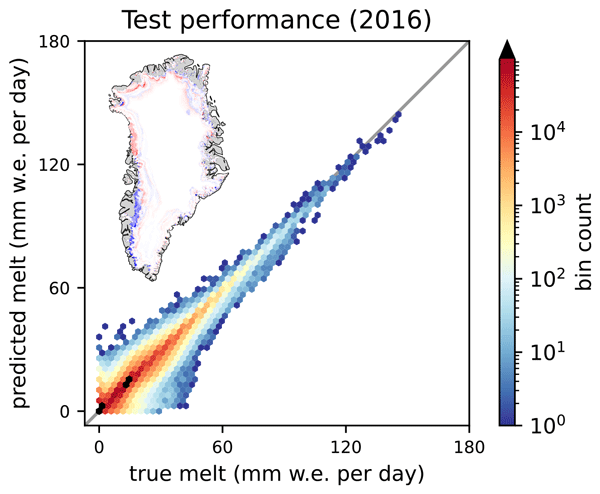
Predicting Greenland's surface melt is critical for understanding sea-level rise, but traditional firn models are too slow for exploring many climate scenarios. We developed a neural network optimized through systematic input selection and network tuning to identify the necessary information to accurately emulate surface melt. This approach cuts computation costs by orders of magnitude and can be retrained for different climate forcings or extended to other surface mass balance properties.
Annika Reiter, Julia Danzer, and Andrea K. Steiner
Weather Clim. Dynam., 6, 1683–1698, https://doi.org/10.5194/wcd-6-1683-2025, https://doi.org/10.5194/wcd-6-1683-2025, 2025
Short summary
Short summary
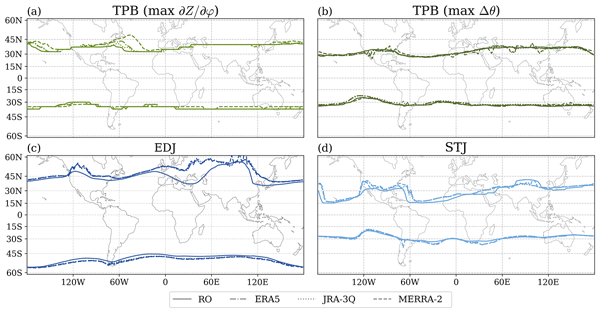
Observational Global navigation satellite system (GNSS) radio occultation (RO) temperature and wind data show high potential to study the tropical width. Comparisons of RO data with state-of-the-art reanalyses demonstrate their feasibility to study the tropopause break and jet stream metrics for zonal-mean and longitudinally-resolved studies. The RO data record provides observations in regions where other methods fall short, such as over oceans and in the Southern Hemisphere.
Florian Ladstädter, Matthias Stocker, Sebastian Scher, and Andrea K. Steiner
Atmos. Chem. Phys., 25, 16053–16062, https://doi.org/10.5194/acp-25-16053-2025, https://doi.org/10.5194/acp-25-16053-2025, 2025
Short summary
Short summary
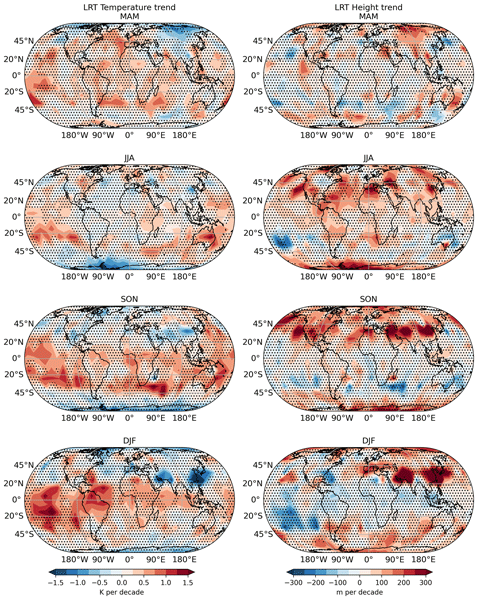
The tropopause, the boundary between the lower and upper atmosphere, is a sensitive marker of climate change. We studied changes in tropopause height and temperature over the past two decades using precise satellite observations. We found warming in the tropics and rising tropopause heights in many regions, especially over Asia and the Middle East. These changes reflect how both atmospheric layers are responding to climate change and highlight the need for continued satellite monitoring.
Florina Roana Schalamon, Sebastian Scher, Andreas Trügler, Lea Hartl, Wolfgang Schöner, and Jakob Abermann
Weather Clim. Dynam., 6, 1075–1088, https://doi.org/10.5194/wcd-6-1075-2025, https://doi.org/10.5194/wcd-6-1075-2025, 2025
Short summary
Short summary
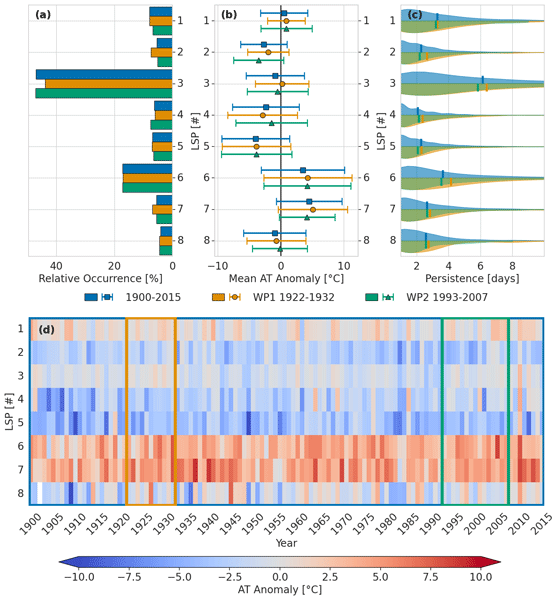
Atmospheric patterns influence the air temperature in Greenland. We investigate two warming periods, from 1922–1932 and 1993–2007, both showing similar temperature increases. Using a neural network-based clustering method, we defined predominant atmospheric patterns for further analysis. Our findings reveal that while the connection between these patterns and local air temperature remains stable, the distribution of patterns changes between the warming periods and the full period (1900–2015).
Peng Sun, Kefei Zhang, Dantong Zhu, Shuangshuang Shi, Xuexi Liu, Dongsheng Zhao, Minghao Zhang, and Suqin Wu
Geosci. Model Dev., 18, 6167–6176, https://doi.org/10.5194/gmd-18-6167-2025, https://doi.org/10.5194/gmd-18-6167-2025, 2025
Short summary
Short summary
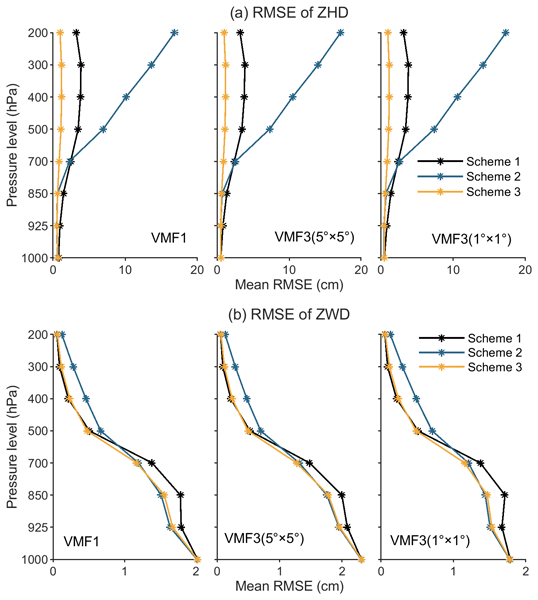
A new method has been developed to more accurately adjust atmospheric delay data for use in satellite positioning, especially in areas with large height differences. By using long-term weather data and testing with global observation stations, the new method significantly improves accuracy compared to traditional approaches. This can benefit applications such as precise positioning and weather monitoring using navigation satellite signals.
Kamilya Yessimbet, Andrea K. Steiner, Florian Ladstädter, and Albert Ossó
Atmos. Chem. Phys., 24, 10893–10919, https://doi.org/10.5194/acp-24-10893-2024, https://doi.org/10.5194/acp-24-10893-2024, 2024
Short summary
Short summary
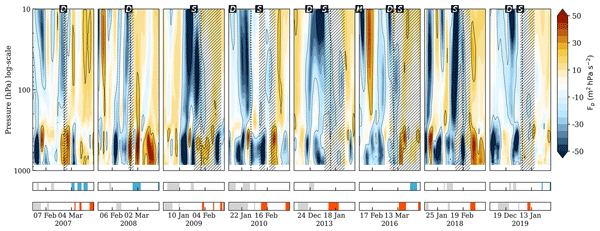
Major sudden stratospheric warmings (SSWs) and atmospheric blocking can markedly influence winter extratropical surface weather. To study the relationship between SSWs and blocking, we examine dynamic stratosphere–troposphere coupling using vertically highly resolved observations from global navigation satellite system radio occultation for 2007–2019. Our results provide a purely observational view of the evolution of major SSWs, their link to blocking, and their effect on the polar tropopause.
Alejandro de la Torre, Peter Alexander, Torsten Schmidt, Andrea K. Steiner, Florian Ladstädter, Rodrigo Hierro, and Pablo Llamedo
EGUsphere, https://doi.org/10.5194/egusphere-2024-1654, https://doi.org/10.5194/egusphere-2024-1654, 2024
Preprint archived
Short summary
Short summary
A single tropopause separates the troposphere below from the stratosphere above. In regions of strong vertical wind shear, a second tropopause layer may be associated to complex weather patterns. From GNSS radio occultation data, the distribution of multiple tropopause and its possible relation to the variability of climate indices is explored. A cluster analysis is applied to geographically associate the DT occurrences with the climate indices and a multivariate linear regression is constructed
Karina von Schuckmann, Audrey Minière, Flora Gues, Francisco José Cuesta-Valero, Gottfried Kirchengast, Susheel Adusumilli, Fiammetta Straneo, Michaël Ablain, Richard P. Allan, Paul M. Barker, Hugo Beltrami, Alejandro Blazquez, Tim Boyer, Lijing Cheng, John Church, Damien Desbruyeres, Han Dolman, Catia M. Domingues, Almudena García-García, Donata Giglio, John E. Gilson, Maximilian Gorfer, Leopold Haimberger, Maria Z. Hakuba, Stefan Hendricks, Shigeki Hosoda, Gregory C. Johnson, Rachel Killick, Brian King, Nicolas Kolodziejczyk, Anton Korosov, Gerhard Krinner, Mikael Kuusela, Felix W. Landerer, Moritz Langer, Thomas Lavergne, Isobel Lawrence, Yuehua Li, John Lyman, Florence Marti, Ben Marzeion, Michael Mayer, Andrew H. MacDougall, Trevor McDougall, Didier Paolo Monselesan, Jan Nitzbon, Inès Otosaka, Jian Peng, Sarah Purkey, Dean Roemmich, Kanako Sato, Katsunari Sato, Abhishek Savita, Axel Schweiger, Andrew Shepherd, Sonia I. Seneviratne, Leon Simons, Donald A. Slater, Thomas Slater, Andrea K. Steiner, Toshio Suga, Tanguy Szekely, Wim Thiery, Mary-Louise Timmermans, Inne Vanderkelen, Susan E. Wjiffels, Tonghua Wu, and Michael Zemp
Earth Syst. Sci. Data, 15, 1675–1709, https://doi.org/10.5194/essd-15-1675-2023, https://doi.org/10.5194/essd-15-1675-2023, 2023
Short summary
Short summary
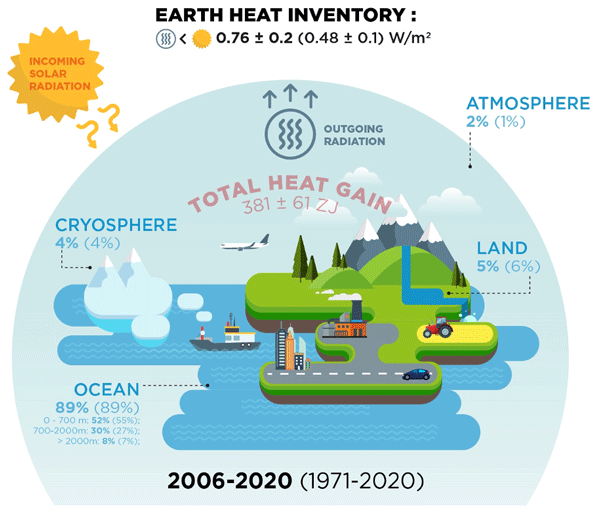
Earth's climate is out of energy balance, and this study quantifies how much heat has consequently accumulated over the past decades (ocean: 89 %, land: 6 %, cryosphere: 4 %, atmosphere: 1 %). Since 1971, this accumulated heat reached record values at an increasing pace. The Earth heat inventory provides a comprehensive view on the status and expectation of global warming, and we call for an implementation of this global climate indicator into the Paris Agreement’s Global Stocktake.
Longjiang Li, Suqin Wu, Kefei Zhang, Xiaoming Wang, Wang Li, Zhen Shen, Dantong Zhu, Qimin He, and Moufeng Wan
Atmos. Meas. Tech., 14, 6379–6394, https://doi.org/10.5194/amt-14-6379-2021, https://doi.org/10.5194/amt-14-6379-2021, 2021
Short summary
Short summary
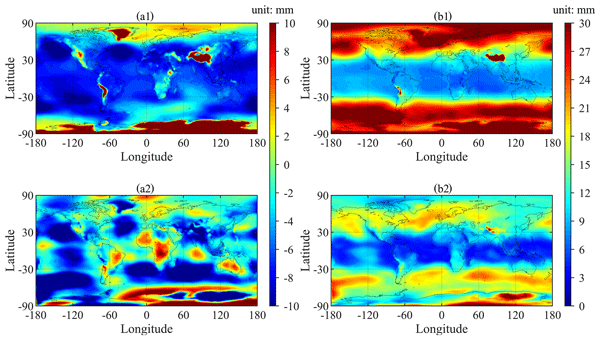
The zenith hydrostatic delay (ZHD) derived from blind models are of low accuracy, especially in mid- and high-latitude regions. To address this issue, the ratio of the ZHD to zenith total delay (ZTD) is firstly investigated; then, based on the relationship between the ZHD and ZTD, a new ZHD model was developed using the back propagation artificial neural network (BP-ANN) method which took the ZTD as an input variable. The model outperforms blind models.
Cited articles
Bell, B., Hersbach, H., Simmons, A., Berrisford, P., Dahlgren, P., Horányi, A., Muñoz-Sabater, J., Nicolas, J., Radu, R., Schepers, D., Soci, C., Villaume, S., Bidlot, J., Haimberger, L., Woollen, J., Buontempo, C., and Thépaut, J.: The ERA5 global reanalysis: Preliminary extension to 1950, Q. J. Roy. Meteorol. Soc., 147, 4186–4227, https://doi.org/10.1002/qj.4174, 2021.
Bevis, M., Businger, S., Herring, T. A., Rocken, C., Anthes, R. A., and Ware, R. H.: GPS meteorology: Remote sensing of atmospheric water vapor using the global positioning system, J. Geophys. Res.-Atmos., 97, 15787–15801, https://doi.org/10.1029/92JD01517, 1992.
Bevis, M., Businger, S., Chiswell, S., Herring, T. A., Anthes, R. A., Rocken, C., and Ware, R. H.: GPS meteorology: Mapping zenith wet delays onto precipitable water, J. Appl. Meteorol. Clim., 33, 379–386, https://doi.org/10.1175/1520-0450(1994)033<0379:GMMZWD>2.0.CO;2, 1994.
Bock, O. and Parracho, A. C.: Consistency and representativeness of integrated water vapour from ground-based GPS observations and ERA-Interim reanalysis, Atmos. Chem. Phys., 19, 9453–9468, https://doi.org/10.5194/acp-19-9453-2019, 2019.
Chan, F. K. S., Chuah, C. J., Ziegler, A. D., Dąbrowski, M., and Varis, O.: Towards resilient flood risk management for Asian coastal cities: Lessons learned from Hong Kong and Singapore, J. Cleaner Prod., 187, 576–589, https://doi.org/10.1016/j.jclepro.2018.03.217, 2018.
Cogan, J., Gratchev, I., and Wang, G.: Rainfall-induced shallow landslides caused by ex-Tropical Cyclone Debbie, 31st March 2017, Landslides, 15, 1215–1221, https://doi.org/10.1007/s10346-018-0982-4, 2018.
Davis, J. L., Herring, T. A., Shapiro, I. I., Rogers, A. E. E., and Elgered, G.: Geodesy by radio interferometry: Effects of atmospheric modeling errors on estimates of baseline length, Radio Sci., 20, 1593–1607, https://doi.org/10.1029/rs020i006p01593, 1985.
Duan, Y., Chen, L., Liang, J., Wang, Y., Wu, L., Cui, X., Ma, L., and Li, Q.: Research progress in the unusual variations of typhoons before and after landfalling, Acta Meteor. Sin., 72, 969–986, https://doi.org/10.11676/qxxb2014.085, 2014.
Elgered, G., Davis, J. L., Herring, T. A., and Shapiro, I. I.: Geodesy by radio interferometry: Water vapor radiometry for estimation of the wet delay, J. Geophys. Res.-Sol. Ea., 96, 6541–6555, https://doi.org/10.1029/90jb00834, 1991.
Elsner, J. B.: Continued increases in the intensity of strong tropical cyclones, Bull. Am. Meteorol. Soc., 101, E1301–E1303, https://doi.org/10.1175/BAMS-D-19-0338.1, 2020.
Emanuel, K.: Increasing destructiveness of tropical cyclones over the past 30 years, Nature, 436, 686–688, https://doi.org/10.1038/nature03906, 2005.
Esteban, M. and Longarte-Galnares, G.: Evaluation of the productivity decrease risk due to a future increase in tropical cyclone intensity in Japan: productivity decrease due to tropical cyclones, Risk Anal., 30, 1789–1802, https://doi.org/10.1111/j.1539-6924.2010.01483.x, 2010.
Gahtan, J., Knapp, K. R., Schreck, C. J. I., Diamond, H. J., Kossin, J. P., and Kruk, M. C.: International Best Track Archive for Climate Stewardship (IBTrACS) project, version 4.01 (Version 4r01), https://doi.org/10.25921/82ty-9e16, 2024.
Gelaro, R., McCarty, W., Suárez, M. J., Todling, R., Molod, A., Takacs, L., Randles, C. A., Darmenov, A., Bosilovich, M. G., Reichle, R., Wargan, K., Coy, L., Cullather, R., Draper, C., Akella, S., Buchard, V., Conaty, A., Da Silva, A. M., Gu, W., Kim, G.-K., Koster, R., Lucchesi, R., Merkova, D., Nielsen, J. E., Partyka, G., Pawson, S., Putman, W., Rienecker, M., Schubert, S. D., Sienkiewicz, M., and Zhao, B.: The modern-era retrospective analysis for research and applications, version 2 (MERRA-2), J. Climate, 30, 5419–5454, https://doi.org/10.1175/JCLI-D-16-0758.1, 2017.
Gui, K., Che, H., Chen, Q., Zeng, Z., Liu, H., Wang, Y., Zheng, Y., Sun, T., Liao, T., Wang, H., and Zhang, X.: Evaluation of radiosonde, MODIS-NIR-Clear, and AERONET precipitable water vapor using IGS ground-based GPS measurements over China, Atmos. Res., 197, 461–473, https://doi.org/10.1016/j.atmosres.2017.07.021, 2017.
Hersbach, H., Bell, B., Berrisford, P., Hirahara, S., Horányi, A., Muñoz-Sabater, J., Nicolas, J., Peubey, C., Radu, R., Schepers, D., Simmons, A., Soci, C., Abdalla, S., Abellan, X., Balsamo, G., Bechtold, P., Biavati, G., Bidlot, J., Bonavita, M., De Chiara, G., Dahlgren, P., Dee, D., Diamantakis, M., Dragani, R., Flemming, J., Forbes, R., Fuentes, M., Geer, A., Haimberger, L., Healy, S., Hogan, R. J., Hólm, E., Janisková, M., Keeley, S., Laloyaux, P., Lopez, P., Lupu, C., Radnoti, G., De Rosnay, P., Rozum, I., Vamborg, F., Villaume, S., and Thépaut, J.: The ERA5 global reanalysis, Q. J. Roy. Meteorol. Soc., 146, 1999–2049, https://doi.org/10.1002/qj.3803, 2020.
Holloway, C. E. and Neelin, J. D.: Moisture vertical structure, column water vapor, and tropical deep convection, J. Atmos. Sci., 66, 1665–1683, https://doi.org/10.1175/2008JAS2806.1, 2009.
Ichoku, C., Levy, R., Kaufman, Y. J., Remer, L. A., Li, R., Martins, V. J., Holben, B. N., Abuhassan, N., Slutsker, I., Eck, T. F., and Pietras, C.: Analysis of the performance characteristics of the five-channel Microtops II Sun photometer for measuring aerosol optical thickness and precipitable water vapor, J. Geophys. Res.-Atmos., 107, 4179, https://doi.org/10.1029/2001jd001302, 2002.
Johnston, B. R., Randel, W. J., and Sjoberg, J. P.: Evaluation of tropospheric moisture characteristics among COSMIC-2, ERA5 and MERRA-2 in the tropics and subtropics, Remote Sens., 13, 880, https://doi.org/10.3390/rs13050880, 2021.
Jung, K., Kam, J., and Lee, S.: Tropical cyclone risk assessment reflecting the climate change trend: the case of South Korea, Nat. Hazards, 120, 5841–5867, https://doi.org/10.1007/s11069-024-06428-0, 2024.
King, M. D., Menzel, W. P., Kaufman, Y. J., Tanre, D., Bo-Cai Gao, Platnick, S., Ackerman, S. A., Remer, L. A., Pincus, R., and Hubanks, P. A.: Cloud and aerosol properties, precipitable water, and profiles of temperature and water vapor from MODIS, IEEE Trans. Geosci. Remote Sens., 41, 442–458, https://doi.org/10.1109/tgrs.2002.808226, 2003.
Knapp, K. R., Kruk, M. C., Levinson, D. H., Diamond, H. J., and Neumann, C. J.: The International Best Track Archive for Climate Stewardship (IBTrACS): Unifying tropical cyclone data, Bull. Am. Meteorol. Soc., 91, 363–376, https://doi.org/10.1175/2009BAMS2755.1, 2010.
Knutson, T., Camargo, S. J., Chan, J. C. L., Emanuel, K., Ho, C.-H., Kossin, J., Mohapatra, M., Satoh, M., Sugi, M., Walsh, K., and Wu, L.: Tropical cyclones and climate change assessment: Part II: Projected response to anthropogenic warming, Bull. Am. Meteorol. Soc., 101, E303–E322, https://doi.org/10.1175/BAMS-D-18-0194.1, 2020.
Kosaka, Y., Kobayashi, S., Harada, Y., Kobayashi, C., Naoe, H., Yoshimoto, K., Harada, M., Goto, N., Chiba, J., Miyaoka, K., Sekiguchi, R., Deushi, M., Kamahori, H., Nakaegawa, T., Tanaka, T. Y., Tokuhiro, T., Sato, Y., Matsushita, Y., and Onogi, K.: The JRA-3Q reanalysis, J. Meteor. Soc. Japan, 102, 49–109, https://doi.org/10.2151/jmsj.2024-004, 2024.
Kossin, J. P.: A global slowdown of tropical-cyclone translation speed, Nature, 558, 104–107, https://doi.org/10.1038/s41586-018-0158-3, 2018.
Kursinski, E. R., Hajj, G. A., Bertiger, W. I., Leroy, S. S., Meehan, T. K., Romans, L. J., Schofield, J. T., McCleese, D. J., Melbourne, W. G., Thornton, C. L., Yunck, T. P., Eyre, J. R., and Nagatani, R. N.: Initial results of radio occultation observations of Earth's atmosphere using the Global Positioning System, Science, 271, 1107–1110, https://doi.org/10.1126/science.271.5252.1107, 1996.
Li, M., Li, W., Shi, C., Jiang, K., Guo, X., Dai, X., Meng, X., Yang, Z., Yang, G., and Liao, M.: Precise orbit determination of the Fengyun-3C satellite using onboard GPS and BDS observations, J. Geodesy, 91, 1313–1327, https://doi.org/10.1007/s00190-017-1027-9, 2017.
Li, W., Yao, Y., Zhang, L., Peng, W., Du, Z., Zuo, Y., and Wang, W.: Evaluating global precipitable water vapor products from four public reanalysis using radiosonde data, Geod. Geodyn., 16, 693–705, https://doi.org/10.1016/j.geog.2025.02.007, 2025.
Li, Z., Muller, J., and Cross, P.: Comparison of precipitable water vapor derived from radiosonde, GPS, and moderate-resolution imaging spectroradiometer measurements, J. Geophys. Res.-Atmos., 108, 2003JD003372, https://doi.org/10.1029/2003JD003372, 2003.
Melbourne, W. G., Davis, E. S., Duncan, C. B., Hajj, G. A., Hardy, K. R., Kursinski, E. R., Meehan, T. K., Young, L. E., and Yunck, T. P.: The application of spaceborne GPS to atmospheric limb sounding and global change monitoring, JPL Publication 94-18, Jet Propulsion Lab, Pasadena, CA, USA, 147, 1994.
Muller, C. J., Back, L. E., O'Gorman, P. A., and Emanuel, K. A.: A model for the relationship between tropical precipitation and column water vapor, Geophys. Res. Lett., 36, L16804, https://doi.org/10.1029/2009GL039667, 2009.
Pérez-Ramírez, D., Whiteman, D. N., Smirnov, A., Lyamani, H., Holben, B. N., Pinker, R., Andrade, M., and Alados-Arboledas, L.: Evaluation of AERONET precipitable water vapor versus microwave radiometry, GPS, and radiosondes at ARM sites, J. Geophys. Res.-Atmos., 119, 9596–9613, https://doi.org/10.1002/2014jd021730, 2014.
Rani, S. and Singh, J.: Evaluation of MODIS, ERA5, and MERRA2 derived integrated precipitable water vapor of India using ground-based GPS data, Ann. Am. Assoc. Geogr., 115, 1506–1531, https://doi.org/10.1080/24694452.2025.2493823, 2025.
Saastamoinen, J.: Atmospheric correction for the troposphere and stratosphere in radio ranging satellites, in: The Use of Artificial Satellites for Geodesy, 247–251, https://doi.org/10.1029/GM015p0247, 1972.
Schneider, T., O'Gorman, P. A., and Levine, X. J.: Water vapor and the dynamics of climate changes, Rev. Geophys., 48, RG3001, https://doi.org/10.1029/2009rg000302, 2010.
Schreiner, W. S., Weiss, J. P., Anthes, R. A., Braun, J., Chu, V., Fong, J., Hunt, D., Kuo, Y. -H., Meehan, T., Serafino, W., Sjoberg, J., Sokolovskiy, S., Talaat, E., Wee, T. K., and Zeng, Z.: COSMIC-2 radio occultation constellation: First results, Geophys. Res. Lett., 47, e2019GL086841, https://doi.org/10.1029/2019gl086841, 2020.
Sherwood, S. C., Roca, R., Weckwerth, T. M., and Andronova, N. G.: Tropospheric water vapor, convection, and climate, Rev. Geophys., 48, RG2001, https://doi.org/10.1029/2009rg000301, 2010.
Shi, C., Zhao, Q., Geng, J., Lou, Y., Ge, M., and Liu, J.: Recent development of PANDA software in GNSS data processing, in: Proceedings of Society of Photo-Optical Instrumentation Engineers (SPIE) 7285, International Conference on Earth Observation Data Processing and Analysis (ICEODPA), 72851S, https://doi.org/10.1117/12.816261, 2008.
Shi, C., Zhou, L., Fan, L., Zhang, W., Cao, Y., Wang, C., Xiao, F., Lv, G., and Liang, H.: Analysis of “21⋅7” extreme rainstorm process in Henan Province using BeiDou/GNSS observation, China J. Geophys., 65, 186–196, https://doi.org/10.6038/cjg2022P0706, 2022.
Shi, J., Zhang, K., Wu, S., Shi, S., and Shen, Z.: Investigation of the atmospheric boundary layer height using radio occultation: a case study during twelve super typhoons over the northwest Pacific, Atmosphere, 12, 1457, https://doi.org/10.3390/atmos12111457, 2021.
Shi, J., Li, M., Steiner, A. K., Li, W., Zhang, M., Fan, Y., Gao, W., and Zhang, K.: Stacking machine learning model for precipitable water vapor vertical adjustment using GNSS networks and radio occultation data, Atmos. Res., 325, 108212, https://doi.org/10.1016/j.atmosres.2025.108212, 2025.
Soci, C., Hersbach, H., Simmons, A., Poli, P., Bell, B., Berrisford, P., Horányi, A., Muñoz-Sabater, J., Nicolas, J., Radu, R., Schepers, D., Villaume, S., Haimberger, L., Woollen, J., Buontempo, C., and Thépaut, J.: The ERA5 global reanalysis from 1940 to 2022, Q. J. Roy. Meteorol. Soc., 150, 4014–4048, https://doi.org/10.1002/qj.4803, 2024.
Turner, D. D., Lesht, B. M., Clough, S. A., Liljegren, J. C., Revercomb, H. E., and Tobin, D. C.: Dry bias and variability in Vaisala RS80-H radiosondes: The ARM experience, J. Atmos. Oceanic Technol., 20, 117–132, https://doi.org/10.1175/1520-0426(2003)020<0117:dbaviv>2.0.co;2, 2003.
Turner, D. D., Clough, S. A., Liljegren, J. C., Clothiaux, E. E., Cady-Pereira, K. E., and Gaustad, K. L.: Retrieving liquid water path and precipitable water vapor from the Atmospheric Radiation Measurement (ARM) microwave radiometers, IEEE Trans. Geosci. Remote Sens., 45, 3680–3690, https://doi.org/10.1109/tgrs.2007.903703, 2007.
Utsumi, N. and Kim, H.: Observed influence of anthropogenic climate change on tropical cyclone heavy rainfall, Nat. Clim. Chang., 12, 436–440, https://doi.org/10.1038/s41558-022-01344-2, 2022.
Vey, S., Dietrich, R., Rülke, A., Fritsche, M., Steigenberger, P., and Rothacher, M.: Validation of precipitable water vapor within the NCEP/DOE reanalysis using global GPS observations from one decade, J. Climate, 23, 1675–1695, https://doi.org/10.1175/2009JCLI2787.1, 2010.
Walsh, K. J. E., McInnes, K. L., and McBride, J. L.: Climate change impacts on tropical cyclones and extreme sea levels in the South Pacific – A regional assessment, Glob. Planet. Chang., 80, 149–164, https://doi.org/10.1016/j.gloplacha.2011.10.006, 2012.
Wang, J. and Zhang, L.: Systematic errors in global radiosonde precipitable water data from comparisons with ground-based GPS measurements, J. Climate, 21, 2218–2238, https://doi.org/10.1175/2007JCLI1944.1, 2008.
Wang, J., Zhang, L., and Dai, A.: Global estimates of water-vapor-weighted mean temperature of the atmosphere for GPS applications, J. Geophys. Res.-Atmos., 110, D21101, https://doi.org/10.1029/2005jd006215, 2005.
Wang, L., Zhou, Y., Lei, X., Zhou, Y., Bi, H., and Mao, X.: Predominant factors of disaster caused by tropical cyclones in South China coast and implications for early warning systems, Sci. Total Environ., 726, 138556, https://doi.org/10.1016/j.scitotenv.2020.138556, 2020a.
Wang, S., Xu, T., Nie, W., Jiang, C., Yang, Y., Fang, Z., Li, M., and Zhang, Z.: Evaluation of precipitable water vapor from five reanalysis products with ground-based GNSS observations, Remote Sens., 12, 1817, https://doi.org/10.3390/rs12111817, 2020b.
Wang, S., Xu, T., Xu, Y., Jiang, C., Gao, F., Zhang, Z., Yang, Y., Fang, Z., and Xue, H.: Intercomparison of total precipitable water derived from COSMIC-2 and three different microwave radiometers over the ocean, IEEE Trans. Geosci. Remote Sens., 60, 4107610, https://doi.org/10.1109/TGRS.2022.3160020, 2022.
Wang, Y., Yang, K., Pan, Z., Qin, J., Chen, D., Lin, C., Chen, Y., Lazhu, Tang, W., Han, M., Lu, N., and Wu, H.: Evaluation of precipitable water vapor from four satellite products and four reanalysis datasets against GPS measurements on the southern Tibetan Plateau, J. Climate, 30, 5699–5713, https://doi.org/10.1175/JCLI-D-16-0630.1, 2017.
Wang, Z.: Role of cumulus congestus in tropical cyclone formation in a high-resolution numerical model simulation, J. Atmos. Sci., 71, 1681–1700, https://doi.org/10.1175/JAS-D-13-0257.1, 2014.
Wang, Z. and Hankes, I.: Moisture and precipitation evolution during tropical cyclone formation as revealed by the SSM/I–SSMIS retrievals, J. Atmos. Sci., 73, 2773–2781, https://doi.org/10.1175/JAS-D-15-0306.1, 2016.
Wang, Z., Xia, N., Zhao, X., Ji, X., and Wang, J.: Comprehensive risk assessment of typhoon disasters in China's coastal areas based on multi-source geographic big data, Sci. Total Environ., 926, 171815, https://doi.org/10.1016/j.scitotenv.2024.171815, 2024.
Wee, T.-K., Anthes, R. A., Hunt, D. C., Schreiner, W. S., and Kuo, Y.-H.: Atmospheric GNSS RO 1D-Var in use at UCAR: Description and validation, Remote Sens., 14, 5614, https://doi.org/10.3390/rs14215614, 2022.
Wei, Q., Li, X., Ma, T., Wang, S., Dai, T., Fan, P., Yu, Y., Jin, Y., and Liu, Y.: A neighborhood standard deviation based algorithm for generating PET crystal position maps, in: 2013 IEEE Nuclear Science Symposium and Medical Imaging Conference (2013 NSS/MIC), 2013 IEEE Nuclear Science Symposium and Medical Imaging Conference (2013 NSS/MIC), 1–4, https://doi.org/10.1109/NSSMIC.2013.6829273, 2013.
Woodruff, J. D., Irish, J. L., and Camargo, S. J.: Coastal flooding by tropical cyclones and sea-level rise, Nature, 504, 44–52, https://doi.org/10.1038/nature12855, 2013.
Xi, D., Lin, N., and Gori, A.: Increasing sequential tropical cyclone hazards along the US East and Gulf coasts, Nat. Clim. Change, 13, 258–265, https://doi.org/10.1038/s41558-023-01595-7, 2023.
Yuan, P., Blewitt, G., Kreemer, C., Jiang, W., Liu, T., He, L., Shan, Q., Balidakis, K., Schuh, H., Wickert, J., and Deng, Z.: A global assessment of diurnal discontinuities in ERA5 tropospheric zenith total delays using 10 years of GNSS data, Geophys. Res. Lett., 52, e2024GL113140, https://doi.org/10.1029/2024GL113140, 2025.
Zhang, C., Wang, S., Zhao, Y., Xu, Y., Zhang, J., Mo, Y., and Yu, H.: Evaluation of water vapor from CARRA reanalysis based on GNSS and radiosonde observation in the Arctic, J. Atmos. Sol-terr. Phy., 268, 106431, https://doi.org/10.1016/j.jastp.2025.106431, 2025.
Zhang, K., Li, H., Wang, X., Zhu, D., He, Q., Li, L., Hu, A., Zheng, N., and Li, H.: Recent progresses and future prospectives of ground-based GNSS water vapor sounding, Acta Geod. Cartogr. Sin., 51, 1172–1191, 2022.
Zhang, Q., Ye, J., Zhang, S., and Han, F.: Precipitable water vapor retrieval and analysis by multiple data sources: Ground-based GNSS, radio occultation, radiosonde, microwave satellite, and NWP reanalysis data, J. Sensors, 2018, 1–13, https://doi.org/10.1155/2018/3428303, 2018.
Zhang, W., Lou, Y., Haase, J. S., Zhang, R., Zheng, G., Huang, J., Shi, C., and Liu, J.: The use of ground-based GPS precipitable water measurements over China to assess radiosonde and ERA-Interim moisture trends and errors from 1999 to 2015, J. Climate, 30, 7643–7667, https://doi.org/10.1175/JCLI-D-16-0591.1, 2017.
Zhang, W., Zhang, H., Liang, H., Lou, Y., Cai, Y., Cao, Y., Zhou, Y., and Liu, W.: On the suitability of ERA5 in hourly GPS precipitable water vapor retrieval over China, J. Geodesy, 93, 1897–1909, https://doi.org/10.1007/s00190-019-01290-6, 2019a.
Zhang, Y., Cai, C., Chen, B., and Dai, W.: Consistency evaluation of precipitable water vapor derived from ERA5, ERA-Interim, GNSS, and radiosondes over China, Radio Sci., 54, 561–571, https://doi.org/10.1029/2018RS006789, 2019b.
Zhao, D., Xu, H., Li, Y., Yu, Y., Duan, Y., Xu, X., and Chen, L.: Locally opposite responses of the 2023 Beijing–Tianjin–Hebei extreme rainfall event to global anthropogenic warming, npj Clim. Atmos. Sci., 7, https://doi.org/10.1038/s41612-024-00584-7, 2024.
Zhao, Q., Ma, X., Yao, W., Liu, Y., and Yao, Y.: A drought monitoring method based on precipitable water vapor and precipitation, J. Climate, 33, 10727–10741, https://doi.org/10.1175/jcli-d-19-0971.1, 2020.
Zumberge, J. F., Heflin, M. B., Jefferson, D. C., Watkins, M. M., and Webb, F. H.: Precise point positioning for the efficient and robust analysis of GPS data from large networks, J. Geophys. Res.-Sol. Ea., 102, 5005–5017, https://doi.org/10.1029/96jb03860, 1997.
Short summary
This study evaluates how three reanalysis datasets represent precipitable water vapor (PWV) during more than 100 typhoons from 2020 to 2024 using multi-source observations. The fifth-generation European Centre for Medium-Range Weather Forecasts Reanalysis (ERA5) performs best, the Japanese Reanalysis for Three Quarters of a Century (JRA-3Q) improves during typhoons, and the Modern-Era Retrospective Analysis for Research and Applications Version 2 (MERRA-2) is less stable
This study evaluates how three reanalysis datasets represent precipitable water vapor (PWV)...


Altmetrics
Final-revised paper
Preprint