
Articles | Volume 26, issue 5
https://doi.org/10.5194/acp-26-3853-2026
© Author(s) 2026. This work is distributed under
the Creative Commons Attribution 4.0 License.
the Creative Commons Attribution 4.0 License.
https://doi.org/10.5194/acp-26-3853-2026
© Author(s) 2026. This work is distributed under
the Creative Commons Attribution 4.0 License.
the Creative Commons Attribution 4.0 License.
Research article
| 
18 Mar 2026
Research article |
| 18 Mar 2026
| 18 Mar 2026
Response of extreme precipitation to dust aerosols in the Tarim Basin over the past 50 years
Ze Chen
Institute of Desert Meteorology, China Meteorological Administration, Urumqi 830002, China
National Observation and Research Station of Desert Meteorology, Taklimakan Desert of Xinjiang, Urumqi 830002, China
Taklimakan Desert Meteorology Field Experiment Station of China Meteorological Administration, Urumqi 830002, China
Xinjiang Key Laboratory of Desert Meteorology and Sandstorm, Urumqi 830002, China
Chenglong Zhou
CORRESPONDING AUTHOR
Institute of Desert Meteorology, China Meteorological Administration, Urumqi 830002, China
National Observation and Research Station of Desert Meteorology, Taklimakan Desert of Xinjiang, Urumqi 830002, China
Taklimakan Desert Meteorology Field Experiment Station of China Meteorological Administration, Urumqi 830002, China
Xinjiang Key Laboratory of Desert Meteorology and Sandstorm, Urumqi 830002, China
Jiacheng Gao
Institute of Desert Meteorology, China Meteorological Administration, Urumqi 830002, China
National Observation and Research Station of Desert Meteorology, Taklimakan Desert of Xinjiang, Urumqi 830002, China
Taklimakan Desert Meteorology Field Experiment Station of China Meteorological Administration, Urumqi 830002, China
Xinjiang Key Laboratory of Desert Meteorology and Sandstorm, Urumqi 830002, China
Congzhen Zhu
Institute of Desert Meteorology, China Meteorological Administration, Urumqi 830002, China
National Observation and Research Station of Desert Meteorology, Taklimakan Desert of Xinjiang, Urumqi 830002, China
Taklimakan Desert Meteorology Field Experiment Station of China Meteorological Administration, Urumqi 830002, China
Xinjiang Key Laboratory of Desert Meteorology and Sandstorm, Urumqi 830002, China
Meiqi Song
Institute of Desert Meteorology, China Meteorological Administration, Urumqi 830002, China
National Observation and Research Station of Desert Meteorology, Taklimakan Desert of Xinjiang, Urumqi 830002, China
Taklimakan Desert Meteorology Field Experiment Station of China Meteorological Administration, Urumqi 830002, China
Xinjiang Key Laboratory of Desert Meteorology and Sandstorm, Urumqi 830002, China
Yu Wang
Institute of Desert Meteorology, China Meteorological Administration, Urumqi 830002, China
National Observation and Research Station of Desert Meteorology, Taklimakan Desert of Xinjiang, Urumqi 830002, China
Taklimakan Desert Meteorology Field Experiment Station of China Meteorological Administration, Urumqi 830002, China
Xinjiang Key Laboratory of Desert Meteorology and Sandstorm, Urumqi 830002, China
Yabin Wei
Institute of Desert Meteorology, China Meteorological Administration, Urumqi 830002, China
National Observation and Research Station of Desert Meteorology, Taklimakan Desert of Xinjiang, Urumqi 830002, China
Taklimakan Desert Meteorology Field Experiment Station of China Meteorological Administration, Urumqi 830002, China
Xinjiang Key Laboratory of Desert Meteorology and Sandstorm, Urumqi 830002, China
Lu Meng
Institute of Desert Meteorology, China Meteorological Administration, Urumqi 830002, China
National Observation and Research Station of Desert Meteorology, Taklimakan Desert of Xinjiang, Urumqi 830002, China
Taklimakan Desert Meteorology Field Experiment Station of China Meteorological Administration, Urumqi 830002, China
Xinjiang Key Laboratory of Desert Meteorology and Sandstorm, Urumqi 830002, China
Mingjie Ma
Institute of Desert Meteorology, China Meteorological Administration, Urumqi 830002, China
National Observation and Research Station of Desert Meteorology, Taklimakan Desert of Xinjiang, Urumqi 830002, China
Taklimakan Desert Meteorology Field Experiment Station of China Meteorological Administration, Urumqi 830002, China
Xinjiang Key Laboratory of Desert Meteorology and Sandstorm, Urumqi 830002, China
Cong Wen
Institute of Desert Meteorology, China Meteorological Administration, Urumqi 830002, China
National Observation and Research Station of Desert Meteorology, Taklimakan Desert of Xinjiang, Urumqi 830002, China
Taklimakan Desert Meteorology Field Experiment Station of China Meteorological Administration, Urumqi 830002, China
Xinjiang Key Laboratory of Desert Meteorology and Sandstorm, Urumqi 830002, China
Related authors
No articles found.
Chenglong Zhou, Yuzhi Liu, Qingzhe Zhu, Qing He, Tianliang Zhao, Fan Yang, Wen Huo, Xinghua Yang, and Ali Mamtimin
Atmos. Chem. Phys., 22, 5195–5207, https://doi.org/10.5194/acp-22-5195-2022, https://doi.org/10.5194/acp-22-5195-2022, 2022
Short summary
Short summary
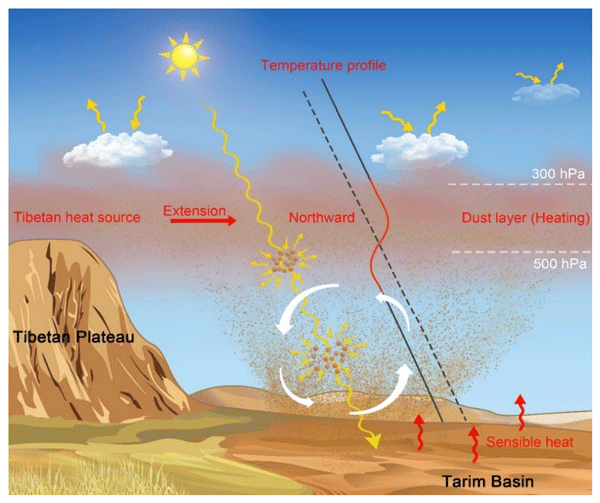
Based on the radiosonde observations, an anomalously warm layer is measured at altitudes between 500 and 300 hPa over the Tarim Basin (TB) with an average intensity of 2.53 and 1.39 K in the spring and summer, respectively. The heat contributions of dust to this anomalously warm atmospheric layer in spring and summer were 13.77 and 10.25 %, respectively. Topographically, the TB is adjacent to the Tibetan Plateau; we propose the concept of the Tibetan heat source’s northward extension.
Cited articles
Cai, M. and Kalnay, E.: Can Reanalysis Have Anthropogenic Climate Trends without Model Forcing?, J. Climate, 18, 1844–1849, https://doi.org/10.1175/JCLI3347.1, 2005.
Chen, S., Zhao, D., Huang, J., He, J., Chen, Y., Chen, J., Bi, H., Lou, G., Du, S., Zhang, Y., and Yang, F.: Mongolia Contributed More than 42 % of the Dust Concentrations in Northern China in March and April 2023, Adv. Atmos. Sci., 40, 1549–1557, https://doi.org/10.1007/s00376-023-3062-1, 2023.
Cheng, H., Lin, Y., Chen, P., Liang, F., and Wang, Y.: Spatial characteristics of sand-dust weather days and influencing factors in the Tarim Basin, Arid Zone Res., 40, 1707–1717, https://doi.org/10.13866/j.azr.2023.11.01, 2023 (in Chinese).
Ding, A. J., Fu, C. B., Yang, X. Q., Sun, J. N., Petäjä, T., Kerminen, V.-M., Wang, T., Xie, Y., Herrmann, E., Zheng, L. F., Nie, W., Liu, Q., Wei, X. L., and Kulmala, M.: Intense atmospheric pollution modifies weather: a case of mixed biomass burning with fossil fuel combustion pollution in eastern China, Atmos. Chem. Phys., 13, 10545–10554, https://doi.org/10.5194/acp-13-10545-2013, 2013.
Ding, A. J., Huang, X., Nie, W., Sun, J. N., Kerminen, V.-M., Petäjä, T., Su, H., Cheng, Y. F., Yang, X.-Q., Wang, M. H., Chi, X. G., Wang, J. P., Virkkula, A., Guo, W. D., Yuan, J., Wang, S. Y., Zhang, R. J., Wu, Y. F., Song, Y., Zhu, T., Zilitinkevich, S., Kulmala, M., and Fu, C. B.: Enhanced haze pollution by black carbon in megacities in China, Geophys. Res. Lett., 43, 2873–2879, https://doi.org/10.1002/2016GL067745, 2016.
Ding, K., Huang, X., Ding, A., Wang, M., Su, H., Kerminen, V.-M., Petäjä, T., Tan, Z., Wang, Z., Zhou, D., Sun, J., Liao, H., Wang, H., Carslaw, K., Wood, R., Zuidema, P., Rosenfeld, D., Kulmala, M., Fu, C., Pöschl, U., Cheng, Y., and Andreae, M. O.: Aerosol-boundary-layer-monsoon interactions amplify semi-direct effect of biomass smoke on low cloud formation in Southeast Asia, Nat. Commun., 12, 6416, https://doi.org/10.1038/s41467-021-26728-4, 2021.
Dong, X., Li, R., Wang, Y., Fu, Y., and Zhao, C.: Potential Impacts of Sahara Dust Aerosol on Rainfall Vertical Structure Over the Atlantic Ocean as Identified From EOF Analysis, J. Geophys. Res., 123, 8850–8868, https://doi.org/10.1029/2018JD028500, 2018.
Gomis-Cebolla, J., Rattayova, V., Salazar-Galán, S., and Francés, F.: Evaluation of ERA5 and ERA5-Land reanalysis precipitation datasets over Spain (1951–2020), Atmos. Res., 284, 106606, https://doi.org/10.1016/j.atmosres.2023.106606, 2023.
Guo, J., Liu, H., Li, Z., Rosenfeld, D., Jiang, M., Xu, W., Jiang, J. H., He, J., Chen, D., Min, M., and Zhai, P.: Aerosol-induced changes in the vertical structure of precipitation: a perspective of TRMM precipitation radar, Atmos. Chem. Phys., 18, 13329–13343, https://doi.org/10.5194/acp-18-13329-2018, 2018.
Hersbach, H., Bell, B., Berrisford, P., Hirahara, S., Horányi, A., Muñoz-Sabater, J., Nicolas, J., Peubey, C., Radu, R., Schepers, D., Simmons, A., Soci, C., Abdalla, S., Abellan, X., Balsamo, G., Bechtold, P., Biavati, G., Bidlot, J., Bonavita, M., De Chiara, G., Dahlgren, P., Dee, D., Diamantakis, M., Dragani, R., Flemming, J., Forbes, R., Fuentes, M., Geer, A., Haimberger, L., Healy, S., Hogan, R. J., Hólm, E., Janisková, M., Keeley, S., Laloyaux, P., Lopez, P., Lupu, C., Radnoti, G., De Rosnay, P., Rozum, I., Vamborg, F., Villaume, S., and Thépaut, J.: The ERA5 global reanalysis, Q. J. Roy. Meteor. Soc., 146, 1999–2049, https://doi.org/10.1002/qj.3803, 2020.
Hersbach, H., Bell, B., Berrisford, P., Biavati, G., Horányi, A., Muñoz Sabater, J., Nicolas, J., Peubey, C., Radu, R., Rozum, I., Schepers, D., Simmons, A., Soci, C., Dee, D., and Thépaut, J.-N.: ERA5 hourly data on pressure levels from 1940 to present, Copernicus Climate Change Service (C3S) Climate Data Store (CDS) [data set], https://doi.org/10.24381/cds.bd0915c6, 2023.
Hu, W., Yao, J., He, Q., and Chen, J.: Changes in precipitation amounts and extremes across Xinjiang (northwest China) and their connection to climate indices, PeerJ, 9, e10792, https://doi.org/10.7717/peerj.10792, 2021.
Huang, J., Wang, T., Wang, W., Li, Z., and Yan, H.: Climate effects of dust aerosols over East Asian arid and semiarid regions, J. Geophys. Res.-Atmos., 119, https://doi.org/10.1002/2014JD021796, 2014.
Huang, J., Yu, H., Guan, X., Wang, G., and Guo, R.: Accelerated dryland expansion under climate change, Nat. Clim. Change, 6, 166–171, https://doi.org/10.1038/nclimate2837, 2016.
Huang, X. and Ding, A.: Aerosol as a critical factor causing forecast biases of air temperature in global numerical weather prediction models, Sci. Bull., 66, 1917–1924, https://doi.org/10.1016/j.scib.2021.05.009, 2021.
Huang, X., Wang, Z., and Ding, A.: Impact of Aerosol-PBL Interaction on Haze Pollution: Multiyear Observational Evidences in North China, Geophys. Res. Lett., 45, 8596–8603, https://doi.org/10.1029/2018GL079239, 2018.
Huang, X., Ding, A., Wang, Z., Ding, K., Gao, J., Chai, F., and Fu, C.: Amplified transboundary transport of haze by aerosol–boundary layer interaction in China, Nat. Geosci., 13, 428–434, https://doi.org/10.1038/s41561-020-0583-4, 2020.
Kalnay, E. and Cai, M.: Impact of urbanization and land-use change on climate, Nature, 423, 528–531, https://doi.org/10.1038/nature01675, 2003.
Kok, J. F., Storelvmo, T., Karydis, V. A., Adebiyi, A. A., Mahowald, N. M., Evan, A. T., He, C., and Leung, D. M.: Mineral dust aerosol impacts on global climate and climate change, Nat. Rev. Earth Environ., 4, 71–86, https://doi.org/10.1038/s43017-022-00379-5, 2023.
Leung, G. R. and Van Den Heever, S. C.: Aerosol breezes drive cloud and precipitation increases, Nat. Commun., 14, 2508, https://doi.org/10.1038/s41467-023-37722-3, 2023.
Li, G., Yang, H., Zhang, Y., Huang, C., Pan, X., Ma, M., Song, M., and Zhao, H.: More Extreme Precipitation in Chinese Deserts From 1960 to 2018, Earth Space Sci., 6, 1196–1204, https://doi.org/10.1029/2018EA000538, 2019.
Li, M. and Yao, J.: Precipitation extremes observed over and around the Taklimakan Desert, China, PeerJ, 11, e15256, https://doi.org/10.7717/peerj.15256, 2023.
Li, R., Dong, X., Guo, J., Fu, Y., Zhao, C., Wang, Y., and Min, Q.: The implications of dust ice nuclei effect on cloud top temperature in a complex mesoscale convective system, Sci. Rep.-UK, 7, 13826, https://doi.org/10.1038/s41598-017-12681-0, 2017.
Li, S., Su, T., Xiang, R., and Schär, C.: Direct and semi-direct aerosol effects on the scaling of extreme sub-daily precipitation over East China, Environ. Res. Lett., 19, 124074, https://doi.org/10.1088/1748-9326/ad9294, 2024.
Li, Y., Qin, X., Liu, Y., Jin, Z., Liu, J., Wang, L., and Chen, J.: Evaluation of Long-Term and High-Resolution Gridded Precipitation and Temperature Products in the Qilian Mountains, Qinghai–Tibet Plateau, Front. Environ. Sci., 10, 906821, https://doi.org/10.3389/fenvs.2022.906821, 2022.
Li, Z., Niu, F., Fan, J., Liu, Y., Rosenfeld, D., and Ding, Y.: Long-term impacts of aerosols on the vertical development of clouds and precipitation, Nat. Geosci., 4, 888–894, https://doi.org/10.1038/ngeo1313, 2011.
Liu, B., Chen, J., Chen, X., Lian, Y., and Wu, L.: Uncertainty in determining extreme precipitation thresholds, J. Hydrol., 503, 233–245, https://doi.org/10.1016/j.jhydrol.2013.09.002, 2013.
Liu, Y., Xu, R., Ziegler, A. D., and Zeng, Z.: Stronger winds increase the sand-dust storm risk in northern China, Environ. Sci. Atmos., 2, 1259–1262, https://doi.org/10.1039/D2EA00058J, 2022.
Ma, C., Liu, Y., Liu, J., and Yang, L.: Spatial and temporal distribution characteristics of cloud water resources in the Tarim Basin in summer, Arid Zone Res., 42, 223–235, https://doi.org/10.13866/j.azr.2025.02.04, 2025a (in Chinese).
Ma, M., Yang, X., He, Q., and Mamtimin, A.: Improvement of dust emission parameterization scheme for dust devils based on intensive observations in the northern margin of the Taklimakan Desert, Theor. Appl. Climatol., 151, 1227–1237, https://doi.org/10.1007/s00704-022-04258-3, 2023.
Ma, M., Yang, X., Yang, F., He, Q., Mamtimin, A., Zheng, X., Zhou, C., and Huo, W.: Dust emission contributions and regulatory mechanisms of dust devils in the Taklimakan Desert, Nat. Hazards, https://doi.org/10.1007/s11069-025-07618-0, 2025b.
Ma, Q.: Multiscale Characteristics and Influencing Mechanisms of Summer Extreme Precipitation Changes in Central Asia, PhD thesis, Nanjing University of Information Science and Technology, https://doi.org/10.27248/d.cnki.gnjqc.2021.000004, 2021 (in Chinese).
Meng, L., He, Q., Zhao, T., Zhang, H., Yang, X., Mamtimin, A., Yang, F., Zhou, C., and Huo, W.: Interactions between dust aerosols and the ultra-high atmospheric boundary layer: Case study of vertical observation over the Taklimakan Desert, China, Atmos. Environ., 343, 120977, https://doi.org/10.1016/j.atmosenv.2024.120977, 2025.
Muñoz-Sabater, J., Dutra, E., Agustí-Panareda, A., Albergel, C., Arduini, G., Balsamo, G., Boussetta, S., Choulga, M., Harrigan, S., Hersbach, H., Martens, B., Miralles, D. G., Piles, M., Rodríguez-Fernández, N. J., Zsoter, E., Buontempo, C., and Thépaut, J.-N.: ERA5-Land: a state-of-the-art global reanalysis dataset for land applications, Earth Syst. Sci. Data, 13, 4349–4383, https://doi.org/10.5194/essd-13-4349-2021, 2021.
O'Neill, B. C., Tebaldi, C., van Vuuren, D. P., Eyring, V., Friedlingstein, P., Hurtt, G., Knutti, R., Kriegler, E., Lamarque, J.-F., Lowe, J., Meehl, G. A., Moss, R., Riahi, K., and Sanderson, B. M.: The Scenario Model Intercomparison Project (ScenarioMIP) for CMIP6, Geosci. Model Dev., 9, 3461–3482, https://doi.org/10.5194/gmd-9-3461-2016, 2016.
Pan, H., Ren, G., Wang, M., Wang, J., and Kumar, K. R.: Investigation on the spatiotemporal and vertical structure of ice cloud and aerosol parameters from multi-source satellite datasets (2007–2021) over the Tarim Basin, China, J. Atmos. Sol.-Terr. Phys., 256, 106185, https://doi.org/10.1016/j.jastp.2024.106185, 2024.
Riahi, K., Van Vuuren, D. P., Kriegler, E., Edmonds, J., O'Neill, B. C., Fujimori, S., Bauer, N., Calvin, K., Dellink, R., Fricko, O., Lutz, W., Popp, A., Cuaresma, J. C., Kc, S., Leimbach, M., Jiang, L., Kram, T., Rao, S., Emmerling, J., Ebi, K., Hasegawa, T., Havlik, P., Humpenöder, F., Da Silva, L. A., Smith, S., Stehfest, E., Bosetti, V., Eom, J., Gernaat, D., Masui, T., Rogelj, J., Strefler, J., Drouet, L., Krey, V., Luderer, G., Harmsen, M., Takahashi, K., Baumstark, L., Doelman, J. C., Kainuma, M., Klimont, Z., Marangoni, G., Lotze-Campen, H., Obersteiner, M., Tabeau, A., and Tavoni, M.: The Shared Socioeconomic Pathways and their energy, land use, and greenhouse gas emissions implications: An overview, Global Environ. Chang., 42, 153–168, https://doi.org/10.1016/j.gloenvcha.2016.05.009, 2017.
Shaddick, G., Thomas, M. L., Mudu, P., Ruggeri, G., and Gumy, S.: Half the world's population are exposed to increasing air pollution, Npj Clim. Atmos. Sci., 3, 23, https://doi.org/10.1038/s41612-020-0124-2, 2020.
Shao, T., Liu, Y., Wang, R., Zhu, Q., Tan, Z., and Luo, R.: Role of anthropogenic aerosols in affecting different-grade precipitation over eastern China: A case study, Sci. Total Environ., 807, 150886, https://doi.org/10.1016/j.scitotenv.2021.150886, 2022.
Song, C., McCoy, D. T., Eidhammer, T., Gettelman, A., McCoy, I. L., Watson-Parris, D., Wall, C. J., Elsaesser, G., and Wood, R.: Buffering of Aerosol-Cloud Adjustments by Coupling Between Radiative Susceptibility and Precipitation Efficiency, Geophys. Res. Lett., 51, e2024GL108663, https://doi.org/10.1029/2024GL108663, 2024.
Song, H.-J., Lim, B., and Joo, S.: Evaluation of Rainfall Forecasts with Heavy Rain Types in the High-Resolution Unified Model over South Korea, Weather Forecast., 34, 1277–1293, https://doi.org/10.1175/WAF-D-18-0140.1, 2019.
Sun, N., Fu, Y., Zhong, L., and Li, R.: Aerosol effects on the vertical structure of precipitation in East China, Npj Clim. Atmos. Sci., 5, 60, https://doi.org/10.1038/s41612-022-00284-0, 2022.
Sun, Y., Wang, Y., Zhao, C., Zhou, Y., Yang, Y., Yang, X., Fan, H., Zhao, X., and Yang, J.: Vertical Dependency of Aerosol Impacts on Local Scale Convective Precipitation, Geophys. Res. Lett., 50, e2022GL102186, https://doi.org/10.1029/2022GL102186, 2023.
Tan, M. L., Armanuos, A. M., Ahmadianfar, I., Demir, V., Heddam, S., Al-Areeq, A. M., Abba, S. I., Halder, B., Cagan Kilinc, H., and Yaseen, Z. M.: Evaluation of NASA POWER and ERA5-Land for estimating tropical precipitation and temperature extremes, J. Hydrol., 624, 129940, https://doi.org/10.1016/j.jhydrol.2023.129940, 2023.
Wielicki, B. A., Barkstrom, B. R., Baum, B. A., Charlock, T. P., Green, R. N., Kratz, D. P., Lee, R. B., Minnis, P., Smith, G. L., Wong, T., Young, D. F., Cess, R. D., Coakley, J. A., Crommelynck, D. A. H., Donner, L., Kandel, R., King, M. D., Miller, A. J., Ramanathan, V., Randall, D. A., Stowe, L. L., and Welch, R. M.: Clouds and the Earth's Radiant Energy System (CERES): algorithm overview, IEEE T. Geosci. Remote, 36, 1127–1141, https://doi.org/10.1109/36.701020, 1998.
Xu, X., Cai, W., Zhao, T., Zhang, H., Guo, X., Liu, W., Zhang, T., Zhao, R., Wu, C., Li, Y., Wang, L., Yan, P., and Yang, C.: Understanding clouds and precipitation over the Mount Qomolangma: how does the aerosol activation effect exist? Sci. Bull., 70, 3649–3658, https://doi.org/10.1016/j.scib.2025.09.031, 2025.
Xue, Y., Yao, S., and Huang, Q.: Mechanistic Diversity of Hourly Extreme Rainfall in the Middle and Lower Reaches of the Yangtze River Basin, J. Geophys. Res.-Atmos., 130, e2025JD043729, https://doi.org/10.1029/2025JD043729, 2025.
Yang, X., Hou, Y., and Chen, B.: Observed surface warming induced by urbanization in east China, J. Geophys. Res., 116, D14113, https://doi.org/10.1029/2010JD015452, 2011.
Yao, J., Chen, Y., Guan, X., Zhao, Y., Chen, J., and Mao, W.: Recent climate and hydrological changes in a mountain–basin system in Xinjiang, China, Earth-Sci. Rev., 226, 103957, https://doi.org/10.1016/j.earscirev.2022.103957, 2022.
Zhang, D., Wang, Z., Heymsfield, A., Fan, J., Liu, D., and Zhao, M.: Quantifying the impact of dust on heterogeneous ice generation in midlevel supercooled stratiform clouds, Geophys. Res. Lett., 39, L18805, https://doi.org/10.1029/2012GL052831, 2012.
Zhang, J., Wang, S., Huang, J., He, Y., and Ren, Y.: The Precipitation-Recycling Process Enhanced Extreme Precipitation in Xinjiang, China, Geophys. Res. Lett., 50, e2023GL104324, https://doi.org/10.1029/2023GL104324, 2023.
Zhao, C., Sun, Y., Yang, J., Li, J., Zhou, Y., Yang, Y., Fan, H., and Zhao, X.: Observational evidence and mechanisms of aerosol effects on precipitation, Sci. Bull., 69, 1569–1580, https://doi.org/10.1016/j.scib.2024.03.014, 2024a.
Zhao, C., Li, J., and Yang, Y.: A Short Review of Microphysical Effects of Aerosols on Clouds and Precipitation, Chin. J. Atmos. Sci., 49, 949–963, https://doi.org/10.3878/j.issn.1006-9895.2503.25015, 2025 (in Chinese).
Zhao, L., Lee, X., Smith, R. B., and Oleson, K.: Strong contributions of local background climate to urban heat islands, Nature, 511, 216–219, https://doi.org/10.1038/nature13462, 2014.
Zhao, P., Liu, X., and Zhao, C.: Potential Modulation of Aerosol on Precipitation Efficiency in Southwest China, Remote Sens.-Basel, 16, 1445, https://doi.org/10.3390/rs16081445, 2024b.
Zhou, C., Yang, F., Mamtimin, A., Huo, W., Liu, X., He, Q., Zhang, J., and Yang, X.: Wind erosion events at different wind speed levels in the Tarim Basin, Geomorphology, 369, 107386, https://doi.org/10.1016/j.geomorph.2020.107386, 2020.
Zhou, C., Liu, Y., Zhu, Q., He, Q., Zhao, T., Yang, F., Huo, W., Yang, X., and Mamtimin, A.: In situ observation of warm atmospheric layer and the heat contribution of suspended dust over the Tarim Basin, Atmos. Chem. Phys., 22, 5195–5207, https://doi.org/10.5194/acp-22-5195-2022, 2022.
Zhou, C., Liu, Y., Yang, X., Zhu, Q., Alam, K., Yang, F., Ali, M., Huo, W., and He, Q.: Positive Feedback of Dust Direct Radiative Effect on Dust Emission in Taklimakan Desert, Geophys. Res. Lett., 50, e2023GL103512, https://doi.org/10.1029/2023GL103512, 2023.
Zhou, C., Liu, Y., Li, D., Zhu, Q., Tan, Z., Luo, R., Song, M., Zhu, C., Wang, Y., Mamtimin, A., Yang, X., Yang, F., Huo, W., Gao, J., Ma, M., and Wang, T.: Multisource Observations of Dust Rain in the Tarim Basin: Dust Events Act as a Trigger for Rainfall, ACS EST Air, 2, 2275–2287, https://doi.org/10.1021/acsestair.5c00217, 2025.
Zhu, H., Li, R., Yang, S., Zhao, C., Jiang, Z., and Huang, C.: The impacts of dust aerosol and convective available potential energy on precipitation vertical structure in southeastern China as seen from multisource observations, Atmos. Chem. Phys., 23, 2421–2437, https://doi.org/10.5194/acp-23-2421-2023, 2023.
Short summary
Long-term observational data indicate that under sufficient moisture conditions, dust aerosols can amplify extreme precipitation (EP) in the arid Tarim Basin. Dust aerosols contribute an average of 6.6 % to EP, primarily through their role as efficient ice nuclei that enhance precipitation processes. Projections indicate that such dust-related extreme precipitation events will remain frequent throughout this century, highlighting the crucial role of dust aerosols in the regional water cycle.
Long-term observational data indicate that under sufficient moisture conditions, dust aerosols...


Altmetrics
Final-revised paper
Preprint