
Articles | Volume 26, issue 5
https://doi.org/10.5194/acp-26-3653-2026
© Author(s) 2026. This work is distributed under
the Creative Commons Attribution 4.0 License.
the Creative Commons Attribution 4.0 License.
https://doi.org/10.5194/acp-26-3653-2026
© Author(s) 2026. This work is distributed under
the Creative Commons Attribution 4.0 License.
the Creative Commons Attribution 4.0 License.
Research article
| 
12 Mar 2026
Research article |
| 12 Mar 2026
| 12 Mar 2026
Past, present, and future arctic radiative states simulated by Polar-WRF
Cameron Bertossa
CORRESPONDING AUTHOR

Dept. Atmospheric and Oceanic Sciences, University of Wisconsin-Madison, Madison, Wisconsin, USA
Tristan L'Ecuyer
Dept. Atmospheric and Oceanic Sciences, University of Wisconsin-Madison, Madison, Wisconsin, USA
Cooperative Institute for Meteorological Satellite Studies, Madison, Wisconsin, USA
David Henderson
Dept. Atmospheric and Oceanic Sciences, University of Wisconsin-Madison, Madison, Wisconsin, USA
Related authors
Brian Kahn, Cameron Bertossa, Xiuhong Chen, Brian Drouin, Erin Hokanson, Xianglei Huang, Tristan L'Ecuyer, Kyle Mattingly, Aronne Merrelli, Tim Michaels, Nate Miller, Federico Donat, Tiziano Maestri, and Michele Martinazzo
EGUsphere, https://doi.org/10.5194/egusphere-2023-2463, https://doi.org/10.5194/egusphere-2023-2463, 2023
Preprint archived
Short summary
Short summary
A cloud detection mask algorithm is developed for the upcoming Polar Radiant Energy in the Far Infrared Experiment (PREFIRE) satellite mission to be launched by NASA in May 2024. The cloud mask is compared to "truth" and is capable of detecting over 90 % of all clouds globally tested with simulated data, and about 87 % of all clouds in the Arctic region.
Benedict Pery, Helen Brindley, Jonathan Murray, Sophie Mosselmans, Sanjeevani Panditharatne, Laura Warwick, Robin Hogan, Yi Huang, Benjamin Riot-Bretêcher, Hilke Oetjen, Dirk Schuettemeyer, and Tristan L'Ecuyer
EGUsphere, https://doi.org/10.5194/egusphere-2026-2443, https://doi.org/10.5194/egusphere-2026-2443, 2026
Short summary
Short summary
The Polar Radiant Energy in the Far-InfraRed Experiment (PREFIRE) satellite mission measures the Earth in a rarely measured part of the electromagnetic spectrum. To build confidence in these new measurements, we test them with an experiment observing the same atmosphere as PREFIRE but from the ground. We find that the PREFIRE measurements agree with what we expect from our ground-based observations, with some unexplained differences needing further study.
Chanyoung Park, Brian J. Soden, Ryan J. Kramer, Tristan S. L'Ecuyer, and Haozhe He
Atmos. Chem. Phys., 25, 7299–7313, https://doi.org/10.5194/acp-25-7299-2025, https://doi.org/10.5194/acp-25-7299-2025, 2025
Short summary
Short summary
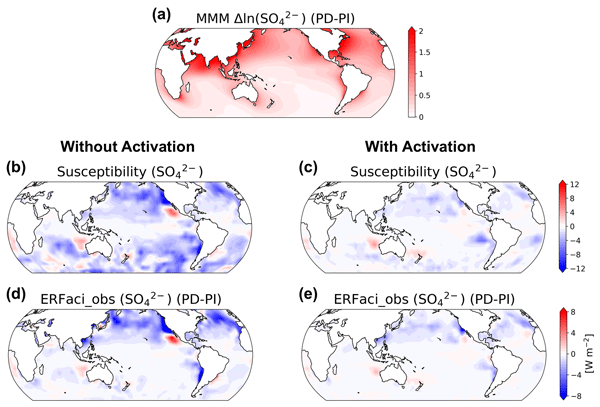
This study addresses the long-standing challenge of quantifying the impact of aerosol–cloud interactions. Using satellite observations, reanalysis data, and a "perfect-model" cross-validation, we show that explicitly accounting for aerosol–cloud droplet activation rates is key to accurately estimating ERFaci (effective radiative forcing due to aerosol–cloud interactions). Our results indicate a smaller and less uncertain ERFaci than previously assessed, implying the reduced role of aerosol–cloud interactions in shaping climate sensitivity.
Natasha Vos, Tristan S. L'Ecuyer, and Tim Michaels
EGUsphere, https://doi.org/10.5194/egusphere-2024-2040, https://doi.org/10.5194/egusphere-2024-2040, 2024
Preprint withdrawn
Short summary
Short summary
PREFIRE uses two CubeSats to make novel measurements of outgoing energy. The CubeSats will frequently resample regions, forming orbit “intersections” that reveal how polar processes impact thermal emissions. This study develops new methods to characterize orbit intersections and applies them to simulated PREFIRE orbits to assess the hypothetical resampling distribution. Generalizing our results informs future missions that two CubeSats at different altitudes greatly enhance resampling coverage.
Brian Kahn, Cameron Bertossa, Xiuhong Chen, Brian Drouin, Erin Hokanson, Xianglei Huang, Tristan L'Ecuyer, Kyle Mattingly, Aronne Merrelli, Tim Michaels, Nate Miller, Federico Donat, Tiziano Maestri, and Michele Martinazzo
EGUsphere, https://doi.org/10.5194/egusphere-2023-2463, https://doi.org/10.5194/egusphere-2023-2463, 2023
Preprint archived
Short summary
Short summary
A cloud detection mask algorithm is developed for the upcoming Polar Radiant Energy in the Far Infrared Experiment (PREFIRE) satellite mission to be launched by NASA in May 2024. The cloud mask is compared to "truth" and is capable of detecting over 90 % of all clouds globally tested with simulated data, and about 87 % of all clouds in the Arctic region.
R. Bradley Pierce, Monica Harkey, Allen Lenzen, Lee M. Cronce, Jason A. Otkin, Jonathan L. Case, David S. Henderson, Zac Adelman, Tsengel Nergui, and Christopher R. Hain
Atmos. Chem. Phys., 23, 9613–9635, https://doi.org/10.5194/acp-23-9613-2023, https://doi.org/10.5194/acp-23-9613-2023, 2023
Short summary
Short summary
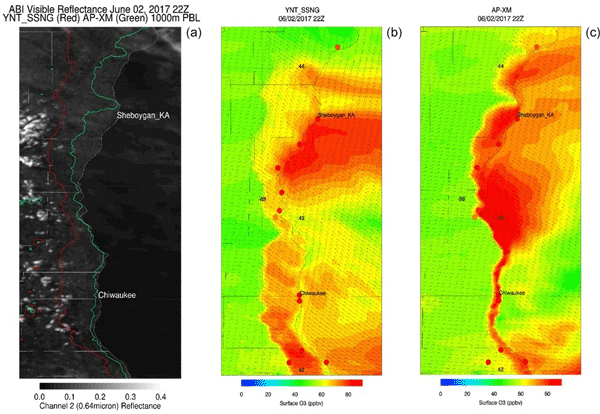
We evaluate two high-resolution model simulations with different meteorological inputs but identical chemistry and anthropogenic emissions, with the goal of identifying a model configuration best suited for characterizing air quality in locations where lake breezes commonly affect local air quality along the Lake Michigan shoreline. This analysis complements other studies in evaluating the impact of meteorological inputs and parameterizations on air quality in a complex environment.
Jason A. Otkin, Lee M. Cronce, Jonathan L. Case, R. Bradley Pierce, Monica Harkey, Allen Lenzen, David S. Henderson, Zac Adelman, Tsengel Nergui, and Christopher R. Hain
Atmos. Chem. Phys., 23, 7935–7954, https://doi.org/10.5194/acp-23-7935-2023, https://doi.org/10.5194/acp-23-7935-2023, 2023
Short summary
Short summary
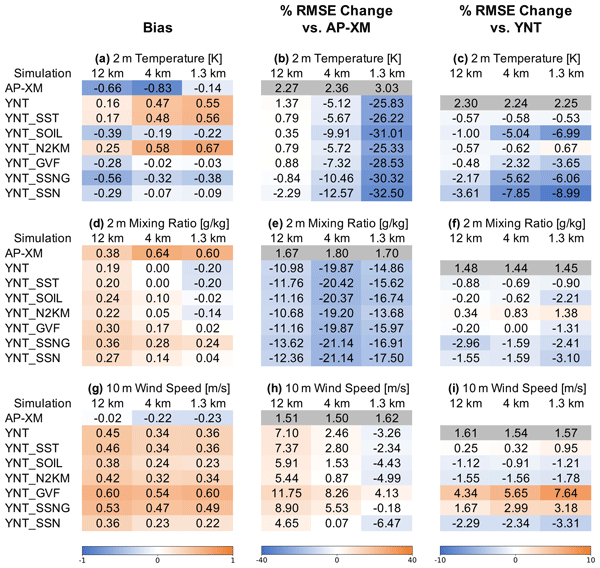
We performed model simulations to assess the impact of different parameterization schemes, surface initialization datasets, and analysis nudging on lower-tropospheric conditions near Lake Michigan. Simulations were run with high-resolution, real-time datasets depicting lake surface temperatures, green vegetation fraction, and soil moisture. The most accurate results were obtained when using high-resolution sea surface temperature and soil datasets to constrain the model simulations.
Alyson Rose Douglas and Tristan L'Ecuyer
Atmos. Chem. Phys. Discuss., https://doi.org/10.5194/acp-2022-688, https://doi.org/10.5194/acp-2022-688, 2022
Revised manuscript not accepted
Short summary
Short summary
Aerosol, or small particles released by human activities, enter the atmosphere and eventually interact with clouds in what we term aerosol-cloud interactions. As more aerosol enter a cloud, they act as cloud droplet nuclei, increasing the number of cloud droplets in a cloud and delaying rain formation, leading to a larger cloud. We use machine learning and found that these interactions lead to 1.27 % more cloudiness on Earth and offset ~1/4 of the warming due to CO2.
Assia Arouf, Hélène Chepfer, Thibault Vaillant de Guélis, Marjolaine Chiriaco, Matthew D. Shupe, Rodrigo Guzman, Artem Feofilov, Patrick Raberanto, Tristan S. L'Ecuyer, Seiji Kato, and Michael R. Gallagher
Atmos. Meas. Tech., 15, 3893–3923, https://doi.org/10.5194/amt-15-3893-2022, https://doi.org/10.5194/amt-15-3893-2022, 2022
Short summary
Short summary
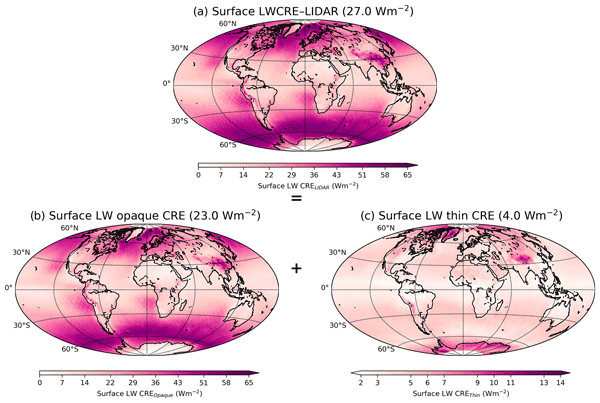
We proposed new estimates of the surface longwave (LW) cloud radiative effect (CRE) derived from observations collected by a space-based lidar on board the CALIPSO satellite and radiative transfer computations. Our estimate appropriately captures the surface LW CRE annual variability over bright polar surfaces, and it provides a dataset more than 13 years long.
Michael R. Gallagher, Matthew D. Shupe, Hélène Chepfer, and Tristan L'Ecuyer
The Cryosphere, 16, 435–450, https://doi.org/10.5194/tc-16-435-2022, https://doi.org/10.5194/tc-16-435-2022, 2022
Short summary
Short summary
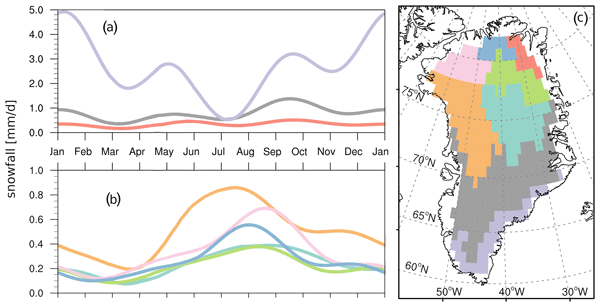
By using direct observations of snowfall and mass changes, the variability of daily snowfall mass input to the Greenland ice sheet is quantified for the first time. With new methods we conclude that cyclones west of Greenland in summer contribute the most snowfall, with 1.66 Gt per occurrence. These cyclones are contextualized in the broader Greenland climate, and snowfall is validated against mass changes to verify the results. Snowfall and mass change observations are shown to agree well.
Cited articles
Arouf, A., Chepfer, H., Kay, J. E., L'Ecuyer, T. S., and Lac, J.: Surface cloud warming increases as late fall Arctic sea ice cover decreases, Geophysical Research Letters, 51, e2023GL105805, https://doi.org/10.1029/2023GL105805, 2024. a, b, c
Avila-Diaz, A., Bromwich, D. H., Wilson, A. B., Justino, F., and Wang, S.-H.: Climate extremes across the North American Arctic in modern reanalyses, Journal of Climate, 34, 2385–2410, https://doi.org/10.1175/JCLI-D-20-0093.1, 2021. a
Bertossa, C. and L’Ecuyer, T.: Two Ubiquitous Radiative States Observed across the High Latitudes, Journal of Climate, 37, 2585–2610, https://doi.org/10.1175/JCLI-D-23-0553.1, 2024. a, b
Bertossa, C. and L’Ecuyer, T.: A rapid deterioration of the transmissive atmospheric radiative regime in the western Arctic, Geophysical Research Letters, 52, e2025GL115362, https://doi.org/10.1029/2025GL115362, 2025. a, b, c, d
Blanchard, Y., Pelon, J., Cox, C. J., Delanoë, J., Eloranta, E. W., and Uttal, T.: Comparison of TOA and BOA LW Radiation Fluxes Inferred From Ground-Based Sensors, A-Train Satellite Observations and ERA Reanalyzes at the High Arctic Station Eureka Over the 2002–2020 Period, Journal of Geophysical Research: Atmospheres, 126, e2020JD033615, https://doi.org/10.1029/2020JD033615, 2021. a
Boeke, R. C., Taylor, P. C., and Sejas, S. A.: On the nature of the Arctic's positive lapse-rate feedback, Geophysical Research Letters, 48, e2020GL091109, https://doi.org/10.1029/2020GL091109, 2021. a
Box, J. E., Colgan, W. T., Christensen, T. R., Schmidt, N. M., Lund, M., Parmentier, F.-J. W., Brown, R., Bhatt, U. S., Euskirchen, E. S., Romanovsky, V. E., Walsh, J., Overland, J., Wang, M., Corell, R., Meier, W., Wouters, B., Mernild, S., Mard, J., Pawlak, J., and Skovgard Olsen, M.: Key indicators of Arctic climate change: 1971–2017, Environmental Research Letters, 14, 045010, https://doi.org/10.1088/1748-9326/aafc1b, 2019. a
Bromwich, D. H., Hines, K. M., and Bai, L.-S.: Development and testing of polar weather research and forecasting model: 2. Arctic Ocean, Journal of Geophysical Research: Atmospheres, 114, https://doi.org/10.1029/2008JD010300, 2009. a
Bromwich, D. H., Wilson, A. B., Bai, L., Liu, Z., Barlage, M., Shih, C.-F., Maldonado, S., Hines, K. M., Wang, S.-H., Woollen, J., Kuo, B., Lin, H.-C., Wee, T.-K., Serreze, M. C., and Walsh, J. E.: The Arctic System Reanalysis, Version 2, Bulletin of the American Meteorological Society, 99, 805–828, 2018. a, b, c
Bruyère, C. L., Done, J. M., Holland, G. J., and Fredrick, S.: Bias corrections of global models for regional climate simulations of high-impact weather, Climate Dynamics, 43, 1847–1856, https://doi.org/10.1007/s00382-013-2011-6, 2014. a
Cai, M.: Dynamical amplification of polar warming, Geophysical Research Letters, 32, https://doi.org/10.1029/2005GL024481, 2005. a
Cesana, G., Kay, J., Chepfer, H., English, J., and De Boer, G.: Ubiquitous low-level liquid-containing Arctic clouds: New observations and climate model constraints from CALIPSO-GOCCP, Geophysical Research Letters, 39, https://doi.org/10.1029/2012GL053385, 2012. a
Cho, H., Jun, S.-Y., Ho, C.-H., and McFarquhar, G.: Simulations of winter Arctic clouds and associated radiation fluxes using different cloud microphysics schemes in the polar WRF: Comparisons With CloudSat, CALIPSO, and CERES, Journal of Geophysical Research: Atmospheres, 125, e2019JD031413, https://doi.org/10.1029/2019JD031413, 2020. a, b
Curry, J. A., Schramm, J. L., and Ebert, E. E.: Sea ice-albedo climate feedback mechanism, Journal of Climate, 8, 240–247, https://doi.org/10.1175/1520-0442(1995)008<0240:SIACFM>2.0.CO;2, 1995. a
Danabasoglu, G., Lamarque, J.-F., Bacmeister, J., Bailey, D. A., DuVivier, A. K., Edwards, J., Emmons, L. K., Fasullo, J., Garcia, R., Gettelman, A., Hannay, C., Holland, M. M., Large, W. G., Lauritzen, P. H., Lawrence, D. M., Lenaerts, J. T. M., Lindsay, K., Lipscomb, W. H., Mills, M. J., Neale, R., Oleson, K. W., Otto-Bliesner, B., Phillips, A. S., Sacks, W., Tilmes, S., van Kampenhout, L., Vertenstein, M., Bertini, A., Dennis, J., Deser, C., Fischer, C., Fox-Kemper, B., Kay, J. E., Kinnison, D., Kushner, P. J., Larson, V. E., Long, M. C., Mickelson, S., Moore, J. K., Nienhouse, E., Polvani, L., Rasch, P. J., and Strand, W. G.: The Community Earth System Model Version 2 (CESM2), Journal of Advances in Modeling Earth Systems, 12, e2019MS001916, https://doi.org/10.1029/2019MS001916, 2020. a
Dodson, J. B., Taylor, P. C., Moore, R. H., Bromwich, D. H., Hines, K. M., Thornhill, K. L., Corr, C. A., Anderson, B. E., Winstead, E. L., and Bennett, J. R.: Evaluation of simulated cloud liquid water in low clouds over the Beaufort Sea in the Arctic System Reanalysis using ARISE airborne in situ observations, Atmospheric Chemistry and Physics, 21, 11563–11580, https://doi.org/10.5194/acp-21-11563-2021, 2021. a, b
Eirund, G. K., Possner, A., and Lohmann, U.: Response of Arctic mixed-phase clouds to aerosol perturbations under different surface forcings, Atmospheric Chemistry and Physics, 19, 9847–9864, https://doi.org/10.5194/acp-19-9847-2019, 2019. a
Ghanbari, M., Arabi, M., Georgescu, M., and Broadbent, A. M.: The role of climate change and urban development on compound dry-hot extremes across US cities, Nature Communications, 14, 3509, https://doi.org/10.1038/s41467-023-39205-x, 2023. a
Giorgi, F. and Mearns, L. O.: Approaches to the simulation of regional climate change: a review, Reviews of Geophysics, 29, 191–216, https://doi.org/10.1029/90RG02636, 1991. a
Graham, R. M., Cohen, L., Ritzhaupt, N., Segger, B., Graversen, R. G., Rinke, A., Walden, V. P., Granskog, M. A., and Hudson, S. R.: Evaluation of six atmospheric reanalyses over Arctic sea ice from winter to early summer, Journal of Climate, 32, 4121–4143, https://doi.org/10.1175/JCLI-D-18-0643.1, 2019. a
Henderson, D. S., L’Ecuyer, T., Stephens, G., Partain, P., and Sekiguchi, M.: A multisensor perspective on the radiative impacts of clouds and aerosols, Journal of Applied Meteorology and Climatology, 52, 853–871, https://doi.org/10.1175/JAMC-D-12-025.1, 2013. a
Hersbach, H., Bell, B., Berrisford, P., Hirahara, S., Horányi, A., Muñoz-Sabater, J., Nicolas, J., Peubey, C., Radu, R., Schepers, D., Simmons, A., Soci, C., Abdalla, S., Abellan, X., Balsamo, G., Bechtold, P., Biavati, G., Bidlot, J., Bonavita, M., De Chiara, G., Dahlgren, P., Dee, D., Diamantakis, M., Dragani, R., Flemming, J., Forbes, R., Fuentes, M., Geer, A., Haimberger, L., Healy, S., Hogan, R. J., Hólm, E., Janisková, M., Keeley, S., Laloyaux, P., Lopez, P., Lupu, C., Radnoti, G., de Rosnay, P., Rozum, I., Vamborg, F., Villaume, S., and Thépaut, J.-N.: The ERA5 Global Reanalysis, Quarterly Journal of the Royal Meteorological Society, 146, 1999–2049, https://doi.org/10.1002/qj.3803, 2020. a
Hines, K. M. and Bromwich, D. H.: Development and testing of Polar Weather Research and Forecasting (WRF) model. Part I: Greenland ice sheet meteorology, Monthly Weather Review, 136, 1971–1989, https://doi.org/10.1175/2007MWR2112.1, 2008. a, b
Hines, K. M., Bromwich, D. H., Bai, L., Bitz, C. M., Powers, J. G., and Manning, K. W.: Sea ice enhancements to Polar WRF, Monthly Weather Review, 143, 2363–2385, https://doi.org/10.1175/MWR-D-14-00344.1, 2015. a
Hines, K. M., Bromwich, D. H., Wang, S.-H., Silber, I., Verlinde, J., and Lubin, D.: Microphysics of summer clouds in central West Antarctica simulated by the Polar Weather Research and Forecasting Model (WRF) and the Antarctic Mesoscale Prediction System (AMPS), Atmospheric Chemistry and Physics, 19, 12431–12454, https://doi.org/10.5194/acp-19-12431-2019, 2019. a, b
Inoue, J., Sato, K., Rinke, A., Cassano, J. J., Fettweis, X., Heinemann, G., Matthes, H., Orr, A., Phillips, T., Seefeldt, M., Solomon, A., and Webster, S.: Clouds and Radiation Processes in Regional Climate Models Evaluated Using Observations over the Ice-Free Arctic Ocean, Journal of Geophysical Research: Atmospheres, 126, e2020JD033904, https://doi.org/10.1029/2020JD033904, 2021. a
Kay, J. E., L’Ecuyer, T., Chepfer, H., Loeb, N., Morrison, A., and Cesana, G.: Recent advances in Arctic cloud and climate research, Current Climate Change Reports, 2, 159–169, https://doi.org/10.1007/s40641-016-0051-9, 2016. a, b
Krayenhoff, E. S., Moustaoui, M., Broadbent, A. M., Gupta, V., and Georgescu, M.: Diurnal interaction between urban expansion, climate change and adaptation in US cities, Nature Climate Change, 8, 1097–1103, https://doi.org/10.1038/s41558-018-0320-9, 2018. a
Li, Z. and Ding, Q.: A global poleward shift of atmospheric rivers, Science Advances, 10, eadq0604, https://doi.org/10.1126/sciadv.adq0604, 2024. a
Listowski, C. and Lachlan-Cope, T.: The microphysics of clouds over the Antarctic Peninsula – Part 2: modelling aspects within Polar WRF, Atmospheric Chemistry and Physics, 17, 10195–10221, https://doi.org/10.5194/acp-17-10195-2017, 2017. a
Liu, Y.: Impacts of active satellite sensors' low-level cloud detection limitations on cloud radiative forcing in the Arctic, Atmospheric Chemistry and Physics, 22, 8151–8173, https://doi.org/10.5194/acp-22-8151-2022, 2022. a
McCrystall, M. R., Stroeve, J., Serreze, M., Forbes, B. C., and Screen, J. A.: New climate models reveal faster and larger increases in Arctic precipitation than previously projected, Nature Communications, 12, 6765, https://doi.org/10.1038/s41467-021-27031-y, 2021. a
McCusker, G. Y., Vüllers, J., Achtert, P., Field, P., Day, J. J., Forbes, R., Price, R., O'Connor, E., Tjernström, M., Prytherch, J., Neely III, R., and Brooks, I. M.: Evaluating Arctic clouds modelled with the Unified Model and Integrated Forecasting System, Atmospheric Chemistry and Physics, 23, 4819–4847, https://doi.org/10.5194/acp-23-4819-2023, 2023. a
McIlhattan, E. A., L’Ecuyer, T. S., and Miller, N. B.: Observational evidence linking Arctic supercooled liquid cloud biases in CESM to snowfall processes, Journal of Climate, 30, 4477–4495, https://doi.org/10.1175/JCLI-D-16-0666.1, 2017. a, b
Monaghan, A., Steinhoff, D., Bruyere, C., and Yates, D.: NCAR CESM global bias-corrected CMIP5 output to support WRF/MPAS research, NSF [data set], https://doi.org/10.5065/D6DJ5CN4, 2014. a
Morrison, A., Kay, J., Chepfer, H., Guzman, R., and Yettella, V.: Isolating the liquid cloud response to recent Arctic sea ice variability using spaceborne lidar observations, Journal of Geophysical Research: Atmospheres, 123, 473–490, https://doi.org/10.1002/2017JD027248, 2018. a, b, c
Morrison, H. and Milbrandt, J. A.: Parameterization of cloud microphysics based on the prediction of bulk ice particle properties. Part I: Scheme description and idealized tests, Journal of the Atmospheric Sciences, 72, 287–311, https://doi.org/10.1175/JAS-D-14-0065.1, 2015. a
Morrison, H., Curry, J., and Khvorostyanov, V.: A new double-moment microphysics parameterization for application in cloud and climate models. Part I: Description, Journal of the Atmospheric Sciences, 62, 1665–1677, https://doi.org/10.1175/JAS3446.1, 2005. a
Morrison, H., De Boer, G., Feingold, G., Harrington, J., Shupe, M. D., and Sulia, K.: Resilience of persistent Arctic mixed-phase clouds, Nature Geoscience, 5, 11–17, https://doi.org/10.1038/ngeo1332, 2012. a
Nam, J., Cho, Y., Lim, K.-S., Jun, S.-Y., Kim, J.-H., Park, S.-J., and Kim, S.-W.: Evaluation of Four Cloud Microphysical Schemes Simulating Arctic Low-Level Clouds Observed During the ACLOUD Experiment, Asia-Pacific Journal of Atmospheric Sciences, 1–14, https://doi.org/10.1007/s13143-024-00378-0, 2024. a
Previdi, M., Smith, K. L., and Polvani, L. M.: Arctic amplification of climate change: a review of underlying mechanisms, Environmental Research Letters, 16, 093003, https://doi.org/10.1088/1748-9326/ac1c29, 2021. a
Rantanen, M., Karpechko, A. Y., Lipponen, A., Nordling, K., Hyvärinen, O., Ruosteenoja, K., Vihma, T., and Laaksonen, A.: The Arctic has warmed nearly four times faster than the globe since 1979, Communications Earth & Environment, 3, 168, https://doi.org/10.1038/s43247-022-00498-3, 2022. a
Riot-Bretêcher, B., Huang, Y., Liu, L., and Gero, J.: Strengthening atmospheric greenhouse effect in the Arctic evidenced by long-term records of downwelling longwave radiance spectrum, Authorea [preprint], https://doi.org/10.22541/essoar.174087674.44997859/v2, 2025. a
Serreze, M. C. and Barry, R. G.: Processes and impacts of Arctic amplification: A research synthesis, Global and Planetary Change, 77, 85–96, https://doi.org/10.1016/j.gloplacha.2011.03.004, 2011. a
Shaw, J., McGraw, Z., Bruno, O., Storelvmo, T., and Hofer, S.: Using satellite observations to evaluate model microphysical representation of arctic mixed-phase clouds, Geophysical Research Letters, 49, e2021GL096191, https://doi.org/10.1029/2021GL096191, 2022. a
Sledd, A. and L’Ecuyer, T.: How much do clouds mask the impacts of Arctic sea ice and snow cover variations? Different perspectives from observations and reanalyses, Atmosphere, 10, 12, https://doi.org/10.3390/atmos10010012, 2019. a
Stroeve, J. and Notz, D.: Changing state of Arctic sea ice across all seasons, Environmental Research Letters, 13, 103001, https://doi.org/10.1088/1748-9326/aade56, 2018. a
Tan, I. and Storelvmo, T.: Evidence of strong contributions from mixed-phase clouds to Arctic climate change, Geophysical Research Letters, 46, 2894–2902, https://doi.org/10.1029/2018GL081871, 2019. a
Taylor, P. C., Boeke, R. C., Li, Y., and Thompson, D. W. J.: Arctic cloud annual cycle biases in climate models, Atmospheric Chemistry and Physics, 19, 8759–8782, https://doi.org/10.5194/acp-19-8759-2019, 2019. a, b
Tjernström, M., Sedlar, J., and Shupe, M. D.: How well do regional climate models reproduce radiation and clouds in the Arctic? An evaluation of ARCMIP simulations, Journal of Applied Meteorology and Climatology, 47, 2405–2422, https://doi.org/10.1175/2008JAMC1845.1, 2008. a
Vavrus, S. and Waliser, D.: An improved parameterization for simulating Arctic cloud amount in the CCSM3 climate model, Journal of Climate, 21, 5673–5687, https://doi.org/10.1175/2008JCLI2299.1, 2008. a
Xue, J., Xiao, Z., Bromwich, D. H., and Bai, L.: Polar WRF V4.1.1 simulation and evaluation for the Antarctic and Southern Ocean, Frontiers of Earth Science, 16, 1005–1024, https://doi.org/10.1007/s11707-022-0971-8, 2022. a
Zhang, D.: Data Quality Assessment for ARM Radiation Data (QCRAD1LONG), 1998-02-15 to 2025-02-08, North Slope Alaska (NSA), Central Facility, Barrow AK (C1), Atmospheric Radiation Measurement (ARM) user facility [data set], https://doi.org/10.5439/1227214, 1998. a
Zou, X., Bromwich, D. H., Montenegro, A., Wang, S.-H., and Bai, L.: Major surface melting over the Ross Ice Shelf part II: Surface energy balance, Quarterly Journal of the Royal Meteorological Society, 147, 2895–2916, https://doi.org/10.1002/qj.4105, 2021. a
Short summary
This study evaluates how well an Arctic-specific model can capture two key cloud states that control how the region traps surface radiation. The model reproduces these states better than others but still produces too many thick, low clouds. With further improvements, it could offer valuable insight into how Arctic cloud behavior and surface heat balance may evolve under future climate change.
This study evaluates how well an Arctic-specific model can capture two key cloud states that...


Altmetrics
Final-revised paper
Preprint