
Articles | Volume 26, issue 3
https://doi.org/10.5194/acp-26-2117-2026
© Author(s) 2026. This work is distributed under
the Creative Commons Attribution 4.0 License.
the Creative Commons Attribution 4.0 License.
https://doi.org/10.5194/acp-26-2117-2026
© Author(s) 2026. This work is distributed under
the Creative Commons Attribution 4.0 License.
the Creative Commons Attribution 4.0 License.
Research article
| 
10 Feb 2026
Research article |
| 10 Feb 2026
| 10 Feb 2026
Cross-Seasonal Impact of SST Anomalies over the Tropical Central Pacific Ocean on the Antarctic Stratosphere
Yucheng Zi
State Key Laboratory of Earth System Numerical Modeling and Application, Institute of Atmospheric Physics, Chinese Academy of Sciences, Beijing, China
Department of Oceanography, Dalhousie University, Halifax, Nova Scotia, Canada
Fisheries and Oceans Canada, Bedford Institute of Oceanography, Dartmouth, Nova Scotia, Canada
School of Earth and Space Sciences, University of Science and Technology of China, Hefei, China
Zhenxia Long
CORRESPONDING AUTHOR

Fisheries and Oceans Canada, Bedford Institute of Oceanography, Dartmouth, Nova Scotia, Canada
Jinyu Sheng
Department of Oceanography, Dalhousie University, Halifax, Nova Scotia, Canada
Gaopeng Lu
School of Earth and Space Sciences, University of Science and Technology of China, Hefei, China
Will Perrie
Department of Oceanography, Dalhousie University, Halifax, Nova Scotia, Canada
Fisheries and Oceans Canada, Bedford Institute of Oceanography, Dartmouth, Nova Scotia, Canada
Department of Engineering Mathematics & Internetworking, Dalhousie University, Halifax, Nova Scotia, Canada
State Key Laboratory of Earth System Numerical Modeling and Application, Institute of Atmospheric Physics, Chinese Academy of Sciences, Beijing, China
School of Earth and Space Sciences, University of Science and Technology of China, Hefei, China
Related authors
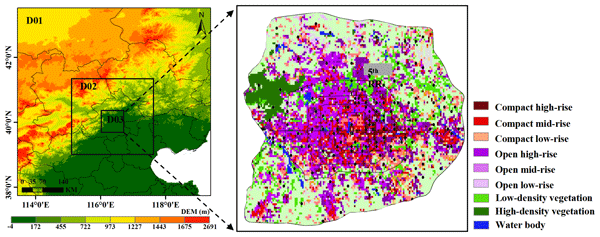
Tao Shi, Yuanjian Yang, Gaopeng Lu, Zuofang Zheng, Yucheng Zi, Ye Tian, Lei Liu, and Simone Lolli
Atmos. Chem. Phys., 25, 9219–9234, https://doi.org/10.5194/acp-25-9219-2025, https://doi.org/10.5194/acp-25-9219-2025, 2025
Short summary
Short summary
The city significantly influences thunderstorm and lightning activity, yet the potential mechanisms remain largely unexplored. Our study has revealed that both city size and building density play pivotal roles in modulating thunderstorm and lightning activity. This research not only deepens our understanding of urban meteorology but also lays an important foundation for developing accurate and targeted urban thunderstorm risk prediction models.
Jie Chao, Qi Liu, Hongming Yan, Zhenlu Liu, Jin Xu, Shuojie Gao, Zihang Han, Hang Su, Ziniu Xiao, Anlai Sun, and Baoxiang Pan
EGUsphere, https://doi.org/10.5194/egusphere-2026-4341, https://doi.org/10.5194/egusphere-2026-4341, 2026
This preprint is open for discussion and under review for Geoscientific Model Development (GMD).
Short summary
Short summary
Scientists need daily weather maps over decades to study extremes, but observations are sparse and uneven. Existing methods fill gaps by averaging nearby data, which smooths intense local events like heavy rain. We instead train a model on modern data to learn realistic patterns. It reconstructs past days using available observations and links days together. Repeating this produces both best estimates and uncertainty, improving accuracy and capturing extremes.
Tao Shi, Yuanjian Yang, Gaopeng Lu, Zuofang Zheng, Yucheng Zi, Ye Tian, Lei Liu, and Simone Lolli
Atmos. Chem. Phys., 25, 9219–9234, https://doi.org/10.5194/acp-25-9219-2025, https://doi.org/10.5194/acp-25-9219-2025, 2025
Short summary
Short summary
The city significantly influences thunderstorm and lightning activity, yet the potential mechanisms remain largely unexplored. Our study has revealed that both city size and building density play pivotal roles in modulating thunderstorm and lightning activity. This research not only deepens our understanding of urban meteorology but also lays an important foundation for developing accurate and targeted urban thunderstorm risk prediction models.
Zhipeng Zhu, Limin Zhou, and Ziniu Xiao
EGUsphere, https://doi.org/10.5194/egusphere-2025-3636, https://doi.org/10.5194/egusphere-2025-3636, 2025
Preprint archived
Short summary
Short summary
This paper introduces a new chemistry-climate model MACO and evaluates its performance through a historical simulation. MACO demonstrates robust capabilities in simulating key middle atmospheric dynamical and chemical processes. Despite some identified biases in the upper stratosphere and mesosphere that require future model improvements, our results suggest that MACO is a suitable tool for middle atmosphere research involving chemistry-climate interactions.
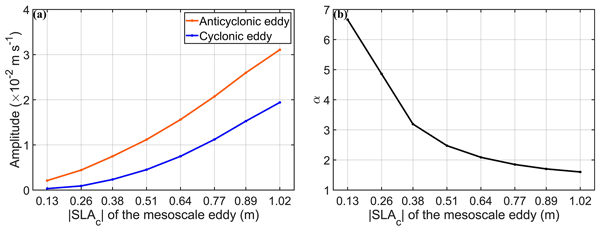
Yu Zhang, Jintao Gu, Shengli Chen, Jianyu Hu, Jinyu Sheng, and Jiuxing Xing
Ocean Sci., 21, 1047–1063, https://doi.org/10.5194/os-21-1047-2025, https://doi.org/10.5194/os-21-1047-2025, 2025
Short summary
Short summary
Current observations at two moorings in the northern South China Sea reveal that mesoscale eddies can transfer energy with near-inertial oscillations (NIOs). Numerical experiments are conducted to investigate important parameters affecting energy transfer between mesoscale eddies and NIOs, which demonstrate that the energy transferred by mesoscale eddies is larger with stronger winds and higher strength of the mesoscale eddy. Anticyclonic eddies can transfer more energy than cyclonic eddies.
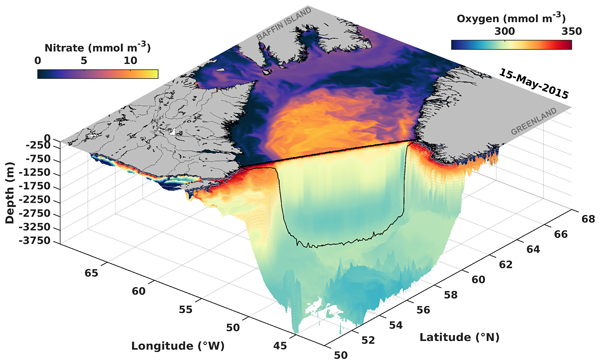
Kyoko Ohashi, Arnaud Laurent, Christoph Renkl, Jinyu Sheng, Katja Fennel, and Eric Oliver
Geosci. Model Dev., 17, 8697–8733, https://doi.org/10.5194/gmd-17-8697-2024, https://doi.org/10.5194/gmd-17-8697-2024, 2024
Short summary
Short summary
We developed a modelling system of the northwest Atlantic Ocean that simulates the currents, temperature, salinity, and parts of the biochemical cycle of the ocean, as well as sea ice. The system combines advanced, open-source models and can be used to study, for example, the ocean capture of atmospheric carbon dioxide, which is a key process in the global climate. The system produces realistic results, and we use it to investigate the roles of tides and sea ice in the northwest Atlantic Ocean.
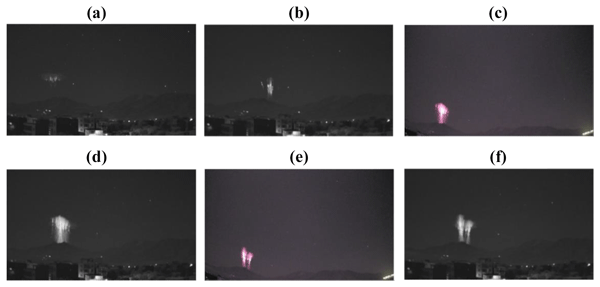
Shican Qiu, Zhe Wang, Gaopeng Lu, Zeren Zhima, Willie Soon, Victor Manuel Velasco Herrera, and Peng Ju
Atmos. Chem. Phys., 24, 8519–8527, https://doi.org/10.5194/acp-24-8519-2024, https://doi.org/10.5194/acp-24-8519-2024, 2024
Short summary
Short summary
We focus on the interactions among TLEs, lightning, and the ionospheric electric field. The SNR of the Schumann resonance at the first and second modes dropped during the TLEs. A significant enhancement of the energy in ULF occurred. Distinct lightning whistler waves were found in the VLF band. Our results indicate that the observations of electric fields from the satellite could possibly be utilized to monitor lower-atmospheric lightning and its impact on the space environment.
Nan Sun, Gaopeng Lu, and Yunfei Fu
Atmos. Chem. Phys., 24, 7123–7135, https://doi.org/10.5194/acp-24-7123-2024, https://doi.org/10.5194/acp-24-7123-2024, 2024
Short summary
Short summary
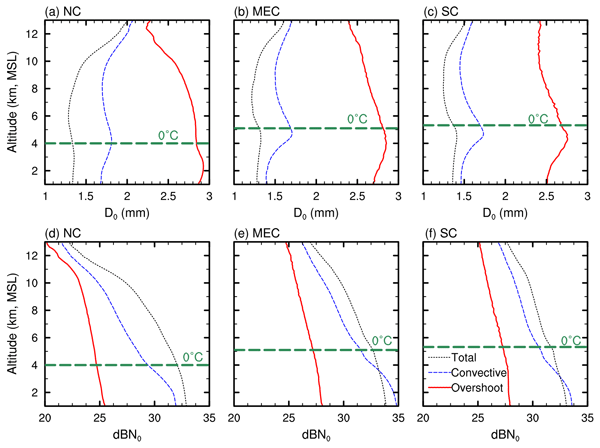
Microphysical characteristics of convective overshooting are essential but poorly understood, and we examine them by using the latest data. (1) Convective overshooting events mainly occur over NC (Northeast China) and northern MEC (Middle and East China). (2) Radar reflectivity of convective overshooting over NC accounts for a higher proportion below the zero level, while the opposite is the case for MEC and SC (South China). (3) Droplets of convective overshooting are large but sparse.
Kenan Wu, Tianwen Wei, Jinlong Yuan, Haiyun Xia, Xin Huang, Gaopeng Lu, Yunpeng Zhang, Feifan Liu, Baoyou Zhu, and Weidong Ding
Atmos. Meas. Tech., 16, 5811–5825, https://doi.org/10.5194/amt-16-5811-2023, https://doi.org/10.5194/amt-16-5811-2023, 2023
Short summary
Short summary
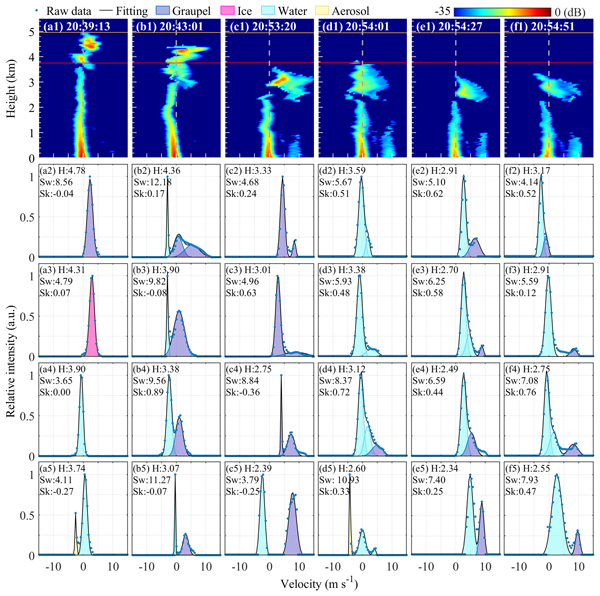
A compact all-fiber coherent Doppler wind lidar (CDWL) working at the 1.5 µm wavelength is applied to probe the dynamics and microphysics structure of thunderstorms. It was found that thunderclouds below the 0 ℃ isotherm have significant spectrum broadening and an increase in skewness, and that lightning affects the microphysics structure of the thundercloud. It is proven that the precise spectrum of CDWL is a promising indicator for studying the charge structure of thunderstorms.
Cited articles
Albers, J. R. and Birner, T.: Vortex Preconditioning due to Planetary and Gravity Waves prior to Sudden Stratospheric Warmings, J. Atmos. Sci., 71, 4028–4054, https://doi.org/10.1175/jas-d-14-0026.1, 2014.
Alexander, M. A., Bladé, I., Newman, M., Lanzante, J. R., Lau, N. C., and Scott, J. D.: The Atmospheric Bridge: The Influence of ENSO Teleconnections on Air–Sea Interaction over the Global Oceans, J. Climate, 15, 2205–2231, https://doi.org/10.1175/1520-0442(2002)015<2205:tabtio>2.0.co;2, 2002.
Andrews, D. G. and McIntyre, M. E.: Planetary Waves in Horizontal and Vertical Shear: The Generalized Eliassen–Palm Relation and the Mean Zonal Acceleration, J. Atmos. Sci., 33, 2031–2048, https://doi.org/10.1175/1520-0469(1976)033<2031:pwihav>2.0.co;2, 1976.
Andrews, D. G. and McIntyre, M. E.: An exact theory of nonlinear waves on a Lagrangian-mean flow, J. Fluid Mech., 89, 609–646, https://doi.org/10.1017/s0022112078002773, 1978.
Andrews, D. G., Holton, J. R., and Leovy, C. B.: Middle atmosphere dynamics, Academic Press, San Diego, 489 pp., https://doi.org/10.1002/qj.49711548612, 1987.
Baldwin, M. P., Ayarzagüena, B., Birner, T., Butchart, N., Butler, A. H., Charlton-Perez, Andrew, J., Domeisen, Daniela, I. V., Garfinkel, Chaim, I., Garny, H., Gerber, Edwin, P., Hegglin, Michaela, I., Langematz, U., and Pedatella, N. M.: Sudden Stratospheric Warmings, Rev. Geophys., 59, https://doi.org/10.1029/2020rg000708, 2021.
Bamston, A. G., Chelliah, M., and Goldenberg, S. B.: Documentation of a highly ENSO-related sst region in the equatorial pacific: Research note, Atmos. Ocean, 35, 367–383, https://doi.org/10.1080/07055900.1997.9649597, 1997.
Barriopedro, D. and Calvo, N.: On the Relationship between ENSO, Stratospheric Sudden Warmings, and Blocking, J. Climate, 27, 4704–4720, https://doi.org/10.1175/jcli-d-13-00770.1, 2014.
Butler, A. H. and Polvani, L. M.: El Niño, La Niña, and stratospheric sudden warmings: A reevaluation in light of the observational record, Geophys. Res. Lett., 38, https://doi.org/10.1029/2011gl048084, 2011.
Domeisen, D. I. V., Garfinkel, C. I., and Butler, A. H.: The Teleconnection of El Niño Southern Oscillation to the Stratosphere, Rev. Geophys., 57, 5–47, https://doi.org/10.1029/2018rg000596, 2019.
Esler, J. G., Polvani, L. M., and Scott, R. K.: The Antarctic stratospheric sudden warming of 2002: A self-tuned resonance?, Geophys. Res. Lett., 33, https://doi.org/10.1029/2006gl026034, 2006.
Evtushevsky, O. M., Kravchenko, V. O., Hood, L. L., and Milinevsky, G. P.: Teleconnection between the central tropical Pacific and the Antarctic stratosphere: spatial patterns and time lags, Clim. Dynam., 44, 1841–1855, https://doi.org/10.1007/s00382-014-2375-2, 2015.
Fogt, R. L., Bromwich, David, H., and Hines, Keith, M.: Understanding the SAM influence on the South Pacific ENSO teleconnection, Clim. Dynam., 36, 1555–1576, https://doi.org/10.1007/s00382-010-0905-0, 2011.
Garfinkel, C. I. and Hartmann, D. L.: Different ENSO teleconnections and their effects on the stratospheric polar vortex, J. Geophys. Res.-Atmos., 113, https://doi.org/10.1029/2008jd009920, 2008.
Grassi, B., Redaelli, G., and Visconti, G.: Tropical SST Preconditioning of the SH Polar Vortex during Winter 2002, J. Climate, 21, 5295–5303, https://doi.org/10.1175/2008jcli2136.1, 2008.
Hersbach, H., Bell, B., Berrisford, P., Biavati, G., Horányi, A., Muñoz Sabater, J., Nicolas, J., Peubey, C., Radu, R., Rozum, I., Schepers, D., Simmons, A., Soci, C., Dee, D., and Thépaut, J.-N.: ERA5 hourly data on pressure levels from 1940 to present, Copernicus Climate Change Service (C3S) Climate Data Store (CDS), Dataset, https://doi.org/10.24381/cds.bd0915c6, 2023a.
Hersbach, H., Bell, B., Berrisford, P., Biavati, G., Horányi, A., Muñoz Sabater, J., Nicolas, J., Peubey, C., Radu, R., Rozum, I., Schepers, D., Simmons, A., Soci, C., Dee, D., and Thépaut, J.-N.: ERA5 hourly data on single levels from 1940 to present, Copernicus Climate Change Service (C3S) Climate Data Store (CDS), Dataset, https://doi.org/10.24381/cds.adbb2d47, 2023b.
Honda, M., Inoue, J., and Yamane, S.: Influence of low Arctic sea–ice minima on anomalously cold Eurasian winters, Geophys. Res. Lett., 36, https://doi.org/10.1029/2008gl037079, 2009.
Hoshi, K., Ukita, J., Honda, M., Iwamoto, K., Nakamura, T., Yamazaki, K., Dethloff, K., Jaiser, R., and Handorf, D.: Poleward eddy heat flux anomalies associated with recent Arctic sea ice loss, Geophys. Res. Lett., 44, 446–454, https://doi.org/10.1002/2016gl071893, 2017.
Hu, Y. and Fu, Q.: Stratospheric warming in Southern Hemisphere high latitudes since 1979, Atmos. Chem. Phys., 9, 4329–4340, https://doi.org/10.5194/acp-9-4329-2009, 2009.
Hu, Y., Tian, W., Zhang, J., Wang, T., and Xu, M.: Weakening of Antarctic stratospheric planetary wave activities in early austral spring since the early 2000s: a response to sea surface temperature trends, Atmos. Chem. Phys., 22, 1575–1600, https://doi.org/10.5194/acp-22-1575-2022, 2022.
Hurwitz, M. M., Newman, P. A., Oman, L. D., and Molod, A. M.: Response of the Antarctic Stratosphere to Two Types of El Niño Events, J. Atmos. Sci., 68, 812–822, https://doi.org/10.1175/2011jas3606.1, 2011a.
Hurwitz, M. M., Song, I.-S., Oman, L. D., Newman, P. A., Molod, A. M., Frith, S. M., and Nielsen, J. E.: Response of the Antarctic stratosphere to warm pool El Niño Events in the GEOS CCM, Atmos. Chem. Phys., 11, 9659–9669, https://doi.org/10.5194/acp-11-9659-2011, 2011b.
Ineson, S. and Scaife, A. A.: The role of the stratosphere in the European climate response to El Niño, Nat. Geosci., 2, 32–36, https://doi.org/10.1038/ngeo381, 2009.
Karpetchko, A., Kyrö, E., and Knudsen, B. M.: Arctic and Antarctic polar vortices 1957–2002 as seen from the ERA-40 reanalyses, J. Geophys. Res.-Atmos., 110, https://doi.org/10.1029/2005jd006113, 2005.
Kim, B.-M., Choi, H., Kim, S.-J., and Choi, W.: Amplitude-dependent relationship between the Southern Annular Mode and the El Niño Southern Oscillation in austral summer, Asia-Pacific J. Atmos. Sci., 53, 85–100, https://doi.org/10.1007/s13143-017-0007-6, 2017.
Kim, B.-M., Son, S.-W., Min, S.-K., Jeong, J.-H., Kim, S.-J., Zhang, X., Shim, T., and Yoon, J.-H.: Weakening of the stratospheric polar vortex by Arctic sea–ice loss, Nat. Commun., 5, https://doi.org/10.1038/ncomms5646, 2014.
Kuroda, Y., Deushi, M., and Shibata, K.: Role of solar activity in the troposphere–stratosphere coupling in the Southern Hemisphere winter, Geophys. Res. Lett., 34, https://doi.org/10.1029/2007gl030983, 2007.
L'Heureux, M. L. and Thompson, D. W. J.: Observed Relationships between the El Niño-Southern Oscillation and the Extratropical Zonal-Mean Circulation, J. Climate, 19, 276–287, https://doi.org/10.1175/jcli3617.1, 2006.
Laat, A. T. J. and Weele, M. V: The 2010 Antarctic ozone hole: Observed reduction in ozone destruction by minor sudden stratospheric warmings, Scientific Reports, 1, https://doi.org/10.1038/srep00038, 2011.
Lim, E., Hendon, H. H., and Thompson, D. W. J.: Seasonal Evolution of Stratosphere–Troposphere Coupling in the Southern Hemisphere and Implications for the Predictability of Surface Climate, J. Geophys. Res.-Atmos., 123, 12002–12016, https://doi.org/10.1029/2018jd029321, 2018.
Lim, E., Zhou, L., Young, G., Abhik, S., Rudeva, I., Hope, P., Wheeler, M. C., Arblaster, J. M., Hendon, H. H., Manney, G., Son, S., Oh, J., and Garreaud, R. D.: Predictability of the 2020 Strong Vortex in the Antarctic Stratosphere and the Role of Ozone, J. Geophys. Res.-Atmos., 129, https://doi.org/10.1029/2024jd040820, 2024.
Lim, E., Thompson, D., Butler, A., Wheeler, M., Nakamura, H., Jucker, M., Arblaster, J., Hendon., Newman, P., and Coy, L.: Characteristics of Antarctic Stratospheric Variability During Winter: A Case Study of the 2024 Sudden Stratospheric Warming and Its Surface Impacts, J. Geophys. Res.-Atmos., 131, https://doi.org/10.1029/2025jd045089, 2026.
Lin, J. and Qian, T.: Impacts of the ENSO Lifecycle on Stratospheric Ozone and Temperature, Geophys. Res. Lett., 46, 10646–10658, https://doi.org/10.1029/2019gl083697, 2019.
Lin, P., Fu, Q., and Hartmann, D. L.: Impact of Tropical SST on Stratospheric Planetary Waves in the Southern Hemisphere, J. Climate, 25, 5030–5046, https://doi.org/10.1175/jcli-d-11-00378.1, 2012.
Lin, P., Fu, Q., Solomon, S., and Wallace, J. M.: Temperature Trend Patterns in Southern Hemisphere High Latitudes: Novel Indicators of Stratospheric Change, J. Climate, 22, 6325–6341, https://doi.org/10.1175/2009jcli2971.1, 2009.
Ma, C., Yang, P., Tan, X., and Bao, M.: Possible Causes of the Occurrence of a Rare Antarctic Sudden Stratospheric Warming in 2019, Atmosphere, 13, 147, https://doi.org/10.3390/atmos13010147, 2022.
Manatsa, D. and Mukwada, G.: A connection from stratospheric ozone to El Niño–Southern Oscillation, Scientific Reports, 7, https://doi.org/10.1038/s41598-017-05111-8, 2017.
Matsuno, T.: A Dynamical Model of the Stratospheric Sudden Warming, J. Atmos. Sci., 28, 1479–1494, https://doi.org/10.1175/1520-0469(1971)028<1479:admots>2.0.co;2, 1971.
McPhaden, M. J., Zebiak, S. E., and Glantz, M. H.: ENSO as an Integrating Concept in Earth Science, Science, 314, 1740–1745, https://doi.org/10.1126/science.1132588, 2006.
Mo, K. C. and Higgins, R. W.: The Pacific–South American Modes and Tropical Convection during the Southern Hemisphere Winter, Mon. Weather Rev., 126, 1581–1596, https://doi.org/10.1175/1520-0493(1998)126<1581:tpsama>2.0.co;2, 1998.
Nakamura, H., Sampe, T., Goto, A., Ohfuchi, W., and Xie, S.: On the importance of midlatitude oceanic frontal zones for the mean state and dominant variability in the tropospheric circulation, Geophys. Res. Lett., 35, https://doi.org/10.1029/2008gl034010, 2008.
Nakamura, T., Yamazaki, K., Iwamoto, K., Honda, M., Miyoshi, Y., Ogawa, Y., and Ukita, J.: A negative phase shift of the winter AO/NAO due to the recent Arctic sea–ice reduction in late autumn, J. Geophys. Res.-Atmos., 3209–3227, https://doi.org/10.1002/2014jd022848. 2015.
Niu, Y., Xie, F., and Wu, S.: ENSO Modoki Impacts on the Interannual Variations of Spring Antarctic Stratospheric Ozone, J. Climate, 36, 5641–5658, https://doi.org/10.1175/jcli-d-22-0826.1, 2023.
O'Neill, A. and Youngblut, C.: Stratospheric warmings diagnosed using the transformed Eulerian-mean equations and the effect of the mean state on wave propagation, J. Atmos. Sci., 39, 1370–1386, https://doi.org/10.1175/1520-0469(1982)039<1370:SWDUTT>2.0.CO;2, 1982.
Polvani, L. M., Sun, L., Butler, A. H., Richter, J. H., and Deser, C.: Distinguishing Stratospheric Sudden Warmings from ENSO as Key Drivers of Wintertime Climate Variability over the North Atlantic and Eurasia, J. Climate, 30, 1959–1969, https://doi.org/10.1175/jcli-d-16-0277.1, 2017.
Rao, J., Garfinkel, C., White, I., and Schwartz, C.: The Southern Hemisphere Minor Sudden Stratospheric Warming in September 2019 and its Predictions in S2S Models, J. Geophys. Res.-Atmos., 125, https://doi.org/10.1029/2020jd032723, 2020.
Rao, J., Garfinkel, C. I., Ren, R., Wu, T., and Lu, Y.: Southern Hemisphere Response to the Quasi-Biennial Oscillation in the CMIP5/6 Models, J. Climate, 36, 2603–2623, https://doi.org/10.1175/jcli-d-22-0675.1, 2023.
Rayner, N. A., Parker, D. E., Horton, E. B., Folland, C. K., Alexander, L. V., Rowell, D. P., Kent, E. C., and Kaplan, A.: Global analyses of sea surface temperature, sea ice, and night marine air temperature since the late nineteenth century, J. Geophys. Res.-Atmos., 108, https://doi.org/10.1029/2002jd002670, 2003.
Rea, D., Elsbury, D., Butler, A. H., Sun, L., Peings, Y., and Magnusdottir, G.: Interannual Influence of Antarctic Sea Ice on Southern Hemisphere Stratosphere–Troposphere Coupling, Geophys. Res. Lett., 51, https://doi.org/10.1029/2023gl107478, 2024.
Sampe, T., Nakamura, H., Goto, A., and Ohfuchi, W.: Significance of a Midlatitude SST Frontal Zone in the Formation of a Storm Track and an Eddy-Driven Westerly Jet*, J. Climate, 23, 1793–1814, https://doi.org/10.1175/2009jcli3163.1, 2010.
Shen, X., Wang, L., and Osprey, S.: Tropospheric Forcing of the 2019 Antarctic Sudden Stratospheric Warming, Geophys. Res. Lett., 47, https://doi.org/10.1029/2020gl089343, 2020.
Silvestri, G. and Vera, C.: Nonstationary Impacts of the Southern Annular Mode on Southern Hemisphere Climate, J. Climate, 22, 6142–6148, https://doi.org/10.1175/2009jcli3036.1, 2009.
Singh, A. K. and Bhargawa, A.: Atmospheric burden of ozone depleting substances (ODSs) and forecasting ozone layer recovery, Atmospheric Pollution Research, 10, 802–807, https://doi.org/10.1016/j.apr.2018.12.008, 2019.
Solomon, S., Ivy, D. J., Kinnison, D., Mills, M. J., Neely, R. R., and Schmidt, A.: Emergence of healing in the Antarctic ozone layer, Science, 353, 269–274, https://doi.org/10.1126/science.aae0061, 2016.
Song, K. and Son, S.-W.: Revisiting the ENSO–SSW Relationship, J. Climate, 31, 2133–2143, https://doi.org/10.1175/jcli-d-17-0078.1, 2018.
Song, J., Zhang, J., Du, S., Xu, M., and Zhao, S.: Impact of Early Winter Antarctic Sea Ice Reduction on Antarctic Stratospheric Polar Vortex, J. Geophys. Res.-Atmos., 130, https://doi.org/10.1029/2024jd041831, 2025.
Stone, K. A., Solomon, S., Thompson, D. W. J., Kinnison, D. E., and Fyfe, J. C.: On the Southern Hemisphere stratospheric response to ENSO and its impacts on tropospheric circulation, J. Climate, 35, 1963–1981, https://doi.org/10.1175/jcli-d-21-0250.1, 2022.
Sun, L., Deser, C., and Tomas, R. A.: Mechanisms of Stratospheric and Tropospheric Circulation Response to Projected Arctic Sea Ice Loss, J. Climate, 28, 7824–7845, https://doi.org/10.1175/jcli-d-15-0169.1, 2015.
Takaya, K. and Nakamura, H.: A Formulation of a Phase-Independent Wave-Activity Flux for Stationary and Migratory Quasigeostrophic Eddies on a Zonally Varying Basic Flow, J. Atmos. Sci., 58, 608–627, https://doi.org/10.1175/1520-0469(2001)058<0608:afoapi>2.0.co;2, 2001.
Thompson, D. W. J. and Solomon, S.: Interpretation of Recent Southern Hemisphere Climate Change, Science, 296, 895–899, https://doi.org/10.1126/science.1069270, 2002.
Thompson, D. W. J., Baldwin, M. P., and Solomon, S.: Stratosphere–Troposphere Coupling in the Southern Hemisphere, J. Atmos. Sci., 62, 708–715, https://doi.org/10.1175/jas-3321.1, 2005.
Thompson, D. W. J., Solomon, S., Kushner, P. J., England, M. H., Grise, K. M., and Karoly, D. J.: Signatures of the Antarctic ozone hole in Southern Hemisphere surface climate change, Nat. Geosci., 4, 741–749, https://doi.org/10.1038/ngeo1296, 2011.
Trenberth, K. E.: The Definition of El Niño, B. Am. Meteorol. Soc., 78, 2771–2777, https://doi.org/10.1175/1520-0477(1997)078<2771:tdoeno>2.0.co;2, 1997.
Wang, C.: A review of ENSO theories, National Science Review, 5, 813–825, https://doi.org/10.1093/nsr/nwy104, 2018.
Wang, Z., Zhang, J., Zhao, S., and Li, D.: The joint effect of mid-latitude winds and the westerly quasi-biennial oscillation phase on the Antarctic stratospheric polar vortex and ozone, Atmos. Chem. Phys., 25, 3465–3480, https://doi.org/10.5194/acp-25-3465-2025, 2025.
Yang, C., Li, T., Dou, X., and Xue, X.: Signal of central Pacific El Niño in the Southern Hemispheric stratosphere during austral spring, J. Geophys. Res.-Atmos., 120, https://doi.org/10.1002/2015jd023486, 2015.
Yang, X.-Y., Yuan, X., and Ting, M.: Dynamical Link between the Barents–Kara Sea Ice and the Arctic Oscillation, J. Climate, 29, 5103–5122, https://doi.org/10.1175/jcli-d-15-0669.1, 2016.
Zhang, R., Zhou, W., Tian, W., Zhang, Y., Liu, Z., and Cheung, P. K. Y.: Changes in the Relationship between ENSO and the Winter Arctic Stratospheric Polar Vortex in Recent Decades, J. Climate, 35, 5399–5414, https://doi.org/10.1175/jcli-d-21-0924.1, 2022.
Zi, Y., Long, Z., Sheng, J., Lu, G., Perrie, W., and Xiao, Z.: The Sudden Stratospheric Warming Events in the Antarctic in 2024, Geophys. Res. Lett., 52, https://doi.org/10.1029/2025gl115257, 2025.
Zubiaurre, I. and Calvo, N.: The El Niño–Southern Oscillation (ENSO) Modoki signal in the stratosphere, J. Geophys. Res.-Atmos., 117, https://doi.org/10.1029/2011jd016690, 2012.
Short summary
We investigated how boreal winter sea surface temperatures anomaly in the central tropical Pacific impact the Antarctic stratosphere months later. Using 45 years of reanalysis data, we found that warmer sea surface lead to a warmer Antarctic stratosphere during the subsequent austral winter. This link, driven by the planetary waves and reinforced by regional sea-ice loss, provides a new insight to make long-range forecasts for stratospheric warming.
We investigated how boreal winter sea surface temperatures anomaly in the central tropical...


Altmetrics
Final-revised paper
Preprint