Articles | Volume 26, issue 22
https://doi.org/10.5194/acp-26-16917-2026
© Author(s) 2026. This work is distributed under
the Creative Commons Attribution 4.0 License.
https://doi.org/10.5194/acp-26-16917-2026
© Author(s) 2026. This work is distributed under
the Creative Commons Attribution 4.0 License.
Observed long-term changes in global tropopause characteristics

School of Meteorology, University of Oklahoma, Norman, OK, USA
Emily N. Tinney
Cooperative Institute for Research in Environmental Sciences, Boulder, CO, USA
Related authors
David Wilmouth, Jennifer Hare, Laila Howar, Ross Salawitch, Eric Hintsa, Jessica Smith, David Sayres, James Anderson, Jason St. Clair, Erin Delaria, Reem Hannun, Thomas Hanisco, Daniel Czizco, Xiaoli Shen, Cameron Homeyer, Michelle Santee, T. Paul Bui, Paul Newman, Frank Keutsch, and Kenneth Bowman
EGUsphere, https://doi.org/10.5194/egusphere-2026-3480, https://doi.org/10.5194/egusphere-2026-3480, 2026
Short summary
Short summary
Inorganic chlorine chemistry in the stratosphere is extensively examined over two summers using high precision in situ aircraft data and satellite data. Measured values both agree and enable refinement to current understanding. Chlorine measurements obtained under perturbed stratospheric conditions of enhanced water vapor from convective storms or aged organic aerosol from wildfires do not appear significantly different from chlorine measurements obtained in the background stratosphere.
Andrea E. Gordon, Cameron R. Homeyer, Jessica B. Smith, Rei Ueyama, Jonathan M. Dean-Day, Elliot L. Atlas, Kate Smith, Jasna V. Pittman, David S. Sayres, David M. Wilmouth, Apoorva Pandey, Jason M. St. Clair, Thomas F. Hanisco, Jennifer Hare, Reem A. Hannun, Steven Wofsy, Bruce C. Daube, and Stephen Donnelly
Atmos. Chem. Phys., 24, 7591–7608, https://doi.org/10.5194/acp-24-7591-2024, https://doi.org/10.5194/acp-24-7591-2024, 2024
Short summary
Short summary
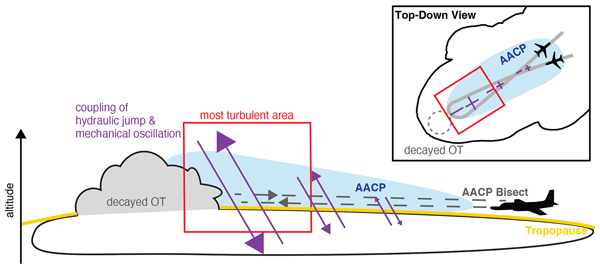
In situ airborne observations of ongoing tropopause-overshooting convection and an above-anvil cirrus plume from the 31 May 2022 flight of the Dynamics and Chemistry of the Summer Stratosphere (DCOTSS) field campaign are examined. Upper troposphere and lower stratosphere composition changes are evaluated along with possible contributing dynamical and physical processes. Measurements reveal multiple changes in air mass composition and stratospheric hydration throughout the flight.
Emily N. Tinney and Cameron R. Homeyer
Atmos. Chem. Phys., 23, 14375–14392, https://doi.org/10.5194/acp-23-14375-2023, https://doi.org/10.5194/acp-23-14375-2023, 2023
Short summary
Short summary
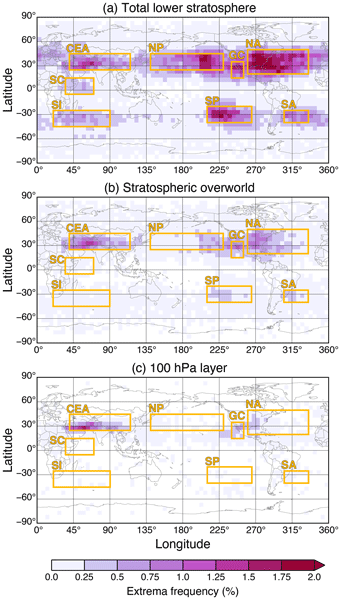
A long-term record of satellite observations is used to study extreme water vapor concentrations in the lower stratosphere, which are important to climate variability and change. We use a deeper layer of stratospheric observations than prior work to more comprehensively identify these events. We show that extreme water vapor concentrations are frequent, especially in the lowest layers of the stratosphere that have not been analyzed previously.
Cited articles
Añel, J. A., Antuña, J. C., de la Torre, L., Castanheira, J. M., and Gimeno, L.: Climatological features of global multiple tropopause events, J. Geophys. Res., 133, D00B08, https://doi.org/10.1029/2007JD009697, 2008. a, b
Ao, C. O. and Hajj, A. J.: Monitoring the width of the tropical belt with GPS radio occultation measurements, Geophys. Res. Lett., 40, 6236–6241, https://doi.org/10.1002/2013GL058203, 2013. a, b
Bell, S. W. and Geller, M. A.: Tropopause inversion layer: Seasonal and latitudinal variations and representation in standard radiosonde data and global models., J. Geophys. Res., 113, D05109, https://doi.org/10.1029/2007JD009022, 2008. a
Biondi, R., Randel, W. J., Ho, S.-P., Neubert, T., and Syndergaard, S.: Thermal structure of intense convective clouds derived from GPS radio occultations, Atmos. Chem. Phys., 12, 5309–5318, https://doi.org/10.5194/acp-12-5309-2012, 2012. a
Birner, T.: Fine-scale structure of the extratropical tropopause, J. Geophys. Res., 111, D04104, https://doi.org/10.1029/2005JD006301, 2006. a
Birner, T.: Recent widening of the tropical belt from global tropopause statistics: Sensitivites, J. Geophys. Res., 115, D23109, https://doi.org/10.1029/2010JD014664, 2010. a, b
Birner, T., Dörnbrack, A., and Schumann, U.: How sharp is the tropopause at midlatitudes?, Geophys. Res. Lett., 29, 1700, https://doi.org/10.1029/2002GL015142, 2002. a
Boljka, L. and Birner, T.: Potential impact of tropopause sharpness on the structure and strength of the general circulation, npj Climate and Atmospheric Science, 5, 98, https://doi.org/10.1038/s41612-022-00319-6, 2022. a, b, c
Brewer, A. W.: Evidence for a world circulation provided by the measurements of helium and water vapour distribution in the stratosphere, Q. J. Roy. Meteor. Soc., 75, 351–363, https://doi.org/10.1002/qj.49707532603, 1949. a
Castanheira, J. M. and Gimeno, L.: Association of double tropopause events with baroclinic waves, J. Geophys. Res., 116, D19113, https://doi.org/10.1029/2011JD016163, 2011. a
Castanheira, J. M., Añel, J. A., Marques, C. A. F., Antuña, J. C., Liberato, M. L. R., de la Torre, L., and Gimeno, L.: Increase of upper troposphere/lower stratosphere wave baroclinicity during the second half of the 20th century, Atmos. Chem. Phys., 9, 9143–9153, https://doi.org/10.5194/acp-9-9143-2009, 2009. a, b, c
Danielsen, E. F.: The laminar structure of the atmosphere and its relation to the concept of a tropopause, Arch. Meteor. Geophy. A, 11, 293–332, https://doi.org/10.1007/BF02247210, 1959. a
Danielsen, E. F.: Stratospheric-tropospheric exchange based on radioactivity, ozone and potential vorticity, J. Atmos. Sci., 25, 502–518, https://doi.org/10.1175/1520-0469(1968)025<0502:STEBOR>2.0.CO;2, 1968. a
Davis, N. and Birner, T.: On the Discrepancies in Tropical Belt Expansion between Reanalyses and Climate Models and among Tropical Belt Width Metrics, J. Climate, 30, 1211–1231, https://doi.org/10.1175/JCLI-D-16-0371.1, 2017. a
Davis, S. M. and Rosenlof, K. H.: A multidiagnostic intercomparison of tropical-width time series using reanalyses and satellite observations, J. Climate, 25, 1061–1078, https://doi.org/10.1175/JCLI-D-11-00127.1, 2012. a, b
Dobson, G. M. B.: Origin and distribution of the polyatomic molecules in the atmosphere, P. R. Soc. London, 236, 187–193, https://doi.org/10.1098/rspa.1956.0127, 1956. a
Ferreira, A. P., Castanheira, J. M., and Gimeno, L.: Water vapour stratification and dynamical warming behind the sharpness of the Earth's midlatitude tropopause, Q. J. Roy. Meteor. Soc., 142, 957–970, https://doi.org/10.1002/qj.2697, 2016. a
Forster, P. M. F. and Shine, K. P.: Stratospheric water vapour changes as a possible contributor to observed stratospheric cooling, Geophys. Res. Lett., 26, 3309–3312, https://doi.org/10.1029/1999GL010487, 1999. a
Fueglistaler, S., Dessler, A. E., Dunkerton, T. J., Folkins, I., Fu, Q., and Mote, P. W.: Tropical Tropopause Layer, Rev. Geophys., 47, RG1004, https://doi.org/10.1029/2008RG000267, 2009. a
Gettelman, A. and Wang, T.: Structural diagnostics of the tropopause inversion layer and its evolution, J. Geophys. Res.-Atmos., 120, 46–62, https://doi.org/10.1002/2014JD021846, 2015. a, b
Gettelman, A., Hoor, P., Pan, L. L., Randel, W. J., Hegglin, M. I., and Birner, T.: The extratropical upper troposphere and lower stratosphere, Rev. Geophys., 49, RG3003, https://doi.org/10.1029/2011RG000355, 2011. a, b, c
Hegglin, M. I., Boone, C. D., Manney, G. L., and Walker, K. A.: A global view of the extratropical tropopause transition layer from Atmospheric Chemistry Experiment Fourier Transform Spectrometer O-3, H2O, and CO, J. Geophys. Res., 114, D00B11, https://doi.org/10.1029/2008JD009984, 2009. a
Hoinka, K. P.: The tropopause: discovery, definition and demarcation, Meteorol. Z., 6, 281–303, https://doi.org/10.1127/metz/6/1997/281, 1997. a
Holton, J. R., Haynes, P. H., McIntyre, M. E., Douglass, A. R., and Pfister, L.: Stratosphere-troposphere exchange, Rev. Geophys., 33, 403–439, https://doi.org/10.1029/95RG02097, 1995. a, b
Homeyer, C. R. and Bowman, K. P.: Rossby Wave Breaking and Transport between the Tropics and Extratropics above the Subtropical Jet, J. Atmos. Sci., 70, 607–626, https://doi.org/10.1175/JAS-D-12-0198.1, 2013. a
Homeyer, C. R., Bowman, K. P., and Pan, L. L.: Extratropical tropopause transition layer characteristics from high-resolution sounding data, J. Geophys. Res., 115, D13108, https://doi.org/10.1029/2009JD013664, 2010. a, b
Leroy, S. S., McVey, A. E., Leidner, S. M., Zhang, H., and Gleisner, H.: GNSS Radio Occultation Data in the AWS Cloud, Earth Space Sci., 11, e2023EA003021, https://doi.org/10.1029/2023EA003021, 2024 (data available at: https://registry.opendata.aws/gnss-ro-opendata, last access: 25 April 2026). a, b
Liu, C. and Barnes, E.: Synoptic Formation of Double Tropopauses, J. Geophys. Res.-Atmos., 123, 693–707, https://doi.org/10.1002/2017JD027941, 2018. a
Lu, J., Deser, C., and Reichler, T.: Cause of the widening of the tropical belt since 1958, Geophys. Res. Lett., 36, L03803, https://doi.org/10.1029/2008GL036076, 2009. a
Martin, E. R., Homeyer, C. R., McKinzie, R. A., McCarthy, K. M., and Xian, T.: Regionally Varying Assessments of Upper-Level Tropical Width in Reanalyses and CMIP5 Models Using a Tropopause Break Metric, J. Climate, 33, 5885–5903, https://doi.org/10.1175/JCLI-D-19-0629.1, 2020. a, b, c
Meng, L., Liu, J., Tarasick, D. W., Randel, W. J., Steiner, A. K., Wilhelmsen, H., Wang, L., and Haimberger, L.: Continous rise of the tropopause in the Northern Hemisphere over 1980–2020, Sci. Adv., 7, eabi8065, https://doi.org/10.1126/sciadv.abi8065, 2021. a, b
Minschwaner, K., Su, H., and Jiang, J. H.: The upward ranch of the Brewer-Dobson circulation quantified by tropical stratospheric water vapor and carbon monoxide measurements from the Aura Microwave Limb Sounder, J. Geophys. Res.-Atmos., 121, 2790–2804, https://doi.org/10.1002/2015JD023961, 2016. a
Mote, P. W., Rosenlof, K. H., McIntyre, M. E., Carr, E. S., Gille, J. C., Holton, J. R., Kinnersley, J. S., Pumphrey, H. C., Russell, J. M., and Waters, J. W.: An atmospheric tape recorder: The imprint of tropical tropopause temperatures on stratospheric water vapor, J. Geophys. Res., 101, 3989–4006, https://doi.org/10.1029/95JD03422, 1996. a
Munchak, L. A. and Pan, L. L.: Separation of the lapse rate and the cold point tropopauses in the tropics and the resulting impact on cloud top-tropopause relationships, J. Geophys. Res.-Atmos., 119, 7963–7978, https://doi.org/10.1002/2013JD021189, 2014. a
Pan, L. L. and Munchak, L. A.: The relationship of cloud top to the tropopause and jet structure from CALIPSO data, J. Geophys. Res., 116, D12201, https://doi.org/10.1029/2010JD015462, 2011. a
Pan, L. L., Randel, W. J., Gary, B. L., Mahoney, M. J., and Hintsa, E. J.: Definitions and sharpness of the extratropical tropopause: A trace gas perspective, J. Geophys. Res., 109, D23103, https://doi.org/10.1029/2004JD004982, 2004. a
Pan, L. L., Randel, W. J., Gille, J. C., Hall, W. D., Nardi, B., Massie, S., Yudin, V., Khosravi, R., Konopka, P., and Tarasick, D.: Tropospheric intrusions associated with the secondary tropopause, J. Geophys. Res., 114, D10302, https://doi.org/10.1029/2008JD011374, 2009. a
Peevey, T. R., Gille, J. C., Randall, C. E., and Kunz, A.: Investigation of double tropopause spatial and temporal global variability utilizing High Resolution Dynamics Limb Sounder temperature observations, J. Geophys. Res., 117, D01105, https://doi.org/10.1029/2011JD016443, 2012. a
Peevey, T. R., Gille, J. C., Homeyer, C. R., and Manney, G. L.: The double tropopause and its dynamical relationship to the tropopause inversion layer in storm track regions, J. Geophys. Res.-Atmos., 119, 10194–10212, https://doi.org/10.1002/2014JD021808, 2014. a
Randel, W. and Park, M.: Diagnosing Observed Stratospheric Water Vapor Relationships to the Cold Point Tropical Tropopause, J. Geophys. Res.-Atmos., 124, https://doi.org/10.1029/2019JD030648, 2019. a, b, c
Randel, W. J., Wu, F., and Gaffen, D. J.: Interannual variability of the tropical tropopause derived from radiosonde data and NCEP reanalyses, J. Geophys. Res., 105, 15,509–15,523, https://doi.org/10.1029/2000JD900155, 2000. a
Randel, W. J., Seidel, D. J., and Pan, L. L.: Observational characterisitics of double tropopauses, J. Geophys. Res., 112, D07309, https://doi.org/10.1029/2006JD007904, 2007a. a, b
Randel, W. J., Wu, F., and Forster, P.: The extratropical tropopause inversion layer: Global observations with GPS data, and a radiative forcing mechanism, J. Atmos. Sci., 64, 4489–4496, https://doi.org/10.1175/2007JAS2412.1, 2007b. a, b
Randel, W. J., Park, M., Emmons, L., Kinnison, D., Bernath, P., Walker, K. A., Boone, C., and Pumphrey, H.: Asian monsoon transport of pollution to the stratosphere, Science, 328, 611–613, https://doi.org/10.1126/science.1182274, 2010. a
Reed, R. J.: A study of a characteristic type of upper-level frontogenesis, J. Meteorol., 12, 226–237, https://doi.org/10.1175/1520-0469(1955)012<0226:ASOACT>2.0.CO;2, 1955. a
Reid, G. C. and Gage, K. S.: Interannual Variations in the Height of the Tropical Tropopause, J. Geophys. Res., 90, 5629–5635, https://doi.org/10.1029/JD090iD03p05629, 1985. a
Santer, B. D., Sausen, R., Wigley, T. M. L., Boyle, J. S., AchutaRao, K., Doutriaux, C., Hansen, J. E., Meehl, G. A., Roeckner, E., Ruedy, R., Schmidt, G., and Taylor, K. E.: Behavior of tropopause height and atmopsheric temperature in models, reanalyses, and observations: Decadal changes, J. Geophys. Res., 108, 4002, https://doi.org/10.1029/2002JD002258, 2003. a
Schmidt, T., Heise, S., Wickert, J., Beyerle, G., and Reigber, C.: GPS radio occultation with CHAMP and SAC-C: global monitoring of thermal tropopause parameters, Atmos. Chem. Phys., 5, 1473–1488, https://doi.org/10.5194/acp-5-1473-2005, 2005. a, b, c
Schmidt, T., Beyerle, G., Heise, S., Wickert, J., and Rothacher, M.: A Climatology of multiple tropopauses derived from GPS radio occultations with CHAMP and SAC-C, Geophys. Res. Lett., 33, L04808, https://doi.org/10.1029/2005GL024600, 2006. a
Schmidt, T., Cammas, J.-P., Smit, H. G. J., Heise, S., Wickert, J., and Haser, A.: Observational characteristics of the tropopause inversion layer derived from CHAMP/GRACE radio occultations and MOZAIC aircraft data, J. Geophys. Res., 115, D24304, https://doi.org/10.1029/2010JD014284, 2010. a
Seidel, D. J. and Randel, W. J.: Variability and trends in the global tropopause estimated from radiosonde data, J. Geophys. Res., 111, D21101, https://doi.org/10.1029/2006JD007363, 2006. a, b
Seidel, D. J. and Randel, W. J.: Recent widening of the tropical belt: Evidence from tropopause observations, J. Geophys. Res., 112, D20113, https://doi.org/10.1029/2007JD008861, 2007. a
Shapiro, M. A., Hampel, T., and Krueger, A. J.: The Arctic Tropopause Fold, Mon. Weather Rev., 115, 444–454, https://doi.org/10.1175/1520-0493(1987)115<0444:TATF>2.0.CO;2, 1987. a
Shepherd, T. G.: Issues in Stratosphere-Troposphere Coupling, J. Meteorol. Soc. Jpn., 80, 769–792, https://doi.org/10.2151/jmsj.80.769, 2002. a, b
Solomon, S., Rosenlof, K. H., Portmann, R. W., Daniel, J. S., Davis, S. M., Sanford, T. J., and Plattner, G.-K.: Contributions of Stratospheric Water Vapor to Decadal Changes in the Rate of Global Warming, Science, 327, 1219–1223, https://doi.org/10.1126/science.1182488, 2010. a
Son, S.-W., Tandon, N. F., and Polvani, L. M.: The fine-scale structure of the global tropopause derived from COSMIC GPS radio occultation measurements, J. Geophys. Res., 116, D20113, https://doi.org/10.1029/2011JD016030, 2011. a, b, c
Sprenger, M., Maspoli, M. C., and Wernli, H.: Tropopause folds and cross-tropopause exchange: A global investigation based upon ECMWF analyses for the time period March 2000 to February 2001, J. Geophys. Res., 108, 8518, https://doi.org/10.1029/2002JD002587, 2003. a
Staten, P. W., Lu, J., Grise, K. M., Davis, S. M., and Birner, T.: Re-examining tropical expansion, Nat. Clim. Change, 8, 768–775, https://doi.org/10.1038/s41558-018-0246-2, 2018. a
Stohl, A., Wernli, H., James, P., Bourqui, M., Forster, C., Liniger, M. A., Seibert, P., and Sprenger, M.: A new perspective of stratosphere-troposphere exchange, B. Am. Meteor. Soc., 84, 1565–1573, https://doi.org/10.1175/BAMS-84-11-1565, 2003. a, b
Tilmes, S., Pan, L. L., Hoor, P., Atlas, E., Avery, M. A., Campos, T., Christensen, L. E., Diskin, G. S., Gao, R.-S., Herman, R. L., Hintsa, E. J., Loewenstein, M., Lopez, J., Paige, M. E., Pittman, J. V., Podolske, J. R., Proffitt, M. R., Sachse, G. W., Schiller, C., Schlager, H., Smith, J., Spelten, N., Webster, C., Weinheimer, A., and Zondlo, M. A.: An aircraft-based upper troposphere and lower stratosphere O3, CO, and H2O climatology for the Northern Hemisphere, J. Geophys. Res., 115, D14303, https://doi.org/10.1029/2009JD012731, 2010. a
Turhal, K., Plöger, F., Clemens, J., Birner, T., Weyland, F., Konopka, P., and Hoor, P.: Variability and trends in the potential vorticity (PV)-gradient dynamical tropopause, Atmos. Chem. Phys., 24, 13653–13679, https://doi.org/10.5194/acp-24-13653-2024, 2024. a, b, c
Wang, S. and Polvani, L. M.: Double tropopause formation in idealized baroclinic life cycles: The key role of an initial tropopause inversion layer, J. Geophys. Res., 116, D05108, https://doi.org/10.1029/2010JD015118, 2011. a
Wilhelmsen, H., Ladstädter, F., Schmidt, T., and Steiner, A. K.: Double Tropopauses and the Tropical Belt Connected to ENSO, Geophys. Res. Lett., 47, e2020GL089027, https://doi.org/10.1029/2020GL089027, 2020. a
Wolter, K. and Timlin, M. S.: El Niño/Southern Oscillation behaviour since 1871 as diagnosed in an extended multivariate ENSO index (MEI.ext), Int. J. Climatol., 31, 1074–1087, https://doi.org/10.1002/joc.2336, 2011. a
World Meteorological Organization: Meteorology – A three-dimensional science: Second session of the commission for aerology, World Meteorol. Organ. Bull., 4, 134–138, https://library.wmo.int/idurl/4/42003 (last access: 9 November 2026), 1957. a
Zängl, G. and Hoinka, K. P.: The Tropopause in the Polar Regions, J. Climate, 14, 3117–3139, https://doi.org/10.1175/1520-0442(2001)014<3117:TTITPR>2.0.CO;2, 2001. a
Zou, L., Hoffmann, L., Müller, R., and Spang, R.: Variability and trends of the tropical tropopause derived from a 1980–2021 multi-reanalysis assessment, Front. Earth Sci., 11, https://doi.org/10.3389/feart.2023.1177502, 2023. a, b, c
Short summary
This study examines changes in the characteristics of the transition layer between the lowest layer of Earth's atmosphere, the troposphere, and the layer immediately above – the stratosphere, known as the "tropopause". During the most recent 23-year period, we find that tropopause altitude, temperature, sharpness, and multiplicity are increasing over time in most locations, though the magnitude and significance varies globally and between characteristics.
This study examines changes in the characteristics of the transition layer between the lowest...
Altmetrics
Final-revised paper
Preprint