Articles | Volume 26, issue 21
https://doi.org/10.5194/acp-26-15633-2026
© Author(s) 2026. This work is distributed under
the Creative Commons Attribution 4.0 License.
Special issue:
https://doi.org/10.5194/acp-26-15633-2026
© Author(s) 2026. This work is distributed under
the Creative Commons Attribution 4.0 License.
EarthCARE Observations of Vertical Motion and Cloud Microphysical Structure in Tropical Cyclones

Atmosphere and Ocean Research Institute, The University of Tokyo, Chiba, 277-8564, Japan
Woosub Roh
Atmosphere and Ocean Research Institute, The University of Tokyo, Chiba, 277-8564, Japan
Tomoki Miyakawa
Atmosphere and Ocean Research Institute, The University of Tokyo, Chiba, 277-8564, Japan
Masaki Satoh
Atmosphere and Ocean Research Institute, The University of Tokyo, Chiba, 277-8564, Japan
Typhoon Science and Technology Research Center, Institute for Multidisciplinary Sciences, Yokohama National University, Yokohama, 240-8501, Japan
Related authors
No articles found.
Woosub Roh, Masaki Satoh, Romain Fiévet, Mark D. Fielding, Robin J. Hogan, Bjorn Stevens, Takuji Kubota, and Hajime Okamoto
EGUsphere, https://doi.org/10.5194/egusphere-2026-3606, https://doi.org/10.5194/egusphere-2026-3606, 2026
This preprint is open for discussion and under review for Geoscientific Model Development (GMD).
Short summary
Short summary
Clouds and rainfall are still difficult to represent accurately in weather and climate models. We introduce a new project called the EarthCARE–ORCESTRA Model Intercomparison Project (ECOMIP), which uses observations from the new Earth Cloud, Aerosol and Radiation Explorer (EarthCARE) satellite and a tropical field campaign to compare and improve atmospheric models. Initial results show that different models can reproduce the same storm system but differ in its size and structure.
John P. Dunne, Helene T. Hewitt, Julie M. Arblaster, Frédéric Bonou, Olivier Boucher, Tereza Cavazos, Beth Dingley, Paul J. Durack, Birgit Hassler, Martin Juckes, Tomoki Miyakawa, Matt Mizielinski, Vaishali Naik, Zebedee Nicholls, Eleanor O'Rourke, Robert Pincus, Benjamin M. Sanderson, Isla R. Simpson, and Karl E. Taylor
Geosci. Model Dev., 18, 6671–6700, https://doi.org/10.5194/gmd-18-6671-2025, https://doi.org/10.5194/gmd-18-6671-2025, 2025
Short summary
Short summary
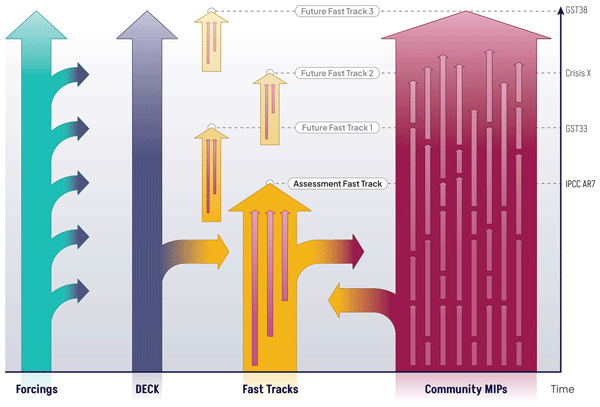
The seventh phase of the Coupled Model Intercomparison Project (CMIP7) coordinates efforts to answer key and timely climate science questions and facilitate delivery of relevant multi-model simulations for prediction and projection; characterization, attribution, and process understanding; and vulnerability, impact, and adaptation analysis. Key to the CMIP7 design are the mandatory Diagnostic, Evaluation and Characterization of Klima and optional Assessment Fast Track experiments.
Kaori Sato, Hajime Okamoto, Tomoaki Nishizawa, Yoshitaka Jin, Takashi Y. Nakajima, Minrui Wang, Masaki Satoh, Woosub Roh, Hiroshi Ishimoto, and Rei Kudo
Atmos. Meas. Tech., 18, 1325–1338, https://doi.org/10.5194/amt-18-1325-2025, https://doi.org/10.5194/amt-18-1325-2025, 2025
Short summary
Short summary
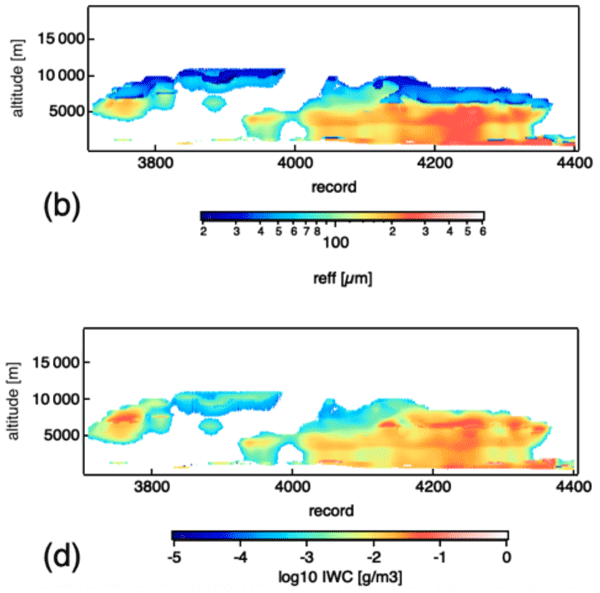
This study introduces the JAXA EarthCARE Level 2 (L2) cloud product using satellite observations and simulated EarthCARE data. The outputs from the product feature a 3D global view of the dominant ice habit categories and corresponding microphysics. Habit and size distribution transitions from cloud to precipitation are quantified by the L2 cloud algorithms. With Doppler data, the products can be beneficial for further understanding of the coupling of cloud microphysics, radiation, and dynamics.
Hajime Okamoto, Kaori Sato, Tomoaki Nishizawa, Yoshitaka Jin, Shota Ogawa, Hiroshi Ishimoto, Yuichiro Hagihara, EIji Oikawa, Maki Kikuchi, Masaki Satoh, and Wooosub Roh
Atmos. Meas. Tech. Discuss., https://doi.org/10.5194/amt-2024-103, https://doi.org/10.5194/amt-2024-103, 2024
Publication in AMT not foreseen
Short summary
Short summary
The article gives the descriptions of the Japan Aerospace Exploration Agency (JAXA) level 2 (L2) cloud mask and cloud particle type algorithms for CPR and ATLID onboard Earth Clouds, Aerosols and Radiation Explorer (EarthCARE) satellite. The 355nm-multiple scattering polarization lidar was used to develop ATLID algorithm. Evaluations show the agreements for CPR-only, ATLID-only and CPR-ATLID synergy algorithms to be about 80%, 85% and 80%, respectively on average for about two EarthCARE orbits.
Hajime Okamoto, Kaori Sato, Tomoaki Nishizawa, Yoshitaka Jin, Takashi Nakajima, Minrui Wang, Masaki Satoh, Kentaroh Suzuki, Woosub Roh, Akira Yamauchi, Hiroaki Horie, Yuichi Ohno, Yuichiro Hagihara, Hiroshi Ishimoto, Rei Kudo, Takuji Kubota, and Toshiyuki Tanaka
Atmos. Meas. Tech. Discuss., https://doi.org/10.5194/amt-2024-101, https://doi.org/10.5194/amt-2024-101, 2024
Publication in AMT not foreseen
Short summary
Short summary
This article gives overviews of the JAXA L2 algorithms and products by Japanese science teams for EarthCARE. The algorithms provide corrected Doppler velocity, cloud particle shape and orientations, microphysics of clouds and aerosols, and radiative fluxes and heating rate. The retrievals by the algorithms are demonstrated and evaluated using NICAM/J-simulator outputs. The JAXA EarthCARE L2 products will bring new scientific knowledge about the clouds, aerosols, radiation and convections.
Woosub Roh, Masaki Satoh, Yuichiro Hagihara, Hiroaki Horie, Yuichi Ohno, and Takuji Kubota
Atmos. Meas. Tech., 17, 3455–3466, https://doi.org/10.5194/amt-17-3455-2024, https://doi.org/10.5194/amt-17-3455-2024, 2024
Short summary
Short summary
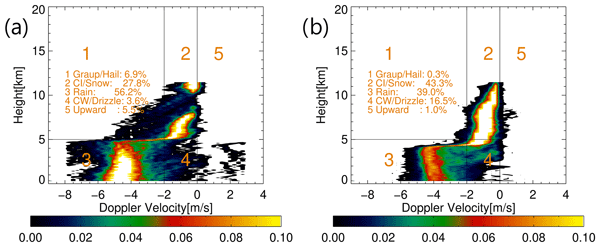
The advantage of the use of Doppler velocity in the categorization of the hydrometeors is that Doppler velocities suffer less impact from the attenuation of rain and wet attenuation on an antenna. The ground Cloud Profiling Radar observation of the radar reflectivity for the precipitation case is limited because of wet attenuation on an antenna. We found the main contribution to Doppler velocities is the terminal velocity of hydrometeors by analysis of simulation results.
Bjorn Stevens, Stefan Adami, Tariq Ali, Hartwig Anzt, Zafer Aslan, Sabine Attinger, Jaana Bäck, Johanna Baehr, Peter Bauer, Natacha Bernier, Bob Bishop, Hendryk Bockelmann, Sandrine Bony, Guy Brasseur, David N. Bresch, Sean Breyer, Gilbert Brunet, Pier Luigi Buttigieg, Junji Cao, Christelle Castet, Yafang Cheng, Ayantika Dey Choudhury, Deborah Coen, Susanne Crewell, Atish Dabholkar, Qing Dai, Francisco Doblas-Reyes, Dale Durran, Ayoub El Gaidi, Charlie Ewen, Eleftheria Exarchou, Veronika Eyring, Florencia Falkinhoff, David Farrell, Piers M. Forster, Ariane Frassoni, Claudia Frauen, Oliver Fuhrer, Shahzad Gani, Edwin Gerber, Debra Goldfarb, Jens Grieger, Nicolas Gruber, Wilco Hazeleger, Rolf Herken, Chris Hewitt, Torsten Hoefler, Huang-Hsiung Hsu, Daniela Jacob, Alexandra Jahn, Christian Jakob, Thomas Jung, Christopher Kadow, In-Sik Kang, Sarah Kang, Karthik Kashinath, Katharina Kleinen-von Königslöw, Daniel Klocke, Uta Kloenne, Milan Klöwer, Chihiro Kodama, Stefan Kollet, Tobias Kölling, Jenni Kontkanen, Steve Kopp, Michal Koran, Markku Kulmala, Hanna Lappalainen, Fakhria Latifi, Bryan Lawrence, June Yi Lee, Quentin Lejeun, Christian Lessig, Chao Li, Thomas Lippert, Jürg Luterbacher, Pekka Manninen, Jochem Marotzke, Satoshi Matsouoka, Charlotte Merchant, Peter Messmer, Gero Michel, Kristel Michielsen, Tomoki Miyakawa, Jens Müller, Ramsha Munir, Sandeep Narayanasetti, Ousmane Ndiaye, Carlos Nobre, Achim Oberg, Riko Oki, Tuba Özkan-Haller, Tim Palmer, Stan Posey, Andreas Prein, Odessa Primus, Mike Pritchard, Julie Pullen, Dian Putrasahan, Johannes Quaas, Krishnan Raghavan, Venkatachalam Ramaswamy, Markus Rapp, Florian Rauser, Markus Reichstein, Aromar Revi, Sonakshi Saluja, Masaki Satoh, Vera Schemann, Sebastian Schemm, Christina Schnadt Poberaj, Thomas Schulthess, Cath Senior, Jagadish Shukla, Manmeet Singh, Julia Slingo, Adam Sobel, Silvina Solman, Jenna Spitzer, Philip Stier, Thomas Stocker, Sarah Strock, Hang Su, Petteri Taalas, John Taylor, Susann Tegtmeier, Georg Teutsch, Adrian Tompkins, Uwe Ulbrich, Pier-Luigi Vidale, Chien-Ming Wu, Hao Xu, Najibullah Zaki, Laure Zanna, Tianjun Zhou, and Florian Ziemen
Earth Syst. Sci. Data, 16, 2113–2122, https://doi.org/10.5194/essd-16-2113-2024, https://doi.org/10.5194/essd-16-2113-2024, 2024
Short summary
Short summary
To manage Earth in the Anthropocene, new tools, new institutions, and new forms of international cooperation will be required. Earth Virtualization Engines is proposed as an international federation of centers of excellence to empower all people to respond to the immense and urgent challenges posed by climate change.
Woosub Roh, Masaki Satoh, Tempei Hashino, Shuhei Matsugishi, Tomoe Nasuno, and Takuji Kubota
Atmos. Meas. Tech., 16, 3331–3344, https://doi.org/10.5194/amt-16-3331-2023, https://doi.org/10.5194/amt-16-3331-2023, 2023
Short summary
Short summary
JAXA EarthCARE synthetic data (JAXA L1 data) were compiled using the global storm-resolving model (GSRM) NICAM (Nonhydrostatic ICosahedral
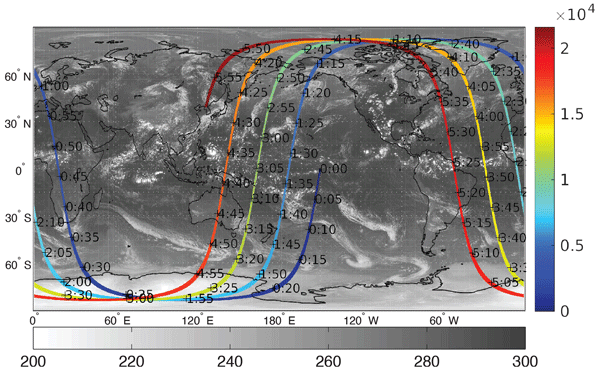
Atmospheric Model) simulation with 3.5 km horizontal resolution and the Joint-Simulator. JAXA L1 data are intended to support the development of JAXA retrieval algorithms for the EarthCARE sensor before launch of the satellite. The expected orbit of EarthCARE and horizontal sampling of each sensor were used to simulate the signals.
Yuichiro Hagihara, Yuichi Ohno, Hiroaki Horie, Woosub Roh, Masaki Satoh, and Takuji Kubota
Atmos. Meas. Tech., 16, 3211–3219, https://doi.org/10.5194/amt-16-3211-2023, https://doi.org/10.5194/amt-16-3211-2023, 2023
Short summary
Short summary
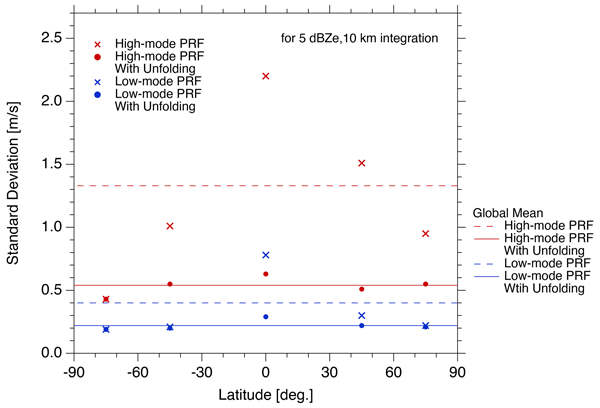
The CPR on the EarthCARE satellite is the first satellite-borne Doppler radar. We evaluated the effectiveness of horizontal integration and the unfolding method for the reduction of the Doppler error (the standard deviation of the random error) in the CPR_ECO product. The error was higher in the tropics than in the other latitudes due to frequent rain echo occurrence and limitation of its unfolding correction. If we use low-mode operation (high PRF), the errors become small enough.
Minrui Wang, Takashi Y. Nakajima, Woosub Roh, Masaki Satoh, Kentaroh Suzuki, Takuji Kubota, and Mayumi Yoshida
Atmos. Meas. Tech., 16, 603–623, https://doi.org/10.5194/amt-16-603-2023, https://doi.org/10.5194/amt-16-603-2023, 2023
Short summary
Short summary
SMILE (a spectral misalignment in which a shift in the center wavelength appears as a distortion in the spectral image) was detected during our recent work. To evaluate how it affects the cloud retrieval products, we did a simulation of EarthCARE-MSI forward radiation, evaluating the error in simulated scenes from a global cloud system-resolving model and a satellite simulator. Our results indicated that the error from SMILE was generally small and negligible for oceanic scenes.
Cited articles
Aoki, S., Kubota, T., and Turk, F. J.: Exploring vertical motions in convective and stratiform precipitation using spaceborne radar observations: insights from EarthCARE and GPM coincidence dataset, Atmos. Meas. Tech., 19, 79–100, https://doi.org/10.5194/amt-19-79-2026, 2026.
Baker, A. J., Vannière, B., and Vidale, P. L.: On the realism of tropical cyclone intensification in global storm-resolving climate models, Geophys. Res. Lett., 51, e2024GL109841, https://doi.org/10.1029/2024GL109841, 2024.
Barron, N. R., Didlake, A. C., and Reasor, P. D.: Statistical analysis of convective updrafts in tropical cyclone rainbands observed by airborne Doppler radar, J. Geophys. Res.-Atmos., 127, e2021JD035718, https://doi.org/10.1029/2021JD035718, 2022.
Black, M. L., Burpee, R. W., and Marks, F. D.: Vertical motion characteristics of tropical cyclones determined with airborne Doppler radial velocities, J. Atmos. Sci., 53, 1887–1909, https://doi.org/10.1175/1520-0469(1996)053<1887:VMCOTC>2.0.CO;2, 1996.
Black, R. A. and Hallett, J.: Observations of the distribution of ice in hurricanes, J. Atmos. Sci., 43, 802–822, https://doi.org/10.1175/1520-0469(1986)043<0802:OOTDOI>2.0.CO;2, 1986.
Black, R. A. and Hallett, J.: Electrification of the hurricane, J. Atmos. Sci., 56, 2004–2028, https://doi.org/10.1175/1520-0469(1999)056<2004:EOTH>2.0.CO;2, 1999.
Black, R. A., Heymsfield, G. M., and Hallett, J.: Extra large particle images at 12 km in a hurricane eyewall: Evidence of high-altitude supercooled water?, Geophys. Res. Lett., 30, https://doi.org/10.1029/2003GL017864, 2003.
Dvorak, V. F.: Tropical cyclone intensity analysis and forecasting from satellite imagery, Mon. Weather Rev., 103, 420–430, https://doi.org/10.1175/1520-0493(1975)103<0420:TCIAAF>2.0.CO;2, 1975.
Dvorak, V. F.: Tropical cyclone intensity analysis using satellite data, NOAA, https://repository.library.noaa.gov/view/noaa/19322 (last access: 24 April 2026), 1984.
Gahtan, J., Knapp, K. R., Schreck III, C. J., Diamond, H. J., Kossin, J. P., and Kruk, M. C.: International Best Track Archive for Climate Stewardship (IBTrACS) Project, Version 4r01, last 3 years, NOAA National Centers for Environmental Information [data set], https://doi.org/10.25921/82ty-9e16, 2024.
Hashino, T., Satoh, M., Hagihara, Y., Kubota, T., Matsui, T., Nasuno, T., and Okamoto, H.: Evaluating cloud microphysics from NICAM against CloudSat and CALIPSO, J. Geophys. Res., 118, 7273–7292, https://doi.org/10.1002/jgrd.50564, 2013.
Hence, D. A. and Houze Jr., R. A.: Kinematic structure of convective-scale elements in the rainbands of Hurricanes Katrina and Rita (2005), J. Geophys. Res.-Atmos., 113, D15108, https://doi.org/10.1029/2007JD009429, 2008.
Huang, J.-D.: EarthCARE-TC, figshare [data set], https://doi.org/10.6084/m9.figshare.32142271.v3, 2026.
Huffman, G. J., Bolvin, D. T., Braithwaite, D., Hsu, K. L., Joyce, R. J., Kidd, C., and Xie, P.: Integrated multi-satellite retrievals for the Global Precipitation Measurement (GPM) mission (IMERG), in: Satellite Precipitation Measurement, Springer, Cham, 343–353, https://doi.org/10.1007/978-3-030-24568-9_19, 2020.
Illingworth, A. J., Barker, H. W., Beljaars, A., Ceccaldi, M., Chepfer, H., Clerbaux, N., and Van Zadelhoff, G. J.: The EarthCARE satellite: The next step forward in global measurements of clouds, aerosols, precipitation, and radiation, B. Am. Meteorol. Soc., 96, 1311–1332, https://doi.org/10.1175/BAMS-D-12-00227.1, 2015.
JAXA (Japan Aerospace Exploration Agency): EarthCARE/CPR L2A CPR one-sensor Cloud Products, JAXA [data set], https://doi.org/10.57746/EO.01jdvd2gqq34e6yz9p8kfe68x5, 2024a.
JAXA (Japan Aerospace Exploration Agency): EarthCARE L2B CPR-ATLID Synergy Cloud Products, JAXA [data set], https://doi.org/10.57746/EO.01jkwjeg2y0bqndnsvjvaaskaw, 2024b.
Judt, F., Klocke, D., Rios-Berrios, R., Vannière, B., Ziemen, F., Auger, L., and Zhou, L.: Tropical cyclones in global storm-resolving models, J. Meteorol. Soc. Jpn., 99, 579–602, https://doi.org/10.2151/jmsj.2021-029, 2021.
Knapp, K. R., Kruk, M. C., Levinson, D. H., Diamond, H. J., and Neumann, C. J.: The International Best Track Archive for Climate Stewardship (IBTrACS): Unifying tropical cyclone data, B. Am. Meteorol. Soc., 91, 363–376, https://doi.org/10.1175/2009BAMS2755.1, 2010.
Kodama, C., Ohno, T., Seiki, T., Yashiro, H., Noda, A. T., Nakano, M., Yamada, Y., Roh, W., Satoh, M., Nitta, T., Goto, D., Miura, H., Nasuno, T., Miyakawa, T., Chen, Y.-W., and Sugi, M.: The Nonhydrostatic ICosahedral Atmospheric Model for CMIP6 HighResMIP simulations (NICAM16-S): experimental design, model description, and impacts of model updates, Geosci. Model Dev., 14, 795–820, https://doi.org/10.5194/gmd-14-795-2021, 2021.
Lee, T. Y. and Wing, A. A.: Satellite-based estimation of the role of cloud–radiative interaction in accelerating tropical cyclone development, J. Atmos. Sci., 81, 959–982, https://doi.org/10.1175/JAS-D-23-0142.1, 2024.
Luo, Z., Stephens, G. L., Emanuel, K. A., Vane, D. G., Tourville, N. D., and Haynes, J. M.: On the use of CloudSat and MODIS data for estimating hurricane intensity, IEEE Geosci. Remote S., 5, 13–16, https://doi.org/10.1109/LGRS.2007.905341, 2008.
Nakanishi, M. and Niino, H.: An improved Mellor–Yamada level-3 model: Its numerical stability and application to a regional prediction of advection fog, Bound.-Layer Meteorol., 119, 397–407, https://doi.org/10.1007/s10546-005-9030-8, 2006.
Noda, A. T., Oouchi, K., Satoh, M., Tomita, H., Iga, S.-I., and Tsushima, Y.: Importance of the subgrid-scale turbulent moist process: Cloud distribution in global cloud-resolving simulations, Atmos. Res., 96, 208–217, https://doi.org/10.1016/j.atmosres.2009.05.007, 2010.
Okamoto, H., Sato, K., Nishizawa, T., Jin, Y., Nakajima, T., Wang, M., Satoh, M., Suzuki, K., Roh, W., Yamauchi, A., Horie, H., Ohno, Y., Hagihara, Y., Ishimoto, H., Kudo, R., Kubota, T., and Tanaka, T.: JAXA Level2 algorithms for EarthCARE mission from single to four sensors: new perspective of cloud, aerosol, radiation and dynamics, Atmos. Meas. Tech. Discuss. [preprint], https://doi.org/10.5194/amt-2024-101, 2024.
Reynolds, R. W., Rayner, N. A., Smith, T. M., Stokes, D. C., and Wang, W.: An improved in situ and satellite SST analysis for climate, J. Climate, 15, 1609–1625, https://doi.org/10.1175/1520-0442(2002)015<1609:AIISAS>2.0.CO;2, 2002.
Roh, W. and Satoh, M.: Evaluation of precipitating hydrometeor parameterizations in a single-moment bulk microphysics scheme for deep convective systems, J. Atmos. Sci., 71, 2654–2673, https://doi.org/10.1175/JAS-D-13-0252.1, 2014.
Roh, W., Satoh, M., Hashino, T., Okamoto, H., and Seiki, T.: Evaluations of the thermodynamic phases of clouds in a cloud-system-resolving model using CALIPSO, J. Atmos. Sci., 77, 3781–3801, https://doi.org/10.1175/JAS-D-19-0273.1, 2020.
Roh, W., Satoh, M., Matsugishi, S., Aoki, S., Kubota, T., and Okamoto, H.: Vertical motions in clouds from EarthCARE satellite and a global storm-resolving modeling, Sci. Rep., 16, 2622, https://doi.org/10.1038/s41598-025-32256-8, 2026.
Sato, K., Okamoto, H., Yamamoto, M. K., Fukao, S., Kumagai, H., Ohno, Y., and Abo, M.: 95-GHz Doppler radar and lidar synergy for simultaneous ice microphysics and in-cloud vertical air motion retrieval, J. Geophys. Res., 114, D03203, https://doi.org/10.1029/2008JD010222, 2009.
Sato, K., Okamoto, H., Nishizawa, T., Jin, Y., Nakajima, T. Y., Wang, M., Satoh, M., Roh, W., Ishimoto, H., and Kudo, R.: JAXA Level 2 cloud and precipitation microphysics retrievals based on EarthCARE radar, lidar, and imager: the CPR_CLP, AC_CLP, and ACM_CLP products, Atmos. Meas. Tech., 18, 1325–1338, https://doi.org/10.5194/amt-18-1325-2025, 2025.
Satoh, M., Matsuno, T., Tomita, H., Miura, H., Nasuno, T., and Iga, S.: Nonhydrostatic icosahedral atmospheric model (NICAM) for global cloud resolving simulations, J. Comput. Phys., 227, 3486–3514, https://doi.org/10.1016/j.jcp.2007.02.006, 2008.
Satoh, M., Tomita, H., Yashiro, H., Miura, H., Kodama, C., Seiki, T., and Kubokawa, H.: The non-hydrostatic icosahedral atmospheric model: Description and development, Prog. Earth Planet. Sci., 1, 18, https://doi.org/10.1186/s40645-014-0018-1, 2014.
Satoh, M., Stevens, B., Judt, F., Khairoutdinov, M., Lin, S. J., Putman, W. M., and Düben, P.: Global cloud-resolving models, Curr. Clim. Change Rep., 5, 172–184, https://doi.org/10.1007/s40641-019-00131-0, 2019.
Seiki, T. and Nakajima, T.: Aerosol effects of the condensation process on a convective cloud simulation, J. Atmos. Sci., 71, 833–853, https://doi.org/10.1175/JAS-D-12-0195.1, 2014.
Sekiguchi, M. and Nakajima, T.: A k-distribution-based radiation code and its computational optimization for an atmospheric general circulation model, J. Quant. Spectrosc. Ra., 109, 2779–2793, https://doi.org/10.1016/j.jqsrt.2008.07.013, 2008.
Stevens, B., Satoh, M., Auger, L., Biercamp, J., Bretherton, C. S., Chen, X., and Zhou, L.: DYAMOND: The dynamics of the atmospheric general circulation modeled on non-hydrostatic domains, Prog. Earth Planet. Sci., 6, 61, https://doi.org/10.1186/s40645-019-0304-z, 2019.
Stevens, B., Acquistapace, C., Hansen, A., Heinze, R., Klinger, C., Klocke, D., and Zängl, G.: The added value of large-eddy and storm-resolving models for simulating clouds and precipitation, J. Meteorol. Soc. Jpn., 98, 395–435, https://doi.org/10.2151/jmsj.2020-021, 2020.
Takasuka, D., Kodama, C., Suematsu, T., Ohno, T., Yamada, Y., Seiki, T., and Masunaga, R.: How can we improve the seamless representation of climatological statistics and weather?, J. Adv. Model. Earth Sy., 16, e2023MS003701, https://doi.org/10.1029/2023MS003701, 2024.
Takata, K., Emori, S., and Watanabe, T.: Development of the minimal advanced treatments of surface interaction and runoff, Glob. Planet. Change, 38, 209–222, https://doi.org/10.1016/S0921-8181(03)00030-4, 2003.
Tomita, H.: New microphysical schemes with five and six categories by diagnostic generation of cloud ice, J. Meteorol. Soc. Jpn., 86, 121–142, https://doi.org/10.2151/jmsj.86A.121, 2008.
Tomita, H. and Satoh, M.: A new dynamical framework of nonhydrostatic global model using the icosahedral grid, Fluid Dyn. Res., 34, 357–400, https://doi.org/10.1016/j.fluiddyn.2004.03.003, 2004.
Tourville, N., Stephens, G., DeMaria, M., and Vane, D.: Remote sensing of tropical cyclones: Observations from CloudSat and A-Train profilers, B. Am. Meteorol. Soc., 96, 609–622, https://doi.org/10.1175/BAMS-D-13-00282.1, 2015.
Wehr, T., Kubota, T., Tzeremes, G., Wallace, K., Nakatsuka, H., Ohno, Y., Koopman, R., Rusli, S., Kikuchi, M., Eisinger, M., Tanaka, T., Taga, M., Deghaye, P., Tomita, E., and Bernaerts, D.: The EarthCARE mission – science and system overview, Atmos. Meas. Tech., 16, 3581–3608, https://doi.org/10.5194/amt-16-3581-2023, 2023.
Willoughby, H. E., Jorgensen, D. P., Black, R. A., and Rosenthal, S. L.: Project STORMFURY: A scientific chronicle 1962–1983, B. Am. Meteorol. Soc., 66, 505–514, https://doi.org/10.1175/1520-0477(1985)066<0505:PSASC>2.0.CO;2, 1985.
Wingo, S. M. and Knupp, K. R.: Kinematic structure of mesovortices in the eyewall of Hurricane Ike (2008) derived from ground-based dual-Doppler analysis, Mon. Weather Rev., 144, 4245–4263, https://doi.org/10.1175/MWR-D-16-0085.1, 2016.
Wu, S. N. and Soden, B. J.: Signatures of tropical cyclone intensification in satellite measurements of ice and liquid water content, Mon. Weather Rev., 145, 4081–4091, https://doi.org/10.1175/MWR-D-17-0046.1, 2017.
Wu, S. N., Soden, B. J., and Alaka, G. J.: Ice water content as a precursor to tropical cyclone rapid intensification, Geophys. Res. Lett., 47, e2020GL089669, https://doi.org/10.1029/2020GL089669, 2020.
Short summary
EarthCARE is equipped with a new spaceborne Doppler radar that can observe cloud vertical motions. Using 16 months of observations, we found clear differences between storm regions in upward air motion, cloud particles, and how fast particles fall. A single-case model comparison also showed that cloud-process settings can affect simulated storm structure. These results show how EarthCARE can help improve the representation of tropical cyclones in weather and climate models.
EarthCARE is equipped with a new spaceborne Doppler radar that can observe cloud vertical...
Altmetrics
Final-revised paper
Preprint