
Articles | Volume 26, issue 21
https://doi.org/10.5194/acp-26-15583-2026
© Author(s) 2026. This work is distributed under
the Creative Commons Attribution 4.0 License.
the Creative Commons Attribution 4.0 License.
https://doi.org/10.5194/acp-26-15583-2026
© Author(s) 2026. This work is distributed under
the Creative Commons Attribution 4.0 License.
the Creative Commons Attribution 4.0 License.
Research article
| 
05 Nov 2026
Research article |
| 05 Nov 2026
| 05 Nov 2026
Uncovering the seasonal trends of VOC production from ozonolysis of seawater
Frances E. Hopkins
CORRESPONDING AUTHOR

Plymouth Marine Laboratory, Plymouth, PL1 3DH, UK
Daniel P. Phillips
Plymouth Marine Laboratory, Plymouth, PL1 3DH, UK
Centre for Ocean and Atmospheric Sciences, School of Environmental Sciences, University of East Anglia, Norwich, NR4 7TJ, UK
National Oceanography Centre, European Way, Southampton, SO14 3ZH, UK
Yinghao Chen
Nuclear and Radiation Safety Center, Ministry of Ecology and Environment, Beijing 102445, PR China
Peter S. Liss
Centre for Ocean and Atmospheric Sciences, School of Environmental Sciences, University of East Anglia, Norwich, NR4 7TJ, UK
Mingxi Yang
Plymouth Marine Laboratory, Plymouth, PL1 3DH, UK
Related authors
Mingxi Yang, Thomas G. Bell, Ian Brooks, Frances Hopkins, Jani Pewter, Katie Read, and Timothy J. Smyth
Atmos. Chem. Phys., 26, 10909–10926, https://doi.org/10.5194/acp-26-10909-2026, https://doi.org/10.5194/acp-26-10909-2026, 2026
Short summary
Short summary
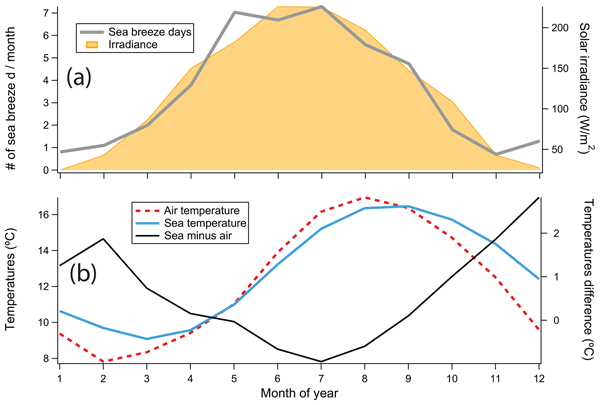
Diurnal sea breeze events can have a strong but uncertain impact on coastal air quality. In this study, using 10 years of observations we show that sea breeze occurs mostly when the sea is cool, wind speeds low, and solar irradiance strong. Surface of gas and particulate pollutants are all higher during sea breeze events than on other days, increasing the rate of air quality regulation exceedance. This may be of concern for beach goers and for people who spend more time outdoors.

Loren G. Temple, Stuart Young, Thomas Bannan, Stephanie E. Batten, Stéphane Bauguitte, Hugh Coe, Eve Grant, Stuart E. Lacy, James D. Lee, Emily Matthews, Dominika Pasternak, Samuel D. A. Rogers, Andrew W. Rollins, Jake Vallow, Mingxi Yang, and Pete M. Edwards
Atmos. Meas. Tech., 19, 1165–1178, https://doi.org/10.5194/amt-19-1165-2026, https://doi.org/10.5194/amt-19-1165-2026, 2026
Short summary
Short summary
Sulfur dioxide (SO2) is a key precursor to aerosol formation, particularly in remote marine environments, ultimately affecting cloud properties and climate. Accurate quantification of atmospheric SO2 is therefore crucial. This work compares a custom-built laser-based instrument to two commercial SO2 analysers during measurements from a large research aircraft. Our results show that this custom-built system offers greater sensitivity at time resolutions required for aircraft measurements.
Alex T. Archibald, Bablu Sinha, Maria R. Russo, Emily Matthews, Freya A. Squires, N. Luke Abraham, Stephane J.-B. Bauguitte, Thomas J. Bannan, Thomas G. Bell, David Berry, Lucy J. Carpenter, Hugh Coe, Andrew Coward, Peter Edwards, Daniel Feltham, Dwayne Heard, Jim Hopkins, James Keeble, Elizabeth C. Kent, Brian A. King, Isobel R. Lawrence, James Lee, Claire R. Macintosh, Alex Megann, Bengamin I. Moat, Katie Read, Chris Reed, Malcolm J. Roberts, Reinhard Schiemann, David Schroeder, Timothy J. Smyth, Loren Temple, Navaneeth Thamban, Lisa Whalley, Simon Williams, Huihui Wu, and Mingxi Yang
Earth Syst. Sci. Data, 17, 135–164, https://doi.org/10.5194/essd-17-135-2025, https://doi.org/10.5194/essd-17-135-2025, 2025
Short summary
Short summary
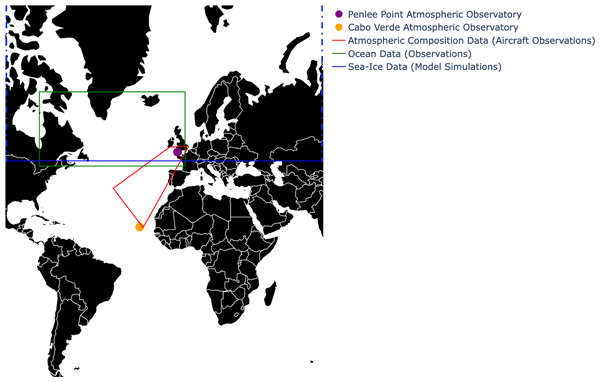
Here, we present an overview of the data generated as part of the North Atlantic Climate System Integrated Study (ACSIS) programme that are available through dedicated repositories at the Centre for Environmental Data Analysis (CEDA; www.ceda.ac.uk) and the British Oceanographic Data Centre (BODC; bodc.ac.uk). The datasets described here cover the North Atlantic Ocean, the atmosphere above (it including its composition), and Arctic sea ice.
Sankirna D. Joge, Anoop S. Mahajan, Shrivardhan Hulswar, Christa A. Marandino, Martí Galí, Thomas G. Bell, Mingxi Yang, and Rafel Simó
Biogeosciences, 21, 4453–4467, https://doi.org/10.5194/bg-21-4453-2024, https://doi.org/10.5194/bg-21-4453-2024, 2024
Short summary
Short summary
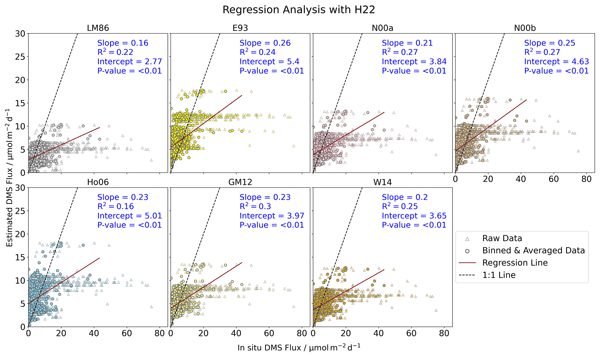
Dimethyl sulfide (DMS) is the largest natural source of sulfur in the atmosphere and leads to the formation of cloud condensation nuclei. DMS emissions and quantification of their impacts have large uncertainties, but a detailed study on the range of emissions and drivers of their uncertainty is missing to date. The emissions are calculated from the seawater DMS concentrations and a flux parameterization. Here we quantify the differences in the effect of flux parameterizations used in models.
Charel Wohl, Anna E. Jones, William T. Sturges, Philip D. Nightingale, Brent Else, Brian J. Butterworth, and Mingxi Yang
Biogeosciences, 19, 1021–1045, https://doi.org/10.5194/bg-19-1021-2022, https://doi.org/10.5194/bg-19-1021-2022, 2022
Short summary
Short summary
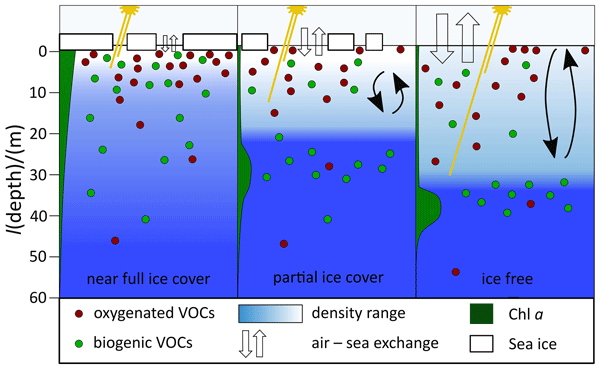
We measured concentrations of five different organic gases in seawater in the high Arctic during summer. We found higher concentrations near the surface of the water column (top 5–10 m) and in areas of partial ice cover. This suggests that sea ice influences the concentrations of these gases. These gases indirectly exert a slight cooling effect on the climate, and it is therefore important to measure the levels accurately for future climate predictions.

Matthew W. Christensen, Andrew Gettelman, Jan Cermak, Guy Dagan, Michael Diamond, Alyson Douglas, Graham Feingold, Franziska Glassmeier, Tom Goren, Daniel P. Grosvenor, Edward Gryspeerdt, Ralph Kahn, Zhanqing Li, Po-Lun Ma, Florent Malavelle, Isabel L. McCoy, Daniel T. McCoy, Greg McFarquhar, Johannes Mülmenstädt, Sandip Pal, Anna Possner, Adam Povey, Johannes Quaas, Daniel Rosenfeld, Anja Schmidt, Roland Schrödner, Armin Sorooshian, Philip Stier, Velle Toll, Duncan Watson-Parris, Robert Wood, Mingxi Yang, and Tianle Yuan
Atmos. Chem. Phys., 22, 641–674, https://doi.org/10.5194/acp-22-641-2022, https://doi.org/10.5194/acp-22-641-2022, 2022
Short summary
Short summary
Trace gases and aerosols (tiny airborne particles) are released from a variety of point sources around the globe. Examples include volcanoes, industrial chimneys, forest fires, and ship stacks. These sources provide opportunistic experiments with which to quantify the role of aerosols in modifying cloud properties. We review the current state of understanding on the influence of aerosol on climate built from the wide range of natural and anthropogenic laboratories investigated in recent decades.
Cited articles
Ahlberg, E., Falk, J., Eriksson, A., Holst, T., Brune, W. H., Kristensson, A., Roldin, P., and Svenningsson, B.: Secondary organic aerosol from VOC mixtures in an oxidation flow reactor, Atmos. Environ., 161, 210–220, https://doi.org/10.1016/j.atmosenv.2017.05.005, 2017.
Bloss, W. J., Evans, M. J., Lee, J. D., Sommariva, R., Heard, D. E., and Pilling, M. J.: The oxidative capacity of the troposphere: Coupling of field measurements of OH and a global chemistry transport model, Faraday Discuss., 130, 425–436, https://doi.org/10.1039/B419090D, 2005.
Brüggemann, M., Hayeck, N., Bonnineau, C., Pesce, S., Alpert, P. A., Perrier, S., Zuth, C., Hoffmann, T., Chen, J., and George, C.: Interfacial photochemistry of biogenic surfactants: A major source of abiotic volatile organic compounds, Faraday Discuss., 200, 59–74, https://doi.org/10.1039/C7FD00022G, 2017.
Carpenter, L. J., Archer, S. D., and Beale, R.: Ocean–atmosphere trace gas exchange, Chem. Soc. Rev., 41, 6473–6506, https://doi.org/10.1039/C2CS35121H, 2012.
Carr, N., Davis, C. E., Blackbird, S., Daniels, L. R., Preece, C., Woodward, M., and Mahaffey, C.: Seasonal and spatial variability in the optical characteristics of DOM in a temperate shelf sea, Prog. Oceanogr., 177, 101929, https://doi.org/10.1016/j.pocean.2018.02.022, 2019.
Chang, W., Heikes, B. G., and Lee, M.: Ozone deposition to the sea surface: Chemical enhancement and wind speed dependence, Atmos. Environ., 38, 1053–1059, https://doi.org/10.1016/j.atmosenv.2003.10.047, 2004.
Finlayson-Pitts, B. J. and Pitts, J. N.: Atmospheric chemistry of tropospheric ozone formation: Scientific and regulatory implications, Air Waste, 43, 1091–1100, https://doi.org/10.1080/1073161X.1993.10467187, 1993.
Halsey, K. H. and Giovannoni, S. J.: Biological controls on marine volatile organic compound emissions: A balancing act at the sea–air interface, Earth-Sci. Rev., 240, 104360, https://doi.org/10.1016/j.earscirev.2023.104360, 2023.
Kiene, R. P. and Bates, T. S.: Biological removal of dimethyl sulphide from sea water, Nature, 345, 702–705, https://doi.org/10.1038/345702a0, 1990.
Kilgour, D. B., Novak, G. A., Claflin, M. S., Lerner, B. M., and Bertram, T. H.: Production of oxygenated volatile organic compounds from the ozonolysis of coastal seawater, Atmos. Chem. Phys., 24, 3729–3742, https://doi.org/10.5194/acp-24-3729-2024, 2024.
Kim, M. J., Novak, G. A., Zoerb, M. C., Yang, M., Blomquist, B. W., Huebert, B. J., Cappa, C. D., and Bertram, T. H.: Air–sea exchange of biogenic volatile organic compounds and the impact on aerosol particle size distributions, Geophys. Res. Lett., 44, 3887–3896, https://doi.org/10.1002/2017GL072975, 2017.
Kirkby, J., Duplissy, J., Sengupta, K., Frege, C., Gordon, H., Williamson, C., Heinritzi, M., Simon, M., Yan, C., Almeida, J., and Tröstl, J.: Ion-induced nucleation of pure biogenic particles, Nature, 533, 521–526, https://doi.org/10.1038/nature17953, 2016.
Lambe, A. T., Chhabra, P. S., Onasch, T. B., Brune, W. H., Hunter, J. F., Kroll, J. H., Cummings, M. J., Brogan, J. F., Parmar, Y., Worsnop, D. R., Kolb, C. E., and Davidovits, P.: Effect of oxidant concentration, exposure time, and seed particles on secondary organic aerosol chemical composition and yield, Atmos. Chem. Phys., 15, 3063–3075, https://doi.org/10.5194/acp-15-3063-2015, 2015.
Lønborg, C., Carreira, C., Jickells, T., and Álvarez-Salgado, X. A.: Impacts of global change on ocean dissolved organic carbon (DOC) cycling, Front. Mar. Sci., 7, 466, https://doi.org/10.3389/fmars.2020.00466, 2020.
Martino, M., Lézé, B., Baker, A. R., and Liss, P. S.: Chemical controls on ozone deposition to water, Geophys. Res. Lett., 39, L05807, https://doi.org/10.1029/2012GL051172, 2012.
McCoy, D. T., Burrows, S. M., Wood, R., Grosvenor, D. P., Elliott, S. M., Ma, P.-L., Rasch, P. J., and Hartmann, D. L.: Natural aerosols explain seasonal and spatial patterns of Southern Ocean cloud albedo, Sci. Adv., 1, e1500157, https://doi.org/10.1126/sciadv.1500157, 2015.
McGenity, T. J., Crombie, A. T., and Murrell, J. C.: Microbial cycling of isoprene, the most abundantly produced biological volatile organic compound on Earth, ISME J., 12, 931–941, https://doi.org/10.1038/s41396-018-0072-6, 2018.
Moore, A. N., Cancelada, L., Ke'La, A., and Prather, K. A.: Secondary aerosol formation from mixtures of marine volatile organic compounds in a potential aerosol mass oxidative flow reactor, Environ. Sci.: Atmos., 4, 351–361, https://doi.org/10.1039/d3ea00169e, 2024.
Mungall, E. L., Abbatt, J. P. D., Wentzell, J. J. B., Lee, A. K. Y., Thomas, J. L., Blais, M., Gosselin, M., Miller, L. A., Papakyriakou, T., and Willis, M. D.: Microlayer source of oxygenated volatile organic compounds in the summertime marine Arctic boundary layer, P. Natl. Acad. Sci. USA, 114, 6203–6208, https://doi.org/10.1073/pnas.1620571114, 2017.
Novak, G. A. and Bertram, T. H.: Reactive VOC production from photochemical and heterogeneous reactions occurring at the air–ocean interface, Acc. Chem. Res., 53, 1014–1023, https://doi.org/10.1021/acs.accounts.9b00038, 2020.
Phillips, D. P., Hopkins, F. E., Bell, T. G., Liss, P. S., Nightingale, P. D., Reeves, C. E., Wohl, C., and Yang, M.: Air–sea exchange of acetone, acetaldehyde, DMS and isoprene at a UK coastal site, Atmos. Chem. Phys., 21, 10111–10132, https://doi.org/10.5194/acp-21-10111-2021, 2021.
Rocco, M., Dunne, E. M., Peltola, M., Barr, N., Williams, J., Colomb, A., Safi, K., Saint-Macary, A., Marriner, A., and Deppeler, S.: Oceanic phytoplankton are a potentially important source of benzenoids to the remote marine atmosphere, Commun. Earth Environ., 2, 175, https://doi.org/10.1038/s43247-021-00253-0, 2021.
Schneider, S. R., Collins, D. B., Lim, C. Y., Zhu, L., and Abbatt, J. P. D.: Formation of secondary organic aerosol from the heterogeneous oxidation by ozone of a phytoplankton culture, ACS Earth Space Chem., 3, 2298–2306, https://doi.org/10.1021/acsearthspacechem.9b00213, 2019.
Schneider, S. R., Collins, D. B., Boyer, M., Chang, R. Y.-W., Gosselin, M., Irish, V. E., Miller, L. A., and Abbatt, J. P. D.: Abiotic emission of volatile organic compounds from the ocean surface: Relationship to seawater composition, ACS Earth Space Chem., https://doi.org/10.1021/acsearthspacechem.4c00163, 2024.
Smyth, T. J., Fishwick, J. R., Al-Moosawi, L., Cummings, D. G., Harris, C., Kitidis, V., Rees, A. P., Martinez-Vicente, V., and Woodward, E. M. S.: A broad spatio-temporal view of the Western English Channel observatory, J. Plankton Res., 32, 585–601, https://doi.org/10.1093/plankt/fbp128, 2010.
Thames, A. B., Brune, W. H., Miller, D. O., Allen, H. M., Apel, E. C., Blake, D. R., Bui, T. P., Commane, R., Crounse, J. D., Daube, B. C., Diskin, G. S., DiGangi, J. P., Elkins, J. W., Hall, S. R., Hanisco, T. F., Hannun, R. A., Hintsa, E., Hornbrook, R. S., Kim, M. J., McKain, K., Moore, F. L., Nicely, J. M., Peischl, J., Ryerson, T. B., St. Clair, J. M., Sweeney, C., Teng, A., Thompson, C. R., Ullmann, K., Wennberg, P. O., and Wolfe, G. M.: Missing OH reactivity in the global marine boundary layer, Atmos. Chem. Phys., 20, 4013–4029, https://doi.org/10.5194/acp-20-4013-2020, 2020.
Wang, Y., Zeng, J., Wu, B., Song, W., Hu, W., Liu, J., Yang, Y., Yu, Z., Wang, X., and Gligorovski, S.: Production of volatile organic compounds by ozone oxidation chemistry at the South China Sea surface microlayer, ACS Earth Space Chem., 7, 1306–1313, https://doi.org/10.1021/acsearthspacechem.3c00102, 2023.
Wohl, C., Capelle, D., Jones, A., Sturges, W. T., Nightingale, P. D., Else, B. G. T., and Yang, M.: Segmented flow coil equilibrator coupled to a proton-transfer-reaction mass spectrometer for measurements of a broad range of volatile organic compounds in seawater, Ocean Sci., 15, 925–940, https://doi.org/10.5194/os-15-925-2019, 2019.
Wohl, C., Güell-Bujons, Q., Castillo, Y. M., Calbet, A., and Simó, R.: Volatile organic compounds released by Oxyrrhis marina grazing on Isochrysis galbana, Oceans, 4, 535–548, https://doi.org/10.3390/oceans4020011, 2023.
Wurl, O., Wurl, E., Miller, L., Johnson, K., and Vagle, S.: Formation and global distribution of sea-surface microlayers, Biogeosciences, 8, 121–135, https://doi.org/10.5194/bg-8-121-2011, 2011.
Xu, F., Hu, K., Lu, S.-H., Guo, S., Wu, Y.-C., Xie, Y., Zhang, H.-H., and Hu, M.: Enhanced marine VOC emissions driven by terrestrial nutrient inputs and their impact on urban air quality in coastal regions, Environ. Sci. Technol., 59, 8140–8154, https://doi.org/10.1021/acs.est.4c12655, 2025.
Yang, M., Phillips, D. P., Hopkins, F. E., Liss, P. S., Suntharalingam, P., Carpenter, L. J., Chance, R., Brown, L. V., Stapleton, C. G., and Jones, M. R.: Marine biogeochemical control on ozone deposition over the ocean, Geophys. Res. Lett., 52, e2024GL113187, https://doi.org/10.1029/2024GL113187, 2025.
Zhou, S., Gonzalez, L., Leithead, A., Finewax, Z., Thalman, R., Vlasenko, A., Vagle, S., Miller, L. A., Li, S.-M., Bureekul, S., Furutani, H., Uematsu, M., Volkamer, R., and Abbatt, J.: Formation of gas-phase carbonyls from heterogeneous oxidation of polyunsaturated fatty acids at the air–water interface and of the sea surface microlayer, Atmos. Chem. Phys., 14, 1371–1384, https://doi.org/10.5194/acp-14-1371-2014, 2014.
Zhou, X. and Mopper, K.: Photochemical production of low-molecular-weight carbonyl compounds in seawater and surface microlayer and their air–sea exchange, Mar. Chem., 56, 201–213, https://doi.org/10.1016/S0304-4203(96)00076-X, 1997.
Short summary
Our study reveals how the surface ocean produces gases when it reacts with ozone. We found that this process changes in response to seasonal changes in ocean biology. By testing fresh seawater and natural organic material, we showed that shifts in plankton and related chemistry strongly affect which gases form. These results help improve predictions of air quality and climate by revealing a natural source of important atmospheric gases.
Our study reveals how the surface ocean produces gases when it reacts with ozone. We found that...


Altmetrics
Final-revised paper
Preprint