
Articles | Volume 26, issue 2
https://doi.org/10.5194/acp-26-1537-2026
© Author(s) 2026. This work is distributed under
the Creative Commons Attribution 4.0 License.
the Creative Commons Attribution 4.0 License.
https://doi.org/10.5194/acp-26-1537-2026
© Author(s) 2026. This work is distributed under
the Creative Commons Attribution 4.0 License.
the Creative Commons Attribution 4.0 License.
Research article
| 
29 Jan 2026
Research article |
| 29 Jan 2026
| 29 Jan 2026
Kinetic fractionation of noble gases in the stratosphere over Japan
Satoshi Sugawara
CORRESPONDING AUTHOR

Faculty of Education, Miyagi University of Education, Sendai 980-0845, Japan
Ikumi Oyabu
National Institute of Polar Research, Tachikawa 190-8518, Japan
Graduate Institute for Advanced Studies, SOKENDAI, Tachikawa 190-8518, Japan
Kenji Kawamura
National Institute of Polar Research, Tachikawa 190-8518, Japan
Graduate Institute for Advanced Studies, SOKENDAI, Tachikawa 190-8518, Japan
Shigeyuki Ishidoya
National Institute of Advanced Industrial Science and Technology (AIST), Tsukuba 305-8569, Japan
Shinji Morimoto
Center for Atmospheric and Oceanic Studies, Tohoku University, Sendai 980-8578, Japan
Shuji Aoki
Center for Atmospheric and Oceanic Studies, Tohoku University, Sendai 980-8578, Japan
Takakiyo Nakazawa
Center for Atmospheric and Oceanic Studies, Tohoku University, Sendai 980-8578, Japan
Sakae Toyoda
School of Materials and Chemical Technology, Institute of Science Tokyo, Yokohama 226-8501, Japan
Hideyuki Honda
Center for Atmospheric and Oceanic Studies, Tohoku University, Sendai 980-8578, Japan
Related authors
Shigeyuki Ishidoya, Takahisa Maeda, Hidehiko Kikuno, Jumpei Fukumasu, Shinya Iwasaki, Sadao Eguchi, Rota Wagai, Kei Asada, Taku Nishimura, Takuhei Yamasaki, Shinji Suzuki, Shohei Murayama, Atsushi Yamamoto, Asaka Hasegawa, Satoshi Sugawara, Shuji Aoki, and Takakiyo Nakazawa
EGUsphere, https://doi.org/10.5194/egusphere-2026-2751, https://doi.org/10.5194/egusphere-2026-2751, 2026
Short summary
Short summary
Soil chamber measurements of O2 and its δ(18O) and CO2 were conducted at a forest site and at agricultural fields. The O2:CO2 exchange ratios for soil–air fluxes were stable at the forest site but variable at agricultural fields. We partitioned measured CO2 fluxes into soil respiration and abiotic reactions to evaluate carbon dioxide removal rate for enhanced rock weathering. The isotopic effect of O2 for soil respiration was evaluated and we estimated its impact on the Dole–Morita effect.
Satoshi Sugawara, Shinji Morimoto, Shigeyuki Ishidoya, Taku Umezawa, Shuji Aoki, Takakiyo Nakazawa, Sakae Toyoda, Kentaro Ishijima, Daisuke Goto, and Hideyuki Honda
Atmos. Chem. Phys., 25, 11895–11917, https://doi.org/10.5194/acp-25-11895-2025, https://doi.org/10.5194/acp-25-11895-2025, 2025
Short summary
Short summary
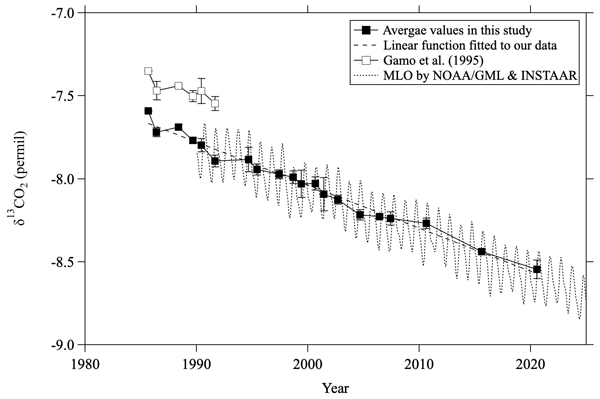
We have collected stratospheric air samples using balloon-borne cryogenic samplers over Japan since 1985 and analyzed them for δ13CO2. δ13CO2 has decreased through time in the mid-stratosphere with an average rate of change of −0.026 ± 0.001 ‰ yr−1. We found that stratospheric δ13CO2 variations are governed by airborne production of 13C-depleted CO2 by CH4 oxidation, gravitational separation, and propagation of the decreasing tropospheric δ13CO2 trend into the stratosphere.
Shigeyuki Ishidoya, Satoshi Sugawara, and Atsushi Okazaki
Atmos. Chem. Phys., 25, 1965–1987, https://doi.org/10.5194/acp-25-1965-2025, https://doi.org/10.5194/acp-25-1965-2025, 2025
Short summary
Short summary
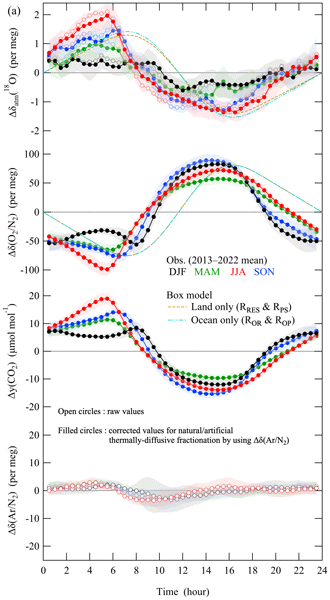
The 18O/16O ratio of atmospheric oxygen, δatm(18O), is higher than that of ocean water due to isotopic effects during biospheric activities. This is known as the Dole–Morita effect, and its millennial-scale variations are recorded in ice cores. However, small variations of δatm(18O) in the present day have never been detected so far. This paper presents the first observations of diurnal, seasonal, and secular variations in δatm(18O) and applies them to evaluate oxygen, carbon, and water cycles.
Taku Umezawa, Satoshi Sugawara, Kenji Kawamura, Ikumi Oyabu, Stephen J. Andrews, Takuya Saito, Shuji Aoki, and Takakiyo Nakazawa
Atmos. Chem. Phys., 22, 6899–6917, https://doi.org/10.5194/acp-22-6899-2022, https://doi.org/10.5194/acp-22-6899-2022, 2022
Short summary
Short summary
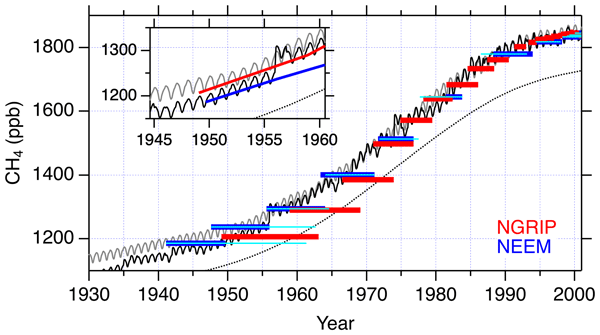
Greenhouse gas methane in the Arctic atmosphere has not been accurately reported for 1900–1980 from either direct observations or ice core reconstructions. By using trace gas data from firn (compacted snow layers above ice sheet), air samples at two Greenland sites, and a firn air transport model, this study suggests a likely range of the Arctic methane reconstruction for the 20th century. Atmospheric scenarios from two previous studies are also evaluated for consistency with the firn data sets.
Nobuyuki Aoki, Shigeyuki Ishidoya, and Nobuhiro Matsumoto
EGUsphere, https://doi.org/10.5194/egusphere-2026-4405, https://doi.org/10.5194/egusphere-2026-4405, 2026
This preprint is open for discussion and under review for Atmospheric Measurement Techniques (AMT).
Short summary
Short summary
We developed highly accurate argon standard gases and confirmed their reliability through independent evaluation. The new standards greatly improved the accuracy of atmospheric Ar/N₂ measurements and enabled a more precise determination of the atmospheric Ar/N₂ ratio. This work provides a solid foundation for using Ar/N₂ measurements to better understand ocean heat uptake and climate change.
Alexander Mattin, Simon J. Barker, V. Holly L. Winton, Andrea Burke, William Hutchison, Patrick J. Sugden, Kirstin Krüger, Alexa R. Van Eaton, Larry G. Mastin, Michael Sigl, Eric W. Wolff, Shuji Fujita, Kumiko Goto-Azuma, Ikumi Oyabu, Motohiro Hirabayashi, Anders Svensson, Magali Verkerk, Colin J. N. Wilson, Stephen B. Piva, Nels A. Iverson, Nelia W. Dunbar, Helle A. Kjær, Nancy A. N. Bertler, Mirko Severi, Andrei V. Kurbatov, and Dominic A. Winski
EGUsphere, https://doi.org/10.5194/egusphere-2026-3434, https://doi.org/10.5194/egusphere-2026-3434, 2026
This preprint is open for discussion and under review for Climate of the Past (CP).
Short summary
Short summary
This study presents evidence of the ~25.3 Ōruanui supereruption preserved in Antarctic ice cores. Glaciochemical signals and volcanic ash were identified across multiple sites, revealing regional differences in volcanic transport, deposition, and preservation. Combining ice core records with climate model simulations, we show the eruption likely caused substantial short-term global cooling and atmospheric change but was unlikely to trigger long-term climate shifts.
Zhenglun Yang, Yukio Terao, Thomas Lauvaux, Tomohiro Oda, Charbel Abdallah, Masahide Nishihashi, Makoto Saito, Hirofumi Ohyama, Shigeyuki Ishidoya, Hirofumi Sugawara, Toshinobu Machida, Motoki Sasakawa, and Yasunori Tohjima
EGUsphere, https://doi.org/10.5194/egusphere-2026-2178, https://doi.org/10.5194/egusphere-2026-2178, 2026
This preprint is open for discussion and under review for Atmospheric Chemistry and Physics (ACP).
Short summary
Short summary
Cities need accurate emission estimates for climate action. We compared five emission inventories over the Greater Tokyo Area using measurements from four sites and an atmospheric transport model. We found that measurements at the four sites show distinct features of the inventories in emission amount and spatial distribution. Site choice is important for evaluating urban emissions. These findings can help improve emission inventories, future urban observations and simulations.
Bibhasvata Dasgupta, Sudhanshu Pandey, Sander Houweling, Malika Menoud, Carina van der Veen, John Miller, Ben Riddell-Young, Sylvia Englund Michel, Peter Sperlich, Shinji Morimoto, Ryo Fujita, Stephen Platt, Christine Groot Zwaaftink, Ingeborg Levin, Cordelia Veidt, Cathrine Lund Myhre, Ceres Woolley Maisch, Rebecca Fisher, Euan G. Nisbet, James France, Rowena Moss, Nicola Warwick, and Thomas Röckmann
Atmos. Chem. Phys., 26, 8601–8616, https://doi.org/10.5194/acp-26-8601-2026, https://doi.org/10.5194/acp-26-8601-2026, 2026
Short summary
Short summary
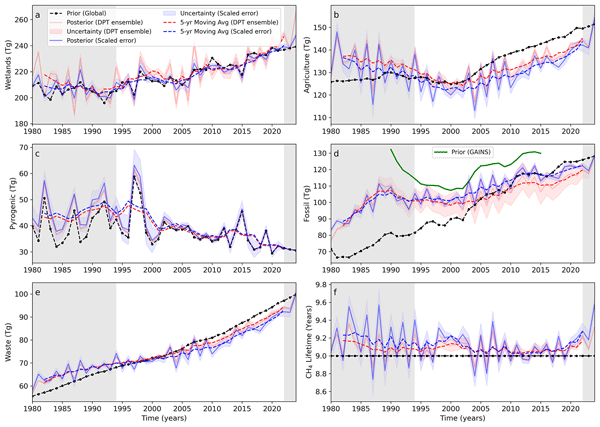
Methane is a strong greenhouse gas, and its rise since the mid-2000s is debated in terms of sources and sinks. Using top-down and bottom-up data, along with inversion models and methane isotopes (δ13C-CH4 and δD-CH4), we find that wetlands are the primary driver of post-2006 increases, followed by agriculture and fossil fuels. Methane's lifetime has decreased by about 0.1 years. We also assess how isotope signatures and sink processes influence uncertainties.
Shigeyuki Ishidoya, Takahisa Maeda, Hidehiko Kikuno, Jumpei Fukumasu, Shinya Iwasaki, Sadao Eguchi, Rota Wagai, Kei Asada, Taku Nishimura, Takuhei Yamasaki, Shinji Suzuki, Shohei Murayama, Atsushi Yamamoto, Asaka Hasegawa, Satoshi Sugawara, Shuji Aoki, and Takakiyo Nakazawa
EGUsphere, https://doi.org/10.5194/egusphere-2026-2751, https://doi.org/10.5194/egusphere-2026-2751, 2026
Short summary
Short summary
Soil chamber measurements of O2 and its δ(18O) and CO2 were conducted at a forest site and at agricultural fields. The O2:CO2 exchange ratios for soil–air fluxes were stable at the forest site but variable at agricultural fields. We partitioned measured CO2 fluxes into soil respiration and abiotic reactions to evaluate carbon dioxide removal rate for enhanced rock weathering. The isotopic effect of O2 for soil respiration was evaluated and we estimated its impact on the Dole–Morita effect.
Bibhasvata Dasgupta, Malika Menoud, Carina van der Veen, Ingeborg Levin, Cordelia Veidt, Heiko Moossen, Sylvia Englund Michel, Peter Sperlich, Shinji Morimoto, Ryo Fujita, Taku Umezawa, Stephen Platt, Christine Groot Zwaaftink, Cathrine Lund Myhre, Rebecca Fisher, David Lowry, Euan G. Nisbet, James France, Ceres Woolley Maisch, Gordon Brailsford, Rowena Moss, Daisuke Goto, Sudhanshu Pandey, Sander Houweling, Nicola Warwick, and Thomas Röckmann
Atmos. Meas. Tech., 18, 6591–6607, https://doi.org/10.5194/amt-18-6591-2025, https://doi.org/10.5194/amt-18-6591-2025, 2025
Short summary
Short summary
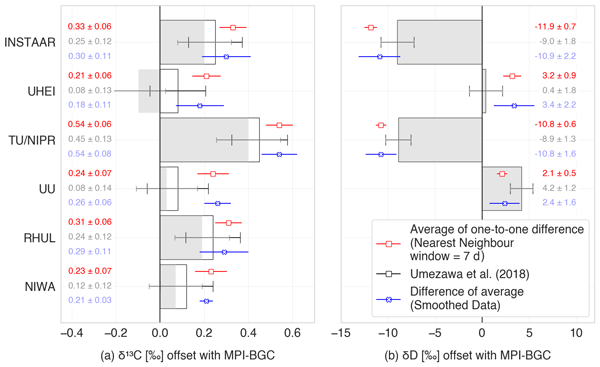
We combined long-term methane mole fraction and isotope measurements from eight laboratories that sample high-latitude stations to compare, offset correct and harmonise the datasets into a hemisphere merged timeseries. Because each laboratory uses slightly different methods, we adjusted the data to make it directly comparable. This allowed us to create a consistent record of atmospheric methane concentration and its isotopes from 1988 to 2023.
Nobuyuki Aoki and Shigeyuki Ishidoya
Atmos. Meas. Tech., 18, 6053–6067, https://doi.org/10.5194/amt-18-6053-2025, https://doi.org/10.5194/amt-18-6053-2025, 2025
Short summary
Short summary
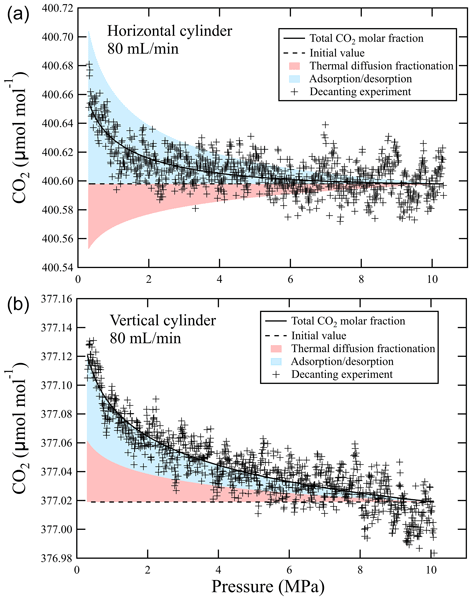
In this study, offsets of CO2 values due to thermal diffusion effect were observed in the outflowing gas from cylinders finding that the CO2 mole fraction in a cylinder deviate by this effect as the pressure dropped. This result suggests that the deviation in the CO2 value in the cylinder is caused not only by the adsorption and desorption effects but also by the thermal diffusion fractionation effect.
Satoshi Sugawara, Shinji Morimoto, Shigeyuki Ishidoya, Taku Umezawa, Shuji Aoki, Takakiyo Nakazawa, Sakae Toyoda, Kentaro Ishijima, Daisuke Goto, and Hideyuki Honda
Atmos. Chem. Phys., 25, 11895–11917, https://doi.org/10.5194/acp-25-11895-2025, https://doi.org/10.5194/acp-25-11895-2025, 2025
Short summary
Short summary
We have collected stratospheric air samples using balloon-borne cryogenic samplers over Japan since 1985 and analyzed them for δ13CO2. δ13CO2 has decreased through time in the mid-stratosphere with an average rate of change of −0.026 ± 0.001 ‰ yr−1. We found that stratospheric δ13CO2 variations are governed by airborne production of 13C-depleted CO2 by CH4 oxidation, gravitational separation, and propagation of the decreasing tropospheric δ13CO2 trend into the stratosphere.
Giyoon Lee, Jinho Ahn, Hyeontae Ju, Ikumi Oyabu, Florian Ritterbusch, Songyi Kim, Jangil Moon, Joohan Lee, Yeongcheol Han, Soon Do Hur, Kenji Kawamura, Zheng-Tian Lu, Wei Jiang, and Guo-Min Yang
The Cryosphere, 19, 3295–3308, https://doi.org/10.5194/tc-19-3295-2025, https://doi.org/10.5194/tc-19-3295-2025, 2025
Short summary
Short summary
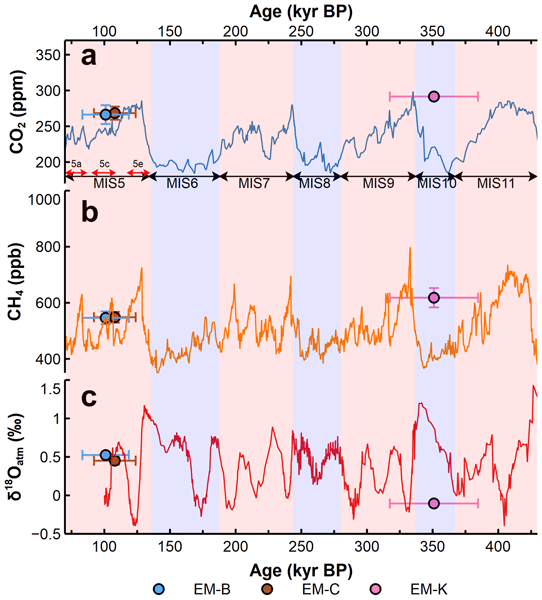
This study investigated ancient ice in the Elephant Moraine, East Antarctica. Using geophysical surveys and chemical analyses, we found surface ice of around 320 000 years old and ice thickness ranging from 200 to 800 m. These findings suggest that the Elephant Moraine region may preserve ice over 1 million years old at depths of several hundred meters. Recovering such ice is a key goal in paleoclimate research to better understand the climate history of Earth.
Masahito Ueyama, Yuta Takao, Hiromi Yazawa, Makiko Tanaka, Hironori Yabuki, Tomo'omi Kumagai, Hiroki Iwata, Md. Abdul Awal, Mingyuan Du, Yoshinobu Harazono, Yoshiaki Hata, Takashi Hirano, Tsutom Hiura, Reiko Ide, Sachinobu Ishida, Mamoru Ishikawa, Kenzo Kitamura, Yuji Kominami, Shujiro Komiya, Ayumi Kotani, Yuta Inoue, Takashi Machimura, Kazuho Matsumoto, Yojiro Matsuura, Yasuko Mizoguchi, Shohei Murayama, Hirohiko Nagano, Taro Nakai, Tatsuro Nakaji, Ko Nakaya, Shinjiro Ohkubo, Takeshi Ohta, Keisuke Ono, Taku M. Saitoh, Ayaka Sakabe, Takanori Shimizu, Seiji Shimoda, Michiaki Sugita, Kentaro Takagi, Yoshiyuki Takahashi, Naoya Takamura, Satoru Takanashi, Takahiro Takimoto, Yukio Yasuda, Qinxue Wang, Jun Asanuma, Hideo Hasegawa, Tetsuya Hiyama, Yoshihiro Iijima, Shigeyuki Ishidoya, Masayuki Itoh, Tomomichi Kato, Hiroaki Kondo, Yoshiko Kosugi, Tomonori Kume, Takahisa Maeda, Shoji Matsuura, Trofim Maximov, Takafumi Miyama, Ryo Moriwaki, Hiroyuki Muraoka, Roman Petrov, Jun Suzuki, Shingo Taniguchi, and Kazuhito Ichii
Earth Syst. Sci. Data, 17, 3807–3833, https://doi.org/10.5194/essd-17-3807-2025, https://doi.org/10.5194/essd-17-3807-2025, 2025
Short summary
Short summary
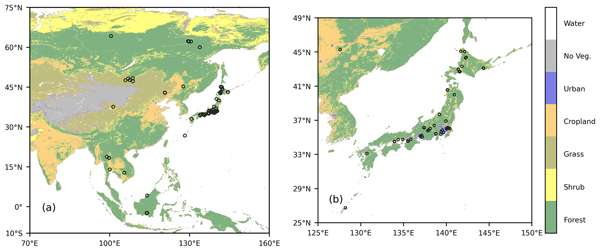
The JapanFlux2024 dataset, created through collaboration across Japan and East Asia, includes eddy covariance data from 83 sites spanning 683 site-years (1990–2023). This comprehensive dataset offers valuable insights into energy, water, and CO2 fluxes, supporting research on land–atmosphere interactions and process models; fosters global collaboration; and advances research in environmental science and regional climate dynamics.
Yosuke Niwa, Yasunori Tohjima, Yukio Terao, Tazu Saeki, Akihiko Ito, Taku Umezawa, Kyohei Yamada, Motoki Sasakawa, Toshinobu Machida, Shin-Ichiro Nakaoka, Hideki Nara, Hiroshi Tanimoto, Hitoshi Mukai, Yukio Yoshida, Shinji Morimoto, Shinya Takatsuji, Kazuhiro Tsuboi, Yousuke Sawa, Hidekazu Matsueda, Kentaro Ishijima, Ryo Fujita, Daisuke Goto, Xin Lan, Kenneth Schuldt, Michal Heliasz, Tobias Biermann, Lukasz Chmura, Jarsolaw Necki, Irène Xueref-Remy, and Damiano Sferlazzo
Atmos. Chem. Phys., 25, 6757–6785, https://doi.org/10.5194/acp-25-6757-2025, https://doi.org/10.5194/acp-25-6757-2025, 2025
Short summary
Short summary
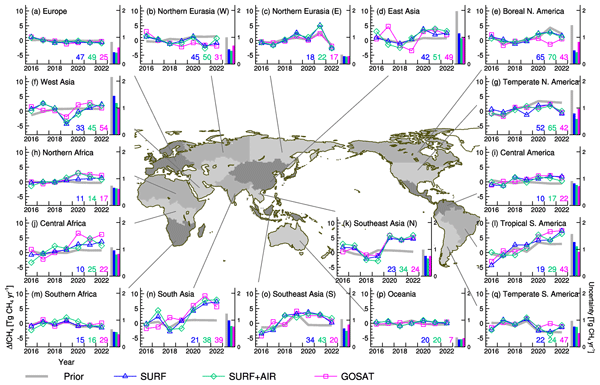
This study estimated regional and sectoral emission contributions to the unprecedented surge of atmospheric methane for 2020–2022. The methane is the second most important greenhouse gas, and its emissions reduction is urgently required to mitigate global warming. Numerical modeling-based estimates with three different sets of atmospheric observations consistently suggested large contributions of biogenic emissions from South Asia and Southeast Asia to the surge of atmospheric methane.
Shigeyuki Ishidoya, Satoshi Sugawara, and Atsushi Okazaki
Atmos. Chem. Phys., 25, 1965–1987, https://doi.org/10.5194/acp-25-1965-2025, https://doi.org/10.5194/acp-25-1965-2025, 2025
Short summary
Short summary
The 18O/16O ratio of atmospheric oxygen, δatm(18O), is higher than that of ocean water due to isotopic effects during biospheric activities. This is known as the Dole–Morita effect, and its millennial-scale variations are recorded in ice cores. However, small variations of δatm(18O) in the present day have never been detected so far. This paper presents the first observations of diurnal, seasonal, and secular variations in δatm(18O) and applies them to evaluate oxygen, carbon, and water cycles.
Frédéric Parrenin, Marie Bouchet, Christo Buizert, Emilie Capron, Ellen Corrick, Russell Drysdale, Kenji Kawamura, Amaëlle Landais, Robert Mulvaney, Ikumi Oyabu, and Sune Olander Rasmussen
Geosci. Model Dev., 17, 8735–8750, https://doi.org/10.5194/gmd-17-8735-2024, https://doi.org/10.5194/gmd-17-8735-2024, 2024
Short summary
Short summary
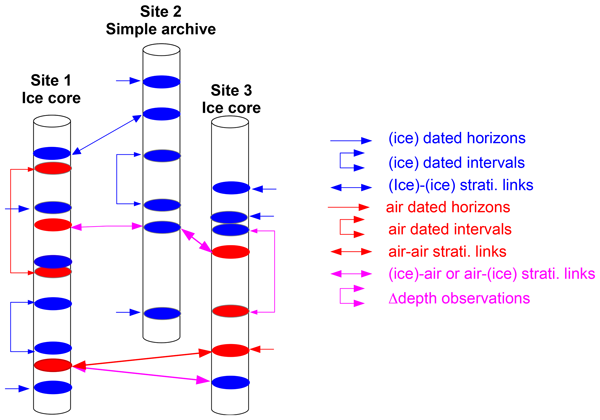
The Paleochrono-1.1 probabilistic dating model allows users to derive a common and optimized chronology for several paleoclimatic sites from various archives (ice cores, speleothems, marine cores, lake cores, etc.). It combines prior sedimentation scenarios with chronological information such as dated horizons, dated intervals, stratigraphic links and (for ice cores) Δdepth observations. Paleochrono-1.1 is available under an open-source license.
Kumiko Goto-Azuma, Remi Dallmayr, Yoshimi Ogawa-Tsukagawa, Nobuhiro Moteki, Tatsuhiro Mori, Sho Ohata, Yutaka Kondo, Makoto Koike, Motohiro Hirabayashi, Jun Ogata, Kyotaro Kitamura, Kenji Kawamura, Koji Fujita, Sumito Matoba, Naoko Nagatsuka, Akane Tsushima, Kaori Fukuda, and Teruo Aoki
Atmos. Chem. Phys., 24, 12985–13000, https://doi.org/10.5194/acp-24-12985-2024, https://doi.org/10.5194/acp-24-12985-2024, 2024
Short summary
Short summary
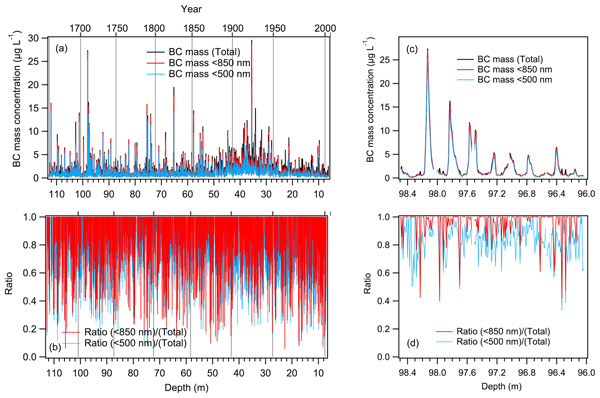
We developed a continuous flow analysis system to analyze an ice core from northwestern Greenland and coupled it with an improved refractory black carbon (rBC) measurement technique. This allowed accurate high-resolution analyses of size distributions and concentrations of rBC particles with diameters of 70 nm–4 μm for the past 350 years. Our results provide crucial insights into rBC's climatic effects. We also found previous ice core studies substantially underestimated rBC mass concentrations.
Ryo Inoue, Teruo Aoki, Shuji Fujita, Shun Tsutaki, Hideaki Motoyama, Fumio Nakazawa, and Kenji Kawamura
The Cryosphere, 18, 3513–3531, https://doi.org/10.5194/tc-18-3513-2024, https://doi.org/10.5194/tc-18-3513-2024, 2024
Short summary
Short summary
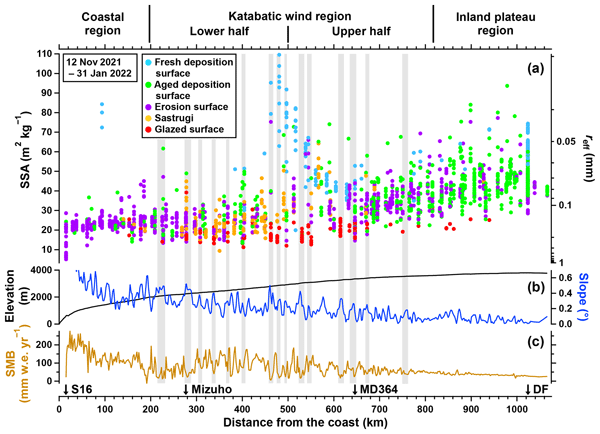
We measured the snow specific surface area (SSA) at ~2150 surfaces between the coast near Syowa Station and Dome Fuji, East Antarctica, in summer 2021–2022. The observed SSA shows no elevation dependence between 15 and 500 km from the coast and increases toward the dome area beyond the range. SSA varies depending on surface morphologies and meteorological events. The spatial variation of SSA can be explained by snow metamorphism, snowfall frequency, and wind-driven inhibition of snow deposition.
Ryo Inoue, Shuji Fujita, Kenji Kawamura, Ikumi Oyabu, Fumio Nakazawa, Hideaki Motoyama, and Teruo Aoki
The Cryosphere, 18, 425–449, https://doi.org/10.5194/tc-18-425-2024, https://doi.org/10.5194/tc-18-425-2024, 2024
Short summary
Short summary
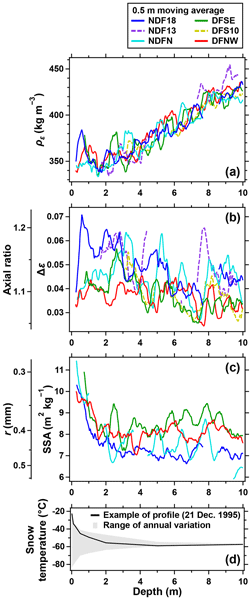
We measured the density, microstructural anisotropy, and specific surface area (SSA) of six firn cores collected within 60 km of Dome Fuji, Antarctica. We found a lack of significant density increase, development of vertically elongated microstructures, and a rapid decrease in SSA in the top few meters due to the metamorphism driven by water vapor transport under a temperature gradient. We highlight the significant spatial variability in the properties, which depends on the accumulation rate.
Shigeyuki Ishidoya, Kazuhiro Tsuboi, Hiroaki Kondo, Kentaro Ishijima, Nobuyuki Aoki, Hidekazu Matsueda, and Kazuyuki Saito
Atmos. Chem. Phys., 24, 1059–1077, https://doi.org/10.5194/acp-24-1059-2024, https://doi.org/10.5194/acp-24-1059-2024, 2024
Short summary
Short summary
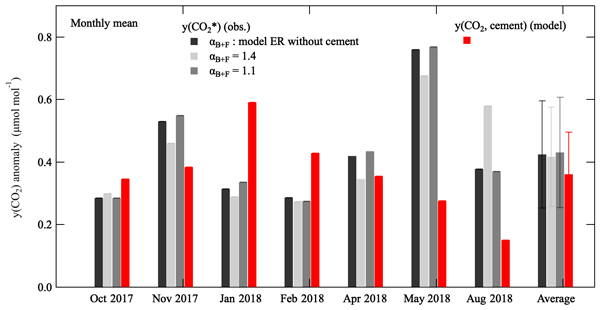
A method evaluating techniques for carbon neutrality, such as carbon capture and storage (CCS), is important. This study presents a method to evaluate CO2 emissions from a cement plant based on atmospheric O2 and CO2 measurements. The method will also be useful for evaluating CO2 capture from flue gas at CCS plants, since the plants remove CO2 from the atmosphere without causing any O2 changes, just as cement plants do, differing only in the direction of CO2 exchange with the atmosphere.
Kazuki Kamezaki, Sebastian O. Danielache, Shigeyuki Ishidoya, Takahisa Maeda, and Shohei Murayama
Atmos. Meas. Tech. Discuss., https://doi.org/10.5194/amt-2023-209, https://doi.org/10.5194/amt-2023-209, 2023
Revised manuscript not accepted
Short summary
Short summary
Recently, MIRA Pico, a portable continuous carbonyl sulfide (COS) concentration analyzer using mid-infrared absorption, has been released. MIRA Pico has a lower cost and is smaller than conventional laser COS analyzers. However, actual COS atmospheric measurement results using MIRA Pico have not yet been reported. In this study, we modified and tested the MIRA Pico for atmospheric COS concentration measurements. We used the modified MIRA Pico for observations at Tsukuba, Japan.
Takashi Obase, Ayako Abe-Ouchi, Fuyuki Saito, Shun Tsutaki, Shuji Fujita, Kenji Kawamura, and Hideaki Motoyama
The Cryosphere, 17, 2543–2562, https://doi.org/10.5194/tc-17-2543-2023, https://doi.org/10.5194/tc-17-2543-2023, 2023
Short summary
Short summary
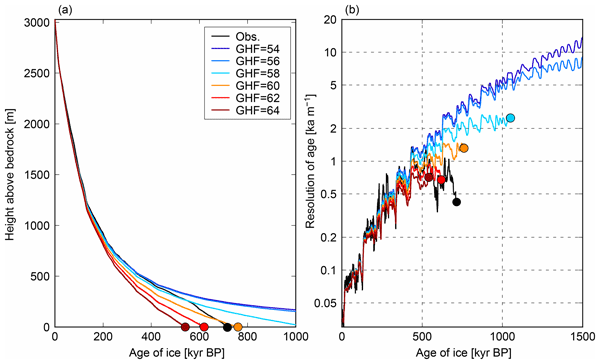
We use a one-dimensional ice-flow model to examine the most suitable core location near Dome Fuji (DF), Antarctica. This model computes the temporal evolution of age and temperature from past to present. We investigate the influence of different parameters of climate and ice sheet on the ice's basal age and compare the results with ground radar surveys. We find that the local ice thickness primarily controls the age because it is critical to the basal melting, which can eliminate the old ice.
Christo Buizert, Sarah Shackleton, Jeffrey P. Severinghaus, William H. G. Roberts, Alan Seltzer, Bernhard Bereiter, Kenji Kawamura, Daniel Baggenstos, Anaïs J. Orsi, Ikumi Oyabu, Benjamin Birner, Jacob D. Morgan, Edward J. Brook, David M. Etheridge, David Thornton, Nancy Bertler, Rebecca L. Pyne, Robert Mulvaney, Ellen Mosley-Thompson, Peter D. Neff, and Vasilii V. Petrenko
Clim. Past, 19, 579–606, https://doi.org/10.5194/cp-19-579-2023, https://doi.org/10.5194/cp-19-579-2023, 2023
Short summary
Short summary
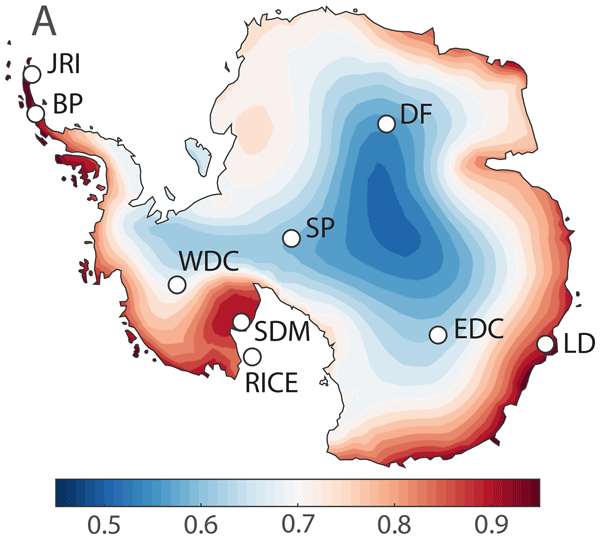
It is unclear how different components of the global atmospheric circulation, such as the El Niño effect, respond to large-scale climate change. We present a new ice core gas proxy, called krypton-86 excess, that reflects past storminess in Antarctica. We present data from 11 ice cores that suggest the new proxy works. We present a reconstruction of changes in West Antarctic storminess over the last 24 000 years and suggest these are caused by north–south movement of the tropical rain belt.
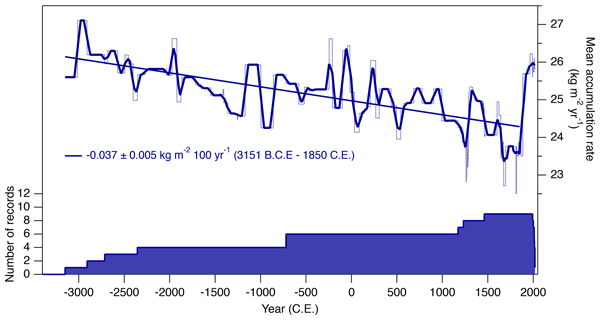
Ikumi Oyabu, Kenji Kawamura, Shuji Fujita, Ryo Inoue, Hideaki Motoyama, Kotaro Fukui, Motohiro Hirabayashi, Yu Hoshina, Naoyuki Kurita, Fumio Nakazawa, Hiroshi Ohno, Konosuke Sugiura, Toshitaka Suzuki, Shun Tsutaki, Ayako Abe-Ouchi, Masashi Niwano, Frédéric Parrenin, Fuyuki Saito, and Masakazu Yoshimori
Clim. Past, 19, 293–321, https://doi.org/10.5194/cp-19-293-2023, https://doi.org/10.5194/cp-19-293-2023, 2023
Short summary
Short summary
We reconstructed accumulation rate around Dome Fuji, Antarctica, over the last 5000 years from 15 shallow ice cores and seven snow pits. We found a long-term decreasing trend in the preindustrial period, which may be associated with secular surface cooling and sea ice expansion. Centennial-scale variations were also found, which may partly be related to combinations of volcanic, solar and greenhouse gas forcings. The most rapid and intense increases of accumulation rate occurred since 1850 CE.
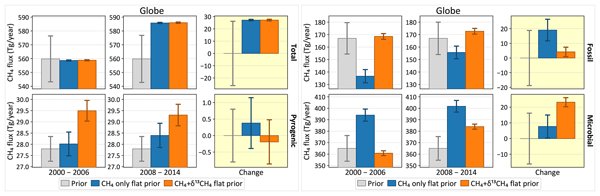
Sourish Basu, Xin Lan, Edward Dlugokencky, Sylvia Michel, Stefan Schwietzke, John B. Miller, Lori Bruhwiler, Youmi Oh, Pieter P. Tans, Francesco Apadula, Luciana V. Gatti, Armin Jordan, Jaroslaw Necki, Motoki Sasakawa, Shinji Morimoto, Tatiana Di Iorio, Haeyoung Lee, Jgor Arduini, and Giovanni Manca
Atmos. Chem. Phys., 22, 15351–15377, https://doi.org/10.5194/acp-22-15351-2022, https://doi.org/10.5194/acp-22-15351-2022, 2022
Short summary
Short summary
Atmospheric methane (CH4) has been growing steadily since 2007 for reasons that are not well understood. Here we determine sources of methane using a technique informed by atmospheric measurements of CH4 and its isotopologue 13CH4. Measurements of 13CH4 provide for better separation of microbial, fossil, and fire sources of methane than CH4 measurements alone. Compared to previous assessments such as the Global Carbon Project, we find a larger microbial contribution to the post-2007 increase.
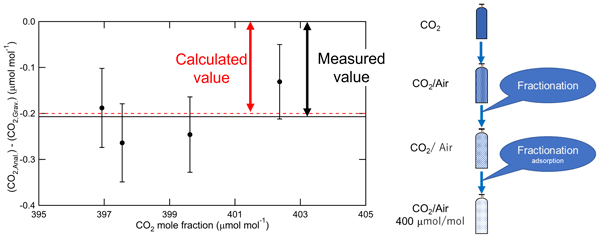
Nobuyuki Aoki, Shigeyuki Ishidoya, Shohei Murayama, and Nobuhiro Matsumoto
Atmos. Meas. Tech., 15, 5969–5983, https://doi.org/10.5194/amt-15-5969-2022, https://doi.org/10.5194/amt-15-5969-2022, 2022
Short summary
Short summary
The CO2 concentration in a cylinder is affected by carbon dioxide (CO2) adsorption to a cylinder’s internal surface and fractionation of CO2 and air in the preparation of standard mixtures. We demonstrate that the effects make the CO2 molar fractions deviate in standard mixtures prepared by diluting pure CO2 with air three times. This means that CO2 standard gases are difficult to gravimetrically prepare through multistep dilution.
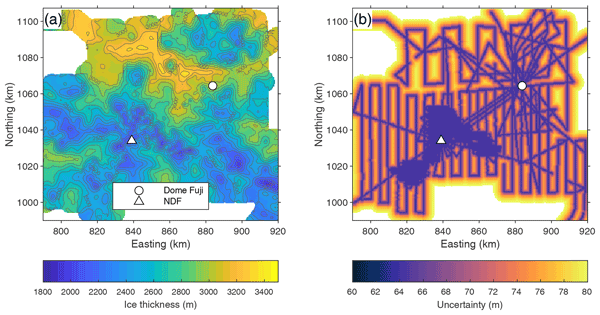
Shun Tsutaki, Shuji Fujita, Kenji Kawamura, Ayako Abe-Ouchi, Kotaro Fukui, Hideaki Motoyama, Yu Hoshina, Fumio Nakazawa, Takashi Obase, Hiroshi Ohno, Ikumi Oyabu, Fuyuki Saito, Konosuke Sugiura, and Toshitaka Suzuki
The Cryosphere, 16, 2967–2983, https://doi.org/10.5194/tc-16-2967-2022, https://doi.org/10.5194/tc-16-2967-2022, 2022
Short summary
Short summary
We constructed an ice thickness map across the Dome Fuji region, East Antarctica, from improved radar data and previous data that had been collected since the late 1980s. The data acquired using the improved radar systems allowed basal topography to be identified with higher accuracy. The new ice thickness data show the bedrock topography, particularly the complex terrain of subglacial valleys and highlands south of Dome Fuji, with substantially high detail.
Jacob D. Morgan, Christo Buizert, Tyler J. Fudge, Kenji Kawamura, Jeffrey P. Severinghaus, and Cathy M. Trudinger
The Cryosphere, 16, 2947–2966, https://doi.org/10.5194/tc-16-2947-2022, https://doi.org/10.5194/tc-16-2947-2022, 2022
Short summary
Short summary
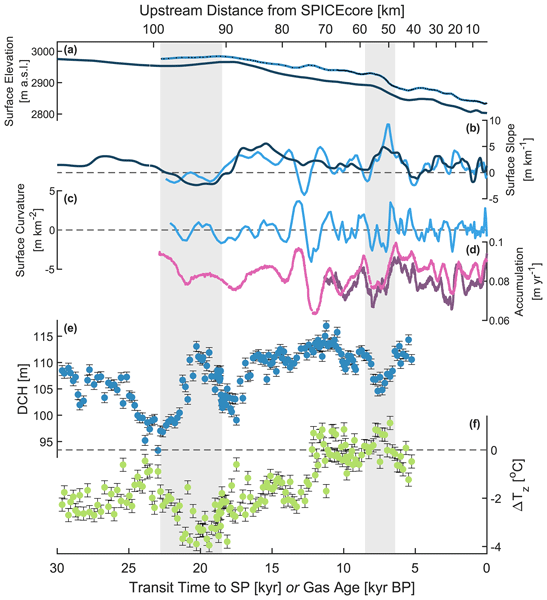
The composition of air bubbles in Antarctic ice cores records information about past changes in properties of the snowpack. We find that, near the South Pole, thinner snowpack in the past is often due to steeper surface topography, in which faster winds erode the snow and deposit it in flatter areas. The slope and wind seem to also cause a seasonal bias in the composition of air bubbles in the ice core. These findings will improve interpretation of other ice cores from places with steep slopes.
Giyoon Lee, Jinho Ahn, Hyeontae Ju, Florian Ritterbusch, Ikumi Oyabu, Christo Buizert, Songyi Kim, Jangil Moon, Sambit Ghosh, Kenji Kawamura, Zheng-Tian Lu, Sangbum Hong, Chang Hee Han, Soon Do Hur, Wei Jiang, and Guo-Min Yang
The Cryosphere, 16, 2301–2324, https://doi.org/10.5194/tc-16-2301-2022, https://doi.org/10.5194/tc-16-2301-2022, 2022
Short summary
Short summary
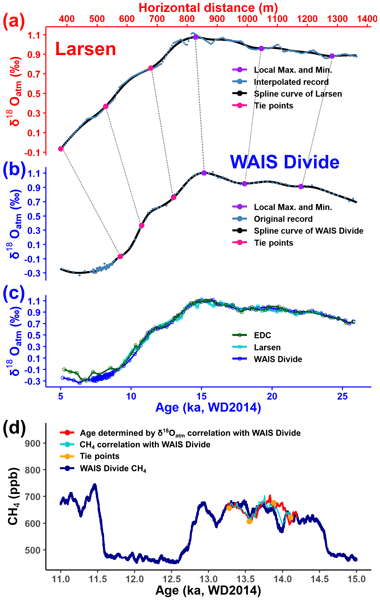
Blue-ice areas (BIAs) have several advantages for reconstructing past climate. However, the complicated ice flow in the area hinders constraining the age. We applied state-of-the-art techniques and found that the ages cover the last deglaciation period. Our study demonstrates that the BIA in northern Victoria Land may help reconstruct the past climate during the termination of the last glacial period.
Shigeyuki Ishidoya, Kazuhiro Tsuboi, Yosuke Niwa, Hidekazu Matsueda, Shohei Murayama, Kentaro Ishijima, and Kazuyuki Saito
Atmos. Chem. Phys., 22, 6953–6970, https://doi.org/10.5194/acp-22-6953-2022, https://doi.org/10.5194/acp-22-6953-2022, 2022
Short summary
Short summary
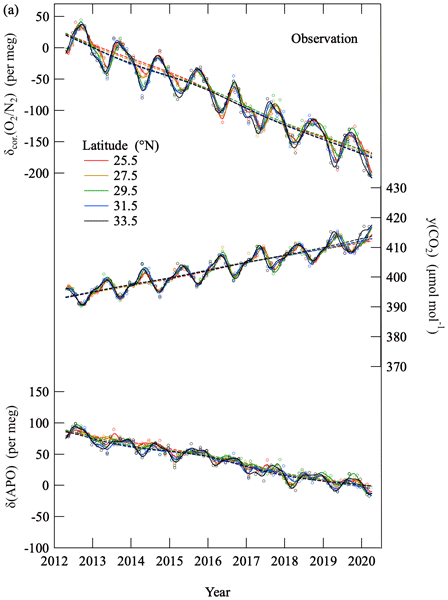
The atmospheric O2 / N2 ratio and CO2 concentration over the western North Pacific are presented. We found significant modification of the seasonal APO cycle in the middle troposphere due to the interhemispheric mixing of air. APO driven by the net marine biological activities indicated annual sea–air O2 flux during El Niño. Terrestrial biospheric and oceanic CO2 uptakes during 2012–2019 were estimated to be 1.8 and 2.8 Pg C a−1, respectively.
Taku Umezawa, Satoshi Sugawara, Kenji Kawamura, Ikumi Oyabu, Stephen J. Andrews, Takuya Saito, Shuji Aoki, and Takakiyo Nakazawa
Atmos. Chem. Phys., 22, 6899–6917, https://doi.org/10.5194/acp-22-6899-2022, https://doi.org/10.5194/acp-22-6899-2022, 2022
Short summary
Short summary
Greenhouse gas methane in the Arctic atmosphere has not been accurately reported for 1900–1980 from either direct observations or ice core reconstructions. By using trace gas data from firn (compacted snow layers above ice sheet), air samples at two Greenland sites, and a firn air transport model, this study suggests a likely range of the Arctic methane reconstruction for the 20th century. Atmospheric scenarios from two previous studies are also evaluated for consistency with the firn data sets.
Ikumi Oyabu, Kenji Kawamura, Tsutomu Uchida, Shuji Fujita, Kyotaro Kitamura, Motohiro Hirabayashi, Shuji Aoki, Shinji Morimoto, Takakiyo Nakazawa, Jeffrey P. Severinghaus, and Jacob D. Morgan
The Cryosphere, 15, 5529–5555, https://doi.org/10.5194/tc-15-5529-2021, https://doi.org/10.5194/tc-15-5529-2021, 2021
Short summary
Short summary
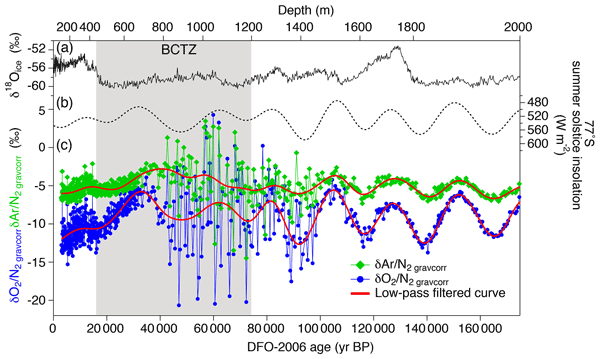
We present O2/N2 and Ar/N2 records from the Dome Fuji ice core through the bubbly ice, bubble–clathrate transition, and clathrate ice zones without gas-loss fractionation. The insolation signal is preserved through the clathrate formation. The relationship between Ar/Ν2 and Ο2/Ν2 suggests that the fractionation for the bubble–clathrate transition is mass independent, while the bubble close-off process involves a combination of mass-independent and mass-dependent fractionation for O2 and Ar.
Cited articles
Adachi, Y., Kawamura, K., Armi, L., and Keeling, R. F.: Diffusive separation of the lower atmosphere, Science, 311, 1429, https://doi.org/10.1126/science.1121312, 2006.
Aoki, S., Nakazawa, T., Machida, T., Sugawara, S., Morimoto, S., Hashida, G., Yamanouchi, T., Kawamura, K., and Honda, H.: Carbon dioxide variations in the stratosphere over Japan, Scandinavia and Antarctica, Tellus B, 55, 178–186, https://doi.org/10.1034/j.1600-0889.2003.00059.x, 2003.
Banks, P. M. and Kockarts, G.: Aeronomy, Parts A and B, Academic Press, Inc., New York, 1973.
Battle, M. O., Severinghaus, J. P., Sofen, E. D., Plotkin, D., Orsi, A. J., Aydin, M., Montzka, S. A., Sowers, T., and Tans, P. P.: Controls on the movement and composition of firn air at the West Antarctic Ice Sheet Divide, Atmos. Chem. Phys., 11, 11007–11021, https://doi.org/10.5194/acp-11-11007-2011, 2011.
Belikov, D., Sugawara, S., Ishidoya, S., Hasebe, F., Maksyutov, S., Aoki, S., Morimoto, S., and Nakazawa, T.: Three-dimensional simulation of stratospheric gravitational separation using the NIES global atmospheric tracer transport model, Atmos. Chem. Phys., 19, 5349–5361, https://doi.org/10.5194/acp-19-5349-2019, 2019.
Bender, M. L., Barnett, B., Dreyfus, G., Jouzel, J., and Porcelli, D.: The contemporary degassing rate of 40Ar from the solid Earth, P. Natl. Acad. Sci. USA, 105, 8232–8237, https://doi.org/10.1073/PNAS.0711679105, 2008.
Bent, J.: Airborne oxygen measurements over the Southern Ocean as an integrated constraint of seasonal biogeochemical processes, PhD thesis, University of California, San Diego, USA, https://escholarship.org/uc/item/4dd6k6j2 (last access: 19 June 2025), 2014.
Bereiter, B., Kawamura, K., and Severinghaus, J. P.: New methods for measuring atmospheric heavy noble gas isotope and elemental ratios in ice core samples, Rapid Commun. Mass Sp., 32, 801–814, https://doi.org/10.1002/rcm.8099, 2018a.
Bereiter, B., Shackleton, S., Baggenstos, D., Kawamura, K., and Severinghaus, J.: Mean global ocean temperatures during the last glacial transition, Nature, 553, 39–44, https://doi.org/10.1038/nature25152, 2018b.
Bieri, R. H., Koide, M., Martell, E. A., and Scholz, T. G.: Noble gases in the atmosphere between 43 and 63 kilometers, J. Geophys. Res., 75, 6731–6735, https://doi.org/10.1029/JC075i033p06731, 1970.
Birner, B., Buizert, C., Wagner, T. J. W., and Severinghaus, J. P.: The influence of layering and barometric pumping on firn air transport in a 2-D model, The Cryosphere, 12, 2021–2037, https://doi.org/10.5194/tc-12-2021-2018, 2018.
Birner, B., Chipperfield, M. P., Morgan, E. J., Stephens, B. B., Linz, M., Feng, W., Wilson, C., Bent, J. D., Wofsy, S. C., Severinghaus, J., and Keeling, R. F.: Gravitational separation of Ar∕N2 and age of air in the lowermost stratosphere in airborne observations and a chemical transport model, Atmos. Chem. Phys., 20, 12391–12408, https://doi.org/10.5194/acp-20-12391-2020, 2020.
Buizert, C. and Severinghaus, J. P.: Dispersion in deep polar firn driven by synoptic-scale surface pressure variability, The Cryosphere, 10, 2099–2111, https://doi.org/10.5194/tc-10-2099-2016, 2016.
Buizert, C., Shackleton, S., Severinghaus, J. P., Roberts, W. H. G., Seltzer, A., Bereiter, B., Kawamura, K., Baggenstos, D., Orsi, A. J., Oyabu, I., Birner, B., Morgan, J. D., Brook, E. J., Etheridge, D. M., Thornton, D., Bertler, N., Pyne, R. L., Mulvaney, R., Mosley-Thompson, E., Neff, P. D., and Petrenko, V. V.: The new Kr-86 excess ice core proxy for synoptic activity: West Antarctic storminess possibly linked to Intertropical Convergence Zone (ITCZ) movement through the last deglaciation, Clim. Past, 19, 579–606, https://doi.org/10.5194/cp-19-579-2023, 2023.
Diallo, M., Legras, B., and Chédin, A.: Age of stratospheric air in the ERA-Interim, Atmos. Chem. Phys., 12, 12133–12154, https://doi.org/10.5194/acp-12-12133-2012, 2012.
Ehhalt, D. H., Heidt, L. E., Lueb, R. H., and Martell, E. A.: Concentrations of CH4, CO, CO2, H2, H2O and N2O in the upper stratosphere, J. Atmos. Sci., 32, 163–169, https://doi.org/10.1175/1520-0469(1975)032<0163:COCCCH>2.0.CO;2, 1975.
Engel, A., Möbius, T., Bönisch, H., Schmidt, U., Heinz, R., Levin, I., Atlas, E., Aoki, S., Nakazawa, T., Sugawara, S., Moore, F., Hurst, D., Elkins, J., Schauffler, S., Andrews, A., and Boering, K.: Age of stratospheric air unchanged within uncertainties over the past 30 years, Nat. Geosci., 2, 28–31, https://doi.org/10.1038/Ngeo388, 2009.
Engel, A., Bönisch, H., Ullrich, M., Sitals, R., Membrive, O., Danis, F., and Crevoisier, C.: Mean age of stratospheric air derived from AirCore observations, Atmos. Chem. Phys., 17, 6825–6838, https://doi.org/10.5194/acp-17-6825-2017, 2017.
Fritsch, F., Garny, H., Engel, A., Bönisch, H., and Eichinger, R.: Sensitivity of age of air trends to the derivation method for non-linear increasing inert SF6, Atmos. Chem. Phys., 20, 8709–8725, https://doi.org/10.5194/acp-20-8709-2020, 2020.
Fu, Q., White, R. H., Wang, M., Alexander, B., Solomon, S., Gettelman, A., Battisti, D. S., and Lin, P.: The Brewer-Dobson circulation during the last glacial maximum, Geophysical Research Letters, 47, e2019GL086271, https://doi.org/10.1029/2019GL086271, 2020.
Fuller, E. N., Schettler, P. D., and Giddings, J. C.: New method for prediction of binary gas-phase diffusion coefficients, Ind. Eng. Chem., 58, 18–27, https://doi.org/10.1021/ie50677a007, 1966.
Fuller, E. N., Ensley, K., and Giddings, J. C.: Diffusion of halogenated hydrocarbons in helium. The effect of structure on collision cross sections, J. Phys. Chem., 73, 3679–3685, https://doi.org/10.1021/j100845a020, 1969.
Garny, H., Birner, T., Bönisch, H., and Bunzel, F.: The effects of mixing on age of air, J. Geophys. Res.-Atmos., 119, 7015–7034, https://doi.org/10.1002/2013JD021417, 2014.
Garny, H., Eichinger, R., Laube, J. C., Ray, E. A., Stiller, G. P., Bönisch, H., Saunders, L., and Linz, M.: Correction of stratospheric age of air (AoA) derived from sulfur hexafluoride (SF6) for the effect of chemical sinks, Atmos. Chem. Phys., 24, 4193–4215, https://doi.org/10.5194/acp-24-4193-2024, 2024a.
Garny, H., Ploeger, F., Abalos, M., Bönisch, H., von Clarmann, T., Diallo, M., Engel, A., Laube, J. C., Linz, M., Neu, J. L., Podglajen, A., Ray, E., Rivoire, L., Saunders, L. N., Stiller, G., Voet, F., Wagenhäuser, T., and Walker, K. A.: Age of stratospheric air: Progress on processes, observations, and long-term trends, Rev. Geophys., 62, e2023RG000832, https://doi.org/10.1029/2023RG000832, 2024b.
Haeberli, M., Baggenstos, D., Schmitt, J., Grimmer, M., Michel, A., Kellerhals, T., and Fischer, H.: Snapshots of mean ocean temperature over the last 700 000 years using noble gases in the EPICA Dome C ice core, Clim. Past, 17, 843–867, https://doi.org/10.5194/cp-17-843-2021, 2021.
Hall, T. M. and Plumb, R. A.: Age as a diagnostic of stratospheric transport, J. Geophys. Res., 99, 1059–1070, 1994.
Honda, H., Aoki, S., Nakazawa, T., Morimoto, S., and Yajima, N.: Cryogenic air sampling system for measurements of the concentrations of stratospheric trace gases and their isotopic ratios over Antarctica, J. Geomagn. Geoelectr., 48, 1145–1155, 1996.
Huang, T., Walters, S., Brasseur, G., Hauglustaine, D., and Wu, W.: Description of SOCRATES – A chemical dynamical radiative two-dimensional model, NCAR/TN-440+EDD NCAR Technical Note, available at: https://opensky.ucar.edu/islandora/object/technotes:300 (last access: 19 June 2025), 1998.
Ishidoya, S. and Murayama, S.: Development of high precision continuous measuring system of the atmospheric O2
Ishidoya, S., Sugawara, S., Hashida, G., Morimoto, S., Aoki, S., Nakazawa, T., and Yamanouchi, T.: Vertical profiles of the O2/N2 ratio in the stratosphere over Japan and Antarctica, Geophys. Res. Lett., 33, L13701, https://doi.org/10.1029/2006GL025886, 2006.
Ishidoya, S., Sugawara, S., Morimoto, S., Aoki, S., and Nakazawa, T.: Gravitational separation of major atmospheric components of nitrogen and oxygen in the stratosphere, Geophys. Res. Lett., 35, L03811, https://doi.org/10.1029/2007GL030456, 2008a.
Ishidoya, S., Morimoto, S., Sugawara, S., Watai, T., Machida, T. Aoki, S., Nakazawa, T., and Yamanouchi, T.: Gravitational separation suggested by O2
Ishidoya, S., Sugawara, S., Morimoto, S., Aoki, S., Nakazawa, T., Honda, H., and Murayama, S.: Gravitational separation in the stratosphere – a new indicator of atmospheric circulation, Atmos. Chem. Phys., 13, 8787–8796, https://doi.org/10.5194/acp-13-8787-2013, 2013.
Ishidoya, S., Sugawara, S., Inai, Y., Morimoto, S., Honda, H., Ikeda, C., Hashida, G., Machida, T., Tomikawa, Y., Toyoda, S., Goto, D., Aoki, S., and Nakazawa, T.: Gravitational separation of the stratospheric air over Syowa, Antarctica and its connection with meteorological fields, Atmos. Sci. Lett., 19, e857, https://doi.org/10.1002/asl.857, 2018.
Ishidoya, S., Sugawara, S., Tohjima, Y., Goto, D., Ishijima, K., Niwa, Y., Aoki, N., and Murayama, S.: Secular change in atmospheric
Ishidoya, S., Sugawara, S., and Okazaki, A.: Diurnal, seasonal, and interannual variations in δ(18O) of atmospheric O2 and its application to evaluate natural and anthropogenic changes in oxygen, carbon, and water cycles, Atmos. Chem. Phys., 25, 1965–1987, https://doi.org/10.5194/acp-25-1965-2025, 2025.
Kawamura, K., Severinghaus, J. P., Albert, M. R., Courville, Z. R., Fahnestock, M. A., Scambos, T., Shields, E., and Shuman, C. A.: Kinetic fractionation of gases by deep air convection in polar firn, Atmos. Chem. Phys., 13, 11141–11155, https://doi.org/10.5194/acp-13-11141-2013, 2013.
Keeling, R. F., Blaine, T., Paplawsky, B., Katz, L., Atwood, C., and Brockwell, T.: Measurement of changes in atmospheric
Khosravi, R., Brasseur, G., Smith, A., Rusch, D., Walters, S., Chabrillat, and Kockarts, G.: Response of the mesosphere to human-induced perturbations and solar variability calculated by a 2-D model, J. Geophys. Res., 107, 4358, https://doi.org/10.1029/2001JD001235, 2002.
Landais, A., Barnola, J. M., Kawamura, K., Caillon, N., Delmotte, M., Van Ommen, T., Dreyfus, G., Jouzel, J., Masson-Delmotte, V., Minster, B., Freitag, J., Leuenberger, M., Schwander, J., Huber, C., Etheridge, D., and Morgan, V.: Firn-air δ15N in modern polar sites and glacial–interglacial ice: a model-data mismatch during glacial periods in Antarctica?, Quaternary Sci. Rev., 25, 49–62, https://doi.org/10.1016/J.Quascirev.2005.06.007, 2006.
Leedham Elvidge, E. C., Bönisch, H., Brenninkmeijer, C. A. M., Engel, A., Fraser, P. J., Gallacher, E., Langenfelds, R., Mühle, J., Oram, D. E., Ray, E. A., Ridley, A. R., Röckmann, T., Sturges, W. T., Weiss, R. F., and Laube, J. C.: Evaluation of stratospheric age of air from CF4, C2F6, C3F8, CHF3, HFC-125, HFC-227ea and SF6; implications for the calculations of halocarbon lifetimes, fractional release factors and ozone depletion potentials, Atmos. Chem. Phys., 18, 3369–3385, https://doi.org/10.5194/acp-18-3369-2018, 2018.
Machida, T., Matsueda, H., Sawa, Y., Nakagawa, Y., Hirotani, K., Kondo, N., Goto, K., Nakazawa, N., Ishikawa, K., and Ogawa, T.: Worldwide measurements of atmospheric CO2 and other trace gas species using commercial airlines, J. Atmos. Ocean. Tech., 25, 1744–1754, https://doi.org/10.1175/2008JTECHA1082.1, 2008.
Matsueda, H., Machida, T., Sawa, Y., and Niwa, Y.: Long-term change of CO2 latitudinal distribution in the upper troposphere, Geophys. Res. Lett., 42, https://doi.org/10.1002/2014GL062768, 2015.
Nakazawa, T., Machida, T., Sugawara, S., Murayama, S., Morimoto, S., Hashida, G., Honda, H., and Itoh, T.: Measurements of the stratospheric carbon dioxide concentration over Japan using a balloon-borne cryogenic sampler, Geophys. Res. Lett., 22, 1229–1232, https://doi.org/10.1029/95GL01188, 1995.
Neu, J. L. and Plumb, R. A.: Age of air in a “leaky pipe” model of stratospheric transport, J. Geophys. Res., 104, 19243–19255, https://doi.org/10.1029/1999JD900251, 1999.
Oyabu, I., Kawamura, K., Kitamura, K., Dallmayr, R., Kitamura, A., Sawada, C., Severinghaus, J. P., Beaudette, R., Orsi, A., Sugawara, S., Ishidoya, S., Dahl-Jensen, D., Goto-Azuma, K., Aoki, S., and Nakazawa, T.: New technique for high-precision, simultaneous measurements of CH4, N2O and CO2 concentrations; isotopic and elemental ratios of N2, O2 and Ar; and total air content in ice cores by wet extraction, Atmos. Meas. Tech., 13, 6703–6731, https://doi.org/10.5194/amt-13-6703-2020, 2020.
Oyabu, I., Kawamura, K., Kitamura, K., Sugawara, S., Ishidoya, S., Umezawa, T., Saito, T., Goto, D. , Fujita, R., Morimoto, S., Aoki, S., Motoyama, H.: Firn air composition at the H128 and NDFN sites, Dronning Maud Land, East Antarctica, Polar Data Journal, 9, https://doi.org/10.20575/00000061, 2025.
Park, J. H., Ko, M. K. W., Jackman, C. H., Plumb, R. A., Kaye, J. A., and Sage, K. H.: Models and Measurements Intercomparison II, NASA/TM-1999–209554, http://www.cs.odu.edu/~mln/ltrs-pdfs/NASA-99-tm209554.pdf (last access: 19 June 2025), 1999.
Ray, E. A., Moore, F. L., Rosenlof, K. H., Davis, S. M., Sweeney, C., Tans, P., Wang, T., Elkins, J. W., Bönisch, H., Engel, A., Sugawara, S., Nakazawa, T., and Aoki, S.: Improving stratospheric transport trend analysis based on SF6 and CO2 measurements, J. Geophys. Res.-Atmos., 119, 14110–14128, https://doi.org/10.1002/2014JD021802, 2014.
Ray, E. A., Moore, F. L., Elkins, J. W., Rosenlof, K. H., Laube, J. C., Röckmann, T., Marsh, D. R., and Andrews, A. E.: Quantification of the SF6 lifetime based on mesospheric loss measured in the stratospheric polar vortex, J. Geophys. Res. Atmos., 122, 4626–4638, https://doi.org/10.1002/2016JD026198, 2017.
Reid, R. C., Prausnitz, J. M., and Poling, B. E.: The Properties of Gases and Liquids, 4th edn., McGraw-Hill, New York, 753 pp., ISBN 978-0070517998, 1987.
Sawa, Y., Machida, T., and Matsueda, H.: Seasonal variations of CO2 near the tropopause observation by commercial aircraft, J. Geophys. Res., 113, D23301, https://doi.org/10.1029/2008JD010568, 2008.
Schwander, J.: The transformation of snow to ice and the occlusion of gases, in: The Environmental Record in Glaciers and Ice Sheets, edited by: Oeschger, H. and Langway, C. C., Wiley, New York, 53–67, ISBN 978-0471921851, 1989.
Severinghaus, J. P. and Battle, M. O.: Fractionation of gases in polar ice during bubble close-off: New constraints from firn air Ne, Kr and Xe observations, Earth Planet. Sc. Lett., 244, 474–500, 2006.
Severinghaus, J. P., Grachev, A., Luz, B., and Caillon, N.: A method for precise measurement of argon 40/36 and krypton argon ratios in trapped air in polar ice with applications to past firn thickness and abrupt climate change in Greenland and at Siple Dome, Antarctica, Geochim. Cosmochim. Ac., 67, 325–343, 2003.
Shackleton, S., Baggenstos, D., Menking, J. A., Dyonisius, M. N., Bereiter, B., Bauska, T. K., Rhodes, R. H., Brook, E. J., Petrenko, V. V., McConnell, J. R., Kellerhals, T., Häberli, M., Schmitt, J., Fischer, H., Severinghaus, J. P.: Global ocean heat content in the Last Interglacial, Nat. Geosci. 13, 77–81, https://doi.org/10.1038/s41561-019-0498-0, 2020.
Sowers, T., Bender, M., and Raynaud, D.: Elemental and isotopic composition of occluded O2 and N2 in polar ice, J. Geophys. Res. Atmos., 94, 5137–5150, https://doi.org/10.1029/JD094id04p05137, 1989.
Stiller, G. P., von Clarmann, T., Haenel, F., Funke, B., Glatthor, N., Grabowski, U., Kellmann, S., Kiefer, M., Linden, A., Lossow, S., and López-Puertas, M.: Observed temporal evolution of global mean age of stratospheric air for the 2002 to 2010 period, Atmos. Chem. Phys., 12, 3311–3331, https://doi.org/10.5194/acp-12-3311-2012, 2012.
Sugawara, S., Ishidoya, S., Aoki, S., Morimoto, S., Nakazawa, T., Toyoda, S., Inai, Y., Hasebe, F., Ikeda, C., Honda, H., Goto, D., and Putri, F. A.: Age and gravitational separation of the stratospheric air over Indonesia, Atmos. Chem. Phys., 18, 1819–1833, https://doi.org/10.5194/acp-18-1819-2018, 2018.
Sugawara, S., Morimoto, S., Ishidoya, S., Umezawa, T., Aoki, S., Nakazawa, T., Toyoda, S., Ishijima, K., Goto, D., and Honda, H.: Stratospheric δ13CO2 observed over Japan and its governing processes, Atmos. Chem. Phys., 25, 11895–11917, https://doi.org/10.5194/acp-25-11895-2025, 2025.
Umezawa, T., Sugawara, S., Hikichi, S., Morimoto, S., Saito, T., Krummel, P. B., Fraser, P. J., and Weiss, R. F.: Evaluation of stratospheric age of air estimated from halocarbon measurements of air samples collected by a balloon-borne cryogenic air sampler over Japan, SOLA, 21, p. 237–243, https://doi.org/10.2151/sola.2025-029, 2025.
Waugh, D. W. and Hall, T. M.: Age of stratospheric air: Theory, observations, and models, Rev. Geophys., 40, 1010, https://doi.org/10.1029/2000RG000101, 2002.
Short summary
Stratospheric air samples have been collected using balloon-borne cryogenic samplers over Japan and analyzed for the isotopic and elemental ratios of noble gases. We report the results of the first study of the kinetic fractionations of Kr, Xe, and Ne in the stratosphere. It was suggested that changes in the stratospheric circulation during glacial and interglacial cycles may have affected the noble gas elemental ratios in ice core samples.
Stratospheric air samples have been collected using balloon-borne cryogenic samplers over Japan...


Altmetrics
Final-revised paper
Preprint