
the Creative Commons Attribution 4.0 License.
the Creative Commons Attribution 4.0 License.
 | 13 Oct 2026
Asymptotic behavior of lidar scattering properties of absorbing dust aerosols across Rayleigh and geometrical-optics regimes: theory and implications
Anthony La Luna

Qianqian Song
Hongbin Yu
John E. Yorks
Ping Yang
Lidar ratio (S), linear depolarization ratio (δ), and single-scattering albedo (ω) are central quantities for dust typing and property retrieval in lidar remote sensing. We investigate their dependence on size parameter (x) and iron oxide fraction of mineral dust using TAMUdust2020 and triaxial-ellipsoid calculations. Results show a consistent asymptotic structure that is weakly sensitive to particle shape in both limits of scattering theory. In the Rayleigh limit (x≪1), and ω∝x3, while δ remains small. In the geometrical-optics limit (x≫1), δ decreases toward low values and , whereas S increases because backscatter is reduced relative to extinction by strong absorption and diffraction-dominated scattering. These asymptotic constraints provide a unified physical interpretation of multiwavelength dust-lidar behavior and help explain observed spectral variability of dust depolarization and lidar ratio. A key implication is that large, strongly absorbing dust can produce optical signatures that overlap with weakly depolarizing aerosol classes, which may bias standard classification and inversion schemes toward underestimation of coarse and super-coarse dust contributions.
- Article
(3107 KB) - Full-text XML
-
Supplement
(3587 KB) - BibTeX
- EndNote


Mineral dust aerosols influence clouds, radiation, air quality, and biogeochemical cycles (DeMott et al., 2003; Karydis et al., 2011; Song et al., 2018; Goudie, 2014; Yu et al., 2015; Fussell and Kelly, 2021; Mahowald et al., 2005; Yu et al., 2019). Because dust particles are typically nonspherical, polarization-sensitive lidar measurements are especially valuable for dust identification and property retrieval. In particular, linear depolarization ratio is sensitive to particle shape and mixing state and is routinely used together with extinction, backscatter, and lidar ratio in aerosol typing and inversion frameworks. These capabilities are provided by major spaceborne systems (CALIOP, CATS, and ATLID) and by long-term ground-based networks such as MPLNET (Winker et al., 2009; Yorks et al., 2016; Donovan et al., 2024; Campbell et al., 2002; Welton and Campbell, 2002).
To interpret lidar observations of mineral dust in physically meaningful terms, it is necessary to quantify how microphysical properties control measured signals. Dust lidar observables (backscatter, extinction, lidar ratio, and depolarization ratio) reflect coupled effects of particle size distribution, shape, composition-dependent complex refractive index, and mixing state. Understanding these dependencies is therefore essential for robust retrieval development and for attribution of observed variability.
Substantial effort has focused on particle-shape effects in dust lidar properties. Mixtures of randomly oriented spheroids reproduce key nonspherical scattering behavior (Dubovik et al., 2006); more recent super-spheroidal and irregular hexahedral models better match observed lidar-ratio–depolarization relationships and high-spectral-resolution lidar constraints (Kong et al., 2022; Saito et al., 2021); and realistic morphology calculations now provide higher-fidelity assessment of shape-induced biases (La Luna et al., 2025). In contrast, the combined roles of particle size and mineralogy, especially in controlling spectral behavior, remain less systematically constrained.
Although Rayleigh-limit behavior of dust scattering properties has been documented in prior studies, corresponding behavior in the geometrical-optics (GO) limit is still comparatively under-studied (Min et al., 2003; Adebiyi et al., 2023). As a result, the community lacks a simple, unified theoretical framework to interpret multiwavelength lidar observations across the full dust size spectrum. Filling this gap is timely because it intersects with two active lines of investigation in the dust community. First, multiple field campaigns have reported substantial contributions from coarse and super-coarse dust (radii >10 µm), including observations during the FENNEC and SALTRACE campaigns and evidence for persistence even during trans-Atlantic transport (Ryder et al., 2013; Weinzierl et al., 2017; Zheng et al., 2024). Underrepresentation of these large particles in models and retrievals can bias the partitioning of extinction and backscatter across wavelengths and, more broadly, can lead to errors in simulated radiative effects, including an overestimate of net shortwave cooling when dust is assumed to be systematically smaller than observed (Kok et al., 2017). The physical mechanisms that enable long-range transport and sustained lofting of super-coarse particles remain insufficiently constrained, which further motivates observation-based diagnostics that are sensitive to size.
Second, dust mineralogy is increasingly recognized as a critical determinant of optical behavior and environmental impacts, yet quantitative constraints have only recently become available at relevant spatial scales. Mineral composition varies with source region and governs the complex refractive index, particularly the absorptive component associated with iron-bearing minerals such as hematite and goethite, which strongly affect absorption from the ultraviolet to the near-infrared (Zhang et al., 2024; Chang et al., 2025, 2026). While mineralogy has long been implicated in dust radiative forcing and in the delivery of bioavailable iron to ocean ecosystems, the emergence of imaging spectroscopy products, especially from NASA’s EMIT mission, enables spatially explicit mapping of surface mineralogy in major source regions. These constraints can be incorporated into emission and transport modeling frameworks to simulate composition-resolved airborne dust following mobilization (Connelly et al., 2021; Green et al., 2023; Gómez Maqueo Anaya et al., 2024, 2025). In light of these developments, improved understanding of how dust size and mineralogy modulate lidar observables, including their spectral dependence, is both scientifically needed and practically valuable for advancing retrieval fidelity and for evaluating model representation of dust across the full size spectrum.
Recent observational studies have highlighted the diagnostic value of multiwavelength lidar measurements for constraining dust properties. In particular, analyses of combined 355, 532, and 1064 nm observations have shown that the wavelength dependence of backscatter, lidar ratio, and depolarization contains richer information for aerosol typing and retrieval compared to single-wavelength approaches (Haarig et al., 2017, 2022, 2024). Nevertheless, several recurring spectral features reported by two-wavelength and three-wavelength lidar systems remain only partially understood, largely because the coupled influences of particle size and mineralogical composition on lidar observables have not been quantified systematically across realistic dust conditions. A prominent example is the frequently observed inverse “v” spectral behavior of the particle depolarization ratio, with a maximum at 532 nm relative to 355 and 1064 nm (Haarig et al., 2024). While prior studies have proposed plausible mechanisms involving wavelength-dependent absorption and size effects, the extent to which this pattern reflects variations in coarse and super-coarse mode contributions, source-dependent mineralogy, and their interactions with nonsphericity is still not well constrained. Motivated by ongoing community efforts to better represent the coarse tail of dust and to incorporate mineralogical constraints, and enabled by the growing availability of multiwavelength lidar observations, this study investigates how dust particle size and mineralogical composition shape the spectral variation of key lidar properties, with particular emphasis on the depolarization ratio and lidar ratio across 355, 532, and 1064 nm.
This study provides a focused, quantitative assessment of how dust particle size and mineralogical composition influence lidar observations, with particular emphasis on spectral variability. A central contribution is the development of a theoretical framework, grounded in geometric optics, that explains the asymptotic behavior of the lidar ratio (LR or S), depolarization ratio (DPR or δ), and single-scattering albedo (SSA or ω) for large, absorbing dust particles. Building on this framework, we examine the combined effects of particle size and mineral-dependent absorption, especially absorption associated with iron oxides, on the spectral signatures of dust lidar measurements at 355, 532, and 1064 nm. We then discuss the implications for identifying super-coarse-mode dust and for constraining dust mineralogy using multiwavelength lidar observations.
2.1 TAMUdust2020 and Triaxial Database
Dust particles are inherently nonspherical and morphologically complex. Previous studies have represented dust geometry using a range of idealized shape models with varying levels of approximation, spanning from simple spheroids to more complex constructs such as Voronoi tessellations and irregular hexahedra.
In this study, single-scattering properties for specified refractive index, particle size, wavelength, and nonsphericity are obtained from two widely used databases. The first is based on the triaxial spheroidal dust model of Meng et al. (2010). The second is the TAMUdust2020 database, which employs irregular hexahedral particles developed by Saito et al. (2021). We additionally perform comparative calculations using rotationally symmetric spheroids to assess sensitivity to shape assumptions. Although neither the spheroidal nor the irregular-hexahedral models can represent the full diversity of natural dust morphologies, the comparisons demonstrate that the asymptotic behaviors presented in Sect. 3 are largely insensitive to the specific shape representation. Following prior recommendations, we adopt a nonsphericity index of Ψ=0.7 for TAMUdust2020.
2.2 Lidar Properties of Dust
In this study, we assume dust particles to be randomly oriented with an equal number of mirror-image particles. The scattering matrix (P) for randomly oriented nonspherical particles simplifies to a block-diagonal structure (Hulst, 1981; Mishchenko and Yurkin, 2017; Yang et al., 2023):
where Pij are scattering-matrix elements.
For single scattering, the lidar ratio (S) and linear depolarization ratio (δ) are
Here, θs=π denotes exact backscatter. While High Spectral Resolution Lidar (HSRL) systems can retrieve S directly (Müller et al., 2007; Bambha et al., 2016), elastic backscatter lidars generally require an assumed S to derive extinction from backscatter (Young et al., 2018).
To represent realistic dust plumes, single-particle properties are integrated over a particle size distribution (PSD). We use a lognormal PSD,
where rm is the volume median radius, defined as the median volume-equivalent-sphere radius of the particle size distribution and σ is the geometric standard deviation. We set σ=0.7 to represent a typical polydisperse dust plume (Saito and Yang, 2021).
Bulk scattering-matrix elements are computed as
with Csca the scattering cross section. The bulk single-scattering albedo is
Using 〈ω〉 and 〈Pij〉, the size-averaged lidar ratio and depolarization ratio are
and
2.3 Dust Mineralogy and Refractive Index
The complex refractive index (CRI) is a key determinant of the scattering properties of dust particles. In the ultraviolet to near-infrared spectral region, variability in the CRI, particularly in the imaginary part that controls absorption, is governed largely by the abundance of iron oxides in dust (e.g., hematite and goethite) (Sokolik et al., 1993; Sokolik and Toon, 1999; Di Biagio et al., 2019; Zhang et al., 2024). Accordingly, this study focuses on the role of iron-oxide variability and examines how changes in iron-oxide content modulate the CRI and the resulting dust scattering properties.
In previous studies, dust CRI is often derived by mixing several iron oxides (e.g., hematite, goethite, and magnetite) and other minerals using the effective medium theory from the mineral compositions of dust particles (e.g., Di Biagio et al., 2019; and more recently extending to longer wavelengths, Di Biagio et al., 2026). Such method is subject to large uncertainties for several reasons. First, reported CRI for key iron oxides in dust, such as hematite, vary substantially across the literature (Scanza et al., 2015; Di Biagio et al., 2019; Go et al., 2022). Moreover, the iron-oxide fraction in natural dust is not a single phase but a heterogeneous mixture of hematite, goethite, and magnetite, each with distinct and comparatively less well constrained optical properties. Consequently, using any single CRI dataset to represent a “pure” iron oxide can introduce significant uncertainty into scattering calculations and, by extension, derived lidar quantities.
In this study, we adopt the CRI parameterization developed by Obiso et al. (2024). This dataset provides spectrally resolved CRI constrained by laboratory measurements from Di Biagio et al. (2019), which analyzed airborne dust generated from soil samples from eight major dust source regions. While this method of parameterizing refractive index to iron oxide content does not directly consider specific iron-based mineralogy, it instead utilizes a parameterization of the mass fraction of iron oxide, defined to include hematite and goethite, as measured in Di Biagio et al. (2019). This method provides a more realistic representation of natural dust compared to “pure” mineral models, as it captures the inherent spectral signatures of heterogeneous soil mixtures and avoids the uncertainty in hematite and goethite refractive index through direct measurements of the pure mineral.
We vary the iron-oxide volume fraction from 0 % to 10 % to span the range commonly reported for natural dust. This corresponds to approximately 0 %–17 % mass fraction due to the higher density of iron compared to the host mineralogy. This variation attempts to span the range of possible refractive index in a dust event. While most studies report averaged mass iron oxide from about 2 % to 5 % (Lafon et al., 2006; Di Biagio et al., 2019), there is variation in source region, with lower values in regions such as the Bodélé depression (Go et al., 2022) and higher values in Sahel, Australia, and Brazil, as much as 15 % (Journet et al., 2014). Studies on internal structure of individual particles of dust find iron oxide presence further varied with greater extremes (Jeong et al., 2016; Conny and Ortiz-Montalvo, 2017). So, while most dust falls within the lower-middle range of iron oxide values presented here, extending to 10 % serves to demonstrate the asymptotic behavior of the lidar properties and define the physical boundaries of how iron-rich plume may behave. The use of volume-weighting in this study is due to how an effective medium is chosen to determine the complex refractive index.
The resulting spectral dependence of the real (n) and imaginary (k) parts of the refractive index is shown in Fig. 1. Increasing the iron-oxide fraction from 0 % to 10 % primarily enhances k, by up to an order of magnitude, with the largest changes occurring at shorter wavelengths (e.g., 355 nm). The increase in k beyond 2 µm wavelength corresponds with greater sensitivity to the host mineralogy as opposed to the iron content in dust, explaining the lack of variation with iron oxide in this region.
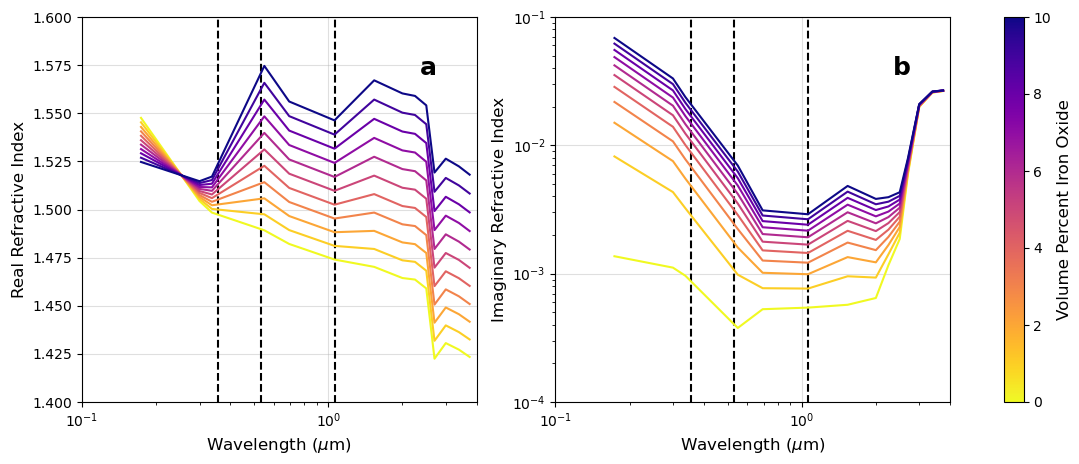
Figure 1Spectral dependence of the effective complex refractive index of mineral dust modeled with varying iron oxide volume fractions (0 % to 10 %). (Left) Real part and (right) Imaginary part of the refractive index. Vertical dashed lines correspond to 355, 532, and 1064 nm wavelengths, three wavelengths of interest for lidar. Mixing of mineral mediums is described in Sect. 2.3.
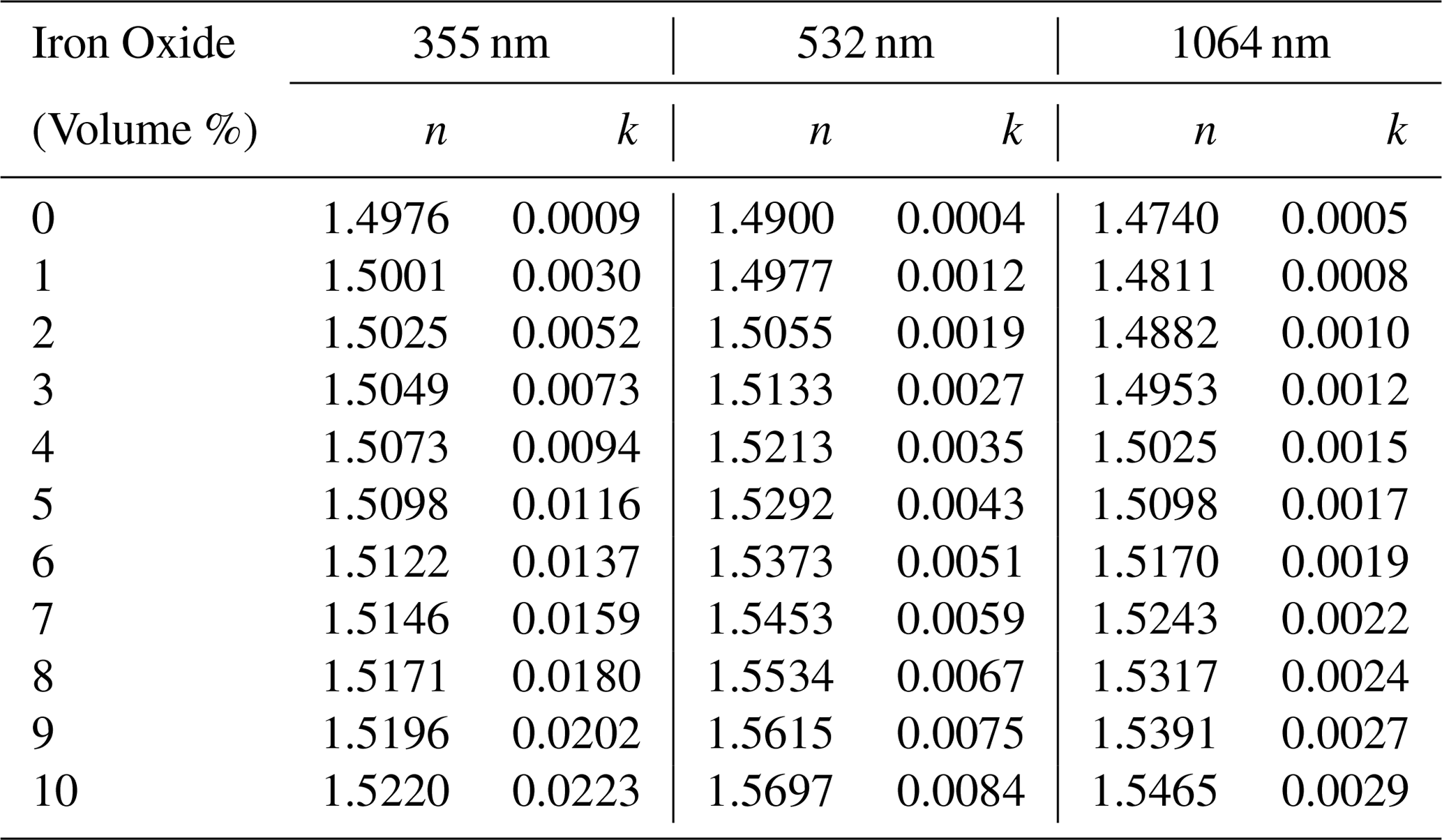
The real part of the refractive index is composed of a simpler two-component volume weighted mixing rule using the data from Scanza et al. (2015), as utilized in Obiso et al. (2024). As illustrated in Fig. 1 and Table 1, the resulting CRI exhibits distinct spectral sensitivities to iron content. The real part (n) shows a characteristic peak at 550 nm and increases in magnitude with higher iron oxide fractions. The imaginary part (k) displays even greater sensitivity, particularly at shorter wavelengths. This sensitivity diminishes as the wavelength increases toward the near-infrared.
Table 1Effective complex refractive indices () of mineral dust at varying iron oxide volume percentages determined through a parameterization of ground sampled dust refractive index and mineral composition.
We acknowledge three primary sources of uncertainty in the optical modeling framework described above. First, the refractive indices used here are derived from an inversion technique that minimizes the difference between optical measurements and Mie theory calculations (Di Biagio et al., 2019). This reliance on a spherical model for retrieval has been shown to systematically underestimate the imaginary refractive index of non-spherical dust particles (Kong et al., 2024). Second, our simulations treat dust particles as homogeneous media with a single effective refractive index. This simplification neglects the complex internal structure of dust, where highly absorbing iron oxides often exist as inclusions or coatings rather than being uniformly mixed, a factor known to influence absorption efficiency (Zong et al., 2021; Kemppinen et al., 2015; Wang et al., 2023). Third, we assume a mineralogically uniform dust plume where the refractive index is constant across all particle sizes. This assumption does not account for size-dependent mineralogy (e.g. Kandler et al., 2007), variations in clay versus silt fractions) or chemical aging processes that may alter composition during transport (Shi et al., 2011; Royer et al., 2025).
In this section, we examine how single-particle lidar-relevant quantities (S, δ, and ω) vary with size parameter and iron-oxide content. We first describe Rayleigh-regime behavior and then derive the geometrical-optics (GO) limit. Bulk (PSD-averaged) behavior is discussed in Sect. 4.
3.1 Rayleigh-Regime Behavior (x≪1)
Figure 2 shows the single-scattering properties of hexahedral dust particles computed using the TAMUdust2020 database as a function of size parameter () and iron-oxide content for three lidar parameters at 532 nm from Rayleigh to GO regime x=103 (results for 355 and 1064 nm exhibit similar asymptotic behavior and are provided in Fig. S1 in the Supplement).
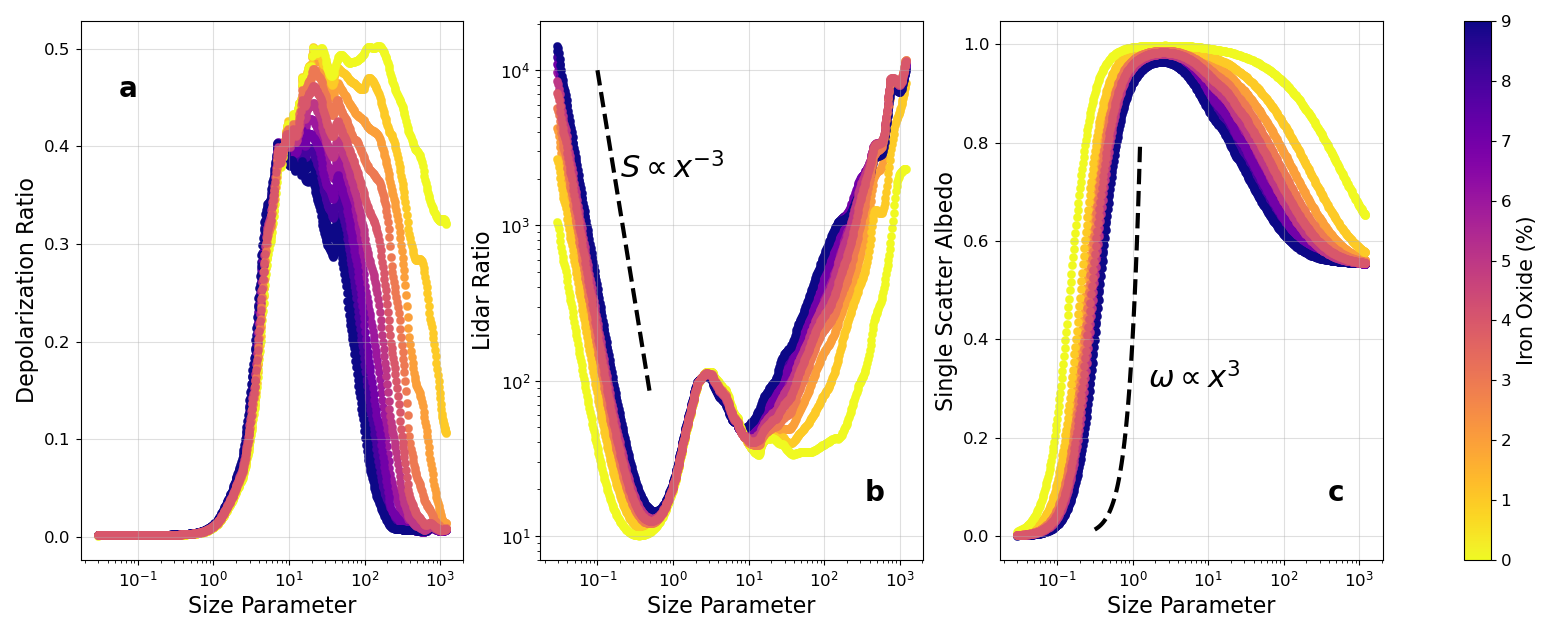
Figure 2Single-particle backscattering properties for hexahedral dust particles calculated via the TAMUdust2020 database at 532 nm. Panels show the evolution of (a) depolarization ratio, (b) lidar ratio, and (c) single-scattering albedo as a function of size parameter.
The depolarization ratio (δ) exhibits a consistent size-dependent behavior across all wavelengths. For small size parameters (x<10), δ increases rapidly with size, consistent with the transition from the Rayleigh to the Mie scattering regime. However, for larger particles (x>10), the behavior diverges based on absorptivity. For non-absorbing particles (low iron oxide content), δ reaches an asymptotic maximum. In contrast, highly absorbing particles (high iron oxide content) exhibit a distinct peak followed by a sharp decrease in depolarization as size increases.
The essential distinction among the three wavelength rows in Fig. 2 is their different absorptivity at fixed iron-oxide fraction (Fig. 1b), i.e., different imaginary refractive index (k). For the same iron-oxide content, dust is most absorbing at 355 nm (largest k), intermediate at 532 nm, and weakest at 1064 nm. Consequently, absorption-driven suppression of depolarization begins at smaller size parameter x at 355 nm, while the damping of δ is delayed to larger x at longer wavelengths.
The lidar ratio (S) and single-scattering albedo (ω) also display a strong dependence on the CRI. As the volume fraction of iron oxide increases, absorption enhances the lidar ratio for large particles, driven by the suppression of backscattered intensity relative to extinction. Conversely, the single-scattering albedo decreases monotonically with increasing size and iron content, reflecting the dominance of volumetric absorption in the geometric optics regime.
The Rayleigh-limit scattering and absorption efficiencies can be approximated as (Bohren and Huffman, 2008)
where x is the size parameter and n is the complex refractive index. In the Rayleigh regime, the leading-order behavior is Qsca∝x4 while Qabs∝x, so Qext≈Qabs and the single-scattering albedo
Because P11 is size independent according to Rayleigh-Gans theory, it follows that , accounting for the negative linear trend in Fig. 2 and the elevated lidar ratios of particles that are small relative to the wavelength.
To verify the leading-order behavior in the Rayleigh regime (x≪1), we performed a log-log regression of the lidar ratio (S) against the size parameter for radii below 10−1 µm. Across all examined refractive indices and wavelengths, the numerical slope was found to be . These values are in close agreement with the theoretical prediction of derived from Eqs. (2) and (11), assuming P11 is size-independent. The slight departure from the ideal slope of −3 may reflect the transition toward the Mie regime and the inclusion of higher-order terms in the power series expansion of the scattering coefficient or effects of particle shape or index of refraction. Furthermore, the log-log slope of the single-scattering albedo (ω) was found to be 2.88±0.08, confirming that the spectral and size dependence of the lidar ratio in this limit is almost entirely driven by the absorption-dominated extinction.
For nonspherical particles, the Rayleigh-limit scattering matrix is governed by the principal values of the polarizability tensor, which can be summarized by a geometric factor M described in Bohren and Huffman (2008). At the backscattering angle (θ=180°), the scattering matrix elements 〈P11〉 and 〈P22〉 are given by:
The linear depolarization ratio (δ) in the Rayleigh limit is thus determined by the deviation of M from unity:
For perfectly spherical particles, M=1 and δ=0. For natural dust particles that are not extremely elongated, M is slightly less than 1, resulting in a small, size-invariant baseline depolarization.
Physically, very small particles are inefficient scatterers compared to their absorption (when Im(n)≠0), so the scattered intensity and polarization changes become negligible, consistent with both δ→0 and ω→0 as x→0.
3.2 Geometrical-Optics-Regime Behavior (x≫1)
To describe the physical mechanism responsible for suppressed depolarization in large, strongly absorbing dust particles, we consider the geometric-optics limit (x≫1). In this regime the extinction cross section approaches twice the geometrical projected area, i.e., Cext≈2Cgeo (equivalently Qext≈2). The scattering cross section can be written as the sum of a ray-tracing contribution and a diffraction contribution, , where the superscripts R and D denote geometrical rays and diffraction, respectively. For sufficiently large particles, Babinet's principle implies . Consistent with this separation, the complex amplitude scattering matrix can be decomposed as (Cai and Liou, 1982; Zhang et al., 2004; Macke et al., 1996; Yang and Liou, 1996):
The first term on the right-hand side represents the ray-tracing (geometrical-optics) contribution, while the second term represents diffraction. In this approximation the diffraction amplitude matrix is diagonal and can be written as Ping and Liou (1998)
where θ is the scattering angle, is the vacuum wavenumber, and D is a constant proportional to the particle projected area, defined as
where es is a unit vector pointing along the scattering direction. The above integration is over the particles' projection on a plane perpendicular to the incident direction. , a function of the scattering angle, largely determines the diffraction pattern and is strongly peaked in the forward direction. Using the standard convention (θ=0 forward scattering, θ=π backscattering), both and vanish at exact backscatter (θ=π).
The corresponding phase matrix elements can be written in terms of the amplitude matrix elements. In particular,
In the ray-tracing contribution, an incident beam undergoes reflection and refraction at the particle surface, and refracted rays may experience further internal reflections before exiting. For large particles with substantial absorption, however, internally transmitted rays are strongly attenuated and the ray-tracing contribution is dominated by the first surface reflection. Consequently, and the polarization properties are largely controlled by Fresnel reflection. At (or near) normal incidence, Fresnel reflection does not generate cross-polarized components, implying for the surface-reflected field. Under these conditions, we obtain the limiting approximations for large, strongly absorbing dust particles. Because diffraction contributes Cgeo to the scattering cross-section, the single-scattering albedo limit becomes:
While is small (representing only the integrated first-surface reflection), it is strictly non-zero. Thus, the theoretical asymptote for real mineral dust will always remain slightly elevated above 0.5, with its exact magnitude dependent on macroscopic shape and random orientation. This asymptotic limit can be expressed in closed form as , where is the projected-area-weighted Fresnel reflectance of the particle. For the mineral dust refractive indices used in this study (Table 1), to 0.10, which yields an asymptotic lower bound of ω∞≈0.546 to 0.549. This analytical estimate closely matches the lower envelope of our numerical bulk asymptotes (0.55 to 0.65), proving that the elevation above 0.5 is entirely accounted for by integrated first-surface Fresnel reflection. Additionally, the phase matrix elements simplify to:
It follows from Eq. (18) that the linear depolarization ratio tends to zero for large, strongly absorbing particles (δ≈0). At the same time, because the ray-tracing contribution is limited to a weak single surface reflection and diffraction does not contribute at exact backscatter, the backscatter phase function (P11) becomes small, yielding a large lidar ratio.
These derived limits provide a theoretical framework that unifies and explains several previously disconnected observations. The absorption-driven suppression of depolarization has been noted numerically in ice-crystal systems (e.g., Kustova et al., 2022) and measured in laboratory experiments with hematite at exact backscatter (e.g., Miffre et al., 2023), but previously lacked a complete backscatter-matrix derivation. Furthermore, this behavior shares a conceptual analog with radar astronomy, where a low circular depolarization ratio serves as the classical signature of polarization-preserving quasi-specular reflection from smooth surfaces.
3.3 Sensitivity to Dust Particle Shape
To establish a robust physical framework for dust lidar properties, it is necessary to determine whether the observed asymptotic behaviors are artifacts of a specific geometric model or fundamental optical phenomena. Natural mineral dust exhibits highly complex and irregular morphologies and are not necessarily fully represented by the simplified models available. However, by comparing the scattering properties of distinct, idealized geometries, we can separate the baseline optical responses from the fine-structure perturbations introduced by specific surface facets and particle symmetries.
To test this sensitivity, we contrast the single-scattering properties of sharp-edged, irregular hexahedrals in TAMU2020 database (shown previously in Fig. 2) with those of smooth, rotationally symmetric spheroids with an aspect ratio of 1.5, presented in Fig. 3. Despite the vast geometric dissimilarity between faceted hexahedrals and curved spheroids, the macroscopic overarching trends remain remarkably consistent across both shape models.
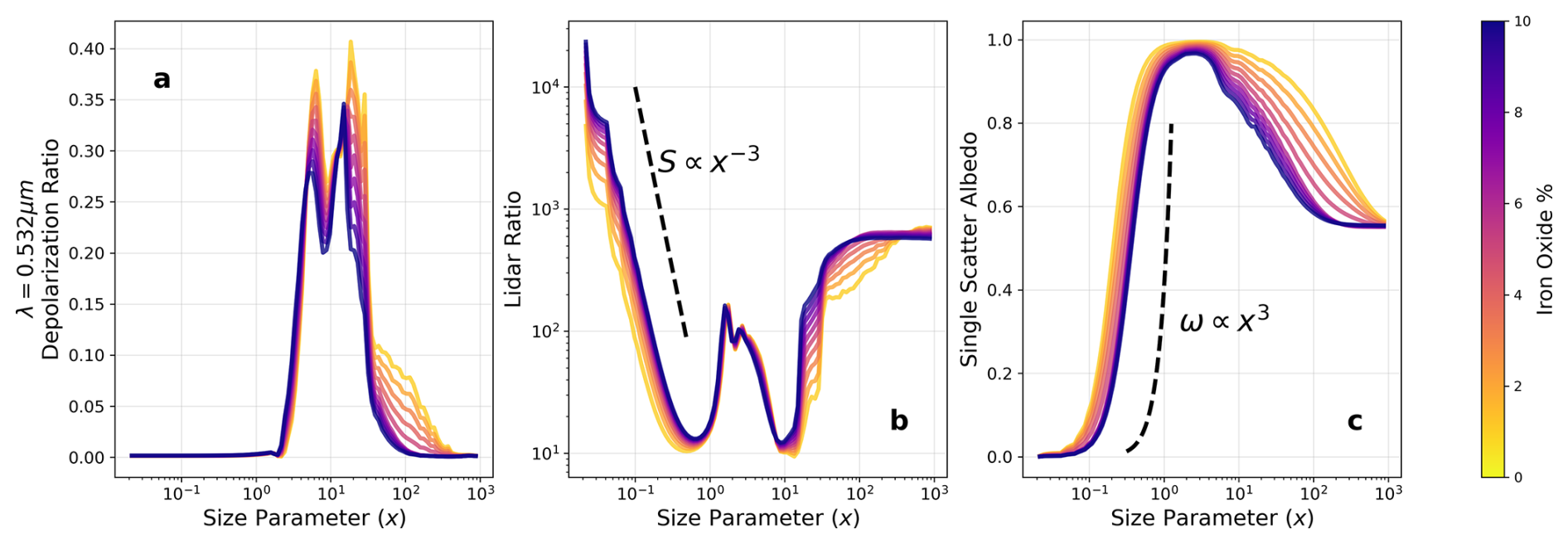
Figure 3Single-particle backscattering properties for spheroidal dust particles with aspect ratio 1.5 calculated via the triaxial ellipsoid database at 532 nm. Panels show the evolution of (a) depolarization ratio, (b) lidar ratio, and (c) single-scattering albedo as a function of size parameter.
In the Rayleigh regime (x≪1), the influence of particle shape is theoretically expected to be minimal, as the particle is entirely encompassed by the incident electromagnetic wave. Our spheroid calculations confirm the robust nature of the limits established by the hexahedral model: the single-scattering albedo closely follows ω∝x3, and the lidar ratio scales as . Furthermore, the linear depolarization ratio (δ) remains near zero for both geometries, dictated by the slight deviations of the polarizability tensor from that of a perfect sphere rather than bulk macroscopic shape.
More importantly, the GO regime (x≫1) exhibits highly shape-insensitive asymptotic behavior when absorption is introduced. For non-absorbing particles, shape significantly dictates the saturation point of the depolarization ratio; for instance, the absolute magnitude of δ is generally lower for spheroids than for hexahedrals due to differing degrees of symmetry and internal ray-tracing dynamics. However, the introduction of absorptive iron oxides fundamentally overrides these shape-specific differences. As particle size and iron oxide content increase, both shape models demonstrate a distinct peak in δ followed by a sharp, asymptotic decrease. This confirms that the suppression of depolarization in super-coarse dust is a fundamental consequence of volumetric absorption attenuating the internal reflected rays that typically generate cross-polarized signals, completely independent of the particle's external geometric smoothness or sharpness.
Similarly, the transition of the single-scattering albedo () and the substantial enhancement of the lidar ratio (S) for large, absorbing particles are preserved across both the hexahedral and spheroidal databases.
While the transition into this high-absorption, high-lidar-ratio regime is robust across both models, their exact trajectories at the extreme upper bounds of the size parameter (x>103) do diverge, with spheroids appearing to level off while hexahedra continue to increase. In the geometrical-optics limit, internal rays are effectively absorbed, rendering exact backscatter highly dependent on first-surface Fresnel reflection. Consequently, the distinct surface geometries, such as smooth curvature for spheroids versus flat facets and sharp edges for hexahedra, yield different backscattering efficiencies. It is difficult to define a universal asymptotic plateau beyond this point due to the computational limits of the underlying databases and the extreme sensitivity of surface reflection to the exact imaginary refractive index. Thus, while the physical mechanism driving the suppression of depolarization and the enhancement of the lidar ratio is independent of shape, the absolute magnitude at extreme macroscopic sizes remains shape-dependent.
While the asymptotic limits (x≪1 and x≫1) and the overarching functional form of the backscattering optical properties are robust across shape models, we emphasize that the intermediate size regime (x∼10–100) remains highly shape-dependent. The absolute magnitude of the depolarization ratio and the exact location of the peak in x-space vary significantly between the two geometries. As shown in our supplementary relative difference analysis (Fig. S2), the absolute magnitude of δ can differ by 0.1 to 0.4 between the hexahedral and spheroidal models in this transition zone. Because operational lidars at wavelengths between 355 and 1064 nm frequently sample coarse dust within this exact size-parameter range, this shape-induced variance is practically significant. Such absolute differences are large enough to shift aerosol-typing thresholds in standard retrieval algorithms (e.g., CALIOP, EarthCARE). The importance of shape selection in this intermediate regime aligns with recent findings that the choice between hexahedral and spheroidal models substantially impacts combined lidar-polarimeter dust retrievals and that spheroids saturate at a lower maximum depolarization ratio (Regmi et al., 2026, Fig. C1–C3).
This convergence between such distinct morphologies suggests that Rayleigh to GO regime transition of dust lidar scattering properties is driven primarily by the size parameter and fundamental electromagnetic absorption, rather than the specific presence of sharp edges or smooth curvature. Therefore, these asymptotic limits represent the fundamental baseline physics for dust scattering. While detailed morphological complexity certainly modulates the exact magnitude of these observables, particle shape acts only as a secondary perturber to these primary optical drivers.
It is important to place these findings within the context of established scattering theory. For strictly non-absorbing particles, the geometrical-optics limit is well-documented: the depolarization ratio reaches a constant, elevated plateau that is heavily dictated by the particle's macroscopic shape. The convergence of δ→0 observed here at large size parameters is therefore not a general size rule for all nonspherical particles, but strictly an absorption-driven phenomenon. Strong volumetric absorption attenuates the internal cross-polarizing rays, effectively overriding the expected shape-dependent plateau. As a result, while absolute magnitudes differ substantially in the intermediate size regime (x∼10–100) where shape uncertainty is highest, the introduction of absorption forces fundamentally different shape models to eventually converge.
4.1 Dependence on the median size of PSD
We now transition from single-particle behavior to bulk optical properties representative of realistic dust plumes. Specifically, single-particle scattering quantities are integrated over the lognormal particle size distribution (Eq. 4) to account for the polydisperse nature of atmospheric dust. The bulk scattering-matrix elements (〈Pij〉) and bulk single-scattering albedo (〈ω〉) are then computed from size-dependent properties weighted by scattering and extinction cross sections (Eqs. 5 and 6). Finally, the PSD-averaged lidar ratio (〈S〉) and depolarization ratio (〈δ〉) are obtained from these integrated quantities (Eqs. 7 and 8). This framework links single-particle microphysical sensitivities to the bulk observables measured by lidar.
The general pattern of bulk scattering properties of dust after PSD average demonstrate a strong dependence on mineralogy, specifically iron oxide content. Figure 4 illustrates these bulk properties using the TAMUdust2020 hexahedral model as a function of median radius of the PSD rm in Eq. (4). While non-absorptive, non-spherical particles generally exhibit an asymptotic increase in depolarization ratio (δ) with size (La Luna et al., 2025), the introduction of absorptive minerals fundamentally alters this behavior. As wavelength decrease and iron oxide content increases, the depolarization ratio peaks before declining significantly for super-coarse particles (r>10 µm). This suppression of δ is attributed to the absorption of internal rays that would otherwise contribute to cross-polarized backscattering. To facilitate direct comparison with lidar field observations, a condensed summary of these absolute bulk optical properties (S, δ, ω) at key size and composition extremes is provided in Table 2.
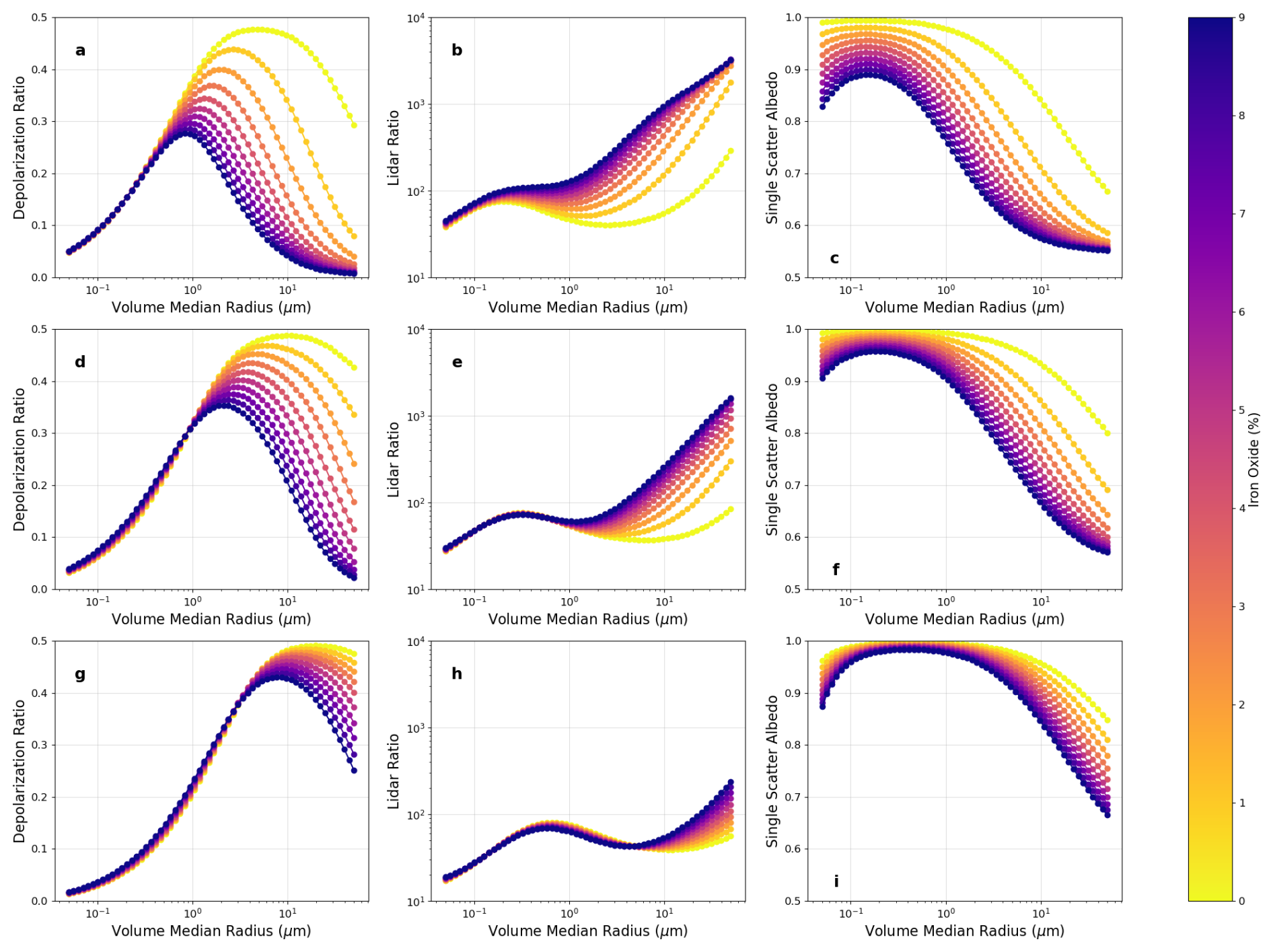
Figure 4(a, d, g) Depolarization ratio, (b, e, h) lidar ratio, and (c, f, i) single scatter albedo for mineral dust at (a–c) 355 nm, (d–f) 532 nm, and (g–i) 1064 nm wavelength using the TAMUdust2020 database.
Similarly, the lidar ratio (S) demonstrates a sensitivity to absorption when rm is large. For large particles, enhanced absorption suppresses backscattering more effectively than extinction, leading to a substantial increase in S. This effect is most pronounced at 355 nm, where iron-oxide absorption is strongest (Fig. 1). Given that S can span multiple orders of magnitude depending on the source region and PSD, the assumption of a uniform lidar ratio in elastic lidar retrievals, particularly for missions such as CALIPSO, may introduce significant uncertainties. Conversely, High Spectral Resolution Lidar (HSRL) missions, such as EarthCARE, measure extinction and backscatter independently, allowing them to directly observe this wide variability in S without relying on assumed values. Furthermore, the single-scattering albedo decreases monotonically with increasing size and iron content, approaching a theoretical asymptote determined by the interplay of particle shape and the imaginary refractive index.
When rm becomes larger than about 10 µm, particles with size parameters in the GO regime dominate the PSD. As a result, the bulk properties in Fig. 4 exhibit the same behavior predicted in Sect. 3.2. While weakly absorbing dusts tend to approach a maximum depolarization ratio as size increases (La Luna et al., 2025), stronger absorption causes δ to peak and then decrease toward zero for large, iron-rich particles. Increased iron-oxide absorption also raises the lidar ratio for large particles, with the strongest effect at 355 nm. Because S spans multiple orders of magnitude, an accurate representation of this quantity is important for lidar retrievals, particularly at 355 nm, where source-dependent mineralogy and PSD differences can strongly affect inferred values. The coupling between size and the imaginary refractive index is also reflected in the bulk single-scattering albedo: as median size increases, SSA decreases monotonically toward an asymptote. As established in Sect. 3.2, while strong absorption effectively extinguishes internally transmitted rays in super-coarse particles, it does not eliminate first-surface Fresnel reflection. Because mineral dust possesses a real refractive index significantly different from air (e.g., n≈1.5), the integrated surface reflection across randomly oriented particles adds a constant, non-negligible scattering contribution. Consequently, the bulk SSA does not reach the absolute theoretical floor of 0.5, but instead converges to a slightly higher elevated baseline (typically 0.55 to 0.65). The exact magnitude of this final asymptote is explicitly governed by the interplay of the real refractive index, macroscopic particle shape, and random orientation.
To distinguish the influence of particle geometry from that of mineral composition, we performed parallel calculations using a spheroidal shape model with a fixed aspect ratio of 1.5. The results are shown in Fig. 5. While the absolute magnitude of the depolarization ratio is lower for spheroids – likely because of shape-dependent saturation behavior – the functional dependence on size and iron-oxide content remains consistent with the hexahedral model. Specifically, the decrease in δ and increase in S for large, absorbing particles are robust features, independent of the specific nonspherical geometry used.
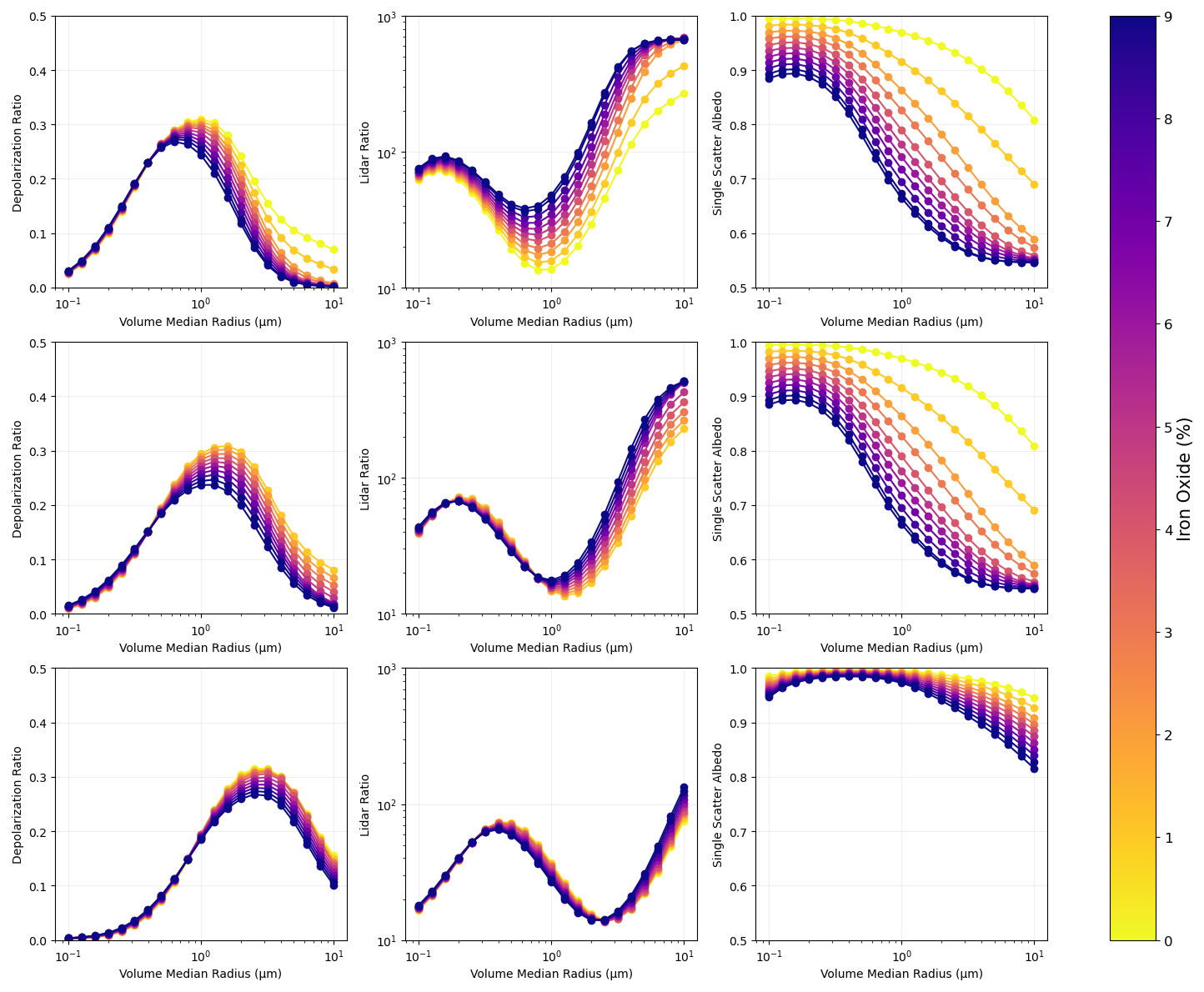
Figure 5(a, d, g) Depolarization ratio, (b, e, h) lidar ratio, and (c, f, i) single scatter albedo for mineral dust at (a–c) 355 nm, (d–f) 532 nm, and (g–i) 1064 nm wavelength using spheroids with an aspect ratio of 1.5.
4.2 Spectral Variation of Lidar Properties Based on Ideal PSD
In Sect. 4.1, we emphasized the size dependence of single-particle and PSD-averaged lidar properties. Here, we shift perspective to their spectral variation, because multiwavelength behavior is the quantity directly observed by operational and research lidar systems. In particular, the physical origin of tri-wavelength dust signatures reported by Haarig et al. (2017, 2022, 2025) at 355, 532, and 1064 nm is not yet fully constrained. To address this gap, we evaluate S and δ at these three wavelengths for three representative median radii (rm=1, 5, and 10 µm). These rm values are selected to emulate PSD evolution from source-dominated, coarse dust to progressively transported dust with reduced coarse-mode contribution.
Figure 6 further elucidates these spectral dependencies by isolating the lidar ratio across varying median radii (1, 5, and 10 µm). At 1064 nm, the lidar ratio is shown to be largely independent of both size and mineralogy. This suggests the extinction errors will be lower at 1064 nm than 532 or 355 nm wavelength for the backscatter lidar technique commonly used in backscatter lidars. In stark contrast, at shorter wavelengths (355 nm), both particle size and absorptivity drive substantial increases in the lidar ratio. This spectral bifurcation highlights the critical need for wavelength-dependent lidar ratio assumptions in remote sensing retrievals, rather than the uniform values often applied across instruments.
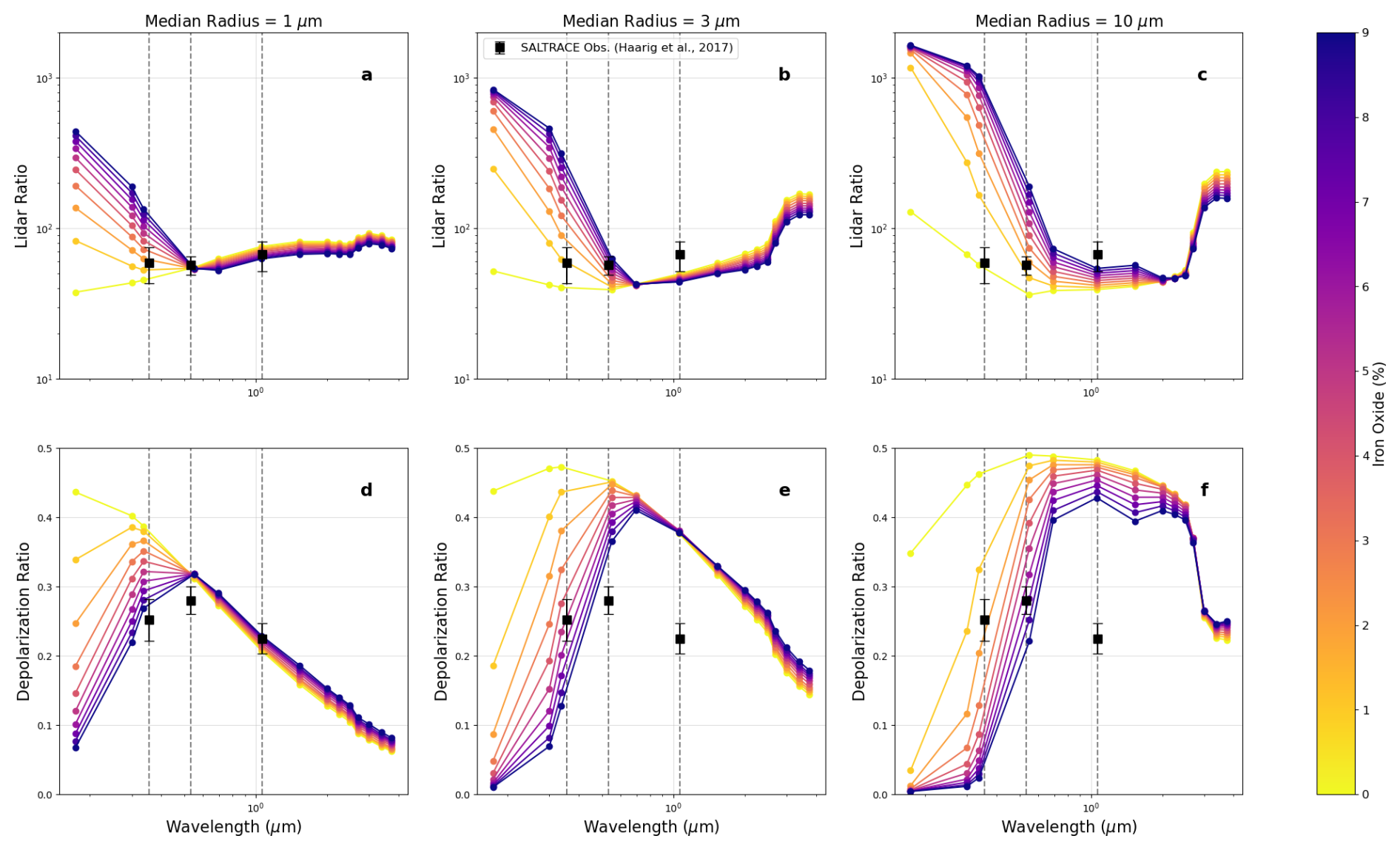
Figure 6(a, b, c) Lidar ratio and (d, e, f) depolarization ratio,for mineral dust at (a, d) 1 µm, (b, e) 3 µm, and (c, f) 10 µm median radius utilizing the hexahedral TAMUdust2020 shape model database. Black square markers denote the mean and standard deviation of triple-wavelength transported Saharan dust observations from the SALTRACE campaign over Barbados (Haarig et al., 2017).
These findings provide a theoretical basis for the “inverse-v” spectral depolarization feature frequently observed in field measurements. At longer wavelengths (1064 nm), absorption by iron oxides is negligible; thus, the depolarization ratio is primarily governed by particle size, exhibiting a positive correlation with increasing radius. Conversely, at shorter wavelengths (355 nm), the signal is dominated by the refractive index. The high absorptivity of iron-rich super-coarse dust effectively dampens the depolarization signal, causing δ355 to drop below δ532 or δ1064. Consequently, the spectral peak of δ typically occurs between 355 and 1064 nm, with the precise location determined by the complex interplay of mineralogy, shape, and the presence of super-coarse modes.
4.3 Spectral Variation based on in situ measured PSD
The analysis above used idealized lognormal PSDs to isolate how size, shape, and composition control lidar observables. We now extend that framework to PSDs from in situ measuremens from several field campaigns so the investigation reflects measured dust populations and enables more direct comparison with observations.
While generalized size distributions for dust at various stages of transport have been documented in recent literature (e.g., Formenti and Di Biagio, 2024), we specifically selected the FENNEC, AER-D, and AERONET distributions for this analysis. The normalized volume size distributions for the three distributions are shown in Fig. 7. These datasets allow us to contrast a source-region profile, a mid-range transported plume, and a standard remote-sensing retrieval, while leveraging the availability of relevant depolarization measurements necessary to validate our theoretical framework.
First, the FENNEC campaign dataset represents a source-region PSD measured in the Sahara, characterized by a coarse-mode dominant profile with a substantial particle fraction extending to radii of 102 µm. Second, the AER-D campaign data, collected off the coast of Western Africa (Cabo Verde), represents a transported dust plume where gravitational settling during transit has effectively depleted the super-coarse fraction (>100 µm). Finally, we evaluate the standard AERONET retrieval PSD (collected at Cabo Verde), which is inherently constrained by an inversion algorithm that truncates particle radii at roughly 10–15 µm and enforces a bi-modal distribution structure.
The presence of super-coarse particles (r>10 µm) fundamentally alters the spectral depolarization signature. As shown in Fig. 8, the FENNEC distribution, which includes particles up to 100 µm, exhibits a significantly elevated δ at 1064 nm (δ1064>0.4) compared to the AER-D distribution (δ1064≈0.25). This aligns with the geometric optics framework established in Sect. 3.2: at longer wavelengths, absorption is minimal, and depolarization is positively correlated with particle size. It may then be important for instruments at 1064 nm wavelength to utilize different lidar ratio for local and transported dust. Consequently, the reduction in δ1064 observed in transported dust serves as a robust indicator of gravitational settling and the loss of the super-coarse mode.
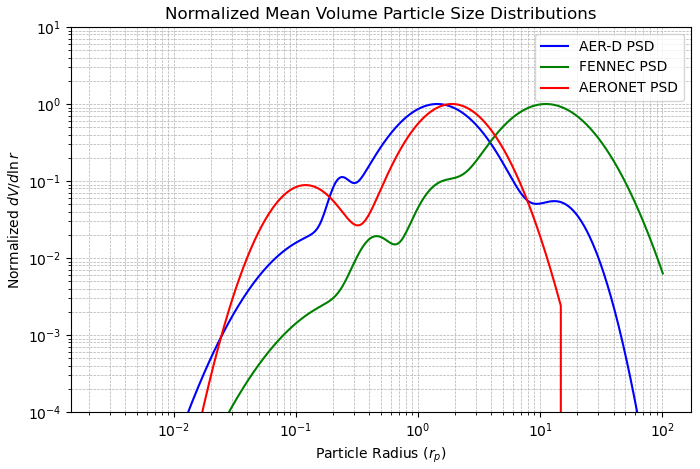
Figure 7Normalized Volume Particle size distribution from (a) AER-D, (b) FENNEC, and (c) AERONET campaigns.
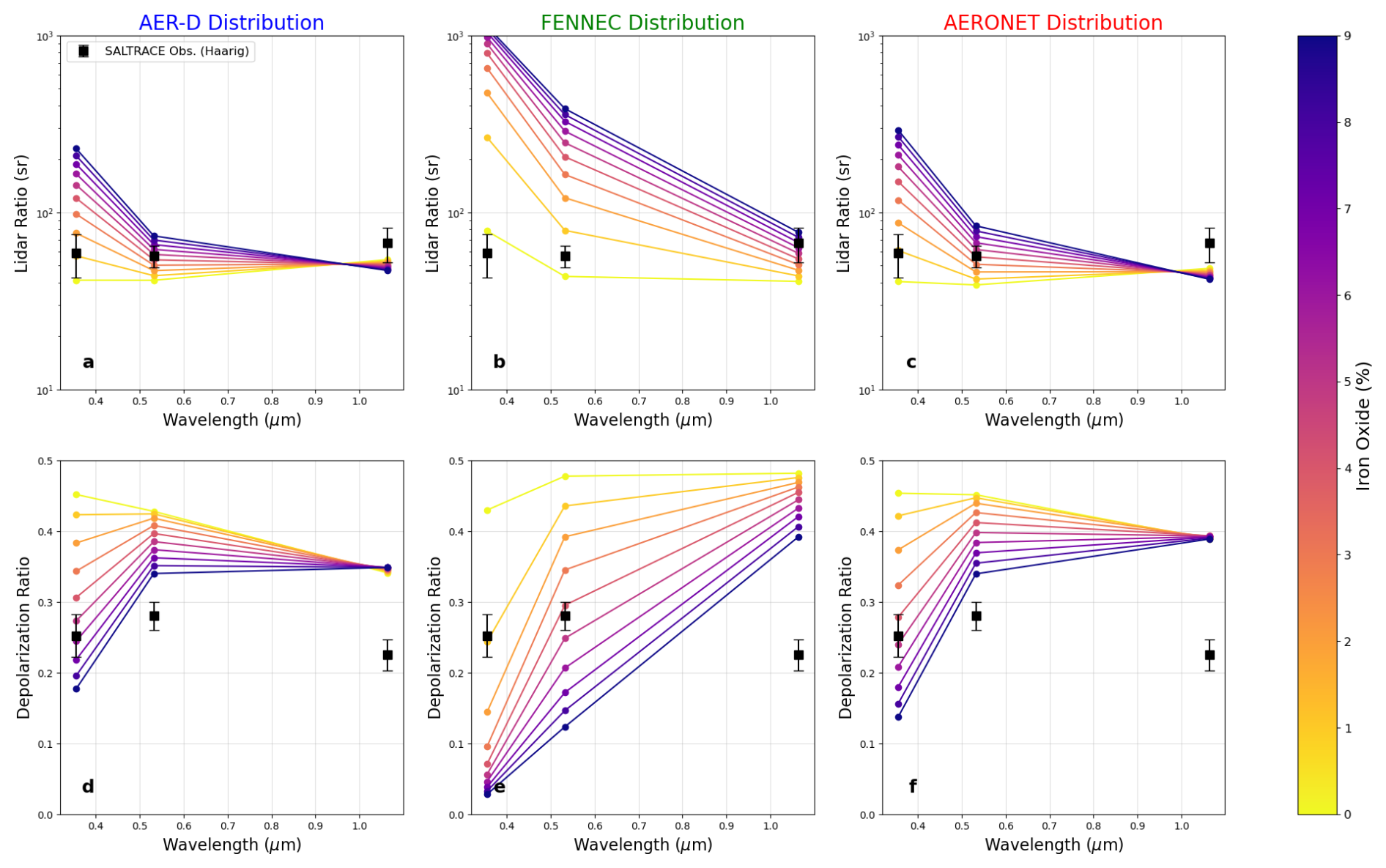
Figure 8Lidar Ratio (a–c) and Depolarization ratio (d–f) for (a, d) AER-D, (b, e) FENNEC, and (c, f) AERONET particle size distributions as a function of wavelength and iron oxide content in mineral dust utilizing the hexahedral TAMUdust2020 shape model database. Black square markers denote the mean and standard deviation of triple-wavelength transported Saharan dust observations from the SALTRACE campaign over Barbados (Haarig et al., 2017).
In contrast, the depolarization ratio at 355 nm is governed primarily by mineralogy rather than size. To replicate the low δ355 values observed in triple-wavelength lidar measurements, significant fractions of absorptive iron oxides are required. This suggests that accurate lidar retrievals at ultraviolet wavelengths cannot rely on global average refractive indices but must account for regional mineralogical variability.
A critical finding of this study is the optical ambiguity introduced by super-coarse, iron-rich particles. Conventional AERONET inversions are constrained to radii <15 µm and typically model dust with a bi-modal distribution. Despite this truncation, the spectral depolarization signature derived from AERONET PSDs (Fig. 8f) is remarkably analogous to that of the super-coarse FENNEC distribution (Fig. 8e).
This equivalence arises because super-coarse, absorbing particles exhibit suppressed depolarization and enhanced extinction (as detailed in Sect. 4), optically mimicking the behavior of fine-mode dust. Consequently, a remote sensing retrieval relying on AERONET as “ground truth” may converge on a solution that accurately reproduces the optical signal but fundamentally misrepresents the underlying size distribution. This “lidar ambiguity” suggests that super-coarse dust may be systematically underestimated in current retrievals, as its optical signature is indistinguishable from fine-mode aerosols in standard inversion schemes.
This ambiguity is further compounded by the lidar ratio. While elastic lidar retrievals typically assume a static lidar ratio for dust (e.g., S≈40–44 sr for CALIOP, Kim et al., 2018, and CATS, Yorks et al., 2016), our results indicate that super-coarse, absorbing dust can exhibit lidar ratios exceeding 300 sr at 355 nm (Fig. 8a–c). For example, a pure dust plume characterized by the super-coarse FENNEC size distribution and a highly representative Saharan iron-oxide volume fraction of just 3 % yields a suppressed depolarization ratio of approximately 0.18 at 355 nm, alongside a highly elevated lidar ratio. When placed into the CALIOP version 4 automated aerosol classification and lidar ratio selection framework (Kim et al., 2018), an algorithm observing a layer with high S and low δ (≈0.18) will assign the plume to the “Polluted Dust” or Dusty Marine' subtypes based on the respective surface type. This highlights the necessity of using multiwavelength depolarization information for aerosol typing in classification algorithms (Shang et al., 2026).
It is important to contextualize these modeled values against field observations. For instance, Veselovskii et al. (2020) report typical bulk dust lidar ratios at 355 nm in the range of 50 to 80 sr. The divergence between our theoretical upper limits (>300 sr) and these observational baselines likely stems from two possible factors. First, accurately computing the exact backscatter phase matrix element (P11) remains a notoriously difficult challenge for idealized shape models, which can sometimes underestimate backscatter and artificially inflate the lidar ratio. Second, natural dust plumes are rarely composed entirely of pure, iron-rich super-coarse particles. Rather, they are physically and chemically heterogeneous mixtures. The blending of this extreme absorbing fraction with finer, less absorptive dust and background atmospheric aerosols dilutes the macroscopic lidar ratio down to the ranges commonly observed by operational systems.
These theoretical sensitivities help reconcile apparent discrepancies in recent field observations. For instance, Gómez Maqueo Anaya et al. (2025) reported no statistically significant correlation between dust hematite content and intensive optical properties across 22 transport cases in Cabo Verde. Within our framework, this behavior is expected when plumes fall outside the super-coarse regime; when volume median radii remain below roughly 3 µm and iron-oxide variations stay within a moderate range (2 %–3 %), the optical signature is dominated by size and shape, rendering minor mineralogical shifts difficult to isolate. Conversely, when super-coarse modes are heavily preserved compositional differences drive pronounced spectral divergence, aligning with the multiwavelength variability reported by Haarig et al. (2022, 2025).
4.4 A Conceptual framework to understand the spectral variation
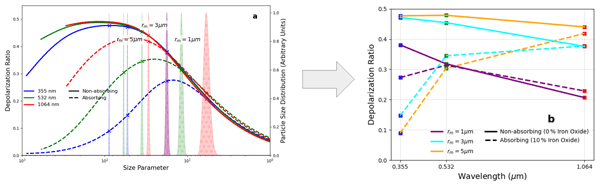
Building on Sect. 4.1 and 4.2, we develop a conceptual framework to explain the spectral variation of dust depolarization ratio (δ) at 355, 532, and 1064 nm. As illustrated in Fig. 9a, this framework is anchored in the transition of single-particle δ from the Rayleigh to geometrical-optics regimes, modulated by absorption. The size-parameter axis is reversed to reflect the increase of x with decreasing wavelength. We overplot PSDs corresponding to rm=1 µm and rm=5 µm in the δ–x space; combining these PSDs with different absorption levels yields four spectral δ patterns in Fig. 9b. This framework qualitatively explains the reported spectral behavior of dust δ in the literature. Specifically, when dust depolarization is measured at different wavelengths, the observations sample distinct regimes of size-parameter space (x). At λ=1064 nm, the effective size parameter is small, sampling the increasing slope of δ within the Mie regime. Here, the depolarization ratio is dictated by the particle size distribution; a coarser distribution shifts the sampling to the right in Fig. 9, resulting in higher δ. The maximum depolarization typically occurs near λ=532 nm, where the sampled size parameter space centers on the peak scattering efficiency for dust. Conversely, λ=355 nm is where mineralogical considerations exert the greatest influence. While non-absorbing minerals (e.g., quartz) maintain an asymptotic high depolarization ratio at this wavelength, the presence of absorptive iron oxides shifts the distribution into the absorption regime described by Eq. (18), leading to a significant reduction in δ.
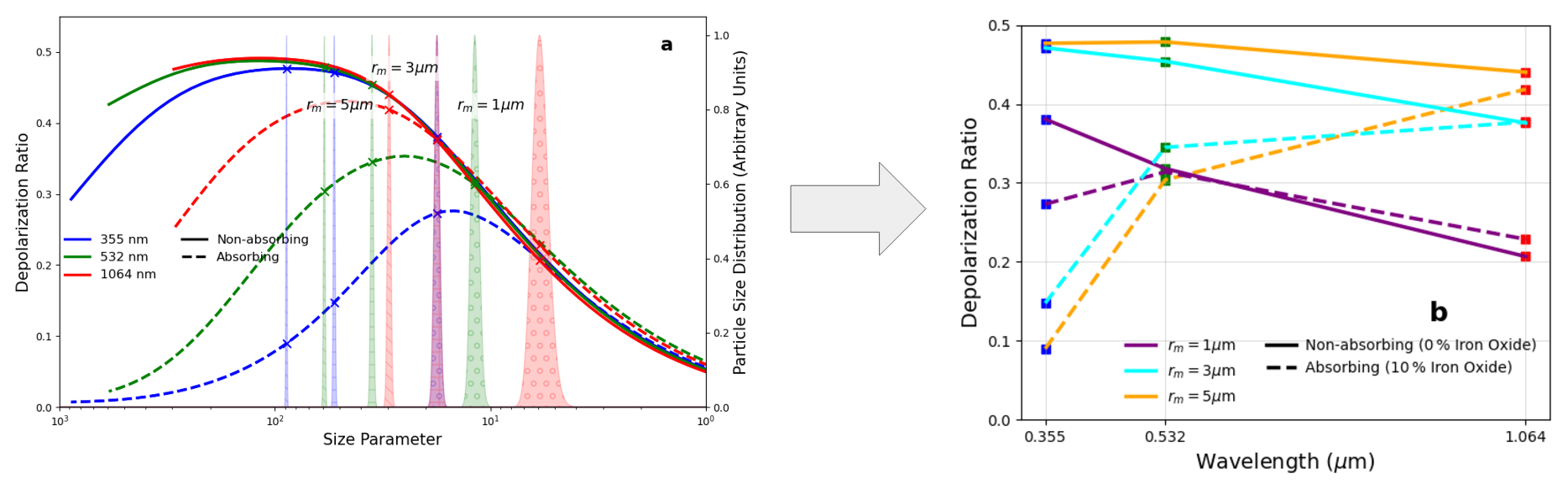
Figure 9Modeled spectral depolarization features of mineral dust utilizing the hexahedral TAMUdust2020 shape model database. (a) Single-particle depolarization ratio as a function of size parameter for non-absorbing (solid lines) and absorbing (dashed lines) particles at 355, 532, and 1064 nm (left vertical axis). Overlaid are lognormal particle size distributions with volume median radii of rm=1, 3, and 5 µm (right vertical axis) to illustrate the size-parameter sampling regimes at different wavelengths. (b) Resulting bulk spectral depolarization ratios, highlighting the “inverse-v” dependence for the different size distributions and absorption properties.
Consistent with this framework, the spectral behavior can be interpreted as wavelength-dependent resampling of the same size distribution in δ–x space. For a fixed particle population, moving to shorter wavelength increases the effective size parameter (e.g., 355 nm relative to 1064 nm), while also increasing sensitivity to iron-oxide absorption through a larger imaginary refractive index in the UV-blue. As a result, depolarization damping is expressed more strongly at 355 nm, whereas at 1064 nm the weaker absorption allows size effects to dominate and preserves higher δ for coarse particles. In the limiting case of weakly absorbing dust (very small iron-oxide fraction, or k≈0), the curves recover the familiar asymptotic behavior reported previously (La Luna et al., 2025).
A critical implication of these findings is the identification of an “optical ambiguity” in current remote sensing frameworks. We demonstrate that large, highly absorptive dust particles yield low depolarization ratios and high lidar ratios, optical signatures that effectively mimic those of fine-mode aerosols or pollution. Consequently, standard retrieval algorithms that assume negligible super-coarse fractions may systematically misclassify these particles, resulting in an overestimation of the fine-mode aerosol load. This mimicry challenges the reliability of retrievals that do not explicitly account for mineralogical absorption in coarse dust.
To resolve this ambiguity, we propose utilizing the depolarization color ratio () as a diagnostic metric for separating size and mineralogy effects (de Foy et al., 2011; Haarig et al., 2024). As illustrated in our analysis, the ratio between δ1064 and δ355 becomes significantly elevated for coarse, absorptive particles. We suggest that future spaceborne lidar systems be designed for multi-wavelength backscatter and depolarization measurements so they can leverage this metric to disentangle the competing influences of particle size and iron oxide content, thereby improving the characterization of dust plume origins and microphysics.
The particularly strong dependence on mineralogy for depolarization ratio at lower wavelengths allows for the opportunity to attempt to separate the dependence of size and refractive index in lidar properties. One such method would be to use a depolarization color ratio metric
for two wavelengths of light λ1, λ2. This metric is commonly used in discussions of the spectral response of dust depolarization ratio as well as for retrieval methodology (e.g. de Foy et al., 2011; Haarig et al., 2024). It becomes very large for coarse absorptive particles as shown in Fig. 10, though the ratio should be observable for moderate sized particles. With an instrument capable of measuring depolarization ratio at multiple wavelengths, retrieving information from the mineralogy of a dust plume may be possible through the framework of iron oxide content.
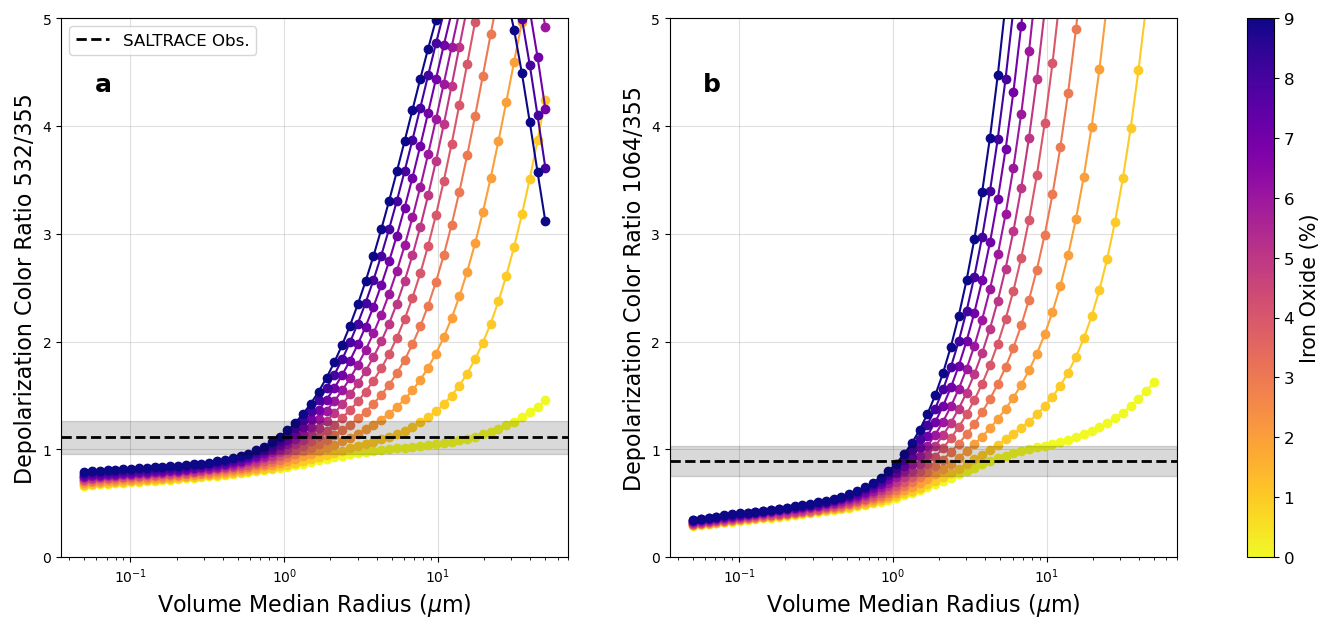
Figure 10Depolarization color ratio (a) and (b) as a function of size and iron oxide content in mineral dust utilizing the hexahedral TAMUdust2020 shape model database. Horizontal dashed lines and shaded regions denote the mean and propagated standard error of the corresponding depolarization color ratios derived from SALTRACE observations (Haarig et al., 2017).
This study systematically investigates the coupled effects of mineralogy and particle size on dust lidar observables, specifically the depolarization ratio (δ) and lidar ratio (S), and optical property single-scattering albedo (SSA). Following the logic developed in the previous sections, our main findings and key novelties are:
-
We establish robust Rayleigh-regime constraints for absorbing dust. In the small-particle limit, and ω∝x3, while δ remains near zero. These relations provide a physically consistent baseline for interpreting weakly depolarizing dust signatures at small size parameter.
-
We establish the theoretical limits of exact-backscatter lidar observables in the geometrical-optics (GO) regime. While the GO limits of extinction and single-scattering albedo for absorbing particles are classical results (e.g., Moosmüller and Sorensen, 2018), to our knowledge, the corresponding exact-backscatter limits of the depolarization ratio (δ) and lidar ratio (S) had not previously been derived. The absorption-driven suppression of depolarization had been observed numerically for ice (Kustova et al., 2022) and in the laboratory for hematite (Miffre et al., 2023) without theoretical explanation; this work supplies the derivation. As particles become super-coarse and absorptive, internal ray paths are attenuated, producing suppressed δ, enhanced S, and asymptotic behavior of SSA toward . Importantly, this behavior is reproduced across distinct particle geometries (hexahedral and spheroidal), demonstrating that GO trends are controlled primarily by size parameter and absorption rather than by details of shape.
-
We bridge single-particle physics to bulk lidar observables through PSD averaging and spectral analysis. Using idealized lognormal PSDs and tri-wavelength calculations (355, 532, and 1064 nm), we show how wavelength-dependent sampling of the δ–x space explains the observed spectral structure, including the inverse-“v” behavior and the differing controls of size (stronger at 1064 nm) and mineralogy (stronger at 355 nm).
-
We test this framework with in situ campaign PSDs (FENNEC and AER-D) and AERONET-retrieved PSDs, and identify a retrieval-relevant optical ambiguity. Super-coarse, iron-rich dust can yield low δ but high S, which can overlap with fine-mode or mixed-aerosol classes. This implies that retrievals assuming truncated coarse modes or fixed dust lidar ratios may systematically underestimate super-coarse dust and bias aerosol-type attribution.
Future refinements to this work should address current limitations in modeling complex aerosol structures. Our results rely on effective medium approximations for refractive indices, which may not fully capture the scattering properties of heterogeneous mixtures. Subsequent studies would benefit from incorporating inhomogeneous internal structures and investigating the roles of chemical aging and coating mechanisms during transport. Such advancements are essential for further reducing uncertainties in the spectral signature of dust depolarization.
Looking forward, the quantitative relationships established here between iron-oxide absorption, particle size, and multiwavelength depolarization offer a powerful, untapped synergy with emerging imaging spectroscopy missions such as NASA's Earth Surface Mineral Dust Source Investigation (EMIT) (Green et al., 2023). While current operational frameworks do not utilize iron-oxide constraints derived directly from spaceborne lidar, coupling EMIT's spatially explicit surface mineralogy maps as localized priors with our physical scattering framework as a forward operator opens a clear pathway forward. Utilizing multiwavelength depolarization lidar measurements within such an integrated framework could ultimately close the loop on composition-resolved dust transport modeling, bridging the gap between spaceborne surface observations and active atmospheric profiling.
Sampled and bulk averaged data from TAMUdust2020 and triaxial ellipsoids from https://doi.org/10.1016/j.jaerosci.2010.02.008 (Meng et al., 2010) are made available at https://doi.org/10.5281/zenodo.19011869 (La Luna et al., 2026). The scattering properties of hexahedral dust geometries are obtained from TAMUdust2020: https://doi.org/10.5281/zenodo.4711247 (Saito, 2021). For the triaxial ellipsoid model, readers are directed to https://doi.org/10.1016/j.jaerosci.2010.02.008 (Meng et al., 2010).
The supplement related to this article is available online at https://doi.org/10.5194/acp-26-14487-2026-supplement.
AL led the investigation, performed all data analysis, and wrote the majority of the original manuscript. ZZ conceptualized the study, supervised the research process, and secured the funding for the project. QS provided the complex refractive index data and parameterization used in the optical modeling. HY contributed to the project coordination and funding acquisition. JY provided expert guidance on lidar remote sensing applications and observational data interpretation. PY provided guidance on single-scattering theory and the use of the TAMUdust2020 and triaxial-ellipsoid databases. All authors contributed to the review and editing of the final manuscript.
At least one of the (co-)authors is a member of the editorial board of Atmospheric Chemistry and Physics. The peer-review process was guided by an independent editor, and the authors also have no other competing interests to declare.
Publisher's note: Copernicus Publications remains neutral with regard to jurisdictional claims made in the text, published maps, institutional affiliations, or any other geographical representation in this paper. The authors bear the ultimate responsibility for providing appropriate place names. Views expressed in the text are those of the authors and do not necessarily reflect the views of the publisher.
This research was supported by the National Science Foundation (NSF) through Atmospheric and Geospace Sciences (grant no. 2232138) and NASA (grant nos. 80NSSC24K0859 and 80NSSC24K0457). Computational resources were provided by UMBC’s Chip High Performance Computing Facility. The authors used ChatGPT (GPT-5.2) and the Prism platform developed by OpenAI to assist with manuscript editing and language improvement during writing and revision.
This research was supported by the National Science Foundation (NSF) through Atmospheric and Geospace Sciences (grant no. 2232138) and NASA (grant nos. 80NSSC24K0859 and 80NSSC24K0457).
This paper was edited by Jason Cohen and reviewed by three anonymous referees.
Adebiyi, A., Kok, J. F., Murray, B. J., Ryder, C. L., Stuut, J.-B. W., Kahn, R. A., Knippertz, P., Formenti, P., Mahowald, N. M., Pérez García-Pando, C., Klose, M., Ansmann, A., Samset, B. H., Ito, A., Balkanski, Y., Di Biagio, C., Romanias, M. N., Huang, Y., and Meng, J.: A review of coarse mineral dust in the Earth system, Aeolian Res., 60, 100849, https://doi.org/10.1016/j.aeolia.2022.100849, 2023. a
Bambha, R., Garcia, J., Razenkov, I., and Eloranta, E.: High-Spectral Resolution Lidar (HSRL) Instrument Handbook, Tech. Rep. DOE/SC-ARM-TR–157, ARM Climate Research Facility, Pacific Northwest National Laboratory, Richland, WA, https://doi.org/10.2172/1251392, 2016. a
Bohren, C. F. and Huffman, D. R.: Absorption and Scattering of Light by Small Particles, John Wiley & Sons, ISBN 978-3-527-61816-3, 2008. a, b
Cai, Q. and Liou, K.-N.: Polarized light scattering by hexagonal ice crystals: theory, Appl. Optics, 21, 3569–3580, https://doi.org/10.1364/AO.21.003569, 1982. a
Campbell, J. R., Hlavka, D. L., Welton, E. J., Flynn, C. J., Turner, D. D., Spinhirne, J. D., Scott, V. S., and Hwang, I. H.: Full-Time, Eye-Safe Cloud and Aerosol Lidar Observation at Atmospheric Radiation Measurement Program Sites: Instruments and Data Processing, J. Atmos. Ocean. Tech., 19, 431–442, https://doi.org/10.1175/1520-0426(2002)019<0431:FTESCA>2.0.CO;2, 2002. a
Chang, Y., Hu, Q., Goloub, P., Podvin, T., Veselovskii, I., Ducos, F., Dubois, G., Saito, M., Lopatin, A., Dubovik, O., and Chen, C.: Retrieval of microphysical properties of dust aerosols from extinction, backscattering and depolarization lidar measurements using various particle scattering models, Atmos. Chem. Phys., 25, 6787–6821, https://doi.org/10.5194/acp-25-6787-2025, 2025. a
Chang, Y., Hu, Q., Goloub, P., and Podvin, T.: Improved Dust Microphysical Retrieval From LiDAR by Introducing a Priori Constraints From In Situ and Laboratory Measurements, J. Geophys. Res.-Atmos., 131, e2025JD045677, https://doi.org/10.1029/2025JD045677, 2026. a
Connelly, D. S., Thompson, D. R., Mahowald, N. M., Li, L., Carmon, N., Okin, G. S., and Green, R. O.: The EMIT mission information yield for mineral dust radiative forcing, Remote Sens. Environ., 258, 112380, https://doi.org/10.1016/j.rse.2021.112380, 2021. a
Conny, J. M. and Ortiz-Montalvo, D. L.: Effect of heterogeneity and shape on optical properties of urban dust based on three‐dimensional modeling of individual particles, J. Geophys. Res.-Atmos., 122, 9816–9842, https://doi.org/10.1002/2017jd026488, 2017. a
de Foy, B., Burton, S. P., Ferrare, R. A., Hostetler, C. A., Hair, J. W., Wiedinmyer, C., and Molina, L. T.: Aerosol plume transport and transformation in high spectral resolution lidar measurements and WRF-Flexpart simulations during the MILAGRO Field Campaign, Atmos. Chem. Phys., 11, 3543–3563, https://doi.org/10.5194/acp-11-3543-2011, 2011. a, b
DeMott, P. J., Sassen, K., Poellot, M. R., Baumgardner, D., Rogers, D. C., Brooks, S. D., Prenni, A. J., and Kreidenweis, S. M.: African dust aerosols as atmospheric ice nuclei, Geophys. Res. Lett., 30, https://doi.org/10.1029/2003GL017410, 2003. a
Di Biagio, C., Formenti, P., Balkanski, Y., Caponi, L., Cazaunau, M., Pangui, E., Journet, E., Nowak, S., Andreae, M. O., Kandler, K., Saeed, T., Piketh, S., Seibert, D., Williams, E., and Doussin, J.-F.: Complex refractive indices and single-scattering albedo of global dust aerosols in the shortwave spectrum and relationship to size and iron content, Atmos. Chem. Phys., 19, 15503–15531, https://doi.org/10.5194/acp-19-15503-2019, 2019. a, b, c, d, e, f, g
Di Biagio, C., Bru, E., Orta, A., Chevaillier, S., Baldo, C., Bergé, A., Cazaunau, M., Lafon, S., Nowak, S., Pangui, E., Andreae, M. O., Dagsson-Waldhauserova, P., Dintwe, K., Kandler, K., King, J. S., Chaput, A., Okin, G. S., Piketh, S., Saeed, T., Seibert, D., Shi, Z., Williams, E., Sellitto, P., and Formenti, P.: Mid- and far-infrared spectral signatures of mineral dust from low- to high-latitude regions: significance and implications, Atmos. Chem. Phys., 26, 1079–1091, https://doi.org/10.5194/acp-26-1079-2026, 2026. a
Donovan, D. P., van Zadelhoff, G.-J., and Wang, P.: The EarthCARE lidar cloud and aerosol profile processor (A-PRO): the A-AER, A-EBD, A-TC, and A-ICE products, Atmos. Meas. Tech., 17, 5301–5340, https://doi.org/10.5194/amt-17-5301-2024, 2024. a
Dubovik, O., Sinyuk, A., Lapyonok, T., Holben, B. N., Mishchenko, M., Yang, P., Eck, T. F., Volten, H., Muñoz, O., Veihelmann, B., van der Zande, W. J., Leon, J., Sorokin, M., and Slutsker, I.: Application of spheroid models to account for aerosol particle nonsphericity in remote sensing of desert dust, J. Geophys. Res.-Atmos., 111, https://doi.org/10.1029/2005jd006619, 2006. a
Formenti, P. and Di Biagio, C.: Large synthesis of in situ field measurements of the size distribution of mineral dust aerosols across their life cycles, Earth Syst. Sci. Data, 16, 4995–5007, https://doi.org/10.5194/essd-16-4995-2024, 2024. a
Fussell, J. C. and Kelly, F. J.: Mechanisms underlying the health effects of desert sand dust, Environ. Int., 157, 106790, https://doi.org/10.1016/j.envint.2021.106790, 2021. a
Go, S., Lyapustin, A., Schuster, G. L., Choi, M., Ginoux, P., Chin, M., Kalashnikova, O., Dubovik, O., Kim, J., da Silva, A., Holben, B., and Reid, J. S.: Inferring iron-oxide species content in atmospheric mineral dust from DSCOVR EPIC observations, Atmos. Chem. Phys., 22, 1395–1423, https://doi.org/10.5194/acp-22-1395-2022, 2022. a, b
Gómez Maqueo Anaya, S., Althausen, D., Faust, M., Baars, H., Heinold, B., Hofer, J., Tegen, I., Ansmann, A., Engelmann, R., Skupin, A., Heese, B., and Schepanski, K.: The implementation of dust mineralogy in COSMO5.05-MUSCAT, Geosci. Model Dev., 17, 1271–1295, https://doi.org/10.5194/gmd-17-1271-2024, 2024. a
Gómez Maqueo Anaya, S., Althausen, D., Hofer, J., Haarig, M., Wandinger, U., Heinold, B., Tegen, I., Faust, M., Baars, H., Ansmann, A., Engelmann, R., Skupin, A., Heese, B., and Schepanski, K.: Investigating the link between mineral dust hematite content and intensive optical properties by means of lidar measurements and aerosol modeling, Atmos. Chem. Phys., 25, 9737–9764, https://doi.org/10.5194/acp-25-9737-2025, 2025. a
Goudie, A. S.: Desert dust and human health disorders, Environ. Int., 63, 101–113, https://doi.org/10.1016/j.envint.2013.10.011, 2014. a
Green, R. O., Mahowald, N., Thompson, D. R., Ung, C., Brodrick, P., Pollock, R., Bennett, M., Lundeen, S., Joyce, M., Olson-Duvall, W., Oaida, B., Bradley, C., Diaz, E., Clark, R., Vannan, S., Swayze, G., Kokaly, R., Ginoux, P., Miller, R., Okin, G., Garcia-Pando, C. P., Ehlmann, B., Kalashnikova, O., Painter, T. H., Realmuto, V., Chadwick, D., Ben-Dor, E., Pearlshtien, D. H., Guanter, L., Phillips, B., Reath, K., Thorpe, A., Shaw, L., Keebler, A., Ochoa, F., Grant, K., Sen, A., Duren, R., Obiso, V., Gonçalves-Ageitos, M., and Huang, Y.: Performance and Early Results from the Earth Surface Mineral Dust Source Investigation (EMIT) Imaging Spectroscopy Mission, in: 2023 IEEE Aerospace Conference, 1–10, https://doi.org/10.1109/AERO55745.2023.10115851, ISSN: 1095-323X, 2023. a, b
Haarig, M., Ansmann, A., Althausen, D., Klepel, A., Groß, S., Freudenthaler, V., Toledano, C., Mamouri, R.-E., Farrell, D. A., Prescod, D. A., Marinou, E., Burton, S. P., Gasteiger, J., Engelmann, R., and Baars, H.: Triple-wavelength depolarization-ratio profiling of Saharan dust over Barbados during SALTRACE in 2013 and 2014, Atmos. Chem. Phys., 17, 10767–10794, https://doi.org/10.5194/acp-17-10767-2017, 2017. a, b, c, d, e
Haarig, M., Ansmann, A., Engelmann, R., Baars, H., Toledano, C., Torres, B., Althausen, D., Radenz, M., and Wandinger, U.: First triple-wavelength lidar observations of depolarization and extinction-to-backscatter ratios of Saharan dust, Atmos. Chem. Phys., 22, 355–369, https://doi.org/10.5194/acp-22-355-2022, 2022. a, b
Haarig, M., Floutsi, A. A., Hofer, J., and Ansmann, A.: Is the depolarization ratio a global characteristic of mineral dust particles? Review on existing multiwavelength lidar measurements, E3S Web of Conferences, EDP Sciences, 575, 02004, https://doi.org/10.1051/e3sconf/202457502004, 2024. a, b, c, d
Haarig, M., Engelmann, R., Baars, H., Gast, B., Althausen, D., and Ansmann, A.: Discussion of the spectral slope of the lidar ratio between 355 and 1064 nm from multiwavelength Raman lidar observations, Atmos. Chem. Phys., 25, 7741–7763, https://doi.org/10.5194/acp-25-7741-2025, 2025. a
Hulst, H. C. v. d.: Light scattering by small particles, New York, Dover Publications, ISBN 978-0-486-64228-4, 1981. a
Jeong, G. Y., Park, M. Y., Kandler, K., Nousiainen, T., and Kemppinen, O.: Mineralogical properties and internal structures of individual fine particles of Saharan dust, Atmos. Chem. Phys., 16, 12397–12410, https://doi.org/10.5194/acp-16-12397-2016, 2016. a
Journet, E., Balkanski, Y., and Harrison, S. P.: A new data set of soil mineralogy for dust-cycle modeling, Atmos. Chem. Phys., 14, 3801–3816, https://doi.org/10.5194/acp-14-3801-2014, 2014. a
Kandler, K., Benker, N., Bundke, U., Cuevas, E., Ebert, M., Knippertz, P., Rodríguez, S., Schütz, L., and Weinbruch, S.: Chemical composition and complex refractive index of Saharan Mineral Dust at Izaña, Tenerife (Spain) derived by electron microscopy, Atmos. Environ., 41, 8058–8074, https://doi.org/10.1016/j.atmosenv.2007.06.047, 2007. a
Karydis, V. A., Kumar, P., Barahona, D., Sokolik, I., and Nenes, A.: On the effect of dust particles on global cloud condensation nuclei and cloud droplet number, J. Geophys. Res.-Atmos., 116, https://doi.org/10.1029/2011JD016283, 2011. a
Kemppinen, O., Nousiainen, T., and Jeong, G. Y.: Effects of dust particle internal structure on light scattering, Atmos. Chem. Phys., 15, 12011–12027, https://doi.org/10.5194/acp-15-12011-2015, 2015. a
Kim, M.-H., Omar, A. H., Tackett, J. L., Vaughan, M. A., Winker, D. M., Trepte, C. R., Hu, Y., Liu, Z., Poole, L. R., Pitts, M. C., Kar, J., and Magill, B. E.: The CALIPSO version 4 automated aerosol classification and lidar ratio selection algorithm, Atmos. Meas. Tech., 11, 6107–6135, https://doi.org/10.5194/amt-11-6107-2018, 2018. a, b
Kok, J. F., Ridley, D. A., Zhou, Q., Miller, R. L., Zhao, C., Heald, C. L., Ward, D. S., Albani, S., and Haustein, K.: Smaller desert dust cooling effect estimated from analysis of dust size and abundance, Nat. Geosci., 10, 274–278, https://doi.org/10.1038/ngeo2912, 2017. a
Kong, S., Sato, K., and Bi, L.: Lidar Ratio–Depolarization Ratio Relations of Atmospheric Dust Aerosols: The Super-Spheroid Model and High Spectral Resolution Lidar Observations, J. Geophys. Res.-Atmos., 127, https://doi.org/10.1029/2021jd035629, 2022. a
Kong, S., Wang, Z., and Bi, L.: Uncertainties in laboratory-measured shortwave refractive indices of mineral dust aerosols and derived optical properties: a theoretical assessment, Atmos. Chem. Phys., 24, 6911–6935, https://doi.org/10.5194/acp-24-6911-2024, 2024. a
Kustova, N., Konoshonkin, A., Shishko, V., Timofeev, D., Tkachev, I., Wang, Z., and Borovoi, A.: Depolarization Ratio for Randomly Oriented Ice Crystals of Cirrus Clouds, Atmosphere, 13, 1551, https://doi.org/10.3390/atmos13101551, 2022. a, b
La Luna, A., Zhang, Z., Zheng, J., Song, Q., Yu, H., Ding, J., Yang, P., and Saito, M.: Scattering properties and lidar characteristics of Asian dust particles based on realistic shape models, Atmos. Chem. Phys., 25, 13359–13377, https://doi.org/10.5194/acp-25-13359-2025, 2025. a, b, c, d
La Luna, A., Zhang, Z., Song, Q., Yu, H., Yorks, J., and Yang, P.: Data for Asymptotic Behavior of Lidar Scattering Properties of Absorbing Dust Aerosols Across Rayleigh and Geometrical-Optics Regimes: Theory and Implications, Zenodo [data set], https://doi.org/10.5281/zenodo.19011869, 2026. a
Lafon, S., Sokolik, I. N., Rajot, J. L., Caquineau, S., and Gaudichet, A.: Characterization of iron oxides in mineral dust aerosols: Implications for light absorption, J. Geophys. Res.-Atmos., 111, https://doi.org/10.1029/2005JD007016, 2006. a
Macke, A., Mueller, J., and Raschke, E.: Single Scattering Properties of Atmospheric Ice Crystals, J. Atmos. Sci., 53, 2813–2825, https://doi.org/10.1175/1520-0469(1996)053<2813:SSPOAI>2.0.CO;2, 1996. a
Mahowald, N. M., Baker, A. R., Bergametti, G., Brooks, N., Duce, R. A., Jickells, T. D., Kubilay, N., Prospero, J. M., and Tegen, I.: Atmospheric global dust cycle and iron inputs to the ocean, Global Biogeochem. Cy., 19, https://doi.org/10.1029/2004GB002402, 2005. a
Meng, Z., Yang, P., Kattawar, G. W., Bi, L., Liou, K. N., and Laszlo, I.: Single-scattering properties of tri-axial ellipsoidal mineral dust aerosols: A database for application to radiative transfer calculations, J. Aerosol Sci. [data set], 41, 501–512, https://doi.org/10.1016/j.jaerosci.2010.02.008, 2010. a, b, c
Miffre, A., Cholleton, D., Noël, C., and Rairoux, P.: Investigating the dependence of mineral dust depolarization on complex refractive index and size with a laboratory polarimeter at 180.0° lidar backscattering angle, Atmos. Meas. Tech., 16, 403–417, https://doi.org/10.5194/amt-16-403-2023, 2023. a, b
Min, M., Hovenier, J. W., and de Koter, A.: Shape effects in scattering and absorption by randomly oriented particles small compared to the wavelength., in: Electromagnetic and Light Scattering – Theory and Applications VII, edited by: Wriedt, T., 230–233, https://doi.org/10.1051/0004-6361:20030456, 2003. a
Mishchenko, M. I. and Yurkin, M. A.: On the concept of random orientation in far-field electromagnetic scattering by nonspherical particles, Opt. Lett., 42, 494–497, https://doi.org/10.1364/OL.42.000494, 2017. a
Moosmüller, H. and Sorensen, C. M.: Single scattering albedo of homogeneous, spherical particles in the transition regime, J. Quant. Spectrosc. Ra., 219, 333–338, https://doi.org/10.1016/j.jqsrt.2018.08.015, 2018. a
Müller, D., Ansmann, A., Mattis, I., Tesche, M., Wandinger, U., Althausen, D., and Pisani, G.: Aerosol-type-dependent lidar ratios observed with Raman lidar, J. Geophys. Res.-Atmos., 112, https://doi.org/10.1029/2006jd008292, 2007. a
Obiso, V., Gonçalves Ageitos, M., Pérez García-Pando, C., Perlwitz, J. P., Schuster, G. L., Bauer, S. E., Di Biagio, C., Formenti, P., Tsigaridis, K., and Miller, R. L.: Observationally constrained regional variations of shortwave absorption by iron oxides emphasize the cooling effect of dust, Atmos. Chem. Phys., 24, 5337–5367, https://doi.org/10.5194/acp-24-5337-2024, 2024. a, b
Ping, Y. and Liou, K. N.: Single-scattering properties of complex ice crystals in terrestrial atmosphere, Contributions to Atmospheric Physics, 71, https://www.osti.gov/etdeweb/biblio/622363 (last access: 18 September 2026), 1998. a
Regmi, G., Espinosa, W. R., Martins, J. V., Puthukkudy, A., Saito, M., Dubovik, O., Momoi, M., and Lopatin, A.: Combined Lidar-Polarimeter Dust Retrievals using Spheroidal and Hexahedral Particle Shape Models, EGUsphere [preprint], https://doi.org/10.5194/egusphere-2025-5865, 2026. a
Royer, H. M., Sheridan, M. T., Elliott, H. E., Blades, E., Lata, N. N., Cheng, Z., China, S., Zhu, Z., Ault, A. P., and Gaston, C. J.: African dust transported to Barbados in the wintertime lacks indicators of chemical aging, Atmos. Chem. Phys., 25, 5743–5759, https://doi.org/10.5194/acp-25-5743-2025, 2025. a
Ryder, C. L., Highwood, E. J., Rosenberg, P. D., Trembath, J., Brooke, J. K., Bart, M., Dean, A., Crosier, J., Dorsey, J., Brindley, H., Banks, J., Marsham, J. H., McQuaid, J. B., Sodemann, H., and Washington, R.: Optical properties of Saharan dust aerosol and contribution from the coarse mode as measured during the Fennec 2011 aircraft campaign, Atmos. Chem. Phys., 13, 303–325, https://doi.org/10.5194/acp-13-303-2013, 2013. a
Saito, M: TAMUdust2020 Database, Version 1.0.0, Zenodo [data set], https://doi.org/10.5281/zenodo.4711247, 2021. a
Saito, M. and Yang, P.: Advanced Bulk Optical Models Linking the Backscattering and Microphysical Properties of Mineral Dust Aerosol, Geophys. Res. Lett., 48, e2021GL095121, https://doi.org/10.1029/2021GL095121, 2021. a
Saito, M., Yang, P., Ding, J., and Liu, X.: A comprehensive database of the optical properties of irregular aerosol particles for radiative transfer simulations, J. Atmos. Sci., 78, 2089–2111, https://doi.org/10.1175/jas-d-20-0338.1, 2021. a, b
Scanza, R. A., Mahowald, N., Ghan, S., Zender, C. S., Kok, J. F., Liu, X., Zhang, Y., and Albani, S.: Modeling dust as component minerals in the Community Atmosphere Model: development of framework and impact on radiative forcing, Atmos. Chem. Phys., 15, 537–561, https://doi.org/10.5194/acp-15-537-2015, 2015. a, b
Shang, X., Filioglou, M., Hofer, J., Haarig, M., Hu, Q., Goloub, P., Romakkaniemi, S., and Komppula, M.: Decomposition of three aerosol types using lidar-derived depolarization ratios at two wavelengths, Atmos. Meas. Tech., 19, 679–697, https://doi.org/10.5194/amt-19-679-2026, 2026. a
Shi, Z., Krom, M. D., Bonneville, S., Baker, A. R., Bristow, C., Drake, N., Mann, G., Carslaw, K., McQuaid, J. B., Jickells, T., and Benning, L. G.: Influence of chemical weathering and aging of iron oxides on the potential iron solubility of Saharan dust during simulated atmospheric processing, Global Biogeoch. Cy., 25, https://doi.org/10.1029/2010GB003837, 2011. a
Sokolik, I. and Toon, O. B.: Incorporation of mineralogical composition into models of the radiative properties of mineral aerosol from UV to IR wavelengths, J. Geophys. Res.-Atmos., 104, 9423–9444, https://doi.org/10.1029/1998JD200048, 1999. a
Sokolik, I., Andronova, A., and Johnson, T. C.: Complex refractive index of atmospheric dust aerosols, Atmos. Environ. A.-Gen., 27, 2495–2502, https://doi.org/10.1016/0960-1686(93)90021-P, 1993. a
Song, Q., Zhang, Z., Yu, H., Kato, S., Yang, P., Colarco, P., Remer, L. A., and Ryder, C. L.: Net radiative effects of dust in the tropical North Atlantic based on integrated satellite observations and in situ measurements, Atmos. Chem. Phys., 18, 11303–11322, https://doi.org/10.5194/acp-18-11303-2018, 2018. a
Veselovskii, I., Hu, Q., Goloub, P., Podvin, T., Korenskiy, M., Derimian, Y., Legrand, M., and Castellanos, P.: Variability in lidar-derived particle properties over West Africa due to changes in absorption: towards an understanding, Atmos. Chem. Phys., 20, 6563–6581, https://doi.org/10.5194/acp-20-6563-2020, 2020. a
Wang, Z., Bi, L., and Kong, S.: Flexible implementation of the particle shape and internal inhomogeneity in the invariant imbedding T-matrix method, Opt. Express, 31, 29427–29439, https://doi.org/10.1364/OE.498190, 2023. a
Weinzierl, B., Ansmann, A., Prospero, J. M., Althausen, D., Benker, N., Chouza, F., Dollner, M., Farrell, D., Fomba, W. K., Freudenthaler, V., Gasteiger, J., Groß, S., Haarig, M., Heinold, B., Kandler, K., Kristensen, T. B., Mayol-Bracero, O. L., Müller, T., Reitebuch, O., Sauer, D., Schäfler, A., Schepanski, K., Spanu, A., Tegen, I., Toledano, C., and Walser, A.: The Saharan Aerosol Long-Range Transport and Aerosol–Cloud-Interaction Experiment: Overview and Selected Highlights, B. Am. Meteorol. Soc., 98, 1427–1451, https://doi.org/10.1175/BAMS-D-15-00142.1, 2017. a
Welton, E. J. and Campbell, J. R.: Micropulse Lidar Signals: Uncertainty Analysis, J. Atmos. Ocean. Tech., 19, 2089–2094, https://doi.org/10.1175/1520-0426(2002)019<2089:MLSUA>2.0.CO;2, 2002. a
Winker, D. M., Vaughan, M. A., Omar, A., Hu, Y., Powell, K. A., Liu, Z., Hunt, W. H., and Young, S. A.: Overview of the CALIPSO Mission and CALIOP Data Processing Algorithms, J. Atmos. Ocean. Tech., 26, 2310–2323, https://doi.org/10.1175/2009jtecha1281.1, 2009. a
Yang, P. and Liou, K. N.: Geometric-optics–integral-equation method for light scattering by nonspherical ice crystals, Appl. Optics, 35, 6568–6584, https://doi.org/10.1364/AO.35.006568, 1996. a
Yang, P., Ding, J., and Kattawar, G. W.: Applications of Maxwell's equations to light scattering by dielectric particles, in: Light, Plasmonics and Particles, Elsevier, 133–147, ISBN 978-0-323-99901-4, https://doi.org/10.1016/b978-0-323-99901-4.00011-1, 2023. a
Yorks, J. E., McGill, M. J., Palm, S. P., Hlavka, D. L., Selmer, P. A., Nowottnick, E. P., Vaughan, M. A., Rodier, S. D., and Hart, W. D.: An overview of the CATS level 1 processing algorithms and data products, Geophys. Res. Lett., 43, 4632–4639, https://doi.org/10.1002/2016GL068006, 2016. a, b
Young, S. A., Vaughan, M. A., Garnier, A., Tackett, J. L., Lambeth, J. D., and Powell, K. A.: Extinction and optical depth retrievals for CALIPSO's Version 4 data release, Atmos. Meas. Tech., 11, 5701–5727, https://doi.org/10.5194/amt-11-5701-2018, 2018. a
Yu, H., Chin, M., Yuan, T., Bian, H., Remer, L. A., Prospero, J. M., Omar, A., Winker, D., Yang, Y., Zhang, Y., Zhang, Z., and Zhao, C.: The fertilizing role of African dust in the Amazon rainforest: A first multiyear assessment based on data from Cloud‐Aerosol Lidar and Infrared Pathfinder Satellite Observations, Geophys. Res. Lett., 42, 1984–1991, https://doi.org/10.1002/2015GL063040, 2015. a
Yu, H., Tan, Q., Chin, M., Remer, L. A., Kahn, R. A., Bian, H., Kim, D., Zhang, Z., Yuan, T., Omar, A. H., Winker, D. M., Levy, R. C., Kalashnikova, O., Crepeau, L., Capelle, V., and Chédin, A.: Estimates of African Dust Deposition Along the Trans-Atlantic Transit Using the Decadelong Record of Aerosol Measurements from CALIOP, MODIS, MISR, and IASI, J. Geophys. Res.-Atmos., 124, 7975–7996, https://doi.org/10.1029/2019JD030574, 2019. a
Zhang, Y., Saito, M., Yang, P., Schuster, G., and Trepte, C.: Sensitivities of Spectral Optical Properties of Dust Aerosols to Their Mineralogical and Microphysical Properties, J. Geophys. Res.-Atmos., 129, e2023JD040181, https://doi.org/10.1029/2023JD040181, 2024. a, b
Zhang, Z., Yang, P., Kattawar, G. W., Tsay, S.-C., Baum, B. A., Hu, Y., Heymsfield, A. J., and Reichardt, J.: Geometrical-optics solution to light scattering by droxtal ice crystals, Appl. Optics, 43, 2490–2499, https://doi.org/10.1364/AO.43.002490, 2004. a
Zheng, J., Zhang, Z., DeSouza-Machado, S., Ryder, C. L., Garnier, A., Di Biagio, C., Yang, P., Welton, E. J., Yu, H., Barreto, A., and Gonzalez, M. Y.: Assessment of Dust Size Retrievals Based on AERONET: A Case Study of Radiative Closure From Visible-Near-Infrared to Thermal Infrared, Geophys. Res. Lett., 51, e2023GL106808, https://doi.org/10.1029/2023GL106808, 2024. a
Zong, R., Weng, F., Bi, L., Lin, X., Rao, C., and Li, W.: Impact of hematite on dust absorption at wavelengths ranging from 0.2 to 1.0 µm: an evaluation of literature data using the T-matrix method, Opt. Express, 29, 17405–17427, https://doi.org/10.1364/OE.427611, 2021. a
- Abstract
- Introduction
- Data and Methodology
- Single-Particle Asymptotic Regimes of Dust Lidar Properties
- Backscattering Properties of PSD-averaged Dust Particles
- Conclusions and Novelty of This Study
- Outlook
- Data availability
- Author contributions
- Competing interests
- Disclaimer
- Acknowledgements
- Financial support
- Review statement
- References
- Supplement
- Abstract
- Introduction
- Data and Methodology
- Single-Particle Asymptotic Regimes of Dust Lidar Properties
- Backscattering Properties of PSD-averaged Dust Particles
- Conclusions and Novelty of This Study
- Outlook
- Data availability
- Author contributions
- Competing interests
- Disclaimer
- Acknowledgements
- Financial support
- Review statement
- References
- Supplement