
Articles | Volume 26, issue 19
https://doi.org/10.5194/acp-26-14471-2026
© Author(s) 2026. This work is distributed under
the Creative Commons Attribution 4.0 License.
the Creative Commons Attribution 4.0 License.
https://doi.org/10.5194/acp-26-14471-2026
© Author(s) 2026. This work is distributed under
the Creative Commons Attribution 4.0 License.
the Creative Commons Attribution 4.0 License.
Research article
| 
13 Oct 2026
Research article |
| 13 Oct 2026
Sensitivity of the summertime diurnal precipitation cycle over three representative regions of China to convective trigger and closure treatments in a single-column model
Xiaocong Wang
CORRESPONDING AUTHOR

Institute of Atmospheric Physics (IAP), Chinese Academy of Sciences (CAS), Beijing, China
Yanjie Liu
Institute of Atmospheric Physics (IAP), Chinese Academy of Sciences (CAS), Beijing, China
College of Earth and Planetary Sciences, University of Chinese Academy of Sciences (UCAS), Beijing, China
Yimin Liu
Institute of Atmospheric Physics (IAP), Chinese Academy of Sciences (CAS), Beijing, China
College of Earth and Planetary Sciences, University of Chinese Academy of Sciences (UCAS), Beijing, China
Related authors
Kai Wang, Xiaocong Wang, Qianshan He, Hong Nie, Yanyu Wang, and Yonghang Chen
Atmos. Chem. Phys., 26, 7127–7139, https://doi.org/10.5194/acp-26-7127-2026, https://doi.org/10.5194/acp-26-7127-2026, 2026
Short summary
Short summary
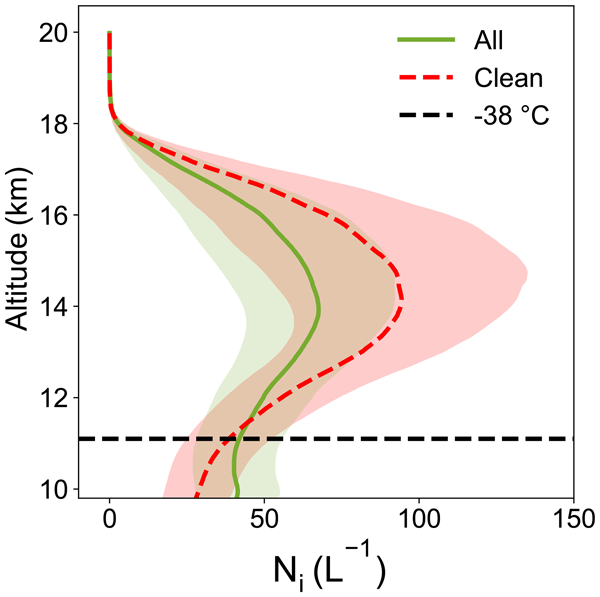
We analyzed ten years of satellite data to study ice particle numbers in cirrus clouds over the Tibetan Plateau. The north has fewer particles than the south due to weaker convection and differences in dust and smoke. Ice particles form through freezing, producing a ‘V’ shaped profile, but weak upward winds in the north shift this peak lower. These findings help understand climate characteristics in the Plateau regions.
Yanjie Liu, Xiaocong Wang, Yimin Liu, Shuaiqi Tang, and Hao Miao
Atmos. Chem. Phys., 26, 6763–6779, https://doi.org/10.5194/acp-26-6763-2026, https://doi.org/10.5194/acp-26-6763-2026, 2026
Short summary
Short summary
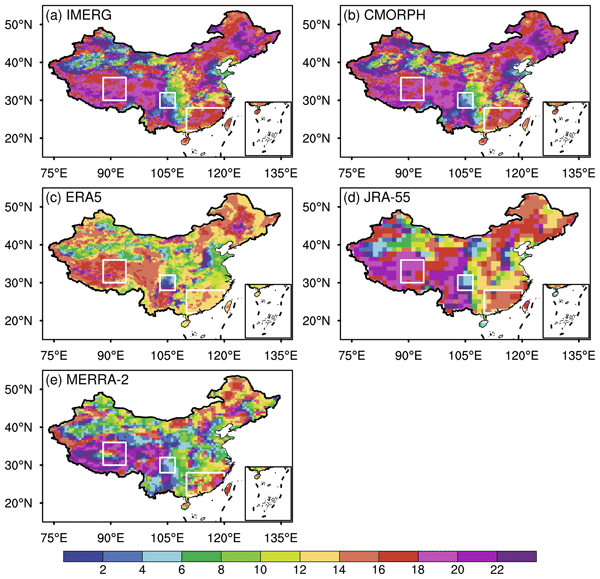
This study investigates how well operational models simulate the diurnal cycle of summer rainfall over China. Comparing three reanalyses shows all capture nocturnal precipitation peak but differ in afternoon rainfall timing: JRA‑55 and MERRA‑2 match observations better, while ERA5 exhibits a 3-hour phase advance. These differences are linked to how large-scale forcing is use in convection parameterization, underscoring the critical role of trigger on cumulus convection.
Zhixiang Li, Jianhua Lu, and Yimin Liu
Weather Clim. Dynam., 7, 1821–1836, https://doi.org/10.5194/wcd-7-1821-2026, https://doi.org/10.5194/wcd-7-1821-2026, 2026
Short summary
Short summary
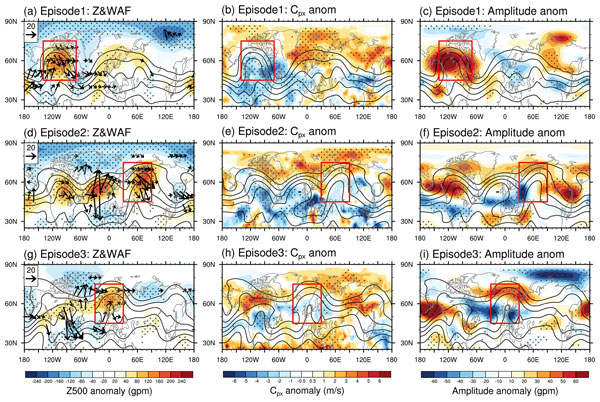
This work studies the dynamical linkages, local wave parameters, and subseasonal predictability of three successive blocking events that are associated with continual extreme events during May–June 2023. These blocks are interconnected via downstream Rossby wave energy dispersion and are dominated by the regime of slowly propagating, large-amplitude planetary-scale waves. Predictability beyond two weeks depends on capturing upstream quasi-stationary troughs and the associated energy dispersion.
Yiran Chen, Jiming Jin, Yimin Liu, Jannik Heusinger, Jesús Carrera, and Zeyu Zhou
Geosci. Model Dev., 19, 8515–8533, https://doi.org/10.5194/gmd-19-8515-2026, https://doi.org/10.5194/gmd-19-8515-2026, 2026
Short summary
Short summary
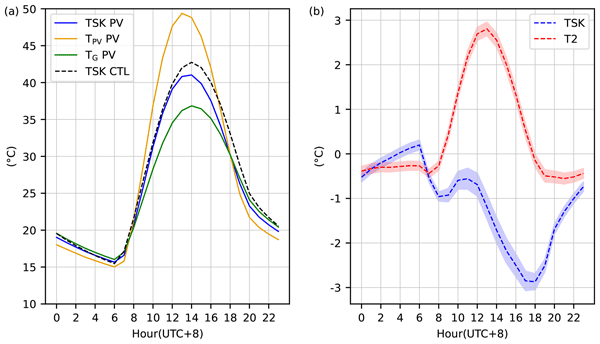
Solar power plants are expanding rapidly worldwide, but their impacts on local climate remain uncertain. In this study, we developed a coupled model that explicitly represents interactions between solar panels, land surface, and the atmosphere. Evaluation against satellite observations showed improved simulation of land surface temperature over solar farms. Simulations show that solar farms can cool the land surface, warm near-surface air, reduce incoming sunlight, and alter rainfall patterns.
Kai Wang, Xiaocong Wang, Qianshan He, Hong Nie, Yanyu Wang, and Yonghang Chen
Atmos. Chem. Phys., 26, 7127–7139, https://doi.org/10.5194/acp-26-7127-2026, https://doi.org/10.5194/acp-26-7127-2026, 2026
Short summary
Short summary
We analyzed ten years of satellite data to study ice particle numbers in cirrus clouds over the Tibetan Plateau. The north has fewer particles than the south due to weaker convection and differences in dust and smoke. Ice particles form through freezing, producing a ‘V’ shaped profile, but weak upward winds in the north shift this peak lower. These findings help understand climate characteristics in the Plateau regions.
Yanjie Liu, Xiaocong Wang, Yimin Liu, Shuaiqi Tang, and Hao Miao
Atmos. Chem. Phys., 26, 6763–6779, https://doi.org/10.5194/acp-26-6763-2026, https://doi.org/10.5194/acp-26-6763-2026, 2026
Short summary
Short summary
This study investigates how well operational models simulate the diurnal cycle of summer rainfall over China. Comparing three reanalyses shows all capture nocturnal precipitation peak but differ in afternoon rainfall timing: JRA‑55 and MERRA‑2 match observations better, while ERA5 exhibits a 3-hour phase advance. These differences are linked to how large-scale forcing is use in convection parameterization, underscoring the critical role of trigger on cumulus convection.
Mei Chong, Shengkai Wang, Xi Chen, Yuan Liang, Bing Pu, Shian-Jiann Lin, Zhi Liang, and Yimin Liu
Earth Syst. Sci. Data Discuss., https://doi.org/10.5194/essd-2025-628, https://doi.org/10.5194/essd-2025-628, 2026
Preprint under review for ESSD
Short summary
Short summary
The wind speed needed to lift dust from surfaces governs the highest uncertainty in emission models, making it the root cause of dust forecasting errors. We developed iDust-ut, a global threshold dataset by fusing ground observations, satellite data, and reanalysis products. Tests with the iDust model show doubled severe dust storm prediction accuracy. The dataset works directly in any model with built-in adaptation for wind biases, substantially improving operational dust forecasting worldwide.
Weihao Sun, Massimo A. Bollasina, Ioana Colfescu, Guoxiong Wu, and Yimin Liu
Atmos. Chem. Phys., 26, 2027–2039, https://doi.org/10.5194/acp-26-2027-2026, https://doi.org/10.5194/acp-26-2027-2026, 2026
Short summary
Short summary
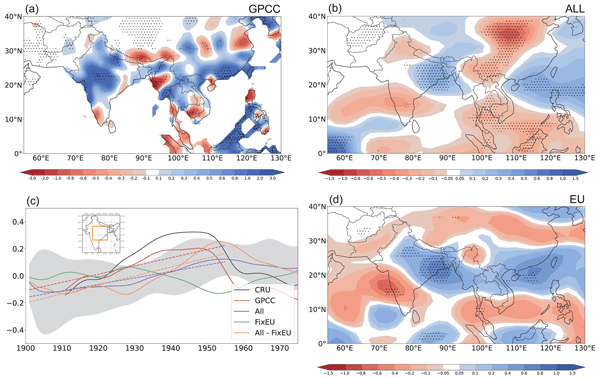
Observational records show that the Asian monsoon underwent substantial changes during the early 20th century, including a wetting trend over South Asia and a southward shift in rainfall over East Asia. We show that increasing European sulphate aerosol emissions played a crucial role in shaping the monsoon rainfall trends. This has important implications for reducing uncertainties in monsoon projections, particularly in light of the diverse future aerosol emission scenarios for the region.
Yangke Liu, Qing Bao, Bian He, Xiaofei Wu, Jing Yang, Yimin Liu, Guoxiong Wu, Tao Zhu, Siyuan Zhou, Yao Tang, Ankang Qu, Yalan Fan, Anling Liu, Dandan Chen, Zhaoming Luo, Xing Hu, and Tongwen Wu
Geosci. Model Dev., 17, 6249–6275, https://doi.org/10.5194/gmd-17-6249-2024, https://doi.org/10.5194/gmd-17-6249-2024, 2024
Short summary
Short summary
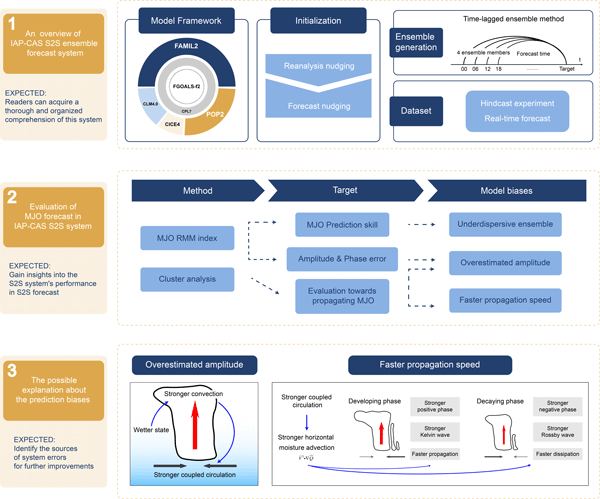
We give an overview of the Institute of Atmospheric Physics–Chinese Academy of Sciences subseasonal-to-seasonal ensemble forecasting system and Madden–Julian Oscillation forecast evaluation of the system. Compared to other S2S models, the IAP-CAS model has its benefits but also biases, i.e., underdispersive ensemble, overestimated amplitude, and faster propagation speed when forecasting MJO. We provide a reason for these biases and prospects for further improvement of this system in the future.
Cited articles
Bechtold, P., Semane, N., Lopez, P., Chaboureau, J.-P., Beljaars, A., and Bormann, N.: Representing Equilibrium and Nonequilibrium Convection in Large-Scale Models, J. Atmos. Sci., 71, 734–753, https://doi.org/10.1175/JAS-D-13-0163.1, 2014.
Benedict, J. J., Maloney, E. D., Sobel, A. H., Frierson, D. M., and Donner, L. J.: Tropical Intraseasonal Variability in Version 3 of the GFDL Atmosphere Model, J. Climate, 26, 426–449, https://doi.org/10.1175/JCLI-D-12-00103.1, 2013.
Bretherton, C. S. and Park, S.: A New Bulk Shallow-Cumulus Model and Implications for Penetrative Entrainment Feedback on Updraft Buoyancy, J. Atmos. Sci., 65, 2174–2193, https://doi.org/10.1175/2007JAS2242.1, 2008.
Bretherton, C. S. and Park, S.: A New Moist Turbulence Parameterization in the Community Atmosphere Model, J. Climate, 22, 3422–3448, https://doi.org/10.1175/2008JCLI2556.1, 2009.
Carbone, R. E. and Tuttle, J. D.: Rainfall Occurrence in the U. S. Warm Season: The Diurnal Cycle, J. Climate, 21, 4132–4146, https://doi.org/10.1175/2008JCLI2275.1, 2008.
Chen, G., Sha, W., Iwasaki, T., and Wen, Z.: Diurnal Cycle of a Heavy Rainfall Corridor over East Asia, Mon. Weather Rev., 145, 3365–3389, https://doi.org/10.1175/MWR-D-16-0423.1, 2017.
Clough, S. A., Shephard, M. W., Mlawer, E. J., Delamere, J. S., Iacono, M. J., Cady-Pereira, K., Boukabara, S., and Brown, P. D.: Atmospheric radiative transfer modeling: A summary of the AER codes, J. Quant. Spectrosc. Ra., 91, 233–244, https://doi.org/10.1016/j.jqsrt.2004.05.058, 2005.
Dai, A. and Trenberth, K. E.: The Diurnal Cycle and Its Depiction in the Community Climate System Model, J. Climate, 17, 930–951, https://doi.org/10.1175/1520-0442(2004)017<0930:TDCAID>2.0.CO;2, 2004.
Dai, A., Giorgi, F., and Trenberth, K. E.: Observed and model-simulated diurnal cycles of precipitation over the contiguous United States, J. Geophys. Res.-Atmos., 104, 6377–6402, https://doi.org/10.1029/98JD02720, 1999.
Dai, A.: Precipitation characteristics in eighteen coupled climate models, J. Climate, 19, 4605–4630, https://doi.org/10.1175/JCLI3884.1, 2006.
Davies, L., Plant, R. S., and Derbyshire, S. H.: Departures from convective equilibrium with a rapidly varying surface forcing, Q. J. Roy. Meteor. Soc., 139, 1731–1746, https://doi.org/10.1002/qj.2065, 2013.
Donner, L. J. and Phillips, V. T.: Boundary layer control on convective available potential energy: Implications for cumulus parameterization, J. Geophys. Res.-Atmos., 108, https://doi.org/10.1029/2003JD003773, 2003.
Gettelman, A., Truesdale, J. E., Bacmeister, J. T., Caldwell, P. M., Neale, R. B., Bogenschutz, P. A., and Simpson, I. R.: The single column atmosphere model version 6 (SCAM6): Not a scam but a tool for model evaluation and development, J. Adv. Model. Earth Sy., 11, 1381–1401, https://doi.org/10.1029/2018MS001578, 2019.
Hersbach, H., Bell, B., Berrisford, P., Hirahara, S., Horányi, A., Muñoz-Sabater, J., Nicolas, J., Peubey, C., Radu, R., Schepers, D., Simmons, A., Soci, C., Abdalla, S., Abellan, X., Balsamo, G., Bechtold, P., Biavati, G., Bidlot, J., Bonavita, M., De Chiara, G., Dahlgren, P., Dee, D., Diamantakis, M., Dragani, R., Flemming, J., Forbes, R., Fuentes, M., Geer, A., Haimberger, L., Healy, S., Hogan, R. J., Hólm, E., Janisková, M., Keeley, S., Laloyaux, P., Lopez, P., Lupu, C., Radnoti, G., De Rosnay, P., Rozum, I., Vamborg, F., Villaume, S., and Thépaut, J.: The ERA5 global reanalysis, Q. J. Roy. Meteor. Soc., 146, 1999–2049, https://doi.org/10.1002/qj.3803, 2020.
Huffman, G. J., Stocker, E. F., Bolvin, D. T., Nelkin, E. J., and Tan, J.: GPM IMERG Final Precipitation L3 Half Hourly 0.1°×0.1° V07, Greenbelt, MD, Goddard Earth Sciences Data and Information Services Center (GES DISC) [data set], https://doi.org/10.5067/GPM/IMERG/3B-HH/07, 2023.
Lee, M.-I., Schubert, S. D., Suarez, M. J., Held, I. M., Lau, N.-C., Ploshay, J. J., Kumar, A., Kim, H.-K., and Schemm, J.-K. E.: An analysis of the warm-season diurnal cycle over the continental United States and northern Mexico in general circulation models, J. Hydrometeorol., 8, 344–366, https://doi.org/10.1175/JHM581.1, 2007.
Lee, M.-I., Schubert, S. D., Suarez, M. J., Schemm, J.-K. E., Pan, H.-L., Han, J., and Yoo, S.-H.: Role of convection triggers in the simulation of the diurnal cycle of precipitation over the United States Great Plains in a general circulation model, J. Geophys. Res.-Atmos., 113, D02111, https://doi.org/10.1029/2007JD008984, 2008.
Li, J., Yu, R., and Zhou, T.: Seasonal variation of the diurnal cycle of rainfall in southern contiguous China, J. Climate, 21, https://doi.org/10.1175/2008JCLI2188.1, 2008.
Liu, Y., Wang, X., Liu, Y., Tang, S., and Miao, H.: A process-oriented analysis of the summertime diurnal cycle of precipitation and diabatic heating over China in three reanalyses, Atmos. Chem. Phys., 26, 6763–6779, https://doi.org/10.5194/acp-26-6763-2026, 2026.
Mapes, B., Tulich, S., Lin, J., and Zuidema, P.: The mesoscale convection life cycle: Building block or prototype for large-scale tropical waves?, Dynam. Atmos. Oceans, 42, 3–29, https://doi.org/10.1016/j.dynatmoce.2006.03.003, 2006.
Morrison, H. and Gettelman, A.: A New Two-Moment Bulk Stratiform Cloud Microphysics Scheme in the Community Atmosphere Model, Version 3 (CAM3). Part I: Description and Numerical Tests, J. Climate, 21, 3642–3659, https://doi.org/10.1175/2008JCLI2105.1, 2008.
Park, S.: A Unified Convection Scheme (UNICON). Part I: Formulationm, J. Atmos. Sci., 71, 3902–3930, https://doi.org/10.1175/JAS-D-13-0233.1, 2014a.
Park, S.: A unified convection scheme (UNICON). Part II: Simulation, J. Atmos. Sci., 71, 3931–3973, https://doi.org/10.1175/JAS-D-13-0234.1, 2014b.
Park, S. and Bretherton, C. S.: The University of Washington Shallow Convection and Moist Turbulence Schemes and Their Impact on Climate Simulations with the Community Atmosphere Model, J. Climate, 22, 3449–3469, https://doi.org/10.1175/2008JCLI2557.1, 2009.
Park, S., Bretherton, C. S., and Rasch, P. J.: Integrating Cloud Processes in the Community Atmosphere Model, Version 5, J. Climate, 27, 6821–6856, https://doi.org/10.1175/JCLI-D-14-00087.1, 2014.
Park, S., Song, C., Kim, S., and Kim, J.: Parameterization of the elevated convection with a unified convection scheme (UNICON) and its impacts on the diurnal cycle of precipitation, J. Adv. Model. Earth Sy., 16, e2023MS003651, https://doi.org/10.1029/2023MS003651, 2024.
Tang, S., Xie, S., Guo, Z., Hong, S., Khouider, B., Klocke, D., Köhler, M., Koo, M., Krishna, P. M., Larson, V. E., Park, S., Vaillancourt, P. A., Wang, Y., Yang, J., Daleu, C. L., Homeyer, C. R., Jones, T. R., Malap, N., Neggers, R., Prabhakaran, T., Ramirez, E., Schumacher, C., Tao, C., Bechtold, P., Ma, H., Neelin, J. D., and Zeng, X.: Long-term single-column model intercomparison of diurnal cycle of precipitation over midlatitude and tropical land, Q. J. Roy. Meteor. Soc., 148, 641–669, https://doi.org/10.1002/qj.4222, 2022.
Tiedtke, M.: A comprehensive mass flux scheme for cumulus parameterization in large-scale models, Mon. Weather Rev., 117, 1779–1800, https://doi.org/10.1175/1520-0493(1989)117<1779:ACMFSF>2.0.CO;2, 1989.
Trenberth, K. E., Dai, A., Rasmussen, R. M., and Parsons, D. B.: The changing character of precipitation, B. Am. Meteorol. Soc., 84, 1205–1218, https://doi.org/10.1175/BAMS-84-9-1205, 2003.
van Stratum, B. J. H., van Heerwaarden, C. C., and Vilà-Guerau de Arellano, J.: The Benefits and Challenges of Downscaling a Global Reanalysis with Doubly-Periodic Large-Eddy Simulations, J. Adv. Model. Earth Sy., 15, e2023MS003750, https://doi.org/10.1029/2023MS003750, 2023.
Wang, X. and Liu, Y.: Simulation Data for the Sensitivity of Summertime Diurnal Precipitation Cycle over China to Convective Trigger and Closure Treatments in a Single-Column Model, Zenodo [data set], https://doi.org/10.5281/zenodo.21207758, 2026.
Wang, X. and Zhang, M.: An analysis of parameterization interactions and sensitivity of single-column model simulations to convection schemes in CAM4 and CAM5, J. Geophys. Res.-Atmos., 118, 8869–8880, https://doi.org/10.1002/jgrd.50690, 2013.
Wang, X., Liu, Y., Zhang, M., Liu, Y., Tang, S., Guo, Z., Wang, K., and Zheng, X.: Evaluation of CAM Single-Column Models in Simulating Convectively Coupled Rossby Gravity Waves During TRMM-KWAJEX, J. Geophys. Res.-Atmos., 131, e2025JD045016, https://doi.org/10.1029/2025JD045016, 2026.
Wang, Y.-C., Pan, H.-L., and Hsu, H.-H.: Impacts of the triggering function of cumulus parameterization on warm-season diurnal rainfall cycles at the Atmospheric Radiation Measurement southern Great Plains site, J. Geophys. Res.-Atmos., 120, 10681–10702, https://doi.org/10.1002/2015JD023337, 2015.
Xie, S. and Zhang, M.: Impact of the convection triggering function on single-column model simulations, J. Geophys. Res.-Atmos., 105, 14983–14996, https://doi.org/10.1029/2000JD900170, 2000.
Xie, S., Wang, Y., Lin, W., Ma, H., Tang, Q., Tang, S., Zheng, X., Golaz, J., Zhang, G. J., and Zhang, M.: Improved diurnal cycle of precipitation in E3SM with a revised convective triggering function, J. Adv. Model. Earth Sy., 11, 2290–2310, https://doi.org/10.1029/2019MS001702, 2019.
Yanai, M., Esbensen, S., and Chu, J.-H.: Determination of bulk properties of tropical cloud clusters from large-scale heat and moisture budgets, J. Atmos. Sci., 30, 611–627, https://doi.org/10.1175/1520-0469(1973)030<0611:DOBPOT>2.0.CO;2, 1973.
Yang, B., Zhou, Y., Zhang, Y., Huang, A., Qian, Y., and Zhang, L.: Simulated precipitation diurnal cycles over East Asia using different CAPE-based convective closure schemes in WRF model, Clim. Dynam., 50, 1639–1658, https://doi.org/10.1007/s00382-017-3712-z, 2018.
Zhang, G. J. and McFarlane, N. A.: Sensitivity of climate simulations to the parameterization of cumulus convection in the Canadian Climate Centre General Circulation Model, Atmos. Ocean, 33, 407–446, https://doi.org/10.1080/07055900.1995.9649539, 1995.
Zhang, G. J.: Convective quasi-equilibrium in midlatitude continental environment and its effect on convective parameterization, J. Geophys. Res.-Atmos., 107, 4220, https://doi.org/10.1029/2001JD001005, 2002.
Zhang, Y., Zhang, F., and Sun, J.: Comparison of the diurnal variations of warm-season precipitation for East Asia vs. North America downstream of the Tibetan Plateau vs. the Rocky Mountains, Atmos. Chem. Phys., 14, 10741–10759, https://doi.org/10.5194/acp-14-10741-2014, 2014.
Short summary
This study advances our understanding of the representation of the diurnal cycle of precipitation (DCP) in numerical models. By systematically comparing three convection schemes with different trigger and closure treatments using a single-column model, this study identifies the physical mechanisms responsible for these biases and evaluates the effectiveness of various modifications in improving DCP simulations over China.
This study advances our understanding of the representation of the diurnal cycle of...
Altmetrics
Final-revised paper
Preprint