
the Creative Commons Attribution 4.0 License.
the Creative Commons Attribution 4.0 License.
 | 12 Oct 2026
Simultaneous measurements of gas- and aerosol-phase water-soluble organic nitrogen in the winter urban atmosphere of Chengdu, China
Kaitao Chen
Zheng Li
Rui Li
Luyao Chen
Rongjie Li
Binyu Xiao
Shaojun Lv
Can Wu
Rui Li
Junke Zhang

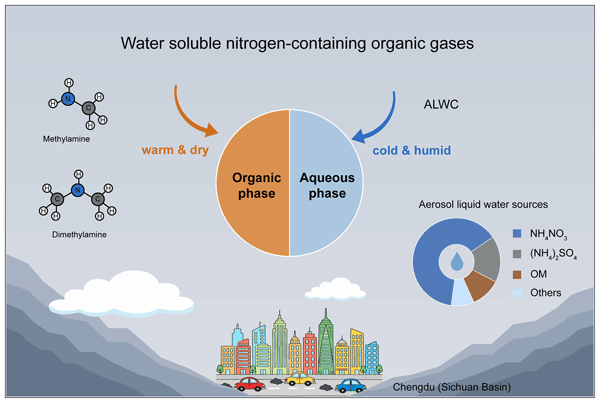
Partitioning gaseous water-soluble organic nitrogen (WSON) to the aerosol phase is a major formation pathway of atmospheric secondary organic aerosols (SOA). However, the factors influencing this WSON partitioning process remain unclear. We conducted simultaneous wintertime measurements of WSON in both gas and aerosol phases at an urban site in Chengdu (CD), located in the Sichuan Basin (SCB), China, to investigate the concentration, gas-particle partitioning processes, and driven factors of WSON. The average concentration of particulate WSON () was about twice that of gaseous WSON () and increased significantly as PM2.5 increased. In winter, WSON readily partitions into the particle phase (), partitioning into the organic phase under warm, dry conditions and into aerosol liquid water under cold, humid conditions, with higher FWSON in the latter. Amines (methylamine, MA; dimethylamine, DMA) were predominantly present in the gas phase but exhibited enhanced partitioning into the particle phase during the PM2.5 polluted periods. Amines preferentially partitioned into aerosol liquid water throughout the entire campaign, stably existing as amine-sulfate or amine-nitrate salts in PM2.5. The influence of aerosol liquid water content (ALWC) on the partitioning behavior of both WSON and amines was substantially greater than that of temperature (T), relative humidity (RH), and aerosol acidity (pH), as further confirmed by thermodynamic modeling with S-curve analysis. Furthermore, NH4NO3 was identified as the primary contributor to ALWC, suggesting that controlling NOx and NH3 emissions is crucial for reducing ALWC and subsequent WSON formation.
- Article
(4026 KB) - Full-text XML
-
Supplement
(1730 KB) - BibTeX
- EndNote


Organic nitrogen (ON) is a ubiquitous component of fine particulate matter (PM2.5), accounting for 10 %–50 % of total nitrogen (TN) in global aerosols (Leung et al., 2024). Atmospheric nitrogen-containing organic compounds (NOCs) encompass a wide range of species, including amines, N-heterocycles, nitroaromatics, organic nitrates, and so on (Jickells et al., 2013; Yu et al., 2024). These species partition between the gas and condensed phases depending on their volatility and water solubility. For example, low-molecular-weight amines and nitroaromatic compounds are semi-volatile and partition dynamically between phases (Liu et al., 2018; Chen et al., 2025), while monofunctional organic nitrates predominantly reside in the gas phase, whereas multifunctional ones preferentially partition into the particle phase (Rollins et al., 2013; González-Sánchez et al., 2021). Among these, water-soluble organic nitrogen (WSON) is of particular interest, as it actively participates in aqueous-phase reactions and significantly contributes to secondary organic aerosol (SOA) formation (Yu et al., 2020).
Amines, as a major class of water-soluble NOCs in the atmosphere, play a pivotal role in aerosol formation and evolution. The H2SO4–amine–H2O ternary nucleation mechanism markedly enhances new particle formation (NPF) rates by stabilizing critical clusters, with ambient observations demonstrating more than a thousand-fold increase in formation rates compared to ammonia (Almeida et al., 2013; Schobesberger et al., 2013; Yao et al., 2018; Kanawade and Jokinen, 2025; Yu et al., 2025). Through acid-base reactions, amines readily form stable aminium salts with inorganic acids, altering particles hygroscopicity, density, and optical properties (Qiu and Zhang, 2013). Additionally, Maillard-like reactions between amines and carbonyls in the aqueous phase contribute substantially to brown carbon (BrC) formation (Tang et al., 2022; Xiao et al., 2025). Despite these recognized roles, the gas-aerosol partitioning behavior of amines remains critically underexplored. Previous studies suggest that amine partitioning is influenced by aerosol acidity (pH), relative humidity (RH), and condensed-phase composition, and is strongly pH-dependent, favoring the particle phase under acidic conditions (Ge et al., 2011; Pankow, 2015). However, amine gas-aerosol partitioning remains poorly understood, hindering accurate assessments of their contributions to PM formation and climate, and thus warranting urgent investigation.
In contrast, the gas–aerosol partitioning of bulk water-soluble organic compounds (WSOC) has been more extensively investigated. Recent simultaneous online measurements in the Yangtze River Delta (YRD) and North China Plain (NCP) have systematically elucidated the driving mechanisms of WSOC partitioning (Lv et al., 2022a, b; Li et al., 2025, 2026). These studies revealed that under dry conditions (RH<80 %), WSOC partitioning is governed by temperature (T) and proceeds via condensation into the organic phase; under humid conditions (RH>80 %), it shifts to being dominated by aerosol liquid water content (ALWC), with uptake into the aqueous phase (Lv et al., 2022a). Ammonia (NH3) not only elevates particle pH through neutralization to promote organic acid dissociation, but also participates in aqueous-phase reactions to form nitrogen-containing organics (e.g., imidazoles), contributing to WSON and BrC light absorption (Lv et al., 2022a; Li et al., 2026). Nationwide data show a strong linear correlation (R=0.77) between WSOCp and NH4NO3 mass fractions, confirming the critical role of NH3 in regional SOA formation (Lv et al., 2022a). However, the gas-aerosol partitioning behavior of WSON has received far less attention, with most studies limited to particle-phase measurements and thus unable to capture the dynamic exchange between phases.
This knowledge gap is especially pronounced in regions with complex aerosol chemistry and high precursor emissions, such as the Sichuan Basin (SCB) , a topographically enclosed basin characterized by high RH, frequent winter haze, and substantial agricultural and industrial NH3 emissions. To address this gap, we conducted an intensive winter observation campaign in Chengdu (CD) from December 2024–January 2025, simultaneously measuring gas- and particle-phase WSON and two amines. Our work aims to elucidate the pollution characteristics of WSON and amines, and the driving factors governing their gas-particle partitioning behavior in the atmosphere.
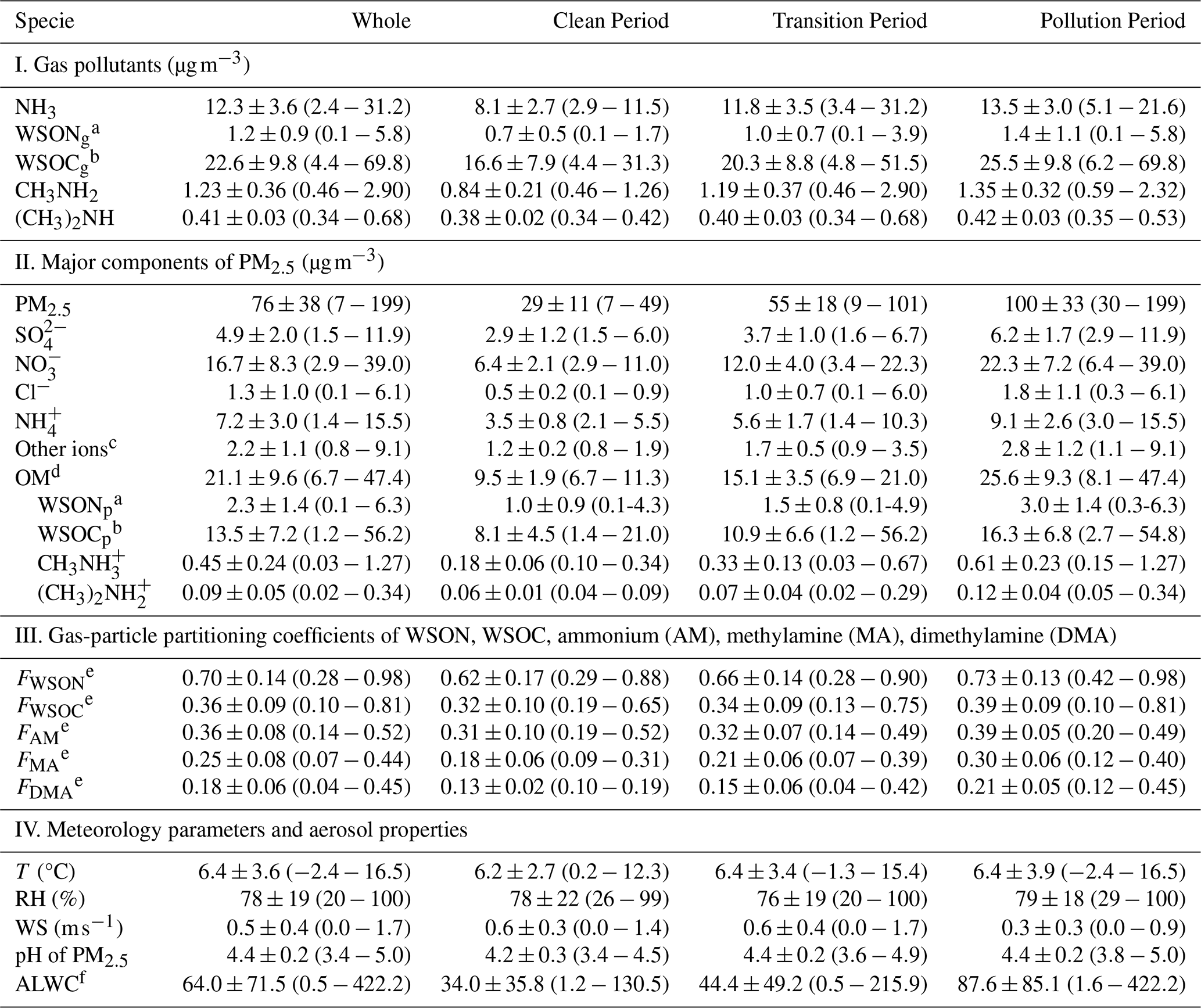
Table 1Concentrations of major pollutants and meteorological parameters in Chengdu (CD) during winter.
a WSONg is the gas-phase organics, WSONp is the organics in PM2.5, (µg N m−3).
b WSOCg is the gas-phase organics, WSOCp is the organics in PM2.5, (µg C m−3).
c Other ions are the sum of , F−, K+, Na+, Mg2+, and Ca2+.
d Organic matter: .
e ).
f ALWC: aerosol liquid water content of PM2.5.
2.1 Observation site description.
Winter sampling was conducted in CD, located in the SCB, from 14 December 2024–9 January 2025. The observation site was situated on the roof of the Civil Engineering Building at Southwest Jiaotong University's Jiuli Campus (30.7° N, 105.05° E) (Fig. S1 in the Supplement), at a height of 25 m above ground level. It was located in the central area of CD, near the North Second Ring Road, surrounded by residential areas, shopping malls, gas stations, and restaurants, During the sampling period, meteorological conditions in CD were stagnant with low wind speeds and high RH (Table 1). The SCB features a typical deep-basin topography (with a basin depth exceeding 2000 m), surrounded by mountains on all sides, which severely hampers the dispersion of air pollutants (Rao et al., 2026). In winter, the Qinling Mountains block the intrusion of cold air, allowing warm and moist air masses to accumulate within the basin, leading to high humidity, frequent fog, and recurrent temperature inversions (with a winter inversion frequency of 95.4 % and an inversion layer depth of 289.4 m) (Feng et al., 2020). During pollution episodes, the boundary layer is significantly compressed, with its height reduced by approximately 50 % (Lu et al., 2024), resulting in a stable atmospheric stratification that is extremely unfavorable for pollutant diffusion. The synergistic effects of increased emissions, stagnant meteorological conditions, and enhanced aqueous-phase reactions under high relative humidity (>80 %) can readily cause extreme PM2.5 episodes (Shu et al., 2025), and the humid environment further promotes the hygroscopic growth and secondary transformation of particulate matter (Wang et al., 2021). In CD, the major sources of PM2.5 are vehicle emissions (25.6 %) and secondary sources (40.5 %) (Zhang et al., 2024). In winter, secondary inorganic ions account for 40 %–60 % of PM2.5 mass, of which approximately half is nitrate (Rao et al., 2026), providing abundant precursors for the secondary formation of NOCs (Li et al., 2023). The combined topographic-meteorological-emission characteristics impart unique regional representativeness to the study of gas-aerosol partitioning of NOCs under the humid and stagnant conditions typical of CD. Therefore, the observation site can effectively capture the influence of the basin-specific atmospheric chemical processes on the partitioning of WSON.
2.2 Measurements of the gas- and aerosol-phase species
Continuous measurements of inorganic ions, WSON, methylamine (MA) and dimethylamine (DMA) in the gas and aerosol phases were conducted at the campus site. Online samples of the aforementioned compounds were collected via the In-situ Gas and Aerosol Compositions monitor (IGAC, model 63GA, Fortelice International Co., Ltd., Taiwan, China) coupled with an ICS-5000+ ion chromatograph (Thermo Scientific,USA) and a TOC/TN analyzer (model TOC/TN-L CPH, Shimadzu, Inc., Japan) for simultaneous measurements of online samples. WSON was measured with a time interval of 3 h, while other species were measured hourly. In this study, the equation for calculating WSON concentration is as follows:
where, g and p represent the gas phase and particle phase, respectively; WSTN represents total water-soluble nitrogen measured by TOC/TN analyzer; WSIN represents the total water-soluble inorganic nitrogen measured by IGAC–IC, when calculating this value, the average is taken over a 3 h WSON sampling intervals. The unit is µg N m−3. Due to the differing forms in which inorganic nitrogen exists in the gas phase and particulate phase, the calculation methods will vary accordingly, as follows:
The gas-particle phase partition coefficient (Fp) for WSON is calculated as follows, similarly, similar calculations apply to amines:
Five anions (, , , Cl−, F−), five cations (, Na+, K+, Mg2+, Ca2+), and two amines (MA and DMA) were measured in this study. PM2.5 and meteorological parameters (including T and RH) were measured by the E–BAM continuous environmental PM2.5 monitor (Met One Instruments, United States) and an automatic weather station (MILOS520, Vaisala, Inc., Finland), respectively. In this study, pollution periods (PP) were defined as days with a daily , clean periods (CP) as , and transition periods (TP) as PM2.5 between 35 and 75 µg m−3. The organic carbon (OC) and elemental carbon (EC) of the PM2.5 filter samples were analyzed by DRI Model 2015 Carbon Analyzer (Atmoslytic, Inc., Calabasas, USA) with IMPROVE_A protocol (Chow et al., 2007; Li et al., 2025).
To minimize background interference and systematic errors in the instrument, a HEPA filter was installed at the IGAC sampling port. Measurement results indicated that the background levels in the tube system were comparable to the blank concentration of deionized water. The background concentrations of WSOC and WSTN in the tubes were and , respectively, significantly lower than the sample concentrations. Additionally, the collection efficiency of IGAC system for both gas and particle phase species is >73 % (Lv et al., 2022a, b), and the data during the observation period were corrected accordingly. For detailed information on instrument applications and method accuracy tests, please refer to the Support Information Text S1.
2.3 Calculations on ALWC and acidity of PM2.5
The ALWC and pH of PM2.5 were estimated using the thermodynamic ISORROPIA-II model based on hourly data of aerosol chemical composition (including Na+, , K+, Ca2+, Mg2+, , , and Cl−), gaseous NH3 concentration, and meteorological parameters (T; RH) (Fountoukis and Nenes, 2007). The forward metastable mode was employed for the estimation due to its lower sensitivity to measurement errors compared to the reverse mode (Hennigan et al., 2015). Data corresponding to RH greater than 95 % were excluded on the basis that such conditions are associated with increased uncertainty in the model estimation of both ALWC and pH (Guo et al., 2015). The contribution of organic compounds to ALWC (ALWCorg) was determined using the mass concentration of organic matter (OM) which was calculated on the basis of OC () (Lv et al., 2022a, b), as described in detail in the Supporting Information Text S2.
2.4 S-Curve analysis of amines
To further elucidate the effects of pH and ALWC on the gas-particle phase distribution of organic amines, this study assumes that the gas and particle phases of amines are in thermodynamic equilibrium. and , the theoretical values of the gas-particle phase distribution coefficients, are calculated using a thermodynamic model and analyzed via S-curve analysis with aerosol pH. The calculation equations are as follows:
where, Hi is the Henry's law constant for organic amine i at 298.15 K, Ka is acid dissociation constant at 298.15 K, γi represents the activity coefficient, which can be calculated using the E-AIM model; Wi is the ALWC of the particles; R is the gas constant, and T is the temperature. Detailed derivations of Eqs. (5) and (6) are provided in the Support Information Text S3.
2.5 Oxidation ratiocal culation
The higher nitrogen oxidation ratio (NOR) and sulfur oxidation ratio (SOR) represent more efficient conversion of gaseous species into secondary aerosols. The calculation equations are as follows:
where, [i] refers to the molar concentration of species i.
3.1 Chemical characteristics of PM2.5 pollution during the campaign
The temporal variations of meteorological parameters, major atmospheric pollutants during the whole campaign are shown in Fig. 1 and Table 1, respectively. During the campaign, the average PM2.5 concentration in CD was (Table 1), with 14 pollution days accounting for 51.9 % of the total sampling days. The average PM2.5 concentration during PP was , with the highest pollution level reaching 199 µg m−3. Concurrently, concentrations (Table S1 in the Supplement) and contributions (Table S1) began to exceed those of and exhibited an overall increasing trend, indicating that has become the dominant inorganic salt in PM2.5. In contrast, remained relatively stable and was significantly lower in 2024 compared to previous years (Table S1). has remained relatively stable since its decline began in 2016, as has Cl−. In this study, , , and accounted for 7.2±3.1 %, 22.8±6.6 %, and 11.5±4.6 % of the PM2.5 mass, respectively (Fig. 1b). Additionally, the observed concentration of OM in CD was 21.1±9.6 µg m−3 (Table 1), contributing 27.3±7.4 % to the total PM2.5 mass. As shown in Table S1, previously reported values in the SCB also exceeded 25 %. These results clearly indicate that and OM are the major components of PM2.5 in the SCB, accounting for over 50 % of the total PM2.5 mass.
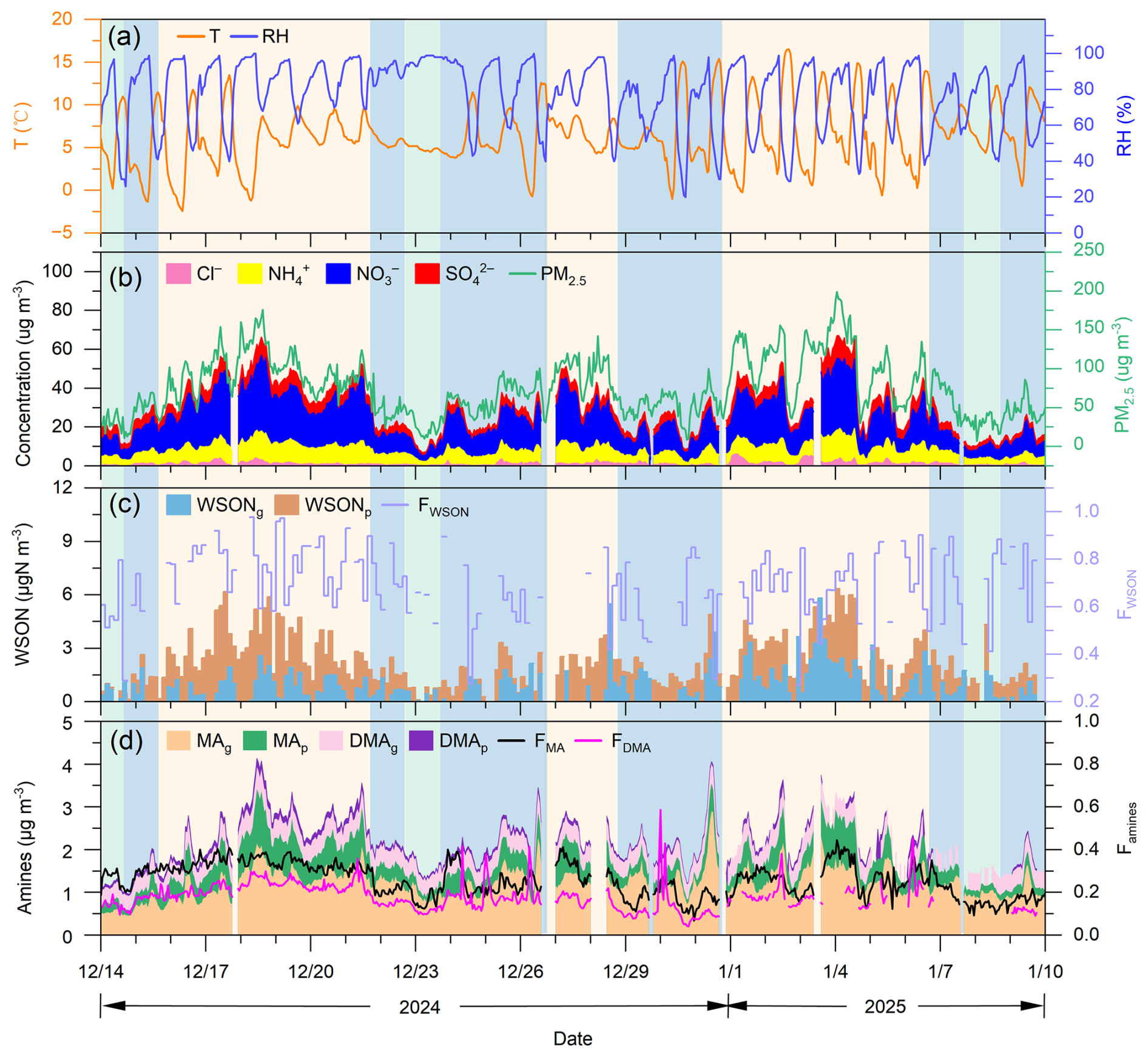
Figure 1Temporal variation of major pollutants in Chengdu, China, during the winter of 2024–2025. ), Cp and Cg are the concentrations of WSON and methylamine (MA) or dimethylamine (DMA) in the particle phase and gas phase, respectively. Green shadows represent clean periods with . Blue shadows represent transition periods with . Orange shadows represent pollution periods with .
The temporal variation of WSONp (Fig. 1c) exhibited the same trend as PM2.5 (Fig. 1b), with a significant positive correlation between WSONp and PM2.5 (R=0.78, p<0.05, Fig. S2). WSONp contributed to 0.5 %–12.4 % of the PM2.5 mass, with the average value was 3 % (Fig. S3a–d). The concentration of WSONp () was more than twice that of WSONg () (Fig. 1c and Table 1), indicating that WSON in CD mainly exists in the particle phase, as observed at Mt. Fuji in Japan (Matsumoto et al., 2020). WSON contributed 9.3 % and 14.7 % to the TN in the gas phase and particulate phase, respectively. In CD, the WSON/WSOC ratios for the gas and particle phases were 0.05 and 0.15 (Fig. S3e–l), respectively. Notably, the ratio increases as pollution worsens (Fig. S3i–l), indicating that more NOCs are enriched during the accumulation of OM. Our study shows that the wintertime WSONp concentration of PM2.5 in CD () was slightly higher than those in central Chinese cities such as Nanjing () (Guan et al., 2022) and Shanghai (SH, ) (Lv et al., 2022a), as well as in the northern city of Wuhai () (Xie et al., 2025), but substantially higher than those in southern coastal cities such as Guangzhou (0.48–0.53 µg N m−3) (Yu et al., 2017) and Hong Kong () (Leung et al., 2024). This indicates that the wintertime NOCs of PM2.5 in CD are notably prominent, likely due to its unique basin topography, which allows local emissions (e.g., biomass burning (Yu et al., 2017; Xie et al., 2025), cooking fumes (Özel et al., 2010; Ditto et al., 2022), vehicle exhaust (Yu et al., 2017; Xie et al., 2025)) and secondary formation (Liu et al., 2023; Yu et al., 2017; Xie et al., 2025) to continuously accumulate near the surface, resulting in concentrations that exceed those in other cities.
As shown in Fig. 1d and Table 1, the gas-phase concentrations of methylamine (MAg) and dimethylamine (DMAg) ( and , respectively) were 3–5 times higher than their particle-phase concentrations ( and , respectively). This trend was consistent with observations reported from the Nanling Mountains in Guangzhou, China (MAg: , MAp: ; DMAg: , DMAp: ) (Liu et al., 2018), suggesting that amines predominantly exist in the gas phase in the atmosphere. Furthermore, the observed amine concentrations were much higher than those reported in other regions (Liu et al., 2018; Yang et al., 2022; Zhu et al., 2022; Yang et al., 2023; Brean et al., 2025). Studies show that vehicle emissions elevate roadside C1–C2 amine concentrations by more than a factor of four relative to background levels (Brean et al., 2025), with a contribution exceeding 70 % (Yang et al., 2022; Zhu et al., 2022). As shown in Fig. S4, amines in CD exhibited significant correlations with the vehicular tracers NO2 and CO (r=0.4 and 0.5, respectively, p<0.05), indicating that vehicle exhaust contributes to amine emissions to some extent. Except primary emissions, secondary formation also was a major source of amines (Yang et al., 2023). In CD, particulate amines exhibited strong correlation with SNA (sulfate, nitrate, ammonium) (r>0.5, p<0.01; Fig. S5), indicating that secondary formation driven by acid–base neutralization is also an important source.
3.2 Gas-to-aerosol phase partitioning of WSON
Figure 2 illustrates the morphological characteristics of aerosols under two different temperature conditions. The FWSON values were lower during the high-T period (0.61±0.11) than during the low-T period (0.71±0.13) (Fig. 2a), suggesting different partitioning processes under the two T regimes. During the high-T process, the OM fraction () (Fig. 2b) exceeded the ALWC fraction () (Fig. 2c), indicating that under high-T and low-RH conditions, the aerosol predominantly existed in an organic phase. In contrast, during the low-T and high-RH process, the fALWC was substantially higher than the fOM, with fALWC being approximately 4.5 times that of fOM, suggesting that under low-T and high-RH conditions, the aerosol was mainly present in an aqueous phase. Furthermore, Fig. 2d shows that the SNA-to-OM ratio during the low-T process (1.16±0.45) was considerably lower than that during the high-T process (1.62±0.42). Although the high-T process exhibited high concentrations of hygroscopic inorganic components, the RH was only 53±13 % (Fig. 2e), significantly lower than that during the low-T process (92±4 %) (Fig. 2e), which limited the increase in ALWC. Consequently, fALWC during the high-T process was much lower than that during the low-T process (0.59±0.11) (Fig. 2c). Therefore, the elevated OM concentrations during the high-T process may have facilitated the formation of an organic aerosol phase, whereas the combination of high RH and abundant inorganic components was likely the primary driver for the high ALWC content observed during the low-T process. In summary, water-soluble organic compounds were preferentially partitioned into the organic phase during the high-T process, whereas they were mainly distributed into the aqueous phase during the low-T process.
Table 2Concentrations Regional comparison of key physicochemical parameters (PM2.5, T, RH, pH, ALWC) and the water-soluble organic nitrogen partitioning coefficient (FWSON) in atmospheric aerosols at Chengdu (CD), Shanghai (SH), and Xianghe (XH).
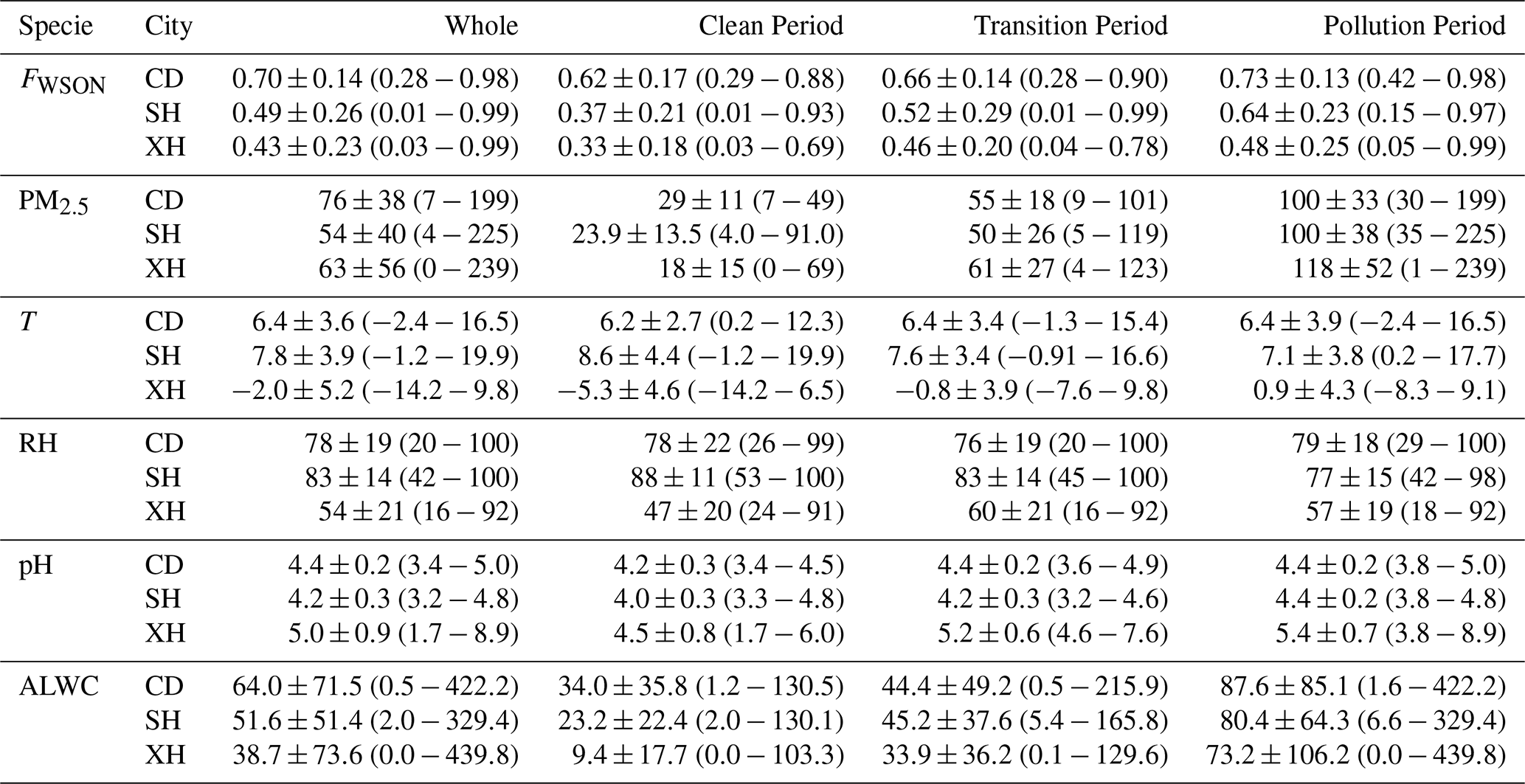
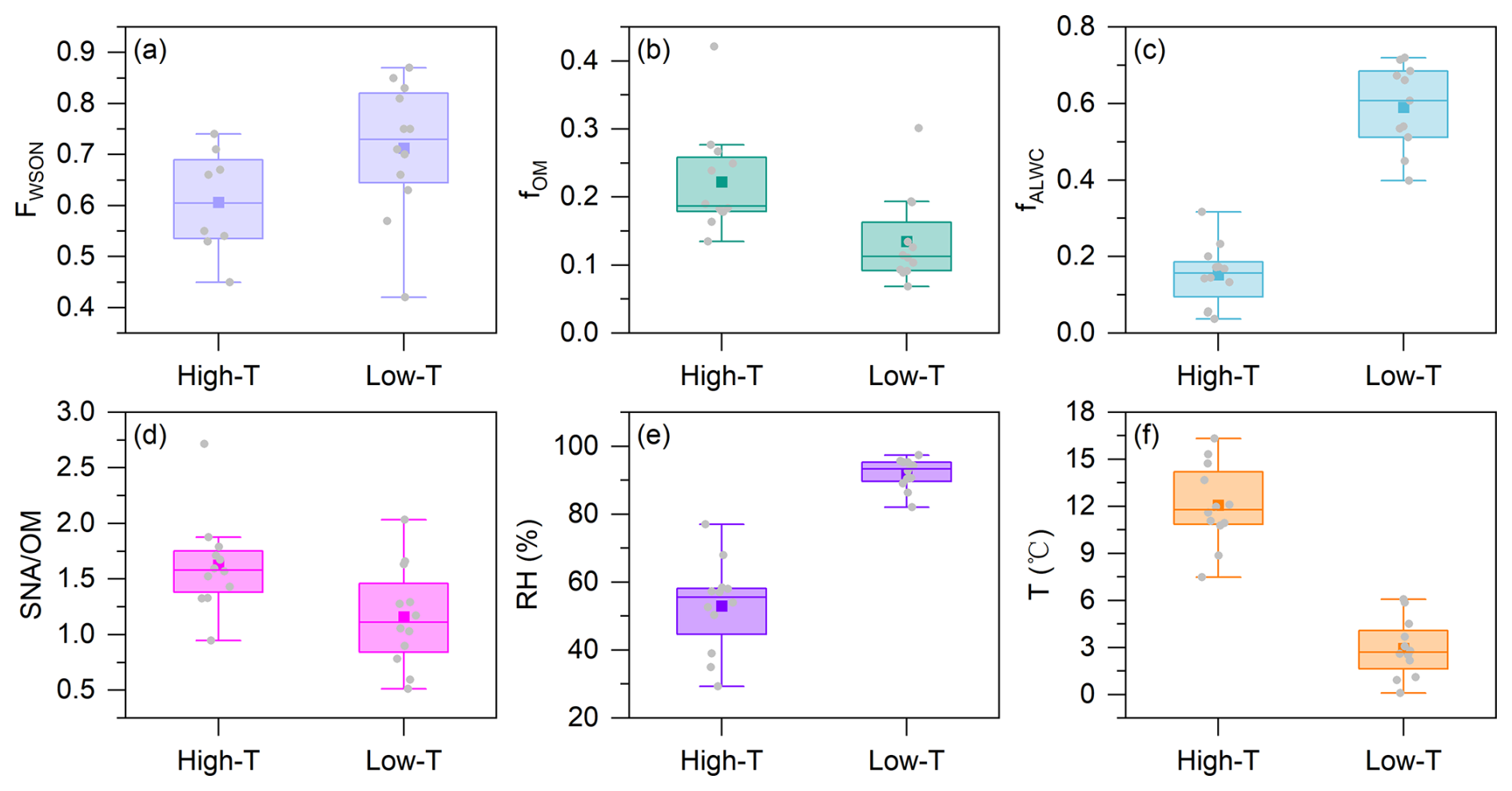
Figure 2Analysis of the parting behavior of WSON under different temperature conditions during the pollution period (2–6 January 2025).
Table 2 presents the differences in FWSON across three Chinese cities, namely CD (representing the SCB), SH (representing the YRD), and Xianghe (XH, representing the NCP). As shown in the Table 2, FWSON was highest in CD (0.70±0.14), followed by SH (0.49±0.26), and lowest in XH (0.43±0.23). The variation in FWSON among the three cities did not follow the same trends as T and RH, and no significant differences in pH were observed, suggesting that T, RH, and pH exerted only weak influences on FWSON. ALWC showed a decreasing trend across the three cities, which was consistent with the regional variation trend of FWSON. In addition, it was also observed that within each city, FWSON increased with increasing ALWC, implying that ALWC may play a substantial role in modulating FWSON variations. As mentioned earlier, CD is located at the bottom of the SCB, and its unique deep-basin topography leads to unfavorable meteorological conditions in winter, such as stagnant conditions (Table 1) and the frequent occurrence of low boundary layers, resulting in the continuous accumulation of pollutants. The strong temperature inversions in CD promote increases in the low-level cloud liquid water path and near-surface RH, exerting a pronounced regulatory effect on the accumulation of ALWC (Guo et al., 2026). The coupling of these topographic and meteorological conditions makes the wintertime ALWC level in CD significantly higher than that in other regions, making the regulatory effect of ALWC on WSON gas-aerosol partitioning more pronounced than that in coastal or northern Chinese cities.
To further investigate the influence of ALWC on the partitioning of WSON in China, we conducted a statistical analysis of the relationship between the spatial distribution of the fALWC and FWSON across the country (Fig. 3a). A significant linear correlation was observed between fALWC and FWSON (R=0.78, p<0.05), indicating that higher ALWC levels promote the partitioning of WSONg into the particle phase. As illustrated in Fig. 3b, ALWC increased with increasing SNA concentrations during the observation period, particularly under conditions of high RH. Calculations using the ISORROPIA-II thermodynamic model indicate that NH4NO3 contributed approximately 61.3 % to ALWC, followed by (NH4)2SO4 (14.4 %) and OM (7.7 %) during the whole campaign in CD (Fig. 3c). Figure 3d demonstrates that ALWC increased with the ratio of NH4NO3 to PM2.5 at a given RH, suggesting that ALWC in CD during winter is primarily driven by NH4NO3. Therefore, controlling emissions of NH4NO3 precursors (NOx and NH3) is crucial for both ALWC and WSON.
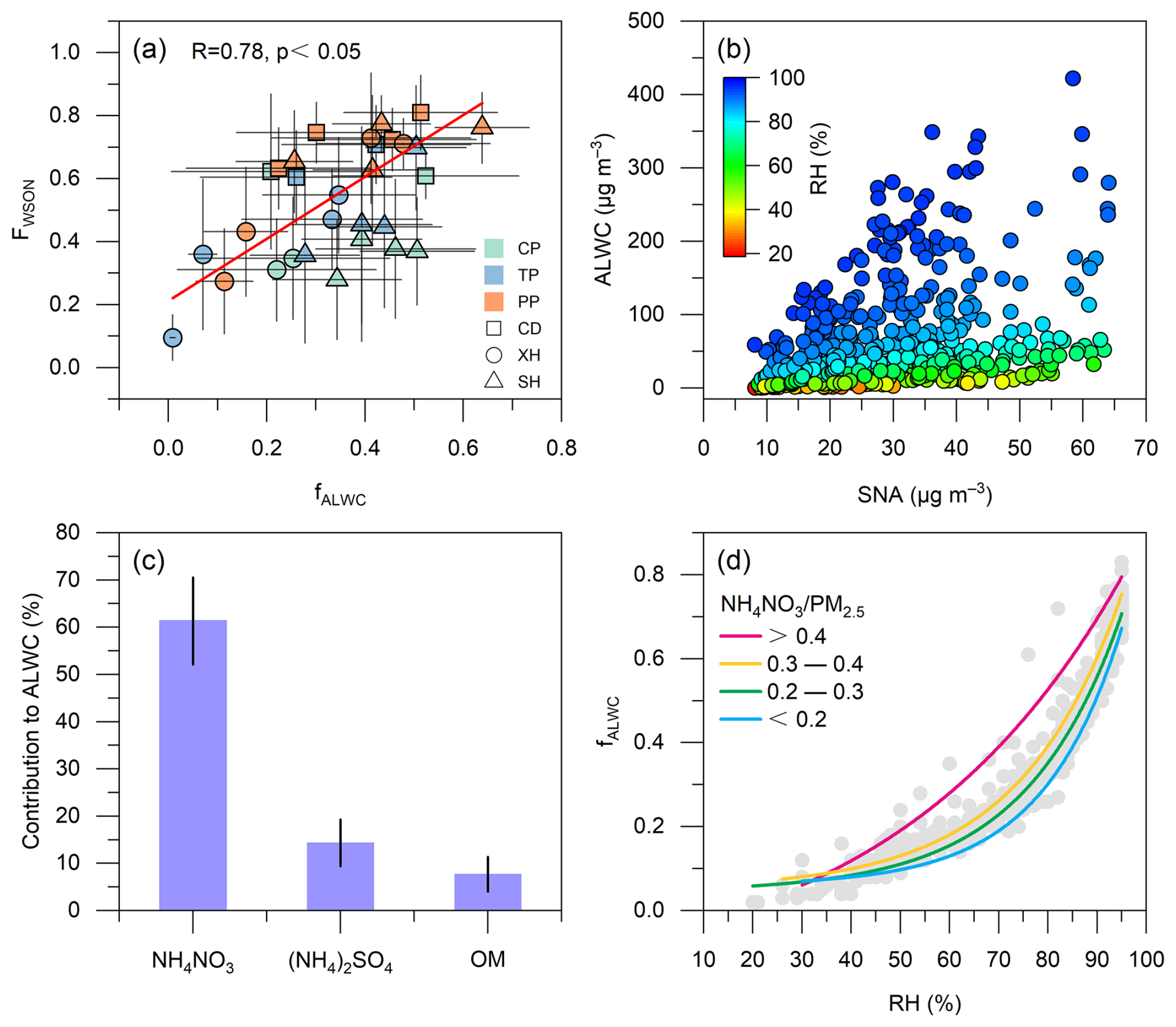
Figure 3Chemical drivers of ALWC and its associations with WSON. (a) correlation between the relative abundance of ALWC to PM2.5 () and FWSON. Symbols represent different geographical regions (CD: Chengdu; XH: Xianghe; SH: Shanghai), colors denote different pollution periods (PP: polluted period; TP: transition period; CP: clean period). (b) relationship between ALWC and SNA concentrations during the whole campaign of CD, colored by RH. (c) mean percentage contribution (±1 SD) of different chemical components (NH4NO3, (NH4)2SO4, OM) to ALWC during the whole campaign of CD. (d) variation of fALWC with RH under different relative abundances of NH4NO3 to PM2.5 during the whole campaign in the CD (solid lines represent the fitted curves, and gray dots represent the raw data).
3.3 Gas-to-aerosol phase partitioning of amines
Amines contribute significantly to WSONg,p in CD. Specifically, amines-N (MA-N and DMA-N) account for 48.7 % and 10.5 % of WSON in the gas and particle phases, respectively (Fig. 4). During the winter haze periods in CD, the total concentration of amines increased substantially, and the gas-particle partitioning coefficient (F) nearly doubled (Table 1), indicating enhanced gas-to-particle conversion. It is also evident from Table 1 that the gas-aerosol partitioning coefficients of the basic nitrogen-containing species (, MA, DMA) followed a decreasing order of , indicating that as the hydrogen atoms on the amino group (−NH2) are progressively substituted by hydrophobic methyl groups (−CH3), these basic species increasingly tend to remain in the gas phase rather than partitioning into the aerosol phase. Previous studies have demonstrated that with increasing degree of methylation of amines, their relative hydration free energy increases, thereby weakening their affinity for water and enhancing their partitioning from the aerosol phase to the gas phase (Rizzo and Jorgensen, 1999). In addition, as shown in Table S2, the reaction rate of NH3 with hydroxyl radical (•OH) in the atmosphere is relatively slow (), corresponding to an atmospheric lifetime of up to 72.3 d. In contrast, MA () and DMA () react extremely rapidly with •OH, with lifetimes of only a few hours (12.6 and 4.3 h for MA and DMA, respectively) (Table S2). This implies that the fast chemical loss of their gas-phase concentrations directly reduces their accumulation potential in the aerosol phase, leading to the observed decline in the measured F values with increasing methylation degree.
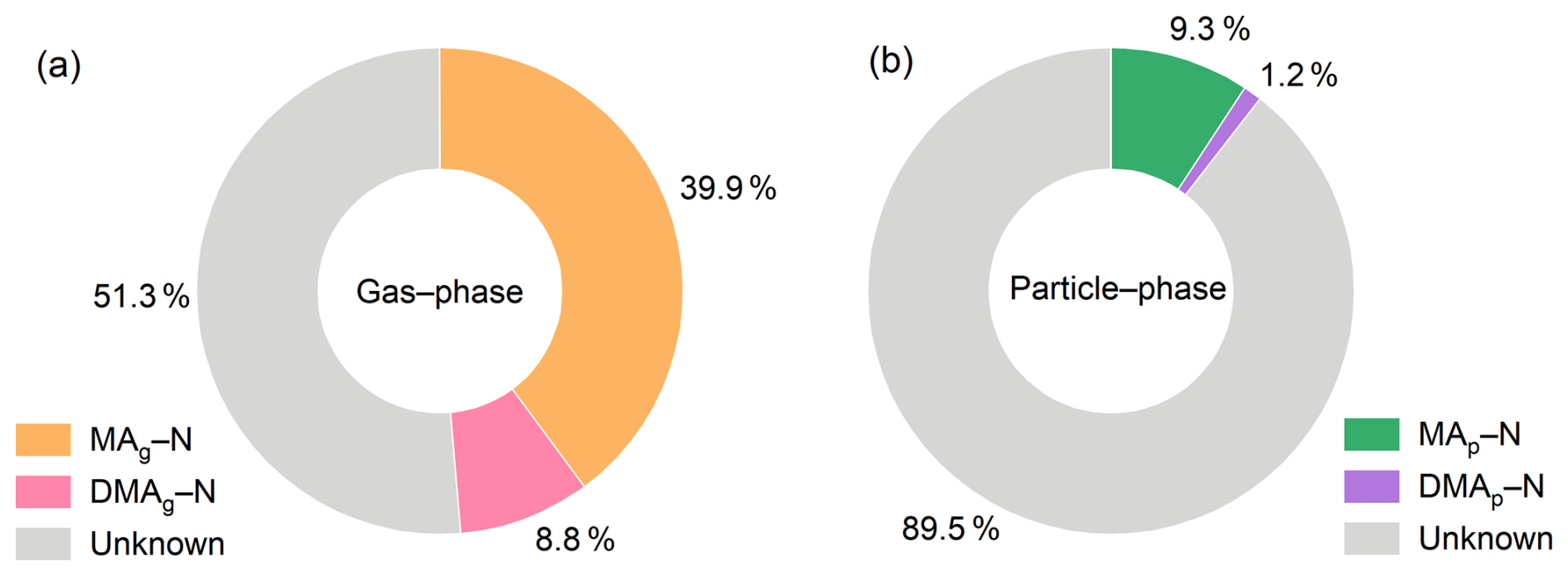
Figure 4Contributions of amines N concentrations to gas-phase (a) and particulate- phase (b) WSON.
To investigate the partitioning behavior of amines, we calculated their partitioning coefficients under different diel conditions, as shown in Fig. 5. As depicted in Fig. 5a and c, OM exhibited no significant correlation with the Fp of amines during either daytime or nighttime (R<0.5, p>0.05), indicating that OM exerted only a weak influence on the gas-aerosol partitioning of MA and DMA, and that their partitioning into the aerosol organic phase was relatively low. In contrast, both FMA and FDMA showed a clear increasing trend with increasing ALWC (R>0.5, p<0.05), suggesting that MA and DMA preferentially partitioned into the aerosol aqueous phase.
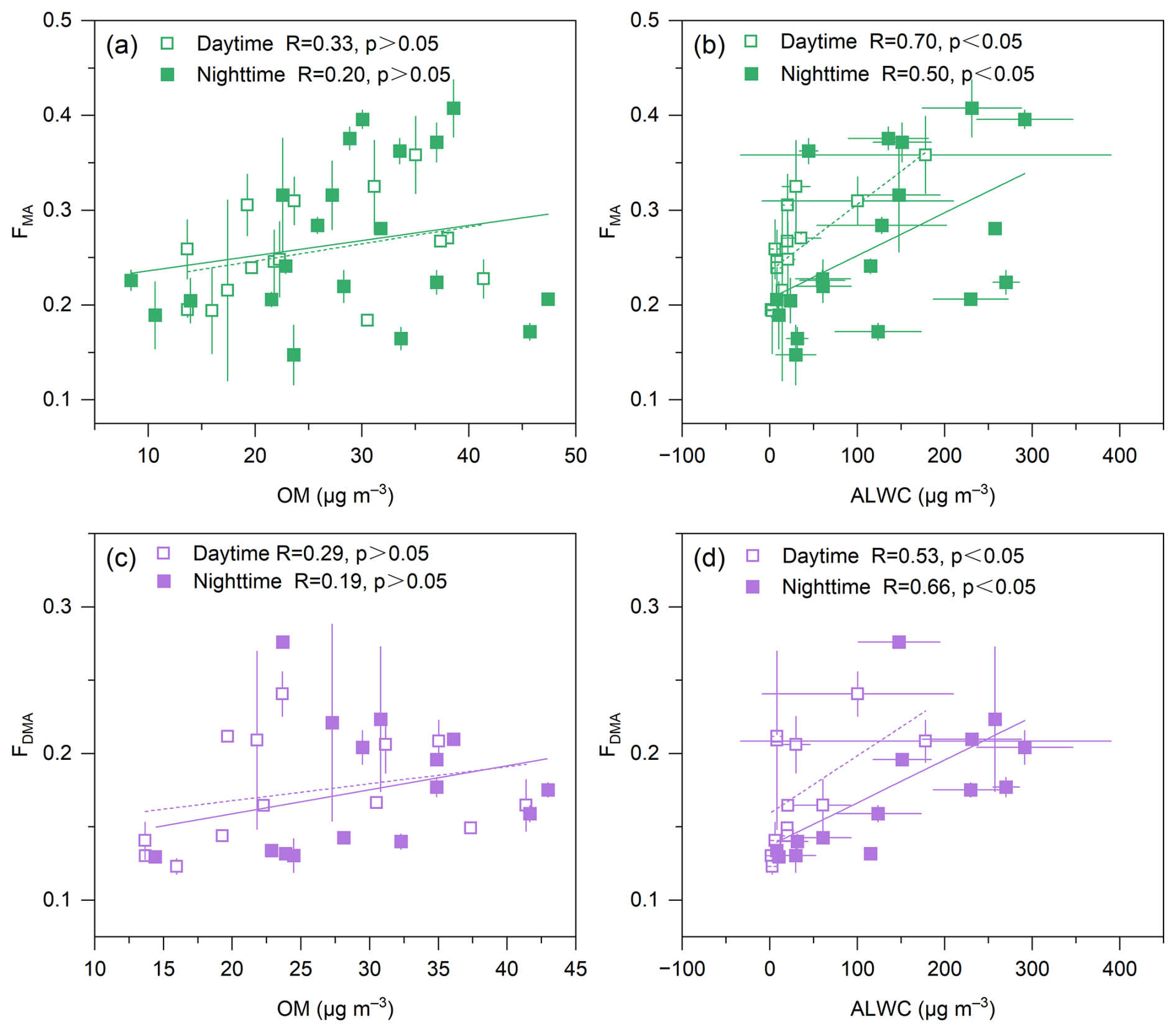
Figure 5Linear regression analysis for Fp with OM and ALWC under the daytime and nighttime during the pollution peroid (2–6 January 2025).
Furthermore, we found significant linear relationships between Fp and acidic anions (nitrate and sulfate) (R>0.5, p<0.01), and the coefficients increased with NOR and SOR (Fig. 6). This indicates that inorganic salts significantly promote the partitioning of MA and DMA, and that reactive uptake may also serve as one of the driving forces facilitating the partitioning of amines into aerosol. According to the Reactions (9–12) (Ge et al., 2011), gaseous amines synergistically neutralize H2SO4HNO3 together with NH3 to generate particulate amine salts (Almeida et al., 2013; Glasoe et al., 2015; Liu et al., 2018). Figure S5 presents a comparison between amines and inorganic salts. Our results show that amines exhibited good linear correlations with both nitrate and sulfate (R>0.5, p<0.01), suggesting that MA and DMA are likely present in particles predominantly as amine nitrate and/or amine sulfate salts (Huang et al., 2022). Furthermore, ALWC was found to promote their formation (Fig. S5). The humid and stagnant meteorological conditions in CD (Table 1) provide an ideal environment for the above transformations, promoting efficient enrichment of amines in the aerosol phase and making them a significant component of water-soluble ions in PM2.5.
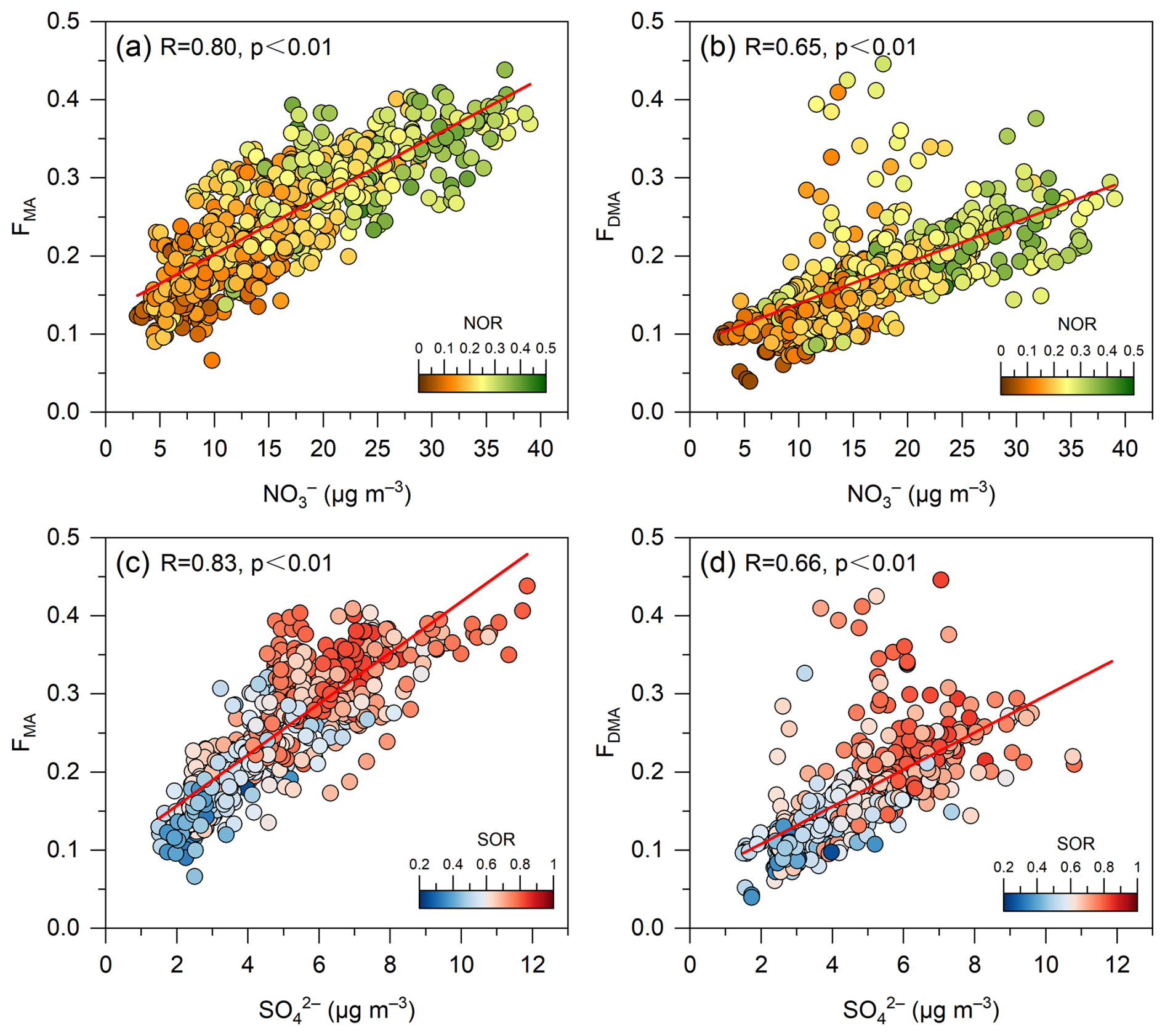
Figure 6Linear regression analysis for the gas-aerosol partitioning coefficient (Fp) of amines with inorganic salts.
To further identify the key factors governing the partitioning of amines, we analyzed the correlations between Fp and meteorological conditions (i.e., RH and T) as well as pH. As shown in Fig. S6a–f, no significant linear or nonlinear correlations were observed between FMA and T, RH, or pH during either daytime or nighttime (R<0.5). Similarly, FDMA did not show notable correlations with T, RH, or pH during the daytime (R<0.5, p>0.05). However, during the nighttime, FDMA exhibited a significant nonlinear relationship with RH, with an exponential increase when RH exceeded 80 %, while the influences of T and pH remained relatively weak (R<0.5, p>0.05). Figure 7a and b present the theoretical values of the gas-particle partitioning coefficients for MA and DMA ( and , respectively) calculated using a thermodynamic model and plotted against aerosol pH in an S-curve analysis. The observed partitioning coefficients for amines in CD fell within the range predicted by theoretical calculations; however, they did not exhibit the anticipated decrease with increasing pH. Theoretically, the partitioning of amines is co-regulated by pH, ALWC, and T. Under acidic conditions with low pH, amines are protonated to form ionic species, with ϵ approaching 100 %, favoring their partitioning into the aerosol phase. As pH increases, deprotonation occurs, forming volatile free bases, with ϵ approaching 0, leading to their transfer to the gas phase. However, given the acidity of atmospheric aqueous phases (pH 0–5), amines exist almost entirely in their protonated form (), within the observed pH range and the uncertainty of the available measurements, no significant independent pH dependence was detected (Tilgner et al., 2021). Generally, lower temperatures enhance the effective solubility of trace gases. However, (Tilgner et al., 2021) explicitly noted that aqueous-phase partitioning coefficients are higher in clouds (typically around 285 K) compared to near-surface conditions during hot summers, and higher in winter compared to summer. This indicates that the influence of T on partitioning coefficients is manifested in vertical altitude gradients and seasonal variations. Within a single season, its impact is less pronounced compared to that of ALWC (Tilgner et al., 2021). In this study, the partitioning coefficients of amines showed no significant correlation with T but exhibited a significant positive correlation with ALWC (Fig. 5). Consequently, variations in pH and T exert minimal influence on amine partitioning (Fig. S6), with ALWC emerging as the dominant limiting factor (Fig. 5).
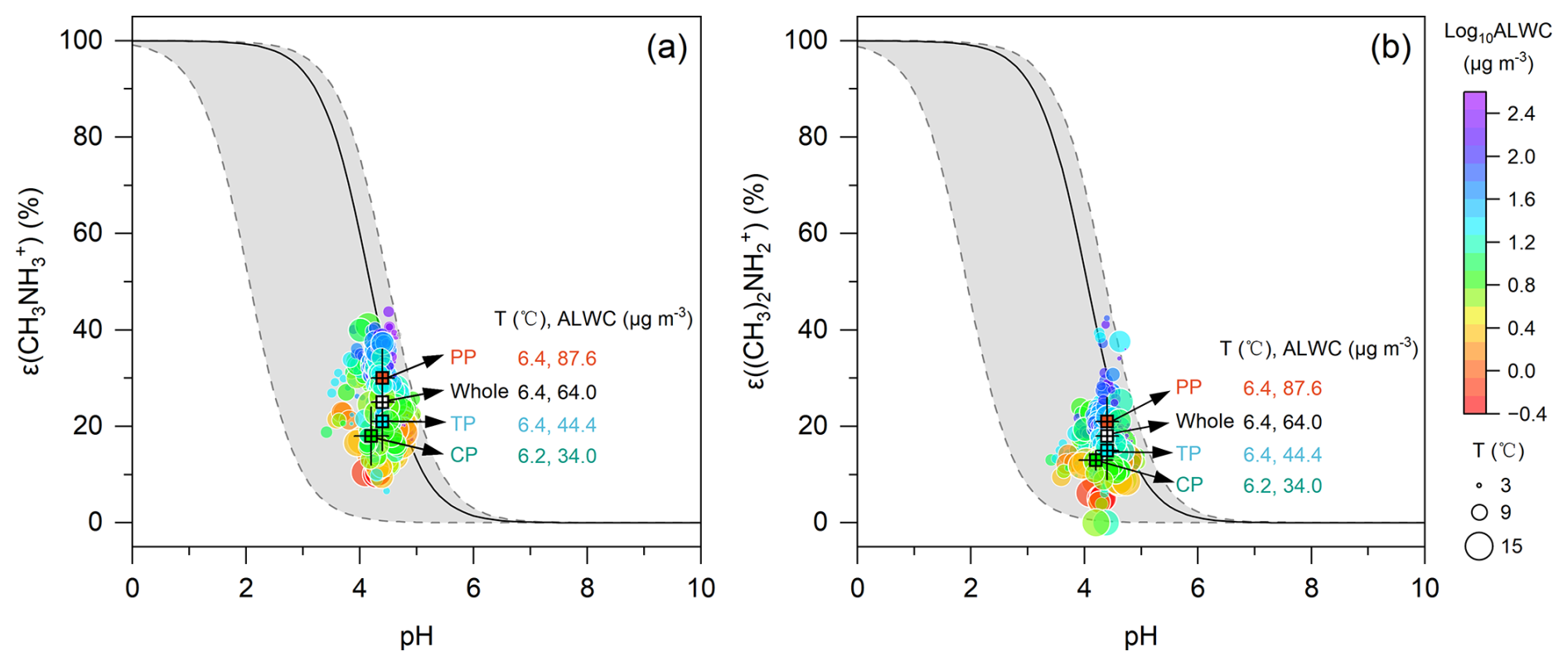
Figure 7Analytically calculated S-curves of and and ambient data during the entire observation period. Circles represent the measured data for methylamine (a) and dimethylamine (b), respectively. For the analytically calculated S-curve, we used , , and (E-AIM model predicted). The black solid line is the S-curve calculated based on the average temperature and ALWC (6.4±3.6 °C and , respectively). The gray dashed line represents the S-curve calculated using 1 standard deviation of the average temperature and ALWC. Due to the value of ALWC minus 1 standard deviation being less than 0, the minimum ALWC value (i.e., ) was used in the calculation. Different colors and blocks represent different sampling periods and their corresponding average values. CP: clean period, TP: transition period, PP: pollution period, and Whole: whole campaign period.
According to the Pankow (1994), aerosol mass loading may also be a factor affecting the gas-particle partitioning of organic compounds (Pankow, 1994; Lutz et al., 2019; Li et al., 2025). This relationship is typically described using Raoult's law, with the calculation equation as follows (Pankow, 1994):
where Ki is the partitioning constant of compound i, [i]particle and [i]gas represent the concentrations of compound i in the particle and gas phases, respectively, and TSP is the concentration of total suspended particulate material (PM2.5 mass concentrations are used in this study). Figure S7 shows the relationship between the ratios of MA and DMA and PM2.5 mass concentrations during the clean, transition, and pollution periods, respectively. For MA, the correlations between its ratio and PM2.5 were weak across all the three periods, with R<0.5 and p<0.01. The ratio of DMA during the clean period showed a correlation with PM2.5 (R=0.56, p<0.01); however, according to the application criteria for the Ki value proposed by (Lutz et al., 2019), an R2 greater than 0.7 is required for accurate Ki determination and meaningful interpretation, indicating that the results did not fall within the applicability range in this study. During the transition and pollution periods, the ratio of DMA also showed no significant correlation with PM2.5 (R<0.4, p<0.01), suggesting that aerosol mass loading did not exert a significant influence on amines uptake during the sampling period.
Atmospheric WSON accounts for approximately one-quarter to one-third of TN in global wet deposition. Its chemical composition is highly complex, and its qualitative and quantitative characterization remains limited to date (Yu et al., 2020). The environmental behavior of WSON in the atmosphere (e.g., residence time, transformation pathways, and deposition mechanisms) is influenced by its FWSON. However, relevant studies are still lacking, and most existing research has only measured particle-phase WSON. The CD, characterized by its unique topography and frequent stagnant, high-humidity meteorological conditions in winter, is one of the regions most severely affected by haze in China.
In this study, IGAC was employed to simultaneously measure, for the first time in CD, the concentration levels, chemical composition, and partitioning characteristics of wintertime gas- and particle-phase WSON. The evolution of WSON gas-particle partitioning across different pollution stages and its key driving factors were systematically elucidated. This study found that in high-humidity environments, ALWC plays a much stronger role in promoting the partitioning of WSON and amines into the particle phase than pH or T. During the PP, the particle-phase partitioning coefficients of amines increased significantly. Owing to their stronger basicity compared to NH3, amines can more effectively undergo acid-base reactions with acidic molecules such as sulfuric acid, forming more stable sulfuric acid–amine–water clusters, thereby substantially enhancing new particle formation rates (Almeida et al., 2013; Schobesberger et al., 2013; Yao et al., 2018). This indicates that amines are important precursors for SOA formation during heavy pollution episodes. Thermodynamic model (ISORROPIA-II) and S-curve analysis revealed that ALWC is the dominant factor controlling the partitioning of NOCs. This finding suggests that in high-humidity polluted regions, aqueous-phase chemical processes contribute significantly to nitrogen-containing organic aerosol formation. Previous studies have similarly demonstrated that ALWC significantly promotes the secondary formation of particle-phase WSON (Yu et al., 2017; Xu et al., 2020; Leung et al., 2024). NH4NO3 contributes approximately 61 % of ALWC, making it the largest contributor. Therefore, for CD, synergistic control of NOX and NH3 emissions can not only directly reduce nitrate in PM2.5 but also indirectly inhibit the particle-phase enrichment of WSON and amines by reducing ALWC, thereby effectively interrupting the self-amplifying cycle of SNA formation. These findings provide a new scientific basis for haze mitigation in high-humidity polluted regions.
The data including meteorological data, gaseous pollutants, and major chemical components in PM2.5 are freely available from Gehui Wang.
The supplement related to this article is available online at https://doi.org/10.5194/acp-26-14329-2026-supplement.
GW designed the experiment and supervised the research. KC, RL ( ), LC, RL (Rongjie Li), BX, SL and JZ collected the samples. KC, RL (), LC, CW and GW conducted the sample analysis. KC, RL (
 ), LC, CW and GW performed the data interpretation. KC and GW wrote the paper. ZL provided helpful assistance in writing the paper. All the authors contributed to the paper with useful scientific discussions.
The contact author has declared that none of the authors has any competing interests.
Publisher's note: Copernicus Publications remains neutral with regard to jurisdictional claims made in the text, published maps, institutional affiliations, or any other geographical representation in this paper. The authors bear the ultimate responsibility for providing appropriate place names. Views expressed in the text are those of the authors and do not necessarily reflect the views of the publisher.
This work was funded by the National Natural Science Foundation of China (grant nos. U23A2030 and 42130704).
This research has been supported by the National Natural Science Foundation of China (grant nos. U23A2030 and 42130704).
This paper was edited by Bin Yuan and reviewed by two anonymous referees.
Almeida, J., Schobesberger, S., Kürten, A., Ortega, I. K., Kupiainen-Määttä, O., Praplan, A. P., Adamov, A., Amorim, A., Bianchi, F., Breitenlechner, M., David, A., Dommen, J., Donahue, N. M., Downard, A., Dunne, E., Duplissy, J., Ehrhart, S., Flagan, R. C., Franchin, A., Guida, R., Hakala, J., Hansel, A., Heinritzi, M., Henschel, H., Jokinen, T., Junninen, H., Kajos, M., Kangasluoma, J., Keskinen, H., Kupc, A., Kurtén, T., Kvashin, A. N., Laaksonen, A., Lehtipalo, K., Leiminger, M., Leppä, J., Loukonen, V., Makhmutov, V., Mathot, S., McGrath, M. J., Nieminen, T., Olenius, T., Onnela, A., Petäjä, T., Riccobono, F., Riipinen, I., Rissanen, M., Rondo, L., Ruuskanen, T., Santos, F. D., Sarnela, N., Schallhart, S., Schnitzhofer, R., Seinfeld, J. H., Simon, M., Sipilä, M., Stozhkov, Y., Stratmann, F., Tomé, A., Tröstl, J., Tsagkogeorgas, G., Vaattovaara, P., Viisanen, Y., Virtanen, A., Vrtala, A., Wagner, P. E., Weingartner, E., Wex, H., Williamson, C., Wimmer, D., Ye, P., Yli-Juuti, T., Carslaw, K. S., Kulmala, M., Curtius, J., Baltensperger, U., Worsnop, D. R., Vehkamäki, H., and Kirkby, J.: Molecular understanding of sulphuric acid–amine particle nucleation in the atmosphere, Nature, 502, 359–363, https://doi.org/10.1038/nature12663, 2013.
Brean, J., Bortolussi, F., Rowell, A., Beddows, D. C. S., Weinhold, K., Mettke, P., Merkel, M., Kumar, A., Barua, S., Iyer, S., Karppinen, A., Sandström, H., Rinke, P., Wiedensohler, A., Pöhlker, M., Dal Maso, M., Rissanen, M., Shi, Z., and Harrison, R. M.: Traffic-Emitted Amines Promote New Particle Formation at Roadsides, ACS ES&T Air, 2, 1704–1713, https://doi.org/10.1021/acsestair.5c00119, 2025.
Chen, Y., Xia, M., Zheng, P., Li, Y., Zou, Z., Tong, S., Li, K., Feng, X., Hui, L., Yuan, Q., Li, J., Yu, J. Z., Lee, S., Wang, T., and Wang, Z.: Complex gas-particle partitioning of nitro-phenolic compounds: field-based insights and determination of apparent activity coefficient, npj Clim. Atmos. Sci., 8, https://doi.org/10.1038/s41612-025-01156-z, 2025.
Chow, J. C., Watson, J. G., Chen, L. W. A., Chang, M. C. O., Robinson, N. F., Trimble, D., and Kohl, S.: The IMPROVE_A Temperature Protocol for Thermal/Optical Carbon Analysis: Maintaining Consistency with a Long-Term Database, J. Air Waste Manage., 57, 1014–1023, https://doi.org/10.3155/1047-3289.57.9.1014, 2007.
Ditto, J. C., Abbatt, J. P. D., and Chan, A. W. H.: Gas- and Particle-Phase Amide Emissions from Cooking: Mechanisms and Air Quality Impacts, Environ. Sci. Technol., 56, 7741–7750, https://doi.org/10.1021/acs.est.2c01409, 2022.
Feng, X., Wei, S., and Wang, S.: Temperature inversions in the atmospheric boundary layer and lower troposphere over the Sichuan Basin, China: Climatology and impacts on air pollution, Sci. Total Environ., 726, https://doi.org/10.1016/j.scitotenv.2020.138579, 2020.
Fountoukis, C. and Nenes, A.: ISORROPIA II: a computationally efficient thermodynamic equilibrium model for K+–Ca2+–Mg2+––Na+–––Cl−–H2O aerosols, Atmos. Chem. Phys., 7, 4639–4659, https://doi.org/10.5194/acp-7-4639-2007, 2007.
Ge, X., Wexler, A. S., and Clegg, S. L.: Atmospheric amines – Part II. Thermodynamic properties and gas/particle partitioning, Atmos. Environ., 45, 561–577, https://doi.org/10.1016/j.atmosenv.2010.10.013, 2011.
Glasoe, W. A., Volz, K., Panta, B., Freshour, N., Bachman, R., Hanson, D. R., McMurry, P. H., and Jen, C.: Sulfuric acid nucleation: An experimental study of the effect of seven bases, J. Geophys. Res.-Atmos., 120, 1933–1950, https://doi.org/10.1002/2014jd022730, 2015.
González-Sánchez, J. M., Brun, N., Wu, J., Morin, J., Temime-Roussel, B., Ravier, S., Mouchel-Vallon, C., Clément, J.-L., and Monod, A.: On the importance of atmospheric loss of organic nitrates by aqueous-phase •OH oxidation, Atmos. Chem. Phys., 21, 4915–4937, https://doi.org/10.5194/acp-21-4915-2021, 2021.
Guan, L., Ding, C., Zhang, Y., Hu, J., and Yu, X.: Pollution Characteristics and Sources of Water-soluble Organic Nitrogen in PM2.5 in Jiangbei New Area,Nanjing, Environm. Sci., 43, 2888–2894, https://doi.org/10.13227/j.hjkx.202110026, 2022.
Guo, H., Xu, L., Bougiatioti, A., Cerully, K. M., Capps, S. L., Hite Jr., J. R., Carlton, A. G., Lee, S.-H., Bergin, M. H., Ng, N. L., Nenes, A., and Weber, R. J.: Fine-particle water and pH in the southeastern United States, Atmos. Chem. Phys., 15, 5211–5228, https://doi.org/10.5194/acp-15-5211-2015, 2015.
Guo, J., Zhu, Y., He, L., Ni, C., Yang, Y., and Tu, C.: Lower tropospheric inversion during haze process in Sichuan Basin: characteristics and influences, Environ. Sci. Technol., 49, 128–136, https://doi.org/10.19672/j.cnki.1003-6504.1316.25.338, 2026.
Hennigan, C. J., Izumi, J., Sullivan, A. P., Weber, R. J., and Nenes, A.: A critical evaluation of proxy methods used to estimate the acidity of atmospheric particles, Atmos. Chem. Phys., 15, 2775–2790, https://doi.org/10.5194/acp-15-2775-2015, 2015.
Huang, S., Song, Q., Hu, W., Yuan, B., Liu, J., Jiang, B., Li, W., Wu, C., Jiang, F., Chen, W., Wang, X., and Shao, M.: Chemical composition and sources of amines in PM2.5 in an urban site of PRD, China, Environ. Res., 212, https://doi.org/10.1016/j.envres.2022.113261, 2022.
Jickells, T., Baker, A. R., Cape, J. N., Cornell, S. E., and Nemitz, E.: The cycling of organic nitrogen through the atmosphere, Philos. T. R. Soc. B, 368, https://doi.org/10.1098/rstb.2013.0115, 2013.
Kanawade, V. P. and Jokinen, T.: Atmospheric amines are a crucial yet missing link in Earth's climate via airborne aerosol production, Communications Earth Environment, 6, https://doi.org/10.1038/s43247-025-02063-0, 2025.
Leung, C. W., Wang, X., and Hu, D.: Characteristics and source apportionment of water-soluble organic nitrogen (WSON) in PM2.5 in Hong Kong: With focus on amines, urea, and nitroaromatic compounds, J. Hazard. Mater., 469, https://doi.org/10.1016/j.jhazmat.2024.133899, 2024.
Li, Y., Fu, T.-M., Yu, J. Z., Yu, X., Chen, Q., Miao, R., Zhou, Y., Zhang, A., Ye, J., Yang, X., Tao, S., Liu, H., and Yao, W.: Dissecting the contributions of organic nitrogen aerosols to global atmospheric nitrogen deposition and implications for ecosystems, Natl. Sci. Rev., 10, https://doi.org/10.1093/nsr/nwad244, 2023.
Li, Z., Wang, G., Xiao, B., Li, R., Wu, C., Lv, S., Wu, F., Fu, Q., and Duan, Y.: Measurement report: simultaneous measurement on gas- and particle-phase water-soluble organics in Shanghai: enhanced light absorption of transported Asian dust, Atmos. Chem. Phys., 25, 12037–12049, https://doi.org/10.5194/acp-25-12037-2025, 2025.
Li, Z., Li, R., Xiao, B., Wu, C., Chen, K., Meng, J., Li, J., and Wang, G.: Gas-to-Particle Phase Transformation of Atmospheric Organics Amplified by Low Temperature and High Aerosol Water in Winter Haze of China, Environ. Sci. Technol., https://doi.org/10.1021/acs.est.5c18827, 2026.
Liu, F., Bi, X., Zhang, G., Lian, X., Fu, Y., Yang, Y., Lin, Q., Jiang, F., Wang, X., Peng, P. A., and Sheng, G.: Gas-to-particle partitioning of atmospheric amines observed at a mountain site in southern China, Atmos. Environ., 195, 1–11, https://doi.org/10.1016/j.atmosenv.2018.09.038, 2018.
Liu, X., Wang, H., Wang, F., Lv, S., Wu, C., Zhao, Y., Zhang, S., Liu, S., Xu, X., Lei, Y., and Wang, G.: Secondary Formation of Atmospheric Brown Carbon in China Haze: Implication for an Enhancing Role of Ammonia, Environ. Sci. Technol., 57, 11163–11172, https://doi.org/10.1021/acs.est.3c03948, 2023.
Lu, H., Xie, M., Zhuang, B., Ma, D., Liu, B., Zhan, Y., Wang, T., Li, S., Li, M., and Zhu, K.: Impacts of atmospheric circulation patterns and cloud inhibition on aerosol radiative effect and boundary layer structure during winter air pollution in Sichuan Basin, China, Atmos. Chem. Phys., 24, 8963–8982, https://doi.org/10.5194/acp-24-8963-2024, 2024.
Lutz, A., Mohr, C., Le Breton, M., Lopez-Hilfiker, F. D., Priestley, M., Thornton, J. A., and Hallquist, M.: Gas to Particle Partitioning of Organic Acids in the Boreal Atmosphere, ACS Earth Space Chem., 3, 1279–1287, https://doi.org/10.1021/acsearthspacechem.9b00041, 2019.
Lv, S., Wang, F., Wu, C., Chen, Y., Liu, S., Zhang, S., Li, D., Du, W., Zhang, F., Wang, H., Huang, C., Fu, Q., Duan, Y., and Wang, G.: Gas-to-Aerosol Phase Partitioning of Atmospheric Water-Soluble Organic Compounds at a Rural Site in China: An Enhancing Effect of NH3 on SOA Formation, Environ. Sci. Technol., 56, 3915–3924, https://doi.org/10.1021/acs.est.1c06855, 2022a.
Lv, S., Wu, C., Wang, F., Liu, X., Zhang, S., Chen, Y., Zhang, F., Yang, Y., Wang, H., Huang, C., Fu, Q., Duan, Y., and Wang, G.: Nitrate-Enhanced Gas-to-Particle-Phase Partitioning of Water-Soluble Organic Compounds in Chinese Urban Atmosphere: Implications for Secondary Organic Aerosol Formation, Environ. Sci. Technol. Lett., 10, 14–20, https://doi.org/10.1021/acs.estlett.2c00894, 2022b.
Matsumoto, K., Ogawa, T., Ishikawa, M., Hirai, A., Watanabe, Y., and Nakano, T.: Organic and inorganic nitrogen deposition on the red pine forests at the northern foot of Mt. Fuji, Japan, Atmos. Environ., 237, https://doi.org/10.1016/j.atmosenv.2020.117676, 2020.
Özel, M. Z., Ward, M. W., Hamilton, J. F., Lewis, A. C., Raventós-Duran, T., and Harrison, R. M.: Analysis of Organic Nitrogen Compounds in Urban Aerosol Samples Using GCxGC-TOF/MS, Aerosol Sci. Tech., 44, 109–116, https://doi.org/10.1080/02786820903410105, 2010.
Pankow, J. F.: An absorption model of gas/particle partitioning of organic compounds in the atmosphere, Atmos. Environ., 28, 185–188, https://doi.org/10.1016/1352-2310(94)90093-0, 1994.
Pankow, J. F.: Phase considerations in the gas/particle partitioning of organic amines in the atmosphere, Atmos. Environ., 122, 448–453, https://doi.org/10.1016/j.atmosenv.2015.09.056, 2015.
Qiu, C. and Zhang, R.: Multiphase chemistry of atmospheric amines, Phys. Chem. Chem. Phys., 15, https://doi.org/10.1039/c3cp43446j, 2013.
Rao, Z., Tao, H., Zhou, L., Wang, W., Liu, S., Luo, B., Zhang, W., Cao, P., Li, J., Yang, F., and Ge, M.: Divergent drivers of winter PM2.5 pollution in representative cities of the Sichuan Basin: Insights from observation and machine learning, J. Hazard. Mater., 514, https://doi.org/10.1016/j.jhazmat.2026.142877, 2026.
Rizzo, R. C. and Jorgensen, W. L.: OPLS All-Atom Model for Amines: Resolution of the Amine Hydration Problem, J. Am. Chem. Soc., 121, 4827–4836, https://doi.org/10.1021/ja984106u, 1999.
Rollins, A. W., Pusede, S., Wooldridge, P., Min, K. E., Gentner, D. R., Goldstein, A. H., Liu, S., Day, D. A., Russell, L. M., Rubitschun, C. L., Surratt, J. D., and Cohen, R. C.: Gas/particle partitioning of total alkyl nitrates observed with TD-LIF in Bakersfield, J. Geophys. Res.-Atmos., 118, 6651–6662, https://doi.org/10.1002/jgrd.50522, 2013.
Schobesberger, S., Junninen, H., Bianchi, F., Lönn, G., Ehn, M., Lehtipalo, K., Dommen, J., Ehrhart, S., Ortega, I. K., Franchin, A., Nieminen, T., Riccobono, F., Hutterli, M., Duplissy, J., Almeida, J., Amorim, A., Breitenlechner, M., Downard, A. J., Dunne, E. M., Flagan, R. C., Kajos, M., Keskinen, H., Kirkby, J., Kupc, A., Kürten, A., Kurtén, T., Laaksonen, A., Mathot, S., Onnela, A., Praplan, A. P., Rondo, L., Santos, F. D., Schallhart, S., Schnitzhofer, R., Sipilä, M., Tomé, A., Tsagkogeorgas, G., Vehkamäki, H., Wimmer, D., Baltensperger, U., Carslaw, K. S., Curtius, J., Hansel, A., Petäjä, T., Kulmala, M., Donahue, N. M., and Worsnop, D. R.: Molecular understanding of atmospheric particle formation from sulfuric acid and large oxidized organic molecules, P. Natl. Acad. Sci. USA, 110, 17223–17228, https://doi.org/10.1073/pnas.1306973110, 2013.
Shu, X., Qiao, X., Tang, Y., Hopke, P. K., Ying, Q., Wang, J., Han, B., Xu, Z., Xia, Z., Ma, Y., Dai, Y., and Leng, J.: Enclosed-terrain urbanized areas require vertically stratified air quality management: Insights from particulate matter vertical observations in China's Sichuan Basin, J. Environ. Manage., 391, https://doi.org/10.1016/j.jenvman.2025.126564, 2025.
Tang, S., Li, F., Lv, J., Liu, L., Wu, G., Wang, Y., Yu, W., Wang, Y., and Jiang, G.: Unexpected molecular diversity of brown carbon formed by Maillard-like reactions in aqueous aerosols, Chem. Sci., 13, 8401–8411, https://doi.org/10.1039/d2sc02857c, 2022.
Tilgner, A., Schaefer, T., Alexander, B., Barth, M., Collett Jr., J. L., Fahey, K. M., Nenes, A., Pye, H. O. T., Herrmann, H., and McNeill, V. F.: Acidity and the multiphase chemistry of atmospheric aqueous particles and clouds, Atmos. Chem. Phys., 21, 13483–13536, https://doi.org/10.5194/acp-21-13483-2021, 2021.
Wang, Y., Hu, M., Hu, W., Zheng, J., Niu, H., Fang, X., Xu, N., Wu, Z., Guo, S., Wu, Y., Chen, W., Lu, S., Shao, M., Xie, S., Luo, B., and Zhang, Y.: Secondary Formation of Aerosols Under Typical High-Humidity Conditions in Wintertime Sichuan Basin, China: A Contrast to the North China Plain, J. Geophys. Res.-Atmos., 126, https://doi.org/10.1029/2021jd034560, 2021.
Xiao, B., Wang, G., Li, Z., Li, R., Liang, C., Wang, H., Zhang, S., Wu, C., Li, R., Zhang, F., Zhang, R., Wu, Y., and Zhang, L.: High Contribution of Secondary Formation to Brown Carbon in China Humid Haze: Enhancing Role of Ammonia and Amines, Environ. Sci. Technol., 59, 27530–27540, https://doi.org/10.1021/acs.est.5c13436, 2025.
Xie, F., Wang, F., Li, L., Peng, C., Zhou, X., Sun, Y., and Lü, C.: Characteristics and sources of water-soluble organic nitrogen in PM2.5 from a resource-dependent city, Atmos. Pollut. Res., 16, https://doi.org/10.1016/j.apr.2025.102586, 2025.
Xu, Y., Miyazaki, Y., Tachibana, E., Sato, K., Ramasamy, S., Mochizuki, T., Sadanaga, Y., Nakashima, Y., Sakamoto, Y., Matsuda, K., and Kajii, Y.: Aerosol Liquid Water Promotes the Formation of Water-Soluble Organic Nitrogen in Submicrometer Aerosols in a Suburban Forest, Environ. Sci. Technol., 54, 1406–1414, https://doi.org/10.1021/acs.est.9b05849, 2020.
Yang, D., Zhu, S., Ma, Y., Zhou, L., Zheng, F., Wang, L., Jiang, J., and Zheng, J.: Emissions of Ammonia and Other Nitrogen-Containing Volatile Organic Compounds from Motor Vehicles under Low-Speed Driving Conditions, Environ. Sci. Technol., 56, 5440–5447, https://doi.org/10.1021/acs.est.2c00555, 2022.
Yang, X., Cao, F., Fan, M., Lin, Y., Xie, F., and Zhang, Y.: Seasonal variations of low molecular alkyl amines in PM2.5 in a North China Plain industrial city: Importance of secondary formation and combustion emissions, Sci. Total Environ., 857, https://doi.org/10.1016/j.scitotenv.2022.159371, 2023.
Yao, L., Garmash, O., Bianchi, F., Zheng, J., Yan, C., Kontkanen, J., Junninen, H., Mazon, S. B., Ehn, M., Paasonen, P., Sipilä, M., Wang, M. Y., Wang, X. K., Xiao, S., Chen, H. F., Lu, Y. Q., Zhang, B. W., Wang, D. F., Fu, Q. Y., Geng, F. H., Li, L., Wang, H. L., Qiao, L. P., Yang, X., Chen, J. M., Kerminen, V. M., Petäjä, T., Worsnop, D. R., Kulmala, M., and Wang, L.: Atmospheric new particle formation from sulfuric acid and amines in a Chinese megacity, Science, 361, 278–281, https://doi.org/10.1126/science.aao4839, 2018.
Yu, Q., Fu, N., Lu, J., Zhang, Y., Du, W., and Wang, J.: Atmospheric Amines: Advances in Analytical Techniques, Emission Inventories, Regional Pollution, and Roles in New Particle Formation, Current Pollution Reports, 11, https://doi.org/10.1007/s40726-025-00364-8, 2025.
Yu, X., Yu, Q., Zhu, M., Tang, M., Li, S., Yang, W., Zhang, Y., Deng, W., Li, G., Yu, Y., Huang, Z., Song, W., Ding, X., Hu, Q., Li, J., Bi, X., and Wang, X.: Water Soluble Organic Nitrogen (WSON) in Ambient Fine Particles Over a Megacity in South China: Spatiotemporal Variations and Source Apportionment, J. Geophys. Res.-Atmos., 122, https://doi.org/10.1002/2017jd027327, 2017.
Yu, X., Li, D., Li, D., Zhang, G., Zhou, H., Li, S., Song, W., Zhang, Y., Bi, X., Yu, J., and Wang, X.: Enhanced Wet Deposition of Water-Soluble Organic Nitrogen During the Harvest Season: Influence of Biomass Burning and In-Cloud Scavenging, J. Geophys. Res.-Atmos., 125, https://doi.org/10.1029/2020jd032699, 2020.
Yu, X., Li, Q., Liao, K., Li, Y., Wang, X., Zhou, Y., Liang, Y., and Yu, J. Z.: New measurements reveal a large contribution of nitrogenous molecules to ambient organic aerosol, npj Clim. Atmos. Sci., 7, https://doi.org/10.1038/s41612-024-00620-6, 2024.
Zhang, J., Su, Y., Chen, C., Guo, W., Tan, Q., Feng, M., Song, D., Jiang, T., Chen, Q., Li, Y., Li, W., Wang, Y., Huang, X., Han, L., Wu, W., and Wang, G.: Chemical composition, sources and formation mechanism of urban PM2.5 in Southwest China: a case study at the beginning of 2023, Atmos. Chem. Phys., 24, 2803–2820, https://doi.org/10.5194/acp-24-2803-2024, 2024.
Zhu, S., Yan, C., Zheng, J., Chen, C., Ning, H., Yang, D., Wang, M., Ma, Y., Zhan, J., Hua, C., Yin, R., Li, Y., Liu, Y., Jiang, J., Yao, L., Wang, L., Kulmala, M., and Worsnop, D. R.: Observation and Source Apportionment of Atmospheric Alkaline Gases in Urban Beijing, Environ. Sci. Technol., 56, 17545–17555, https://doi.org/10.1021/acs.est.2c03584, 2022.