
the Creative Commons Attribution 4.0 License.
the Creative Commons Attribution 4.0 License.
 | 06 Oct 2026
Cross-phase partitioning of sulfur-nitrogen ratios and aerosol mixing-state evolution based on single-particle observations
Yuan Dai

Mindong Chen
Su Zhang
Haiwei Li
Yunjiang Zhang
Yun Wu
Ming Wang
Xinlei Ge
The balance between sulfur and nitrogen (S-N) precursors influences secondary aerosol formation, yet its cross-phase links to particle composition and mixing states remain poorly constrained. Here, we integrated single-particle aerosol mass spectrometry (SPA-MS) with pollutant and meteorological observations during winter and summer emission control periods (ECPs) and corresponding normal periods (NPs) in Yangzhou, eastern China. By establishing gas-phase (gSNR), particle-phase (pSNR), and number-based (nSNR) sulfur-to-nitrogen ratio metrics, we combined causal inference with interpretable machine learning to analyze the underlying drivers. During ECPs, reduced NOx emissions alongside relatively stable SO2 concentrations elevated gSNR, driving an average ∼ 57 % increase in pSNR across particle classes and a 27 % expansion in mean vacuum aerodynamic diameter (Dva) relative to NPs. Causal analysis revealed a stepwise propagation of S-N partitioning running sequentially from gas-phase precursors to single-particle chemistry and ultimately to the population mixing state. Particle-resolved chemistry demonstrated that pSNR enrichment was highest in particles containing both black carbon and organic carbon, but markedly lower in BC-free inorganic particles, indicating strong particle-type-dependent aging pathways. Relative humidity (RH) acted as a primary regulator of this cross-phase coupling: below 55 % RH, the SNR metrics decoupled, maintaining substantial chemical heterogeneity across particle classes (externally mixed state); above 85 % RH, aerosol liquid water uptake accelerated gas-particle exchange and multiphase processing, causing the SNR metrics to converge as aerosols evolve toward an internally mixed state. These findings suggest that future air-quality models would benefit from incorporating particle-type heterogeneity and humidity-dependent multiphase processes under shifting emission regimes.
- Article
(5711 KB) - Full-text XML
-
Supplement
(3299 KB) - BibTeX
- EndNote


Secondary aerosols, dominated by sulfate and nitrate, constitute a major fraction of fine particulate matter (PM2.5, aerodynamic diameter ≤ 2.5 µm) (Huang et al., 2014; Wang et al., 2013). These species strongly influence aerosol hygroscopicity, toxicity, optical properties, and radiative forcing (Nozière et al., 2010; Sheldon et al., 2023; El Haddad et al., 2024). They originate mainly from the multiphase oxidation of sulfur dioxide (SO2) and nitrogen oxides (NOx = NO2 + NO) (Cheng et al., 2016; Liu et al., 2022) and their formation is governed by the interplay of precursor abundance, atmospheric oxidizing capacity, and meteorological conditions (George and Abbatt, 2010; Shiraiwa et al., 2011; Wen et al., 2018). Among these factors, relative humidity (RH) plays a central role by regulating aerosol liquid water and phase state, which in turn influences surface properties, mass-transport rates, and chemical aging pathways (Shiraiwa et al., 2011; Liu et al., 2018; Huang et al., 2023). These coupled processes are concisely reflected in the sulfur-to-nitrogen ratio (SNR), a common diagnostic for source attribution and sulfate-nitrate (S-N) evolution (Xie et al., 2020; Liu et al., 2020; Sosa Echeverría et al., 2023). However, SNR is still often interpreted using bulk or time-averaged measurements (Snider et al., 2016; Sun et al., 2016; Xu et al., 2019), which may inherently obscure particle-type heterogeneity and mixing-state diversity that matter for multiphase processing. Furthermore, current model parameterizations often oversimplify the effects of RH and aerosol phase state (Schmedding et al., 2020; Shiraiwa et al., 2017), while observational constraints remain largely limited to heavily polluted episodes (Huang et al., 2023; Wang et al., 2021a). These limitations leave uncertainties regarding how shifts in gas-phase precursor composition translate into particle composition, number fractions, and transitions between internal and external mixing, particularly under cleaner urban conditions.
These uncertainties may be magnified by the rapid evolution of anthropogenic emissions. Between 2013 and 2024, China's clean air actions triggered an asymmetric decline in major gaseous precursors (Zhang et al., 2020b; Geng et al., 2024): annual SO2 fell from 40 to 8 µg m−3 (−80 %) and stabilized well below the World Health Organization (WHO) guidelines, while NO2 reductions were more moderate (−55 %), remaining nearly twice the revised WHO annual limit (Ministry of Ecology and Environment of the People's Republic of China, Bulletins on the State of China's Ecological and Environmental Quality, 2013–2024 https://www.mee.gov.cn/hjzl/sthjzk/zghjzkgb/, last access: 3 October 2026). This imbalance drove the national gas-phase SNR (gSNR) down from 1.27 to 0.56 and favored nitrate-dominated aerosols (Liu et al., 2022; Chu et al., 2020; Lin et al., 2023). However, further trend shifts are likely as policy priorities move toward deeper NOx control. The WHO tightened its annual NO2 guideline (from 40 to 10 µg m−3), while relaxing the daily SO2 limit (from 20 to 40 µg m−3). China has strengthened industrial and traffic NOx emission standards (Lu et al., 2020; Zhang et al., 2021b), and accelerated the uptake of new-energy vehicles (Liang et al., 2019). Under this trend, gSNR may rise again, potentially coinciding with higher ozone (O3) levels and a more oxidizing atmosphere(Li et al., 2019). The COVID-19 lockdowns provide a natural experiment consistent with this direction. Across Chinese megacities, lockdown periods induced sharp, short-term NOx declines (30 % to 50 %) and O3 increases (21 % to 77 %) while SO2 remained stable (Le et al., 2020; Huang et al., 2021; Dai et al., 2024), effectively simulating future emission trends within a cleaner and more oxidizing background.
In this study, we use these perturbations in Yangzhou, a representative city in the Yangtze River Delta (YRD), to investigate multiphase S-N evolution across two lockdown-recovery cycles. By integrating single-particle aerosol mass spectrometry (SPA-MS) with causal inference and interpretable machine-learning analysis, we track S-N partitioning across gas, particle and number domains. This particle-resolved approach links precursor shifts, oxidizing conditions, and RH-dependent phase transitions to single-particle aging and mixing-state evolution, providing process-level evidence to improve regional model representations of coupled S-N partitioning under ongoing NOx mitigation.
2.1 Site Description and Sampling Periods
Field observations were conducted at a national air-quality monitoring station in Yangzhou (32.41° N, 119.40° E), a representative urban center within the YRD of China. The monitoring site is situated 20 m above ground level in a mixed residential, commercial, and educational district, representing typical urban background conditions in the region. To examine atmospheric responses to abrupt emission changes during the COVID-19 pandemic, we selected four rain-free five-day episodes with broadly comparable meteorological conditions, comprising two emission control periods (ECPs) and their corresponding normal periods (NPs): a winter ECP (W-ECP, 29 January–2 February 2020) and its winter NP (W-NP, 20–24 February 2020), as well as a summer ECP (S-ECP, 17–21 August 2021) and its summer NP (S-NP, 17–21 September 2021).
Single-particle chemical composition, vacuum aerodynamic diameter (Dva), and mixing state were measured in real time using a single-particle aerosol mass spectrometer (SPA-MS; Hexin Analytical Instrument Co., Ltd., China). The instrument primarily detected particles with Dva ranging from 0.2 to 2.0 µm, as detailed previously (Dai et al., 2024). Concurrently, PM2.5 mass concentrations were measured by a particulate matter monitor (XHPM2000E, Xianhe, China), while trace gases (NOx, SO2, CO, and O3) were quantified using Thermo Scientific analyzers (Models 42i, 43i, 48i, and 49i) (Fig. S1 in the Supplement). All instruments were co-located to ensure the temporal and spatial consistency of the aerosol and precursor datasets.
Meteorological parameters were retrieved via Google Earth Engine (GEE) from the NASA Goddard Earth Observing System Composition Forecast system (GEOS-CF) and the ERA5-Land hourly dataset from the European Centre for Medium-Range Weather Forecasts (ECMWF). Ten variables were extracted for the grid cell nearest to the monitoring site (Table S2 in the Supplement): 2 m air temperature (T2m), 10 m air temperature (T10m), eastward and northward wind components at 2 m (U2m, V2m), surface net solar radiation (SSR), planetary boundary layer height (BLH), sea level pressure (SLP), total precipitation (TPREC), 2 m dew point temperature (DP2m), and relative humidity (RH). These variables were selected for their potential roles in influencing atmospheric stability, pollutant transport, and chemical transformation kinetics. All datasets were temporally synchronized to an hourly resolution to facilitate integrated analysis with the chemical measurements.
2.2 Single-Particle Classification
A total of 324 090 ambient particles were detected and classified based on their SPA-MS mass spectra. Particles were clustered using the ART-2a algorithm in MATLAB R2024a (MathWorks, Inc.) via the Computational Continuation Core toolkit (COCO v1.4). The algorithm was executed for 20 iterations with a vigilance factor of 0.8 and a learning rate of 0.05, parameters consistent with established single-particle aerosol studies (Huang et al., 2023; Zhang et al., 2021a; Dai et al., 2024). Following the initial clustering, particle types were aggregated into five operational principal groups according to their dominant mass-spectral signatures. Black Carbon (BC) particles were identified by carbon-cluster ions (e.g., ±12[C], ±36[C3], ±48[C4], and ±60[C5]). BC with organic carbon (BCOC) particles exhibited the same BC signatures together with characteristic organic-carbon (OC) fragments (e.g., 27[C2H3]+, 29[C2H5]+, 37[C3H]+, and 43[C2H3O]+). BC-free inorganic (BF) particles lacked BC cluster signatures and were dominated by inorganic species. BC-free OC-rich (BFOC) particles also lacked BC clusters but showed a high relative abundance of OC fragments. Residual subclasses with mixed or ambiguous signatures were defined as “Other”.
To better resolve S-N partitioning, we further divided these principal groups into 19 subclasses. Subclasses enriched in secondary inorganic species (SIS) were identified by sulfate (−97[HSO], −96[SO]), nitrate (−62[NO], −46[NO]), or both, and were labeled with the suffixes “-S”, “-N” and “-SN”, respectively. Particles exhibiting strong cyanide-related ions (−26[CN−] and −42[CNO−]) were labeled with “-CN”. Number fractions and representative mass spectra are summarized in Table S1 and Fig. S2.
2.3 Classification of Fresh-like and Aged-like Particles
Aerosols were further grouped into fresh-like (-CN) and aged-like (-sec) based on diagnostic SPA-MS fragments and Dva (Figs. 1f and 2). Strong cyanide-related ions together with carbonaceous fragments are commonly observed in relatively fresh combustion particles from biomass burning, coal combustion, and vehicle exhaust (Huang et al., 2023; Sun et al., 2017; Zhang et al., 2020a). We therefore treated CN-containing subclasses within each principal group as operational fresh-like states. For instance, BCOC-CN particles exhibit abundant carbon-cluster and hydrocarbon fragments accompanied by cyanide signatures (Fig. 2h), occurring predominantly at smaller Dva (100–600 nm), consistent with freshly emitted combustion aerosols (Sharma et al., 2018). Similarly, BFOC-CN particles display +39[K+], −26[CN−], and levoglucosan-derived fragments (−45[CHO], −59[C2H3O], −73[C3H5O]) and are predominantly found at small sizes, representing primary organic aerosol from biomass burning (Fig. 2c) (Bi et al., 2011; Huang et al., 2023).
Aged-like types (-sec) were constructed by regrouping sulfate-rich (-S), nitrate-rich (-N) and mixed (-SN) subclasses into composite SIS-enriched categories within each principal group, reflecting extensive secondary processing (Xie et al., 2020). BCOC-sec types display coexisting BC, OC and strong SIS fragments (Fig. 2g), indicating substantial internal mixing of carbonaceous and secondary inorganics, in line with previous observations (Dai et al., 2024; Xie et al., 2020). BC-sec (BC-S, BC-N, BC-SN; Fig. 2f showed negligible OC signals but elevated SIS ions, while BF-sec and BFOC-sec (BF-S, BC-N, BC-SN; BFOC-S, BC-N, BC-SN) exhibit elevated sulfate and nitrate ions but lack BC fragments (Fig. 2b, d).
The consistency of this fresh-aged framework is supported by both compositional and temporal variations. The relative contribution of SIS signal is systematically lower in “-CN” than in “-sec” types for BC, BCOC, BF and BFOC groups (Fig. S3a). In addition, hourly number concentrations of each “-sec” type correlate most strongly with the “-CN” type within the same principal group (Fig. S3b). Together with the systematic increase in Dva from “-CN” to “-sec”, these diagnostics support interpreting “-CN” and “-sec” as fresh-like and aged-like compositional states within each principal group. We therefore define four dominant fresh-like/aged-like pairs: BC-CN/BC-sec, BCOC-CN/BCOC-sec, BF-CN/BF-sec, and BFOC-CN/BFOC-sec.
2.4 Definition of Sulfur-to-Nitrogen Ratios Metrics
To quantify S-N partitioning across gas, particles, and number domains, we define three complementary SNR metrics: gas-phase SNR (gSNR), particle-phase SNR (pSNR), and number-based SNR (nSNR). The gSNR is calculated as the molar ratio of SO2 to NOx from hourly observations:
The pSNR is derived from SPA-MS spectra by calculating the ratio of total peak areas (PA) of sulfate ions (−97[HSO], −96[SO]) to nitrate ions (−62[NO], −46[NO]) for a selected particle or particle class:
Although SPA-MS is semi-quantitative, uniform acquisition and processing of sulfate- and nitrate-related ion signals provide a consistent basis for comparing relative variations in pSNR. Because ion responses and matrix effects may vary, pSNR is interpreted as a relative spectral indicator rather than an absolute sulfate-to-nitrate molar or mass ratio, consistent with prior SPA-MS studies (Healy et al., 2013; Zhang et al., 2021a).
The nSNR represents the ratio of the number concentrations (N) of sulfur-containing particles to nitrogen-containing particles, serving as a population-level proxy for external mixing tendency of sulfate- versus nitrate-containing particles:
2.5 Particle-Type-Resolved Hygroscopicity Estimation
To characterize particle-type-resolved hygroscopicity, we inferred an effective hygroscopicity parameter (κeff) for each particle class at hourly resolution using aggregated SPA-MS ion signals. Major ion peaks were assigned to several chemical components (e.g., sulfate, nitrate, organics, black carbon, and potassium salts). Sulfate and nitrate were represented by ammonium sulfate and ammonium nitrate, respectively. For each component i, the hourly summed peak area Ai was normalized by its assumed density ρi (e.g., ammonium nitrate for nitrate, ammonium sulfate for sulfate; Table S3) to obtain an equivalent volume. The volume fraction of component i was then approximated as
The effective hygroscopicity of each particle class was calculated using κ-Köhler theory and the Zdanovskii-Stokes-Robinson (ZSR) mixing rule (Petters and Kreidenweis, 2007):
where κi is the literature-derived hygroscopicity parameter of component i. Table S3 lists the lower, mean, and upper κi values for ammonium sulfate and ammonium nitrate and the prescribed values for the other components. The mean values were used in the baseline calculation. Sensitivity was evaluated using four combinations of the lower and upper values for ammonium sulfate and ammonium nitrate (lower-lower, lower-upper, upper-lower, and upper-upper), while the component volume fractions, densities, κi values of the other components, and ZSR mixing rule were held constant.
The resulting κeff represents an hourly, particle-type-resolved estimate derived from aggregated SPA-MS spectra. SPA-MS ion signals are semi-quantitative and may be affected by species-dependent ionization efficiencies and matrix effects. The estimates also assume ammonium salts for sulfate and nitrate and volume-additive mixing under the ZSR rule. Accordingly, κeff is interpreted as a relative indicator for comparisons among particle classes, periods, and aging states, rather than as a direct hygroscopicity measurement.
2.6 Causal-Structure Analysis
Causal networks, expressed as directed acyclic graphs (DAGs), characterize conditional dependence structures and identify directed relationships compatible with potential causal pathways among variables (Koller, 2009). In this study, we applied the Causal Learner toolbox in MATLAB R2024a (MathWorks, Inc.) (Ling et al., 2022) to explore potential relationships among SNR metrics, meteorological parameters, and gaseous pollutants.
For each target SNR metric (gSNR, pSNR, nSNR), the Grow-Shrink (GS) algorithm was first applied to determine its Markov blanket (MB), the minimal variable set directly linked to the target. The GS procedure alternates between adding conditionally dependent variables (grow phase) and removing conditionally independent variables (shrink phase) until convergence (Margaritis, 1999). The MB-derived subset was further refined using the Greedy Equivalence Search (GES) algorithm, which iteratively improves the global causal structure via adding edges (forward phase) and removing redundant links to prevent overfitting (backward phase) (Chickering, 2003). The resulting DAGs identified direct and indirect dependency pathways linking SNR evolution to meteorological and chemical drivers. The statistical support and physical plausibility of these pathways provide a process-consistent structural basis for subsequent predictive modeling.
2.7 SSA-XGBoost Modeling and Interpretation
Building on the DAG-derived causal structure, we used the eXtreme Gradient Boosting (XGBoost) algorithm to construct separate models for each aged-like particle class (BCOC-sec, BC-sec, BFOC-sec, BF-sec), with hourly pSNR and nSNR modeled in turn as target variables, to quantify the relative influence of the identified drivers on their variability. All predictors were standardized by the z-score method before model fitting. The dataset was split into six folds: five folds for iterative training and validation, and one held-out fold reserved exclusively for interpretation to prevent information leakage. Model hyperparameters were tuned via the Sparrow Search Algorithm (SSA), a swarm-intelligence metaheuristic that balances global exploration (discoverer phase) and local exploitation (joiner phase) to prevent premature convergence (Yang et al., 2025). SSA was run with a population size of 10 and 50 iterations. Model performance was assessed using root-mean-square error (RMSE) and the coefficient of determination (R2), averaged over five validation folds (Table S4). The SSA-XGBoost model achieved high R2 (0.71–0.91) for major particle types, ensuring the robustness of the predicted SNR values.
We interpreted the trained models using SHapley Additive exPlanations (SHAP), a cooperative game-theoretic approach that decomposes individual predictions into additive feature contributions (Ekanayake et al., 2022). SHAP values quantify both the magnitude and direction of each predictor's effect on pSNR or nSNR. This approach provides transparent and physically meaningful insights into how gSNR, meteorology, and gaseous pollutants modulate SNR variability across aged-like particle types.
3.1 Atmospheric Responses to Emission Shifts
Using the four episodes defined in Sect. 2.1, we assessed atmospheric responses to abrupt anthropogenic emission shifts across two COVID-19 ECP and NP cycles in Yangzhou (Figs. 1 and S1). During the ECPs, surface NOx concentrations decreased sharply relative to the corresponding NPs, by 39 % in winter and 34 % in summer (Fig. 1a). In contrast, SO2 changed little and remained within 3.5 to 3.9 ppb. This asymmetric response significantly enhanced gSNR, with seasonal averages increasing from 0.21 to 0.36 (+71 %) in winter and from 0.35 to 0.56 (+60 %) in summer. O3 was about 15 % higher during ECPs, consistent with weaker NO titration (Wang et al., 2022). PM2.5 decreased modestly during ECPs, by 13 % in winter and 9 % in summer (Fig. 1a).
Time series show that gSNR, pSNR, and nSNR varied synchronously, and their fluctuations were more pronounced during ECPs than during NPs (Fig. 1c). This co-variation indicates that changes in precursor composition were accompanied by coherent responses in particle composition and in the population-level abundance of sulfur- and nitrogen-containing aerosols. Total particle number concentration (N) increased during NPs while PM2.5 mass remained similar, suggesting a shift toward smaller particles that contribute more strongly to number than to mass after controls were relaxed (Fig. 1d).
As shown in Fig. 1b, BC-containing particles dominated the aerosol population across all episodes, accounting for an average of 58 % of total detections and peaking at 69 % during S-ECP. Freshly emitted particles accounted for approximately 16 % of detections during ECPs and rose to ∼ 26 % in the NPs, reflecting the rebound in primary emissions. Relative to NPs, ECPs were associated with more sulfate-dominated secondary inorganic species (SIS) and pronounced particle growth across particle classes. Averaged across all categories, pSNR was about 57 % higher during ECPs than during NPs (Fig. 1e), with a stronger shift in BC-containing than in BC-free particles and a larger contrast in summer than in winter. Mean Dva was increased by about 27 % during ECPs, with the largest increases in aged-like types (Fig. 1f). Across all principal groups, aged-like categories consistently showed higher pSNR and broader size distributions than their fresh-like counterparts, consistent with enhanced oxidation under elevated gSNR, favoring sulfate-rich growth.
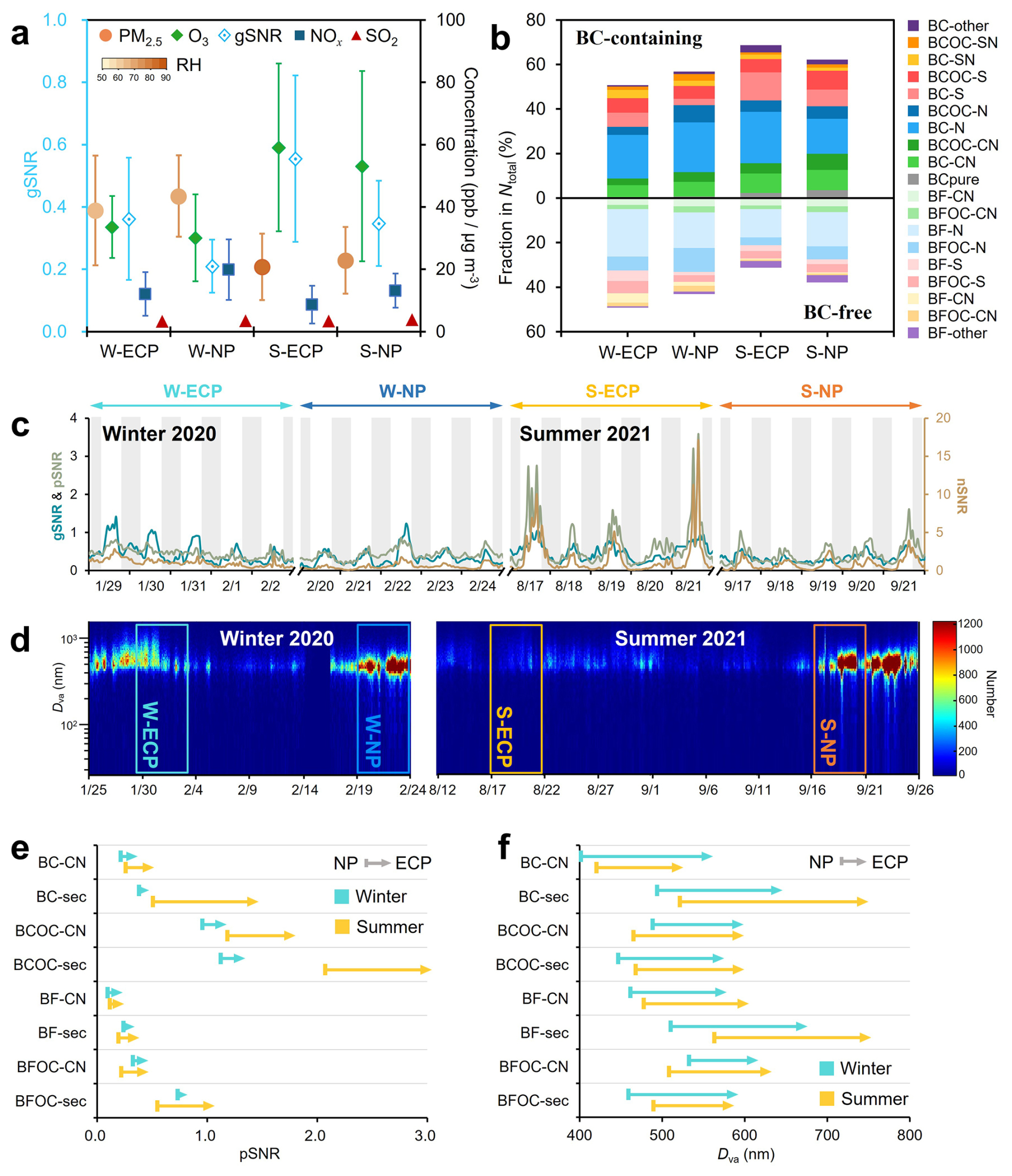
Figure 1Physicochemical characteristics of particles under different emission control and normal periods. W-ECP, W-NP, S-ECP and S-NP denote the winter emission control period, winter normal period, summer emission control period and summer normal period, respectively. (a) Variations in the gas-phase sulfur-to-nitrogen ratio (gSNR) alongside major atmospheric constituents. (b) Number fractions of BC-containing and BC-free particle types. (c) Temporal profiles of gSNR, particle-phase SNR (pSNR) and number-based SNR (nSNR). (d) Temporal evolution of size-resolved total particle number distributions; Dva denotes the vacuum aerodynamic diameter of single particles. (e–f) Seasonal contrasts in pSNR and Dva of different particle types between emission control periods (ECPs) and normal periods (NPs).
3.2 Particle-Type-Dependent Diurnal Variations in pSNR
To quantify compositional effects on pSNR variation, representative aged-like particles were decomposed into BC, OC, and SIS components (Fig. 2). The BF-sec group was used as the non-carbonaceous reference. To quantify the relative sulfate-to-nitrate enrichment in carbonaceous particles, we defined a normalized pSNR enhancement factor (λ) as follows:
where i corresponds to BFOC-sec, BC-sec, and BCOC-sec particle types, yielding λOC, λBC, and λBCOC, respectively.
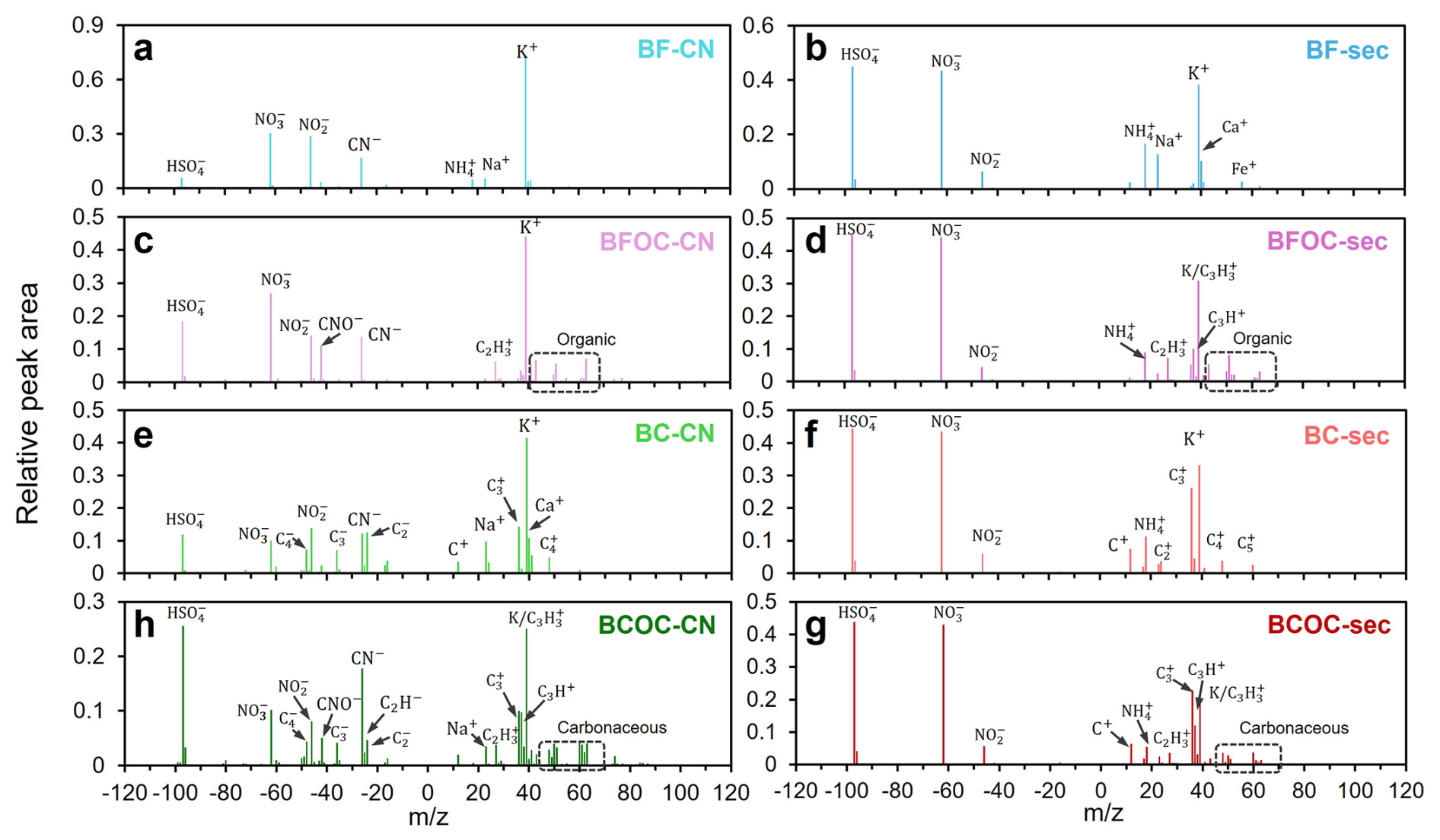
Figure 2Representative single-particle mass spectra of fresh-like (-CN) and aged-like (-sec) particle classes.
Figure 3 shows pronounced diurnal and seasonal contrasts in λ, with larger amplitudes and greater variability in summer. A distinct daytime transition is evident in summer, with λBC rising from 1–3 in the morning to 6–9 near local solar noon, exceeding λOC (typically 3–6) and remaining dominant until evening (Fig. 3d). This behavior is consistent with the hypothesis of enhanced sulfate formation on BC-containing particles during photochemically active periods, potentially linked to BC-mediated release (Liang et al., 2021; Ye et al., 2017) and photo-induced formation of reactive oxygen species (ROS) that accelerate the conversion of SO2 to sulfate (Zhang et al., 2022; Zhu et al., 2020). At night, when solar radiation is negligible and RH is high (> 80 %), λOC exceeds λBC, aligning with aqueous-phase sulfate production through H2O2 or O3 oxidation and with possible organosulfate formation (Cheng et al., 2016; Wang et al., 2021b). Increased organic-phase viscosity may further limit gas-particle partitioning (Vaden et al., 2011), water uptake (Rickards et al., 2015), and multiphase reactions (Shiraiwa et al., 2011), which could prolong sulfate retention within OC-rich particles. Laboratory and modeling studies also suggest that BC can catalyze SO2 oxidation even in darkness (He et al., 2018; He and He, 2020), although this likely represents a minor nighttime pathway compared with OC-driven aqueous processes.
Across the summer diurnal cycle, λBCOC consistently exceeds both λBC and λOC, peaking in the afternoon (Fig. 3d). This persistent enhancement suggests a synergistic role of BCOC, BC provides reactive or catalytic surfaces, while OC facilitates sulfate accommodation or retention within the particle matrix. Such synergy likely reflects the complex surface chemistry of BC, involving polycyclic aromatic hydrocarbons (PAHs) and aromatic oxygenated species, which may promote SO2 uptake and facilitate heterogeneous oxidation under ultraviolet (UV) irradiation (Riva et al., 2016). Light-absorbing organic compounds, such as brown carbon and humic-like substances, may further act as photosensitizers and accelerate SO2-to-sulfate conversion (Wang et al., 2020b).
In winter (Fig. 3a, b), all λ values are smaller, but the compositional contrasts remain. λOC generally exceeds λBC throughout the day, consistent with a larger relative contribution of OC-related aqueous pathways under weaker photochemistry. Nevertheless, λBCOC remains the largest, indicating that BCOC mixtures still provide the most favorable environment for sulfate enrichment even under low-radiation, low-temperature conditions. This persistent BCOC advantage may reflect not only enhanced photochemical/heterogeneous processing, but also microphysical effects, such as larger accessible surface associated with soot morphology (Beeler et al., 2025) and coating softening or water uptake (Li et al., 2021) that promotes sulfate partitioning and retention.
These observations show that the diurnal variation of pSNR is strongly composition-dependent. BC-containing particles show the strongest enhancement during photochemically active hours, OC-rich particles become relatively more important under humid nighttime and winter conditions, and mixed BCOC particles show the largest enhancement in both seasons, likely driven by combined chemical and microphysical effects.
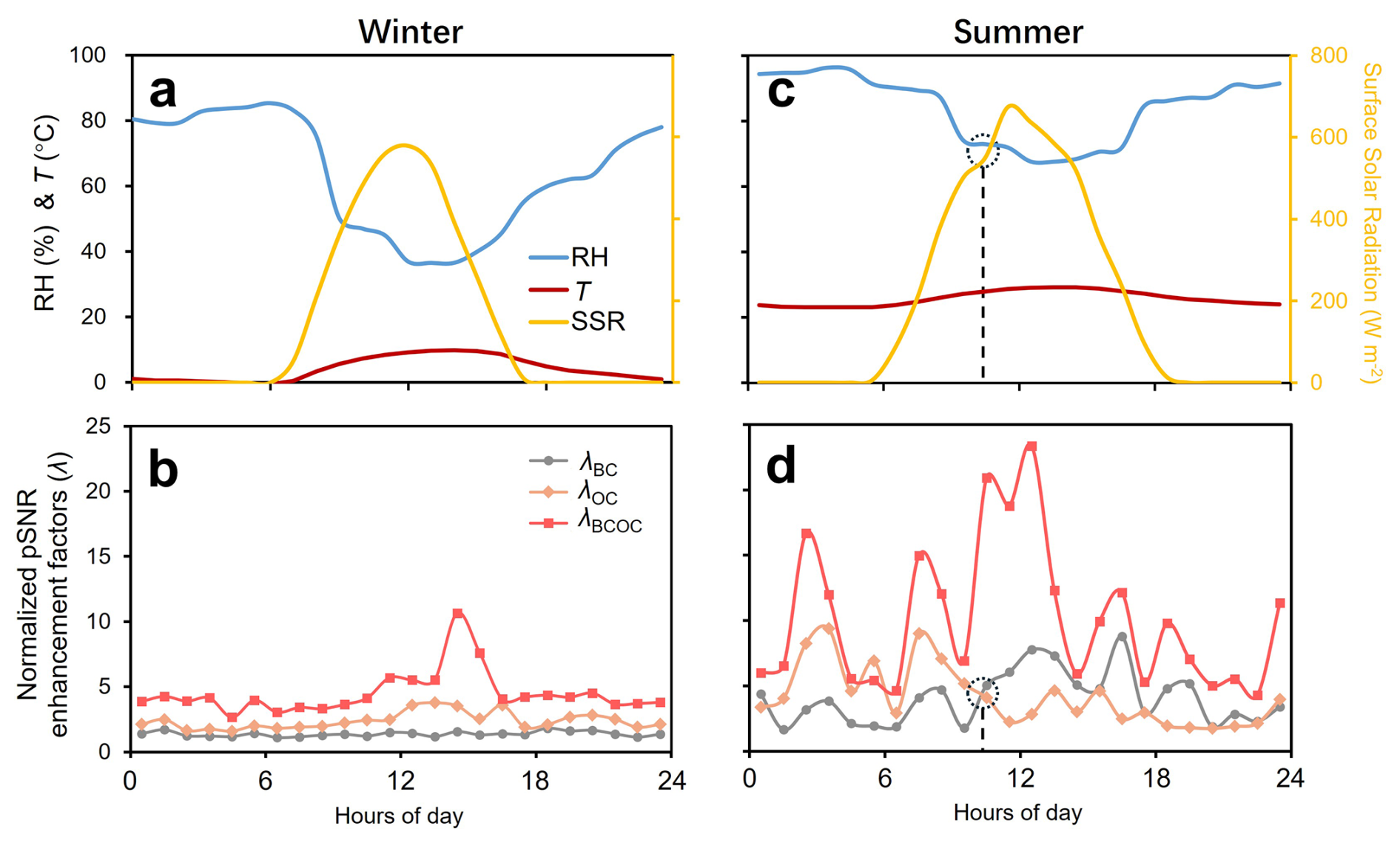
Figure 3Diurnal cycles of meteorology and component-resolved particle-phase sulfur-to-nitrogen ratio (pSNR) enhancement (λ) in winter (a, b) and summer (c, d). Panels (a), (c) show the diurnal variation of meteorological parameters, including relative humidity (RH, blue), temperature (T, deep red), and surface solar radiation (SSR, yellow). Panels (b), (d) present normalized pSNR enhancement factors (λ) values for components: organic carbon (λOC; pink), black carbon (λBC; black), and the mixed BC-OC (λBCOC; red). The dashed circles indicate the transitional period when BC overtakes OC in driving pSNR enhancement during summer.
3.3 Particle-Type-Dependent Aging Patterns
To characterize particle-type-dependent aging, we jointly examined changes in inferred κeff, pSNR, and Dva and developed a conceptual framework in the κeff-pSNR space (Fig. 4). As defined in Sect. 2.3, each fresh-like subtype was paired with its dominant aged-like counterpart. Stage I compares fresh-like and aged-like populations during NPs, whereas Stage II compares aged-like populations between NPs and ECPs. These comparisons represent population-level contrasts rather than trajectories of individual particles. To evaluate the robustness of inferred κeff, calculations were repeated using alternative hygroscopicity values for ammonium sulfate and ammonium nitrate (Table S3; Fig. S4). The resulting ranges represent parameter sensitivity within the adopted mixing rule rather than the full uncertainty in κeff. Because relative ionization efficiencies and matrix effects can affect SPA-MS signals, pSNR changes are interpreted as relative ion-signal shifts rather than absolute composition changes.
For OC-rich fresh particles (BCOC-CN and BFOC-CN), Stage I aged-like populations had an approximately 5 % lower mean Dva and an 83 % higher pSNR than their fresh-like counterparts, whereas κeff changes were generally small or parameter dependent. No consistent κeff increase or decrease was obtained for BCOC in either season or BFOC in winter, while the summer BFOC response exhibited changes of 2.5 %–17.0 %. This pattern may reflect compaction and the formation of an organic-rich shell that retains sulfate while limiting additional water uptake (Mikhailov et al., 2009; Riemer et al., 2019). During Stage II, stronger oxidation is associated with an increase in Dva of about 25 % and a further rise in pSNR of about 80 %, again with minimal change in κeff, consistent with continued sulfate accumulation and coating growth on a compact and relatively hydrophobic matrix.
For BC particles with weaker organic signatures, the transition from BC-CN to BC-sec exhibited the largest κeff increase (∼ 31 %). This response remained positive across all tested parameter combinations, ranging from 16.8 % to 27.5 % in winter and from 28.5 % to 47.1 % in summer (Fig. S4). Together with increases in Dva (∼ 24 %) and pSNR (∼ 87 %), this pattern indicates dominant inorganic uptake during NPs. During Stage II, pSNR increased markedly (∼ 105 %) and Dva increased by ∼ 36 % to ∼ 700 nm, while the inferred κeff increase remained small across the tested parameter combinations (1.0 %–4.6 %). This shift indicates enhanced sulfate-rich coating growth as gSNR and oxidant levels rise.
For BC-free particles (BF-CN to BF-sec), pSNR remained relatively low and changed only slightly. Stage I κeff changes remained positive but small in both winter (1.3 %–5.6 %) and summer (1.3 %–7.3 %). The Stage II κeff response was also modest in winter (0.9 %–7.3 %) but stronger in summer (11.6 %–18.2 %). Together with the approximately 22 % increase in Dva, these changes are consistent with increased secondary inorganic contributions, particularly during summer ECPs.
Overall, the coupling between inferred κeffand pSNR strengthened under higher gSNR and stronger oxidative conditions, although the response remained particle-type dependent. BC-containing particles showed pronounced sulfate enrichment, consistent with the accumulation of secondary sulfate coatings on soot particles. OC-rich particles also exhibited strong pSNR enhancement but comparatively limited changes in inferred hygroscopicity, whereas BC-free particles showed weaker compositional adjustment and more gradual particle growth. Thus, the two-stage framework captures distinct composition-dependent responses rather than a uniform aging pathway, reflecting differences in core type, coating chemistry, and mixing state.
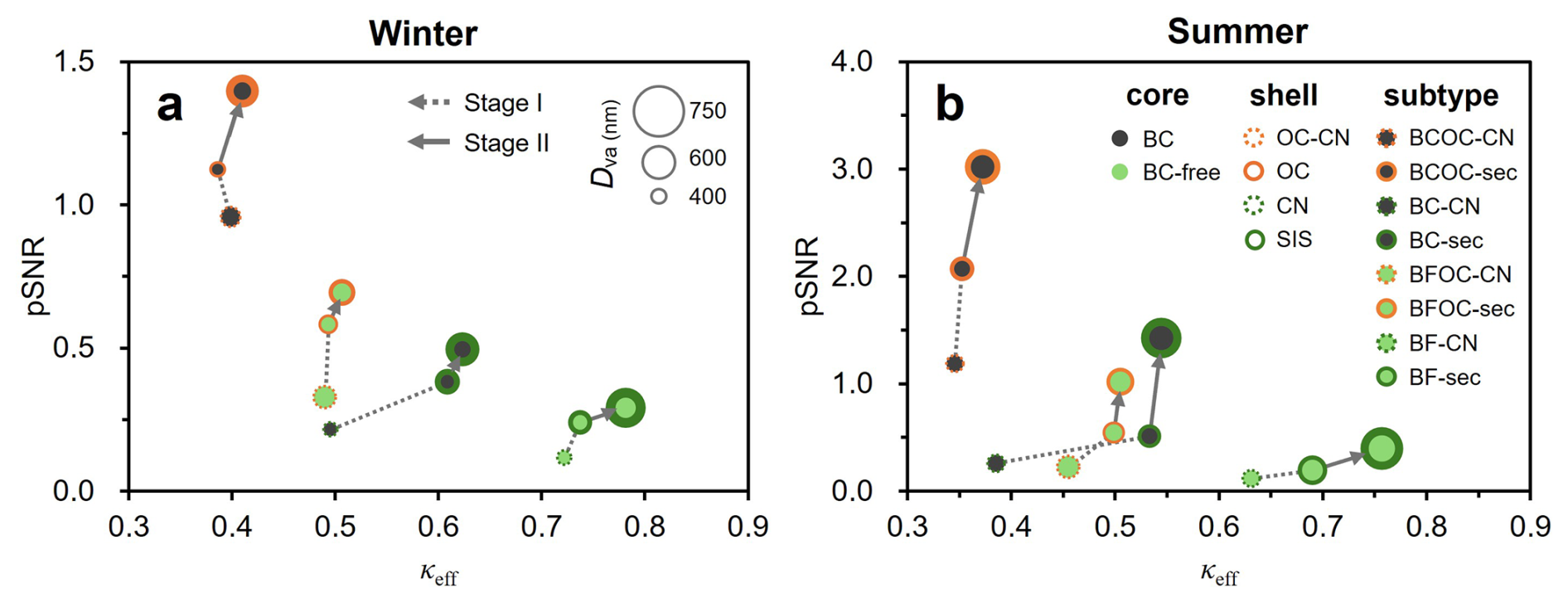
Figure 4Conceptual framework for the co-evolution of particle-phase sulfur-to-nitrogen ratio (pSNR) and inferred hygroscopicity (κeff) among particle classes during winter (a) and summer (b). Particles are represented by core-shell schematics. The inner circle indicates BC-containing (dark gray) or BC-free (light green) particles, and the outer ring indicates coatings dominated by organic carbon (OC, orange) or secondary inorganic species (SIS, green). Dashed and solid rings denote fresh-like and aged-like populations, respectively. Marker size scales with vacuum aerodynamic diameter (Dva). Shell thickness estimates from the Dva of aged-like and fresh-like particles. Dotted and solid arrows indicate aging relationships during Stage I in normal periods (NPs) and additional Stage II processing in emission control periods (ECPs), respectively.
3.4 Humidity-Dependent Sulfur-Nitrogen Partitioning
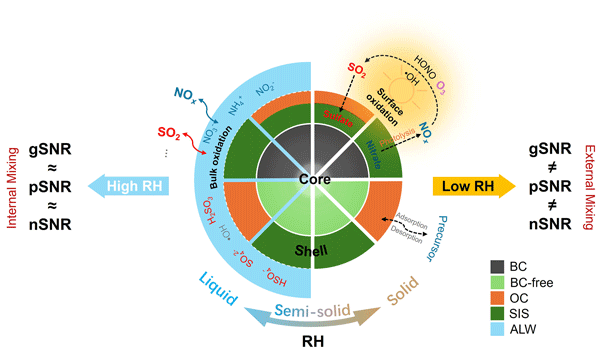
Ammonium sulfate (AS) and ammonium nitrate (AN) are the dominant SIS in PM2.5 (Fu et al., 2016; Lin et al., 2020). Their deliquescence relative humidity (DRH), together with the mutual deliquescence RH (MDRH) of their mixtures, provide reference points for interpreting particle phase transitions and aqueous processing (Liu et al., 2021; Sun et al., 2018). These transitions may shift in the presence of organic constituents and other components in ambient particles (Li et al., 2021). As RH increases, the associated rise in aerosol liquid water (ALW) reduces matrix viscosity, enhances molecular transport, and promotes morphological restructuring and internal mixing (Mikhailov et al., 2009; Shiraiwa et al., 2011). In our observations, increasing RH is accompanied by generally declining and progressively converging gSNR, pSNR, and nSNR, indicating a shift toward more balanced S-N partitioning across gas, particle, and number domains (Fig. S5a, e). In parallel, BCOC-sec consistently exhibited the highest pSNR and nSNR, while BF-sec remained the lowest, but these contrasts weaken as RH increases, suggesting that elevated humidity reduces particle-type compositional and population-level contrasts of S-N partitioning (Fig. S5b, f). Guided by these physicochemical thresholds and the observed SNR evolution, we divide the observations into four characteristic RH regimes (Fig. 5). Because particle phase state and ALW were not directly measured, these regimes are operational ranges rather than fixed phase-transition boundaries.
3.4.1 Low-RH regime (RH < 55 %)
Under dry conditions, particles are largely solid with negligible ALW and limited ionic mobility (Sun et al., 2018). Uptake of HNO3 and N2O5 hydrolysis is suppressed, restricting particulate nitrate formation (Bertram and Thornton, 2009), while SO2 oxidation on BC and mineral surfaces proceeds slowly (He et al., 2018; Zhao et al., 2017). High solar radiation in this regime favors particulate nitrate photolysis, generating OH radicals that can drive heterogeneous SO2 oxidation (He et al., 2017; Ye et al., 2017). As a result, pSNR is locally elevated, particularly in BCOC-sec, where BC serves as a photochemically active substrate enhancing sulfate formation, while OC acts as a stabilizing matrix that retains sulfate internally (Sect. 3.2). Weak correlations among gSNR, pSNR and nSNR (Fig. S6) indicate kinetic limitations on gas-particle mass transfer and the particle population remains externally mixed with pronounced differences in nSNR across particle types (Fig. S5c, g).
3.4.2 Moderate RH regime I (RH ≈ 55 %–70 %)
Crossing the DRH of AN (∼ 61 %) induces a solid to semi-solid transition, forming a reactive aqueous surface film (Seinfeld and Pandis, 2016). These films relax interfacial diffusion constraints and enhance ionic mobility, activating solid particles by rapid water uptake, which is consistent with increases in particle size and number concentration (Fig. S5d, h). ALW on BC surfaces may dissociate to OH radicals, while O3, H2O2 and NO2 oxidation pathways further enhance sulfate formation (He and He, 2020; Wang et al., 2020a). Because NH3 tends to neutralize H2SO4 preferentially, sulfate can remain relatively favored during the early stage of humidification, even as nitrate production increases (Wang et al., 2013; Seinfeld and Pandis, 2016). Accordingly, pSNR rises, most strongly in BC-containing classes such as BC-sec and BCOC-sec (Fig. S5b, f).
3.4.3 Moderate RH regime II (RH ≈ 70 %–85 %)
As RH approaches the MDRH of AS-AN mixtures (69 %–75 %), semi-solid particles transition toward fully liquid states with substantial ALW uptake and bulk-phase processing (Sun et al., 2018). This phase transition promotes efficient internal mixing and SIS shell formation (Riemer et al., 2019), driving particle growth and increased number concentration primarily through condensational uptake between ∼ 60 %–75 % RH (Fig. S5d, h). Once H2SO4 is largely neutralized, excess NH3 facilitates NH4NO3formation (Seinfeld and Pandis, 2016). High ALW and elevated effective Henry's law constants enhance HNO3 uptake, while NO2 hydrolysis and heterogeneous N2O5 reactions accelerate nitrate accumulation (Bertram and Thornton, 2009). These processes progressively shift S-N partitioning toward nitrogen, lowering pSNR from its peak near 70 % RH. Concurrently, the differences among gSNR, pSNR, and nSNR narrow, suggesting that gas-particle S-N partitioning increasingly approaches quasi-equilibrium and cross-phase coupling strengthens (Fig. 5). Around 80 % RH, both Dva and particle number concentration show a sharp and transient decline, likely reflecting enhanced coagulation, temporarily reduced net condensational growth (El Haber et al., 2024), and liquid-coating-induced restructuring (e.g., capillary compaction of loose aggregates into denser particles) (Chen et al., 2016; Beeler et al., 2025).
3.4.4 High-RH regime (RH > 85 %)
Exceeding the DRH of AS (∼ 80 %) (Lightstone et al., 2000) induces a predominantly aqueous particle phase (Bateman et al., 2016; Sun et al., 2018). Under these conditions, dissolution of reactive precursors is favored and kinetic barriers to gas-to-particle partitioning are strongly reduced (Seinfeld and Pandis, 2016), leading to much tighter coupling among gSNR, pSNR, and nSNR (R2 ranged from 0.68 to 0.81, Fig. S6). All three SNR metrics converge to similarly low and relatively stable values (Fig. 5), consistent with more efficient cross-phase exchange and multiphase processing. Particle-type SNR curves (Fig. S5b, c, f, g) show minimal divergence, reflecting extensive internal mixing that homogenizes particle composition and convergence of external mixing states across the population. Near saturation, continued water uptake increases particle size and may enhance wet removal (e.g., fog/precipitation-related scavenging), contributing to reduced number concentrations (Fig. S5d, h).
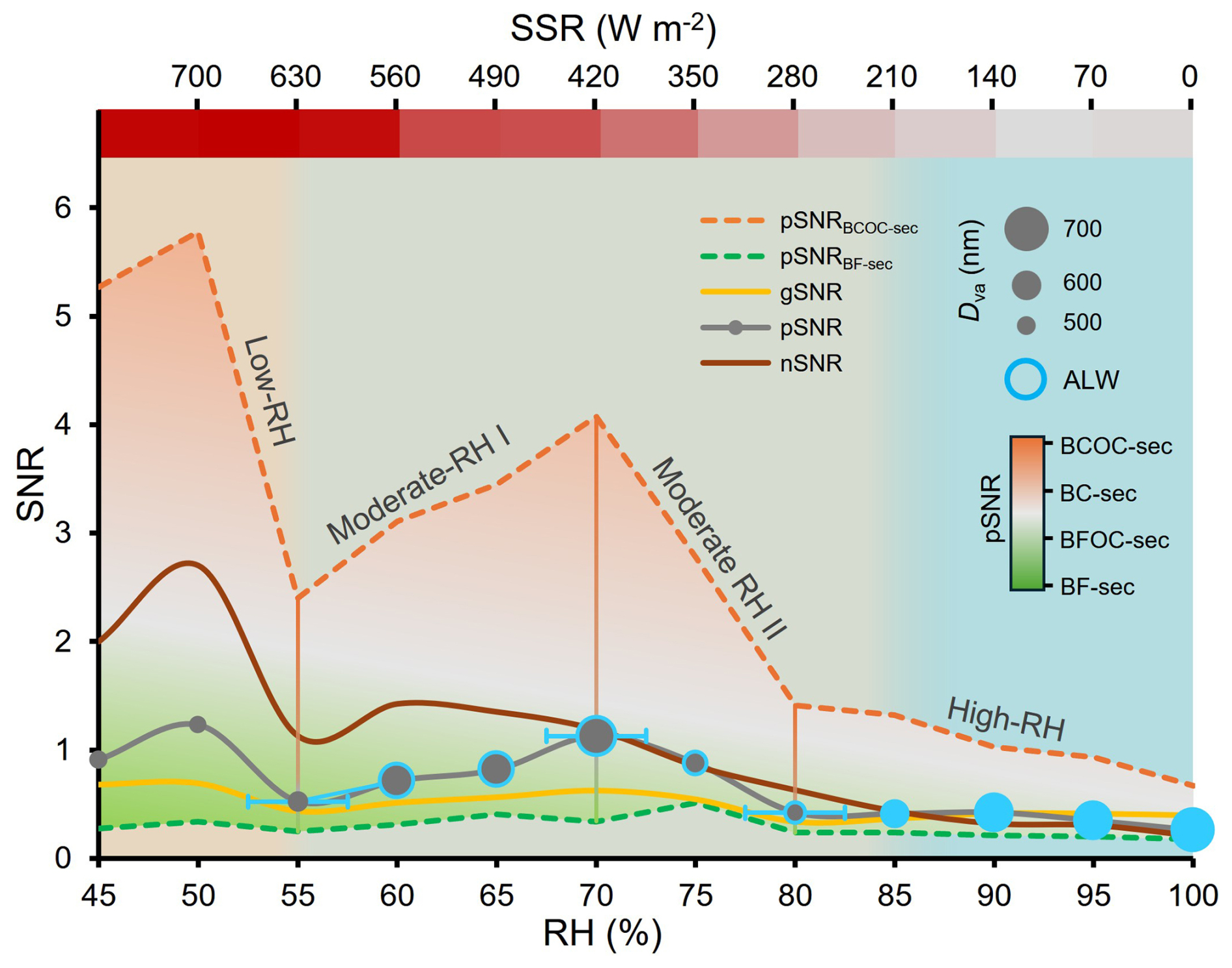
Figure 5Phase-state-resolved variations of sulfur-to-nitrogen ratios (SNRs) and particle physicochemical properties as a function of relative humidity (RH). Shown are RH-dependent variations of gas-phase (gSNR, yellow), particle-phase (pSNR, grey), and number-based (nSNR, brown), overlaid with pSNR of representative particle classes: BCOC-sec (orange dashed) and BF-sec (green dashed). Color shading beneath the curves denotes the relative magnitude of pSNR, following the sequence BCOC-sec > BC-sec > BFOC-sec > BF-sec. The RH regimes are classified as Low RH (< 55 %), Moderate RH (55 %–70 % and 70 %–85 %), and high RH (> 85 %), with the top red gradient bar indicating mean surface solar radiation (SSR). Circular markers represent average particle size (bubble size: Dva), phase state (grey: solid; grey with blue ring: semi-solid; blue: liquid), and aerosol liquid water (ALW, blue ring). Vertical lines mark the DRH of NH4NO3(AN), the MDRH of (NH4)2SO4-NH4NO3 mixtures (AN-SN), and the DRH of (NH4)2SO4(SN); error bars represent variability among literature reports and temperature-dependent shifts.
3.5 Causal Structure and Key Predictors of SNR Variability
3.5.1 Causal Network Insights
From the ten meteorological and chemical descriptors (Table S2), the GS algorithm selected eight key predictors: O3, T2m, SSR, RH, WS, WD, SLP, and BLH. Applying the GES to this subset produced the DAGs in Fig. 6. In the DAGs, arrow direction denotes causal influence, arrow color encodes the sign of association (red for positive, grey for negative), and arrow thickness scales with the absolute Pearson correlation between connected variables. The DAG analysis identifies a consistent dependency structure linking gSNR to pSNR and nSNR. While these arrows indicate the most probable direction of influence under current statistical constraints, they represent the sequential propagation of chemical signals from gas-phase precursors to particle-level composition and then reshape the population-level mixing state, consistent with the mechanistic picture developed in Sect. 3.2–3.4, but may still be affected by unmeasured factors (e.g., NH3 availability or heterogeneous kinetics) that are not explicitly represented in the network.
In addition, O3 and BLH occupy intermediate positions between the SNR metrics and the meteorological cluster (RH, T2m, SSR, SLP), indicating that oxidant levels and boundary-layer dynamics may mediate the influence of radiation and stability on S-N partitioning. RH, T2m and SSR form a densely connected sub-network with predominantly negative links between RH, T2m and SSR, consistent with the anti-correlation between humidity and temperature/solar radiation. WS and WD show weaker and more diffuse connections, suggesting a secondary role through transport and dispersion. Overall, the DAG indicates that precursor ratios, oxidant levels and boundary-layer structure jointly organize the progression from gas-phase composition to particle-phase and number-based SNR metrics.
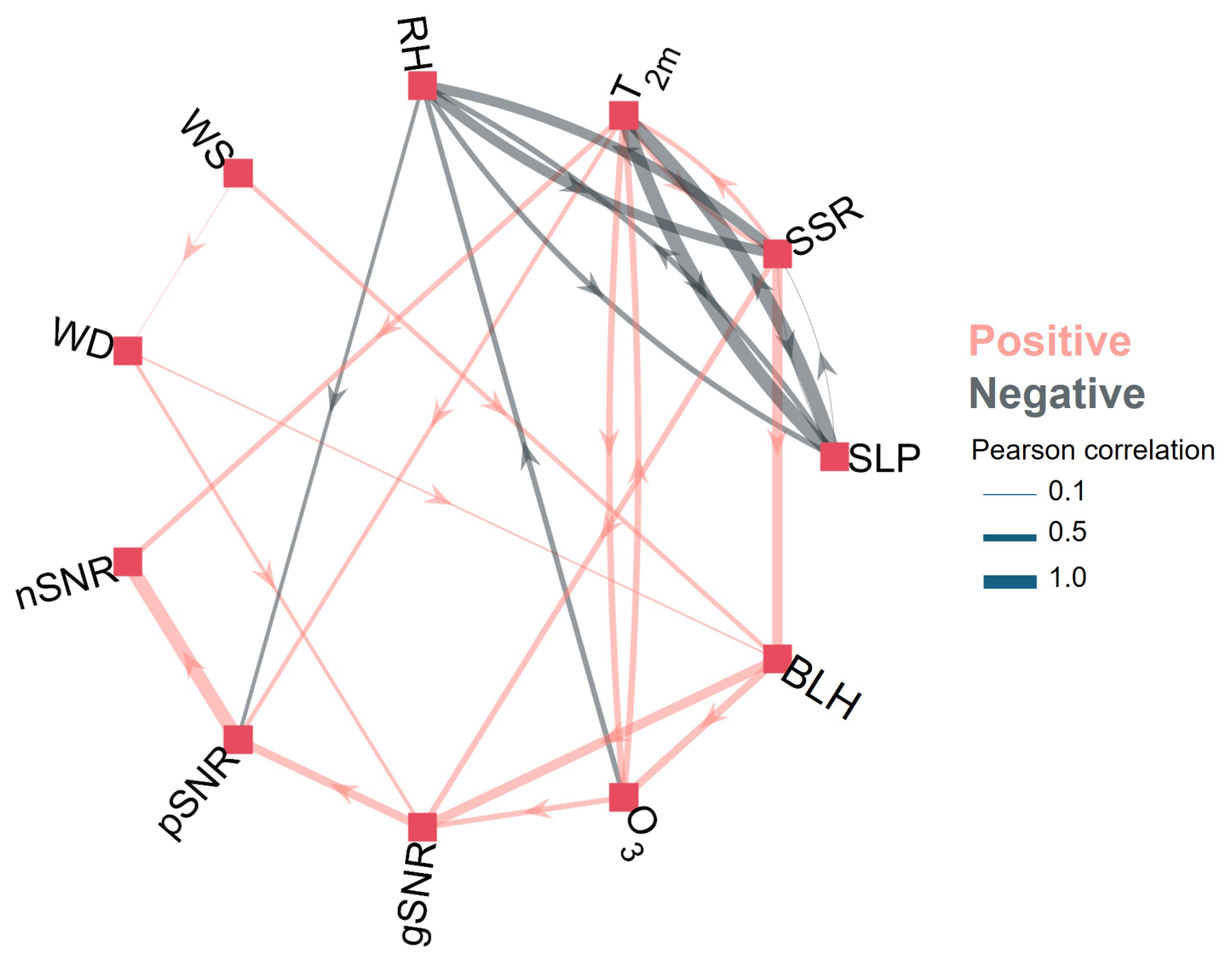
Figure 6Causal network linking sulfur-to-nitrogen ratios (SNRs), meteorological variables, and ozone. Arrows indicate the directions of dependencies inferred from causal analysis. Red and gray arrows denote positive and negative Pearson correlations, respectively, with line thickness proportional to the absolute correlation coefficient. Variables include gas-phase (gSNR), particle-phase (pSNR), and number-based (nSNR) sulfur-to-nitrogen ratios; relative humidity (RH); air temperature at 2 m (T2m); surface solar radiation (SSR); sea level pressure (SLP); boundary layer height (BLH); ozone (O3); wind speed (WS); and wind direction (WD).
3.5.2 Model Performance Validation
To complement the causal analysis and capture nonlinear interactions, we trained particle-class-specific models using an SSA-optimized XGBoost framework. Cross-validated performance statistics (Table S4) show R2 values above 0.70 with low RMSE for all three SNR metrics, indicating robust predictive skill across different particle types and limited overfitting.
3.5.3 SHAP-based Interpretation of Predictor Contributions
To quantify the relative influence of candidate drivers, we examined SHAP values for each SNR metric. As shown in Fig. S7a–d, gSNR is the dominant determinant of particle-phase S-N partitioning, with the strongest influence for BC-sec, where large SHAP magnitudes suggest strong sensitivity of BC-containing particles to gas-phase composition. In the number domain (nSNR; Fig. S7e–h), pSNR is the leading contributor across all aged-like classes, supporting a sequential response in which gas-phase variability first modulates within-particle S-N balance (pSNR) and is subsequently expressed at the population level (nSNR), consistent with the causal pathway inferred in Sect. 3.5.
Meteorological factors exert secondary, modulatory influences on SNR metrics. RH shows a consistent negative effect, reflecting enhanced nitrate formation and dilution under humid conditions. Conversely, SSR and O3 contribute positively (Fig. S7b, f), indicating enhanced photochemistry activity and SO2 oxidation (Seinfeld and Pandis, 2016; He et al., 2014). WD and BLH generally contribute negatively, capturing the dilution and vertical mixing effects that suppress SNR metrics (Fig. S7c, g).
This study identified linked variations in gas-phase (gSNR), particle-phase (pSNR), and number-based (nSNR) sulfur-to-nitrogen ratios, connecting precursor composition with particle chemistry and population characteristics. During emission control periods (ECPs), NOx decreased while SO2 concentrations remained relatively stable, increasing gSNR. Compared with normal periods (NPs), pSNR was approximately 57 % higher and mean vacuum aerodynamic diameter (Dva) was 27 % larger. Causal analysis inferred directed links from gSNR to pSNR and from pSNR to nSNR, alongside connections with O3 and meteorological variables. Predictor rankings from interpretable machine learning were consistent with this structure.
These relationships were accompanied by particle-type differences in diurnal composition patterns and population-level aging comparisons. Particles containing both black carbon (BC) and organic carbon (OC) showed the greatest pSNR enhancement relative to BC-free inorganic particles in both seasons. Among the other carbonaceous classes, enhancement was greater in BC particles with weaker organic signatures around midday in summer, but greater in BC-free OC-rich particles at night and in winter. The aging comparisons further showed that compositional changes were not uniformly accompanied by increased inferred hygroscopicity. Organic-rich particles generally showed pronounced pSNR increases with limited or parameter-dependent hygroscopicity changes. BC particles with weaker organic signatures had substantially higher inferred hygroscopicity in aged-like than fresh-like populations during NPs. Their aged-like counterparts during ECPs showed further pSNR and size increases but little additional hygroscopicity enhancement.
Alongside these compositional differences, the coupling among gSNR, pSNR, and nSNR varied with relative humidity (RH). Dry conditions (RH < 55 %) were characterized by weaker correlations and more pronounced differences among particle classes. At intermediate RH (55 % to 85 %), pSNR and Dva exhibited nonlinear changes, whereas high RH (> 85 %) featured stronger correlations and smaller particle-type contrasts. These patterns are consistent with water uptake and multiphase processing contributing to RH-dependent of sulfur-nitrogen partitioning, highlighting the environmental context of the observed compositional responses.
These findings suggest that air-quality models may benefit from considering particle-type heterogeneity and RH-dependent processing in gas-particle partitioning and secondary aerosol formation. Their relevance extends to future emission scenarios with declining gSNR, under which changes in particle-phase sulfur-nitrogen balance may be accompanied by differing hygroscopicity responses among particle populations. Associated changes in particle size, hygroscopicity, and mixing state could influence cloud condensation nuclei (CCN) activation, humidity-dependent light scattering, and aerosol radiative effects (Matsui et al., 2018; Rosenfeld et al., 2014; Titos et al., 2021; Xu et al., 2021). The observed relationships provide a physical basis for investigating these atmospheric consequences across particle types and humidity conditions under evolving emission controls.
All data supporting the findings of this study are available within the paper and its Supplement (data are available at: https://doi.org/10.6084/m9.figshare.32618274, Dai, 2026). Additional data related to this paper are available on request by contacting the corresponding author Xinlei Ge (xinlei@seu.edu.cn) and Junfeng Wang (wangjunfeng@nuist.edu.cn).
The supplement related to this article is available online at https://doi.org/10.5194/acp-26-14015-2026-supplement.
X.G., M.C., and J.W. conceptualized the study and designed the research. Y.D. and S.Z. conducted the field experiments. Y.D. and J.W. analyzed the data and prepared the original draft of the manuscript. X.G., M.C., H.L., Y.W., Y.Z., and M.W. reviewed and edited the manuscript.
The contact author has declared that none of the authors has any competing interests.
Publisher's note: Copernicus Publications remains neutral with regard to jurisdictional claims made in the text, published maps, institutional affiliations, or any other geographical representation in this paper. The authors bear the ultimate responsibility for providing appropriate place names. Views expressed in the text are those of the authors and do not necessarily reflect the views of the publisher.
This study was supported by the National Natural Science Foundation of China (grant nos. U24A20515, 22361162668, 22276099 and 42405106).
This paper was edited by Zhonghua Zheng and reviewed by two anonymous referees.
Bateman, A. P., Gong, Z., Liu, P., Sato, B., Cirino, G., Zhang, Y., Artaxo, P., Bertram, A. K., Manzi, A. O., Rizzo, L. V., Souza, R. A. F., Zaveri, R. A., and Martin, S. T.: Sub-micrometre particulate matter is primarily in liquid form over Amazon rainforest, Nat. Geosci., 9, 34–37, https://doi.org/10.1038/ngeo2599, 2016.
Beeler, P., Corbin, J. C., Sipkens, T. A., and Fierce, L.: A framework for quantifying the size and fractal dimension of compacting soot particles, Environ. Sci. Technol., 59, 5994–6003, https://doi.org/10.1021/acs.est.4c11100, 2025.
Bertram, T. H. and Thornton, J. A.: Toward a general parameterization of N2O5 reactivity on aqueous particles: the competing effects of particle liquid water, nitrate and chloride, Atmos. Chem. Phys., 9, 8351–8363, https://doi.org/10.5194/acp-9-8351-2009, 2009.
Bi, X., Zhang, G., Li, L., Wang, X., Li, M., Sheng, G., Fu, J., and Zhou, Z.: Mixing state of biomass burning particles by single particle aerosol mass spectrometer in the urban area of PRD, China, Atmos. Environ., 45, 3447–3453, https://doi.org/10.1016/j.atmosenv.2011.03.034, 2011.
Chen, C., Fan, X., Shaltout, T., Qiu, C., Ma, Y., Goldman, A., and Khalizov, A. F.: An unexpected restructuring of combustion soot aggregates by subnanometer coatings of polycyclic aromatic hydrocarbons, Geophys. Res. Lett., 43, 11080–11088, https://doi.org/10.1002/2016GL070877, 2016.
Cheng, Y., Zheng, G., Wei, C., Mu, Q., Zheng, B., Wang, Z., Gao, M., Zhang, Q., He, K., Carmichael, G., Pöschl, U., and Su, H.: Reactive nitrogen chemistry in aerosol water as a source of sulfate during haze events in China, Sci. Adv., 2, e1601530, https://doi.org/10.1126/sciadv.1601530, 2016.
Chickering, D. M.: Optimal structure identification with greedy search, J. Mach. Learn. Res. 3, 507–554, https://doi.org/10.1162/153244303321897717, 2003.
Chu, B., Ma, Q., Liu, J., Ma, Jinzhu, Zhang, P., Chen, T., Feng, Q., Wang, C., Yang, N., Ma, H., Ma, Jingjin, Russell, A. G., and He, H.: Air pollutant correlations in China: Secondary air pollutant responses to NOx and SO2 control, Environ. Sci. Technol. Lett., 7, 695–700, https://doi.org/10.1021/acs.estlett.0c00403, 2020.
Dai, Y.: Data supporting “Cross-phase partitioning of sulfur-nitrogen ratios and aerosol mixing-state evolution based on single-particle observations”, figshare [data set], https://doi.org/10.6084/m9.figshare.32618274, 2026.
Dai, Y., Wang, J., Wang, H., Cui, S., Zhang, Y., Li, H., Wu, Y., Wang, M., Aruffo, E., and Ge, X.: Measurement report: Characteristics of airborne black-carbon-containing particles during the 2021 summer COVID-19 lockdown in a typical Yangtze River Delta city, China, Atmos. Chem. Phys., 24, 9733–9748, https://doi.org/10.5194/acp-24-9733-2024, 2024.
Ekanayake, I. U., Meddage, D. P. P., and Rathnayake, U.: A novel approach to explain the black-box nature of machine learning in compressive strength predictions of concrete using shapley additive explanations (SHAP), Case Stud. Constr. Mater. 16, e01059, https://doi.org/10.1016/j.cscm.2022.e01059, 2022.
El Haber, M., Gérard, V., Kleinheins, J., Ferronato, C., Nozière, B.: Measuring the surface tension of atmospheric particles and relevant mixtures to better understand key atmospheric processes, Chem. Rev., 124, 10924–10963, https://doi.org/10.1021/acs.chemrev.4c00173, 2024.
El Haddad, I., Vienneau, D., Daellenbach, K. R., Modini, R., Slowik, J. G., Upadhyay, A., Vasilakos, P. N., Bell, D., de Hoogh, K., and Prevot, A. S. H.: Opinion: How will advances in aerosol science inform our understanding of the health impacts of outdoor particulate pollution?, Atmos. Chem. Phys., 24, 11981–12011, https://doi.org/10.5194/acp-24-11981-2024, 2024.
Fu, X., Wang, S., Chang, X., Cai, S., Xing, J., and Hao, J.: Modeling analysis of secondary inorganic aerosols over China: Pollution characteristics, and meteorological and dust impacts, Sci. Rep., 6, 35992, https://doi.org/10.1038/srep35992, 2016.
Geng, G., Liu, Yuxi, Liu, Yang, Liu, S., Cheng, J., Yan, L., Wu, N., Hu, H., Tong, D., Zheng, B., Yin, Z., He, K., and Zhang, Q.: Efficacy of China's clean air actions to tackle PM2.5 pollution between 2013 and 2020 air actions, Nat. Geosci., 17, 987–994, https://doi.org/10.1038/s41561-024-01540-z, 2024.
George, I. J. and Abbatt, J. P. D.: Heterogeneous oxidation of atmospheric aerosol particles by gas-phase radicals, Nat. Chem., 2, 713–722, https://doi.org/10.1038/nchem.806, 2010.
He, G. and He, H.: Water promotes the oxidation of SO2 by O2 over carbonaceous aerosols, Environ. Sci. Technol., 54, 7070–7077, https://doi.org/10.1021/acs.est.0c00021, 2020.
He, G., Ma, J., and He, H.: Role of carbonaceous aerosols in catalyzing sulfate formation, ACS Catal., 8, 3825–3832, https://doi.org/10.1021/acscatal.7b04195, 2018.
He, H., Wang, Y., Ma, Q., Ma, J., Chu, B., Ji, D., Tang, G., Liu, C., Zhang, H., and Hao, J.: Mineral dust and NOx promote the conversion of SO2 to sulfate in heavy pollution days, Sci. Rep., 4, 4172, https://doi.org/10.1038/srep04172, 2014.
He, X., Pang, S., Ma, J., and Zhang, Y.: Influence of relative humidity on heterogeneous reactions of O3 and O3/SO2 with soot particles: Potential for environmental and health effects, Atmos. Environ., 165, 198–206, https://doi.org/10.1016/j.atmosenv.2017.06.049, 2017.
Healy, R. M., Sciare, J., Poulain, L., Crippa, M., Wiedensohler, A., Prévôt, A. S. H., Baltensperger, U., Sarda-Estève, R., McGuire, M. L., Jeong, C.-H., McGillicuddy, E., O'Connor, I. P., Sodeau, J. R., Evans, G. J., and Wenger, J. C.: Quantitative determination of carbonaceous particle mixing state in Paris using single-particle mass spectrometer and aerosol mass spectrometer measurements, Atmos. Chem. Phys., 13, 9479–9496, https://doi.org/10.5194/acp-13-9479-2013, 2013.
Huang, R.-J., Zhang, Y., Bozzetti, C., Ho, K. -F., Cao, J. -J., Han, Y., Daellenbach, K. R., Slowik, J. G., Platt, S. M., Canonaco, F., Zotter, P., Wolf, R., Pieber, S. M., Bruns, E. A., Crippa, M., Ciarelli, G., Piazzalunga, A., Schwikowski, M., Abbaszade, G., Schnelle-Kreis, J., Zimmermann, R., An, Z., Szidat, S., Baltensperger, U., Haddad, I. E., and Prévôt, A. S. H.: High secondary aerosol contribution to particulate pollution during haze events in China, Nature, 514, 218–222, https://doi.org/10.1038/nature13774, 2014.
Huang, X., Ding, A., Gao, J., Zheng, B., Zhou, D., Qi, X., Tang, R., Wang, J., Ren, C., Nie, W., Chi, X., Xu, Z., Chen, L., Li, Y., Che, F., Pang, N., Wang, H., Tong, D., Qin, W., Cheng, W., Liu, W., Fu, Q., Liu, B., Chai, F., Davis, S. J., Zhang, Q., and He, K.: Enhanced secondary pollution offset reduction of primary emissions during COVID-19 lockdown in China, Natl. Sci. Rev., 8, nwaa137, https://doi.org/10.1093/nsr/nwaa137, 2021.
Huang, X., Liu, Z., Ge, Y., Li, Q., Wang, Xiaofei, Fu, H., Zhu, J., Zhou, B., Wang, L., George, C., Wang, Y., Wang, Xinfeng, Su, J., Xue, L., Yu, S., Mellouki, A., and Chen, J.: Aerosol high water contents favor sulfate and secondary organic aerosol formation from fossil fuel combustion emissions, Npj Clim. Atmos. Sci., 6, 173, https://doi.org/10.1038/s41612-023-00504-1, 2023.
Koller, D.: Probabilistic graphical models: Principles and techniques – adaptive computation and machine learning, The MIT Press, ISBN 978-0-262-01319-2, 2009.
Le, T., Wang, Y., Liu, L., Yang, J., Yung, Y. L., Li, G., and Seinfeld, J. H.: Unexpected air pollution with marked emission reductions during the COVID-19 outbreak in China, Science, 369, 702–706, https://doi.org/10.1126/science.abb7431, 2020.
Li, K., Jacob, D. J., Liao, H., Shen, L., Zhang, Q., and Bates, K. H.: Anthropogenic drivers of 2013–2017 trends in summer surface ozone in China, P. Natl. Acad. Sci., 116, 422–427, https://doi.org/10.1073/pnas.1812168116, 2019.
Li, W., Teng, X., Chen, X., Liu, L., Xu, L., Zhang, J., Wang, Y., Zhang, Y., and Shi, Z.: Organic coating reduces hygroscopic growth of phase-separated aerosol particles, Environ. Sci. Technol., 55, 16339–16346, https://doi.org/10.1021/acs.est.1c05901, 2021.
Liang, X., Zhang, S., Wu, Y., Xing, J., He, X., Zhang, K. M., Wang, S., and Hao, J.: Air quality and health benefits from fleet electrification in China, Nat. Sustain., 2, 962–971, https://doi.org/10.1038/s41893-019-0398-8, 2019.
Liang, Z., Zhang, R., Gen, M., Chu, Y., and Chan, C. K.: Nitrate photolysis in mixed sucrose–nitrate–sulfate particles at different relative humidities, J. Phys. Chem. A, 125, 3739–3747, https://doi.org/10.1021/acs.jpca.1c00669, 2021.
Lightstone, J. M., Onasch, T. B., Imre, D., and Oatis, S.: Deliquescence, efflorescence, and water activity in ammonium nitrate and mixed ammonium nitrate/succinic acid microparticles, J. Phys. Chem. A, 104, 9337–9346, https://doi.org/10.1021/jp002137h, 2000.
Lin, C., Huang, R.-J., Zhong, H., Duan, J., Wang, Z., Huang, W., and Xu, W.: Elucidating ozone and PM2.5 pollution in the Fenwei Plain reveals the co-benefits of controlling precursor gas emissions in winter haze, Atmos. Chem. Phys., 23, 3595–3607, https://doi.org/10.5194/acp-23-3595-2023, 2023.
Lin, Y.-C., Zhang, Y.-L., Fan, M.-Y., and Bao, M.: Heterogeneous formation of particulate nitrate under ammonium-rich regimes during the high-PM2.5 events in Nanjing, China, Atmos. Chem. Phys., 20, 3999–4011, https://doi.org/10.5194/acp-20-3999-2020, 2020.
Ling, Z., Yu, K., Zhang, Y., Liu, L., and Li, J.: Causal learner: A toolbox for causal structure and markov blanket learning, Pattern Recognit. Lett., 163, 92–95, https://doi.org/10.1016/j. patrec. 2022. 09. 021, 2022.
Liu, P., Li, Y. J., Wang, Y., Bateman, A. P., Zhang, Y., Gong, Z., Bertram, A. K., and Martin, S. T.: Highly viscous states affect the browning of atmospheric organic particulate matter, ACS Cent. Sci., 4, 207–215, https://doi.org/10.1021/acscentsci. 7b00452, 2018.
Liu, P., Ye, C., Xue, C., Zhang, C., Mu, Y., and Sun, X.: Formation mechanisms of atmospheric nitrate and sulfate during the winter haze pollution periods in Beijing: gas-phase, heterogeneous and aqueous-phase chemistry, Atmos. Chem. Phys., 20, 4153–4165, https://doi.org/10.5194/acp-20-4153-2020, 2020.
Liu, X., Ran, L., Lin, W., Xu, X., Ma, Z., Dong, F., He, D., Zhou, L., Shi, Q., and Wang, Y.: Measurement report: Variations in surface SO2 and NOx mixing ratios from 2004 to 2016 at a background site in the North China Plain, Atmos. Chem. Phys., 22, 7071–7085, https://doi.org/10.5194/acp-22-7071-2022, 2022.
Liu, Y., Feng, Z., Zheng, F., Bao, X., Liu, P., Ge, Y., Zhao, Y., Jiang, T., Liao, Y., Zhang, Y., Fan, X., Yan, C., Chu, B., Wang, Y., Du, W., Cai, J., Bianchi, F., Petäjä, T., Mu, Y., He, H., and Kulmala, M.: Ammonium nitrate promotes sulfate formation through uptake kinetic regime, Atmos. Chem. Phys., 21, 13269–13286, https://doi.org/10.5194/acp-21-13269-2021, 2021.
Lu, X., Zhang, S., Xing, J., Wang, Y., Chen, W., Ding, D., Wu, Y., Wang, S., Duan, L., and Hao, J.: Progress of air pollution control in China and its challenges and opportunities in the ecological civilization era, Engineering, 6, 1423–1431, https://doi.org/10.1016/j.eng.2020.03.014, 2020.
Margaritis, D.: Bayesian network induction via local neighborhoods, in: Proceedings of the 13th International Conference on Neural Information Processing Systems, edited by: Solla, S. A., Leen, T. K., and Müller, K. R., MIT Press, 505–511, 1999.
Matsui, H., Hamilton, D. S., and Mahowald, N. M.: Black carbon radiative effects highly sensitive to emitted particle size when resolving mixing-state diversity, Nat. Commun., 9, 3446, https://doi.org/10.1038/s41467-018-05635-1, 2018.
Mikhailov, E., Vlasenko, S., Martin, S. T., Koop, T., and Pöschl, U.: Amorphous and crystalline aerosol particles interacting with water vapor: conceptual framework and experimental evidence for restructuring, phase transitions and kinetic limitations, Atmos. Chem. Phys., 9, 9491–9522, https://doi.org/10.5194/acp-9-9491-2009, 2009.
Nozière, B., Ekström, S., Alsberg, T., and Holmström, S.: Radical-initiated formation of organosulfates and surfactants in atmospheric aerosols, Geophys. Res. Lett., 37, 2009GL041683, https://doi.org/10.1029/2009GL041683, 2010.
Petters, M. D. and Kreidenweis, S. M.: A single parameter representation of hygroscopic growth and cloud condensation nucleus activity, Atmos. Chem. Phys., 7, 1961–1971, https://doi.org/10.5194/acp-7-1961-2007, 2007.
Rickards, A. M. J., Song, Y. -C., Miles, R. E. H., Preston, T. C., and Reid, J. P.: Variabilities and uncertainties in characterising water transport kinetics in glassy and ultraviscous aerosol, Phys. Chem. Chem. Phys., 17, 10059–10073, https://doi.org/10.1039/C4CP05383D, 2015.
Riemer, N., Ault, A. P., West, M., Craig, R. L., and Curtis, J. H.: Aerosol mixing state: Measurements, modeling, and impacts, Rev. Geophys., 57, 187–249, https://doi.org/10.1029/2018RG000615, 2019.
Riva, M., Da Silva Barbosa, T., Lin, Y.-H., Stone, E. A., Gold, A., and Surratt, J. D.: Chemical characterization of organosulfates in secondary organic aerosol derived from the photooxidation of alkanes, Atmos. Chem. Phys., 16, 11001–11018, https://doi.org/10.5194/acp-16-11001-2016, 2016.
Rosenfeld, D., Andreae, M. O., Asmi, A., Chin, M., de Leeuw, G., Donovan, D. P., Kahn, R., Kinne, S., Kivekäs, N., Kulmala, M., Lau, W., Schmidt, K. S., Suni, T., Wagner, T., Wild, M., and Quaas, J.: Global observations of aerosol-cloud-precipitation-climate interactions, Rev. Geophys., 52, 750–808, https://doi.org/10.1002/2013RG000441, 2014.
Schmedding, R., Rasool, Q. Z., Zhang, Y., Pye, H. O. T., Zhang, H., Chen, Y., Surratt, J. D., Lopez-Hilfiker, F. D., Thornton, J. A., Goldstein, A. H., and Vizuete, W.: Predicting secondary organic aerosol phase state and viscosity and its effect on multiphase chemistry in a regional-scale air quality model, Atmos. Chem. Phys., 20, 8201–8225, https://doi.org/10.5194/acp-20-8201-2020, 2020.
Seinfeld, J. H. and Pandis, S. N.: Atmospheric chemistry and physics from air pollution to climate change, 3rd edn., John Wiley & Sons, Hoboken, New Jersey, ISBN 978-1-118-94740-1, 2016.
Sharma, N., Agarwal, A. K., Eastwood, P., Gupta, T., and Singh, A. P. (Eds.): Air pollution and control, Energy, Environment, and Sustainability, Springer Singapore, Singapore, https://doi.org/10.1007/978-981-10-7185-0, 2018.
Sheldon, C. S., Choczynski, J. M., Morton, K., Diaz, T. P., Davis, R. D., and Davies, J. F.: Exploring the hygroscopicity, water diffusivity, and viscosity of organic-inorganic aerosols – a case study on internally-mixed citric acid and ammonium sulfate particles, Environ. Sci. Atmos., 3, 24–34, https://doi.org/10.1039/D2EA00116K, 2023.
Shiraiwa, M., Ammann, M., Koop, T., and Pöschl, U.: Gas uptake and chemical aging of semisolid organic aerosol particles, P. Natl. Acad. Sci. USA, 108, 11003–11008, https://doi.org/10.1073/pnas.1103045108, 2011.
Shiraiwa, M., Li, Y., Tsimpidi, A. P., Karydis, V. A., Berkemeier, T., Pandis, S. N., Lelieveld, J., Koop, T., and Pöschl, U.: Global distribution of particle phase state in atmospheric secondary organic aerosols, Nat. Commun., 8, 15002, https://doi.org/10.1038/ncomms15002, 2017.
Snider, G., Weagle, C. L., Murdymootoo, K. K., Ring, A., Ritchie, Y., Stone, E., Walsh, A., Akoshile, C., Anh, N. X., Balasubramanian, R., Brook, J., Qonitan, F. D., Dong, J., Griffith, D., He, K., Holben, B. N., Kahn, R., Lagrosas, N., Lestari, P., Ma, Z., Misra, A., Norford, L. K., Quel, E. J., Salam, A., Schichtel, B., Segev, L., Tripathi, S., Wang, C., Yu, C., Zhang, Q., Zhang, Y., Brauer, M., Cohen, A., Gibson, M. D., Liu, Y., Martins, J. V., Rudich, Y., and Martin, R. V.: Variation in global chemical composition of PM2.5: emerging results from SPARTAN, Atmos. Chem. Phys., 16, 9629–9653, https://doi.org/10.5194/acp-16-9629-2016, 2016.
Sosa Echeverría, R., Alarcón Jiménez, A. L., Torres Barrera, M. del C., Sánchez Alvarez, P., Granados Hernandez, E., Vega, E., Jaimes Palomera, M., Retama, A., and Gay, D. A.: Nitrogen and sulfur compounds in ambient air and in wet atmospheric deposition at Mexico city metropolitan area, Atmos. Environ., 292, 119411, https://doi.org/10.1016/j.atmosenv.2022.119411, 2023.
Sun, J., Liu, L., Xu, L., Wang, Y., Wu, Z., Hu, M., Shi, Z., Li, Y., Zhang, X., Chen, J., and Li, W.: Key role of nitrate in phase transitions of urban particles: Implications of important reactive surfaces for secondary aerosol formation, J. Geophys. Res.-Atmos., 123, 1234–1243, https://doi.org/10.1002/2017JD027264, 2018.
Sun, J., Zhi, G., Hitzenberger, R., Chen, Y., Tian, C., Zhang, Y., Feng, Y., Cheng, M., Zhang, Y., Cai, J., Chen, F., Qiu, Y., Jiang, Z., Li, J., Zhang, G., and Mo, Y.: Emission factors and light absorption properties of brown carbon from household coal combustion in China, Atmos. Chem. Phys., 17, 4769–4780, https://doi.org/10.5194/acp-17-4769-2017, 2017.
Sun, Y., Wang, Z., Wild, O., Xu, W., Chen, C., Fu, P., Du, W., Zhou, L., Zhang, Q., Han, T., Wang, Q., Pan, X., Zheng, H., Li, J., Guo, X., Liu, J., and Worsnop, D. R.: “APEC blue”: Secondary aerosol reductions from emission controls in beijing, Sci. Rep., 6, 20668, https://doi.org/10.1038/srep20668, 2016.
Titos, G., Burgos, M. A., Zieger, P., Alados-Arboledas, L., Baltensperger, U., Jefferson, A., Sherman, J., Weingartner, E., Henzing, B., Luoma, K., O'Dowd, C., Wiedensohler, A., and Andrews, E.: A global study of hygroscopicity-driven light-scattering enhancement in the context of other in situ aerosol optical properties, Atmos. Chem. Phys., 21, 13031–13050, https://doi.org/10.5194/acp-21-13031-2021, 2021.
Vaden, T. D., Imre, D., Beránek, J., Shrivastava, M., and Zelenyuk, A.: Evaporation kinetics and phase of laboratory and ambient secondary organic aerosol, P. Natl. Acad. Sci. USA, 108, 2190–2195, https://doi.org/10.1073/pnas.1013391108, 2011.
Wang, H., Huang, C., Tao, W., Gao, Y., Wang, S., Jing, S., Wang, W., Yan, R., Wang, Q., An, J., Tian, J., Hu, Q., Lou, S., Pöschl, U., Cheng, Y., and Su, H.: Seasonality and reduced nitric oxide titration dominated ozone increase during COVID-19 lockdown in Eastern China, Npj Clim. Atmos. Sci., 5, 1–7, https://doi.org/10.1038/s41612-022-00249-3, 2022.
Wang, J., Li, J., Ye, J., Zhao, J., Wu, Y., Hu, J., Liu, D., Nie, D., Shen, F., Huang, X., Huang, D. D., Ji, D., Sun, X., Xu, W., Guo, J., Song, S., Qin, Y., Liu, P., Turner, J. R., Lee, H. C., Hwang, S., Liao, H., Martin, S. T., Zhang, Q., Chen, M., Sun, Y., Ge, X., and Jacob, D. J.: Fast sulfate formation from oxidation of SO2 by NO2 and HONO observed in Beijing haze, Nat. Commun., 11, 2844, https://doi.org/10.1038/s41467-020-16683-x, 2020a.
Wang, J., Ye, J., Zhang, Q., Zhao, J., Wu, Y., Li, J., Liu, D., Li, W., Zhang, Y., Wu, C., Xie, C., Qin, Y., Lei, Y., Huang, X., Guo, J., Liu, P., Fu, P., Li, Y., Lee, H. C., Choi, H., Zhang, J., Liao, H., Chen, M., Sun, Y., Ge, X., Martin, S. T., and Jacob, D. J.: Aqueous production of secondary organic aerosol from fossil-fuel emissions in winter Beijing haze, P. Natl. Acad. Sci. USA, 118, e2022179118, https://doi.org/10.1073/pnas.2022179118, 2021a.
Wang, X., Gemayel, R., Hayeck, N., Perrier, S., Charbonnel, N., Xu, C., Chen, H., Zhu, C., Zhang, L., Wang, L., Nizkorodov, S. A., Wang, Xinming, Wang, Z., Wang, T., Mellouki, A., Riva, M., Chen, J., and George, C.: Atmospheric photosensitization: A new pathway for sulfate formation, Environ. Sci. Technol., 54, 3114–3120, https://doi.org/10.1021/acs.est.9b06347, 2020b.
Wang, Y., Zhang, Q. Q., He, K., Zhang, Q., and Chai, L.: Sulfate-nitrate-ammonium aerosols over China: response to 2000–2015 emission changes of sulfur dioxide, nitrogen oxides, and ammonia, Atmos. Chem. Phys., 13, 2635–2652, https://doi.org/10.5194/acp-13-2635-2013, 2013.
Wang, Y., Zhao, Y., Wang, Y., Yu, J.-Z., Shao, J., Liu, P., Zhu, W., Cheng, Z., Li, Z., Yan, N., and Xiao, H.: Organosulfates in atmospheric aerosols in Shanghai, China: seasonal and interannual variability, origin, and formation mechanisms, Atmos. Chem. Phys., 21, 2959–2980, https://doi.org/10.5194/acp-21-2959-2021, 2021b.
Wen, L., Xue, L., Wang, X., Xu, C., Chen, T., Yang, L., Wang, T., Zhang, Q., and Wang, W.: Summertime fine particulate nitrate pollution in the North China Plain: increasing trends, formation mechanisms and implications for control policy, Atmos. Chem. Phys., 18, 11261–11275, https://doi.org/10.5194/acp-18-11261-2018, 2018.
Xie, C., He, Y., Lei, L., Zhou, W., Liu, J., Wang, Q., Xu, W., Qiu, Y., Zhao, J., Sun, J., Li, L., Li, M., Zhou, Z., Fu, P., Wang, Z., and Sun, Y.: Contrasting mixing state of black carbon-containing particles in summer and winter in Beijing, Environ. Pollut., 263, 114455, https://doi.org/10.1016/j.envpol.2020.114455, 2020.
Xu, W., Fossum, K. N., Ovadnevaite, J., Lin, C., Huang, R.-J., O'Dowd, C., and Ceburnis, D.: The impact of aerosol size-dependent hygroscopicity and mixing state on the cloud condensation nuclei potential over the north-east Atlantic, Atmos. Chem. Phys., 21, 8655–8675, https://doi.org/10.5194/acp-21-8655-2021, 2021.
Xu, W., Sun, Y., Wang, Q., Zhao, J., Wang, J., Ge, X., Xie, C., Zhou, W., Du, W., Li, J., Fu, P., Wang, Z., Worsnop, D. R., and Coe, H.: Changes in aerosol chemistry from 2014 to 2016 in winter in Beijing: Insights from high-resolution aerosol mass spectrometry, J. Geophys. Res.-Atmos., 124, 1132–1147, https://doi.org/10.1029/2018JD029245, 2019.
Yang, J., Chen, Y., Chang, L., and Lü, Y.: Research on data resource pricing method based on SSA-XGBoost model, J. Syst. Sci. Inf., 13, 116–136, https://doi.org/10.21078/JSSI-2024-0074, 2025.
Ye, C., Zhang, N., Gao, H., and Zhou, X.: Photolysis of particulate nitrate as a source of HONO and NOx, Environ. Sci. Technol., 51, 6849–6856, https://doi.org/10.1021/acs.est.7b00387, 2017.
Zhang, G., Lian, X., Fu, Y., Lin, Q., Li, L., Song, W., Wang, Z., Tang, M., Chen, D., Bi, X., Wang, X., and Sheng, G.: High secondary formation of nitrogen-containing organics (NOCs) and its possible link to oxidized organics and ammonium, Atmos. Chem. Phys., 20, 1469–1481, https://doi.org/10.5194/acp-20-1469-2020, 2020a.
Zhang, G., Fu, Y., Peng, X., Sun, W., Shi, Z., Song, W., Hu, W., Chen, D., Lian, X., Li, L., Tang, M., Wang, X., and Bi, X.: Black carbon involved photochemistry enhances the formation of sulfate in the ambient atmosphere: Evidence from in situ individual particle investigation, J. Geophys. Res.-Atmos., 126, e2021JD035226, https://doi.org/10.1029/2021JD035226, 2021a.
Zhang, P., Chen, T., Ma, Q., Chu, B., Wang, Y., Mu, Y., Yu, Y., and He, H.: Diesel soot photooxidation enhances the heterogeneous formation of H2SO4, Nat. Commun., 13, 5364, https://doi.org/10.1038/s41467-022-33120-3, 2022.
Zhang, Y., Vu, T. V., Sun, J., He, J., Shen, X., Lin, W., Zhang, X., Zhong, J., Gao, W., Wang, Y., Fu, T. M., Ma, Y., Li, W., and Shi, Z.: Significant changes in chemistry of fine particles in wintertime Beijing from 2007 to 2017: Impact of clean air actions, Environ. Sci. Technol., 54, 1344–1352, https://doi.org/10.1021/acs.est.9b04678, 2020b.
Zhang, Y., Zhao, Y., Gao, M., Bo, X., and Nielsen, C. P.: Air quality and health benefits from ultra-low emission control policy indicated by continuous emission monitoring: a case study in the Yangtze River Delta region, China, Atmos. Chem. Phys., 21, 6411–6430, https://doi.org/10.5194/acp-21-6411-2021, 2021b.
Zhao, Y., Liu, Y., Ma, J., Ma, Q., and He, H.: Heterogeneous reaction of SO2 with soot: The roles of relative humidity and surface composition of soot in surface sulfate formation, Atmos. Environ., 152, 465–476, https://doi.org/10.1016/j.atmosenv.2017.01.005, 2017.
Zhu, J., Shang, J., Chen, Y., Kuang, Y., and Zhu, T.: Reactive oxygen species-related inside-to-outside oxidation of soot particles triggered by visible-light irradiation: Physicochemical property changes and oxidative potential enhancement, Environ. Sci. Technol., 54, 8558–8567, https://doi.org/10.1021/acs.est.0c01150, 2020.