
Articles | Volume 26, issue 17
https://doi.org/10.5194/acp-26-12641-2026
© Author(s) 2026. This work is distributed under
the Creative Commons Attribution 4.0 License.
the Creative Commons Attribution 4.0 License.
https://doi.org/10.5194/acp-26-12641-2026
© Author(s) 2026. This work is distributed under
the Creative Commons Attribution 4.0 License.
the Creative Commons Attribution 4.0 License.
Research article
| 
07 Sep 2026
Research article |
| 07 Sep 2026
| 07 Sep 2026
Impact of high-resolution soil erodibility datasets on dust simulations in WRF-Chem with the GOCART scheme
Leandro Cristian Segado-Moreno
CORRESPONDING AUTHOR

Physics of the Earth, Regional Campus of International Excellence (CEIR) “Campus Mare Nostrum”, University of Murcia, Murcia, Spain
Juan Pedro Montávez
Physics of the Earth, Regional Campus of International Excellence (CEIR) “Campus Mare Nostrum”, University of Murcia, Murcia, Spain
Ginés Garnés-Morales
Department of Meteorology, University of Reading, Reading, United Kingdom
Eloisa Raluy-López
Physics of the Earth, Regional Campus of International Excellence (CEIR) “Campus Mare Nostrum”, University of Murcia, Murcia, Spain
Pedro Jiménez-Guerrero
Physics of the Earth, Regional Campus of International Excellence (CEIR) “Campus Mare Nostrum”, University of Murcia, Murcia, Spain
Biomedical Research Institute of Murcia (IMIB-Arrixaca), Murcia, Spain
Rajesh Kumar
National Center for Atmospheric Research (NCAR), Boulder, United States
Related authors
No articles found.
Worapop Thongsame, Daven K. Henze, Gabriele Pfister, Rajesh Kumar, and Mary Barth
Atmos. Chem. Phys., 26, 14051–14072, https://doi.org/10.5194/acp-26-14051-2026, https://doi.org/10.5194/acp-26-14051-2026, 2026
Short summary
Short summary
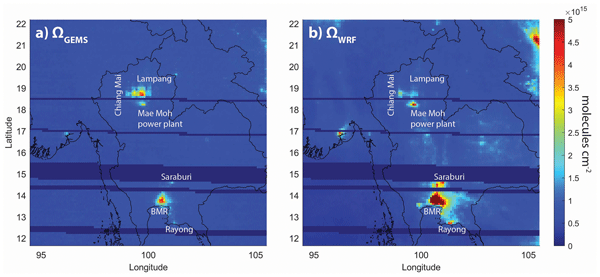
Air pollution from nitrogen oxides threatens human health in Thailand. We used a brand new geostationary satellite (GEMS) to measure air pollution and update emissions for modeling in Thailand. Our updated emissions improve model performance compared to other satellites. Additionally, our work reveals data inconsistencies in North Thailand between two satellites. This shows the potential of geostationary satellites and the requirement for calibration and bias correction.
Chayan Roychoudhury, Rajesh Kumar, Cenlin He, William Y. Y. Cheng, Kirpa Ram, Naoki Mizukami, and Avelino F. Arellano
Earth Syst. Sci. Data, 18, 5209–5257, https://doi.org/10.5194/essd-18-5209-2026, https://doi.org/10.5194/essd-18-5209-2026, 2026
Short summary
Short summary
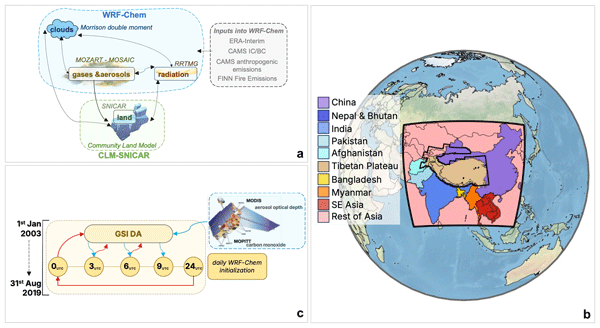
Snow and ice in the high mountains of Asia feed rivers supplying water to over a billion people, but airborne soot and dust darken the snow and speed up melting. We built a 17-year record of these conditions by blending satellite observations with a complex model that simulates weather, air pollution, land, and snow as one connected system. The record agrees well with independent measurements and traces soot on the glaciers to its regional sources, helping assess risks to Asia's water supply.
Eloisa Raluy-López, Domingo Muñoz-Esparza, and Juan Pedro Montávez
Geosci. Model Dev., 19, 5139–5154, https://doi.org/10.5194/gmd-19-5139-2026, https://doi.org/10.5194/gmd-19-5139-2026, 2026
Short summary
Short summary
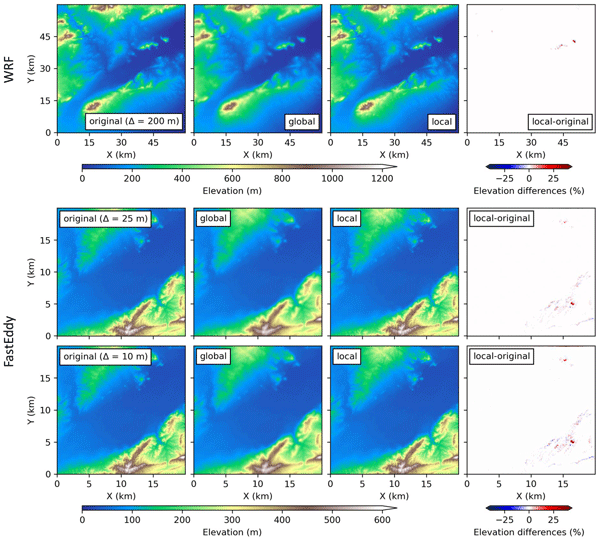
High-resolution atmospheric simulations can become numerically unstable over steep terrain. Traditional terrain smoothing approaches modify the domain globally, reducing terrain detail. We developed a local smoothing method that improves simulation stability while only modifying steep-slope points, helping to retain the benefits of high-resolution modeling. Tested in a mesoscale and a microscale atmospheric model, it is computationally efficient, easy to implement, and adaptable to other models.
Dylan B. A. Jones, Lucas Prates, Zhen Qu, William Y. Y. Cheng, Kazuyuki Miyazaki, Takashi Sekiya, Antje Inness, Rajesh Kumar, Xiao Tang, Helen Worden, Gerbrand Koren, and Vincent Huijnen
Atmos. Chem. Phys., 26, 6655–6682, https://doi.org/10.5194/acp-26-6655-2026, https://doi.org/10.5194/acp-26-6655-2026, 2026
Short summary
Short summary
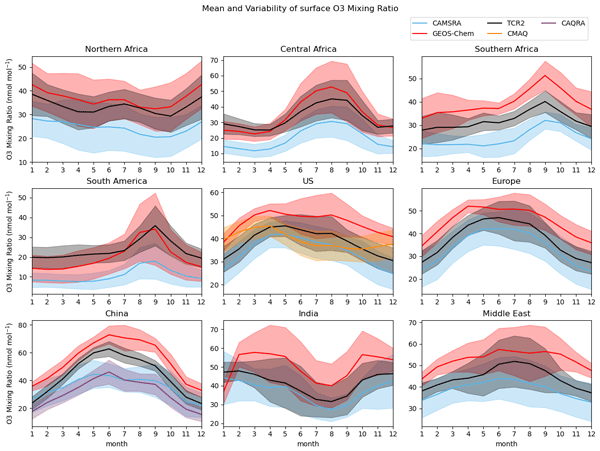
We evaluate five chemical reanalysis products to assess their potential to provide useful information on tropospheric ozone variability. We find that the reanalyses produce consistent information on ozone variations in the free troposphere, but have large discrepancies at the surface. The results suggests that improvements in the reanalyses are needed to better exploit the assimilated observations to enhance the utility of the reanalysis products at the surface.
Rajmal Jat, Akash Sagar Vispute, Sachin D. Ghude, Rajesh Kumar, Vinayak Sinha, Baerbel Sinha, Gaurav Govardhan, Zhining Tao, Prafull P. Yadav, Sandeep Wagh, Sreyashi Debnath, Aditi Rathore, and Madhavan Rajeevan
EGUsphere, https://doi.org/10.5194/egusphere-2026-1302, https://doi.org/10.5194/egusphere-2026-1302, 2026
Short summary
Short summary
This study developed a simplified and computationally efficient secondary organic aerosol parameterization in the MOZART–GOCART scheme within WRF-Chem using volatile organic compound observations in Delhi. This parameterization was evaluated for a period with severe pollution influenced by crop residue burning. Results show that the approach improves the model’s ability to reproduce organic aerosols and fine particulate matter while remaining much faster than more complex chemical schemes.
Naoki Mizukami, Samar Minallah, Cenlin He, Chayan Roychoudhury, William Y.Y. Cheng, and Rajesh Kumar
EGUsphere, https://doi.org/10.5194/egusphere-2025-4586, https://doi.org/10.5194/egusphere-2025-4586, 2025
Short summary
Short summary
We examined how air pollution particles that darken snow affect water resources in High Mountain Asia, a region that supplies rivers vital to millions of populations. Using computer models, we found that these particles cause snow to melt two weeks to a month earlier, shifting when water becomes available. This leads to more runoff at first but less later in the year, slightly reducing annual river flow. The findings highlight the need to link air pollution control with water management.
Chayan Roychoudhury, Cenlin He, Rajesh Kumar, and Avelino F. Arellano Jr.
Earth Syst. Dynam., 16, 1237–1266, https://doi.org/10.5194/esd-16-1237-2025, https://doi.org/10.5194/esd-16-1237-2025, 2025
Short summary
Short summary
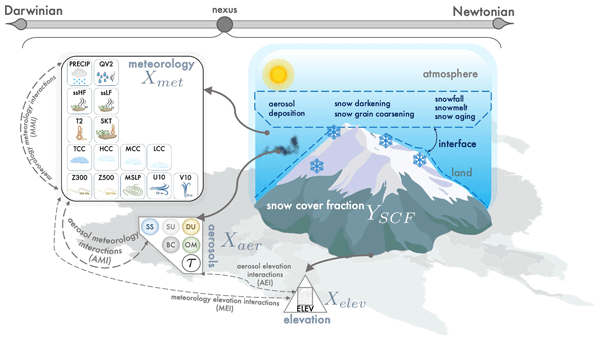
We present a novel data-driven approach to understand how pollution and weather processes interact to influence snowmelt in Asian glaciers and how these interactions are represented in three climate models. Our findings show where models need improvement in predicting snowmelt, particularly dust and its transport. This method can support future model development for reliable predictions in climate-vulnerable regions.
Rajesh Kumar, Piyush Bhardwaj, Cenlin He, Jennifer Boehnert, Forrest Lacey, Stefano Alessandrini, Kevin Sampson, Matthew Casali, Scott Swerdlin, Olga Wilhelmi, Gabriele G. Pfister, Benjamin Gaubert, and Helen Worden
Earth Syst. Sci. Data, 17, 1807–1834, https://doi.org/10.5194/essd-17-1807-2025, https://doi.org/10.5194/essd-17-1807-2025, 2025
Short summary
Short summary
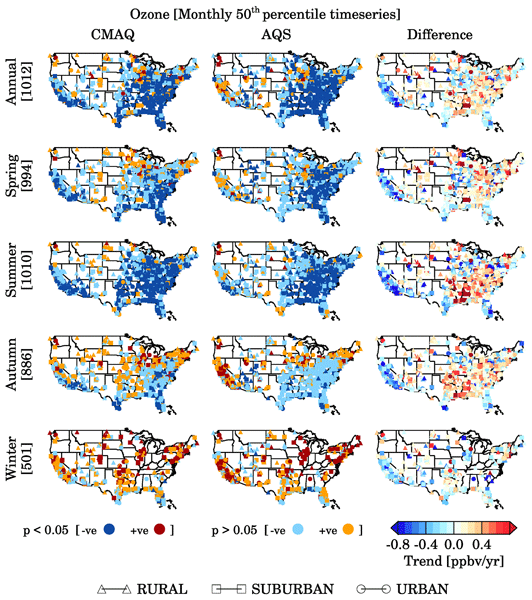
We have created a 14-year hourly air quality dataset at 12 km resolution by combining satellite observations of atmospheric composition with air quality models over the contiguous United States (CONUS). The dataset has been found to reproduce key observed features of air quality over the CONUS. To enable easy visualization and interpretation of county-level air quality measures and trends by stakeholders, an ArcGIS air quality dashboard has also been developed.
Connor J. Clayton, Daniel R. Marsh, Steven T. Turnock, Ailish M. Graham, Kirsty J. Pringle, Carly L. Reddington, Rajesh Kumar, and James B. McQuaid
Atmos. Chem. Phys., 24, 10717–10740, https://doi.org/10.5194/acp-24-10717-2024, https://doi.org/10.5194/acp-24-10717-2024, 2024
Short summary
Short summary
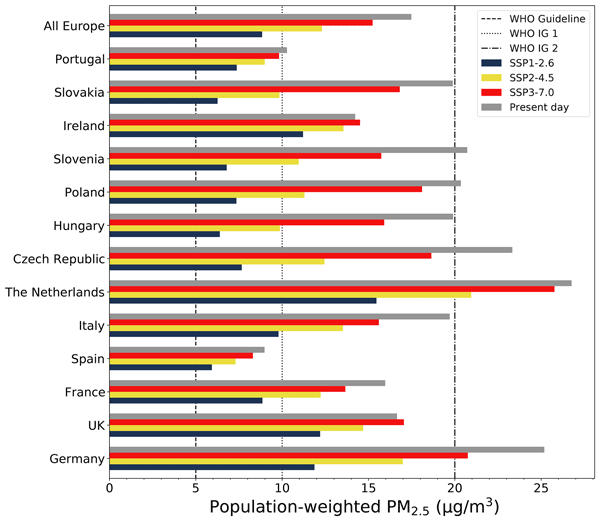
We demonstrate that strong climate mitigation could improve air quality in Europe; however, less ambitious mitigation does not result in these co-benefits. We use a high-resolution atmospheric chemistry model. This allows us to demonstrate how this varies across European countries and analyse the underlying chemistry. This may help policy-facing researchers understand which sectors and regions need to be prioritised to achieve strong air quality co-benefits of climate mitigation.
Matthew S. Johnson, Sajeev Philip, Scott Meech, Rajesh Kumar, Meytar Sorek-Hamer, Yoichi P. Shiga, and Jia Jung
Atmos. Chem. Phys., 24, 10363–10384, https://doi.org/10.5194/acp-24-10363-2024, https://doi.org/10.5194/acp-24-10363-2024, 2024
Short summary
Short summary
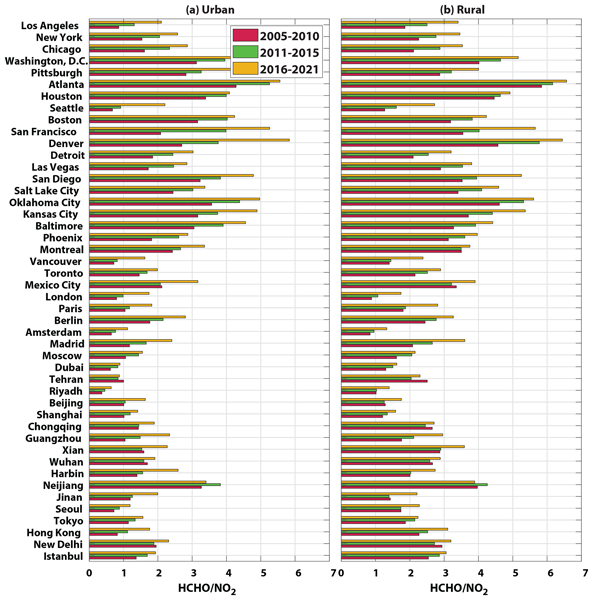
Satellites, like the Ozone Monitoring Instrument (OMI), retrieve proxy species of ozone (O3) formation (formaldehyde and nitrogen dioxide) and the ratios (FNRs) which can define O3 production sensitivity regimes. Here we investigate trends of OMI FNRs from 2005 to 2021, and they have increased in major cities, suggesting a transition from radical- to NOx-limited regimes. OMI also observed the impact of reduced emissions during the 2020 COVID-19 lockdown that resulted in increased FNRs.
Andrew O. Langford, Raul J. Alvarez II, Kenneth C. Aikin, Sunil Baidar, W. Alan Brewer, Steven S. Brown, Matthew M. Coggan, Patrick D. Cullis, Jessica Gilman, Georgios I. Gkatzelis, Detlev Helmig, Bryan J. Johnson, K. Emma Knowland, Rajesh Kumar, Aaron D. Lamplugh, Audra McClure-Begley, Brandi J. McCarty, Ann M. Middlebrook, Gabriele Pfister, Jeff Peischl, Irina Petropavlovskikh, Pamela S. Rickley, Andrew W. Rollins, Scott P. Sandberg, Christoph J. Senff, and Carsten Warneke
EGUsphere, https://doi.org/10.5194/egusphere-2024-1938, https://doi.org/10.5194/egusphere-2024-1938, 2024
Preprint withdrawn
Short summary
Short summary
High ozone (O3) formed by reactions of nitrogen oxides (NOx) and volatile organic compounds (VOCs) can harm human health and welfare. High O3 is usually associated with hot summer days, but under certain conditions, high O3 can also form under winter conditions. In this study, we describe a high O3 event that occurred in Colorado during the COVID-19 quarantine that was caused in part by the decrease in traffic, and in part by a shallow inversion created by descent of stratospheric air.
Chandrakala Bharali, Mary Barth, Rajesh Kumar, Sachin D. Ghude, Vinayak Sinha, and Baerbel Sinha
Atmos. Chem. Phys., 24, 6635–6662, https://doi.org/10.5194/acp-24-6635-2024, https://doi.org/10.5194/acp-24-6635-2024, 2024
Short summary
Short summary
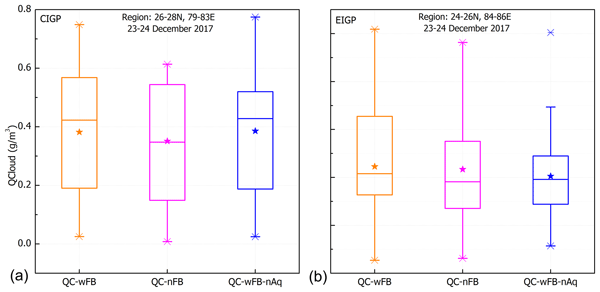
This study examines the role of atmospheric aerosols in winter fog over the Indo-Gangetic Plains of India using WRF-Chem. The increase in RH with aerosol–radiation feedback (ARF) is found to be important for fog formation as it promotes the growth of aerosols in the polluted environment. Aqueous-phase chemistry in the fog increases PM2.5 concentration, further affecting ARF. ARF and aqueous-phase chemistry affect the fog intensity and the timing of fog formation by ~1–2 h.
Yafang Guo, Chayan Roychoudhury, Mohammad Amin Mirrezaei, Rajesh Kumar, Armin Sorooshian, and Avelino F. Arellano
Geosci. Model Dev., 17, 4331–4353, https://doi.org/10.5194/gmd-17-4331-2024, https://doi.org/10.5194/gmd-17-4331-2024, 2024
Short summary
Short summary
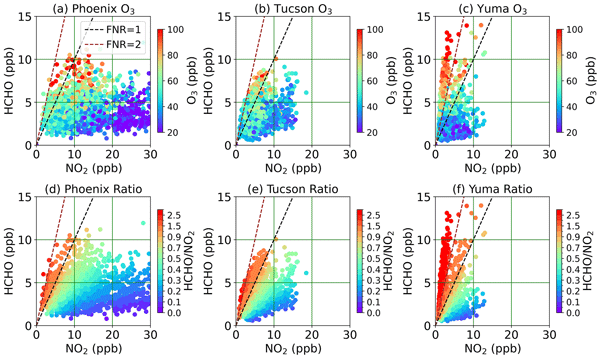
This research focuses on surface ozone (O3) pollution in Arizona, a historically air-quality-challenged arid and semi-arid region in the US. The unique characteristics of this kind of region, e.g., intense heat, minimal moisture, and persistent desert shrubs, play a vital role in comprehending O3 exceedances. Using the WRF-Chem model, we analyzed O3 levels in the pre-monsoon month, revealing the model's skill in capturing diurnal and MDA8 O3 levels.
Gaurav Govardhan, Sachin D. Ghude, Rajesh Kumar, Sumit Sharma, Preeti Gunwani, Chinmay Jena, Prafull Yadav, Shubhangi Ingle, Sreyashi Debnath, Pooja Pawar, Prodip Acharja, Rajmal Jat, Gayatry Kalita, Rupal Ambulkar, Santosh Kulkarni, Akshara Kaginalkar, Vijay K. Soni, Ravi S. Nanjundiah, and Madhavan Rajeevan
Geosci. Model Dev., 17, 2617–2640, https://doi.org/10.5194/gmd-17-2617-2024, https://doi.org/10.5194/gmd-17-2617-2024, 2024
Short summary
Short summary
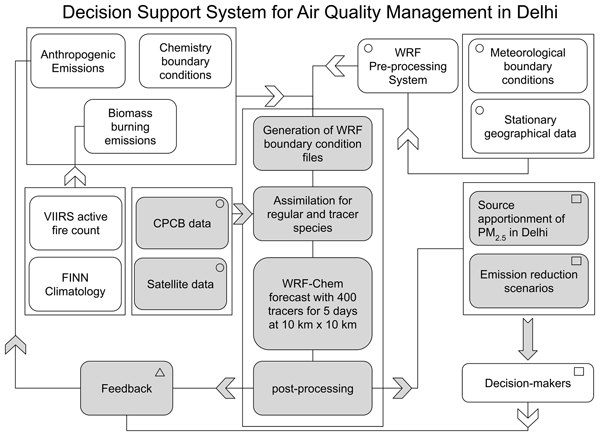
A newly developed air quality forecasting framework, Decision Support System (DSS), for air quality management in Delhi, India, provides source attribution with numerous emission reduction scenarios besides forecasts. DSS shows that during post-monsoon and winter seasons, Delhi and its neighboring districts contribute to 30 %–40 % each to pollution in Delhi. On average, a 40 % reduction in the emissions in Delhi and the surrounding districts would result in a 24 % reduction in Delhi's pollution.
Eloisa Raluy-López, Juan Pedro Montávez, and Pedro Jiménez-Guerrero
Geosci. Model Dev., 17, 1469–1495, https://doi.org/10.5194/gmd-17-1469-2024, https://doi.org/10.5194/gmd-17-1469-2024, 2024
Short summary
Short summary
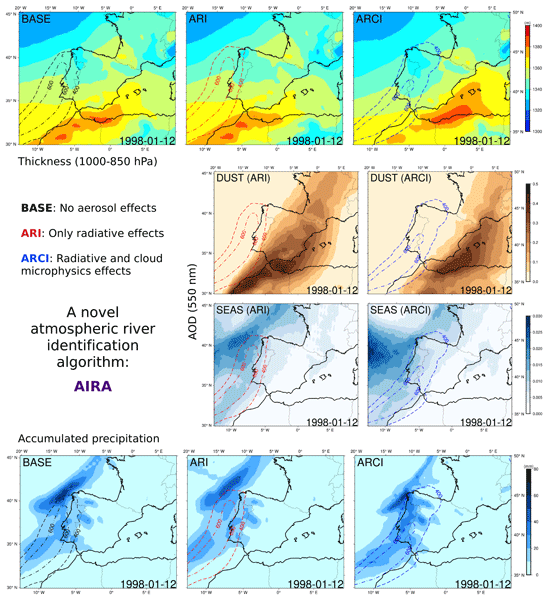
Atmospheric rivers (ARs) represent a significant source of water but are also related to extreme precipitation events. Here, we present a new regional-scale AR identification algorithm and apply it to three simulations that include aerosol interactions at different levels. The results show that aerosols modify the intensity and trajectory of ARs and redistribute the AR-related precipitation. Thus, the correct inclusion of aerosol effects is important in the simulation of AR behavior.
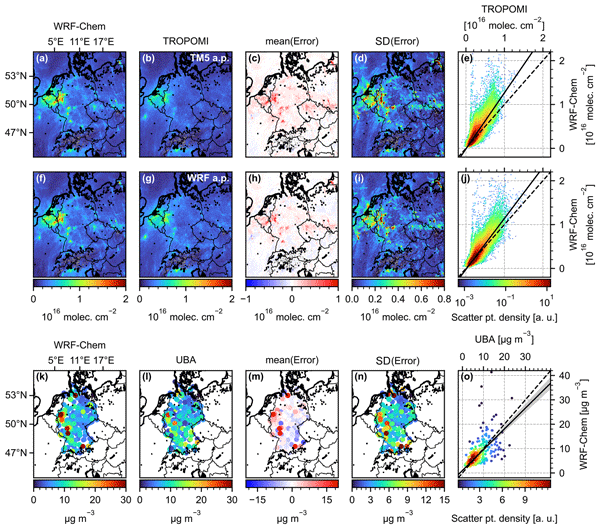
Leon Kuhn, Steffen Beirle, Vinod Kumar, Sergey Osipov, Andrea Pozzer, Tim Bösch, Rajesh Kumar, and Thomas Wagner
Atmos. Chem. Phys., 24, 185–217, https://doi.org/10.5194/acp-24-185-2024, https://doi.org/10.5194/acp-24-185-2024, 2024
Short summary
Short summary
NO₂ is an important air pollutant. It was observed that the WRF-Chem model shows significant deviations in NO₂ abundance when compared to measurements. We use a 1-month simulation over central Europe to show that these deviations can be mostly resolved by reparameterization of the vertical mixing routine. In order to validate our results, they are compared to in situ, satellite, and MAX-DOAS measurements.
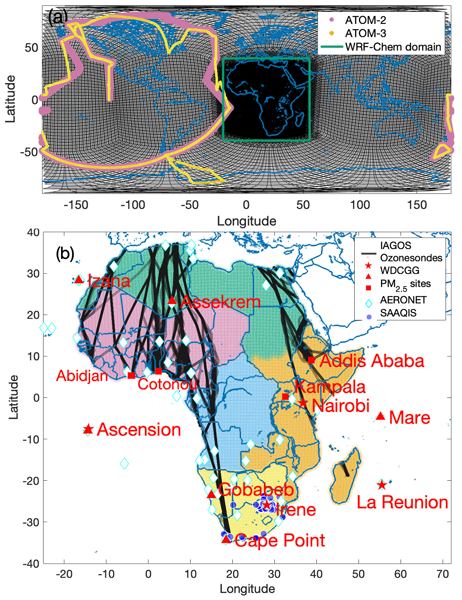
Wenfu Tang, Louisa K. Emmons, Helen M. Worden, Rajesh Kumar, Cenlin He, Benjamin Gaubert, Zhonghua Zheng, Simone Tilmes, Rebecca R. Buchholz, Sara-Eva Martinez-Alonso, Claire Granier, Antonin Soulie, Kathryn McKain, Bruce C. Daube, Jeff Peischl, Chelsea Thompson, and Pieternel Levelt
Geosci. Model Dev., 16, 6001–6028, https://doi.org/10.5194/gmd-16-6001-2023, https://doi.org/10.5194/gmd-16-6001-2023, 2023
Short summary
Short summary
The new MUSICAv0 model enables the study of atmospheric chemistry across all relevant scales. We develop a MUSICAv0 grid for Africa. We evaluate MUSICAv0 with observations and compare it with a previously used model – WRF-Chem. Overall, the performance of MUSICAv0 is comparable to WRF-Chem. Based on model–satellite discrepancies, we find that future field campaigns in an eastern African region (30°E–45°E, 5°S–5°N) could substantially improve the predictive skill of air quality models.
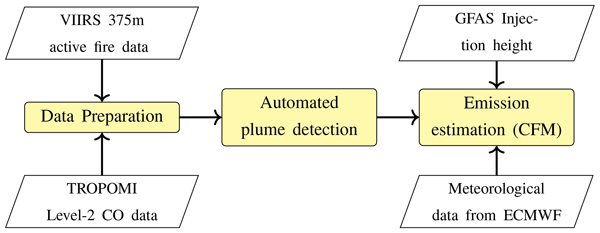
Manu Goudar, Juliëtte C. S. Anema, Rajesh Kumar, Tobias Borsdorff, and Jochen Landgraf
Geosci. Model Dev., 16, 4835–4852, https://doi.org/10.5194/gmd-16-4835-2023, https://doi.org/10.5194/gmd-16-4835-2023, 2023
Short summary
Short summary
A framework was developed to automatically detect plumes and compute emission estimates with cross-sectional flux method (CFM) for biomass burning events in TROPOMI CO datasets using Visible Infrared Imaging Radiometer Suite active fire data. The emissions were more reliable when changing plume height in downwind direction was used instead of constant injection height. The CFM had uncertainty even when the meteorological conditions were accurate; thus there is a need for better inversion models.
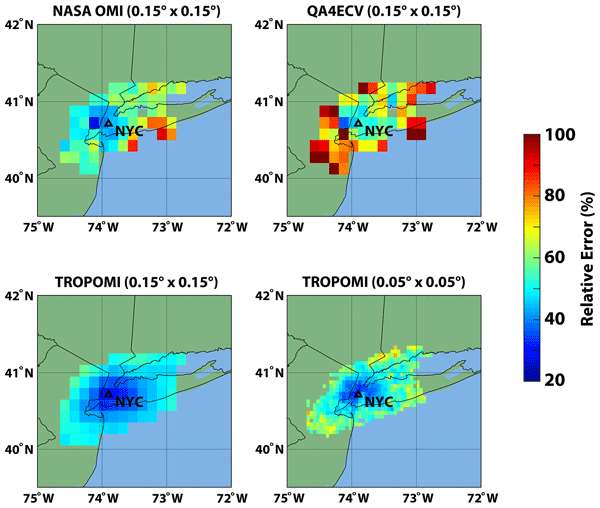
Matthew S. Johnson, Amir H. Souri, Sajeev Philip, Rajesh Kumar, Aaron Naeger, Jeffrey Geddes, Laura Judd, Scott Janz, Heesung Chong, and John Sullivan
Atmos. Meas. Tech., 16, 2431–2454, https://doi.org/10.5194/amt-16-2431-2023, https://doi.org/10.5194/amt-16-2431-2023, 2023
Short summary
Short summary
Satellites provide vital information for studying the processes controlling ozone formation. Based on the abundance of particular gases in the atmosphere, ozone formation is sensitive to specific human-induced and natural emission sources. However, errors and biases in satellite retrievals hinder this data source’s application for studying ozone formation sensitivity. We conducted a thorough statistical evaluation of two commonly applied satellites for investigating ozone formation sensitivity.
Prajjwal Rawat, Manish Naja, Evan Fishbein, Pradeep K. Thapliyal, Rajesh Kumar, Piyush Bhardwaj, Aditya Jaiswal, Sugriva N. Tiwari, Sethuraman Venkataramani, and Shyam Lal
Atmos. Meas. Tech., 16, 889–909, https://doi.org/10.5194/amt-16-889-2023, https://doi.org/10.5194/amt-16-889-2023, 2023
Short summary
Short summary
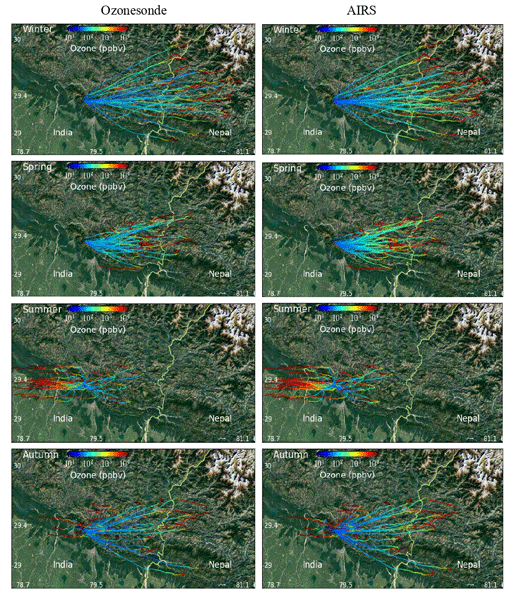
Satellite-based ozone observations have gained importance due to their global coverage. However, satellite-retrieved products are indirect and need to be validated, particularly over mountains. Ozonesondes launched from a Himalayan site are used to assess the Atmospheric Infrared Sounder (AIRS) ozone retrieval. AIRS is shown to overestimate ozone in the upper troposphere and lower stratosphere, while the differences from ozonesondes are more minor in the middle troposphere and stratosphere.

Pooja V. Pawar, Sachin D. Ghude, Gaurav Govardhan, Prodip Acharja, Rachana Kulkarni, Rajesh Kumar, Baerbel Sinha, Vinayak Sinha, Chinmay Jena, Preeti Gunwani, Tapan Kumar Adhya, Eiko Nemitz, and Mark A. Sutton
Atmos. Chem. Phys., 23, 41–59, https://doi.org/10.5194/acp-23-41-2023, https://doi.org/10.5194/acp-23-41-2023, 2023
Short summary
Short summary
In this study, for the first time in South Asia we compare simulated ammonia, ammonium, and total ammonia using the WRF-Chem model and MARGA measurements during winter in the Indo-Gangetic Plain region. Since observations show HCl promotes the fraction of high chlorides in Delhi, we added HCl / Cl emissions to the model. We conducted three sensitivity experiments with changes in HCl emissions, and improvements are reported in accurately simulating ammonia, ammonium, and total ammonia.
Amar Halifa-Marín, Miguel A. Torres-Vázquez, Enrique Pravia-Sarabia, Marc Lemus-Canovas, Pedro Jiménez-Guerrero, and Juan Pedro Montávez
Hydrol. Earth Syst. Sci., 26, 4251–4263, https://doi.org/10.5194/hess-26-4251-2022, https://doi.org/10.5194/hess-26-4251-2022, 2022
Short summary
Short summary
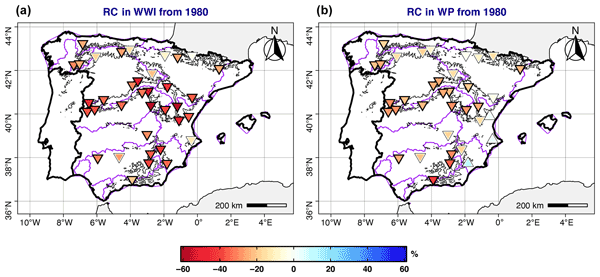
Near-natural Iberian water resources have suddenly decreased since the 1980s. These declines have been promoted by the weakening (enhancement) of wintertime precipitation (the NAOi) in the most humid areas, whereas afforestation and drought intensification have played a crucial role in semi-arid areas. Future water management would benefit from greater knowledge of North Atlantic climate variability and reforestation/afforestation processes in semi-arid catchments.
Chaman Gul, Shichang Kang, Siva Praveen Puppala, Xiaokang Wu, Cenlin He, Yangyang Xu, Inka Koch, Sher Muhammad, Rajesh Kumar, and Getachew Dubache
Atmos. Chem. Phys., 22, 8725–8737, https://doi.org/10.5194/acp-22-8725-2022, https://doi.org/10.5194/acp-22-8725-2022, 2022
Short summary
Short summary
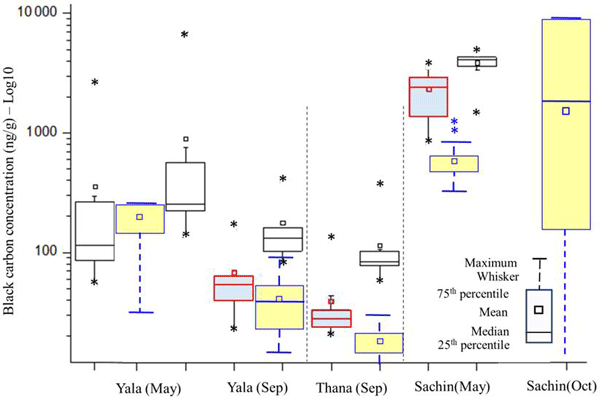
This work aims to understand concentrations, spatial variability, and potential source regions of light-absorbing impurities (black carbon aerosols, dust particles, and organic carbon) in the surface snow of central and western Himalayan glaciers and their impact on snow albedo and radiative forcing.

Patricia Tarín-Carrasco, Ulas Im, Camilla Geels, Laura Palacios-Peña, and Pedro Jiménez-Guerrero
Atmos. Chem. Phys., 22, 3945–3965, https://doi.org/10.5194/acp-22-3945-2022, https://doi.org/10.5194/acp-22-3945-2022, 2022
Short summary
Short summary
The evidence of the effects of atmospheric pollution (and particularly fine particulate matter, PM2.5) on human mortality is now unquestionable. Here, 895 000 annual premature deaths (PD) are estimated for the present (1991–2010), which increases to 1 540 000 in the year 2050 due to the ageing of the European population. The implementation of a mitigation scenario (80 % of the energy production in Europe from renewable sources) could lead to a decrease of over 60 000 annual PD for the year 2050.
Cited articles
Beloconi, A. and Vounatsou, P.: Revised EU and WHO air quality thresholds: Where does Europe stand?, Atmos. Environ., 314, 120110, https://doi.org/10.1016/j.atmosenv.2023.120110, 2023. a
Chen, F. and Dudhia, J.: Coupling an advanced land surface–hydrology model with the Penn State–NCAR MM5 modeling system. Part I: Model implementation and sensitivity, Mon. Weather Rev., 129, 569–585, https://doi.org/10.1175/1520-0493(2001)129<0587:CAALSH>2.0.CO;2, 2001. a
Chung, C. E.: Aerosol Direct Radiative Forcing: A Review, in: Atmospheric Aerosols – Regional Characteristics – Chemistry and Physics, edited by: Abdul-Razzak, H., chap. 14, IntechOpen, London, https://doi.org/10.5772/50248, 2012. a
Consejería de Medio Ambiente, Universidades, Investigación y Mar Menor. Dirección General de Medio Ambiente: Regional SINQLAIR Air Quality Network, https://sinqlair.carm.es/calidadaire/ (last access: 23 January 2026), 2018. a
Danielson, J. and Gesch, D.: Global multi-resolution terrain elevation data 2010 (GMTED2010), Tech. rep., U.S. Department of the Interior, https://doi.org/10.3133/ofr20111073, 2011. a, b
Darmenova, K., Sokolik, I. N., Shao, Y., Marticorena, B., and Bergametti, G.: Development of a physically based dust emission module within the Weather Research and Forecasting (WRF) model: Assessment of dust emission parameterizations and input parameters for source regions in Central and East Asia, J. Geophys. Res.-Atmos., 114, https://doi.org/10.1029/2008JD011236, 2009. a
DeFries, R., Townshend, J., and Hansen, M.: Continuous fields of vegetation characteristics at the global scale at 1-km resolution, J. Geophys. Res.-Atmos., 104, 16911–16923, https://doi.org/10.1029/1999JD900057, 1999. a
Demuzere, M., Kittner, J., Martilli, A., Mills, G., Moede, C., Stewart, I. D., van Vliet, J., and Bechtel, B.: A global map of local climate zones to support earth system modelling and urban-scale environmental science, Earth Syst. Sci. Data, 14, 3835–3873, https://doi.org/10.5194/essd-14-3835-2022, 2022. a, b
Demuzere, M., Kittner, J., Martilli, A., Mills, G., Moede, C., Stewart, I. D., van Vliet, J., and Bechtel, B.: Global map of Local Climate Zones, Zenodo, https://doi.org/10.5281/zenodo.8419340, 2023. a, b
Eltahan, M., Shokr, M., and Sherif, A. O.: Simulation of severe dust events over Egypt using tuned dust schemes in weather research forecast (WRF-Chem), Atmosphere, 9, 246, https://doi.org/10.3390/atmos9070246, 2018. a
Faber, E., Baker, B., Rocha Lima, A., and Schepanski, K.: Making a Dust Source Map: Can We Build, Implement, and Learn From a Reflectance Derived Sediment Supply Map in the Unified Forecast System (UFS)?, J. Geophys. Res.-Atmos., 131, e2025JD045333, https://doi.org/10.1029/2025JD045333, 2026. a
Friedl, M., McIver, D., Hodges, J., Zhang, X., Muchoney, D., Strahler, A., Woodcock, C., Gopal, S., Schneider, A., Cooper, A., Baccini, A., Gao, F., and Schaaf, C.: Global land cover mapping from MODIS: algorithms and early results, Remote Sens. Environ., 83, 287–302, https://doi.org/10.1016/S0034-4257(02)00078-0, 2002. a
Garnés-Morales, G., Montávez, J. P., Halifa-Marín, A., and Jiménez-Guerrero, P.: Role of aerosols on atmospheric circulation in regional climate Experiments over Europe, Atmosphere, 14, 491, https://doi.org/10.3390/atmos14030491, 2023. a
Garnés-Morales, G., Tortosa, J., Jiménez-Guerrero, P., Gil-Guirado, S., García-Fernández, E., and Montávez, J. P.: Assessing the effects of compound events of temperature and air pollution on weekly mortality in Spain using random forests, Weather and Climate Extremes, 100816, https://doi.org/10.1016/j.wace.2025.100816, 2025. a
Georgiou, G. K., Christoudias, T., Proestos, Y., Kushta, J., Pikridas, M., Sciare, J., Savvides, C., and Lelieveld, J.: Evaluation of WRF-Chem model (v3.9.1.1) real-time air quality forecasts over the Eastern Mediterranean, Geosci. Model Dev., 15, 4129–4146, https://doi.org/10.5194/gmd-15-4129-2022, 2022. a
Ginoux, P., Chin, M., Tegen, I., Prospero, J. M., Holben, B., Dubovik, O., and Lin, S.-J.: Sources and distributions of dust aerosols simulated with the GOCART model, J. Geophys. Res.-Atmos., 106, 20255–20273, https://doi.org/10.1029/2000JD000053, 2001. a
Grell, G. A.: Prognostic evaluation of assumptions used by cumulus parameterizations, Mon. Weather Rev., 121, 764–787, https://doi.org/10.1175/1520-0493(1993)121<0764:PEOAUB>2.0.CO;2, 1993. a
Grell, G. A. and Dévényi, D.: A generalized approach to parameterizing convection combining ensemble and data assimilation techniques, Geophys. Res. Lett., 29, 38-1–38-4, https://doi.org/10.1029/2002GL015311, 2002. a
Grell, G. A., Peckham, S. E., Schmitz, R., McKeen, S. A., Frost, G., Skamarock, W. C., and Eder, B.: Fully coupled “online” chemistry within the WRF model, Atmos. Environ., 39, 6957–6975, https://doi.org/10.1016/j.atmosenv.2005.04.027, 2005. a, b
Hengl, T., Mendes de Jesus, J., Heuvelink, G. B., Ruiperez Gonzalez, M., Kilibarda, M., Blagotić, A., Shangguan, W., Wright, M. N., Geng, X., Bauer-Marschallinger, B., Guevara, M. A., Vargas, R., MacMillan, R. A., Batjes, N. H., Leenaars, J. G., Ribeiro, E., Wheeler, I., Mantel, S., and Kempen, B.: SoilGrids250m: Global gridded soil information based on machine learning, PLoS one, 12, e0169748, https://doi.org/10.1371/journal.pone.0169748, 2017. a, b
Hersbach, H., Bell, B., Berrisford, P., Biavati, G., Horányi, A., Muñoz Sabater, J., Nicolas, J., Peubey, C., Radu, R., Rozum, I., Schepers, D., Simmons, A., Soci, C., Dee, D., and Thépaut, J.-N.: ERA5 hourly data on pressure levels from 1940 to present, Copernicus Climate Change Service (C3S) Climate Data Store (CDS), https://doi.org/10.24381/cds.bd0915c6, 2018. a
Hong, S.-Y., Noh, Y., and Dudhia, J.: A new vertical diffusion package with an explicit treatment of entrainment processes, Mon. Weather Rev., 134, 2318–2341, https://doi.org/10.1175/MWR3199.1, 2006. a
Iacono, M. J., Delamere, J. S., Mlawer, E. J., Shephard, M. W., Clough, S. A., and Collins, W. D.: Radiative forcing by long-lived greenhouse gases: Calculations with the AER radiative transfer models, J. Geophys. Res.-Atmos., 113, https://doi.org/10.1029/2008JD009944, 2008. a, b
Jerez, S., Palacios-Peña, L., Gutiérrez, C., Jiménez-Guerrero, P., López-Romero, J. M., Pravia-Sarabia, E., and Montávez, J. P.: Sensitivity of surface solar radiation to aerosol–radiation and aerosol–cloud interactions over Europe in WRFv3.6.1 climatic runs with fully interactive aerosols, Geosci. Model Dev., 14, 1533–1551, https://doi.org/10.5194/gmd-14-1533-2021, 2021. a
Jiménez, P. A., Dudhia, J., González-Rouco, J. F., Navarro, J., Montávez, J. P., and García-Bustamante, E.: A revised scheme for the WRF surface layer formulation, Mon. Weather Rev., 140, 898–918, https://doi.org/10.1175/MWR-D-11-00056.1, 2012. a
Jin, J., Segers, A., Liao, H., Heemink, A., Kranenburg, R., and Lin, H. X.: Source backtracking for dust storm emission inversion using an adjoint method: case study of Northeast China, Atmos. Chem. Phys., 20, 15207–15225, https://doi.org/10.5194/acp-20-15207-2020, 2020. a
Johnson, B., Shine, K., and Forster, P.: The semi-direct aerosol effect: Impact of absorbing aerosols on marine stratocumulus, Q. J. Roy. Meteor. Soc., 130, 1407–1422, https://doi.org/10.1256/qj.03.61, 2004. a
Knippertz, P. and Todd, M.: Mineral dust aerosols over the Sahara: Meteorological controls on emission and transport and implications for modeling, Rev. Geophys., 50, https://doi.org/10.1029/2011rg000362, 2012. a
Kok, J. F., Ward, D. S., Mahowald, N. M., and Evan, A. T.: Global and regional importance of the direct dust-climate feedback, Nat. Commun., 9, 241, https://doi.org/10.1038/s41467-017-02620-y, 2018. a
Kok, J. F., Adebiyi, A. A., Albani, S., Balkanski, Y., Checa-Garcia, R., Chin, M., Colarco, P. R., Hamilton, D. S., Huang, Y., Ito, A., Klose, M., Leung, D. M., Li, L., Mahowald, N. M., Miller, R. L., Obiso, V., Pérez García-Pando, C., Rocha-Lima, A., Wan, J. S., and Whicker, C. A.: Improved representation of the global dust cycle using observational constraints on dust properties and abundance, Atmos. Chem. Phys., 21, 8127–8167, https://doi.org/10.5194/acp-21-8127-2021, 2021. a
Lee, J. A., Jiménez, P. A., Kumar, R., and He, C.: Impact of direct insertion of SMAP soil moisture retrievals in WRF-Chem for dust storm events in the western US, Atmos. Environ., 321, 120349, https://doi.org/10.1016/j.atmosenv.2024.120349, 2024. a
Lee, J.-H., Lee, S.-H., and Cho, J. H.: A novel method for detecting natural dust source regions using satellite and ground-based measurements, Atmos. Environ., 344, 121024, https://doi.org/10.1016/j.atmosenv.2024.121024, 2025. a
Li, H. and Wang, C.: Impact of dust radiation effect on simulations of temperature and wind–A case study in Taklimakan Desert, Atmos. Res., 273, 106163, https://doi.org/10.1016/j.atmosres.2022.106163, 2022. a
López-Cayuela, M.-Á., Córdoba-Jabonero, C., Sicard, M., Abril-Gago, J., Salgueiro, V., Comerón, A., Granados-Muñoz, M. J., Costa, M. J., Muñoz-Porcar, C., Bravo-Aranda, J. A., Bortoli, D., Rodríguez-Gómez, A., Alados-Arboledas, L., and Guerrero-Rascado, J. L.: Fine and coarse dust radiative impact during an intense Saharan dust outbreak over the Iberian Peninsula – short-wave direct radiative effect, Atmos. Chem. Phys., 25, 3213–3231, https://doi.org/10.5194/acp-25-3213-2025, 2025. a
Mahowald, N. M., Ballantine, J. A., Feddema, J., and Ramankutty, N.: Global trends in visibility: implications for dust sources, Atmos. Chem. Phys., 7, 3309–3339, https://doi.org/10.5194/acp-7-3309-2007, 2007. a
Masson-Delmotte, V., Zhai, P., Pirani, A., Connors, S. L., Péan, C., Berger, S., Caud, N., Chen, Y., Goldfarb, L., Gomis, M., et al.: Climate change 2021: the physical science basis, Contribution of working group I to the sixth assessment report of the intergovernmental panel on climate change, 2, 2391, https://doi.org/10.1017/9781009157896, 2021. a
Morrison, H., Curry, J., and Khvorostyanov, V.: A new double-moment microphysics parameterization for application in cloud and climate models. Part I: Description, J. Atmos. Sci., 62, 1665–1677, https://doi.org/10.1175/JAS3446.1, 2005. a
Palacios-Peña, L., Lorente-Plazas, R., Montávez, J. P., and Jiménez-Guerrero, P.: Saharan dust modeling over the Mediterranean basin and Central Europe: does the resolution matter?, Front. Earth Sci., 7, 290, https://doi.org/10.3389/feart.2019.00290, 2019. a
Palacios-Peña, L., Fast, J. D., Pravia-Sarabia, E., and Jiménez-Guerrero, P.: Sensitivity of aerosol optical properties to the aerosol size distribution over central Europe and the Mediterranean Basin using the WRF-Chem v.3.9.1.1 coupled model, Geosci. Model Dev., 13, 5897–5915, https://doi.org/10.5194/gmd-13-5897-2020, 2020. a
Parajuli, S. P., Stenchikov, G. L., Ukhov, A., and Kim, H.: Dust emission modeling using a new high-resolution dust source function in WRF-Chem with implications for air quality, J. Geophys. Res.-Atmos., 124, 10109–10133, https://doi.org/10.1029/2019JD030248, 2019. a
Pey, J., Querol, X., Alastuey, A., Forastiere, F., and Stafoggia, M.: African dust outbreaks over the Mediterranean Basin during 2001–2011: PM10 concentrations, phenomenology and trends, and its relation with synoptic and mesoscale meteorology, Atmos. Chem. Phys., 13, 1395–1410, https://doi.org/10.5194/acp-13-1395-2013, 2013. a
Pino-Carmona, M., Ruiz-Arias, J. A., Fernández-Carvelo, S., Bravo-Aranda, J. A., and Alados-Arboledas, L.: Intercomparison of WRF-chem aerosol schemes during a dry Saharan dust outbreak in Southern Iberian Peninsula, Atmos. Environ., 339, 120872, https://doi.org/10.1016/j.atmosenv.2024.120872, 2024. a
Poggio, L., de Sousa, L. M., Batjes, N. H., Heuvelink, G. B. M., Kempen, B., Ribeiro, E., and Rossiter, D.: SoilGrids 2.0: producing soil information for the globe with quantified spatial uncertainty, SOIL, 7, 217–240, https://doi.org/10.5194/soil-7-217-2021, 2021. a, b
Querol, X., Pey, J., Pandolfi, M., Alastuey, A., Cusack, M., Pérez, N., Moreno, T., Viana, M., Mihalopoulos, N., Kallos, G., and Kleanthous, S.: African dust contributions to mean ambient PM10 mass-levels across the Mediterranean Basin, Atmos. Environ., 43, 4266–4277, https://doi.org/10.1016/j.atmosenv.2009.06.013, 2009. a
Rahmati, O., Mohammadi, F., Ghiasi, S. S., Tiefenbacher, J., Moghaddam, D. D., Coulon, F., Nalivan, O. A., and Bui, D. T.: Identifying sources of dust aerosol using a new framework based on remote sensing and modelling, Sci. Total Environ., 737, 139508, https://doi.org/10.1016/j.scitotenv.2020.139508, 2020. a
Ratcliffe, N. G., Ryder, C. L., Bellouin, N., Woodward, S., Jones, A., Johnson, B., Wieland, L.-M., Dollner, M., Gasteiger, J., and Weinzierl, B.: Long-range transport of coarse mineral dust: an evaluation of the Met Office Unified Model against aircraft observations, Atmos. Chem. Phys., 24, 12161–12181, https://doi.org/10.5194/acp-24-12161-2024, 2024. a
Rizza, U., Barnaba, F., Miglietta, M. M., Mangia, C., Di Liberto, L., Dionisi, D., Costabile, F., Grasso, F., and Gobbi, G. P.: WRF-Chem model simulations of a dust outbreak over the central Mediterranean and comparison with multi-sensor desert dust observations, Atmos. Chem. Phys., 17, 93–115, https://doi.org/10.5194/acp-17-93-2017, 2017. a
Salvador, P., Pey, J., Pérez, N., Querol, X., and Artíñano, B.: Increasing atmospheric dust transport towards the western Mediterranean over 1948–2020, npj Climate and Atmospheric Science, 5, 34, https://doi.org/10.1038/s41612-022-00256-4, 2022. a
Schraufnagel, D. E.: The health effects of ultrafine particles, Exp. Mol. Med., 52, 311–317, https://doi.org/10.1038/s12276-020-0403-3, 2020. a
Segado-Moreno, L. C. and Montavez, J. P.: EROD Tuner, Zenodo [code], https://doi.org/10.5281/zenodo.18606994, 2026. a, b, c
Segado-Moreno, L. C., Montavez, J. P., Raluy-López, E., Garnés-Morales, G., and Jiménez-Guerrero, P.: EROD-HR – A High Resolution Global Dust Erodibility Dataset, Zenodo [data set], https://doi.org/10.5281/zenodo.18594482, 2026a. a, b
Segado-Moreno, L. C., Montavez, J. P., Raluy-López, E., Garnés-Morales, G., and Jiménez-Guerrero, P.: SOILHD – Soil-Type Heterogeneous Erodibility Dataset , Zenodo [data set], https://doi.org/10.5281/zenodo.18596292, 2026b. a, b
Spyrou, C., Solomos, S., Bartsotas, N. S., Douvis, K. C., and Nickovic, S.: Development of a Dust Source Map for WRF-Chem Model Based on MODIS NDVI, Atmosphere, 13, https://doi.org/10.3390/atmos13060868, 2022. a, b, c
Stewart, I. D. and Oke, T. R.: Local climate zones for urban temperature studies, B. Am. Meteor. Soc., 93, 1879–1900, https://doi.org/10.1175/BAMS-D-11-00019.1, 2012. a
Tan, C., Liu, C., Li, T., Luan, Z., Tang, M., and Zhao, T.: A Dynamically Updated Dust Source Function for Dust Emission Scheme: Improving Dust Aerosol Simulation on an East Asian Dust Storm, Atmosphere, https://doi.org/10.3390/atmos16040357, 2025. a
Tarín-Carrasco, P., Im, U., Geels, C., Palacios-Peña, L., and Jiménez-Guerrero, P.: Contribution of fine particulate matter to present and future premature mortality over Europe: A non-linear response, Environ. Int., 153, 106517, https://doi.org/10.1016/j.envint.2021.106517, 2021. a
Tegen, I. and Schepanski, K.: The global distribution of mineral dust, in: IOP Conference Series: Earth and Environmental Science, IOP Publishing, 7, 012001, https://doi.org/10.1088/1755-1307/7/1/012001, 2009. a
Tong, D. Q., Gill, T. E., Sprigg, W. A., Van Pelt, R. S., Baklanov, A. A., Barker, B. M., Bell, J. E., Castillo, J., Gassó, S., Gaston, C. J., Griffin, D. W., Huneeus, N., Kahn, R. A., Kuciauskas, A. P., Ladino, L. A., Li, J., Mayol-Bracero, O. L., McCotter, O. Z., Méndez-Lázaro, P. A., Mudu, P., Nickovic, S., Oyarzun, D., Prospero, J., Raga, G. B., Raysoni, A. U., Ren, L., Sarafoglou, N., Sealy, A., Sun, Z., and Vimic, A. V.: Health and safety effects of airborne soil dust in the Americas and beyond, Rev. Geophys., 61, https://doi.org/10.1029/2021RG000763, 2023. a
Ukhov, A., Ahmadov, R., Grell, G., and Stenchikov, G.: Improving dust simulations in WRF-Chem v4.1.3 coupled with the GOCART aerosol module, Geosci. Model Dev., 14, 473–493, https://doi.org/10.5194/gmd-14-473-2021, 2021. a
Yarragunta, Y., Francis, D., Fonseca, R., and Nelli, N.: Evaluation of the WRF-Chem performance for the air pollutants over the United Arab Emirates, Atmos. Chem. Phys., 25, 1685–1709, https://doi.org/10.5194/acp-25-1685-2025, 2025. a
Zeng, Y., Wang, M., Zhao, C., Chen, S., Liu, Z., Huang, X., and Gao, Y.: WRF-Chem v3.9 simulations of the East Asian dust storm in May 2017: modeling sensitivities to dust emission and dry deposition schemes, Geosci. Model Dev., 13, 2125–2147, https://doi.org/10.5194/gmd-13-2125-2020, 2020. a
Zhang, L., Montuoro, R., McKeen, S. A., Baker, B., Bhattacharjee, P. S., Grell, G. A., Henderson, J., Pan, L., Frost, G. J., McQueen, J., Saylor, R., Li, H., Ahmadov, R., Wang, J., Stajner, I., Kondragunta, S., Zhang, X., and Li, F.: Development and evaluation of the Aerosol Forecast Member in the National Center for Environment Prediction (NCEP)'s Global Ensemble Forecast System (GEFS-Aerosols v1), Geosci. Model Dev., 15, 5337–5369, https://doi.org/10.5194/gmd-15-5337-2022, 2022. a
Zhao, A., Ryder, C. L., and Wilcox, L. J.: How well do the CMIP6 models simulate dust aerosols?, Atmos. Chem. Phys., 22, 2095–2119, https://doi.org/10.5194/acp-22-2095-2022, 2022. a
Zhao, J., Ma, X., Wu, S., and Sha, T.: Dust emission and transport in Northwest China: WRF-Chem simulation and comparisons with multi-sensor observations, Atmos. Res., 241, 104978, https://doi.org/10.1016/j.atmosres.2020.104978, 2020. a, b
Short summary
This study focuses on improving models that simulate how mineral dust is emitted and transported in the atmosphere. We created two new, more detailed maps of soils and terrain to better represent where dust is generated. As a case study, we use dust events coming from North Africa affecting the Iberian Peninsula. Results show that the improved data helps the model match observed air pollution better, especially during dust episodes in inland areas.
This study focuses on improving models that simulate how mineral dust is emitted and transported...


Altmetrics
Final-revised paper
Preprint