
Articles | Volume 26, issue 16
https://doi.org/10.5194/acp-26-11923-2026
© Author(s) 2026. This work is distributed under
the Creative Commons Attribution 4.0 License.
the Creative Commons Attribution 4.0 License.
https://doi.org/10.5194/acp-26-11923-2026
© Author(s) 2026. This work is distributed under
the Creative Commons Attribution 4.0 License.
the Creative Commons Attribution 4.0 License.
Research article
| 
21 Aug 2026
Research article |
| 21 Aug 2026
| 21 Aug 2026
Impacts of anthropogenic aerosols on a snowfall event – a case study in the Guanzhong Basin and its surrounding areas, China
Yuning Yang
School of Human Settlements and Civil Engineering, Xi'an Jiaotong University, Xi'an, 710049, China
Naifang Bei
CORRESPONDING AUTHOR

School of Human Settlements and Civil Engineering, Xi'an Jiaotong University, Xi'an, 710049, China
Ruonan Wang
State Key Laboratory of Loess Science, Institute of Earth Environment, Chinese Academy of Sciences, Xi'an, 710061, China
Qing Ji
School of Human Settlements and Civil Engineering, Xi'an Jiaotong University, Xi'an, 710049, China
Shaanxi Meteorological Observatory, Xi'an, 710014, China
Haiyue Hong
School of Human Settlements and Civil Engineering, Xi'an Jiaotong University, Xi'an, 710049, China
Zhe Li
School of Human Settlements and Civil Engineering, Xi'an Jiaotong University, Xi'an, 710049, China
Xuexi Tie
State Key Laboratory of Loess Science, Institute of Earth Environment, Chinese Academy of Sciences, Xi'an, 710061, China
Guohui Li
CORRESPONDING AUTHOR
State Key Laboratory of Loess Science, Institute of Earth Environment, Chinese Academy of Sciences, Xi'an, 710061, China
Related authors
Naifang Bei, Bo Xiao, Ruonan Wang, Yuning Yang, Lang Liu, Yongming Han, and Guohui Li
Atmos. Chem. Phys., 25, 10931–10948, https://doi.org/10.5194/acp-25-10931-2025, https://doi.org/10.5194/acp-25-10931-2025, 2025
Short summary
Short summary
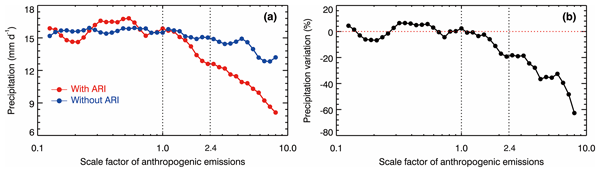
This study uses a cloud-resolving model to examine how aerosols influence a mesoscale convective system (MCS) in central China via aerosol–radiation interaction (ARI) and aerosol–cloud interaction (ACI). Without ARIs, added aerosols do not significantly affect precipitation due to cloud competition for moisture. ARIs can stabilize or enhance convection. High aerosol levels lead to a combined ARI and ACI effect that greatly reduces precipitation.
Xinpeng Ye, Qian Jiang, Jin Ban, Mengyu Xie, Qianyi Xu, Zeyu Wang, Jian Sun, Hongai Zhang, Xinyi Niu, Hongmei Xu, Zhenxing Shen, and Guohui Li
EGUsphere, https://doi.org/10.5194/egusphere-2026-4504, https://doi.org/10.5194/egusphere-2026-4504, 2026
This preprint is open for discussion and under review for Atmospheric Chemistry and Physics (ACP).
Short summary
Short summary
Ground-level ozone pollution is increasing worldwide, but its formation in agricultural–urban interface regions remains unclear. We investigated summertime ozone pollution in Northeast China using field observations and atmospheric modelling. Results showed that ozone was driven mainly by regional transport, background levels, and interactions between human and natural emissions. Effective mitigation requires regional cooperation and targeted control of key human emissions.
Yuxuan Lu, Ruonan Wang, Ningning Zhang, Qiyuan Wang, Yuepeng Pan, Qian Jiang, and Xuexi Tie
EGUsphere, https://doi.org/10.5194/egusphere-2026-2692, https://doi.org/10.5194/egusphere-2026-2692, 2026
Short summary
Short summary
This study explored how ammonia reacts with secondary organic aerosols over northern China using model simulations constrained by observational data. The reaction had little effect on overall fine particle pollution but produced noticeable nitrogen-containing organic particles, improving understanding of atmospheric pollution formation and chemical processes in air quality models.
Ruonan Wang, Ningning Zhang, Jiarui Wu, Qian Jiang, Jiaoyang Yu, Yuxuan Lu, and Xuexi Tie
Atmos. Chem. Phys., 26, 3417–3438, https://doi.org/10.5194/acp-26-3417-2026, https://doi.org/10.5194/acp-26-3417-2026, 2026
Short summary
Short summary
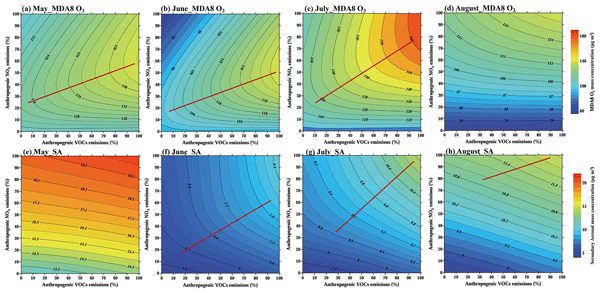
Air pollution in China has shifted from particles to ozone as a main concern in warm-seasons. We combined ten years of observations with model simulations to explore how ozone and secondary particles change in the Guanzhong Basin. We find that chemical drivers shift during the season, leading to different pollution responses. These insights point to targeted, season-specific strategies that can improve air quality more effectively.
Shuyu Zhao, Tian Feng, Xuexi Tie, Biao Tian, Xiao Hu, Bo Hu, Dong Yang, Sinan Gu, and Minghu Ding
Atmos. Chem. Phys., 25, 12483–12496, https://doi.org/10.5194/acp-25-12483-2025, https://doi.org/10.5194/acp-25-12483-2025, 2025
Short summary
Short summary
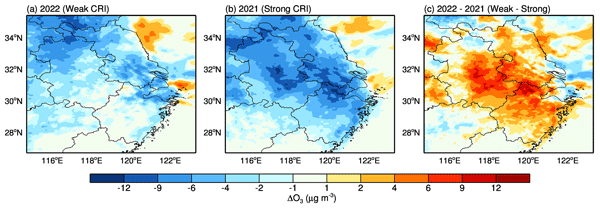
This study investigated how cloud–radiation interactions influence ozone formation in a warming climate. Using measurements, reanalysis data, and models, we found that cloud–radiation interactions can worsen O3 pollution, and climate warming will amplify the influence. We highlight that climate change will pose greater challenges for China's O3 pollution prevention and control, and actions such as reducing O3 precursors emissions and mitigating climate change are urgently needed.
Tian Feng, Guohui Li, Shuyu Zhao, Naifang Bei, Xin Long, Yuepeng Pan, Yu Song, Ruonan Wang, Xuexi Tie, and Luisa T. Molina
Atmos. Chem. Phys., 25, 11703–11718, https://doi.org/10.5194/acp-25-11703-2025, https://doi.org/10.5194/acp-25-11703-2025, 2025
Short summary
Short summary
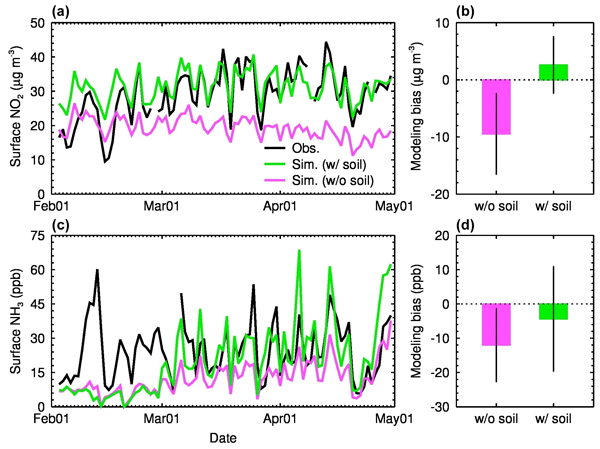
The impacts of agricultural fertilization on nitrogen oxide and air quality are becoming more pronounced with continuous reductions in fossil fuel sources in China. We report that atmospheric nitrogen dioxide pulses driven by agricultural fertilization largely complicate air pollution in the North China Plain, highlighting the necessity of agricultural emission control.
Naifang Bei, Bo Xiao, Ruonan Wang, Yuning Yang, Lang Liu, Yongming Han, and Guohui Li
Atmos. Chem. Phys., 25, 10931–10948, https://doi.org/10.5194/acp-25-10931-2025, https://doi.org/10.5194/acp-25-10931-2025, 2025
Short summary
Short summary
This study uses a cloud-resolving model to examine how aerosols influence a mesoscale convective system (MCS) in central China via aerosol–radiation interaction (ARI) and aerosol–cloud interaction (ACI). Without ARIs, added aerosols do not significantly affect precipitation due to cloud competition for moisture. ARIs can stabilize or enhance convection. High aerosol levels lead to a combined ARI and ACI effect that greatly reduces precipitation.
Xuehong Gong, Zeyu Liu, Jie Tian, Qiyuan Wang, Guohui Li, Zhisheng An, and Yongming Han
Atmos. Chem. Phys., 25, 10379–10401, https://doi.org/10.5194/acp-25-10379-2025, https://doi.org/10.5194/acp-25-10379-2025, 2025
Short summary
Short summary
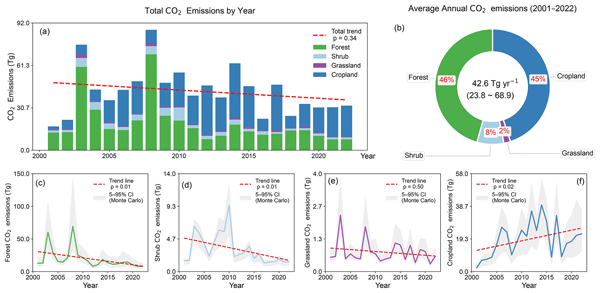
We studied wildfire carbon dioxide emissions across China from 2001 to 2022 and found that cropland and forest fires are the main contributors. While forest and shrub fires have decreased, cropland fires are rising, especially in northeastern China. Our findings suggest that climate and local policies affect wildfire emissions and that better fire management is needed to reduce future carbon impacts.
Jiamao Zhou, Jiarui Wu, Xiaoli Su, Ruonan Wang, Imad EI Haddad, Xia Li, Qian Jiang, Ting Zhang, Wenting Dai, Junji Cao, Andre S. H. Prevot, Xuexi Tie, and Guohui Li
Atmos. Chem. Phys., 25, 7563–7580, https://doi.org/10.5194/acp-25-7563-2025, https://doi.org/10.5194/acp-25-7563-2025, 2025
Short summary
Short summary
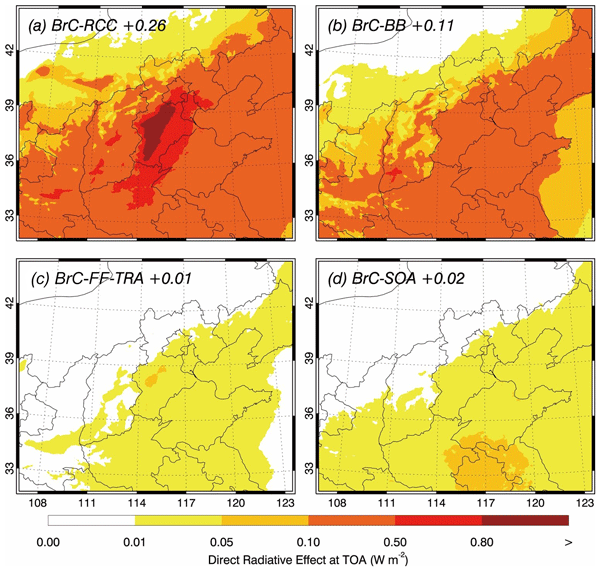
Brown carbon (BrC) is a type of airborne particle produced from various combustion sources which is light absorption. Historically, climate models have categorizing organic particles as either non-absorbing or purely reflective. Our study shows that BrC can reduce the usual cooling effect of organic particles. While BrC is often linked to biomass burning, however, BrC from fossil fuels contributes significantly to atmospheric heating.
Cited articles
Ackerman, A. S., Toon, O. B., Stevens, D. E., Heymsfield, A. J., Ramanathan, V., and Welton, E. J.: Reduction of tropical cloudiness by soot, Science, 288, 1042–1047, https://doi.org/10.1126/science.288.5468.1042, 2000.
Albrecht, B. A.: Aerosols, cloud microphysics, and fractional cloudiness, Science, 245, 1227–1230, https://doi.org/10.1126/science.245.4923.1227, 1989.
Bai, Y., Li, J., Guo, J., Xu, H., and Wang, Y.: Simulation of the responses of rainstorm in the Yangtze River Middle Reaches to changes in anthropogenic aerosol emissions, Atmos. Environ., 220, 117081, https://doi.org/10.1016/j.atmosenv.2019.117081, 2020.
Bei, N., Li, G., Huang, R., Cao, J., Meng, N., Feng, T., Liu, S., Zhang, T., Zhang, Q., and Molina, L. T.: Typical synoptic situations and their impacts on the wintertime air pollution in the Guanzhong Basin, China, Atmos. Chem. Phys., 16, 7373–7387, https://doi.org/10.5194/acp-16-7373-2016, 2016a.
Bei, N., Xiao, B., Meng, N., and Feng, T.: Critical role of meteorological conditions in a persistent haze episode in the Guanzhong Basin, China, Sci. Total Environ., 550, 273–284, https://doi.org/10.1016/j.scitotenv.2016.01.124, 2016b.
Bei, N., Wu, J., Elser, M., Feng, T., Cao, J., El-Haddad, I., Li, X., Huang, R. J., Li, Z., Long, X., Zhao, S., Tie, X., Prévôt, A. S. H., and Li, G.: Impacts of meteorological uncertainties on the haze formation in Beijing–Tianjin–Hebei (BTH) during wintertime: a case study, Atmos. Chem. Phys., 17, 14579–14591, https://doi.org/10.5194/acp-17-14579-2017, 2017a.
Bei, N., Zhao, L., Xiao, B., Meng, N., and Feng, T.: Impacts of local circulations on the wintertime air pollution in the Guanzhong Basin, China, Sci. Total Environ., 592, 373–390, https://doi.org/10.1016/j.scitotenv.2017.02.151, 2017b.
Bei, N., Xiao, B., Wang, R., Yang, Y., Liu, L., Han, Y., and Li, G.: Impacts of aerosol–radiation and aerosol–cloud interactions on a short-term heavy-rainfall event – a case study in the Guanzhong Basin, China, Atmos. Chem. Phys., 25, 10931–10948, https://doi.org/10.5194/acp-25-10931-2025, 2025.
Boucher, O., Randall, D., Artaxo, P., Bretherton, C., Feingold, G., Forster, P., Kerminen, V., Kondo, Y., Liao, H., and Lohmann, U.: Clouds and aerosols, in Climate change 2013: The physical science basis, in: Contribution of working group I to the fifth assessment report of the intergovernmental panel on climate change, Cambridge University Press, 571–657, https://doi.org/10.1017/CBO9781107415324.016, 2013.
Braham Jr., R. R.: Cloud physics of urban weather modification – a preliminary report, B. Am. Meteorol. Soc., 55, 100–106, 1974.
Cao, Q., Jiang, B., Shen, X., Lin, W., and Chen, J.: Microphysics effects of anthropogenic aerosols on urban heavy precipitation over the Pearl River Delta, China, Atmos. Res., 253, 105478, https://doi.org/10.1016/j.atmosres.2021.105478, 2021.
Charlson, R. J., Schwartz, S. E., Hales, J. M., Cess, R. D., Coakley Jr., J. A., Hansen, J. E., and Hofmann, D. J.: Climate forcing by anthropogenic aerosols, Science, 255, 423–430, https://doi.org/10.1126/science.255.5043.423, 1992.
Cheng, Y., Yu, Q.-Q., Liu, J.-M., Zhu, S., Zhang, M., Zhang, H., Zheng, B., and He, K.-B.: Model vs. observation discrepancy in aerosol characteristics during a half-year long campaign in Northeast China: the role of biomass burning, Environ. Pollut., 269, 116167, https://doi.org/10.1016/j.envpol.2020.116167, 2021.
Chou, M. D. and Suarez, M. J.: A solar radiation parameterization for atmospheric studies, in: Technical Report Series on Global Modeling and Data Assimilation, edited by: Suarez, M. J., NASA Goddard Space Flight Center, Greenbelt, Maryland, USA, Vol. 15, NASA/TM-1999-104606, 40 pp., https://ntrs.nasa.gov/citations/19990060930 (last access: 22 September 2024), 1999.
Chou, M. D., Suarez, M. J., Liang, X. Z., Yan, M. M. H., and Cote, C.: A thermal infrared radiation parameterization for atmospheric studies, in: Technical Report Series on Global Modeling and Data Assimilation (No. NASA/TM-2001-104606), edited by: Suarez M. J., Goddard Space Flight Center, Greenbelt, Maryland, 19, https://ntrs.nasa.gov/citations/20010072848 (last access: 22 September 2024), 2001.
Ding, A. J., Huang, X., Nie, W., Sun, J. N., Kerminen, V.-M., Petäjä, T., Su, H., Cheng, Y. F., Yang, X.-Q., Wang, M. H., Chi, X. G., Wang, J. P., Virkkula, A., Guo, W. D., Yuan, J., Wang, S. Y., Zhang, R. J., Wu, Y. F., Song, Y., Zhu, T., Zilitinkevich, S., Kulmala, M., and Fu, C. B.: Enhanced haze pollution by black carbon in megacities in China, Geophys. Res. Lett., 43, 2873–2879, https://doi.org/10.1002/2016GL067745, 2016.
Ding, Q., Sun, J., Huang, X., Ding, A., Zou, J., Yang, X., and Fu, C.: Impacts of black carbon on the formation of advection–radiation fog during a haze pollution episode in eastern China, Atmos. Chem. Phys., 19, 7759–7774, https://doi.org/10.5194/acp-19-7759-2019, 2019.
Gao, M., Carmichael, G. R., Wang, Y., Saide, P. E., Yu, M., Xin, J., Liu, Z., and Wang, Z.: Modeling study of the 2010 regional haze event in the North China Plain, Atmos. Chem. Phys., 16, 1673–1691, https://doi.org/10.5194/acp-16-1673-2016, 2016.
Grell, G. A., Peckham, S. E., Schmitz, R., McKeen, S. A., Frost, G., Skamarock, W. C., and Eder, B.: Fully coupled “online” chemistry within the WRF model, Atmos. Environ., 39, 6957–6975, https://doi.org/10.1016/j.atmosenv.2005.04.027, 2005.
Guo, J., Deng, M., Fan, J., Li, Z., Chen, Q., Zhai, P., Dai, Z., and Li, X.: Precipitation and air pollution at mountain and plain stations in northern China: insights gained from observations and modeling, J. Geophys. Res.-Atmos., 119, 4793–4807, https://doi.org/10.1002/2013JD021161, 2014.
Guo, J., Liu, H., Li, Z., Rosenfeld, D., Jiang, M., Xu, W., Jiang, J. H., He, J., Chen, D., Min, M., and Zhai, P.: Aerosol-induced changes in the vertical structure of precipitation: a perspective of TRMM precipitation radar, Atmos. Chem. Phys., 18, 13329–13343, https://doi.org/10.5194/acp-18-13329-2018, 2018.
Guo, L., Fu, D., Xiao, H., Zhang, Y., and Miao, S.: Numerical analysis of the impact of complex urban environment on a snowfall event in Beijing, J. Geophys. Res.-Atmos., 126, e2021JD035442, https://doi.org/10.1029/2021JD035442, 2021.
Horowitz, L. W., Walters, S., Mauzerall, D. L., Emmons, L. K., Rasch, P. J., Granier, C., Tie, X., Lamarque, J.-F., Schultz, M. G., Tyndall, G. S., Orlando, J. J., and Brasseur, G. P.: A global simulation of tropospheric ozone and related tracers: Description and evaluation of MOZART, version 2, J. Geophys. Res.-Atmos., 108, 4784, https://doi.org/10.1029/2002JD002853, 2003.
Hu, Y., Zang, Z., Chen, D., Ma, X., Liang, Y., You, W., Pan, X., Wang, L., Wang, D., and Zhang, Z.: Optimization and evaluation of SO2 emissions based on WRF-Chem and 3DVAR data assimilation, Remote Sens., 14, 220, https://doi.org/10.3390/rs14010220, 2022.
Huang, X. and Ding, A.: Aerosol as a critical factor causing forecast biases of air temperature in global numerical weather prediction models, Sci. Bull., 66, 1917–1924, https://doi.org/10.1016/j.scib.2021.05.009, 2021.
Huo, F., Liu, Y., Li, R., Wang, Y., Li, Z., Zhang, Y., and He, Q.: Reduction in autumn precipitation over Southwest China by anthropogenic aerosol emissions from eastern China, Atmos. Res., 257, 105627, https://doi.org/10.1016/j.atmosres.2021.105627, 2021.
IPCC: Climate Change 2013: The Physical Science Basis, in: Contribution of Working Group I to the Fifth Assessment Report of the Intergovernmental Panel on Climate Change, Cambridge University Press, Cambridge, UK and New York, NY, USA, https://doi.org/10.1017/CBO9781107415324, 2013.
IPCC: Climate Change 2021: The Physical Science Basis, in: Contribution of Working Group I to the Sixth Assessment Report of the Intergovernmental Panel on Climate Change, Cambridge University Press, Cambridge, UK and New York, NY, USA, https://doi.org/10.1017/9781009157896, 2021.
Khain, A., Rosenfeld, D., and Pokrovsky, A.: Aerosol impact on the dynamics and microphysics of deep convective clouds, Q. J. Roy. Meteorol. Soc., 131, 2639–2663, https://doi.org/10.1256/qj.04.62, 2005.
Khain, A., BenMoshe, N., and Pokrovsky, A.: Factors determining the impact of aerosols on surface precipitation from clouds: an attempt at classification, J. Atmos. Sci., 65, 1721–1748, https://doi.org/10.1175/2007JAS2515.1, 2008.
Kogan, Y. L. and Martin, W. J.: Parameterization of bulk condensation in numerical cloud models, J. Atmos. Sci., 51, 1728–1739, https://doi.org/10.1175/1520-0469(1994)051<1728:POBCIN>2.0.CO;2, 1994.
Koren, I., Kaufman, Y. J., Remer, L. A., and Martins, J. V.: Measurement of the effect of Amazon smoke on inhibition of cloud formation, Science, 303, 1342–1345, https://doi.org/10.1126/science.1089424, 2004.
Lee, S. S., Guo, J., and Li, Z.: Delaying precipitation by air pollution over the Pearl River Delta: 2. Model simulations, J. Geophys. Res.-Atmos., 121, 11739–11760, https://doi.org/10.1002/2015JD024362, 2016.
Li, G., Wang, Y., and Zhang, R.: Implementation of a two-moment bulk microphysics scheme to the WRF model to investigate aerosol–cloud interaction, J. Geophys. Res.-Atmos., 113, D15211, https://doi.org/10.1029/2007JD009361, 2008.
Li, G., Wang, Y., Lee, K.-H., Diao, Y., and Zhang, R.: Impacts of aerosols on the development and precipitation of a mesoscale squall line, J. Geophys. Res.-Atmos., 114, D17205, https://doi.org/10.1029/2008JD011581, 2009.
Li, G., Lei, W., Zavala, M., Volkamer, R., Dusanter, S., Stevens, P., and Molina, L. T.: Impacts of HONO sources on the photochemistry in Mexico City during the MCMA-2006/MILAGO Campaign, Atmos. Chem. Phys., 10, 6551–6567, https://doi.org/10.5194/acp-10-6551-2010, 2010.
Li, G., Bei, N., Tie, X., and Molina, L. T.: Aerosol effects on the photochemistry in Mexico City during MCMA-2006/MILAGRO campaign, Atmos. Chem. Phys., 11, 5169–5182, https://doi.org/10.5194/acp-11-5169-2011, 2011a.
Li, G., Zavala, M., Lei, W., Tsimpidi, A. P., Karydis, V. A., Pandis, S. N., Canagaratna, M. R., and Molina, L. T.: Simulations of organic aerosol concentrations in Mexico City using the WRF-CHEM model during the MCMA-2006/MILAGRO campaign, Atmos. Chem. Phys., 11, 3789–3809, https://doi.org/10.5194/acp-11-3789-2011, 2011b.
Li, G., Lei, W., Bei, N., and Molina, L. T.: Contribution of garbage burning to chloride and PM2.5 in Mexico City, Atmos. Chem. Phys., 12, 8751–8761, https://doi.org/10.5194/acp-12-8751-2012, 2012.
Li, Q., Zhang, H., Cai, X., Song, Y., and Zhu, T.: The impacts of the atmospheric boundary layer on regional haze in North China, npj Clim. Atmos. Sci., 4, 9, https://doi.org/10.1038/s41612-021-00165-y, 2021.
Li, Z., He, Y., Yu, S., Wang, H., Fan, F., Qin, C., Chen, Y., Dai, W., Jin, Z., and Zhao, D.: Intercomparison of multiple chemical mechanisms in simulating severe haze event over the North China Plain, Atmos. Environ., 361, 121439, https://doi.org/10.1016/j.atmosenv.2025.121439, 2025.
Lin, Q., Chen, J., Ou, T., Lai, H.-W., Prein, A. F., and Chen, D.: Performance of the WRF model at the convection-permitting scale in simulating snowfall and lake-effect snow over the Tibetan Plateau, J. Geophys. Res.-Atmos., 128, e2022JD038433, https://doi.org/10.1029/2022JD038433, 2023.
Liu, J., Yang, K., Wang, J., Zhou, X., Jiang, Y., Shao, C., Lu, H., Yao, X., Sun, J., and Shi, J.: Impacts of a shallow convection scheme on kilometer-scale atmospheric simulations over the Tibetan Plateau, Clim. Dynam., 62, 8019–8034, https://doi.org/10.1007/s00382-024-07320-0, 2024.
Liu, L., Ma, Y., Menenti, M., Zhang, X., and Ma, W.: Evaluation of WRF modeling in relation to different land surface schemes and initial and boundary conditions: A snow event simulation over the Tibetan Plateau, J. Geophys. Res.-Atmos., 124, 209–226, https://doi.org/10.1029/2018JD029208, 2019.
Makar, P. A., Gong, W., Milbrandt, J., Hogrefe, C., Zhang, Y., Curci, G., Žabkar, R., Im, U., Balzarini, A., Baró, R., Bianconi, R., Cheung, P., Forkel, R., Gravel, S., Hirtl, M., Honzak, L., Hou, A., Jiménez-Guerrero, P., Langer, M., Moran, M. D., Pabla, B., Pérez, J. L., Pirovano, G., San José, R., Tuccella, P., Werhahn, J., Zhang, J., and Galmarini, S.: Feedbacks between air pollution and weather, Part 1: Effects on weather, Atmos. Environ., 115, 442–469, https://doi.org/10.1016/j.atmosenv.2014.12.003, 2015.
Menon, S., Hansen, J., Nazarenko, L., and Luo, Y.: Climate effects of black carbon aerosols in China and India, Science, 297, 2250–2253, https://doi.org/10.1126/science.1075159, 2002.
Mitchell Jr., J. M.: The effect of atmospheric aerosols on climate with special reference to temperature near the earth's surface, J. Appl. Meteorol. Clim., 10, 703–714, https://doi.org/10.1175/1520-0450(1971)010<0703:TEOAAO>2.0.CO;2, 1971.
Moraglia, G. and Crippa, P.: Assessing the influence of aerosols on urban precipitation: a sensitivity study of Dallas–Fort Worth, Atmos. Res., 328, 108436, https://doi.org/10.1016/j.atmosres.2025.108436, 2026.
Morrison, H., Thompson, G., and Tatarskii, V.: Impact of cloud microphysics on the development of trailing stratiform precipitation in a simulated squall line: Comparison of one-and two-moment schemes, Mon. Weather Rev., 137, 991–1007, https://doi.org/10.1175/2008MWR2556.1, 2009.
Myhre, G., Samset, B. H., Schulz, M., Balkanski, Y., Bauer, S., Berntsen, T. K., Bian, H., Bellouin, N., Chin, M., Diehl, T., Easter, R. C., Feichter, J., Ghan, S. J., Hauglustaine, D., Iversen, T., Kinne, S., Kirkevåg, A., Lamarque, J.-F., Lin, G., Liu, X., Lund, M. T., Luo, G., Ma, X., van Noije, T., Penner, J. E., Rasch, P. J., Ruiz, A., Seland, Ø., Skeie, R. B., Stier, P., Takemura, T., Tsigaridis, K., Wang, P., Wang, Z., Xu, L., Yu, H., Yu, F., Yoon, J.-H., Zhang, K., Zhang, H., and Zhou, C.: Radiative forcing of the direct aerosol effect from AeroCom Phase II simulations, Atmos. Chem. Phys., 13, 1853–1877, https://doi.org/10.5194/acp-13-1853-2013, 2013.
Öktem, R., Romps, D. M., and Varble, A. C.: No warm-phase invigoration of convection detected during GoAmazon, J. Atmos. Sci., 80, 2345–2364, https://doi.org/10.1175/JAS-D-22-0241.1, 2023.
Peng, H., Hu, X., Ai, W., Qiao, J., and Zhao, X.: Effects of fine and coarse aerosols on the summer precipitation structure and microphysics over the Yangtze River Delta region, Atmos. Res., 326, 108277, https://doi.org/10.1016/j.atmosres.2025.108277, 2025.
Pinsky, M., Mazin, I. P., Korolev, A., and Khain, A.: Supersaturation and diffusional droplet growth in liquid clouds, J. Atmos. Sci., 70, 2778–2793, https://doi.org/10.1175/JAS-D-12-077.1, 2013.
Pravia-Sarabia, E., Montávez, J. P., Halifa-Marin, A., Jiménez-Guerrero, P., and Gómez-Navarro, J. J.: The Role of Aerosol Concentration on Precipitation in a Winter Extreme Mixed-Phase System: The Case of Storm Filomena, Remote Sens., 15, 1398, https://doi.org/10.3390/rs15051398, 2023.
Quaas, J.: Approaches to observe anthropogenic aerosol–cloud interactions, Curr. Clim. Change Rep., 1, 297–304, https://doi.org/10.1007/s40641-015-0028-0, 2015.
Romps, D. M., Latimer, K., Zhu, Q., Jurkat-Witschas, T., Mahnke, C., Prabhakaran, T., Weigel, R., and Wendisch, M.: Air pollution unable to intensify storms via warm-phase invigoration, Geophys. Res. Lett., 50, e2022GL100409, https://doi.org/10.1029/2022GL100409, 2023.
Rosenfeld, D.: TRMM observed first direct evidence of smoke from forest fires inhibiting rainfall, Geophys. Res. Lett., 26, 3105–3108, https://doi.org/10.1029/1999GL006066, 1999.
Rosenfeld, D., Dai, J., Yu, X., Yao, Z., Xu, X., Yang, X., and Du, C.: Inverse relations between amounts of air pollution and orographic precipitation, Science, 315, 1396–1398, https://doi.org/10.1126/science.1137949, 2007.
Rosenfeld, D., Lohmann, U., Raga, G. B., O'Dowd, C. D., Kulmala, M., Fuzzi, S., Reissell, A., and Andreae, M. O.: Flood or drought: how do aerosols affect precipitation?, Science, 321, 1309–1313, https://doi.org/10.1126/science.1160606, 2008.
Ryu, Y.-H. and Min, S.-K.: Greenhouse warming and anthropogenic aerosols synergistically reduce springtime rainfall in low-latitude East Asia, npj Clim. Atmos. Sci., 5, 69, https://doi.org/10.1038/s41612-022-00295-x, 2022.
Saleeby, S. M., Cotton, W. R., and Fuller, J. D.: The cumulative impact of cloud droplet nucleating aerosols on orographic snowfall in Colorado, J. Appl. Meteorol. Clim., 50, 599–612, https://doi.org/10.1175/2010JAMC2498.1, 2010.
Shao, T., Zhang, H., Xu, X., Li, J., Wu, S., and Liu, Y.: Role of anthropogenic aerosols in affecting different-grade precipitation over eastern China: a case study, Sci. Total Environ., 807, 150886, https://doi.org/10.1016/j.scitotenv.2021.150886, 2022.
Sun, N., Fu, Y., Zhong, L., and Li, R.: Aerosol effects on the vertical structure of precipitation in East China, npj Clim. Atmos. Sci., 5, 60, https://doi.org/10.1038/s41612-022-00284-0, 2022.
Sun, Y. and Zhao, C.: Distinct impacts on precipitation by aerosol radiative effect over three different megacity regions of eastern China, Atmos. Chem. Phys., 21, 16555–16574, https://doi.org/10.5194/acp-21-16555-2021, 2021.
Tao, W. K., Li, X. W., Khain, A., Matsui, T., and Lang, S.: Role of atmospheric aerosol concentration on deep convective precipitation: cloud-resolving model simulation, J. Geophys. Res.-Atmos., 112, D24S18, https://doi.org/10.1029/2007JD008728, 2007.
Thompson, G. and Eidhammer, T.: A study of aerosol impacts on clouds and precipitation development in a large winter cyclone, J. Atmos. Sci., 71, 3636–3658, https://doi.org/10.1175/JAS-D-13-0305.1, 2014.
Travis, K. R., Nault, B. A., Crawford, J. H., Kim, H., Chen, Q., Zheng, Y., Liu, T., Jimenez, J. L., Campuzano-Jost, P., Wennberg, P. O., Crounse, J. D., and Huey, L. G.: Year-round analysis of multiphase sulfate production in aerosol particles in East Asia, ACS ES&T Air, 2, 1758–1769, https://doi.org/10.1021/acsestair.5c00136, 2025.
Twomey, S.: The influence of pollution on the shortwave albedo of clouds, J. Atmos. Sci., 34, 1149–1152, https://doi.org/10.1175/1520-0469(1977)034<1149:TIOPOT>2.0.CO;2, 1977.
Varble, A. C., Igel, A. L., Morrison, H., Grabowski, W. W., and Lebo, Z. J.: Opinion: A critical evaluation of the evidence for aerosol invigoration of deep convection, Atmos. Chem. Phys., 23, 13791–13808, https://doi.org/10.5194/acp-23-13791-2023, 2023.
Wang, W., Chen, G., and Zhang, Y.: Role of aerosol ice-nucleus effect in the development of the “21⋅7” Henan extreme precipitation, J. Geophys. Res.-Atmos., 129, e2024JD041487, https://doi.org/10.1029/2024JD041487, 2024.
Wang, Y., Wan, Q., Meng, W., Liao, F., Tan, H., and Zhang, R.: Long-term impacts of aerosols on precipitation and lightning over the Pearl River Delta megacity area in China, Atmos. Chem. Phys., 11, 12421–12436, https://doi.org/10.5194/acp-11-12421-2011, 2011.
Wilcox, E. M., Thomas, R. M., Praveen, P. S., Pistone, K., Bender, F. A.-M., and Ramanathan, V.: Black carbon solar absorption suppresses turbulence in the atmospheric boundary layer, P. Natl. Acad. Sci. USA, 113, 11794–11799, https://doi.org/10.1073/pnas.1525746113, 2016.
Wu, J., Bei, N., Wang, Y., Su, X., Zhang, N., Wang, L., Hu, B., Wang, Q., Jiang, Q., Zhang, C., Liu, Y., Wang, R., Li, X., Lu, Y., Liu, Z., Cao, J., Tie, X., Li, G., and Seinfeld, J. H.: Aerosol light absorption alleviates particulate pollution during wintertime haze events, P. Natl. Acad. Sci. USA, 122, e2402281121, https://doi.org/10.1073/pnas.2402281121, 2025.
Xiao, Z., Zhu, S., Miao, Y., Yu, Y., and Che, H.: On the relationship between convective precipitation and aerosol pollution in the North China Plain during autumn and winter, Atmos. Res., 271, 106120, https://doi.org/10.1016/j.atmosres.2022.106120, 2022.
Xie, X., Myhre, G., Shindell, D., Faluvegi, G., Takemura, T., Voulgarakis, A., Shi, Z., Li, X., Xie, X., Liu, H., Liu, X., and Liu, Y.: Anthropogenic sulfate aerosol pollution in South and East Asia induces increased summer precipitation over arid Central Asia, Commun. Earth Environ., 3, 328, https://doi.org/10.1038/s43247-022-00660-x, 2022.
Yang, X. and Li, Z.: Increases in thunderstorm activity and relationships with air pollution in southeast China, J. Geophys. Res.-Atmos., 119, 1835–1844, https://doi.org/10.1002/2013JD021224, 2014.
Yang, X., Ferrat, M., and Li, Z.: New evidence of orographic precipitation suppression by aerosols in central China, Meteorol. Atmos. Phys., 119, 17–29, https://doi.org/10.1007/s00703-012-0221-9, 2013a.
Yang, X., Yao, Z., Li, Z., and Fan, T.: Heavy air pollution suppresses summer thunderstorms in central China, J. Atmos. Sol. Terr. Phy., 95, 28–40, https://doi.org/10.1016/j.jastp.2012.12.023, 2013b.
Yun, Y., Zhang, D.-L., Gao, W., Yin, J., Zhao, C., Li, J., Guo, J., and Liu, H.: Spatiotemporal variations of the effects of aerosols on clouds and precipitation in an extreme-rain-producing MCS in South China, J. Geophys. Res.-Atmos., 129, e2023JD040014, https://doi.org/10.1029/2023JD040014, 2024.
Zhang, L., Wu, P., and Zhou, T.: Aerosol forcing of extreme summer drought over North China, Environ. Res. Lett., 12, 034020, https://doi.org/10.1088/1748-9326/aa5fb0, 2017.
Zhang, W., Wang, H., Zhang, X., Huang, L., Peng, Y., Liu, Z., Zhang, X., and Che, H.: Aerosol–cloud interaction in the atmospheric chemistry model GRAPES_Meso5.1/CUACE and its impacts on mesoscale numerical weather prediction under haze pollution conditions in Jing–Jin–Ji in China, Atmos. Chem. Phys., 22, 15207–15221, https://doi.org/10.5194/acp-22-15207-2022, 2022.
Zhang, Y., Easter, R. C., Ghan, S. J., and Abdul-Razzak, H.: Impact of aerosol size representation on modeling aerosol-cloud interactions, J. Geophys. Res.-Atmos., 107, 4558, https://doi.org/10.1029/2001JD001549, 2002.
Zhao, C., Sun, Y., Yang, J., Li, J., Zhou, Y., Yang, Y., Fan, H., and Zhao, X.: Observational evidence and mechanisms of aerosol effects on precipitation, Sci. Bull., 69, 1569–1580, https://doi.org/10.1016/j.scib.2024.03.014, 2024.
Zhou, Y., Zhao, C., and Sun, Y.: A modeling study of aerosol effect on summer nocturnal convective precipitation in Beijing, Atmos. Res., 305, 107430, https://doi.org/10.1016/j.atmosres.2024.107430, 2024.
Short summary
This study examines how air pollution affects snowfall during a winter storm in central China. Using a detailed computer model of weather and air pollution, we compared conditions with different pollution levels. We find that pollution can either increase or decrease snowfall, depending on air moisture and whether snow forms mainly as ice or liquid. Pollution mainly changes how often snowfall occurs, rather than where it falls, improving understanding of weather and climate impacts.
This study examines how air pollution affects snowfall during a winter storm in central China....


Altmetrics
Final-revised paper
Preprint