
Articles | Volume 26, issue 15
https://doi.org/10.5194/acp-26-11409-2026
© Author(s) 2026. This work is distributed under
the Creative Commons Attribution 4.0 License.
the Creative Commons Attribution 4.0 License.
https://doi.org/10.5194/acp-26-11409-2026
© Author(s) 2026. This work is distributed under
the Creative Commons Attribution 4.0 License.
the Creative Commons Attribution 4.0 License.
Research article
| 
13 Aug 2026
Research article |
| 13 Aug 2026
| 13 Aug 2026
Sodium Lidar observed multiple sodium layer structures and their dynamical coupling mechanism
Yuxia Jia
National Key Laboratory of Deep Space Exploration/School of Earth and Space Sciences, University of Science and Technology of China, Hefei, Anhui, China
CAS Center for Excellence in Comparative Planetology/CAS Key Laboratory of Geospace Environment/Mengcheng National Geophysical Observatory, University of Science and Technology of China, Hefei, Anhui, China
Chao Ban
CORRESPONDING AUTHOR

State Key Laboratory of Atmospheric Environment and Extreme Meteorology, Institute of Atmospheric Physics, Chinese Academy of Sciences, Beijing, China
National Key Laboratory of Deep Space Exploration/School of Earth and Space Sciences, University of Science and Technology of China, Hefei, Anhui, China
CAS Center for Excellence in Comparative Planetology/CAS Key Laboratory of Geospace Environment/Mengcheng National Geophysical Observatory, University of Science and Technology of China, Hefei, Anhui, China
Xin Fang
National Key Laboratory of Deep Space Exploration/School of Earth and Space Sciences, University of Science and Technology of China, Hefei, Anhui, China
CAS Center for Excellence in Comparative Planetology/CAS Key Laboratory of Geospace Environment/Mengcheng National Geophysical Observatory, University of Science and Technology of China, Hefei, Anhui, China
Zhaopeng Wu
Key Laboratory of Planetary Science and Frontier Technology, Institute of Geology and Geophysics, Chinese Academy of Sciences, Beijing, China
Jianfei Wu
National Key Laboratory of Deep Space Exploration/School of Earth and Space Sciences, University of Science and Technology of China, Hefei, Anhui, China
CAS Center for Excellence in Comparative Planetology/CAS Key Laboratory of Geospace Environment/Mengcheng National Geophysical Observatory, University of Science and Technology of China, Hefei, Anhui, China
Weilin Pan
State Key Laboratory of Atmospheric Environment and Extreme Meteorology, Institute of Atmospheric Physics, Chinese Academy of Sciences, Beijing, China
University of Chinese Academy of Sciences, Beijing, China
Chengyun Yang
National Key Laboratory of Deep Space Exploration/School of Earth and Space Sciences, University of Science and Technology of China, Hefei, Anhui, China
CAS Center for Excellence in Comparative Planetology/CAS Key Laboratory of Geospace Environment/Mengcheng National Geophysical Observatory, University of Science and Technology of China, Hefei, Anhui, China
Related authors
No articles found.
Wen Yi, Jianyuan Wang, Xianghui Xue, Chengyun Yang, Iain M. Reid, Robert A. Vincent, Andrew MacKinnon, Damian J. Murphy, Njål Gulbrandsen, Masaki Tsutsumi, Baiqi Ning, Guozhu Li, Nicholas J. Mitchell, Tracy Moffat-Griffin, Toshitaka Tsuda, Haiying Li, Paulo P. Batista, Jianfei Wu, Tingdi Chen, and Xiankang Dou
Atmos. Chem. Phys., 26, 13441–13462, https://doi.org/10.5194/acp-26-13441-2026, https://doi.org/10.5194/acp-26-13441-2026, 2026
Short summary
Short summary
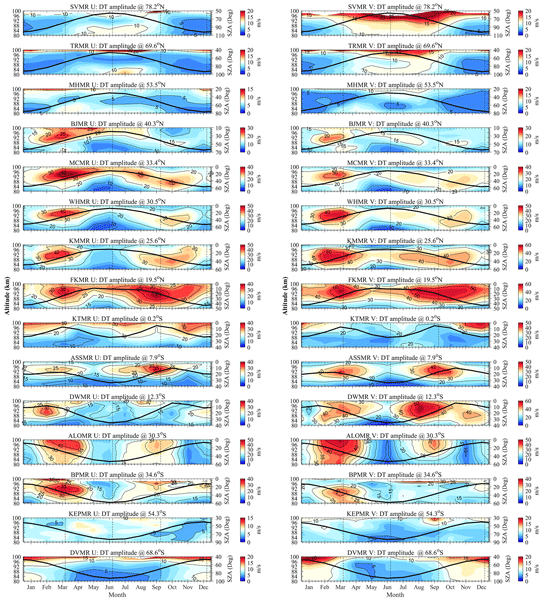
This study provides observational evidence that the solar zenith angle (SZA) influences the vertical structure of diurnal tides in the mesosphere and lower thermosphere (MLT) region. Diurnal tides are strongest at low and mid-latitudes (10–50° N/S) and weaker near the Equator and at polar latitudes. The results further suggest that background zonal winds influence tidal propagation and structure through filtering and momentum drag.
Ruichun Dong, Xin Fang, Chengyun Yang, and Tao Li
Atmos. Chem. Phys., 26, 13139–13156, https://doi.org/10.5194/acp-26-13139-2026, https://doi.org/10.5194/acp-26-13139-2026, 2026
Short summary
Short summary
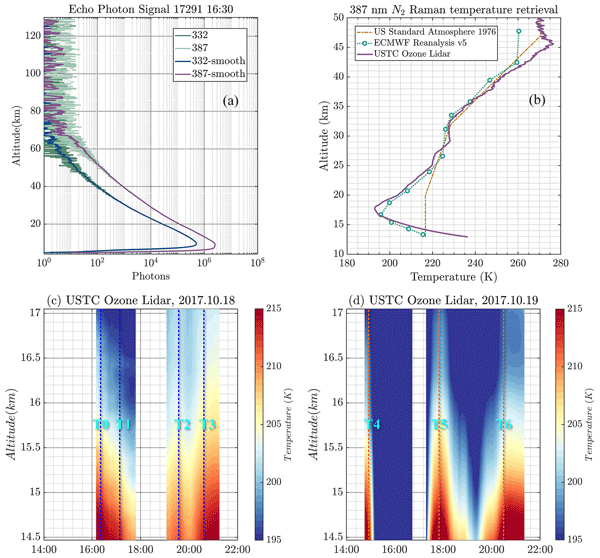
High-resolution USTC (University of Science and Technology of China) Ozone Lidar observations at Yangbajing, Tibet capture short-lived rapid STE (stratosphere-to-troposphere exchange)-related ozone descent for the first time. Lidar temperature profiles link these events to tropopause thermal variability unresolved by conventional models. Wei’s flux diagnostic and PV (potential vorticity)-threshold sensitivity identify 3 PVU (potential vorticity units) as optimal. ERA5 shows gravity-wave modulation during tropopause folding, and lidar ozone profiles are used to quantify instantaneous cross-tropopause ozone flux.
Yiran Pan, Jialin Zhang, Chengyun Yang, Tao Li, Xin Fang, Xinyue Wang, Xianghui Xue, and Xiankang Dou
EGUsphere, https://doi.org/10.5194/egusphere-2026-3774, https://doi.org/10.5194/egusphere-2026-3774, 2026
Short summary
Short summary
In 2024, the upper atmosphere above Antarctica experienced two sudden warming events and then repeated warming and recovery instead of returning steadily to normal. Large-scale atmospheric waves disturbed the circling polar winds, and the altered winds then shaped how later waves moved upward, allowing the disturbance to persist. This helps explain how rare Antarctic events can last longer and affect links between the upper and lower atmosphere.
Jiahui Hu, Alan Liu, Adriana Feener, Wenjun Dong, Jing Li, and Tao Li
EGUsphere, https://doi.org/10.48550/arXiv.2603.03669, https://doi.org/10.48550/arXiv.2603.03669, 2026
Short summary
Short summary
All-sky OH airglow imaging captures mesospheric gravity waves near ~87 km, but ripple-scale instabilities (5–15 km) are difficult to identify manually. We develop an automated SE-CNN framework trained on image patches to detect ripples in 512×512 images. Using MAD normalization and sliding-window detection with clustering, the model achieves 92% F1-score and recovers ~90% of manual events, enabling objective, scalable analysis of ripple occurrence and variability.
Chao Ban, Xin Fang, Wen Yi, Jie Zeng, Gunter Stober, Weilin Pan, Tao Li, and Xianghui Xue
Atmos. Meas. Tech., 19, 1697–1709, https://doi.org/10.5194/amt-19-1697-2026, https://doi.org/10.5194/amt-19-1697-2026, 2026
Short summary
Short summary
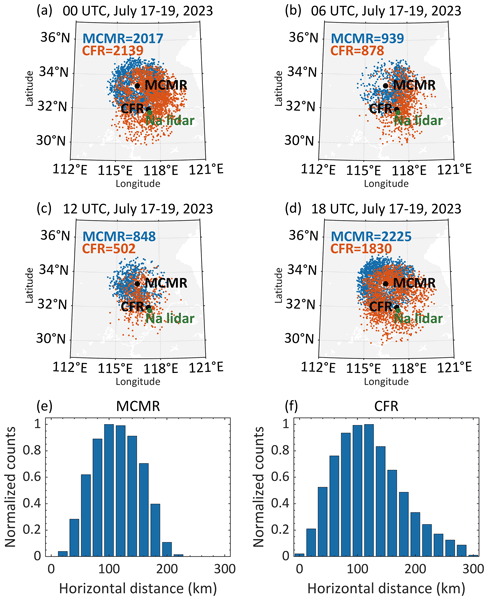
This paper presents an intercomparison of zonal winds observed by a sodium fluorescence lidar and three types of meteor radars – a multistatic meteor radar, a conventional monostatic radar, and a forward remote receiver – located near Hefei, China. The multistatic meteor radar shows the best agreement with the lidar measurements, confirming the reliability of its wind retrievals in the mesosphere and lower thermosphere and highlighting its potential for future atmospheric dynamics studies.

Xingjin Wang, Xin Fang, Wenhao Gao, Xianhang Chen, Tai Liu, Chengyun Yang, Tingdi Chen, Tao Li, and Xianghui Xue
Atmos. Meas. Tech., 19, 1629–1641, https://doi.org/10.5194/amt-19-1629-2026, https://doi.org/10.5194/amt-19-1629-2026, 2026
Short summary
Short summary
This paper reports the deployment of the first narrowband sodium lidar in the low-latitude region of China. The lidar observations are compared with satellite measurements and atmospheric models, confirming the scientific credibility of these results. Calculations of vertical gravity wave heat and sodium fluxes are used to investigate the influence of the space environment. This lidar system will provide a new ground-based detection device for studying atmospheric environment above the area.
Chengyun Yang, Xiang Guo, Tao Li, Xinyue Wang, Jun Zhang, Xin Fang, and Xianghui Xue
Atmos. Chem. Phys., 26, 1021–1039, https://doi.org/10.5194/acp-26-1021-2026, https://doi.org/10.5194/acp-26-1021-2026, 2026
Short summary
Short summary
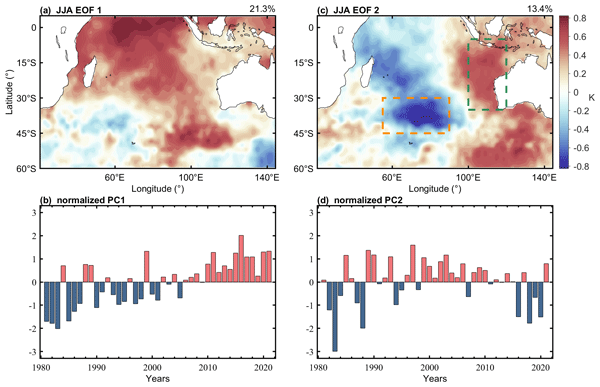
The Indian Ocean strongly influences weather and climate far beyond its region. We found that unusual sea surface warming patterns in the midlatitude Indian Ocean can disrupt winds and temperatures in the middle atmosphere, including the stratosphere and mesosphere, of the Southern Hemisphere. These disturbances alter ozone and air movement and may affect polar climate. Our results highlight the need to include Indian Ocean variability in climate models for better predictions.
Jianyuan Wang, Na Li, Wen Yi, Xianghui Xue, Iain M. Reid, Jianfei Wu, Hailun Ye, Jian Li, Zonghua Ding, Jinsong Chen, Guozhu Li, Yaoyu Tian, Boyuan Chang, Jiajing Wu, and Lei Zhao
Atmos. Chem. Phys., 24, 13299–13315, https://doi.org/10.5194/acp-24-13299-2024, https://doi.org/10.5194/acp-24-13299-2024, 2024
Short summary
Short summary
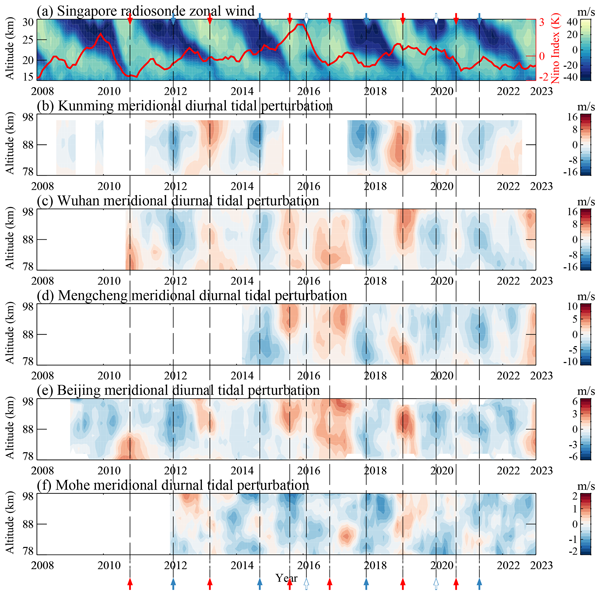
We present the impact of quasi-biennial oscillation (QBO) disruption events on diurnal tides over the low- and mid-latitude MLT region observed by a meteor radar chain. By using a global atmospheric model and reanalysis data, it is found that the stratospheric QBO winds can affect the mesospheric diurnal tides by modulating the subtropical ozone variability in the upper stratosphere and the interaction between tides and gravity waves in the mesosphere.
Jianfei Wu, Wuhu Feng, Xianghui Xue, Daniel Robert Marsh, and John Maurice Campbell Plane
Atmos. Chem. Phys., 24, 12133–12141, https://doi.org/10.5194/acp-24-12133-2024, https://doi.org/10.5194/acp-24-12133-2024, 2024
Short summary
Short summary
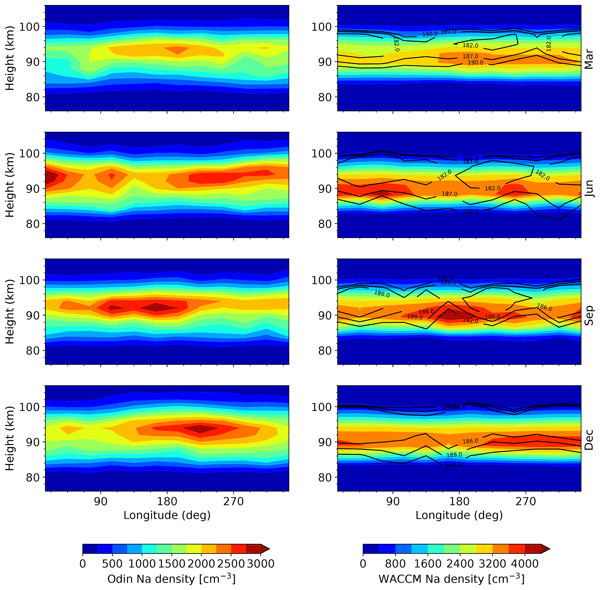
Metal layers occur in the mesosphere and lower thermosphere region 80–120 km from the ablation of cosmic dust. Nonmigrating diurnal tides are persistent global oscillations. We investigate nonmigrating diurnal tidal variations in metal layers using satellite observations and global climate model simulations; these have not been studied previously due to the limitations of measurements. The nonmigrating diurnal tides in temperature are strongly linked to the corresponding change in metal layers.
Penghao Tian, Bingkun Yu, Hailun Ye, Xianghui Xue, Jianfei Wu, and Tingdi Chen
Atmos. Chem. Phys., 23, 13413–13431, https://doi.org/10.5194/acp-23-13413-2023, https://doi.org/10.5194/acp-23-13413-2023, 2023
Short summary
Short summary
Modeling and prediction of ionospheric irregularities is an important topic in upper-atmospheric and upper-ionospheric physics. We proposed an artificial intelligence model to reconstruct the E-region ionospheric irregularities and first developed an open-source application for the community. The model reveals complex relationships between ionospheric irregularities and external driving factors. The findings suggest that spatiotemporal information plays an important role in the reconstruction.
Xin Fang, Feng Li, Lei-lei Sun, and Tao Li
Atmos. Meas. Tech., 16, 2263–2272, https://doi.org/10.5194/amt-16-2263-2023, https://doi.org/10.5194/amt-16-2263-2023, 2023
Short summary
Short summary
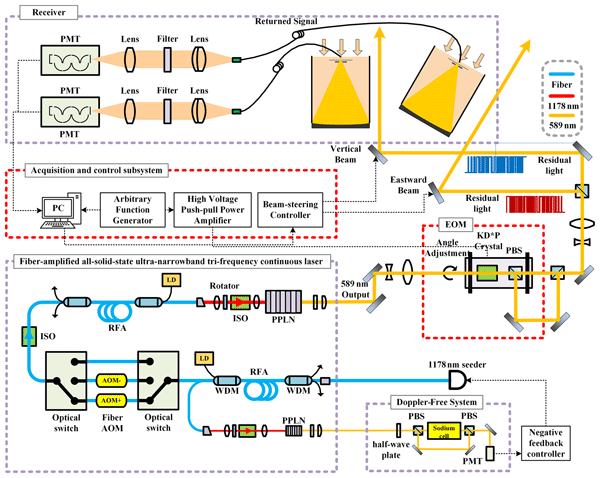
We successfully developed the first pseudorandom modulation continuous-wave narrowband sodium lidar (PMCW-NSL) system for simultaneous measurements of the mesopause region's temperature and wind. Based on the innovative decoded technique and algorithm for CW lidar, both the main and residual lights modulated by M-code are used and directed to the atmosphere in the vertical and eastward directions, tilted 20° from the zenith. The PMCW-NSL system can applied to airborne and space-borne purposes.
Wen Yi, Jie Zeng, Xianghui Xue, Iain Reid, Wei Zhong, Jianfei Wu, Tingdi Chen, and Xiankang Dou
Atmos. Meas. Tech. Discuss., https://doi.org/10.5194/amt-2022-254, https://doi.org/10.5194/amt-2022-254, 2022
Revised manuscript not accepted
Short summary
Short summary
In recent years, the concept of multistatic meteor radar systems has attracted the attention of the atmospheric radar community, focusing on the MLT region. In this study, we apply a multistatic meteor radar system consisting of a monostatic meteor radar in Mengcheng (33.36° N, 116.49° E) and a remote receiver in Changfeng (31.98° N, 117.22° E) to estimate the two-dimensional horizontal wind field, and the horizontal divergence and relative vorticity of the wind field.
Yetao Cen, Chengyun Yang, Tao Li, James M. Russell III, and Xiankang Dou
Atmos. Chem. Phys., 22, 7861–7874, https://doi.org/10.5194/acp-22-7861-2022, https://doi.org/10.5194/acp-22-7861-2022, 2022
Short summary
Short summary
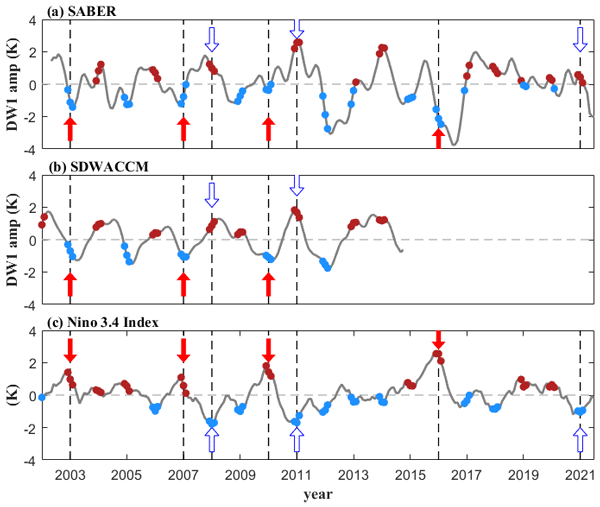
The MLT DW1 amplitude is suppressed during El Niño winters in both satellite observation and SD-WACCM simulations. The suppressed Hough mode (1, 1) in the tropopause region propagates vertically to the MLT region, leading to decreased DW1 amplitude. The latitudinal zonal wind shear anomalies during El Niño winters would narrow the waveguide and prevent the vertical propagation of DW1. The gravity wave drag excited by ENSO-induced anomalous convection could also modulate the MLT DW1 amplitude.
Shican Qiu, Mengxi Shi, Willie Soon, Mingjiao Jia, Xianghui Xue, Tao Li, Peng Ju, and Xiankang Dou
Atmos. Chem. Phys. Discuss., https://doi.org/10.5194/acp-2021-1085, https://doi.org/10.5194/acp-2021-1085, 2022
Revised manuscript not accepted
Short summary
Short summary
The solitary wave theory is applied for the first time to study the sporadic sodium layers (NaS). We perform soliton fitting processes on the observed data from the Andes Lidar Observatory, and find out that 24/27 NaS events exhibit similar features to a soliton. Time series of the net anomaly reveal the same variation process to the solution of a five-order KdV equation. Our results suggest the NaS phenomenon would be an appropriate tracer for nonlinear wave studies in the atmosphere.

Jianfei Wu, Wuhu Feng, Han-Li Liu, Xianghui Xue, Daniel Robert Marsh, and John Maurice Campbell Plane
Atmos. Chem. Phys., 21, 15619–15630, https://doi.org/10.5194/acp-21-15619-2021, https://doi.org/10.5194/acp-21-15619-2021, 2021
Short summary
Short summary
Metal layers occur in the MLT region (80–120 km) from the ablation of cosmic dust. The latest lidar observations show these metals can reach a height approaching 200 km, which is challenging to explain. We have developed the first global simulation incorporating the full life cycle of metal atoms and ions. The model results compare well with lidar and satellite observations of the seasonal and diurnal variation of the metals and demonstrate the importance of ion mass and ion-neutral coupling.
Cited articles
Ban, C., Li, T., Fang, X., Dou, X., and Xiong, J.: Sodium lidar-observed gravity wave breaking followed by an upward propagation of sporadic sodium layer over Hefei, China, J. Geophys. Res.-Space, 120, 7958–7969, https://doi.org/10.1002/2015JA021339, 2015.
Batista, P. P., Clemesha, B. R., and Simonich, D. M.: Horizontal structures in sporadic sodium layers at 23°, Geophys. Res. Lett., 18, 1027–1030, https://doi.org/10.1029/91GL00549, 1991.
Cai, X., Yuan, T., and Eccles, J. V.: A numerical investigation on tidal and gravity wave contributions to the summer time Na variations in the midlatitude E region, J. Geophys. Res.-Space, 122, 10577–10595, https://doi.org/10.1002/2016JA023764, 2017.
Chen, X., Huang, W., Ban, C., Kosch, M. J., Murphy, D. J., Hu, Z., Liu, J., He, F., Wang, R., Yang, H., and Hu, H.: Dynamic properties of a sporadic sodium layer revealed by observations over Zhongshan, Antarctica: A case study, J. Geophys. Res.-Space, 126, e2021JA029787, https://doi.org/10.1029/2021JA029787, 2021.
Clemesha, B. R.: Sporadic neutral metal layers in the mesosphere and lower thermosphere, J. Atmos. Terr. Phys., 57, 725–736, https://doi.org/10.1016/0021-9169(94)00049-T, 1995.
Clemesha, B. R., Kirchhoff, V. W. J. H., Simonich, D. M., and Takahashi, H.: Evidence of an extra-terrestrial source for the mesospheric sodium layer, Geophys. Res. Lett., 5, 873–876, https://doi.org/10.1029/GL005i010p00873, 1978.
Clemesha, B. R., Batista, P. P., and Simonich, D. M.: Formation of sporadic sodium layers, J. Geophys. Res., 101, 19701–19706, https://doi.org/10.1029/96JA00824, 1996.
Collins, S. C., Plane, J. M. C., Kelley, M. C., Wright, T. G., Soldán, P., Kane, T. J., Gerrard, A. J., Grime, B. W., Rollason, R. J., Friedman, J. S., González, S. A., Zhou, Q., Sulzer, M. P., and Tepley, C. A.: A study of the role of ion–molecule chemistry in the formation of sporadic sodium layers, J. Atmos. Sol.-Terr. Phy., 64, 845–860, https://doi.org/10.1016/S1364-6826(02)00129-3, 2002.
Cox, R. M. and Plane, J. M. C.: An ion-molecule mechanism for the formation of neutral sporadic Na layers, J. Geophys. Res., 103, 6349–6359, https://doi.org/10.1029/97JD03376, 1998.
Dou, X. K., Xue, X. H., Chen, T. D., Wan, W. X., Cheng, X. W., Li, T., Chen, C., Qiu, S., and Chen, Z. Y.: A statistical study of sporadic sodium layer observed by Sodium lidar at Hefei (31.8° N, 117.3° E), Ann. Geophys., 27, 2247–2257, https://doi.org/10.5194/angeo-27-2247-2009, 2009.
Dou, X. K., Xue, X. H., Li, T., Chen, T. D., Chen, C., and Qiu, S. C.: Possible relations between meteors, enhanced electron density layers, and sporadic sodium layers, J. Geophys. Res., 115, A06311, https://doi.org/10.1029/2009JA014575, 2010.
Fritts, D. C. and Alexander, M. J.: Gravity wave dynamics and effects in the middle atmosphere, Rev. Geophys., 41, 1003, https://doi.org/10.1029/2001RG000106, 2003.
Gardner, C. S. and Liu, A. Z.: Seasonal variations of the vertical fluxes of heat and horizontal momentum in the mesopause region at Starfire Optical Range, New Mexico, J. Geophys. Res., 112, D09113, https://doi.org/10.1029/2005JD006179, 2007.
Guo, Y., Liu, A. Z., and Gardner, C. S.: First Na lidar measurements of turbulence heat flux, thermal diffusivity, and energy dissipation rate in the mesopause region, Geophys. Res. Lett., 44, 5782–5790, https://doi.org/10.1002/2017GL073807, 2017.
Haldoupis, C.: A tutorial review on sporadic E layers, in: Aeronomy of the Earth's Atmosphere and Ionosphere, vol. 2, edited by: Abdu, M. and Pancheva, D., Springer, 381–394, https://doi.org/10.1007/978-94-007-0326-1_29, 2011.
Haldoupis, C., Pancheva, D., and Mitchell, N. J.: A study of tidal and planetary wave periodicities present in midlatitude sporadic E layers, J. Geophys. Res., 109, A02302, https://doi.org/10.1029/2003JA010253, 2004.
Haldoupis, C., Meek, C., Christakis, N., Pancheva, D., and Bourdillon, A.: Ionogram height-time-intensity observations of descending sporadic E layers at mid-latitude, J. Atmos. Sol.-Terr. Phy., 68, 539–557, https://doi.org/10.1016/j.jastp.2005.03.020, 2006.
Heinselman, C. J., Thayer, J. P., and Watkins, B. J.: A high-latitude observation of sporadic sodium and sporadic E-layer formation, Geophys. Res. Lett., 25, 3059–3062, https://doi.org/10.1029/98GL02215, 1998.
Jia, Y., Ban, C., Li, T., Fang, X., Wu, Z., Wu, J., Pan, W., and Yang, C.: Data of “Sodium Lidar observed multiple sodium layer structures and their dynamical coupling mechanism”, V1, Science Data Bank [data], https://doi.org/10.57760/sciencedb.34682, 2026.
Kane, T. J., Gardner, C. S., Zhou, Q., Mathews, J. D., and Tepley, C. A.: Lidar, radar and airglow observations of a prominent sporadic Na/sporadic E layer event at Arecibo during AIDA-89, J. Atmos. Terr. Phys., 55, 499–511, https://doi.org/10.1016/0021-9169(93)90084-C, 1993.
Kirkwood, S. and Nilsson, H.: High-latitude sporadic-E and other thin layers – The role of magnetospheric electric fields, Space Sci. Rev., 91, 579–613, https://doi.org/10.1023/A:1005241931650, 2000.
Li, T., She, C. Y., Liu, H. L., and Montgomery, M. T.: Evidence of a gravity wave breaking event and the estimation of the wave characteristics from sodium lidar observation over Fort Collins, CO (41° N, 105° W), Geophys. Res. Lett., 34, L05815, https://doi.org/10.1029/2006GL028988, 2007.
Li, T., Fang, X., Liu, W., Gu, S., and Dou, X.: Narrowband sodium lidar for the measurements of mesopause region temperature and wind, Appl. Optics, 51, 5401–5411, https://doi.org/10.1364/AO.51.005401, 2012.
Li, T., Ban, C., Fang, X., Li, J., Wu, Z., Feng, W., Plane, J. M. C., Xiong, J., Marsh, D. R., Mills, M. J., and Dou, X.: Climatology of mesopause region nocturnal temperature, zonal wind and sodium density observed by sodium lidar over Hefei, China (32° N, 117° E), Atmos. Chem. Phys., 18, 11683–11695, https://doi.org/10.5194/acp-18-11683-2018, 2018.
Li, T., Ban, C., Fang, X., Li, F., Cen, Y., Lai, D., Sun, C., Sun, L., Zhang, J., and Xu, C.: Seasonal variation in gravity wave momentum and heat fluxes in the mesopause region observed by sodium lidar, J. Geophys. Res.-Atmos., 127, e2022JD037558, https://doi.org/10.1029/2022JD037558, 2022.
Plane, J. M. C., Feng, W., and Dawkins, E. C. M.: The mesosphere and metals: Chemistry and changes, Chem. Rev., 115, 4497–4541, https://doi.org/10.1021/cr500501m, 2015.
Qiu, L., Zuo, X., Yu, T., Sun, Y., Liu, H., Sun, L., and Zhao, B.: The characteristics of summer descending sporadic E layer observed with the ionosondes in the China region, J. Geophys. Res.-Space, 126, e2020JA028729, https://doi.org/10.1029/2020JA028729, 2021.
Qiu, S., Tang, Y., Jia, M., Xue, X., Dou, X., Li, T., and Wang, Y.: A review of latitudinal characteristics of sporadic sodium layers, including new results from the Chinese Meridian Project, Earth-Sci. Rev., 162, 83–106, https://doi.org/10.1016/j.earscirev.2016.07.004, 2016.
She, C. Y. and Yu, J. R.: Simultaneous three-frequency Na lidar measurements of radial wind and temperature in the mesopause region, Geophys. Res. Lett., 21, 1771–1774, https://doi.org/10.1029/94GL01417, 1994.
She, C. Y., Liu, A. Z., Yuan, T., Yue, J., Li, T., Ban, C., and Friedman, J. S.: MLT Science Enabled by Atmospheric Lidars, in: Upper Atmosphere Dynamics and Energetics, edited by: Wang, W., Zhang, Y., and Paxton, L. J., https://doi.org/10.1002/9781119815631.ch20, 2021.
Thomas, L., Gibson, A. J., and Bhattacharyya, S. K.: Lidar observations of a horizontal variation in the atmospheric sodium layer, J. Atmos. Terr. Phys., 39, 1405–1409, https://doi.org/10.1016/0021-9169(77)90095-2, 1977.
Tsuda, T. T., Nozawa, S., Kawahara, T. D., Kawabata, T., Saito, N., Wada, S., Hall, C. M., Tsutsumi, M., Ogawa, Y., Oyama, S., Takahashi, T., Ejiri, M. K., Nishiyama, T., Nakamura, T., and Brekke, A.: A sporadic sodium layer event detected with five-directional lidar and simultaneous wind, electron density, and electric field observation at Tromsø, Norway, Geophys. Res. Lett., 42, 9190–9196, https://doi.org/10.1002/2015GL066411, 2015.
Von Zahn, U. and Hansen, T. L.: Sudden neutral sodium layers: A strong link to sporadic E layers, J. Atmos. Terr. Phys., 50, 93–104, https://doi.org/10.1016/0021-9169(88)90047-5, 1988.
Wang, J., Yue, X., Zhou, X., Cai, Y., Ding, F., Chau, J. L., Fritts, D. C., Vierinen, J., Liu, A. Z.., and Ning, B.: Direct observational evidence of the mesoscale gravity wave modulations on low-latitude sporadic E layer, Geophys. Res. Lett., 53, e2025GL121033, https://doi.org/10.1029/2025GL121033, 2026.
Wu, J., Feng, W., Liu, H.-L., Xue, X., Marsh, D. R., and Plane, J. M. C.: Self-consistent global transport of metallic ions with WACCM-X, Atmos. Chem. Phys., 21, 15619–15630, https://doi.org/10.5194/acp-21-15619-2021, 2021.
Xiong, J. G., Wan, W., Ning, B., and Liu, L.: First results of the tidal structure in the MLT revealed by Wuhan Meteor Radar (30°40′ N, 114°30′ E), J. Atmos. Sol.-Terr. Phys., 66, 675–682, https://doi.org/10.1016/j.jastp.2004.01.018, 2004.
Xue, X., Li, G., Dou, X., Yue, X., Yang, G., Chen, J., Chen, T., Ning, B., Wang, J., Wang, G., and Wan, W.: An overturning-like thermospheric Na layer and its relevance to Ionospheric field aligned irregularity and sporadic E, J. Atmos. Sol.-Terr. Phy., 162, 151–161, https://doi.org/10.1016/j.jastp.2016.12.006, 2017.
Xue, X. H., Dou, X. K., Lei, J., Chen, J. S., Ding, Z. H., Li, T., Gao, Q., Tang, W. W., Cheng, X. W., and Wei, K.: Lower thermospheric-enhanced sodium layers observed at low latitude and possible formation: Case studies, J. Geophys. Res.-Space, 118, 2409–2418, https://doi.org/10.1002/jgra.50200, 2013.
Zhou, C., Tang, Q., Song, X., Qing, H., Liu, Y., Wang, X., Gu, X., Ni, B., and Zhao, Z.: A statistical analysis of sporadic E layer occurrence in the midlatitude China region, J. Geophys. Res.-Space, 122, 3617–3631, https://doi.org/10.1002/2016JA023135, 2017.
Zhou, Q., Mathews, J. D., and Tepley, C. A.: A proposed temperature-dependent mechanism for the formation of sporadic sodium layers, J. Atmos. Terr. Phys., 55, 513–521, https://doi.org/10.1016/0021-9169(93)90085-D, 1993.
Short summary
In this study, a sodium lidar at the University of Science and Technology of China (USTC) observed multiple sporadic sodium layers (SSLs) and enhanced sodium patterns (ESPs) during a single night. By combining observations from a meteor radar and an ionosonde in Wuhan, the results show that horizontal winds can not only directly transport sodium atoms through advection but also indirectly influence sodium density by modulating ion convergence and Es layers via atmospheric waves.
In this study, a sodium lidar at the University of Science and Technology of China (USTC)...


Altmetrics
Final-revised paper
Preprint