Articles | Volume 25, issue 23
https://doi.org/10.5194/acp-25-18267-2025
© Author(s) 2025. This work is distributed under
the Creative Commons Attribution 4.0 License.
https://doi.org/10.5194/acp-25-18267-2025
© Author(s) 2025. This work is distributed under
the Creative Commons Attribution 4.0 License.
The influence of climate variability on transatlantic flight times

Centre for Climate Adaptation and Environment Research, University of Bath, Bath, UK
Phoebe E. Noble
Centre for Climate Adaptation and Environment Research, University of Bath, Bath, UK
Timothy P. Banyard
Department of Earth and Environmental Sciences, University of Manchester, Manchester, UK
Centre for Climate Adaptation and Environment Research, University of Bath, Bath, UK
Sarah J. Freeman
Nature Positive Ltd, Bath, UK
Paul D. Williams
Department of Meteorology, University of Reading, Reading, UK
Related authors
Peter G. Berthelemy, Corwin J. Wright, Neil P. Hindley, Phoebe E. Noble, and Lars Hoffmann
Atmos. Chem. Phys., 25, 17595–17611, https://doi.org/10.5194/acp-25-17595-2025, https://doi.org/10.5194/acp-25-17595-2025, 2025
Short summary
Short summary
Atmospheric gravity waves are one of the key mechanisms for moving energy upwards through the atmosphere. We use temperature data to see them from a satellite, and here have made a new method to automatically detect them. This works by seeing if points next to each other are from the same wave. This is useful for creating larger gravity wave datasets without noise, which can then be used by climate forecasters to improve their understanding of the atmosphere.
Marwa Almowafy, Corwin J. Wright, and Neil P. Hindley
Atmos. Meas. Tech., 18, 6393–6416, https://doi.org/10.5194/amt-18-6393-2025, https://doi.org/10.5194/amt-18-6393-2025, 2025
Short summary
Short summary
Gravity waves (GW) influence atmospheric dynamics. One key effect is on the zonal winds in the tropics stratosphere, which drive the quasi-biennial oscillation (QBO). Satellite observations are used to study gravity waves, but each satellite is constrained by its observational limits. This study investigates how GW–QBO interactions are observed by two satellites, SABER and GNSS-RO, and examines the potential for GNSS-RO to extend the GW climatology that is carried out by SABER for 23 years.
Phoebe Noble, Haruka Okui, Joan Alexander, Manfred Ern, Neil P. Hindley, Lars Hoffmann, Laura Holt, Annelize van Niekerk, Riwal Plougonven, Inna Polichtchouk, Claudia C. Stephan, Martina Bramberger, Milena Corcos, William Putnam, Christopher Kruse, and Corwin J. Wright
EGUsphere, https://doi.org/10.5194/egusphere-2025-4878, https://doi.org/10.5194/egusphere-2025-4878, 2025
Short summary
Short summary
Gravity waves are small-scale processes that drive the circulation in the middle and upper atmosphere. In this work, we assess 3 new high-resolution models against satellite data. Generally, models capture the spatial patterns and represent stratospheric northern hemisphere mountain generated waves well. However, they still underestimate amplitudes globally and struggle with the representation of southern hemispheric convective waves.
Chaim I. Garfinkel, Zachary D. Lawrence, Amy H. Butler, Etienne Dunn-Sigouin, Irene Erner, Alexey Y. Karpechko, Gerbrand Koren, Marta Abalos, Blanca Ayarzagüena, David Barriopedro, Natalia Calvo, Alvaro de la Cámara, Andrew Charlton-Perez, Judah Cohen, Daniela I. V. Domeisen, Javier García-Serrano, Neil P. Hindley, Martin Jucker, Hera Kim, Robert W. Lee, Simon H. Lee, Marisol Osman, Froila M. Palmeiro, Inna Polichtchouk, Jian Rao, Jadwiga H. Richter, Chen Schwartz, Seok-Woo Son, Masakazu Taguchi, Nicholas L. Tyrrell, Corwin J. Wright, and Rachel W.-Y. Wu
Weather Clim. Dynam., 6, 171–195, https://doi.org/10.5194/wcd-6-171-2025, https://doi.org/10.5194/wcd-6-171-2025, 2025
Short summary
Short summary
Variability in the extratropical stratosphere and troposphere is coupled, and because of the longer timescales characteristic of the stratosphere, this allows for a window of opportunity for surface prediction. This paper assesses whether models used for operational prediction capture these coupling processes accurately. We find that most processes are too weak; however downward coupling from the lower stratosphere to the near surface is too strong.
Timothy P. Banyard, Corwin J. Wright, Scott M. Osprey, Neil P. Hindley, Gemma Halloran, Lawrence Coy, Paul A. Newman, Neal Butchart, Martina Bramberger, and M. Joan Alexander
Atmos. Chem. Phys., 24, 2465–2490, https://doi.org/10.5194/acp-24-2465-2024, https://doi.org/10.5194/acp-24-2465-2024, 2024
Short summary
Short summary
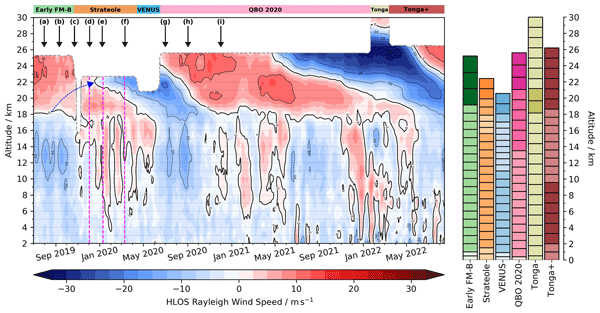
In 2019/2020, the tropical stratospheric wind phenomenon known as the quasi-biennial oscillation (QBO) was disrupted for only the second time in the historical record. This was poorly forecasted, and we want to understand why. We used measurements from the first Doppler wind lidar in space, Aeolus, to observe the disruption in an unprecedented way. Our results reveal important differences between Aeolus and the ERA5 reanalysis that affect the timing of the disruption's onset and its evolution.
Xue Wu, Lars Hoffmann, Corwin J. Wright, Neil P. Hindley, M. Joan Alexander, Silvio Kalisch, Xin Wang, Bing Chen, Yinan Wang, and Daren Lyu
EGUsphere, https://doi.org/10.5194/egusphere-2023-3008, https://doi.org/10.5194/egusphere-2023-3008, 2024
Preprint archived
Short summary
Short summary
This study identified a noteworthy time-lagged correlation between hurricane intensity and stratospheric gravity wave intensities during hurricane intensification. Meanwhile, the study reveals distinct frequencies, horizontal wavelengths, and vertical wavelengths in the inner core region during hurricane intensification, offering essential insights for monitoring hurricane intensity via satellite observations of stratospheric gravity waves.
Zachary D. Lawrence, Marta Abalos, Blanca Ayarzagüena, David Barriopedro, Amy H. Butler, Natalia Calvo, Alvaro de la Cámara, Andrew Charlton-Perez, Daniela I. V. Domeisen, Etienne Dunn-Sigouin, Javier García-Serrano, Chaim I. Garfinkel, Neil P. Hindley, Liwei Jia, Martin Jucker, Alexey Y. Karpechko, Hera Kim, Andrea L. Lang, Simon H. Lee, Pu Lin, Marisol Osman, Froila M. Palmeiro, Judith Perlwitz, Inna Polichtchouk, Jadwiga H. Richter, Chen Schwartz, Seok-Woo Son, Irene Erner, Masakazu Taguchi, Nicholas L. Tyrrell, Corwin J. Wright, and Rachel W.-Y. Wu
Weather Clim. Dynam., 3, 977–1001, https://doi.org/10.5194/wcd-3-977-2022, https://doi.org/10.5194/wcd-3-977-2022, 2022
Short summary
Short summary
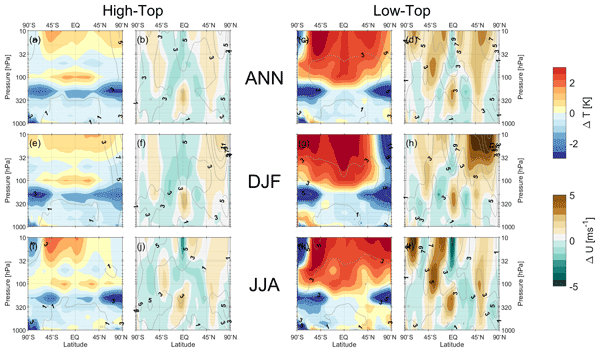
Forecast models that are used to predict weather often struggle to represent the Earth’s stratosphere. This may impact their ability to predict surface weather weeks in advance, on subseasonal-to-seasonal (S2S) timescales. We use data from many S2S forecast systems to characterize and compare the stratospheric biases present in such forecast models. These models have many similar stratospheric biases, but they tend to be worse in systems with low model tops located within the stratosphere.
Neil P. Hindley, Nicholas J. Mitchell, Neil Cobbett, Anne K. Smith, Dave C. Fritts, Diego Janches, Corwin J. Wright, and Tracy Moffat-Griffin
Atmos. Chem. Phys., 22, 9435–9459, https://doi.org/10.5194/acp-22-9435-2022, https://doi.org/10.5194/acp-22-9435-2022, 2022
Short summary
Short summary
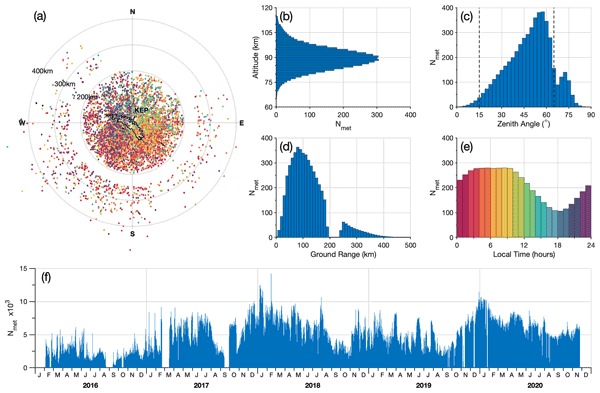
We present observations of winds in the mesosphere and lower thermosphere (MLT) from a recently installed meteor radar on the remote island of South Georgia (54° S, 36° W). We characterise mean winds, tides, planetary waves, and gravity waves in the MLT at this location and compare our measured winds with a leading climate model. We find that the observed wintertime winds are unexpectedly reversed from model predictions, probably because of missing impacts of secondary gravity waves in the model.
Isabell Krisch, Neil P. Hindley, Oliver Reitebuch, and Corwin J. Wright
Atmos. Meas. Tech., 15, 3465–3479, https://doi.org/10.5194/amt-15-3465-2022, https://doi.org/10.5194/amt-15-3465-2022, 2022
Short summary
Short summary
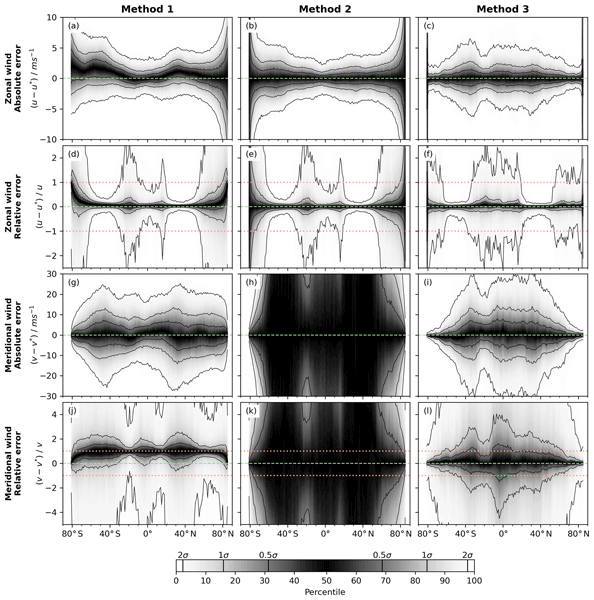
The Aeolus satellite measures global height resolved profiles of wind along a certain line-of-sight. However, for atmospheric dynamics research, wind measurements along the three cardinal axes are most useful. This paper presents methods to convert the measurements into zonal and meridional wind components. By combining the measurements during ascending and descending orbits, we achieve good derivation of zonal wind (equatorward of 80° latitude) and meridional wind (poleward of 70° latitude).
Phoebe Noble, Neil Hindley, Corwin Wright, Chihoko Cullens, Scott England, Nicholas Pedatella, Nicholas Mitchell, and Tracy Moffat-Griffin
Atmos. Chem. Phys. Discuss., https://doi.org/10.5194/acp-2022-150, https://doi.org/10.5194/acp-2022-150, 2022
Revised manuscript not accepted
Short summary
Short summary
We use long term radar data and the WACCM-X model to study the impact of dynamical phenomena, including the 11-year solar cycle, ENSO, QBO and SAM, on Antarctic mesospheric winds. We find that in summer, the zonal wind (both observationally and in the model) is strongly correlated with the solar cycle. We also see important differences in the results from the other processes. In addition we find important and large biases in the winter model zonal winds relative to the observations.
Corwin J. Wright, Richard J. Hall, Timothy P. Banyard, Neil P. Hindley, Isabell Krisch, Daniel M. Mitchell, and William J. M. Seviour
Weather Clim. Dynam., 2, 1283–1301, https://doi.org/10.5194/wcd-2-1283-2021, https://doi.org/10.5194/wcd-2-1283-2021, 2021
Short summary
Short summary
Major sudden stratospheric warmings (SSWs) are some of the most dramatic events in the atmosphere and are believed to help cause extreme winter weather events such as the 2018 Beast from the East in Europe and North America. Here, we use unique data from the European Space Agency's new Aeolus satellite to make the first-ever measurements at a global scale of wind changes due to an SSW in the lower part of the atmosphere to help us understand how SSWs affect the atmosphere and surface weather.
Corwin J. Wright, Neil P. Hindley, M. Joan Alexander, Laura A. Holt, and Lars Hoffmann
Atmos. Meas. Tech., 14, 5873–5886, https://doi.org/10.5194/amt-14-5873-2021, https://doi.org/10.5194/amt-14-5873-2021, 2021
Short summary
Short summary
Measuring atmospheric gravity waves in low vertical-resolution data is technically challenging, especially when the waves are significantly longer in the vertical than in the length of the measurement domain. We introduce and demonstrate a modification to the existing Stockwell transform methods of characterising these waves that address these problems, with no apparent reduction in the other capabilities of the technique.
Neil P. Hindley, Corwin J. Wright, Alan M. Gadian, Lars Hoffmann, John K. Hughes, David R. Jackson, John C. King, Nicholas J. Mitchell, Tracy Moffat-Griffin, Andrew C. Moss, Simon B. Vosper, and Andrew N. Ross
Atmos. Chem. Phys., 21, 7695–7722, https://doi.org/10.5194/acp-21-7695-2021, https://doi.org/10.5194/acp-21-7695-2021, 2021
Short summary
Short summary
One limitation of numerical atmospheric models is spatial resolution. For atmospheric gravity waves (GWs) generated over small mountainous islands, the driving effect of these waves on atmospheric circulations can be underestimated. Here we use a specialised high-resolution model over South Georgia island to compare simulated stratospheric GWs to colocated 3-D satellite observations. We find reasonable model agreement with observations, with some GW amplitudes much larger than expected.
Peter G. Berthelemy, Corwin J. Wright, Neil P. Hindley, Phoebe E. Noble, and Lars Hoffmann
Atmos. Chem. Phys., 25, 17595–17611, https://doi.org/10.5194/acp-25-17595-2025, https://doi.org/10.5194/acp-25-17595-2025, 2025
Short summary
Short summary
Atmospheric gravity waves are one of the key mechanisms for moving energy upwards through the atmosphere. We use temperature data to see them from a satellite, and here have made a new method to automatically detect them. This works by seeing if points next to each other are from the same wave. This is useful for creating larger gravity wave datasets without noise, which can then be used by climate forecasters to improve their understanding of the atmosphere.
Marwa Almowafy, Corwin J. Wright, and Neil P. Hindley
Atmos. Meas. Tech., 18, 6393–6416, https://doi.org/10.5194/amt-18-6393-2025, https://doi.org/10.5194/amt-18-6393-2025, 2025
Short summary
Short summary
Gravity waves (GW) influence atmospheric dynamics. One key effect is on the zonal winds in the tropics stratosphere, which drive the quasi-biennial oscillation (QBO). Satellite observations are used to study gravity waves, but each satellite is constrained by its observational limits. This study investigates how GW–QBO interactions are observed by two satellites, SABER and GNSS-RO, and examines the potential for GNSS-RO to extend the GW climatology that is carried out by SABER for 23 years.
Phoebe Noble, Haruka Okui, Joan Alexander, Manfred Ern, Neil P. Hindley, Lars Hoffmann, Laura Holt, Annelize van Niekerk, Riwal Plougonven, Inna Polichtchouk, Claudia C. Stephan, Martina Bramberger, Milena Corcos, William Putnam, Christopher Kruse, and Corwin J. Wright
EGUsphere, https://doi.org/10.5194/egusphere-2025-4878, https://doi.org/10.5194/egusphere-2025-4878, 2025
Short summary
Short summary
Gravity waves are small-scale processes that drive the circulation in the middle and upper atmosphere. In this work, we assess 3 new high-resolution models against satellite data. Generally, models capture the spatial patterns and represent stratospheric northern hemisphere mountain generated waves well. However, they still underestimate amplitudes globally and struggle with the representation of southern hemispheric convective waves.
Isabel H. Smith, Paul D. Williams, and Reinhard Schiemann
EGUsphere, https://doi.org/10.5194/egusphere-2025-2378, https://doi.org/10.5194/egusphere-2025-2378, 2025
Short summary
Short summary
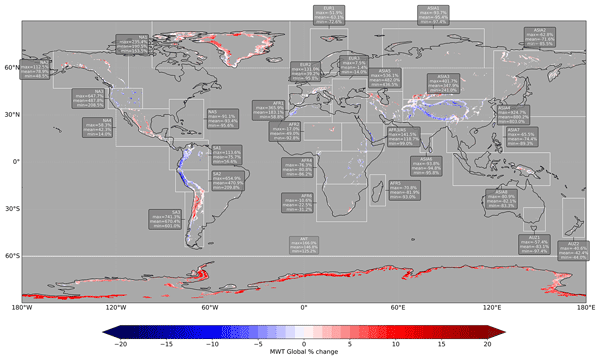
Mountain wave turbulence (MWT) has a dangerous and costly impact on the aviation sector. There's a lack of research into future projected MWT with global warming. Overall, MWT trends are seasonally and location dependent. Over several mountain ranges an increase arose particularly over Greenland and regions in Asia. A drop in MWT also developed over the Alps, the Rockys, Atlas and northern and central Andes. Southern Andes and the Himalayas had seasonal differences resulting in a mix of trends.
Chaim I. Garfinkel, Zachary D. Lawrence, Amy H. Butler, Etienne Dunn-Sigouin, Irene Erner, Alexey Y. Karpechko, Gerbrand Koren, Marta Abalos, Blanca Ayarzagüena, David Barriopedro, Natalia Calvo, Alvaro de la Cámara, Andrew Charlton-Perez, Judah Cohen, Daniela I. V. Domeisen, Javier García-Serrano, Neil P. Hindley, Martin Jucker, Hera Kim, Robert W. Lee, Simon H. Lee, Marisol Osman, Froila M. Palmeiro, Inna Polichtchouk, Jian Rao, Jadwiga H. Richter, Chen Schwartz, Seok-Woo Son, Masakazu Taguchi, Nicholas L. Tyrrell, Corwin J. Wright, and Rachel W.-Y. Wu
Weather Clim. Dynam., 6, 171–195, https://doi.org/10.5194/wcd-6-171-2025, https://doi.org/10.5194/wcd-6-171-2025, 2025
Short summary
Short summary
Variability in the extratropical stratosphere and troposphere is coupled, and because of the longer timescales characteristic of the stratosphere, this allows for a window of opportunity for surface prediction. This paper assesses whether models used for operational prediction capture these coupling processes accurately. We find that most processes are too weak; however downward coupling from the lower stratosphere to the near surface is too strong.
Timothy P. Banyard, Corwin J. Wright, Scott M. Osprey, Neil P. Hindley, Gemma Halloran, Lawrence Coy, Paul A. Newman, Neal Butchart, Martina Bramberger, and M. Joan Alexander
Atmos. Chem. Phys., 24, 2465–2490, https://doi.org/10.5194/acp-24-2465-2024, https://doi.org/10.5194/acp-24-2465-2024, 2024
Short summary
Short summary
In 2019/2020, the tropical stratospheric wind phenomenon known as the quasi-biennial oscillation (QBO) was disrupted for only the second time in the historical record. This was poorly forecasted, and we want to understand why. We used measurements from the first Doppler wind lidar in space, Aeolus, to observe the disruption in an unprecedented way. Our results reveal important differences between Aeolus and the ERA5 reanalysis that affect the timing of the disruption's onset and its evolution.
Xue Wu, Lars Hoffmann, Corwin J. Wright, Neil P. Hindley, M. Joan Alexander, Silvio Kalisch, Xin Wang, Bing Chen, Yinan Wang, and Daren Lyu
EGUsphere, https://doi.org/10.5194/egusphere-2023-3008, https://doi.org/10.5194/egusphere-2023-3008, 2024
Preprint archived
Short summary
Short summary
This study identified a noteworthy time-lagged correlation between hurricane intensity and stratospheric gravity wave intensities during hurricane intensification. Meanwhile, the study reveals distinct frequencies, horizontal wavelengths, and vertical wavelengths in the inner core region during hurricane intensification, offering essential insights for monitoring hurricane intensity via satellite observations of stratospheric gravity waves.
Zachary D. Lawrence, Marta Abalos, Blanca Ayarzagüena, David Barriopedro, Amy H. Butler, Natalia Calvo, Alvaro de la Cámara, Andrew Charlton-Perez, Daniela I. V. Domeisen, Etienne Dunn-Sigouin, Javier García-Serrano, Chaim I. Garfinkel, Neil P. Hindley, Liwei Jia, Martin Jucker, Alexey Y. Karpechko, Hera Kim, Andrea L. Lang, Simon H. Lee, Pu Lin, Marisol Osman, Froila M. Palmeiro, Judith Perlwitz, Inna Polichtchouk, Jadwiga H. Richter, Chen Schwartz, Seok-Woo Son, Irene Erner, Masakazu Taguchi, Nicholas L. Tyrrell, Corwin J. Wright, and Rachel W.-Y. Wu
Weather Clim. Dynam., 3, 977–1001, https://doi.org/10.5194/wcd-3-977-2022, https://doi.org/10.5194/wcd-3-977-2022, 2022
Short summary
Short summary
Forecast models that are used to predict weather often struggle to represent the Earth’s stratosphere. This may impact their ability to predict surface weather weeks in advance, on subseasonal-to-seasonal (S2S) timescales. We use data from many S2S forecast systems to characterize and compare the stratospheric biases present in such forecast models. These models have many similar stratospheric biases, but they tend to be worse in systems with low model tops located within the stratosphere.
Neil P. Hindley, Nicholas J. Mitchell, Neil Cobbett, Anne K. Smith, Dave C. Fritts, Diego Janches, Corwin J. Wright, and Tracy Moffat-Griffin
Atmos. Chem. Phys., 22, 9435–9459, https://doi.org/10.5194/acp-22-9435-2022, https://doi.org/10.5194/acp-22-9435-2022, 2022
Short summary
Short summary
We present observations of winds in the mesosphere and lower thermosphere (MLT) from a recently installed meteor radar on the remote island of South Georgia (54° S, 36° W). We characterise mean winds, tides, planetary waves, and gravity waves in the MLT at this location and compare our measured winds with a leading climate model. We find that the observed wintertime winds are unexpectedly reversed from model predictions, probably because of missing impacts of secondary gravity waves in the model.
Isabell Krisch, Neil P. Hindley, Oliver Reitebuch, and Corwin J. Wright
Atmos. Meas. Tech., 15, 3465–3479, https://doi.org/10.5194/amt-15-3465-2022, https://doi.org/10.5194/amt-15-3465-2022, 2022
Short summary
Short summary
The Aeolus satellite measures global height resolved profiles of wind along a certain line-of-sight. However, for atmospheric dynamics research, wind measurements along the three cardinal axes are most useful. This paper presents methods to convert the measurements into zonal and meridional wind components. By combining the measurements during ascending and descending orbits, we achieve good derivation of zonal wind (equatorward of 80° latitude) and meridional wind (poleward of 70° latitude).
Phoebe Noble, Neil Hindley, Corwin Wright, Chihoko Cullens, Scott England, Nicholas Pedatella, Nicholas Mitchell, and Tracy Moffat-Griffin
Atmos. Chem. Phys. Discuss., https://doi.org/10.5194/acp-2022-150, https://doi.org/10.5194/acp-2022-150, 2022
Revised manuscript not accepted
Short summary
Short summary
We use long term radar data and the WACCM-X model to study the impact of dynamical phenomena, including the 11-year solar cycle, ENSO, QBO and SAM, on Antarctic mesospheric winds. We find that in summer, the zonal wind (both observationally and in the model) is strongly correlated with the solar cycle. We also see important differences in the results from the other processes. In addition we find important and large biases in the winter model zonal winds relative to the observations.
Corwin J. Wright, Richard J. Hall, Timothy P. Banyard, Neil P. Hindley, Isabell Krisch, Daniel M. Mitchell, and William J. M. Seviour
Weather Clim. Dynam., 2, 1283–1301, https://doi.org/10.5194/wcd-2-1283-2021, https://doi.org/10.5194/wcd-2-1283-2021, 2021
Short summary
Short summary
Major sudden stratospheric warmings (SSWs) are some of the most dramatic events in the atmosphere and are believed to help cause extreme winter weather events such as the 2018 Beast from the East in Europe and North America. Here, we use unique data from the European Space Agency's new Aeolus satellite to make the first-ever measurements at a global scale of wind changes due to an SSW in the lower part of the atmosphere to help us understand how SSWs affect the atmosphere and surface weather.
Corwin J. Wright, Neil P. Hindley, M. Joan Alexander, Laura A. Holt, and Lars Hoffmann
Atmos. Meas. Tech., 14, 5873–5886, https://doi.org/10.5194/amt-14-5873-2021, https://doi.org/10.5194/amt-14-5873-2021, 2021
Short summary
Short summary
Measuring atmospheric gravity waves in low vertical-resolution data is technically challenging, especially when the waves are significantly longer in the vertical than in the length of the measurement domain. We introduce and demonstrate a modification to the existing Stockwell transform methods of characterising these waves that address these problems, with no apparent reduction in the other capabilities of the technique.
Neil P. Hindley, Corwin J. Wright, Alan M. Gadian, Lars Hoffmann, John K. Hughes, David R. Jackson, John C. King, Nicholas J. Mitchell, Tracy Moffat-Griffin, Andrew C. Moss, Simon B. Vosper, and Andrew N. Ross
Atmos. Chem. Phys., 21, 7695–7722, https://doi.org/10.5194/acp-21-7695-2021, https://doi.org/10.5194/acp-21-7695-2021, 2021
Short summary
Short summary
One limitation of numerical atmospheric models is spatial resolution. For atmospheric gravity waves (GWs) generated over small mountainous islands, the driving effect of these waves on atmospheric circulations can be underestimated. Here we use a specialised high-resolution model over South Georgia island to compare simulated stratospheric GWs to colocated 3-D satellite observations. We find reasonable model agreement with observations, with some GW amplitudes much larger than expected.
Cited articles
Airbus: Previous-generation aircraft, https://www.airbus.com/en/who-we-are/our-history/commercial-aircraft-history/previous-generation-aircraft (last access: 9 November 2024), 2024. a
Alizadeh, O.: A review of ENSO teleconnections at present and under future global warming, WIREs Climate Change, 15, https://doi.org/10.1002/wcc.861, 2023. a
Anstey, J. A., Banyard, T. P., Butchart, N., Coy, L., Newman, P. A., Osprey, S., and Wright, C. J.: Prospect of Increased Disruption to the QBO in a Changing Climate, Geophysical Research Letters, 48, https://doi.org/10.1029/2021gl093058, 2021a. a
Anstey, J. A., Simpson, I. R., Richter, J. H., Naoe, H., Taguchi, M., Serva, F., Gray, L. J., Butchart, N., Hamilton, K., Osprey, S., Bellprat, O., Braesicke, P., Bushell, A. C., Cagnazzo, C., Chen, C., Chun, H., Garcia, R. R., Holt, L., Kawatani, Y., Kerzenmacher, T., Kim, Y., Lott, F., McLandress, C., Scinocca, J., Stockdale, T. N., Versick, S., Watanabe, S., Yoshida, K., and Yukimoto, S.: Teleconnections of the Quasi‐Biennial Oscillation in a multi-model ensemble of QBO‐resolving models, Quarterly Journal of the Royal Meteorological Society, 148, 1568–1592, https://doi.org/10.1002/qj.4048, 2021b. a
Belsley, D. A., Kuh, E., and Welsch, R. E.: Regression Diagnostics: Identifying Influential Data and Sources of Collinearity, Wiley, ISBN 9780471725152, https://doi.org/10.1002/0471725153, 1980. a
Boucher, O., Bellouin, N., Clark, H., Gryspeerdt, E., and Karadayi, J.: Comparison of Actual and Time-Optimized Flight Trajectories in the Context of the In-Service Aircraft for a Global Observing System (IAGOS) Programme, Aerospace, 10, 744, https://doi.org/10.3390/aerospace10090744, 2023. a, b
Boulanger, D., Thouret, V., and Petzold, A.: IAGOS Data Portal, IAGOS Data Portal [data set], https://doi.org/10.25326/20, 2019. a, b, c
Burzlaff, M.: Aircraft Fuel Consumption – Estimation and Visualization, Hamburg: Aircraft Design and Systems Group (AERO), Department of Automotive and Aeronautical Engineering, Hamburg University of Applied Sciences, https://doi.org/10.15488/2553, 2017a. a
Burzlaff, M.: Aircraft Fuel Consumption – Estimation and Visualization, Harvard Dataverse [data set], https://doi.org/10.7910/DVN/2HMEHB, 2017b. a
Coddington, O., Lean, J. L., Lindholm, D., Pilewskie, P., Snow, M., and NOAA CDR Program: NOAA Climate Data Record (CDR) of Total Solar Irradiance (TSI), NRLTSI Version 2, NOAA [data set], https://doi.org/10.7289/V55B00C1, 2015. a
Collingwood, E., Scaife, A. A., Lu, H., Sinha, B., King, J., Marsh, R., and Marshall, G.: Meridional Wind in the Upper Stratosphere: A Source of Winter NAO Predictability, Geophysical Research Letters, 51, https://doi.org/10.1029/2024gl111717, 2024. a, b
Domeisen, D. I., Garfinkel, C. I., and Butler, A. H.: The Teleconnection of El Niño Southern Oscillation to the Stratosphere, Reviews of Geophysics, 57, 5–47, https://doi.org/10.1029/2018rg000596, 2019. a
Durbin, J. and Watson, G. S.: Testing for Serial Correlation in Least-Square Regression, I, Biometrika, 37, 409–428, https://doi.org/10.1093/biomet/37.3-4.409, 1950. a
Enfield, D. B., Mestas-Nuñez, A. M., and Trimble, P. J.: The Atlantic Multidecadal Oscillation and its relation to rainfall and river flows in the continental U.S., Geophysical Research Letters, 28, 2077–2080, https://doi.org/10.1029/2000gl012745, 2001. a
European Environment Agency: EMEP/EEA air pollutant emission inventory guidebook 2023 – Technical guidance to prepare national emission inventories, Publications Office of the European Union, https://doi.org/10.2800/795737, 2023. a
Gray, L. J., Scaife, A. A., Mitchell, D. M., Osprey, S., Ineson, S., Hardiman, S., Butchart, N., Knight, J., Sutton, R., and Kodera, K.: A lagged response to the 11 year solar cycle in observed winter Atlantic/European weather patterns, Journal of Geophysical Research: Atmospheres, 118, https://doi.org/10.1002/2013jd020062, 2013. a, b
Hall, R., Erdélyi, R., Hanna, E., Jones, J. M., and Scaife, A. A.: Drivers of North Atlantic Polar Front jet stream variability, International Journal of Climatology, 35, 1697–1720, https://doi.org/10.1002/joc.4121, 2014. a, b, c
Hansen, F., Matthes, K., and Wahl, S.: Tropospheric QBO–ENSO Interactions and Differences between the Atlantic and Pacific, Journal of Climate, 29, 1353–1368, https://doi.org/10.1175/jcli-d-15-0164.1, 2016. a
Hersbach, H., Bell, B., Berrisford, P., Hirahara, S., Horányi, A., Muñoz-Sabater, J., Nicolas, J., Peubey, C., Radu, R., Schepers, D., and Simmons, A.: The ERA5 global reanalysis, Quarterly Journal of the Royal Meteorological Society, 146, 1999–2049, https://doi.org/10.1002/qj.3803, 2020. a
Hurrell, J. W., Kushnir, Y., Ottersen, G., and Visbeck, M.: An overview of the North Atlantic oscillation, Geophysical Monograph-American Geophysical Union, 134, 1–36, 2003. a
Karnauskas, K. B., Donnelly, J. P., Barkley, H. C., and Martin, J. E.: Coupling between air travel and climate, Nature Climate Change, 5, 1068–1073, https://doi.org/10.1038/nclimate2715, 2015. a, b, c, d
Kim, J.-H., Kim, D., Lee, D.-B., Chun, H.-Y., Sharman, R. D., Williams, P. D., and Kim, Y.-J.: Impact of climate variabilities on trans-oceanic flight times and emissions during strong NAO and ENSO phases, Environmental Research Letters, 15, 105017, https://doi.org/10.1088/1748-9326/abaa77, 2020. a, b, c, d, e, f, g, h, i, j
Kodera, K. and Kuroda, Y.: Dynamical response to the solar cycle, Journal of Geophysical Research: Atmospheres, 107, https://doi.org/10.1029/2002jd002224, 2002. a
Kumar, V., Yoden, S., and Hitchman, M. H.: QBO and ENSO Effects on the Mean Meridional Circulation, Polar Vortex, Subtropical Westerly Jets, and Wave Patterns During Boreal Winter, Journal of Geophysical Research: Atmospheres, 127, https://doi.org/10.1029/2022jd036691, 2022. a
Lawrence, Z. D., Abalos, M., Ayarzagüena, B., Barriopedro, D., Butler, A. H., Calvo, N., de la Cámara, A., Charlton-Perez, A., Domeisen, D. I. V., Dunn-Sigouin, E., García-Serrano, J., Garfinkel, C. I., Hindley, N. P., Jia, L., Jucker, M., Karpechko, A. Y., Kim, H., Lang, A. L., Lee, S. H., Lin, P., Osman, M., Palmeiro, F. M., Perlwitz, J., Polichtchouk, I., Richter, J. H., Schwartz, C., Son, S.-W., Erner, I., Taguchi, M., Tyrrell, N. L., Wright, C. J., and Wu, R. W.-Y.: Quantifying stratospheric biases and identifying their potential sources in subseasonal forecast systems, Weather Clim. Dynam., 3, 977–1001, https://doi.org/10.5194/wcd-3-977-2022, 2022. a
Lee, D., Fahey, D., Skowron, A., Allen, M., Burkhardt, U., Chen, Q., Doherty, S., Freeman, S., Forster, P., Fuglestvedt, J., Gettelman, A., De León, R., Lim, L., Lund, M., Millar, R., Owen, B., Penner, J., Pitari, G., Prather, M., Sausen, R., and Wilcox, L.: The contribution of global aviation to anthropogenic climate forcing for 2000 to 2018, Atmospheric Environment, 244, 117834, https://doi.org/10.1016/j.atmosenv.2020.117834, 2021. a
Mann, M. E., Steinman, B. A., Brouillette, D. J., and Miller, S. K.: Multidecadal climate oscillations during the past millennium driven by volcanic forcing, Science, 371, 1014–1019, https://doi.org/10.1126/science.abc5810, 2021. a
Montgomery, D. C., Peck, E. A., and Vining, G. G.: Introduction to Linear Regression Analysis, Wiley Series in Probability and Statistics, Wiley-Blackwell, Hoboken, NJ, 5 Edn., ISBN 9781118627365, 2012. a
Noble, P. E., Hindley, N. P., Wright, C. J., Cullens, C., England, S., Pedatella, N., Mitchell, N. J., and Moffat-Griffin, T.: Interannual Variability of Winds in the Antarctic Mesosphere and Lower Thermosphere Over Rothera (67°S, 68°W) During 2005–2021 in Meteor Radar Observations and WACCM-X, Journal of Geophysical Research: Atmospheres, 129, https://doi.org/10.1029/2023jd039789, 2024. a, b
Osprey, S. M., Butchart, N., Knight, J. R., Scaife, A. A., Hamilton, K., Anstey, J. A., Schenzinger, V., and Zhang, C.: An unexpected disruption of the atmospheric quasi-biennial oscillation, Science, 353, 1424–1427, https://doi.org/10.1126/science.aah4156, 2016. a
Planespotter.net: Aircraft Tail Number Lookup, https://planespotters.net (last access: 9 November 2024), 2024. a
Reichler, T., Dameris, M., and Sausen, R.: Determining the tropopause height from gridded data, Geophysical Research Letters, 30, https://doi.org/10.1029/2003gl018240, 2003. a, b
Salby, M. and Callaghan, P.: Connection between the Solar Cycle and the QBO: The Missing Link, Journal of Climate, 13, 328–338, https://doi.org/10.1175/1520-0442(2000)013<0328:CBTSCA>2.0.CO;2, 2000. a
Scaife, A. A., Ineson, S., Knight, J. R., Gray, L., Kodera, K., and Smith, D. M.: A mechanism for lagged North Atlantic climate response to solar variability, Geophysical Research Letters, 40, 434–439, https://doi.org/10.1002/grl.50099, 2013. a
Scaife, A. A., Athanassiadou, M., Andrews, M., Arribas, A., Baldwin, M., Dunstone, N., Knight, J., MacLachlan, C., Manzini, E., Müller, W. A., Pohlmann, H., Smith, D., Stockdale, T., and Williams, A.: Predictability of the quasi‐biennial oscillation and its northern winter teleconnection on seasonal to decadal timescales, Geophysical Research Letters, 41, 1752–1758, https://doi.org/10.1002/2013gl059160, 2014. a
Scaife, A. A., Dunstone, N., Hardiman, S., Ineson, S., Li, C., Lu, R., Pang, B., Klein-Tank, A., Smith, D., Van Niekerk, A., Renwick, J., and Williams, N.: ENSO affects the North Atlantic Oscillation 1 year later, Science, 386, 82–86, https://doi.org/10.1126/science.adk4671, 2024. a
Strommen, K.: Jet latitude regimes and the predictability of the North Atlantic Oscillation, Quarterly Journal of the Royal Meteorological Society, 146, 2368–2391, https://doi.org/10.1002/qj.3796, 2020. a
Tenenbaum, J., Williams, P. D., Turp, D., Buchanan, P., Coulson, R., Gill, P. G., Lunnon, R. W., Oztunali, M. G., Rankin, J., and Rukhovets, L.: Aircraft observations and reanalysis depictions of trends in the North Atlantic winter jet stream wind speeds and turbulence, Quarterly Journal of the Royal Meteorological Society, 148, 2927–2941, https://doi.org/10.1002/qj.4342, 2022. a, b, c
Trenberth, K. E. and Stepaniak, D. P.: Indices of El Niño Evolution, Journal of Climate, 14, 1697–1701, https://doi.org/10.1175/1520-0442(2001)014<1697:LIOENO>2.0.CO;2, 2001. a
US Bureau of Transport Statistics: Data Bank 28IS – T-100 and T-100(f) International Segment Data, U.S. and Foreign Air Carriers Traffic and Capacity Data, https://www.bts.gov/browse-statistical-products-and-data/bts-publications/%E2%80%A2-data-bank-28is-t-100-and-t-100f (last access: 10 November 2024), 2024. a, b
US Energy Administration: Carbon Dioxide Emissions Coefficients, https://www.eia.gov/environment/emissions/co2_vol_mass.php/ (last access: 9 November 2024), 2024a. a
US Energy Administration: Spot prices for Kerosene-Style Jet Fuel, US East Coast, https://www.eia.gov/dnav/pet/pet_pri_spt_s1_m.htm (last access: 9 November 2024), 2024b. a
Wells, C. A., Williams, P. D., Nichols, N. K., Kalise, D., and Poll, I.: Reducing transatlantic flight emissions by fuel-optimised routing, Environmental Research Letters, 16, 025002, https://doi.org/10.1088/1748-9326/abce82, 2021. a, b
Wells, C. A., Kalise, D., Nichols, N. K., Poll, I., and Williams, P. D.: The role of airspeed variability in fixed-time, fuel-optimal aircraft trajectory planning, Optimization and Engineering, 24, 1057–1087, https://doi.org/10.1007/s11081-022-09720-9, 2022. a
Wells, C. A., Williams, P. D., Nichols, N. K., Kalise, D., and Poll, I.: Minimising emissions from flights through realistic wind fields with varying aircraft weights, Transportation Research Part D: Transport and Environment, 117, 103660, https://doi.org/10.1016/j.trd.2023.103660, 2023. a
Williams, P. D.: Transatlantic flight times and climate change, Environmental Research Letters, 11, 024008, https://doi.org/10.1088/1748-9326/11/2/024008, 2016. a
Woollings, T. and Blackburn, M.: The North Atlantic Jet Stream under Climate Change and Its Relation to the NAO and EA Patterns, Journal of Climate, 25, 886–902, https://doi.org/10.1175/jcli-d-11-00087.1, 2012. a
Woollings, T., Hannachi, A., and Hoskins, B.: Variability of the North Atlantic eddy-driven jet stream: Variability of the North Atlantic Jet Stream, Quarterly Journal of the Royal Meteorological Society, 136, 856–868, https://doi.org/10.1002/qj.625, 2010. a, b, c
Wright, C.: corwin365/20201122IagosTimeDifference: Code used in Wright et al. IAGOS flight times studies, 2025 – As-Accepted Release (v1.1), Zenodo [code], https://doi.org/10.5281/zenodo.17908777, 2025. a
Wright, C. J. and Banyard, T. P.: Multidecadal Measurements of UTLS Gravity Waves Derived From Commercial Flight Data, Journal of Geophysical Research: Atmospheres, 125, https://doi.org/10.1029/2020jd033445, 2020. a, b, c
Zhao, S., Jin, F.-F., Stuecker, M. F., Thompson, P. R., Kug, J.-S., McPhaden, M. J., Cane, M. A., Wittenberg, A. T., and Cai, W.: Explainable El Niño predictability from climate mode interactions, Nature, 630, 891–898, https://doi.org/10.1038/s41586-024-07534-6, 2024. a
Short summary
We use measured transatlantic flight times since 1994 from the IAGOS (In-Service Aircraft for a Global
Observing System) program to assess the impact of the North Atlantic Oscillation, El Nino-Southern Oscillation, Quasi-Biennial Oscillation and solar cycle. We show that they drive changes to one-way flight times of over an hour and to round-trip flight times by several minutes per flight. They thus cause variability in total CO2 emissions of 10s of kT/month and financial cost of millions of US dollars/month over the full transatlantic fleet.
We use measured transatlantic flight times since 1994 from the IAGOS (In-Service Aircraft for a...
Altmetrics
Final-revised paper
Preprint