
Articles | Volume 25, issue 23
https://doi.org/10.5194/acp-25-17725-2025
© Author(s) 2025. This work is distributed under
the Creative Commons Attribution 4.0 License.
the Creative Commons Attribution 4.0 License.
https://doi.org/10.5194/acp-25-17725-2025
© Author(s) 2025. This work is distributed under
the Creative Commons Attribution 4.0 License.
the Creative Commons Attribution 4.0 License.
Research article
| 
05 Dec 2025
Research article |
| 05 Dec 2025
| 05 Dec 2025
Migrating diurnal tide anomalies during QBO disruptions in 2016 and 2020: morphology and mechanism
Shuai Liu
State Key Laboratory of Solar Activity and Space Weather, National Space Science Center, Chinese Academy of Sciences, Beijing, 100190, China
College of Earth and Planetary Sciences, University of Chinese Academy of Sciences, Beijing, 101408, China
Guoying Jiang
CORRESPONDING AUTHOR

State Key Laboratory of Solar Activity and Space Weather, National Space Science Center, Chinese Academy of Sciences, Beijing, 100190, China
School of Astronomy and Space Science, University of Chinese Academy of Sciences, Beijing, 101408, China
Hainan National Field Science Observation and Research Observatory for Space Weather, Danzhou, Hainan Province, China
Bingxian Luo
CORRESPONDING AUTHOR
State Key Laboratory of Solar Activity and Space Weather, National Space Science Center, Chinese Academy of Sciences, Beijing, 100190, China
College of Earth and Planetary Sciences, University of Chinese Academy of Sciences, Beijing, 101408, China
School of Mathematics and Statistics, Henan Normal University, Xinxiang, 453007, China
Jiyao Xu
State Key Laboratory of Solar Activity and Space Weather, National Space Science Center, Chinese Academy of Sciences, Beijing, 100190, China
School of Astronomy and Space Science, University of Chinese Academy of Sciences, Beijing, 101408, China
Yajun Zhu
State Key Laboratory of Solar Activity and Space Weather, National Space Science Center, Chinese Academy of Sciences, Beijing, 100190, China
School of Astronomy and Space Science, University of Chinese Academy of Sciences, Beijing, 101408, China
Hainan National Field Science Observation and Research Observatory for Space Weather, Danzhou, Hainan Province, China
CAS Key Laboratory of Geospace Environment, Department of Geophysics and Planetary Sciences, University of Science and Technology of China, Hefei, China
CAS Center for Excellence in Comparative Planetology, Anhui Mengcheng Geophysics National Observation and Research Station, University of Science and Technology of China, Hefei, China
Related authors
Xiaolin Wu, Yajun Zhu, Anne K. Smith, Martin Kaufmann, Guoying Jiang, Shuai Liu, and Jiyao Xu
Atmos. Chem. Phys., 26, 4669–4683, https://doi.org/10.5194/acp-26-4669-2026, https://doi.org/10.5194/acp-26-4669-2026, 2026
Short summary
Short summary
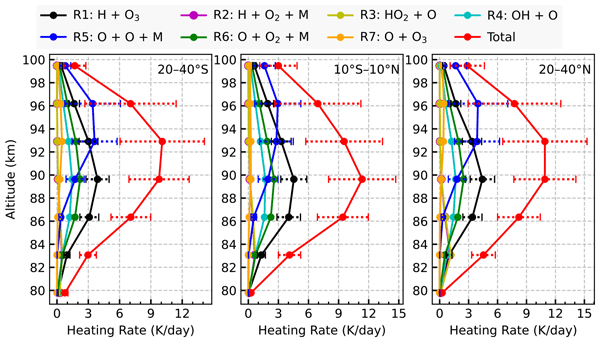
Chemical reactions are key to the energy budget of the upper mesosphere–lower thermosphere, but this process remains poorly quantified. We derived a new dataset of nighttime chemical heating by combining observations from two different satellite instruments. The main exothermic reactions, hydrogen reacting with ozone and oxygen recombination, dominate at different altitudes and vary seasonally. The new results revise previous estimates and provide constraints on the mesopause energy budget.
Wen Yi, Jianyuan Wang, Xianghui Xue, Chengyun Yang, Iain M. Reid, Robert A. Vincent, Andrew MacKinnon, Damian J. Murphy, Njål Gulbrandsen, Masaki Tsutsumi, Baiqi Ning, Guozhu Li, Nicholas J. Mitchell, Tracy Moffat-Griffin, Toshitaka Tsuda, Haiying Li, Paulo P. Batista, Jianfei Wu, Tingdi Chen, and Xiankang Dou
Atmos. Chem. Phys., 26, 13441–13462, https://doi.org/10.5194/acp-26-13441-2026, https://doi.org/10.5194/acp-26-13441-2026, 2026
Short summary
Short summary
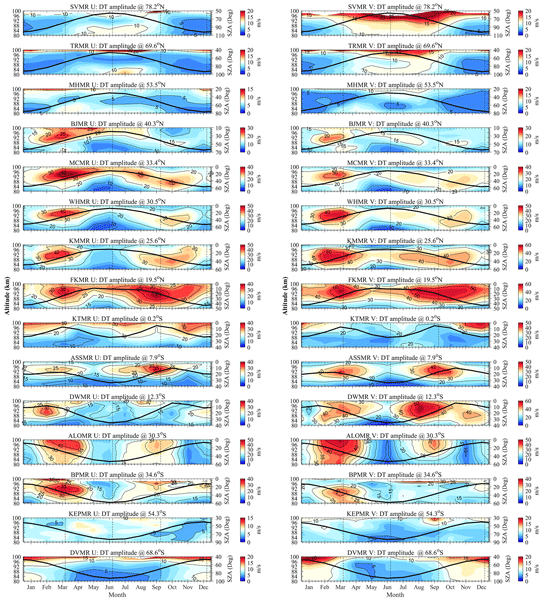
This study provides observational evidence that the solar zenith angle (SZA) influences the vertical structure of diurnal tides in the mesosphere and lower thermosphere (MLT) region. Diurnal tides are strongest at low and mid-latitudes (10–50° N/S) and weaker near the Equator and at polar latitudes. The results further suggest that background zonal winds influence tidal propagation and structure through filtering and momentum drag.
Zheng Wang, Yusen Tian, Guangwei Cao, Guojun Wang, Guangyuan Tan, Kai Ding, Yajun Zhu, and Xiao Wang
EGUsphere, https://doi.org/10.5194/egusphere-2026-5242, https://doi.org/10.5194/egusphere-2026-5242, 2026
This preprint is open for discussion and under review for Annales Geophysicae (ANGEO).
Short summary
Short summary
Six years of observations over Hainan show that background plasma and short-timescale ionospheric structure follow different seasonal and daily cycles. Winter disturbances strengthen during the afternoon and evolve over or pass through the region. Summer disturbances intensify near midnight but are concentrated in particular directions or areas, revealing a more uneven horizontal distribution.
Xiao Liu, Jiyao Xu, Jia Yue, Qinzeng Li, Zhaoai Yan, Yangkun Liu, Luiz Fillip Rodrigues Vital, and Juliano Moro
EGUsphere, https://doi.org/10.5194/egusphere-2026-5223, https://doi.org/10.5194/egusphere-2026-5223, 2026
This preprint is open for discussion and under review for Atmospheric Chemistry and Physics (ACP).
Short summary
Short summary
Gravity waves (GWs) can balance the energy budget of the mesosphere and lower thermosphere by heating/cooling the background atmosphere. Based on linear GW theory for a compressible atmosphere, we derive global heat fluxes and heating rates associated with non‑breaking GWs using SABER observations spanning 2002–2025. Relative to ground‑based lidar measurements, the GW‑driven heat fluxes and heating rates obtained in this work feature global coverage and a continuous long‑term temporal record.
Tiancai Wang, Yajun Zhu, Guangyi Zhu, Wei Yuan, Zhongqi Tan, Weijun Liu, Qiucheng Gong, Hong Gao, and Jiyao Xu
EGUsphere, https://doi.org/10.5194/egusphere-2026-2475, https://doi.org/10.5194/egusphere-2026-2475, 2026
Short summary
Short summary
The Fabry-Perot interferometer (FPI) is a vital optical instrument for measuring atmospheric wind and temperature. However, traditional FPIs are often bulky and sensitive to pressure changes of the interference cavity. We have developed a novel FPI that uses an all-solid-state interference cavity to provide an aviable alternative. Laboratory and field tests demonstrated its excellent accuracy and close agreement with established instruments.
Liang Zhang, Zhongfang Liu, and Yajun Zhu
EGUsphere, https://doi.org/10.5194/egusphere-2026-4809, https://doi.org/10.5194/egusphere-2026-4809, 2026
Short summary
Short summary
Using 24 years of SABER and MLS satellite data, we show that the T80 index dominates interannual and daily variability of MLT density. Stronger upwelling (lower T80) generates a vertical density dipole over southern high latitudes (R = 0.98 at 95 km) via column adjustment and local thermal effects, while an anti-phased pattern appears at low latitudes. The robust T80-density linkage enables one-month-ahead statistical forecasts of MLT density (R up to 0.90).
Qinzeng Li, Jiyao Xu, Wei Yuan, Angel An, Shengyang Gu, Oscar A. van der Velde, Yajun Zhu, and Xiaolong Wei
EGUsphere, https://doi.org/10.5194/egusphere-2026-4160, https://doi.org/10.5194/egusphere-2026-4160, 2026
This preprint is open for discussion and under review for Atmospheric Chemistry and Physics (ACP).
Short summary
Short summary
On 19 May 2022, a powerful thunderstorm outbreak south of the Himalayas produced both unusual high-altitude lightning and large atmospheric waves. Using satellite and ground-based observations, we tracked the waves over distances exceeding 3000 kilometers. Some waves observed at the highest altitudes were likely generated by the breakdown of earlier waves. The results show how severe storms can affect atmospheric regions far above the weather systems that create them.
Liang Zhang, Zhongfang Liu, and Yajun Zhu
EGUsphere, https://doi.org/10.5194/egusphere-2026-3749, https://doi.org/10.5194/egusphere-2026-3749, 2026
Short summary
Short summary
The T80 index, a proxy for summer polar upwelling, provides a near-perfect description (R = 0.98) and a one- to two-month forecast (R = 0.90) of the Southern Hemisphere summer mesopause height. The mechanism involves a vertical dipole temperature response through coupled dynamics, microphysics, and chemistry: stronger upwelling cools below ~90 km via adiabatic ascent and warms above ~90 km via chemical and radiative heating, shifting the temperature minimum downward.
Gunter Stober, Hanli Liu, Zishun Qiao, Kaoru Sato, Loretta Pearl Poku, Witali Krochin, Alan Liu, Alexander Kozlovsky, Diego Janches, Jie Zeng, Wen Yi, Masaki Tsutsumi, Njål Gulbrandsen, Satonori Nozawa, Mark Lester, Johan Kero, and Nicholas Mitchell
EGUsphere, https://doi.org/10.5194/egusphere-2026-3156, https://doi.org/10.5194/egusphere-2026-3156, 2026
This preprint is open for discussion and under review for Atmospheric Measurement Techniques (AMT).
Short summary
Short summary
Vertical winds are a crucial atmospheric parameter in the mesosphere/lower thermosphere and are connected to adiabatic heating and cooling of the atmosphere. Mesospheric temperatures are affected by the vertical transport driven by a pole-to-pole circulation with upwelling in the summer hemisphere and downwelling in the winter hemisphere. We present results based on a new retrieval technique for the seasonal climatological vertical winds and an intercomparison to current state-of-the-art models.
Gang Chen, Yimeng Xu, Guotao Yang, Wuhu Feng, Jiyao Xu, Shaodong Zhang, Guozhu Li, Hanxian Fang, Lifang Du, Haoran Zheng, Xuewu Cheng, Faquan Li, Yuchang Xun, Kaiming Huang, and Chunxiao Yan
EGUsphere, https://doi.org/10.5194/egusphere-2026-2356, https://doi.org/10.5194/egusphere-2026-2356, 2026
Short summary
Short summary
A new lidar for calcium ion (Ca+) observations has been operated in Yanqing, Beijing, China. Cloud-like Ca+ are observed to occur at altitudes of 120–300 km, and these clouds are composed of striped structures. These Ca+ are found to descend into Es layer and the main metal layer, and increase their ion density. According to the stripe-like structures and their influence on the metal ion layers, we believe that these metal ions observed by the lidar in Beijing come from meteoroids trails
Loretta Pearl Poku, Gunter Stober, Witali Krochin, Alan Liu, Alexander Kozlovsky, Diego Janches, Jie Zeng, Wen Yi, Masaki Tsutsumi, Njål Gulbrandsen, Satonori Nozawa, Mark Lester, Johan Kero, and Nicholas Mitchell
EGUsphere, https://doi.org/10.5194/egusphere-2025-6377, https://doi.org/10.5194/egusphere-2025-6377, 2026
Short summary
Short summary
This study presents 3D spatially resolved wind fields in the MLT using advanced retrieval techniques. Specifically, a novel SVVP method in spherical coordinates to enhance the physical consistency of wind retrievals compared to the conventional VVP method in plane geometry and the 3DVAR+DIV method. The SVVP provides a robust framework for future MLT dynamics studies, and the 3DVAR+DIV retrieval is beneficial for high-resolution case studies due to its ability to capture small-scale variability.
Xiaolin Wu, Yajun Zhu, Anne K. Smith, Martin Kaufmann, Guoying Jiang, Shuai Liu, and Jiyao Xu
Atmos. Chem. Phys., 26, 4669–4683, https://doi.org/10.5194/acp-26-4669-2026, https://doi.org/10.5194/acp-26-4669-2026, 2026
Short summary
Short summary
Chemical reactions are key to the energy budget of the upper mesosphere–lower thermosphere, but this process remains poorly quantified. We derived a new dataset of nighttime chemical heating by combining observations from two different satellite instruments. The main exothermic reactions, hydrogen reacting with ozone and oxygen recombination, dominate at different altitudes and vary seasonally. The new results revise previous estimates and provide constraints on the mesopause energy budget.
Chao Ban, Xin Fang, Wen Yi, Jie Zeng, Gunter Stober, Weilin Pan, Tao Li, and Xianghui Xue
Atmos. Meas. Tech., 19, 1697–1709, https://doi.org/10.5194/amt-19-1697-2026, https://doi.org/10.5194/amt-19-1697-2026, 2026
Short summary
Short summary
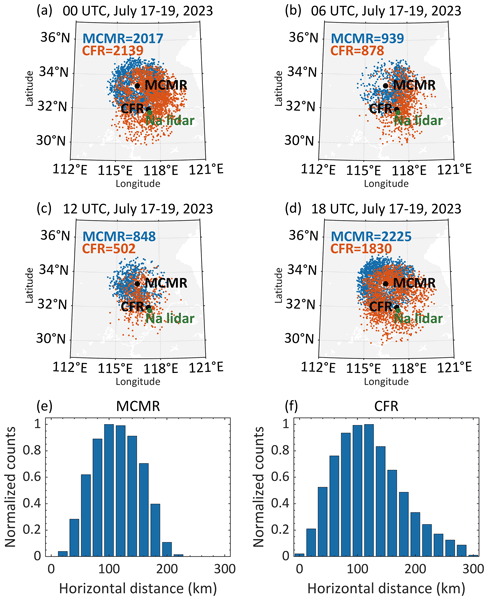
This paper presents an intercomparison of zonal winds observed by a sodium fluorescence lidar and three types of meteor radars – a multistatic meteor radar, a conventional monostatic radar, and a forward remote receiver – located near Hefei, China. The multistatic meteor radar shows the best agreement with the lidar measurements, confirming the reliability of its wind retrievals in the mesosphere and lower thermosphere and highlighting its potential for future atmospheric dynamics studies.
Xiaolong Wei, Guoying Jiang, Yajun Zhu, Jiyao Xu, Weijun Liu, Tiancai Wang, Guangyi Zhu, and Wei Yuan
Atmos. Meas. Tech., 18, 6959–6977, https://doi.org/10.5194/amt-18-6959-2025, https://doi.org/10.5194/amt-18-6959-2025, 2025
Short summary
Short summary
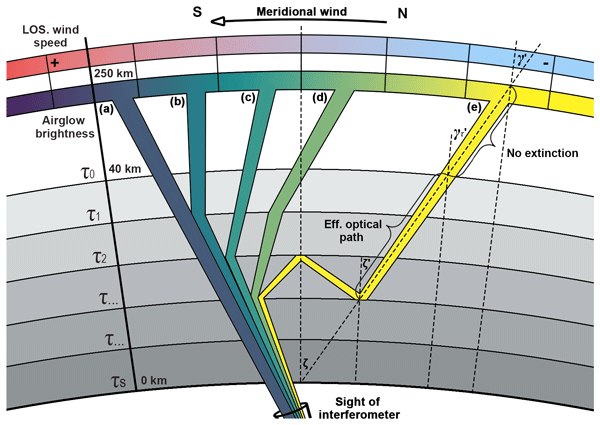
Scattered airglow can bias thermospheric wind observations by ground-based interferometers, especially when brightness is spatially uneven due to auroras. We simulated lower atmospheric scattering during two mid-latitude auroral events and confirmed that scattering can lead to line-of-sight speed biases, thereby increasing the horizontal differences between opposite cardinal directions. This scattering impact needs to be carefully considered in thermospheric dynamics analysis.
Guangyi Zhu, Yajun Zhu, Martin Kaufmann, Tiancai Wang, Weijun Liu, Wei Yuan, Siyin Liu, Guotao Yang, and Jiyao Xu
Atmos. Meas. Tech., 18, 5985–5997, https://doi.org/10.5194/amt-18-5985-2025, https://doi.org/10.5194/amt-18-5985-2025, 2025
Short summary
Short summary
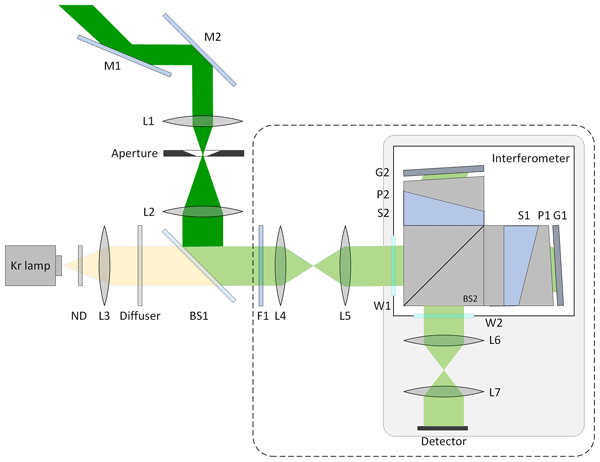
Winds in the mesopause region (85–100 km altitude) drive upper-atmospheric dynamics and energy transfer. We present the Asymmetric Spatial Heterodyne Spectrometer, a ground-based instrument, to measure winds by observing the green airglow of atomic oxygen. Lab tests demonstrated the instrument achieves better than 2 m/s accuracy. Field measurements at a high-latitude site in China showed strong agreement with independent LiDAR data, confirming that the system delivers reliable wind retrievals.
Qinzeng Li, Jiyao Xu, Yajun Zhu, Cristiano M. Wrasse, José V. Bageston, Wei Yuan, Xiao Liu, Weijun Liu, Ying Wen, Hui Li, and Zhengkuan Liu
Atmos. Chem. Phys., 25, 9719–9736, https://doi.org/10.5194/acp-25-9719-2025, https://doi.org/10.5194/acp-25-9719-2025, 2025
Short summary
Short summary
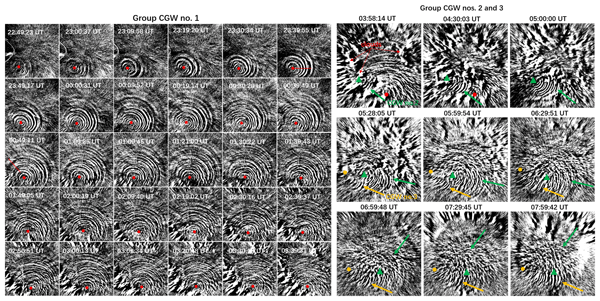
This study explores intense concentric gravity waves (CGWs) based on ground-based and multi-satellite observations over southern Brazil, revealing significant airglow perturbations and strong momentum release. Triggered by deep convection and enabled by weaker wind fields, these CGWs reached the mesopause and thermosphere. Consistent detection via OI and OH airglow emissions confirms their vertical propagation, while asymmetric thermosphere propagation is linked to Doppler-induced wavelength changes.
Jianyuan Wang, Na Li, Wen Yi, Xianghui Xue, Iain M. Reid, Jianfei Wu, Hailun Ye, Jian Li, Zonghua Ding, Jinsong Chen, Guozhu Li, Yaoyu Tian, Boyuan Chang, Jiajing Wu, and Lei Zhao
Atmos. Chem. Phys., 24, 13299–13315, https://doi.org/10.5194/acp-24-13299-2024, https://doi.org/10.5194/acp-24-13299-2024, 2024
Short summary
Short summary
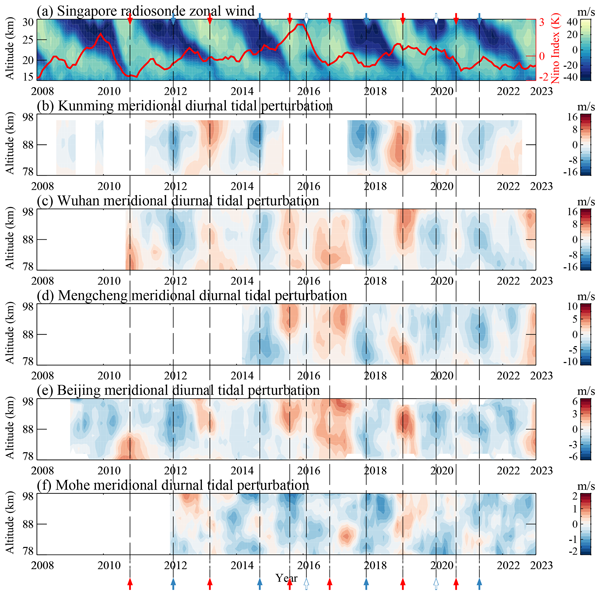
We present the impact of quasi-biennial oscillation (QBO) disruption events on diurnal tides over the low- and mid-latitude MLT region observed by a meteor radar chain. By using a global atmospheric model and reanalysis data, it is found that the stratospheric QBO winds can affect the mesospheric diurnal tides by modulating the subtropical ozone variability in the upper stratosphere and the interaction between tides and gravity waves in the mesosphere.
Xiao Liu, Jiyao Xu, Jia Yue, Yangkun Liu, and Vania F. Andrioli
Atmos. Chem. Phys., 24, 10143–10157, https://doi.org/10.5194/acp-24-10143-2024, https://doi.org/10.5194/acp-24-10143-2024, 2024
Short summary
Short summary
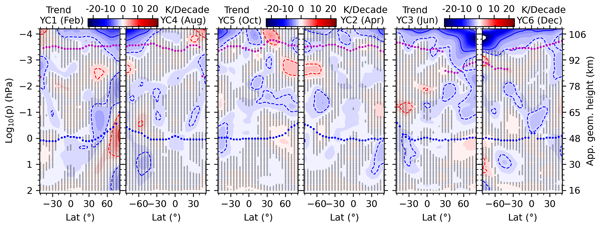
Disagreement in long-term trends in the high-latitude mesosphere temperature should be elucidated using one coherent measurement over a long period. Using SABER measurements at high latitudes and binning the data based on yaw cycle, we focus on long-term trends in the mean temperature and mesopause in the high-latitude mesosphere–lower-thermosphere region, which has been rarely studied via observations but is more sensitive to dynamic changes.
Qinzeng Li, Jiyao Xu, Aditya Riadi Gusman, Hanli Liu, Wei Yuan, Weijun Liu, Yajun Zhu, and Xiao Liu
Atmos. Chem. Phys., 24, 8343–8361, https://doi.org/10.5194/acp-24-8343-2024, https://doi.org/10.5194/acp-24-8343-2024, 2024
Short summary
Short summary
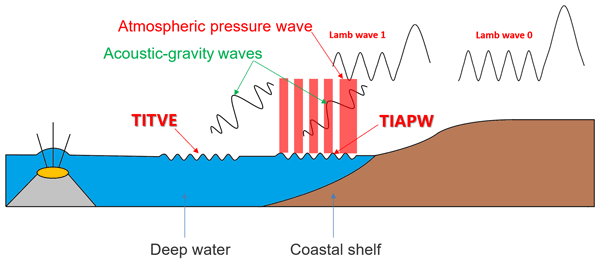
The 2022 Hunga Tonga–Hunga Ha’apai (HTHH) volcanic eruption not only triggered broad-spectrum atmospheric waves but also generated unusual tsunamis which can generate atmospheric gravity waves (AGWs). Multiple strong atmospheric waves were observed in the far-field area of the 2022 HTHH volcano eruption in the upper atmosphere by a ground-based airglow imager network. AGWs caused by tsunamis can propagate to the mesopause region; there is a good match between atmospheric waves and tsunamis.
Gunter Stober, Sharon L. Vadas, Erich Becker, Alan Liu, Alexander Kozlovsky, Diego Janches, Zishun Qiao, Witali Krochin, Guochun Shi, Wen Yi, Jie Zeng, Peter Brown, Denis Vida, Neil Hindley, Christoph Jacobi, Damian Murphy, Ricardo Buriti, Vania Andrioli, Paulo Batista, John Marino, Scott Palo, Denise Thorsen, Masaki Tsutsumi, Njål Gulbrandsen, Satonori Nozawa, Mark Lester, Kathrin Baumgarten, Johan Kero, Evgenia Belova, Nicholas Mitchell, Tracy Moffat-Griffin, and Na Li
Atmos. Chem. Phys., 24, 4851–4873, https://doi.org/10.5194/acp-24-4851-2024, https://doi.org/10.5194/acp-24-4851-2024, 2024
Short summary
Short summary
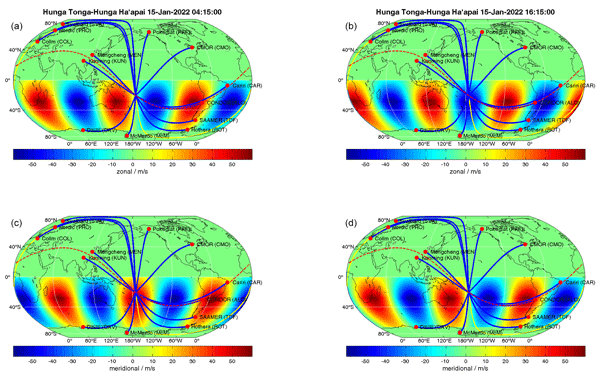
On 15 January 2022, the Hunga Tonga-Hunga Ha‘apai volcano exploded in a vigorous eruption, causing many atmospheric phenomena reaching from the surface up to space. In this study, we investigate how the mesospheric winds were affected by the volcanogenic gravity waves and estimated their propagation direction and speed. The interplay between model and observations permits us to gain new insights into the vertical coupling through atmospheric gravity waves.

Xiao Liu, Jiyao Xu, Jia Yue, and Vania F. Andrioli
Atmos. Chem. Phys., 23, 6145–6167, https://doi.org/10.5194/acp-23-6145-2023, https://doi.org/10.5194/acp-23-6145-2023, 2023
Short summary
Short summary
Winds are important in characterizing atmospheric dynamics and coupling. However, it is difficult to directly measure the global winds from the stratosphere to the lower thermosphere. We developed a global zonal wind dataset according to the gradient wind theory and SABER and meteor radar observations. Using the dataset, we studied the intra-annual, inter-annual, and long-term variations. This is helpful to understand the variations and coupling of the stratosphere to the lower thermosphere.
Wen Yi, Jie Zeng, Xianghui Xue, Iain Reid, Wei Zhong, Jianfei Wu, Tingdi Chen, and Xiankang Dou
Atmos. Meas. Tech. Discuss., https://doi.org/10.5194/amt-2022-254, https://doi.org/10.5194/amt-2022-254, 2022
Revised manuscript not accepted
Short summary
Short summary
In recent years, the concept of multistatic meteor radar systems has attracted the attention of the atmospheric radar community, focusing on the MLT region. In this study, we apply a multistatic meteor radar system consisting of a monostatic meteor radar in Mengcheng (33.36° N, 116.49° E) and a remote receiver in Changfeng (31.98° N, 117.22° E) to estimate the two-dimensional horizontal wind field, and the horizontal divergence and relative vorticity of the wind field.
Qinzeng Li, Jiyao Xu, Hanli Liu, Xiao Liu, and Wei Yuan
Atmos. Chem. Phys., 22, 12077–12091, https://doi.org/10.5194/acp-22-12077-2022, https://doi.org/10.5194/acp-22-12077-2022, 2022
Short summary
Short summary
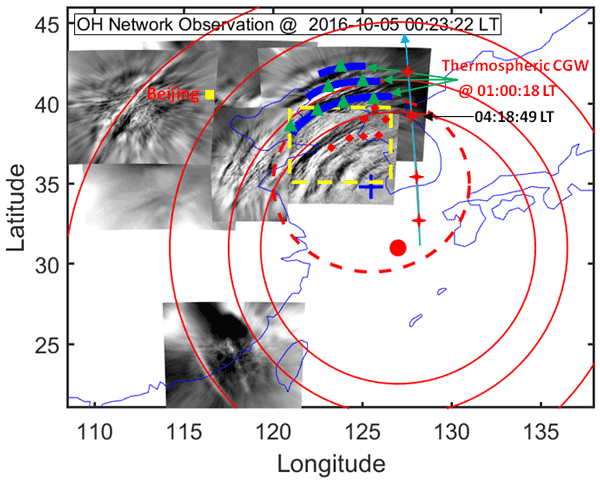
We use ground-based airglow network observations, reanalysis data, and satellite observations to explore the propagation process of concentric gravity waves (CGWs) excited by a typhoon between the troposphere, stratosphere, mesosphere, and thermosphere. We find that CGWs in the mesosphere are generated directly by the typhoon but the CGW observed in the thermosphere may be excited by CGW dissipation in the mesosphere, rather than directly excited by a typhoon and propagated to the thermosphere.
Daochun Yu, Haitao Li, Baoquan Li, Mingyu Ge, Youli Tuo, Xiaobo Li, Wangchen Xue, Yaning Liu, Aoying Wang, Yajun Zhu, and Bingxian Luo
Atmos. Meas. Tech., 15, 3141–3159, https://doi.org/10.5194/amt-15-3141-2022, https://doi.org/10.5194/amt-15-3141-2022, 2022
Short summary
Short summary
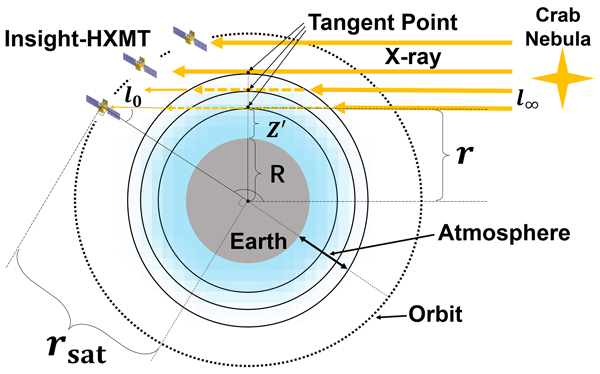
In this work, the measurement of vertical atmospheric density profiles using X-ray Earth occultation is investigated. The Earth’s density profile for the lower thermosphere is obtained with Insight-HXMT. It is shown that the Insight-HXMT X-ray satellite of China can be used as an X-ray atmospheric diagnostics instrument for the upper atmosphere. The Insight-HXMT satellite can, with other X-ray astronomical satellites in orbit, form a network for X-ray Earth occultation sounding in the future.
Xiao Liu, Jiyao Xu, Jia Yue, You Yu, Paulo P. Batista, Vania F. Andrioli, Zhengkuan Liu, Tao Yuan, Chi Wang, Ziming Zou, Guozhu Li, and James M. Russell III
Earth Syst. Sci. Data, 13, 5643–5661, https://doi.org/10.5194/essd-13-5643-2021, https://doi.org/10.5194/essd-13-5643-2021, 2021
Short summary
Short summary
Based on the gradient balance wind theory and the SABER observations, a dataset of monthly mean zonal wind has been developed at heights of 18–100 km and latitudes of 50° Sndash;50° N from 2002 to 2019. The dataset agrees with the zonal wind from models (MERRA2, UARP, HWM14) and observations by meteor radar and lidar at seven stations. The dataset can be used to study seasonal and interannual variations and can serve as a background for wave studies of tides and planetary waves.
Cited articles
Anstey, J. A., Banyard, T. P., Butchart, N., Coy, L., Newman, P. A., Osprey, S., and Wright, C. J.: Prospect of Increased Disruption to the QBO in a Changing Climate, Geophys. Res. Lett., 48, https://doi.org/10.1029/2021gl093058, 2021.
Araújo, L. R., Lima, L. M., Jacobi, C., and Batista, P. P.: Quasi-biennial oscillation signatures in the diurnal tidal winds over Cachoeira Paulista, Brazil, J. Atmos. Sol. Terr. Phys., 155, 71–78, https://doi.org/10.1016/j.jastp.2017.02.001, 2017.
Baldwin, M. P., Gray, L. J., Dunkerton, T. J., Hamilton, K., Haynes, P. H., Randel, W. J., Holton, J. R., Alexander, M. J., Hirota, I., Horinouchi, T., Jones, D. B. A., Kinnersley, J. S., Marquardt, C., Sato, K., and Takahashi, M.: The quasi-biennial oscillation, Rev. Geophys., 39, 179–229, https://doi.org/10.1029/1999rg000073, 2001.
Barton, C. A. and McCormack, J. P.: Origin of the 2016 QBO Disruption and Its Relationship to Extreme El Niño Events, Geophys. Res. Lett., 44, https://doi.org/10.1002/2017gl075576, 2017.
Cen, Y., Yang, C., Li, T., Russell III, J. M., and Dou, X.: Suppressed migrating diurnal tides in the mesosphere and lower thermosphere region during El Niño in northern winter and its possible mechanism, Atmos. Chem. Phys., 22, 7861–7874, https://doi.org/10.5194/acp-22-7861-2022, 2022.
Chapman, S. and Lindzen, R.: Atmospheric tides – thermal and gravitational, D. Reidel Publishing Company, Dordrecht, the Netherlands, ISBN 978-94-010-3401-2, 1970.
Coy, L., Newman, P. A., Pawson, S., and Lait, L. R.: Dynamics of the Disrupted 2015/16 Quasi-Biennial Oscillation, J. Clim., 30, 5661–5674, https://doi.org/10.1175/jcli-d-16-0663.1, 2017.
Czesla, S., Schröter, S., Schneider, C. P., Huber, K. F., Pfeifer, F., Andreasen, D. T., and Zechmeister, M.: PyA: Python astronomy-related packages, GitHub [code], https://github.com/sczesla/PyAstronomy (last access: 20 May 2025), 2019.
Davis, R. N., Du, J., Smith, A. K., Ward, W. E., and Mitchell, N. J.: The diurnal and semidiurnal tides over Ascension Island (° S, 14° W) and their interaction with the stratospheric quasi-biennial oscillation: studies with meteor radar, eCMAM and WACCM, Atmos. Chem. Phys., 13, 9543–9564, https://doi.org/10.5194/acp-13-9543-2013, 2013.
Dhadly, M. S., Emmert, J. T., Drob, D. P., McCormack, J. P., and Niciejewski, R. J.: Short-Term and Interannual Variations of Migrating Diurnal and Semidiurnal Tides in the Mesosphere and Lower Thermosphere, J. Geophys. Res.: Space Phys., 123, 7106–7123, https://doi.org/10.1029/2018ja025748, 2018.
Diallo, M., Riese, M., Birner, T., Konopka, P., Müller, R., Hegglin, M. I., Santee, M. L., Baldwin, M., Legras, B., and Ploeger, F.: Response of stratospheric water vapor and ozone to the unusual timing of El Niño and the QBO disruption in 2015–2016, Atmos. Chem. Phys., 18, 13055–13073, https://doi.org/10.5194/acp-18-13055-2018, 2018.
Diallo, M. A., Ploeger, F., Hegglin, M. I., Ern, M., Grooß, J.-U., Khaykin, S., and Riese, M.: Stratospheric water vapour and ozone response to the quasi-biennial oscillation disruptions in 2016 and 2020, Atmos. Chem. Phys., 22, 14303–14321, https://doi.org/10.5194/acp-22-14303-2022, 2022.
Ern, M., Ploeger, F., Preusse, P., Gille, J. C., Gray, L. J., Kalisch, S., Mlynczak, M. G., Russell, J. M., and Riese, M.: Interaction of gravity waves with the QBO: A satellite perspective, J. Geophys. Res.: Atmos., 119, 2329–2355, https://doi.org/10.1002/2013jd020731, 2014.
Forbes, J. M. and Garrett, H. B.: Seasonal-Latitudinal Structure of the Diurnal Thermospheric Tide, J. Atmos. Sci., 35, 148–159, https://doi.org/10.1175/1520-0469(1978)035<0148:Slsotd>2.0.Co;2, 1978.
Forbes, J. M. and Vincent, R. A.: Effects of mean winds and dissipation on the diurnal propagating tide: An analytic approach, Planet. Space Sci., 37, 197–209, https://doi.org/10.1016/0032-0633(89)90007-x, 1989.
Gan, Q., Du, J., Ward, W. E., Beagley, S. R., Fomichev, V. I., and Zhang, S.: Climatology of the diurnal tides from eCMAM30 (1979 to 2010) and its comparison with SABER, Earth Planets Space, 66, https://doi.org/10.1186/1880-5981-66-103, 2014.
Garcia, R. R.: On the Structure and Variability of the Migrating Diurnal Temperature Tide Observed by SABER, J. Atmos. Sci., 80, 687–704, https://doi.org/10.1175/jas-d-22-0167.1, 2023.
Garcia, R. R., Marsh, D. R., Kinnison, D. E., Boville, B. A., and Sassi, F.: Simulation of secular trends in the middle atmosphere, 1950–2003, J. Geophys. Res.: Atmos., 112, https://doi.org/10.1029/2006jd007485, 2007.
Gelaro, R., McCarty, W., Suarez, M. J., Todling, R., Molod, A., Takacs, L., Randles, C., Darmenov, A., Bosilovich, M. G., Reichle, R., Wargan, K., Coy, L., Cullather, R., Draper, C., Akella, S., Buchard, V., Conaty, A., da Silva, A., Gu, W., Kim, G. K., Koster, R., Lucchesi, R., Merkova, D., Nielsen, J. E., Partyka, G., Pawson, S., Putman, W., Rienecker, M., Schubert, S. D., Sienkiewicz, M., and Zhao, B.: The Modern-Era Retrospective Analysis for Research and Applications, Version 2 (MERRA-2), J. Clim., 30, 5419–5454, https://doi.org/10.1175/JCLI-D-16-0758.1, 2017.
Global Modeling and Assimilation Office (GMAO): MERRA-2 inst3_3d_asm_Nv: 3d, 3-Hourly, Instantaneous,Model-Level,Assimilation,Assimilated Meteorological Fields V5.12.4, Goddard Earth Sciences Data and Information Services Center (GES DISC), Greenbelt, MD, USA [data set], https://doi.org/10.5067/WWQSXQ8IVFW8, 2015a.
Global Modeling and Assimilation Office (GMAO): MERRA-2 inst3_3d_aer_Nv: 3d,3-Hourly,Instantaneous,Model-Level,Assimilation,Aerosol Mixing Ratio V5.12.4, Goddard Earth Sciences Data and Information Services Center (GES DISC), Greenbelt, MD, USA [data set], https://doi.org/10.5067/LTVB4GPCOTK2, 2015b.
Global Modeling and Assimilation Office (GMAO): MERRA-2 tavg1_2d_rad_Nx: 2d,1-Hourly,Time-Averaged,Single-Level,Assimilation,Radiation Diagnostics V5.12.4, Goddard Earth Sciences Data and Information Services Center (GES DISC), Greenbelt, MD, USA [data set], https://doi.org/10.5067/Q9QMY5PBNV1T, 2015c.
Global Modeling and Assimilation Office (GMAO): MERRA-2 tavg3_3d_tdt_Np: 3d,3-Hourly,Time-Averaged,Pressure-Level,Assimilation,Temperature Tendencies V5.12.4, Goddard Earth Sciences Data and Information Services Center (GES DISC), Greenbelt, MD, USA [data set], https://doi.org/10.5067/9NCR9DDDOPFI, 2015d.
Groves, G. V.: Hough components of water vapour heating, J. Atmos. Terr. Phys., 44, 281–290, https://doi.org/10.1016/0021-9169(82)90033-2, 1982.
Hagan, M. E.: Comparative effects of migrating solar sources on tidal signatures in the middle and upper atmosphere, J. Geophys. Res.: Atmos., 101, 21213–21222, https://doi.org/10.1029/96jd01374, 1996.
Hagan, M. E., Burrage, M. D., Forbes, J. M., Hackney, J., Randel, W. J., and Zhang, X.: QBO effects on the diurnal tide in the upper atmosphere, Earth Planets Space, 51, 571–578, https://doi.org/10.1186/BF03353216, 1999.
Holton, J. R. and Lindzen, R. S.: An Updated Theory for the Quasi-Biennial Cycle of the Tropical Stratosphere, J. Atmos. Sci., 29, 1076–1080, https://doi.org/10.1175/1520-0469(1972)029<1076:Autftq>2.0.Co;2, 1972.
Hu, S. and Fedorov, A. V.: The extreme El Niño of 2015–2016 and the end of global warming hiatus, Geophys. Res. Lett., 44, 3816–3824, https://doi.org/10.1002/2017gl072908, 2017.
Jiang, G., Xu, J., Shi, J., Yang, G., Wang, X., and Yan, C.: The first observation of the atmospheric tides in the mesosphere and lower thermosphere over Hainan, China, Chin. Sci. Bull., 55, 1059–1066, https://doi.org/10.1007/s11434-010-0084-8, 2010.
Johnston, B. R., Randel, W. J., and Braun, J. J.: Interannual Variability of Tropospheric Moisture and Temperature and Relationships to ENSO Using COSMIC-1 GNSS-RO Retrievals, J. Clim., 35, 7109–7125, https://doi.org/10.1175/jcli-d-21-0884.1, 2022.
Kang, M.-J. and Chun, H.-Y.: Contributions of equatorial waves and small-scale convective gravity waves to the 2019/20 quasi-biennial oscillation (QBO) disruption, Atmos. Chem. Phys., 21, 9839–9857, https://doi.org/10.5194/acp-21-9839-2021, 2021.
Kang, M.-J., Chun, H.-Y., Son, S.-W., Garcia, R. R., An, S.-I., and Park, S.-H.: Role of tropical lower stratosphere winds in quasi-biennial oscillation disruptions, Sci. Adv., 8, https://doi.org/10.1126/sciadv.abm7229, 2022.
Kogure, M. and Liu, H.: DW1 Tidal Enhancements in the Equatorial MLT During 2015 El Niño: The Relative Role of Tidal Heating and Propagation, J. Geophys. Res.: Space Phys., 126, https://doi.org/10.1029/2021ja029342, 2021.
Kogure, M., Liu, H., and Jin, H.: Impact of Tropospheric Ozone Modulation Due To El Niño on Tides in the MLT, Geophys. Res. Lett., 50, https://doi.org/10.1029/2023gl102790, 2023.
Lacis, A. A. and Hansen, J.: A Parameterization for the Absorption of Solar Radiation in the Earth's Atmosphere, J. Atmos. Sci., 31, 118–133, https://doi.org/10.1175/1520-0469(1974)031<0118:Apftao>2.0.Co;2, 1974.
Li, T., She, C. Y., Liu, H. L., Yue, J., Nakamura, T., Krueger, D. A., Wu, Q., Dou, X., and Wang, S.: Observation of local tidal variability and instability, along with dissipation of diurnal tidal harmonics in the mesopause region over Fort Collins, Colorado (41° N, 105° W), J. Geophys. Res.: Atmos., 114, https://doi.org/10.1029/2008jd011089, 2009.
Lieberman, R. S., Ortland, D. A., and Yarosh, E. S.: Climatology and interannual variability of diurnal water vapor heating, J. Geophys. Res.: Atmos., 108, https://doi.org/10.1029/2002jd002308, 2003.
Lieberman, R. S., Riggin, D. M., Ortland, D. A., Nesbitt, S. W., and Vincent, R. A.: Variability of mesospheric diurnal tides and tropospheric diurnal heating during 1997–1998, J. Geophys. Res., 112, https://doi.org/10.1029/2007jd008578, 2007.
Lindzen, R. S. and Holton, J. R.: A Theory of the Quasi-Biennial Oscillation, J. Atmos. Sci., 25, 1095–1107, https://doi.org/10.1175/1520-0469(1968)025<1095:Atotqb>2.0.Co;2, 1968.
Liu, G., Lieberman, R. S., Harvey, V. L., Pedatella, N. M., Oberheide, J., Hibbins, R. E., Espy, P. J., and Janches, D.: Tidal Variations in the Mesosphere and Lower Thermosphere Before, During, and After the 2009 Sudden Stratospheric Warming, J. Geophys. Res.: Space Phys., 126, https://doi.org/10.1029/2020ja028827, 2021.
Liu, H. L. and Hagan, M. E.: Local heating/cooling of the mesosphere due to gravity wave and tidal coupling, Geophys. Res. Lett., 25, 2941–2944, https://doi.org/10.1029/98gl02153, 1998.
Liu, H. L., Foster, B. T., Hagan, M. E., McInerney, J. M., Maute, A., Qian, L., Richmond, A. D., Roble, R. G., Solomon, S. C., Garcia, R. R., Kinnison, D., Marsh, D. R., Smith, A. K., Richter, J., Sassi, F., and Oberheide, J.: Thermosphere extension of the Whole Atmosphere Community Climate Model, J. Geophys. Res.: Space Phys., 115, https://doi.org/10.1029/2010ja015586, 2010.
Liu, H. L., Bardeen, C. G., Foster, B. T., Lauritzen, P., Liu, J., Lu, G., Marsh, D. R., Maute, A., McInerney, J. M., Pedatella, N. M., Qian, L., Richmond, A. D., Roble, R. G., Solomon, S. C., Vitt, F. M., and Wang, W.: Development and Validation of the Whole Atmosphere Community Climate Model With Thermosphere and Ionosphere Extension (WACCM – X 2.0), J. Adv. Model. Earth Syst., 10, 381–402, https://doi.org/10.1002/2017ms001232, 2018.
Liu, M., Xu, J., Liu, H., and Liu, X.: Possible modulation of migrating diurnal tide by latitudinal gradient of zonal wind observed by SABER/TIMED, Science China Earth Sciences, 59, 408–417, https://doi.org/10.1007/s11430-015-5185-4, 2015.
Liu, S., Jiang, G., Luo, B., Xu, J., Lin, R., Zhu, Y., and Liu, W.: Solar Cycle Dependence of Migrating Diurnal Tide in the Equatorial Mesosphere and Lower Thermosphere, Remote Sens., 16, https://doi.org/10.3390/rs16183437, 2024a.
Liu, Y., Xu, J., Smith, A. K., and Liu, X.: Seasonal and Interannual Variations of Global Tides in the Mesosphere and Lower Thermosphere Neutral Winds: I. Diurnal Tides, J. Geophys. Res.: Space Phys., 129, https://doi.org/10.1029/2023ja031887, 2024b.
Lu, X., Liu, A. Z., Swenson, G. R., Li, T., Leblanc, T., and McDermid, I. S.: Gravity wave propagation and dissipation from the stratosphere to the lower thermosphere, J. Geophys. Res.: Atmos., 114, https://doi.org/10.1029/2008jd010112, 2009.
Lu, X., Liu, H. L., Liu, A. Z., Yue, J., McInerney, J. M., and Li, Z.: Momentum budget of the migrating diurnal tide in the Whole Atmosphere Community Climate Model at vernal equinox, J. Geophys. Res.: Atmos., 117, https://doi.org/10.1029/2011jd017089, 2012.
Marsh, D. R., Mills, M. J., Kinnison, D. E., Lamarque, J.-F., Calvo, N., and Polvani, L. M.: Climate Change from 1850 to 2005 Simulated in CESM1(WACCM), J. Clim., 26, 7372–7391, https://doi.org/10.1175/jcli-d-12-00558.1, 2013.
Mayr, H. G., Mengel, J. G., Chan, K. L., and Porter, H. S.: Seasonal variations of the diurnal tide induced by gravity wave filtering, Geophys. Res. Lett., 25, 943–946, https://doi.org/10.1029/98gl00637, 1998.
Mayr, H. G. and Mengel, J. G.: Interannual variations of the diurnal tide in the mesosphere generated by the quasi-biennial oscillation, J. Geophys. Res., 110, D10111, https://doi.org/10.1029/2004JD005055, 2005.
McLandress, C.: The Seasonal Variation of the Propagating Diurnal Tide in the Mesosphere and Lower Thermosphere. Part I: The Role of Gravity Waves and Planetary Waves, J. Atmos. Sci., 59, 893–906, https://doi.org/10.1175/1520-0469(2002)059<0893:Tsvotp>2.0.Co;2, 2002a.
McLandress, C.: The Seasonal Variation of the Propagating Diurnal Tide in the Mesosphere and Lower Thermosphere. Part II: The Role of Tidal Heating and Zonal Mean Winds, J. Atmos. Sci., 59, 907–922, https://doi.org/10.1175/1520-0469(2002)059<0907:Tsvotp>2.0.Co;2, 2002b.
Mertens, C. J., Schmidlin, F. J., Goldberg, R. A., Remsberg, E. E., Pesnell, W. D., Russell, J. I. I. I., Mlynczak, M. G., Lopez-Puertas, M., Wintersteiner, P. P., Picard, R. H., Winick, J. R., and Gordley, L. L.: SABER observations of mesospheric temperatures and comparisons with falling sphere measurements taken during the 2002 summer MaCWAVE campaign, Geophys. Res. Lett., 31, https://doi.org/10.1029/2003gl018605, 2004.
Mertens, C. J., Mlynczak, M. G., López-Puertas, M., Wintersteiner, P. P., Picard, R. H., Winick, J. R., Gordley, L. L., and Russell, J. M.: Retrieval of mesospheric and lower thermospheric kinetic temperature from measurements of CO2 15 µm Earth Limb Emission under non-LTE conditions, Geophys. Res. Lett., 28, 1391–1394, https://doi.org/10.1029/2000gl012189, 2001.
Mlynczak, M. G., Hunt, L. A., Garcia, R. R., Harvey, V. L., Marshall, B. T., Yue, J., Mertens, C. J., and Russell III, J. M.: Cooling and Contraction of the Mesosphere and Lower Thermosphere From 2002 to 2021, J. Geophys. Res. Atmos., 127, e2022JD036767, https://doi.org/10.1029/2022JD036767, 2022.
Mlynczak, M. G., Marshall, B. T., Garcia, R. R., Hunt, L., Yue, J., Harvey, V. L., Lopez-Puertas, M., Mertens, C., and Russell, J.: Algorithm Stability and the Long-Term Geospace Data Record From TIMED/SABER, Geophys. Res. Lett., 50, https://doi.org/10.1029/2022gl102398, 2023.
Mukhtarov, P., Pancheva, D., and Andonov, B.: Global structure and seasonal and interannual variability of the migrating diurnal tide seen in the SABER/TIMED temperatures between 20 and 120 km, J. Geophys. Res.: Space Phys., 114, https://doi.org/10.1029/2008ja013759, 2009.
Neale, R., Richter, J. H., Conley, A. J., Park, S., Lauritzen, P. H., Gettelman, A., Williamson, D., Rasch, P. J., Vavrus, S. J., Taylor, M. A., Collins, W., Zhang, M., and Lin, S.: Description of the NCAR Community Atmosphere Model (CAM 4.0), https://doi.org/10.5065/GSEB-6470, 2010.
Newman, P. A., Coy, L., Pawson, S., and Lait, L. R.: The anomalous change in the QBO in 2015–2016, Geophys. Res. Lett., 43, 8791–8797, https://doi.org/10.1002/2016gl070373, 2016.
Oberheide, J., Forbes, J. M., Häusler, K., Wu, Q., and Bruinsma, S. L.: Tropospheric tides from 80 to 400 km: Propagation, interannual variability, and solar cycle effects, J. Geophys. Res.: Atmos., 114, https://doi.org/10.1029/2009jd012388, 2009.
Ortland, D. A.: Daily estimates of the migrating tide and zonal mean temperature in the mesosphere and lower thermosphere derived from SABER data, J. Geophys. Res.: Atmos., 122, 3754–3785, https://doi.org/10.1002/2016jd025573, 2017.
Osprey, S. M., Butchart, N., Knight, J. R., Scaife, A. A., Hamilton, K., Anstey, J. A., Schenzinger, V., and Zhang, C.: An unexpected disruption of the atmospheric quasi-biennial oscillation, Science, 353, 1424–1427, https://doi.org/10.1126/science.aah4156, 2016.
Pedatella, N.: Ionospheric Variability during the 2020–2021 SSW: COSMIC-2 Observations and WACCM-X Simulations, Atmosphere, 13, https://doi.org/10.3390/atmos13030368, 2022.
Pramitha, M., Kishore Kumar, K., Venkat Ratnam, M., Praveen, M., and Rao, S. V. B.: Disrupted Stratospheric QBO Signatures in the Diurnal Tides Over the Low-Latitude MLT Region, Geophys. Res. Lett., 48, https://doi.org/10.1029/2021gl093022, 2021a.
Pramitha, M., Kumar, K. K., Ratnam, M. V., Praveen, M., and Bhaskara Rao, S. V.: Stratospheric Quasi Biennial Oscillation Modulations of Migrating Diurnal Tide in the Mesosphere and Lower Thermosphere Over the Low and Equatorial Latitudes, J. Geophys. Res.: Space Phys., 126, https://doi.org/10.1029/2020ja028970, 2021b.
Qian, L., Burns, A. G., Emery, B. A., Foster, B., Lu, G., Maute, A., Richmond, A. D., Roble, R. G., Solomon, S. C., and Wang, W.: The NCAR TIE-GCM: A community model of the coupled thermosphere/ionosphere system, in: Modeling the Ionosphere–Thermosphere System, edited by: Joseph Huba, J., Schunk, R., and Khazanov, G., AGU Geophysical Monographs, American Geophysical Union, https://doi.org/10.1002/9781118704417, 2014.
Riggin, D. M. and Lieberman, R. S.: Variability of the diurnal tide in the equatorial MLT, J. Atmos. Sol. Terr. Phys., 102, 198–206, https://doi.org/10.1016/j.jastp.2013.05.011, 2013.
Sakazaki, T., Fujiwara, M., and Zhang, X.: Interpretation of the vertical structure and seasonal variation of the diurnal migrating tide from the troposphere to the lower mesosphere, J. Atmos. Sol. Terr. Phys., 105–106, 66–80, https://doi.org/10.1016/j.jastp.2013.07.010, 2013.
Sakazaki, T., Fujiwara, M., and Shiotani, M.: Representation of solar tides in the stratosphere and lower mesosphere in state-of-the-art reanalyses and in satellite observations, Atmos. Chem. Phys., 18, 1437–1456, https://doi.org/10.5194/acp-18-1437-2018, 2018.
Santoso, A., McPhaden, M. J., and Cai, W.: The Defining Characteristics of ENSO Extremes and the Strong 2015/2016 El Niño, Rev. Geophys., 55, 1079–1129, https://doi.org/10.1002/2017rg000560, 2017.
Schoeberl, M. R., Douglass, A. R., Newman, P. A., Lait, L. R., Lary, D., Waters, J., Livesey, N., Froidevaux, L., Lambert, A., Read, W., Filipiak, M. J., and Pumphrey, H. C.: QBO and annual cycle variations in tropical lower stratosphere trace gases from HALOE and Aura MLS observations, J. Geophys. Res.: Atmos., 113, https://doi.org/10.1029/2007jd008678, 2008.
Siddiqui, T. A., Chau, J. L., Stolle, C., and Yamazaki, Y.: Migrating solar diurnal tidal variability during Northern and Southern Hemisphere Sudden Stratospheric Warmings, Earth Planets Space, 74, https://doi.org/10.1186/s40623-022-01661-y, 2022.
Singh, D. and Gurubaran, S.: Variability of diurnal tide in the MLT region over Tirunelveli (8.7° N), India: Consistency between ground- and space-based observations, J. Geophys. Res.: Atmos., 122, 2696–2713, https://doi.org/10.1002/2016jd025910, 2017.
Smith, A. K.: Global Dynamics of the MLT, Surv. Geophys., 33, 1177–1230, https://doi.org/10.1007/s10712-012-9196-9, 2012.
Smith, A. K., Harvey, V. L., Mlynczak, M. G., Funke, B., García-Comas, M., Hervig, M., Kaufmann, M., Kyrölä, E., López-Puertas, M., McDade, I., Randall, C. E., Russell, J. M., Sheese, P. E., Shiotani, M., Skinner, W. R., Suzuki, M., and Walker, K. A.: Satellite observations of ozone in the upper mesosphere, J. Geophys. Res.: Atmos., 118, 5803–5821, https://doi.org/10.1002/jgrd.50445, 2013.
Smith, A. K., Pedatella, N. M., Marsh, D. R., and Matsuo, T.: On the Dynamical Control of the Mesosphere–Lower Thermosphere by the Lower and Middle Atmosphere, J. Atmos. Sci., 74, 933–947, https://doi.org/10.1175/jas-d-16-0226.1, 2017.
Somerville, R. C. J., Stone, P. H., Halem, M., Hansen, J. E., Hogan, J. S., Druyan, L. M., Russell, G., Lacis, A. A., Quirk, W. J., and Tenenbaum, J.: The GISS Model of the Global Atmosphere, J. Atmos. Sci., 31, 84–117, https://doi.org/10.1175/1520-0469(1974)031<0084:Tgmotg>2.0.Co;2, 1974.
Sun, R., Gu, S., Dou, X., and Li, N.: Tidal Structures in the Mesosphere and Lower Thermosphere and Their Solar Cycle Variations, Atmosphere, 13, https://doi.org/10.3390/atmos13122036, 2022.
Stober, G., Kuchar, A., Pokhotelov, D., Liu, H., Liu, H.-L., Schmidt, H., Jacobi, C., Baumgarten, K., Brown, P., Janches, D., Murphy, D., Kozlovsky, A., Lester, M., Belova, E., Kero, J., and Mitchell, N.: Interhemispheric differences of mesosphere–lower thermosphere winds and tides investigated from three whole-atmosphere models and meteor radar observations, Atmos. Chem. Phys., 21, 13855–13902, https://doi.org/10.5194/acp-21-13855-2021, 2021.
Strobel, D. F.: Parameterization of the atmospheric heating rate from 15 to 120 km due to O2 and O3 absorption of solar radiation, J. Geophys. Res.: Oceans, 83, 6225–6230, https://doi.org/10.1029/JC083iC12p06225, 1978.
Tweedy, O. V., Kramarova, N. A., Strahan, S. E., Newman, P. A., Coy, L., Randel, W. J., Park, M., Waugh, D. W., and Frith, S. M.: Response of trace gases to the disrupted 2015–2016 quasi-biennial oscillation, Atmos. Chem. Phys., 17, 6813–6823, https://doi.org/10.5194/acp-17-6813-2017, 2017.
Vincent, R. A., Kovalam, S., Fritts, D. C., and Isler, J. R.: Long-term MF radar observations of solar tides in the low-latitude mesosphere: Interannual variability and comparisons with the GSWM, J. Geophys. Res.: Atmos., 103, 8667–8683, https://doi.org/10.1029/98jd00482, 1998.
Wang, J., Li, N., Yi, W., Xue, X., Reid, I. M., Wu, J., Ye, H., Li, J., Ding, Z., Chen, J., Li, G., Tian, Y., Chang, B., Wu, J., and Zhao, L.: The impact of quasi-biennial oscillation (QBO) disruptions on diurnal tides over the low- and mid-latitude mesosphere and lower thermosphere (MLT) region observed by a meteor radar chain, Atmos. Chem. Phys., 24, 13299–13315, https://doi.org/10.5194/acp-24-13299-2024, 2024.
Wang, Y., Rao, J., Lu, Y., Ju, Z., Yang, J., and Luo, J.: A revisit and comparison of the quasi-biennial oscillation (QBO) disruption events in 2015/16 and 2019/20, Atmos. Res., 294, https://doi.org/10.1016/j.atmosres.2023.106970, 2023.
Wu, D. L., McLandress, C., Read, W. G., Waters, J. W., and Froidevaux, L.: Equatorial diurnal variations observed in UARS Microwave Limb Sounder temperature during 1991–1994 and simulated by the Canadian Middle Atmosphere Model, J. Geophys. Res.: Atmos., 103, 8909–8917, https://doi.org/10.1029/98jd00530, 1998.
Wu, Q., Ortland, D. A., Killeen, T. L., Roble, R. G., Hagan, M. E., Liu, H. L., Solomon, S. C., Xu, J., Skinner, W. R., and Niciejewski, R. J.: Global distribution and interannual variations of mesospheric and lower thermospheric neutral wind diurnal tide: 1. Migrating tide, J. Geophys. Res.: Space Phys., 113, https://doi.org/10.1029/2007ja012542, 2008.
Xu, J., Smith, A. K., Yuan, W., Liu, H. L., Wu, Q., Mlynczak, M. G., and Russell, J. M.: Global structure and long-term variations of zonal mean temperature observed by TIMED/SABER, J. Geophys. Res., 112, https://doi.org/10.1029/2007jd008546, 2007.
Xu, J., Smith, A. K., Liu, H. L., Yuan, W., Wu, Q., Jiang, G., Mlynczak, M. G., Russell, J. M., and Franke, S. J.: Seasonal and quasi-biennial variations in the migrating diurnal tide observed by Thermosphere, Ionosphere, Mesosphere, Energetics and Dynamics (TIMED), J. Geophys. Res., 114, https://doi.org/10.1029/2008jd011298, 2009.
Xu, J., Smith, A. K., Jiang, G., and Yuan, W.: Seasonal variation of the Hough modes of the diurnal component of ozone heating evaluated from Aura Microwave Limb Sounder observations, J. Geophys. Res.: Atmos., 115, https://doi.org/10.1029/2009jd013179, 2010.
Yang, C., Smith, A. K., Li, T., and Dou, X.: The Effect of the Madden – Julian Oscillation on the Mesospheric Migrating Diurnal Tide: A Study Using SD – WACCM, Geophys. Res. Lett., 45, 5105–5114, https://doi.org/10.1029/2018gl077956, 2018.
Zhu, X.: An Accurate and Efficient Radiation Algorithm for Middle Atmosphere Models, J. Atmos. Sci., 51, 3593–3614, https://doi.org/10.1175/1520-0469(1994)051<3593:Aaaera>2.0.Co;2, 1994.
Short summary
Disruptions of the Quasi-Biennial Oscillation modulate the migrating diurnal tide in the mesosphere and lower thermosphere. During the events, wavelengths and phases of the tide remain unchanged, but its amplitude strengthens. The variation of heating sources, dissipation, zonal wind latitude shear and gravity wave drag may contribute to the amplification of the tide amplitude. These features provide insight into the dynamical coupling of troposphere, stratosphere, mesosphere and lower thermosphere.
Disruptions of the Quasi-Biennial Oscillation modulate the migrating diurnal tide in the...


Altmetrics
Final-revised paper
Preprint