Articles | Volume 21, issue 2
https://doi.org/10.5194/acp-21-1159-2021
© Author(s) 2021. This work is distributed under
the Creative Commons Attribution 4.0 License.
https://doi.org/10.5194/acp-21-1159-2021
© Author(s) 2021. This work is distributed under
the Creative Commons Attribution 4.0 License.
Local and remote response of ozone to Arctic stratospheric circulation extremes
Department of Atmospheric Sciences, University of Utah, Salt Lake
City, UT 84112, USA
Research Center for Environmental Changes, Academia Sinica, Taipei City, 11529, Taiwan
Thomas Reichler
Department of Atmospheric Sciences, University of Utah, Salt Lake
City, UT 84112, USA
Related authors
Hao-Jhe Hong and Thomas Reichler
Geosci. Model Dev., 14, 6647–6660, https://doi.org/10.5194/gmd-14-6647-2021, https://doi.org/10.5194/gmd-14-6647-2021, 2021
Short summary
Short summary
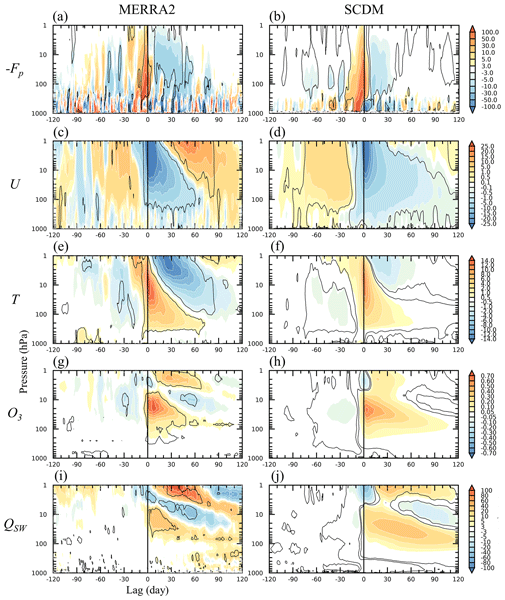
The Arctic wintertime circulation of the stratosphere has pronounced impacts on the troposphere and surface climate. Changes in the stratospheric circulation can lead to either increases or decreases in Arctic ozone. Understanding the interactions between ozone and the circulation will have the benefit of model prediction for the climate. This study introduces an economical and fast simplified model that represents the realistic distribution of ozone and its interaction with the circulation.
Molly E. Menzel, Darryn W. Waugh, Zheng Wu, and Thomas Reichler
Weather Clim. Dynam., 5, 251–261, https://doi.org/10.5194/wcd-5-251-2024, https://doi.org/10.5194/wcd-5-251-2024, 2024
Short summary
Short summary
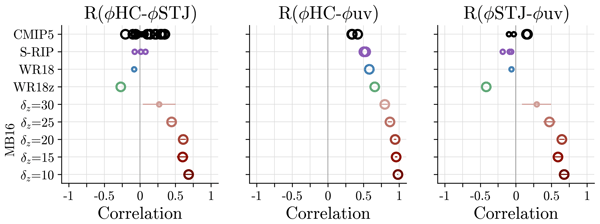
Recent work exploring the tropical atmospheric circulation response to climate change has revealed a disconnect in the latitudinal location of two features, the subtropical jet and the Hadley cell edge. Here, we investigate if the surprising result from coupled climate model and meteorological reanalysis output is consistent across model complexity.
Daniel Baldassare, Thomas Reichler, Piret Plink-Björklund, and Jacob Slawson
Weather Clim. Dynam., 4, 531–541, https://doi.org/10.5194/wcd-4-531-2023, https://doi.org/10.5194/wcd-4-531-2023, 2023
Short summary
Short summary
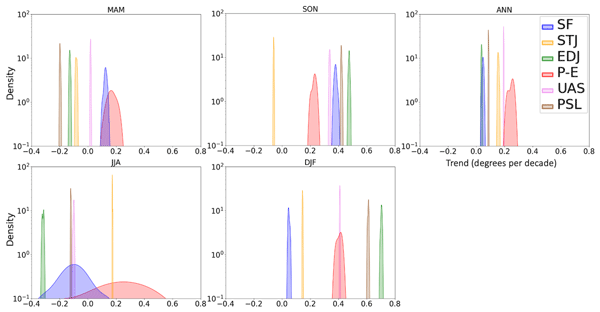
Using ensemble members from the ERA5 reanalysis, the most widely used method for estimating tropical-width trends, the meridional stream function, was found to have large error, particularly in the Northern Hemisphere and in the summer, because of weak gradients at the tropical edge and poor data quality. Another method, using the latitude where the surface wind switches from westerly to easterly, was found to have lower error due to better-observed data.
Thomas Reichler and Martin Jucker
Weather Clim. Dynam., 3, 659–677, https://doi.org/10.5194/wcd-3-659-2022, https://doi.org/10.5194/wcd-3-659-2022, 2022
Short summary
Short summary
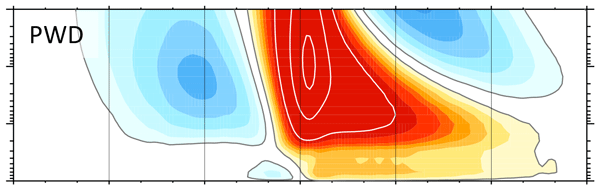
Variations in the stratospheric polar vortex, so-called vortex events, can improve predictions of surface weather and climate. There are various ways to detect such events, and here we use the amount of wave energy that propagates into the stratosphere. The new definition is tested against so-called stratospheric sudden warmings (SSWs). We find that the wave definition has advantages over SSWs, for example in terms of a stronger surface response that follows the events.
Hao-Jhe Hong and Thomas Reichler
Geosci. Model Dev., 14, 6647–6660, https://doi.org/10.5194/gmd-14-6647-2021, https://doi.org/10.5194/gmd-14-6647-2021, 2021
Short summary
Short summary
The Arctic wintertime circulation of the stratosphere has pronounced impacts on the troposphere and surface climate. Changes in the stratospheric circulation can lead to either increases or decreases in Arctic ozone. Understanding the interactions between ozone and the circulation will have the benefit of model prediction for the climate. This study introduces an economical and fast simplified model that represents the realistic distribution of ozone and its interaction with the circulation.
Cited articles
Andrews, D. G., Holton, J. R., and Leovoy, C. B.: Middle Atmosphere Dynamics, Orlando, Fla, Academic Press, 1987.
Baldwin, M. P., Gray, L. J., Dunkerton, T. J., Hamilton, K., Haynes, P. H.,
Randel, W. J., Holton, J. R., Alexander, M. J., Hirota, I., Horinouchi, T.,
Jones, D. B. A., Kinnersley, J. S., Marquardt, C., Sato, K., and Takahashi,
M.: The quasi-biennial oscillation, Rev. Geophys., 39, 179–229,
https://doi.org/10.1029/1999RG000073, 2001.
Black, R. X. and McDaniel, B. A.: The dynamics of Northern Hemisphere
stratospheric final warming events, J. Atmos. Sci., 64, 2932–2946,
https://doi.org/10.1175/JAS3981.1, 2007.
Bosilovich, M. G., Akella, S., Coy, L., Cullather, R., Draper, C., Gelaro,
R., Kovach, R., Liu, Q., Molod, A., Norris, P., Wargan, K., Chao, W.,
Reichle, R., Takacs, L., Vikhliaev, Y., Bloom, S., Collow, A., Firth, S.,
Labows, G., Partyka, G., Pawson, S., Reale, O., Schubert, S. D., and Suarez,
M.: MERRA-2: Initial Evaluation of the Climate, Technical Report Series on
Global Modeling and Data Assimilation, Tech. Rep. NASA/TM-2015-104606, availabe at:
http://gmao.gsfc.nasa.gov/reanalysis/MERRA-2/docs/ (last access: 13 January 2020), 2015.
Butler, A. H., Sjoberg, J. P., Seidel, D. J., and Rosenlof, K. H.: A sudden stratospheric warming compendium, Earth Syst. Sci. Data, 9, 63–76, https://doi.org/10.5194/essd-9-63-2017, 2017.
Charlton, A. J. and Polvani, L. M.: A new look at stratospheric sudden
warmings. Part I: Climatology and modeling benchmarks, J.
Climate, 20, 449–469, https://doi.org/10.1175/JCLI3996.1, 2007.
Coy, L., Wargan, K., Molod, A. M., McCarty, W. R., and Pawson, S.: Structure
and dynamics of the quasi-biennial oscillation in MERRA-2, J.
Climate, 29, 5339–5354, https://doi.org/10.1175/JCLI-D-15-0809.1, 2016.
Craig, R. A. and Ohring, G.: The temperature dependence of ozone
radiational heating rates in the vicinity of the mesopeak, J. Meteor., 15,
59–62, 1958.
Davis, S. M., Hegglin, M. I., Fujiwara, M., Dragani, R., Harada, Y., Kobayashi, C., Long, C., Manney, G. L., Nash, E. R., Potter, G. L., Tegtmeier, S., Wang, T., Wargan, K., and Wright, J. S.: Assessment of upper tropospheric and stratospheric water vapor and ozone in reanalyses as part of S-RIP, Atmos. Chem. Phys., 17, 12743–12778, https://doi.org/10.5194/acp-17-12743-2017, 2017.
de la Cámara, A., Abalos, M., and Hitchcock, P.: Changes in stratospheric
transport and mixing during sudden stratospheric warmings, J. Geophys. Res.-Atmos., 123, 3356–3373, https://doi.org/10.1002/2017JD028007, 2018a.
de la Cámara, A., Abalos, M., Hitchcock, P., Calvo, N., and Garcia, R. R.: Response of Arctic ozone to sudden stratospheric warmings, Atmos. Chem. Phys., 18, 16499–16513, https://doi.org/10.5194/acp-18-16499-2018, 2018b.
Dhaka, S. K., Kumar, V., Choudhary, R. K., Ho, S.-P., Takahashi, M., and
Yoden, S.: Indications of a strong dynamical coupling between the polar and
tropical regions during the sudden stratospheric warming event January 2009,
based on COSMIC/FORMASAT-3 satellite temperature data, Atmos. Res., 166,
60–69, https://doi.org/10.1016/j.atmosres.2015.06.008, 2015.
Dunkerton, T. J., Delisi, D. P., and Baldwin, M. P.: Distribution of major
stratospheric warmings in relation to the quasi-biennial oscillation,
Geophys. Res. Lett., 15, 136–139, https://doi.org/10.1029/GL015i002p00136,
1988.
Eliassen, A. and Palm, E.: On the transfer of energy in stationary mountain
waves, Geofys. Publ., 22, 1–23, 1961.
Gómez-Escolar, M., Calvo, N., Barriopedro, D., and Fueglistaler, S.:
Tropical response to stratospheric sudden warmings and its modulation by the
QBO, J. Geophys. Res.-Atmos., 119, 7382–7395,
https://doi.org/10.1002/2013JD020560, 2014.
Haase, S. and Matthes, K.: The importance of interactive chemistry for stratosphere–troposphere coupling, Atmos. Chem. Phys., 19, 3417–3432, https://doi.org/10.5194/acp-19-3417-2019, 2019.
Hartmann, D. L., Wallace, J. M., Limpasuvan, V., Thompson, D. W. J., and
Holton, J. R.: Can ozone depletion and global warming interact to produce
rapid climate change, P. Natl. Acad. Sci. USA, 97, 1412–1417,
https://doi.org/10.1073/pnas.97.4.1412, 2000.
Hitchcock, P. and Shepherd, T. G.: Zonal-mean dynamics of extended
recoveries from stratospheric sudden warmings, J. Atmos. Sci., 70, 688–707,
https://doi.org/10.1175/JAS-D-12-0111.1, 2013.
Hocke, K., Lainer, M., and Schanz, A.: Composite analysis of a major sudden stratospheric warming, Ann. Geophys., 33, 783–788, https://doi.org/10.5194/angeo-33-783-2015, 2015.
Horan, M. F. and Reichler, T.: Modeling seasonal sudden stratospheric
warming climatology based on polar vortex statistics, J.
Climate, 30, 10101–10116, https://doi.org/10.1175/JCLI-D-17-0257.1, 2017.
Hu, J., Ren, R., and Xu, H.: Occurrence of winter stratospheric sudden
warming events and the seasonal timing of spring stratospheric final
warming, J. Atmos. Sci., 71, 2319–2334,
https://doi.org/10.1175/JAS-D-13-0349.1, 2014.
Isaksen, I. S. A., Zerefos, C., Wang, W.-C., Balis, D., Eleftheratos, K.,
Rognerud, B., Stordal, F., Berntsen, T. K., LaCasce, J. H., Søvde, O. A.,
Olivié, D., Orsolini, Y. J., Zyrichidou, I., Prather, M., and Tuinder,
O. N. E.: Attribution of the Arctic ozone column deficit in March 2011,
Geophys. Res. Lett., 39, L24810, https://doi.org/10.1029/2012GL053876, 2012.
Kodera, K.: Influence of stratospheric sudden warming on the equatorial
troposphere, Geophys. Res. Lett., 33, L06804,
https://doi.org/10.1029/2005GL024510, 2006.
Kuroda, Y. and Kodera, K.: Variability of the polar-night jet in the
Northern and Southern Hemispheres, J. Geophys. Res., 106, 20703–20713,
https://doi.org/10.1029/2001JD900226, 2001.
Leovy, C. B., Sun, C.-R., Hitchman, M. H., Remsberg, E. E., Russell, J. M.,
Gordley, L. L., Gille, J. C., and Lyjak, L. V.: Transport of ozone in the
middle stratosphere: Evidence for planetary wave breaking, J. Atmos. Sci.,
42, 230–244,
https://doi.org/10.1175/1520-0469(1985)042<0230:TOOITM>2.0.CO;2,
1985.
Li, F., Vikhliaev, Y. V., Newman, P. A., Pawson, S., Perlwitz, J., Waugh, D.
W., and Douglass, A. R.: Impacts of interactive stratospheric chemistry on
Antarctic and Southern Ocean climate change in the Goddard Earth Observing
System, version 5 (GEOS-5), J. Climate, 29, 3199–3218,
https://doi.org/10.1175/JCLI-D-15-0572.1, 2016.
Limpasuvan, V., Thompson, D. W. J., and Hartmann, D. L.: The life cycle of
the Northern Hemisphere sudden stratospheric warmings, J. Climate, 17,
2584–2596,
https://doi.org/10.1175/1520-0442(2004)017<2584:TLCOTN>2.0.CO;2,
2004.
Limpasuvan, V., Hartmann, D. L., Thompson, D. W. J., Jeev, K., and Yung, Y.
L.: Stratosphere-troposphere evolution during polar vortex intensification,
J. Geophys. Res., 110, D24101, https://doi.org/10.1029/2005JD006302, 2005.
Lubis, S. W., Silverman, V., Matthes, K., Harnik, N., Omrani, N.-E., and Wahl, S.: How does downward planetary wave coupling affect polar stratospheric ozone in the Arctic winter stratosphere?, Atmos. Chem. Phys., 17, 2437–2458, https://doi.org/10.5194/acp-17-2437-2017, 2017.
Ma, J., Waugh, D. W., Douglass, A. R., Kawa, S. R., Newman, P. A., Pawson,
S., Stolarski, R., and Lin, S. J.: Interannual variability of stratospheric
trace gases: The role of extratropical wave driving, Q. J. Roy. Meteor.
Soc., 130, 2459–2474, https://doi.org/10.1256/qj.04.28, 2004.
Manney, G. L. and Lawrence, Z. D.: The major stratospheric final warming in 2016: dispersal of vortex air and termination of Arctic chemical ozone loss, Atmos. Chem. Phys., 16, 15371–15396, https://doi.org/10.5194/acp-16-15371-2016, 2016.
Manney, G. L., Santee, M. L., Rex, M., Livesey, N. J., Pitts, M. C.,
Veefkind, P., Nash, E. R., Wohltmann, I., Lehmann, R., Froidevaux, L.,
Poole, L. R., Schoeberl, M. R., Haffner, D. P., Davies, J., Dorokhov, V.,
Gernandt, H., Johnson, B., Kivi, R., Kyrö, E., Larsen, N., Levelt, P.
F., Makshtas, A., McElroy, C. T., Nakajima, H., Parrondo, M. C., Tarasick,
D. W., Gathen, P., Walker, K. A., and Zinoviev, N. S.: Unprecedented Arctic
ozone loss in 2011, Nature, 478, 469–475,
https://doi.org/10.1038/nature10556, 2011.
Manney, G. L., Livesey, N. J., Santee, M. L., Froidevaux, L., Lambert, A.,
Lawrence, Z. D., Millán, L. F., Neu, J. L., Read, W. G., Schwartz, M.
J., and Fuller, R. A.: Record-low Arctic stratospheric ozone in 2020: MLS
observations of chemical processes and comparisons with previous extreme
winters, Geophys. Res. Lett., 47, e2020GL089063,
https://doi.org/10.1029/2020GL089063, 2020.
McIntyre, M. E.: How well do we understand the dynamics of stratospheric
warmings, J. Meteorol. Soc. Jpn., 60, 37–65,
https://doi.org/10.2151/jmsj1965.60.1_37, 1982.
Newman, P. A., Coy, L., Pawson, S., and Lait, L. R.: The anomalous change in
the QBO in 2015–2016, Geophys. Res. Lett., 43, 8791–8797,
https://doi.org/10.1002/2016GL070373, 2016.
Plumb, R. A. and Eluszkiewicz, J.: The Brewer-Dobson circulation: Dynamics
of the tropical upwelling, J. Atmos. Sci., 56, 868–890,
https://doi.org/10.1175/1520-0469(1999)056<0868:TBDCDO>2.0.CO;2,
1999.
Polvani, L. M. and Waugh, D. W.: Upward wave activity flux as a precursor
to extreme stratospheric events and subsequent anomalous surface weather
regimes, J. Climate, 17, 3548–3554,
https://doi.org/10.1175/1520-0442(2004)017<3548:UWAFAA>2.0.CO;2,
2004.
Randel, W. J.: Global variations of zonal mean ozone during stratospheric
warming events, J. Atmos. Sci., 50, 3308–3321,
https://doi.org/10.1175/1520-0469(1993)050<3308:GVOZMO>2.0.CO;2,
1993.
Randel, W. J. and Wu, F.: Isolation of the ozone QBO in SAGE II data by
singular-value decomposition, J. Atmos. Sci., 53, 2546–2559,
https://doi.org/10.1175/1520-0469(1996)053<2546:IOTOQI>2.0.CO;2,
1996.
Randel, W. J., Wu, F., and Stolarski, R.: Changes in column ozone correlated
with the stratospheric EP flux, J. Meteorol. Soc. Jpn., 80, 849–862,
https://doi.org/10.2151/jmsj.80.849, 2002.
Rienecker, M. M., Suarez, M. J., Todling, R., Bacmeister, J., Takacs, L.,
Liu, H.-C., Gu, W., Sienkiewicz, M., Koster, R. D., Gelaro, R., Stajner, I.,
and Nielsen, J. E.: The GEOS-5 Data Assimilation System – Documentation of
versions 5.0.1 and 5.1.0, and 5.2.0, NASA Tech. Rep. Series on Global
Modeling and Data Assimilation, NASA/TM-2008-104606, Vol. 27, 101 pp., 2008.
Romanowsky, E., Handorf, D., Jaiser, R., Wohltmann, I., Dorn, W., Ukita, J.,
Cohen, J., Dethloff, K., and Rex, M.: The role of stratospheric ozone for
Arctic-midlatitude linkages, Sci. Rep., 9, 7962,
https://doi.org/10.1038/s41598-019-43823-1, 2019.
Sagi, K., Pérot, K., Murtagh, D., and Orsolini, Y.: Two mechanisms of stratospheric ozone loss in the Northern Hemisphere, studied using data assimilation of Odin/SMR atmospheric observations, Atmos. Chem. Phys., 17, 1791–1803, https://doi.org/10.5194/acp-17-1791-2017, 2017.
Scherhag, R.: Die explosionsartigen Stratosphärenerwärmungen des
Spätwinter 1951–1952, Ber. Dtsch. Wetterd., 6, 51–63, 1952.
Shaw, T. A. and Perlwitz, J.: The life cycle of Northern Hemisphere
downward wave coupling between the stratosphere and troposphere, J. Climate,
26, 1745–1763, https://doi.org/10.1175/JCLI-D-12-00251.1, 2013.
Tao, M., Konopka, P., Ploeger, F., Riese, M., Müller, R., and Volk, C.
M.: Impact of stratospheric major warmings and the quasi-biennial
oscillation on the variability of stratospheric water vapor, Geophys. Res.
Lett., 42, 4599–4607, https://doi.org/10.1002/2015GL064443, 2015.
Tweedy, O. V., Kramarova, N. A., Strahan, S. E., Newman, P. A., Coy, L., Randel, W. J., Park, M., Waugh, D. W., and Frith, S. M.: Response of trace gases to the disrupted 2015–2016 quasi-biennial oscillation, Atmos. Chem. Phys., 17, 6813–6823, https://doi.org/10.5194/acp-17-6813-2017, 2017.
Wargan, K. G., Labow, G., Frith, S., Pawson, S., Livesey, N., and Partyka,
G.: Evaluation of the ozone fields in NASA's MERRA-2 reanalysis, J.
Climate, 30, 2961–2988, https://doi.org/10.1175/JCLI-D-16-0699.1, 2017.
Short summary
Stratospheric ozone is a crucial chemical substance that protects life on Earth from harmful ultraviolet radiation. This article demonstrates how a strong or a weak Arctic polar vortex has an impact on wintertime circulation activity and the concentration of ozone in the stratosphere. Our results suggest that changes in the strength of the polar vortex lead to not only significant and persistent ozone changes locally in the Arctic but also to evident ozone changes in the tropics.
Stratospheric ozone is a crucial chemical substance that protects life on Earth from harmful...
Altmetrics
Final-revised paper
Preprint