
the Creative Commons Attribution 4.0 License.
the Creative Commons Attribution 4.0 License.
 | 13 Jul 2026
Development of iron-mediated molecular chlorine chemistry in GEOS-Chem: model description, evaluation and global atmospheric implication
Jing Chen
Xianyi Sun
Chuang Qin
Jie Li
Qianjie Chen
Molecular chlorine (Cl2) plays a significant role in shaping atmospheric oxidative capacity (AOC), yet the GEOS-Chem global model tends to underestimate Cl2 concentrations due to incomplete representations of its formation pathways. Here, we adapt an iron (Fe)-mediated Cl2 formation mechanism into the GEOS-Chem model, explicitly representing the dynamic solubility of iron and Cl2 production. This implementation enables the GEOS-Chem model to better reproduce observed Cl2 concentrations, increasing correlation coefficient from 0.55 to 0.88 relative to the Base simulation (without Fe–Cl mechanism). Global surface mean Cl2 concentration increases about fivefold (from 0.4 to 2.2 pptv) which strengthens radical propagation, causing approximately threefold and fourfold rise in global Cl and ClO radicals, respectively. These radical perturbations further result in pronounced spatial heterogeneity in AOC. While global mean OH decreases by 5.7 % due to Cl-driven O3 removal and conversion of HOx to ClOx, eastern China experiences concurrent increases in O3 and OH (up to 14 %), as enhanced RO2 formation from Cl-accelerated VOCs oxidation elevates both OH and O3 under high-NOx conditions. Consequently, the strengthened AOC intensifies regional secondary aerosol formation with wintertime PM2.5 in eastern China surges by up to 6 %, driven primarily by accelerated nitrate production. Conversely, a discernible decline in PM2.5 occurs in the downwind regions with enhanced AOC and also remote marine regions. These findings underscore the importance to consider iron-chlorine coupling chemistry in the GEOS-Chem global model for accurately representing atmospheric oxidation processes and enhancing its reliability of air quality assessments.
- Article
(4141 KB) - Full-text XML
-
Supplement
(5175 KB) - BibTeX
- EndNote


Chlorine chemistry has been recognized as an important factor in regulating atmospheric oxidative capacity (AOC), air quality and global climate (Saiz-Lopez and von Glasow, 2012; Simpson et al., 2015; Hossaini et al., 2016; Li et al., 2022, 2023b; Saiz-Lopez et al., 2023, 2025). Chlorine radicals (Cl), which react more rapidly with many volatile organic compounds (VOCs) than hydroxyl radical (OH) (Faxon and Allen, 2013; Sun et al., 2026), can alter the abundance and cycling of key atmospheric radicals and oxidants (such as OH, HO2, RO2 and O3) through coupled reaction pathways (Faxon et al., 2015; Chen et al., 2025a, b; Saiz-Lopez and von Glasow, 2012).
Molecular chlorine (Cl2) is a key chlorine-containing species and can serve as an efficient source of Cl radicals through fast photolysis (Dai et al., 2025; Liu et al., 2017; Priestley et al., 2018). Cl2 is generally thought to be formed through several pathways, including autocatalytic gas-phase reactions (e.g., ClO + ClO, ClOO + Cl, ClNO3 + Cl), heterogeneous uptake reactions of OH, ClNO2, ClNO3, and HOCl on acidic chloride-containing aerosol (Simpson et al., 2015; Wang et al., 2019), and O3 uptake by aerosol (Li et al., 2023a). Beyond these pathways, photo-driven chloride activation has also been increasingly recognized as a potential source of Cl2 production, with relevant processes involving iron (Fe), TiO2, particulate nitrate and NH4Cl (Li et al., 2020; Peng et al., 2022; Li et al., 2026). In particular, laboratory (Wittmer et al., 2015a, b; Wittmer and Zetzsch, 2017) and field studies (Chen et al., 2024, 2025b; Röckmann et al., 2024) both suggest that aerosols containing soluble iron and chloride may generate Cl2 through Fe(III)-mediated photochemical processes, serving as a considerable additional source of Cl radicals. This mechanism has inspired recent studies on whether enhanced Cl2 production could promote Cl-initiated atmospheric CH4 removal (Li et al., 2023b; Gorham et al., 2024; Meidan et al., 2024; van Herpen et al., 2025). Besides, it also provides a basis for understanding missing daytime Cl2 and its subsequent impacts on AOC and regional air quality (van Herpen et al., 2023; Chen et al., 2024, 2025b).
A realistic treatment of soluble Fe aerosols is important for simulating Fe(III)-mediated Cl2 production. Earlier simulations about iron–chlorine chemistry treat aerosol iron solubility with fixed assumptions (e.g., a constant photoreactive Fe fraction of 1.8 % (van Herpen et al., 2023), or prescribed soluble Fe fractions of 4 % for dust and 40 % for non-dust sources; Chen et al., 2024). These simplified treatments neglect the dynamic changes in Fe solubility that occur during atmospheric transport, which are driven by aerosol acidification and complexation with organic ligands (Chen and Grassian, 2013). Observations have shown increased Fe solubility from locations near dust sources to downwind regions during atmospheric transport processes (Zhi et al., 2025; Rodríguez et al., 2021; Srinivas et al., 2014; Takahashi et al., 2011). In addition, Fe aerosols from different sources exhibit distinct dissolution behaviors. For example, Fe in coal-combustion particles dissolves much more rapidly than that in mineral dust because of the higher acidity and the presence of reactive organic and inorganic coatings in coal-combustion particles (Baldo et al., 2022). Fe emitted from biomass burning also tends to exhibit higher initial solubility than mineral dust (Wang et al., 2021b; Paris et al., 2010), making its soluble Fe emissions broadly comparable to those from dust sources (Zhang and Zheng, 2024). Therefore, a source-dependent, dynamic and process-based parameterization of Fe solubility is needed to improve the accuracy and reliability of model representations of Fe(III)-mediated Cl2 photochemical production. Recently, Meidan et al. (2024) has conducted the first global-scale attempt to link iron and Cl2 production using an asynchronous modelling framework with a more physically based treatment of iron dissolution. However, in their configuration, the online feedbacks between iron dissolution, chlorine activation, atmospheric oxidants, and secondary aerosol formation remain incompletely represented.
Herein, we updated the chemical mechanism in the GEOS-Chem global atmospheric chemistry model to include an Fe(III)-mediated Cl2 formation pathway together with a more explicit treatment of Fe dissolution. Model performance was evaluated against observations of aerosol Fe concentrations, Fe solubility, and Cl2 concentrations. The influences of Cl2 photolysis on the distribution of Cl radicals and other reactive chlorine species, AOC, and the associated feedbacks on air quality were then examined. Our results contribute to a better understanding of Fe-driven chlorine chemistry in the atmospheric halogen cycles and suggest that incorporating dynamic Fe solubility and iron-halogen interactions can enhance the representation of chlorine chemistry in the GEOS-Chem global model.
2.1 Model description
Global chemical transport model GEOS-Chem (version 14.2.3, https://doi.org/10.5281/zenodo.10246546, Yantosca et al., 2023) was employed to assess the influence of reactive chlorine chemistry on atmospheric processes. The standard chemical mechanism comprises 293 species and 921 reactions, providing a comprehensive representation of the chemical cycling of nitrogen oxides (NOx), oxidants (OH, NO3 and O3), volatile organic compounds (VOCs), aerosols, and halogens (Cl, Br, and I) in the troposphere and stratosphere. Within the GEOS-Chem standard framework, the formation of Cl2 is primarily driven by the heterogeneous uptake of HOCl, ClNO2, ClNO3, and OH onto chloride-containing aerosols (e.g. sea salt aerosols). These processes are dynamically modulated by aerosol acidity (pH), liquid water content (LWC), and specific surface area. Although gas-phase reactions (e.g., ClO self-reaction, ClOO + Cl and ClNO3 + Cl) are explicitly represented as well, they contribute marginally to the total Cl2 budget compared to heterogeneous pathways. The chemical sinks for Cl2 are photolysis and gas-phase oxidation by OH, with photolysis serving as the dominant sink which generates Cl atoms.
Building on this framework, we integrated an Fe(III)-mediated pathway for Cl2 formation in GEOS-Chem, with the goal of exploring the potential feedback between the iron cycle and reactive chlorine chemistry as well as global AOC.
2.2 Development of the Fe(III)-mediated Cl2 formation (IMC) mechanism
2.2.1 Emissions of chlorine
In this study, emissions of chlorine from both natural and anthropogenic sources are considered. Natural chlorine emissions are dominated by sea-salt aerosols (SSA), which are calculated based on the spatiotemporal variations in environmental factors, including wind speed, sea surface temperature (SST) and sea-ice fraction. SSA is categorized into fine-mode particles (with diameter of 0.2–1 µm) and coarse-mode particles (with diameter of 1–8 µm), accounting for 16 % and 84 % of total SSA emissions, respectively. Correspondingly, sea-salt chloride (pCl) is present at a fixed mass fraction of 55.04 % of SSA in each mode (Wang et al., 2019). Anthropogenic chlorine emissions (HCl + fine-mode pCl) primarily originate from waste incineration, biomass burning, and industrial processes (Fu et al., 2018; Yin et al., 2022; Chang et al., 2024). Following Fu et al. (2018), a global anthropogenic chlorine emission inventory is constructed and updated to 2023 using the latest activity data and relevant emission factors. The partitioning between HCl and pCl is dynamically determined by the ISORROPIA II thermodynamic equilibrium module (Fountoukis and Nenes, 2007) in GEOS-Chem following Wang et al. (2020).
2.2.2 Emissions of iron
Iron (Fe) emissions include both dust-bound Fe and non-dust Fe. Dust-bound Fe emissions are determined by the corresponding dust emissions and the Fe content of the mineral components. Natural dust emissions are based on a semi-empirical function which combines the topographic source function used in Goddard Chemistry Aerosol Radiation and Transport (GOCART) scheme (Ginoux et al., 2004) with the dust entrainment and deposition (DEAD) mobilization scheme (Zender et al., 2003) by Duncan Fairlie et al. (2007). Anthropogenic dust includes fine particulate matter (PM2.5) emissions from anthropogenic fugitive, combustion and industrial processes (AFCID) (Philip et al., 2017). In the model, dust emissions are represented in four distinct size bins with diameters of 0.2–2.0 µm (DST1), 2.0–3.6 µm (DST2), 3.6–6.0 µm (DST3), and 6.0–12.0 µm (DST4). Natural mineral dust is distributed across all four size bins, and originates mainly from the Sahara Desert in North Africa, the Arabian Desert, the deserts of Central and East Asia, and the Australian deserts. In contrast, anthropogenic dust is exclusively assigned to the finest bin (DST1) and primarily concentrated in regions with intensive human activities, including northern China, India, and parts of Europe.
In the standard GEOS-Chem mechanism, dust-bound Fe is simplified by assuming a uniform Fe mass fraction (3.5 %) of dust emissions. However, incorporating explicit soil mineralogy is essential for capturing spatial variability and Fe solubility (Gonçalves Ageitos et al., 2023; Nickovic et al., 2012; Scanza et al., 2015; Johnson and Meskhidze, 2013). In this study, we adopt the soil mineralogical map updated by Nickovic et al. (2012) which is based on the earlier dataset of Claquin et al. (1999). Claquin et al. (1999) identified eight key minerals, including illite (4 % as Fe), smectite (11 % as Fe), hematite (57.5 % as Fe), kaolinite (0.24 % as Fe), feldspars (0.34 % as Fe), quartz (0 % as Fe), calcite (0 % as Fe), and gypsum (0 % as Fe). Building upon this, Nickovic et al. (2012) introduced a more realistic particle-size distribution by incorporating higher-resolution soil texture data, and redistributed iron oxides across both clay (< 2 µm) and silt size, thereby establishing a more physically consistent mineralogical structure. To reduce computational cost while capturing essential chemical processes, only illite, smectite, and hematite are explicitly represented because kaolinite and feldspar collectively accounting for less than 6 % of total mineral Fe (as shown in Fig. S1 in the Supplement).
Non-dust iron emissions primarily comprise biomass burning (including wildfires) and other anthropogenic sources. Biomass-burning (BB) Fe emissions are scaled from the Quick Fire Emissions Dataset (QFED) since previous studies have demonstrated that QFED offers superior performance in capturing the spatial and temporal variability of fire activities compared to other inventories (Wu et al., 2025). Following the methodology of Hamilton et al. (2019), Fe emissions from BB are parameterized based on a mass ratio to black carbon (Fe : BC = 0.06), with 25 % and 75 % of BB Fe treated with BC-like and dust-like physical properties, respectively, to approximate their different transport and removal behaviors. Anthropogenic non-BB Fe originates mainly from shipping, aviation, and other human activities. In this study, anthropogenic non-BB Fe emissions are scaled to anthropogenic primary sulfate emissions from the Community Emissions Data System (CEDS) emission inventory which extends to 2023 and updates shipping fuel sulfur content by incorporating IMO sulfur-content agreements, assuming a fixed mass ratio of 1 : 30 following previous studies (Chen et al., 2024; Alexander et al., 2009).
2.2.3 New iron-bearing species
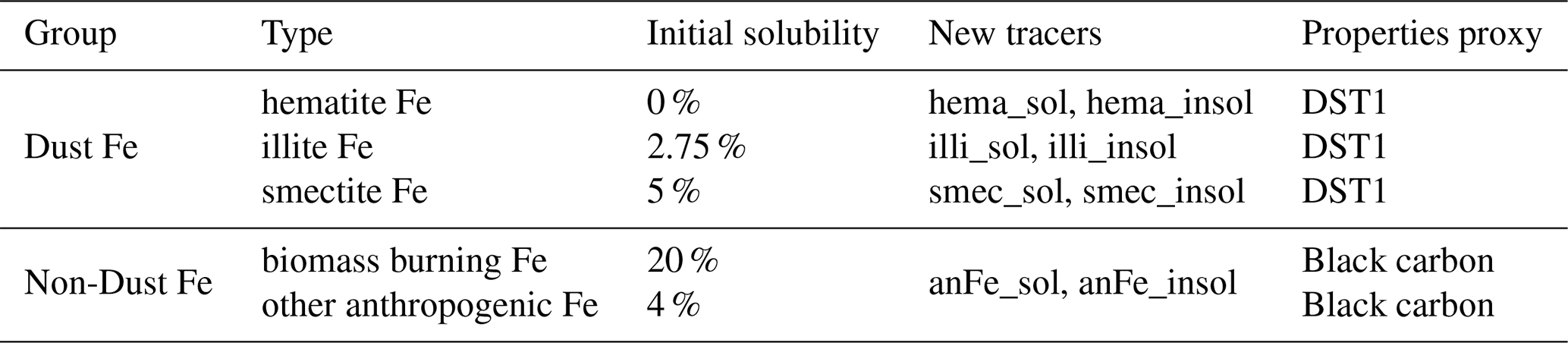
Since the Fe(III)-mediated chlorine chemistry is primarily constrained to fine particles (Chen et al., 2024), eight new iron-bearing tracers associated with the IMC mechanism are introduced into the model. These tracers can be grouped into two major groups based on their source characteristics: dust-bound Fe (Dust Fe) and non-dust Fe (Non-Dust Fe). Dust Fe includes soluble and insoluble fractions of three representative iron-bearing minerals (hematite, illite, and smectite), while non-dust Fe encompasses contributions from biomass burning and other anthropogenic sources. Since the initial solubility of Fe is strongly influenced by its source and mineralogical structure, differentiated solubility values are assigned to each tracer (as shown in Table 1). In details, dust-bound Fe is initialized with solubilities ranging from 0 % to 5 %, depending on the chemical stability of the corresponding mineral (Hamilton et al., 2019; Scanza et al., 2018). For biomass-burning Fe, whose reported solubility spans from 2.19 % to 46 % (Zhang and Zheng, 2024), a representative value of 20 % is adopted. For other anthropogenic Fe sources (primarily combustion-derived Fe), a solubility of 4 % is applied following previous studies (Luo et al., 2008; Hamilton et al., 2019; Scanza et al., 2018). In addition, each tracer is assigned specific physical proxy properties to represent its atmospheric behaviors. Specifically, fine dust Fe follows the physical characteristics of fine-mode dust (DST1), including its prescribed density and deposition parameters. For non-dust Fe, we adopt the physical characteristics of black carbon, as these iron species are typically co-emitted and internally mixed with carbonaceous aerosols. Soluble and insoluble non-dust Fe is further mapped to hydrophilic and hydrophobic host species, respectively. This treatment ensures that the simulated Fe tracers undergo more physically reasonable atmospheric transport and scavenging processes.
Table 1Summary of implemented iron-bearing tracers and associated species properties.
2.2.4 Parameterization of iron dissolution kinetics
Once released, insoluble Fe undergoes complex chemical processing that facilitates its transformation into soluble forms during atmospheric transport. The conversion is collectively driven by three primary mechanisms: proton-promoted dissolution, ligand-mediated dissolution, and photochemical reductive dissolution. To capture these processes, a multi-stage parameterization scheme is implemented to describe the dynamic dissolution kinetics. Distinct dissolution rates are assigned according to the source of each Fe tracer. Specially, dust-bound Fe generally exhibits chemically stable mineral structures and is treated using the slow kinetics scheme. In contrast, non-dust Fe, characterized by a more amorphous structure and greater specific surface area, follows medium kinetics pathways. The specific dissolution processes and parameterization details are described below, with i denoting the corresponding dissolution regime (slow or medium) in each equation.
Proton-promoted dissolution
Proton-promoted dissolution occurs as acidic species (e.g., H2SO4, HNO3) release H+ ions that attack the crystal lattice of iron oxides, mobilizing iron into the aerosol phase. This process is supported by numerous field observations which demonstrate a significant positive correlation between iron solubility and acidic ions (Zhang et al., 2021, 2023; Zhu et al., 2020). Following Meskhidze et al. (2005), the acid-promoted dissolution rate constant, k(Fesol)proton, is parameterized as Eq. (1):
where Ki(T) (mol m−2 s−1) is the temperature-dependent rate constant, mi (unitless) is the empirical reaction order and Ai (m2 g−1) is the specific surface area of the particle, with distinct formulations or values adopted for slow and medium dissolution regimes following Hamilton et al. (2019). f(∇Gr) is the thermodynamic response function, which accounts for the system's deviation from chemical equilibrium. Based on Luo et al. (2008), this value is simplified to 1. MW is the molecular weight of the species with unit of g mol−1. α(H+) represents the proton activity, which can be calculated as Eq. (2):
For simplicity, aerosol pH is determined by the concentration of major acidic species (sulfate) and the alkaline buffering capacity of mineral dust (calcite). Following Luo et al. (2008), we assume 6 % of mineral dust is soluble calcite.
Ligand-mediated dissolution
Ligand-mediated dissolution involves the formation of stable complexes between organic ligands (e.g., dicarboxylic acids, oxalate) and dissolved Fe(III), which effectively inhibits the hydrolysis and subsequent precipitation of iron thus increasing its solubility. Extensive studies have highlighted that organic ligands significantly enhance iron solubility and bioavailability, particularly in organic-rich environments. As oxalate is the most abundant dicarboxylic acid in the atmosphere, field observations have consistently identified a strong positive correlation between oxalate concentrations and soluble iron (Li et al., 2024; Zhang et al., 2021, 2024). Consequently, this study adopts a ligand-enhanced dissolution parameterization following Hamilton et al. (2019), with the reaction rate expressed as:
where ai and bi represent the source-specific rate coefficients, consistent with the values in Hamilton et al. (2019).
Since explicitly resolving full photochemical formation mechanism of oxalate would impose substantial computational cost, oxalate concentrations are diagnosed using a proxy approach. Following Hamilton et al. (2019), secondary organic aerosol (SOA) is adopted as the proxy, as its formation pathways are closely associated with the photochemical oxidation of organic precursors that also lead to oxalate production. Finally, concentration of oxalate is calculated from simulated SOA concentrations as Eq. (4):
The scaling factor of 15 is adopted from multi sensitivity simulations, which has been shown to reasonably capture the spatial characteristics of global oxalate distributions (Scanza et al., 2018). Max[SOA] denotes the global maximum SOA concentration diagnosed from the standard simulation.
Photochemical reductive dissolution
Photochemical reductive dissolution involves the reduction of Fe(III) to the more soluble Fe(II) via ligand-to-metal charge transfer (LMCT) activated by solar radiation absorbing. However, since redox cycling equilibrates much faster than aerosol transport, no additional valence-specific tracers are introduced. Instead, the instantaneous Fe(III) Fe(II) ratio is diagnosed under a quasi-steady-state assumption during the calculation of Cl2 production (Sect. 2.2.5), determined by the local photochemical radiation flux.
2.2.5 Parameterization of IMC mechanism
In this study, the total dissolved iron (totFesol, unit: mol m−3) is defined as the sum of soluble Fe originating from both mineral dust and non-dust (anthropogenic and biomass burning) sources:
where hemasol, illisol, smecsol represent soluble iron from hematite, illite, and smectite, respectively, and anFesol denotes soluble Fe from biomass burning and other anthropogenic emissions.
Since the formation of Cl2 depends strongly on the solar-radiation-driven Fe redox cycle, the fraction of Fe(II) is diagnosed following the empirical formulation of van Herpen et al. (2023) as Eq. (6):
where I is the instantaneous solar irradiance (W m−2) and I0 is the reference irradiance (600 W m−2). The rate constants k1(0.19 min−1) and k2(1.9 min−1), representing the oxidation rate of Fe(II) to Fe(III) and photoreduction rate of Fe(III) to Fe(II), respectively, following the values specified in van Herpen et al. (2023).
Laboratory studies have shown that IMC mechanism can be suppressed under specific chemical conditions. Specifically, when the molar ratio of Cl− Fe(III) reaches approximately 955, the formation of photosensitive iron–chloride complexes is substantially inhibited due to the extremely low concentration of total Fe(III), leading to negligible Cl2 production (Wittmer et al., 2015b). To avoid overestimating the contribution of this pathway in “high-chloride, low-iron” environments, this critical threshold is incorporated into the parameterization. Consequently, the final expression for the Cl2 production rate (, mol m−3 min−1) is as Eq. (7):
2.3 Model simulation scenarios
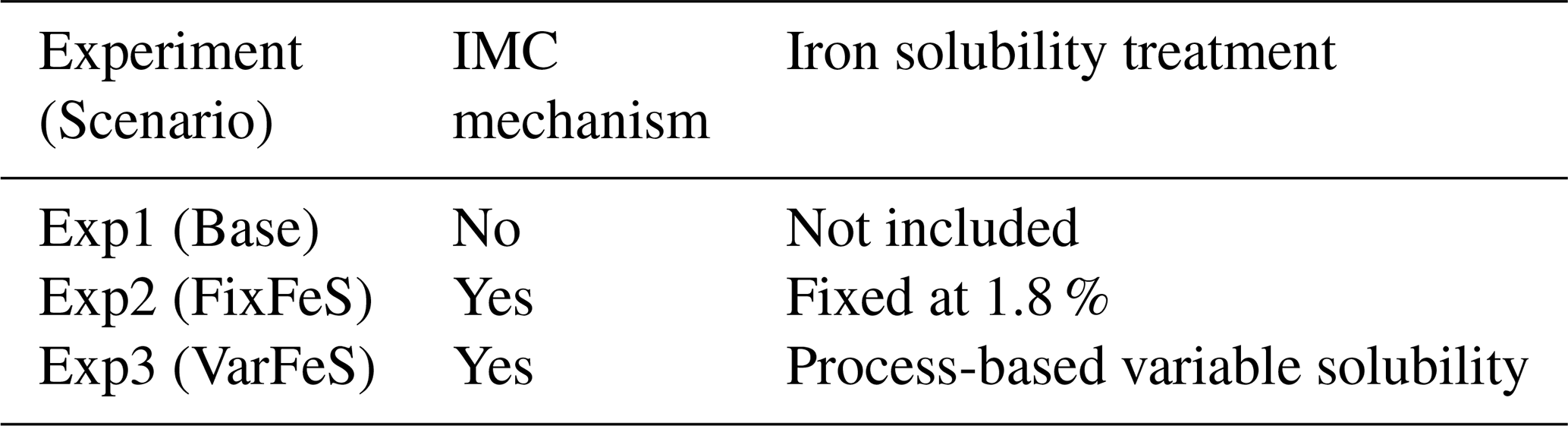
To evaluate the atmospheric impacts of IMC mechanism, we conduct three sensitivity simulations. The three scenarios differ in their treatment of Cl2 formation and iron solubility (Table 2). The “Base” simulation excludes both the IMC mechanism and iron solubility effects. The “FixFeS” simulation includes the IMC mechanism with a uniform fraction of 1.8 % for photoactive soluble iron, following the ratio treatment of photoactive Fe in van Herpen et al. (2023). The “VarFeS” simulation incorporates both the IMC mechanism and a dynamic representation of iron solubility modulated by proton processing, organic complexation, and mineralogical variability. Since the fraction of dissolved Fe that is photochemically active is not well constrained, we use dissolved Fe as a proxy for the Fe pool available for IMC-driven Cl2 production. This configuration enables us to separately evaluate the impact of the IMC mechanism and the role of iron solubility on Cl2 formation.
Each simulation is performed at 4° latitude × 5° longitude horizontal resolution with 47 vertical levels (extending from the surface to 0.01 hPa), driven by MERRA-2 meteorological fields. All runs are initialized from identical concentration fields representative of realistic atmospheric conditions and span a 1.5-year period from 1 June 2022 to 31 December 2023. The first 6 months serves as a spin-up to minimize the influence of initialization, and all analyses are based on output from the year of 2023. Aside from the updated chlorine and iron emissions described above (Sect. 2.2.1 and 2.2.2), the simulations use the standard suite of GEOS-Chem emission inventories. In details, anthropogenic and ship emissions of CO, NOx, NH3, SO2, VOCs, BC and OC are taken from the Community Emissions Data System (CEDS) version 2 (Hoesly et al., 2018). Biomass burning emissions follow QFED version 2.5r1 (Koster et al., 2015) while biogenic VOCs emissions are calculated online by Model of Emissions of Gases and Aerosols from Nature (MEGAN) version 2.1 (Guenther et al., 2012), as implemented by Hu et al. (2015). Aircraft emissions of CO, NOx, SO2, VOCs, BC and OC are taken from AEIC (Stettler et al., 2011). All emission inputs correspond to the simulation year 2023 except for AEIC aircraft emissions and AFCID, which are based on 2019 and 2015 due to data availability.
2.4 Observations for model evaluation
To assess model performance for iron dissolution processes and IMC mechanism, simulation results are evaluated against compiled observational datasets of solubility of iron and concentration of iron as well as Cl2. Global datasets provided by Myriokefalitakis et al. (2018) and Mahowald et al. (2009) are expanded with additional new observations records for both Fe concentration and solubility (as shown in Table S1 in the Supplement). These additional data points primarily cover Asian regions, which are sparsely represented in previous datasets but are characterized by high pCl emissions. In total, the final synthesized dataset comprises 1399 and 1089 observational points for total Fe concentration and Fe solubility, respectively.
In contrast to iron, observational data for Cl2 are far more limited. Reported Cl2 concentrations range from a few ppt to approximately 1 ppb, indicating a wide dynamic range driven by regional emission characteristics and rapid atmospheric reactions. Currently available Cl2 observations are characterized by limited spatial coverage, predominantly distributed across the coastal regions of China, North America, Europe, and Canada (as shown in Fig. S2). For this study, a total of 25 observational points of Cl2 are compiled. Since several sites report only peak values or nighttime averages, measurements are subsequently normalized for comparison with the model results. Detailed information for the observational dataset of Cl2 is provided in Table S2.
3.1 Model evaluation
3.1.1 Evaluation of total Fe concentrations and solubility against observations
Since three simulation scenarios share identical total iron emissions and transport processes, they yield effectively the same total aerosol Fe concentrations. Moreover, while the “Base” and “FixFeS” scenarios employ either no or uniform iron solubility, only the “VarFeS” scenario incorporates a physically based, dynamic representation of iron solubility. Therefore, the comparison of total Fe concentrations and solubility with observations in this section focuses on simulation results from the “VarFeS” scenario.
As illustrated in Fig. 1, global distribution of total aerosol Fe concentration is broadly consistent between the model simulations and the available observations. Elevated Fe concentrations (typically exceeding 2 µg m−3) are concentrated over major arid and semi-arid regions, including the North Africa, the Middle East and Central Asia, reflecting the dominance of intense mineral dust emissions in these areas (Wu et al., 2021; Shao et al., 2011). A localized enhancement is also simulated over southern South America, mainly reflecting the contribution of dust-derived Fe from the Patagonian dust source region (Fig. S3), which has been identified as an important dust source in the Southern Hemisphere (Demasy et al., 2024; Gassó and Stein, 2007; Paparazzo et al., 2018). Similarly, enhanced Fe loadings are also simulated in regions characterized by extensive anthropogenic activities, such as the North China Plain, India and Europe. In contrast, over remote oceanic regions far from dust sources and in areas with limited anthropogenic influence (like central Pacific and Southern Ocean), both simulations and observations exhibit low Fe loadings, consistent with progressive deposition during long-range transport. In addition, the model also effectively captures the primary intercontinental transport pathways, such as atmospheric outflow of North African dust toward North Atlantic and South America, and the transport of Central Asian dust to the North Pacific (Zan et al., 2025), as evidenced by the gradually decreasing Fe concentration along these routes.
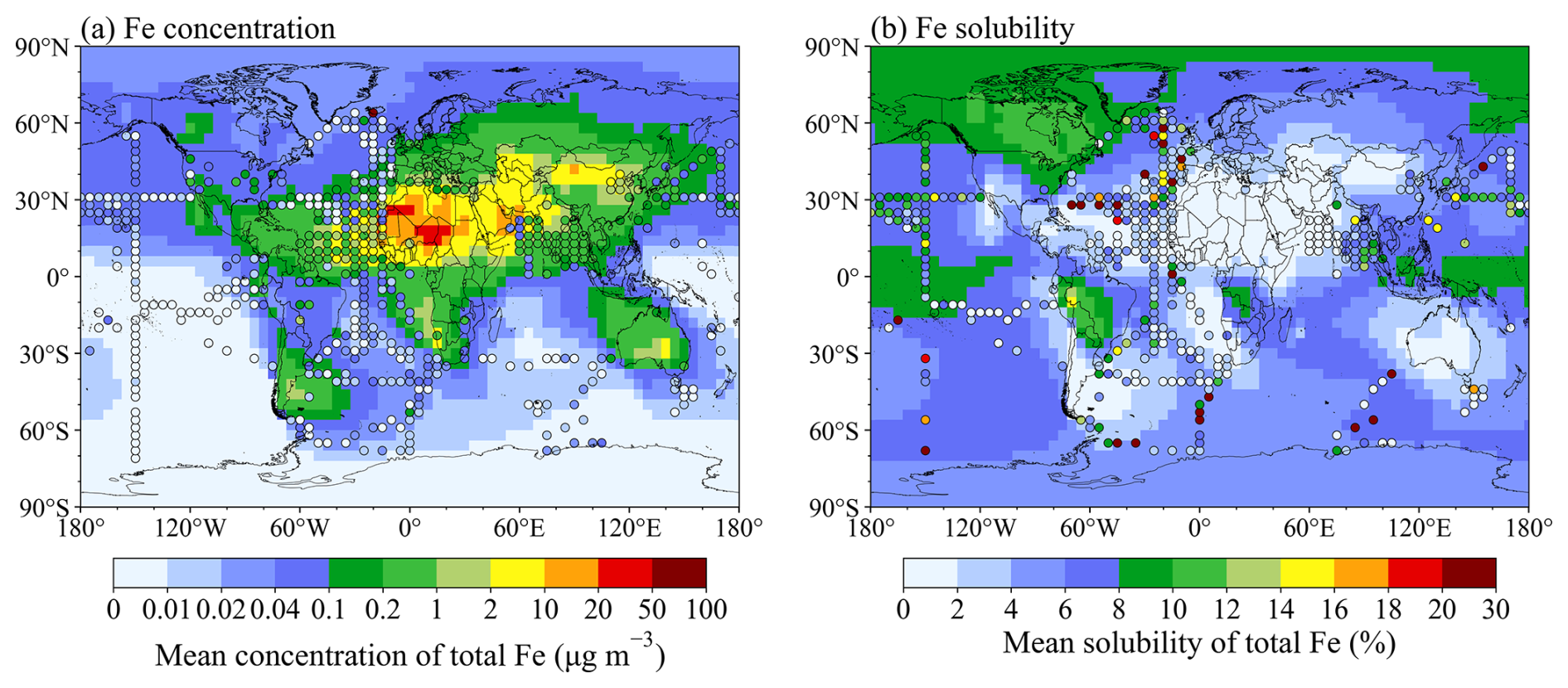
Figure 1Comparison of modelled annual mean surface results with observational records for (a) total aerosol Fe concentration and (b) Fe solubility. Observations (circles) have been averaged to the resolution of the model grid.
The comparison between simulated and observed Fe solubility reveals more pronounced regional heterogeneity, reflecting the combined effects of iron speciation, source characteristics, and atmospheric processing. Modelled surface mean value of total Fe solubility at all the observational sites globally is 3.4 %, which is in good agreement with the observational value of 3.2 %. Generally, the model simulates low solubility (typically < 2 %) over major dust source regions such as the Sahara Desert, the Gobi Desert, and inland Australia Desert, consistent with the dominance of poorly soluble iron oxides in freshly emitted mineral dust in these areas. A similar feature is also found over southern South America, where the enhanced Fe is mainly associated with freshly emitted Patagonian dust. The low solubility in this region is therefore consistent with the dominance of relatively insoluble mineral Fe phases and the limited atmospheric aging near the dust source. In contrast, remote oceanic regions exhibit substantially higher solubility, in line with previous observational evidences that Fe solubility increases during long-range transport (Takahashi et al., 2011; Srinivas et al., 2014; Rodríguez et al., 2021). In addition to atmospheric processing, regional differences in Fe source composition also contribute to the spatial variability of Fe solubility. Although both mid-to-high-latitude North America and East Asia experience frequent open biomass burning, they exhibit distinct Fe solubility patterns. As shown in Fig. S3, the relatively high solubility over northern North America is mainly associated with the stronger contribution of boreal biomass-burning Fe, which is represented with relatively high initial solubility in the model. In East Asia, however, aerosol Fe is mainly from mineral dust transported from the Taklimakan and Gobi deserts, as well as anthropogenic fugitive, combustion, and industrial Fe sources (Philip et al., 2017; Zhu et al., 2025; Bunnell et al., 2025; Sakata et al., 2025), which generally correspond to lower Fe solubility. Therefore, the biomass-burning Fe signal is largely diluted by these larger Fe inputs, leading to lower bulk Fe solubility over East Asia despite the occurrence of biomass burning.
Notably, the observational datasets display substantial inherent spatial variability, with solubility values differing by orders of magnitude even between nearby sites. This strong spatial heterogeneity highlights the sensitivity of Fe solubility to local environmental conditions, including acidic gases concentrations, organic ligands availability, the diversity of aerosol origins, and even sample storage and analytical protocols. Overall, the model reproduces the large-scale gradients in Fe solubility, but local discrepancies persist, underscoring the regional diversity of solubilization mechanisms and the remaining uncertainties in their parameterization within the model.
3.1.2 Evaluation of Cl2 concentrations against observations
Incorporating alternative dissolution pathways and IMC mechanism markedly improves the model's ability to reproduce observed Cl2, with the correlation coefficient increasing from 0.55 (“Base”) to 0.88 (“VarFeS”) and reducing the normalized mean bias (NMB) from −82.5 % to 45.9 %. Specifically, for lower Cl2 concentrations (below 10 pptv), the improvement is even more pronounced, with the NMB shifting from −86.3 % to 18.0 %. As shown in Fig. 2, the absence of IMC mechanism in the “Base” scenario leads to a systematic underestimation of Cl2, with simulated concentrations up to 83 % lower than observations. In the “FixFeS” scenario, a fixed 1.8 % fraction of photoactive Fe also results in a lower correlation with observations (r = 0.74) compared with “VarFeS” scenario. This discrepancy reflects the inability of a constant fraction to represent the realistic spatial variability of soluble Fe abundances. This is supported by the fact that Fe solubility itself exhibits significant regional heterogeneity. For instance, observed soluble Fe fractions can reach as high as 32 % in the North Atlantic due to anthropogenic pollutants from North America and Europe (Chen and Siefert, 2004). In contrast, by incorporating source-dependent variable Fe dissolution mechanism, the Cl2 concentrations in the “VarFeS” scenario match observations better across most sites, even though an overall overestimation exists. In comparison with the previous nested GEOS-Chem study over North China by Chen et al. (2024), both studies consistently show that traditional gas-phase and heterogeneous Cl2 formation mechanisms substantially underestimate observed Cl2, while IMC mechanism markedly improves model performance. At the Wangdu site, Chen et al. (2024) reported observed mean Cl2 mixing ratios of 48 ± 51 pptv during the daytime and 28 ± 35 pptv at night, while their “RUNFe” simulation reproduced approximately one-third of the observed daytime mean and one-half of the nighttime mean. In this study, the monthly mean Cl2 mixing ratio at the Wangdu site is 58.5 pptv, broadly consistent with the observed daytime magnitude but higher than the nighttime mean. This overestimation may result from the inherent limitations of the IMC parameterization. Since the rate constants k1 and k2 adopted in this study are derived from field measurements conducted in the North Atlantic (van Herpen et al., 2023), so extending these regional constrained empirical parameters to a global scale may introduce inherent uncertainties, as the chemical composition and aging of aerosols vary geographically. The use of soluble Fe as a surrogate for photoactive Fe may also contribute to this positive bias, as only a fraction of dissolved Fe can effectively participate in photochemical Fe cycling. In addition, the current IMC parameterization also implicitly assumes a 100 % conversion efficiency, where every two Fe(III) Fe(II) photoactivate cycles yield one Cl2 molecule (as reflected in the stoichiometric factor). However, photo-induced electrons or intermediate species (e.g., Cl radicals) may undergo competitive quenching or side reactions with other reducing constituents such as organic matter or reduced sulfur species. Furthermore, the simplified treatment of organic ligands also introduces uncertainty which neglects the potential competitive complexation between oxalate and chloride for Fe(III). Thus, actual Cl2 yield may be overestimated under certain environmental conditions. Other potential uncertainties are discussed in Sect. S1 in the Supplement.
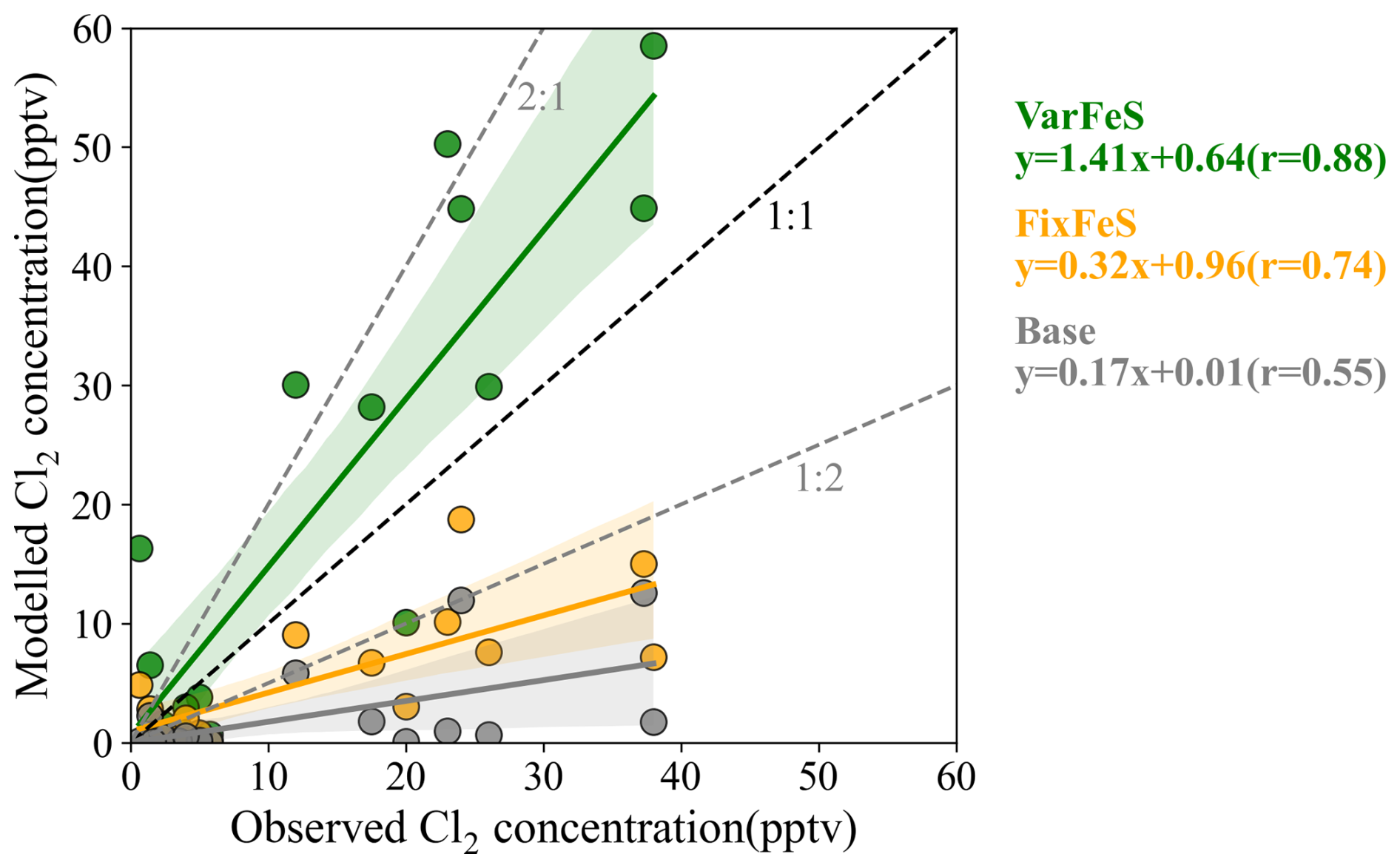
Figure 2Comparison of modelled and normalized observed Cl2 concentrations under different scenarios.
3.2 Effects on reactive chlorine species
3.2.1 Cl2
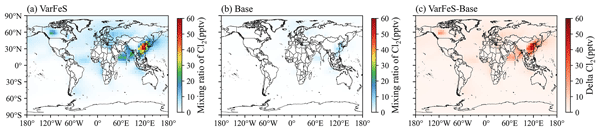
As illustrated in Fig. 3, the inclusion of the IMC mechanism induces a profound shift in global mean surface Cl2 concentration, which increases from 0.4 (with a range of 0–11) pptv in the “Base” scenario to 2.2 (with a range of 0.01–57) pptv in the “VarFeS” scenario. In the “Base” case, elevated concentrations of Cl2 are confined mainly to coastal China, driven by heterogeneous uptake of ClNO2 onto the surface of particulate chloride. In the “VarFeS” scenario for 2023, however, pronounced regional and seasonal heterogeneities exist in global Cl2 distribution. Prominent Cl2 hotpots are identified in the western Canada (WC: 8.2 ± 5.5 pptv), the eastern China (EC: 24.9 ± 16.3 pptv), the southern Asia (SA: 10.2 ± 7.6 pptv), the northern Eurasia (NE: 5.5 ± 2.3 pptv), and the tropical Atlantic (TA: 4.9 ± 1.8 pptv) (see Fig. S4 for regional definitions). Furthermore, distinct seasonal patterns are observed in these regions (Fig. S5). In WC, the Cl2 enhancement is predominantly triggered by extreme wildfire events in 2023 in summer. Wildfires simultaneously release large amounts of soluble Fe and pCl aerosols from biomass burning within a short period (Tang et al., 2021; Zhang et al., 2022) (the corresponding distribution of soluble Fe concentration is shown in Fig. S6), thereby eliminating precursor limitations on Cl2 formation processes. During summer, when solar radiation is stronger, the concentration of Cl2 reaches 11.4 ± 10.3 pptv, which is 2.4 times higher than it in winter in Canada. Consistently, the source-specific attribution analysis indicates that biomass-burning Fe provides a regionally important contribution to Cl2 production over WC (Fig. S7). By contrast, Cl2 enhancements in EC (mainly in North China Plain, NCP) and SA (mainly in India) are significantly amplified during winter. In boreal winter, elevated anthropogenic and dust-derived Fe from heating-related activities (coal and biomass combustion) and enhanced dust resuspension, together with high pCl emissions from coal burning and biomass burning, strongly favor Cl2 production. Combined with wintertime meteorological synergies, such as shallow planetary boundary layer heights and frequent stagnant conditions that suppress vertical dispersion, these factors collectively lead to the persistent accumulation of Cl2 in the surface layer. Consequently, the NCP and the northern India exhibit the strongest Cl2 enhancement during winter, with mixing ratios reaching 40–60 pptv in December. Similarly, meteorological conditions and remarkable anthropogenic dust Fe emissions lead to noticeable Cl2 production in NE during wintertime as well. In contrast to these regions, Cl2 maxima over the TA are governed by the long-term background input of natural mineral dust Fe (Fig. S7). Although dust-bound Fe possesses lower solubility, the massive total flux ensures that soluble Fe concentrations (43.5 ± 19.0 ng m−3) far above the global mean (7.1 ± 14.8 ng m−3) (Fig. S6), coupled with abundant sea-salt chloride emissions, maintains a stable Cl2 background in TA.
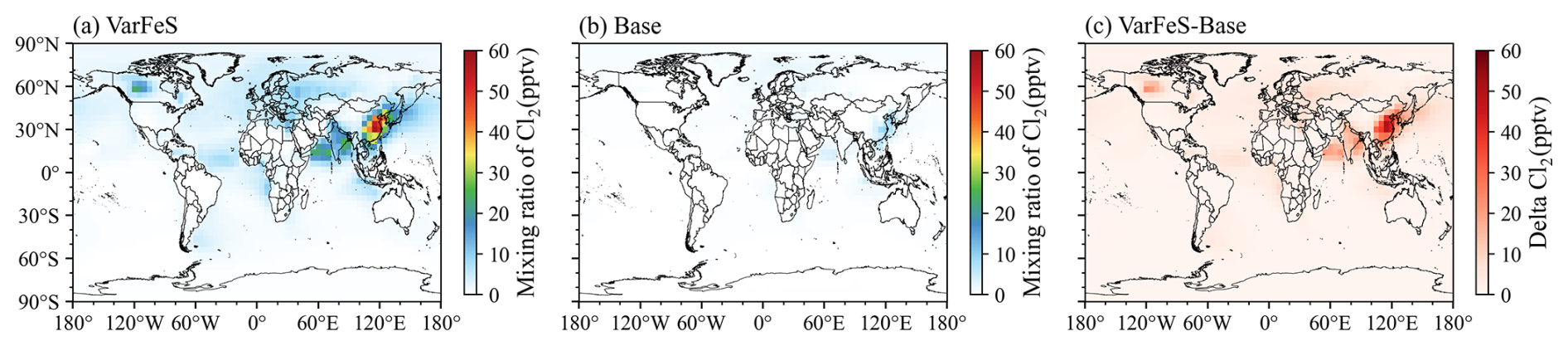
Figure 3Spatial distributions of global surface Cl2 mixing ratios under different simulation scenarios (a, b) and their corresponding absolute differences (c).
3.2.2 Other reactive chlorine species
Changes in Cl2 concentrations exert substantial downstream impacts on the broader reactive chlorine species, as depicted in Fig. 4. The spatial distribution of elevated Cl radicals (Fig. 4a) closely tracks Cl2 hotspots, reflecting the rapid photolysis of Cl2. This efficient conversion of Cl2 to Cl enlarges atmospheric Cl radical reservoir within these source regions and extends its influence into downwind environments, yielding a maximum Cl radical increase of 2.14 × 10⁴ atoms cm−3 compared to the “Base” scenario. The amplified Cl radical pool further intensifies the cycle involving Cl, O3, and ClO (ClOx cycling), driving a global rise in ClO concentrations by an average factor of 3.5, with peak enhancements reaching 84-fold (Fig. 4b). Strengthened ClOx cycling subsequently deepens its interaction with HOx and NOx chemical families, where rising ClO levels drive a 2.6-fold average increase in HOCl via the ClO and HO2 reaction (Fig. 4c). This modelled response aligns closely with recent field observations which indicated that photochemical processing of aerosol iron is a key driver of daytime Cl2 production and the subsequent formation of HOCl (Chen et al., 2025c).
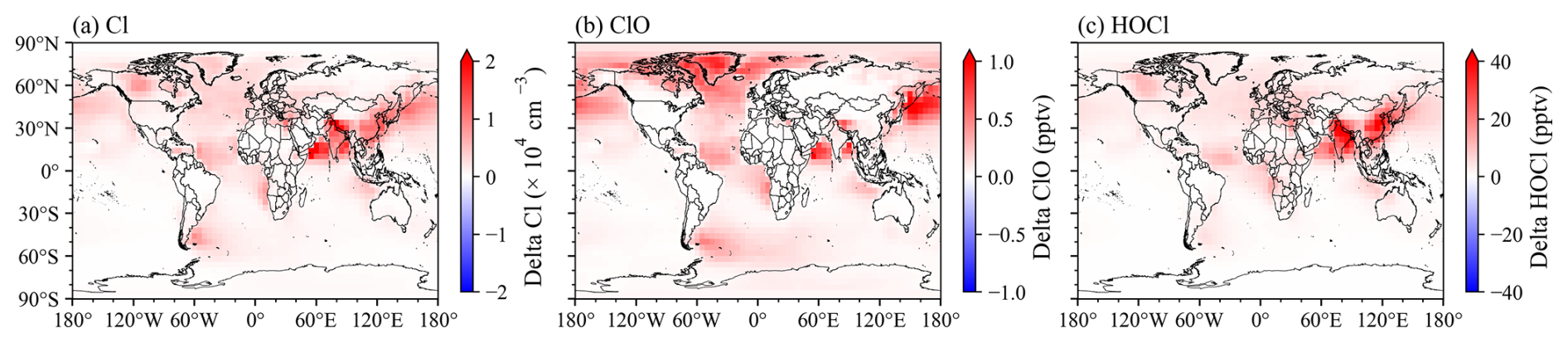
Figure 4Corresponding absolute differences between the “VarFeS” and “Base” simulations for different reactive chlorine species.
Beyond the major Cl2 production hotspots over Canada, northern China and India, the Tibetan Plateau (TP) also exhibits pronounced changes in Cl, ClO, and HOCl, likely driven by long-range transport from Southern Asia. Previous studies have shown that pre-monsoon biomass-burning emissions from western India can contribute over 60 % of PM2.5 concentrations on the TP via westerly transport (Yang et al., 2022). Besides, mineral dust from the Thar Desert (Wang et al., 2021a) and anthropogenic pollution from the Indo-Gangetic Plain (Xia et al., 2011) can be transported to the Himalayas by the combined effects of the “Himalayan pump” and the prevailing pre-monsoon circulation. Thus, it is plausible that biomass-burning aerosols enriched in pCl and Fe, together with Fe-bearing mineral dust, facilitate the production of Cl2. Then, under the TP's intense ultraviolet radiation, Cl2 is rapidly photolyzed, ultimately driving the pronounced enhancements in other reactive chlorine species observed in this region.
3.3 Effects on atmospheric oxidative capacity (AOC)
3.3.1 RO2
Inclusion of the IMC mechanism in “VarFeS” scenario significantly alters the concentration of RO2, with global annual mean RO2 concentration increasing by approximately 0.1 pptv and peak enhancement reaching 2 pptv. The spatial distribution of RO2 enhancement closely follows the major Cl2 hotspots which are driven by the role of Cl radicals. Since reaction rate constants for Cl radicals with most typical VOCs (such as methane, ethane, isoprene and α-pinene) exceed those for OH radicals by 1–2 orders of magnitude (Faxon and Allen, 2013; Sun et al., 2026), the Fe(III)-mediated Cl source greatly accelerates the production of R radicals, thereby driving rapid increases in RO2. As a result, RO2 increases by up to 30 % (2.3 % on global average), with the largest enhancements occurring in open biomass burning regions across the mid-to-high latitudes of the Northern Hemisphere. These results indicate that in regions with abundant VOCs precursors (e.g., intense wildfire emissions), the contribution of Cl radicals generated via IMC mechanism can be strongly amplified. Besides, despite extremely low background pollutant levels, the relative enhancement of RO2 remains high over Antarctica. This can be attributed to long-range transport of iron-containing aerosols from South American wildfires to the Southern Ocean, where Fe(III)-mediated photochemistry makes Cl radicals a major oxidant in these areas. Given the very low baseline RO2 concentrations, even a slight increase leads to a disproportionately large relative change. It should be noted that the simulated RO2 enhancement does not necessarily imply a uniform enhancement of AOC, as the subsequent oxidant response is strongly dependent on local NOx and O3 conditions (Pennacchio et al., 2025).
3.3.2 OH and HO2
On a global scale, the spatial distributions of surface OH and HO2 exhibit substantial changes driven primarily by chlorine-initiated cycling. With the inclusion of IMC mechanism, the global annual mean surface OH concentrations decreased by 2.5 × 10⁴ atoms cm−3, which corresponds to a 5.7 % relative reduction compared to the “Base” scenario. This decline is particularly evident in NOx-limited oceanic and remote regions, driven by two synergistic pathways: first, Cl-initiated chemistry may suppress HOx recycling as conversion of HO2 and OH to Cl ClO leads to a synchronized decline in OH levels (Simpson et al., 2015; Chen et al., 2024); secondly, since O3 photolysis represents the primary source of OH radicals in most environments (Lelieveld et al., 2016), the widespread reduction of O3 abundances by Cl radicals in these regions further curtails OH production. A similar mechanism was highlighted by Pennacchio et al. (2025), who demonstrated that Cl2-driven chemistry can suppress OH production by reducing O3 and NO2 under low-to-moderate NOx conditions, despite enhanced chlorine radical production. However, the variation characteristics are different regionally depending on the HOx recycling efficiency. The oxidation of VOCs by Cl radicals generates additional RO2, which subsequently enhances HO2 production (Dai et al., 2025). In NOx-rich regions, elevated NO levels substantially accelerate the conversion of HO2 to OH, thereby strengthening HOx recycling and increasing OH abundances. This enhancement is also partly contributed by nighttime ClNO2 chemistry, as nocturnal ClNO2 formation followed by morning photolysis provides an additional Cl radical source, further promoting HO2 production and subsequent OH regeneration (Liu et al., 2017; Riedel et al., 2014). The effect is particularly pronounced over the NCP, where enhanced RO2 formation and efficient HO2-to-OH conversion lead to a localized OH increase of up to 14 %. Similarly, parts of the United States and Europe show rising OH concentrations, as strengthened HOx cycling in these regions effectively boosts OH levels. In contrast, although a substantial rise in HO2 is also predicted for India, the resulting change in OH remains minimal. This suggests that relatively abundant VOCs in India (Pakkattil and Ghude, 2025) already drive HOx recycling toward high efficiency and near-saturation. Consequently, further regeneration becomes primarily constrained by the limited availability of NOx, thus making OH production less sensitive to additional chlorine-driven HO2 inputs. Furthermore, as noted by Pennacchio et al. (2025), the impact of Cl2 is non-linearly dependent on its production intensity as well. In the NCP, which represents the highest Cl2 production rate hotspot in our study (as shown in Fig. S8), chlorine-mediated radical chemistry may provide additional pathways (e.g., through the Cl + CH3OOH reaction) for OH formation beyond the conventional NO-driven HO2-to-OH conversion. This intensity-dependent response further helps explain the sharp contrast in OH variations between the NCP and other regions.
3.3.3 O3
Including the IMC mechanism improves the model representation of surface O3 relative to the Base scenario (Sect. S2), this provides further context for interpreting the simulated O3 responses. As depicted in Fig. 5, O3 shows two distinct responses due to differences in both regional variations in photochemical sensitivity to NOx and local intensity of Cl2 productions. Across most global regions with low NOx levels, the concentration of O3 declines as elevated Cl radicals tend to accelerate O3 loss through direct reaction (forming ClO). This decline is further exacerbated by the formation of ClONO2 (as shown in Fig. S9) via the reaction of ClO with NO2 and its subsequent hydrolysis which acts as an efficient sink of NOx thereby substantially suppresses O3 photochemical production (Pennacchio et al., 2025). Consistent with the widespread decreases in surface O3 outside high-NOx source regions, the tropospheric O3 burden declines from 367.9 Tg in the Base scenario to 357.3 Tg in the VarFeS scenario, corresponding to a 2.9 % reduction. Conversely, the NCP stands out as one of the few regions worldwide where O3 increases markedly, which is attributed to its photochemical environment dominated by high NOx levels and strong “VOCs limitation regime” (Liu et al., 2025; Yao et al., 2024). Under NOx-excess conditions, the particularly high local Cl2 production rate over the NCP likely further amplifies this positive O3 response (Fig. S8). Acceleration of VOCs oxidation by Cl radicals substantially increases RO2 concentrations and thereby promotes photochemical O3 production, overcompensating for any NOx loss via ClONO2 pathways. By contrast, although India experiences comparable NOx levels and elevated Cl2 concentrations to those in NCP, a slight decrease in O3 concentration is observed due to its distinct O3 photochemical regime. Recent satellite evidence confirms that the majority of India predominantly resides within a “NOx limited regime” with respect to ozone formation (Pakkattil and Ghude, 2025; Rawat and Naja, 2022). Consequently, the combination of chlorine-driven NOx depletion together with the direct consumption of O3 by Cl leads to decreased O3 levels over India.
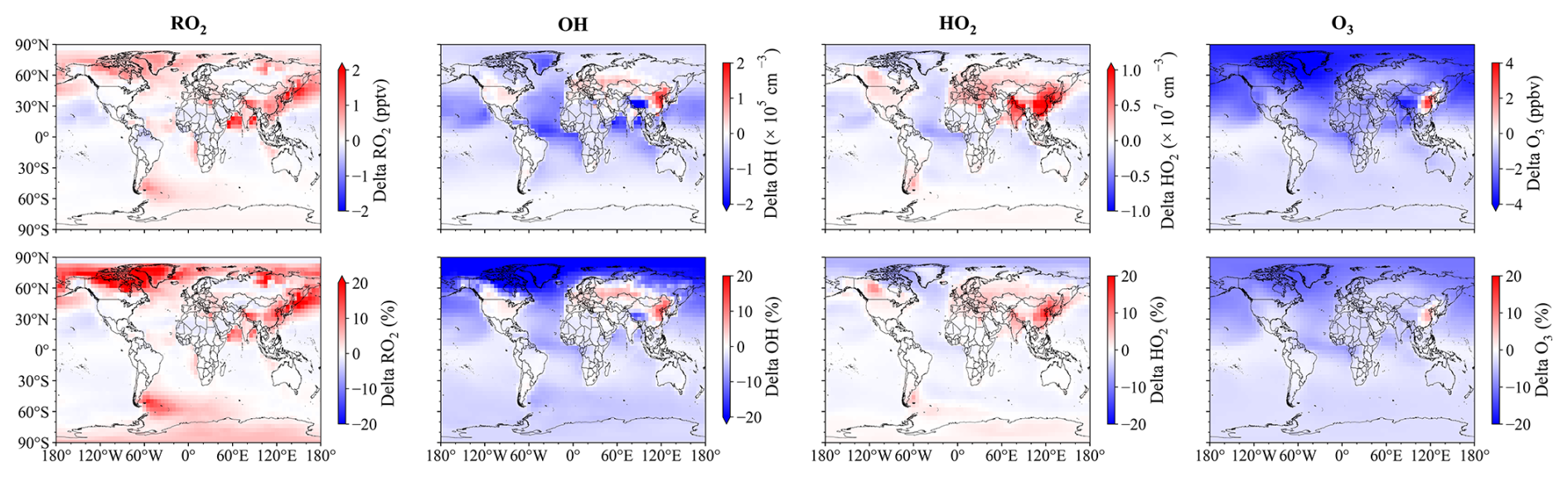
Figure 5Comparison of absolute changes (top panel: VarFeS-Base) and relative changes (bottom panel: (VarFeS − Base) Base) in annual mean surface concentration of RO2, OH, HO2 and O3.
Overall, incorporating the IMC mechanism exerts regionally differentiated impacts on the global AOC. Over the NCP, atmospheric AOC is markedly enhanced, driven by accelerated radical chain reactions and elevated oxidant levels. In other regions, however, the influence of Cl chemistry is jointly modulated by the local photochemical environment, the NOx-VOCs sensitivity regime, and background oxidant levels, resulting in a complex pattern in which enhancements and suppressions coexist.
3.4 Effects on fine particulate matter
Including the IMC mechanism significantly reshapes the global AOC by modulating radical cycling, which subsequently exerts a distinct influence on the formation and spatial distribution of fine particulate matter (PM2.5) pollution, as shown in Fig. 6.
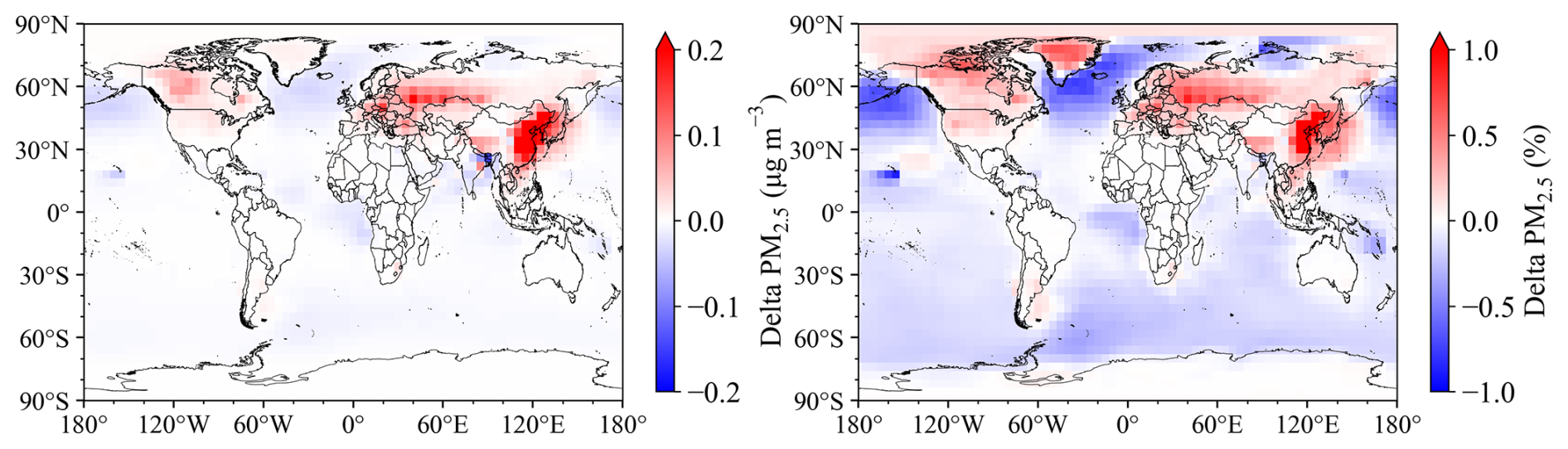
Figure 6Comparison of absolute changes (left: VarFeS-Base) and relative changes (right: (VarFeS − Base) Base) in annual mean surface concentration of PM2.5.
Spatially, PM2.5 enhancements are primarily concentrated in the mid-to-high latitude land areas of the Northern Hemisphere. While slight increases of roughly 0.5 % are found in western Europe, northern America, Canada, and parts of the Arctic Ocean, the most pronounced response appears over the NCP, where PM2.5 rises by up to 2.5 % (+2.2 µg m−3). From the perspective of chemical composition (Fig. S10), the PM2.5 enhancement is predominantly driven by nitrate formation. Over the NCP, nitrate rises by 1.9 µg m−3, accompanied by a smaller increase in ammonium (+0.4 µg m−3). This nitrate-dominated response is closely linked to elevated Cl2 concentrations. Photolysis of Cl2 generates highly reactive Cl radicals that substantially increase OH levels over the NCP. Since OH radicals are the critical daytime oxidants driving the conversion of nitrogen oxides into nitrate (Liu et al., 2020; Wang et al., 2026), the strengthened oxidizing environment accelerates nitrate formation and thereby increases PM2.5 mass concentration. This is consistent with previous studies reporting that increasing AOC significantly contributes to enhanced nitrate and PM2.5 concentrations (Feng et al., 2021; Fu et al., 2020; Zang et al., 2022). Importantly, this mechanism is further amplified under wintertime conditions, when stagnant meteorology and elevated precursor emissions coexist. In winter over the NCP, PM2.5 increases can reach up to 6.2 % (Fig. S11). High NOx levels, frequent stagnation, shallow boundary layers, and low-temperature conditions favorable for particulate nitrate stability collectively promote the partitioning of HNO3 into the particle phase. As a result, nitrate formation is substantially enhanced, leading to a pronounced increase in PM2.5 in this region.
In contrast, regions located downwind of the enhanced Cl2 production zones, as well as adjacent marine areas, exhibit a general decrease in PM2.5 concentrations. This reduction is likely attributable to the accelerated oxidation of NOx and other precursors near the source regions under strengthened AOC. As NOx is more rapidly converted to HNO3 and subsequently to particulate nitrate, these species undergo earlier deposition and removal, thereby diminishing the reservoir of precursors available for long-range transport and secondary aerosol formation. Consequently, the downwind regions experience lower PM2.5 levels. In addition, this decreasing pattern is also consistent with the spatial distribution of sulfate reductions (Fig. S10). Under conditions of enhanced HOx cycling, nitrate and sulfate do not respond uniformly to the IMC mechanism. While nitrate formation is primarily driven by increased OH oxidation (Liu et al., 2020; Wang et al., 2026), sulfate production is governed not only by gas-phase OH oxidation of SO2 but also by aqueous, heterogeneous, and transition-metal-catalyzed oxidation pathways (Guo et al., 2024; Gao et al., 2024; He et al., 2025). Besides, hydroxymethanesulfonate (HMS) formed through the reaction between dissolved SO2 and HCHO can subsequently be oxidized by aqueous OH radicals to sulfate (Song et al., 2019; Dovrou et al., 2022; Ma et al., 2020). Though elevated regional OH levels promote HCHO production which further increases the concentration of HMS (Fig. S12), HMS formation may temporarily sequester precursor SO2, and its subsequent oxidation is likely insufficient to offset the suppression of sulfate formation via direct SO2 oxidation. Therefore, sulfate concentrations slightly decrease over the NCP despite the enhanced OH levels.
It should be noted, however, that the GEOS-Chem model employs a simplified SOA scheme, which likely leads to an underestimation of the impact of chlorine chemistry on SOA formation and, consequently, on total PM2.5 concentrations. Overall, the IMC mechanism enhances regional AOC, thereby promoting the formation and accumulation of PM2.5 near source regions and redistributing particulate matter on a regional scale. Therefore, future regional air-quality management strategies need to consider the roles of iron cycling and halogen chemistry jointly.
We incorporated an Fe(III)-mediated Cl2 production mechanism into the GEOS-Chem global atmospheric chemistry model to quantify its impacts on global atmospheric oxidative capacity, ozone chemistry, and secondary aerosol formation. Incorporating this pathway enhances GEOS-Chem's ability to represent observed Cl2 concentrations, increasing the correlation coefficient from 0.55 to 0.88 relative to “Base” scenario.
Substantial changes in global reactive chlorine species and atmospheric oxidative capacity emerge following the model update. Global mean tropospheric Cl2 increases from 0.4 to 2.2 pptv, with hotspots exceeding 40 pptv over the eastern China and India. Rapid photolysis of Cl2 expands the Cl radical reservoir and strengthens VOCs oxidation, leading to a 2.3 % increase in global RO2 (peaking at 30 % in wildfire-influenced regions). Enhanced Cl-driven oxidation perturbs HOx recycling by O3 depletion and converting OH and HO2 into Cl and ClO in the remote marine regions, leading to a synchronized decline in OH and ultimately a 5.7 % reduction in the global mean OH levels. In contrast, the eastern China exhibits concurrent increases in both O3 and OH (up to +14 %), as Cl-accelerated VOCs oxidation under its strongly VOC-limited chemical regime. Such perturbations significantly impact regional air quality. Specifically, Fe-Cl chemistry elevates PM2.5 mass concentrations across the mid-to-high latitude Northern Hemisphere. The most pronounced response occurs in eastern China, where PM2.5 increases by up to 2.5 %, primarily driven by accelerated NOx oxidation under elevated daytime OH. This effect is further intensified during stagnant winter episodes, with localized PM2.5 surges reaching 6 %, while PM2.5 is reduced downstream.
In summary, model results demonstrate that Fe(III)-mediated Cl2 production can exert substantial impacts on global radical budget and regional AOC. By promoting near-source aerosol formation while diminishing downwind concentrations, this mechanism reshapes the spatial pattern of secondary pollution. Considering this pathway is therefore essential for accurately representing atmospheric oxidation processes and enhancing the reliability of air quality assessments.
For model evaluation, the observational datasets used to evaluate simulated total aerosol Fe concentrations and Fe solubility were mainly compiled from the global datasets of Myriokefalitakis et al. (2018) and Mahowald et al. (2009), with additional observational records summarized in Table S1. The Cl2 observational dataset used to evaluate the performance of the implemented Fe(III)-mediated Cl2 formation mechanism is presented in Table S2. Surface O3 observations used for model evaluation were obtained from publicly available air-quality monitoring datasets, including OpenAQ (https://openaq.org/, last access: 2 July 2026), the China National Environmental Monitoring Centre (https://www.cnemc.cn/, last access: 2 July 2026), the U.S. Environmental Protection Agency (https://www.epa.gov/, last access: 2 July 2026), and the European Environment Agency (https://www.eea.europa.eu/en, last access: 2 July 2026).
For model development, the standard GEOS-Chem model version 14.2.3 used in this study is publicly available at Zenodo repository (https://doi.org/10.5281/zenodo.10246546, Yantosca et al., 2023), the soil mineralogical data used to represent dust Fe were taken from Nickovic et al. (2012), the modified GEOS-Chem source-code files associated with Fe dissolution processes and Cl2 formation mechanisms implemented in this study are available on Zenodo (https://doi.org/10.5281/zenodo.20529218, Chen, 2026).
The supplement related to this article is available online at https://doi.org/10.5194/acp-26-9809-2026-supplement.
JC: conceptualization, methodology, formal analysis, software, visualization, writing (original draft preparation), writing (review and editing). XS: methodology. CQ: methodology. JL: methodology. QC: methodology, funding acquisition, writing (review and editing). XF: conceptualization, methodology, resources, funding acquisition, supervision, writing (review and editing).
The contact author has declared that none of the authors has any competing interests.
Publisher's note: Copernicus Publications remains neutral with regard to jurisdictional claims made in the text, published maps, institutional affiliations, or any other geographical representation in this paper. The authors bear the ultimate responsibility for providing appropriate place names. Views expressed in the text are those of the authors and do not necessarily reflect the views of the publisher.
We would like to thank Prof. Nicholas Meskhidze and Prof. Douglas Hamilton from NC State University for their help on Fe parameterization.
This research has been supported by the Natural Science Foundation of Guangdong Province (grant no. 2025A1515012215), the Natural Science Foundation of Shenzhen Municipality (grant no. JCYJ20220530143007016), the National Key Research and Development Program of China (grant no. 2023YFC3709204), and the Guangdong Provincial Pearl River Talents Program (grant no. 2023QN10L113). QC has been supported by the Hong Kong Research Grants Council (grant nos. 15219722, 25231725, and 15223221).
This paper was edited by Mingjin Tang and reviewed by three anonymous referees.
Alexander, B., Park, R. J., Jacob, D. J., and Gong, S.: Transition metal-catalyzed oxidation of atmospheric sulfur: Global implications for the sulfur budget, J. Geophys. Res.-Atmos., 114, D02309, https://doi.org/10.1029/2008JD010486, 2009.
Baldo, C., Ito, A., Krom, M. D., Li, W., Jones, T., Drake, N., Ignatyev, K., Davidson, N., and Shi, Z.: Iron from coal combustion particles dissolves much faster than mineral dust under simulated atmospheric acidic conditions, Atmos. Chem. Phys., 22, 6045–6066, https://doi.org/10.5194/acp-22-6045-2022, 2022.
Bunnell, Z. B., Sieber, M., Hamilton, D. S., Marsay, C. M., Buck, C. S., Landing, W. M., John, S. G., and Conway, T. M.: The influence of natural, anthropogenic, and wildfire sources on iron and zinc aerosols delivered to the North Pacific Ocean, Geophys. Res. Lett., 52, e2024GL113877, https://doi.org/10.1029/2024gl113877, 2025.
Chang, D., Li, Q., Wang, Z., Dai, J., Fu, X., Guo, J., Zhu, L., Pu, D., Cuevas, C. A., Fernandez, R. P., Wang, W., Ge, M., Fung, J. C. H., Lau, A. K. H., Granier, C., Brasseur, G., Pozzer, A., Saiz-Lopez, A., Song, Y., and Wang, T.: Significant chlorine emissions from biomass burning affect the long-term atmospheric chemistry in Asia, Natl. Sci. Rev., 11, nwae285, https://doi.org/10.1093/nsr/nwae285, 2024.
Chen, G., Chen, Z., Zhang, Y., Fan, X., Xu, L., Lin, Z., Ji, X., and Chen, J.: Enhanced oxidation capacity driven by pollution-induced chlorine chemistry in the coastal atmosphere, npj Clim. Atmos. Sci., 8, https://doi.org/10.1038/s41612-025-01133-6, 2025a.
Chen, G. J., Fan, X. L., Lin, Z. Y., Ji, X. T., Chen, Z. Y., Xu, L. L., and Chen, J. S.: Driving factors and photochemical impacts of Cl2 in coastal atmosphere of Southeast China, npj Clim. Atmos. Sci., 8, 2397–3722, https://doi.org/10.1038/s41612-025-01022-y, 2025b.
Chen, G. J., Fan, X. L., Yu, S. C., Tham, Y. J., Lin, Z. Y., Ji, X. T., Xu, L. L., and Chen, J. S.: HOCl formation driven by photochemical processes enhanced atmospheric oxidation capacity in a coastal atmosphere, Environ. Sci. Technol., 59, 5164–5171, https://doi.org/10.1021/acs.est.5c01363, 2025c.
Chen, H. and Grassian, V.: Iron dissolution of dust source materials during simulated acidic processing: the effect of sulfuric, acetic, and oxalic acids, Environ. Sci. Technol., 47, 10312–10321, https://doi.org/10.1021/es401285s, 2013.
Chen, J.: Modified GEOS-Chem source-code files for iron dissolution and iron-mediated molecular chlorine formation, Zenodo [code], https://doi.org/10.5281/zenodo.20529218, 2026.
Chen, Q., Wang, X., Fu, X., Li, X., Alexander, B., Peng, X., Wang, W., Xia, M., Tan, Y., Gao, J., Chen, J., Mu, Y., Liu, P., and Wang, T.: Impact of molecular chlorine production from aerosol iron photochemistry on atmospheric oxidative capacity in North China, Environ. Sci. Technol., 58, 12585–12597, https://doi.org/10.1021/acs.est.4c02534, 2024.
Chen, Y. and Siefert, R. L.: Seasonal and spatial distributions and dry deposition fluxes of atmospheric total and labile iron over the tropical and subtropical North Atlantic Ocean, J. Geophys. Res.-Atmos., 109, D09305, https://doi.org/10.1029/2003jd003958, 2004.
Claquin, T., Schulz, M., and Balkanski, Y. J.: Modeling the mineralogy of atmospheric dust sources, J. Geophys. Res.-Atmos., 104, 22243–22256, https://doi.org/10.1029/1999jd900416, 1999.
Dai, J. N., Wang, T., Shen, H. Q., Xia, M., Sun, W. H., and Brasseur, G. P.: Significant impact of a daytime halogen oxidant on coastal air quality, Environ. Sci. Technol., 59, 2169–2180, https://doi.org/10.1021/acs.est.4c08360, 2025.
Demasy, C., Boye, M., Lai, B., Burckel, P., Feng, Y., Losno, R., Borensztajn, S., and Besson, P.: Iron dissolution from Patagonian dust in the Southern Ocean: under present and future conditions, Front. Mar. Sci., 11, 1363088, https://doi.org/10.3389/fmars.2024.1363088, 2024.
Dovrou, E., Bates, K. H., Moch, J. M., Mickley, L. J., Jacob, D. J., and Keutsch, F. N.: Catalytic role of formaldehyde in particulate matter formation, P. Natl. Acad. Sci. USA, 119, https://doi.org/10.1073/pnas.2113265119, 2022.
Duncan Fairlie, T., Jacob, D. J., and Park, R. J.: The impact of transpacific transport of mineral dust in the United States, Atmos. Environ., 41, 1251–1266, https://doi.org/10.1016/j.atmosenv.2006.09.048, 2007.
Faxon, C. B. and Allen, D. T.: Chlorine chemistry in urban atmospheres: a review, Environ. Chem., 10, 221–233, https://doi.org/10.1071/en13026, 2013.
Faxon, C. B., Bean, J., and Ruiz, L.: Inland concentrations of Cl2 and ClNO2 in southeast Texas suggest chlorine chemistry significantly contributes to atmospheric reactivity, Atmosphere, 6, 1487–1506, https://doi.org/10.3390/atmos6101487, 2015.
Feng, T., Bei, N., Zhao, S., Wu, J., Liu, S., Li, X., Liu, L., Wang, R., Zhang, X., Tie, X., and Li, G.: Nitrate debuts as a dominant contributor to particulate pollution in Beijing: Roles of enhanced atmospheric oxidizing capacity and decreased sulfur dioxide emission, Atmos. Environ., 244, 117995, https://doi.org/10.1016/j.atmosenv.2020.117995, 2021.
Fountoukis, C. and Nenes, A.: ISORROPIA II: a computationally efficient thermodynamic equilibrium model for K+-Ca2+-Mg2+-NH-Na+-SO-NO-Cl−-H2O aerosols, Atmos. Chem. Phys., 7, 4639–4659, https://doi.org/10.5194/acp-7-4639-2007, 2007.
Fu, X., Wang, T., Wang, S., Zhang, L., Cai, S., Xing, J., and Hao, J.: Anthropogenic emissions of hydrogen chloride and fine particulate chloride in china, Environ. Sci. Technol., 52, 1644–1654, https://doi.org/10.1021/acs.est.7b05030, 2018.
Fu, X., Wang, T., Gao, J., Wang, P., Liu, Y. M., Wang, S. X., Zhao, B., and Xue, L. K.: Persistent heavy winter nitrate pollution driven by increased photochemical oxidants in northern China, Environ. Sci. Technol., 54, 3881–3889, https://doi.org/10.1021/acs.est.9b07248, 2020.
Gao, J., Wang, H., Liu, W., Xu, H., Wei, Y., Tian, X., Feng, Y., Song, S., and Shi, G.: Hydrogen peroxide serves as pivotal fountainhead for aerosol aqueous sulfate formation from a global perspective, Nat. Commun., 15, 4625, https://doi.org/10.1038/s41467-024-48793-1, 2024.
Gassó, S. and Stein, A. F.: Does dust from Patagonia reach the sub-Antarctic Atlantic ocean?, Geophys. Res. Lett., 34, https://doi.org/10.1029/2006gl027693, 2007.
Ginoux, P., Prospero, J., Torres, O., and Chin, M.: Long-term simulation of global dust distribution with the GOCART model: correlation with North Atlantic Oscillation, Environ. Modell. Softw., 19, 113–128, https://doi.org/10.1016/s1364-8152(03)00114-2, 2004.
Gonçalves Ageitos, M., Obiso, V., Miller, R. L., Jorba, O., Klose, M., Dawson, M., Balkanski, Y., Perlwitz, J., Basart, S., Di Tomaso, E., Escribano, J., Macchia, F., Montané, G., Mahowald, N. M., Green, R. O., Thompson, D. R., and Pérez García-Pando, C.: Modeling dust mineralogical composition: sensitivity to soil mineralogy atlases and their expected climate impacts, Atmos. Chem. Phys., 23, 8623–8657, https://doi.org/10.5194/acp-23-8623-2023, 2023.
Gorham, K. A., Abernethy, S., Jones, T. R., Hess, P., Mahowald, N. M., Meidan, D., Johnson, M. S., van Herpen, M. M. J. W., Xu, Y., Saiz-Lopez, A., Röckmann, T., Brashear, C. A., Reinhardt, E., and Mann, D.: Opinion: A research roadmap for exploring atmospheric methane removal via iron salt aerosol, Atmos. Chem. Phys., 24, 5659–5670, https://doi.org/10.5194/acp-24-5659-2024, 2024.
Guenther, A. B., Jiang, X., Heald, C. L., Sakulyanontvittaya, T., Duhl, T., Emmons, L. K., and Wang, X.: The Model of Emissions of Gases and Aerosols from Nature version 2.1 (MEGAN2.1): an extended and updated framework for modeling biogenic emissions, Geosci. Model Dev., 5, 1471–1492, https://doi.org/10.5194/gmd-5-1471-2012, 2012.
Guo, Z., Lu, K., Qiu, P., Xu, M., and Guo, Z.: Quantifying SO2 oxidation pathways to atmospheric sulfate using stable sulfur and oxygen isotopes: laboratory simulation and field observation, Atmos. Chem. Phys., 24, 2195–2205, https://doi.org/10.5194/acp-24-2195-2024, 2024.
Hamilton, D. S., Scanza, R. A., Feng, Y., Guinness, J., Kok, J. F., Li, L., Liu, X., Rathod, S. D., Wan, J. S., Wu, M., and Mahowald, N. M.: Improved methodologies for Earth system modelling of atmospheric soluble iron and observation comparisons using the Mechanism of Intermediate complexity for Modelling Iron (MIMI v1.0), Geosci. Model Dev., 12, 3835–3862, https://doi.org/10.5194/gmd-12-3835-2019, 2019.
He, P. Z., Chi, X. Y., Zhang, B. H., Hua, C., Dao, X., Meng, X. Y., and Ma, T. M.: Exploring the formation of atmospheric nitrate and sulfate based on one-year observations in Beijing, Aerosol Sci. Eng., https://doi.org/10.1007/s41810-025-00361-w, 2025.
Hoesly, R. M., Smith, S. J., Feng, L., Klimont, Z., Janssens-Maenhout, G., Pitkanen, T., Seibert, J. J., Vu, L., Andres, R. J., Bolt, R. M., Bond, T. C., Dawidowski, L., Kholod, N., Kurokawa, J.-I., Li, M., Liu, L., Lu, Z., Moura, M. C. P., O'Rourke, P. R., and Zhang, Q.: Historical (1750–2014) anthropogenic emissions of reactive gases and aerosols from the Community Emissions Data System (CEDS), Geosci. Model Dev., 11, 369–408, https://doi.org/10.5194/gmd-11-369-2018, 2018.
Hossaini, R., Chipperfield, M. P., Saiz-Lopez, A., Fernandez, R., Monks, S., Feng, W. H., Brauer, P., and von Glasow, R.: A global model of tropospheric chlorine chemistry: Organic versus inorganic sources and impact on methane oxidation, J. Geophys. Res.-Atmos., 121, 14271–14297, https://doi.org/10.1002/2016jd025756, 2016.
Hu, L., Millet, D. B., Baasandorj, M., Griffis, T. J., Turner, P., Helmig, D., Curtis, A. J., and Hueber, J.: Isoprene emissions and impacts over an ecological transition region in the U.S. Upper Midwest inferred from tall tower measurements, J. Geophys. Res.-Atmos., 120, 3553–3571, https://doi.org/10.1002/2014jd022732, 2015.
Johnson, M. S. and Meskhidze, N.: Atmospheric dissolved iron deposition to the global oceans: effects of oxalate-promoted Fe dissolution, photochemical redox cycling, and dust mineralogy, Geosci. Model Dev., 6, 1137–1155, https://doi.org/10.5194/gmd-6-1137-2013, 2013.
Koster, R. D., Darmenov, A. S., and da Silva, A. M.: The Quick Fire Emissions Dataset (QFED): Documentation of Versions 2.1, 2.2 and 2.4, Technical Report Series on Global Modeling and Data Assimilation, NASA/TM-2015-104606/Vol.38, https://ntrs.nasa.gov/search.jsp?R=20180005253 (last access: 2 July 2026), 2015.
Lelieveld, J., Gromov, S., Pozzer, A., and Taraborrelli, D.: Global tropospheric hydroxyl distribution, budget and reactivity, Atmos. Chem. Phys., 16, 12477–12493, https://doi.org/10.5194/acp-16-12477-2016, 2016.
Li, F. B., Huang, D. D., Nie, W., Tham, Y. J., Lou, S. R., Li, Y. Y., Tian, L. H., Liu, Y. L., Zhou, M., Wang, H. C., Qiao, L. P., Wang, H. L., Wang, Z., Huang, C., and Li, Y. J.: Observation of nitrogen oxide-influenced chlorine chemistry and source analysis of Cl2 in the Yangtze River Delta, China, Atmos. Environ., 306, 119829, https://doi.org/10.1016/j.atmosenv.2023.119829, 2023a.
Li, Q. Y., Fernandez, R. P., Hossaini, R., Iglesias-Suarez, F., Cuevas, C. A., Apel, E. C., Kinnison, D. E., Lamarque, J. F., and Saiz-Lopez, A.: Reactive halogens increase the global methane lifetime and radiative forcing in the 21st century, Nat. Commun., 13, 2768, https://doi.org/10.1038/s41467-022-30456-8, 2022.
Li, Q. Y., Meidan, D., Hess, P., Añel, J. A., Cuevas, C. A., Doney, S., Fernandez, R. P., van Herpen, M., Höglund-Isaksson, L., Johnson, M. S., Kinnison, D. E., Lamarque, J. F., Röckmann, T., Mahowald, N. M., and Saiz-Lopez, A.: Global environmental implications of atmospheric methane removal through chlorine-mediated chemistry-climate interactions, Nat. Commun., 14, 4045, https://doi.org/10.1038/s41467-023-39794-7, 2023b.
Li, S., Wang, Y., Liu, Y., Cao, Q., Chen, G., Fan, X., Li, Q., Zhang, P., Hu, R., Tham, Y. J., He, X.-C., Chu, B., Ma, Q., Chen, J., and He, H.: Photolytic oxidation of ammonium chloride as a source of Cl2 in the atmosphere, Nat. Commun., 17, 4508, https://doi.org/10.1038/s41467-026-70941-y, 2026.
Li, W., Qi, Y., Liu, Y., Wu, G., Zhang, Y., Shi, J., Qu, W., Sheng, L., Wang, W., Zhang, D., and Zhou, Y.: Daytime and nighttime aerosol soluble iron formation in clean and slightly polluted moist air in a coastal city in eastern China, Atmos. Chem. Phys., 24, 6495–6508, https://doi.org/10.5194/acp-24-6495-2024, 2024.
Li, Y., Nie, W., Liu, Y., Huang, D., Xu, Z., Peng, X., George, C., Yan, C., Tham, Y. J., Yu, C., Xia, M., Fu, X., Wang, X., Xue, L., Wang, Z., Xu, Z., Chi, X., Wang, T., and Ding, A.: Photoinduced production of chlorine molecules from titanium dioxide surfaces containing chloride, Environ. Sci. Technol. Lett., 7, 70–75, https://doi.org/10.1021/acs.estlett.9b00704, 2020.
Liu, K. X., Wang, H. Q., Gong, X., Li, Y. F., Wang, J. S., Lu, M. M., Tang, X., Xue, C. F., Peng, J. F., Song, S. J., Zhang, Y. F., and Feng, Y. C.: Shifts of the three-dimensional O3 photochemical regime of the North China Plain within the boundary layer, Environ. Sci. Technol. Lett., 12, 1197–1204, https://doi.org/10.1021/acs.estlett.5c00741, 2025.
Liu, P., Ye, C., Xue, C., Zhang, C., Mu, Y., and Sun, X.: Formation mechanisms of atmospheric nitrate and sulfate during the winter haze pollution periods in Beijing: gas-phase, heterogeneous and aqueous-phase chemistry, Atmos. Chem. Phys., 20, 4153–4165, https://doi.org/10.5194/acp-20-4153-2020, 2020.
Liu, X., Qu, H., Huey, L. G., Wang, Y., Sjostedt, S., Zeng, L., Lu, K., Wu, Y., Hu, M., Shao, M., Zhu, T., and Zhang, Y.: High levels of daytime molecular chlorine and nitryl chloride at a rural site on the North China Plain, Environ. Sci. Technol., 51, 9588–9595, https://doi.org/10.1021/acs.est.7b03039, 2017.
Luo, C., Mahowald, N., Bond, T., Chuang, P. Y., Artaxo, P., Siefert, R., Chen, Y., and Schauer, J.: Combustion iron distribution and deposition, Global Biogeochem. Cy., 22, GB1012, https://doi.org/10.1029/2007gb002964, 2008.
Ma, T., Furutani, H., Duan, F., Kimoto, T., Jiang, J., Zhang, Q., Xu, X., Wang, Y., Gao, J., Geng, G., Li, M., Song, S., Ma, Y., Che, F., Wang, J., Zhu, L., Huang, T., Toyoda, M., and He, K.: Contribution of hydroxymethanesulfonate (HMS) to severe winter haze in the North China Plain, Atmos. Chem. Phys., 20, 5887–5897, https://doi.org/10.5194/acp-20-5887-2020, 2020.
Mahowald, N. M., Engelstaedter, S., Luo, C., Sealy, A., Artaxo, P., Benitez-Nelson, C., Bonnet, S., Chen, Y., Chuang, P. Y., Cohen, D. D., Dulac, F., Herut, B., Johansen, A. M., Kubilay, N., Losno, R., Maenhaut, W., Paytan, A., Prospero, J. M., Shank, L. M., and Siefert, R. L.: Atmospheric iron deposition: global distribution, variability, and human perturbations, Annu. Rev. Mar. Sci., 1, 245–278, https://doi.org/10.1146/annurev.marine.010908.163727, 2009.
Meidan, D., Li, Q. Y., Cuevas, C. A., Doney, S. C., Fernandez, R. P., van Herpen, M., Johnson, M. S., Kinnison, D. E., Li, L. L., Hamilton, D. S., Saiz-Lopez, A., Hess, P., and Mahowald, N. M.: Evaluating the potential of iron-based interventions in methane reduction and climate mitigation, Environ. Res. Lett., 19, https://doi.org/10.1088/1748-9326/ad3d72, 2024.
Meskhidze, N., Chameides, W. L., and Nenes, A.: Dust and pollution: A recipe for enhanced ocean fertilization?, J. Geophys. Res.-Atmos., 110, D03301, https://doi.org/10.1029/2004jd005082, 2005.
Myriokefalitakis, S., Ito, A., Kanakidou, M., Nenes, A., Krol, M. C., Mahowald, N. M., Scanza, R. A., Hamilton, D. S., Johnson, M. S., Meskhidze, N., Kok, J. F., Guieu, C., Baker, A. R., Jickells, T. D., Sarin, M. M., Bikkina, S., Shelley, R., Bowie, A., Perron, M. M. G., and Duce, R. A.: Reviews and syntheses: the GESAMP atmospheric iron deposition model intercomparison study, Biogeosciences, 15, 6659–6684, https://doi.org/10.5194/bg-15-6659-2018, 2018.
Nickovic, S., Vukovic, A., Vujadinovic, M., Djurdjevic, V., and Pejanovic, G.: Technical Note: High-resolution mineralogical database of dust-productive soils for atmospheric dust modeling, Atmos. Chem. Phys., 12, 845–855, https://doi.org/10.5194/acp-12-845-2012, 2012.
Pakkattil, A. and Ghude, S.: Tropospheric ozone precursors over the Indian region: Insights into the shift toward a highly NOx-limited regime, Atmos. Environ., 353, 121233, https://doi.org/10.1016/j.atmosenv.2025.121233, 2025.
Paparazzo, F., Crespi-Abril, A., Gonçalves, R., Barbieri, E., Gracia Villalobos, L., Solís, M., and Soria, G.: Patagonian dust as a source of macronutrients in the southwest Atlantic Ocean, Oceanography, 31, 33–39, https://doi.org/10.5670/oceanog.2018.408, 2018.
Paris, R., Desboeufs, K. V., Formenti, P., Nava, S., and Chou, C.: Chemical characterisation of iron in dust and biomass burning aerosols during AMMA-SOP0/DABEX: implication for iron solubility, Atmos. Chem. Phys., 10, 4273–4282, https://doi.org/10.5194/acp-10-4273-2010, 2010.
Pennacchio, L., van Herpen, M., Meidan, D., Saiz-Lopez, A., and Johnson, M. S.: Catalytic efficiencies for methane removal: Impact of HOx, NOx, and chemistry in the high-chlorine regime, ACS Earth Space Chem., 9, 504–512, https://doi.org/10.1021/acsearthspacechem.4c00283, 2025.
Peng, X., Wang, T., Wang, W., Ravishankara, A. R., George, C., Xia, M., Cai, M., Li, Q., Salvador, C. M., Lau, C., Lyu, X., Poon, C. N., Mellouki, A., Mu, Y., Hallquist, M., Saiz-Lopez, A., Guo, H., Herrmann, H., Yu, C., Dai, J., Wang, Y., Wang, X., Yu, A., Leung, K., Lee, S., and Chen, J.: Photodissociation of particulate nitrate as a source of daytime tropospheric Cl2, Nat. Commun., 13, https://doi.org/10.1038/s41467-022-28383-9, 2022.
Philip, S., Martin, R. V., Snider, G., Weagle, C. L., van Donkelaar, A., Brauer, M., Henze, D. K., Klimont, Z., Venkataraman, C., Guttikunda, S. K., and Zhang, Q.: Anthropogenic fugitive, combustion and industrial dust is a significant, underrepresented fine particulate matter source in global atmospheric models, Environ. Res. Lett., 12, 044018, https://doi.org/10.1088/1748-9326/aa65a4, 2017.
Priestley, M., le Breton, M., Bannan, T. J., Worrall, S. D., Bacak, A., Smedley, A. R. D., Reyes-Villegas, E., Mehra, A., Allan, J., Webb, A. R., Shallcross, D. E., Coe, H., and Percival, C. J.: Observations of organic and inorganic chlorinated compounds and their contribution to chlorine radical concentrations in an urban environment in northern Europe during the wintertime, Atmos. Chem. Phys., 18, 13481–13493, https://doi.org/10.5194/acp-18-13481-2018, 2018.
Rawat, P. and Naja, M.: Remote sensing study of ozone, NO2, and CO: some contrary effects of SARS-CoV-2 lockdown over India, Environ. Sci. Pollut. Res., 29, 22515–22530, https://doi.org/10.1007/s11356-021-17441-2, 2022.
Riedel, T. P., Wolfe, G. M., Danas, K. T., Gilman, J. B., Kuster, W. C., Bon, D. M., Vlasenko, A., Li, S.-M., Williams, E. J., Lerner, B. M., Veres, P. R., Roberts, J. M., Holloway, J. S., Lefer, B., Brown, S. S., and Thornton, J. A.: An MCM modeling study of nitryl chloride (ClNO2) impacts on oxidation, ozone production and nitrogen oxide partitioning in polluted continental outflow, Atmos. Chem. Phys., 14, 3789–3800, https://doi.org/10.5194/acp-14-3789-2014, 2014.
Röckmann, T., van Herpen, M., Brashear, C., van der Veen, C., Gromov, S., Li, Q. Y., Saiz-Lopez, A., Meidan, D., Barreto, A., Prats, N., Marmol, I., Ramos, R., Banos, I., Arrieta, J. M., Zaehnle, S., Jordan, A., Moossen, H., Timas, H., Young, D., Sperlich, P., Moss, R., and Johnson, M. S.: The use of δ13C in CO to determine removal of CH4 by Cl radicals in the atmosphere, Environ. Res. Lett., 19, https://doi.org/10.1088/1748-9326/ad4375, 2024.
Rodríguez, S., Prospero, J. M., López-Darias, J., García-Alvarez, M.-I., Zuidema, P., Nava, S., Lucarelli, F., Gaston, C. J., Galindo, L., and Sosa, E.: Tracking the changes of iron solubility and air pollutants traces as African dust transits the Atlantic in the Saharan dust outbreaks, Atmos. Environ., 246, 118092, https://doi.org/10.1016/j.atmosenv.2020.118092, 2021.
Saiz-Lopez, A. and von Glasow, R.: Reactive halogen chemistry in the troposphere, Chem. Soc. Rev., 41, 6448–6472, https://doi.org/10.1039/c2cs35208g, 2012.
Saiz-Lopez, A., Fernandez, R. P., Li, Q., Cuevas, C. A., Fu, X., Kinnison, D. E., Tilmes, S., Mahajan, A. S., Gómez Martín, J. C., Iglesias-Suarez, F., Hossaini, R., Plane, J. M. C., Myhre, G., and Lamarque, J.-F.: Natural short-lived halogens exert an indirect cooling effect on climate, Nature, 618, 967–973, https://doi.org/10.1038/s41586-023-06119-z, 2023.
Saiz-Lopez, A., Mahajan, A. S., Abbatt, J., Bobrowski, N., Brown, S. S., Burrows, J. P., Carpenter, L. J., Chipperfield, M. P., Cuevas, C. A., Fernandez, R. P., Hossaini, R., Kinnison, D. E., Lamarque, J. F., Finlayson-Pitts, B. J., Plane, J. M. C., Platt, U., Pratt, K. A., Ravishankara, A. R., Salawitch, R. J., Saltzman, E. S., Simpson, W. R., Solomon, S., Thornton, J. A., and Wang, T.: The influence of short-lived halogens on atmospheric chemistry and climate, Nature, 648, 289–299, https://doi.org/10.1038/s41586-025-09753-x, 2025.
Sakata, K., Takano, S., Matsuki, A., Takeichi, Y., Tanimoto, H., Sakaguchi, A., Kurisu, M., and Takahashi, Y.: Atmospheric chemistry in East Asia determines the iron solubility of aerosol particles supplied to the North Pacific Ocean, Atmos. Chem. Phys., 25, 11087–11107, https://doi.org/10.5194/acp-25-11087-2025, 2025.
Scanza, R. A., Hamilton, D. S., Perez Garcia-Pando, C., Buck, C., Baker, A., and Mahowald, N. M.: Atmospheric processing of iron in mineral and combustion aerosols: development of an intermediate-complexity mechanism suitable for Earth system models, Atmos. Chem. Phys., 18, 14175–14196, https://doi.org/10.5194/acp-18-14175-2018, 2018.
Scanza, R. A., Mahowald, N., Ghan, S., Zender, C. S., Kok, J. F., Liu, X., Zhang, Y., and Albani, S.: Modeling dust as component minerals in the Community Atmosphere Model: development of framework and impact on radiative forcing, Atmos. Chem. Phys., 15, 537–561, https://doi.org/10.5194/acp-15-537-2015, 2015.
Shao, Y., Wyrwoll, K.-H., Chappell, A., Huang, J., Lin, Z., McTainsh, G. H., Mikami, M., Tanaka, T. Y., Wang, X., and Yoon, S.: Dust cycle: An emerging core theme in earth system science, Aeolian Res., 2, 181–204, https://doi.org/10.1016/j.aeolia.2011.02.001, 2011.
Simpson, W. R., Brown, S. S., Saiz-Lopez, A., Thornton, J. A., and von Glasow, R.: Tropospheric halogen chemistry: Sources, cycling, and impacts, Chem. Rev., 115, 4035–4062, https://doi.org/10.1021/cr5006638, 2015.
Song, S., Gao, M., Xu, W., Sun, Y., Worsnop, D. R., Jayne, J. T., Zhang, Y., Zhu, L., Li, M., Zhou, Z., Cheng, C., Lv, Y., Wang, Y., Peng, W., Xu, X., Lin, N., Wang, Y., Wang, S., Munger, J. W., Jacob, D. J., and McElroy, M. B.: Possible heterogeneous chemistry of hydroxymethanesulfonate (HMS) in northern China winter haze, Atmos. Chem. Phys., 19, 1357–1371, https://doi.org/10.5194/acp-19-1357-2019, 2019.
Srinivas, B., Sarin, M. M., and Rengarajan, R.: Atmospheric transport of mineral dust from the Indo-Gangetic Plain: Temporal variability, acid processing, and iron solubility, Geochem. Geophy. Geosy., 15, 3226–3243, https://doi.org/10.1002/2014gc005395, 2014.
Stettler, M. E. J., Eastham, S., and Barrett, S. R. H.: Air quality and public health impacts of UK airports. Part I: Emissions, Atmos. Environ., 45, 5415–5424, https://doi.org/10.1016/j.atmosenv.2011.07.012, 2011.
Sun, Y. H., Xu, L., Li, J. L., Li, K., Tchinda, N. T., and Du, L.: Role of atomic chlorine in atmospheric volatile organic compound oxidation and secondary organic aerosol formation: a review, Environ. Sci.-Atmos., 6, 7–26, https://doi.org/10.1039/d5ea00101c, 2026.
Takahashi, Y., Higashi, M., Furukawa, T., and Mitsunobu, S.: Change of iron species and iron solubility in Asian dust during the long-range transport from western China to Japan, Atmos. Chem. Phys., 11, 11237–11252, https://doi.org/10.5194/acp-11-11237-2011, 2011.
Tang, W., Llort, J., Weis, J., Perron, M. M. G., Basart, S., Li, Z., Sathyendranath, S., Jackson, T., Sanz Rodriguez, E., Proemse, B. C., Bowie, A. R., Schallenberg, C., Strutton, P. G., Matear, R., and Cassar, N.: Widespread phytoplankton blooms triggered by 2019–2020 Australian wildfires, Nature, 597, 370–375, https://doi.org/10.1038/s41586-021-03805-8, 2021.
van Herpen, M., Li, Q. Y., Saiz-Lopez, A., Liisberg, J. B., Röckmann, T., Cuevas, C. A., Fernandez, R. P., Mak, J. E., Mahowald, N. M., Hess, P., Meidan, D., Stuut, J. B. W., and Johnson, M. S.: Photocatalytic chlorine atom production on mineral dust-sea spray aerosols over the North Atlantic, P. Natl. Acad. Sci. USA, 120, e2303974120, https://doi.org/10.1073/pnas.2303974120, 2023.
van Herpen, M., Pennacchio, L., Brashear, C., Mikkelsen, M. K., Saiz-Lopez, A., Röckmann, T., and Johnson, M. S.: Photocatalytic chlorine production from iron chlorides in atmospheric aerosols: Strategies for quantifying methane and tropospheric ozone control, J. Geophys. Res.-Atmos., 130, https://doi.org/10.1029/2024jd041156, 2025.
Wang, J. Q., Du, X. H., Wen, L., Che, F., Zhang, Y. C., and Gao, J.: Particulate nitrate pollution control in North China Plain and Northeastern United States: A comparison of formation mechanism and its response to gaseous pollutants, Environ. Pollut., 397, https://doi.org/10.1016/j.envpol.2026.127939, 2026.
Wang, T., Tang, J., Sun, M., Liu, X., Huang, Y., Huang, J., Han, Y., Cheng, Y., Huang, Z., and Li, J.: Identifying a transport mechanism of dust aerosols over South Asia to the Tibetan Plateau: A case study, Sci. Total Environ., 758, 143714, https://doi.org/10.1016/j.scitotenv.2020.143714, 2021a.
Wang, W. C., Luo, C. H., Sheng, L. F., Zhao, C. F., Zhou, Y., and Chen, Y. H.: Effects of biomass burning on chlorophyll-a concentration and particulate organic carbon in the subarctic North Pacific Ocean based on satellite observations and WRF-Chem model simulations: A case study, Atmos. Res., 254, 105526, https://doi.org/10.1016/j.atmosres.2021.105526, 2021b.
Wang, X., Jacob, D. J., Fu, X., Wang, T., Breton, M. L., Hallquist, M., Liu, Z., McDuffie, E. E., and Liao, H.: Effects of anthropogenic chlorine on PM2.5 and ozone air quality in China, Environ. Sci. Technol., 54, 9908–9916, https://doi.org/10.1021/acs.est.0c02296, 2020.
Wang, X., Jacob, D. J., Eastham, S. D., Sulprizio, M. P., Zhu, L., Chen, Q., Alexander, B., Sherwen, T., Evans, M. J., Lee, B. H., Haskins, J. D., Lopez-Hilfiker, F. D., Thornton, J. A., Huey, G. L., and Liao, H.: The role of chlorine in global tropospheric chemistry, Atmos. Chem. Phys., 19, 3981–4003, https://doi.org/10.5194/acp-19-3981-2019, 2019.
Wittmer, J. and Zetzsch, C.: Photochemical activation of chlorine by iron-oxide aerosol, J. Atmos. Chem., 74, 187–204, https://doi.org/10.1007/s10874-016-9336-6, 2017.
Wittmer, J., Bleicher, S., and Zetzsch, C.: Iron(III)-induced activation of chloride and bromide from modeled salt pans, J. Phys. Chem. A, 119, 4373–4385, https://doi.org/10.1021/jp508006s, 2015a.
Wittmer, J., Bleicher, S., Ofner, J., and Zetzsch, C.: Iron(III)-induced activation of chloride from artificial sea-salt aerosol, Environ. Chem., 12, 461–475, https://doi.org/10.1071/en14279, 2015b.
Wu, C., Lin, Z., Liu, X., Ji, D., Zhang, H., Li, C., and Lin, G.: Description of dust emission parameterization in CAS-ESM2 and its simulation of global dust cycle and East Asian dust events, J. Adv. Model. Earth Sy., 13, e2020MS002456, https://doi.org/10.1029/2020ms002456, 2021.
Wu, S. C., Kumar, R., Li, P. Y., Kotamarthi, R., Collis, S., Shams, S., and Sharma, A.: Sensitivity of regional WRF-Chem air quality and weather simulations to biomass-burning emission data sets: A case study of the impact of canadian wildfire on the US, J. Geophys. Res.-Atmos., 130, e2025JD043944, https://doi.org/10.1029/2025jd043944, 2025.
Xia, X., Zong, X., Cong, Z., Chen, H., Kang, S., and Wang, P.: Baseline continental aerosol over the central Tibetan plateau and a case study of aerosol transport from South Asia, Atmos. Environ., 45, 7370–7378, https://doi.org/10.1016/j.atmosenv.2011.07.067, 2011.
Yang, J., Kang, S., Hu, Y., Chen, X., and Rai, M.: Influence of south Asian biomass burning on ozone and aerosol concentrations over the Tibetan Plateau, Adv. Atmos. Sci., 39, 1184–1197, https://doi.org/10.1007/s00376-022-1197-0, 2022.
Yantosca, B., Sulprizio, M., Lundgren, L., Keller, C., kelvinhb, Fritz, T., Lin, H., 22degrees, Ridley, D., Bindle, L., michael-s-long, David, S., Eastham, tsherwen, Downs, W., Fisher, J., Thackray, C., Holmes, C., GanLuo, Zhuang, J., Murray, L., SpaceMouse, Estrada, L. A., Shutter, J., noelleselin, Long, M., nicholasbalasus, xin-chen-github, emily-ramnarine, gianga, and Haskins, J.: geoschem/geos-chem: GEOS-Chem (science codebase) 14.2.3, Version 14.2.3, Zenodo [code], https://doi.org/10.5281/zenodo.10246546, 2023.
Yao, T. E., Ye, H. X., Wang, Y. Q., Zhang, J. J., Guo, J. H., and Li, J.: Kolmogorov-Zurbenko filter coupled with machine learning to reveal multiple drivers of surface ozone pollution in China from 2015 to 2022, Sci. Total Environ., 949, https://doi.org/10.1016/j.scitotenv.2024.175093, 2024.
Yin, S., Yi, X., Li, L., Huang, L., Ooi, M. C. G., Wang, Y., Allen, D. T., and Streets, D. G.: An updated anthropogenic emission inventory of reactive chlorine precursors in China, ACS Earth Space Chem., 6, 1846–1857, https://doi.org/10.1021/acsearthspacechem.2c00096, 2022.
Zan, J., Maher, B. A., Fang, X., Stevens, T., Ning, W., Wu, F., Yang, Y., Kang, J., and Hu, Z.: Global dust impacts on biogeochemical cycles and climate, Nat. Rev. Earth Environ., 6, 789–807, https://doi.org/10.1038/s43017-025-00734-2, 2025.
Zang, H., Zhao, Y., Huo, J., Zhao, Q., Fu, Q., Duan, Y., Shao, J., Huang, C., An, J., Xue, L., Li, Z., Li, C., and Xiao, H.: High atmospheric oxidation capacity drives wintertime nitrate pollution in the eastern Yangtze River Delta of China, Atmos. Chem. Phys., 22, 4355–4374, https://doi.org/10.5194/acp-22-4355-2022, 2022.
Zender, C. S., Bian, H., and Newman, D.: Mineral Dust Entrainment and Deposition (DEAD) model: Description and 1990s dust climatology, J. Geophys. Res.-Atmos., 108, 4416, https://doi.org/10.1029/2002jd002775, 2003.
Zhang, B., Shen, H., Yun, X., Zhong, Q., Henderson, B. H., Wang, X., Shi, L., Gunthe, S. S., Huey, L. G., Tao, S., Russell, A. G., and Liu, P.: Global emissions of hydrogen chloride and particulate chloride from continental sources, Environ. Sci. Technol., 56, 3894–3904, https://doi.org/10.1021/acs.est.1c05634, 2022.
Zhang, H., Li, R., Dong, S., Wang, F., Zhu, Y., Meng, H., Huang, C., Ren, Y., Wang, X., Hu, X., Li, T., Peng, C., Zhang, G., Xue, L., Wang, X., and Tang, M.: Abundance and fractional solubility of aerosol iron during winter at a coastal city in Northern China: Similarities and contrasts between fine and coarse particles, J. Geophys. Res.-Atmos., 127, e2021JD036070, https://doi.org/10.1029/2021jd036070, 2021.
Zhang, H., Li, R., Huang, C., Li, X., Dong, S., Wang, F., Li, T., Chen, Y., Zhang, G., Ren, Y., Chen, Q., Huang, R., Chen, S., Xue, T., Wang, X., and Tang, M.: Seasonal variation of aerosol iron solubility in coarse and fine particles at an inland city in northwestern China, Atmos. Chem. Phys., 23, 3543–3559, https://doi.org/10.5194/acp-23-3543-2023, 2023.
Zhang, T. L. and Zheng, M.: Atmospheric iron in Chinese marginal seas and the Northwest Pacific: A review, China Environ. Sci., 44, 602–619, 2024.
Zhang, Z., Tao, J., Zhang, L., Hu, B., Liu, M., Nie, F., Lu, H., Chen, L., Wu, Y., Chen, D., Wang, B., and Che, H.: Influence of sources and atmospheric processes on metal solubility in PM2.5 in urban Guangzhou, South China, Sci. Total Environ., 951, 175807, https://doi.org/10.1016/j.scitotenv.2024.175807, 2024.
Zhi, M. K., Wang, G. C., Xu, L., Li, K. L., Nie, W., Niu, H. Y., Shao, L. Y., Liu, Z. R., Yi, Z. W., Wang, Y. T., Shi, Z. B., Ito, A., Zhai, S. X., and Li, W. J.: How acid iron dissolution in aged dust particles responds to the buffering capacity of carbonate minerals during Asian dust storms, Environ. Sci. Technol., 59, 6167–6178, https://doi.org/10.1021/acs.est.4c12370, 2025.
Zhu, H., Liu, Y., Yue, M., Feng, S., Fu, P., Huang, K., Dong, X., and Wang, M.: Trends and drivers of soluble iron deposition from East Asian dust to the Northwest Pacific: a springtime analysis (2001–2017), Atmos. Chem. Phys., 25, 5175–5197, https://doi.org/10.5194/acp-25-5175-2025, 2025.
Zhu, Y., Li, W., Lin, Q., Yuan, Q., Liu, L., Zhang, J., Zhang, Y., Shao, L., Niu, H., Yang, S., and Shi, Z.: Iron solubility in fine particles associated with secondary acidic aerosols in east China, Environ. Pollut., 264, 114769, https://doi.org/10.1016/j.envpol.2020.114769, 2020.