
Articles | Volume 26, issue 13
https://doi.org/10.5194/acp-26-9559-2026
© Author(s) 2026. This work is distributed under
the Creative Commons Attribution 4.0 License.
the Creative Commons Attribution 4.0 License.
https://doi.org/10.5194/acp-26-9559-2026
© Author(s) 2026. This work is distributed under
the Creative Commons Attribution 4.0 License.
the Creative Commons Attribution 4.0 License.
Research article
| 
08 Jul 2026
Research article |
| 08 Jul 2026
| 08 Jul 2026
Co-seismic infrasound in the ionosphere over Central Europe from the M8.8 Kamchatka 2025 earthquake observed by Doppler sounding at record heights
Institute of Atmospheric Physics of the Czech Academy of Sciences, Prague, 141 00, Czech Republic
Zbyšek Mošna
Institute of Atmospheric Physics of the Czech Academy of Sciences, Prague, 141 00, Czech Republic
Jiří Baše
Institute of Atmospheric Physics of the Czech Academy of Sciences, Prague, 141 00, Czech Republic
Jan Zedník
Institute of Geophysics of the Czech Academy of Sciences, Prague, 141 00, Czech Republic
Carsten Schmidt
German Remote Sensing Data Center of the German Aerospace Center (DLR-DFD), Oberpfaffenhofen, 82234, Germany
Patrick Hannawald
German Remote Sensing Data Center of the German Aerospace Center (DLR-DFD), Oberpfaffenhofen, 82234, Germany
Institute of Atmospheric Physics of the Czech Academy of Sciences, Prague, 141 00, Czech Republic
Jaroslav Urbář
Institute of Atmospheric Physics of the Czech Academy of Sciences, Prague, 141 00, Czech Republic
Šimon Mackovjak
Institute of Experimental Physics, Slovak Academy of Sciences, Košice, 040 01, Slovakia
Related authors
Paul Prikryl, David R. Themens, Jaroslav Chum, Shibaji Chakraborty, Robert G. Gillies, and James M. Weygand
Ann. Geophys., 43, 511–534, https://doi.org/10.5194/angeo-43-511-2025, https://doi.org/10.5194/angeo-43-511-2025, 2025
Short summary
Short summary
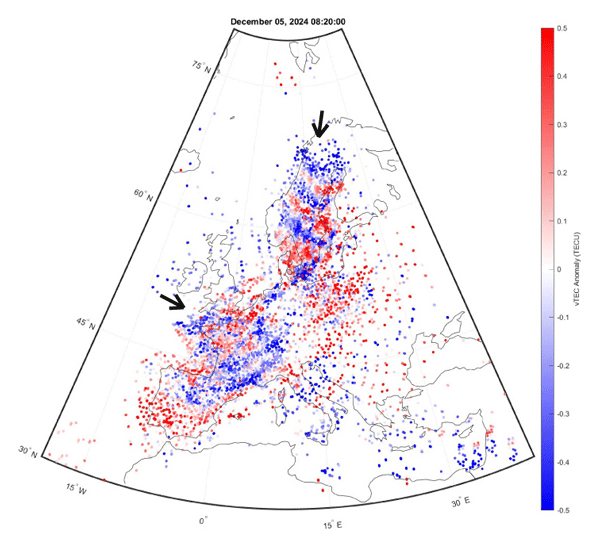
Traveling ionospheric disturbances are plasma density fluctuations usually driven by atmospheric gravity waves in the neutral atmosphere. The aim of this study is to attribute multi-instrument observations of traveling ionospheric disturbances to gravity waves generated in the upper atmosphere at high latitudes or gravity waves generated by tropospheric weather systems at midlatitudes.
Michal Kozubek, Lisa Kuchelbacher, Jaroslav Chum, Tereza Sindelarova, Franziska Trinkl, and Katerina Podolska
Atmos. Meas. Tech., 18, 1373–1388, https://doi.org/10.5194/amt-18-1373-2025, https://doi.org/10.5194/amt-18-1373-2025, 2025
Short summary
Short summary
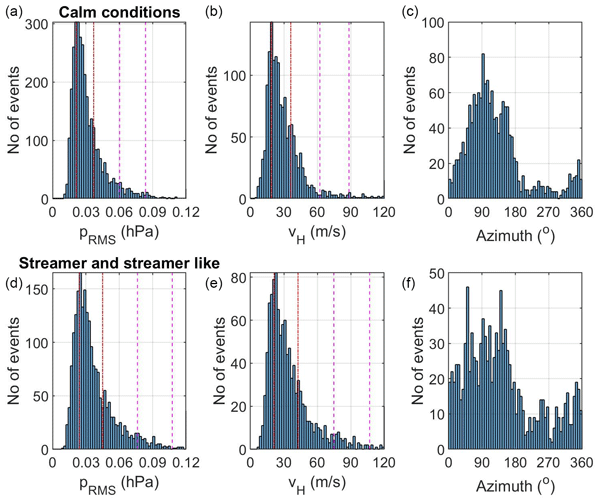
Waves are important as main drivers of different stratispheric patterns (streamers). We analyse changes in waves and infrasound characteristics related to streamers using continuous Doppler soundings and arrays of microbarometers in Czechia. Ground measurements using infrasound arrays showed that gravity wave propagation azimuths were more random during streamers than during calm conditions. Measurements in the ionosphere during streamers did not differ from those expected for the given time.
Jaroslav Chum, Ronald Langer, Ivana Kolmašová, Ondřej Lhotka, Jan Rusz, and Igor Strhárský
Atmos. Chem. Phys., 24, 9119–9130, https://doi.org/10.5194/acp-24-9119-2024, https://doi.org/10.5194/acp-24-9119-2024, 2024
Short summary
Short summary
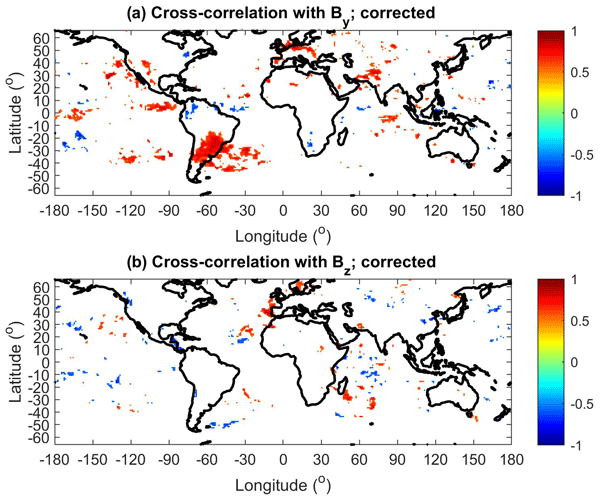
Lightning and extreme weather can endanger people and technology. Despite advances in science, not all the factors that lead to the formation of thunderclouds, to their charging and to lightning ignition are known in detail. This paper shows that lightning frequency may, to some extent, be modulated by solar activity and solar wind. Namely, in the region of the South Atlantic Anomaly of the Earth's magnetic field, it correlates with the polarity and intensity of the solar wind.
Pavla Hrubcová, Matěj Machek, Jiří Vackář, Anna Pohořalá, Hana Kampfová Exnerová, Petr Špaček, and Jan Zedník
Solid Earth, 17, 979–989, https://doi.org/10.5194/se-17-979-2026, https://doi.org/10.5194/se-17-979-2026, 2026
Short summary
Short summary
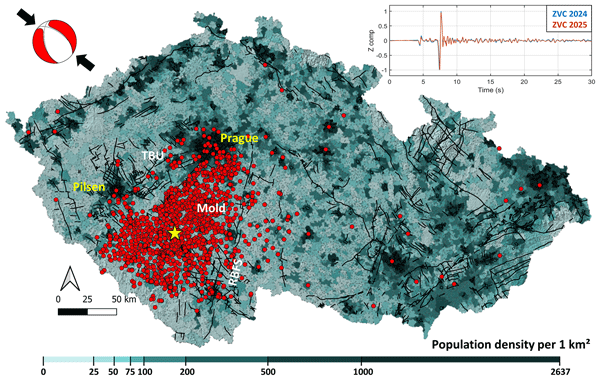
Two rare earthquakes in the Bohemian Massif in 2024 and 2025 were analysed from crowdsourced macroseismic and seismological data. Both events occurred at large depths (~ 24 km) and were widely felt. Non-even distribution of observations reflects contrasting attenuation and control on geology in the Bohemian Massif. Results show that crowdsourced data can effectively constrain deep geological structures and complement instrumental observations in regions with sparse seismicity.
Sabine Wüst, Jakob Strutz, Patrick Hannawald, Jonas Steffen, Rainer Lienhart, and Michael Bittner
Atmos. Meas. Tech., 19, 3539–3556, https://doi.org/10.5194/amt-19-3539-2026, https://doi.org/10.5194/amt-19-3539-2026, 2026
Short summary
Short summary
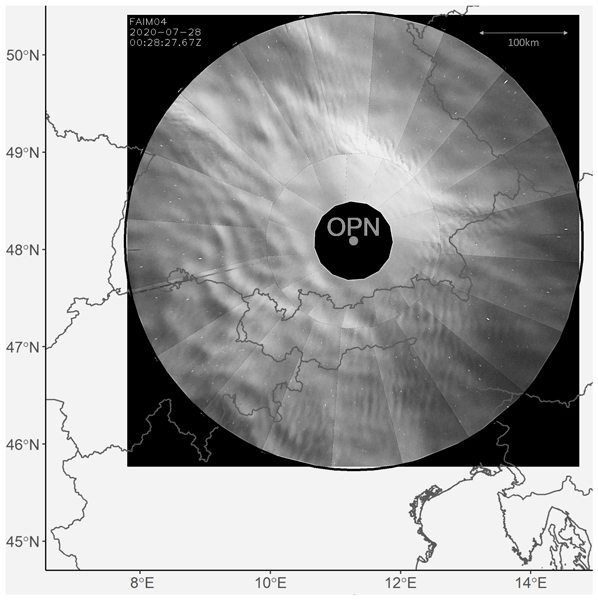
Since June 2019, an infrared camera has been scanning the nearly entire sky (diameter: 500 km) above DLR Oberpfaffenhofen (48.09° N, 11.28° E), Germany, every night providing images of the OH* airglow layer (height: 85–87 km), with a high spatial and temporal resolution (150 m, 2 min). We analysed three years of data for spatially confined small-scale wave structures with a machine learning approach. We derived seasonal variations and deduced that wave breaking is mostly observed in summer.
Thomas Trickl, Hannes Vogelmann, Michael Bittner, Gerald Nedoluha, Carsten Schmidt, Wolfgang Steinbrecht, and Sabine Wüst
Atmos. Meas. Tech., 18, 7477–7496, https://doi.org/10.5194/amt-18-7477-2025, https://doi.org/10.5194/amt-18-7477-2025, 2025
Short summary
Short summary
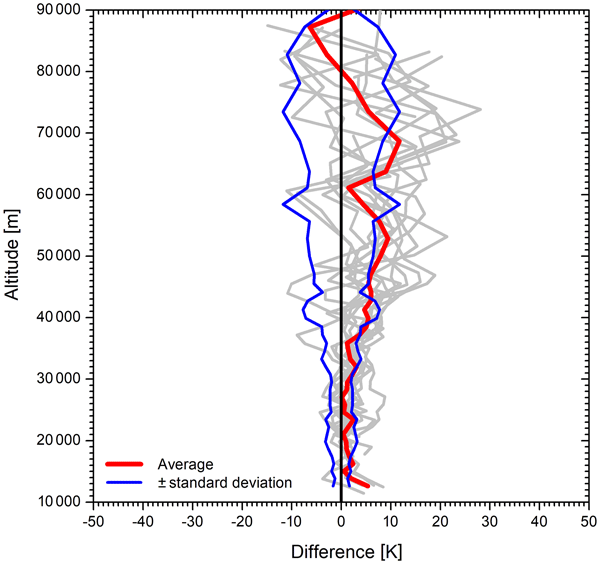
A powerful lidar system has been installed at the high-altitude observatory Schneefernerhaus (2575 m) to allow for atmospheric temperature measurements up to more than 80 km within just one hour. The temperature profiles are calibrated by values obtained from chemiluminscence of the hydroxyl radical around 86 km. The temperature profiles are successfully compared with satellite and lidar data.
Daniel Kouba, Zbyšek Mošna, and Petra Koucká Knížová
Atmos. Meas. Tech., 18, 7039–7052, https://doi.org/10.5194/amt-18-7039-2025, https://doi.org/10.5194/amt-18-7039-2025, 2025
Short summary
Short summary
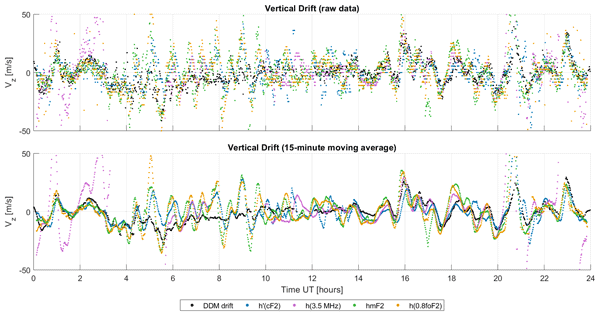
Understanding how the upper atmosphere moves is important for improving radio communication and satellite navigation. We compared two techniques that use radio signals from the ground to estimate vertical motion – one based on direct Doppler shifts, the other on changes in reflection height. We found that under certain conditions, especially at night and with proper timing, the results from both methods are comparable and consistent.
Paul Prikryl, David R. Themens, Jaroslav Chum, Shibaji Chakraborty, Robert G. Gillies, and James M. Weygand
Ann. Geophys., 43, 511–534, https://doi.org/10.5194/angeo-43-511-2025, https://doi.org/10.5194/angeo-43-511-2025, 2025
Short summary
Short summary
Traveling ionospheric disturbances are plasma density fluctuations usually driven by atmospheric gravity waves in the neutral atmosphere. The aim of this study is to attribute multi-instrument observations of traveling ionospheric disturbances to gravity waves generated in the upper atmosphere at high latitudes or gravity waves generated by tropospheric weather systems at midlatitudes.
Stefan Noll, Carsten Schmidt, Patrick Hannawald, Wolfgang Kausch, and Stefan Kimeswenger
Geosci. Model Dev., 18, 4353–4398, https://doi.org/10.5194/gmd-18-4353-2025, https://doi.org/10.5194/gmd-18-4353-2025, 2025
Short summary
Short summary
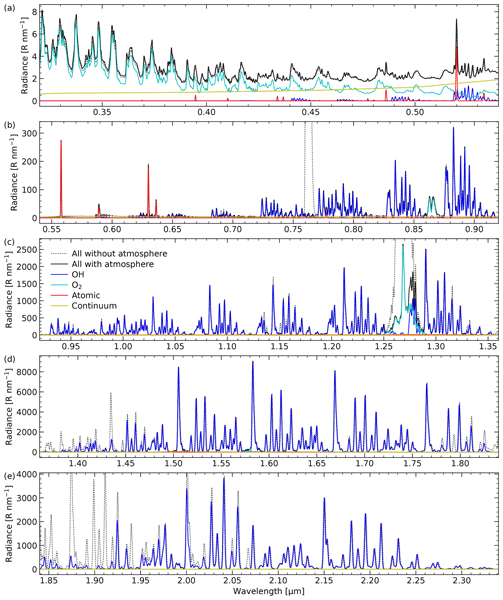
Non-thermal emission from chemical reactions in the Earth's middle und upper atmosphere strongly contributes to the brightness of the night sky below about 2.3 µm. The new Paranal Airglow Line And Continuum Emission model calculates the emission spectrum and its variability with an unprecedented accuracy. Relying on a large spectroscopic data set from astronomical spectrographs and theoretical molecular/atomic data, this model is valuable for airglow research and astronomical observatories.
Michal Kozubek, Lisa Kuchelbacher, Jaroslav Chum, Tereza Sindelarova, Franziska Trinkl, and Katerina Podolska
Atmos. Meas. Tech., 18, 1373–1388, https://doi.org/10.5194/amt-18-1373-2025, https://doi.org/10.5194/amt-18-1373-2025, 2025
Short summary
Short summary
Waves are important as main drivers of different stratispheric patterns (streamers). We analyse changes in waves and infrasound characteristics related to streamers using continuous Doppler soundings and arrays of microbarometers in Czechia. Ground measurements using infrasound arrays showed that gravity wave propagation azimuths were more random during streamers than during calm conditions. Measurements in the ionosphere during streamers did not differ from those expected for the given time.
Jaroslav Chum, Ronald Langer, Ivana Kolmašová, Ondřej Lhotka, Jan Rusz, and Igor Strhárský
Atmos. Chem. Phys., 24, 9119–9130, https://doi.org/10.5194/acp-24-9119-2024, https://doi.org/10.5194/acp-24-9119-2024, 2024
Short summary
Short summary
Lightning and extreme weather can endanger people and technology. Despite advances in science, not all the factors that lead to the formation of thunderclouds, to their charging and to lightning ignition are known in detail. This paper shows that lightning frequency may, to some extent, be modulated by solar activity and solar wind. Namely, in the region of the South Atlantic Anomaly of the Earth's magnetic field, it correlates with the polarity and intensity of the solar wind.
Stefan Noll, John M. C. Plane, Wuhu Feng, Konstantinos S. Kalogerakis, Wolfgang Kausch, Carsten Schmidt, Michael Bittner, and Stefan Kimeswenger
Atmos. Chem. Phys., 24, 1143–1176, https://doi.org/10.5194/acp-24-1143-2024, https://doi.org/10.5194/acp-24-1143-2024, 2024
Short summary
Short summary
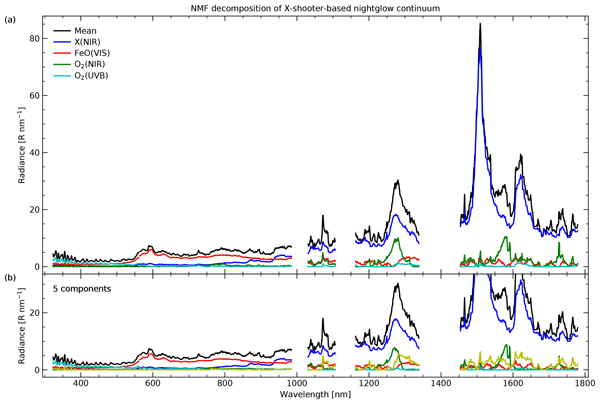
The Earth's nighttime radiation in the range from the near-UV to the near-IR mainly originates between 75 and 105 km and consists of lines of different species, which are important indicators of the chemistry and dynamics at these altitudes. Based on astronomical spectra, we have characterised the structure and variability of a pseudo-continuum of a high number of faint lines and discovered a new emission process in the near-IR. By means of simulations, we identified HO2 as the likely emitter.
Carsten Schmidt, Lisa Küchelbacher, Sabine Wüst, and Michael Bittner
Atmos. Meas. Tech., 16, 4331–4356, https://doi.org/10.5194/amt-16-4331-2023, https://doi.org/10.5194/amt-16-4331-2023, 2023
Short summary
Short summary
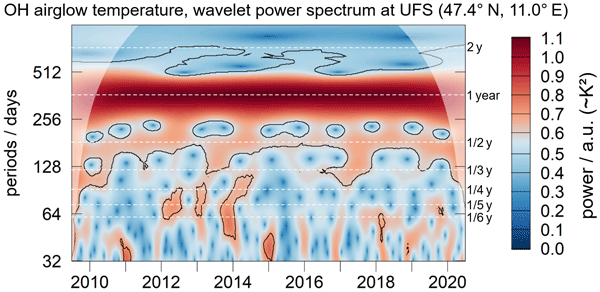
Two identical instruments in a parallel setup were used to observe the mesospheric OH airglow for more than 10 years (2009–2020) at 47.42°N, 10.98°E. This allows unique analyses of data quality aspects and their impact on the obtained results. During solar cycle 24 the influence of the sun was strong (∼6 K per 100 sfu). A quasi-2-year oscillation (QBO) of ±1 K is observed mainly during the maximum of the solar cycle. Unlike the stratospheric QBO the variation has a period of or below 24 months.
René Sedlak, Andreas Welscher, Patrick Hannawald, Sabine Wüst, Rainer Lienhart, and Michael Bittner
Atmos. Meas. Tech., 16, 3141–3153, https://doi.org/10.5194/amt-16-3141-2023, https://doi.org/10.5194/amt-16-3141-2023, 2023
Short summary
Short summary
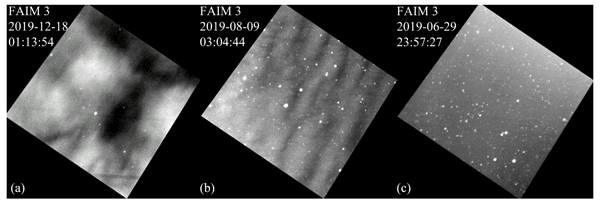
We show that machine learning can help in classifying images of the OH* airglow, a thin layer in the middle atmosphere (ca. 86 km height) emitting infrared radiation, in an efficient way. By doing this,
dynamicepisodes of strong movement in the OH* airglow caused predominantly by waves can be extracted automatically from large data sets. Within these dynamic episodes, turbulent wave breaking can also be found. We use these observations of turbulence to derive the energy released by waves.
René Sedlak, Patrick Hannawald, Carsten Schmidt, Sabine Wüst, Michael Bittner, and Samo Stanič
Atmos. Meas. Tech., 14, 6821–6833, https://doi.org/10.5194/amt-14-6821-2021, https://doi.org/10.5194/amt-14-6821-2021, 2021
Short summary
Short summary
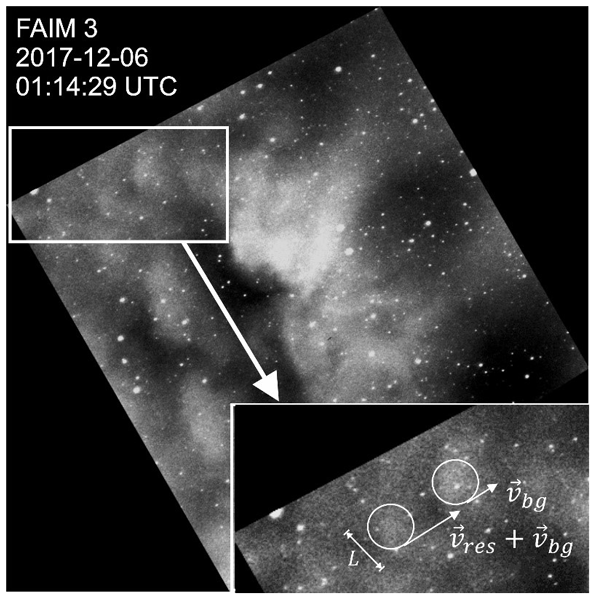
High-resolution images of the OH* airglow layer (ca. 87 km height) acquired at Otlica Observatory, Slovenia, have been analysed. A statistical analysis of small-scale wave structures with horizontal wavelengths up to 4.5 km suggests strong presence of instability features in the upper mesosphere or lower thermosphere. The dissipated energy of breaking gravity waves is derived from observations of turbulent vortices. It is concluded that dynamical heating plays a vital role in the atmosphere.
Cited articles
Alfonsi, L., Cesaroni, C., Hernandez-Pajares, M., Astafyeva, E., Bufferal, S., Elias, P., Belehaki, A., Ioanna, T., Yang, H., and Guerra, M.: Ionospheric response to the 2020 Samos earthquake and tsunami, Earth Planet. Space, 76, 13, https://doi.org/10.1186/s40623-023-01940-2, 2024.
Artru, J., Farges, T., and Lognonné. P.: Acoustic waves generated from seismic surface waves: propagation properties determined from Doppler sounding observations and normal-mode modeling, Geophys J. Int., 158, 1067–1077, 2004.
Astafyeva, E.: Ionospheric detection of natural hazards, Rev. Geophys. 57, 1265–1288, https://doi.org/10.1029/2019RG000668, 2019.
Astafyeva, E. and Heki, K.: Dependence of waveform of near-field co-seismic ionospheric disturbances on focal mechanisms, Earth Planet. Space, 61, 939–943, https://doi.org/10.1186/bf03353206, 2009.
Bass, H. E., Sutherland, L. C., Piercy, J., and Evans, L.: Absorption of sound by the atmosphere, in: Physical Acoustics, Vol. XVII, Chap. 3., edited by: Mason, W. P. and Thurston, R. N., Academic Press, Inc, 145–232, https://ui.adsabs.harvard.edu/abs/1984papm...17..145B/abstract (last access: 19 June 2026), 1984.
Bolt, B. A.: Seismic air waves from the great 1964 Alaskan earthquake, Nature, 202, 1095–1096, https://doi.org/10.1038/2021095a0, 1964.
Calais, E. and Minster, J. B.: GPS detection of ionospheric perturbations following the January 17, 1994, Northridge earthquake, Geophys. Res. Lett., 22, 1045–1048, https://doi.org/10.1029/95GL00168, 1995.
Chum, J., Hruska, F., Zednik, J., and Lastovicka, J.: Ionospheric disturbances (infrasound waves) over the Czech Republic excited by the 2011 Tohoku earthquake, J. Geophys. Res., 117, A08319, https://doi.org/10.1029/2012JA017767, 2012.
Chum, J., Liu, J. Y., Laštovička, J., Fišer, J., Mošna, Z., Baše, J., and Sun, Y. Y.: Ionospheric signatures of the April 25, 2015 Nepal earthquake and the relative role of compression and advection for Doppler sounding of infrasound in the ionosphere, Earth Planet. Space, 68, 24, https://doi.org/10.1186/s40623-016-0401-9, 2016a.
Chum, J., Cabrera, M. A., Mošna, Z., Fagre, M., Baše, J., and Fišer, J.: Nonlinear acoustic waves in the viscous thermosphere and ionosphere above earthquake, J. Geophys. Res.-Space, 121, https://doi.org/10.1002/2016JA023450, 2016b.
Chum, J., Liu, J. Y., Podolská, K., and Šindelářová, T.: Infrasound in the ionosphere from earthquakes and typhoons, J. Atmos. Sol.-Terr. Phy., 171, 72–82, https://doi.org/10.1016/j.jastp.2017.07.022, 2018a.
Chum, J., Urbář, J., Laštovička, J., Cabrera, M. A., Liu, J.Y., Bonomi, F., Fagre, M., Fišer, J., and Mošna, Z.: Continuous Doppler sounding of the ionosphere during solar flares, Earth, Planet. Space, 70, 198, https://doi.org/10.1186/s40623-018-0976-4, 2018b.
Chum, J., Podolská, K., Rusz, J., Baše, J., and Tedoradze, N.:, Statistical investigation of gravity wave characteristics in the ionosphere, Earth Planet. Space, 73, 60, https://doi.org/10.1186/s40623-021-01379-3, 2021.
Chum, J., Šindelářová, T., Koucká Knížová, P., Podolská, K., Rusz, J., Baše, J., Nakata, H., Hosokawa, K., Danielides, M., Schmidt, C., Knez, L., Liu, J. Y., Molina, M.G., Fagre, M., Katamzi-Joseph, Z., Ohya, H., Omori, T., Laštovička, J., Obrazová Burešová, D., Kouba, D., Urbář, J., and Truhlík, V.: Atmospheric and ionospheric waves induced by the Hunga eruption on 15 January 2022; Doppler sounding and infrasound, Geophys. J. Int., 233, 1429–1443, https://doi.org/10.1093/gji/ggac517, 2023.
Davies, K. and Baker, D.M.: Ionospheric effects observed around the time of the Alaskan earthquake of March 28, 1964, J. Geophys. Res., 70, 2251–2253, https://doi.org/10.1029/JZ070i009p02251, 1965.
Davies, K., Watts, J., and Zacharisen, D.: A study of F2-layer effects as observed with a Doppler technique, J. Geophys. Res., 67, https://doi.org/10.1029/JZ067i002p00601, 1962.
Donn, W. L. and Posmentier, E. S.: Ground-coupled air waves from the great Alaskan earthquake, J. Geophys. Res., 69, 5357–536, 1964.
Drob, D. P., Emmert, J. T., Meriwether, J. W., Makela, J. J., Doornbos, E., Conde, M., Hernandez, G., Noto, J., Zawdie, K. A., McDonald, S. E., Huba, J. D., and Klenzing, J. H.: An update to the Horizontal Wind Model (HWM): The quiet time thermosphere, Earth Space Sci., 2, 301–319, https://doi.org/10.1002/2014EA000089, 2015.
Emmert, J. T., Drob, D. P., Picone, J. M., Siskind, D. E., Jones Jr., M., Mlynczak, M. G., Bernath, P. F., Chu, X., Doornbos, E., Funke, B., Goncharenko, L. P., Hervig, M. E., Schwartz, M. J., Sheese, P. E., Vargas, F., Williams, B. P., and Yuan, T.: NRLMSIS 2.0: a whole-atmosphere empirical model of temperature and neutral species densities, Earth Space Sci., 8, e2020EA001321, https://doi.org/10.1029/2020EA001321, 2020.
Hannawald, P., Schmidt, C., Wüst, S., and Bittner, M.: A fast SWIR imager for observations of transient features in OH airglow, Atmos. Meas. Tech., 9, 1461–1472, https://doi.org/10.5194/amt-9-1461-2016, 2016.
Haralambous, H., Guerra, M., Chum, J., Verhulst, T. G. W., Barta, V., Altadill, D., Cesaroni, C., Galkin, I., Márta, K., Mielich, J., Kouba, D., Buresova, D., Segarra, A., Spogli, L., Rusz, J., and Zedník, J.: Multi-instrument observations of various ionospheric disturbances caused by the 6 February 2023 Turkey earthquake, J. Geophys. Res.-Space, 128, e2023JA031691, https://doi.org/10.1029/2023JA031691, 2023.
Heki, K. and Ping, J.: Directivity and apparent velocity of the coseismic ionospheric disturbances observed with a dense GPS array, Earth Planet. Sc. Lett., 236, 845–855, https://doi.org/10.1016/j.epsl.2005.06.010, 2005.
Inchin, P. A., Snively, J. B., Williamson, A., Melgar, D., Aguilar Guerrero, J., and Zettergren, M. D.: Mesopause airglow disturbances driven by nonlinear infrasonic acoustic waves generated by large earthquakes, J. Geophys. Res.-Space, 125, e2019JA027628, https://doi.org/10.1029/2019JA027628, 2020.
Inchin, P. A., Guerrero, J. A., Snively, J. B., and Kaneko, Y.: Simulation of infrasonic acoustic wave imprints on airglow layers during the 2016 M7.8 Kaikoura earthquake, J. Geophys. Res.-Space, 127, e2021JA029529, https://doi.org/10.1029/2021JA029529, 2022.
Jacobs, J. A. and Watanabe, T.: Doppler frequency changes in radio waves propagating through a moving ionosphere, Radio Sci., 1, 257–264, 1966.
Kikuchi, T., Chum, J., Tomizawa, I., Kumiko, K., Hosokawa, K., Ebihara, Y., Hozumi, K., and Supnithi, P.: Penetration of the electric fields of the geomagnetic sudden commencement over the globe as observed with the HF Doppler sounders and magnetometers, Earth Planet. Space, 73, https://doi.org/10.1186/s40623-020-01350-8, 2021.
Kikuchi, T., Araki, T., Hashimoto, K. K., Ebihara, Y., Tanaka, T., Nishimura, Y., Vichare, G., Sinha, A. K., Chum J., Hosokawa, K., Tomizawa, I., Tanaka, Y., and Kadokura, A.: Instantaneous Achievement of the Hall and Pedersen–Cowling Current Circuits in Northern and Southern Hemispheres During the Geomagnetic Sudden Commencement on 12 May 2021, Front. Astron. Space Sci., 9: 879314, https://doi.org/10.3389/fspas.2022.879314, 2022.
Laštovička, J. and Chum, J.: A review of results of the international ionospheric Doppler sounder network, Adv. Space Res., 60, 1629–1643, https://doi.org/10.1016/j.asr.2017.01.032, 2017.
Liu, J. Y., Chen, C. H., Lin, C. H., Tsai, H. F., Chen, C. H., and Kamogawa, M.: Ionospheric disturbances triggered by the 11 March 2011 M9.0 Tohoku earthquake, J. Geophys. Res., 116, A06319, https://doi.org/10.1029/2011JA016761, 2011.
Mackovjak, Š., Kostárová, S., Chum, J., Schmidt, C., Hannawald, P., Wüst, S., Küchelbacher, L., Truhlík, V., Koucká Knížová, P., Urbář, J., Randuška, L., Štempel, F., and Kubančák, J.: Dataset of Quiet Space Weather Periods for Ionospheric Studies, Earth Space Sci., 13, e2025EA004537, https://doi.org/10.1029/2025EA004537, 2026.
Maruyama, T. and Shinagawa, H.: Infrasonic sounds excited by seismic waves of the 2011 Tohoku-Oki earthquake as visualized in ionograms, J. Geophys. Res.-Space, 119, 4094–4108, https://doi.org/10.1002/2013JA019707, 2014.
Otsuka, Y., Kotake, N., Tsugawa, T., Shiokawa, K., Ogawa, T., Effendy, Saito, S., Kawamura, M., Maruyama, T., Hemmakorn, N., and Komolmis, T.: GPS detection of total electron content variations over Indonesia and Thailand following the 26 December 2004 earthquake, Earth Planet. Space, 58, 159–165, https://doi.org/10.1186/BF03353373, 2006.
Paul, K. S., Biswas, T., Haralambous, H., and Moses, M.: Ionospheric disturbances induced by the 29 July 2025 Kuril–Kamchatka Earthquake: Multi-instrument observations and analysis, J. Geophys. Res.-Space, 131, https://doi.org/10.1029/2025JA034646, 2026.
Reinisch, B. W., Huang, X., Galkin, I. A., Paznukhov, V., and Kozlov, A.: Recent advances in real-time analysis of ionograms and ionospheric drift measurements with digisondes, J. Atmos. Sol.-Terr. Phy., 67, 1054–1062, https://doi.org/10.1016/j.jastp.2005.01.009, 2005.
Rolland, L. M., Lognonné, P., and Munekane, H.: Detection and modeling of Rayleigh wave induced patterns in the ionosphere, J. Geophys. Res., 116, A05320, https://doi.org/10.1029/2010JA016060, 2011.
Schmidt, C., Höppner, K., and Bittner, M.: A ground-based spectrometer equipped with an InGaAs array for routine observations of OH(3-1) rotational temperatures in the mesopause region, J. Atmos. Sol.-Terr. Phy., 102, 125–139, https://doi.org/10.1016/j.jastp.2013.05.001, 2013.
Schmidt, C., Dunker, T., Lichtenstern, S., Scheer, J., Wüst, S., Hoppe, U.-P., and Bittner, M.: Derivation of vertical wavelengths of gravity waves in the MLT-region from multispectral airglow observations, J. Atmos. Sol.-Terr. Phy., 173, 119–127, https://doi.org/10.1016/j.jastp.2018.03.002, 2018.
Schmidt, C., Chum, J., Base, J., Wüst, S., and Bittner, M.: High-resolution OH airglow temperatures above the Czech Republic during the passage of seismic surface waves of the M8.8 Kamchatka 2025 earthquake, Zenodo [data set], https://doi.org/10.5281/zenodo.18788838, 2026.
Snively, J. B.: Mesospheric hydroxyl airglow signatures of acoustic and gravity waves generated by transient tropospheric forcing, Geophys. Res. Lett., 40, 4533–4537, https://doi.org/10.1002/grl.50886, 2013.
Song, R., Hattori, K., Zhang, X., Liu, J. Y., and Yoshino, C.: A case study of the three-dimensional co-seismic ionospheric disturbance evolution Sci. Rep., 15, 42209, https://doi.org/10.1038/s41598-025-26074-1, 2025.
Sutcliffe, P. R. and Poole, A. W. V.: Ionospheric Doppler and electron velocities in the presence of ULF waves, J. Geophys. Res., 94, 13505–13514, https://doi.org/10.1029/JA094iA10p13505, 1989.
von Savigny, C., McDade, I. C., Eichmann, K.-U., and Burrows, J. P.: On the dependence of the OH* Meinel emission altitude on vibrational level: SCIAMACHY observations and model simulations, Atmos. Chem. Phys., 12, 8813–8828, https://doi.org/10.5194/acp-12-8813-2012, 2012.
Watada, S., Kunugi, T., Hirata, K., Sugioka, H., Nishida, K., Sekiguchi, S., Oikawa, J., Tsuji, Y., and Kanamori, H.: Atmospheric pressure chase associated with the 2003 Tokachi-Oki earthquake, Geophys. Res. Lett., 33, L24306, https://doi.org/10.1029/2006GL027967, 2006.
Wüst, S., Bittner, M., Espy, P. J., French, W. J. R., and Mulligan, F. J.: Hydroxyl airglow observations for investigating atmospheric dynamics: results and challenges, Atmos. Chem. Phys., 23, 1599–1618, https://doi.org/10.5194/acp-23-1599-2023, 2023.
Wüst, S., Guerra, M., Chum, J., and Gasque, L. C.: Using atmospheric waves for the detection and early warning of natural hazards: a review combining results from the neutral atmosphere and the ionosphere, Surv. Geophys., https://doi.org/10.1007/s10712-025-09909-4, 2026.
Yang, H., Hernandez-Pajares, M., Jarmolowski, W., Wielgosz, P., Vadas, S. L., Colombo, O. L., Monte-Moreno, E., Garcia-Rigo, A., Graffigna, E., Krypiak-Gregorczyk, A., Milanowska B., Bofill-Soliguer, P., Olivares-Pulido, G., Liu, Q., and Haagmans, R.: Systematic detection of anomalous ionospheric perturbations above LEOs from GNSS POD data including possible tsunami signatures, IEEE T. Geosci. Remote, 60, 1–23, https://doi.org/10.1109/TGRS.2022.3182885, 2022.
Zettergren, M. D. and Snively, J. B.: Latitude and longitude dependence of ionospheric TEC and magnetic perturbations from infrasonic-acoustic waves generated by strong seismic events, Geophys. Res. Lett., 46, 1132–1140, https://doi.org/10.1029/2018GL081569, 2019.
Short summary
An analysis of unique observations of long period infrasound waves (~200 s) recorded in the ionosphere over Central Europe at record heights by continuous Doppler sounding is presented. The infrasound was generated by the Long-period surface seismic waves induced by the M8.8 Kamchatka earthquake on July 29, 2025. The time delay of the infrasound detection in the ionosphere relative to the vertical motion of the ground surface is consistent with the numerical simulation of infrasound propagation.
An analysis of unique observations of long period infrasound waves (~200 s) recorded in the...


Altmetrics
Final-revised paper
Preprint