
the Creative Commons Attribution 4.0 License.
the Creative Commons Attribution 4.0 License.
 | 11 Jun 2026
NOx emissions constraints from GEMS NO2 retrievals: inversion methodology and air quality model evaluation in Bangkok using ASIA-AQ multi-platform observations
Julianna A. Christopoulos
Pablo E. Saide
Manas R. Mohanty
Nattamon Maneenoi
Jhoon Kim
Laura Judd
Katherine R. Travis
Savitri Garivait
Agapol Junpen
Kazuyuki Miyazaki
Jinkyul Choi
Takashi Sekiya
David Peterson
Theodore M. McHardy
Nicholas Gapp
Jason M. St. Clair
Erin Delaria
Glenn M. Wolfe
Abby Sebol
Alessandro Franchin
Changmin Cho
Morgan L. Silverman
James H. Crawford
Nitrogen Dioxide (NO2) is a key component of tropospheric chemistry and air quality, yet large uncertainties persist in regional NOx emissions across rapidly developing megacities in Southeast Asia. Observations from the Geostationary Emissions Monitoring Spectrometer (GEMS) provide new constraints on anthropogenic NO2 variability, while the 2024 NASA Airborne and Satellite Investigation of Asian Air Quality (ASIA-AQ) campaign, offers an extensive, independent dataset for model evaluation. Here, we examine air quality in Bangkok using coarse (20 km) and high-resolution (4 km) WRF-Chem simulations during ASIA-AQ. We develop a top-down framework that uses hourly GEMS NO2 columns to derive constraints on the daytime cycle of NOx emissions. Emissions are first estimated from GEMS using a Cross-Sectional Flux (CSF) inversion and then incorporated into WRF-Chem through a novel optimization that reshapes the magnitude and daytime structure of NOx while accounting for lifetime and satellite vertical sensitivity. GEMS-constrained NOx emissions for March 2024 are estimated to range from 2.7 to 4.3 kt month−1 after accounting for known low biases in the GEMS retrievals. Re-running WRF-Chem with the updated emissions leads to substantial improvements in modeled NO2 magnitude and temporal variability when evaluated against independent ground-based, Pandora, and airborne measurements. Remaining negative biases are consistent with a systematic low bias in the GEMS v3 NO2 product, highlighting the importance of multi-platform evaluation using independent observations. Together, these results demonstrate the value of hourly geostationary observations combined with high-resolution modeling as a scalable pathway for improving urban NOx emissions estimates and air quality simulations in Southeast Asia.
- Article
(8881 KB) - Full-text XML
-
Supplement
(8862 KB) - BibTeX
- EndNote


The troposphere contains a variety of pollutants and aerosols that degrade air quality and affect human health (Chen and Chen, 2021; Fuller et al., 2022; Shetty et al., 2023). Nitrogen oxides (NOx= NO + NO2) are primary pollutants with significant variability in space and time (Seinfeld and Pandis, 2016). Information on NOx sources is crucial in defining its concentration and distribution (Miyazaki et al., 2019). Nitrogen dioxide (NO2) is fundamental to air quality and atmospheric chemistry, as it is the primary precursor to surface ozone (O3) and nitrate aerosols (Pörtner et al., 2022) and is independently linked to the development of pediatric asthma (Anenberg et al., 2022). It is thus inherent that NO2, and its sources, are well quantified and studied to gain insights into its environmental impact.
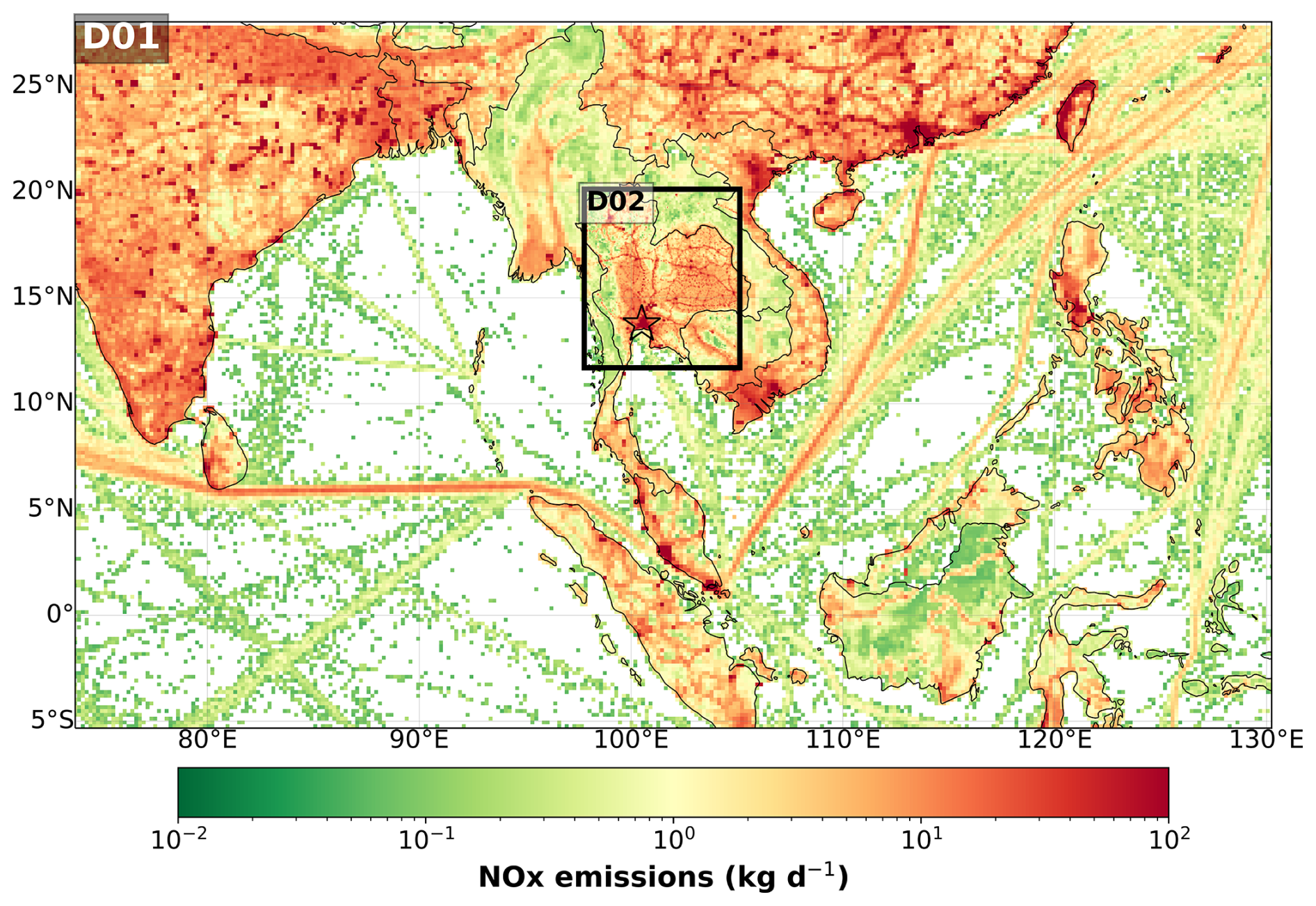
Figure 1Spatial illustration of the WRF-Chem model domain configuration, including D01 (20 km) and D02 (4 km), and average base-model NOx input emissions from EDGAR v5. D02 is centered over Thailand, and the urban signal associated with the Bangkok Metropolitan Region (BMR) is highlighted by the star.
Over the past two decades, satellite observations of tropospheric NO2 have revealed substantial regional variability in emissions, particularly over industrial and urban areas (Goldberg et al., 2024; Park et al., 2025; Rey-Pommier et al., 2025). While strict air quality policies in North America and Europe have resulted in significant NO2 reductions, many developing regions, especially the megacities of Southeast Asia, have seen increases (Elguindi et al., 2020; Georgoulias et al., 2019; Miyazaki et al., 2017; Park et al., 2025; Sicard et al., 2023). Thailand, for example, has undergone rapid industrialization, urbanization, and economic growth over the past 30 years, with most of this development occurring in the Bangkok Metropolitan Region (BMR) (Thailand Office of the National Economic and Social Development Board; World Bank, 2017; Uttamang et al., 2018). This has led to increased emissions from vehicular traffic and industrial activity, resulting in a sustained degradation of air quality (Uttamang et al., 2018). Since the mid-1990s, the BMR has frequently exceeded Thailand's National Ambient Air Quality Standards (NAAQS) for particulate matter (PM) (25 µg m−3) and O3 (100 ppb), particularly during the dry season (February–May) (Kumar et al., 2012; Uttamang et al., 2018, 2020, 2023). Within the BMR, there have been initiatives to reduce health impacts and exposure related to PM2.5. For example, the National Agenda Action Plan on “Solving the Pollution Problems of Particulate Matter” motivated implementation measures in transport, industry, and waste sectors (Aung et al., 2025). However, achieving the air quality standard has remained an issue. Modeling studies have shown that O3 levels typically peak between January and March, coinciding with increased solar radiation, higher temperatures, elevated humidity, and prevailing northeasterly winds during the Northeast monsoon season. These meteorological conditions, combined with rising emissions, often contribute to O3 pollution episodes in the region (Uttamang et al., 2020). A key limitation of these air quality modeling studies is the uncertainty in bottom-up anthropogenic emissions inventories, which remain a significant source of error. In the BMR, uncertainties in regional emissions can be as large as a factor of 2 or higher (Bond et al., 2004, 2007; Smith et al., 2011; Uttamang et al., 2020). These emissions uncertainties limit our ability to accurately simulate pollutant concentrations and assess the effectiveness of emission control strategies. Thus, to address this issue, new observational capabilities that can directly capture emission variability at fine spatial (< 10 km) and temporal (hourly) scales are needed.
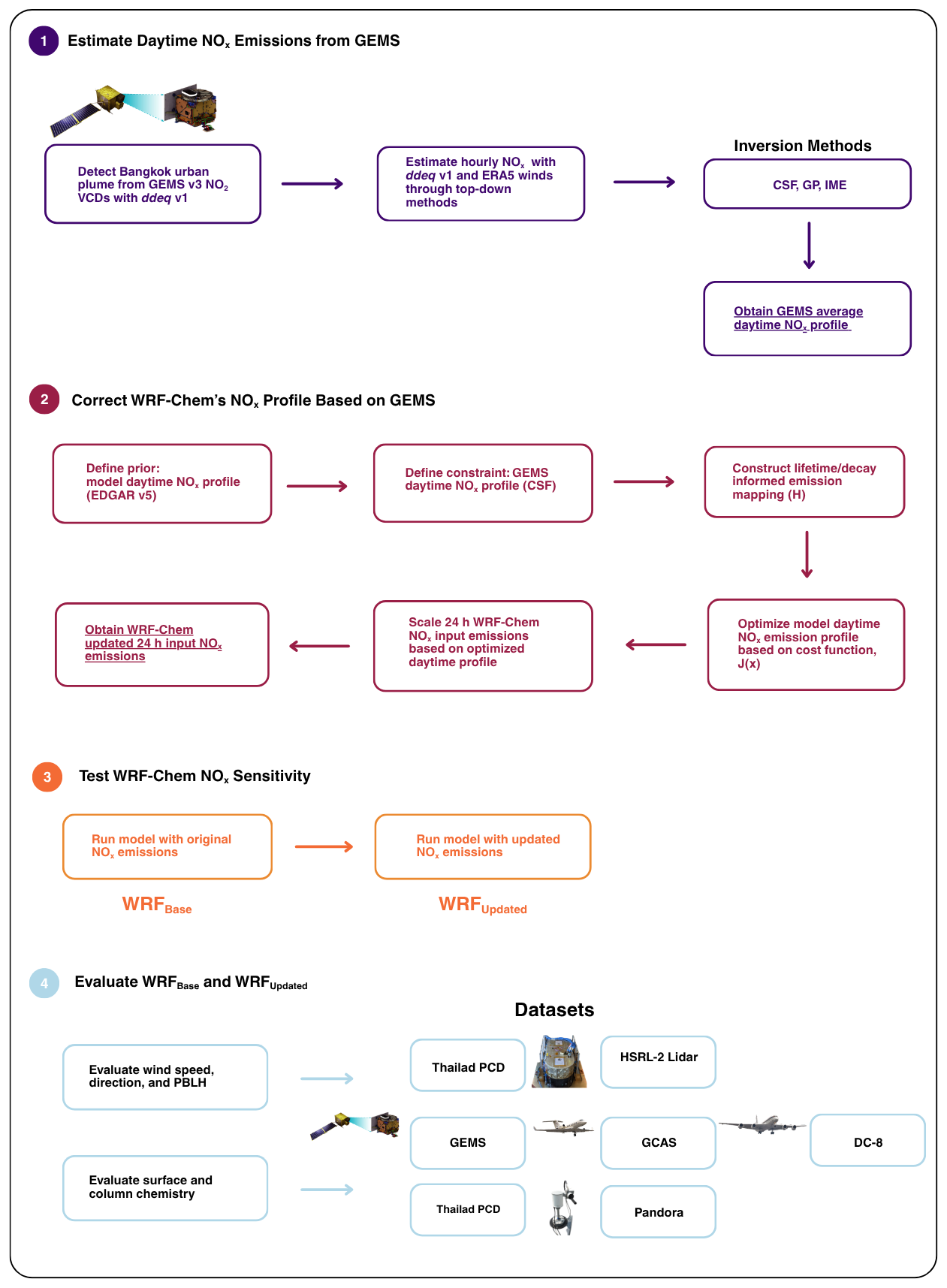
Figure 2Schematic overview of the workflow used to derive satellite-constrained daytime NOx emission profiles and assess their impact in WRF-Chem over the BMR. (1) Urban NO2 plumes are detected using GEMS tropospheric NO2 columns, and hourly NOx emissions are estimated using top-down methods implemented in the ddeq v1 Python library. (2) A GEMS-derived daytime NOx profile is used to constrain the prior emission profile through an optimization framework, yielding updated input 24 h NOx emissions for WRF-Chem. (3) Model simulations are performed using both the original and updated emissions. (4) Model performance is evaluated against surface, column, airborne, and observations.
We are currently entering a new era of satellite atmospheric composition monitoring with the launch of three geostationary (GEO) imaging spectrometers covering a large component of the Northern Hemisphere. The Geostationary Environmental Monitoring Spectrometer, GEMS (Kim et al., 2020), Tropospheric Emissions: Monitoring of Pollution, TEMPO (Zoogman et al., 2017), and Sentinel-4 (Gulde et al., 2017), now provide unprecedented spatial and temporal resolution of atmospheric constituents. These instruments offer hourly observations that resolve daytime variability of key pollutants, including NO2. Until now, most studies of top-down NOx emissions have relied on once-daily measurements from low Earth orbit (LEO) satellites (i.e., OMI, TROPOMI) requiring assumptions about diurnal emission and chemistry patterns that introduce uncertainties when coupled with chemical transport models, particularly those arising from coarse spatial resolution (> 20 km), emissions inventories, and chemical mechanisms (Park et al., 2025). Although these measurements have been invaluable for global and long-term NOx assessments, they cannot fully capture the pronounced sub-daily variability in NO2 driven by emissions, chemistry, and transport. GEO satellites now provide the capability to directly observe this hourly variability (Park et al., 2025). For example, using 12 km WRF-Chem simulations Hsu et al. (2026) showed that TEMPO-derived top-down NOx emissions are broadly consistent with TROPOMI and bottom-up inventories, but noted coarse model resolution (e.g., 12 km) can limit the representation of coastal meteorology and chemical nonlinearity.
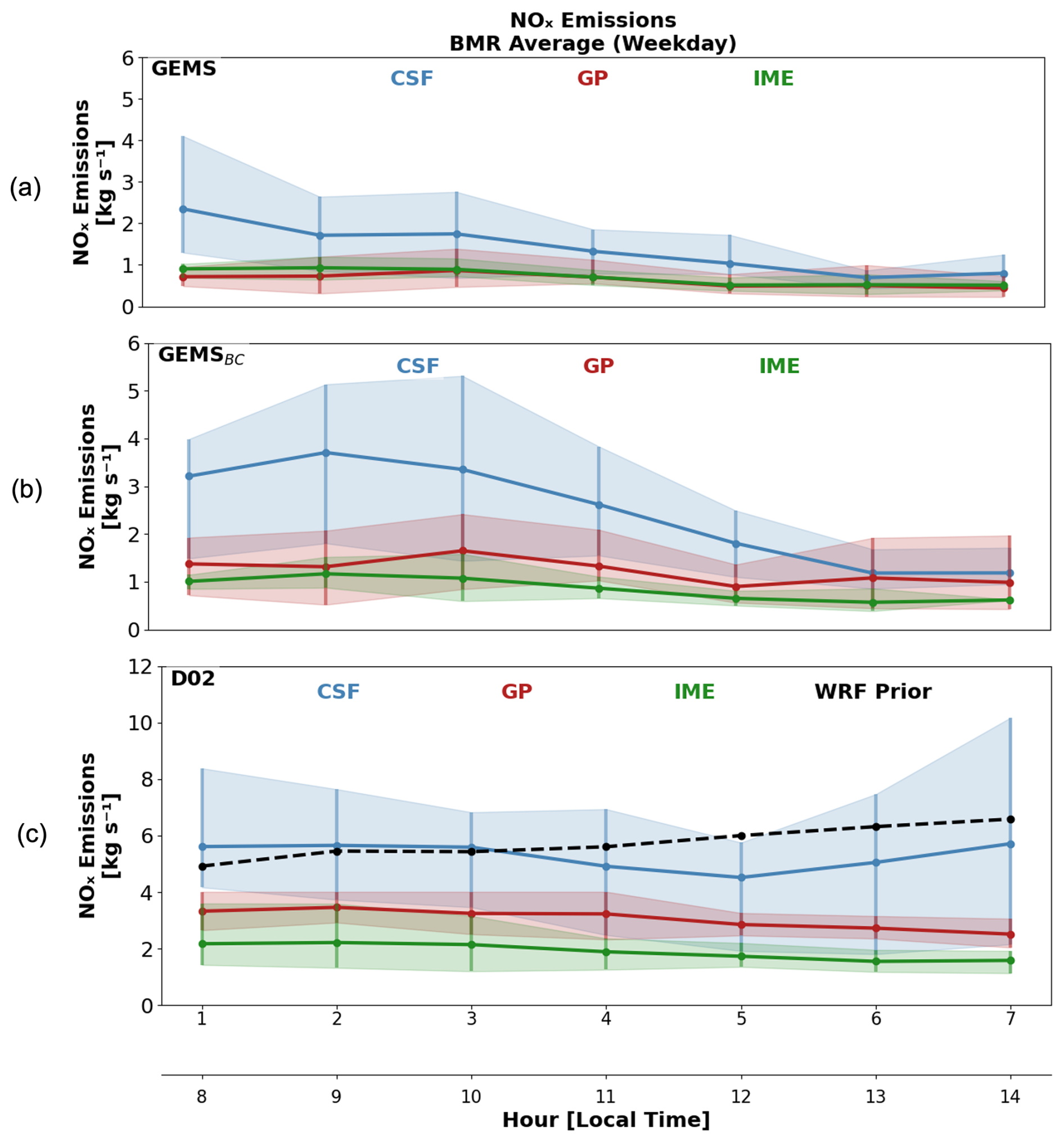
Figure 3Comparison of daytime NOx emission estimates derived from (a) GEMS, (b) GEMS with bias correction applied (GEMSBC), and (c) WRF-GEMS D02 using the Cross-Sectional Flux (blue), Gaussian Plume inversion (red), and Integrated Mass Enhancement (green) methods. Emissions (kg s −1) represent averages across daytime hours and weekdays during the ASIA-AQ deployment period (14–27 March 2024). Model-derived emissions in (c) were obtained by re-gridding WRFBase output to the GEMS spatial resolution and applying the same inversion methods. The WRFBase prior emission profile is shown as a black dashed line and represents a backward-looking 3 h average to account for emission accumulation embedded in the inversion estimates.
GEMS was the first UV-visible hyper-spectrometer in geostationary orbit and was launched on GEO-KOMPSAT-2B on 18 February 2020. GEMS measurements allow the observation of air quality constituents (e.g., NO2, SO2, O3, HCHO, CHOCHO, and aerosols) at a spatial resolution of 3.5 km ×7.7 km2 at the center of its field of regard and was the first space-based instrument to provide hourly observations of these species. The GEMS field of regard covers 20 countries in Asia, E–W from Japan to India, and N–S from Mongolia to Indonesia (Kim et al., 2020; Park et al., 2025). Recent work has demonstrated the potential of GEMS and air quality models to estimate top-down NOx emissions over major Asian cities during the summertime (de Foy and Schauer, 2022; Park et al., 2024, 2025). These studies highlight the need for comprehensive validation involving independent observations. The Airborne and Satellite Investigation of Asian Air Quality, ASIA-AQ, has provided an excellent opportunity to conduct extensive validation of air pollutants across multiple Asian megacities, including Bangkok (ASIA-AQ White Paper) (ASIA-AQ, 2025).
In this manuscript, we aim to address these gaps specifically near Bangkok, Thailand by deriving emissions and examining fine- (4 km) and coarse- (20 km) resolution Weather Research and Forecasting model coupled with Chemistry (WRF-Chem) simulations driven by them during mid-March 2024. First, we derive daytime hourly NOx emissions from GEMS over the BMR in March 2024. Next, we use the GEMS emissions to constrain hourly model emissions through a novel optimization technique. To conclude, we assess model performance using GEMS and independently with ground-monitor information, Pandora site measurements, and airborne measurements collected during the ASIA-AQ campaign.
Table 1WRF-Chem base (WRFBase) model configuration and input datasets.
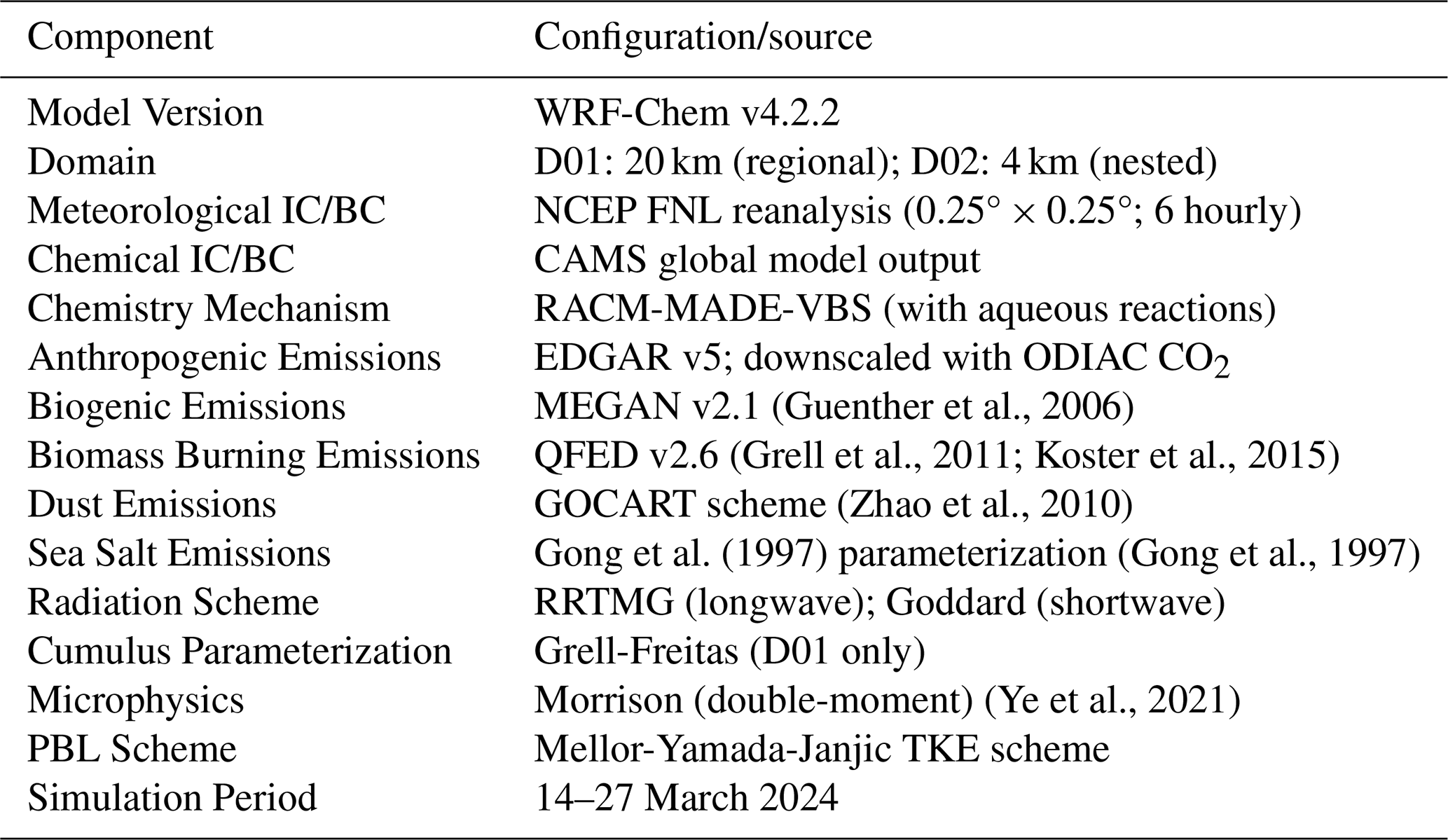
To simulate air quality over the BMR, we use a regional simulation of WRF-Chem v4.2.2 in a research configuration (Table 1; Fig. 1) (Agarwal et al., 2024; Anav et al., 2024; Gao and Zhou, 2024; Skamarock et al., 2019). The model setup follows previous WRF-Chem implementations in the Korea-United States Air Quality field study (KORUS-AQ) for air quality studies over the Seoul Metropolitan Area (Choi et al., 2020; Goldberg et al., 2019; Lennartson et al., 2018; Park et al., 2021; Saide et al., 2020). The model was driven by reanalysis meteorology, NCEP Final Reanalysis (NCEP FNL), and Copernicus Modeling Service (CAMS) chemical boundary conditions (National Centers for Environmental Prediction/National Weather Service/NOAA/US Department of Commerce, 2000; Inness et al., 2019). Meteorology was constrained using four-dimension data assimilation (FDDA) via grid nudging applied to model domains using the 0.25° NCEP FNL reanalysis fields to improve large-scale wind representation. A two-domain approach with one-way nesting was incorporated to gauge strengths between coarse- and high-resolution simulations. D01 (20 km) spans a large portion of the GEMS field of regard, covering primary transboundary pollution sources (e.g., deserts in China/India, anthropogenic emissions from China/India). A nested 4 km domain (D02) is centered over Bangkok (Fig. 1).
Original anthropogenic emissions of trace gases and primary aerosols were based on the Emissions Database for Global Atmospheric Research (EDGAR v5) (Crippa et al., 2020) inventory at 0.1°×0.1° horizontal resolution. For D02, EDGAR emissions for the transport and industrial sectors were downscaled using the Open-source Data Inventory for Anthropogenic Carbon Dioxide emission inventory (ODIAC) at 1 km × 1 km resolution (Oda et al., 2018). This is done by distributing EDGAR emissions into the 1 km2 grid using ODIAC CO2 as a spatial proxy in a mass conserving way. Biogenic, dust, sea salt, and fire emissions were computed within WRF-Chem using the model's full-chemistry emission modules (Table 1). In this configuration, dust and sea-salt emissions are calculated every chemistry timestep, while biogenic emissions (MEGAN) are updated every 30 min. For fire emissions, plume rise is enabled, in which the injection heights are diagnosed using the plume-rise parameterization and emissions are vertically distributed (typically ∼ 80 % at the surface with the remainder aloft). The model was configured using the RACM-MADE-VBS (Ahmadov et al., 2012; Tuccella et al., 2015) chemical mechanism and physics parameterizations selected based on prior campaign experience (e.g., KORUS-AQ), with updates to better represent secondary organic aerosol formation, heterogenous chemistry, and aerosol properties. The modal aerosol scheme in MADE-VBS tracks both particle mass and number, allowing mode diameters to evolve dynamically with aerosol aging and growth processes. Hereafter, we will refer to this model configuration as WRFBase. Model cases with updated anthropogenic NOx emissions will be referred to as WRFUpdated and WRFUpdated+BC (later introduced).
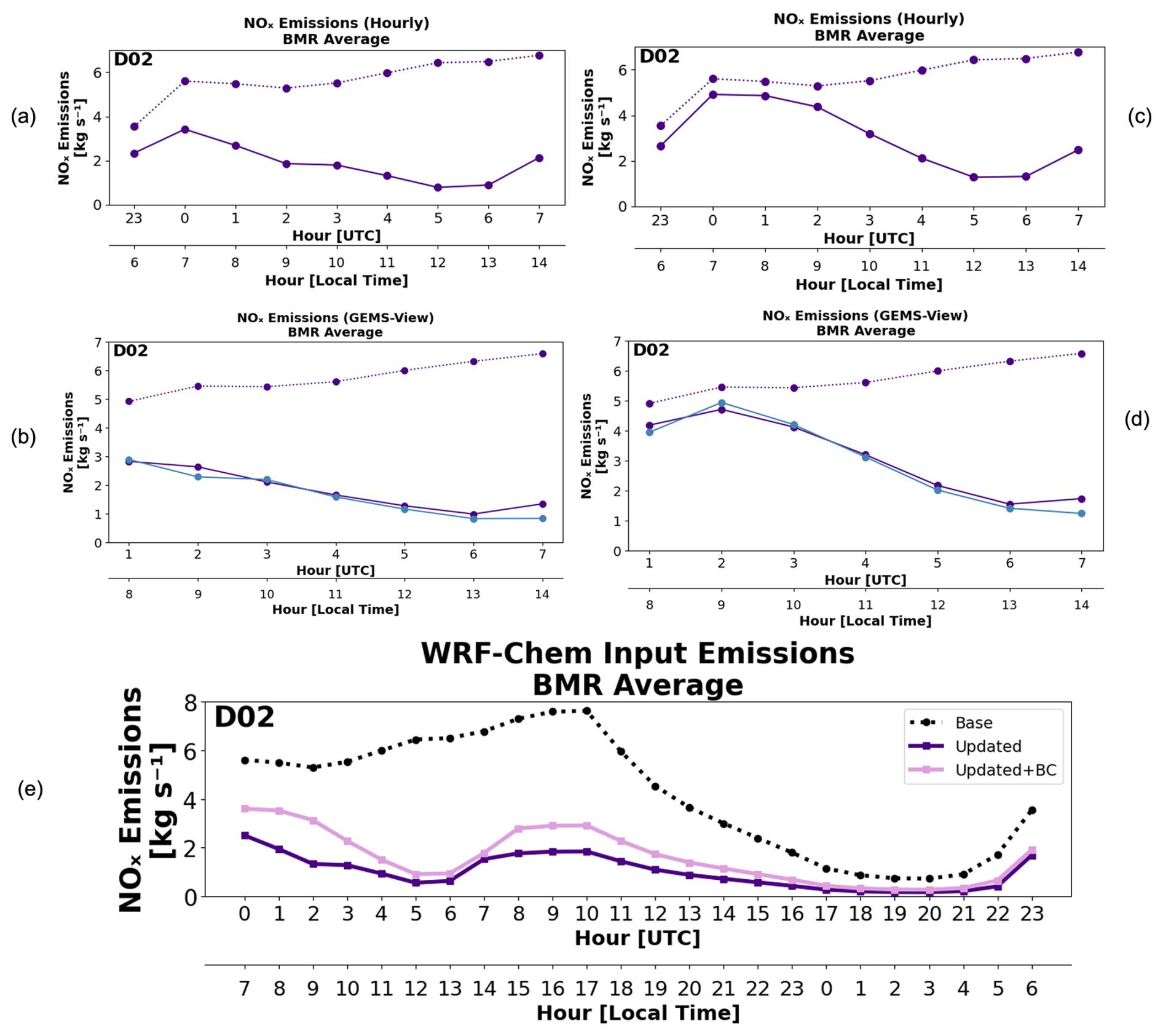
Figure 4Results of the emissions optimization, shown as averages over the BMR. (a) Posterior optimized (solid) and prior (dashed) daytime NOx emissions in model space, where the prior represents the 3 h backward average of EDGAR v5 emissions used as input to the optimization. (b) Same emissions as in (a) but transformed into observational space using the observational operator. The GEMS profile is shown in blue. (c) and (d) are representative of optimization results using the GEMS bias-corrected CSF results as the constraint. (e) Full diurnal cycle of updated (solid purple), updated+BC (solid pink), and prior (dashed) NOx emissions. Note that, unlike (a), the prior in (e) does not include the 23 UTC hour from the previous day in the backward averaging.
3.1 Correcting for GEMS bias prior to inversion
Recent independent validation studies of the operational GEMS v3 product over Bangkok and South Korea report low biases in NO2 columns relative to ground-based sun-photometer and DOAS measurements (Bae et al., 2025; Jung et al., 2025). Bae et al. (2025) shows that GEMS v3 increasingly underestimates NO2 relative to Pandora under high-NO2 conditions ( molecules cm−2) as is the case for Bangkok pollution levels. In Jung et al. (2025), validation results over Bangkok indicate a pronounced low bias in GEMS tropospheric NO2 columns relative to Pandora, with regression slopes of ∼ 0.35 for v2.0 and ∼0.28 for v3.0, indicating increasing underestimation at higher NO2 levels. While moderate correlations (r ≈ 0.6–0.7) suggest that GEMS captures temporal variability, column magnitudes are substantially underestimated, particularly under polluted conditions. The persistence of this behavior in the v3.0 product indicates that the low bias is not fully corrected by recent algorithm updates and is consistent with retrieval sensitivity limitations in highly polluted urban environments (Jung et al., 2025).
To address the low bias in GEMS prior to the NOx satellite emission inversion, we first quantify the GEMS bias relative to Pandora measurements over our period of interest (14–27 March 2024). We compare total column GEMS NO2 to Pandora Level 2 direct-sun total column retrieval, filtering for high quality measurements (quality flag = 10) and averaging to hourly means. GEMS columns are sampled at the nearest grid cell to each Pandora site and temporally collocated. Results are shown in Fig. S1 in the Supplement. GEMS NO2 columns are generally about a factor of two lower than Pandora measurements (mean bias molecules cm−2). This factor-of-two difference persists throughout March 2024 (Fig. S1).
To assess the sensitivity of the top-down NOx inversion framework to this bias, we apply a simple correction factor to GEMS prior to inversion. Specifically, GEMS NO2 columns over the BMR are scaled by a factor of 1.67 derived from the Pandora comparison. The inversion is then performed with and without the bias-corrected columns.
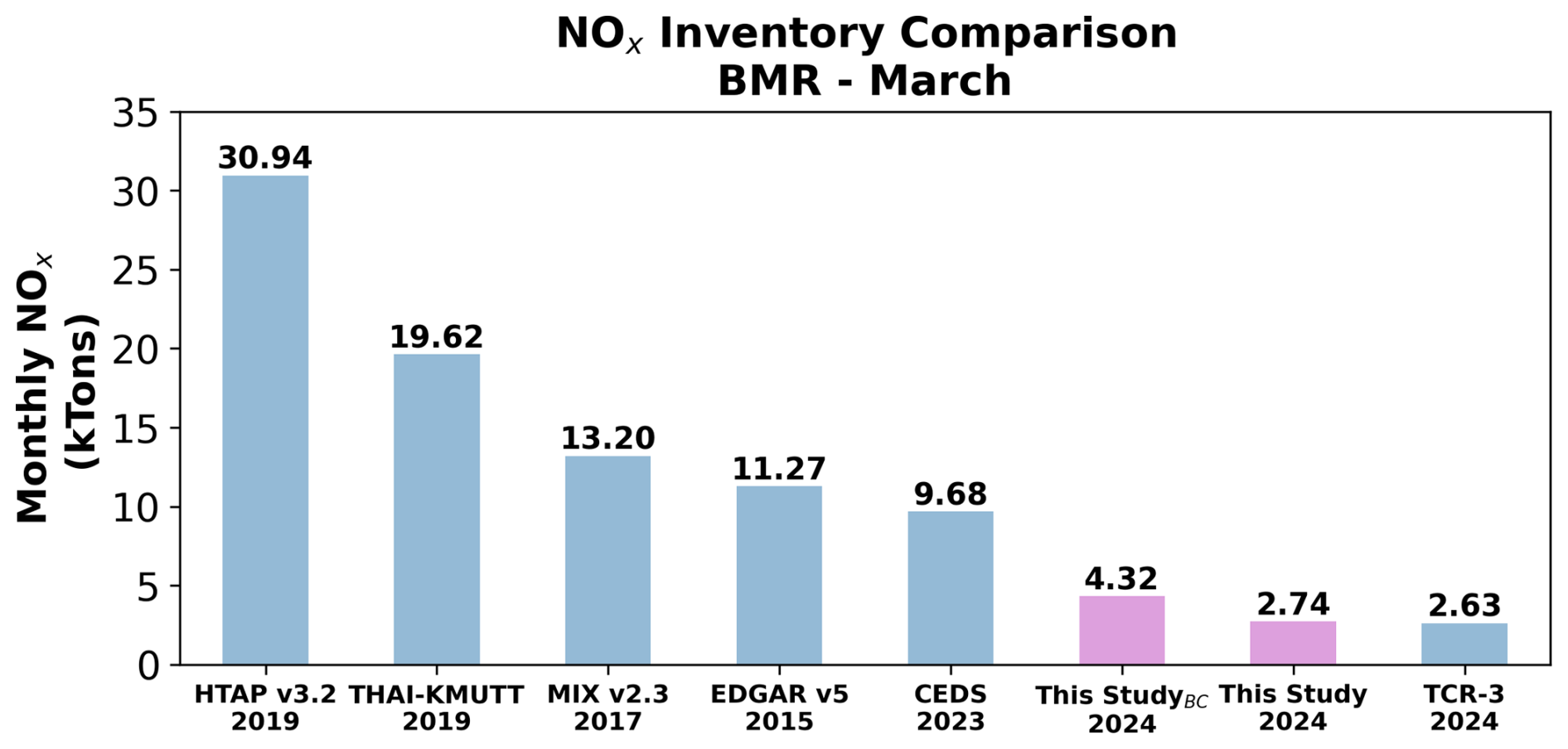
Figure 5Comparison of March NOx emissions over the BMR derived from bottom-up, top-down, and assimilated approaches. Bottom-up inventories (HTAP v3.2; Guizzardi et al., 2025), THAI-KMUTT, MIX v2.3 (Li et al., 2024), EDGAR v5 (Crippa et al., 2020), and CEDS (Hoesly et al., 2018)) exhibit substantial variability. In contrast, top-down estimates from GEMS and TROPOMI (TCR-3) for 2024 indicate considerably lower emissions (2.6–4.3 kt month−1), highlighting uncertainties in bottom-up inventory methodologies, satellite sensitivity, and potential changes in anthropogenic NOx activity.
3.2 GEMS inversion framework
Previous studies have used satellite data (OMI, TROPOMI, SCIAMACHY, GOME (−2), OMPS) to estimate top-down NOx emissions over urban areas, but were limited to once-a-day, mid-afternoon measurements, leaving temporal variability in emissions largely unaddressed (Beirle et al., 2011; Goldberg et al., 2017, 2019). Ground-based and aircraft measurements of emissions can be challenging to constrain given boundary layer dynamics, such as changes in boundary layer height, stability, and vertical mixing, which can strongly influence observed concentrations of trace gases (Goldberg et al., 2017, 2019). Additionally, temporal allocation in bottom-up emission inventories remain a significant uncertainty, particularly at hourly and daily timescales because default temporal profiles (diurnal, weekly, seasonal) often fail to capture real activity patterns, meteorological influences, and sector-specific variability (Goldberg et al., 2017, 2019; Mues et al., 2014). GEMS observations, however, offer a unique opportunity to provide hourly emissions rates over Bangkok, complementing existing inventories that are usually provided at monthly scales. To estimate NOx emissions over Bangkok in March 2024, we apply the methodology of Kuhlmann et al. (2024), implemented through the openly available data-driven emission quantification (ddeq v1) Python library (see step 1, Fig. 2). The standard ddeq library implements computationally inexpensive methods (e.g., Gaussian Plume Inversion (GP), Cross-Sectional Flux (CSF) method, Integrated Mass Enhancement (IME) method) to estimate emissions from Sentinel5P TROPOMI images (Graziosi and Manca, 2025; Meier et al., 2024). One study found limited temporal sampling from polar-orbiting satellites (i.e., TROPOMI) can lead to systematic underestimation of NOx emissions, particularly because wintertime conditions with higher emissions are often poorly observed due to cloud cover (Meier et al., 2024). Geostationary observations, including GEMS, address this limitation by providing hourly measurements that increase the likelihood of usable data on partially cloudy days and enable direct resolution of daytime emission variability, which is not accessible from once-daily LEO observations. For our application, we estimate emissions for daylight hours from GEMS tropospheric column NO2 data over Bangkok during the ASIA-AQ campaign. A brief description of inversion methods and specifics is provided here. A complete description of the inversion methods and algorithm can be found in Kuhlmann et al. (2024).
First, within the ddeq framework, the source location (Bangkok; 13.7563° N, 100.5018° E), GEMS v3 NO2 column data, and ERA5 wind fields are read. We chose to incorporate ERA5 wind fields as opposed to those provided by our high resolution WRF-Chem simulation in this analysis given they presented significantly lower bias when compared to surface observations (Fig. S2; Sect. 6.1). The ERA5 wind fields were downloaded and prepared by the ddeq library. Cloudy pixels (CF > 0.3) were removed. Next, a plume detection algorithm is implemented to identify the Bangkok urban plume within the GEMS image. The Bangkok plume subregion is estimated based on the source location and ERA5 wind field. Generally, a wind vector is taken at the source location, and the plume is assumed to be located downwind, and a rectangular polygon can be drawn with the along- and across-wind direction (Kuhlmann et al., 2024). An example of these plume detections and associated rectangular polygons is shown in Fig. S3. To aid the algorithm's plume detection process, we identify two additional sources north of Bangkok in the Saraburi province to avoid overlapping plumes from other NOx sources. These correspond to the Khao Wong (14.692856° N, 100.817204° E), and Thap Kwang (14.645313° N, 101.077650° E) regions, which we identified through NO2 patterns visible in the GEMS data in Fig. S3. These areas are not representative of Bangkok urban emissions as they are a source of industrial activity related to limestone quarries and mining operations outside the inversion domain (Makkwao and Prueksasit, 2021). Next, a center curve is fitted to the data, and natural coordinates are calculated for the detected plume associated to Bangkok to prep for the inversion algorithm. The coordinates are computed as the distance along and perpendicular to the wind vector and for curved plumes this distance is computed as the arc length. Lastly, the data is prepared for the satellite-derived emissions estimation by calculating and removing the background field and converting the NO2 columns to kg m−2. We estimate satellite-derived NOx emissions using three inversion techniques included in ddeq: CSF, GP, and IME methods. Below is a summary of the CSF method defined in Kuhlmann et al. (2024). GP and IME method descriptions are available in the Supplement (e.g., S1) and Kuhlmann et al. (2024). In the following subsections and in Sect. 4, we refer to the WRF-Chem input inventory based on EDGAR as the prior emissions, the CSF-based estimates from GEMS as the satellite-derived emissions, the CSF-based estimates from the model-simulated columns as the model-derived emissions, and the final emissions after applying the optimization framework, as the posterior emissions.
3.3 Cross-Sectional Flux (CSF) framework
The CSF approach applies mass conservation to quantify the NOx flux transported downwind of Bangkok using (i) the wind speed perpendicular to the plume and (ii) the NO2 enhancement integrated along the plume (line density). The NOx flux, F (kg s−1), is defined as:
where u (m s−1) is the effective transport wind speed and q (kg m−1) is the NO2 line density. The emission rate, Q (kg s−1), is then inferred by correcting for chemical decay along the plume using:
Here, D(xτ) represents the along-plume decay for lifetime τ. Here, τ represents an effective plume lifetime that accounts for both chemical decay and plume dispersion (Kuhlmann et al., 2024).
3.3.1 Effective wind speed estimation
The ddeq algorithm computes an effective wind speed, i.e., the plume-transport wind, that supports an unbiased emission estimate. Ideally, this is a NO2-enhancement-weighted average of the along-plume wind:
Here, is the NO2 enhancement, is the along-plume wind speed and zT is the plume-top height. Because ρe is not directly observed, ddeq follows the approximation of Fioletov et al. (2015), in which the effective wind speed is estimated using the mean of the lowest three ERA5 layers, representing the typical transport level for near-surface urban plumes.
3.3.2 NO2 line density calculation
The line density q(x), is the integral of the NO2 enhancement across the plume cross-section:
where represents the NO2 enhancement above the background in kg m−2. The integration bounds y1 and y1 are defined by the plume subregion (polygon) identified using the ddeq framework, which delineates the area of enhanced NO2 associated with the source based on plume detection and wind direction (Kuhlmann et al., 2024). As such, the effective integration length across the plume is determined by the spatial extend of this polygon and the fitted Gaussian representation. To further compute this and account for missing satellite pixels, ddeq fits a Gaussian function to all GEMS pixels within a plume polygon:
Here, μ and σ(x) are the plume center and width in meters, and my+b approximates a linear background. The plume width is further defined as:
where K is the eddy diffusivity coefficient (m2 s−1), κ accounts for nonlinear plume spreading under varying meteorology, and u is the effective transport wind speed defined above. The plume width, σ(x) is derived from the Gaussian fit, and the parameters, K and κ are then determined by fitting, σ(x) within the CSF framework. After fitting the Gaussian function, line densities are converted to fluxes using wind speeds at each corresponding downwind cross-section. Fluxes can be estimated for several cross-sections or polygons located downwind of the urban source (see Figs. S3, S4) (Kuhlmann et al., 2024). Using multiple points along the plume ensures different portions of the plume are sampled robustly.
3.3.3 Emission rate and lifetime estimation
Because NO2 decays as the plume travels, the flux decreases with distance. To estimate the true emission rate, Q, at the source, ddeq fits a lifetime τ by matching modeled and observed flux decay:
where μa and σa describe the city-scale plume location and extent, describes the exponential decay along the plume, and g is the Gaussian parameter described above. Fitting Eq. (7) to the derived fluxes yields both the emission rate Q and plume lifetime τ (Kuhlmann et al., 2024).
3.3.4 Conversion from NO2 to NOx emissions
GEMS provides NO2 column densities; therefore, a NO2 to NOx conversion factor is needed to obtain NOx emissions. Following the ddeq implementation, we use:
to obtain NOx estimates, where fq= 1.32, as implemented in the ddeq algorithm; a localized factor was not derived from WRF-Chem due to known NO2 biases in the prior simulation that would propagate into the conversion.
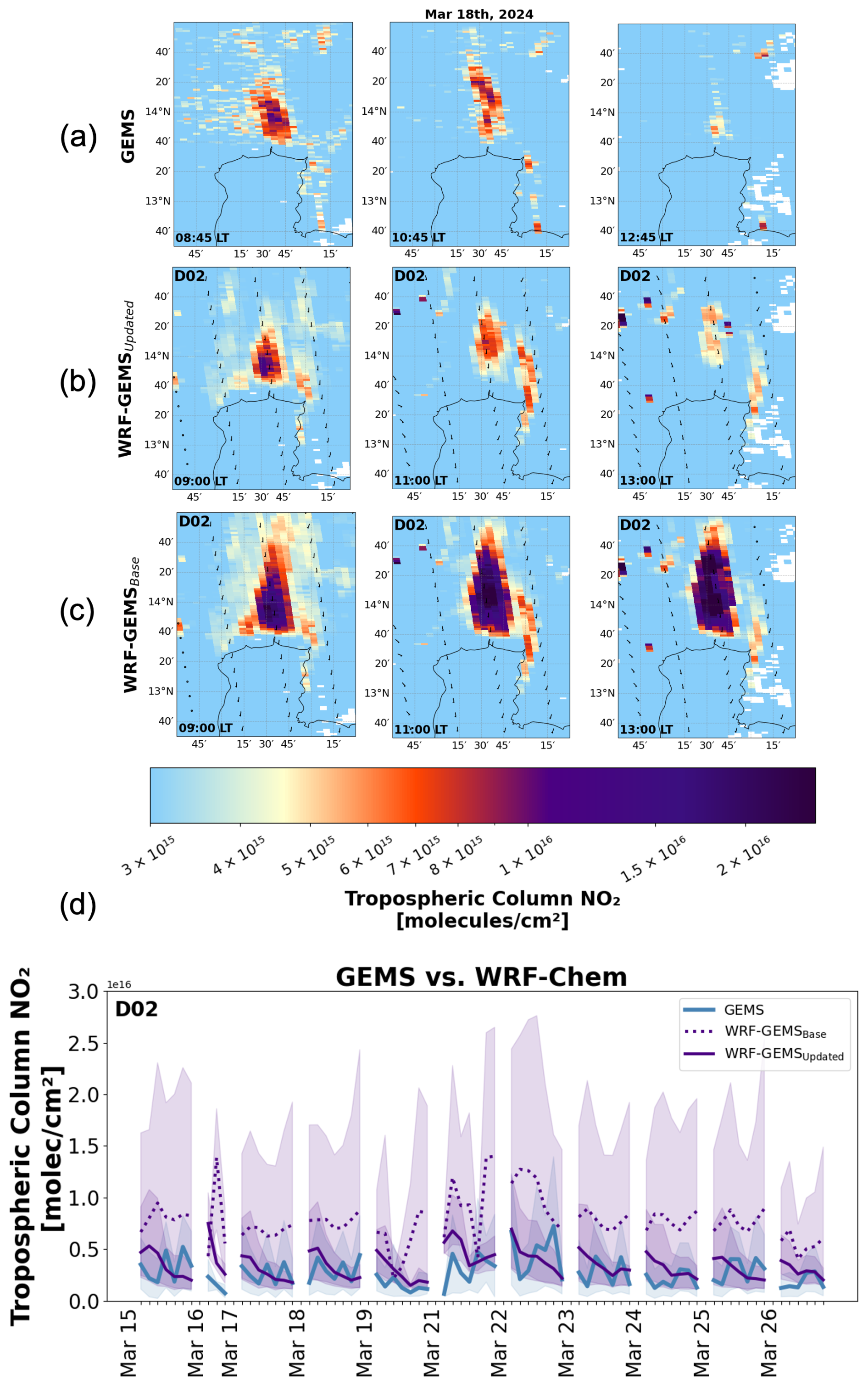
Figure 6Spatial comparison over the BMR on 18 March 2024 of tropospheric NO2 columns from (a) GEMS, (b) WRF-GEMSUpdated D02, and (c) WRF-GEMSBase D02 for snapshots at 02:00, 04:00, and 07:00 UTC, corresponding to approximately 09:00, 11:00, and 13:00 LT. (d) Tropospheric NO2 column for daytime hours between GEMS (blue), WRF-GEMSBase D02 (dotted purple), and WRF-GEMSUpdated D02 (solid purple) during the ASIA-AQ deployment period. Shaded regions indicate variability, represented by the 10th and 90th percentiles.
3.3.5 Structural uncertainties in the CSF framework
While the CSF framework provides a computationally efficient approach for deriving satellite-derived emissions, we acknowledge the method contains some structural uncertainties. First, the integration bounds used to compute the line densities (Eq. 4) are defined by the plume polygon identified from the satellite observations and wind field, such that the inferred top-down emissions depend on how the plume extent is delineated. As a result, inferred satellite-derived emissions can be sensitive to the selected plume extent, particularly under conditions of weak enhancements or overlapping sources. Second, the satellite-derived emission estimate scales directly with the effective wind speed (Eq. 1), such that errors in wind magnitude or direction propagate into the derived fluxes and satellite-derived emissions (see Fig. S5). Although ERA5 winds averaged over the lowest model layers are used to approximate plume transport, they may not fully represent local meteorological variability. Third, the inferred satellite-derived emission rate depends on the assumptions within the fitting framework, including the Gaussian representation of plume structure (Eq. 5), the parametrization of plume spreading (Eq. 6), and the effective lifetime τ (Eq. 7), which represent a simplified treatment of chemical decay and dispersion. Together, these factors represent inherent uncertainties in the CSF approach that should be considered when interpreting the satellite-derived emissions.
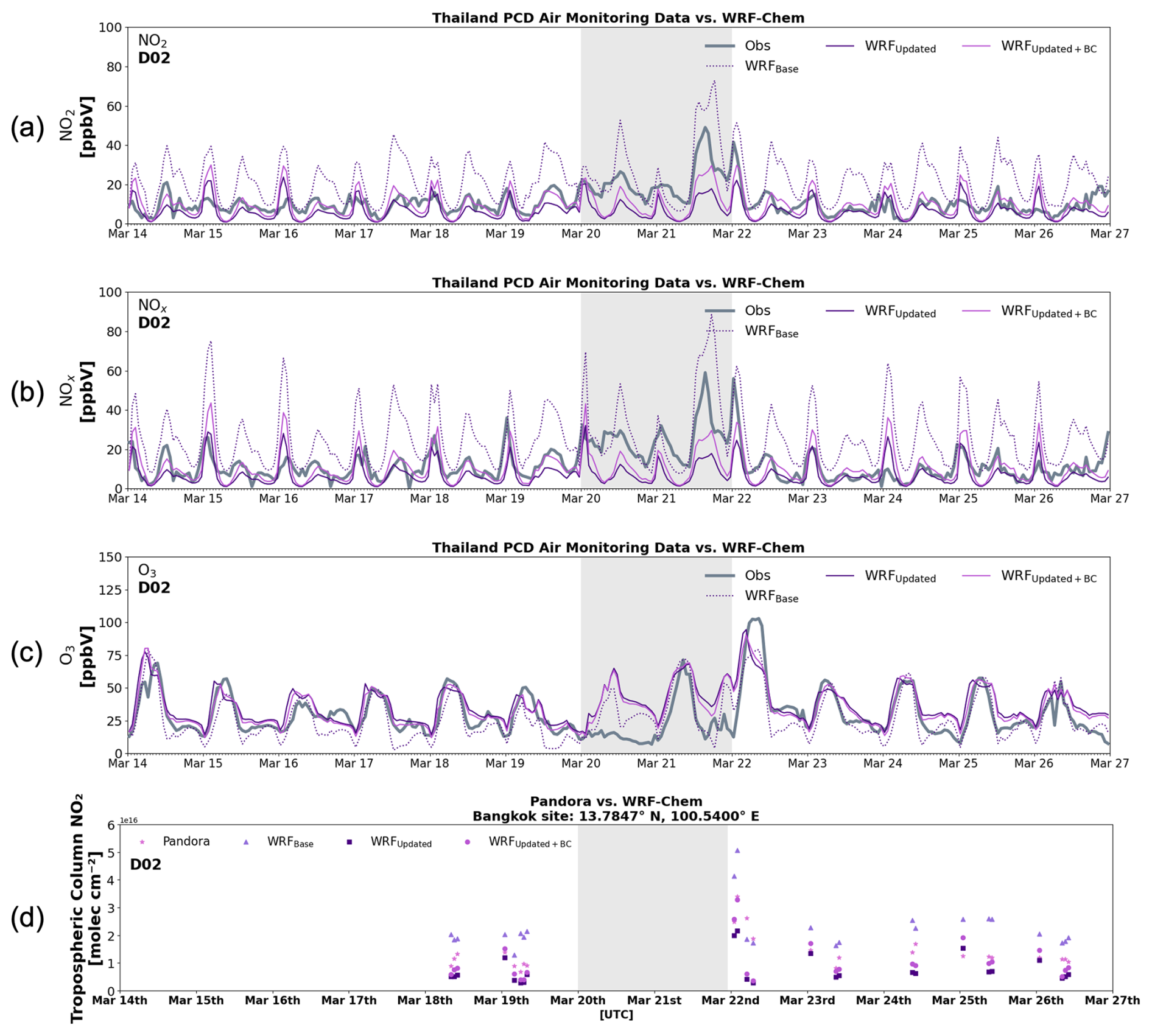
Figure 7Comparison of WRFBase D02 (dotted purple),WRFUpdated D02 (solid purple), and WRFUpdated+BC D02 (solid magenta) simulations against Thailand Pollution Control Department (PCD) ground-monitor network observations for (a) NO2 mixing ratio (ppbV), (b) NOx mixing ratio (ppbV), and (c) O3 mixing ratio (ppbV) during the ASIA-AQ deployment period (14–27 March 2024) represent averages across stations within the Bangkok urban plume. (d) Comparison of tropospheric NO2 columns from WRFBase D02 (light purple triangles), WRFUpdated D02 (dark purple squares), WRFUpdated+BC D01 (magenta dots) and Pandora (pink stars) for high-quality observations during the ASIA-AQ deployment period (18–27 March 2024). The shaded region represents the stagnation period, 20–21 March excluded from the evaluation.
3.4 Results for satellite-derived NOx emission estimates
GEMS NOx emissions for Bangkok were estimated for daytime hours (00:45–06:45 UTC) during the ASIA-AQ deployment, 14–27 March 2024. The bias-corrected satellite inversion results are denoted with the subscript “BC”. Days with significant cloud contamination were removed from the analyses on a case-by-case basis, leaving satellite-derived emissions estimates for 14, 15, 17, 18, 22, 24, and 25 March 2024. Satellite-derived emissions were computed for both weekends and weekdays, however, due to fewer weekends in the study period, weekday estimates are estimated to be more robust. We aggregate satellite-derived emissions hourly across weekdays to produce a summary daytime profile as illustrated in Fig. 3a and b. Satellite-derived emissions generally range between 0.5 and 4 kg s−1 dependent on the inversion method. Bias-corrected results (Fig. 3b) illustrate a larger NOx range, between 0.4 and 5 kg s−1. Differences between CSF, GP, and IME satellite-derived emission estimates are expected, as each method relies on distinct assumptions regarding transport, plume geometry, and chemical loss. Similar spreads between methods have been reported in previous satellite-based emission studies (Hakkarainen et al., 2024; Santaren et al., 2025), particularly in urban environments, and can be interpreted as a measure of structural uncertainty rather than inconsistency between methodologies. Nevertheless, in this application, the CSF method illustrates a distinct daytime pattern with satellite-derived emissions peaking between 08:00 and 09:00 LT (bias-corrected) coinciding with morning rush hour traffic, decreasing by approximately 65 % by 14:00 LT. The GP and IME results illustrate a relatively stable daytime pattern and overall lower (< 50 %) morning satellite-derived emission compared to the CSF method.
These results reflect both methodological differences and uncertainties in the underlying NO2 observations. While the satellite-derived emissions might provide strong constraints on daytime variability, uncertainties in the GEMS NO2 retrieval, particularly under high NO2 conditions may influence the magnitude and timing of the inferred emissions as depicted in Fig. 3a and b. The bias-corrected emissions are approximately 70 % higher on average, indicating a substantial sensitivity of the inversion to the assumed retrieval bias.
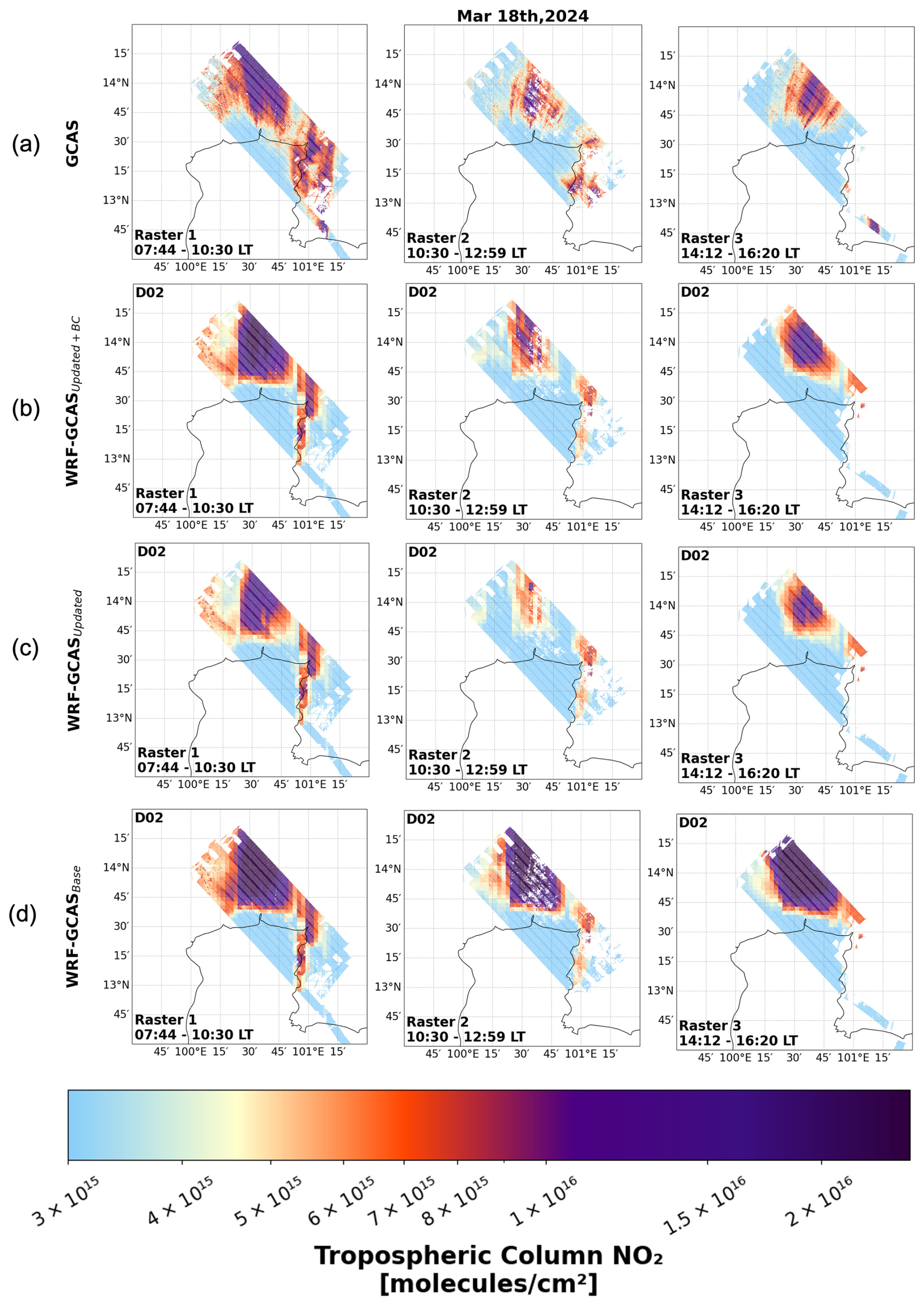
Figure 8Spatial comparison over the BMR on 18 March 2024 of tropospheric NO2 columns from (a) GCAS, (b) WRF-GCASUpdated+BC D02, (c) WRF-GCASUpdated D02 and (d) WRF-GCASBase D02 for raster periods corresponding to morning, afternoon, and early evening local time.
3.5 Selection of the inversion method
To identify the optimal inversion method to be used for model correction, we test which method can successfully recover WRF-Chem's prior daytime NOx emission profile. To do so, we apply the ddeq inversion algorithms to WRFBase, to produce “top-down” estimates from the model, which we will refer to as model-derived emissions. To replicate the satellite output, we re-gridded the model output from its native resolution to the satellite swath grid using the Universal Regridder for Geospatial Data (xESMF) Python package (Zhuang et al., 2025). A nearest-neighbor interpolation scheme was used to preserve spatial gradients and align the model resolution to that of the satellite observations. This spatial re-gridding was performed on an hourly basis, corresponding to the nearest observation time (00:45–06:45 UTC). Following re-gridding, model NO2 mixing ratios were vertically interpolated to the satellite pressure levels using a one-dimensional linear interpolation to ensure consistency between the model and observed data for averaging kernel application. After interpolating model output to GEMS's spatial and pressure grid, we computed the model's tropospheric column NO2 (molecules cm−2). This is done by converting the model's standard output of NO2 volume mixing ratio (ppmV) to a number density with the ideal gas law:
where is the NO2 mixing ratio in ppmV, P is pressure in Pa, T is temperature in K, R is the gas constant (8.314 J mol−1 K−1), and NA is Avogadro's number (6.022×10²³ mol−1). The number density is then multiplied by the thickness of each vertical model layer Δz to obtain the NO2 amount per unit area. Summing across all layers yields the total column NO2:
where Ak is the averaging kernel value at layer k, Δzk is the thickness of the model layer k, in meters, and converts the units to molecules cm−2. As WRF-Chem has no stratosphere, we regard this as the tropospheric column NO2. The satellite averaging kernel weights each model layer based on how sensitive GEMS is to that part of the atmosphere. This allows for a direct comparison with GEMS retrievals.
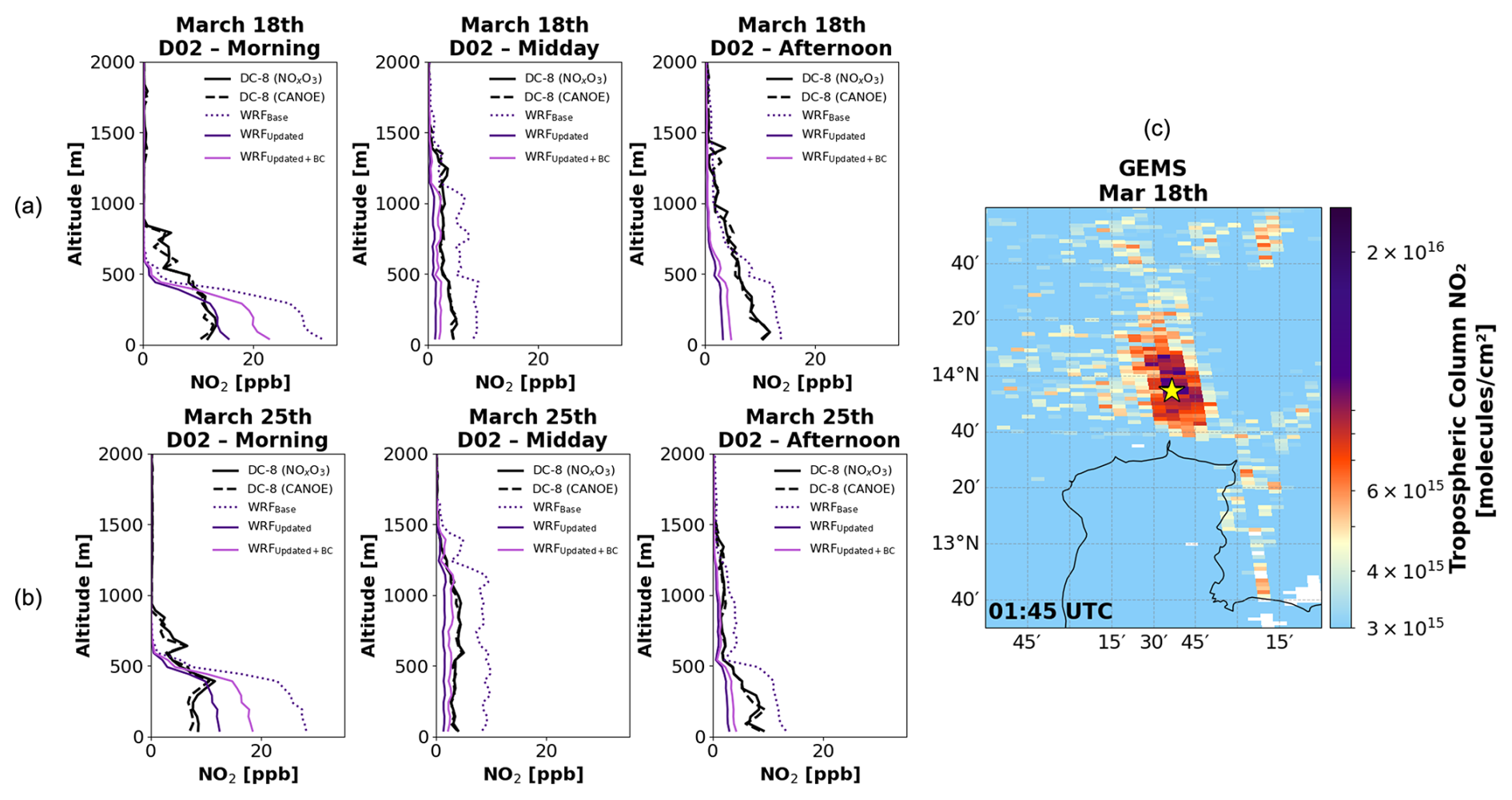
Figure 9Comparison of WRF-Chem D02 simulations (WRFBase: dotted dark purple; WRFUpdated: solid dark purple; WRFUpdated+BC: solid magenta) with airborne in situ measurements from the CANOE (dashed black) and NOxO3 (solid black) instruments aboard the DC-8 for (a) 18 March and (b) 25 March 2024. Profiles are grouped by morning (06:00–11:00 LT), midday (11:00–13:00 LT), and afternoon (13:00–17:00 LT) approaches at Don Mueang International Airport in northern Bangkok, whose location relative to the Bangkok urban plume is shown within a GEMS snapshot in (c).
We compute model-derived NOx emissions from re-gridded WRFBase (which we denote as WRF-GEMS) with ddeq and the resulting average daytime profile for Bangkok is illustrated in Fig. 3c. The shape and magnitude of model-derived NOx emissions differ substantially from the satellite-derived emission data. Model-derived emissions are initially >50 % larger than GEMS-derived emissions. Additionally, there are minimal changes in the daytime pattern present in any of the inversion methods. In fact, WRF-GEMS D02 sees an increase in emission between 08:00 and 10:00 LT, a pattern that disagrees with the observed satellite-derived emissions. The results here further illustrate the need for an hourly correction to the model's emission profile, rather than applying a single scaling factor across all hours. The WRFBase prior emission profile is shown by the black dashed line. For this comparison, we smoothed the prior emission profile using a 3 h backward-looking average to account for the accumulation and chemical evolution represented implicitly in the inversion results. Overlaying the prior emissions shows that the model-derived CSF method most accurately recovers them, likely due to its use of downwind fluxes and multiple cross-sections across the plume, which provide additional constraints on plume evolution and reduce sensitivity to local errors in wind fields, plume definition, and missing data compared to the IME and GP methods. As a result, we select the CSF inversion method moving forward to correct and scale WRF-Chem's daytime NOx emission profile.
To better represent NOx emissions over Bangkok, we developed an optimization framework to re-scale and shape WRF-Chem's prior daytime emissions across the BMR (see step 2, Fig. 2). The prior emissions come from monthly EDGAR v5 values. The optimization uses a cost function J(x) to adjust daytime prior emissions based on GEMS NOx retrievals, incorporating the lifetime and uncertainties from both the model and observations.
4.1 Optimization of daytime anthropogenic NOx emissions
4.1.1 Observational constraint
The GEMS average daytime NOx profile (blue lines in Fig. 3a, b) from the CSF method provides the observational constraint. Two versions of the optimization are performed: one using the constraint derived from the bias-corrected retrievals, and one without it. To improve consistency between the observed and modeled columns, we applied a correction factor to the constraint to account for the portion of the NO2 column that GEMS does not capture because of reduced sensitivity near the surface. Although the air mass factor (AMF) calculation includes vertical weighting, the retrieved GEMS column can still underestimate tropospheric NO2 in conditions where a substantial fraction resides in the lowest few hundred meters and is weakly sensed by the instrument. To address this sensitivity, satellite-derived NOx emission estimates were scaled using the ratio of model-derived emissions obtained from the full column (i.e., Eq. (10) excluding the Ak) and from the same column after application of the GEMS averaging kernel:
where eGEMS, , and denote the satellite-derived daytime NOx emission profiles derived from GEMS, model-derived emissions from WRF-Chem (D02) total columns, and model-derived emissions from the same columns after applying the GEMS averaging kernel, respectively. Hourly correction factors ranged between 1.05 and 1.33, where larger corrections (e.g., 1.33) were present in the morning hours, 01:00–02:00 UTC. This vertically adjusted satellite-derived emission vector was used as the observational constraint, y in the optimization.
4.1.2 Prior assumptions, lifetimes, and temporal weighting
The prior for the optimization, xb, refers to the bottom-up daytime NOx emission profile shown in the black dashed line in Fig. 3c. For the optimization, it is necessary to map the prior emissions to the satellite-derived emissions through the observational operator H. Satellite emissions of NOx represent not only emissions from the current hour, but also contributions from preceding hours. To address this, we introduce an operator H that links the prior daytime hourly emissions to the satellite-derived NOx amounts. Each row of H defines how emissions from a set of prior model hours contribute to an observation at time, ti.
For each GEMS observation hour ti, we assume that the column enhancement is influenced by emissions from a backward-looking window of 3 model hours: .
The window choice was determined by comparing inversion results to model priors using averaging windows from 1 to 6 h. The 3 h window provided the best agreement with the model-derived CSF emissions as shown in Fig. 3c. Within this window, the contribution from each prior hour depends on the atmospheric lifetime of NO2 for that hour. We use hourly lifetimes, τ, derived from the GEMS-based CSF inversion in Eq. (7), where τ is fitted from observed along-plume decay using ERA5 winds, and is therefore independent of WRF-Chem meteorology. This ensures the satellite-derived emission estimates are completely independent of the WRF-Chem simulations. For reference, WRF-Chem-derived decay times are generally longer than those inferred from GEMS, reflecting differences in modeled vs. observed loss and dilution processes. Hours with no satellite information, are assigned a default lifetime of 3 h. We then apply a simple exponential decay law:
where: is the time lag between when NOx was emitted and when its NO2 enhancement is observed. These raw weights are normalized within each row of H to ensure mass conservation:
Thus, Hi,j, represents the fraction of the observed column at hour i, that is attributable to emissions from model hour j. This framework of H ensures that shorter lifetimes contribute to a stronger emphasis on the most recent emissions, appropriately reflecting rapid chemical loss, and longer lifetimes spread the influence of emissions over multiple hours, consistent with slower decay. By embedding this chemical persistence into the operator, H, we obtain a physically representative mapping between model emissions and the satellite observations that are used to constrain them.
4.1.3 Solution for posterior daytime emissions
A model corrected daytime NOx emission profile (posterior), was obtained by minimizing the following cost function:
where y is the satellite-derived, column-corrected NOx emission vector, x is the unknown corrected model daytime emission profile, xb is the model prior profile, are the observation and background error covariance matrices, and H is the observational operator matrix described above. In this study, we use R= 1 and B= 10. These values were based on sensitivity tests in which we vary R and B over several orders of magnitude. The chosen values represent a compromise that allowed the posterior emission profile to closely follow the satellite constrains while preventing excessive deviations from the prior emission profile. To account for temporal correlation in prior emission errors, the elements of B are defined as:
where |ti−tj| is the temporal separation between emission hours i and j, and L is the temporal correlation length, set to L= 2 h in this study. This setup ensures that prior errors vary smoothly in time rather than independently hour-to-hour. Finally, the cost function was minimized using a Sequential Least Squares Quadratic Programming (SLSQP) algorithm – minimize(method=“SLSQP”), v1.16.2 (SciPy Developers, 2025; Nocedal and Wright, 2006). The result is a corrected model hourly emission vector, , that balances the satellite-derived emissions with the model's prior estimate while accounting for chemistry and transport behavior (Fig. 4).
Figure 4a and c illustrate the raw hourly daytime NOx for both the prior model (dashed purple) and the optimized version (solid purple), based on constraints applied without and with the GEMS bias correction, respectively. In both bases, the posterior profile departs notably from the prior in both magnitude and shape. In the case without the bias-corrected constraint (Fig. 4a), a morning peak is visible at 07:00 LT, followed by a steady decline until 13:00 LT. This pattern is consistent with temporal patterns in weekday traffic intensity in Bangkok found in Ly et al. (2015), which found the morning traffic to peak at 07:30 LT ending at 09:30 LT, and the evening peak from 17:00 to 20:00 LT (outside of GEMS observing window). Activity begins to increase at 13:00 LT which corresponds to the NOx increase we begin to see in the posterior result after 06:00 UTC. The case with the bias-corrected constraint (Fig. 4c) places peak morning emission closer to the model prior at 07:00–08:00 LT, with NOx declining slightly later, at 09:00 LT. NOx emission begins to increase after 13:00 LT similar to what is depicted in Fig. 4a. When the prior and posterior hourly emissions are passed through H, we obtain a temporally smoothed emission profile consistent with what GEMS would observe (Fig. 4b, d). Figures 4b and d show the posterior profile closely reproduces the GEMS-derived daytime pattern, indicating the optimization effectively aligns model emissions with satellite-derived emissions while preserving components of the prior model behavior.
4.2 Adjustment of WRF-Chem diurnal emission profiles
Using satellite-derived NOx emissions and the posterior results above, we correct the WRF-Chem 24 h input emissions over the BMR. Since GEMS provides estimates over 01:00–07:00 UTC, we only have posterior model emissions over this window. To apply these updates to the full gridded 24 h WRF-Chem anthropogenic emission input (00:00–23:00 UTC), while preserving the model's spatial distribution, we compute hourly scaling factors which we use to adjust the gridded prior NOx emissions. Because GEMS provides constraints only during the daytime overpass window, the derived scaling below primarily reflects daytime emission adjustments. We therefore apply the mean scaling factor uniformly during the nighttime hours to preserve the prior temporal structure and avoid introducing artificial discontinuities between the constrained and unconstrained hours, particularly given the large daytime emission reductions. This approach is consistent with previous satellite-constrained emission studies (e.g., Goldberg et al., 2019) which constrain emission magnitude based on a single daytime value derived from OMI. Where available, locally derived temporal profiles should be used to better represent regional emission patterns; in this study, our prior profile reflects the best available regional representation for Asia at the time of study.
To compute the factors, hourly WRF-Chem NO and NO2 prior emission fields were summed across the vertical levels and masked to the Bangkok region bounded by N–S: 13.5–15.0°, W–E: 100.2–100.9°, using the WRF-Chem grid. In WRF-Chem, NOx emissions are stored as NO2-equivalent mass (“NOx as NO2”), so all conversions use the molecular weight of NO2. The total emissions were converted to mol h−1 using a molecular weight of 46.01 g mol−1 and an area of 16 km2 per grid cell (following the resolution of D02). Each posterior emission, was converted from kg s−1 to mol h−1 and divided by the corresponding original WRF-Chem total to compute a scale factor, f for each hour h:
where is the original domain-integrated prior NOx emissions for hour h. Since the optimization covered hours with GEMS measurements, the scaling factors for the remaining model hours were computed using the ratio of average daytime posterior emissions where averages are taken over the constrained hours. Finally, we apply the scaling factors spatially over the BMR. The scaling factor was applied to the hourly WRF-Chem anthropogenic emissions prior files and only to NO and NO2 grid cells within the BMR mask. This preserves the original spatial distribution but adjusts the total prior emissions to match the posterior values. The updated emission files were then used to initialize an updated model simulation, ran for the ASIA-AQ deployment period, which we will refer to as WRFUpdated (see step 3, Fig. 2).
Figure 4e compares the average diurnal prior profile over BMR with the updated profile derived from the optimization and scaling procedure. The optimized diurnal profile based on the bias-corrected GEMS constraint is illustrated by the light pink line. The updated profiles show a notable increase in NOx between 07:00 and 10:00 UTC (14:00 to 17:00 LT), which may reflect the beginning of a rush-hour signal over the city. Nighttime emissions retain the overall shape of the prior profile but are scaled downward based on the daytime average. Figure S6 maps the spatial distribution of these updates across BMR, showing the largest differences in the late afternoon and early evening, with localized reductions of up to 400 mol km−2 h−1 in the updated input emissions.
4.3 Comparison with bottom-up emission inventories
To place the updated NOx emissions in context of existing emission inventories, we compared total monthly emissions over the BMR against several widely used bottom-up inventories, our top-down emissions (including bias-corrected results – This StudyBC), and emissions from a chemical reanalysis product (Fig. 5). These include HTAP v3.2 (base 2019), a local Thailand Inventory (THAI-KMUTT) (base 2019), MIX v2.3 (base 2017), EDGAR v5 (base 2015), CEDS (base 2024), our study (2024), and the Tropospheric Chemistry Reanalysis (TCR-3) top-down emissions TCR-3 (2024) (Miyazaki et al., 2020). Across inventories, monthly totals for March can vary nearly by an order of magnitude, highlighting large uncertainty in regional NOx sources and emissions processing methodology. For example, although both HTAP v3.2 and MIX v2.3 rely on the REAS framework (Kurokawa and Ohara, 2020) for Asian anthropogenic emissions, they are derived from different REAS versions, temporal coverage, and processing assumptions, which can lead to substantial differences in absolute emission magnitudes over Bangkok. HTAP v3.2 is based on REAS v3.2.1, which provides monthly emissions for 2000–2015 at a spatial resolution of 0.25°. In the HTAP product, these emissions are re-gridded to 0.1° by assuming a uniform spatial distribution within each grid cell (Guizzardi et al., 2025). In contrast, the MIX inventory is based on REAS v2, which covers 2000–2008 and reflects earlier emission estimates and activity data (Li et al., 2024). REAS v2 was subsequently extended to 2010 following the scaling approach described by Kurokawa and Ohara (2020).
Overall, HTAP v3.2 depicts the highest NOx totals at 31 kt month−1. THAI-KMUTT follows with emissions at ∼ 20 kt month−1, reflecting its incorporation of detailed regional activity from local emissions data. The coarser-resolution MIX v2.3, and EDGAR v5, and CEDS inventories reflect lower totals, at ∼ 13, 11, 10 kt month−1 respectively, consistent with the use of different emission estimation methodology and older base years for MIX and EDGAR which correspond to lower macro-economic (e.g., GDP) indicators in Thailand compared to 2019. Lastly, GEMS top-down NOx estimates (including bias-corrected results) and TCR-3 estimates based on the chemical reanalysis using TROPOMI NO2 indicate substantially lower emissions (2–4 kt month−1). These reduced magnitudes may result from both recent emission declines and structural differences in how emissions are computed (i.e., top-down perspective).
It is important to note uncertainties are present and differ amongst emission methods. For example, bottom-up inventories depend on activity data, emission factors, spatial approximations, and assumptions that may not capture rapid socio-economic changes or region-specific behavior. Top-down estimates incorporate uncertainties from their respective satellite retrievals, reanalysis data (e.g., ERA5), averaging kernels, chemical lifetime assumptions, and forecast-model transport and chemistry (e.g., TCR-3). Together, these differences highlight the value of combining observational constraints with updated bottom-up information to define NOx emission estimates.
To evaluate the performance of WRF-Chem (Base + Updated) NO2 simulations during the ASIA-AQ period (14–27 March 2024) in Bangkok, we first compared model output with satellite tropospheric column NO2 retrievals from GEMS v3 data. For GEMS observations, pixels were filtered based on cloud fraction (CF < 0.3). The GEMS averaging kernel and air mass factor data were used to isolate tropospheric contributions and account for satellite instrument sensitivity. To enable a direct comparison with our model output, we re-gridded model output from its native resolution to the satellite swath grid as explained in Sect. 3.3. As before, we refer to the re-gridded model simulations with the GEMS averaging kernel applied as WRF-GEMS. To evaluate regional NO2 variability, we aggregated satellite and model-derived tropospheric column NO2 values over the BMR, by defining a N–S (13.5–14° N), W–E (100.3–100.9° E) bounding box for the area. For pixels within this boxed region, we calculate the mean NO2 concentration, minimum NO2, maximum NO2, standard deviation, and the 10th and 90th percentiles to characterize regional variability. This analysis was repeated on an hourly basis for each co-located WRF-Chem and GEMS dataset, providing a regionally aggregated view of column NO2 for intercomparison.
The results shown here are based on satellite comparisons using the non-bias corrected model results and are intended to illustrate that the optimization brings the model closer to GEMS observations. The maps shown in Fig. 6 illustrate a spatial comparison of (a) GEMS, (b) updated model results, WRF-GEMSUpdated D02, and (c) base model, WRF-GEMSBase D02 tropospheric columns NO2 over the BMR for several snapshots on 18 March 2024. Results for D01 can be found in Figs. S6 and S7. GEMS generally places BMR city enhancements between 5×10¹⁵ and 2×10¹⁶ molecules cm−2 in a N–S direction. Both WRFUpdated D01, D02 generally reflect the spatial distribution and magnitude of tropospheric column NO2 observed during daylight hours. WRFUpdated D02 (Fig. 6b) tends to place the city plume more northward at 04:00 and 07:00 UTC compared to what is observed in GEMS data (Fig. 6a). This spatial discrepancy is likely related to overpredicted model winds (further discussed in Sect. 6.1) which displaces the plume in a northward direction. Additionally, while the inversion framework adjusts emission magnitudes temporally, it does not correct spatial errors in plume transport or source distribution (See Sect. 7.2 for further discussion). Nevertheless, the daytime pattern seen in GEMS is accurately reflected in WRFUpdated with column NO2 values at their peak in the morning hours (08:00 LT), decreasing substantially throughout the afternoon (14:00 LT) due to photochemical interactions. This is a substantial improvement from WRFBase, which sees a large overestimation of NO2 in the morning hours followed by persistent and growing NO2 columns throughout the afternoon as seen in Fig. 6c.
The time series in Fig. 6d illustrates a full comparison of daytime tropospheric column NO2 values across model types in D02 (see Fig. S7 for D01) for the duration of ASIA-AQ. WRF-GEMSUpdated indicates a clear reduction in error and bias from WRFBase as illustrated by the reduced NO2 columns and model spread. WRFUpdated also indicates corrected daytime patterns compared to WRFBase, indicating better consistency with GEMS observations for the deployment period with few exceptions such as 22 March where GEMS has peaks in the afternoon (further discussed in Sect. 6.1).
To independently assess the performance of the optimized WRF-Chem simulations, we compared three model configurations: WRFBase, WRFUpdated, and WRFUpdated+BC for D01 and D02 against a suite of independent airborne and ground-based observations distinct from the satellite measurements used in the emission optimization process (see step 4, Fig. 2). Comparisons between WRFUpdated and WRFUpdated+BC reflect the sensitivity of the model results to biases in the GEMS retrieval used to constrain emissions in the optimization process. This evaluation primarily emphasizes the results of D02 (4 km), which more directly represents urban-scale processes and exhibits improved performance compared to D01 across multiple observational datasets. These datasets provide an unbiased test of how well the model reproduces meteorological conditions and trace gas amounts beyond those directly constrained from GEMS observations. By evaluating WRF-Chem against surface monitoring networks (Thailand PCD), Pandora spectrometer measurements, and airborne ASIA-AQ data (e.g., GCAS NO2 columns, DC-8 vertical profiles), we examine the model's ability to capture daytime variability, vertical structure, and surface concentrations of NO2 across different spatial and temporal scales. Evaluation amongst these diverse datasets, therefore, helps to support the robustness of the emission correction framework described in this paper.
6.1 Meteorological evaluation: winds and PBL height
6.1.1 Evaluation methodology
To assess the performance of WRF-Chem meteorological fields, modeled wind speed and direction were evaluated against surface observations across the BMR during the ASIA-AQ campaign, 14–27 March 2024. Biomass burning was active in the region during the study period, particularly over northern Thailand and Myanmar, with peak activity occurring in mid-March. However, transport to Bangkok was likely limited due to weak synoptic flow and short chemical lifetime of NOx, reducing its impact on urban concentrations of NOx in the BMR. Following 20 March, precipitation suppressed fire activity, further minimizing its impact. While biomass burning may contribute to broader regional enhancements, its impact on the inversion results and coincident model evaluation over Bangkok is expected to be minor.
Surface observations of wind speed (m s−1) and direction are obtained from Thailand Pollution Control Department (PCD) ground monitor network data. Hourly surface wind observations from PCD network data were co-located with corresponding model outputs for D01 and D02. For each site, model data were extracted from the nearest grid cell and interpolated to observation timestamps. Daily wind roses were constructed to visualize and compare the frequency distribution of wind speed and direction between the model and observations. For each station, wind speeds were binned into intervals of 0–1, 1–3, 3–5, and 5–8 m s−1 and wind directions were grouped into 16 compass sectors. Normalized frequency counts were computed to highlight dominant flow patterns. Data was averaged across stations within a larger bounding box around BMR, N–S (12.5–15° N), W–E (99.5–101.5° E). For meteorology, we use a large box that spans the regional flow influencing Bangkok so that we capture plume transport into and out of the city. Figure S8a illustrates the station locations and averaging domains in Bangkok.
Additionally, we performed an evaluation of planetary boundary layer height (PBLH) to gauge the model's ability to capture daily PBLH magnitude and development during the deployment period. Observed PBLHs were derived from the NASA Langley airborne High Spectral Resolution Lidar Generation -2 (HSRL-2) data following a machine learning approach described in Christopoulos et al. (2025) for ASIA-AQ flight days, 18 March, 19 March, 23 March, and 25 March 2024. We evaluate PBLHs for aircraft raster periods (i.e., Raster 1: morning, Raster 2: afternoon, Raster 3: late afternoon/evening hours) and co-locate the observed PBLHs to modeled PBLHs based on a nearest grid-cell approximation.
6.1.2 Model-observation wind discrepancies
Within the observational data, a pronounced synoptic transition occurred over Thailand on 20–21 March 2024, during which winds reversed from the typical southwesterlies that were present during the deployment period to northeasterlies, weakened substantially, coinciding with a drop in PBLH, and increased atmospheric stability (see observations; Figs. S9, S10). This transition played a major role in PM2.5 and ozone exceedances by promoting stagnation over the BMR. The WRF-Chem simulation failed to capture the timing or strength of this abrupt wind shift and associated stagnation (Figs. S2a, b and S9b, c). The model instead maintained stronger southwesterly flow and higher PBLH, which led to unrealistic vertical mixing patterns compared to the observations (Figs. S9, S10). Since this mismatch drives discrepancies between model and observations that are unrelated to emissions adjustments/inversions, we exclude 20–21 March from the inversion/air quality evaluation. Although the simulation is driven by FNL, it is possible for WRF-Chem to mis-time a rapid synoptic transition. This event evolved on a relatively short spatial and temporal scale, and the coarse FNL boundary conditions may not have fully resolved the sharp changes in low-level flow. In addition, local processes (i.e., convection, PBL mixing, land-sea interactions) around Bangkok can cause the model to drift from the observed timing once it is integrated forward. We suspect these factors likely contributed to the later wind shift in WRF-Chem. We additionally found WRF-Chem (D01, D02) systematically overpredicts wind speed throughout the deployment (Fig. S2a, b; Table S2) with better agreement from the high-resolution 4 km domain. This bias likely arises from the fact that many PCD monitors are embedded within the complex urban environment of Bangkok, which are not fully resolved at WRF-Chem's spatial scale.
The consequences of this mis-timed synoptic transition are most pronounced on 21 March as demonstrated in the next section, when weak large-scale flow made the simulation highly sensitive to local processes. Under these conditions, WRF-Chem misses the stagnation and dilutes pollutants too quickly. This helps explain why the model performs worst during the highest observed PM2.5 and O3 episode. These results indicate that forecast performance during similar weak-flow pollution events would benefit from improved representation of urban boundary-layer processes (e.g., surface roughness, urban canopy effects, and land–sea breeze structure).
6.1.3 Model-observation PBLH discrepancies
As shown in Fig. S10 and summarized in Table S3, WRF-Chem generally captures the temporal evolution of the PBLH observed by the aircraft. During the daytime (afternoon hours represented by Raster 2–3), the simulated PBL is broadly comparable to the observations, with median values that are often similar. However, the magnitude and sign of the model bias vary by day, with WRF-Chem demonstrating both over- and under-estimation likely related to the meteorological conditions. This day-to-day variability suggests PBLH biases are not systematic during the afternoon and may influence surface pollution dilation differently across individual cases, potentially contributing to variability in simulated daytime NO2 concentrations rather than a consistent model bias.
6.2 Surface air quality evaluation
To evaluate model performance of surface trace gases, modeled surface mixing ratios of NO2, NOx, and O3 were evaluated against observations across BMR during 14–27 March 2024. Surface observations of these constituents (in ppbV) were obtained from Thailand PCD ground monitor network data. Like the evaluation of wind speeds and direction, data was co-located by extracting model information from the nearest grid cell and matched to the observation timesteps. Station data and model data were averaged across stations located within the Bangkok urban plume, bounded by N–S (13.5–14.6° N), W–E (100.2–101° E). Figure S8b illustrates the station locations and averaging domain in Bangkok. For the air quality evaluation, we restrict the station averaging domain to a smaller area over the Bangkok urban plume. This smaller domain allows us to assess how the inversion and optimization specifically correct the local plume structure as opposed to a broader regional background.
6.2.1 NO2 and NOx
Figure 7a, b, and c shows a comparison of average surface NO2, NOx, and O3 (ppbV) for stations located within the Bangkok urban plume during the ASIA-AQ deployment for D02. D01 results are available in Fig. S11. The 20–21 March is shaded in grey to indicate the period where the model mis-represented synoptic conditions resulting in enhancements in the observed concentrations due to stagnation. During this time, NO2 and NOx reached as high as 49, and 59 ppbV, respectively. O3 peaked at 103 ppbV the following day, on 22 March. Excluding this event, observed NO2 and NOx for this period generally ranged between 3–17 ppbV, and 3.5–22 ppbV respectively. Overall, there is a clear improvement in the representation of NO2 and NOx during this period in WRFUpdated and WRFUpdated+BC as shown in Fig. 7a and b.
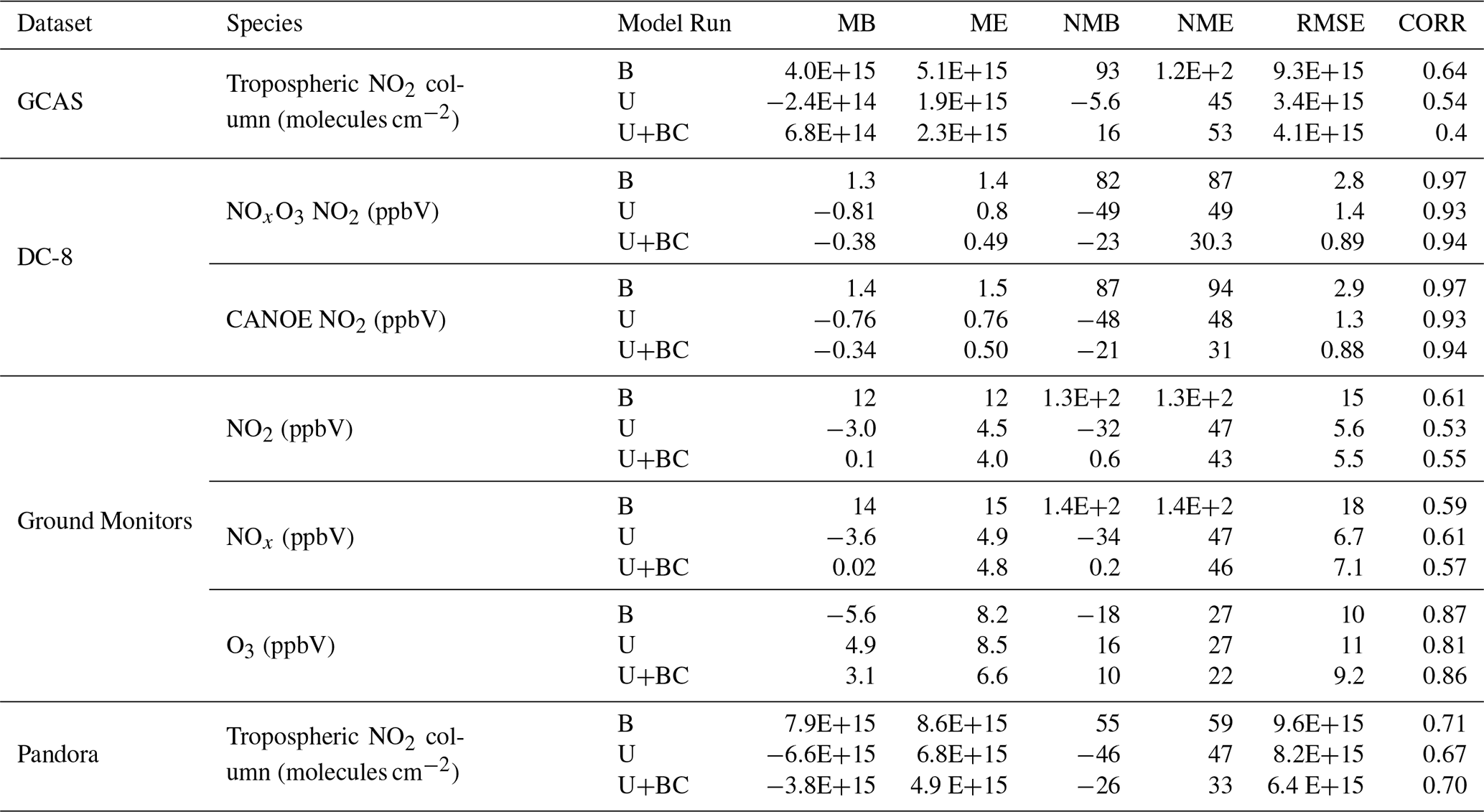
Table 2 depicts summary statistics for this analysis. The baseline simulation, WRFBase overestimates both NO2 and NOx with mean biases of +12 and +14 ppbV, respectively. With updated emissions, these large positive biases in WRFUpdated were eliminated and reversed, yielding mean biases of −3.0 ppbV for NO2 and −3.6 ppbV for NOx. The remaining negative bias is likely linked to the overprediction of winds, associated advection, and inversion related biases, which leads to locally diluted concentrations near urban sites as shown in the previous analyses. WRFUpdated+BC further reduces the residual bias related to WRFUpdated, bringing mean biases closer to zero (e.g., +0.1 ppbV for NO2 and +0.02 ppbV for NOx), while maintaining comparable error and correlation, indicating accounting for the GEMS retrieval bias prior to inversion provides a modest additional improvement in model performance. Correlations with observed NO2 and NOx remain moderate (r= 0.5–0.6) reflecting potential spatial discrepancies in WRFUpdated as seen in the previous analyses. Average diurnal cycles of NOx for D02, D01 are further illustrated in Fig. S12a and c. Observed NOx shows a clear morning peak and lower midday concentrations driven by boundary layer evolution. WRFBase overestimates NOx and exaggerates the morning peak while WRFUpdated (dark purple) substantially improves both magnitude and timing but underestimates the evening peak values. WRFUpdated+BC shows mixed performance with an overprediction of the morning peak while the evening peak aligns more closely with observations compared to WRFUpdated, indicating a trade-off in how the bias correction might redistribute NOx across the diurnal cycle in the updated models.
Table 2Summary of WRF-Chem D02 validation statistics for WRFBase (B), WRFUpdated (U), and WRFUpdated+BC (U+BC) simulations evaluated against independent observational datasets. Metrics include mean bias (MB), mean error (ME), normalized mean bias (NMB), normalized mean error (NME), root-mean-square error (RMSE), and Pearson correlation coefficient (CORR).
6.2.2 O3
Observed O3 generally ranged between 14 and 57 ppbV, excluding the stagnation event on 20–21 March, and the baseline model captures this range reasonably well (Fig. 7c). After updating the emissions, O3 increases in WRFUpdated and WRFUpdated+BC primarily at night, consistent with reduced NO titration following the decrease in NOx emissions. Average diurnal cycles in D02 (Fig. S12b, d) show that daytime O3 production changes only modestly between base and updated simulations, indicating the emission update mainly affects nighttime chemistry, as opposed to shifting photochemical O3 formation in the daytime. This pattern is reflected in the change in overall mean bias in Table 2, which shifts from an underprediction (−5.6 ppbV) to an overprediction (+4.9 ppbV) in WRFUpdated. The overprediction is not as substantial in WRFUpdated+BC (+3.1 ppbV). While WRFUpdated exhibits an earlier O3 peak in D02 compared to observations, this shift is not present in D01 despite the same emission inversion being applied. This likely suggests the discrepancy is driven by domain-dependent differences in meteorological or chemical processes, rather than an error in the inferred NOx emission timing. The O3 peak is better represented in WRFUpdated+BC.
The relatively weak daytime O3 response to decreased NOx emissions is consistent with recent analyses of O3 formation sensitivity during ASIA-AQ with in situ measurements, which indicate that the BMR exhibits mixed sensitivity to NOx and VOCs, in contrast to the predominantly NOx-limited regimes observed at other ASIA-AQ locations (e.g., Manila) (Cho et al., 2026). In this mixed-sensitivity regime, changes in NOx emissions alone are not expected to strongly perturb daytime O3 production, further providing validation for the minimal daytime O3 response observed here. The magnitude of the daytime O3 response varies by domain/model as shown by the D01 results (Fig. S12d). Although WRFUpdated D01 better matches observed daytime O3, this apparent improvement likely reflects NOx titration associated with spatial dilution.
Overall, these results suggest that while the updated emissions improve the model's NOx representation, further improvements in VOC representation and local mixing processes may be needed to fully capture daytime O3 levels in the BMR. Nevertheless, the updated emissions substantially improve the model's simulation of surface NO2 and NOx, resulting in a more realistic overall representation of air quality in Bangkok.
6.3 Evaluation with Pandora column observations
We additionally evaluate modeled NO2 columns against Pandora measurements for the Bangkok site. Pandora NO2 evaluation used Level 2 direct-sun total column retrievals, filtered for high-quality measurements (quality flag =10), and averaged to hourly means. Tropospheric columns from Pandora were estimated by subtracting coincident or closest GEMS stratospheric NO2 at the nearest satellite pixel. Model columns were sampled at the nearest grid cell to the Pandora site and temporally matched to observations.
Figure 7d depicts a comparison of WRFBase (light purple triangles), WRFUpdated (dark purple squares), WRFUpdated+BC (magenta dots) and Pandora (pink stars), tropospheric NO2 column measurements for days with high quality data. Throughout this period, Pandora measurements generally ranged between approximately 7×10¹⁵ to 3.5×10¹⁶ molecules cm−2 and fit between WRFBase which places columns higher (e.g., up to 5×10¹⁶ molecules cm−2), WRFUpdated+BC and WRFUpdated which places columns lower (e.g. 2×10¹⁵ molecules cm−2). Average statistics between model cases for this analysis are shown in Table 2. Biases are generally similar between model cases. WRFBase overestimates column NO2 as illustrated by the mean bias ( molecules cm−2) whereas emissions updates contribute to an underestimation ( molecules cm−2). However, there are some improvements in absolute error metrics with ME and RMSE decreasing by roughly 20 % and 12 % respectively, and NME dropping from 61 % to 48 %. The greatest bias improvements overall are seen in WRFUpdated+BC ( molecules cm−2). Figure S13 illustrates the spatial distribution of mean tropospheric model NO2 bias for GEMS and Pandora during the time reflected in Fig. 7d. In the WRFBase simulation, a strong positive bias is seen within and north of the Pandora site, indicating the overestimation of NO2 columns (up to 2×10¹⁶ molecules cm−2) in the urban plume relative to GEMS. This pattern reiterates the point that the prior anthropogenic emissions (based on EDGAR v5) were too large with pollutant accumulation occurring downwind of Bangkok as a result. After applying the emission updates, the WRFUpdated simulation essentially eliminates this bias. The overall bias near the Pandora site becomes close to neutral or slightly negative, demonstrating the optimization effectively corrected the spatial overprediction. WRFUpdated+BC further reduces the residual negative bias relative to WRFUpdated with NMB improving from −46 % to −26 % and RMSE decreasing from 8.2×10¹⁵ to 6.4×10¹⁵ molecules cm−2. This indicates that accounting for the GEMS retrieval bias in the initial optimization process partially corrects the remaining underestimation, although some spatial discrepancies persist dude to transport and plume placement error. Examples of daily biases for WRFBase D01, D02, and WRFUpdated D01, D02 can be found in Figs. S14 and S15.
6.4 Evaluation with ASIA-AQ aircraft measurements
The Airborne and Satellite Investigation of Asian Air Quality (ASIA-AQ) was a NASA field campaign conducted in February–March 2024 to advance the understanding of urban and regional air quality across East and Southeast Asia. Targeting several megacities (e.g., Manila, Seoul, Bangkok, Chiang Mai), the campaign combined satellite observations, aircraft measurements, ground-based monitoring, and modeling approaches to characterize pollution sources and validate satellite retrievals. A main objective of ASIA-AQ was to evaluate the data from GEMS. Airborne observations were collected using the NASA DC-8 in situ and LaRC G-III remote sensing aircraft, with coordinated support from ground-based networks such as Pandora and AERONET. Additionally, chemical transport models (e.g., GEOS-Chem, GEOS-FP, MUSICA, WRF-Chem, WRF-CMAQ) played a key role in real-time flight planning and post-campaign interpretation.
6.4.1 GCAS
The GEOstationary Coastal and Air Pollution Events (GEO-CAPE) Airborne Simulator (GCAS) is an airborne UV-Vis spectrometer that was flown on the G-III aircraft during the ASIA-AQ campaign. GCAS was designed to simulate the spectral capabilities of TEMPO and GEMS, but with a much finer pixel resolution of approximately 250×560 m at flight altitude (Janz et al., 2019; Lee et al., 2024). GCAS uses a push-broom remote sensing technique and consists of two spectrometer channels: a UV-Vis channel (300–490 nm) optimized for air quality measurements, and a Vis-NIR channel (480–900 nm) for ocean color observations (Kowalewski and Janz, 2014; Lee et al., 2024). This work focuses on the NO2 retrieval from spectra in the UV-Vis channel. Retrieval details and validation results can be found in Judd et al. (2020) but were previously found to be unbiased with uncertainties within ± 25 %. As in previous field campaigns, the aircraft executed a “lawnmower” flight pattern with parallel flight lines spaced 6.3 km apart, providing about 10 % overlap between flight lines assuming a flight altitude of 8534 m. This flight strategy, combined with the instrument's 45° field of view, allowed for the generation of gap-free NO2 column maps up to three times per day, period referred to as a “raster”. Due to the short duration of each raster period (∼ 3 h), local meteorological conditions often influence the fine-scale structures observed in the GCAS NO2 data (Goldberg et al., 2024). Here, we evaluate the WRF-Chem runs against GCAS for several flight days: 18, 19, 23, and 25 March 2024.
We perform the evaluation for each raster separately to isolate specific flight patterns and accurately evaluate spatial gradients in NO2 between the model and observations. For each analysis, GCAS pixels corresponding to the flagged raster were retained for comparison. Additional filters were applied to remove poor-quality retrievals. We masked pixels with cloud or sun glint contamination based on a provided flag variable (cloud_glint_flag =1) and discarded retrievals with missing data or undefined AMFs. GCAS provides separate NO2 vertical columns above and below the aircraft, as well as model-derived scattering weights, and AMFs for both portions. The above and below aircraft contributions can be approximated as the stratospheric and tropospheric contributions, respectively. For this evaluation, we focus exclusively on the NO2 column below the aircraft or the tropospheric column NO2, which is the portion most relevant to surface-level air quality and most comparable to our WRF-Chem results. We compute the below-aircraft averaging kernel, , as:
Here, SWi represents the scattering weight for layer i, representing the sensitivity of the measured radiance to NO2 in that layer. This averaging kernel represents the satellite-equivalent vertical sensitivity to NO2 below the aircraft and was used to weigh the WRF-Chem vertical profile.
WRF-Chem output including, NO2 mixing ratio, pressure, temperature, and height were used to compute air density and convert volume mixing ratios to number densities as previously done in the GEMS evaluation. Each GCAS pixel was temporally matched to the nearest model output time (rounded to nearest hour) and spatially co-located by finding the nearest WRF-Chem grid cell. To isolate the portion of the model column below the aircraft, we filtered the model levels based on the aircraft altitude reported at each pixel. We compute the tropospheric column as shown in Eq. (10). To generate a model column that reflects the vertical sensitivity of the GCAS retrieval, we interpolate the WRF-Chem profile to the number of GCAS vertical layers (49), converted the mixing ratios to number density, and applied the GCAS averaging kernel to yield WRF-GCAS.
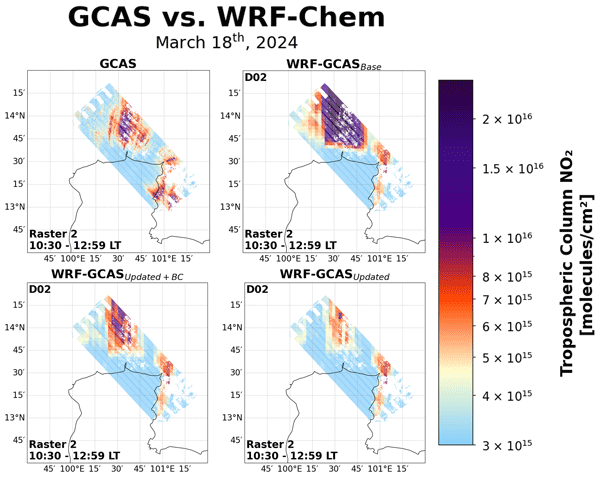
The maps in Fig. 8 illustrate a spatial comparison between (a) GCAS, (b) WRF-GCASUpdated+BC D02, (c) WRF-GCASUpdated D02, and (d) WRF-GCASBase D02 over BMR for a flight day on 18 March 2024. D01 spatial comparisons are available in Fig. S16. 18 March represents a typical example of local pollution dominating BMR with minimal influences from long-range pollution transport and biomass burning. The GCAS instrument generally places tropospheric column NO2 values in BMR between 5×10¹⁵ and 2×10¹⁶ molecules cm−2, with the largest enhancements observed in the city center, as also seen in the GEMS data (Fig. 7). A clear N–S plume is visible in the data, reflecting persistent southerly onshore flow from the Gulf of Thailand. This pattern coincides with the seasonal shift from the northeast to southwest monsoon. Overall, WRF-GCASUpdated and WRF-GCASUpdated+BC generally better capture the spatial differences and magnitudes of tropospheric column NO2 in BMR for different raster periods compared to WRF-GCASBase. WRFUpdated+BC outperforms WRFUpdated in capturing NO2 column enhancements, particularly during raster 2 (late morning–afternoon LT). GCAS also illustrates enhanced NO2 columns southeast of Bangkok in a region known as the Eastern Economic Corridor (EEC), a major hub for industrial activity (e.g., automotive manufacturing, petrochemicals, electronics). WRFUpdated, WRFUpdated+BC, and WRFBase tend to underestimate pollution levels in the EEC. This is likely related to wind speed overprediction and a lack of updated regional source data in the EDGAR v5 inventory (since this is a region outside of the performed inversion). Information from a local emissions inventory, or additional inversions performed on this region could aid the model in better representing the air quality in this region, which has similar magnitudes of column NO2 (2×10¹⁶ molecules cm−2) to the Bangkok city center.
Statistics for this analysis are shown in Table 2. Overall, statistics are representative of substantial bias and error improvements in the updated runs from WRFBase, which significantly overpredicts column NO2 amounts in the region for all raster periods. For example, ME and RMSE are improved by ∼ 62 % from WRFBase and WRFUpdated. Mean biases are negative which indicate WRFUpdated is underpredicting NO2 columns. This is likely the result of the low inversion biases and windspeed overprediction. However, this underprediction is improved throughout the day as seen in Fig. S17a and b. This is in opposition to WRFBase, which increases in biases and error for each raster as also shown in Fig. S17a and b. These daytime patterns also highlight an important distinction between the benefits of geostationary (GEMS) versus LEO observations. Morning improvements are particularly strong because the inversion directly constrains the rapid rise in emissions during the morning, something that LEO sensors generally under sample due to their limited overpass frequency. Midday and afternoon performance remains improved as well, but the morning hours show the clearest advantage of daytime GEO sampling for capturing short-timescale emission variability. Similar results are demonstrated in WRFUpdated D01 (Fig. S18). WRFUpdated+BC is indicative of a partial correction to the negative bias in WRFUpdated, shifting the NMB from −5.6 % to +16 %. While this brings the simulated NO2 columns closer to observations in a mean sense, is it followed by increases in error, suggesting a trade-off between bias reduction and overall model performance.
Correlations remain moderate (0.4–0.6) for model cases, however, WRFUpdated and WRFUpdated+BC illustrate weaker correlations likely due to (i) subtle shifts in the urban plume placement (i.e., shift in a more northerly direction), and (ii) a reduction in dynamic range after emissions corrections. For example, when plume magnitudes are lowered, the variability shrinks allowing the correlations to become less sensitive to spatial-temporal agreement and more sensitive to small plume-placement differences as is the case here.
6.4.2 NOxO3 and CANOE (DC-8)
We additionally compare the model simulations to in situ NO2 data gathered by the National Center for Atmospheric Research's (NCAR) NOxO3 and NASA's GSFC's Compact Airborne NO2 Instrument (CANOE) aboard the DC-8 aircraft. The NOxO3 instrument is a 3-channel chemiluminescence instrument designed for the measurement of NO, NO2, and O3 (Ridley et al., 1992; Ridley and Grahek, 1990). CANOE measures NO2 using non-resonant laser induced fluorescence (LIF) (St. Clair et al., 2019). We use the 1 s DC-8 data for the flights conducted in Thailand during March 2024 (18 March, 25 March). A visual depiction of the DC-8 flight path is shown in Fig. S19. The typical flight path included several low-altitude descents/ascents over several airports (see Fig. S19b) along with long-distance transects across Central Thailand.
To evaluate model performance, we match hourly WRF-Chem outputs from both the 20 km (D01) and 4 km (D02) domains to the aircraft location and time. For each observation, we extract co-located model NO2 values along the aircraft track. Profiles are filtered by location (e.g., Don Mueang International Airport in Bangkok) and direction (e.g., ascent or descent) using flags in the provided observational datasets. Individual profiles are grouped by their unique number, and we bin the observations and model output by altitude (50 m vertical bins). For each bin, we compute mean NO2 from the aircraft and model datasets. These vertically resolved comparisons allow us to assess model skill in capturing the observed structure and magnitude of NO2 within the boundary layer and lower troposphere.
Figure 9 depicts a comparison of aggregated in situ NO2 vertical profiles over the Don Mueang International airport for (a) 18 March and (b) 25 March. Model scenarios are shown in shades of purple (WRFBase: dotted dark purple; WRFUpdated: solid dark purple; WRFUpdated+BC solid magenta), and in situ information from two instruments aboard the DC-8, NOxO3 (solid) and CANOE (dashed) are displayed in black. The location of the Don Mueang International Airport with respect to the Bangkok urban plume is depicted in (c). We separate and group the data by time of day to gauge how the model runs perform with respect to time of day. Corresponding plots for D01 are available in Fig. S20. As shown in Fig. 9, the NOxO3 and CANOE NO2 measurements exhibit excellent agreement throughout the analysis period. This consistency between two independent in situ instruments strengthens confidence in the observational data used for model evaluation. Comparison with DC-8 in situ NO2 profiles show that WRFBase consistently overestimated observed concentrations, with a mean bias of +1.3 ppb and normalized mean bias near 80 %. Figure 9a and b indicate the overestimation is most pronounced near the surface during the morning, where WRFBase exceeds observations by nearly 25 ppb. WRFUpdated+BC also suggests an overestimation compared to aircraft observations in the morning. In contrast, WRFUpdated captures the observed morning surface enhancements accurately. As time progresses, however, WRFUpdated and WRFUpdated+BC begin to underestimate the column (average bias ∼ −0.3 to −0.8 ppb), though both mean error and RMSE remain improved in the updated cases relative to WRFBase (Table 2). This daytime behavior likely reflects the nature of the GEMS-based emission constraints, which are directly applied only until 14:00 LT, after which a single daily scaling factor is applied on the input emissions. As afternoon PBL growth and photochemistry evolve, the fixed scaling likely results in an underestimation in the afternoon profiles. Additionally, overestimated model winds speeds may further dilute surface concentrations, likely contributing to the midday and afternoon biases shown in WRFUpdated, and WRFUpdated+BC. The afternoon underestimation is slightly reduced in WRFUpdated+BC, likely reflecting the impact of the bias correction applied prior to inversion/NOx emission optimization.
Correlations for WRFUpdated (r=0.93–0.97) and WRFUpdated+BC (r=0.94) remain high indicating the simulation preserved the observed structure while improving the overprediction. Overall, these results highlight the effectiveness of the emission updates in accurately capturing morning surface air quality. This suggests that while the updated emissions substantially improve the magnitude of modeled NO2, remaining discrepancies are driven primarily by meteorological transport rather than emission magnitude.
7.1 Implications of GEMS NO2 retrieval biases
In our study, the comparisons with independent aircraft and ground-based observations indicate the satellite-constrained emissions without bias-corrections presented here may represent a low estimate. In particular, the systematic low bias in GEMS NO2 is consistent with the negative biases often seen in the WRFUpdated simulations. Importantly, this bias could not be diagnosed using the satellite data alone.
To further evaluate the relative behavior of GEMS and airborne GCAS NO2 columns, we compare their tropospheric columns using WRFUpdated+BC as a common transfer framework (Fig. S21). Figure S21 compares the observed GCAS/GEMS NO2 column ratios with ratios calculated after both datasets are mapped through WRFUpdated+BC. In the observations, GCAS columns are consistently higher than the raw GEMS columns as illustrated by the orange line, with GCAS/GEMS ratios of ∼ 2–3 on most days and values reaching ∼ 6–7 on 21 March. In contrast, the corresponding WRF-GCASUpdated+BC/WRF-GEMSUpdated+BC ratios are closer to 1:1 (∼ 1.1–1.7), even on 21 March. This behavior is consistent with a low bias in GEMS NO2 columns relative to GCAS. After applying the bias correction, the GCAS/GEMSBC ratios approach 1:1 on most days, indicating improved consistency between the datasets, and supporting the effectiveness of the applied GEMS bias correction.
When incorporating bias-corrected retrievals into the top-down inversions and NOx emission optimization process, the resulting WRFUpdated+BC run reduces the negative biases in the independent validation, in some cases bringing the model results even closer to observations as seen in the surface air quality analysis. However, this improvement is not uniform. In certain comparisons (e.g., GCAS and DC-8), WRFUpdated+BC introduces a tendency toward overprediction in morning hours, highlighting tradeoffs associated with the bias correction. These results suggest that while accounting for the retrieval bias can improve mean model performance, additional uncertainties such as overestimated wind speeds and associated transport errors continue to influence the representation of modeled NO2.
Here, the integration of ground-based, airborne, satellite, and model data provides a powerful framework not only for improving emissions but also for identifying limitations within individual observing systems. While WRFUpdated clearly outperforms the baseline model, and WRFUpdated+BC offers targeted improvements in reducing systematic bias, the combined observational evidence highlights the necessity of a multi-platform validation to fully interpret the satellite-based emission estimates.
Despite this low bias in the GEMS retrieval, the high-frequency daytime sampling provided by geostationary observations offers critical constraints on daytime variability and plume evolution that are particularly valuable for emission inversion and air quality modelling. For example, the GEMS-constrained emission adjustments presented here were critical for improving the temporal evolution of NOx in WRF-Chem, resulting in substantial and robust improvements in model performance across independent evaluations. Future work may further benefit from continued refinement of bias-corrected GEMS products and upcoming algorithm improvements (e.g., v4), alongside improved representation of spatial representation of emissions within the model.
7.2 Limitations and potential extensions of the inversion framework
The current model emission update framework optimizes the temporal evolution of emissions but does not explicitly resolve regional variability, as a single set of hourly scaling factors is applied uniformly across all grid cells within the BMR. As a result, the inversion preserves the spatial structure of the prior inventory, and any inaccuracies in the spatial distribution of emissions are not corrected.
Extending this approach to resolve emissions at finer scales would require allowing emissions to vary across grid cells or subregions, supported by additional constraints. These constraints could include regional higher-resolution regional prior inventories when available, as well as higher-resolution observations (e.g., GCAS) that can better resolve the urban variability in NO2 as shown in this analysis.
8.1 A GEO-constrained framework for anthropogenic NOx emissions
Accurate urban NOx emissions remain a major challenge for air quality modeling efforts, but geostationary satellites now offer a path forward. This work takes a novel approach in improving urban NOx emissions using daytime GEO satellite observations. We quantify and reduce biases in modeled NO2 over the Bangkok Metropolitan Region (BMR), by integrating GEMS constraints into a high-resolution model's daytime prior emission profile. We first used top-down inversions of hourly GEMS NO2 columns with the Cross-Sectional Flux (CSF) method to develop an average daytime NOx profile for the BMR in March 2024. Using this information, we developed and applied an optimization framework that incorporates physical constraints (i.e., with regards to emissions accumulation and lifetime) to reshape the WRF-Chem's daytime emission pattern and magnitude to better reflect observed emissions variability in the BMR.
This represents one of the first applications of the ddeq framework to estimate hourly urban NOx emissions with geostationary observations in Southeast Asia. In contrast to a full chemical reanalysis, the ddeq-based framework provides an efficient and scalable alternative that does not require repeated model reinitialization of extensive chemical state optimization. This makes the approach particularly suitable for regional applications and for broader application across different modeling systems and urban environments within the domain of GEO sensors.
8.2 Model improvements across independent observational platforms
Re-running WRF-Chem (D01 – 20 km; D02 – 4 km) with an updated NOx emission profile (WRFUpdated; WRFUpdated+BC) led to substantial improvements across multiple independent datasets. Model evaluation with ground monitors, Pandora, GCAS, and DC-8 observations consistently showed reduced biases and errors relative to the baseline simulation based on EDGAR v5 emissions. For example, surface-level comparisons with Thailand PCD ground network data confirmed some of these trends in WRFUpdated, with mean biases in NO2 and NOx decreasing from +12 to +14 ppbV in WRFBase to roughly −3 ppbV in WRFUpdated, and 0.02 to 0.1 ppbV in WRFUpdated+BC. At the Bangkok Pandora site, mean bias shifted from strongly positive ( molecules cm−2) to negative, and normalized mean errors decreased by ∼ 20 %–4 % in WRFUpdated and WRFUpdated+BC. Evaluation against GCAS airborne column retrievals further showed that the emissions updates improved spatial variability and magnitude of NO2 across the Bangkok urban plume, reducing mean and root mean square errors by ∼ 55 %–63 % in WRFUpdated and WRFUpdated+BC compared to WRFBase. The DC-8 in situ vertical profiles further illustrated that WRFUpdated could substantially reduce near-surface overestimation in morning hours and preserve the observed vertical structure of NO2 mixing ratios.
8.3 Assessing GEMS bias through multi-platform integration
Overall, these results demonstrate that incorporating geostationary satellite constraints into regional, high-resolution (4 km) chemical transport models can substantially improve the representation of urban air quality over Bangkok. Large biases in the baseline simulation are likely driven by reliance on outdated global emissions inventories (e.g., EDGAR v5), which do not reflect recent changes in regional anthropogenic activity, as well as uncertainties in bottom-up methodologies where updated local estimates appear systematically high. The satellite-constrained emission estimates derived here are consistent with independent top-down approaches (e.g., TCR-3) based on different satellite platforms and methodologies, increasing confidence in the inferred reductions.
Comparisons with independent aircraft and ground-based observations further indicate that the GEMS-constrained emissions presented here may represent an underestimate. In particular, the systematic low bias reported for the GEMS v3 NO2 product is consistent with the remaining negative biases observed in WRFUpdated. By accounting for this bias through the application of bias-corrected retrievals, WRFUpdated+BC reduces these negative biases, although in some cases introduces a tendency toward overprediction, highlighting tradeoffs associated with the correction. While model output (e.g., WRFBase) can serve as a transfer standard for comparing different observing systems, these results highlight the importance of integrating ground-based, airborne, satellite, and model information to robustly identify biases and improve emission estimates.
8.4 Value of hourly GEO constraints, high-resolution modelling and future directions
A key strength of this framework is the use of hourly daytime constraints uniquely provided by geostationary observations, which enable direct characterization of daytime emission variability and plume evolution that cannot be captured by once-daily low-Earth-orbit measurements. These daytime constraints are particularly important for urban environments, where emissions, chemistry, and boundary-layer dynamics vary rapidly and strongly influence air quality impacts.
Coarse (∼ 12 km) simulations have been shown to inadequately represent circulations in coastal environments, and nonlinear NOx chemistry, leading to systematic biases in simulations of NO2 (Hsu et al., 2026; Valin et al., 2011; Verreyken et al., 2025; Yu et al., 2023). These limitations in model resolution are expected in coastal megacities such as Bangkok with complex local topography and land-sea contrasts. Consistent with recent TEMPO-based emission studies indicating that model resolution can limit the robustness of GEO-based top-down NOx constraints (Hsu et al., 2026), these considerations motivate the use of 4 km WRF-Chem simulations in this work as a necessary framework for accurately interpreting geostationary satellite observations and constraining urban NOx emissions.
While remaining discrepancies, including the negative model biases, are likely influenced in part by overpredicted model wind speeds and associated transport errors, future work could benefit from finer-resolution simulations (< 4 km) and more advanced urban parameterizations (e.g., multi-layer urban canopy models; Liu et al., 2025) to better represent urban flow, drag, and mixing. Continued validation and further development of bias-corrected GEMS retrievals will also strengthen the use of geostationary NO2 products. Nevertheless, the high-frequency daytime sampling provided by GEMS already offers critical information for emission inversion, and the integration of GEMS-derived constraints into WRF-Chem represents a scalable pathway toward near-real-time, satellite-informed emissions estimation and improved air quality forecasting for rapidly developing megacities.
The code repository for ddeq v1 is available on GitLab: https://gitlab.com/empa503/remote-sensing/ddeq (last access: 2 June 2026). The implementation of ddeq v1 for top-down NOx estimates and model optimization scripts are publicly available via Zenodo (https://doi.org/10.5281/zenodo.18381169) (Christopoulos, 2026).
All ASIA-AQ field campaign data used in this study (i.e., GEMS NO2 v3, NOxO3, CANOE, GCAS, Thailand PCD air quality monitoring data) are openly available and were acquired from their NASA Langley Research Center maintained archive: https://www-air.larc.nasa.gov/cgi-bin/ArcView/asiaaq (last access: 2 June 2026). Pandora total column NO2 observations are available through the Pandonia Global Network website: https://www.pandonia-global-network.org/home/documents/pgn-data/ (last access: 2 June 2026). ERA5 meteorological reanalysis data were obtained from the Copernicus Climate Data Store: https://cds.climate.copernicus.eu/ (last access: 2 June 2026). Global emissions used in this study are openly available as well, HTAP v3.2 (https://edgar.jrc.ec.europa.eu/dataset_htap_v32) (last access: 2 June 2026), MIXv3.1 (https://csl.noaa.gov/groups/csl4/modeldata/data/Li2023/) (last access: 2 June 2026), EDGARv5 (https://edgar.jrc.ec.europa.eu/dataset_ghg50) (last access: 2 June 2026), ODIAC (https://db.cger.nies.go.jp/dataset/ODIAC/) (last access: 2 June 2026). THAI-KMUTT, and TCR-3 emissions can be made available upon request.
The supplement related to this article is available online at https://doi.org/10.5194/acp-26-8021-2026-supplement.
JAC designed the study, performed the model simulations, conducted the data analysis, prepared all figures, and wrote the initial draft of the manuscript. PS supervised the project, contributed ideas, guidance, and discussions regarding the model framework and interpretation of results. MM provided additional guidance on the modeling framework and interpretation of results. All authors discussed the results and contributed to the final version of the manuscript.
At least one of the (co-)authors is a member of the editorial board of Atmospheric Chemistry and Physics. The peer-review process was guided by an independent editor, and the authors also have no other competing interests to declare.
The views expressed in this manuscript are those of the authors and do not reflect the views of NASA.
Publisher's note: Copernicus Publications remains neutral with regard to jurisdictional claims made in the text, published maps, institutional affiliations, or any other geographical representation in this paper. The authors bear the ultimate responsibility for providing appropriate place names. Views expressed in the text are those of the authors and do not necessarily reflect the views of the publisher.
We thank the entire ASIA-AQ team for their contributions to the field experiment. We are particularly grateful to the instrument teams for their efforts in conducting in situ measurements, to the airborne remote sensing teams (HSRL-2 and GCAS) for their data collection and support, and the GEMS team for providing the data used in this work. We also thank Dr. Daniel Goldberg for helpful discussions related to top-down emissions estimation methodologies, including recommendations on the ddeq library and guidance on inversion methodology development. The TCR-3 product was generated by calculations using the Earth Simulator with the support of the Japan Agency for Marine-Earth Science and Technology.
This research has been supported by the National Aeronautics and Space Administration (grant nos. 80NSSC22M0266 and 80NSSC23K0786).
This paper was edited by Andreas Hofzumahaus and reviewed by two anonymous referees.
Agarwal, P., Stevenson, D. S., and Heal, M. R.: Evaluation of WRF-Chem-simulated meteorology and aerosols over northern India during the severe pollution episode of 2016, Atmos. Chem. Phys., 24, 2239–2266, https://doi.org/10.5194/acp-24-2239-2024, 2024.
Ahmadov, R., McKeen, S. A., Robinson, A. L., Bahreini, R., Middlebrook, A. M., de Gouw, J. A., Meagher, J., Hsie, E.-Y., Edgerton, E., Shaw, S., and Trainer, M.: A volatility basis set model for summertime secondary organic aerosols over the eastern United States in 2006, J. Geophys. Res. Atmos., https://doi.org/10.1029/2011JD016831, 2012.
Anav, A., Sorrentino, B., Collalti, A., Paoletti, E., Sicard, P., Coulibaly, F., Manzini, J., Hoshika, Y., and De Marco, A.: Meteorological, chemical and biological evaluation of the coupled chemistry-climate WRF-Chem model from regional to urban scale. An impact-oriented application for human health, Environ. Res., 257, 119401, https://doi.org/10.1016/j.envres.2024.119401, 2024.
Anenberg, S. C., Mohegh, A., Goldberg, D. L., Kerr, G. H., Brauer, M., Burkart, K., Hystad, P., Larkin, A., Wozniak, S., and Lamsal, L.: Long-term trends in urban NO2 concentrations and associated paediatric asthma incidence: estimates from global datasets, Lancet Planet. Health, 6, e49–e58, https://doi.org/10.1016/S2542-5196(21)00255-2, 2022.
ASIA-AQ: ASIA-AQ White Paper, National Aeronautics and Space Administration, https://espo.nasa.gov/asia-aq/document/ASIA-AQ_White_Paper (last access: 6 January 2025), 2023.
Aung, S. H., Gheewala, S. H., Winijkul, E., Panyametheekul, S., and Prapaspongsa, T.: Environmental impacts and costs of ozone formation in Bangkok Metropolitan Region, Atmos. Pollut. Res., 16, 102450, https://doi.org/10.1016/j.apr.2025.102450, 2025.
Bae, K., Richter, A., Lange, K., Friedrich, M. M., Pinardi, G., Roozendael, M. V., Merlaud, A., Fayt, C., Bösch, T., Zilker, B., Latsch, M., Behrens, L. K., Lee, H., Jung, Y., Hong, H., Chang, L.-S., and Song, C.-K.: Comparison of GEMS v3.0 tropospheric NO2 columns with ground-based DOAS instruments in Ulsan, GISci. Remote Sens., https://doi.org/10.1080/15481603.2025.2597604, 2025.
Beirle, S., Boersma, K. F., Platt, U., Lawrence, M. G., and Wagner, T.: Megacity Emissions and Lifetimes of Nitrogen Oxides Probed from Space, Science, 333, 1737–1739, https://doi.org/10.1126/science.1207824, 2011.
Bond, T. C., Streets, D. G., Yarber, K. F., Nelson, S. M., Woo, J.-H., and Klimont, Z.: A technology-based global inventory of black and organic carbon emissions from combustion, J. Geophys. Res., https://doi.org/10.1029/2003JD003697, 2004.
Bond, T. C., Bhardwaj, E., Dong, R., Jogani, R., Jung, S., Roden, C., Streets, D. G., and Trautmann, N. M.: Historical emissions of black and organic carbon aerosol from energy-related combustion, 1850–2000, Global Biogeochem. Cycles, 21, https://doi.org/10.1029/2006GB002840, 2007.
Chen, F. and Chen, Z.: Cost of economic growth: Air pollution and health expenditure, Sci. Total Environ., 755, 142543, https://doi.org/10.1016/j.scitotenv.2020.142543, 2021.
Cho, C., Franchin, A., Flocke, F., Lesko, K., Owen, C., Hall, S. R., Ullmann, K., Apel, E. C., Hills, A. J., Hornbrook, R. S., Roozitalab, B., Jeong, D., Diskin, G. S., Choi, Y., DiGangi, J. P., Miech, J., Wolfe, G. M., Hanisco, T. F., St. Clair, J. M., Liao, J., Delaria, E. R., Sebol, A., Hannun, R. A., Wennberg, P. O., Ball, K., Lee, Y. R., Huey, L. G., Tanner, D. J., Arterburn, L., Blake, D. R., Blake, N. J., Barletta, B., Meinardi, S., Min, K.-E., Kang, H., Nam, W., Wisthaler, A., Piel, F., Wojnowski, W., Dibb, J., and Crawford, J.: Insights on Ozone Formation Sensitivity in Southeast and East Asian Megacities during ASIA-AQ, EGUsphere [preprint], https://doi.org/10.5194/egusphere-2025-6434, 2026.
Choi, S., Lamsal, L. N., Follette-Cook, M., Joiner, J., Krotkov, N. A., Swartz, W. H., Pickering, K. E., Loughner, C. P., Appel, W., Pfister, G., Saide, P. E., Cohen, R. C., Weinheimer, A. J., and Herman, J. R.: Assessment of NO2 observations during DISCOVER-AQ and KORUS-AQ field campaigns, Atmos. Meas. Tech., 13, 2523–2546, https://doi.org/10.5194/amt-13-2523-2020, 2020.
Christopoulos, J.: GEMS Top-Down NOx Emissions and Model Optimization, Zenodo [code], https://doi.org/10.5281/zenodo.18381169, 2026.
Christopoulos, J. A., Saide, P. E., Ferrare, R., Collister, B., Barton-Grimley, R. A., Scarino, A. J., Collins, J., Hair, J. W., and Nehrir, A.: Improving Planetary Boundary Layer Height Estimation From Airborne Lidar Instruments, J. Geophys. Res. Atmos., 130, e2024JD042538, https://doi.org/10.1029/2024JD042538, 2025.
Crippa, M., Solazzo, E., Huang, G., Guizzardi, D., Koffi, E., Muntean, M., Schieberle, C., Friedrich, R., and Janssens-Maenhout, G.: High resolution temporal profiles in the Emissions Database for Global Atmospheric Research, Sci. Data, 7, 121, https://doi.org/10.1038/s41597-020-0462-2, 2020.
de Foy, B. and Schauer, J. J.: An improved understanding of NOx emissions in South Asian megacities using TROPOMI NO2 retrievals, Environ. Res. Lett., 17, 024006, https://doi.org/10.1088/1748-9326/ac48b4, 2022.
Elguindi, N., Granier, C., Stavrakou, T., Darras, S., Bauwens, M., Cao, H., Chen, C., Denier van der Gon, H. A. C., Dubovik, O., Fu, T. M., Henze, D. K., Jiang, Z., Keita, S., Kuenen, J. J. P., Kurokawa, J., Liousse, C., Miyazaki, K., Müller, J.-F., Qu, Z., Solmon, F., and Zheng, B.: Intercomparison of Magnitudes and Trends in Anthropogenic Surface Emissions From Bottom-Up Inventories, Top-Down Estimates, and Emission Scenarios, Earth's Future, 8, e2020EF001520, https://doi.org/10.1029/2020EF001520, 2020.
Fioletov, V. E., McLinden, C. A., Krotkov, N., and Li, C.: Lifetimes and emissions of SO2 from point sources estimated from OMI, Geophys. Res. Lett., 42, 1969–1976, https://doi.org/10.1002/2015GL063148, 2015.
Fuller, R., Landrigan, P. J., Balakrishnan, K., Bathan, G., Bose-O'Reilly, S., Brauer, M., Caravanos, J., Chiles, T., Cohen, A., Corra, L., Cropper, M., Ferraro, G., Hanna, J., Hanrahan, D., Hu, H., Hunter, D., Janata, G., Kupka, R., Lanphear, B., Lichtveld, M., Martin, K., Mustapha, A., Sanchez-Triana, E., Sandilya, K., Schaefli, L., Shaw, J., Seddon, J., Suk, W., Téllez-Rojo, M. M., and Yan, C.: Pollution and health: a progress update, Lancet Planet. Health, 6, e535–e547, https://doi.org/10.1016/S2542-5196(22)00090-0, 2022.
Gao, Z. and Zhou, X.: A review of the CAMx, CMAQ, WRF-Chem and NAQPMS models: Application, evaluation and uncertainty factors, Environ. Pollut., 343, 123183, https://doi.org/10.1016/j.envpol.2023.123183, 2024.
Georgoulias, A. K., van der A, R. J., Stammes, P., Boersma, K. F., and Eskes, H. J.: Trends and trend reversal detection in 2 decades of tropospheric NO2 satellite observations, Atmos. Chem. Phys., 19, 6269–6294, https://doi.org/10.5194/acp-19-6269-2019, 2019.
Goldberg, D. L., Lamsal, L. N., Loughner, C. P., Swartz, W. H., Lu, Z., and Streets, D. G.: A high-resolution and observationally constrained OMI NO2 satellite retrieval, Atmos. Chem. Phys., 17, 11403–11421, https://doi.org/10.5194/acp-17-11403-2017, 2017.
Goldberg, D. L., Saide, P. E., Lamsal, L. N., de Foy, B., Lu, Z., Woo, J.-H., Kim, Y., Kim, J., Gao, M., Carmichael, G., and Streets, D. G.: A top-down assessment using OMI NO2 suggests an underestimate in the NOx emissions inventory in Seoul, South Korea, during KORUS-AQ, Atmos. Chem. Phys., 19, 1801–1818, https://doi.org/10.5194/acp-19-1801-2019, 2019.
Goldberg, D. L., Tao, M., Kerr, G. H., Ma, S., Tong, D. Q., Fiore, A. M., Dickens, A. F., Adelman, Z. E., and Anenberg, S. C.: Evaluating the spatial patterns of U.S. urban NOx emissions using TROPOMI NO2, Remote Sens. Environ., 300, 113917, https://doi.org/10.1016/j.rse.2023.113917, 2024.
Gong, S. L., Barrie, L. A., and Blanchet, J.-P.: Modeling sea-salt aerosols in the atmosphere: 1. Model development, J. Geophys. Res. Atmos., 102, 3805–3818, https://doi.org/10.1029/96JD02953, 1997.
Graziosi, F. and Manca, G.: Quantification of Hotspot Methane Emissions Using Sentinel-5P TROPOMI Observations, Publications Office of the European Union, https://doi.org/10.2760/4473858, 2025.
Grell, G., Freitas, S. R., Stuefer, M., and Fast, J.: Inclusion of biomass burning in WRF-Chem: impact of wildfires on weather forecasts, Atmos. Chem. Phys., 11, 5289–5303, https://doi.org/10.5194/acp-11-5289-2011, 2011.
Guenther, A., Karl, T., Harley, P., Wiedinmyer, C., Palmer, P. I., and Geron, C.: Estimates of global terrestrial isoprene emissions using MEGAN (Model of Emissions of Gases and Aerosols from Nature), Atmos. Chem. Phys., 6, 3181–3210, https://doi.org/10.5194/acp-6-3181-2006, 2006.
Guizzardi, D., Crippa, M., Butler, T., Keating, T., Wu, R., Kaminski, J., Kuenen, J., Kurokawa, J., Chatani, S., Morikawa, T., Pouliot, G., Racine, J., Moran, M. D., Klimont, Z., Manseau, P. M., Mashayekhi, R., Henderson, B. H., Smith, S. J., Hoesly, R., Muntean, M., Banja, M., Schaaf, E., Pagani, F., Woo, J.-H., Kim, J., Pisoni, E., Zhang, J., Niemi, D., Sassi, M., Duhamel, A., Ansari, T., Foley, K., Geng, G., Chen, Y., and Zhang, Q.: The HTAP_v3.2 emission mosaic: merging regional and global monthly emissions (2000–2020) to support air quality modelling and policies, Earth Syst. Sci. Data, 17, 5915–5950, https://doi.org/10.5194/essd-17-5915-2025, 2025.
Gulde, S. T., Kolm, M. G., Smith, D. J., Maurer, R., Courrèges-Lacoste, G. B., Sallusti, M., and Bagnasco, G.: Sentinel 4: a geostationary imaging UVN spectrometer for air quality monitoring: status of design, performance and development, in: International Conference on Space Optics – ICSO 2014, 1158–1166, https://doi.org/10.1117/12.2304099, 2017.
Hakkarainen, J., Kuhlmann, G., Koene, E., Santaren, D., Meier, S., Krol, M. C., van Stratum, B. J. H., Ialongo, I., Chevallier, F., Tamminen, J., Brunner, D., and Broquet, G.: Analyzing nitrogen dioxide to nitrogen oxide scaling factors for data-driven satellite-based emission estimation methods: A case study of Matimba/Medupi power stations in South Africa, Atmos. Pollut. Res., 15, 102171, https://doi.org/10.1016/j.apr.2024.102171, 2024.
Hoesly, R. M., Smith, S. J., Feng, L., Klimont, Z., Janssens-Maenhout, G., Pitkanen, T., Seibert, J. J., Vu, L., Andres, R. J., Bolt, R. M., Bond, T. C., Dawidowski, L., Kholod, N., Kurokawa, J.-I., Li, M., Liu, L., Lu, Z., Moura, M. C. P., O'Rourke, P. R., and Zhang, Q.: Historical (1750–2014) anthropogenic emissions of reactive gases and aerosols from the Community Emissions Data System (CEDS), Geosci. Model Dev., 11, 369–408, https://doi.org/10.5194/gmd-11-369-2018, 2018.
Hsu, C.-H., Henze, D. K., Mizzi, A. P., Harkins, C., Lyu, C., Cooper, O. R., Schwantes, R. H., He, J., Li, M., Wang, S., Stockwell, C. E., Warneke, C., Rollins, A. W., Waxman, E. M., Zuraski, K., Peischl, J., Kondragunta, S., Li, F., Xu, C., Pierce, R. B., Abad, G. G., Nowlan, C. R., Liu, X., and McDonald, B. C.: Top-Down Estimates of U.S. NOx Emissions Using TEMPO and TROPOMI NO2 Remote Sensing Observations With WRF-Chem/Chem-DART, J. Geophys. Res. Atmos., 131, e2025JD044223, https://doi.org/10.1029/2025JD044223, 2026.
Inness, A., Ades, M., Agustí-Panareda, A., Barré, J., Benedictow, A., Blechschmidt, A.-M., Dominguez, J. J., Engelen, R., Eskes, H., Flemming, J., Huijnen, V., Jones, L., Kipling, Z., Massart, S., Parrington, M., Peuch, V.-H., Razinger, M., Remy, S., Schulz, M., and Suttie, M.: The CAMS reanalysis of atmospheric composition, Atmos. Chem. Phys., 19, 3515–3556, https://doi.org/10.5194/acp-19-3515-2019, 2019.
Janz, S. J., Kowalewski, M., Lamsal, L., Nowlan, C., and Judd, L.: Airborne hyperspectral trace gas sensors as testbeds for geostationary air quality missions, in: Sensors, Systems, and Next-Generation Satellites XXIII, 111512E, 509–518, https://doi.org/10.1117/12.2533765, 2019.
Judd, L. M., Al-Saadi, J. A., Szykman, J. J., Valin, L. C., Janz, S. J., Kowalewski, M. G., Eskes, H. J., Veefkind, J. P., Cede, A., Mueller, M., Gebetsberger, M., Swap, R., Pierce, R. B., Nowlan, C. R., Abad, G. G., Nehrir, A., and Williams, D.: Evaluating Sentinel-5P TROPOMI tropospheric NO2 column densities with airborne and Pandora spectrometers near New York City and Long Island Sound, Atmos. Meas. Tech., 13, 6113–6140, https://doi.org/10.5194/amt-13-6113-2020, 2020.
Jung, Y., Park, J., Hong, H., Lee, H., and Jeong, U.: Evaluation of GEMS NO Retrieval Algorithm Version 2.0 and 3.0 Using TROPOMI and Pandora Observations, Korean J. Remote Sens., 41, 803–811, https://doi.org/10.7780/kjrs.2025.41.5.8, 2025.
Kim, J., Jeong, U., Ahn, M.-H., Kim, J. H., Park, R. J., Lee, H., Song, C. H., Choi, Y.-S., Lee, K.-H., Yoo, J.-M., Jeong, M.-J., Park, S. K., Lee, K.-M., Song, C.-K., Kim, S.-W., Kim, Y. J., Kim, S.-W., Kim, M., Go, S., Liu, X., Chance, K., Miller, C. C., Al-Saadi, J., Veihelmann, B., Bhartia, P. K., Torres, O., Abad, G. G., Haffner, D. P., Ko, D. H., Lee, S. H., Woo, J.-H., Chong, H., Park, S. S., Nicks, D., Choi, W. J., Moon, K.-J., Cho, A., Yoon, J., Kim, S., Hong, H., Lee, K., Lee, H., Lee, S., Choi, M., Veefkind, P., Levelt, P. F., Edwards, D. P., Kang, M., Eo, M., Bak, J., Baek, K., Kwon, H.-A., Yang, J., Park, J., Han, K. M., Kim, B.-R., Shin, H.-W., Choi, H., Lee, E., Chong, J., Cha, Y., Koo, J.-H., Irie, H., Hayashida, S., Kasai, Y., Kanaya, Y., Liu, C., Lin, J., Crawford, J. H., Carmichael, G. R., Newchurch, M. J., Lefer, B. L., Herman, J. R., Swap, R. J., Lau, A. K. H., Kurosu, T. P., Jaross, G., Ahlers, B., Dobber, M., McElroy, C. T., and Choi, Y.: New Era of Air Quality Monitoring from Space: Geostationary Environment Monitoring Spectrometer (GEMS), Bull. Amer. Meteor. Soc., https://doi.org/10.1175/BAMS-D-18-0013.1, 2020.
Koster, R. D., Darmenov, A. S., and da Silva, A. M.: The Quick Fire Emissions Dataset (QFED): Documentation of Versions 2.1, 2.2 and 2.4: Technical Report Series on Global Modeling and Data Assimilation – Volume 38, https://gmao.gsfc.nasa.gov/media/science_snapshot/k9bkl33mqdnhr9sql32cssvkg/Darmenov796.pdf (last access: 2 June 2026), 2015.
Kowalewski, M. G. and Janz, S. J.: Remote sensing capabilities of the GeoCAPE Airborne Simulator, in: Earth Observing Systems XIX, 496–507, https://doi.org/10.1117/12.2062058, 2014.
Kuhlmann, G., Koene, E., Meier, S., Santaren, D., Broquet, G., Chevallier, F., Hakkarainen, J., Nurmela, J., Amorós, L., Tamminen, J., and Brunner, D.: The ddeq Python library for point source quantification from remote sensing images (version 1.0), Geosci. Model Dev., 17, 4773–4789, https://doi.org/10.5194/gmd-17-4773-2024, 2024.
Kumar, R., Naja, M., Pfister, G. G., Barth, M. C., Wiedinmyer, C., and Brasseur, G. P.: Simulations over South Asia using the Weather Research and Forecasting model with Chemistry (WRF-Chem): chemistry evaluation and initial results, Geosci. Model Dev., 5, 619–648, https://doi.org/10.5194/gmd-5-619-2012, 2012.
Kurokawa, J. and Ohara, T.: Long-term historical trends in air pollutant emissions in Asia: Regional Emission inventory in ASia (REAS) version 3, Atmos. Chem. Phys., 20, 12761–12793, https://doi.org/10.5194/acp-20-12761-2020, 2020.
Lee, S., Bae, K., Janz, S. J., Judd, L. M., Xiong, S., Boehmler, J., Jung, Y., Lee, H.-J., Hong, H., Chang, L.-S., Kang, M., Ahn, M.-H., Song, C.-K., and Park, S. S.: Sensitivity analysis of NO2 differential slant column density according to spatial resolution using GCAS data from the SIJAQ 2022 campaign, Atmos. Environ., 335, 120723, https://doi.org/10.1016/j.atmosenv.2024.120723, 2024.
Lennartson, E. M., Wang, J., Gu, J., Castro Garcia, L., Ge, C., Gao, M., Choi, M., Saide, P. E., Carmichael, G. R., Kim, J., and Janz, S. J.: Diurnal variation of aerosol optical depth and PM2.5 in South Korea: a synthesis from AERONET, satellite (GOCI), KORUS-AQ observation, and the WRF-Chem model, Atmos. Chem. Phys., 18, 15125–15144, https://doi.org/10.5194/acp-18-15125-2018, 2018.
Li, M., Kurokawa, J., Zhang, Q., Woo, J.-H., Morikawa, T., Chatani, S., Lu, Z., Song, Y., Geng, G., Hu, H., Kim, J., Cooper, O. R., and McDonald, B. C.: MIXv2: a long-term mosaic emission inventory for Asia (2010–2017), Atmos. Chem. Phys., 24, 3925–3952, https://doi.org/10.5194/acp-24-3925-2024, 2024.
Liu, J., Gao, H., Jia, R., Wang, R., Han, D., Liu, L., Xu, X., and Qiao, Z.: A downscaling framework with WRF-UCM and LES/RANS models for urban microclimate simulation strategy: Validation through both measurement and mechanism model, Build. Environ., 269, 112361, https://doi.org/10.1016/j.buildenv.2024.112361, 2025.
Ly, K., Piantanakulchai, M., and Vannarat, S.: A study on traffic state patterns in urban area: A case study of Bangkok, Thailand, Proc. East. Asia Soc. Transp. Stud., 10, 1378–1391, 2015.
Makkwao, K. and Prueksasit, T.: PM10 concentration emitted from blasting and crushing processes of limestone mines in Saraburi Province, Thailand, in: Proceedings of the 23rd International Conference on Environmental Pollution and Prevention (ICEPP 2021), Bangkok, Thailand, January 2021, https://www.researchgate.net/publication/348591684_PM10_Concentration_Emitted_from_Blasting_and_Crushing_Processes_of_Limestone_Mines_in_Saraburi_Province_Thailand (last access: 2 June 2026), 2021.
Meier, S., Koene, E. F. M., Krol, M., Brunner, D., Damm, A., and Kuhlmann, G.: A lightweight NO2-to-NOx conversion model for quantifying NOx emissions of point sources from NO2 satellite observations, Atmos. Chem. Phys., 24, 7667–7686, https://doi.org/10.5194/acp-24-7667-2024, 2024.
Miyazaki, K., Eskes, H., Sudo, K., Boersma, K. F., Bowman, K., and Kanaya, Y.: Decadal changes in global surface NOx emissions from multi-constituent satellite data assimilation, Atmos. Chem. Phys., 17, 807–837, https://doi.org/10.5194/acp-17-807-2017, 2017.
Miyazaki, K., Sekiya, T., Fu, D., Bowman, K. W., Kulawik, S. S., Sudo, K., Walker, T., Kanaya, Y., Takigawa, M., Ogochi, K., Eskes, H., Boersma, K. F., Thompson, A. M., Gaubert, B., Barre, J., and Emmons, L. K.: Balance of Emission and Dynamical Controls on Ozone During the Korea-United States Air Quality Campaign From Multiconstituent Satellite Data Assimilation, J. Geophys. Res. Atmos., 124, 387–413, https://doi.org/10.1029/2018JD028912, 2019.
Miyazaki, K., Bowman, K., Sekiya, T., Eskes, H., Boersma, F., Worden, H., Livesey, N., Payne, V. H., Sudo, K., Kanaya, Y., Takigawa, M., and Ogochi, K.: Updated tropospheric chemistry reanalysis and emission estimates, TCR-2, for 2005–2018, Earth Syst. Sci. Data, 12, 2223–2259, https://doi.org/10.5194/essd-12-2223-2020, 2020.
Mues, A., Kuenen, J., Hendriks, C., Manders, A., Segers, A., Scholz, Y., Hueglin, C., Builtjes, P., and Schaap, M.: Sensitivity of air pollution simulations with LOTOS-EUROS to the temporal distribution of anthropogenic emissions, Atmos. Chem. Phys., 14, 939–955, https://doi.org/10.5194/acp-14-939-2014, 2014.
National Centers for Environmental Prediction/National Weather Service/NOAA/US Department of Commerce: NCEP FNL Operational Model Global Tropospheric Analyses, continuing from July 1999, NSF National Center for Atmospheric Research [data set], https://doi.org/10.5065/D6M043C6, 2000.
Nocedal, J. and Wright, S. J.: Numerical optimization, 2nd Edition, Springer, New York, NY, 664 pp., 2006.
Oda, T., Maksyutov, S., and Andres, R. J.: The Open-source Data Inventory for Anthropogenic CO2, version 2016 (ODIAC2016): a global monthly fossil fuel CO2 gridded emissions data product for tracer transport simulations and surface flux inversions, Earth Syst. Sci. Data, 10, 87–107, https://doi.org/10.5194/essd-10-87-2018, 2018.
Park, R. J., Oak, Y. J., Emmons, L. K., Kim, C.-H., Pfister, G. G., Carmichael, G. R., Saide, P. E., Cho, S.-Y., Kim, S., Woo, J.-H., Crawford, J. H., Gaubert, B., Lee, H.-J., Park, S.-Y., Jo, Y.-J., Gao, M., Tang, B., Stanier, C. O., Shin, S. S., Park, H. Y., Bae, C., and Kim, E.: Multi-model intercomparisons of air quality simulations for the KORUS-AQ campaign, Elementa: Sci. Anthrop., 9, 00139, https://doi.org/10.1525/elementa.2021.00139, 2021.
Park, J., Choi, Y., Jung, J., Lee, K., and Yeganeh, A. K.: First top-down diurnal adjustment to NOx emissions inventory in Asia informed by the Geostationary Environment Monitoring Spectrometer (GEMS) tropospheric NO2 columns, Sci. Rep., 14, 24338, https://doi.org/10.1038/s41598-024-76223-1, 2024.
Park, J., Hong, H., Lee, H., Kim, S.-W., Kim, J., Van Roozendael, M., Fayt, C., Ahn, M.-H., Jacob, D. J., Seo, S., Kim, K.-M., Kim, D., Choi, W., Lee, W.-J., Lee, D.-W., Wagner, T., Richter, A., Krotkov, N. A., Lamsal, L. N., Ko, D. H., Lee, S. H., and Woo, J.-H.: Tropospheric nitrogen dioxide levels vary diurnally in Asian cities, Commun. Earth Environ., 6, 389, https://doi.org/10.1038/s43247-025-02272-7, 2025.
Pörtner, H.-O., Roberts, D. C., Tignor, M. M. B., Poloczanska, E. S., Mintenbeck, K., Alegría, A., Craig, M., Langsdorf, S., Löschke, S., Möller, V., Okem, A., and Rama, B. (Eds.): Climate Change 2022: Impacts, Adaptation and Vulnerability, Contribution of Working Group II to the Sixth Assessment Report of the Intergovernmental Panel on Climate Change, https://doi.org/10.1017/9781009325844, 2022.
Rey-Pommier, A., Héraud, A., Chevallier, F., Ciais, P., Christoudias, T., Kushta, J., and Sciare, J.: Global gridded NOx emissions using TROPOMI observations, Earth Syst. Sci. Data, 17, 3329–3351, https://doi.org/10.5194/essd-17-3329-2025, 2025.
Ridley, B. A. and Grahek, F. E.: A Small, Low Flow, High Sensitivity Reaction Vessel for NO Chemiluminescence Detectors, J. Atmos. Ocean. Tech., https://doi.org/10.1175/1520-0426(1990)007<0307:ASLFHS>2.0.CO;2, 1990.
Ridley, B. A., Grahek, F. E., and Walega, J. G.: A Small High-Sensitivity, Medium-Response Ozone Detector Suitable for Measurements from Light Aircraft, J. Atmos. Ocean. Tech., https://doi.org/10.1175/1520-0426(1992)009<0142:ASHSMR>2.0.CO;2 1992.
Saide, P. E., Gao, M., Lu, Z., Goldberg, D. L., Streets, D. G., Woo, J.-H., Beyersdorf, A., Corr, C. A., Thornhill, K. L., Anderson, B., Hair, J. W., Nehrir, A. R., Diskin, G. S., Jimenez, J. L., Nault, B. A., Campuzano-Jost, P., Dibb, J., Heim, E., Lamb, K. D., Schwarz, J. P., Perring, A. E., Kim, J., Choi, M., Holben, B., Pfister, G., Hodzic, A., Carmichael, G. R., Emmons, L., and Crawford, J. H.: Understanding and improving model representation of aerosol optical properties for a Chinese haze event measured during KORUS-AQ, Atmos. Chem. Phys., 20, 6455–6478, https://doi.org/10.5194/acp-20-6455-2020, 2020.
Santaren, D., Hakkarainen, J., Kuhlmann, G., Koene, E., Chevallier, F., Ialongo, I., Lindqvist, H., Nurmela, J., Tamminen, J., Amorós, L., Brunner, D., and Broquet, G.: Benchmarking data-driven inversion methods for the estimation of local CO2 emissions from synthetic satellite images of XCO2 and NO2, Atmos. Meas. Tech., 18, 211–239, https://doi.org/10.5194/amt-18-211-2025, 2025.
SciPy Developers: minimize(method=“SLSQP”), SciPy [code], https://docs.scipy.org/doc/scipy/reference/optimize.minimize-slsqp.html (last access: 4 November 2025), 2025.
Seinfeld, J. H. and Pandis, S. N.: Atmospheric Chemistry and Physics: From Air Pollution to Climate Change, 3rd edn., Wiley, Hoboken, NJ, USA, 192–195, ISBN 9781118947401, 2016.
Shetty, S. S., Deepthi, D., Harshitha, S., Sonkusare, S., Naik, P. B., Suchetha Kumari, N., and Madhyastha, H.: Environmental pollutants and their effects on human health, Heliyon, 9, https://doi.org/10.1016/j.heliyon.2023.e19496, 2023.
Sicard, P., Agathokleous, E., Anenberg, S. C., De Marco, A., Paoletti, E., and Calatayud, V.: Trends in urban air pollution over the last two decades: A global perspective, Sci. Total Environ., 858, 160064, https://doi.org/10.1016/j.scitotenv.2022.160064, 2023.
Skamarock, W. C., Klemp, J. B., Dudhia, J., Gill, D. O., Liu, Z., Berner, J., Wang, W., Powers, J. G., Duda, M. G., Barker, D. M., and Huang, X.-Y.: A Description of the Advanced Research WRF Model Version 4, National Center for Atmospheric Research, https://doi.org/10.5065/1DFH-6P97, 2019.
Smith, S. J., van Aardenne, J., Klimont, Z., Andres, R. J., Volke, A., and Delgado Arias, S.: Anthropogenic sulfur dioxide emissions: 1850–2005, Atmos. Chem. Phys., 11, 1101–1116, https://doi.org/10.5194/acp-11-1101-2011, 2011.
St. Clair, J. M., Swanson, A. K., Bailey, S. A., and Hanisco, T. F.: CAFE: a new, improved nonresonant laser-induced fluorescence instrument for airborne in situ measurement of formaldehyde, Atmos. Meas. Tech., 12, 4581–4590, https://doi.org/10.5194/amt-12-4581-2019, 2019.
Thailand Office of the National Economic and Social Development Board, World Bank: Industrial Change in the Bangkok Urban Region, https://doi.org/10.1596/27380, 2017.
Tuccella, P., Curci, G., Grell, G. A., Visconti, G., Crumeyrolle, S., Schwarzenboeck, A., and Mensah, A. A.: A new chemistry option in WRF-Chem v. 3.4 for the simulation of direct and indirect aerosol effects using VBS: evaluation against IMPACT-EUCAARI data, Geosci. Model Dev., 8, 2749–2776, https://doi.org/10.5194/gmd-8-2749-2015, 2015.
Uttamang, P., Aneja, V. P., and Hanna, A. F.: Assessment of gaseous criteria pollutants in the Bangkok Metropolitan Region, Thailand, Atmos. Chem. Phys., 18, 12581–12593, https://doi.org/10.5194/acp-18-12581-2018, 2018.
Uttamang, P., Campbell, P. C., Aneja, V. P., and Hanna, A. F.: A multi-scale model analysis of ozone formation in the Bangkok Metropolitan Region, Thailand, Atmospheric Environment, 229, 117433, https://doi.org/10.1016/j.atmosenv.2020.117433, 2020.
Uttamang, P., Choomanee, P., Phupijit, J., Bualert, S., and Thongyen, T.: Investigation of Secondary Organic Aerosol Formation during O3 and PM2.5 Episodes in Bangkok, Thailand, Atmosphere, 14, 994, https://doi.org/10.3390/atmos14060994, 2023.
Valin, L. C., Russell, A. R., Hudman, R. C., and Cohen, R. C.: Effects of model resolution on the interpretation of satellite NO2 observations, Atmos. Chem. Phys., 11, 11647–11655, https://doi.org/10.5194/acp-11-11647-2011, 2011.
Verreyken, B. W. D., Harkins, C., Li, M., Angevine, W., Stockwell, C. E., Xu, L., Coggon, M., Gilman, J., Warneke, C., Strobach, E., Brown, S., McCarty, B., Marchbanks, R., Baidar, S., Brewer, A., Pfannerstill, E. Y., Arata, C., Goldstein, A. H., Brioude, J., and McDonald, B. C.: Top-Down Evaluation of Volatile Chemical Product Emissions Using a Lagrangian Framework, Environ. Sci. Technol., 59, 7211–7221, https://doi.org/10.1021/acs.est.4c10117, 2025.
Ye, J., Liu, L., Wang, Q., Hu, S., and Li, S.: A Novel Machine Learning Algorithm for Planetary Boundary Layer Height Estimation Using AERI Measurement Data, IEEE Geosci. Remote Sens. Lett., 19, https://doi.org/10.1109/lgrs.2021.3073048, 2021.
Yu, K. A., Li, M., Harkins, C., He, J., Zhu, Q., Verreyken, B., Schwantes, R. H., Cohen, R. C., McDonald, B. C., and Harley, R. A.: Improved Spatial Resolution in Modeling of Nitrogen Oxide Concentrations in the Los Angeles Basin, Environ. Sci. Technol., 57, 20689–20698, https://doi.org/10.1021/acs.est.3c06158, 2023.
Zhao, C., Liu, X., Leung, L. R., Johnson, B., McFarlane, S. A., Gustafson Jr., W. I., Fast, J. D., and Easter, R.: The spatial distribution of mineral dust and its shortwave radiative forcing over North Africa: modeling sensitivities to dust emissions and aerosol size treatments, Atmos. Chem. Phys., 10, 8821–8838, https://doi.org/10.5194/acp-10-8821-2010, 2010.
Zhuang, J., Dussin, R., Huard, D., Bourgault, P., Banihirwe, A., Raynaud, S., Malevich, B., Schupfner, M., Gauthier, F. C., Levang, S., Jüling, A., Almansi, M., Scott, R., Rondeau, G., Rasp, S., Smith, T. J., Mares, B., Stachelek, J., Plough, M., Vogler, P., Bell, R., Caneill, R., and Li, X.: pangeo-data/xESMF: v0.8.10, Zenodo [code], https://doi.org/10.5281/ZENODO.4294774, 2025.
Zoogman, P., Liu, X., Suleiman, R. M., Pennington, W. F., Flittner, D. E., Al-Saadi, J. A., Hilton, B. B., Nicks, D. K., Newchurch, M. J., Carr, J. L., Janz, S. J., Andraschko, M. R., Arola, A., Baker, B. D., Canova, B. P., Chan Miller, C., Cohen, R. C., Davis, J. E., Dussault, M. E., Edwards, D. P., Fishman, J., Ghulam, A., González Abad, G., Grutter, M., Herman, J. R., Houck, J., Jacob, D. J., Joiner, J., Kerridge, B. J., Kim, J., Krotkov, N. A., Lamsal, L., Li, C., Lindfors, A., Martin, R. V., McElroy, C. T., McLinden, C., Natraj, V., Neil, D. O., Nowlan, C. R., O'Sullivan, E. J., Palmer, P. I., Pierce, R. B., Pippin, M. R., Saiz-Lopez, A., Spurr, R. J. D., Szykman, J. J., Torres, O., Veefkind, J. P., Veihelmann, B., Wang, H., Wang, J., and Chance, K.: Tropospheric emissions: Monitoring of pollution (TEMPO), J. Quant. Spectrosc. Radiat. Transf., 186, 17–39, https://doi.org/10.1016/j.jqsrt.2016.05.008, 2017.
- Abstract
- Introduction
- Model configuration and experimental design
- Satellite-derived NOx emission estimates
- Model emission adjustment framework
- Evaluation against satellite observations
- Evaluation using independent observations
- Discussion
- Conclusions
- Code availability
- Data availability
- Author contributions
- Competing interests
- Disclaimer
- Acknowledgements
- Financial support
- Review statement
- References
- Supplement
- Abstract
- Introduction
- Model configuration and experimental design
- Satellite-derived NOx emission estimates
- Model emission adjustment framework
- Evaluation against satellite observations
- Evaluation using independent observations
- Discussion
- Conclusions
- Code availability
- Data availability
- Author contributions
- Competing interests
- Disclaimer
- Acknowledgements
- Financial support
- Review statement
- References
- Supplement