
the Creative Commons Attribution 4.0 License.
the Creative Commons Attribution 4.0 License.
 | 01 Jun 2026
Elevated anthropogenic contributions to trace elements in marine aerosols compared to coastal Qingdao in eastern China
Yuxuan Qi
Wenshuai Li
Wen Qu
Haizhou Zhang
Wenqing Zhu
Jinhui Shi
Daizhou Zhang
Yanjing Zhang
Lifang Sheng
Wencai Wang
Yunhui Zhao
Yuanyuan Ma
Danyang Ren
Guanru Wu
Xinfeng Wang
Xiaohong Yao
Yang Zhou
Long-range transport of trace elements (TEs) by aerosols plays a critical role in modulating marine biogeochemistry; however, their source contributions and spatial variability across land-sea gradients remain poorly constrained. Here, we conducted a refined source apportionment of TEs (e.g., Fe, Mn, Cr, V, Ni, Cu, Zn, As, Pb and Cd) in PM2.5 collected in the coastal city of Qingdao (eastern China) and adjacent marine regions (the Bohai Sea and Yellow Sea) during spring and summer 2018, to quantitatively resolve terrestrial vs. marine source contributions and identify the key processes controlling their spatial patterns. In spring, all TEs exhibited higher concentrations in Qingdao than in marine atmosphere. In contrast, in summer, Zn, Pb, As, and Cd became more enriched over the marine areas than in Qingdao, with coal combustion accounting for 52.5 %–78.8 % of their concentrations, indicating enhanced anthropogenic impact on the marine atmosphere. For traditional crustal TEs (Fe, Mn and Cr), terrestrial dust dominated in spring Qingdao (e.g., Fe: 81.6 %, 2832.0 ng m−3), where the pure dust contributions declined sharply in spring marine areas (Fe: 25.4 %, 145.2 ng m−3). However, part of the dust likely underwent aging during transport and was incorporated into the aged marine aerosol factor, which contributed 33.6 % of Fe, indicating that dust-related influence remained important offshore and that spring marine aerosols experienced substantial mixing among transported dust, marine processing and anthropogenic emissions. In contrast, coal combustion became the dominant source in summer marine aerosols (Fe: 43.2 %, 82.8 ng m−3), exceeding its contribution in Qingdao (Fe: 14.1 %, 45.5 ng m−3). Residual oil combustion was identified as the primary source of marine Ni and V (V: 65.7 % in spring and 79.8 % in summer) and also made substantial contributions to Fe, Mn, and Cr, particularly in summer marine aerosols (e.g., Fe: 26.1 %, 50.0 ng m−3). Overall, the refined source apportionment demonstrates that anthropogenic emissions, especially coal combustion and shipping-related residual oil combustion, play a dominant role in shaping the TE composition of marine aerosols over the Bohai and Yellow Seas, while transported dust and its atmospheric aging remain important for crustal elements.
These results advance our understanding of land-sea interactions in atmospheric TE cycling and provide new constraints for regional air quality and climate models.
- Article
(3173 KB) - Full-text XML
-
Supplement
(1976 KB) - BibTeX
- EndNote


Atmospheric aerosols can significantly impact the local environment and global climate change through modifying the Earth's radiation balance and supplying nutrients to ecosystems (Ramanathan et al., 2007; Choobari et al., 2014; Huang et al., 2014). Anthropogenic activities release pollutants that contribute to atmospheric fine particulate matter (Dp≤2.5 µm, PM2.5). Distinct from large-diameter particles, these primary or secondary PM2.5 usually possess long lifetimes, which are capable of undergoing long-range transport and depositing into remote oceans. This process introduces substantial anthropogenic pollutants, thereby impacting ocean ecosystems (Mahowald, 2011; Xu et al., 2021).
Despite trace elements constituting only a minor fraction of the PM2.5 mass, their significant post-deposition impacts on downwind marine ecosystems have attracted considerable attention (Li et al., 2015; Morel and Price, 2003; Zhang et al., 2018). Some trace elements deposited in the open oceans, such as Mn, Fe, Ni, Cu, Zn, and Cd, have biological roles, generally as cofactors or part of cofactors of enzymes or as structural elements in proteins (Morel and Price, 2003; Mackey et al., 2012). These elements can markedly influence the growth of phytoplankton taxa and the biological community structure of marine organisms, thereby affecting carbon sequestration and marine primary production (Boyd et al., 2000; Falkowski et al., 1998; Mann et al., 2002; Martin, 1990; Morel and Price, 2003; Yoon et al., 2018; Tang et al., 2021). The total fraction of trace elements cannot be fully utilized by marine biota. In most cases, only the soluble fractions are more likely to be bioavailable (Shi et al., 2012b), and the solubility is closely associated with their sources and atmospheric physicochemical processes (Baker et al., 2006; Sholkovitz et al., 2012; Sun et al., 2024; Zhu et al., 2022b). For instance, while mineral dust is the principal source of Fe, numerous studies have demonstrated that Fe emitted from anthropogenic sources has a higher solubility (López-García et al., 2017; Sholkovitz et al., 2012; Sun et al., 2024). Model results also suggest that the combustion-derived Fe tended to account for over 20 % of the Fe deposition near the Asian continent, and the efficiency of pyrogenic Fe in enhancing marine productivity exceeds that of lithogenic sources (Ito et al., 2021; Luo et al., 2008). Fe from the combustion source is typically present in finer particles (Buck et al., 2010; Ito and Feng, 2011).
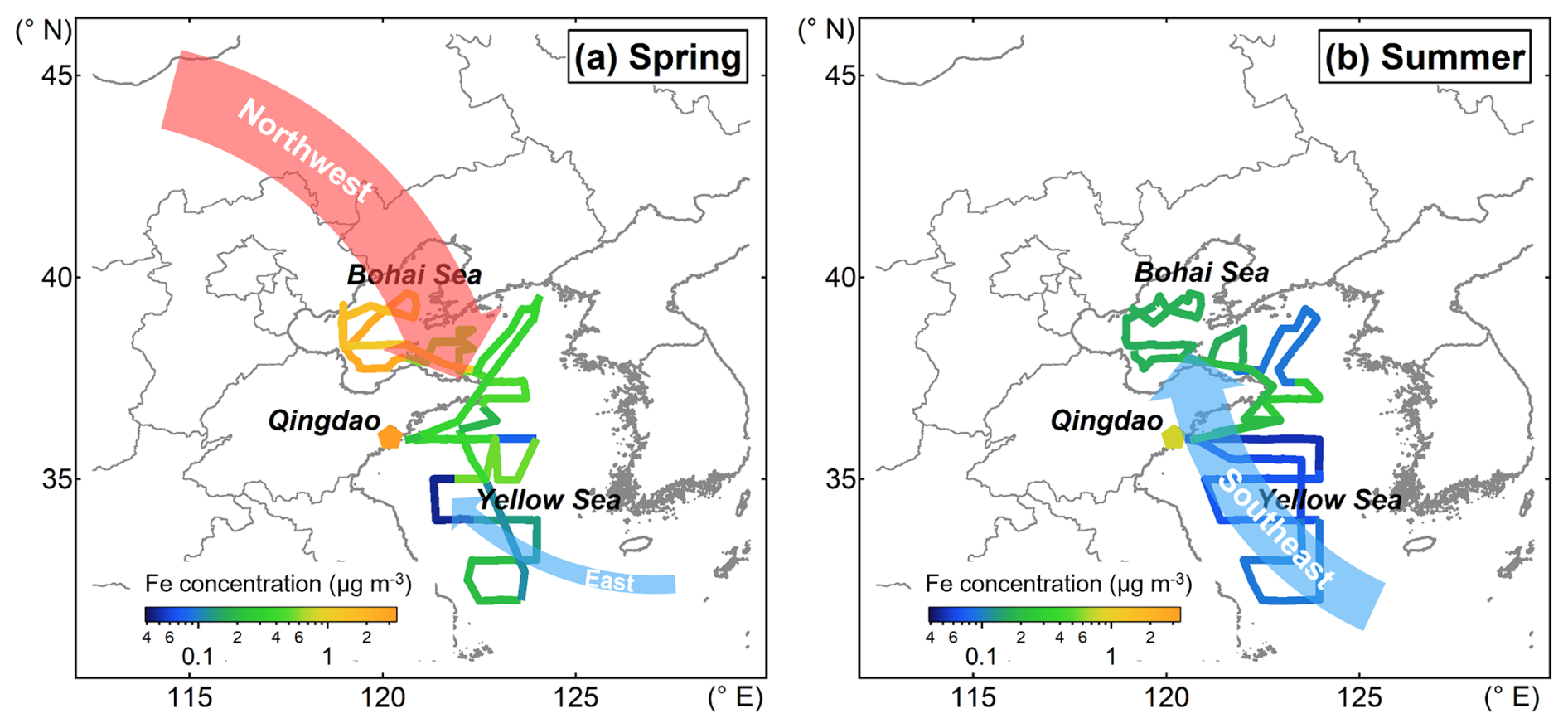
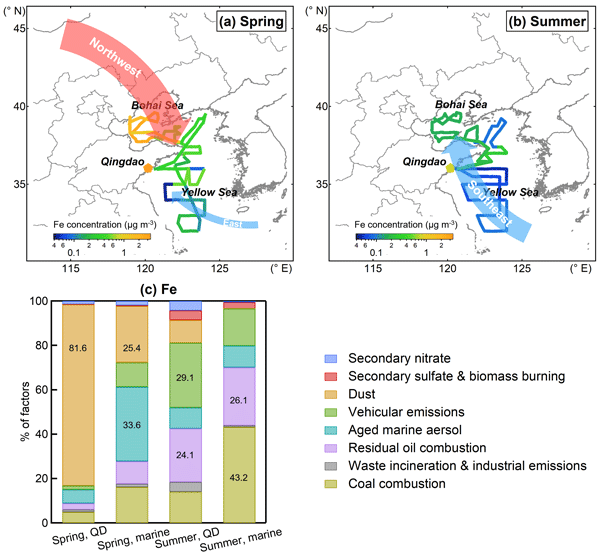
Figure 1Schematic diagram of regional maps with dominant air mass transport pathways (arrows). The solid lines indicate cruise tracks for (a) springtime and (b) summertime cruises over BS and YS during 2018 and the star denotes the location of Qingdao, with the color-filled indicating Fe concentration.
The Bohai Sea (BS) and Yellow Sea (YS) are on the crucial transport pathway for aerosols originating from heavily polluted regions of East Asia to the Northwest Pacific within the westerly belt. Qingdao (QD) is a coastal city adjacent to YS, influenced by both continental and marine air masses (Fig. 1). Aerosol trace elements over the BS and YS likely exhibit distinct characteristics compared to those in coastal cities, necessitating synchronized land-sea observations to investigate these characteristics. However, as previously noted, the current knowledge regarding the source apportionment of trace elements in marine aerosols remains limited (Hilario et al., 2020). Prior field cruise investigations have focused on the characteristics of total suspended particulates (TSP) and PM10 (Dp≤10 µm) (Hsu et al., 2010b; Li et al., 2025; Peng et al., 2025; Qiu, 2015; Shi et al., 2013; Wang et al., 2013; Yang et al., 2020). In contrast, trace elements in PM2.5 have been scarcely explored. It has been revealed that trace elements in fine particles exhibit distinct potential environmental impacts compared with those in coarse particles (Li et al., 2018; Hsieh et al., 2022; Sakata et al., 2022; Zhang et al., 2022), highlighting the importance of targeting PM2.5.
Atmospheric processes during long-range transport from the continent to ocean can alter the physicochemical properties of aerosols, thereby influencing the bioavailability of trace elements upon deposition (Schroth et al., 2009; Sholkovitz et al., 2012; Wang et al., 2022; Wang et al., 2021; Luo et al., 2020; Xu et al., 2023b; Zhang et al., 2024). Therefore, accurately identifying and apportioning sources of PM2.5 and associated trace elements is crucial for understanding their biogeochemical impacts across land-to-sea gradients. This study focuses on the characteristics and source apportionment of elements in PM2.5, based on simultaneous observations in Qingdao and over the BS and YS during spring and summer 2018 (Fig. 1). The objective is to provide a more comprehensive understanding of the distribution and sources of trace elements in fine particles from coastal to marginal sea areas in eastern China.
2.1 Sample collection
PM2.5 samples were collected to measure fine particle components over the BS, YS, and Qingdao during the spring and summer of 2018. In the cruise missions, the samples were collected over the BS and YS from 28 March to 17 April and from 24 July to 10 August 2018. These areas are located in the downwind areas of the Asian dust source regions and northern China city groups being significantly influenced by dust and anthropogenic pollution (Fig. 1). A total of 18 and 9 samples were collected in spring and summer over the marine areas, respectively. Specifically, these comprised 3 samples from the BS and 15 from the YS in spring, and 2 from the BS and 7 from the YS in summer. Sampling durations varied from several hours to 28 h in spring and from 18 to approximately 40 h in summer to accumulate sufficient particle mass. During the collection of marine aerosols, samples were exclusively collected while the ship was underway and the relative wind direction ranged between −60 and +60° (with 0° representing the bow) to avoid contamination from the vessel's own exhaust emissions.
The samples in Qingdao were collected in the same period as the cruise missions. The sampling site was located at the Baguanshan Atmospheric Research Observatory (BARO, 36.03° N, 120.20° E; 74 m above sea level) in the Shinan District Qingdao (Fig. 1), with an approximately 600 m straight-line distance from the coastline (Li et al., 2024; Yang et al., 2024). In Qingdao, 37 and 25 samples were collected during non-rainy periods in spring and summer, respectively. At the coastal site, a day/night sampling strategy was primarily employed, and a few summer samples were collected over about 23 h periods.
High-volume particle samplers (Tisch Environmental, Inc., USA and Qingdao Jinshida Electronic Technology Co., Ltd., China) were applied to collect the particles onto Whatman® 41# filters (Whatman Limited, Maidstone, UK) for trace element analysis, and onto PALL® quartz filters (Pall Gelman, Inc., USA) for analysis of water-soluble ions, organic carbon (OC), and elemental carbon (EC). The 41# filters were washed with diluted acid prior to sampling following Chance et al. (2015) to remove background trace elements. Quartz filters were pre-baked at 450 °C for 6 h before the sample collection to eliminate background organic contaminants. For quality assurance and control, blank filters were collected and processed, with detailed results and their impact assessment provided in Sect. S1.1 and Table S1 in the Supplement. All samples were sealed in plastic bags and stored at −20 °C until subsequent analysis.
2.2 Chemical analysis
Trace elements. An 8.0 cm2 section of both the sample and blank filters was digested with an acid mixture (2.0 mL of 69 % HNO3 and 0.5 mL of 40 % HF) in closed Teflon vessels and heated at 180 °C for 48 h. After cooling to room temperature, the solutions were evaporated to near dryness at 180 °C using an electric heating plate (Sect. S1.1 in the Supplement). Then, the residue was diluted to 50 mL with 2 % HNO3 and stored at ∼4 °C until analysis (Shi et al., 2020; Li et al., 2025).
The concentrations of elements in the extracts were measured using an inductively coupled plasma-mass spectrometry (ICP-MS, iCAP Qc, Thermo Fisher Scientific, Germany) equipped with a quadrupole mass analyzer. Rh, Sc, and Th were used as internal standards to correct for matrix effects and instrumental drift. A standard solution was analyzed as a quality control sample for every 10 samples (Shi et al., 2020).
Water-soluble ions. Sample sections and blank filters were extracted with 10 mL Milli-Q water (≥18.0 MΩ cm) using ultrasonication for 40 min at 0 °C followed by filtration through a 0.45 µm pore diameter filter, then stored at ∼4 °C until analysis in 3 d. Water-soluble ionic species, including Na+, NH, K+, Mg2+, Ca2+, Cl−, NO, SO and C2O, were analyzed using a Dionex ICS-3000 ion chromatography. To monitor instrumental precision/accuracy and quantify background contamination over the analytical sequence, blank filter solutions and standard solutions were analyzed every 10 samples (Sun et al., 2024). See Sect. S1.2 in the Supplement for additional QA QC details.
OC and EC. 2.0 cm2 section of samples and blank filters were analyzed by a Sunset OC EC analyzer using NIOSH protocol (Wu et al., 2016). The data obtained were calibrated with a standard curve. Detailed information is described in Sect. S1.3 in the Supplement.
2.3 Other data and backward trajectories
Meteorological parameters during the sample collection periods, including relative humidity (RH), wind speed (WS) and wind direction, were obtained from the shipboard measurements and Qingdao Meteorological Bureau, and monitoring data of gaseous pollutants, including SO2, NO2, O3, and CO, were from China National Environmental Monitoring Centre (http://www.cnemc.cn/, last access: 14 May 2026, https://quotsoft.net/air/, last access: 14 May 2026).
The Hybrid Single-Particle Lagrangian Integrated Trajectory (HYSPLIT) model (PC v4.8) developed by the National Oceanic and Atmospheric Administration Air Resources Laboratory (NOAA-ARL) (Draxler and Rolph, 2014) was employed to reconstruct the three-dimensional 72 h backward trajectories. This was done to identify distinct air mass source regions and their transport paths. The starting point for the trajectory calculations was set at an altitude of 300 m above the ground level. The calculations were performed with the vertical velocity calculation method and archived Global Data Assimilation System (GDAS) meteorological data.
2.4 Positive matrix factorization receptor model
The Positive Matrix Factorization (PMF) model is a widely used receptor model to resolve pollution sources and quantify the source contributions to ambient particulate matter concentrations (Paatero and Tapper, 1994). It decomposes the measured data matrix into factor profile, contribution, and residual matrix. In this study, the Environmental Protection Agency (EPA) PMF version 5.0 was utilized for analysis (Norris et al., 2014).
Source apportionment studies generally follow two complementary approaches: a broad classification of major source categories and a more refined apportionment aimed at resolving mixed sources and atmospheric processes in greater detail. Our study follows the latter approach. Therefore, the PMF analysis was constructed based on the physicochemical interpretability of the bulk PM2.5 system, rather than from the perspective of trace metals alone.
Accordingly, the mass concentrations of 12 elements (V, Cr, Mn, Fe, Ni, Co, Cu, Zn, As, Cd, Ba and Pb), 9 water-soluble ions (Na+, NH, K+, Mg2+, Ca2+, Cl−, NO, SO and C2O), and OC EC from both Qingdao and cruise campaigns (81 samples) were input to the PMF analysis. Secondary ions and sea-salt related species were retained as process tracers to constrain marine influence, aerosol aging, and internal mixing during transport. Multiple factors ranging from 6 to 10 were thoroughly evaluated to determine the optimal solution. The stability and reliability of the factor solutions were assessed using the displacement (DISP) and bootstrap (BS) uncertainty estimation methods (Norris et al., 2014).
Ultimately, an 8-factor solution emerged as the most robust and interpretable. In contrast, the 7-factor solution failed to distinguish the industrial emissions from dust (Fig. S1a). The 9-factor solution tended to resolve an additional factor; however, it exhibited relatively low BS mapping values (58 %, 67 %, and 73 %) for several factors (Fig. S1b and Table S2). The 8-factor solution demonstrated the highest stability. The mapping percentages using the BS uncertainty method exceeded 80 % for all factors (Table S3), surpassing the performances of the 7-factor and 9-factor solutions (Tables S4 and S2). Moreover, the DISP analysis showed no occurrences of factor swapping and no reduction in the model fit statistic Q (both %dQ and the error code were 0), further validating the stability and interpretation of the 8-factor solution. Detailed information on the PMF performance can be found in Sect. S2 and Fig. S2. The comparison between measured and PMF-simulated concentrations for representative elements (Fe, V, and Pb) is shown in Fig. S2, with R2 values of 0.97–0.98 and slopes close to 1.0, demonstrating the strong performance and reliability of the PMF model.
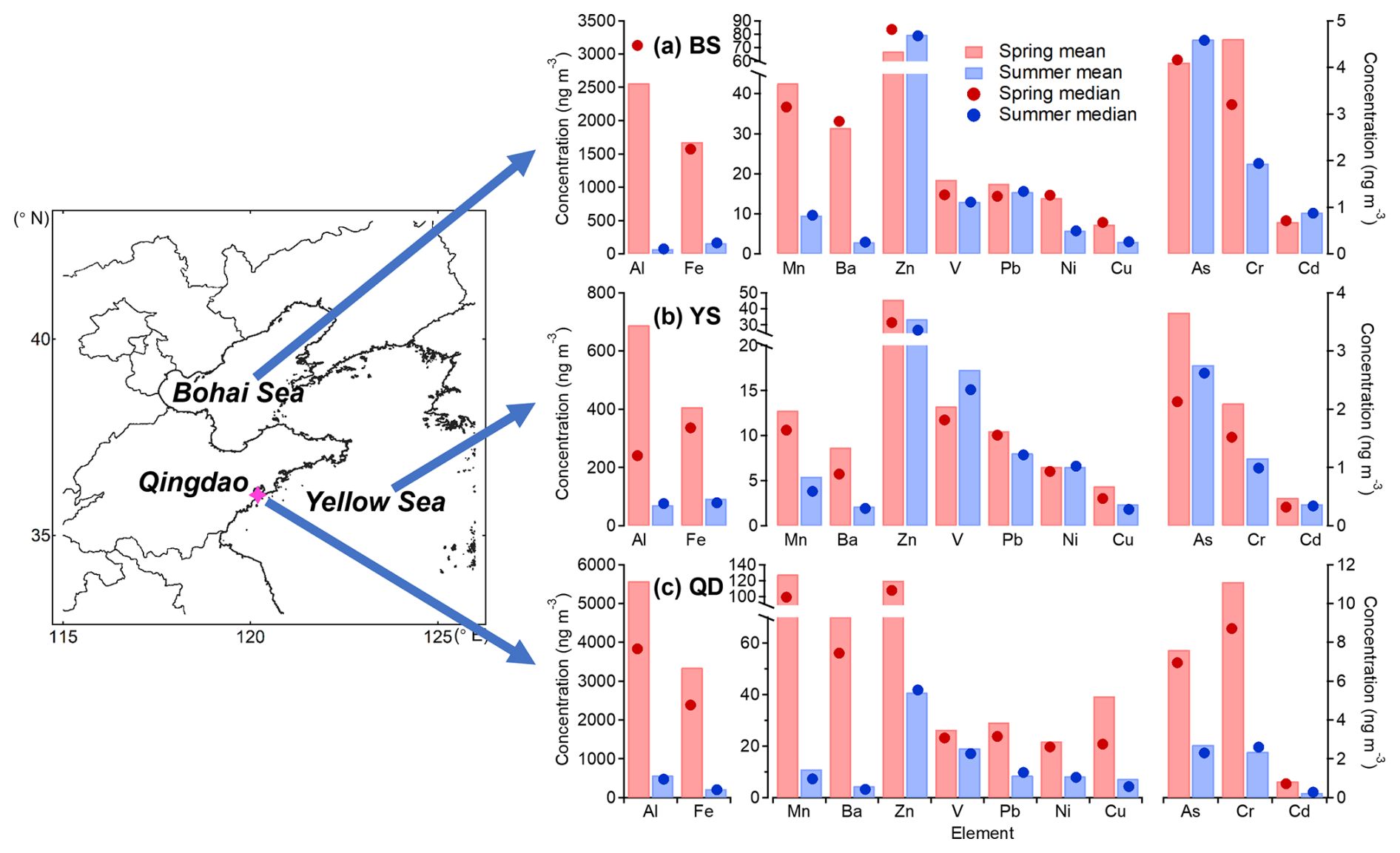
Figure 2Concentrations of TEs (ng m−3) over the (a) BS, (b) YS, and (c) Qingdao during the campaigns in 2018. The bars represent the time-weighted (hereafter) average, and the circles represent the median.
3.1 Overall concentrations and spatial variations
Figure 2, Tables S5 and S6 summarize the overall average concentrations of elements. Over the BS and YS, the predominant trace elements were Al, Fe, and Zn, with concentrations (average ± standard deviation) of 1043.2±1031.0 ng m−3, 648.6±654.8 ng m−3, and 49.9±75.0 ng m−3 in spring, and 71.1±19.0 ng m−3, 109.8±51.4 ng m−3, and 44.9±30.2 ng m−3 in summer, followed by Mn (spring) and V (summer) respectively. In the coastal city, the dominant trace elements were Al and Fe, with average concentrations of 5573.5±5641.1 and 3347.3±3249.3 ng m−3 in spring and 572.9±395.4 and 228.3±211.7 ng m−3 in summer, followed by Mn in spring and Zn in summer, respectively (Fig. 2c). Among the measured anthropogenic trace elements (e.g., Pb, Cu, As, Cd), Zn was the most abundant in both marine and coastal environments, with its anthropogenic origin confirmed by a high enrichment factor (EF; calculation method provided in the Supplement, Sect. S3 and Fig. S3) (Taylor, 1964). Except for V, element concentrations during summer in Qingdao were lower than those reported by Li et al. (2018) during summer 2016. In this study, V and Ni, as representative tracers of emissions from heavy oil combustion, indicated a higher influence from this source during the campaigns (Li et al., 2020; Zhang et al., 2019b; Zhao et al., 2013).
All elements displayed notably higher concentrations in Qingdao compared to the marine area in spring. However, the discrepancy in concentrations of V, As, and Cd between land and sea was relatively smaller than those of other elements (Fig. 2). The YS region recorded the lowest concentrations for most elements in both spring and summer. Conversely, Zn, As, and Cd exhibited elevated levels over the ocean in summer (Fig. S4b), highlighting the significant impact of transported primary anthropogenic emissions on marine aerosol composition. Notably, a severe pollution event (sample SU005, 1–2 August 2018) under stagnant meteorological conditions (WS <2 m s−1) led to a pronounced concentration peak of these elements over marine areas. Back trajectory analysis indicates that the air masses originated from the industrial emissions and coal combustion-intensive regions of the BS and Liaodong Peninsula (Fig. S5d), further underscoring the significant impact of transported primary anthropogenic emissions on marine aerosol composition. Given the high sensitivity of the mean to such an extreme outlier, particularly with the limited sample size, this sample was excluded from both the calculation of average values and subsequent PMF analysis.
3.2 Seasonal variations
Seasonally, concentrations of Al, Fe, Mn, and Ba over the BS and YS in spring were 4–35 times and 2–10 times higher than those in summer, respectively. This distinct seasonality can be attributed to dust storms, a frequent phenomenon in northern China during spring (Li et al., 2019). In contrast, Zn, As, and Cd displayed slightly higher concentrations over the BS in summer than in spring, suggesting anthropogenic emissions in the Circum-Bohai-Sea (CBS) region (a geographic area encompassing the land and coastal zones surrounding the BS in China, it includes, but is not limited to, the Bohai Rim) (Polissar et al., 2001). Conversely, V and Pb exhibited no discernible seasonal variations, likely due to the consistent anthropogenic emissions such as industrial and residual oil combustion emissions (Wu et al., 2017). In Qingdao, concentrations of all these elements were notably higher in spring compared to summer (Fig. 2c). Similarly, the EFs of Fe and Mn over the BS and YS in summer were higher than those in Qingdao (Fig. S3), suggesting an enhanced influence of anthropogenic sources in the marine atmosphere during this season. This pattern is further examined in the source apportionment results (Sect. 4.3.1).
3.3 Comparison with other studies
We compared our results to other literature data on the concentrations of selected elements in various oceanic regions and typical megacities in China (Tables S5 and S6) (Qi and Zhou, 2021). Notably, elemental concentrations over the YS in this study were significantly lower than those observed during spring 2011 (Zhao et al., 2015). This decrease suggests a potential reduction in the overall aerosol burden transported to the YS in 2018. It could be a consequence of interannual variations in continental outflow and/or the effectiveness of emission control policies and environmental remediation measures, with the decline in anthropogenic tracers (e.g., Zn, V, Ni, As) providing specific support for the potential role of emission controls. When comparing with spring 2018 ECS sampling data (Sun et al., 2022), a distinct north-to-south decline in the concentrations of mineral elements (Al, Fe, Mn, Ba) and anthropogenic heavy metals (e.g., Zn, Pb) was observed. This spatial pattern suggests that both dust-derived and anthropogenic pollutants, transported via the westerly winds, exert progressively weaker influences on marine aerosols from northern to southern coastal regions (Zhao et al., 2015). Compared with summer island measurements reported by Yuan et al. (2023), the concentrations of most elements in this study were within the same order of magnitude.
In Qingdao, most crustal elements, such as Fe and Mn, exhibited higher concentrations in spring and lower concentrations in summer than the annual average concentrations reported in Beijing, Shanghai, and Guangzhou, the typical megacities in China (Table S6) (Chen et al., 2008; Yang et al., 2011). This pattern highlighted the pronounced seasonality of crustal influence in Qingdao, with spring being strongly impacted by dust events, while the input of crustal dust was substantially weakened in summer. Anthropogenic elements such as Zn, Pb, As, Cr, and Cd, which are typically associated with sources like coal combustion, non-ferrous metal smelting, and various industrial processes (Borai et al., 2002; Chen et al., 2013; Karar et al., 2006; Li et al., 2015, 2020), were consistently at lower levels in Qingdao than in the three megacities, indicating a lower overall burden from these anthropogenic sources in Qingdao. Notwithstanding the differences in sampling year and season, V concentrations in Qingdao were 2–3 times higher than those in Shanghai (Chen et al., 2008), suggesting a more severe pollution from ship emissions or other residual oil combustions in Qingdao. However, the differences in sampling times need consideration. Section 4.2.3 explores the impact of vessel emission control policies on the ship emission aerosols.
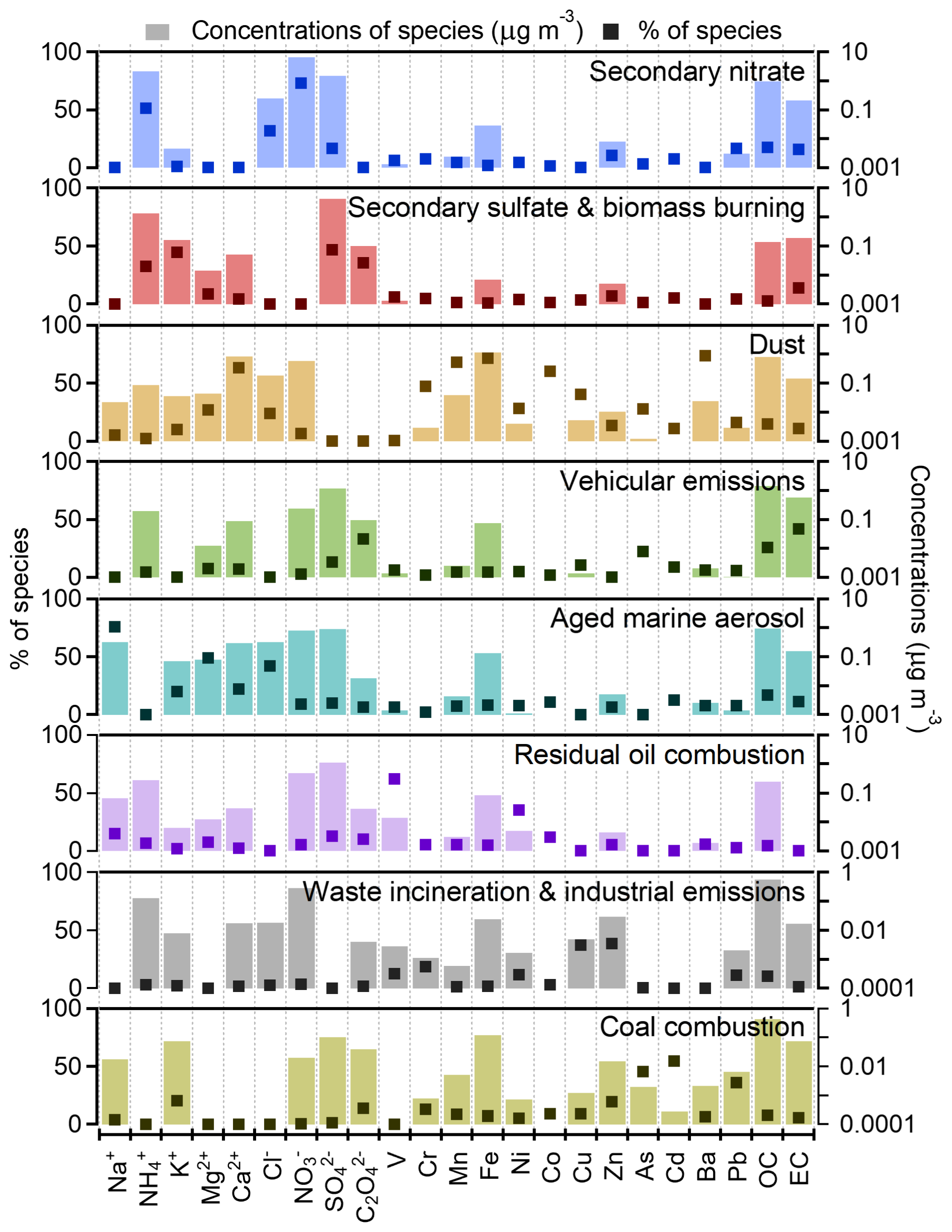
Figure 3PMF resolved source profiles (dark points represent the percentages and light rectangles represent the concentrations of each species in each factor) of the 8-factor solution.
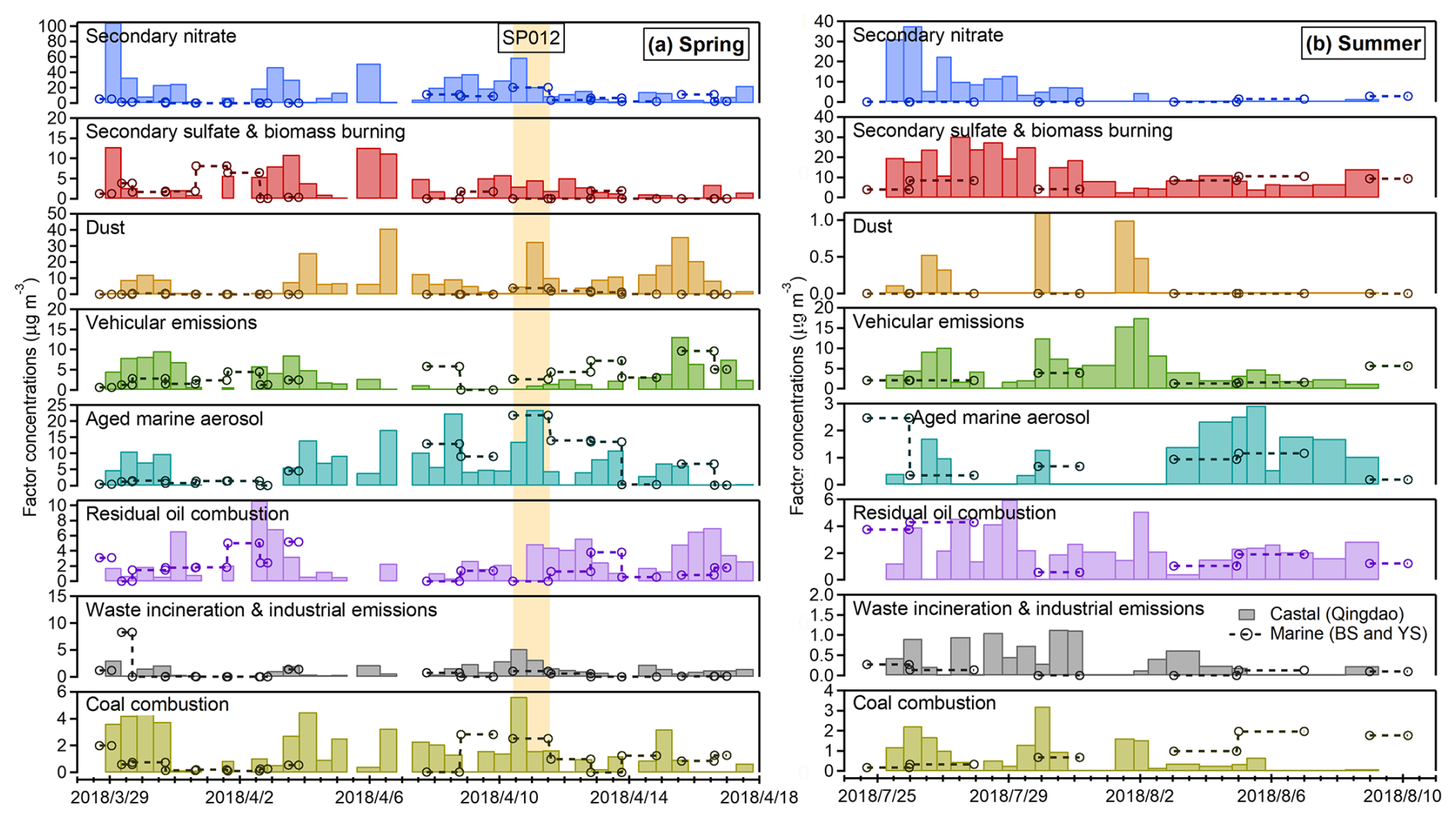
Figure 4Time series of individual PMF factor concentrations for PM2.5 in (a) spring and (b) summer. Bars represent coastal (Qingdao) samples, while open circles with dashed lines denote marine (BS and YS) samples. “SP012” marked in (a) shows the factor concentrations during the sampling period of sample SP012. The detailed procedure for converting the model's factor contribution output to concentrations is provided in Sect. 4.1.
4.1 Source apportionment of PM2.5
Eight factors were identified by PMF. The resolved factor profiles and time series are presented in Figs. 3 and 4 respectively. The time series of individual PMF factor concentrations (e.g., Fig. 4) were derived from the factor contributions output by the PMF model. A factor-specific scaling coefficient was determined by relating the PMF-derived factor contributions to the corresponding absolute concentration. This coefficient was then applied to the full factor contribution time series to reconstruct the absolute concentration time series. The mean concentrations and the relative contributions of each factor are displayed in Fig. 5. The characteristics of the determined aerosol sources are as follows.
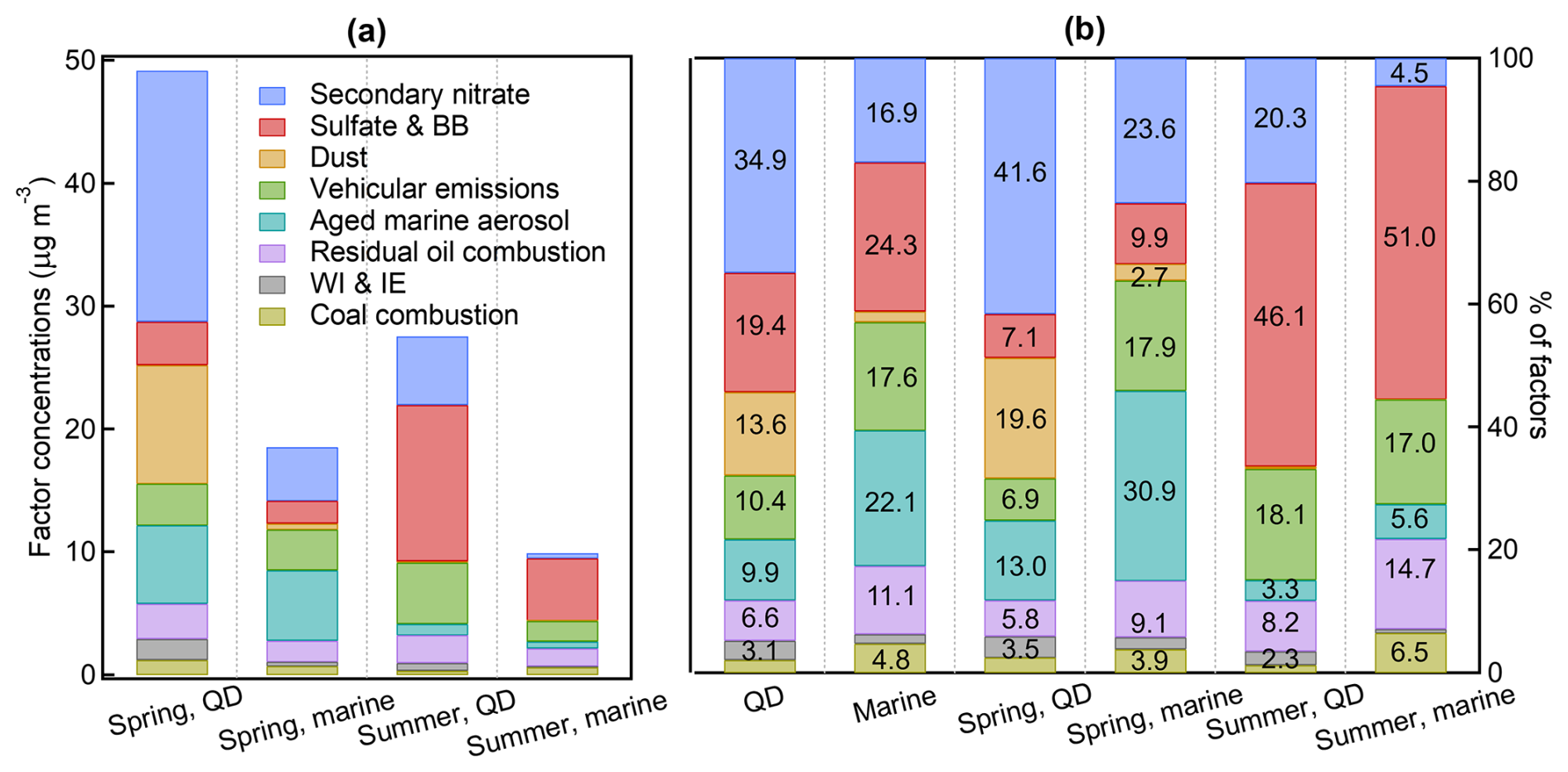
Figure 5The averaged (a) concentrations and (b) relative percentage contributions of identified source factors to PM2.5 as determined by PMF analysis. Sulfate & BB refers to sulfate & biomass burning. WI & IE denotes waste incineration & industrial emissions. “marine” refers to the BS and YS.
Factor 1 was identified as the secondary nitrate factor, characterized by high loadings of NO, NH and Cl− (Fig. 3) (Wu et al., 2017; Xu et al., 2023a). Based on its chemical profile, this factor represents a mixture of ammonium nitrate and ammonium chloride. This factor contributed a significant proportion of fine particles in both Qingdao and marine environments, accounting for 34.9 % and 16.9 % of PM2.5 mass respectively (Fig. 5b). Notably, Factor 1 displayed an enhanced influence during nighttime (Fig. S6). To help validate the source of this factor, its time-series contribution was compared to ambient gas measurement data (Fig. 4, and Table S7). It correlated with NO2 (r=0.45, p<0.01) and CO (r=0.39, p<0.01). This could potentially be indicative of the nocturnal heterogeneous reaction formation or subsequent regional transport (Wang et al., 2018).
Factor 2 was recognized as the secondary sulfate & biomass burning (sulfate & BB) factor, marked by high SO, K+, NH and oxalate (Wu et al., 2017; Xu et al., 2023a). This factor accounted for 19.4 % and 24.3 % of the PM2.5 mass in Qingdao and marine regions respectively. The notable presence of K+, oxalate, and some EC and Zn in this factor suggested the possible mixing with emissions from biomass burning (Wang et al., 2018; Zhu et al., 2022a). Factor 2 exhibited correlations with CO (r=0.54, p<0.01) and RH (r=0.36, p<0.01). CO serves as a key tracer of primary incomplete combustion processes (Zhang et al., 2017). The strong interconnection between sulfate and oxalate can be ascribed to their similar liquid phase formation mechanisms (Yu et al., 2005; Zhou et al., 2015).
Factor 3, identified as the dust factor, was characterized by high loadings of crustal species, including Ba, Fe, Mn and Ca2+ (Fig. 3) (Amil et al., 2016; Gugamsetty et al., 2012; Mustaffa et al., 2014). A significant portion of Co was also apportioned to Factor 3, denoting its crustal origin (Wu et al., 2023). In Qingdao, the time series of Factor 3 exhibited distinct peaks on 29–30 March, 3, 6, 10–11, and 15 April 2018 (Fig. 4a), each coinciding with documented springtime Asian dust events (Li et al., 2023, 2019). Diurnally, Factor 3 exhibited a moderate positive correlation with WS (r=0.43, p<0.05) in Qingdao in spring. Throughout the entire sampling campaign, it maintained a strong negative correlation with RH (, p<0.01; Table S7) in Qingdao. These correlations suggested the influence of meteorological conditions, consistent with the inherently arid nature of dusty air masses. Factor 3 accounted for 13.6 % of the total PM2.5 mass at coastal site and diminished to 1.7 % within the marine environments (Fig. 5b).
Factor 4 was identified as the vehicular emissions factor, characterized by significant apportionments for EC and OC, contributing 10.4 % to the total Qingdao aerosol mass and 17.6 % to the marine aerosols. OC and EC are major pollutants stemming from gasoline and diesel combustion (Liu et al., 2016, 2020). The presence of Cu was likely due to additives in fuel/lubricant combustion, brake linings and tire wear (Gu et al., 2011; Lee et al., 2006; Pant and Harrison, 2013), further supporting this identification. During summertime, vehicular emissions correlated strongly and positively with NO2 (r=0.78, p<0.01). Throughout the sampling campaign, the factor correlated positively with CO (r=0.30, p<0.05) and negatively with O3 (, p<0.01). These relationships underscored the chemical interplay where O3 is reduced by NO to generate NO2.
Factor 5 was characterized by high concentrations of marine source components, including Na+, Mg2+ and Cl−, and showed a positive correlation with WS (r=0.35, p<0.01) and a strong negative correlation with RH (, p<0.01) (Sharma et al., 2016; Zhang et al., 2018). These features aligned with sea salt aerosols production driven by wind-induced disturbance of the ocean surface (Prijith et al., 2014). However, the coexistence of nitrate, sulfate, and harbour-related components (Ca2+, K+) suggested that this factor did not represent fresh sea spray, but rather aged marine aerosol mixed with anthropogenic pollutants during transport (van Pinxteren et al., 2010; Pey et al., 2013; Liu et al., 2025). At the coastal site, its enhanced daytime concentration was consistent with the sea-land breeze patterns (Fig. S6). Time series analysis further showed that Factor 5 had a prevalent influence over the BS and YS (Fig. 4). Notably, in Qingdao during spring, the synchronous peaks of Factor 5 and Factor 3 strongly suggest mixing between marine aerosol and dust during transport. This interpretation is consistent with the prevailing westerly and northwesterly winds (Figs. 1 and S5a), which favor the co-transport of continental dust and marine aerosols to the coastal sampling site. A representative example is shown by backward trajectories for a marine sample (SP012, with the highest aged marine aerosol source concentration) and its corresponding Qingdao samples during the same period. These trajectories clearly illustrate that the air masses originated from the YS and approached Qingdao from the west prior to their arrival at the sampling site (Fig. S7). Moreover, high wind speeds during dust events may also enhance sea salt emissions (Feng et al., 2017), further contributing to the similarity in the temporal variations of dust and aged marine aerosol. On average, the aged marine aerosol factor contributed 9.9 % to PM2.5 mass at the Qingdao site and 22.1 % in marine PM2.5 samples.
Factor 6, the residual oil combustion factor, was characterized by high apportionments of V and Ni (Wu et al., 2020), contributing 6.6 % and 9.0 % to the total PM2.5 mass in Qingdao and BS and YS areas, respectively. The cargo handling capacity of Qingdao port reached 542.5 million t in 2018, ranking fourth among the main ports of China (data obtained from National Bureau of Statistics of China, 2018, https://www.stats.gov.cn/sj/ndsj/2018/indexch.htm, last access: 14 May 2026). The contributions of Factor 6 highlighted the significant influence of shipping traffic on both the coastal city Qingdao and the BS and YS areas. It showed a positive correlation with SO2 (r=0.38, p<0.01) (Table S7), further validating its association with ship emissions (Zhang et al., 2019b).
Factor 7 was defined as the waste incineration & industrial emissions factor. It exhibited substantial loadings of heavy metals such as Zn, Cu, Cr, and Pb, which are tracers of waste incineration & industrial activities, including metallurgical smelting, oil mining, and the production of cement, plastic, pigment, chemical and building materials (Borai et al., 2002; Karar et al., 2006; Li et al., 2012; Tian et al., 2012; Wang et al., 2018). Its correlations with NO2 (r=0.50, p<0.01) and SO2 (r=0.31, p<0.05) underscored its industrial origins, although it is a minor contributor to total PM2.5 (3.1 % in Qingdao and 1.5 % in the BS and YS areas, as shown in Table S7).
Factor 8 was identified as the coal combustion factor. This attribution was robustly supported by the enrichment of well-documented coal combustion tracers of As, Cd and Pb, elements consistently linked to coal-fired emissions (Chang et al., 2018; Li et al., 2020; Rai et al., 2016; Zhang et al., 2011, 2008). Furthermore, the factor exhibited a statistically significant correlation with SO2 (r=0.35, p<0.01), a primary gaseous co-emission from coal combustion (Lin et al., 2022). This coal combustion factor contributed modestly to the total PM2.5 mass but showed notable spatial variability: 2.1 % at coastal (Qingdao) site and 4.8 % in marine PM2.5 samples, with marine contributions exceeding twice the coastal value. The spatial distributions of coal-fired power plants, PM2.5 emissions from coal-fired power plants, and atmospheric As concentration in China collectively indicated that the coal combustion factor was mainly associated with transport from coastal source regions (Fig. S8) (Tian et al., 2014; Wang et al., 2016; Zhang et al., 2020). In particular, the dense concentration of coal-fired power plants along the coastline serves as a persistent source of coal-burning aerosols over the sea. Under prevailing winds, emissions from these coastal plants can be transported offshore, resulting in elevated concentrations over marine areas. However, these coal-related sources were not consistently located upwind of the Qingdao sampling site and therefore have minimal influence on concentrations there. Furthermore, although this factor contributed only a limited fraction of PM2.5 mass, it made a substantial contribution to heavy metal concentrations, which will be discussed in detail in Sect. 4.3.
4.2 Difference and linkage in source contributions of PM2.5 between coastal and marine environments
4.2.1 Enhanced anthropogenic inputs to marine areas driven by spring westerly
Distinct differences in PM2.5 source apportionment were observed between the coastal and marine environments during spring. Secondary nitrate, dust, and waste incineration & industrial emissions exhibited significantly lower concentrations and relative contributions in marine environments compared to the coastal site. Specifically, secondary nitrate was the predominant contributor at the coastal site, accounting for 41.6 % (20.4 µg m−3) of PM2.5 mass. In contrast, its contribution was notably lower in the marine area (23.6 %, 4.4 µg m−3; Fig. 5). This disparity was driven by the divergence in the air masses transport pathways. Air masses arriving at Qingdao (spring clusters E, S, W and summer cluster L) contained higher concentrations of secondary components like NO and NH (land-based species), which did not fully extend to marine areas (Fig. S5a and c, and Table S8). As NO and NH are primarily associated with terrestrial sources, their influence is more significant in Qingdao.
Dust, the second largest contributor in spring, accounted for 19.6 % (9.7 µg m−3) in Qingdao but sharply reduced to 2.7 % (0.5 µg m−3) over the BS and YS. Dust particles with larger diameters are more likely to be removed through inertial and gravitational settling processes during transport (Gu et al., 2011; Vu et al., 2015; Zhao et al., 2015), leading to the rapid sedimentation and reduced concentration in remote marine environments (Baker and Jickells, 2006; Ma et al., 2023). The waste incineration & industrial emissions factor also showed lower contributions in the marine area (2.0 %) compared to the coastal site (3.5 %).
Aged marine aerosol, sulfate & BB, coal combustion, vehicular emissions and residual oil combustion showed higher contributions in the marine area, despite lower or comparable absolute concentrations to the coastal site (Fig. 5). Aged marine aerosol contributions were 30.9 % in the marine area, versus 13.0 % at the coastal site, consistent with the fact of its marine origin. Furthermore, its temporal peaks at Qingdao closely resembled those of the dust factor (Fig. 4a). It is hypothesized that during dust events, aged marine aerosol may mix with the transported dust, making the two factors difficult to distinguish and leading to the higher concentration of aged marine aerosol at Qingdao (6.4 µg m−3) compared to those over the marine area (5.7 µg m−3).
On the one hand, increased RH in marine air favored the formation of sulfate and oxalate through liquid-phase reactions (Zhang et al., 2019a; Zhou et al., 2015), enhancing sulfate & BB contribution in the marine atmosphere (9.9 %) compared to the coastal site (7.1 %). On the other hand, small-sized particles from biomass burning and coal combustion are more effectively transported to marine areas (Gu et al., 2011; Vu et al., 2015). The vehicular emissions, accounting for 17.9 % in marine areas (Fig. 5b), had nearly identical average concentrations in both Qingdao and marine environments (3.4 and 3.3 µg m−3, respectively) (Fig. 5a). Characterized by small EC-rich particles, these vehicular emissions can be easily transported to remote areas (Gu et al., 2011; Vu et al., 2015). As shown in Figs. 4a, S8a and c, time series peaks of vehicular emissions factor over the ocean coincided with the samples collected from air masses originating in northern and central China, i.e., samples SP010, SP014, and SP017.
Residual oil combustion exhibited a lower average concentration in marine areas (1.7 µg m−3) than in Qingdao (2.9 µg m−3). This is consistent with the influence of ship and port emissions on coastal urban areas. The time series peaks of residual combustion factor over the ocean were often associated with air masses transported from sea to land (e.g., samples SP006 and SP008). Unlike the waste incineration & industrial emissions factor, these four anthropogenic factors demonstrated that varying transport paths, particle size, and source proximity could affect land-sea distribution patterns of their contributions.
4.2.2 Dominance of biomass burning and vehicular emissions in summer marine areas
Similar spatial land-sea distribution patterns were observed for secondary nitrate, dust, waste incineration & industrial emissions, as well as sulfate & BB in summer. However, the dominant contributor shifted from secondary nitrate in spring to sulfate & BB in summer, indicating decreased nitrate contributions during the warmer season. This reduction was attributed to the thermal decomposition of NH4NO3 under high summer temperatures and enhanced secondary sulfate facilitated by photochemical reactions with the high temperature and sufficient light, as well as aqueous-phase oxidation promoted by high RH (Wu et al., 2017; Kim et al., 2022).
Unlike in spring, summer data revealed higher concentrations and contributions of vehicular emissions at the coastal site (5.0 µg m−3, 18.1 %) compared to the BS and YS (1.7 µg m−3, 17.0 %) (Fig. 5). This difference could be ascribed to the seasonal variations in pollutants transport direction, driven by the summer southeasterly winds, altering typical land to sea trajectories. Similarly, aged marine aerosol concentrations were higher at the coastal site (0.9 µg m−3) compared to marine areas (0.6 µg m−3), which may be partly attributed to enhanced sea spray generation near the shoreline due to stronger wave breaking (Zhou et al., 2025); summer southeasterly winds may also facilitate marine aerosol transfer inland, thereby influencing the air quality of coastal urban areas (Figs. S4c, d, and S8d). The coal combustion factor also showed a more pronounced contribution over the marine area (0.6 µg m−3, 6.5 %) than at the coastal site (0.4 µg m−3, 1.3 %). This variation was attributed to elevated concentrations of trace elements in marine aerosols during summer.
4.2.3 Changes over the past decade
Comparative analysis of particulate matter source apportionment between the present study and earlier work (Wu et al., 2017) suggested evolving trends in source contributions over the past decade. Notably, statistical comparison is not feasible due to the lack of primary data from the earlier study. The observed differences showed an increase in the fraction of secondary nitrate (from 25.2 % to 34.9 %), a decrease in sulfate (& BB) (from 25.7 % to 19.4 %), and minimal change in vehicular emissions contribution (from 10.0 % to 10.4 %), accompanied by an elevation in the mass concentrations of Ni and V. These observed variations were consistent with the impacts of evolving environmental regulations and the transformation in the energy structure over the past decade.
Another interesting trend is the contribution from residual oil combustion. As a coastal city, Qingdao experiences heavy shipping traffic. Results from a PMF analysis conducted from August 2018 to May 2019 near the Qingdao Port indicated that marine vessel emissions were the primary contributor (25.1 %), with the YS and BS as potential source regions (Bie et al., 2021). In this study, residual oil combustion accounted for 6.6 % at the coastal site and 11.1 % over the marine area. The cargo handling capacity of Qingdao ports in 2017 was approximately double that of 2007 (National Bureau of Statistics of China, 2018, 2008, https://www.stats.gov.cn/sj/ndsj/2008/indexch.htm, last access: 14 May 2026), underscoring the significant impact of ship emissions.
The implementation of “domestic emission control areas” (DECAs) in China signified a significant regulatory shift to address air quality concerns. Commencing on 1 January 2017, ships berthed at core ports in three designated regions (the Pearl River Delta, the Yangtze River Delta, and the Bohai Rim) were mandated to use fuel with a sulfur content not exceeding 0.5 % (DECA 1.0) (Zhang et al., 2019b). This regulation was further expanded on 1 January 2019 to require vessels operating within 12 nautical miles of the coastline to adhere to the same low sulfur criteria (DECA 2.0) (Yu et al., 2021). The transition to low-sulfur fuels led to a significant increase in the ratio of emitted aerosols. This phenomenon was primarily caused by the desulfurization of fuels which removed V much more efficiently than Ni, thereby increasing the ratio in the fuel itself, which is then reflected in the combustion emissions (Yu et al., 2021). In Shanghai, the ratio in ship emitted particles derived from PMF increased from 0.34 to 0.45 between DECA 1.0 and DECA 2.0, reaching 2.14 in 2020 (Yu et al., 2021). In the present study, the ratio for residual oil combustion aerosols resolved by PMF was 0.37, aligning with DECA 1.0 levels. Notably, Bie et al. (2021) reported a ratio of 2.17 in 2019 near the Qingdao Port, confirming DECA policy effectiveness. The lower ratio (0.37) in our study suggested residual oil combustion pollutants in the study area may still include higher-sulfur fuel signatures, potentially from regional transport rather than strictly regulated local shipping.
4.2.4 Comparison with source apportionment studies in other marginal seas of the Western Pacific
We compared the source apportionment results obtained over the BS and YS in this study with those from studies conducted over the offshore eastern China Sea, around the Taiwan Island, China, and over the South China Sea (SCS) (Sun et al., 2022; Yen et al., 2022a, b). These sea areas all belong to the marginal seas of the Western Pacific, sharing the common influence of the East Asian monsoon and continental outflows, yet exhibiting differences in the types of pollution sources and their respective contributions. Although direct comparison should be interpreted with caution because of differences in sampling period, receptor location, and PMF inputs among studies, the available results still reveal meaningful regional similarities and contrasts.
Across these marginal seas, PM2.5 sources were generally resolved into secondary inorganic aerosols, dust-related sources (including crustal or fugitive dust as reported in other studies), marine source (including sea salt or oceanic spray), and specific anthropogenic emissions. Among these, secondary aerosols (dominated by nitrate and/or sulfate) and marine-related source were important contributors in most regions. For example, secondary formation (22.9 %) and combustion source (30.6 %) were reported to make significant contributions over the offshore eastern China Sea in spring (Sun et al., 2022; Fig. S9c), which is qualitatively similar to our findings for spring and summer. Likewise, the notable contribution of marine-related aerosol in this study (22.1 %) is comparable to that reported for other sea areas, including 18.6 %–30.2 % around Taiwan Island and 5.6 %–29.5 % over the SCS annually (oceanic spray over the Dongsha Islands; oceanic spray & fugitive dust over the Nansha Islands) (Yen et al., 2022a, b; Fig. S9a, b, and d).
In contrast, the BS and YS showed a stronger continental influence, as reflected by the clearer resolution of industrial processes and coal combustion related factors. This characteristic was less pronounced over the more southerly sea areas, suggesting a stronger impact of the industrial structure and coal-dominated consumption of Northern China on the marine regions. Furthermore, vehicular emissions were identified as an important and stable pollution source over the BS and YS (17.6 %) in spring and summer, aligning with the substantial contribution (24.5 %) reported over the offshore eastern China Sea in spring (Sun et al., 2022). In contrast, studies around the Taiwan Island and over the SCS more commonly resolved a mixed factor combining ship and vehicular emissions, with contributions of 17.4 %–41.2 % annually (Yen et al., 2022a, b). This difference may indicate that traffic and shipping emissions were more readily separated over the BS and YS, although part of the discrepancy may also arise from differences in receptor environments and PMF configurations among studies.
Overall, the comparison suggests a clear transition in PM2.5 source characteristics from the BS to the YS, with continental anthropogenic influences gradually weakening and marine-related contributions becoming more important southward/offshore, while the adjacent seas of the Western Pacific further reflect increasing impacts from mixed marine and shipping-related emissions.
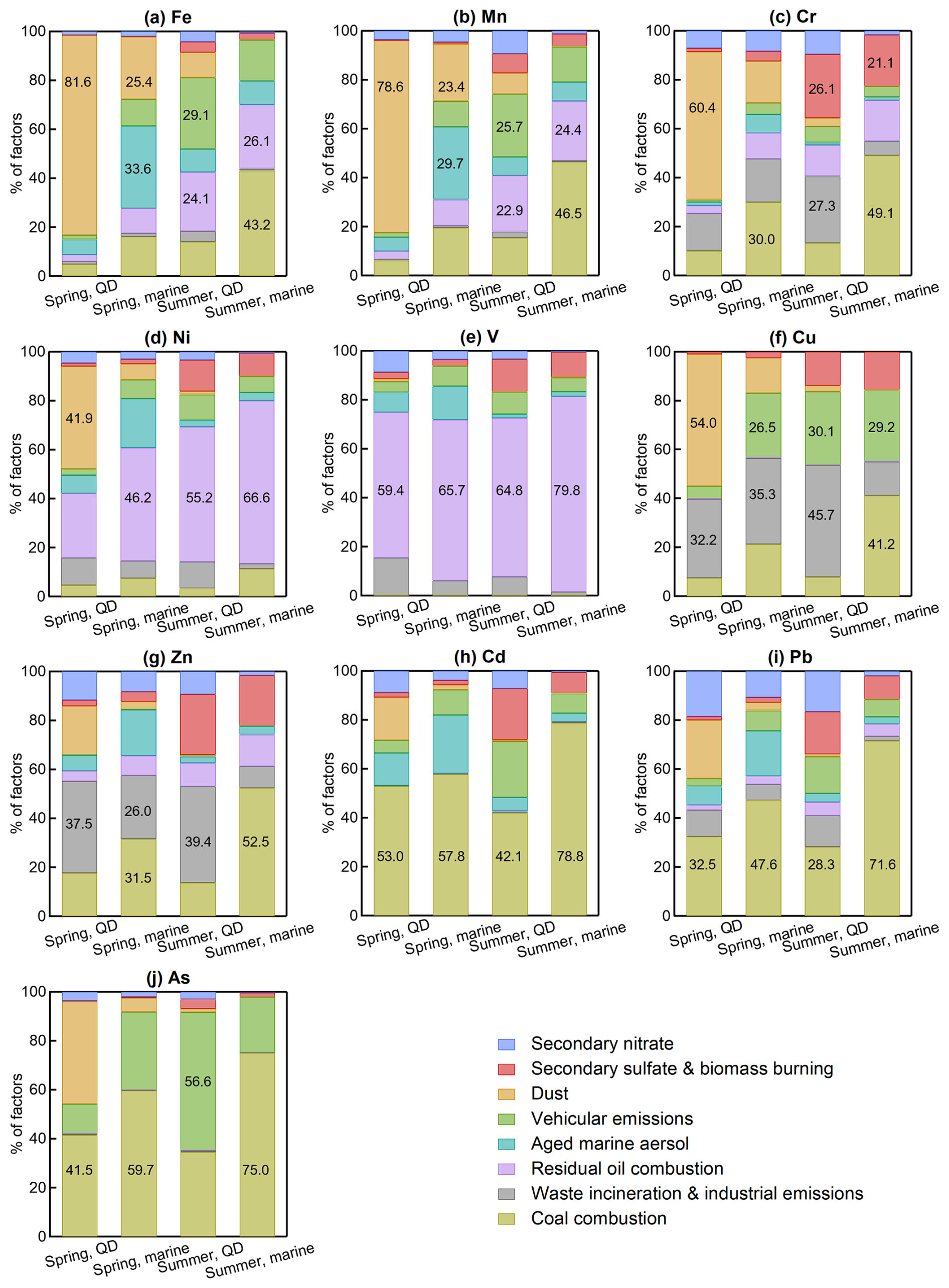
Figure 6Percentage contributions of various source factors to individual elements based on PMF results. “marine” refers to the BS and YS.
4.3 Source contributions of individual elements
This study revealed clear disparities in the source contributions to the ten essential elements across terrestrial and marine regions, mirroring the spatial distribution patterns seen in PM2.5 (Figs. 6, S10, Tables S9 and S10). The influence of dust and waste incineration & industrial emissions sources decreased, whereas coal combustion, vehicular emissions (in spring) and aged marine aerosol exhibited enhanced contributions to elements over the marine area.
4.3.1 Fe, Mn and Cr
Atmospheric aerosols containing Fe and Mn are crucial for marine biogeochemistry and ecosystem dynamics. As a limiting nutrient, Fe is closely coupled with sulfur cycles (e.g., via dimethyl sulfide production/processing) in both the atmosphere and ocean, triggering phytoplankton blooms, and enhancing carbon dioxide (CO2) sequestration through the global carbon cycle (Shi et al., 2012b; Zhuang et al., 1992). Similarly, Mn serves as an essential cofactor for enzymes involved in photosynthesis and other biochemical processes, making it vital for marine organisms, and its deficiency directly impacts the growth rate of phytoplankton (Morel and Price, 2003; Hawco et al., 2022).
In spring, dust was the dominant source of Fe and Mn in Qingdao, contributing 81.6 % and 78.6 % to the total Fe and Mn, respectively (Fig. 6a and b). Over the marine region, however, the contribution of dust decreased substantially, to 25.4 % for Fe and 23.4 % for Mn. This significant reduction in the relative contribution of dust over the ocean suggests substantial processing and mixing during transport. Indeed, the PMF model identified “aged marine aerosol” as a distinct source, which contributed 33.6 % to Fe and 29.7 % to Mn in marine aerosols during spring (Fig. 6a and b). This factor is characterized by strong correlations between sea salt ions and crustal elements (e.g., Fe, Mn), coherent temporal variations, and consistent backward trajectory clusters, indicating substantial mixing of mineral dust with sea spray aerosols (SSAs) during transport (Geng et al., 2014; Hilario et al., 2020). This behavior aligns with previous single-particle observations, showing that mineral dust can be efficiently incorporated into SSA particles during long range transport over the ocean (Andreae et al., 1986; Okada et al., 1990; Zhang et al., 2003, 2006; Wagener et al., 2008; Hsu et al., 2010a; Adachi et al., 2020; Knopf et al., 2022; Kwak et al., 2022). The implications of such internal mixing for Fe bioavailability remain uncertain. While SSAs could inhibit Fe dissolution via pH buffering (Hsu et al., 2010a), organic ligands in SSAs may also promote the release and stabilization of soluble Fe (Wu et al., 2023). Since dissolved Fe was not measured in this study, we do not attempt to quantify this effect, but note that SSAs mixing is a non-negligible process in the marine Fe budget.
In contrast to dust, the relative contributions from vehicular emissions (11.0 % and 10.6 % for Fe and Mn, respectively) and coal combustion (16.2 % and 19.5 %), were markedly higher in marine aerosols than in Qingdao (vehicular emissions: 1.8 % and 1.8 %; coal combustion: 4.9 % and 6.2 %). In terms of absolute concentrations, coal combustion contributed 92.4 ng m−3 Fe and 4.0 ng m−3 Mn to the marine atmosphere in spring, while dust contributed 145.2 ng m−3 Fe and 4.8 ng m−3 Mn (Fig. S10 and Table S10).
In summer, coal combustion became the primary contributor to marine Fe and Mn (43.2 % and 46.5 %, respectively), exceeding Qingdao contributions by 3 times. This finding is consistent with higher EFs of Fe and Mn observed over the BS and YS in summer compared to Qingdao (Fig. S3), further supporting the enhanced influence of anthropogenic sources in the marine atmosphere during this season. Residual oil combustion was also a discernible source for Fe and Mn in summer marine atmosphere, contributing 26.1 % (50.0 ng m−3) and 24.4 % (1.9 ng m−3), respectively. Southeasterly winds transported ship-derived pollutants coastward, markedly increasing the relative contributions of Fe (24.1 %) and Mn (22.9 %) in Qingdao compared to spring (2.8 % and 3.1 %, respectively). However, from the perspective of absolute concentration, the contributions of residual oil combustion to Fe and Mn in Qingdao remained lower in summer (77.8 and 2.9 ng m−3, respectively) than in spring (98.7 and 3.7 ng m−3). A t test on the concentrations showed that these seasonal differences are not statistically significant (p>0.05), suggesting that emissions from residual oil combustion remain relatively stable, likely associated with persistent shipping activities and stationary sources.
Comparisons with previous studies regarding Fe and Mn show both consistencies and discrepancies. Chen et al. (2024) also identified dust as the dominant source of Fe in Qingdao during spring, with a contribution of 88 %, which is comparable to our estimate of 81.6 %. In contrast, Zhang et al. (2024) reported substantially higher dust contributions over the YS in spring (52 %–69 %) than observed in this study (25.4 %) over the BS and YS, together with higher contributions from industry and coal combustion (25.4 %–33.6 % vs. 17.6 %), whereas the contribution from ship emissions was broadly comparable (0.9 %–8.2 % vs. 10.2 %). Compared with Zhang et al. (2024), our results suggest a more differentiated source structure, particularly over the BS and YS, where continental outflow appears to be shaped by mixing among industrial emissions, coal combustion, vehicular emissions, secondary processing, and marine aerosol during transport. Notably, Zhang et al. (2024) did not explicitly resolve the mixing of marine aerosol with transported dust or separate several additional anthropogenic sources. If the aged marine aerosol factor identified here is considered as part of the aged dust-influenced aerosol during transport, the total dust-related contribution would increase to 59.0 %, making our results broadly comparable to those of Zhang et al. (2024). Zhang et al. (2024) provided a first-order classification of major source categories, whereas our refined PMF analysis resolves additional source and process complexity and thus offers a more detailed representation of transported aerosols over the marginal seas. The seasonal pattern of Mn source apportionment reported by Yang et al. (2022) for Beijing is also consistent with our results for Qingdao, with dust dominating in spring and industrial emissions becoming more important in summer. Notably, our source apportionment revealed a significant contribution of anthropogenic source to total Fe and Mn in the marine atmosphere, accounting for 41.0 % in spring and 90.3 % in summer for Fe, and 46.9 % and 7.8 % for Mn (Fig. 6a, b, and Table S9).
The source pattern of Cr shared some similarities with that of Fe and Mn in spring (Fig. 6c). Marine aerosols exhibited a pronounced increase in coal combustion contributions (30.0 % in spring and 49.1 % in summer) compared to Qingdao particles, likely due to emissions from coastal power plants transported seaward. Waste incineration & industrial emissions was the second-largest contributor to Cr in Qingdao during spring and the largest contributor during summer, qualitatively similar to the findings of Yang et al. (2022) for Beijing, although the industrial emissions contribution levels they reported (41 %–77 %) were substantially higher than those in our study (15.3 % in spring, 27.3 % in summer). Direct comparisons for Cr over the marginal seas are limited, which highlights the need for further research on the speciation and sources of this trace metal in marine environments.
4.3.2 Ni, Cu, Zn, V and Cd
Ni, Cu, Zn, and Cd can influence phytoplankton growth dynamics, modify marine biotic community structure, and affect carbon sequestration processes, functioning either as enzyme cofactors or structural elements in proteins (Jickells et al., 2005; Morel and Price, 2003; Shelley et al., 2015). Notably, Ni and V primarily originated from residual oil combustion, with contributions being markedly higher over the marine area (46.2 %–79.8 %) compared to the coastal site (26.2 %–64.8 %) (Fig. 6d and e). However, the absolute concentrations of Ni and V from residual oil combustion were higher in the Qingdao atmosphere (Ni: 4.8–6.0 ng m−3, V: 12.8–16.2 ng m−3) than in the BS and YS atmosphere (Ni: 3.1–3.6 ng m−3, V: 8.2–9.6 ng m−3). This demonstrated that the emissions from residual oil combustion had a significant impact not only on the marine environment but, more notably, on the coastal urban air quality.
Over the BS and YS, coal combustion (21.3 %–41.2 %), vehicular emissions (26.5 %–29.2 %) and WI & IE (13.9 %–35.3 %) contributed more significantly to Cu (Fig. 6f). In Qingdao, WI & IE was an important source of Cu, consistent with observations in Beijing (Yang et al., 2022). Apart from the aged marine aerosol contributions, Zn was associated with multiple anthropogenic sources, including waste incineration, industrial emissions, coal combustion, biomass burning, and secondary sulfate-related aerosol processing. Similar findings have been widely reported in previous PMF studies, where Zn was identified in biomass burning and secondary aerosol factors (Li et al., 2007, 2020; Liu et al., 2020; Zhu et al., 2022a; Liu et al., 2025). In the marine area, coal combustion dominated Zn contributions, accounting for 31.5 % and 52.5 % of total Zn in spring and summer, respectively (Fig. 6g).
4.3.3 Pb, Cd and As
Pb, Cd, and As, which are biologically toxic, pose potential non-carcinogenic or carcinogenic risks to human health and cause considerable detriment upon marine ecosystems (Nagajyoti et al., 2010; Zhang et al., 2018). Source apportionment revealed that coal combustion was the dominant contributor of Pb and Cd in BS and YS areas, particularly during summer, accounting for 71.6 % of Pb and 78.8 % of Cd (Fig. 6h and i). The absolute concentrations revealed the land-to-sea transport: coal combustion contributed 4.6 ng m−3 of Pb to the marine atmosphere in summer, which was 1.8 times higher than its concentration in Qingdao (2.6 ng m−3), clearly indicating the pervasive influence of terrestrial coal emissions across the sea. In Beijing, the predominant sources of Pb were coal combustion in spring and industrial emissions in summer (Yang et al., 2022), mirroring our coastal observations. Similarly, coal combustion was identified as the primary source of As (34.6 %–75.0 %), with its influence increasing over the BS and YS during spring (59.7 %) and summer (75.0 %) (Fig. 6j). The emission inventory also indicates that 74.2 % of As emissions can be ascribed to coal combustion in China (Tian et al., 2015). Furthermore, vehicular emissions also contributed significantly to As (12.3 %–56.6 %), which can be attributed to the role of As as a recognized tracer for fossil fuel combustion (Chen et al., 2013). An interesting finding was the significant contribution of aged marine aerosol to Zn, Pb and Cd in marine environments during spring, indicating the mixing between SSAs and anthropogenic aerosols. The time series suggested that the peaks in aged marine aerosol contributions coincided with the high concentrations of Pb, Cd and Zn (Figs. 4a and S3a), supporting that aged marine aerosol particles acted as a carrier for these toxic anthropogenic elements during transport.
This study investigated the spatial and seasonal distributions, and sources of TEs in PM2.5 based on simultaneous observations in Qingdao and over the BS and YS during spring and summer 2018, with a focus on land-sea contrasts and the influence of anthropogenic activities on the marine air. A refined PMF analysis identified eight aerosol sources, including secondary nitrate, secondary sulfate & biomass burning, dust, vehicular emissions, aged marine aerosol, residual oil combustion (ship emissions), coal combustion, and waste incineration & industrial pollutants.
Terrestrial-marine aerosol source gradients were driven by atmospheric transport and deposition processes. Secondary nitrate, primarily derived from terrestrial anthropogenic activities, exhibited a sharp land-to-sea decline, with contributions decreasing from 41.6 % (Qingdao) to 23.6 % (marine) in spring, and from 20.3 % to 4.5 % in summer. In contrast, secondary sulfate & biomass burning contributions increased slightly from Qingdao to marine areas: from 7.1 % to 9.9 % in spring, and from 46.1 % to 51.0 % in summer, reflecting enhanced sulfur precursor availability in marine areas and long-range transport over the marine areas. Natural terrestrial sources (dust and dust-anthropogenic mixtures) demonstrated pronounced attenuation over marine areas due to size-dependent particle settling. For example, dust contributions declined from 19.6 % (Qingdao) to 2.7 % (marine) in spring. In contrast, finer anthropogenic particulates (e.g., vehicular emissions) exhibited enhanced offshore transport, with marine contributions (17.9 %) exceeding those in Qingdao (6.9 %) in spring. Summer southerly winds moderated this land-to-sea contrast. Marine-related aerosols, particularly aged marine aerosols and residual oil combustion, dominated marine areas, with residual oil combustion contributing up to 9.1 % in spring and 14.7 % in summer.
Trace element distributions mirrored aerosol source dynamics but with source-specific seasonal shifts. All TEs exhibited notably higher concentrations in Qingdao compared to marine in spring, where Zn, Pb, As, and Cd reversed this land-to-sea pattern in summer (marine > Qingdao), reflecting intensified anthropogenic influence over the marine atmosphere. In terms of sources distribution, traditional crustal TEs (Fe, Mn, Cr) were mainly controlled by terrestrial dust in spring in Qingdao (Fe: 81.6 %, 2832.0 ng m−3 ; Mn: 78.6 %, 92.7 ng m−3; Cr: 60.4 %, 6.9 ng m−3), but dust contributions decreased sharply over marine areas (Fe: 25.4 %, 145.2 ng m−3; Mn: 23.4 %, 4.8 ng m−3; Cr: 16.9 %, 0.4 ng m−3). Instead, coal combustion became the dominant source of these elements, particularly in summer marine areas (Fe: 43.2 %, 82.8 ng m−3; Mn: 46.5 %, 3.6 ng m−3; Cr: 49.1 %, 0.6 ng m−3). Residual oil combustion was also the dominant source of Ni and V in both coastal and marine environments (except spring Qingdao Ni, 41.9 % sourced from dust), and contributed substantially to Fe, Mn and Cr, particularly in summer (Fe: 24.1 %, 77.8 ng m−3 in Qingdao and 26.1 %, 50.0 ng m−3 marine; Mn: 22.9 %, 2.9 ng m−3 in Qingdao and 24.4 %, 1.9 ng m−3 marine).
Springtime marine environments also showed elevated aged marine aerosol contributions to Fe, Mn, Zn, Cd, and Pb (18.5 %–33.6 %), indicating extensive multi-source mixing (dust-marine-anthropogenic) in aerosols. The biogeochemical impact of this complex mixing on the reactivity of elements warrants further investigation.
These findings underscore the complex interplay of natural and anthropogenic drivers shaping coastal aerosol composition, and highlight the critical role of atmospheric transport and source-receptor dynamics as key controls on land-to-sea aerosol-borne element distributions and continental-marine aerosols interactions. This study improves our understanding of how continental emissions influence offshore air quality and marine atmospheric chemistry, which is critical for refining regional air quality and climate models. Future work should further investigate the physicochemical reactivity and solubility of these TEs mixed-source aerosols to assess their impactions for marine biogeochemistry.
The backward trajectories were calculated using the Hybrid Single-Particle Lagrangian Integrated Trajectory (HYSPLIT) transport model (https://www.ready.noaa.gov/HYSPLIT.php, last access: 14 May 2026). The data associated with the figures in this manuscript, including Supporting Materials, are available at https://doi.org/10.6084/m9.figshare.29625746 (Zhou, 2026).
The supplement related to this article is available online at https://doi.org/10.5194/acp-26-7721-2026-supplement.
YQ: formal analysis, writing-original draft, validation, writing-review & editing. WL: investigating, formal analysis, validation. WQ: methodology. HZ: methodology. WZ: investigating, formal analysis, validation. JS: writing-review & editing, methodology. DZ: validation, writing-review & editing. YZ: investigation, validation. LS: validation, writing-review. WW: validation, writing-review. YZ: investigation, validation. YM: investigation, validation. DR: investigation, validation. GW: investigation, validation. XW: methodology. XY: validation, methodology. YZ: conceptualization, writing-review & editing, validation, funding acquisition, supervision, project administration.
The contact author has declared that none of the authors has any competing interests.
Publisher's note: Copernicus Publications remains neutral with regard to jurisdictional claims made in the text, published maps, institutional affiliations, or any other geographical representation in this paper. The authors bear the ultimate responsibility for providing appropriate place names. Views expressed in the text are those of the authors and do not necessarily reflect the views of the publisher.
This article is part of the special issue “RUSTED: Reducing Uncertainty in Soluble aerosol Trace Element Deposition (AMT/ACP/AR/BG inter-journal SI)”. It is not associated with a conference.
The authors would like to thank all the colleagues who participated in this work for their support. Data acquisition and sample collections were supported by the National Natural Science Foundation of China (NSFC) Open Research Cruise (Cruise No. NORC2018-01), funded by Shiptime Sharing Project of NSFC. This cruise was conducted onboard R/V DONGFANGHONG 2 by Ocean University of China. The authors gratefully acknowledge the NOAA-ARL for providing the HYSPLIT transport and dispersion model. Financial support.
This research has been supported by the National Natural Science Foundation of China (grant nos. 42475119, and 41605114) and the Natural Science Foundation of Shandong Province (grant no. ZR2024MD016).
This paper was edited by Mingjin Tang and reviewed by Kohei s Sakata, Akinori Ito, and four anonymous referees.
Adachi, K., Oshima, N., Gong, Z., de Sá, S., Bateman, A. P., Martin, S. T., de Brito, J. F., Artaxo, P., Cirino, G. G., Sedlacek III, A. J., and Buseck, P. R.: Mixing states of Amazon basin aerosol particles transported over long distances using transmission electron microscopy, Atmos. Chem. Phys., 20, 11923–11939, https://doi.org/10.5194/acp-20-11923-2020, 2020.
Amil, N., Latif, M. T., Khan, M. F., and Mohamad, M.: Seasonal variability of PM2.5 composition and sources in the Klang Valley urban-industrial environment, Atmos. Chem. Phys., 16, 5357–5381, https://doi.org/10.5194/acp-16-5357-2016, 2016.
Andreae, M. O., Charlson, R. J., Bruynseels, F., Storms, H., Grieken, R. Van, and Maenhaut, W.: Internal mixture of sea salt, silicates, and excess sulfate in marine aerosols, Science, 232, 1620–1623, https://doi.org/10.1126/science.232.4758.1620, 1986.
Baker, A. R. and Jickells, T. D.: Mineral particle size as a control on aerosol iron solubility, Geophys. Res. Lett., 33, L17608, https://doi.org/10.1029/2006GL026557, 2006.
Baker, A. R., Jickells, T. D., Witt, M., and Linge, K. L.: Trends in the solubility of iron, aluminium, manganese and phosphorus in aerosol collected over the Atlantic Ocean, Mar. Chem., 98, 43–58, https://doi.org/10.1016/j.marchem.2005.06.004, 2006.
Bie, S., Yang, L., Zhang, Y., Huang, Q., Li, J., Zhao, T., Zhang, X., Wang, P., and Wang, W.: Source appointment of PM2.5 in Qingdao Port, East of China, Sci. Total. Environ., 755, https://doi.org/10.1016/j.scitotenv.2020.142456, 2021.
Borai, E. H., El-Sofany, E. A., Abdel-Halim, A. S., and Soliman, A. A.: Speciation of hexavalent chromium in atmospheric particulate samples by selective extraction and ion chromatographic determination, Trac-Trend. Anal. Chem., 21, 741–745, https://doi.org/10.1016/S0165-9936(02)01102-0, 2002.
Boyd, P. W., Watson, A. J., Law, C. S., Abraham, E. R., Trull, T., Murdoch, R., Bakker, D. C. E., Bowie, A. R., Buesseler, K. O., Chang, H., Charette, M., Croot, P., Downing, K., Frew, R., Gall, M., Hadfield, M., Hall, J., Harvey, M., Jameson, G., LaRoche, J., Liddicoat, M., Ling, R., Maldonado, M. T., McKay, R. M., Nodder, S., Pickmere, S., Pridmore, R., Rintoul, S., Safi, K., Sutton, P., Strzepek, R., Tanneberger, K., Turner, S., Waite, A., and Zeldis, J.: A mesoscale phytoplankton bloom in the polar Southern Ocean stimulated by iron fertilization, Nature, 407, 695–702, https://doi.org/10.1038/35037500, 2000.
Buck, C. S., Landing, W. M., and Resing, J. A.: Particle size and aerosol iron solubility: A high-resolution analysis of Atlantic aerosols, Mar. Chem., 120, 14–24, https://doi.org/10.1016/j.marchem.2008.11.002, 2010.
Chance, R., Jickells, T. D., and Baker, A. R.: Atmospheric trace metal concentrations, solubility and deposition fluxes in remote marine air over the south-east Atlantic, Mar. Chem., 177, 45–56, https://doi.org/10.1016/j.marchem.2015.06.028, 2015.
Chang, Y., Huang, K., Xie, M., Deng, C., Zou, Z., Liu, S., and Zhang, Y.: First long-term and near real-time measurement of trace elements in China's urban atmosphere: temporal variability, source apportionment and precipitation effect, Atmos. Chem. Phys., 18, 11793–11812, https://doi.org/10.5194/acp-18-11793-2018, 2018.
Chen, J., Tan, M., Li, Y., Zheng, J., Zhang, Y., Shan, Z., Zhang, G., and Li, Y.: Characteristics of trace elements and lead isotope ratios in PM2.5 from four sites in Shanghai, J. Hazard. Mater., 156, 36–43, https://doi.org/10.1016/j.jhazmat.2007.11.122, 2008.
Chen, J., Liu, G., Kang, Y., Wu, B., Sun, R. Y., Zhou, C. C., and Wu., D.: Atmospheric emissions of F, As, Se, Hg, and Sb from coal-fired power and heat generation in China, Chemosphere, 90, 1925–1932, https://doi.org/10.1016/j.chemosphere.2012.10.032, 2013.
Chen, Y., Wang, Z., Fang, Z., Huang, C., Xu, H., Zhang, H., Zhang, T., Wang, F., Luo, L., Shi, G., Wang, X., and Tang, M.: Dominant contribution of non-dust primary emissions and secondary processes to dissolved aerosol iron, Environ. Sci. Technol., 58, 17355–17363, https://doi.org/10.1021/acs.est.4c05816, 2024.
Choobari, O. A., Zawar-Reza, P., and Sturman, A.: The global distribution of mineral dust and its impacts on the climate system: A review, Atmos. Res., 138, 152–165, https://doi.org/10.1016/j.atmosres.2013.11.007, 2014.
Draxler, R. R. and Rolph, G. D.: HYSPLIT (HYbrid Single-Particle Lagrangian Integrated Trajectory) Model access via NOAA ARL READY Website, NOAA Air Resources Laboratory, College Park, MD, https://www.ready.noaa.gov/HYSPLIT.php (last access: 14 May 2026), 2014.
Falkowski, P. G., Barber, R. T., and Smetacek, V.: Biogeochemical controls and feedbacks on ocean primary production, Science, 281, 200–206, https://doi.org/10.1126/science.281.5374.200, 1998.
Feng, L., Shen, H., Zhu, Y., Gao, H., and Yao, X.: Insight into Generation and Evolution of Sea-Salt Aerosols from Field Measurements in Diversified Marine and Coastal Atmospheres, Sci. Rep., 7, 41260, https://doi.org/10.1038/srep41260, 2017.
Geng, H., Hwang, H., Liu, X., Dong, S., and Ro, C.-U.: Investigation of aged aerosols in size-resolved Asian dust storm particles transported from Beijing, China, to Incheon, Korea, using low-Z particle EPMA, Atmos. Chem. Phys., 14, 3307–3323, https://doi.org/10.5194/acp-14-3307-2014, 2014.
Gu, J., Pitz, M., Schnelle-Kreis, J., Diemer, J., Reller, A., Zimmermann, R., Soentgen, J., Stoelzel, M., Wichmann, H.-E., Peters, A., and Cyrys, J.: Source apportionment of ambient particles: Comparison of positive matrix factorization analysis applied to particle size distribution and chemical composition data, Atmos. Environ., 45, 1849–1857, https://doi.org/10.1016/j.atmosenv.2011.01.009, 2011.
Gugamsetty, B., Wei, H., Liu, C. N., Awasthi, A., Hsu, S. C., Tsai, C. J., Roam, G. D., Wu, Y. C., and Chen, C. F.: Source Characterization and Apportionment of PM10, PM2.5 and PM0.1 by Using Positive Matrix Factorization, Aerosol Air Qual. Res., 12, 476–491, https://doi.org/10.4209/aaqr.2012.04.0084, 2012.
Hawco, N. J., Tagliabue, A. and Twining, B. S.: Manganese limitation of phytoplankton physiology and productivity in the Southern Ocean, Global Biogeochem. Cycles, 36, e2022GB007382. https://doi.org/10.1029/2022GB007382, 2022.
Hilario, M. R. A., Cruz, M. T., Cambaliza, M. O. L., Reid, J. S., Xian, P., Simpas, J. B., Lagrosas, N. D., Uy, S. N. Y., Cliff, S., and Zhao, Y.: Investigating size-segregated sources of elemental composition of particulate matter in the South China Sea during the 2011 Vasco cruise, Atmos. Chem. Phys., 20, 1255–1276, https://doi.org/10.5194/acp-20-1255-2020, 2020.
Hsieh, C.-C., Chen, H.-Y., and Ho, T.-Y.: The effect of aerosol size on Fe solubility and deposition flux: A case study in the East China Sea, Mar. Chem., 241, 104106, https://doi.org/10.1016/j.marchem.2022.104106, 2022.
Hsu, S.-C., Liu, S. C., Arimoto, R., Shiah, F.-K., Gong, G.-C., Huang, Y.-T., Kao, S.-J., Chen, J.-P., Lin, F.-J., Lin, C.-Y., Huang, J.-C., Tsai, F., and Lung, S.-C. C.: Effects of acidic processing, transport history, and dust and sea salt loadings on the dissolution of iron from Asian dust, J. Geophys. Res.-Atmos., 115, D19313. https://doi.org/10.1029/2009JD013442, 2010a.
Hsu, S. C., Wong, G. T. F., Gong, G. C., Shiah, F. K., Huang, Y. T., Kao, S. J., Tsai, F. J., Lung, S. C. C., Lin, F. J., Lin, II, Hung, C. C., and Tseng, C. M.: Sources, solubility, and dry deposition of aerosol trace elements over the East China Sea, Mar. Chem., 120, 116–127, https://doi.org/10.1016/j.marchem.2008.10.003, 2010b.
Huang, J., Wang, T., Wang, W., Li, Z., and Yan, H.: Climate effects of dust aerosols over East Asian arid and semiarid regions, J. Geophys. Res.-Atmos., 119, 11398–11416, https://doi.org/10.1002/2014JD021796, 2014.
Ito, A. and Feng, Y.: Iron mobilization in North African Dust, Proc. Environ. Sci., 6, 27–34, https://doi.org/10.1016/j.proenv.2011.05.004, 2011.
Ito, A., Ye, Y., Baldo, C., and Shi, Z. B.: Ocean fertilization by pyrogenic aerosol iron, npj Clim. Atmos. Sci., 4, https://doi.org/10.1038/s41612-021-00185-8, 2021.
Jickells, T. D., An, Z. S., Andersen, K. K., Baker, A. R., Bergametti, G., Brooks, N., Cao, J. J., Boyd, P. W., Duce, R. A., Hunter, K. A., Kawahata, H., Kubilay, N., laRoche, J., Liss, P. S., Mahowald, N., Prospero, J. M., Ridgwell, A. J., Tegen, I., and Torres, R.: Global iron connections between desert dust, ocean biogeochemistry, and climate, Science, 308, 67–71, https://doi.org/10.1126/science.1105959, 2005.
Karar, K., Gupta, A. K., Kumar, A., and Biswas, A. K.: Characterization and identification of the sources of chromium, zinc, lead, cadmium, nickel, manganese and iron in Pm-10 particulates at the two sites of kolkata, india, Environ. Monit. Assess., 120, 347–360, https://doi.org/10.1007/s10661-005-9067-7, 2006.
Kim, N., Yum, S. S., Cho, S., Jung, J., Lee, G., and Kim, H.: Atmospheric sulfate formation in the Seoul Metropolitan Area during spring/summer: Effect of trace metal ions, Environ. Pollut., 315, 120379, https://doi.org/10.1016/j.envpol.2022.120379, 2022.
Knopf, D. A., Charnawskas, J. C., Wang, P., Wong, B., Tomlin, J. M., Jankowski, K. A., Fraund, M., Veghte, D. P., China, S., Laskin, A., Moffet, R. C., Gilles, M. K., Aller, J. Y., Marcus, M. A., Raveh-Rubin, S., and Wang, J.: Micro-spectroscopic and freezing characterization of ice-nucleating particles collected in the marine boundary layer in the eastern North Atlantic, Atmos. Chem. Phys., 22, 5377–5398, https://doi.org/10.5194/acp-22-5377-2022, 2022.
Kwak, N., Lee, H., Maeng, H., Seo, A., Lee, K., Kim, S., Lee, M., Cha, J. W., Shin, B., and Park, K.: Morphological and chemical classification of fine particles over the Yellow Sea during spring, Environ. Pollut., 305, 2015–2018, 119286, https://doi.org/10.1016/j.envpol.2022.119286, 2022.
Lee, J. H., Hopke, P. K., and Turner, J. R.: Source identification of airborne PM2.5 at the St. Louis-Midwest Supersite, J. Geophys. Res.-Atmos., 111, https://doi.org/10.1029/2005JD006329, 2006.
Li, P., Li, Q., Shi, J., Gao, H., and Yao, X.: Concentration, solubility, and dry deposition flux of trace elements in fine and coarse particles in Qingdao during summer, Environ. Sci., 39, 3067–3074, https://doi.org/10.13227/j.hjkx.201712231, 2018 (in Chinese).
Li, Q., Cheng, H., Zhou, T., Lin, C., and Guo, S.: The estimated atmospheric lead emissions in China, Atmos. Environ., 60, 1990–2009, https://doi.org/10.1016/j.atmosenv.2012.06.025, 2012.
Li, R., Wang, Q., He, X., Zhu, S., Zhang, K., Duan, Y., Fu, Q., Qiao, L., Wang, Y., Huang, L., Li, L., and Yu, J. Z.: Source apportionment of PM2.5 in Shanghai based on hourly organic molecular markers and other source tracers, Atmos. Chem. Phys., 20, 12047–12061, https://doi.org/10.5194/acp-20-12047-2020, 2020.
Li, T., Wang, Y., Li, W. J., Chen, J. M., Wang, T., and Wang, W. X.: Concentrations and solubility of trace elements in fine particles at a mountain site, southern China: regional sources and cloud processing, Atmos. Chem. Phys., 15, 8987–9002, https://doi.org/10.5194/acp-15-8987-2015, 2015.
Li, W., Wang, W., Zhou, Y., Ma, Y., Zhang, D., and Sheng, L.: Occurrence and Reverse Transport of Severe Dust Storms Associated with Synoptic Weather in East Asia, Atmosphere, 10, https://doi.org/10.3390/atmos10010004, 2019.
Li, W., Qi, Y., Qu, W., Qu, W., Shi, J., Zhang, D., Liu, Y., Wu, F., Ma, Y., Zhang, Y., Ren, D., Du, X., Yang, S., Wang, X., Yi, L., Gao, X., Wang, W., Ma, Y., Sheng, L., and Zhou, Y.: Sulfate and nitrate elevation in reverse-transport dust plumes over coastal areas of China, Atmos. Environ., 295, 119518, https://doi.org/10.1016/j.atmosenv.2022.119518, 2023.
Li, W., Qi, Y., Liu, Y., Wu, G., Zhang, Y., Shi, J., Qu, W., Sheng, L., Wang, W., Zhang, D., and Zhou, Y.: Daytime and nighttime aerosol soluble iron formation in clean and slightly polluted moist air in a coastal city in eastern China, Atmos. Chem. Phys., 24, 6495–6508, https://doi.org/10.5194/acp-24-6495-2024, 2024.
Li, W., Qi, W., Wu, G., Zhang, Y., Han, R., Liu, Y., Qu, W., Song, Y., Wang, X., Chen, T., Sheng, L., Shi, J., Zhang, D., and Zhou, Y.: Anthropogenic dominance and secondary processes drive aerosol iron solubility in Asian continental outflow: insights from spring Qingdao, China, Environ. Sci. Technol. Air, 2, 1840–1848, https://doi.org/10.1021/acsestair.5c00049, 2025.
Li, X., Wang, S, Duan, L., Hao, J., Li, C., Chen, Y., and Yang, L.: Particulate and trace gas emissions from open burning of wheat straw and corn stover in China, Environ. Sci. Technol, 41, 6052–6058, https://doi.org/10.1021/es0705137, 2007.
Lin, Y.-C., Yu, M., Xie, F., and Zhang, Y.: Anthropogenic Emission Sources of Sulfate Aerosols in Hangzhou, East China: Insights from Isotope Techniques with Consideration of Fractionation Effects between Gas-to-Particle Transformations, Environ. Sci. Technol., 56, 3905–3914, https://doi.org/10.1021/acs.est.1c05823, 2022.
Liu, B., Song, N., Dai, Q., Mei, R., Sui, B., Bi, X., and Feng, Y.: Chemical composition and source apportionment of ambient PM2.5 during the non-heating period in Taian, China, Atmos. Res., 170, 23–33, https://doi.org/10.1016/j.atmosres.2015.11.002, 2016.
Liu, B., Sun, X., Zhang, J., Bi, X., Li, Y., Li, L., Dong, H., Xiao, Z., Zhang, Y., and Feng, Y.: Characterization and Spatial Source Apportionments of Ambient PM10 and PM2.5 during the Heating Period in Tian'jin, China, Aerosol Air Qual. Res., 20, 1–13, https://doi.org/10.4209/aaqr.2019.06.0281, 2020.
Liu, X., Zhang, X., Jin, B., Wang, T., Qian, S., Zou, J., Dinh, V. N. T., Jaffrezo, J.-L., Uzu, G., Dominutti, P., Darfeuil, S., Fzvez, O., Conil, S., Marchand, N., Castillo, S., de la Rosa, J., Grange, S., Hueglin, C., Eleftheriadis, K., Diapouli, E., Manousakas, M.-I., Gini, M., Nava, S., Calzolai, G., Alves, C., Monge, M., Reche, C., Harrison, R. M., Hopke, P. K., Alastuey, A., and Querol, X.: Source apportionment of PM10 based on offline chemical speciation data at 24 European sites, npj Clim. Atmos. Sci., 8, 255, https://doi.org/10.1038/s41612-025-01097-7, 2025.
López-García, P., Gelado-Caballero, M. D., Collado-Sánchez, C., and Hernández-Brito, J. J.: Solubility of aerosol trace elements: Sources and deposition fluxes in the Canary Region, Atmos. Environ., 148, 167–174, https://doi.org/10.1016/j.atmosenv.2016.10.035, 2017.
Luo, C., Mahowald, N., Bond, T., Chuang, P. Y., Artaxo, P., Siefert, R., Chen, Y., and Schauer, J.: Combustion iron distribution and deposition, Global Biogeochem. Cy., 22, https://doi.org/10.1029/2007GB002964, 2008.
Luo, C. H., Wang, W. C., Sheng, L. F., Zhou, Y., Hu, Z. Y., Qu, W. J., Li, X. D., and Hai, S. F.: Influence of polluted dust on chlorophyll-a concentration and particulate organic carbon in the subarctic North Pacific Ocean based on satellite observation and the WRF-Chem simulation, Atmos. Res., 236, 104812, https://doi.org/10.1016/j.atmosres.2019.104812, 2020.
Ma, Y. N., Ma, Y. J., Zhang, X. G., Wu, F. K., Liu, Q., Wu, X. Y., Lyu, Y., Jiang, J. W., Zhao, D. D., Ren, X. B., Li, Z., Jia, X., Li, M. C., Yao, J. Y., Gao, Z. M., Hai, S. F., and Xin, J. Y.: Shipboard Observations of Aerosol Chemical Properties Over the Western Pacific Ocean in Winter 2018, J. Geophys. Res.-Atmos., 128, https://doi.org/10.1029/2023JD039422, 2023.
Mackey, K. R. M., Buck, K. N., Casey, J. R., Cid, A., Lomas, M. W., Sohrin, Y., and Paytan, A.: Phytoplankton responses to atmospheric metal deposition in the coastal and open-ocean Sargasso Sea, Front. Microbiol., 3, https://doi.org/10.3389/fmicb.2012.00359, 2012.
Mahowald, N.: Aerosol Indirect Effect on Biogeochemical Cycles and Climate, Science, 334, 794–796, https://doi.org/10.1126/science.1207374, 2011.
Mann, E. L., Ahlgren, N., Moffett, J. W., and Chisholm, S. W.: Copper toxicity and cyanobacteria ecology in the Sargasso Sea, Limnol. Oceanogr., 47, 976–988, https://doi.org/10.4319/lo.2002.47.4.0976, 2002.
Martin, J. H.: Glacial-interglacial CO2 change: The iron hypothesis, Paleoceanography, 5, 1–13, https://doi.org/10.1029/PA005i001p00001, 1990.
Morel, F. M. M. and Price, N. M.: The biogeochemical cycles of trace metals in the oceans, Science, 300, 944–947, https://doi.org/10.1126/science.1083545, 2003.
Mustaffa, N. I. H., Latif, M. T., Ali, M. M., and Khan, M. F.: Source apportionment of surfactants in marine aerosols at different locations along the Malacca Straits, Environ. Sci. Pollut. R., 21, 6590–6602, https://doi.org/10.1007/s11356-014-2562-z, 2014.
Nagajyoti, P. C., Lee, K. D., and Sreekanth, T. V. M.: Heavy metals, occurrence and toxicity for plants: a review, Environ. Chem. Lett., 8, 199–216, https://doi.org/10.1007/s10311-010-0297-8, 2010.
National Bureau of Statistics of China: China Statistical Yearbook 2018, National Bureau of Statistics of China, Beijing, https://www.stats.gov.cn/sj/ndsj/2008/indexch.htm (last access: 14 May 2026), 2008.
National Bureau of Statistics of China: China Statistical Yearbook 2018, National Bureau of Statistics of China, Beijing, https://www.stats.gov.cn/sj/ndsj/2018/indexch.htm (last access: 14 May 2026), 2018.
Norris, G., Duvall, R., Brown, S., and Bai, S.: EPA positive matrix factorization (PMF) 5.0 fundamentals and user guide, US Environmental Protection Agency Office of Research and Development, Washington, DC, https://www.epa.gov/air-research/epa-positive-matrix-factorization-50-fundamentals-and-user-guide (last access: 14 May 2026), 2014.
Okada, K., Naruse, H., Tanaka, T., Nemoto, O., Iwasaka, Y., Wu, P.-M., Ono, A., Duce, R. A., Uematsu, M., Merrill, J. T., and Arao, K.: X-ray spectrometry of individual Asian dust-storm particles over the Japanese islands and the North Pacific Ocean, Atmos. Environ., 24, 1369–1378, https://doi.org/10.1016/0960-1686(90)90043-M, 1990.
Paatero, P. and Tapper, U.: Positive matrix factorization – a nonnegative factor model with optimal utilization of error-estimates of data values, Environmetrics, 5, 111–126, https://doi.org/10.1002/env.3170050203, 1994.
Pant, P. and Harrison, R. M.: Estimation of the contribution of road traffic emissions to particulate matter concentrations from field measurements: A review, Atmos. Environ., 77, 78–97, https://doi.org/10.1016/j.atmosenv.2013.04.028, 2013.
Peng, L., Cui, X., Wang, X., Guo, Y., Ma, Y., Wen, Y., Wang, Z., Guo, Y., and Sun, J.: Occurrence, source, and ecological impacts of dry depositing aerosol metal elements in the Bohai Bay, Mar. Environ. Res., 208, 107137, https://doi.org/10.1016/j.marenvres.2025.107137, 2025.
Pey, J., Alastuey, A., and Querol, X.: PM10 and PM2.5 sources at an insular location in the western Mediterranean by using source apportionment techniques, Sci. Total. Environ., 456–457, 267–277, https://doi.org/10.1016/j.scitotenv.2013.03.084, 2013.
Polissar, A. V., Hopke, P. K., and Poirot, R. L.: Atmospheric aerosol over Vermont: Chemical composition and sources, Environ. Sci. Technol., 35, 4604–4621, https://doi.org/10.1021/es0105865, 2001.
Prijith, S. S., Aloysius, M., and Mohan, M.: Relationship between wind speed and sea salt aerosol production: A new approach, J. Atmos. Sol.-Terr. Phy., 108, 34–40, https://doi.org/10.1016/j.jastp.2013.12.009, 2014.
Qi, Y. and Zhou, Y.: A review of the iron and its solubility in atmospheric aerosols, J. Mar. Meteorol., 41, 1–13, https://doi.org/10.19513/j.cnki.issn2096-3599.2021.02.001, 2021 (in Chinese).
Qiu, S.: Solubility of iron in atmospheric aerosols and related factors in Marginal Seas, China, M.S. Thesis, Ocean University of China, Qingdao, China, 2015 (in Chinese).
Rai, P., Chakraborty, A., Mandariya, A. K., and Gupta, T.: Composition and source apportionment of PM1 at urban site Kanpur in India using PMF coupled with CBPF, Atmos. Res., 178, 506–520, https://doi.org/10.1016/j.atmosres.2016.04.015, 2016.
Ramanathan, V., Ramana, M. V., Roberts, G., Kim, D., Corrigan, C., Chung, C., and Winker, D.: Warming trends in Asia amplified by brown cloud solar absorption, Nature, 448, 575–U575, https://doi.org/10.1038/nature06019, 2007.
Sakata, K., Kurisu, M., Takeichi, Y., Sakaguchi, A., Tanimoto, H., Tamenori, Y., Matsuki, A., and Takahashi, Y.: Iron (Fe) speciation in size-fractionated aerosol particles in the Pacific Ocean: The role of organic complexation of Fe with humic-like substances in controlling Fe solubility, Atmos. Chem. Phys., 22, 9461–9482, https://doi.org/10.5194/acp-22-9461-2022, 2022.
Schroth, A. W., Crusius, J., Sholkovitz, E. R., and Bostick, B. C.: Iron solubility driven by speciation in dust sources to the ocean, Nat. Geosci., 2, 337–340, https://doi.org/10.1038/NGEO501, 2009.
Sharma, S. K., Sharma, A., Saxena, M., Choudhary, N., Masiwal, R., Mandal, T. K., and Sharma, C.: Chemical characterization and source apportionment of aerosol at an urban area of Central Delhi, India, Atmos. Pollut. Res., 7, 110–121, https://doi.org/10.1016/j.apr.2015.08.002, 2016.
Shelley, R. U., Morton, P. L., and Landing, W. M.: Elemental ratios and enrichment factors in aerosols from the US-GEOTRMES North Atlantic transects, Deep-Sea Res. Pt. II, 116, 262–272, https://doi.org/10.1016/j.dsr2.2014.12.005, 2015.
Shi, J.-H., Gao, H.-W., Zhang, J., Tan, S.-C., Ren, J.-L., Liu, C.-G., Liu, Y., and Yao, X.: Examination of causative link between a spring bloom and dry/wetdeposition of Asian dust in the Yellow Sea, China, J. Geophys. Res.-Atmos., 117, D17394, https://doi.org/10.1029/2012JD017983, 2012a.
Shi, J.-H., Zhang, J., Gao, H.-W., Tan, S.-C., Yao, X.-H., and Ren, J.-L.: Concentration, solubility and deposition flux of atmospheric particulate nutrients over the Yellow Sea, Deep-Sea Res. Pt. II, 97, 43–50, https://doi.org/10.1016/j.dsr2.2013.05.004, 2013.
Shi, Z., Krom, M. D., Jickells, T. D., Bonneville, S., Carslaw, K. S., Mihalopoulos, N., Baker, A. R., and Benning, L. G.: Impacts on iron solubility in the mineral dust by processes in the source region and the atmosphere: A review, Aeolian Res., 5, 21–42, https://doi.org/10.1016/j.aeolia.2012.03.001, 2012b.
Shi, J., Guan, Y., Ito, A., Gao, H., Yao, X., Baker, A. R., and Zhang, D.: High production of soluble iron promoted by aerosol acidification in fog, Geophys. Res. Lett., 47, e2019GL086124, https://doi.org/10.1029/2019GL086124, 2020.
Sholkovitz, E. R., Sedwick, P. N., Church, T. M., Baker, A. R., and Powell, C. F.: Fractional solubility of aerosol iron: Synthesis of a global-scale data set, Geochim. Cosmochim. Ac., 89, 173–189, https://doi.org/10.1016/j.gca.2012.04.022, 2012.
Sun, H., Sun, J., Zhu, C., Yu, L., Lou, Y., Li, R., and Lin, Z.: Chemical characterizations and sources of PM2.5 over the offshore Eastern China sea: Water soluble ions, stable isotopic compositions, and metal elements, Atmos. Pollut. Res., 13, 101410, https://doi.org/10.1016/j.apr.2022.101410, 2022.
Sun, M., Qi, Y., Li, W., Zhu, W., Yang, Y., Wu, G., Zhang, Y., Zhao, Y., Shi, J., Sheng, L., Wang, W., Liu, Y., Qu, W., Wang, X., and Zhou, Y. Investigation of a haze-to-dust and dust swing process at a coastal city in northern China part II: A study on the solubility of iron and manganese across aerosol sources and secondary processes, Atmos. Environ., 328, 120532, https://doi.org/10.1016/j.atmosenv.2024.120532, 2024.
Tang, W. Y., Llort, J., Weis, J., Perron, M. M. G., Basart, S., Li, Z. C., Sathyendranath, S., Jackson, T., Rodriguez, E. S., Proemse, B. C., Bowie, A. R., Schallenberg, C., Strutton, P. G., Matear, R., and Cassar, N.: Widespread phytoplankton blooms triggered by 2019–2020 Australian wildfires, Nature, 597, 370–375, https://doi.org/10.1038/s41586-021-03805-8, 2021.
Taylor, S. R.: Trace element abundances and the chondritic earth model, Geochim. Cosmochim. Ac., 28, 1989–1998, https://doi.org/10.1016/0016-7037(64)90142-5, 1964.
Tian, H., Cheng, K., Wang, Y., Zhao, D., Lu, L., Jia, W., and Hao, J.: Temporal and spatial variation characteristics of atmospheric emissions of Cd, Cr, and Pb from coal in China, Atmos. Environ., 50, 157–163, https://doi.org/10.1016/j.atmosenv.2011.12.045, 2012.
Tian, H., Liu, K., Zhou, J., Lu, L., Hao, J., Qiu, P., Gao, J., Zhu, C., Wang, K., and Hua, S.: Atmospheric Emission Inventory of Hazardous Trace Elements from China's Coal-Fired Power Plants-Temporal Trends and Spatial Variation Characteristics, Environ. Sci. Technol., 48, 3575–3582, https://doi.org/10.1021/es404730j, 2014.
Tian, H. Z., Zhu, C. Y., Gao, J. J., Cheng, K., Hao, J. M., Wang, K., Hua, S. B., Wang, Y., and Zhou, J. R.: Quantitative assessment of atmospheric emissions of toxic heavy metals from anthropogenic sources in China: historical trend, spatial distribution, uncertainties, and control policies, Atmos. Chem. Phys., 15, 10127–10147, https://doi.org/10.5194/acp-15-10127-2015, 2015.
van Pinxteren, D., Brüggemann, E., Gnauk, T., Müller, K., Thiel, C., and Herrmann, H.: A GIS based approach to back trajectory analysis for the source apportionment of aerosol constituents and its first application, J. Atmos. Chem., 67, 1–28, https://doi.org/10.1007/s10874-011-9199-9, 2010.
Vu, T. V., Delgado-Saborit, J. M., and Harrison, R. M.: Review: Particle number size distributions from seven major sources and implications for source apportionment studies, Atmos. Environ., 122, 114–132, https://doi.org/10.1016/j.atmosenv.2015.09.027, 2015.
Wagener, T., Guieu, C., Losno, R., Bonnet, S., and Mahowald, N.: Revisiting atmospheric dust export to the Southern Hemisphere ocean: Biogeochemical implications, Global Biogeochem. Cycles, 22, GB2006, https://doi.org/10.1029/2007GB002984, 2008.
Wang, L., Qi, J. H., Shi, J. H., Chen, X. J., and Gao, H. W.: Source apportionment of particulate pollutants in the atmosphere over the Northern Yellow Sea, Atmos. Environ., 70, 425–434, https://doi.org/10.1016/j.atmosenv.2012.12.041, 2013.
Wang, Q., Qiao, L., Zhou, M., Zhu, S., Griffith, S., Li, L., and Yu, J. Z.: Source Apportionment of PM2.5 Using Hourly Measurements of Elemental Tracers and Major Constituents in an Urban Environment: Investigation of Time-Resolution Influence, J. Geophys. Res.-Atmos., 123, 5284–5300, https://doi.org/10.1029/2017JD027877, 2018.
Wang, W., Luo, C., Sheng, L., Zhao, C., Zhou, Y., and Chen, Y.: Effects of biomass burning on chlorophyll-a concentration and particulate organic carbon in the subarctic North Pacific Ocean based on satellite observations and WRF-Chem model simulations: A case study, Atmos. Res., 254, 105526, https://doi.org/10.1016/j.atmosres.2021.105526, 2021.
Wang, W. C., He, Z. Z., Hai, S. F., Sheng, L. F., Han, Y. Q., and Zhou, Y.: Dust Aerosol's Deposition and its Effects on Chlorophyll-A Concentrations Based on Multi-Sensor Satellite Observations and Model Simulations: A Case Study, Front. Env. Sci.-Switz., 10, 875365, https://doi.org/10.3389/fenvs.2022.875365, 2022.
Wang, Y., Cheng, K., Tian, H.-Z., Yi, P., and Xue, Z.-G.: Emission Characteristics and Control Prospects of Primary PM2.5 from Fossil Fuel Power Plants in China, Aerosol Air Qual. Res., 16, 3290–3301, https://doi.org/10.4209/aaqr.2016.07.0324, 2016.
Wu, C., Huang, X. H. H., Ng, W. M., Griffith, S. M., and Yu, J. Z.: Inter-comparison of NIOSH and IMPROVE protocols for OC and EC determination: implications for inter-protocol data conversion, Atmos. Meas. Tech., 9, 4547–4560, https://doi.org/10.5194/amt-9-4547-2016, 2016.
Wu, H. Y., Hsieh, C. C., and Ho, T. Y.: Trace metal dissolution kinetics of East Asian size-fractionated aerosols in seawater: The effect of a model siderophore, Mar. Chem., 254, 104277, https://doi.org/10.1016/j.marchem.2023.104277, 2023.
Wu, R., Zhou, X., Wang, L., Wang, Z., Zhou, Y., Zhang, J., and Wang, W.: PM2.5 Characteristics in Qingdao and across Coastal Cities in China, Atmosphere, 8, https://doi.org/10.3390/atmos8040077, 2017.
Wu, S. P., Cai, M. J., Xu, C., Zhang, N., Zhou, J. B., Yan, J. P., Schwab, J. J., and Yuan, C. S.: Chemical nature of PM2.5 and PM10 in the coastal urban Xiamen, China: Insights into the impacts of shipping emissions and health risk, Atmos. Environ., 227, https://doi.org/10.1016/j.atmosenv.2020.117383, 2020.
Xu, B., Xu, H., Zhao, H., Gao, J., Liang, D., Li, Y., Wang, W., Feng, Y., and Shi, G.: Source apportionment of fine particulate matter at a megacity in China, using an improved regularization supervised PMF model, Sci. Total Environ., 879, 163198, https://doi.org/10.1016/j.scitotenv.2023.163198, 2023a.
Xu, L., Liu, X., Gao, H., Yao, X., Zhang, D., Bi, L., Liu, L., Zhang, J., Zhang, Y., Wang, Y., Yuan, Q., and Li, W.: Long-range transport of anthropogenic air pollutants into the marine air: insight into fine particle transport and chloride depletion on sea salts, Atmos. Chem. Phys., 21, 17715–17726, https://doi.org/10.5194/acp-21-17715-2021, 2021.
Yang, F., Tan, J., Zhao, Q., Du, Z., He, K., Ma, Y., Duan, F., Chen, G., and Zhao, Q.: Characteristics of PM2.5 speciation in representative megacities and across China, Atmos. Chem. Phys., 11, 5207–5219, https://doi.org/10.5194/acp-11-5207-2011, 2011.
Yang, T., Chen, Y., Zhou, S., Li, H., Wang, F., and Zhu, Y.: Solubilities and deposition fluxes of atmospheric Fe and Cu over the Northwest Pacific and its marginal seas, Atmos. Environ., 239, 117763, https://doi.org/10.1016/j.atmosenv.2020.117763, 2020.
Yang, X., Zheng, M., Liu, Y., Yan, C., Liu, J., Liu, J., and Cheng, Y.: Exploring sources and health risks of metals in Beijing PM2.5: Insights from long-term online measurements, Sci. Total Environ., 814, 151954, https://doi.org/10.1016/j.scitotenv.2021.151954, 2022.
Yang, Y., Sun, M., Wu, G., Qi, Y., Zhu, W., Zhao, Y., Zhu, Y., Li, W., Zhang, Y., Wang, N., Sheng, L., Wang, W., Yu, X., Yu, J., Yao, X., and Zhou, Y.: Characteristics of aerosol aminiums over a coastal city in North China: Insights from the divergent impacts of marine and terrestrial influences, Sci. Total Environ., 918, 170672, https://doi.org/10.1016/j.scitotenv.2024.170672, 2024.
Yen, P.-H., Yuan, C.-S., Ceng, J.-H., Chiang, K.-C., Tseng, Y.-L., Soong, K.-Y., and Jeng, M.-S.: Inter-comparison of chemical fingerprint and source apportionment of marine fine particles at two islands through the west and east passages of the Taiwan Island, Sci. Total Environ., 851, 158313, https://doi.org/10.1016/j.scitotenv.2022.158313, 2022a.
Yen, P.-H., Yuan, C.-S., Wu, C.-H., Yeh, M.-J., Tseng, Y.-L., Soong, K.-Y.: Transport route-based cluster analysis of chemical fingerprints and source origins of marine fine particles (PM2.5) in South China Sea, Sci. Total Environ., 806, 150591, https://doi.org/10.1016/j.scitotenv.2021.150591, 2022b.
Yoon, J.-E., Yoo, K.-C., Macdonald, A. M., Yoon, H.-I., Park, K.-T., Yang, E. J., Kim, H.-C., Lee, J. I., Lee, M. K., Jung, J., Park, J., Lee, J., Kim, S., Kim, S.-S., Kim, K., and Kim, I.-N.: Reviews and syntheses: Ocean iron fertilization experiments – past, present, and future looking to a future Korean Iron Fertilization Experiment in the Southern Ocean (KIFES) project, Biogeosciences, 15, 5847–5889, https://doi.org/10.5194/bg-15-5847-2018, 2018.
Yu, G., Zhang, Y., Yang, F., He, B., Zhang, C., Zou, Z., Yang, X., Li, N., and Chen, J.: Dynamic Ratio in the Ship-Emitted Particles Driven by Multiphase Fuel Oil Regulations in Coastal China, Environ. Sci. Technol., 55, 15031–15039, https://doi.org/10.1021/acs.est.1c02612, 2021.
Yu, J. Z., Huang, X. F., Xu, J. H., and Hu, M.: When aerosol sulfate goes up, so does oxalate: Implication for the formation mechanisms of oxalate, Environ. Sci. Technol., 39, 128–133, https://doi.org/10.1021/es049559f, 2005.
Yuan, C.-S., Hung, C.-M., Hung, K.-N., Yang, Z.-M., Cheng, P.-H., and Soong, K.-Y.: Route-based chemical significance and source origin of marine PM2.5 at three remote islands in East Asia: Spatiotemporal variation and long-range transport, Atmos. Pollut. Res., 14, 101762, https://doi.org/10.1016/j.apr.2023.101762, 2023.
Zhang, D., Iwasaka, Y., Shi, G., Zhang, J., Matsuki, A., and Trochkine, D.: Mixture state and size of Asian dust particles collected at southwestern Japan in spring 2000, J. Geophys. Res.-Atmos., 108, 4760, https://doi.org/10.1029/2003JD003869, 2003.
Zhang, D., Iwasaka, Y., Matsuki, A., Ueno, K., and Matsuzaki, T.: Coarse and accumulation mode particles associated with Asian dust in southwestern Japan, Atmos. Environ., 40, 1205–1215, https://doi.org/10.1016/j.atmosenv.2005.10.037, 2006.
Zhang, G., Lin, Q., Peng, L., Yang, Y., Jiang, F., Liu, F., Song, W., Chen, D., Cai, Z., Bi, X., Miller, M., Tang, M., Huang, W., Wang, X., Peng, P. a., and Sheng, G.: Oxalate Formation Enhanced by Fe-Containing Particles and Environmental Implications, Environ. Sci. Technol., 53, 1269–1277, https://doi.org/10.1021/acs.est.8b05280, 2019a.
Zhang, H., Li, R., Dong, S., Wang, F., Zhu, Y., Meng, H., Huang, C., Ren, Y., Wang, X., Hu, X., Li, T., Peng, C., Zhang, G., Xue, L., Wang, X., and Tang, M.: Abundance and Fractional Solubility of Aerosol Iron During Winter at a Coastal City in Northern China: Similarities and Contrasts Between Fine and Coarse Particles, J. Geophys. Res.-Atmos., 127, https://doi.org/10.1029/2021JD036070, 2022.
Zhang, J., Zhou, X., Wang, Z., Yang, L., Wang, J., and Wang, W.: Trace elements in PM2.5 in Shandong Province: Source identification and health risk assessment, Sci. Total. Environ., 621, 558–577, https://doi.org/10.1016/j.scitotenv.2017.11.292, 2018.
Zhang, L., Gao, Y., Wu, S., Zhang, S., Smith, K. R., Yao, X., and Gao, H.: Global impact of atmospheric arsenic on health risk: 2005 to 2015, P. Natl. Acad. Sci. USA, 117, 13975–13982, https://doi.org/10.1073/pnas.2002580117, 2020.
Zhang, Q., Jimenez, J. L., Canagaratna, M. R., Ulbrich, I. M., Ng, N. L., Worsnop, D. R., and Sun, Y.: Understanding atmospheric organic aerosols via factor analysis of aerosol mass spectrometry: a review, Anal. Bioanal. Chem., 401, 3045–3067, https://doi.org/10.1007/s00216-011-5355-y, 2011.
Zhang, T. L., Liu, J. Y., Xiang, Y. X., Liu, X. M., Zhang, J., Zhang, L., Ying, Q., Wang, Y. T., Wang, Y. N., Chen, S. L., Chai, F., and Zheng, M.: Quantifying anthropogenic emission of iron in marine aerosol in the Northwest Pacific with shipborne online measurements, Sci. Total Environ., 912, 169158, https://doi.org/10.1016/j.scitotenv.2023.169158, 2024.
Zhang, Y., Schauer, J. J., Zhang, Y., Zeng, L., Wei, Y., Liu, Y., and Shao, M.: Characteristics of particulate carbon emissions from real-world Chinese coal combustion, Environ. Sci. Technol., 42, 5068–5073, https://doi.org/10.1021/es7022576, 2008.
Zhang, Y., Cai, J., Wang, S., He, K., and Zheng, M.: Review of receptor-based source apportionment research of fine particulate matter and its challenges in China, Sci. Total. Environ., 586, 917–929, https://doi.org/10.1016/j.scitotenv.2017.02.071, 2017.
Zhang, Y., Deng, F., Man, H., Fu, M., Lv, Z., Xiao, Q., Jin, X., Liu, S., He, K., and Liu, H.: Compliance and port air quality features with respect to ship fuel switching regulation: a field observation campaign, SEISO-Bohai, Atmos. Chem. Phys., 19, 4899–4916, https://doi.org/10.5194/acp-19-4899-2019, 2019b.
Zhao, M., Zhang, Y., Ma, W., Fu, Q., Yang, X., Li, C., Zhou, B., Yu, Q., and Chen, L.: Characteristics and ship traffic source identification of air pollutants in China's largest port, Atmos. Environ., 64, 277–286, https://doi.org/10.1016/j.atmosenv.2012.10.007, 2013.
Zhao, R., Han, B., Lu, B., Zhang, N., Zhu, L., and Bai, Z.: Element composition and source apportionment of atmospheric aerosols over the China Sea, Atmos. Pollut. Res., 6, 191–201, https://doi.org/10.5094/APR.2015.023, 2015.
Zhou, S., Salter, M., Bertram, T., Azevedo, E. B., Reis, F., and Wang J.: Shoreline wave breaking strongly enhances the coastal sea spray aerosol population: Climate and airquality implications, Sci. Adv., 11, eadw0343, https://doi.org/10.1126/sciadv.adw0343, 2025.
Zhou, Y.: Elevated Anthropogenic Contributions to Trace Elements in Marine Aerosols Compared to Coastal Qingdao in Eastern China, Figshare [data set], https://doi.org/10.6084/m9.figshare.29625746, 2026.
Zhou, Y., Huang, X. H., Bian, Q., Griffith, S. M., Louie, P. K. K., and Yu, J. Z.: Sources and atmospheric processes impacting oxalate at a suburban coastal site in Hong Kong: Insights inferred from 1 year hourly measurements, J. Geophys. Res.-Atmos., 120, 9772–9788, https://doi.org/10.1002/2015JD023531, 2015.
Zhu, W., Qi, Y., Tao, H., Zhang, H., Li, W., Qu, W., Shi, J., Liu, Y., Sheng, L., Wang, W., Wu, G., Zhao, Y., Zhang, Y., Yao, X., Wang, X., Yi, L., Ma, Y., and Zhou, Y.: Investigation of a haze-to-dust and dust swing process at a coastal city in northern China part I: Chemical composition and contributions of anthropogenic and natural sources, Sci. Total. Environ., 851, 158270, https://doi.org/10.1016/j.scitotenv.2022.158270, 2022a.
Zhu, Y., Li, W., Wang, Y., Zhang, J., Liu, L., Xu, L., Xu, J., Shi, J., Shao, L., Fu, P., Zhang, D., and Shi, Z.: Sources and processes of iron aerosols in a megacity in Eastern China, Atmos. Chem. Phys., 22, 2191–2202, https://doi.org/10.5194/acp-22-2191-2022, 2022b.
Zhuang, G., Yi, Z., Duce, R. A., and Brown, P. R.: Link between iron and sulphur cycles suggested by detection of Fe(n) in remote marine aerosols, Nature, 355, 537–539, https://doi.org/10.1038/355537a0, 1992.