
the Creative Commons Attribution 4.0 License.
the Creative Commons Attribution 4.0 License.
 | 22 May 2026
Secondary formation dominated low molecular weight amines origins in aerosols over the marginal seas of China
Xiao-Ying Yang
Fang Cao
Chang-Liu Wu
Yu-Xian Zhang
Wen-Huai Song
Yu-Chi Lin
Yan-Lin Zhang

Atmospheric low molecular weight amines play important roles in aerosol physiochemical properties and climate. However, the compositions, sources, and secondary formation mechanisms of amines in offshore aerosols remain unclear. Here, an integrated observation of methylamine (MA), ethylamine (EA), dimethylamine (DMA), iso-propanamine (IPA), propanamine (PA), “trimethylamine + diethylamine” (TMDEA), and over 100 other chemical components was conducted in total suspended particles samples collected during a spring 2018 research cruise across the Yellow Sea and Bohai Sea, China. Concentrations of total amines exhibited a north-to-south gradient from the Bohai Sea to the South Yellow Sea, corresponding to the decreasing influence of terrestrial air masses. Source analyses of amines were performed using specific organic molecular tracers representing primary biogenic sources, higher plant waxes, marine/microbial sources, biogenic secondary organic aerosols, biomass burning, and fossil fuel combustion, and two major secondary formation pathways were inferred. MA, EA, and DMA were largely influenced by terrestrial biogenic and anthropogenic sources, with the majority (74.0 %, 52.6 %, and 65.7 %) formed via nitrate-associated secondary formation pathways. PA was mainly derived from combustion-related sources along with terrestrial and marine biogenic contributions. In contrast, the predominant TMDEA was mostly generated via sulfate-associated secondary formation pathways (61.8 %) and contributed by marine emissions, resulting in spatial pattern distinct from other major amines and the north-to-south increasing relative contributions of amines in aerosols. These results highlight the impact of terrestrial emissions on offshore aerosol chemistry and the importance of origins and multiphase chemistry of amines under varying ambient conditions.
- Article
(4848 KB) - Full-text XML
-
Supplement
(2692 KB) - BibTeX
- EndNote


Amines, derivatives of ammonia (NH3) with one or more hydrogen atoms replaced by alkyl or aryl groups, represent an important class of nitrogen-containing organic compounds (Shen et al., 2023; Zhu et al., 2022; Liu et al., 2023). Low molecular weight amines, such as methylamine (MA), dimethylamine (DMA), trimethylamine (TMA), ethylamine (EA), diethylamine (DEA), and propanamine (PA), are the most common and abundant atmospheric amines. They are ubiquitous in both the gas and particle phases due to high water solubility and strong alkalinity (Ge et al., 2011b, a). These amines are primarily emitted in the gas phase and mainly exist in aerosols as aminium salts formed via chemically reactive gas-to-particle conversion, commonly referred to as secondary formation of amines.
Gaseous amines can be oxidized by atmospheric oxidants (including OH, O3, and NOx) (Tang et al., 2013; Nielsen et al., 2012), and undergo gas-to-particle conversion through direct dissolution (Liu et al., 2018), acid-base reactions (Liu et al., 2023; Barsanti and Pankow, 2006; Chen et al., 2022), and heterogeneous reactions (Pankow, 2015; Chan and Chan, 2013; Qiu and Zhang, 2013), leading to the formation of secondary organic aerosols (SOA) that aggravate air quality and visibility. Gaseous amines and their oxidization products, such as nitrosamines, pose significant risks to human health (Li et al., 2019a; Lee and Wexler, 2013). The multiphase chemistry of atmospheric amines participates in and accelerates new particle formation (Liu et al., 2022; Huang et al., 2022; Yao et al., 2018; Shen et al., 2019), enhances aerosol hygroscopicity (Chu et al., 2015; Gomez-Hernandez et al., 2016), and promotes the activation of cloud condensation nuclei (Tang et al., 2014; Corral et al., 2022; Gomez-Hernandez et al., 2016). Additionally, amines can promote the formation of brown carbon (Marrero-Ortiz et al., 2018; Lin et al., 2015), thereby affecting atmospheric radiation and climate. However, challenges in detecting minute levels of amines, the scarcity of ambient measurements, and a limited process-based understanding of aerosol formation have led to the underrepresented of amines in global climate models (Kanawade and Jokinen, 2025).
Atmospheric amines originate from diverse natural (e.g. ocean, soil, and vegetation) and anthropogenic sources (e.g. animal husbandry, biomass burning, coal combustion, vehicle emissions, composting, waste incineration, industrial activities, and sewage) (Shen et al., 2017; Hemmilä et al., 2018; Feng et al., 2022). Ocean is an important natural source of low molecular weight amines, with emissions mainly driven by biological processes (Calderón et al., 2007; Wang and Lee, 1994). Global modeling (Myriokefalitakis et al., 2010) suggested that amines contribute approximately 20 % to marine SOA, ranking second to dimethylsulfide (DMS). However, this contribution may be substantially overestimated, given that the actual proportions of amines relative to NH3 are up to three orders of magnitude lower than the values assumed in the model. Measured concentrations of amines vary across different oceans in both seawater and the atmosphere (Violaki and Mihalopoulos, 2010; Gibb et al., 1999; Van Neste et al., 1987). Elevated concentrations of DMA and TMA are associated with marine biological activities (Carpenter et al., 2012; Welsh, 2000) and algal blooms (Müller et al., 2009; Facchini et al., 2008b). Marine organisms act as both sources and sinks of amines, and the source/sink capability of the ocean varies with ambient conditions (van Pinxteren et al., 2019). For instance, TMA can be released from living tissues or during biodegradation and decay, and can also be utilized by microorganisms for energy metabolism (Sun et al., 2019; Köllner et al., 2017; Lidbury et al., 2015). TMA can be biologically oxidized to trimethylamine oxide (TMAO), an osmotic regulatory compound in marine organisms and a precursor of DMA and MA (Chen et al., 2011; Lidbury et al., 2017). The calculated sea-to-air fluxes of DMA at Cape Verde were both positive and negative, whereas those of MA were mostly positive (van Pinxteren et al., 2019). Amines in marine aerosols are originated from sea spray (Bates et al., 2012; Gorzelska and Galloway, 1990), bubble bursting (Milne and Zika, 1993), and gas-to-particle conversion, i.e. secondary formation (Rinaldi et al., 2010; Facchini et al., 2008a, b). Most low molecular weight amines in marine aerosols are considered to be secondarily formed (Gaston et al., 2013; Dall'Osto et al., 2019). For instance, 11 %–25 % of MA, DMA and TMA in the Antarctic sympagic environment originated from primary marine aerosols, whereas 75 %–89 % were incorporated into aerosols after air-sea exchange (Dall'Osto et al., 2019). Amines in marine aerosols may also be influenced by inland sources and long-range atmospheric transportation (Nielsen et al., 2012). TMA detected in aerosols off the coast of California was associated with inland animal husbandry activities rather than local marine biogenic emissions (Gaston et al., 2013).
Atmospheric low molecular weight amines have been widely reported in urban (Cheng et al., 2020; Chen et al., 2019; Liu et al., 2017), rural (Cheng et al., 2018; Lin et al., 2017), and coastal areas (Liu et al., 2022; Hu et al., 2015; Zhou et al., 2019; Du et al., 2021), but relatively few studies have focused on marine regions of China (Zhou et al., 2019; Yu et al., 2016; Hu et al., 2015). The Yellow Sea (YS) and Bohai Sea (BS) are two marginal seas in eastern China that serve as transition zones for atmospheric pollutants and particles transported from East Asia to the Northwest Pacific Ocean (NWPO). The YS is divided into South Yellow Sea (SYS) and North Yellow Sea (NYS), both semi-open sea areas of the NWPO. The BS is the northernmost marginal sea of China, surrounded by land on three sides and bordered to the east by the NYS. Aerosols over the YS–BS are significantly influenced by the transportation of terrestrial emissions from northern and eastern China during the prevailing spring East Asia monsoon (Fang et al., 2016). Previous studies on aerosol amines over the marginal seas of China have mainly focused on DMA and TMDEA, the sum of TMA and DEA (Zhou et al., 2019; Xie et al., 2018; Yu et al., 2016; Hu et al., 2015). Although MA has been observed as the dominant amine in urban aerosols in northern China and the Yangtze River Delta region (Yang et al., 2023; Liu et al., 2023; Huang et al., 2018), its contribution in marine aerosols of China remains unclear. The primary sources and secondary formation pathways of aerosol amines over the YS–BS are poorly constrained due to the combined influence of complex terrestrial and marine emissions, as well as the lack of specific source indicators. To address these, an integrated analysis of six major amines together with more than 100 other chemical components in aerosols was conducted using filter samples collected over the YS–BS during a research cruise in spring 2018. Spatial variations, potential sources, and secondary formation pathways of aerosol amines were investigated. By elucidating the relationships between individual amines and specific organic molecular tracers representing six source categories, this study provides new observational constraints on the sources and atmospheric processes of amines in marine aerosols. The results suggest that individual amines were associated with different primary sources and likely underwent two distinct major secondary formation pathways. These findings provide a basis for improving the quantitative source apportionment of aerosol amines and for further clarify their origins and gas-to-particle conversion under varying ambient conditions.
2.1 Aerosol sampling
During a Chinese oceanographic cruise over the YS–BS (28 March–16 April 2018), total suspended particles (TSP) samples were collected on prebaked (450 °C for 6 h) quartz fiber filters using a high-volume air sampler (ASM-1000, Guangzhou; flow rate: 1 m3 min−1) aboard the Dong Fang Hong 2 (Fig. S1 and Table S1 in the Supplement). The sampler was installed windward on the upper deck at the ship bow (∼10 m above the sea surface). To avoid contamination from the ship exhaust, sampling was performed only while the vessel was underway. During the sampling period, a total of 15 samples were collected, and 3 field blank filters were prepared by collecting without airflow. The samples were categorized into SYS, NYS, and BS by sampling positions. Real-time navigation and meteorological data, including position (longitude and latitude), ambient temperature (T), relative humidity (RH), and wind speed, were recorded by the onboard monitoring system.
2.2 Chemical analysis
Low molecular weight amines can be directly separated and quantified using ion chromatography methods (Feng et al., 2020; Place et al., 2017; VandenBoer et al., 2012). Six major protonated amine species extracted from TSP filter samples, including methylamine (, MA), ethylamine (, EA), dimethylamine [, DMA], iso-propanamine [, IPA], propanamine (, PA), and the combined species “trimethylamine [(CH3)3NH+, TMA] + diethylamine [, DEA]” (TMDEA), were measured by a ion chromatography (Thermo Fisher Scientific Dionex ICS-5000+), as described in detail elsewhere (Yang et al., 2023). Before analysis, a 0.8 cm2 portion of each sampled or blank filter was ultrasonically extracted 3 times with 10–30 mL of ultrapure water for 15 min in an ice-water bath, followed by filtration through a 0.22 µm Teflon filter. The analytical precision was better than 10 %, and recoveries for all amines ranged from 90 % to 110 %. The method detection limits (MDLs) for MA, EA, DMA, IPA, PA, and TMDEA were 0.4, 0.4, 0.5, 0.7, 1.1, and 2.9 ng m−3, respectively.
To provide a comprehensive characterization of aerosols, other key chemical components in TSP samples were also analyzed, including water-soluble inorganic ions (WSIIs; Na+, , K+, Mg2+, Ca2+, Cl−, , , etc.), low molecular weight organic acids (, , , , CH3O3S−MSA−, etc.), carbonaceous components [Organic carbon (OC) and Elemental carbon (EC)], and organic compositions (polar and nonpolar). Detailed methodologies for analyzing these species had been described elsewhere (Fan et al., 2019; Cao et al., 2024), and the measurement results were summarized in Table S2.
2.3 Auxiliary data
Average chlorophyll a (Chl a) concentrations in seawater during the sampling period were retrieved from combined Aqua-MODIS and Terra-MODIS datasets (https://oceancolor.gsfc.nasa.gov/, last access: 23 March 2026) using ArcGIS software (Fig. S2). Fire spot information was obtained from the Fire Information for Resource Management System (FIRMS, https://firms.modaps.eosdis.nasa.gov/, last access: 19 May 2026). Based on the archived Global Data Assimilation System (https://www.ready.noaa.gov/data/archives/gdas1/, last access: 20 May 2026) meteorological data, 48 h backward air-mass trajectories at 200 m above ground level were calculated using the Hybrid Single-particle Lagrangian Integrated Trajectory (HYSPLIT) model, and subsequently processed with MeteoInfo software (Fig. S3). The trajectories were calculated from the position and time point at the beginning of each sampling, with hourly intervals thereafter.
3.1 Overview of amines in marine aerosols
During the cruise over the YS–BS from 28 March to 16 April 2018, the concentrations of total amines (∑amines; the summation of MA, EA, DMA, IPA, PA, and TMDEA) in TSP ranged from 16.2 to 89.1 ng m−3 (Fig. 1). Lower ∑amines concentrations were observed over the SYS and NYS, averaging 40.4 ± 16.4 ng m−3 and 43.5 ± 17.5 ng m−3, respectively, and higher concentrations occurred over the BS, averaging at 63.6 ± 18.3 ng m−3. Concentrations of other chemical components, including total WSIIs, TC, and total measured organic compositions, exhibited a similar spatial pattern (SYS < NYS < BS; Table S2).
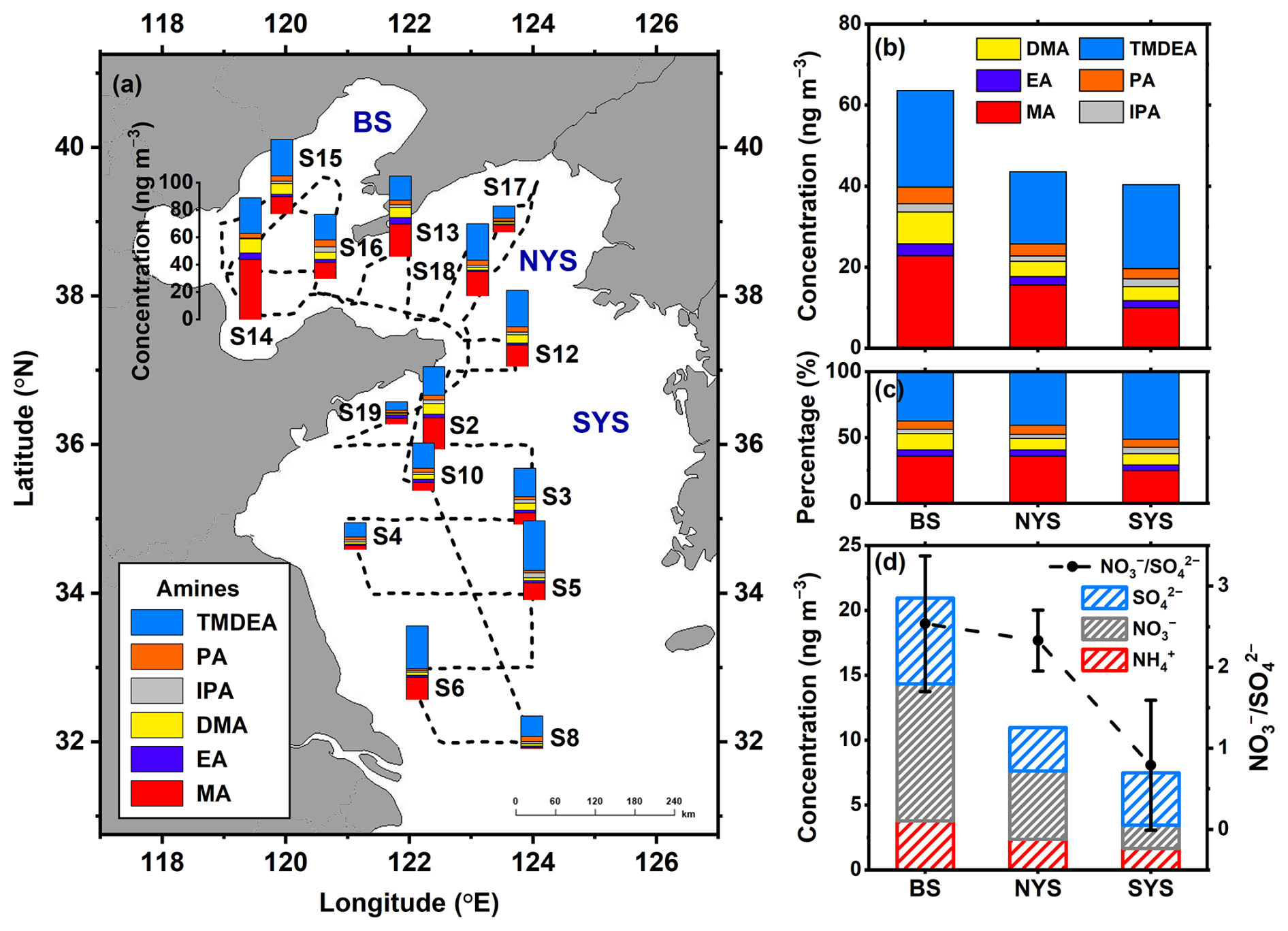
Figure 1Concentrations of amines in 15 TSP samples (a) collected along the cruise track (black dotted line); average concentrations (b) and relative contributions (c) of amines; and concentrations of , , and , along with molar ratios (d), in TSP over the SYS, NYS, and BS.
TMDEA was the predominant amine species in TSP over the YS–BS, with concentrations ranging from 6.1 to 36.3 ng m−3 (Fig. S4) and averages of 20.7 ± 9.1 ng m−3, 17.8 ± 7.3 ng m−3, and 23.8 ± 3.7 ng m−3 over the SYS, NYS, and BS, respectively. The fraction of TMDEA in ∑amines decreased from the SYS (51.2 %) to the NYS (40.8 %) and BS (37.4 %). The concentrations of amines measured in TSP were comparable to those in PM2.5 and PM10 (Table S3), as amines are predominantly (>70 %) distributed in aerosols with diameters <1.8 µm (Zhou et al., 2019; Xie et al., 2018; Yu et al., 2016). Compared with other marine and coastal regions, the aerosol TMDEA concentrations in spring over the YS–BS were higher than those reported for the East China Sea (ECS), Huaniao Island (in the ECS), South China Sea (SCS), and Northwest Pacific Ocean (NWPO) (Chen et al., 2022; Zhou et al., 2019; Xie et al., 2018; Yu et al., 2016). Over the YS–BS, aerosol TMDEA concentrations were higher in summer than in spring and autumn (Xie et al., 2018; Yu et al., 2016).
MA, the second most abundant amine species (range: 0.9–44.0 ng m−3), exhibited average concentrations of 22.8 ± 15.0 ng m−3 and 15.7 ± 7.7 ng m−3 in TSP over the BS and NYS, contributing 35.9 % to ∑amines. Relatively lower MA concentrations (10.0 ± 7.0 ng m−3) and a smaller proportion of MA to ∑amines (24.9 %) were observed over the SYS compared with the NYS–BS. A markedly high MA concentration was found in S14, the cruise track of which was close to land and largely influenced by terrestrial air masses (Figs. S3 and S4). The average aerosol MA concentration over the YS–BS in spring (13.7 ng m−3) was comparable to that at Jeju Island, South Korea (Yang et al., 2004), and was higher than those at coastal Qingdao (a port city surrounded by the YS and BS) and Huaniao Island in winter (Liu et al., 2022; Huang et al., 2018). These values were further higher than those reported for the Arabian Sea (Gibb et al., 1999) and tropical Atlantic (van Pinxteren et al., 2019), where measurements focused on ultrafine particles may underestimate aerosol amines concentrations to some extent.
DMA concentrations ranged from 1.3 to 10.4 ng m−3, with averages of 3.5 ± 2.1 ng m−3, 3.8 ± 2.6 ng m−3, and 7.9 ± 2.1 ng m−3 in TSP over the SYS, NYS, and BS, respectively. Higher DMA contributions to ∑amines were found over the BS (12.4 %) than the NYS (8.7 %) and SYS (8.6 %). The average aerosol DMA concentration over the YS–BS in spring (4.4 ng m−3) was much lower than those reported for coastal Qingdao in winter and for the YS–BS in different seasons in previous years (Table S3). EA (0.6–4.8 ng m−3), IPA (0.5–3.9 ng m−3), and PA (1.3–5.1 ng m−3) constituted a relatively small fraction of ∑amines (7.3 %–28.2 %), with average concentrations of 2.0 ± 1.2 ng m−3, 1.8 ± 1.0 ng m−3, and 2.9 ± 1.0 ng m−3 in TSP over the YS–BS, respectively. The average aerosol EA concentration over the BS (3.0 ng m−3) was comparable to those observed at coastal Qingdao (Liu et al., 2022) and Jeju Island, South Korea (Yang et al., 2004). Comparable data for EA, IPA, and PA concentrations in marine aerosols were currently limited.
According to air-mass analyses (Fig. S3), S3 and S12–S19 (include all samples from the NYS–BS) were strongly influenced by continental outflow, while S5, S6, and S8 (from the SYS) were dominated by marine air masses. The remaining samples were affected by mixed terrestrial and marine air masses. Higher concentrations of MA (16.0 ± 11.5 ng m−3), EA (2.3 ± 1.4 ng m−3), DMA (5.3 ± 2.9 ng m−3), and PA (3.2 ± 1.0 ng m−3) were observed in samples influenced by continental outflow compared to those dominated by marine air masses (MA: 10.0 ± 6.6 ng m−3; EA: 1.3 ± 0.2 ng m−3; DMA: 2.0 ± 0.1 ng m−3; and PA: 2.3 ± 1.0 ng m−3). In contrast, TMDEA concentrations were higher in samples dominated by marine air masses (27.6 ± 9.1 ng m−3) than those influenced by continental outflow (19.8 ± 7.4 ng m−3). Strong positive correlations were observed among MA, EA, and DMA (R=0.73–0.77, P<0.01), whereas no statistically significant correlation (P>0.05) exhibited between IPA, PA, or TMDEA and other amine species. These results suggested that MA, EA, and DMA might share similar sources and secondary formation pathways, whereas IPA, PA, and TMDEA were likely influenced by different sources or atmospheric processes.
3.2 Relative contributions of amines in TSP over the YS–BS
Amines, as a subset of water-soluble organic carbon, generally constitute only a minor fraction of OC. Both OC and EC concentrations in TSP increased from the SYS to the NYS and BS (Fig. 2), consistent with the strengthened influence of atmospheric pollutants transported from mainland East Asia (Fig. S3). However, the ∑amines-COC ratios (2.1 ‰–8.8 ‰) were relatively higher in aerosols over the SYS (5.4 ‰ ± 2.2 ‰) than the NYS (4.4 ‰ ± 1.7 ‰) and BS (4.0 ‰ ± 1.4 ‰; Fig. S5), contrary to the spatial variation of ∑amines concentrations.
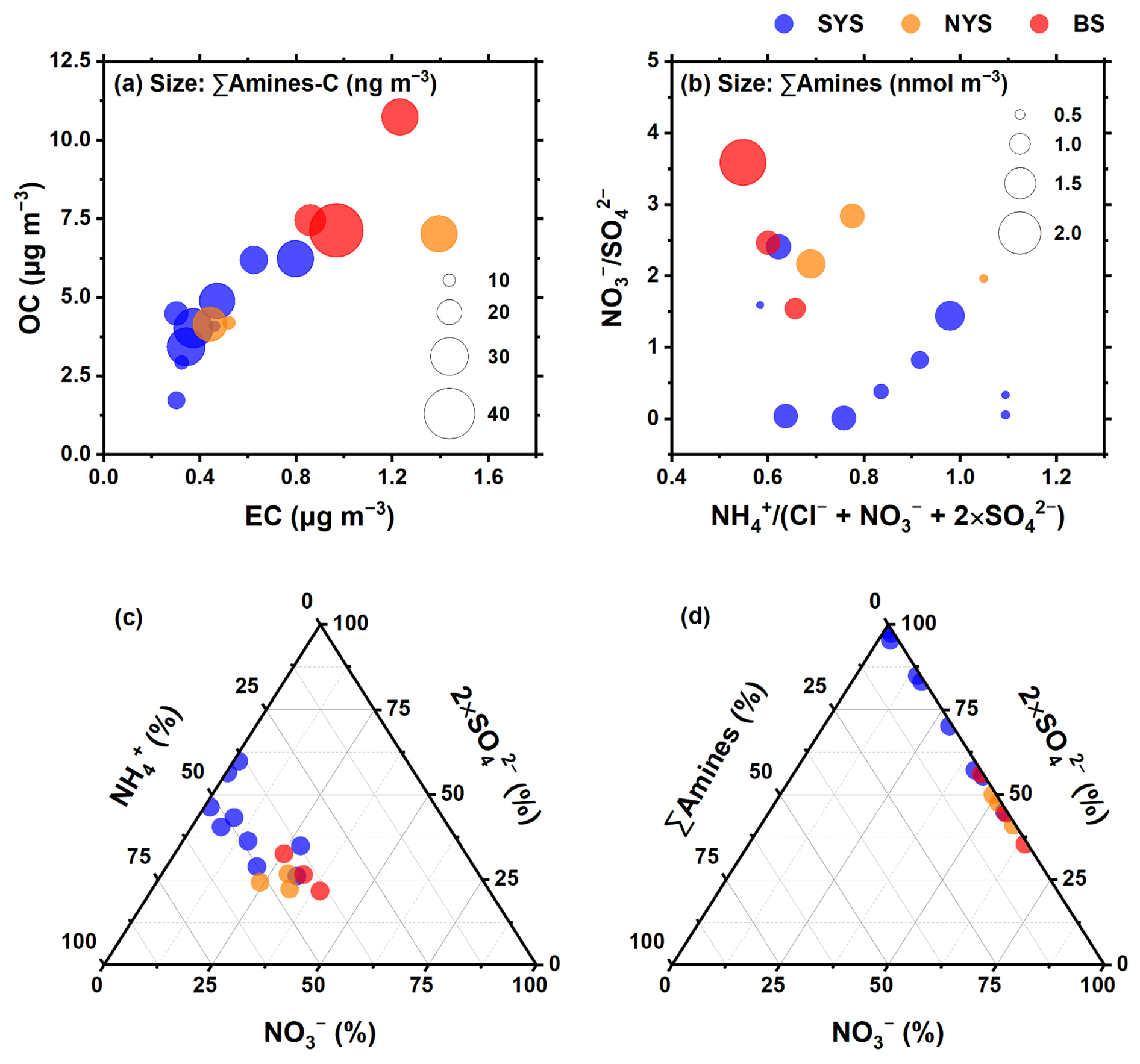
Figure 2Variations of ∑amines-C with OC and EC concentrations (a); variations of ∑amines molar concentrations with the and molar ratios (b); ternary diagram of the molar ratio of , , and (c); and ternary diagram of the molar ratio of ∑amines, , and (d) in TSP over the SYS, NYS, and BS.
Positive correlations were found between and amines, including MA (R=0.78, P<0.01), DMA (R=0.74, P<0.01), EA (R=0.57, P<0.05), PA (R=0.58, P<0.05), and TMDEA (R=0.52, P<0.05). Aerosol is formed via the heterogeneous uptake of NH3, the most abundant alkaline gas in the atmosphere, by acidic aerosols, and exists as ammonium sulfate [(NH4)2SO4], ammonium bisulfate (NH4HSO4), ammonium nitrate (NH4NO3), and ammonium chloride (NH4Cl) (Behera et al., 2013). Atmosphere NH3 shares overlapping source profiles with gaseous amines, including animal husbandry, biomass burning, vehicle emissions, industrial activities, soil, and the ocean. This was inferred as the reason for considerable correlations between and amines in aerosols.
Gaseous low molecular weight amines are more alkaline than NH3, and may compete with NH3 in atmospheric acid-base reactions (Sorooshian et al., 2008; Chen et al., 2022). The molar ratios of aerosol amines to were calculated to assess their relative contributions to the neutralization of acidic species in aerosols (Hu et al., 2015). The ∑amines molar ratios (4.8 ‰–17.0 ‰) were 9.7 ‰ ± 3.4 ‰, 7.6 ‰ ± 0.8 ‰, and 6.8 ‰ ± 1.8 ‰ over the SYS, NYS, and BS, respectively. The spatial pattern of ∑amines molar ratios (SYS > NYS > BS) was consistent with that of the ∑amines-COC ratios, both indicating a north-to-south increase in the relative contributions of amines to aerosol composition over the YS–BS.
The ∑amines molar ratios obtained in this study were of the same order of magnitude as those reported previously (Xie et al., 2018; Yu et al., 2016). Overall, amines contribute negligibly to the neutralization of acidic species in TSP compared with , which is reasonable given the much higher atmospheric abundance of NH3 relative to gaseous amines (Zheng et al., 2015; You et al., 2014; Ge et al., 2011a, b). However, amines potentially play a more important role in neutralizing acidic species in submicron particles, particularly in the presence of organic compounds (Xie et al., 2018). The composition of , , and may influence aerosol amines, as they can act as competitors for neutralization and as major reactants in aerosol formation. The molar ratios is commonly used to assess whether fully neutralizes acidic species (Cl−, , and ) in aerosols. In this study, the ratios in TSP over the YS–BS were mostly <1 (0.8 ± 0.2; Figs. 2 and S5), indicating deficiency. This deficiency was more markedly over the BS (0.6 ± 0.0) than the YS (0.8 ± 0.2). The molar ratios in TSP over the SYS (0.8 ± 0.8) were significantly lower than those over the NYS (2.3 ± 0.4) and BS (2.5 ± 0.8), indicating that was the dominate acidic species in SYS aerosols, whereas dominated in NYS and BS aerosols. The composition of , , and in NYS aerosols was intermediate between that over the BS and SYS, consistent with the regional variations in amines concentrations and composition. Molar concentrations of ∑amines increased with increasing deficiency [indicated by molar ratios; , P<0.05] and with ratios (R=0.56, P<0.05), particularly in BS aerosols. Nevertheless, individual amines responded differently to variations in deficiency and molar ratios, likely reflecting differences in their primary sources (terrestrial vs. marine) and formation pathways (nitrate vs. sulfate associated).
3.3 Source analysis of amines in TSP over the YS–BS
3.3.1 Biogenic sources
On a global scale, ocean is a major source of gaseous methylamines (fluxes: TMA > MA ≫ DMA) (Van Neste et al., 1987; Schade and Crutzen, 1995). Intensive ocean farming is widespread in the coastal areas of the YS–BS (Hu et al., 2015), where marine biogenic sources, including fish emission (Namieśnik et al., 2003), biodegradation of nitrogen-containing materials, and decay process (Calderón et al., 2007) may release gaseous amines into the atmosphere. The concentration of Chl a in surface seawater is an indicator of phytoplankton biomass and thus reflects the intensity of marine biogenic emissions to some extent. Significantly higher Chl a concentrations were observed in the BS than in the YS, with relatively elevated values in near shore areas (Fig. S2). The spatial distribution of ∑amines in TSP over the YS–BS was broadly consistent with, though not identical to, Chl a concentrations in surface seawater. This discrepancy likely reflected secondary formation of amines in aerosols, as well as the influence of long-range transportation of terrestrial emissions driven by the prevailing East Asia monsoon during spring, particularly to S3 and S12–S19 (Fig. S3).
Aerosol MA, EA, and DMA exhibited positive linear relationships with total primary sugars and sugar alcohols (Fig. 3a–c and Table S4), which mainly originate from primary biogenic sources such as bacteria, pollen, and plant or animal debris (Li et al., 2019b). These sources can be either marine or terrestrial. Fungal spore OC and plant debris OC were estimated from mannitol and arabitol (Bauer et al., 2008), and glucose (Zheng et al., 2018), respectively. Significant positive correlations were observed between MA, EA, and DMA and fungal spore OC, plant debris OC, and several individual primary sugars and sugar alcohols (e.g., trehalose, α-fructose, and sucrose; R>0.50, P<0.05). DMA exhibited the strongest correlation with trehalose (R=0.71, P<0.01), a compound abundant in microorganisms, algae, plants, and invertebrates, and also acts as an indicator of re-suspended dust (Medeiros et al., 2006; Simoneit et al., 2004). In addition, MA, DMA, and PA were positively correlated with high molecular weight n-alkanes (ALKHMW; C27, C29, C31 and C33) and fatty alcohols (ALCHMW; >C19alc; Fig. 3d and e), while PA also correlated with low molecular weight fatty acids (FALMW; ≤C19:0; Fig. 3f). ALKHMW (Rogge et al., 1993), ALCHMW (Simoneit et al., 1991), and high molecular weight fatty acids (FAHMW; >C19:0) are tracers of higher plant waxes from terrestrial vegetation, whereas FALMW are associated with marine/microbial sources (Haque et al., 2019). Overall, these findings indicated that amines (MA, EA, DMA, and PA) in TSP over the YS–BS were contributed by biogenic sources. MA and DMA were largely influenced by terrestrial biogenic emissions, whereas PA was affected by both terrestrial and marine biogenic sources.
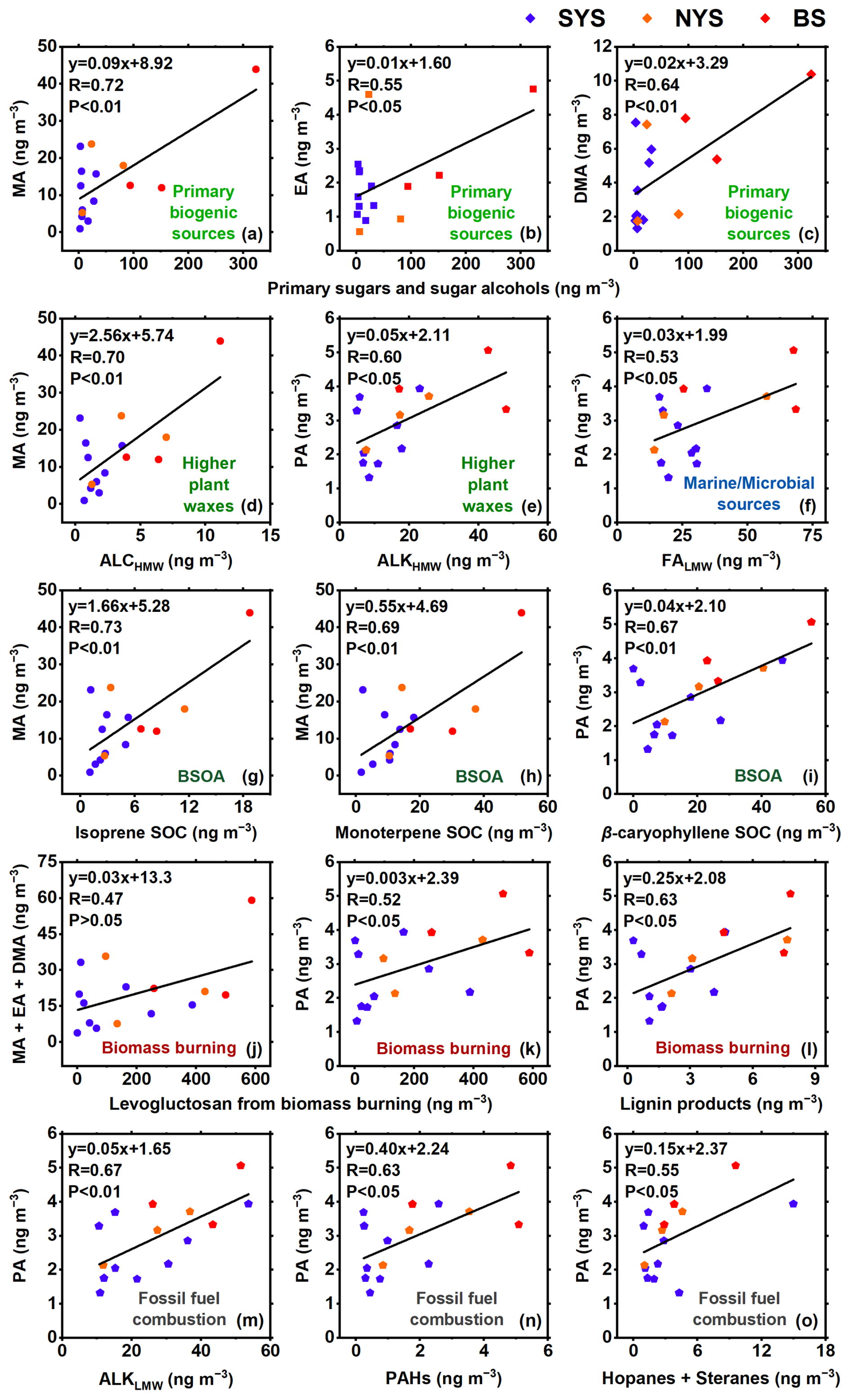
Figure 3Linear regressions between amines and biomarkers (a–i), biomass burning tracers (j–l), and fossil fuel combustion tracers (m–o) in TSP over the SYS, NYS, and BS.
Atmospheric biogenic secondary organic aerosols (BSOA) are formed via the photochemical oxidation of biogenic volatile organic compounds (BVOCs) by O3, OH and NOx (Ng et al., 2011). In this study, six isoprene SOA (SOAI) tracers, three monoterpene SOA (SOAM) tracers, and one β-caryophyllene SOA (SOAC) tracer were measured in TSP over the YS–BS. Biogenic SOC derived from isoprene, monoterpene, and β-caryophyllene was estimated using the tracer-based method (Kang et al., 2018; Kleindienst et al., 2007). Significant positive linearity were observed between MA and both isoprene and monoterpene SOC (Fig. 3g and h). Among the SOAI tracers, MA exhibited stronger correlations with 2-methyltetrols (2-MTLs; R=0.74, P<0.01) and C5-alkene triols (R=0.66, P<0.01) than with 2-methylglyceric acid (2-MGA; R=0.64, P<0.05). DMA was also positively correlated with isoprene SOC (R=0.55, P<0.05), only driven by its association with 2-MTLs (R=0.59, P<0.05). Among the SOAM tracers, pinonic acid correlated with MA (R=0.73, P<0.01), EA (R=0.52, P<0.05), and DMA (R=0.58, P<0.05), while pinic acid only correlated with MA (R=0.59, P<0.05). In addition, PA showed a positive linearity with β-caryophyllene SOC (R=0.67, P<0.01; Fig. 3i). These findings supported that MA, EA, DMA, and PA shared common sources with BVOCs and/or interacted with BSOA formation processes. High concentrations of amines and biomarkers were simultaneously observed in aerosols over the BS and NYS, whereas amines in the SYS aerosols remained at moderate levels despite low tracers concentrations (Fig. 3). These indicated that terrestrial biogenic emissions contributed more substantially to aerosol amines over the BS and NYS than the SYS.
3.3.2 Anthropogenic sources
Anthropogenic sources are another important contributor to atmospheric amines and can be broadly categorized into combustion-related sources (e.g., biomass burning, coal combustion, vehicle emissions, and waste incineration) and non-combustion sources (e.g., animal husbandry, composting, industrial activities, sewage, and septic system). EA (R=0.61, P<0.05) and DMA (R=0.72, P<0.01) concentrations in TSP over the YS–BS increased with EC, indicating the influence of combustion emissions. Levogluctosan (Lev) is a well-established tracer for biomass burning (Li et al., 2019b). Concentrations of Lev derived from biomass burning (Levbb) were estimated using Lev and non-sea-salt K+ () with considering its atmospheric degradation and ∼25 % non-biomass burning sources []. Biomass burning was not a major source of MA, EA, and DMA in aerosols over the YS–BS (Fig. 3j), but contributed substantially to PA, as indicated by the positive linear relationships between PA and both Levbb and lignin products (Fig. 3k and l). The most notable contributor to PA from biomass burning was conifer burning (the second-largest portion of total biomass burning) according to the correlations between PA and individual lignin products, including 4-hydroxybenzoic acid (4-HBA; a herbaceous burning marker and the predominate lignin product in this study; R=0.52, P<0.05), vanillic acid (VA; a softwood and hardwood burning marker; R=0.67, P<0.01), syringic acid (SA; also an indicator of softwood and hardwood burning; R=0.60, P<0.05), and dehydroabietic acid (DA; a conifer burning marker; R=0.71, P<0.01). In addition, MA (R=0.57, P<0.05) and DMA (R=0.54, P<0.05) were positively correlated with polycyclic aromatic hydrocarbons (PAHs), indicating potential contributions from fossil fuel combustion (Table S4). Among all amines, PA showed the strongest association with combustion-related sources, as evidenced by its correlations with multiple fossil fuel combustion tracers (Fig. 3m–o), including low molecular weight n-alkanes (ALKLMW; C20–C26; R=0.67, P<0.01), PAHs (R=0.63, P<0.05), hopanes (R=0.55, P<0.05), and steranes (R=0.57, P<0.05).
Emissions of amines (MA, DMA, and TMA) from non-combustion anthropogenic sources, including composting, sewage, and septic systems, are largely linked to biodegradation process. Therefore, the contribution of non-combustion anthropogenic sources to amines was encompassed within the primary biogenic sources category. IPA did not show any correlation with organic molecular tracers in TSP over the YS–BS. Given its widespread industrial use (e.g., in pesticides, pharmaceuticals, dye intermediates, emulsifiers, detergents, surfactants, and textile additives), aerosol IPA may be emitted in particulate form from specific industrial activities (Ge et al., 2011a).
3.3.3 Secondary formation of MA, EA, DMA, and PA
Significant correlations were observed between MA, EA, DMA, and PA with Cl− and (Fig. 4). The regression intercepts of MA, EA, and DMA against Cl− or were lower than those with primary organic tracers (Figs. 3 and S6), indicating substantial contributions from secondary formation. Gas-to-particle conversion of MA, EA, DMA, and PA was inferred to include direct dissolution (Eq. R1), uptake onto acidic particle surfaces (Eq. R2) (Yin et al., 2011), acid-base reactions (Eqs. R3 and R4), and displacement reactions with NH4NO3 (Eq. R5) (Bzdek et al., 2010). For MA, EA, and DMA with high water solubility, direct dissolution is considered as a key step in their gas-to-particle conversion. Uptake of gaseous amines onto acidic particle surfaces was more important over the BS, where aerosol acidic species are significantly in excess relative to . MA, EA, DMA, and PA in TSP over the YS–BS were formed via acid-base reactions with atmospheric HCl and HNO3, while CH3COOH also contributed to the formation of aerosol MA, EA and DMA (Fig. 4). In TSP over the YS–BS, concentrations were significantly higher than those of Cl− and (Table S2), thus, acid-base reactions with HNO3, together with displacement reactions involving NH4NO3, were the major pathways for the secondary formation of aerosol MA, EA, DMA and PA. The partitioning of amines into aerosols was further promoted by low T, high aerosol acidity, and high RH under dynamic solid/aqueous/gas equilibrium conditions. During the cruise, lower average T were observed over the BS (9.0 °C) and NYS (6.7 °C) than the SYS (9.5 °C), and RH remained at a high level across the YS–BS (mean: 86.2 %; median: 87.6 %). The relatively abundant acidic species and lower T over the BS and NYS favored the partitioning of MA, EA, DMA, and PA into the particle phase compared with the conditions over the SYS.
Contributions of nitrate-associated secondary formation to aerosol amines were estimated from the average amine concentrations weighted by concentrations and regression intercepts (Fig. S6). These estimates are semi-quantitative and limited by the small sample sizes, rather than representing quantitative source apportionment or mechanistic yields. Contributions of nitrate-associated secondary formation to ∑amines were highest in TSP over the BS (43.0 % ± 26.9 %), followed by the NYS (33.8 % ± 19.7 %) and SYS (21.8 % ± 18.8 %). Among individual amines, nitrate-associated secondary formation contributed most to MA (74.0 % ± 61.5 %), followed by DMA (65.7 % ± 44.3 %), EA (52.6 % ± 55.0 %), and PA (35.1 % ± 22.4 %). PA was less contributed by secondary formation, likely because it can be directly emitted in particulate form or condense into aerosols after emission due to its relatively higher boiling point (47.8 °C) compared with MA (−6.3 °C), EA (16.6 °C), and DMA (7.4 °C).
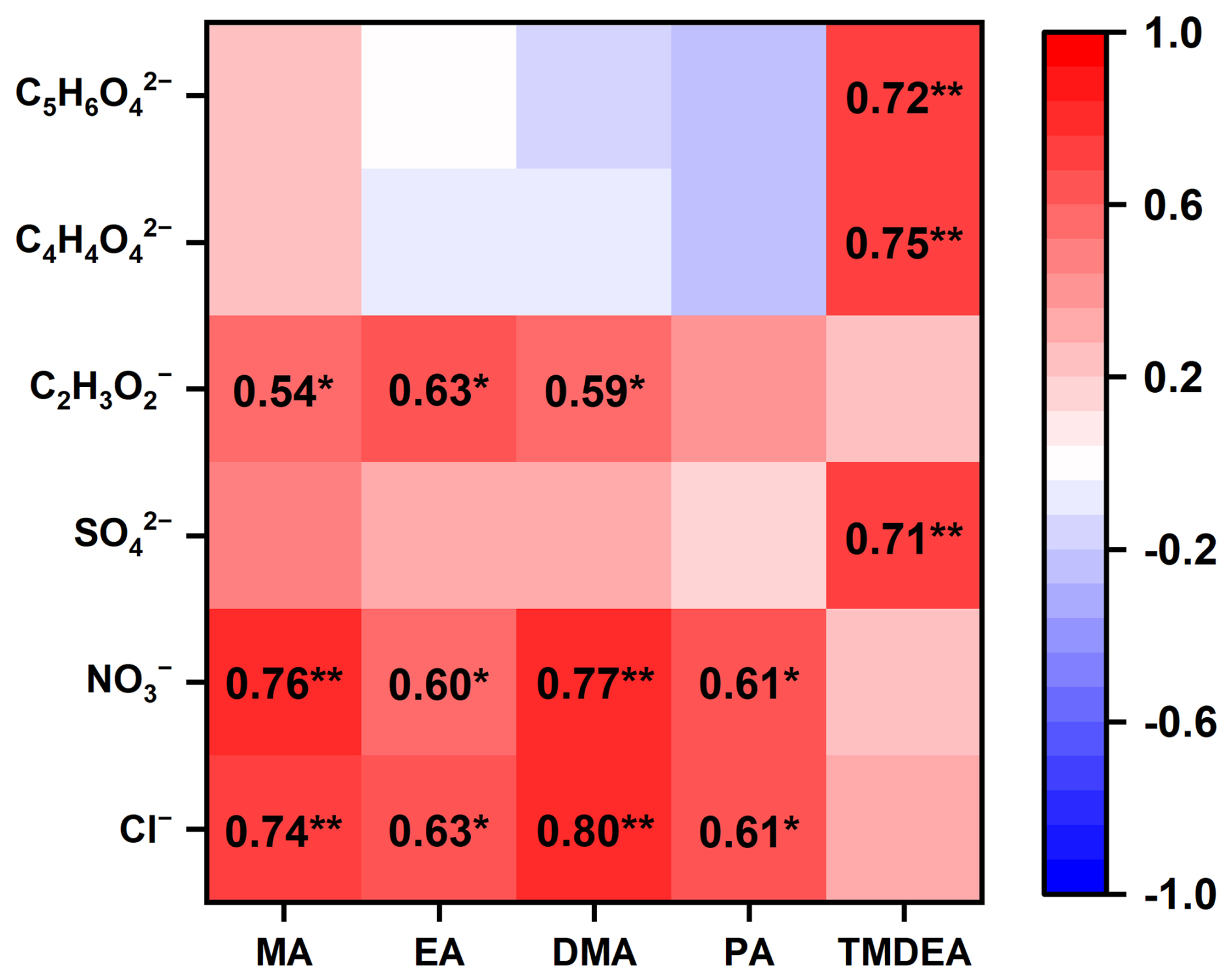
Figure 4Correlation coefficient matrix between amines and acidic species in TSP over the YS–BS. Numbers indicate correlation coefficients that passed the significance test; ** denotes P<0.01, and * denotes P<0.05.
The relationships among amines (MA, EA, DMA, and PA), BSOA, and in TSP over the YS–BS suggested potential interactions among their secondary formation processes. NOx, emitted from soil, biogenic activities, and combustion sources, are important precursors for both BSOA and atmospheric HNO3, which subsequently forms nitrate aerosols. This was supported by significant positive correlations between and SOAI (R=0.88, P<0.01), SOAM (R=0.86, P<0.01), and SOAC (R=0.64, P<0.05). The formation of MA and DMA in aerosols might occur under low NOx conditions, as evidenced by their stronger correlations with 2-MTLs or C5-alkene triols (products of isoprene photochemical oxidation under low NOx conditions) (Zheng et al., 2018; Zhang et al., 2011) than with 2-MGA (products of isoprene aqueous-phase oxidation under high NOx conditions) (He et al., 2018). Strong atmospheric photo-oxidation generally accelerates the gas-phase degradation of amines (Lee and Wexler, 2013), thereby reducing the formation of particle-phase aminium salts. BVOCs, as precursors of BSOA, can generate HNO3 via the “NO3+HC” pathway, further promoting the formation of aminium nitrates. Meanwhile, BSOA formation consumes atmospheric oxidants, which may reduce the degradation of gaseous amines. The presence of an organic phase also enhances the competitiveness of amines relative to in aerosols (Xie et al., 2018). In addition, the gas-to-particle conversion of amines may facilitate BSOA formation by providing more hygroscopic particulate surfaces.
3.3.4 Secondary formation of TMDEA
Compared with other amines, a larger fraction of TMDEA likely originated from marine sources, as evidenced by its relatively high concentrations and proportions in TSP over the SYS, especially in samples dominated by marine air masses. Previous studies also suggested marine emissions as an important potential source of TMDEA (Schade and Crutzen, 1995; van Pinxteren et al., 2019). TMDEA in TSP over the YS–BS exhibited no correlation with organic molecular tracers representing primary biogenic sources or BSOA (Table S4), although terrestrial vegetation and non-combustion anthropogenic sources are also potential sources of gaseous TMDEA (Zhu et al., 2022; Ge et al., 2011a). Concentrations of aerosol TMDEA were likely constrained by gas-to-particle conversion efficiency. A hypothesis is that part of gaseous TMA emitted from primary sources is consumed through reactions with NO3 to form non-aminium-salt SOA (Price et al., 2016, 2014) and HNO3 (Eqs. R6 and R7).
TMDEA in TSP over the YS–BS showed no correlation with Cl−, or , but exhibited significant positive linear relationships with , , and (Figs. 4 and S6). The gas-to-particle conversion of TMDEA was inferred to include uptake onto acidic particle surfaces (Eq. R2), acid-base reactions with H2SO4 (Eq. R8) and dicarboxylic acids (C4H6O4 and C5H8O4), as well as displacement reactions with (NH4)HSO4 and (NH4)2SO4 (Eqs. R9 and R10). Uptake onto acidic particle surfaces is considered as a key step in the gas-to-particle conversion of TMDEA, as TMA exhibits the strongest alkalinity among gaseous amines. TMDEA in TSP over the YS–BS showed limited association with chloride and nitrate, likely due to the much lower competitiveness of TMA in forming these salts (as reflected by dissociation constants) relative to MA, EA, DMA, and NH3 (Ge et al., 2011b). Instead, acid-base reactions with H2SO4, together with displacement reactions involving (NH4)HSO4 and (NH4)2SO4, were the major pathways for the secondary formation of aerosol TMDEA. Contributions of dicarboxylic acids were relatively minor, given the significantly lower concentrations of and compared with in TSP over the YS–BS (Table S2). These findings were consistent with previous laboratory and theoretical studies showing that TMA preferentially reacts with H2SO4 (Johnson and Jen, 2023), and that DEA exhibits the highest uptake coefficient during the irreversible reactive uptake of gaseous ethylamines by H2SO4 (Yin et al., 2011).
Sulfate-associated secondary formation contributed 61.8 % ± 31.6 % to TMDEA in TSP over the YS–BS, as estimated from average TMDEA concentrations weighted by concentrations and regression intercept (Fig. S6). The contributions were highest over the SYS (63.4 % ± 36.2 %), followed by the BS (61.4 % ± 16.2 %) and NYS (55.8 % ± 29.3 %). Correspondingly, sulfate-associated secondary formation contributed 23.0 % ± 6.0 %, 22.8 % ± 13.7 %, and 32.5 % ± 22.1 % to ∑amines over the BS, NYS, and SYS, respectively. The spatial pattern of average contributions from sulfate-associated secondary formation (SYS > BS > NYS) was consistent with that of T, indicating that T conditions influenced the relative advantages of sulfate and nitrate formation.
Significant positive correlations were observed between dicarboxylates ( and ; R=0.78 and 0.66, P<0.01) and non-sea-salt sulfate (), indicating that these species shared similar potential terrestrial anthropogenic or marine biogenic origins (Miyazaki et al., 2010; Mochida et al., 2003). Molar concentrations of biogenic- were estimated from T and MSA−, as both MSA− and are oxidation products of DMS emitted from marine biogenic sources (Nakamura et al., 2005; Bates et al., 1992). Anthropogenic- was then calculated by nss- subtracting biogenic-. The result showed that biogenic- accounted for 11.1 % of total in TSP over the SYS, markedly higher than the NYS (4.3 %) and BS (2.1 %), yet still representing a minor fraction relative to anthropogenic-. Consequently, TMDEA in TSP over the YS–BS was predominantly taken up by anthropogenic sulfate aerosols.
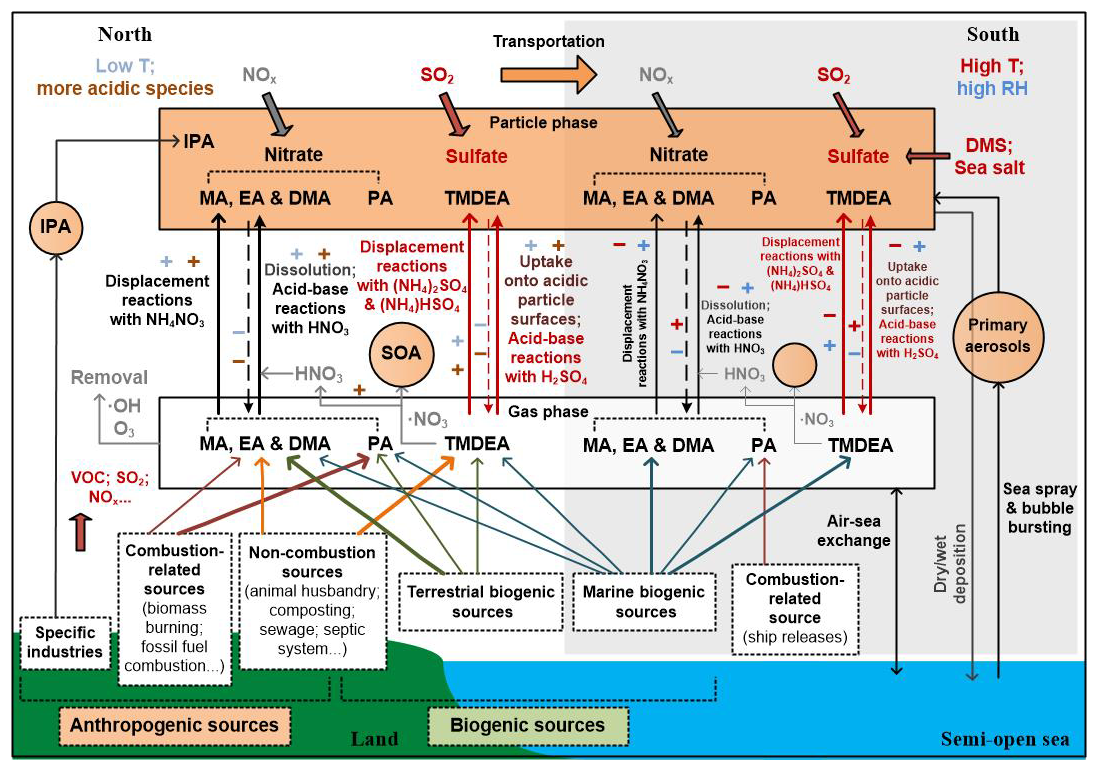
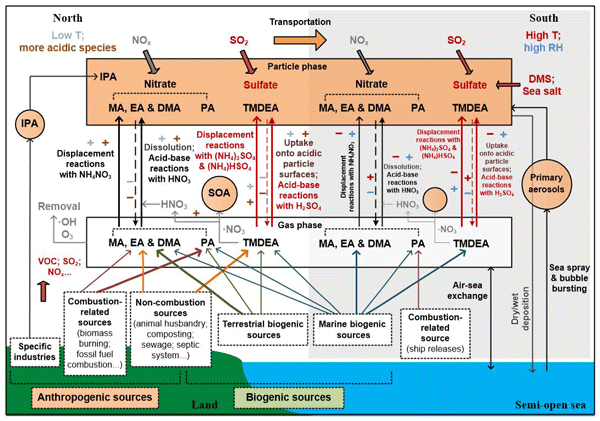
Figure 5Schematic diagram illustrating the source contributions and major secondary formation mechanisms of amines, along with the influences of environmental conditions over the YS–BS.
High concentrations of TMDEA, , , and were simultaneously observed in S5 and S6 over the SYS, along with relatively high marine biogenic contributions (Biogenic-: 11.2 % and 10.3 %). deficiency [: 0.8 and 0.6], high T (12.2 and 12.1 °C), high wind speed (6.9 and 7.2 m s−1), and saturated humidity (RH=100 %) were also found in S5 and S6 (Table S1). Under high RH, more amines partition into aqueous aerosols via direct dissolution, promoting aminium salts formation, whereas high T shifts the solid/aqueous/gas equilibrium of aminium salts toward the gas phase. Compared with the chlorides and nitrates of MA, EA, DMA, and PA, TMDEA sulfates are more thermally stable. In addition, strong winds enhance the emission of primary marine aerosols from sea spray and bubble bursting, providing additional amines to TSP, as amines are present in both seawater and primary marine aerosols. The source contributions and major secondary formation pathways of amines were summarized in Fig. 5.
This study systematically analyzed the spatial variations, potential sources, and secondary formation mechanisms of six major low molecular weight amines in aerosols over the marginal seas of China. Concentrations of total amines, water soluble inorganic ions, carbonaceous components, and more than 100 organic compositions generally exhibited a north-to-south decreasing pattern from the BS to the NYS and SYS. This trend was consistent with the decreasing influence of continental emissions from mainland East Asia, coupled with the increasing contribution of the marine atmosphere.
Offshore aerosols exhibited distinct compositions of amines compared to terrestrial aerosols, with TMDEA surpassing MA as the predominant amine. The proportions of TMDEA in ∑amines and the relative contributions of ∑amines in aerosols increased from north to south (BS < NYS < SYS), highlighting the ocean as a substantial source of amines, particularly TMDEA, despite the significant influence of terrestrial emissions. Distinct potential sources and major secondary formation pathways were identified for different amine species. MA, EA, and DMA were mainly derived from terrestrial biogenic and non-combustion anthropogenic sources, followed by fossil fuel combustion, with over 50 % formed via nitrate-associated secondary formation pathways, interacting with BSOA formation in the NOx-involved oxidation of BVOCs. In comparison, PA was mainly originated from combustion-related sources along with terrestrial and marine biogenic sources, with only ∼35 % contributed by nitrate-associated secondary formation. In contrast to other amines, TMDEA was mostly (∼60 %) generated via sulfate-associated secondary formation pathways, and also contributed by primary marine aerosols from sea spray and bubble bursting.
Terrestrial sources not only emit gaseous amines but also contribute acidic aerosols that can further uptake amines from marine sources during the transportation of air masses from the mainland to the ocean. This process affects the physiochemical properties and climate effects of marine aerosols, as well as the carbon and nitrogen cycles. In addition to precursors abundance, ambient conditions also influence the secondary formation of aerosol amines, leading to temporal and spatial variations in their concentrations and compositions. Overall, our findings improve the understanding of amines in marine aerosols, highlight the impact of terrestrial emissions on offshore aerosol chemistry, and underscore the importance of multiphase chemical processes of amines under diverse ambient conditions.
Data are available from the corresponding author on request (dryanlinzhang@outlook.com).
The supplement related to this article is available online at https://doi.org/10.5194/acp-26-7031-2026-supplement.
Xiao-Ying Yang wrote the draft and produced all the figures and tables. Fang Cao, Yu-Chi Lin, and Yan-Lin Zhang provided useful comments and revised the paper. Chang-Liu Wu, Yu-Xian Zhang, and Wen-Huai Song provided the measurement data.
The contact author has declared that none of the authors has any competing interests.
Publisher's note: Copernicus Publications remains neutral with regard to jurisdictional claims made in the text, published maps, institutional affiliations, or any other geographical representation in this paper. The authors bear the ultimate responsibility for providing appropriate place names. Views expressed in the text are those of the authors and do not necessarily reflect the views of the publisher.
We sincerely thank the captain and all crews of the Dong Fang Hong 2; Wen-shuai Li and Tian-tian Liu from the Ocean University of China for their help in the research cruise; Yi-xuan Zhang, Yan Fang, Sheng-cheng Shao, Xia Wu and Tong Huang from Nanjing University of Information Science & Technology for their assistance in the aerosol sampling and experiment process.
This research has been supported by the National Natural Science Foundation of China (grant no. 42325304).
This paper was edited by Joachim Curtius and reviewed by three anonymous referees.
Barsanti, K. and Pankow, J.: Thermodynamics of the formation of atmospheric organic particulate matter by accretion reactions – Part 3: Carboxylic and dicarboxylic acids, Atmos. Environ., 40, 6676–6686, https://doi.org/10.1016/j.atmosenv.2006.03.013, 2006.
Bates, T., Calhoun, J., and Quinn, P.: Variations in the methanesulfonate to sulfate molar ratio in marine aerosol particles over the South Pacific Ocean, J. Geophys. Res., 97, 9859–9865, https://doi.org/10.1029/92JD00411, 1992.
Bates, T. S., Quinn, P. K., Frossard, A. A., Russell, L. M., Hakala, J., Petäjä, T., Kulmala, M., Covert, D. S., Cappa, C. D., Li, S. M., Hayden, K. L., Nuaaman, I., McLaren, R., Massoli, P., Canagaratna, M. R., Onasch, T. B., Sueper, D., Worsnop, D. R., and Keene, W. C.: Measurements of ocean derived aerosol off the coast of California, J. Geophys. Res.-Atmos., 117, https://doi.org/10.1029/2012jd017588, 2012.
Bauer, H., Claeys, M., Vermeylen, R., Schüller, E., Weinke, G., Berger, A., and Puxbaum, H.: Arabitol and mannitol as tracers for a quantification of airborne fungal spores, Atmos. Environ., 42, 588–593, https://doi.org/10.1016/j.atmosenv.2007.10.013, 2008.
Behera, S. N., Sharma, M., Aneja, V. P., and Balasubramanian, R.: Ammonia in the atmosphere: a review on emission sources, atmospheric chemistry and deposition on terrestrial bodies, Environ. Sci. Pollut. R., 20, 8092–8131, https://doi.org/10.1007/s11356-013-2051-9, 2013.
Bzdek, B. R., Ridge, D. P., and Johnston, M. V.: Amine exchange into ammonium bisulfate and ammonium nitrate nuclei, Atmos. Chem. Phys., 10, 3495–3503, https://doi.org/10.5194/acp-10-3495-2010, 2010.
Calderón, S., Poor, N., and Campbell, S.: Estimation of the particle and gas scavenging contributions to wet deposition of organic nitrogen, Atmos. Environ., 41, 4281–4290, https://doi.org/10.1016/j.atmosenv.2006.06.067, 2007.
Cao, F., Zhang, Y.-X., Zhang, Y.-L., Song, W.-H., Zhang, Y.-X., Lin, Y.-C., Gul, C., and Haque, M. M.: Molecular compositions of marine organic aerosols over the Bohai and Yellow Seas: Influence of primary emission and secondary formation, Atmos. Res., 297, 107088, https://doi.org/10.1016/j.atmosres.2023.107088, 2024.
Carpenter, L., Archer, S., and Beale, R.: Ocean-atmosphere trace gas exchange, Chem. Soc. Rev., 41, 6473–6506, https://doi.org/10.1039/c2cs35121h, 2012.
Chan, L. and Chan, C.: Role of the Aerosol Phase State in Ammonia/Amines Exchange Reactions, Environ. Sci. Technol., 47, 5755–5762, https://doi.org/10.1021/es4004685, 2013.
Chen, D., Yao, X., Chan, C. K., Tian, X., Chu, Y., Clegg, S. L., Shen, Y., Gao, Y., and Gao, H.: Competitive Uptake of Dimethylamine and Trimethylamine against Ammonia on Acidic Particles in Marine Atmospheres, Environ. Sci. Technol., 56, 5430–5439, https://doi.org/10.1021/acs.est.1c08713, 2022.
Chen, Y., Patel, N., Crombie, A., Scrivens, J., and Murrell, J.: Bacterial flavin-containing monooxygenase is trimethylamine monooxygenase, P. Natl. Acad. Sci. USA, 108, 17791–17796, https://doi.org/10.1073/pnas.1112928108, 2011.
Chen, Y., Tian, M., Huang, R.-J., Shi, G., Wang, H., Peng, C., Cao, J., Wang, Q., Zhang, S., Guo, D., Zhang, L., and Yang, F.: Characterization of urban amine-containing particles in southwestern China: seasonal variation, source, and processing, Atmos. Chem. Phys., 19, 3245–3255, https://doi.org/10.5194/acp-19-3245-2019, 2019.
Cheng, C., Huang, Z., Chan, C. K., Chu, Y., Li, M., Zhang, T., Ou, Y., Chen, D., Cheng, P., Li, L., Gao, W., Huang, Z., Huang, B., Fu, Z., and Zhou, Z.: Characteristics and mixing state of amine-containing particles at a rural site in the Pearl River Delta, China, Atmos. Chem. Phys., 18, 9147–9159, https://doi.org/10.5194/acp-18-9147-2018, 2018.
Cheng, G., Hu, Y., Sun, M., Chen, Y., Chen, Y., Zong, C., Chen, J., and Ge, X.: Characteristics and potential source areas of aliphatic amines in PM2.5 in Yangzhou, China, Atmos. Pollut. Res., 11, 296–302, https://doi.org/10.1016/j.apr.2019.11.002, 2020.
Chu, Y., Sauerwein, M., and Chan, C. K.: Hygroscopic and phase transition properties of alkyl aminium sulfates at low relative humidities, Phys. Chem. Chem. Phys., 17, 19789–19796, https://doi.org/10.1039/C5CP02404H, 2015.
Corral, A. F., Choi, Y., Collister, B. L., Crosbie, E., Dadashazar, H., DiGangi, J. P., Diskin, G. S., Fenn, M., Kirschler, S., Moore, R. H., Nowak, J. B., Shook, M. A., Stahl, C. T., Shingler, T., Thornhill, K. L., Voigt, C., Ziemba, L. D., and Sorooshian, A.: Dimethylamine in cloud water: a case study over the northwest Atlantic Ocean, Environmental Science: Atmospheres, 2, 1534–1550, https://doi.org/10.1039/D2EA00117A, 2022.
Dall'Osto, M., Airs, R., Beale, R., Cree, C., Fitzsimons, M., Beddows, D., Harrison, R., Ceburnis, D., O'Dowd, C., Rinaldi, M., Paglione, M., Nenes, A., Decesari, S., and Simó, R.: Simultaneous Detection of Alkylamines in the Surface Ocean and Atmosphere of the Antarctic Sympagic Environment, ACS Earth and Space Chemistry, 3, 854–862, https://doi.org/10.1021/acsearthspacechem.9b00028, 2019.
Du, W., Wang, X., Yang, F., Bai, K., Wu, C., Liu, S., Wang, F., Lv, S., Chen, Y., Wang, J., Liu, W., Wang, L., Chen, X., and Wang, G.: Particulate Amines in the Background Atmosphere of the Yangtze River Delta, China: Concentration, Size Distribution, and Sources, Adv. Atmos. Sci., 38, 1128–1140, https://doi.org/10.1007/s00376-021-0274-0, 2021.
Facchini, M., Decesari, S., Rinaldi, M., Carbone, C., Finessi, E., Mircea, M., Sandro, F., Moretti, F., Tagliavini, E., Ceburnis, D., and O'Dowd, C.: Important Source of Marine Secondary Organic Aerosol from Biogenic Amines, Environ. Sci. Technol., 42, 9116–9121, https://doi.org/10.1021/es8018385, 2008a.
Facchini, M., Rinaldi, M., Decesari, S., Carbone, C., Finessi, E., Mircea, M., Sandro, F., Ceburnis, D., Flanagan, R., Nilsson, E., de Leeuw, G., Martino, M., Woeltjen, J., and Dowd, C.: Primary submicron marine aerosol dominated by insoluble organic colloids and aggregates, Geophys. Res. Lett., 35, L17814, https://doi.org/10.1029/2008GL034210, 2008b.
Fan, M.-Y., Zhang, Y.-L., Lin, Y.-C., Chang, Y.-H., Cao, F., Zhang, W.-Q., Hu, Y.-B., Bao, M.-Y., Liu, X.-Y., Zhai, X.-Y., Lin, X., Zhao, Z.-Y., and Song, W.-H.: Isotope-based source apportionment of nitrogen-containing aerosols: A case study in an industrial city in China, Atmos. Environ., 212, 96–105, https://doi.org/10.1016/j.atmosenv.2019.05.020, 2019.
Fang, Y., Chen, Y., Tian, C., Lin, T., Hu, L., Li, J., and Zhang, G.: Application of PMF receptor model merging with PAHs signatures for source apportionment of black carbon in the continental shelf surface sediments of the Bohai and Yellow Seas, China, J. Geophys. Res.-Oceans, 121, 1346–1359, https://doi.org/10.1002/2015JC011214, 2016.
Feng, H., Ye, X., Liu, Y., Wang, Z., Gao, T., Cheng, A., and Chen, J.: Simultaneous Determination of Nine Atmospheric Amines and Six Inorganic Ions by Non-suppressed Ion Chromatography Using Acetonitrile and 18-Crown-6 as Eluent Additive, J. Chromatogr. A, 461234, https://doi.org/10.1016/j.chroma.2020.461234, 2020.
Feng, X., Wang, C., Feng, Y., Junjie, C., Zhang, Y., Qi, X., Li, Q., Li, J., and Chen, Y.: Outbreaks of Ethyl-Amines during Haze Episodes in North China Plain: A Potential Source of Amines from Ethanol Gasoline Vehicle Emission, Environ. Sci. Tech. Let., 9, 306–311, https://doi.org/10.1021/acs.estlett.2c00145, 2022.
Gaston, C., Quinn, P., Bates, T., Gilman, J., Bon, D., Kuster, W., and Prather, K.: The impact of shipping, agricultural, and urban emissions on single particle chemistry observed aboard the R/V Atlantis during CalNex, J. Geophys. Res.-Atmos., 118, 5003–5017, https://doi.org/10.1002/jgrd.50427, 2013.
Ge, X., Wexler, A., and Clegg, S.: Atmospheric amines – Part I. A review, Atmos. Environ., 45, 524–546, https://doi.org/10.1016/j.atmosenv.2010.10.012, 2011a.
Ge, X., Wexler, A., and Clegg, S.: Atmospheric amines – Part II. Thermodynamic properties and gas/particle partitioning, Atmos. Environ., 45, 561–577, https://doi.org/10.1016/j.atmosenv.2010.10.013, 2011b.
Gibb, S., Mantoura, R., and Liss, P.: Ocean-atmosphere exchange and atmospheric speciation of ammonia and methylamines in the region of the NW Arabian Sea, Global Biogeochem. Cy., 13, 161–178, https://doi.org/10.1029/98GB00743, 1999.
Gomez-Hernandez, M., McKeown, M., Secrest, J., Marrero-Ortiz, W., Lavi, A., Rudich, Y., Collins, D. R., and Zhang, R.: Hygroscopic Characteristics of Alkylaminium Carboxylate Aerosols, Environ. Sci. Technol., 50, 2292–2300, https://doi.org/10.1021/acs.est.5b04691, 2016.
Gorzelska, K. and Galloway, J.: Amine nitrogen in the atmospheric environment over the North Atlantic Ocean, Global Biogeochem. Cy., 4, 309–333, https://doi.org/10.1029/GB004i003p00309, 1990.
Haque, Md. M., Kawamura, K., Deshmukh, D. K., Fang, C., Song, W., Mengying, B., and Zhang, Y.-L.: Characterization of organic aerosols from a Chinese megacity during winter: predominance of fossil fuel combustion, Atmos. Chem. Phys., 19, 5147–5164, https://doi.org/10.5194/acp-19-5147-2019, 2019.
He, Q., Ding, X., Fu, X.-X., Zhang, Y.-Q., Wang, J.-Q., Liu, Y.-X., Tang, M.-J., Wang, X., and Rudich, Y.: Secondary Organic Aerosol Formation from Isoprene Epoxides in the Pearl River Delta, South China: IEPOX- and HMML-Derived Tracers, J. Geophys. Res.-Atmos., 123, 6999–7012, https://doi.org/10.1029/2017JD028242, 2018.
Hemmilä, M., Hellén, H., Virkkula, A., Makkonen, U., Praplan, A. P., Kontkanen, J., Ahonen, L., Kulmala, M., and Hakola, H.: Amines in boreal forest air at SMEAR II station in Finland, Atmos. Chem. Phys., 18, 6367–6380, https://doi.org/10.5194/acp-18-6367-2018, 2018.
Hu, Q., Yu, P., Zhu, Y., Li, K., Gao, H., and Yao, X.: Concentration, Size Distribution, and Formation of Trimethylaminium and Dimethylaminium Ions in Atmospheric Particles over Marginal Seas of China, J. Atmos. Sci., 72, 150522112638006, https://doi.org/10.1175/JAS-D-14-0393.1, 2015.
Huang, S., Song, Q., Hu, W., Yuan, B., Liu, J., Jiang, B., Li, W., Wu, C., Jiang, F., Chen, W., Wang, X., and Shao, M.: Chemical composition and sources of amines in PM2.5 in an urban site of PRD, China, Environ. Res., 212, 113261, https://doi.org/10.1016/j.envres.2022.113261, 2022.
Huang, X., Kao, S.-J., Lin, J., Qin, X., and Deng, C.: Development and validation of a HPLC/FLD method combined with online derivatization for the simple and simultaneous determination of trace amino acids and alkyl amines in continental and marine aerosols, PLOS ONE, 13, e0206488, https://doi.org/10.1371/journal.pone.0206488, 2018.
Johnson, J. and Jen, C.: Role of Methanesulfonic Acid in Sulfuric Acid–Amine and Ammonia New Particle Formation, ACS Earth and Space Chemistry, 7, 653–660, https://doi.org/10.1021/acsearthspacechem.3c00017, 2023.
Kanawade, V. P. and Jokinen, T.: Atmospheric amines are a crucial yet missing link in Earth's climate via airborne aerosol production, Communications Earth & Environment, 6, 98, https://doi.org/10.1038/s43247-025-02063-0, 2025.
Kang, M., Fu, P., Kawamura, K., Yang, F., Zhang, H., Zang, Z., Ren, H., Ren, L., Zhao, Y., Sun, Y., and Wang, Z.: Characterization of biogenic primary and secondary organic aerosols in the marine atmosphere over the East China Sea, Atmos. Chem. Phys., 18, 13947–13967, https://doi.org/10.5194/acp-18-13947-2018, 2018.
Kleindienst, T., Jaoui, M., Lewandowski, M., Offenberg, J., Lewis, C., Bhave, P., and Edney, E.: Estimates of the contributions of biogenic and anthropogenic hydrocarbons to secondary organic aerosol at a southern US location, Atmos. Environ., 41, 8288–8300, https://doi.org/10.1016/j.atmosenv.2007.06.045, 2007.
Köllner, F., Schneider, J., Willis, M. D., Klimach, T., Helleis, F., Bozem, H., Kunkel, D., Hoor, P., Burkart, J., Leaitch, W. R., Aliabadi, A. A., Abbatt, J. P. D., Herber, A. B., and Borrmann, S.: Particulate trimethylamine in the summertime Canadian high Arctic lower troposphere, Atmos. Chem. Phys., 17, 13747–13766, https://doi.org/10.5194/acp-17-13747-2017, 2017.
Lee, D. and Wexler, A.: Atmospheric amines – Part III: Photochemistry and toxicity, Atmos. Environ., 71, 95–103, https://doi.org/10.1016/j.atmosenv.2013.01.058, 2013.
Li, G., Liao, Y., Hu, J., Lu, L., Zhang, Y., Li, B., and An, T.: Activation of NF-κB pathways mediating the inflammation and pulmonary diseases associated with atmospheric methylamine exposure, Environ. Pollut., 252, 1216–1224, https://doi.org/10.1016/j.envpol.2019.06.059, 2019a.
Li, J., Wang, G., Zhang, Q., Li, J., Wu, C., Jiang, W., Zhu, T., and Zeng, L.: Molecular characteristics and diurnal variations of organic aerosols at a rural site in the North China Plain with implications for the influence of regional biomass burning, Atmos. Chem. Phys., 19, 10481–10496, https://doi.org/10.5194/acp-19-10481-2019, 2019b.
Lidbury, I., Chen, Y., and Murrell, J.: Trimethylamine and trimethylamine N-oxide are supplementary energy sources for a marine heterotrophic bacterium: Implications for marine carbon and nitrogen cycling, ISME J., 9, 760–769, https://doi.org/10.1038/ismej.2014.149, 2015.
Lidbury, I., Mausz, M., Scanlan, D., and Chen, Y.: Identification of dimethylamine monooxygenase in marine bacteria reveals a metabolic bottleneck in the methylated amine degradation pathway, ISME J., 11, 1592–1601, https://doi.org/10.1038/ismej.2017.31, 2017.
Lin, P., Laskin, J., Nizkorodov, S., and Laskin, A.: Revealing Brown Carbon Chromophores Produced in Reactions of Methylglyoxal with Ammonium Sulfate, Environ. Sci. Technol., 49, 14257–14266, https://doi.org/10.1021/acs.est.5b03608, 2015.
Lin, Q., Zhang, G., Peng, L., Bi, X., Wang, X., Brechtel, F. J., Li, M., Chen, D., Peng, P., Sheng, G., and Zhou, Z.: In situ chemical composition measurement of individual cloud residue particles at a mountain site, southern China, Atmos. Chem. Phys., 17, 8473–8488, https://doi.org/10.5194/acp-17-8473-2017, 2017.
Liu, F., Bi, X., Zhang, G., Peng, L., Lian, X., Lu, H., Fu, Y., Wang, X., Peng, P. A., and Sheng, G.: Concentration, size distribution and dry deposition of amines in atmospheric particles of urban Guangzhou, China, Atmos. Environ., 171, 279–288, https://doi.org/10.1016/j.atmosenv.2017.10.016, 2017.
Liu, F., Bi, X., Zhang, G., Lian, X., Fu, Y., Yang, Y., Lin, Q., Jiang, F., Wang, X., Peng, P. a., and Sheng, G.: Gas-to-particle partitioning of atmospheric amines observed at a mountain site in southern China, Atmos. Environ., 195, 1–11, https://doi.org/10.1016/j.atmosenv.2018.09.038, 2018.
Liu, T., Xu, Y., Sun, Q., Zhu, R.-G., Li, C. X., Li, Z. Y., Zhang, K. Q., Sun, C. X., and Xiao, H. Y.: Characteristics, Origins, and Atmospheric Processes of Amines in Fine Aerosol Particles in Winter in China, J. Geophys. Res.-Atmos., 128, e2023JD038974, https://doi.org/10.1029/2023JD038974, 2023.
Liu, Z., Li, M., Wang, X., Liang, Y., Jiang, Y., Chen, J., Mu, J., Zhu, Y., Meng, H., Yang, L., Hou, K., Wang, Y., and Xue, L.: Large contributions of anthropogenic sources to amines in fine particles at a coastal area in northern China in winter, Sci. Total Environ., 839, 156281, https://doi.org/10.1016/j.scitotenv.2022.156281, 2022.
Marrero-Ortiz, W., Hu, M., Du, Z., Ji, Y.-M., Wang, Y., Guo, S., Lin, Y., Gomez-Hermandez, M., Peng, J., Li, Y., Secrest, J., Levy Zamora, M., Wang, Y., An, T., and Zhang, R.: Formation and Optical Properties of Brown Carbon from Small α-Dicarbonyls and Amines, Environ. Sci. Technol., 53, 117–126, https://doi.org/10.1021/acs.est.8b03995, 2018.
Medeiros, P., Conte, M., Weber, J., and Simoneit, B.: Sugars as source indicators of biogenic organic carbon in aerosols collected above the Howland Experimental Forest, Maine, Atmos. Environ., 40, 1694–1705, https://doi.org/10.1016/j.atmosenv.2005.11.001, 2006.
Milne, P. and Zika, R.: Amino acid nitrogen in atmospheric aerosols: Occurrence, sources and photochemical modification, J. Atmos. Chem., 16, 361–398, https://doi.org/10.1007/BF01032631, 1993.
Miyazaki, Y., Kawamura, K., and Sawano, M.: Size distributions and chemical characterization of water-soluble organic aerosols over the western North Pacific in summer, J. Geophys. Res., 115, 210, https://doi.org/10.1029/2010JD014439, 2010.
Mochida, M., Kawabata, A., Kawamura, K., Hatsushika, H., and Yamazaki, K.: Seasonal variation and origin of dicarboxylic acids in the marine atmosphere over the western North Pacific, J. Geophys. Res., 108, 4193, https://doi.org/10.1029/2002JD002355, 2003.
Müller, C., Iinuma, Y., Karstensen, J., van Pinxteren, D., Lehmann, S., Gnauk, T., and Herrmann, H.: Seasonal variation of aliphatic amines in marine sub-micrometer particles at the Cape Verde islands, Atmos. Chem. Phys., 9, 9587–9597, https://doi.org/10.5194/acp-9-9587-2009, 2009.
Myriokefalitakis, S., Elisabetta, V., Tsigaridis, K., Papadimas, C. D., Sciare, J., Mihalopoulos, N., Facchini, M., Matteo, R., Dentener, F., Ceburnis, D., Hatzianastassiou, N., O'Dowd, C., van Weele, M., and Kanakidou, M.: Global Modeling of the Oceanic Source of Organic Aerosols, Adv. Meteorol., 2010, https://doi.org/10.1155/2010/939171, 2010.
Nakamura, T., Matsumoto, K., and Uematsu, M.: Chemical characteristics of aerosols transported from Asia to the East China Sea: An evaluation of anthropogenic combined nitrogen deposition in autumn, Atmos. Environ., 39, 1749–1758, https://doi.org/10.1016/j.atmosenv.2004.11.037, 2005.
Namieśnik, J., Jastrzebska, A., and Zygmunt, B.: Determination of volatile aliphatic amines in air by solid-phase microextraction coupled with gas chromatography with flame ionization detection, J. Chromatogr. A, 1016, 1–9, https://doi.org/10.1016/S0021-9673(03)01296-2, 2003.
Ng, N. L., Canagaratna, M. R., Jimenez, J. L., Chhabra, P. S., Seinfeld, J. H., and Worsnop, D. R.: Changes in organic aerosol composition with aging inferred from aerosol mass spectra, Atmos. Chem. Phys., 11, 6465–6474, https://doi.org/10.5194/acp-11-6465-2011, 2011.
Nielsen, C. J., Herrmann, H., and Weller, C.: Atmospheric chemistry and environmental impact of the use of amines in carbon capture and storage (CCS), Chem. Soc. Rev., 41, 6684–6704, https://doi.org/10.1039/c2cs35059a, 2012.
Pankow, J.: Phase Considerations in the Gas/Particle Partitioning of Organic Amines in the Atmosphere, Atmos. Environ., 122, 448–453, https://doi.org/10.1016/j.atmosenv.2015.09.056, 2015.
Place, B. K., Quilty, A. T., Di Lorenzo, R. A., Ziegler, S. E., and VandenBoer, T. C.: Quantitation of 11 alkylamines in atmospheric samples: separating structural isomers by ion chromatography, Atmos. Meas. Tech., 10, 1061–1078, https://doi.org/10.5194/amt-10-1061-2017, 2017.
Price, D., Clark, C., Tang, X., Cocker, D., Purvis-Roberts, K., and Silva, P.: Proposed chemical mechanisms leading to secondary organic aerosol in the reactions of aliphatic amines with hydroxyl and nitrate radicals, Atmos. Environ., 96, 135–144, https://doi.org/10.1016/j.atmosenv.2014.07.035, 2014.
Price, D., Kacarab, M., Cocker, D., Purvis-Roberts, K., and Silva, P.: Effects of Temperature on the Formation of Secondary Organic Aerosol from Amine Precursors, Aerosol Sci. Tech., 50, 1216–1226, https://doi.org/10.1080/02786826.2016.1236182, 2016.
Qiu, C. and Zhang, R.: Multiphase chemistry of atmospheric amines, Phys. Chem. Chem. Phys., 15, 5738–5752, https://doi.org/10.1039/c3cp43446j, 2013.
Rinaldi, M., Decesari, S., Finessi, E., Giulianelli, L., Carbone, C., Fuzzi, S., O'Dowd, C. D., Ceburnis, D., and Facchini, M. C.: Primary and Secondary Organic Marine Aerosol and Oceanic Biological Activity: Recent Results and New Perspectives for Future Studies, Adv. Meteorol., 2010, 1–10, https://doi.org/10.1155/2010/310682, 2010.
Rogge, W., Hildemann, L., Mazurek, M., Cass, G., and Simoneit, B.: Sources of Fine Organic Aerosol. 3. Road Dust, Tire Debris, and Organometallic Brake Lining Dust: Roads as Sources and Sinks, Environ. Sci. Technol., 27, 1892–1904, https://doi.org/10.1021/es00046a019, 1993.
Schade, G. and Crutzen, P.: Emission of aliphatic amines from animal husbandry and their reactions: Potential source of N2O and HCN, J. Atmos. Chem., 22, 319–346, https://doi.org/10.1007/BF00696641, 1995.
Shen, J., Xie, H.-B., Elm, J., Ma, F., Chen, J., and Vehkamäki, H.: Methanesulfonic Acid-driven New Particle Formation Enhanced by Monoethanolamine: A Computational Study, Environ. Sci. Technol., 53, 14387–14397, https://doi.org/10.1021/acs.est.9b05306, 2019.
Shen, W., Ren, L., Zhao, Y., Zhou, L., Dai, L., Ge, X., Kong, S., Yan, Q., Xu, H., Jiang, Y., He, J., Chen, M., and Yu, H.: C1-C2 alkyl aminiums in urban aerosols: Insights from ambient and fuel combustion emission measurements in the Yangtze River Delta region of China, Environ. Pollut., 230, 12–21, https://doi.org/10.1016/j.envpol.2017.06.034, 2017.
Shen, X., Chen, J., and An, T.: A new advance in pollution profile, transformation process, and contribution to SOA formation of atmospheric organic amines, Environmental Science: Atmospheres, 3, 444–473, https://doi.org/10.1039/D2EA00167E, 2023.
Simoneit, B., Sheng, G., Chen, X., Fu, J., Zhang, J., and Xu, Y.: Molecular marker study of extractable organic matter in aerosols from urban areas of China, Atmos. Environ. A-Gen., 25, 2111–2129, https://doi.org/10.1016/0960-1686(91)90088-O, 1991.
Simoneit, B., Elias, V., Kobayashi, M., Kawamura, K., Rushdi, A., Medeiros, P., Rogge, W., and Didyk, B.: SugarsDominant Water-Soluble Organic Compounds in Soils and Characterization as Tracers in Atmospheric Particulate Matter, Environ. Sci. Technol., 38, 5939–5949, https://doi.org/10.1021/es0403099, 2004.
Sorooshian, A., Murphy, S. M., Hersey, S., Gates, H., Padro, L. T., Nenes, A., Brechtel, F. J., Jonsson, H., Flagan, R. C., and Seinfeld, J. H.: Comprehensive airborne characterization of aerosol from a major bovine source, Atmos. Chem. Phys., 8, 5489–5520, https://doi.org/10.5194/acp-8-5489-2008, 2008.
Sun, J., Mausz, M., Chen, Y., and Giovannoni, S.: Microbial Trimethylamine Metabolism in Marine Environments: Microbial TMA metabolism, Environ. Microbiol., 21, 513–520, https://doi.org/10.1111/1462-2920.14461, 2019.
Tang, X., Price, D., Praske, E., Lee, S. A., Shattuck, M. A., Purvis-Roberts, K., Silva, P. J., Asa-Awuku, A., and Cocker, D. R.: NO3 radical, OH radical and O3-initiated secondary aerosol formation from aliphatic amines, Atmos. Environ., 72, 105–112, https://doi.org/10.1016/j.atmosenv.2013.02.024, 2013.
Tang, X., Price, D., Praske, E., Vu, D. N., Purvis-Roberts, K., Silva, P. J., Cocker III, D. R., and Asa-Awuku, A.: Cloud condensation nuclei (CCN) activity of aliphatic amine secondary aerosol, Atmos. Chem. Phys., 14, 5959–5967, https://doi.org/10.5194/acp-14-5959-2014, 2014.
Van Neste, A., Duce, R. A., and Lee, C.: Methylamines in the Marine Atmosphere, Geophys. Res. Lett., 14, 711–714, https://doi.org/10.1029/GL014i007p00711, 1987.
van Pinxteren, M., Fomba, K., van Pinxteren, D., Triesch, N., Hoffmann, E., Cree, C., Fitzsimons, M., Tümpling, W., and Herrmann, H.: Aliphatic amines at the Cape Verde Atmospheric Observatory: Abundance, origins and sea-air fluxes, Atmos. Environ., 203, 183–195, https://doi.org/10.1016/j.atmosenv.2019.02.011, 2019.
VandenBoer, T., Markovic, M., Petroff, A., Czar, M. F., Borduas, N., and Murphy, J. G.: Ion chromatographic separation and quantitation of alkyl methylamines and ethylamines in atmospheric gas and particulate matter using preconcentration and suppressed conductivity detection, J. Chromatogr. A, 1252, 74–83, https://doi.org/10.1016/j.chroma.2012.06.062, 2012.
Violaki, K. and Mihalopoulos, N.: Water-soluble organic nitrogen (WSON) in size-segregated atmospheric particles over the Eastern Mediterranean, Atmos. Environ., 44, 4339–4345, https://doi.org/10.1016/j.atmosenv.2010.07.056, 2010.
Wang, X.-C. and Lee, C.: Sources and distribution of aliphatic amines in salt marsh sediment, Org. Geochem., 22, 1005–1021, https://doi.org/10.1016/0146-6380(94)90034-5, 1994.
Welsh, D.: Ecological significance of compatible solute accumulation by micro-organisms: From single cells to global climate, FEMS Microbiol. Rev., 24, 263–290, https://doi.org/10.1111/j.1574-6976.2000.tb00542.x, 2000.
Xie, H., Feng, L., Hu, Q., Zhu, Y., Gao, H., Gao, Y., and Yao, X.: Concentration and size distribution of water-extracted dimethylaminium and trimethylaminium in atmospheric particles during nine campaigns – Implications for sources, phase states and formation pathways, Sci. Total Environ., 631–632, 130–141, https://doi.org/10.1016/j.scitotenv.2018.02.303, 2018.
Yang, H., Xu, J., Wu, W.-S., Wan, C., and Yu, J.: Chemical Characterization of Water-Soluble Organic Aerosols at Jeju Island Collected During ACE-Asia, Environ. Chem., 1, 13–17, https://doi.org/10.1071/EN04006, 2004.
Yang, X.-Y., Cao, F., Fan, M., Lin, Y. C., Xie, F., and Zhang, Y.: Seasonal variations of low molecular alkyl amines in PM2.5 in a North China Plain industrial city: Importance of secondary formation and combustion emissions, Sci. Total Environ., 857, 159371, https://doi.org/10.1016/j.scitotenv.2022.159371, 2023.
Yao, L., Garmash, O., Bianchi, F., Zheng, J., Yan, C., Kontkanen, J., Junninen, H., Mazon, S., Ehn, M., Paasonen, P., Sipilä, M., Wang, M., Wang, X., Xiao, S., Chen, H., Lu, Y., Zhang, B., Wang, D., Fu, Q., and Wang, L.: Atmospheric new particle formation from sulfuric acid and amines in a Chinese megacity, Science, 361, 278–281, https://doi.org/10.1126/science.aao4839, 2018.
Yin, S., Ge, M.-F., Wang, W., Liu, Z., and Wang, D.: Uptake of gas-phase alkylamines by sulfuric acid, Chinese Sci. Bull., 56, 1241–1245, https://doi.org/10.1007/s11434-010-4331-9, 2011.
You, Y., Kanawade, V. P., de Gouw, J. A., Guenther, A. B., Madronich, S., Sierra-Hernández, M. R., Lawler, M., Smith, J. N., Takahama, S., Ruggeri, G., Koss, A., Olson, K., Baumann, K., Weber, R. J., Nenes, A., Guo, H., Edgerton, E. S., Porcelli, L., Brune, W. H., Goldstein, A. H., and Lee, S.-H.: Atmospheric amines and ammonia measured with a chemical ionization mass spectrometer (CIMS), Atmos. Chem. Phys., 14, 12181–12194, https://doi.org/10.5194/acp-14-12181-2014, 2014.
Yu, P., Hu, Q., Li, K., Zhu, Y., Liu, X., Gao, H., and Yao, X.: Characteristics of dimethylaminium and trimethylaminium in atmospheric particles ranging from supermicron to nanometer sizes over eutrophic marginal seas of China and oligotrophic open oceans, Sci. Total Environ., 572, 813–824, https://doi.org/10.1016/j.scitotenv.2016.07.114, 2016.
Zhang, H., Surratt, J. D., Lin, Y. H., Bapat, J., and Kamens, R. M.: Effect of relative humidity on SOA formation from isoprene/NO photooxidation: enhancement of 2-methylglyceric acid and its corresponding oligoesters under dry conditions, Atmos. Chem. Phys., 11, 6411–6424, https://doi.org/10.5194/acp-11-6411-2011, 2011.
Zheng, J., Ma, Y., Chen, M., Zhang, Q., Wang, L., Khalizov, A. F., Yao, L., Wang, Z., Wang, X., and Chen, L.: Measurement of atmospheric amines and ammonia using the high resolution time-of-flight chemical ionization mass spectrometry, Atmos. Environ., 102, 249–259, https://doi.org/10.1016/j.atmosenv.2014.12.002, 2015.
Zheng, L., Yang, X., Lai, S., Ren, H., Yue, S., Zhang, Y., Huang, X., Gao, Y., Sun, Y., Wang, Z., and Fu, P.: Impacts of springtime biomass burning in the northern Southeast Asia on marine organic aerosols over the Gulf of Tonkin, China, Environ. Pollut., 237, 285–297, https://doi.org/10.1016/j.envpol.2018.01.089, 2018.
Zhou, S., Li, H., Yang, T., Chen, Y., Deng, C., Gao, Y., Chen, C., and Xu, J.: Characteristics and sources of aerosol aminiums over the eastern coast of China: insights from the integrated observations in a coastal city, adjacent island and surrounding marginal seas, Atmos. Chem. Phys., 19, 10447–10467, https://doi.org/10.5194/acp-19-10447-2019, 2019.
Zhu, S., Yan, C., Zheng, J., Chen, C., Ning, H., Yang, D., Wang, M., Ma, Y., Zhan, J., Hua, C., Yin, R., Li, Y., Liu, Y., Jiang, J., Yao, L., Wang, L., Kulmala, M., and Worsnop, D.: Observation and Source Apportionment of Atmospheric Alkaline Gases in Urban Beijing, Environ. Sci. Technol., 56, 17545–17555, https://doi.org/10.1021/acs.est.2c03584, 2022.