
Articles | Volume 26, issue 10
https://doi.org/10.5194/acp-26-7013-2026
© Author(s) 2026. This work is distributed under
the Creative Commons Attribution 4.0 License.
the Creative Commons Attribution 4.0 License.
https://doi.org/10.5194/acp-26-7013-2026
© Author(s) 2026. This work is distributed under
the Creative Commons Attribution 4.0 License.
the Creative Commons Attribution 4.0 License.
Research article
| 
22 May 2026
Research article |
| 22 May 2026
| 22 May 2026
Dynamic characteristics of snowfall particles in atmospheric turbulent boundary layer and its effect on dust wet deposition
Jie Zhang
College of Civil Engineering and Mechanics, Lanzhou University, Lanzhou, 730000, China
Key Laboratory of Mechanics on Disaster and Environment in Western China, The Ministry of Education of China, Lanzhou, 730000, China
Wanzhi Li
College of Civil Engineering and Mechanics, Lanzhou University, Lanzhou, 730000, China
Key Laboratory of Mechanics on Disaster and Environment in Western China, The Ministry of Education of China, Lanzhou, 730000, China
Ning Huang
College of Civil Engineering and Mechanics, Lanzhou University, Lanzhou, 730000, China
Key Laboratory of Mechanics on Disaster and Environment in Western China, The Ministry of Education of China, Lanzhou, 730000, China
Binbin Pei
CORRESPONDING AUTHOR

College of Civil Engineering and Mechanics, Lanzhou University, Lanzhou, 730000, China
Key Laboratory of Mechanics on Disaster and Environment in Western China, The Ministry of Education of China, Lanzhou, 730000, China
Related authors

Hongxiang Yu, Guang Li, Benjamin Walter, Michael Lehning, Jie Zhang, and Ning Huang
The Cryosphere, 17, 639–651, https://doi.org/10.5194/tc-17-639-2023, https://doi.org/10.5194/tc-17-639-2023, 2023
Short summary
Short summary
Snow cornices lead to the potential risk of causing snow avalanche hazards, which are still unknown so far. We carried out a wind tunnel experiment in a cold lab to investigate the environmental conditions for snow cornice accretion recorded by a camera. The length growth rate of the cornices reaches a maximum for wind speeds approximately 40 % higher than the threshold wind speed. Experimental results improve our understanding of the cornice formation process.
Jie Zhang, Guang Li, Li Shi, Ning Huang, and Yaping Shao
Atmos. Chem. Phys., 22, 9525–9535, https://doi.org/10.5194/acp-22-9525-2022, https://doi.org/10.5194/acp-22-9525-2022, 2022
Short summary
Short summary
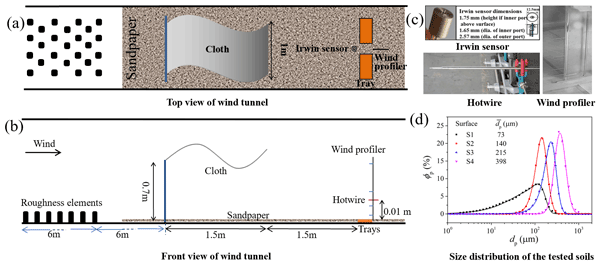
Sand and dust emission are usually investigated by wind-tunnel experiments. However, wind-tunnel flows are usually neutrally stratified without large eddies, which typically develop in the convective atmospheric boundary layer. Here we proposed a novel technique by deploying a piece of randomly fluttering cloth in a wind tunnel to generate the large eddies and found them to enhance the entrainment of sand and dust particles, which explains why large eddies are important to aeolian entrainment.
Xin Yin, Cong Jiang, Yaping Shao, Ning Huang, and Jie Zhang
Atmos. Chem. Phys., 22, 4509–4522, https://doi.org/10.5194/acp-22-4509-2022, https://doi.org/10.5194/acp-22-4509-2022, 2022
Short summary
Short summary
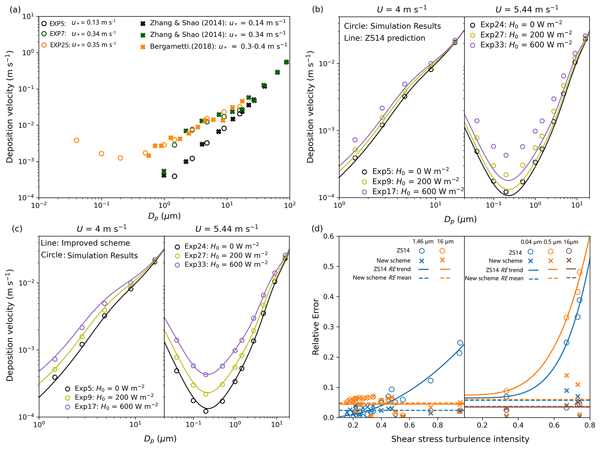
Through a series of numerical experiments using the large-eddy-simulation model, we have developed an improved particle deposition scheme that takes into account transient wind shear fluctuations. Statistical analysis of the simulation results shows that the shear stress can be well approximated by a Weibull distribution and that the new scheme provides more accurate predictions than the conventional scheme, particularly under weak wind conditions and strong convective atmospheric conditions.
Hongxiang Yu, Li Guang, Benjamin Walter, Jianping Huang, Ning Huang, and Michael Lehning
The Cryosphere, 19, 5389–5402, https://doi.org/10.5194/tc-19-5389-2025, https://doi.org/10.5194/tc-19-5389-2025, 2025
Short summary
Short summary
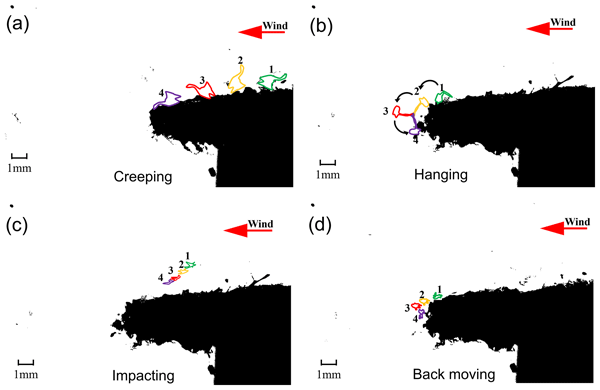
Cornices are overhanging snow accumulations that form on mountain crests. Using wind-tunnel experiments and high-speed photography, the study tracks particle trajectories around cornices and finds distinct differences between edge and surface deposition. A static adhesion model for edge deposition was developed and validated to predict how particle size and shape affect adhesion. The work clarifies the microdynamics of early cornice growth and provides a foundation for avalanche modeling.
Ning Huang, Jiacheng Bao, Hongxiang Yu, and Guang Li
Atmos. Chem. Phys., 25, 12535–12548, https://doi.org/10.5194/acp-25-12535-2025, https://doi.org/10.5194/acp-25-12535-2025, 2025
Short summary
Short summary
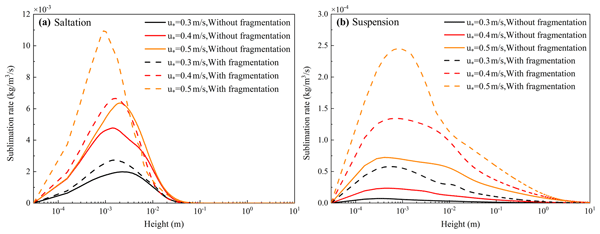
Particle fragmentation makes snowflakes spherical during wind-drifting snow. However, no drifting snow model has presented this process so far. We established a drifting snow model considering particle fragmentation and investigated the effects of snow particle fragmentation on drifting and blowing snow. Our results show that fragmentation intensifies the sublimation of blowing snow and changes the airborne particle size distribution, which should not be ignored in current blowing snow models.
Hongxiang Yu, Guang Li, Benjamin Walter, Michael Lehning, Jie Zhang, and Ning Huang
The Cryosphere, 17, 639–651, https://doi.org/10.5194/tc-17-639-2023, https://doi.org/10.5194/tc-17-639-2023, 2023
Short summary
Short summary
Snow cornices lead to the potential risk of causing snow avalanche hazards, which are still unknown so far. We carried out a wind tunnel experiment in a cold lab to investigate the environmental conditions for snow cornice accretion recorded by a camera. The length growth rate of the cornices reaches a maximum for wind speeds approximately 40 % higher than the threshold wind speed. Experimental results improve our understanding of the cornice formation process.
Jie Zhang, Guang Li, Li Shi, Ning Huang, and Yaping Shao
Atmos. Chem. Phys., 22, 9525–9535, https://doi.org/10.5194/acp-22-9525-2022, https://doi.org/10.5194/acp-22-9525-2022, 2022
Short summary
Short summary
Sand and dust emission are usually investigated by wind-tunnel experiments. However, wind-tunnel flows are usually neutrally stratified without large eddies, which typically develop in the convective atmospheric boundary layer. Here we proposed a novel technique by deploying a piece of randomly fluttering cloth in a wind tunnel to generate the large eddies and found them to enhance the entrainment of sand and dust particles, which explains why large eddies are important to aeolian entrainment.
Xin Yin, Cong Jiang, Yaping Shao, Ning Huang, and Jie Zhang
Atmos. Chem. Phys., 22, 4509–4522, https://doi.org/10.5194/acp-22-4509-2022, https://doi.org/10.5194/acp-22-4509-2022, 2022
Short summary
Short summary
Through a series of numerical experiments using the large-eddy-simulation model, we have developed an improved particle deposition scheme that takes into account transient wind shear fluctuations. Statistical analysis of the simulation results shows that the shear stress can be well approximated by a Weibull distribution and that the new scheme provides more accurate predictions than the conventional scheme, particularly under weak wind conditions and strong convective atmospheric conditions.
Cited articles
Balachandar, S. and Eaton, J. K.: Turbulent Dispersed Multiphase Flow, Annu. Rev. Fluid Mech., 42, 111–133, https://doi.org/10.1146/annurev.fluid.010908.165243, 2010.
Carrier, G. F.: On Slow Viscous Flow, Defense Technical Information Center, https://apps.dtic.mil/sti/tr/pdf/AD0016588.pdf (last access: 3 May 2026), 1953.
Dockery, D. W. and Stone, P. H.: Cardiovascular Risks from Fine Particulate Air Pollution, New Engl. J. Med., 356, 511–513, https://doi.org/10.1056/NEJMe068274, 2007.
Dorgan, A. J. and Loth, E.: Simulation of particles released near the wall in a turbulent boundary layer, Int. J. Multiphas. Flow, 30, 649–673, https://doi.org/10.1016/j.ijmultiphaseflow.2004.05.006, 2004.
Feng, J.: A size-resolved model for below-cloud scavenging of aerosols by snowfall, J. Geophys. Res., 114, 2008JD011012, https://doi.org/10.1029/2008JD011012, 2009.
Fuzzi, S., Baltensperger, U., Carslaw, K., Decesari, S., Denier van der Gon, H., Facchini, M. C., Fowler, D., Koren, I., Langford, B., Lohmann, U., Nemitz, E., Pandis, S., Riipinen, I., Rudich, Y., Schaap, M., Slowik, J. G., Spracklen, D. V., Vignati, E., Wild, M., Williams, M., and Gilardoni, S.: Particulate matter, air quality and climate: lessons learned and future needs, Atmos. Chem. Phys., 15, 8217–8299, https://doi.org/10.5194/acp-15-8217-2015, 2015.
Ge, B., Xu, D., Wild, O., Yao, X., Wang, J., Chen, X., Tan, Q., Pan, X., and Wang, Z.: Inter-annual variations of wet deposition in Beijing from 2014–2017: implications of below-cloud scavenging of inorganic aerosols, Atmos. Chem. Phys., 21, 9441–9454, https://doi.org/10.5194/acp-21-9441-2021, 2021.
Good, G. H., Gerashchenko, S., and Warhaft, Z.: Intermittency and inertial particle entrainment at a turbulent interface: the effect of the large-scale eddies, J. Fluid Mech., 694, 371–398, https://doi.org/10.1017/jfm.2011.552, 2012.
Greenfield, S. M.: Rain scavenging of radioactive particulate matter from the atmosphere, J. Atmos. Sci., 14, 115–125, 1957.
Harimaya, T., Kodama, H., and Muramoto, K.: Regional Differences in Snowflake Size Distributions, J. Meteorol. Soc. Jpn., 82, 895–903, https://doi.org/10.2151/jmsj.2004.895, 2004.
Haupt, S. E., Zajaczkowski, F. J., and Peltier, L. J.: Detached Eddy Simulation of Atmospheric Flow About a Surface Mounted Cube at High Reynolds Number, J. Fluid. Eng., 133, 031002, https://doi.org/10.1115/1.4003649, 2011.
Henzing, J. S., Olivié, D. J. L., and van Velthoven, P. F. J.: A parameterization of size resolved below cloud scavenging of aerosols by rain, Atmos. Chem. Phys., 6, 3363–3375, https://doi.org/10.5194/acp-6-3363-2006, 2006.
Hua, F. J., Kang, Y. M., and Zhong, K.: Influence of turbulent effect on the collection process of aerosols by raindrops, China Environ. Sci., 37, 13–20, 2017.
Huang, N. and Shi, G.: The significance of vertical moisture diffusion on drifting snow sublimation near snow surface, The Cryosphere, 11, 3011–3021, https://doi.org/10.5194/tc-11-3011-2017, 2017.
Huang, N., Yu, Y., Shao, Y., and Zhang, J.: Numerical Simulation of Falling-Snow Deposition Pattern Over 3D-Hill, J. Geophys. Res.-Atmos., 129, https://doi.org/10.1029/2023jd039898, 2024.
Ishihara, T., Hibi, K., and Oikawa, S.: A wind tunnel study of turbulent flow over a three-dimensional steep hill, J. Wind Eng. Ind. Aerod., 83, 95–107, 1999.
Kozmar, H.: An alternative approach to experimental simulation of wind characteristics in urban environments, Procedia Environ. Sci., 4, 43–50, 2011.
Langleben, M. P.: The terminal velocity of snowflakes, Q. J. Roy. Meteor. Soc., 80, 174–181, 1954.
Langmuir, I.: The production of rain by a chain reaction in cumulus clouds at temperatures above freezing, J. Atmos. Sci., 5, 175–192, 1948.
Lateb, M., Masson, C., Stathopoulos, T., and Bédard, C.: Simulation of near-field dispersion of pollutants using detached-eddy simulation, Comput. Fluids, 100, 308–320, 2014.
Li, C., Lim, K., Berk, T., Abraham, A., Heisel, M., Guala, M., Coletti, F., and Hong, J.: Settling and clustering of snow particles in atmospheric turbulence, J. Fluid Mech., 912, A49, https://doi.org/10.1017/jfm.2020.1153, 2021.
Li, D., Luo, K., and Fan, J.: Modulation of turbulence by dispersed solid particles in a spatially developing flat-plate boundary layer, J. Fluid Mech., 802, 359–394, https://doi.org/10.1017/jfm.2016.406, 2016.
Li, D., Luo, K., and Fan, J.: Direct numerical simulation of turbulent flow and heat transfer in a spatially developing turbulent boundary layer laden with particles, J. Fluid Mech., 845, 417–461, https://doi.org/10.1017/jfm.2018.231, 2018.
Liu, J. and Niu, J.: CFD simulation of the wind environment around an isolated high-rise building: An evaluation of SRANS, LES and DES models, Build. Environ., 96, 91–106, https://doi.org/10.1016/j.buildenv.2015.11.007, 2016.
Liu, Z., Hu, B., Zhang, J., Yu, Y., and Wang, Y.: Characteristics of aerosol size distributions and chemical compositions during wintertime pollution episodes in Beijing, Atmos. Res., 168, 1–12, https://doi.org/10.1016/j.atmosres.2015.08.013, 2016.
Lund, T. S., Wu, X., and Squires, K. D.: Generation of Turbulent Inflow Data for Spatially-Developing Boundary Layer Simulations, J. Comput. Phys., 140, 233–258, https://doi.org/10.1006/jcph.1998.5882, 1998.
Mei, R., Adrian, R. J., and Hanratty, T. J.: Particle dispersion in isotropic turbulence under Stokes drag and Basset force with gravitational settling, J. Fluid Mech., 225, 481–495, https://doi.org/10.1017/S0022112091002136, 1991.
Mitchell, D. L. and Heymsfield, A. J.: Refinements in the Treatment of Ice Particle Terminal Velocities, Highlighting Aggregates, J. Atmos. Sci., 62, 1637–1644, https://doi.org/10.1175/JAS3413.1, 2005.
Nozawa, K. and Tamura, T.: Large eddy simulation of the flow around a low-rise building immersed in a rough-wall turbulent boundary layer, J. Wind Eng. Ind. Aerod., 90, 1151–1162, https://doi.org/10.1016/S0167-6105(02)00228-3, 2002.
Pruppacher, H. R. and Klett, J. D.: Microphysics of Clouds and Precipitation, Springer Netherlands, ISBN 978-0-7923-4211-3, https://doi.org/10.1007/978-0-306-48100-0, 1997.
Pruppacher, H. R., Klett, J. D., and Wang, P. K.: Microphysics of Clouds and Precipitation, Aerosol Sci. Tech., 28, 381–382, https://doi.org/10.1080/02786829808965531, 1998.
Roache, P. J.: A method for uniform reporting of grid refinement studies, ASME, 158, 109–109, 1993.
Rosenfeld, D., Andreae, M. O., Asmi, A., Chin, M., De Leeuw, G., Donovan, D. P., Kahn, R., Kinne, S., Kivekäs, N., Kulmala, M., Lau, W., Schmidt, K. S., Suni, T., Wagner, T., Wild, M., and Quaas, J.: Global observations of aerosol-cloud-precipitation-climate interactions: Aerosol-cloud-climate interactions, Rev. Geophys., 52, 750–808, https://doi.org/10.1002/2013RG000441, 2014.
Schumann, T.: Large discrepancies between theoretical and field-determined scavenging coefficients, J. Aerosol Sci., 20, 1159–1162, https://doi.org/10.1016/0021-8502(89)90786-6, 1989.
Scott, W. D.: Measuring the erosivity of the wind, CATENA, 24, 163–175, https://doi.org/10.1016/0341-8162(95)00022-K, 1995.
Seinfeld, J. H. and Pandis, S. N.: Atmospheric Chemistry and Physics: From Air Pollution to Climate Change, 2nd Edn., Wiley and Sons, Hoboken, NJ, USA, ISBN 978-0-471-72018-8, 2006.
Seinfeld, J. H. and Pandis, S. N.: Atmospheric chemistry andphysics: from air pollution to climate change, John Wiley & Sons, ISBN 978-1-119-22116-6, 2016.
Shao, Y.: Physics and modelling of wind erosion, Springer, Cambridge, ISBN 978-1-4020-8895-7, 2008.
Slinn, W.: Precipitation Scavenging, U.S. Department of Energy, https://doi.org/10.2172/6503687, 1984.
Slinn, W. G. N. and Hales, J. M.: A reevaluation of the role of thermophoresis as a mechanism of in-and below-cloud scavenging, J. Atmos. Sci., 28, 1465–1471, 1971.
Solomon, A., Morrison, H., Persson, O., Shupe, M. D., and Bao, J.-W.: Investigation of Microphysical Parameterizations of Snow and Ice in Arctic Clouds during M-PACE through Model–Observation Comparisons, Mon. Weather Rev., 137, 3110–3128, https://doi.org/10.1175/2009MWR2688.1, 2009.
Spalart, P. R.: Strategies for turbulence modelling and simulations, Int. J. Heat Fluid Fl., 21, 252–263, https://doi.org/10.1016/S0142-727X(00)00007-2, 2000.
Spalart, P. R., Deck, S., Shur, M. L., Squires, K. D., Strelets, M. Kh., and Travin, A.: A New Version of Detached-eddy Simulation, Resistant to Ambiguous Grid Densities, Theor. Comp. Fluid Dyn., 20, 181–195, https://doi.org/10.1007/s00162-006-0015-0, 2006.
Suriano, Z. J., Uz, J., and Loewy, C.: Intra-annual snowfall variability in the central United States, Int. J. Climatol., 43, 5720–5734, https://doi.org/10.1002/joc.8170, 2023.
Tang, G., Zhao, P., Wang, Y., Gao, W., Cheng, M., Xin, J., Li, X., and Wang, Y.: Mortality and air pollution in Beijing: The long-term relationship, Atmos. Environ., 150, 238–243, https://doi.org/10.1016/j.atmosenv.2016.11.045, 2017.
Textor, C., Schulz, M., Guibert, S., Kinne, S., Balkanski, Y., Bauer, S., Berntsen, T., Berglen, T., Boucher, O., Chin, M., Dentener, F., Diehl, T., Easter, R., Feichter, H., Fillmore, D., Ghan, S., Ginoux, P., Gong, S., Grini, A., Hendricks, J., Horowitz, L., Huang, P., Isaksen, I., Iversen, I., Kloster, S., Koch, D., Kirkevåg, A., Kristjansson, J. E., Krol, M., Lauer, A., Lamarque, J. F., Liu, X., Montanaro, V., Myhre, G., Penner, J., Pitari, G., Reddy, S., Seland, Ø., Stier, P., Takemura, T., and Tie, X.: Analysis and quantification of the diversities of aerosol life cycles within AeroCom, Atmos. Chem. Phys., 6, 1777–1813, https://doi.org/10.5194/acp-6-1777-2006, 2006.
Tooby, P. F., Wick, G. L., and Isaacs, J. D.: The motion of a small sphere in a rotating velocity field: A possible mechanism for suspending particles in turbulence, J. Geophys. Res., 82, 2096–2100, https://doi.org/10.1029/JC082i015p02096, 1977.
Vasaturo, R., Kalkman, I., Blocken, B., and Van Wesemael, P. J. V.: Large eddy simulation of the neutral atmospheric boundary layer: performance evaluation of three inflow methods for terrains with different roughness, J. Wind Eng. Ind. Aerod., 173, 241–261, https://doi.org/10.1016/j.jweia.2017.11.025, 2018.
Wang, L.-P. and Maxey, M. R.: Settling velocity and concentration distribution of heavy particles in homogeneous isotropic turbulence, J. Fluid Mech., 256, 27–68, https://doi.org/10.1017/S0022112093002708, 1993.
Wang, M. and Moin, P.: Dynamic wall modeling for large-eddy simulation of complex turbulent flows, Phys. Fluids, 14, 2043–2051, https://doi.org/10.1063/1.1476668, 2002.
Woods, C. P., Stoelinga, M. T., and Locatelli, J. D.: Size Spectra of Snow Particles Measured in Wintertime Precipitation in the Pacific Northwest, J. Atmos. Sci., 65, 189–205, https://doi.org/10.1175/2007JAS2243.1, 2008.
Zhang, J. and Shao, Y.: A new parameterization of particle dry deposition over rough surfaces, Atmos. Chem. Phys., 14, 12429–12440, https://doi.org/10.5194/acp-14-12429-2014, 2014.
Zhang, J., Li, W., Huang, N., and Pei, B.: Dynamic characteristics of snowfall particles in atmospheric turbulent boundary layer and its effect on dust wet deposition, Zenodo [data set], https://doi.org/10.5281/zenodo.19479621, 2026.
Zhang, L., Wang, X., Moran, M. D., and Feng, J.: Review and uncertainty assessment of size-resolved scavenging coefficient formulations for below-cloud snow scavenging of atmospheric aerosols, Atmos. Chem. Phys., 13, 10005–10025, https://doi.org/10.5194/acp-13-10005-2013, 2013.
Zhou, T., Yang, Q., Yan, B., Deng, X., and Yuan, Y.: Detached eddy simulation of turbulent flow fields over steep hilly terrain, J. Wind Eng. Ind. Aerod., 221, 104906, https://doi.org/10.1016/j.jweia.2022.104906, 2022.
Zhou, Y. and Kareem, A.: Definition of Wind Profiles in ASCE 7, J. Struct. Eng., 128, 1082–1086, https://doi.org/10.1061/(ASCE)0733-9445(2002)128:8(1082), 2002.
Short summary
Snow cleans air as falling snow captures dust. We studied how wind turbulence affects this process. Our computer simulations reveal that turbulence makes snow particles move horizontally, greatly increasing their dust collection. Current models ignore this horizontal motion and thus underestimate cleaning. Our new model captures this effect, offering a better tool for predicting air pollution removal and guiding environmental cleanup efforts.
Snow cleans air as falling snow captures dust. We studied how wind turbulence affects this...


Altmetrics
Final-revised paper
Preprint