
Articles | Volume 26, issue 9
https://doi.org/10.5194/acp-26-6083-2026
© Author(s) 2026. This work is distributed under
the Creative Commons Attribution 4.0 License.
the Creative Commons Attribution 4.0 License.
https://doi.org/10.5194/acp-26-6083-2026
© Author(s) 2026. This work is distributed under
the Creative Commons Attribution 4.0 License.
the Creative Commons Attribution 4.0 License.
Research article
| 
06 May 2026
Research article |
| 06 May 2026
| 06 May 2026
Thin organic films unexpectedly enhance alcohol uptake on soot analogs: critical implications for aerosol aging
Xiangrui Kong
Department of Chemistry and Molecular Biology, Atmospheric Science, University of Gothenburg, Gothenburg 41390, Sweden
Yongjian Lian
Tianjin Key Laboratory of Urban Transport Emission Research & State Environmental Protection Key Laboratory of Urban Ambient Air Particulate Matter Pollution Prevention and Control, College of Environmental Science and Engineering, Nankai University, Tianjin 300071, China
Shuai Jiang
CORRESPONDING AUTHOR

Tianjin Key Laboratory of Urban Transport Emission Research & State Environmental Protection Key Laboratory of Urban Ambient Air Particulate Matter Pollution Prevention and Control, College of Environmental Science and Engineering, Nankai University, Tianjin 300071, China
Jan B. C. Pettersson
CORRESPONDING AUTHOR
Department of Chemistry and Molecular Biology, Atmospheric Science, University of Gothenburg, Gothenburg 41390, Sweden
Related authors
Dan Liang, Hongxing Zhang, Zhenchuan Niu, Sen Wang, Weijian Zhou, Xuxiang Li, Jingjing Jia, Yifan Tao, Guowei Wang, Xue Feng, Wanyu Liu, Zhao Jin, Yongming Han, Xuefeng Lu, Jan B. C. Pettersson, and Xiangrui Kong
EGUsphere, https://doi.org/10.5194/egusphere-2026-4203, https://doi.org/10.5194/egusphere-2026-4203, 2026
This preprint is open for discussion and under review for Atmospheric Chemistry and Physics (ACP).
Short summary
Short summary
Cities dominate global CO2 emissions, yet observational evidence linking changes to climate policies is scarce. We studied Beijing and Xi’an from 2020 to 2024, measuring CO2 fluxes and tree-ring radiocarbon to quantify emissions and trace fossil sources. We find a sustained decline in urban emissions, driven by decreasing fossil fuel combustion. This is linked to structural shifts in energy and transport. These results prove that climate policies produce measurable atmospheric responses.
Xurong Bai, Yongjian Lian, Ruoying Yuan, Wenli Xu, Yiyang Jiao, Jinsheng Zhang, Chunyu Wang, Jianfei Peng, Hongjun Mao, and Shuai Jiang
EGUsphere, https://doi.org/10.5194/egusphere-2026-4901, https://doi.org/10.5194/egusphere-2026-4901, 2026
This preprint is open for discussion and under review for Atmospheric Chemistry and Physics (ACP).
Short summary
Short summary
Marine particle formation affects climate, but measurements often exceed predictions from two iodine-containing acids. Ethylenediamine, from industry, agriculture, and carbon capture, strongly speeds particle creation by stabilizing clusters with these acids. This effect is largest in cold polar and coastal regions, where simulations match observed rates. Near shipping and coastal emissions, this may be a major source, warranting study of similar basic compounds.
Yijing Chen, Cheng Wu, Epameinondas Tsiligiannis, Ravi Kant Pathak, Jan B. C. Pettersson, Harsh Raj Mishra, Gazala Habib, Geetam Tiwari, Kebin He, Jingkun Jiang, and Mattias Hallquist
Atmos. Chem. Phys., 26, 13121–13137, https://doi.org/10.5194/acp-26-13121-2026, https://doi.org/10.5194/acp-26-13121-2026, 2026
Short summary
Short summary
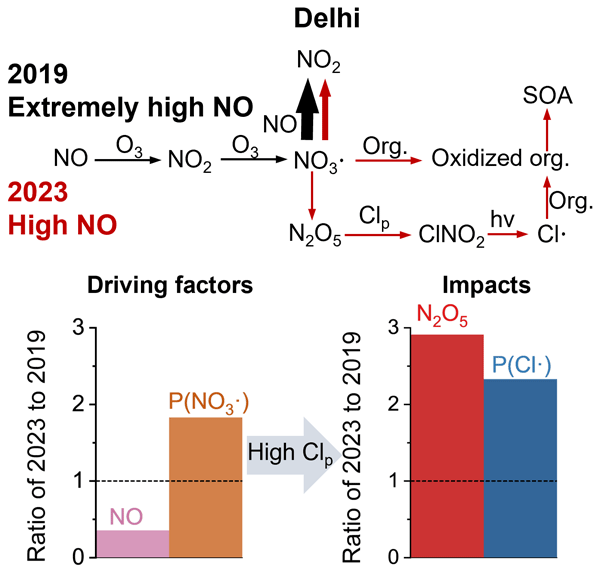
This work extends current understanding of atmospheric chemistry across different NO regimes in Delhi. Field measurements during the early springtime of 2023 show enhanced nighttime production of N2O5 and ClNO2, driven by decreased NO and high particulate chloride concentrations. The inert particulate chloride can be efficiently activated to photolabile gases with the reduction of NO, and contributes to secondary pollution by enhancing atmospheric organics oxidation in Delhi.
Dan Liang, Hongxing Zhang, Zhenchuan Niu, Sen Wang, Weijian Zhou, Xuxiang Li, Jingjing Jia, Yifan Tao, Guowei Wang, Xue Feng, Wanyu Liu, Zhao Jin, Yongming Han, Xuefeng Lu, Jan B. C. Pettersson, and Xiangrui Kong
EGUsphere, https://doi.org/10.5194/egusphere-2026-4203, https://doi.org/10.5194/egusphere-2026-4203, 2026
This preprint is open for discussion and under review for Atmospheric Chemistry and Physics (ACP).
Short summary
Short summary
Cities dominate global CO2 emissions, yet observational evidence linking changes to climate policies is scarce. We studied Beijing and Xi’an from 2020 to 2024, measuring CO2 fluxes and tree-ring radiocarbon to quantify emissions and trace fossil sources. We find a sustained decline in urban emissions, driven by decreasing fossil fuel combustion. This is linked to structural shifts in energy and transport. These results prove that climate policies produce measurable atmospheric responses.
Dimitri Castarède, Zoé Brasseur, Yusheng Wu, Zamin A. Kanji, Markus Hartmann, Lauri Ahonen, Merete Bilde, Markku Kulmala, Tuukka Petäjä, Jan B. C. Pettersson, Berko Sierau, Olaf Stetzer, Frank Stratmann, Birgitta Svenningsson, Erik Swietlicki, Quynh Thu Nguyen, Jonathan Duplissy, and Erik S. Thomson
Atmos. Meas. Tech., 16, 3881–3899, https://doi.org/10.5194/amt-16-3881-2023, https://doi.org/10.5194/amt-16-3881-2023, 2023
Short summary
Short summary
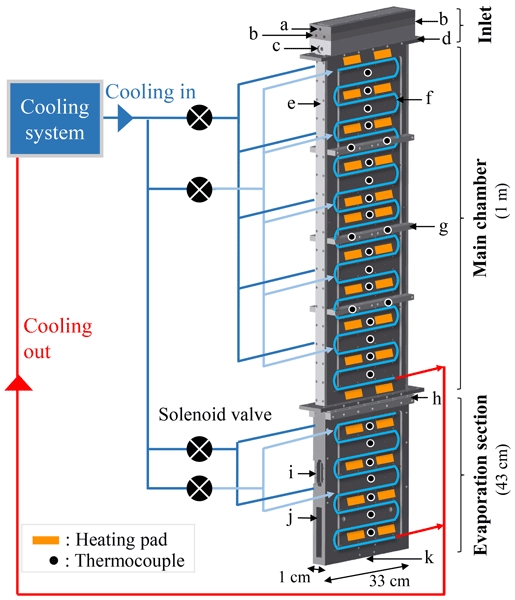
Clouds play a key role in Earth’s climate by influencing the surface energy budget. Certain types of atmospheric aerosols, called ice-nucleating particles (INPs), induce the formation of ice in clouds and, thus, often initiate precipitation formation. The Portable Ice Nucleation Chamber 2 (PINCii) is a new instrument developed to study ice formation and to conduct ambient measurements of INPs, allowing us to investigate the sources and properties of the atmospheric aerosols that can act as INPs.
Cited articles
Ahern, A. T., Subramanian, R., Saliba, G., Lipsky, E. M., Donahue, N. M., and Sullivan, R. C.: Effect of secondary organic aerosol coating thickness on the real-time detection and characterization of biomass-burning soot by two particle mass spectrometers, Atmos. Meas. Tech., 9, 6117–6137, https://doi.org/10.5194/amt-9-6117-2016, 2016.
Andersson, P. U., Tomsic, A., Andersson, M. B., and Petterson, J. B. C.: Emission of small fragments during water cluster collisions with a graphite surface, Chem. Phys. Lett., 279, 100–106, https://doi.org/10.1016/S0009-2614(97)00990-1, 1997.
Arumainayagam, C. R. and Madix, R. J.: Molecular Beam Studies of Gas-Surface Collision Dynamics, Prog. Surf. Sci., 38, 1–102, 1991.
Bayly, C. I., Cieplak, P., Cornell, W., and Kollman, P. A.: A well-behaved electrostatic potential based method using charge restraints for deriving atomic charges: the RESP model, J. Phys. Chem., 97, 10269–10280, https://doi.org/10.1021/j100142a004, 1993.
Beeler, P., Corbin, J. C., Sipkens, T. A., and Fierce, L.: A Framework for Quantifying the Size and Fractal Dimension of Compacting Soot Particles, Environ. Sci. Technol., 59, 5994–6003, https://doi.org/10.1021/acs.est.4c11100, 2025.
Berkemeier, T., Huisman, A. J., Ammann, M., Shiraiwa, M., Koop, T., and Pöschl, U.: Kinetic regimes and limiting cases of gas uptake and heterogeneous reactions in atmospheric aerosols and clouds: a general classification scheme, Atmos. Chem. Phys., 13, 6663–6686, https://doi.org/10.5194/acp-13-6663-2013, 2013.
Browne, E. C., Franklin, J. P., Canagaratna, M. R., Massoli, P., Kirchstetter, T. W., Worsnop, D. R., Wilson, K. R., and Kroll, J. H.: Changes to the Chemical Composition of Soot from Heterogeneous Oxidation Reactions, J. Phys. Chem. A, 119, 1154–1163, https://doi.org/10.1021/jp511507d, 2015.
Bussi, G., Donadio, D., and Parrinello, M.: Canonical sampling through velocity rescaling, J. Chem. Phys., 126, https://doi.org/10.1063/1.2408420, 2007.
Chen, C., Enekwizu, O. Y., Ma, X., Jiang, Y., Khalizov, A. F., Zheng, J., and Ma, Y.: Effect of organic coatings derived from the OH-initiated oxidation of amines on soot morphology and cloud activation, Atmos. Res., 239, 104905, https://doi.org/10.1016/j.atmosres.2020.104905, 2020.
Chen, X., Ching, J., Wu, F., Matsui, H., Jacobson, M. Z., Zhang, F., Wang, Y., Zhang, Z., Liu, D., Zhu, S., Rudich, Y., Shi, Z., Yoo, H., Jeon, K.-J., and Li, W.: Locating the missing absorption enhancement due to multi-core black carbon aerosols, Nat. Commun., 16, 10187, https://doi.org/10.1038/s41467-025-65079-2, 2025.
Essmann, U., Perera, L., Berkowitz, M. L., Darden, T., Lee, H., and Pedersen, L. G.: A smooth particle mesh Ewald method, J. Chem. Phys., 103, 8577–8593, https://doi.org/10.1063/1.470117, 1995.
Freedman, M. A.: Phase separation in organic aerosol, Chem. Soc. Rev., 46, 7694–7705, https://doi.org/10.1039/C6CS00783J, 2017.
Groom, C. R., Bruno, I. J., Lightfoot, M. P., and Ward, S. C.: The Cambridge Structural Database, Acta Crystallogr. B, 72, 171–179, https://doi.org/10.1107/S2052520616003954, 2016.
Hallquist, M., Wenger, J. C., Baltensperger, U., Rudich, Y., Simpson, D., Claeys, M., Dommen, J., Donahue, N. M., George, C., Goldstein, A. H., Hamilton, J. F., Herrmann, H., Hoffmann, T., Iinuma, Y., Jang, M., Jenkin, M. E., Jimenez, J. L., Kiendler-Scharr, A., Maenhaut, W., McFiggans, G., Mentel, Th. F., Monod, A., Prévôt, A. S. H., Seinfeld, J. H., Surratt, J. D., Szmigielski, R., and Wildt, J.: The formation, properties and impact of secondary organic aerosol: current and emerging issues, Atmos. Chem. Phys., 9, 5155–5236, https://doi.org/10.5194/acp-9-5155-2009, 2009.
Han, C., Liu, Y., and He, H.: The photoenhanced aging process of soot by the heterogeneous ozonization reaction, Phys. Chem. Chem. Phys., 18, 24401–24407, https://doi.org/10.1039/C6CP03938C, 2016.
Henögl, E., Haberl, V., Ablasser, J., and Schennach, R.: Adsorption and Desorption of Organic Molecules From Thin Cellulose Films, Frontiers in Materials, 6, 2019, https://doi.org/10.3389/fmats.2019.00178, 2019.
Hess, B., Bekker, H., Berendsen, H. J. C., and Fraaije, J. G. E. M.: LINCS: A linear constraint solver for molecular simulations, J. Comput. Chem., 18, 1463–1472, https://doi.org/10.1002/(SICI)1096-987X(199709)18:12<1463::AID-JCC4>3.0.CO;2-H, 1997.
Horta, B. A. C., Merz, P. T., Fuchs, P. F. J., Dolenc, J., Riniker, S., and Hünenberger, P. H.: A GROMOS-Compatible Force Field for Small Organic Molecules in the Condensed Phase: The 2016H66 Parameter Set, J. Chem. Theory Comput., 12, 3825–3850, https://doi.org/10.1021/acs.jctc.6b00187, 2016.
Johansson, S. M., Kong, X., Papagiannakopoulos, P., Thomson, E. S., and Pettersson, J. B.: A novel gas-vacuum interface for environmental molecular beam studies, Rev. Sci. Instrum., 88, 035112, https://doi.org/10.1063/1.4978325, 2017.
Johansson, S. M., Lovric, J., Kong, X., Thomson, E. S., Papagiannakopoulos, P., Briquez, S., Toubin, C., and Pettersson, J. B. C.: Understanding water interactions with organic surfaces: environmental molecular beam and molecular dynamics studies of the water-butanol system, Phys. Chem. Chem. Phys., 21, 1141–1151, https://doi.org/10.1039/c8cp04151b, 2019.
Johansson, S. M., Lovric, J., Kong, X., Thomson, E. S., Hallquist, M., and Pettersson, J. B. C.: Experimental and Computational Study of Molecular Water Interactions with Condensed Nopinone Surfaces Under Atmospherically Relevant Conditions, J. Phys. Chem. A, 124, 3652–3661, https://doi.org/10.1021/acs.jpca.9b10970, 2020.
Kong, X., Andersson, P. U., Thomson, E. S., and Pettersson, J. B. C.: Ice Formation via Deposition Mode Nucleation on Bare and Alcohol-Covered Graphite Surfaces, J. Phys. Chem. C, 116, 8964–8974, https://doi.org/10.1021/jp212235p, 2012.
Kong, X., Papagiannakopoulos, P., Thomson, E. S., Markovic, N., and Pettersson, J. B.: Water accommodation and desorption kinetics on ice, J. Phys. Chem. A, 118, 3973–3979, https://doi.org/10.1021/jp503504e, 2014a.
Kong, X., Thomson, E. S., Papagiannakopoulos, P., Johansson, S. M., and Pettersson, J. B.: Water accommodation on ice and organic surfaces: insights from environmental molecular beam experiments, J. Phys. Chem. B, 118, 13378–13386, https://doi.org/10.1021/jp5044046, 2014b.
Kong, X., Lovrić, J., Johansson, S. M., Prisle, N. L., and Pettersson, J. B. C.: Dynamics and Sorption Kinetics of Methanol Monomers and Clusters on Nopinone Surfaces, J. Phys. Chem. A, 125, 6263–6272, https://doi.org/10.1021/acs.jpca.1c02309, 2021.
Kroll, J. H. and Seinfeld, J. H.: Chemistry of secondary organic aerosol: Formation and evolution of low-volatility organics in the atmosphere, Atmos. Environ., 42, 3593–3624, https://doi.org/10.1016/j.atmosenv.2008.01.003, 2008.
Lack, D. A. and Cappa, C. D.: Impact of brown and clear carbon on light absorption enhancement, single scatter albedo and absorption wavelength dependence of black carbon, Atmos. Chem. Phys., 10, 4207–4220, https://doi.org/10.5194/acp-10-4207-2010, 2010.
Li, W., Riemer, N., Xu, L., Wang, Y., Adachi, K., Shi, Z., Zhang, D., Zheng, Z., and Laskin, A.: Microphysical properties of atmospheric soot and organic particles: measurements, modeling, and impacts, Npj Clim. Atmos. Sci., 7, 65, https://doi.org/10.1038/s41612-024-00610-8, 2024.
Liu, Y., He, G., Chu, B., Ma, Q., and He, H.: Atmospheric heterogeneous reactions on soot: A review, Fundamental Research, 3, 579–591, https://doi.org/10.1016/j.fmre.2022.02.012, 2023.
Loi, Q. K., Phothong, K., Yuasa, R., Horikawa, T., and Do, D. D.: Evidence of bimolecular layer of ethanol on graphite at 190K – Experimental and simulation studies, Carbon, 216, 118535, https://doi.org/10.1016/j.carbon.2023.118535, 2024.
Malde, A. K., Zuo, L., Breeze, M., Stroet, M., Poger, D., Nair, P. C., Oostenbrink, C., and Mark, A. E.: An Automated Force Field Topology Builder (ATB) and Repository: Version 1.0, J. Chem. Theory Comput., 7, 4026–4037, https://doi.org/10.1021/ct200196m, 2011.
McDonald, B. C., de Gouw, J. A., Gilman, J. B., Jathar, S. H., Akherati, A., Cappa, C. D., Jimenez, J. L., Lee-Taylor, J., Hayes, P. L., McKeen, S. A., Cui, Y. Y., Kim, S.-W., Gentner, D. R., Isaacman-VanWertz, G., Goldstein, A. H., Harley, R. A., Frost, G. J., Roberts, J. M., Ryerson, T. B., and Trainer, M.: Volatile chemical products emerging as largest petrochemical source of urban organic emissions, Science, 359, 760–764, https://doi.org/10.1126/science.aaq0524, 2018.
Någård, M. B. and Pettersson, J. B. C.: Internal excitation of ethanol molecules emitted during cluster-surface collisions, Chem. Phys. Lett., 293, 535–540, https://doi.org/10.1016/S0009-2614(98)00804-5, 1998.
Omar, H., Ahmadi, S., Szymoniak, P., and Schönhals, A.: Molecular mobility of thin films of poly(bisphenol-A carbonate) capped and with one free surface: from bulk-like samples down to the adsorbed layer, Soft Matter, 21, 241–254, https://doi.org/10.1039/D4SM01238K, 2025.
Palin, L., Brunelli, M., Wright, J. P., Pattison, P., and Fitch, A. N.: The low-temperature structure of nopinone, Z. Kristallogr., 223, 602–604, https://doi.org/10.1524/zkri.2008.1101, 2008.
Papagiannakopoulos, P., Kong, X., Thomson, E. S., Marković, N., and Pettersson, J. B. C.: Surface Transformations and Water Uptake on Liquid and Solid Butanol near the Melting Temperature, J. Phys. Chem. C, 117, 6678–6685, https://doi.org/10.1021/jp4003627, 2013.
Petters, M. D. and Kreidenweis, S. M.: A single parameter representation of hygroscopic growth and cloud condensation nucleus activity, Atmos. Chem. Phys., 7, 1961–1971, https://doi.org/10.5194/acp-7-1961-2007, 2007.
Sedlacek III, A. J., Lewis, E. R., Onasch, T. B., Zuidema, P., Redemann, J., Jaffe, D., and Kleinman, L. I.: Using the Black Carbon Particle Mixing State to Characterize the Lifecycle of Biomass Burning Aerosols, Environ. Sci. Technol., 56, 14315–14325, https://doi.org/10.1021/acs.est.2c03851, 2022.
Shen, X., Zhao, Y., Chen, Z., and Huang, D.: Heterogeneous reactions of volatile organic compounds in the atmosphere, Atmos. Environ., 68, 297–314, https://doi.org/10.1016/j.atmosenv.2012.11.027, 2013.
Shiraiwa, M., Pfrang, C., Koop, T., and Pöschl, U.: Kinetic multi-layer model of gas-particle interactions in aerosols and clouds (KM-GAP): linking condensation, evaporation and chemical reactions of organics, oxidants and water, Atmos. Chem. Phys., 12, 2777–2794, https://doi.org/10.5194/acp-12-2777-2012, 2012.
Stephan, S., Thol, M., Vrabec, J., and Hasse, H.: Thermophysical Properties of the Lennard-Jones Fluid: Database and Data Assessment, J. Chem. Inf. Model., 59, 4248–4265, https://doi.org/10.1021/acs.jcim.9b00620, 2019.
Stroet, M., Caron, B., Visscher, K. M., Geerke, D. P., Malde, A. K., and Mark, A. E.: Automated Topology Builder Version 3.0: Prediction of Solvation Free Enthalpies in Water and Hexane, J. Chem. Theory Comput., 14, 5834–5845, https://doi.org/10.1021/acs.jctc.8b00768, 2018.
Svanberg, M., Marković, N., and Pettersson, J. B. C.: Energy transfer in water cluster scattering from solid surfaces, Chem. Phys., 201, 473–489, https://doi.org/10.1016/0301-0104(95)00284-7, 1995.
Tomsic, A., Andersson, P. U., Markovic, N., Piskorz, W., Svanberg, M., and Pettersson, J. B. C.: Molecular-dynamics simulations of cluster–surface collisions: Emission of large fragments, J. Chem. Phys., 115, 10509–10517, https://doi.org/10.1063/1.1413740, 2001.
Vaden, T. D., Imre, D., Beránek, J., Shrivastava, M., and Zelenyuk, A.: Evaporation kinetics and phase of laboratory and ambient secondary organic aerosol, P. Natl. Acad. Sci. USA, 108, 2190–2195, https://doi.org/10.1073/pnas.1013391108, 2011.
Van Der Spoel, D., Lindahl, E., Hess, B., Groenhof, G., Mark, A. E., and Berendsen, H. J. C.: GROMACS: Fast, flexible, and free, J. Comput. Chem., 26, 1701–1718, https://doi.org/10.1002/jcc.20291, 2005.
Wu, C., Wang, C., Wang, S., Wang, W., Yuan, B., Qi, J., Wang, B., Wang, H., Wang, C., Song, W., Wang, X., Hu, W., Lou, S., Ye, C., Peng, Y., Wang, Z., Huangfu, Y., Xie, Y., Zhu, M., Zheng, J., Wang, X., Jiang, B., Zhang, Z., and Shao, M.: Measurement report: Important contributions of oxygenated compounds to emissions and chemistry of volatile organic compounds in urban air, Atmos. Chem. Phys., 20, 14769–14785, https://doi.org/10.5194/acp-20-14769-2020, 2020.
Wu, H., Li, G., Hou, J., and Sotthewes, K.: Probing surface properties of organic molecular layers by scanning tunneling microscopy, Adv. Colloid Interfac., 318, 102956, https://doi.org/10.1016/j.cis.2023.102956, 2023.
Xia, S.-Y., Wang, C., Zhu, B., Chen, X., Feng, N., Yu, G.-H., and Huang, X.-F.: Long-term observations of oxygenated volatile organic compounds (OVOCs) in an urban atmosphere in southern China, 2014–2019, Environ. Pollut., 270, 116301, https://doi.org/10.1016/j.envpol.2020.116301, 2021.
Xu, L., Fukushima, S., Sobanska, S., Murata, K., Naganuma, A., Liu, L., Wang, Y., Niu, H., Shi, Z., Kojima, T., Zhang, D., and Li, W.: Tracing the evolution of morphology and mixing state of soot particles along with the movement of an Asian dust storm, Atmos. Chem. Phys., 20, 14321–14332, https://doi.org/10.5194/acp-20-14321-2020, 2020.
Zaveri, R. A., Easter, R. C., Shilling, J. E., and Seinfeld, J. H.: Modeling kinetic partitioning of secondary organic aerosol and size distribution dynamics: representing effects of volatility, phase state, and particle-phase reaction, Atmos. Chem. Phys., 14, 5153–5181, https://doi.org/10.5194/acp-14-5153-2014, 2014.
Zhang, R., Khalizov, A. F., Pagels, J., Zhang, D., Xue, H., and McMurry, P. H.: Variability in morphology, hygroscopicity, and optical properties of soot aerosols during atmospheric processing, P. Natl. Acad. Sci. USA, 105, 10291–10296, https://doi.org/10.1073/pnas.0804860105, 2008.
Short summary
This study examines how organic films on soot particles influence how alcohol vapors are taken up and released. Laboratory measurements and computer simulations show that very thin organic coatings unexpectedly trap alcohols by forming stable surface layers, while thicker coatings favor faster release. The results reveal that particle surface structure strongly controls pollutant aging in the atmosphere, with important implications for air quality, cloud formation, and climate.
This study examines how organic films on soot particles influence how alcohol vapors are taken...


Altmetrics
Final-revised paper
Preprint