
Articles | Volume 26, issue 8
https://doi.org/10.5194/acp-26-5603-2026
© Author(s) 2026. This work is distributed under
the Creative Commons Attribution 4.0 License.
the Creative Commons Attribution 4.0 License.
https://doi.org/10.5194/acp-26-5603-2026
© Author(s) 2026. This work is distributed under
the Creative Commons Attribution 4.0 License.
the Creative Commons Attribution 4.0 License.
Research article
| 
23 Apr 2026
Research article |
| 23 Apr 2026
| 23 Apr 2026
The diurnal cycle and temperature dependence of crystal shapes in ice clouds from satellite lidar polarized measurements

LAERO, Univ Toulouse, CNRS, IRD, Toulouse, France
Hélène Chepfer
LMD/IPSL, Sorbonne Université, Ecole Polytechnique, Institut Polytechnique de Paris, ENS, PSL Université, CNRS, Paris, France
Christelle Barthe
LAERO, Univ Toulouse, CNRS, IRD, Toulouse, France
John Yorks
NASA Goddard Space Flight Center, Greenbelt, Maryland, USA
Related authors
Mathilde Leroux and Vincent Noel
Atmos. Chem. Phys., 24, 6433–6454, https://doi.org/10.5194/acp-24-6433-2024, https://doi.org/10.5194/acp-24-6433-2024, 2024
Short summary
Short summary
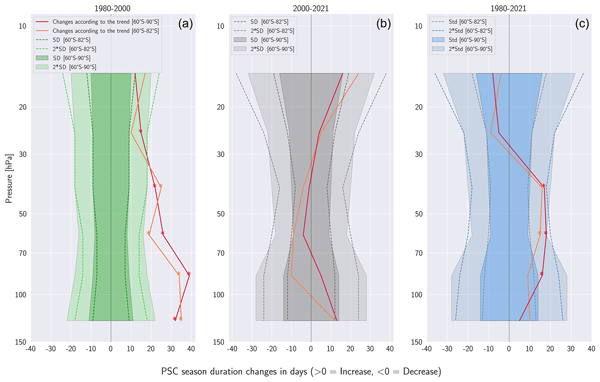
This study investigates the long-term changes in the polar stratospheric cloud (PSC) season from 1980 to 2021 above Antarctica. We analyzed CALIOP observations from 2006 to 2020 to build a statistical temperature-based model. We applied our model to gridded reanalysis temperatures, leading to an integrated view of PSC occurrence that is free from sampling issues, allowing us to document the past evolution of the PSC season.
Artem G. Feofilov, Hélène Chepfer, Vincent Noël, and Frederic Szczap
Atmos. Meas. Tech., 16, 3363–3390, https://doi.org/10.5194/amt-16-3363-2023, https://doi.org/10.5194/amt-16-3363-2023, 2023
Short summary
Short summary
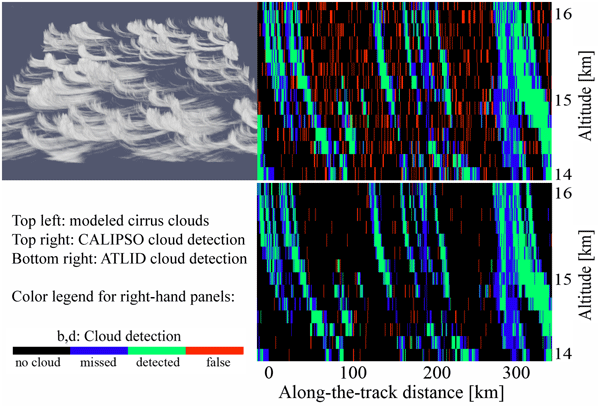
The response of clouds to human-induced climate warming remains the largest source of uncertainty in model predictions of climate. We consider cloud retrievals from spaceborne observations, the existing CALIOP lidar and future ATLID lidar; show how they compare for the same scenes; and discuss the advantage of adding a new lidar for detecting cloud changes in the long run. We show that ATLID's advanced technology should allow for better detecting thinner clouds during daytime than before.
Matthias Tesche and Vincent Noel
Atmos. Meas. Tech., 15, 4225–4240, https://doi.org/10.5194/amt-15-4225-2022, https://doi.org/10.5194/amt-15-4225-2022, 2022
Short summary
Short summary
Mid-level and high clouds can be considered natural laboratories for studying cloud glaciation in the atmosphere. While they can be conveniently observed from ground with lidar, such measurements require a clear line of sight between the instrument and the target cloud. Here, observations of clouds with two spaceborne lidars are used to assess where ground-based lidar measurements of mid- and upper-level clouds are least affected by the light-attenuating effect of low-level clouds.
Artem G. Feofilov, Hélène Chepfer, Vincent Noël, Rodrigo Guzman, Cyprien Gindre, Po-Lun Ma, and Marjolaine Chiriaco
Atmos. Meas. Tech., 15, 1055–1074, https://doi.org/10.5194/amt-15-1055-2022, https://doi.org/10.5194/amt-15-1055-2022, 2022
Short summary
Short summary
Space-borne lidars have been providing invaluable information of atmospheric optical properties since 2006, and new lidar missions are on the way to ensure continuous observations. In this work, we compare the clouds estimated from space-borne ALADIN and CALIOP lidar observations. The analysis of collocated data shows that the agreement between the retrieved clouds is good up to 3 km height. Above that, ALADIN detects 40 % less clouds than CALIOP, except for polar stratospheric clouds (PSCs).
Christelle Barthe, Françoise Vimeux, Camille Risi, and Sören François
Geosci. Model Dev., 19, 9935–9956, https://doi.org/10.5194/gmd-19-9935-2026, https://doi.org/10.5194/gmd-19-9935-2026, 2026
Short summary
Short summary
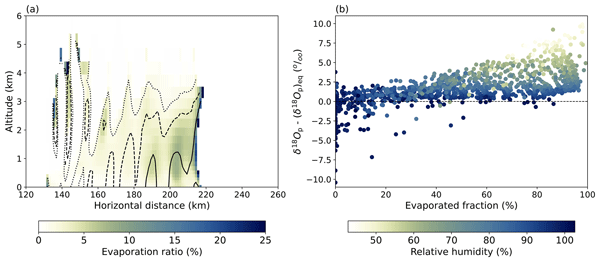
We implemented water stable isotopologues in the non-hydrostatic mesoscale atmospheric model Meso-NH. We validated this isotopic version (Meso-NH-ISO) with a simulation of a well-documented squall line in the Sahel region. In future works, simulations with Meso-NH-ISO will be done on real cases of cyclones or squall lines. The goal is to better interpret and quantify isotopic observations on the field in terms of atmospheric processes that drive development and intensity of those thunderstorms.
Anthony La Luna, Zhibo Zhang, Qianqian Song, Hongbin Yu, John E. Yorks, and Ping Yang
Atmos. Chem. Phys., 26, 14487–14506, https://doi.org/10.5194/acp-26-14487-2026, https://doi.org/10.5194/acp-26-14487-2026, 2026
Short summary
Short summary
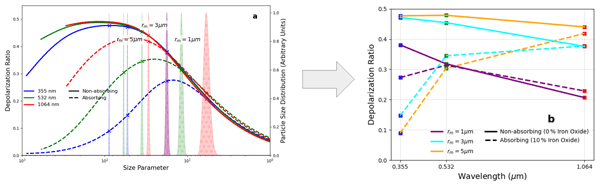
Mineral dust blown from deserts affects air quality and climate worldwide. Scientists use laser instruments on satellites to detect and measure dust. We discovered that very large, iron-rich dust particles produce signals that fool these instruments into misidentifying them as pollution or smoke. Using light scattering theory, we showed this confusion follows universal physical laws regardless of dust shape – helping scientists better interpret next-generation satellite measurements.
John E. Yorks, Edward P. Nowottnick, Steven Platnick, Kerry G. Meyer, Matthew Walker McLinden, Meloe S. F. Kacenelenbogen, Kenneth E. Christian, Joseph A. Finlon, Natalie A. Midzak, Natalia Roldán-Henao, Patrick A. Selmer, Matthew J. McGill, Erica K. Dolinar, Charles N. Helms, Robert Koopman, Jonas von Bismark, and Montserrat Pińol Solé
Earth Syst. Sci. Data, 18, 3833–3852, https://doi.org/10.5194/essd-18-3833-2026, https://doi.org/10.5194/essd-18-3833-2026, 2026
Short summary
Short summary
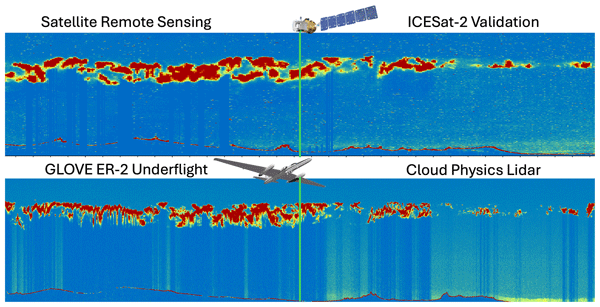
The Goddard Space Flight Center's Lidar Observation and Validation Experiment (GLOVE) was a NASA field campaign from January–February 2025 that used a special airplane with scientific instruments to check if satellites measuring Earth's atmosphere were working correctly. The plane flew under two key satellites to compare measurements of clouds, dust, and other particles in the air. Data from 8 flights help scientists better understand how well these space-based instruments perform, especially for detecting different types of clouds and atmospheric conditions.
Inès Vongpaseut and Christelle Barthe
Atmos. Chem. Phys., 25, 14945–14965, https://doi.org/10.5194/acp-25-14945-2025, https://doi.org/10.5194/acp-25-14945-2025, 2025
Short summary
Short summary
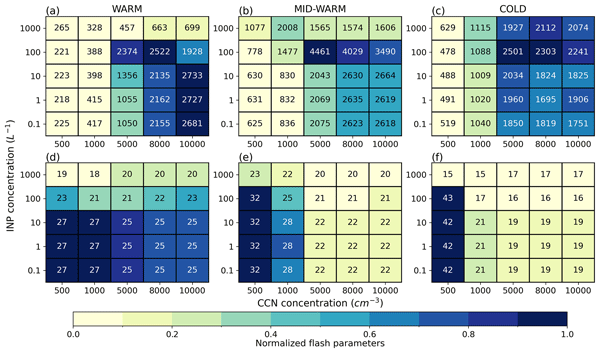
Three idealized storms that differ by their cloud base temperature were simulated in order to assess the impact of ice production on cloud electrical activity. Ice production is impacted by aerosols that either can form cloud droplets or ice crystals and processes that form ice crystals from pre-existing cloud particles. All those processes can interact and affect the electrical activity and differently according to the cloud conditions.
Juan Escobar, Philippe Wautelet, Joris Pianezze, Florian Pantillon, Thibaut Dauhut, Christelle Barthe, and Jean-Pierre Chaboureau
Geosci. Model Dev., 18, 2679–2700, https://doi.org/10.5194/gmd-18-2679-2025, https://doi.org/10.5194/gmd-18-2679-2025, 2025
Short summary
Short summary
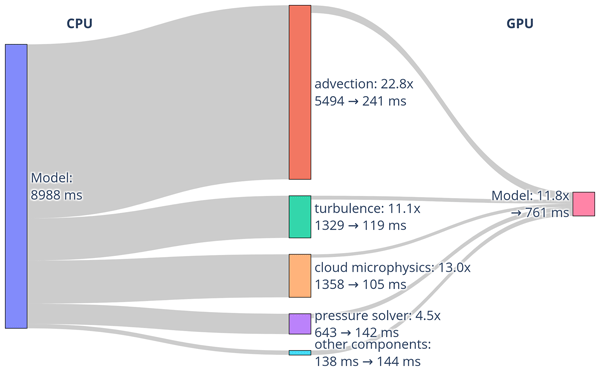
The Meso-NH weather research code is adapted for GPUs using OpenACC, leading to significant performance and energy efficiency improvements. Called MESONH-v55-OpenACC, it includes enhanced memory management, communication optimizations and a new solver. On the AMD MI250X Adastra platform, it achieved up to 6× speedup and 2.3× energy efficiency gain compared to CPUs. Storm simulations at 100 m resolution show positive results, positioning the code for future use on exascale supercomputers.
Marie Taufour, Jean-Pierre Pinty, Christelle Barthe, Benoît Vié, and Chien Wang
Geosci. Model Dev., 17, 8773–8798, https://doi.org/10.5194/gmd-17-8773-2024, https://doi.org/10.5194/gmd-17-8773-2024, 2024
Short summary
Short summary
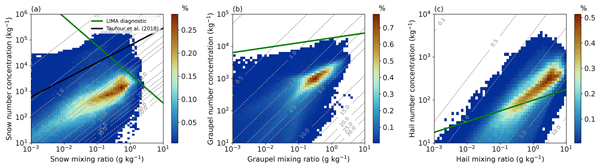
We have developed a complete two-moment version of the LIMA (Liquid Ice Multiple Aerosols) microphysics scheme. We have focused on collection processes, where the hydrometeor number transfer is often estimated in proportion to the mass transfer. The impact of these parameterizations on a convective system and the prospects for more realistic estimates of secondary parameters (reflectivity, hydrometeor size) are shown in a first test on an idealized case.
Mathilde Leroux and Vincent Noel
Atmos. Chem. Phys., 24, 6433–6454, https://doi.org/10.5194/acp-24-6433-2024, https://doi.org/10.5194/acp-24-6433-2024, 2024
Short summary
Short summary
This study investigates the long-term changes in the polar stratospheric cloud (PSC) season from 1980 to 2021 above Antarctica. We analyzed CALIOP observations from 2006 to 2020 to build a statistical temperature-based model. We applied our model to gridded reanalysis temperatures, leading to an integrated view of PSC occurrence that is free from sampling issues, allowing us to document the past evolution of the PSC season.
Artem G. Feofilov, Hélène Chepfer, Vincent Noël, and Frederic Szczap
Atmos. Meas. Tech., 16, 3363–3390, https://doi.org/10.5194/amt-16-3363-2023, https://doi.org/10.5194/amt-16-3363-2023, 2023
Short summary
Short summary
The response of clouds to human-induced climate warming remains the largest source of uncertainty in model predictions of climate. We consider cloud retrievals from spaceborne observations, the existing CALIOP lidar and future ATLID lidar; show how they compare for the same scenes; and discuss the advantage of adding a new lidar for detecting cloud changes in the long run. We show that ATLID's advanced technology should allow for better detecting thinner clouds during daytime than before.
Matthias Tesche and Vincent Noel
Atmos. Meas. Tech., 15, 4225–4240, https://doi.org/10.5194/amt-15-4225-2022, https://doi.org/10.5194/amt-15-4225-2022, 2022
Short summary
Short summary
Mid-level and high clouds can be considered natural laboratories for studying cloud glaciation in the atmosphere. While they can be conveniently observed from ground with lidar, such measurements require a clear line of sight between the instrument and the target cloud. Here, observations of clouds with two spaceborne lidars are used to assess where ground-based lidar measurements of mid- and upper-level clouds are least affected by the light-attenuating effect of low-level clouds.
Artem G. Feofilov, Hélène Chepfer, Vincent Noël, Rodrigo Guzman, Cyprien Gindre, Po-Lun Ma, and Marjolaine Chiriaco
Atmos. Meas. Tech., 15, 1055–1074, https://doi.org/10.5194/amt-15-1055-2022, https://doi.org/10.5194/amt-15-1055-2022, 2022
Short summary
Short summary
Space-borne lidars have been providing invaluable information of atmospheric optical properties since 2006, and new lidar missions are on the way to ensure continuous observations. In this work, we compare the clouds estimated from space-borne ALADIN and CALIOP lidar observations. The analysis of collocated data shows that the agreement between the retrieved clouds is good up to 3 km height. Above that, ALADIN detects 40 % less clouds than CALIOP, except for polar stratospheric clouds (PSCs).
Cited articles
Atlas, R. and Bretherton, C. S.: Aircraft observations of gravity wave activity and turbulence in the tropical tropopause layer: prevalence, influence on cirrus clouds, and comparison with global storm-resolving models, Atmos. Chem. Phys., 23, 4009–4030, https://doi.org/10.5194/acp-23-4009-2023, 2023.
Bailey, M. P. and Hallett, J.: A Comprehensive Habit Diagram for Atmospheric Ice Crystals: Confirmation from the Laboratory, AIRS II, and Other Field Studies, J. Atmos. Sci., 66, 2888–2899, https://doi.org/10.1175/2009JAS2883.1, 2009.
Baran, A. J., Gayet, J.-F., and Shcherbakov, V.: On the interpretation of an unusual in-situ measured ice crystal scattering phase function, Atmos. Chem. Phys., 12, 9355–9364, https://doi.org/10.5194/acp-12-9355-2012, 2012.
Bouniol, D., Roca, R., Fiolleau, T., and Raberanto, P.: Life cycle resolved observation of radiative properties of mesoscale convective systems, J. Appl. Meteorol. Clim., https://doi.org/10.1175/JAMC-D-20-0244.1, 2021.
Cairo, F., Krämer, M., Afchine, A., Di Donfrancesco, G., Di Liberto, L., Khaykin, S., Lucaferri, L., Mitev, V., Port, M., Rolf, C., Snels, M., Spelten, N., Weigel, R., and Borrmann, S.: A comparative analysis of in situ measurements of high-altitude cirrus in the tropics, Atmos. Meas. Tech., 16, 4899–4925, https://doi.org/10.5194/amt-16-4899-2023, 2023.
Cesana, G., Chepfer, H., Winker, D., Getzewich, B., Cai, X., Jourdan, O., Mioche, G., Okamoto, H., Hagihara, Y., Noel, V., and Reverdy, M.: Using in situ airborne measurements to evaluate three cloud phase products derived from CALIPSO, J. Geophys. Res.-Atmos., 121, 5788–5808, https://doi.org/10.1002/2015JD024334, 2016.
Chepfer, H., Goloub, P., Riedi, J., De Haan, J. F., Hovenier, J. W., and Flamant, P. H.: Ice crystal shapes in cirrus clouds derived from POLDER/ADEOS-1, J. Geophys. Res., 106, 7955–7966, https://doi.org/10.1029/2000JD900285, 2001.
Chepfer, H., Noel, V., Chiriaco, M., Wielicki, B., Winker, D., Loeb, N., and Wood, R.: The Potential of a Multidecade Spaceborne Lidar Record to Constrain Cloud Feedback, J. Geophys. Res.-Atmos., 123, 5433–5454, https://doi.org/10.1002/2017JD027742, 2018.
Chepfer, H., Brogniez, H., and Noel, V.: Diurnal variations of cloud and relative humidity profiles across the tropics, Sci. Rep.-UK, 9, 16045, https://doi.org/10.1038/s41598-019-52437-6, 2019.
Feofilov, A. G. and Stubenrauch, C. J.: Diurnal variation of high-level clouds from the synergy of AIRS and IASI space-borne infrared sounders, Atmos. Chem. Phys., 19, 13957–13972, https://doi.org/10.5194/acp-19-13957-2019, 2019.
Forster, L. and Mayer, B.: Ice crystal characterization in cirrus clouds III: retrieval of ice crystal shape and roughness from observations of halo displays, Atmos. Chem. Phys., 22, 15179–15205, https://doi.org/10.5194/acp-22-15179-2022, 2022.
Gelaro, R., McCarty, W., Suárez, M. J., Todling, R., Molod, A., Takacs, L., Randles, C. A., Darmenov, A., Bosilovich, M. G., Reichle, R., Wargan, K., Coy, L., Cullather, R., Draper, C., Akella, S., Buchard, V., Conaty, A., Da Silva, A. M., Gu, W., Kim, G.-K., Koster, R., Lucchesi, R., Merkova, D., Nielsen, J. E., Partyka, G., Pawson, S., Putman, W., Rienecker, M., Schubert, S. D., Sienkiewicz, M., and Zhao, B.: The Modern-Era Retrospective Analysis for Research and Applications, Version 2 (MERRA-2), J. Climate, 30, 5419–5454, https://doi.org/10.1175/JCLI-D-16-0758.1, 2017.
Gettelman, A., Forbes, R., Marchand, R., Chen, C.-C., and Fielding, M.: The impact of cloud microphysics and ice nucleation on Southern Ocean clouds assessed with single-column modeling and instrument simulators, Geosci. Model Dev., 17, 8069–8092, https://doi.org/10.5194/gmd-17-8069-2024, 2024.
Hagihara, Y., Okamoto, H., and Yoshida, R.: Development of a combined CloudSat-CALIPSO cloud mask to show global cloud distribution, J. Geophys. Res., 115, 2009JD012344, https://doi.org/10.1029/2009JD012344, 2010.
Heymsfield, A. J., Schmitt, C., Bansemer, A., and Twohy, C. H.: Improved Representation of Ice Particle Masses Based on Observations in Natural Clouds, J. Atmos. Sci., 67, 3303–3318, https://doi.org/10.1175/2010JAS3507.1, 2010.
Hirakata, M., Okamoto, H., Hagihara, Y., Hayasaka, T., and Oki, R.: Comparison of Global and Seasonal Characteristics of Cloud Phase and Horizontal Ice Plates Derived from CALIPSO with MODIS and ECMWF, J. Atmos. Ocean. Tech., 31, 2114–2130, https://doi.org/10.1175/JTECH-D-13-00245.1, 2014.
Ishimoto, H., Masuda, K., Mano, Y., Orikasa, N., and Uchiyama, A.: Irregularly shaped ice aggregates in optical modeling of convectively generated ice clouds, J. Quant. Spectrosc. Ra., 113, 632–643, https://doi.org/10.1016/j.jqsrt.2012.01.017, 2012.
Järvinen, E., Van Diedenhoven, B., Magee, N., Neshyba, S., Schnaiter, M., Xu, G., Jourdan, O., Delene, D., Waitz, F., Lolli, S., and Kato, S.: Ice Crystal Complexity and Link to the Cirrus Cloud Radiative Effect, in: Geophysical Monograph Series, edited by: Sullivan, S. C. and Hoose, C., Wiley, 47–85, https://doi.org/10.1002/9781119700357.ch3, 2023.
Jensen, E. J., Pfister, L., Bui, T. V., Lawson, P., Baker, B., Mo, Q., Baumgardner, D., Weinstock, E. M., Smith, J. B., Moyer, E. J., Hanisco, T. F., Sayres, D. S., Clair, J. M. St., Alexander, M. J., Toon, O. B., and Smith, J. A.: Formation of large (≃100 µm) ice crystals near the tropical tropopause, Atmos. Chem. Phys., 8, 1621–1633, https://doi.org/10.5194/acp-8-1621-2008, 2008.
Jiang, J. H., Su, H., Zhai, C., Janice Shen, T., Wu, T., Zhang, J., Cole, J. N. S., Von Salzen, K., Donner, L. J., Seman, C., Del Genio, A., Nazarenko, L. S., Dufresne, J.-L., Watanabe, M., Morcrette, C., Koshiro, T., Kawai, H., Gettelman, A., Millán, L., Read, W. G., Livesey, N. J., Kasai, Y., and Shiotani, M.: Evaluating the Diurnal Cycle of Upper-Tropospheric Ice Clouds in Climate Models Using SMILES Observations, J. Atmos. Sci., 72, 1022–1044, https://doi.org/10.1175/JAS-D-14-0124.1, 2015.
Kärcher, B., Jensen, E. J., Pokrifka, G. F., and Harrington, J. Y.: Ice Supersaturation Variability in Cirrus Clouds: Role of Vertical Wind Speeds and Deposition Coefficients, J. Geophys. Res.-Atmos., 128, e2023JD039324, https://doi.org/10.1029/2023JD039324, 2023.
Kärcher, B., Hoffmann, F., Podglajen, A., Hertzog, A., Pluogonven, R., Atlas, R., Corcos, M., Grabowski, W. W., and Gasparini, B.: Effects of Turbulence on Upper-Tropospheric Ice Supersaturation, J. Atmos. Sci., 81, 1589–1604, https://doi.org/10.1175/JAS-D-23-0217.1, 2024.
Krämer, M., Rolf, C., Luebke, A., Afchine, A., Spelten, N., Costa, A., Meyer, J., Zöger, M., Smith, J., Herman, R. L., Buchholz, B., Ebert, V., Baumgardner, D., Borrmann, S., Klingebiel, M., and Avallone, L.: A microphysics guide to cirrus clouds – Part 1: Cirrus types, Atmos. Chem. Phys., 16, 3463–3483, https://doi.org/10.5194/acp-16-3463-2016, 2016.
Lawson, R. P., Woods, S., Jensen, E., Erfani, E., Gurganus, C., Gallagher, M., Connolly, P., Whiteway, J., Baran, A. J., May, P., Heymsfield, A., Schmitt, C. G., McFarquhar, G., Um, J., Protat, A., Bailey, M., Lance, S., Muehlbauer, A., Stith, J., Korolev, A., Toon, O. B., and Krämer, M.: A Review of Ice Particle Shapes in Cirrus formed In Situ and in Anvils, J. Geophys. Res.-Atmos., 124, 10049–10090, https://doi.org/10.1029/2018JD030122, 2019.
Lesigne, T., Ravetta, F., Podglajen, A., Mariage, V., and Pelon, J.: Extensive coverage of ultrathin tropical tropopause layer cirrus clouds revealed by balloon-borne lidar observations, Atmos. Chem. Phys., 24, 5935–5952, https://doi.org/10.5194/acp-24-5935-2024, 2024.
Letu, H., Ishimoto, H., Riedi, J., Nakajima, T. Y., C.-Labonnote, L., Baran, A. J., Nagao, T. M., and Sekiguchi, M.: Investigation of ice particle habits to be used for ice cloud remote sensing for the GCOM-C satellite mission, Atmos. Chem. Phys., 16, 12287–12303, https://doi.org/10.5194/acp-16-12287-2016, 2016.
Li, M., Letu, H., Peng, Y., Ishimoto, H., Lin, Y., Nakajima, T. Y., Baran, A. J., Guo, Z., Lei, Y., and Shi, J.: Investigation of ice cloud modeling capabilities for the irregularly shaped Voronoi ice scattering models in climate simulations, Atmos. Chem. Phys., 22, 4809–4825, https://doi.org/10.5194/acp-22-4809-2022, 2022.
Macke, A.: Scattering of light by polyhedral ice crystals, Appl. Optics, 32, 2780, https://doi.org/10.1364/AO.32.002780, 1993.
Magee, N., Boaggio, K., Staskiewicz, S., Lynn, A., Zhao, X., Tusay, N., Schuh, T., Bandamede, M., Bancroft, L., Connelly, D., Hurler, K., Miner, B., and Khoudary, E.: Captured cirrus ice particles in high definition, Atmos. Chem. Phys., 21, 7171–7185, https://doi.org/10.5194/acp-21-7171-2021, 2021.
Martins, E., Noel, V., and Chepfer, H.: Properties of cirrus and subvisible cirrus from nighttime Cloud-Aerosol Lidar with Orthogonal Polarization (CALIOP), related to atmospheric dynamics and water vapor, J. Geophys. Res., 116, D02208, https://doi.org/10.1029/2010JD014519, 2011.
Midzak, N., Yorks, J. E., Zhang, J., Van Diedenhoven, B., Woods, S., and McGill, M.: A Classification of Ice Crystal Habits Using Combined Lidar and Scanning Polarimeter Observations during the SEAC4RS Campaign, J. Atmos. Ocean. Tech., 37, 2185–2196, https://doi.org/10.1175/JTECH-D-20-0037.1, 2020.
Mitchell, D. L., Liu, Y., and Macke, A.: Modeling Cirrus Clouds. Part II: Treatment of Radiative Properties, J. Atmos. Sci., 53, 2967–2988, https://doi.org/10.1175/1520-0469(1996)053<2967:MCCPIT>2.0.CO;2, 1996.
NASA/LARC/SD/ASDC: CATS-ISS Level 1B Night Mode 7.2 Version 3-00, NASA Langley Atmospheric Science Data Center DAAC [data set], https://doi.org/10.5067/ISS/CATS/L1B_N-M7.2-V3-00, 2019.
Noel, V. and Sassen, K.: Study of Planar Ice Crystal Orientations in Ice Clouds from Scanning Polarization Lidar Observations, J. Appl. Meteorol., 44, 653–664, https://doi.org/10.1175/JAM2223.1, 2005.
Noel, V., Winker, D. M., McGill, M., and Lawson, P.: Classification of particle shapes from lidar depolarization ratio in convective ice clouds compared to in situ observations during CRYSTAL-FACE, J. Geophys. Res., 109, 2004JD004883, https://doi.org/10.1029/2004JD004883, 2004.
Noel, V., Chepfer, H., Chiriaco, M., and Yorks, J.: The diurnal cycle of cloud profiles over land and ocean between 51° S and 51° N, seen by the CATS spaceborne lidar from the International Space Station, Atmos. Chem. Phys., 18, 9457–9473, https://doi.org/10.5194/acp-18-9457-2018, 2018.
Okamoto, H., Sato, K., Borovoi, A., Ishimoto, H., Masuda, K., Konoshonkin, A., and Kustova, N.: Interpretation of lidar ratio and depolarization ratio of ice clouds using spaceborne high-spectral-resolution polarization lidar, Opt. Express, 27, 36587, https://doi.org/10.1364/OE.27.036587, 2019.
Okamoto, H., Sato, K., Borovoi, A., Ishimoto, H., Masuda, K., Konoshonkin, A., and Kustova, N.: Wavelength dependence of ice cloud backscatter properties for space-borne polarization lidar applications, Opt. Express, 28, 29178, https://doi.org/10.1364/OE.400510, 2020.
Pauly, R. M., Yorks, J. E., Hlavka, D. L., McGill, M. J., Amiridis, V., Palm, S. P., Rodier, S. D., Vaughan, M. A., Selmer, P. A., Kupchock, A. W., Baars, H., and Gialitaki, A.: Cloud-Aerosol Transport System (CATS) 1064 nm calibration and validation, Atmos. Meas. Tech., 12, 6241–6258, https://doi.org/10.5194/amt-12-6241-2019, 2019.
Podglajen, A., Plougonven, R., Hertzog, A., and Jensen, E.: Impact of gravity waves on the motion and distribution of atmospheric ice particles, Atmos. Chem. Phys., 18, 10799–10823, https://doi.org/10.5194/acp-18-10799-2018, 2018.
Qu, Y., Khain, A., Phillips, V., Ilotoviz, E., Shpund, J., Patade, S., and Chen, B.: The Role of Ice Splintering on Microphysics of Deep Convective Clouds Forming Under Different Aerosol Conditions: Simulations Using the Model With Spectral Bin Microphysics, J. Geophys. Res.-Atmos., 125, e2019JD031312, https://doi.org/10.1029/2019JD031312, 2020.
Reverdy, M., Noel, V., Chepfer, H., and Legras, B.: On the origin of subvisible cirrus clouds in the tropical upper troposphere, Atmos. Chem. Phys., 12, 12081–12101, https://doi.org/10.5194/acp-12-12081-2012, 2012.
Sassen, K.: Ice Crystal Habit Discrimination with the Optical Backscatter Depolarization Technique, J. Appl. Meteorol., 16, 425–431, https://doi.org/10.1175/1520-0450(1977)016<0425:ICHDWT>2.0.CO;2, 1977.
Sassen, K. and Campbell, J. R.: A Midlatitude Cirrus Cloud Climatology from the Facility for Atmospheric Remote Sensing. Part I: Macrophysical and Synoptic Properties, J. Atmos. Sci., 58, 481–496, https://doi.org/10.1175/1520-0469(2001)058<0481:AMCCCF>2.0.CO;2, 2001.
Sassen, K., Kayetha, V. K., and Zhu, J.: Ice cloud depolarization for nadir and off‐nadir CALIPSO measurements, Geophys. Res. Lett., 39, 2012GL053116, https://doi.org/10.1029/2012GL053116, 2012.
Sato, K. and Okamoto, H.: Global Analysis of Height-Resolved Ice Particle Categories From Spaceborne Lidar, Geophys. Res. Lett., 50, e2023GL105522, https://doi.org/10.1029/2023GL105522, 2023.
Sellitto, P., Bucci, S., and Legras, B.: Comparison of ISS–CATS and CALIPSO–CALIOP Characterization of High Clouds in the Tropics, Remote Sens.-Basel, 12, 3946, https://doi.org/10.3390/rs12233946, 2020.
Shaw, T. A., Baldwin, M., Barnes, E. A., Caballero, R., Garfinkel, C. I., Hwang, Y.-T., Li, C., O'Gorman, P. A., Rivière, G., Simpson, I. R., and Voigt, A.: Storm track processes and the opposing influences of climate change, Nat. Geosci., 9, 656–664, https://doi.org/10.1038/ngeo2783, 2016.
Stillwell, R. A., Neely, R. R., Thayer, J. P., Walden, V. P., Shupe, M. D., and Miller, N. B.: Radiative Influence of Horizontally Oriented Ice Crystals over Summit, Greenland, J. Geophys. Res.-Atmos., 124, 12141–12156, https://doi.org/10.1029/2018JD028963, 2019.
Taufour, M., Pinty, J.-P., Barthe, C., Vié, B., and Wang, C.: LIMA (v2.0): A full two-moment cloud microphysical scheme for the mesoscale non-hydrostatic model Meso-NH v5-6, Geosci. Model Dev., 17, 8773–8798, https://doi.org/10.5194/gmd-17-8773-2024, 2024.
van Diedenhoven, B.: Remote Sensing of Crystal Shapes in Ice Clouds, in: Springer Series in Light Scattering, edited by: Kokhanovsky, A., Springer International Publishing, Cham, 197–250, https://doi.org/10.1007/978-3-319-70808-9_5, 2018.
van Diedenhoven, B., Fridlind, A. M., Cairns, B., and Ackerman, A. S.: Variation of ice crystal size, shape, and asymmetry parameter in tops of tropical deep convective clouds, J. Geophys. Res.-Atmos., 119, 11809–11825, https://doi.org/10.1002/2014JD022385, 2014.
Wehr, T., Kubota, T., Tzeremes, G., Wallace, K., Nakatsuka, H., Ohno, Y., Koopman, R., Rusli, S., Kikuchi, M., Eisinger, M., Tanaka, T., Taga, M., Deghaye, P., Tomita, E., and Bernaerts, D.: The EarthCARE mission – science and system overview, Atmos. Meas. Tech., 16, 3581–3608, https://doi.org/10.5194/amt-16-3581-2023, 2023.
Winker, D. M., Vaughan, M. A., Omar, A., Hu, Y., Powell, K. A., Liu, Z., Hunt, W. H., and Young, S. A.: Overview of the CALIPSO Mission and CALIOP Data Processing Algorithms, J. Atmos. Ocean. Tech., 26, 2310–2323, https://doi.org/10.1175/2009JTECHA1281.1, 2009.
Woods, S., Lawson, R. P., Jensen, E., Bui, T. P., Thornberry, T., Rollins, A., Pfister, L., and Avery, M.: Microphysical Properties of Tropical Tropopause Layer Cirrus, J. Geophys. Res.-Atmos., 123, 6053–6069, https://doi.org/10.1029/2017JD028068, 2018.
Xu, G., Waitz, F., Wagner, S., Nehlert, F., Schnaiter, M., and Järvinen, E.: Toward Better Constrained Scattering Models for Natural Ice Crystals in the Visible Region, J. Geophys. Res.-Atmos., 128, e2022JD037604, https://doi.org/10.1029/2022JD037604, 2023.
Yang, P., Baum, B. A., Heymsfield, A. J., Hu, Y. X., Huang, H.-L., Tsay, S.-C., and Ackerman, S.: Single-scattering properties of droxtals, J. Quant. Spectrosc. Ra., 79–80, 1159–1169, https://doi.org/10.1016/S0022-4073(02)00347-3, 2003.
Yorks, J. E., McGill, M. J., Palm, S. P., Hlavka, D. L., Selmer, P. A., Nowottnick, E. P., Vaughan, M. A., Rodier, S. D., and Hart, W. D.: An overview of the CATS level 1 processing algorithms and data products, Geophys. Res. Lett., 43, 4632–4639, https://doi.org/10.1002/2016GL068006, 2016.
Yorks, J. E., Wang, J., McGill, M. J., Follette-Cook, M., Nowottnick, E. P., Reid, J. S., Colarco, P. R., Zhang, J., Kalashnikova, O., Yu, H., Marenco, F., Santanello, J. A., Weckwerth, T. M., Li, Z., Campbell, J. R., Yang, P., Diao, M., Noel, V., Meyer, K. G., Carr, J. L., Garay, M., Christian, K., Bennedetti, A., Ring, A. M., Crawford, A., Pavolonis, M. J., Aquila, V., Kim, J., and Kondragunta, S.: A SmallSat Concept to Resolve Diurnal and Vertical Variations of Aerosols, Clouds, and Boundary Layer Height, B. Am. Meteorol. Soc., 104, E815–E836, https://doi.org/10.1175/BAMS-D-21-0179.1, 2023.
Yoshida, R., Okamoto, H., Hagihara, Y., and Ishimoto, H.: Global analysis of cloud phase and ice crystal orientation from Cloud-Aerosol Lidar and Infrared Pathfinder Satellite Observation (CALIPSO) data using attenuated backscattering and depolarization ratio, J. Geophys. Res., 115, 2009JD012334, https://doi.org/10.1029/2009JD012334, 2010.
Short summary
The shape of crystals in ice clouds drives their impact on the earth energy balance. These shapes are very variable and hard to categorize. In this paper, we use a recently developed method to classify clouds in categories of crystal shape. We apply this method to 33 months of measurements from a lidar in space. We discuss how the importance of shape categories changes with the time of the day. These results could be useful for people who try to simulate clouds in atmospheric models.
The shape of crystals in ice clouds drives their impact on the earth energy balance. These...


Altmetrics
Final-revised paper
Preprint